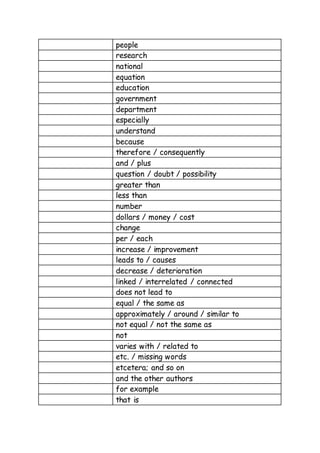
people
research
national
equation
education
government
department
especially
understand
because
therefore / consequently
and / plus
question / doubt / possibility
greater than
less than
number
dollars / money / cost
change
per / each
increase / improvement
leads to / causes
decrease / deterioration
linked / interrelated / connected
does not lead to
equal / the same as
approximately / around / similar to
not equal / not the same as
not
varies with / related to
etc. / missing words
etcetera; and so on
and the other authors
for example
that is
note well / remember this
male / female
section
paragraph
page / pages
with / about (circa)
without
first / second / third / fourth
at
compare to
morning
afternoon
namely
as soon as possible
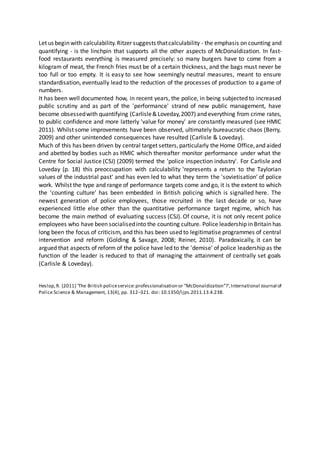
Let us begin with calculability.Ritzer suggests thatcalculability - the emphasis on counting and
quantifying - is the linchpin that supports all the other aspects of McDonaldization. In fast-
food restaurants everything is measured precisely: so many burgers have to come from a
kilogram of meat, the French fries must be of a certain thickness, and the bags must never be
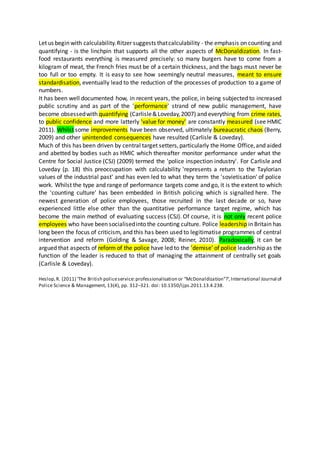
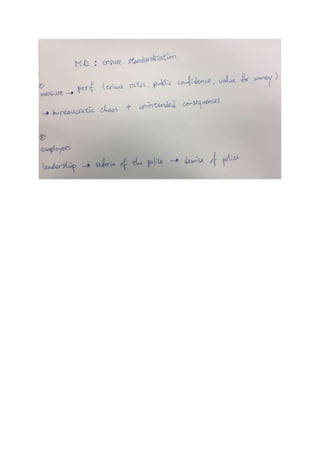
too full or too empty. It is easy to see how seemingly neutral measures, meant to ensure
standardisation, eventually lead to the reduction of the processes of production to a game of
numbers.
It has been well documented how, in recent years, the police, in being subjected to increased
public scrutiny and as part of the 'performance' strand of new public management, have
become obsessedwith quantifying (Carlisle&Loveday,2007) and everything from crime rates,
to public confidence and more latterly 'value for money' are constantly measured (see HMIC
2011). Whilst some improvements have been observed, ultimately bureaucratic chaos (Berry,
2009) and other unintended consequences have resulted (Carlisle & Loveday).
Much of this has been driven by central target setters,particularly the Home Office,and aided
and abetted by bodies such as HMIC which thereafter monitor performance under what the
Centre for Social Justice (CSJ) (2009) termed the 'police inspection industry'. For Carlisle and
Loveday (p. 18) this preoccupation with calculability 'represents a return to the Taylorian
values of the industrial past' and has even led to what they term the 'sovietisation' of police
work. Whilst the type and range of performance targets come and go, it is the extent to which
the 'counting culture' has been embedded in British policing which is signalled here. The
newest generation of police employees, those recruited in the last decade or so, have
experienced little else other than the quantitative performance target regime, which has
become the main method of evaluating success (CSJ). Of course, it is not only recent police
employees who have been socialisedinto the counting culture. Police leadership in Britain has
long been the focus of criticism, and this has been used to legitimatise programmes of central
intervention and reform (Golding & Savage, 2008; Reiner, 2010). Paradoxically, it can be
argued that aspects of reform of the police have led to the 'demise' of police leadership as the
function of the leader is reduced to that of managing the attainment of centrally set goals
(Carlisle & Loveday).
Heslop,R. (2011) ‘The British policeservice:professionalisation or “McDonaldization”?’,International Journal of
Police Science & Management, 13(4), pp. 312–321. doi: 10.1350/ijps.2011.13.4.238.
Let us begin with calculability.Ritzer suggests thatcalculability - the emphasis on counting and
quantifying - is the linchpin that supports all the other aspects of McDonaldization. In fast-
food restaurants everything is measured precisely: so many burgers have to come from a
kilogram of meat, the French fries must be of a certain thickness, and the bags must never be
too full or too empty. It is easy to see how seemingly neutral measures, meant to ensure
standardisation, eventually lead to the reduction of the processes of production to a game of
numbers.
It has been well documented how, in recent years, the police, in being subjected to increased
public scrutiny and as part of the 'performance' strand of new public management, have
become obsessedwith quantifying (Carlisle&Loveday,2007) and everything from crime rates,
to public confidence and more latterly 'value for money' are constantly measured (see HMIC
2011). Whilst some improvements have been observed, ultimately bureaucratic chaos (Berry,
2009) and other unintended consequences have resulted (Carlisle & Loveday).
Much of this has been driven by central target setters,particularly the Home Office,and aided
and abetted by bodies such as HMIC which thereafter monitor performance under what the
Centre for Social Justice (CSJ) (2009) termed the 'police inspection industry'. For Carlisle and
Loveday (p. 18) this preoccupation with calculability 'represents a return to the Taylorian
values of the industrial past' and has even led to what they term the 'sovietisation' of police
work. Whilst the type and range of performance targets come and go, it is the extent to which
the 'counting culture' has been embedded in British policing which is signalled here. The
newest generation of police employees, those recruited in the last decade or so, have
experienced little else other than the quantitative performance target regime, which has
become the main method of evaluating success (CSJ). Of course, it is not only recent police
employees who have been socialisedinto the counting culture. Police leadership in Britain has
long been the focus of criticism, and this has been used to legitimatise programmes of central
intervention and reform (Golding & Savage, 2008; Reiner, 2010). Paradoxically, it can be
argued that aspects of reform of the police have led to the 'demise' of police leadership as the
function of the leader is reduced to that of managing the attainment of centrally set goals
(Carlisle & Loveday).
Heslop,R. (2011) ‘The British policeservice:professionalisation or “McDonaldization”?’,International Journal of
Police Science & Management, 13(4), pp. 312–321. doi: 10.1350/ijps.2011.13.4.238.
Reading Grid
Discuss the role of HE in the 21st
Century
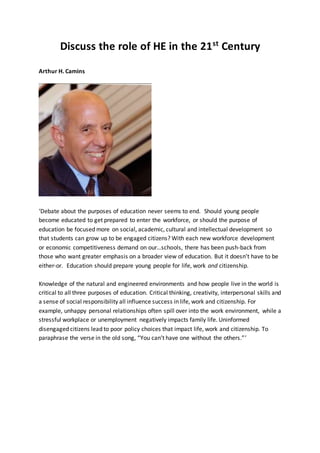
Arthur H. Camins
‘Debate about the purposes of education never seems to end. Should young people
become educated to get prepared to enter the workforce, or should the purpose of
education be focused more on social, academic, cultural and intellectual development so
that students can grow up to be engaged citizens? With each new workforce development
or economic competitiveness demand on our…schools, there has been push-back from
those who want greater emphasis on a broader view of education. But it doesn’t have to be
either-or. Education should prepare young people for life, work and citizenship.
Knowledge of the natural and engineered environments and how people live in the world is
critical to all three purposes of education. Critical thinking, creativity, interpersonal skills and
a sense of social responsibility all influence success in life, work and citizenship. For
example, unhappy personal relationships often spill over into the work environment, while a
stressful workplace or unemployment negatively impacts family life. Uninformed
disengaged citizens lead to poor policy choices that impact life, work and citizenship. To
paraphrase the verse in the old song, “You can’t have one without the others.”’
Paulo Friere
[Summary] The goals and purposes of adult education as societal transformation and
contended that education is a consciousness-raising process. From his view, the aim of
education is to help participants put knowledge into practice and that the outcome of
education is societal transformation. Freire believed in human’s ability to re-create a social
world and establish a dynamic society, and that the major aim of education is to help people
put knowledge into action. Doing so, according to Freire, would enable people to change the
world – to humanise it. Freire is clearly concerned with creating a better world and the
development and liberation of people. As such, the goals and purposes within this learning
context are oriented to societal as well as individual improvement.
Bell hooks
‘Education is the practice of freedom.’
‘The heart of education as a practice of freedom is to promote growth. It's very much an act
of love in that sense of love as something that promotes our spiritual and mental growth.
‘When people frequently ask me, 'What changed your life; what enabled you to come from
this working-class, segregated home where [your] parents were not college-educated
people into being one of our nation's well-known intellectuals?' [My answer is,] 'It's there in
that space where I learned to be a reader and a critical thinker.'
Mike Rustin
‘Opposition to the government's higher education policy [of greater focus on employability
skills] is frompeople who has so far been expressed in very traditionalist terms – with the
idea that a university has an intrinsic value and good. On the one hand, you have the
marketised view of universities as equipping people to earn their living, and on the other
hand, a traditional view that universities are about pure learning, but the students we have
here have always seen benefits beyond learning for its own sake. We have really hard
evidence to show that students are fairly clear about why they want to go to university –
and for the vast majority, it is about getting a better job and having a successful career. A lot
of people say what about learning for learning's sake? I find that problematic. Everyone has
a purpose for why they want to learn.’
Discuss the role of HE in the 21st Century
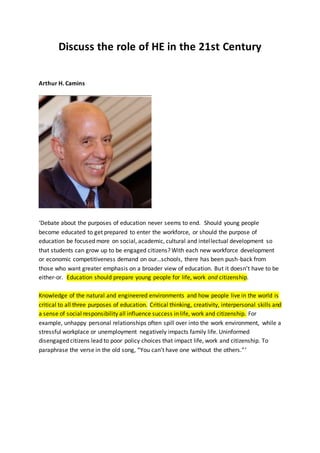
Arthur H. Camins
‘Debate about the purposes of education never seems to end. Should young people
become educated to get prepared to enter the workforce, or should the purpose of
education be focused more on social, academic, cultural and intellectual development so
that students can grow up to be engaged citizens? With each new workforce development
or economic competitiveness demand on our…schools, there has been push-back from
those who want greater emphasis on a broader view of education. But it doesn’t have to be
either-or. Education should prepare young people for life, work and citizenship.
Knowledge of the natural and engineered environments and how people live in the world is
critical to all three purposes of education. Critical thinking, creativity, interpersonal skills and
a sense of social responsibility all influence success in life, work and citizenship. For
example, unhappy personal relationships often spill over into the work environment, while a
stressful workplace or unemployment negatively impacts family life. Uninformed
disengaged citizens lead to poor policy choices that impact life, work and citizenship. To
paraphrase the verse in the old song, “You can’t have one without the others.”’
Paulo Friere
[Summary] The goals and purposes of adult education as societal transformation and
contended that education is a consciousness-raising process. From his view, the aim of
education is to help participants put knowledge into practice and that the outcome of
education is societal transformation. Freire believed in human’s ability to re-create a social
world and establish a dynamic society, and that the major aim of education is to help people
put knowledge into action. Doing so, according to Freire, would enable people to change the
world – to humanise it. Freire is clearly concerned with creating a better world and the
development and liberation of people. As such, the goals and purposes within this learning
context are oriented to societal as well as individual improvement.
Bell hooks
‘Education is the practice of freedom.’
‘The heart of education as a practice of freedom is to promote growth. It's very much an act
of love in that sense of love as something that promotes our spiritual and mental growth.
‘When people frequently ask me, 'What changed your life; what enabled you to come from
this working-class, segregated home where [your] parents were not college-educated
people into being one of our nation's well-known intellectuals?' [My answer is,] 'It's there in
that space where I learned to be a reader and a critical thinker.'
Mike Rustin
‘Opposition to the government's higher education policy [of greater focus on employability
skills] is frompeople who has so far been expressed in very traditionalist terms – with the
idea that a university has an intrinsic value and good. On the one hand, you have the
marketised view of universities as equipping people to earn their living, and on the other
hand, a traditional view that universities are about pure learning, but the students we have
here have always seen benefits beyond learning for its own sake. We have really hard
evidence to show that students are fairly clear about why they want to go to university –
and for the vast majority, it is about getting a better job and having a successful career. A lot
of people say what about learning for learning's sake? I find that problematic. Everyone has
a purpose for why they want to learn.’

Printout

  • 1.
    people research national equation education government department especially understand because therefore / consequently and/ plus question / doubt / possibility greater than less than number dollars / money / cost change per / each increase / improvement leads to / causes decrease / deterioration linked / interrelated / connected does not lead to equal / the same as approximately / around / similar to not equal / not the same as not varies with / related to etc. / missing words etcetera; and so on and the other authors for example that is
  • 2.
    note well /remember this male / female section paragraph page / pages with / about (circa) without first / second / third / fourth at compare to morning afternoon namely as soon as possible
  • 3.
    Let us beginwith calculability.Ritzer suggests thatcalculability - the emphasis on counting and quantifying - is the linchpin that supports all the other aspects of McDonaldization. In fast- food restaurants everything is measured precisely: so many burgers have to come from a kilogram of meat, the French fries must be of a certain thickness, and the bags must never be too full or too empty. It is easy to see how seemingly neutral measures, meant to ensure standardisation, eventually lead to the reduction of the processes of production to a game of numbers. It has been well documented how, in recent years, the police, in being subjected to increased public scrutiny and as part of the 'performance' strand of new public management, have become obsessedwith quantifying (Carlisle&Loveday,2007) and everything from crime rates, to public confidence and more latterly 'value for money' are constantly measured (see HMIC 2011). Whilst some improvements have been observed, ultimately bureaucratic chaos (Berry, 2009) and other unintended consequences have resulted (Carlisle & Loveday). Much of this has been driven by central target setters,particularly the Home Office,and aided and abetted by bodies such as HMIC which thereafter monitor performance under what the Centre for Social Justice (CSJ) (2009) termed the 'police inspection industry'. For Carlisle and Loveday (p. 18) this preoccupation with calculability 'represents a return to the Taylorian values of the industrial past' and has even led to what they term the 'sovietisation' of police work. Whilst the type and range of performance targets come and go, it is the extent to which the 'counting culture' has been embedded in British policing which is signalled here. The newest generation of police employees, those recruited in the last decade or so, have experienced little else other than the quantitative performance target regime, which has become the main method of evaluating success (CSJ). Of course, it is not only recent police employees who have been socialisedinto the counting culture. Police leadership in Britain has long been the focus of criticism, and this has been used to legitimatise programmes of central intervention and reform (Golding & Savage, 2008; Reiner, 2010). Paradoxically, it can be argued that aspects of reform of the police have led to the 'demise' of police leadership as the function of the leader is reduced to that of managing the attainment of centrally set goals (Carlisle & Loveday). Heslop,R. (2011) ‘The British policeservice:professionalisation or “McDonaldization”?’,International Journal of Police Science & Management, 13(4), pp. 312–321. doi: 10.1350/ijps.2011.13.4.238.
  • 4.
    Let us beginwith calculability.Ritzer suggests thatcalculability - the emphasis on counting and quantifying - is the linchpin that supports all the other aspects of McDonaldization. In fast- food restaurants everything is measured precisely: so many burgers have to come from a kilogram of meat, the French fries must be of a certain thickness, and the bags must never be too full or too empty. It is easy to see how seemingly neutral measures, meant to ensure standardisation, eventually lead to the reduction of the processes of production to a game of numbers. It has been well documented how, in recent years, the police, in being subjected to increased public scrutiny and as part of the 'performance' strand of new public management, have become obsessedwith quantifying (Carlisle&Loveday,2007) and everything from crime rates, to public confidence and more latterly 'value for money' are constantly measured (see HMIC 2011). Whilst some improvements have been observed, ultimately bureaucratic chaos (Berry, 2009) and other unintended consequences have resulted (Carlisle & Loveday). Much of this has been driven by central target setters,particularly the Home Office,and aided and abetted by bodies such as HMIC which thereafter monitor performance under what the Centre for Social Justice (CSJ) (2009) termed the 'police inspection industry'. For Carlisle and Loveday (p. 18) this preoccupation with calculability 'represents a return to the Taylorian values of the industrial past' and has even led to what they term the 'sovietisation' of police work. Whilst the type and range of performance targets come and go, it is the extent to which the 'counting culture' has been embedded in British policing which is signalled here. The newest generation of police employees, those recruited in the last decade or so, have experienced little else other than the quantitative performance target regime, which has become the main method of evaluating success (CSJ). Of course, it is not only recent police employees who have been socialisedinto the counting culture. Police leadership in Britain has long been the focus of criticism, and this has been used to legitimatise programmes of central intervention and reform (Golding & Savage, 2008; Reiner, 2010). Paradoxically, it can be argued that aspects of reform of the police have led to the 'demise' of police leadership as the function of the leader is reduced to that of managing the attainment of centrally set goals (Carlisle & Loveday). Heslop,R. (2011) ‘The British policeservice:professionalisation or “McDonaldization”?’,International Journal of Police Science & Management, 13(4), pp. 312–321. doi: 10.1350/ijps.2011.13.4.238.
  • 6.
  • 8.
    Discuss the roleof HE in the 21st Century Arthur H. Camins ‘Debate about the purposes of education never seems to end. Should young people become educated to get prepared to enter the workforce, or should the purpose of education be focused more on social, academic, cultural and intellectual development so that students can grow up to be engaged citizens? With each new workforce development or economic competitiveness demand on our…schools, there has been push-back from those who want greater emphasis on a broader view of education. But it doesn’t have to be either-or. Education should prepare young people for life, work and citizenship. Knowledge of the natural and engineered environments and how people live in the world is critical to all three purposes of education. Critical thinking, creativity, interpersonal skills and a sense of social responsibility all influence success in life, work and citizenship. For example, unhappy personal relationships often spill over into the work environment, while a stressful workplace or unemployment negatively impacts family life. Uninformed disengaged citizens lead to poor policy choices that impact life, work and citizenship. To paraphrase the verse in the old song, “You can’t have one without the others.”’
  • 9.
    Paulo Friere [Summary] Thegoals and purposes of adult education as societal transformation and contended that education is a consciousness-raising process. From his view, the aim of education is to help participants put knowledge into practice and that the outcome of education is societal transformation. Freire believed in human’s ability to re-create a social world and establish a dynamic society, and that the major aim of education is to help people put knowledge into action. Doing so, according to Freire, would enable people to change the world – to humanise it. Freire is clearly concerned with creating a better world and the development and liberation of people. As such, the goals and purposes within this learning context are oriented to societal as well as individual improvement.
  • 10.
    Bell hooks ‘Education isthe practice of freedom.’ ‘The heart of education as a practice of freedom is to promote growth. It's very much an act of love in that sense of love as something that promotes our spiritual and mental growth. ‘When people frequently ask me, 'What changed your life; what enabled you to come from this working-class, segregated home where [your] parents were not college-educated people into being one of our nation's well-known intellectuals?' [My answer is,] 'It's there in that space where I learned to be a reader and a critical thinker.'
  • 11.
    Mike Rustin ‘Opposition tothe government's higher education policy [of greater focus on employability skills] is frompeople who has so far been expressed in very traditionalist terms – with the idea that a university has an intrinsic value and good. On the one hand, you have the marketised view of universities as equipping people to earn their living, and on the other hand, a traditional view that universities are about pure learning, but the students we have here have always seen benefits beyond learning for its own sake. We have really hard evidence to show that students are fairly clear about why they want to go to university – and for the vast majority, it is about getting a better job and having a successful career. A lot of people say what about learning for learning's sake? I find that problematic. Everyone has a purpose for why they want to learn.’
  • 12.
    Discuss the roleof HE in the 21st Century Arthur H. Camins ‘Debate about the purposes of education never seems to end. Should young people become educated to get prepared to enter the workforce, or should the purpose of education be focused more on social, academic, cultural and intellectual development so that students can grow up to be engaged citizens? With each new workforce development or economic competitiveness demand on our…schools, there has been push-back from those who want greater emphasis on a broader view of education. But it doesn’t have to be either-or. Education should prepare young people for life, work and citizenship. Knowledge of the natural and engineered environments and how people live in the world is critical to all three purposes of education. Critical thinking, creativity, interpersonal skills and a sense of social responsibility all influence success in life, work and citizenship. For example, unhappy personal relationships often spill over into the work environment, while a stressful workplace or unemployment negatively impacts family life. Uninformed disengaged citizens lead to poor policy choices that impact life, work and citizenship. To paraphrase the verse in the old song, “You can’t have one without the others.”’
  • 13.
    Paulo Friere [Summary] Thegoals and purposes of adult education as societal transformation and contended that education is a consciousness-raising process. From his view, the aim of education is to help participants put knowledge into practice and that the outcome of education is societal transformation. Freire believed in human’s ability to re-create a social world and establish a dynamic society, and that the major aim of education is to help people put knowledge into action. Doing so, according to Freire, would enable people to change the world – to humanise it. Freire is clearly concerned with creating a better world and the development and liberation of people. As such, the goals and purposes within this learning context are oriented to societal as well as individual improvement.
  • 14.
    Bell hooks ‘Education isthe practice of freedom.’ ‘The heart of education as a practice of freedom is to promote growth. It's very much an act of love in that sense of love as something that promotes our spiritual and mental growth. ‘When people frequently ask me, 'What changed your life; what enabled you to come from this working-class, segregated home where [your] parents were not college-educated people into being one of our nation's well-known intellectuals?' [My answer is,] 'It's there in that space where I learned to be a reader and a critical thinker.'
  • 15.
    Mike Rustin ‘Opposition tothe government's higher education policy [of greater focus on employability skills] is frompeople who has so far been expressed in very traditionalist terms – with the idea that a university has an intrinsic value and good. On the one hand, you have the marketised view of universities as equipping people to earn their living, and on the other hand, a traditional view that universities are about pure learning, but the students we have here have always seen benefits beyond learning for its own sake. We have really hard evidence to show that students are fairly clear about why they want to go to university – and for the vast majority, it is about getting a better job and having a successful career. A lot of people say what about learning for learning's sake? I find that problematic. Everyone has a purpose for why they want to learn.’