Cognitive Psychology
MPC-001
Cognitive Psychology
(MPC001)
SPRING SEASON PUBLICATIONS
Navi Mumbai, INDIA
Free Distribution of this document, except the author, will
be considered as COPYRIGHT Violation.
As per Indian Copyrights Act 1957, Copyright
infringement is a cognizable offence and Copyright
owners can take legal action against any person or entity
that infringes on the copyright of a work. The copyright
owner can file a civil remedies case in a court having
jurisdiction and is entitled to remedies by way of
injunctions, damages and accounts.
Assignment Container: Cognitive Psychology (MPC001)
© Spring Season Publications 2020-2022
All Rights Reserved
First Published – 2020
Fourth Ed. - 2022
Spring Season Publications
Kharghar Sec 10, Navi Mumbai, MS, INDIA, 410210
www.springseason.in
All rights reserved. No part of this publication may be reproduced, stored in or introduced into a retrieval system, or
transmitted, in any form, or by any means (electrical, mechanical, Photocopying, recording or otherwise) without the prior
Written permission of the author.
All data were deemed correct at time of creation
Author/Publisher is not liable for errors or omissions
Only for PERSONAL USE not for PUBLIC Circulation
INR 99/-
www.springseason.in
Guidelines/Tips to Write MAPC Assignments
Using this Document
• Please note that the main aim of this document is to provide the guideline to write the assignment
• It is advisable not copy answers as it is from this document
• Write the answers in your own words
• Numbers of illustrations are also given in this document
Paper
• You need to use A4 ruled paper (with lines). You can also use the A4 note book and cover it with plain
and nice cover and put the desired information on it
• Also it is advisable to check with your resource/study center for any guidelines on the same and follow
if it is there
• However, contain of the assignment is important as compare to the paper used to write it (As per our
understanding)
Writing your Answers
• Assignment should be Hand written and you can use both the side of the page to write your answer
• Write the Section/Question number with each answer and please write all the questions
• Make sure that the answer is within the stipulated word limit
• You can use Blue/Black ink to write your assignment (Don’t use pencil in your assignment)
• Don’t use RED Pen in your assignment as normally it is used to check the assignment
• If you wish you can use light color pens for illustrations/brain maps for your assignment
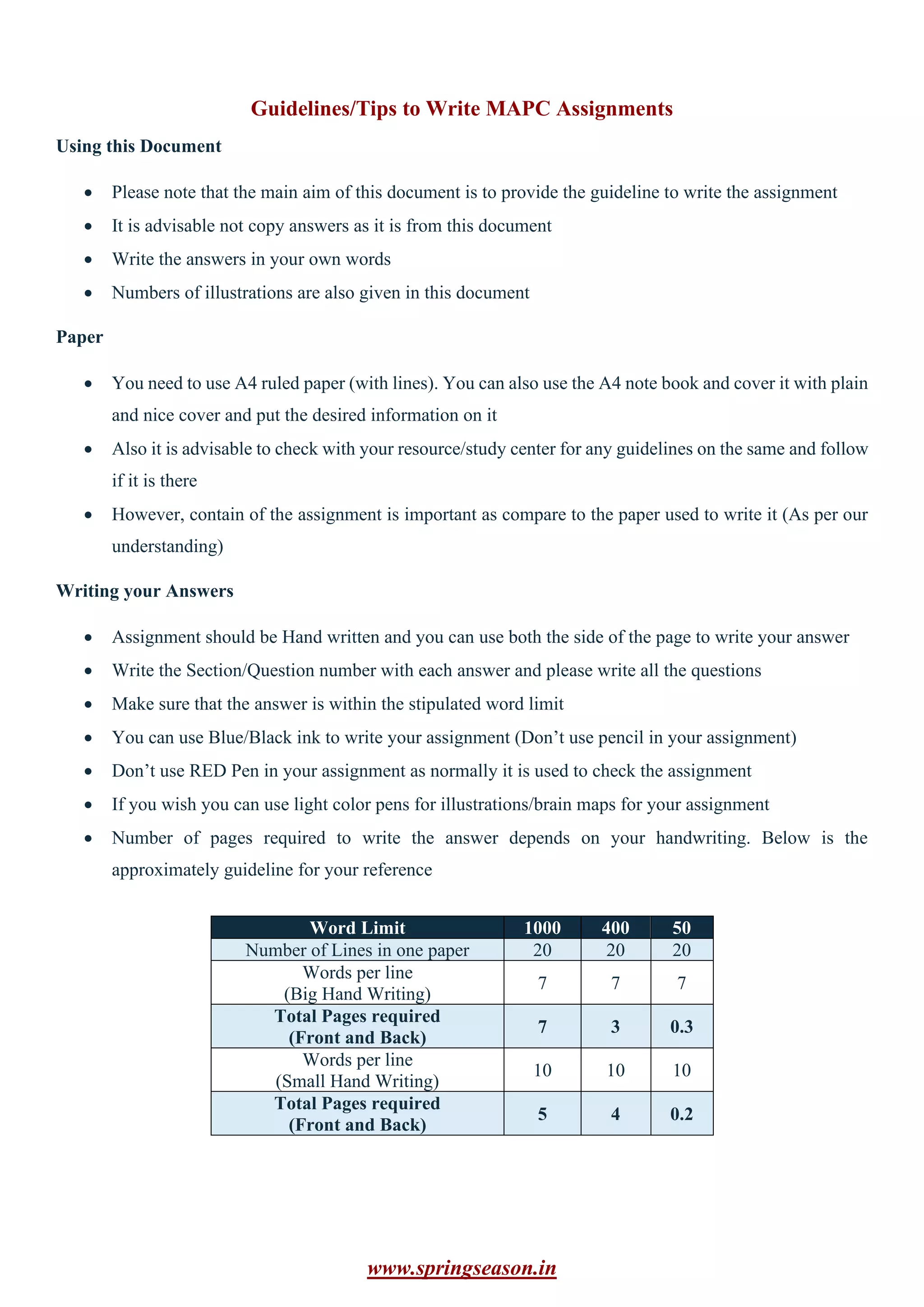
• Number of pages required to write the answer depends on your handwriting. Below is the
approximately guideline for your reference
Word Limit 1000 400 50
Number of Lines in one paper 20 20 20
Words per line
(Big Hand Writing)
7 7 7
Total Pages required
(Front and Back)
7 3 0.3
Words per line
(Small Hand Writing)
10 10 10
Total Pages required
(Front and Back)
5 4 0.2
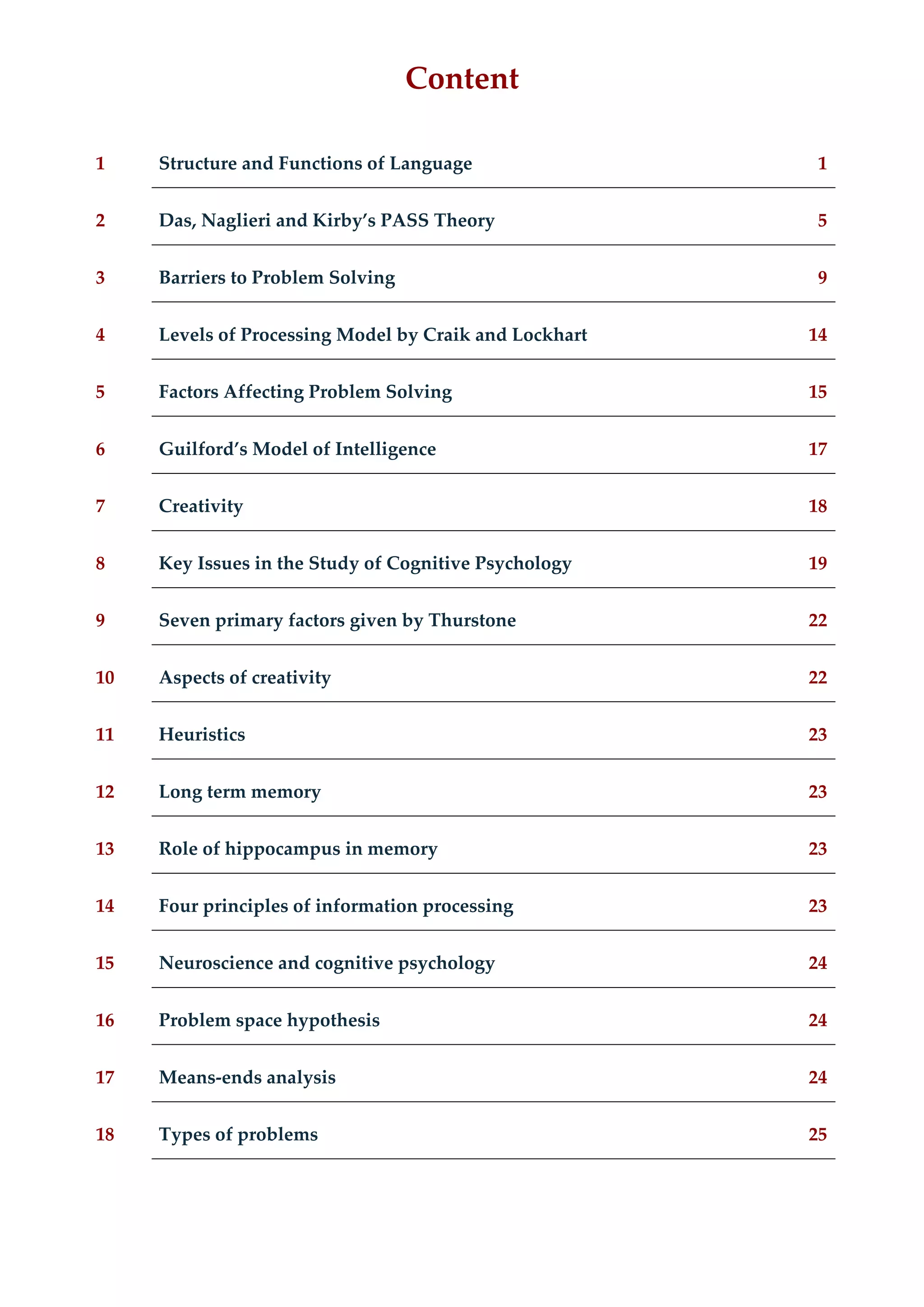
Content
1 Structure and Functions of Language 1
2 Das, Naglieri and Kirby’s PASS Theory 5
3 Barriers to Problem Solving 9
4 Levels of Processing Model by Craik and Lockhart 14
5 Factors Affecting Problem Solving 15
6 Guilford’s Model of Intelligence 17
7 Creativity 18
8 Key Issues in the Study of Cognitive Psychology 19
9 Seven primary factors given by Thurstone 22
10 Aspects of creativity 22
11 Heuristics 23
12 Long term memory 23
13 Role of hippocampus in memory 23
14 Four principles of information processing 23
15 Neuroscience and cognitive psychology 24
16 Problem space hypothesis 24
17 Means-ends analysis 24
18 Types of problems 25
Assignment Container Cognitive Psychology (MPC-001)
Page 1 of 25 www.springseason.in
IGNOU MAPC
COGNITIVE PSYCHOLOGY (MPC-001)
Course Code: MPC-001
Assignment Code: MPC-001/ASST/TMA/2022-23
Marks: 100
Last Date of Submission: 31st March 2023 and 30th Sep 2023
SECTION-A
Answer the following question in about 1000 words (wherever applicable) each.
15 x 3 = 45 Marks
Q. No. 1 Discuss the structure and functions of language
Answer: Functions of Language
Language is part of almost all kinds of social interaction. Language serves many functions, which
are all related to the fundamental process of communication where sound or signs convey objects,
actions and ideas.
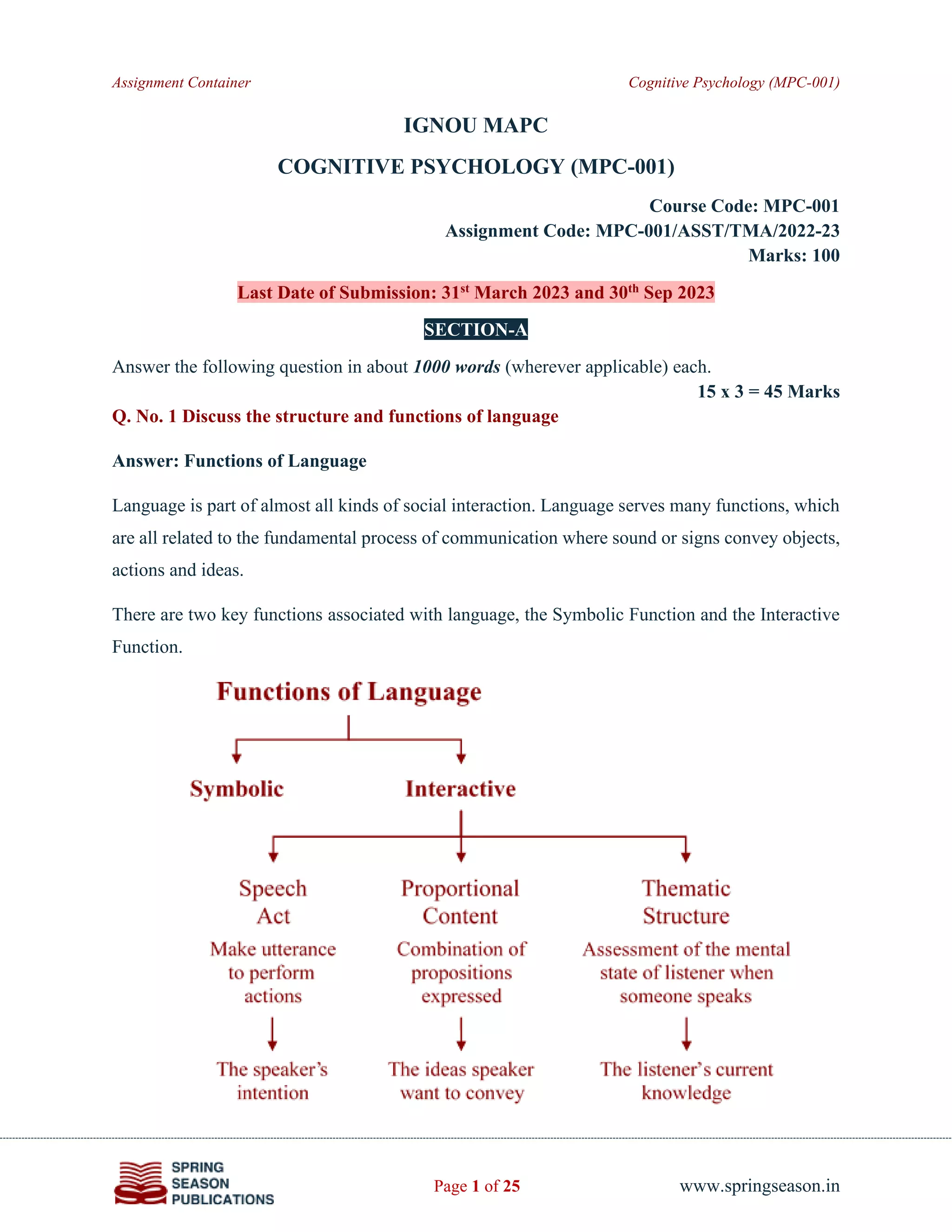
There are two key functions associated with language, the Symbolic Function and the Interactive
Function.
Assignment Container Cognitive Psychology (MPC-001)
Page 14 of 25 www.springseason.in
SECTION-B
Answer the following question in about 400 words (wherever applicable) each.
5 x 5 = 25 Marks
Q. No. 4 Describe the levels of processing model by Craik and Lockhart.
Answer: The levels of processing model (Craik & Lockhart, 1972) focuses on the depth of
processing involved in memory, and predicts the deeper information is processed, the longer a
memory trace will last.
Craik defined depth as:
“the meaningfulness extracted from the stimulus rather than in
terms of the number of analyses performed upon it.”
Unlike the multi-store model it is a non-structured approach. The basic idea is that memory is
really just what happens as a result of processing information.
Memory is just a by-product of the depth of processing of information, and there is no clear
distinction between short term and long term memory.
Therefore, instead of concentrating on the stores/structures involved (i.e. short term memory &
long term memory), this theory concentrates on the processes involved in memory.
We can process information in 3 ways:
Shallow Processing
This takes two forms
1. Structural processing (appearance) which is when we encode only the physical qualities
of something. E.g. the typeface of a word or how the letters look.
2. Phonemic processing – which is when we encode its sound.
Shallow processing only involves maintenance rehearsal (repetition to help us hold something in
the STM) and leads to fairly short-term retention of information.
This is the only type of rehearsal to take place within the multi-store model.
Deep Processing
Assignment Container Cognitive Psychology (MPC-001)
Page 25 of 25 www.springseason.in
state. (92 Words)
Q. No. 18 Types of problems
Answer: Psychology has broken down problems in two different ways, well-defined and ill-
defined problems.
A well-defined problem is one that has a clear goal or solution, and problem-solving strategies are
easily developed. Well-defined problems can be solved using a formula or algorithm; a step-by-
step process that will always produce the correct result.
In contrast, a poorly-defined problem is the opposite. It’s one that is unclear, abstract, or confusing,
and that does not have a clear problem-solving strategy. These problems require investigation to
define, understand and solve. (86 Words)
Spring Season Publications
Kharghar, Navi Mumbai, MS, INDIA, 410210
Visit us at
www.springseason.in
Rs. 99

AC 001 Cognitive 2023.pdf

  • 1.
  • 2.
    Cognitive Psychology (MPC001) SPRING SEASONPUBLICATIONS Navi Mumbai, INDIA
  • 3.
    Free Distribution ofthis document, except the author, will be considered as COPYRIGHT Violation. As per Indian Copyrights Act 1957, Copyright infringement is a cognizable offence and Copyright owners can take legal action against any person or entity that infringes on the copyright of a work. The copyright owner can file a civil remedies case in a court having jurisdiction and is entitled to remedies by way of injunctions, damages and accounts. Assignment Container: Cognitive Psychology (MPC001) © Spring Season Publications 2020-2022 All Rights Reserved First Published – 2020 Fourth Ed. - 2022 Spring Season Publications Kharghar Sec 10, Navi Mumbai, MS, INDIA, 410210 www.springseason.in All rights reserved. No part of this publication may be reproduced, stored in or introduced into a retrieval system, or transmitted, in any form, or by any means (electrical, mechanical, Photocopying, recording or otherwise) without the prior Written permission of the author. All data were deemed correct at time of creation Author/Publisher is not liable for errors or omissions Only for PERSONAL USE not for PUBLIC Circulation INR 99/-
  • 4.
    www.springseason.in Guidelines/Tips to WriteMAPC Assignments Using this Document • Please note that the main aim of this document is to provide the guideline to write the assignment • It is advisable not copy answers as it is from this document • Write the answers in your own words • Numbers of illustrations are also given in this document Paper • You need to use A4 ruled paper (with lines). You can also use the A4 note book and cover it with plain and nice cover and put the desired information on it • Also it is advisable to check with your resource/study center for any guidelines on the same and follow if it is there • However, contain of the assignment is important as compare to the paper used to write it (As per our understanding) Writing your Answers • Assignment should be Hand written and you can use both the side of the page to write your answer • Write the Section/Question number with each answer and please write all the questions • Make sure that the answer is within the stipulated word limit • You can use Blue/Black ink to write your assignment (Don’t use pencil in your assignment) • Don’t use RED Pen in your assignment as normally it is used to check the assignment • If you wish you can use light color pens for illustrations/brain maps for your assignment • Number of pages required to write the answer depends on your handwriting. Below is the approximately guideline for your reference Word Limit 1000 400 50 Number of Lines in one paper 20 20 20 Words per line (Big Hand Writing) 7 7 7 Total Pages required (Front and Back) 7 3 0.3 Words per line (Small Hand Writing) 10 10 10 Total Pages required (Front and Back) 5 4 0.2
  • 5.
    Content 1 Structure andFunctions of Language 1 2 Das, Naglieri and Kirby’s PASS Theory 5 3 Barriers to Problem Solving 9 4 Levels of Processing Model by Craik and Lockhart 14 5 Factors Affecting Problem Solving 15 6 Guilford’s Model of Intelligence 17 7 Creativity 18 8 Key Issues in the Study of Cognitive Psychology 19 9 Seven primary factors given by Thurstone 22 10 Aspects of creativity 22 11 Heuristics 23 12 Long term memory 23 13 Role of hippocampus in memory 23 14 Four principles of information processing 23 15 Neuroscience and cognitive psychology 24 16 Problem space hypothesis 24 17 Means-ends analysis 24 18 Types of problems 25
  • 7.
    Assignment Container CognitivePsychology (MPC-001) Page 1 of 25 www.springseason.in IGNOU MAPC COGNITIVE PSYCHOLOGY (MPC-001) Course Code: MPC-001 Assignment Code: MPC-001/ASST/TMA/2022-23 Marks: 100 Last Date of Submission: 31st March 2023 and 30th Sep 2023 SECTION-A Answer the following question in about 1000 words (wherever applicable) each. 15 x 3 = 45 Marks Q. No. 1 Discuss the structure and functions of language Answer: Functions of Language Language is part of almost all kinds of social interaction. Language serves many functions, which are all related to the fundamental process of communication where sound or signs convey objects, actions and ideas. There are two key functions associated with language, the Symbolic Function and the Interactive Function.
  • 8.
    Assignment Container CognitivePsychology (MPC-001) Page 14 of 25 www.springseason.in SECTION-B Answer the following question in about 400 words (wherever applicable) each. 5 x 5 = 25 Marks Q. No. 4 Describe the levels of processing model by Craik and Lockhart. Answer: The levels of processing model (Craik & Lockhart, 1972) focuses on the depth of processing involved in memory, and predicts the deeper information is processed, the longer a memory trace will last. Craik defined depth as: “the meaningfulness extracted from the stimulus rather than in terms of the number of analyses performed upon it.” Unlike the multi-store model it is a non-structured approach. The basic idea is that memory is really just what happens as a result of processing information. Memory is just a by-product of the depth of processing of information, and there is no clear distinction between short term and long term memory. Therefore, instead of concentrating on the stores/structures involved (i.e. short term memory & long term memory), this theory concentrates on the processes involved in memory. We can process information in 3 ways: Shallow Processing This takes two forms 1. Structural processing (appearance) which is when we encode only the physical qualities of something. E.g. the typeface of a word or how the letters look. 2. Phonemic processing – which is when we encode its sound. Shallow processing only involves maintenance rehearsal (repetition to help us hold something in the STM) and leads to fairly short-term retention of information. This is the only type of rehearsal to take place within the multi-store model. Deep Processing
  • 9.
    Assignment Container CognitivePsychology (MPC-001) Page 25 of 25 www.springseason.in state. (92 Words) Q. No. 18 Types of problems Answer: Psychology has broken down problems in two different ways, well-defined and ill- defined problems. A well-defined problem is one that has a clear goal or solution, and problem-solving strategies are easily developed. Well-defined problems can be solved using a formula or algorithm; a step-by- step process that will always produce the correct result. In contrast, a poorly-defined problem is the opposite. It’s one that is unclear, abstract, or confusing, and that does not have a clear problem-solving strategy. These problems require investigation to define, understand and solve. (86 Words)
  • 10.
    Spring Season Publications Kharghar,Navi Mumbai, MS, INDIA, 410210 Visit us at www.springseason.in Rs. 99