CHARACTERIZATION OF
COMPLETE DENTURE
Characterization
 To alter by application of unique markings,
indentations, coloration and similar custom
means of delineation on a tooth or dental
prosthesis thus enhancing the natural
appearance (GPT 8).
Introduction
 Characterization should have some amount
of realistic perception rather than
incorporating unrealistic features.
 It includes the inclusion of dentogenic
concept.
 According to Frush and Fisher dentogenic
concept includes effects of three main factors
such as age, sex and personality in sequence
of esthetic planning
 Frush and Fisher stated that “The environment
of the teeth determine realistic appearance
 Various means like minor irregularities in tooth
arrangement, overlapping, tilting, modification
of incisal edges, rotations of teeth, stippling,
staining, tinting of the denture base, crowding
and fixing dental jewelry etc., can be
incorporated depending on patients desire
towards achieving natural illusion.
 Characterisation
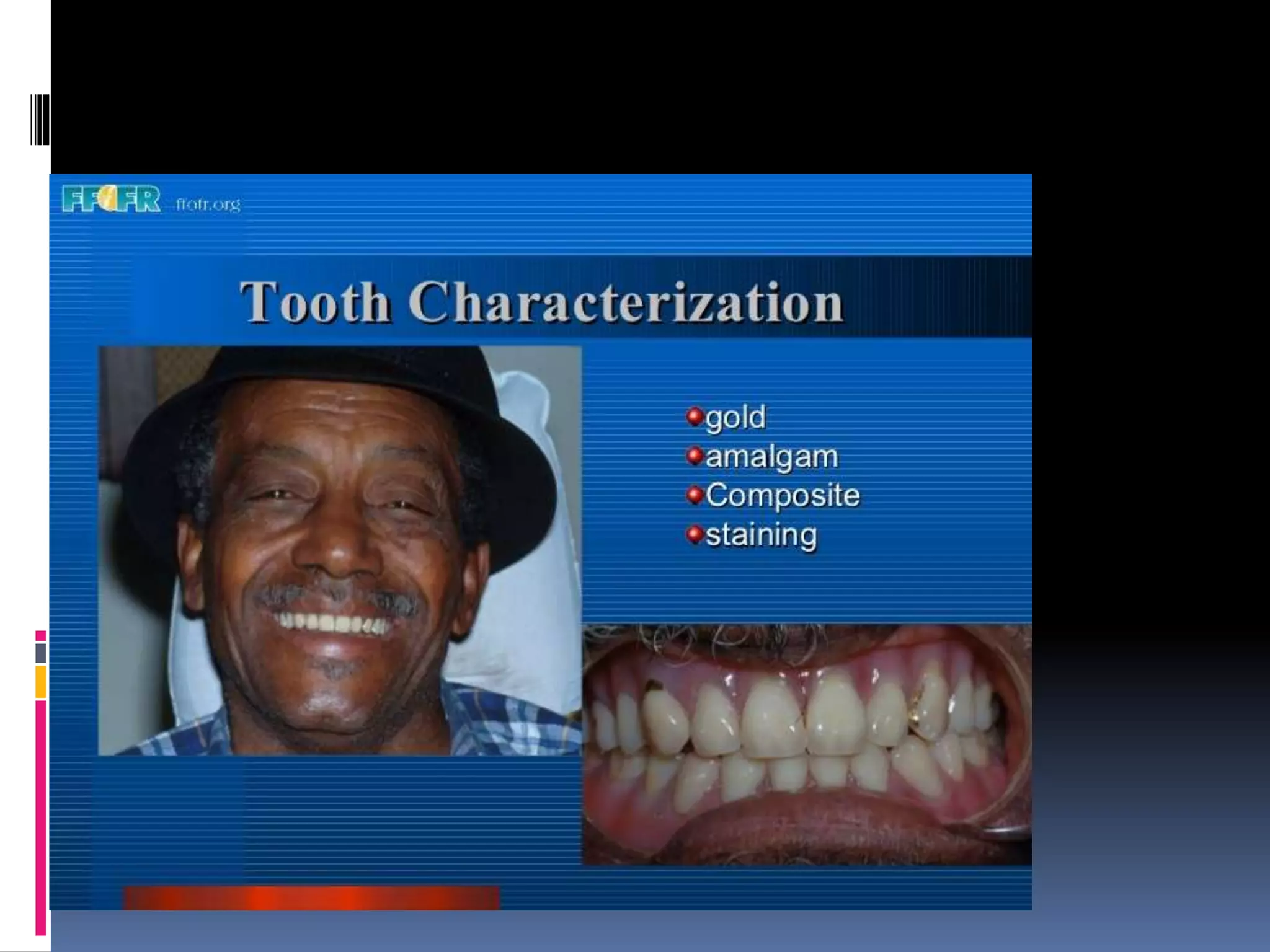
-Tooth characterisation
-Gingival characterisation
 It is the duty of the dentist to inform the patient that his or her
complete denture can be characterized to suit his/her wish and
appearance.
 Hardy stated that, “To meet the esthetic needs of the denture
patient, we should make the denture teeth look like the patients
natural teeth.
 Few Case report which explain
tooth and gingival
characterization
 Characterization of complete dentureSRM
Journal of Research in Dental Sciences |Vol. 6
| Issue 1 | January-March 2015
Case 1
 Tobacco staining on complete denture Patient had the habit of pan
chewing.
 Hence, the patient insisted on having the stains so that the denture
looks natural.
 Brown pigments were incorporated in monomer and painted on to
the acrylic teeth
Case 2
 An 80-year-old patient came for a new denture just because the
absence of diastema was giving an artificial appearance.The patient
was very specific about the diastema, and it was checked during
trial.The final denture was fabricated with spacing between the
anteriors
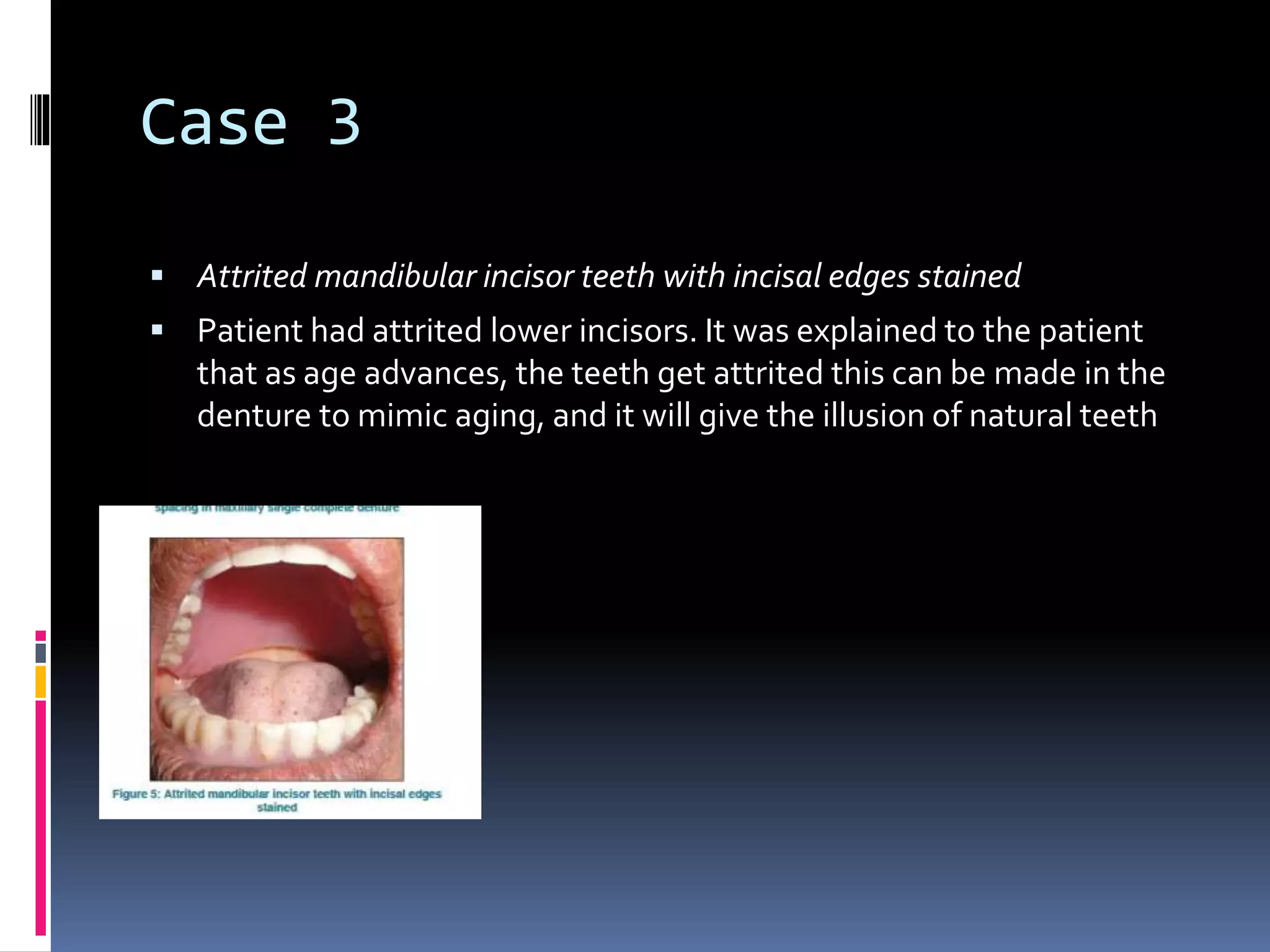
Case 3
 Attrited mandibular incisor teeth with incisal edges stained
 Patient had attrited lower incisors. It was explained to the patient
that as age advances, the teeth get attrited this can be made in the
denture to mimic aging, and it will give the illusion of natural teeth
Case 4
 Dental jewellery on maxillary lateral incisor tooth.
 Incorporating the same in a young denture wearer will possibly
boost the charm and confidence of the patient.
 Tooth jewelry was given to a young female patient to give a
natural appearance.The clinician gave an opinion of placing
an artificial stone on upper right lateral incisor to give an
esthetic and natural look.
Case 6 intrinsic
characterization of denture base
 Denture flanges mimicking gingival color
 The basic shade of the gingiva and the color of pigmentation should
be duplicated indentures to make them look more natural.
 This can be done either intrinsically by incorporating pigments
during packing of acrylic or extrinsically after acrylization.
 Blackish brown pigments were added to the monomer during
packing of the denture
Extrinsic denture
characterization
Technique for
Characterization
- External
- Internal
Internal Characterization of
Denture Base by Using Acrylic
Stains
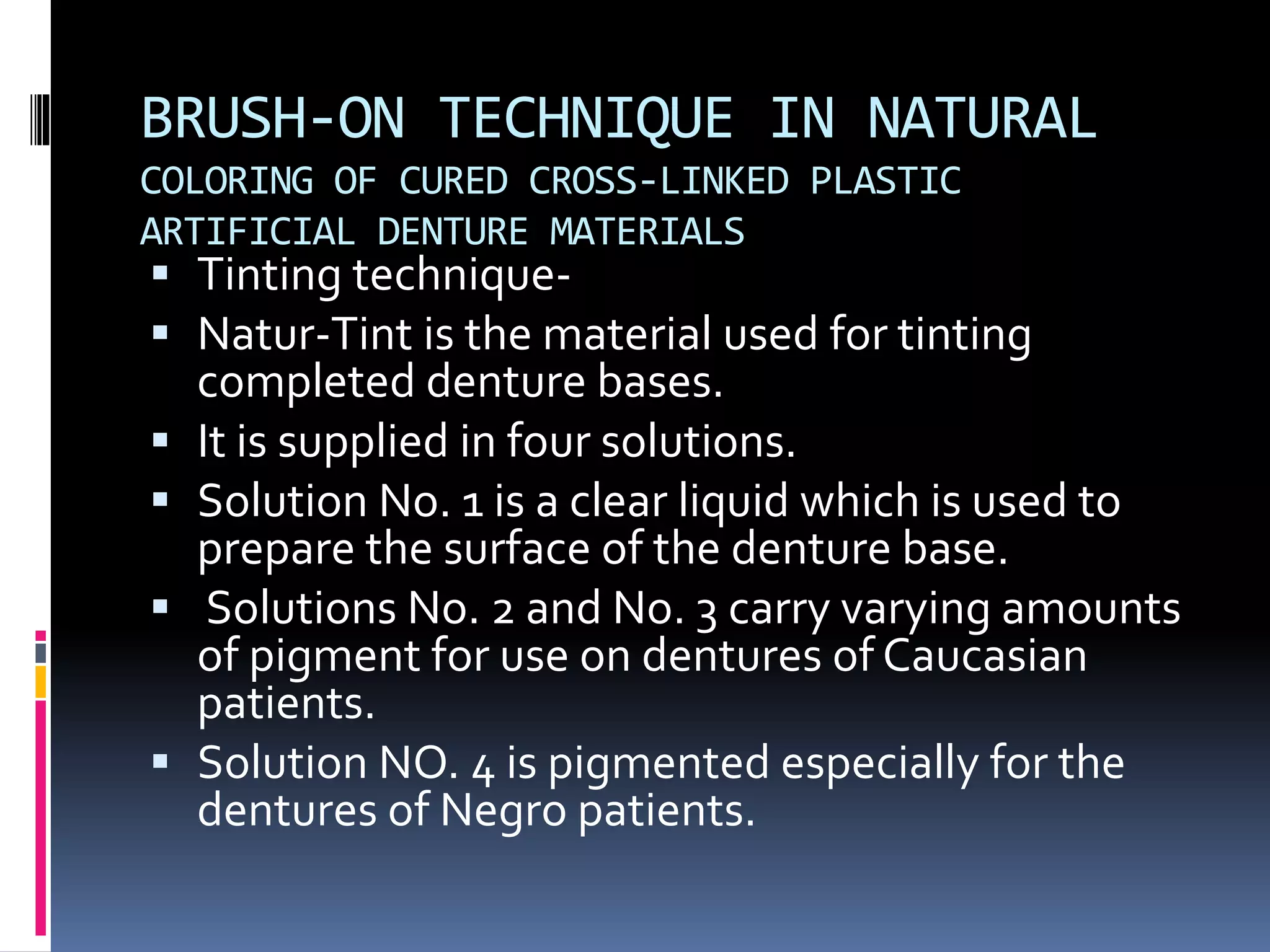
Waxed-up denture Tissue paper painted on the waxed-up denture
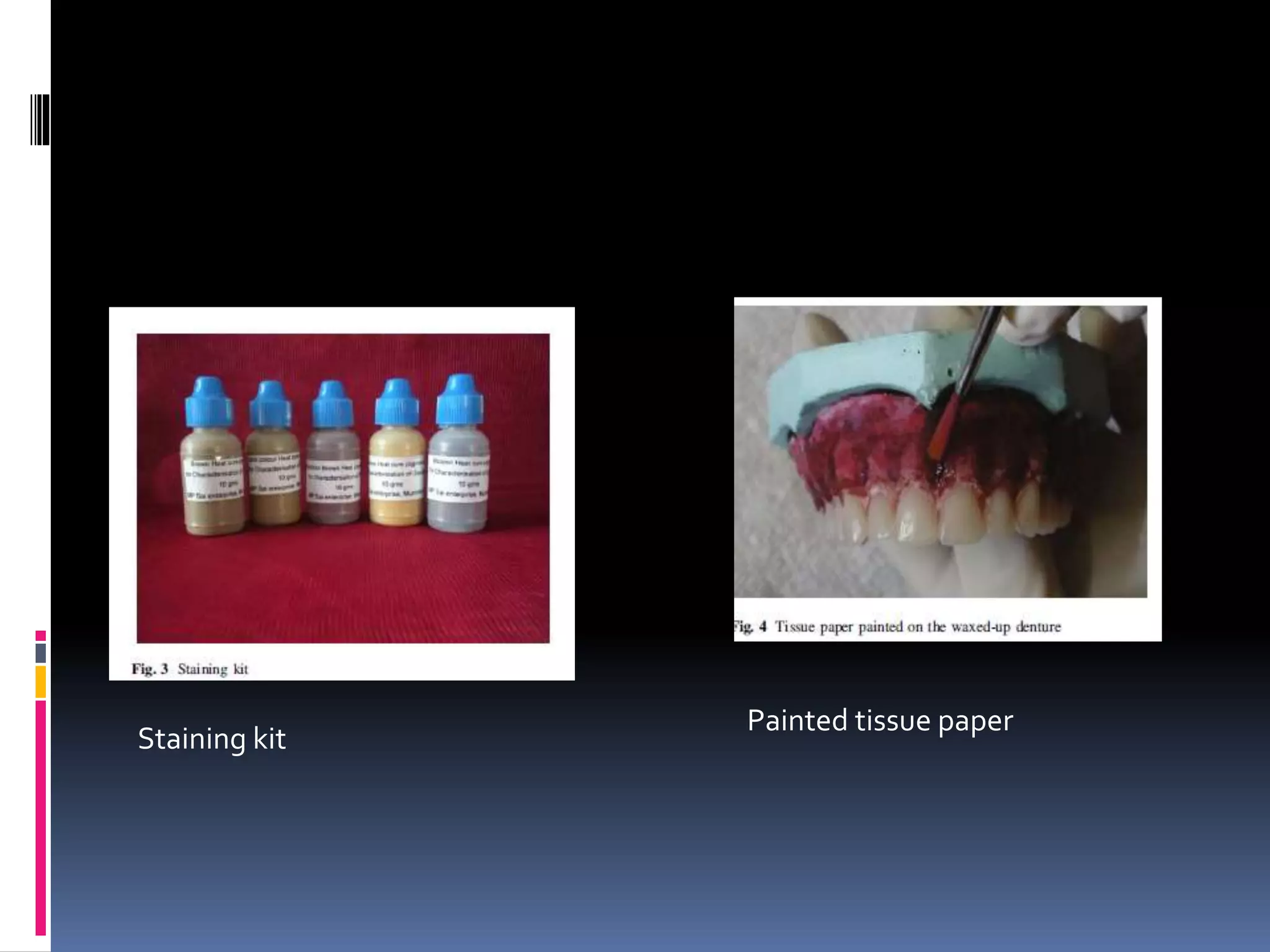
Staining kit
Painted tissue paper
Adapted thin layer of heat cure acrylic
resin doughPainted tissue paper
Internal Characterization of Denture Base by Using
Acrylic Stains andTissue PaperJ Indian Prosthodont
Soc (July-Sept 2011) 11(3):202-204
Painted tissue paper strip adapted
in the mould
Finished and polished
characterized denture
BRUSH-ON TECHNIQUE IN NATURAL
COLORING OF CURED CROSS-LINKED PLASTIC
ARTIFICIAL DENTURE MATERIALS
 Tinting technique-
 Natur-Tint is the material used for tinting
completed denture bases.
 It is supplied in four solutions.
 Solution No. 1 is a clear liquid which is used to
prepare the surface of the denture base.
 Solutions No. 2 and No. 3 carry varying amounts
of pigment for use on dentures of Caucasian
patients.
 Solution NO. 4 is pigmented especially for the
dentures of Negro patients.
technique for tinting
dentures
Clean the denture thoroughly.When the new denture is recovered from
the flask, it should be shaped and thoroughly cleaned but not
polished.
Paint the solution No. 1 (clear) on the outside surface of the labial
flange to soften this surface of the acrylic base
Determine the pigmented solution to use comparing the color guide
with them apply solution according to color match
Remove the glaze with flour of pumice and a brush.The denture will
look more natural if it is not highly polished.
RUSH-ONTECHNIQUE IN NATURAL COLORINGOF CUREDCROSS-
LINKED PLASTICARTIFICIAL DENTURE MATERIALS JOHN L.
POWERS, D.D.S.
Disscusion
 It was Pound in 1951 who introduced the technique
of tinting acyrlic denture bases to simulate the
normal gingival color depending on the racial and
individual color pattern.
 Kemniter used a combination of blue and brown
stains to reproduce melanin pigmentation of
gingival.
 Lynn C. Dirken described a method for obtaining
natural appearance by a combination of stippling
and tinting.
 The goal of characterization is to achieve a natural
appearance for the denture by creating an illusion of
reality in the smile
Summary
 Skillful procedure can produce excellent results, but a
poorly executed tinting procedure may, however, ruin an
otherwise acceptable denture.
 This technique describe the external and internal
characterization of the denture base by different method
which are incorporated in the denture base at the time of
packing stage or after flasking .
 Advantages of this method are stains are incorporated
deeply in the denture, the operator has a control over
extent of the tint, characterization can be appreciated
during the staining procedure, and the tinted tissue
paper minimizes spread of the colors
References
 Characterization of complete dentureSRM
Journal of Research in Dental Sciences |Vol. 6 |
Issue 1 | January-March 2015
 RUSH-ONTECHNIQUE IN NATURAL COLORING
OF CURED CROSS-LINKED PLASTIC ARTIFICIAL
DENTURE MATERIALS JOHN L. POWERS,
D.D.S.
 Powers JL (1953) Brush-on technique in natural
coloring of cured cross-linked plastic artificial
denture materials. J Prosthet Dent 3:350–353

Characterization of complete denture

  • 1.
  • 2.
    Characterization  To alterby application of unique markings, indentations, coloration and similar custom means of delineation on a tooth or dental prosthesis thus enhancing the natural appearance (GPT 8).
  • 4.
    Introduction  Characterization shouldhave some amount of realistic perception rather than incorporating unrealistic features.  It includes the inclusion of dentogenic concept.  According to Frush and Fisher dentogenic concept includes effects of three main factors such as age, sex and personality in sequence of esthetic planning
  • 5.
     Frush andFisher stated that “The environment of the teeth determine realistic appearance  Various means like minor irregularities in tooth arrangement, overlapping, tilting, modification of incisal edges, rotations of teeth, stippling, staining, tinting of the denture base, crowding and fixing dental jewelry etc., can be incorporated depending on patients desire towards achieving natural illusion.
  • 7.
  • 10.
     It isthe duty of the dentist to inform the patient that his or her complete denture can be characterized to suit his/her wish and appearance.  Hardy stated that, “To meet the esthetic needs of the denture patient, we should make the denture teeth look like the patients natural teeth.
  • 11.
     Few Casereport which explain tooth and gingival characterization  Characterization of complete dentureSRM Journal of Research in Dental Sciences |Vol. 6 | Issue 1 | January-March 2015
  • 12.
    Case 1  Tobaccostaining on complete denture Patient had the habit of pan chewing.  Hence, the patient insisted on having the stains so that the denture looks natural.  Brown pigments were incorporated in monomer and painted on to the acrylic teeth
  • 13.
    Case 2  An80-year-old patient came for a new denture just because the absence of diastema was giving an artificial appearance.The patient was very specific about the diastema, and it was checked during trial.The final denture was fabricated with spacing between the anteriors
  • 14.
    Case 3  Attritedmandibular incisor teeth with incisal edges stained  Patient had attrited lower incisors. It was explained to the patient that as age advances, the teeth get attrited this can be made in the denture to mimic aging, and it will give the illusion of natural teeth
  • 15.
    Case 4  Dentaljewellery on maxillary lateral incisor tooth.  Incorporating the same in a young denture wearer will possibly boost the charm and confidence of the patient.  Tooth jewelry was given to a young female patient to give a natural appearance.The clinician gave an opinion of placing an artificial stone on upper right lateral incisor to give an esthetic and natural look.
  • 16.
    Case 6 intrinsic characterizationof denture base  Denture flanges mimicking gingival color  The basic shade of the gingiva and the color of pigmentation should be duplicated indentures to make them look more natural.  This can be done either intrinsically by incorporating pigments during packing of acrylic or extrinsically after acrylization.  Blackish brown pigments were added to the monomer during packing of the denture
  • 17.
  • 18.
  • 19.
    Internal Characterization of DentureBase by Using Acrylic Stains Waxed-up denture Tissue paper painted on the waxed-up denture
  • 20.
  • 21.
    Adapted thin layerof heat cure acrylic resin doughPainted tissue paper
  • 22.
    Internal Characterization ofDenture Base by Using Acrylic Stains andTissue PaperJ Indian Prosthodont Soc (July-Sept 2011) 11(3):202-204 Painted tissue paper strip adapted in the mould Finished and polished characterized denture
  • 23.
    BRUSH-ON TECHNIQUE INNATURAL COLORING OF CURED CROSS-LINKED PLASTIC ARTIFICIAL DENTURE MATERIALS  Tinting technique-  Natur-Tint is the material used for tinting completed denture bases.  It is supplied in four solutions.  Solution No. 1 is a clear liquid which is used to prepare the surface of the denture base.  Solutions No. 2 and No. 3 carry varying amounts of pigment for use on dentures of Caucasian patients.  Solution NO. 4 is pigmented especially for the dentures of Negro patients.
  • 24.
    technique for tinting dentures Cleanthe denture thoroughly.When the new denture is recovered from the flask, it should be shaped and thoroughly cleaned but not polished. Paint the solution No. 1 (clear) on the outside surface of the labial flange to soften this surface of the acrylic base Determine the pigmented solution to use comparing the color guide with them apply solution according to color match Remove the glaze with flour of pumice and a brush.The denture will look more natural if it is not highly polished. RUSH-ONTECHNIQUE IN NATURAL COLORINGOF CUREDCROSS- LINKED PLASTICARTIFICIAL DENTURE MATERIALS JOHN L. POWERS, D.D.S.
  • 25.
    Disscusion  It wasPound in 1951 who introduced the technique of tinting acyrlic denture bases to simulate the normal gingival color depending on the racial and individual color pattern.  Kemniter used a combination of blue and brown stains to reproduce melanin pigmentation of gingival.  Lynn C. Dirken described a method for obtaining natural appearance by a combination of stippling and tinting.  The goal of characterization is to achieve a natural appearance for the denture by creating an illusion of reality in the smile
  • 26.
    Summary  Skillful procedurecan produce excellent results, but a poorly executed tinting procedure may, however, ruin an otherwise acceptable denture.  This technique describe the external and internal characterization of the denture base by different method which are incorporated in the denture base at the time of packing stage or after flasking .  Advantages of this method are stains are incorporated deeply in the denture, the operator has a control over extent of the tint, characterization can be appreciated during the staining procedure, and the tinted tissue paper minimizes spread of the colors
  • 27.
    References  Characterization ofcomplete dentureSRM Journal of Research in Dental Sciences |Vol. 6 | Issue 1 | January-March 2015  RUSH-ONTECHNIQUE IN NATURAL COLORING OF CURED CROSS-LINKED PLASTIC ARTIFICIAL DENTURE MATERIALS JOHN L. POWERS, D.D.S.  Powers JL (1953) Brush-on technique in natural coloring of cured cross-linked plastic artificial denture materials. J Prosthet Dent 3:350–353