COST VOLUME PROFIT
ANALYSIS
          narain@fms.edu
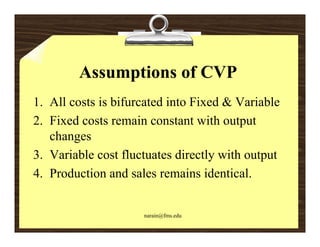
Assumptions of CVP
1. All costs is bifurcated into Fixed & Variable
2. Fixed costs remain constant with output
   changes
3. Variable cost fluctuates directly with output
4. Production d l
4 P d ti and sales remains identical.
                               i id ti l


                     narain@fms.edu
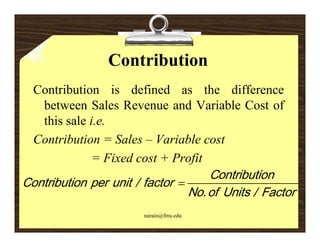
Contribution
  Contribution is defined as the difference
     between Sales Revenue and Variable Cost of
     this sale i.e.
  Contribution = Sales – Variable cost
                     = Fixed cost + Profit
                                                       C o n tri b u ti o n
C o n tri b u ti o n p e r u nit / f a ct o r 
                                                N o . o f U nit s / F a ct o r
                                  narain@fms.edu
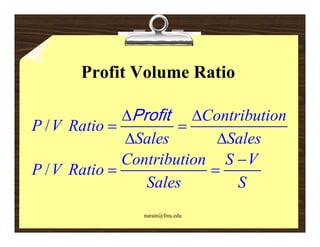
Profit Volume Ratio

               P r o fit Contribution
P / V Ratio             
              Sales         Sales
              Contribution S  V
P / V Ratio                
                  Sales         S
                 narain@fms.edu
Break Even Analysis
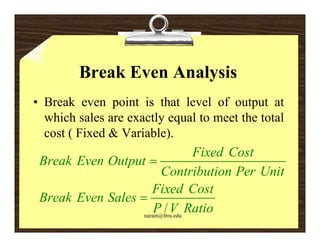
• Break even point is that level of output at
               p                          p
  which sales are exactly equal to meet the total
  cost ( Fixed & Variable).
                         )
                                  Fixed Cost
 Break Even Output 
                         Contribution Per Unit
                      Fixed Cost
 Break Even Sales 
                       P / V Ratio
                   narain@fms.edu
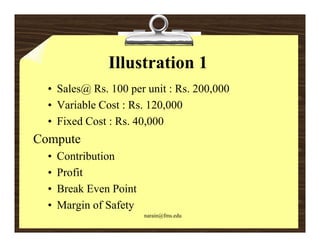
Illustration 1
  • Sales@ Rs. 100 per unit : Rs. 200,000
  • Variable Cost : Rs. 120,000
  • Fixed Cost : Rs. 40,000
Compute
  •   Contribution
  •   Profit
      P fit
  •   Break Even Point
  •   Margin f S f
      M i of Safety
                         narain@fms.edu
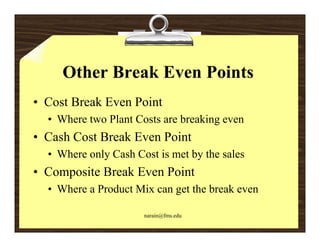
Other Break Even Points
• Cost Break Even Point
  • Where two Plant Costs are breaking even
• Cash Cost Break Even Point
  • Where only Cash Cost is met by the sales
• Composite Break Even Point
  • Where a Product Mix can get the break even

                      narain@fms.edu
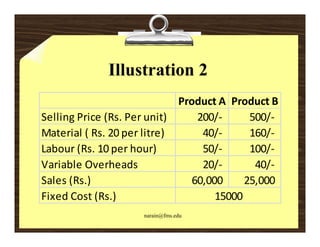
Illustration 2
                              Product A Product B
Selling Price (Rs. Per unit)         200/‐       500/‐
Material ( Rs. 20 per litre)          40/‐       160/‐
Labour (Rs. 10 per hour)              50/‐       100/‐
Variable Overheads                    20/‐        40/‐
Sales (Rs.)                         60,000      
                                               25,000
Fixed Cost (Rs.)
            ( )                          15000
                       narain@fms.edu
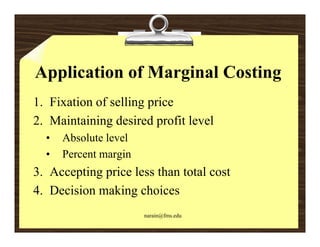
Application of Marginal Costing
1. Fixation of selling p
                     g price
2. Maintaining desired profit level
  •   Absolute level
  •   Percent margin
3.
3 Accepting price less than total cost
4. Decision making choices
                       narain@fms.edu
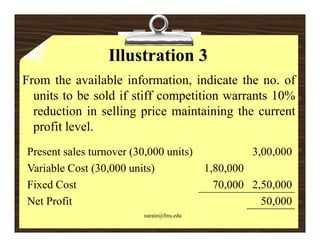
Illustration 3
From th available i f
F     the       il bl information, i di t th no. of
                              ti   indicate the     f
  units to be sold if stiff competition warrants 10%
  reduction i selling price maintaining th current
    d ti in lli            i     i t i i the        t
  profit level.
Present sales turnover (30,000 units)               3,00,000
Variable Cost (30,000 units)
               (30 000                     1,80,000
                                           1 80 000
Fixed Cost                                   70,000 2,50,000
Net Profit                                            50,000
                                                      50 000
                          narain@fms.edu
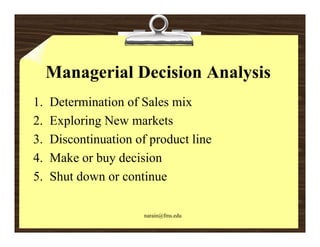
Managerial Decision Analysis
1.   Determination of Sales mix
2.   Exploring New markets
3.
3    Discontinuation of product line
4.   Make or buy decision
5.   Shut down or continue

                       narain@fms.edu
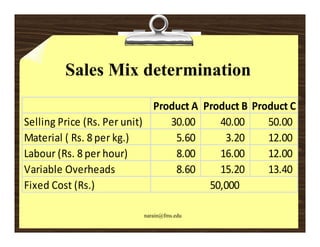
Sales Mix determination
                              Product A
                              Product A       Product B
                                              Product B       Product C
                                                              Product C
Selling Price (Rs. Per unit)         30.00            
                                                     40.00           50.00
Material ( Rs. 8 per kg.)
Material ( Rs 8 per kg )               5 60
                                       5.60            3 20
                                                       3.20          12 00
                                                                     12.00
Labour (Rs. 8 per hour)                 
                                       8.00           
                                                     16.00           12.00
Variable Overheads
Variable Overheads                     8 60
                                       8.60          15 20
                                                     15.20           13 40
                                                                     13.40
Fixed Cost (Rs.)                                50,000

                             narain@fms.edu
Sales Mix determination
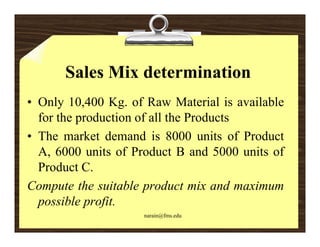
• Only 10,400 Kg. of Raw Material is available
      y ,          g
  for the production of all the Products
• The market demand is 8000 units of Product
  A, 6000 units of Product B and 5000 units of
  Product C.
Compute the suitable product mix and maximum
  possible profit
           profit.
                    narain@fms.edu
Exploring new market
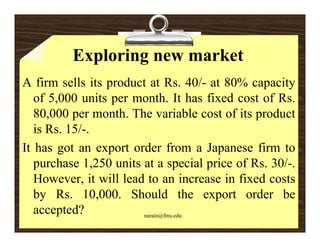
A firm sells its product at Rs. 40/- at 80% capacity
   of 5,000 units per month. It has fixed cost of Rs.
   80,000 per month. The variable cost of its product
   is Rs. 15/-.
It has got an export order from a Japanese firm to
   purchase 1,250 units at a special price of Rs. 30/-.
   However, it will lead to an increase in fixed costs
   by Rs. 10,000. Should the export order be
   accepted?            narain@fms.edu
Dropping a Product Line
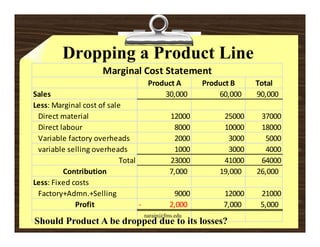
                         Marginal Cost Statement
                                           Product A             Product B             Total
Sales                                                 30,000                60,000      90,000
          g
Less: Marginal cost of sale
 Direct material                                   12000                  25000       37000
 Direct labour                                      8000                  10000       18000
 Variable factory overheads
 Variable factory overheads                         2000                    3000       5000
 variable selling overheads                         1000                    3000       4000
                           Total                   23000                  41000       64000
         Contribution                              7 000                19 000     26 000
                                                   7,000                19,000     26,000
Less: Fixed costs
 Factory+Admn.+Selling                              9000                  12000       21000
             Profit              ‐                 2,000                  7,000       5,000
                                        narain@fms.edu
Should Product A be dropped due to its losses?
Sourcing & Continuation
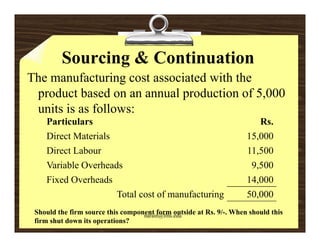
The manufacturing cost associated with the
 product based on an annual production of 5,000
 units is as follows:
    Particulars                                                        Rs.
    Direct Materials                                                15,000
    Direct Labour                                                   11,500
    Variable Overheads                                               9,500
    Fixed Overheads                                                 14,000
                     Total cost of manufacturing                    50,000
 Should the firm source this component form outside at Rs. 9/-. When should this
                                   narain@fms.edu
 firm shut down its operations?

Fma9

  • 1.
  • 2.
    Assumptions of CVP 1.All costs is bifurcated into Fixed & Variable 2. Fixed costs remain constant with output changes 3. Variable cost fluctuates directly with output 4. Production d l 4 P d ti and sales remains identical. i id ti l narain@fms.edu
  • 3.
    Contribution Contributionis defined as the difference between Sales Revenue and Variable Cost of this sale i.e. Contribution = Sales – Variable cost = Fixed cost + Profit C o n tri b u ti o n C o n tri b u ti o n p e r u nit / f a ct o r  N o . o f U nit s / F a ct o r narain@fms.edu
  • 4.
    Profit Volume Ratio  P r o fit Contribution P / V Ratio   Sales Sales Contribution S  V P / V Ratio   Sales S narain@fms.edu
  • 5.
    Break Even Analysis •Break even point is that level of output at p p which sales are exactly equal to meet the total cost ( Fixed & Variable). ) Fixed Cost Break Even Output  Contribution Per Unit Fixed Cost Break Even Sales  P / V Ratio narain@fms.edu
  • 6.
    Illustration 1 • Sales@ Rs. 100 per unit : Rs. 200,000 • Variable Cost : Rs. 120,000 • Fixed Cost : Rs. 40,000 Compute • Contribution • Profit P fit • Break Even Point • Margin f S f M i of Safety narain@fms.edu
  • 7.
    Other Break EvenPoints • Cost Break Even Point • Where two Plant Costs are breaking even • Cash Cost Break Even Point • Where only Cash Cost is met by the sales • Composite Break Even Point • Where a Product Mix can get the break even narain@fms.edu
  • 8.
    Illustration 2 Product A Product B Selling Price (Rs. Per unit)  200/‐ 500/‐ Material ( Rs. 20 per litre) 40/‐ 160/‐ Labour (Rs. 10 per hour) 50/‐ 100/‐ Variable Overheads 20/‐ 40/‐ Sales (Rs.)      60,000       25,000 Fixed Cost (Rs.) ( ) 15000 narain@fms.edu
  • 9.
    Application of MarginalCosting 1. Fixation of selling p g price 2. Maintaining desired profit level • Absolute level • Percent margin 3. 3 Accepting price less than total cost 4. Decision making choices narain@fms.edu
  • 10.
    Illustration 3 From thavailable i f F the il bl information, i di t th no. of ti indicate the f units to be sold if stiff competition warrants 10% reduction i selling price maintaining th current d ti in lli i i t i i the t profit level. Present sales turnover (30,000 units) 3,00,000 Variable Cost (30,000 units) (30 000 1,80,000 1 80 000 Fixed Cost 70,000 2,50,000 Net Profit 50,000 50 000 narain@fms.edu
  • 11.
    Managerial Decision Analysis 1. Determination of Sales mix 2. Exploring New markets 3. 3 Discontinuation of product line 4. Make or buy decision 5. Shut down or continue narain@fms.edu
  • 12.
    Sales Mix determination Product A Product A Product B Product B Product C Product C Selling Price (Rs. Per unit)         30.00         40.00       50.00 Material ( Rs. 8 per kg.) Material ( Rs 8 per kg )         5 60 5.60        3 20 3.20      12 00 12.00 Labour (Rs. 8 per hour)            8.00         16.00       12.00 Variable Overheads Variable Overheads         8 60 8.60      15 20 15.20      13 40 13.40 Fixed Cost (Rs.) 50,000 narain@fms.edu
  • 13.
    Sales Mix determination •Only 10,400 Kg. of Raw Material is available y , g for the production of all the Products • The market demand is 8000 units of Product A, 6000 units of Product B and 5000 units of Product C. Compute the suitable product mix and maximum possible profit profit. narain@fms.edu
  • 14.
    Exploring new market Afirm sells its product at Rs. 40/- at 80% capacity of 5,000 units per month. It has fixed cost of Rs. 80,000 per month. The variable cost of its product is Rs. 15/-. It has got an export order from a Japanese firm to purchase 1,250 units at a special price of Rs. 30/-. However, it will lead to an increase in fixed costs by Rs. 10,000. Should the export order be accepted? narain@fms.edu
  • 15.
    Dropping a ProductLine Marginal Cost Statement Product A Product B Total Sales                30,000                60,000      90,000 g Less: Marginal cost of sale Direct material 12000 25000 37000 Direct labour 8000 10000 18000 Variable factory overheads Variable factory overheads 2000 3000 5000 variable selling overheads 1000 3000 4000 Total 23000 41000 64000 Contribution                 7 000                19 000     26 000 7,000 19,000 26,000 Less: Fixed costs Factory+Admn.+Selling 9000 12000 21000 Profit ‐                 2,000                  7,000       5,000 narain@fms.edu Should Product A be dropped due to its losses?
  • 16.
    Sourcing & Continuation Themanufacturing cost associated with the product based on an annual production of 5,000 units is as follows: Particulars Rs. Direct Materials 15,000 Direct Labour 11,500 Variable Overheads 9,500 Fixed Overheads 14,000 Total cost of manufacturing 50,000 Should the firm source this component form outside at Rs. 9/-. When should this narain@fms.edu firm shut down its operations?