Abscisic acid in Plants
By:Debajyoti Behera
1
CONTENTS
• Chemical composition
• Occurrence and distribution
• Biosynthesis
• Role of Abscisic Acid
2
CHEMICAL COMPOSITION
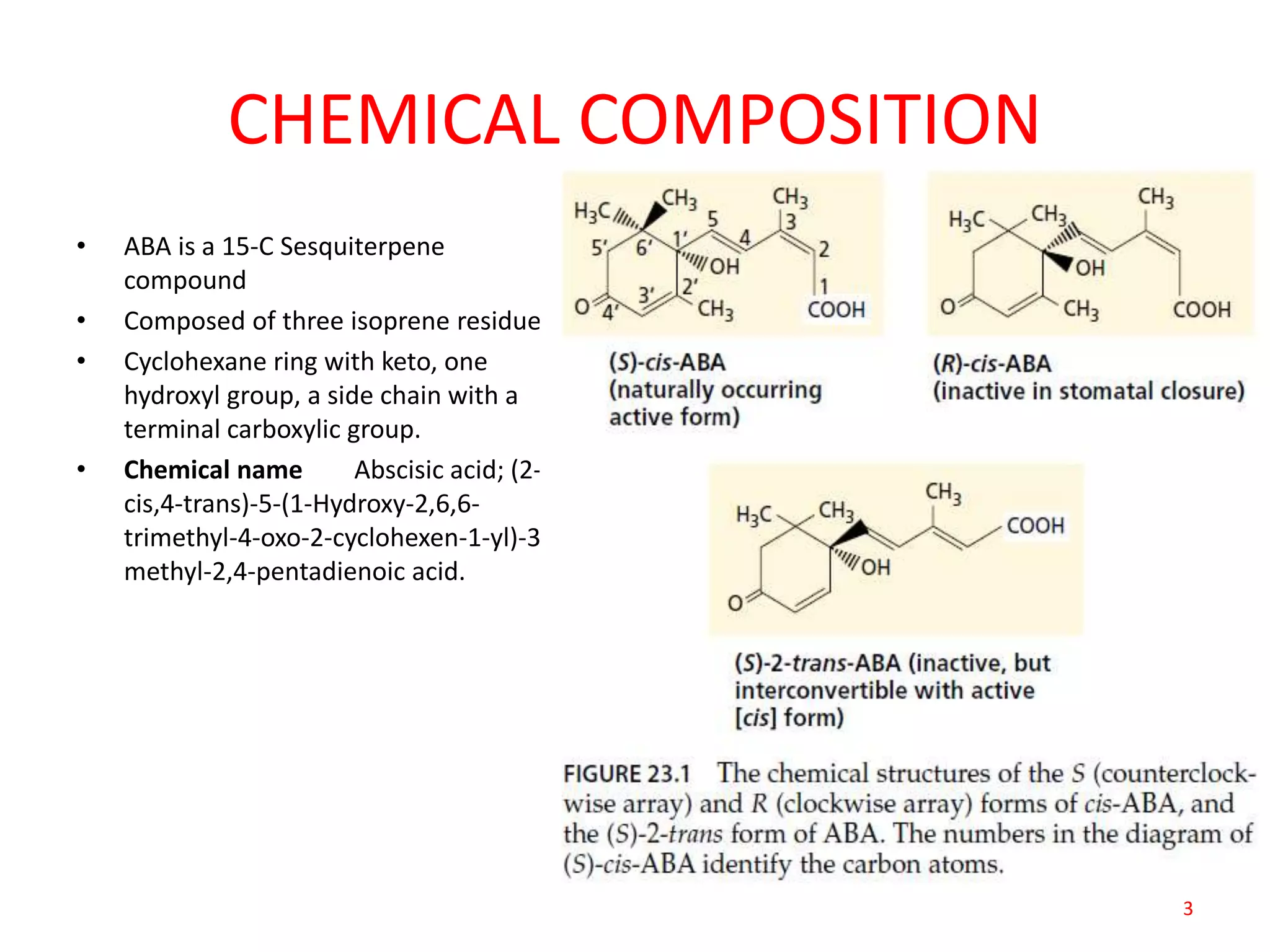
• ABA is a 15-C Sesquiterpene
compound
• Composed of three isoprene residues
• Cyclohexane ring with keto, one
hydroxyl group, a side chain with a
terminal carboxylic group.
• Chemical name Abscisic acid; (2-
cis,4-trans)-5-(1-Hydroxy-2,6,6-
trimethyl-4-oxo-2-cyclohexen-1-yl)-3-
methyl-2,4-pentadienoic acid.
3
OCCURRENCE AND DISTRIBUTION
• ABA is a ubiquitous plant hormone in vascular plants
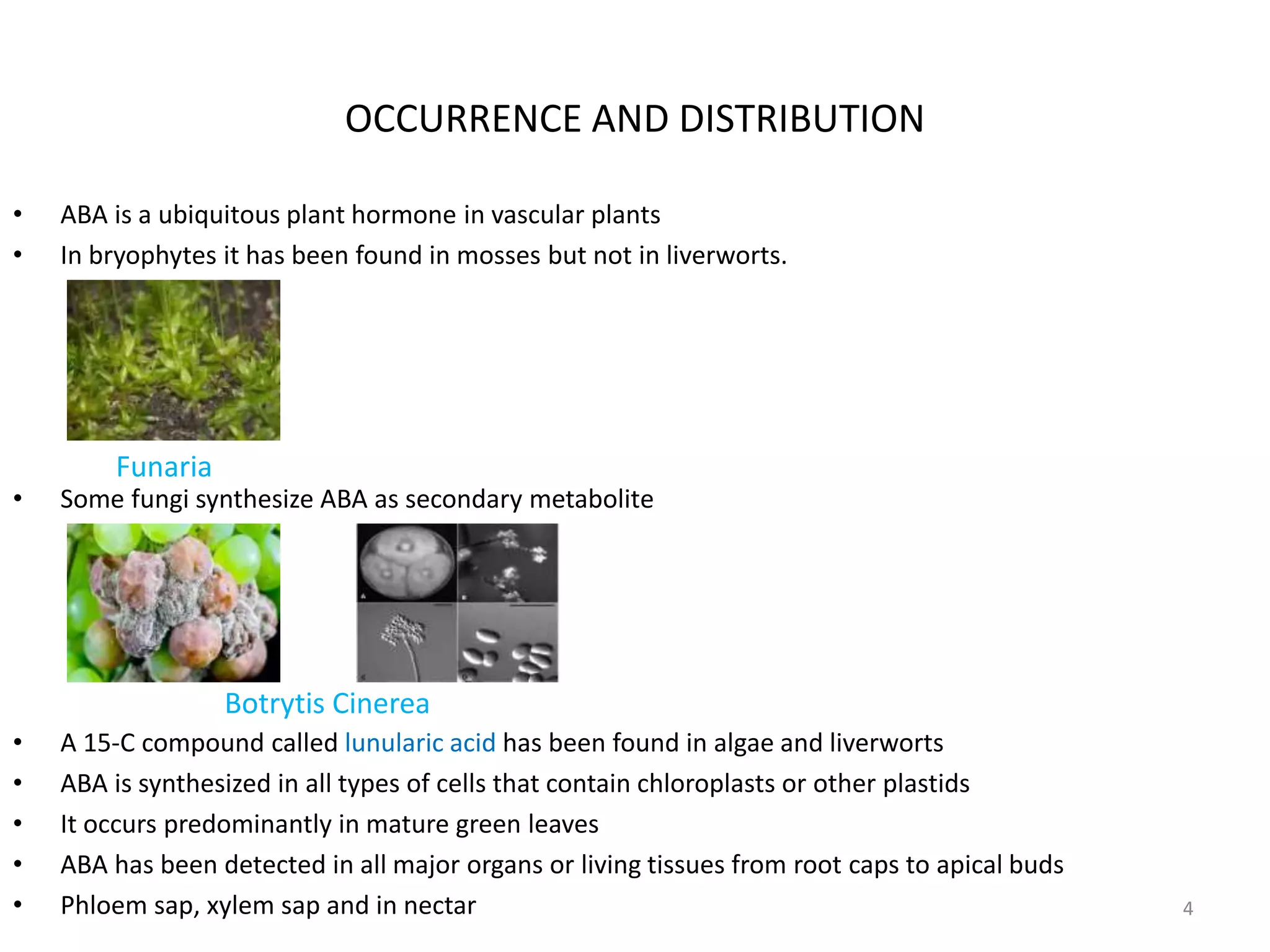
• In bryophytes it has been found in mosses but not in liverworts.
• Some fungi synthesize ABA as secondary metabolite
• A 15-C compound called lunularic acid has been found in algae and liverworts
• ABA is synthesized in all types of cells that contain chloroplasts or other plastids
• It occurs predominantly in mature green leaves
• ABA has been detected in all major organs or living tissues from root caps to apical buds
• Phloem sap, xylem sap and in nectar 4
Botrytis Cinerea
Funaria
BIOSYNTHESIS
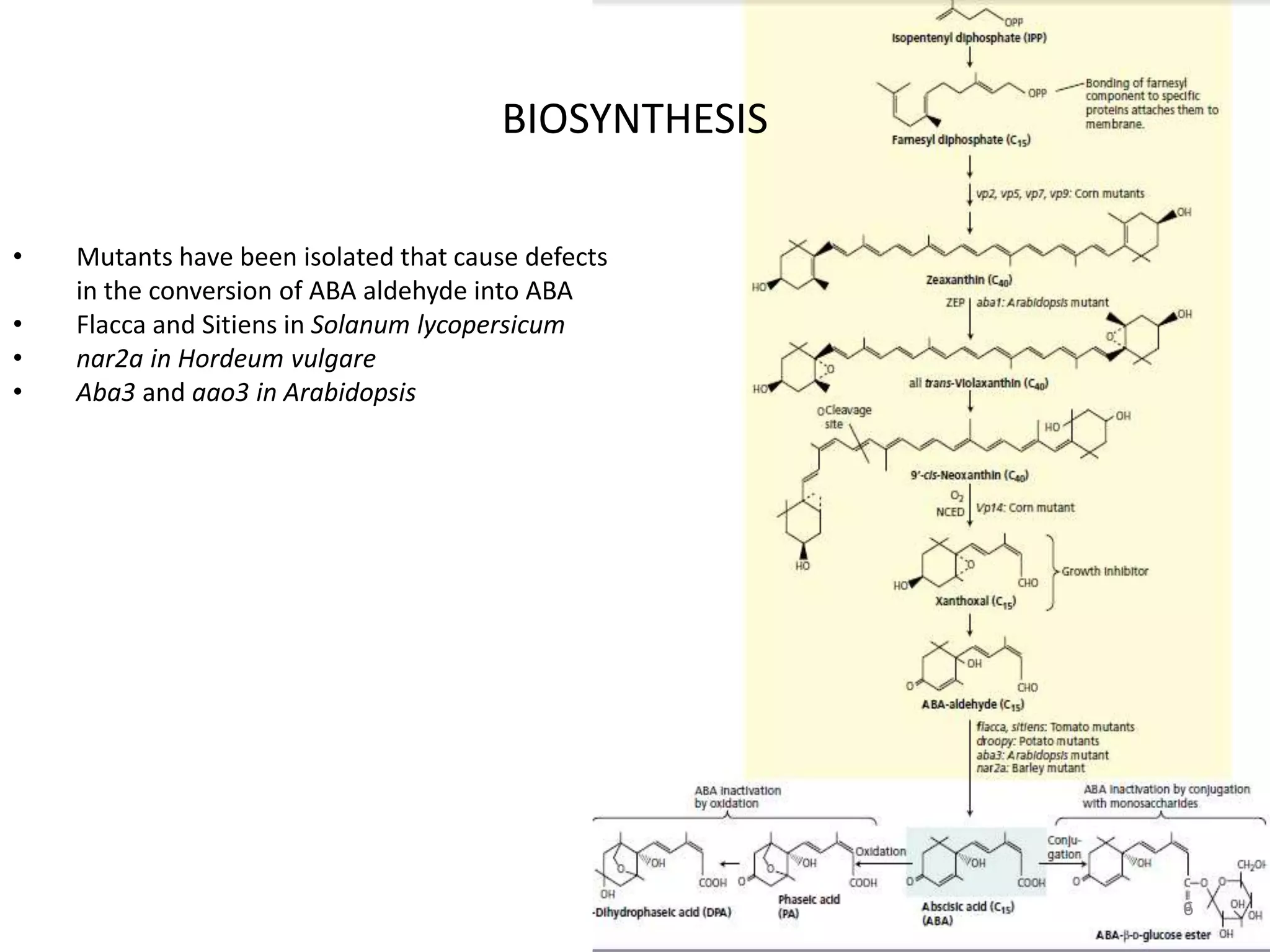
• Initial stages occur in the plastids, where isopentenyl diphosphate (IPP) is converted to the
C40 xanthophyll zeaxanthin
• Zeaxanthin is further modified to 9-cisneoxanthin which is cleaved by the enzyme NCED (9-cis
epoxycarotenoid dioxygenase) to form the C15 inhibitor, xanthoxal
• Xanthoxal is then converted to ABA in the cytosol
5
BIOSYNTHESIS
• Mutants have been isolated that cause defects
in the conversion of ABA aldehyde into ABA
• Flacca and Sitiens in Solanum lycopersicum
• nar2a in Hordeum vulgare
• Aba3 and aao3 in Arabidopsis
6
DEVELOPMENTAL AND PHYSIOLOGICAL ROLE OF ABA
• Promotes stomatal closing.
• Induces bud dormancy and seed dormancy.
• Promotes desiccation tolerance in the embryo.
• Inhibits precocious germination and vivipary
• Promotes root growth and inhibits shoot growth in stressed water condition
• Leaf Senescence
7
PROMOTES STOMATAL CLOSING
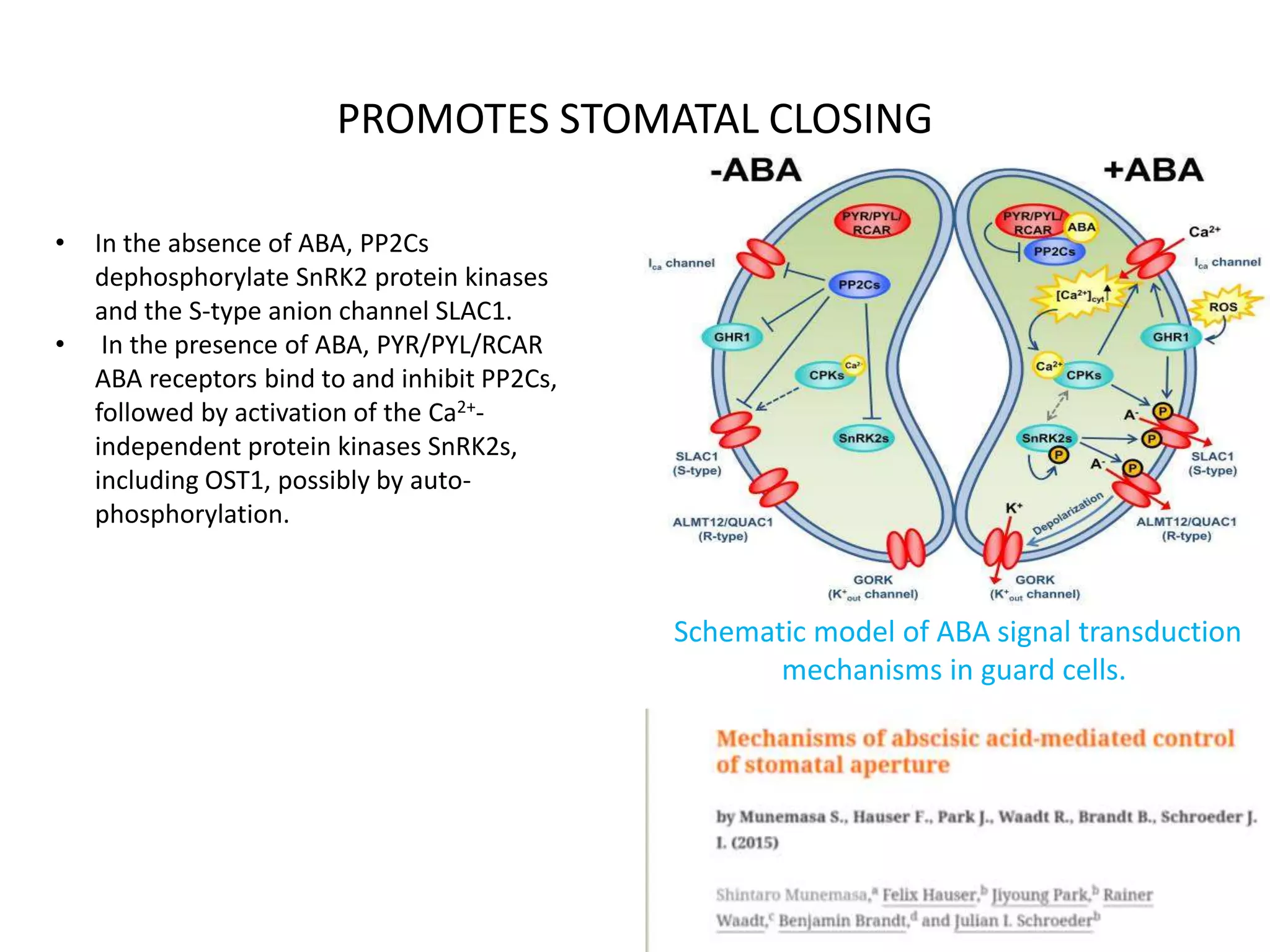
• In the absence of ABA, PP2Cs
dephosphorylate SnRK2 protein kinases
and the S-type anion channel SLAC1.
• In the presence of ABA, PYR/PYL/RCAR
ABA receptors bind to and inhibit PP2Cs,
followed by activation of the Ca2+-
independent protein kinases SnRK2s,
including OST1, possibly by auto-
phosphorylation.
8
Schematic model of ABA signal transduction
mechanisms in guard cells.
PROMOTES STOMATAL CLOSING
• Hyperpolarization-dependent Ca2+-permeable cation (ICa) channels are released from PP2C-
dependent down regulation, resulting in ABA-responsive [Ca2+]cyt increases that activate
CPKs. CPKs also are required for activation of ICa channels.
• ABA-induced Ca2+ release from intracellular Ca2+ stores is not shown in this figure for
simplicity and due to the need to further characterize the detailed signaling mechanisms.
• The active SnRK2s and CPKs phosphorylate SLAC1 with preferential affinities at different sites
and activate the channel.
• The SnRK2 protein kinase OST1 also phosphorylates and activates the R-type anion channel
ALMT12/QUAC1. In planta roles of CPKs and PP2Cs in ALMT12/QUAC1 regulation and
possible direct cross-regulation of CPKs and SnRK2s need to be further investigated.
Activation of the two types of anion channels causes sustained plasma membrane
depolarization, which drives K+ efflux through the voltage-dependent outward K+ (K+
out)
channel GORK. The loss of K+ and anion leads to guard cell turgor decrease and stomatal
closure.
9
INDUCES SEED DORMANCY
• Growth of the seed suspended -“dormant seeds”.
• Controlled by the ratio of ABA to GA
• Embryo dormancy is due to the presence of inhibitors, especially ABA, as well as the absence
of growth promoters, such as GA.
• The loss of embryo dormancy is often associated with a sharp drop in the ratio of ABA to GA
10
INDUCE DORMANCY OF BUDS
• Dormant bud - shortened internodes and specially
modified leaves – “BUD SCALES”
• Most of the trees - buds formed late summer and
remain dormant throughout winter.
• Levels of endogenous ABA is high
• Herbaceous plants - eg. Potato
11
Bud dormancy in potato
Terminal and auxiliary bud
dormancy
PROMOTES DESICCATION TOLERANCE IN THE EMBRYO
• An important function of ABA -developing seed -desiccation tolerance.
• Levels of ABA in seeds peak during embryogenesis.
• During the mid- to late stages of seed development, specific mRNAs accumulate in embryos.
• These mRNAs encode so-called late-embryogenesisabundant (LEA) proteins.
• Synthesis of many LEA proteins induced by ABA treatment.
12
INHIBITS PRECOCIOUS GERMINATION AND VIVIPARY
• When immature embryos are removed from their seeds and placed in culture medium they germinate
precociously
• ABA added to the culture medium inhibits precocious germination
• This result, in combination with the fact that the level of endogenous ABA is high during mid- to late
seed development, suggests that ABA is the natural constraint that keeps developing embryos in their
embryogenic state.
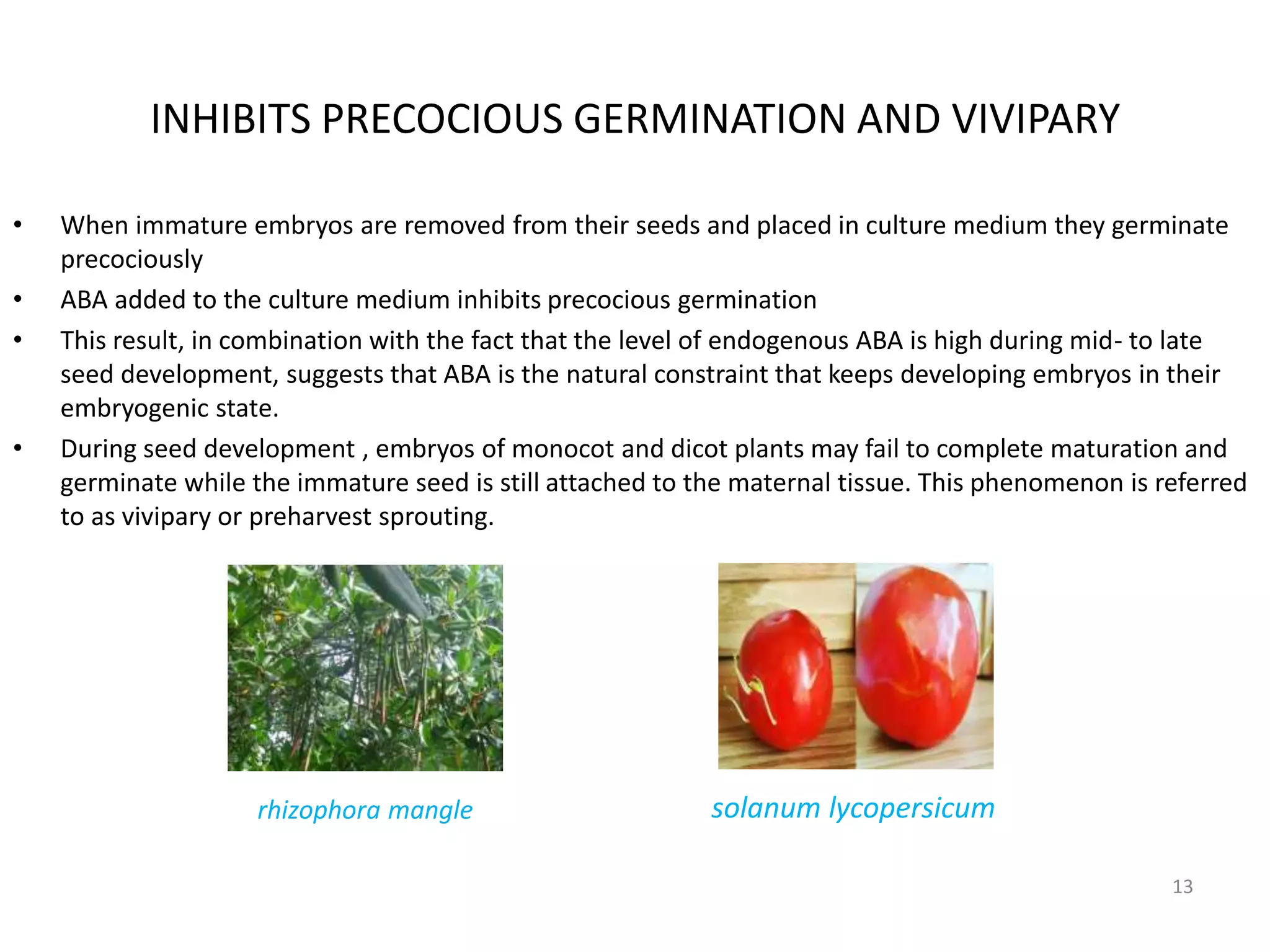
• During seed development , embryos of monocot and dicot plants may fail to complete maturation and
germinate while the immature seed is still attached to the maternal tissue. This phenomenon is referred
to as vivipary or preharvest sprouting.
13
rhizophora mangle solanum lycopersicum
INHIBITS PRECOCIOUS GERMINATION AND VIVIPARY
• In maize, several viviparous (vp) mutants have been selected in
which the embryos germinate directly on the cob while still
attached to the plant
• Vivipary in the ABA-deficient mutants can be partially
prevented by treatment with exogenous ABA
14
Precocious germination in the ABA-
deficient
vp14 mutant of maize.
SHOOT AND ROOT GROWTH
• ABA has different effects on the growth of roots and shoots, and the effects are strongly
dependent on the water status of the plant.
• Maize :
• Two types of seedlings were used
(1) wild-type seedlings with normal ABA levels
(2) an ABA-deficient, viviparous mutant
• This suggests that
• 1. Endogenous ABA promotes shoot growth in well watered plants.
• 2. Endogenous ABA acts as a signal to reduce shoot growth only under waterstressed
conditions
15
LEAF SENESCENCE
• The deteriorative processes that naturally terminate their functional life referred to as
“senescence”.
• Expression of senescence associated genes (SAGs) increases
• Hydrolytic enzymes- proteases, ribonucleases, lipases
• ABA involved in “senescence of leaves” but not the abscission of leaves
16
Senescence in different types of leaf
17

Abscisic acid biosynthesis and function

  • 1.
    Abscisic acid inPlants By:Debajyoti Behera 1
  • 2.
    CONTENTS • Chemical composition •Occurrence and distribution • Biosynthesis • Role of Abscisic Acid 2
  • 3.
    CHEMICAL COMPOSITION • ABAis a 15-C Sesquiterpene compound • Composed of three isoprene residues • Cyclohexane ring with keto, one hydroxyl group, a side chain with a terminal carboxylic group. • Chemical name Abscisic acid; (2- cis,4-trans)-5-(1-Hydroxy-2,6,6- trimethyl-4-oxo-2-cyclohexen-1-yl)-3- methyl-2,4-pentadienoic acid. 3
  • 4.
    OCCURRENCE AND DISTRIBUTION •ABA is a ubiquitous plant hormone in vascular plants • In bryophytes it has been found in mosses but not in liverworts. • Some fungi synthesize ABA as secondary metabolite • A 15-C compound called lunularic acid has been found in algae and liverworts • ABA is synthesized in all types of cells that contain chloroplasts or other plastids • It occurs predominantly in mature green leaves • ABA has been detected in all major organs or living tissues from root caps to apical buds • Phloem sap, xylem sap and in nectar 4 Botrytis Cinerea Funaria
  • 5.
    BIOSYNTHESIS • Initial stagesoccur in the plastids, where isopentenyl diphosphate (IPP) is converted to the C40 xanthophyll zeaxanthin • Zeaxanthin is further modified to 9-cisneoxanthin which is cleaved by the enzyme NCED (9-cis epoxycarotenoid dioxygenase) to form the C15 inhibitor, xanthoxal • Xanthoxal is then converted to ABA in the cytosol 5
  • 6.
    BIOSYNTHESIS • Mutants havebeen isolated that cause defects in the conversion of ABA aldehyde into ABA • Flacca and Sitiens in Solanum lycopersicum • nar2a in Hordeum vulgare • Aba3 and aao3 in Arabidopsis 6
  • 7.
    DEVELOPMENTAL AND PHYSIOLOGICALROLE OF ABA • Promotes stomatal closing. • Induces bud dormancy and seed dormancy. • Promotes desiccation tolerance in the embryo. • Inhibits precocious germination and vivipary • Promotes root growth and inhibits shoot growth in stressed water condition • Leaf Senescence 7
  • 8.
    PROMOTES STOMATAL CLOSING •In the absence of ABA, PP2Cs dephosphorylate SnRK2 protein kinases and the S-type anion channel SLAC1. • In the presence of ABA, PYR/PYL/RCAR ABA receptors bind to and inhibit PP2Cs, followed by activation of the Ca2+- independent protein kinases SnRK2s, including OST1, possibly by auto- phosphorylation. 8 Schematic model of ABA signal transduction mechanisms in guard cells.
  • 9.
    PROMOTES STOMATAL CLOSING •Hyperpolarization-dependent Ca2+-permeable cation (ICa) channels are released from PP2C- dependent down regulation, resulting in ABA-responsive [Ca2+]cyt increases that activate CPKs. CPKs also are required for activation of ICa channels. • ABA-induced Ca2+ release from intracellular Ca2+ stores is not shown in this figure for simplicity and due to the need to further characterize the detailed signaling mechanisms. • The active SnRK2s and CPKs phosphorylate SLAC1 with preferential affinities at different sites and activate the channel. • The SnRK2 protein kinase OST1 also phosphorylates and activates the R-type anion channel ALMT12/QUAC1. In planta roles of CPKs and PP2Cs in ALMT12/QUAC1 regulation and possible direct cross-regulation of CPKs and SnRK2s need to be further investigated. Activation of the two types of anion channels causes sustained plasma membrane depolarization, which drives K+ efflux through the voltage-dependent outward K+ (K+ out) channel GORK. The loss of K+ and anion leads to guard cell turgor decrease and stomatal closure. 9
  • 10.
    INDUCES SEED DORMANCY •Growth of the seed suspended -“dormant seeds”. • Controlled by the ratio of ABA to GA • Embryo dormancy is due to the presence of inhibitors, especially ABA, as well as the absence of growth promoters, such as GA. • The loss of embryo dormancy is often associated with a sharp drop in the ratio of ABA to GA 10
  • 11.
    INDUCE DORMANCY OFBUDS • Dormant bud - shortened internodes and specially modified leaves – “BUD SCALES” • Most of the trees - buds formed late summer and remain dormant throughout winter. • Levels of endogenous ABA is high • Herbaceous plants - eg. Potato 11 Bud dormancy in potato Terminal and auxiliary bud dormancy
  • 12.
    PROMOTES DESICCATION TOLERANCEIN THE EMBRYO • An important function of ABA -developing seed -desiccation tolerance. • Levels of ABA in seeds peak during embryogenesis. • During the mid- to late stages of seed development, specific mRNAs accumulate in embryos. • These mRNAs encode so-called late-embryogenesisabundant (LEA) proteins. • Synthesis of many LEA proteins induced by ABA treatment. 12
  • 13.
    INHIBITS PRECOCIOUS GERMINATIONAND VIVIPARY • When immature embryos are removed from their seeds and placed in culture medium they germinate precociously • ABA added to the culture medium inhibits precocious germination • This result, in combination with the fact that the level of endogenous ABA is high during mid- to late seed development, suggests that ABA is the natural constraint that keeps developing embryos in their embryogenic state. • During seed development , embryos of monocot and dicot plants may fail to complete maturation and germinate while the immature seed is still attached to the maternal tissue. This phenomenon is referred to as vivipary or preharvest sprouting. 13 rhizophora mangle solanum lycopersicum
  • 14.
    INHIBITS PRECOCIOUS GERMINATIONAND VIVIPARY • In maize, several viviparous (vp) mutants have been selected in which the embryos germinate directly on the cob while still attached to the plant • Vivipary in the ABA-deficient mutants can be partially prevented by treatment with exogenous ABA 14 Precocious germination in the ABA- deficient vp14 mutant of maize.
  • 15.
    SHOOT AND ROOTGROWTH • ABA has different effects on the growth of roots and shoots, and the effects are strongly dependent on the water status of the plant. • Maize : • Two types of seedlings were used (1) wild-type seedlings with normal ABA levels (2) an ABA-deficient, viviparous mutant • This suggests that • 1. Endogenous ABA promotes shoot growth in well watered plants. • 2. Endogenous ABA acts as a signal to reduce shoot growth only under waterstressed conditions 15
  • 16.
    LEAF SENESCENCE • Thedeteriorative processes that naturally terminate their functional life referred to as “senescence”. • Expression of senescence associated genes (SAGs) increases • Hydrolytic enzymes- proteases, ribonucleases, lipases • ABA involved in “senescence of leaves” but not the abscission of leaves 16 Senescence in different types of leaf
  • 17.