
SIP & its application
What is SIP
(Session Initiation Protocol) ?

 • A signaling protocol for setting up multimedia sessions
   between endpoints .
 • SIP is end-to-end, client-server session signaling protocol
   similar to HTTP.
 • SIP designed in line with other Internet protocols by the
   IETF.
SIP Basic Functionality
    Supports 5 facets of communication:
•   User location: determination of the end system to be used for
    communication;
•   User capabilities: determination of the media and media
    parameters to be used;
•   User availability: determination of the willingness of the
    called party to engage in communications;
•   Call setup: "ringing", establishment of call parameters at both
    called and calling party;
•   Call handling: including transfer and termination of calls.
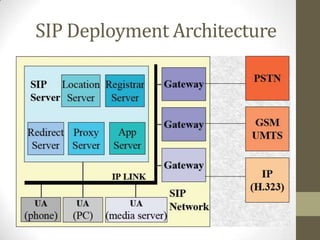
SIP Deployment Architecture
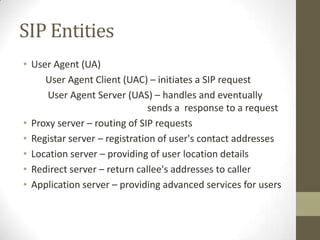
SIP Entities
• User Agent (UA)
     User Agent Client (UAC) – initiates a SIP request
     User Agent Server (UAS) – handles and eventually
                               sends a response to a request
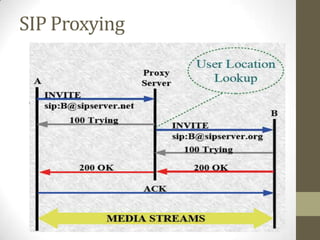
• Proxy server – routing of SIP requests
• Registar server – registration of user's contact addresses
• Location server – providing of user location details
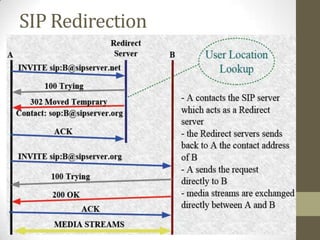
• Redirect server – return callee's addresses to caller
• Application server – providing advanced services for users
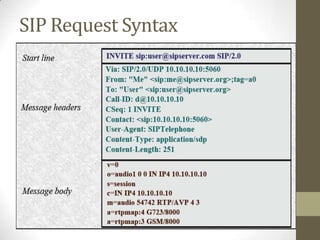
SIP Request Syntax
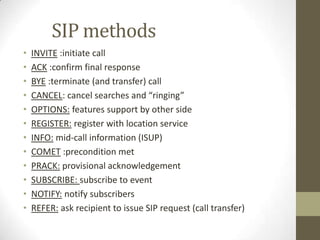
SIP methods
•   INVITE :initiate call
•   ACK :confirm final response
•   BYE :terminate (and transfer) call
•   CANCEL: cancel searches and “ringing”
•   OPTIONS: features support by other side
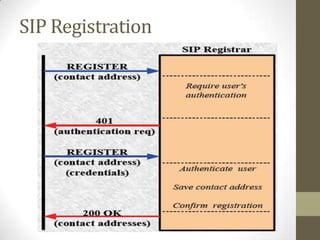
•   REGISTER: register with location service
•   INFO: mid-call information (ISUP)
•   COMET :precondition met
•   PRACK: provisional acknowledgement
•   SUBSCRIBE: subscribe to event
•   NOTIFY: notify subscribers
•   REFER: ask recipient to issue SIP request (call transfer)
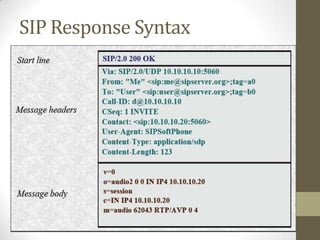
SIP Response Syntax
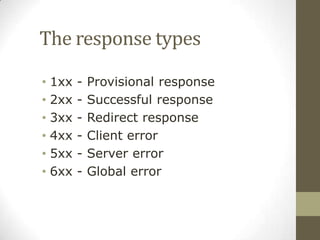
The response types

• 1xx   -   Provisional response
• 2xx   -   Successful response
• 3xx   -   Redirect response
• 4xx   -   Client error
• 5xx   -   Server error
• 6xx   -   Global error
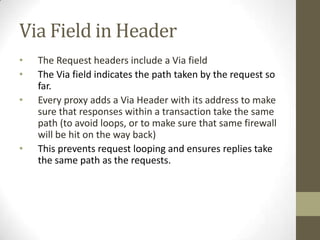
Via Field in Header
•   The Request headers include a Via field
•   The Via field indicates the path taken by the request so
    far.
•   Every proxy adds a Via Header with its address to make
    sure that responses within a transaction take the same
    path (to avoid loops, or to make sure that same firewall
    will be hit on the way back)
•   This prevents request looping and ensures replies take
    the same path as the requests.
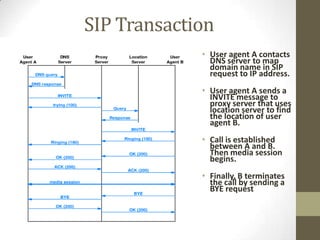
SIP Transaction
             • User agent A contacts
               DNS server to map
               domain name in SIP
               request to IP address.
             • User agent A sends a
               INVITE message to
               proxy server that uses
               location server to find
               the location of user
               agent B.
             • Call is established
               between A and B.
               Then media session
               begins.
             • Finally, B terminates
               the call by sending a
               BYE request
SIP Registration
SIP Proxying
SIP Redirection
Instant Messaging and SIMPLE
• Session Initiation Protocol for Instant Messaging
  and Presence Leveraging Extensions.
• Instant messaging (IM) ,the most common and
  popular methods of communicating over IP
  networks.
• IM applications:-
■ AIM, America Online Instant Messenger
■ Google talk
■ Yahoo Messenger
■ MSN Messenger
WHAT IS VOIP
• Voice over IP (VoIP) is any technology that facilitates the voice
  communication and video conferencing uses live images and
  sound, over an IP network, such as the Internet.

• The two (or more) endpoints - often referred to as terminals
  or clients - could be any device with a microphone and
  speaker, such as a normal PC computer or something
  resembling a traditional phone.

• Session Initiation Protocol (SIP) is standard used in Voice over
  IP (VoIP).
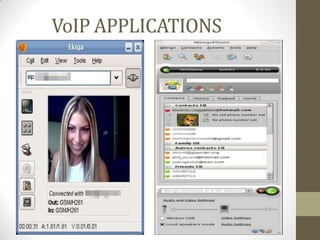
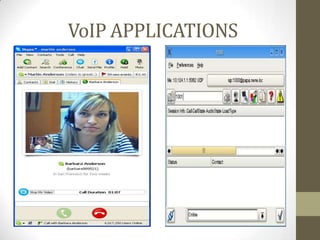
VoIP APPLICATIONS
VoIP APPLICATIONS
References
• RFC 2543: “SIP: Session Initiation Protocol”
   http://www.cis.ohio-state.edu/cgi-bin/rfc/rfc2543.html
• Papers on IP Telephony
  http://www.cs.columbia.edu/~hgs/sip/papers.html
• http://www.iptel.org/sip
• http://www.cs.columbia.edu/sip/
• http://www.iptel.org/sip/
Thank You

Sip & its application

  • 1.
    SIP & itsapplication
  • 2.
    What is SIP (SessionInitiation Protocol) ? • A signaling protocol for setting up multimedia sessions between endpoints . • SIP is end-to-end, client-server session signaling protocol similar to HTTP. • SIP designed in line with other Internet protocols by the IETF.
  • 3.
    SIP Basic Functionality Supports 5 facets of communication: • User location: determination of the end system to be used for communication; • User capabilities: determination of the media and media parameters to be used; • User availability: determination of the willingness of the called party to engage in communications; • Call setup: "ringing", establishment of call parameters at both called and calling party; • Call handling: including transfer and termination of calls.
  • 4.
  • 5.
    SIP Entities • UserAgent (UA) User Agent Client (UAC) – initiates a SIP request User Agent Server (UAS) – handles and eventually sends a response to a request • Proxy server – routing of SIP requests • Registar server – registration of user's contact addresses • Location server – providing of user location details • Redirect server – return callee's addresses to caller • Application server – providing advanced services for users
  • 6.
  • 7.
    SIP methods • INVITE :initiate call • ACK :confirm final response • BYE :terminate (and transfer) call • CANCEL: cancel searches and “ringing” • OPTIONS: features support by other side • REGISTER: register with location service • INFO: mid-call information (ISUP) • COMET :precondition met • PRACK: provisional acknowledgement • SUBSCRIBE: subscribe to event • NOTIFY: notify subscribers • REFER: ask recipient to issue SIP request (call transfer)
  • 8.
  • 9.
    The response types •1xx - Provisional response • 2xx - Successful response • 3xx - Redirect response • 4xx - Client error • 5xx - Server error • 6xx - Global error
  • 10.
    Via Field inHeader • The Request headers include a Via field • The Via field indicates the path taken by the request so far. • Every proxy adds a Via Header with its address to make sure that responses within a transaction take the same path (to avoid loops, or to make sure that same firewall will be hit on the way back) • This prevents request looping and ensures replies take the same path as the requests.
  • 11.
    SIP Transaction • User agent A contacts DNS server to map domain name in SIP request to IP address. • User agent A sends a INVITE message to proxy server that uses location server to find the location of user agent B. • Call is established between A and B. Then media session begins. • Finally, B terminates the call by sending a BYE request
  • 12.
  • 13.
  • 14.
  • 15.
    Instant Messaging andSIMPLE • Session Initiation Protocol for Instant Messaging and Presence Leveraging Extensions. • Instant messaging (IM) ,the most common and popular methods of communicating over IP networks. • IM applications:- ■ AIM, America Online Instant Messenger ■ Google talk ■ Yahoo Messenger ■ MSN Messenger
  • 16.
    WHAT IS VOIP •Voice over IP (VoIP) is any technology that facilitates the voice communication and video conferencing uses live images and sound, over an IP network, such as the Internet. • The two (or more) endpoints - often referred to as terminals or clients - could be any device with a microphone and speaker, such as a normal PC computer or something resembling a traditional phone. • Session Initiation Protocol (SIP) is standard used in Voice over IP (VoIP).
  • 17.
  • 18.
  • 19.
    References • RFC 2543:“SIP: Session Initiation Protocol” http://www.cis.ohio-state.edu/cgi-bin/rfc/rfc2543.html • Papers on IP Telephony http://www.cs.columbia.edu/~hgs/sip/papers.html • http://www.iptel.org/sip • http://www.cs.columbia.edu/sip/ • http://www.iptel.org/sip/
  • 20.