NGN_SP004_E1
SIP Introduction
Objectives
 Upon the completion of this chapter, you should
be able to understand :
 Network entities defined by SIP
 Addressing solution defined by SIP
 Commands defined by SIP
 Communication mechanism defined by SIP
 Simple call Scenario flow
Outline
 SIP introduction
 SIP components
 SIP message structure
 Call scenario analysis
 SIP-T introduction
 SIP/H323 comparison
RTCP
RTP
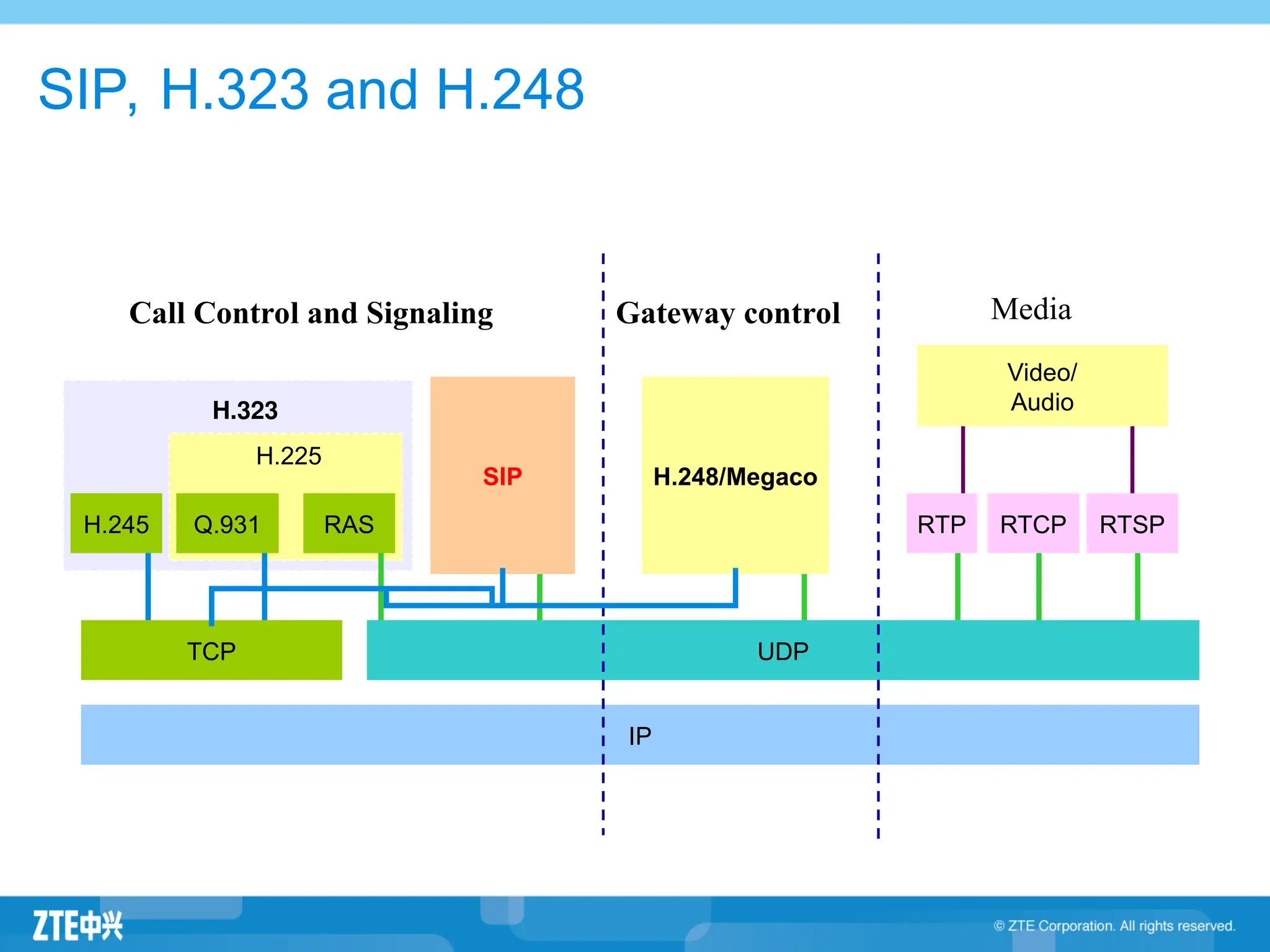
SIP, H.323 and H.248
IP
H.248/Megaco
Call Control and Signaling Gateway control Media
H.225
Q.931
H.323
TCP
RAS
UDP
SIP
H.245
Video/
Audio
RTSP
What is SIP?
“
”
SIP: Session Initiation Protocol
SIP is a multimedia communication protocol established
by IETF. It is a text-based application-layer control protocol
independent of lower-layer protocols, designed to establish,
modify and terminate two-party or multi-party multimedia
sessions over the IP network.
What is SIP?
“
”
SIP was firstly researched by the MMUSIC IETF
workgroup in 1995 and recommended to be a standard by
IETF in 1999.
SIP uses HTTP and SMTP protocols.
SIP is still developing now. Relevant equipment vendors
and service providers have created an SIP forum:
www.sipforum.org
Outline
 SIP introduction
 SIP components
 SIP message structure
 Call scenario analysis
 SIP-T introduction
 SIP/H323 comparison
Redirect
Server
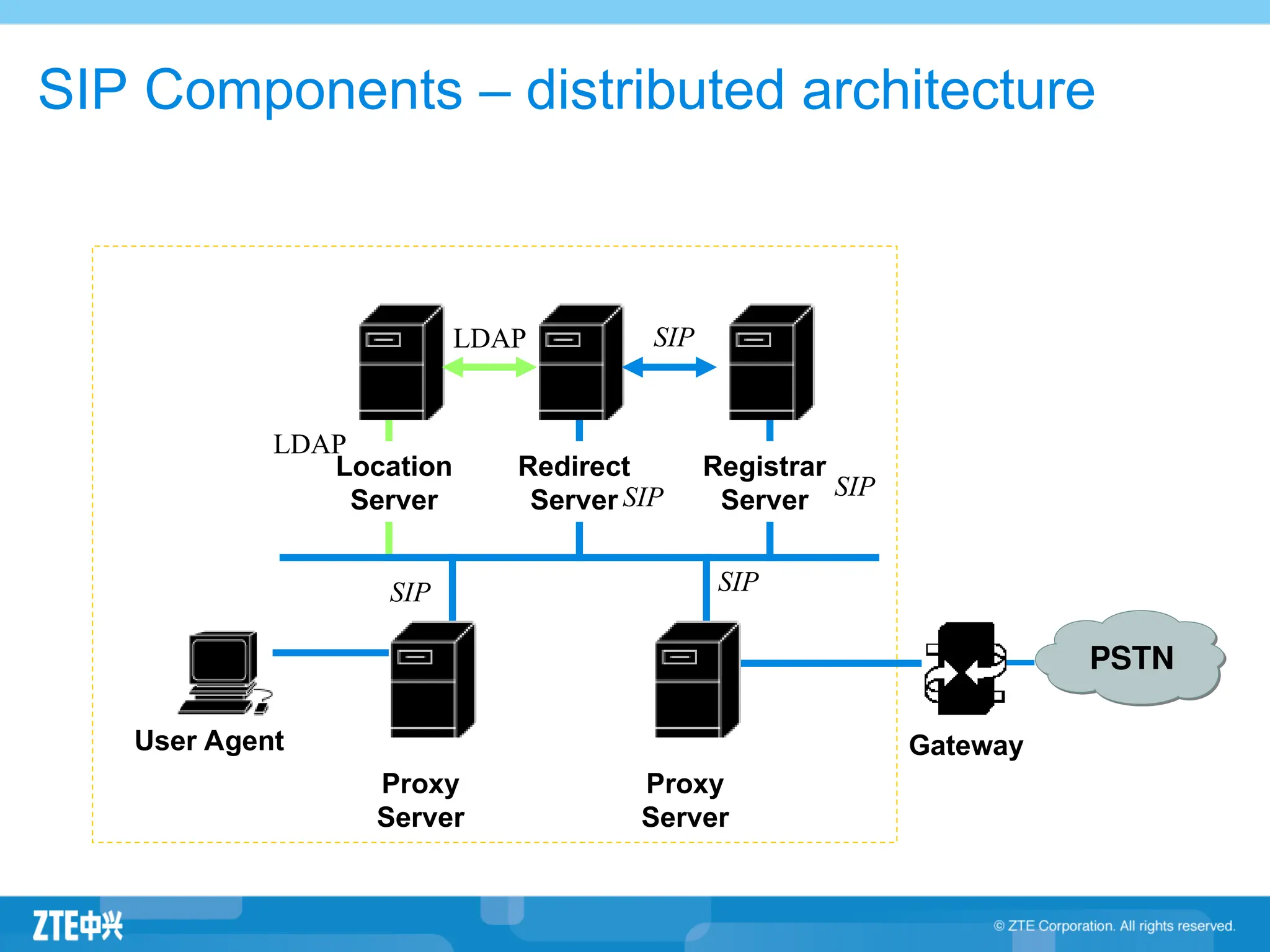
SIP Components – distributed architecture
Location
Server
Registrar
Server
User Agent
Proxy
Server
Gateway
PSTN
Proxy
Server
SIP
SIP SIP
SIP SIP
LDAP
LDAP
Basic SIP components (1/5)
 User agents
 User agent client (UAC)

A user agent client is a logical entity that creates a
new request, and then uses the client transaction
state machinery to send it.
 User agent server (UAS)

A user agent server is a logical entity that generates a
response to a SIP request. The response accepts,
rejects, or redirects the request.
Basic SIP components (2/5)
 Network servers
 Redirect server

reduce the processing load on proxy servers

improve signaling path robustness

push routing information for a request back in a
response to the client
Basic SIP components (3/5)
 Network Servers
 Proxy server

An intermediary entity that acts as both a server and a
client for the purpose of making requests on behalf of
other clients

ensure that a request is sent to another entity "closer"
to the targeted user
Basic SIP components (4/5)
 Network servers
 Registrar server

accepts REGISTER requests

places the information it receives in those requests
into the location service
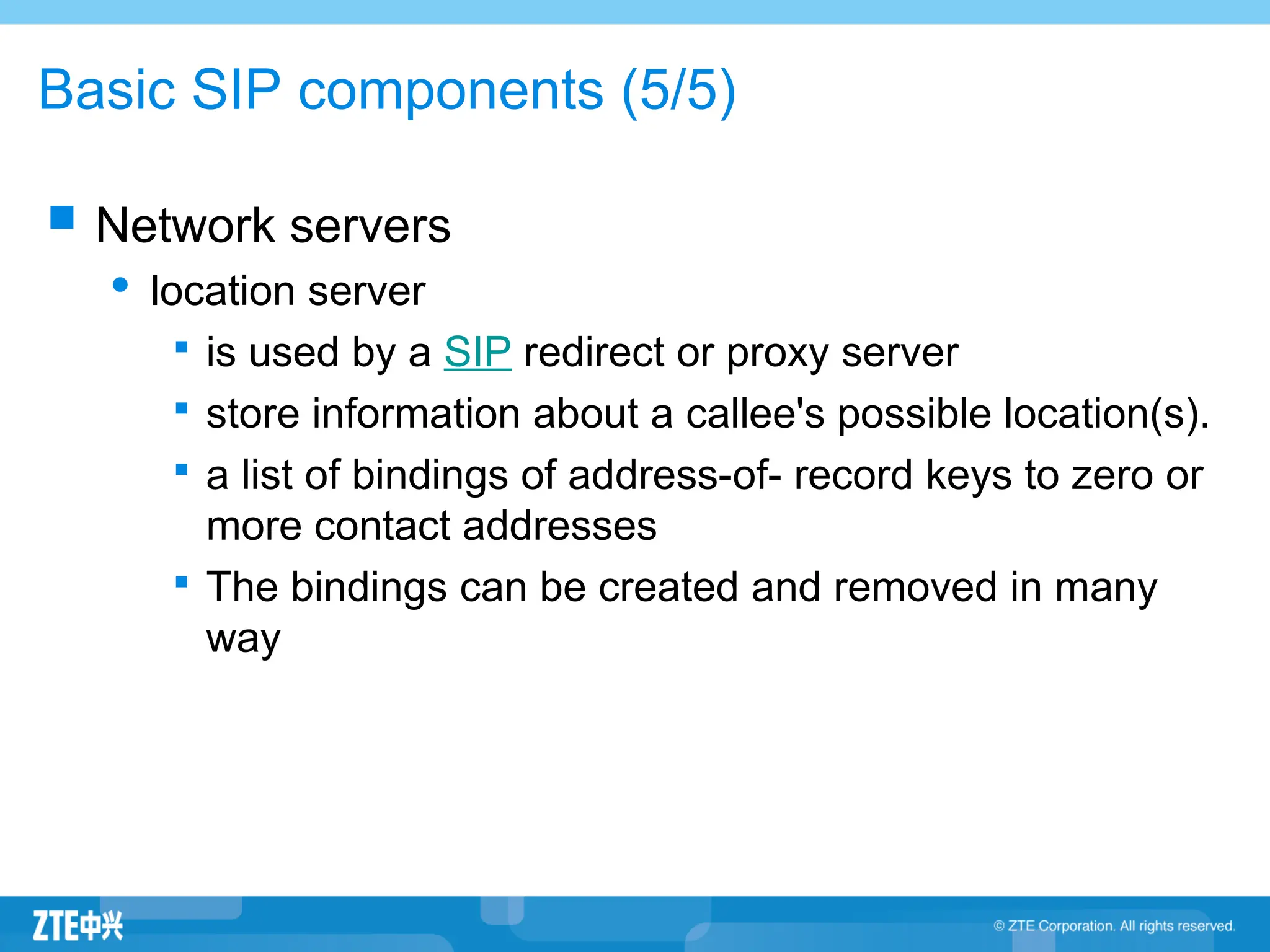
Basic SIP components (5/5)
 Network servers
 location server

is used by a SIP redirect or proxy server

store information about a callee's possible location(s).

a list of bindings of address-of- record keys to zero or
more contact addresses

The bindings can be created and removed in many
way
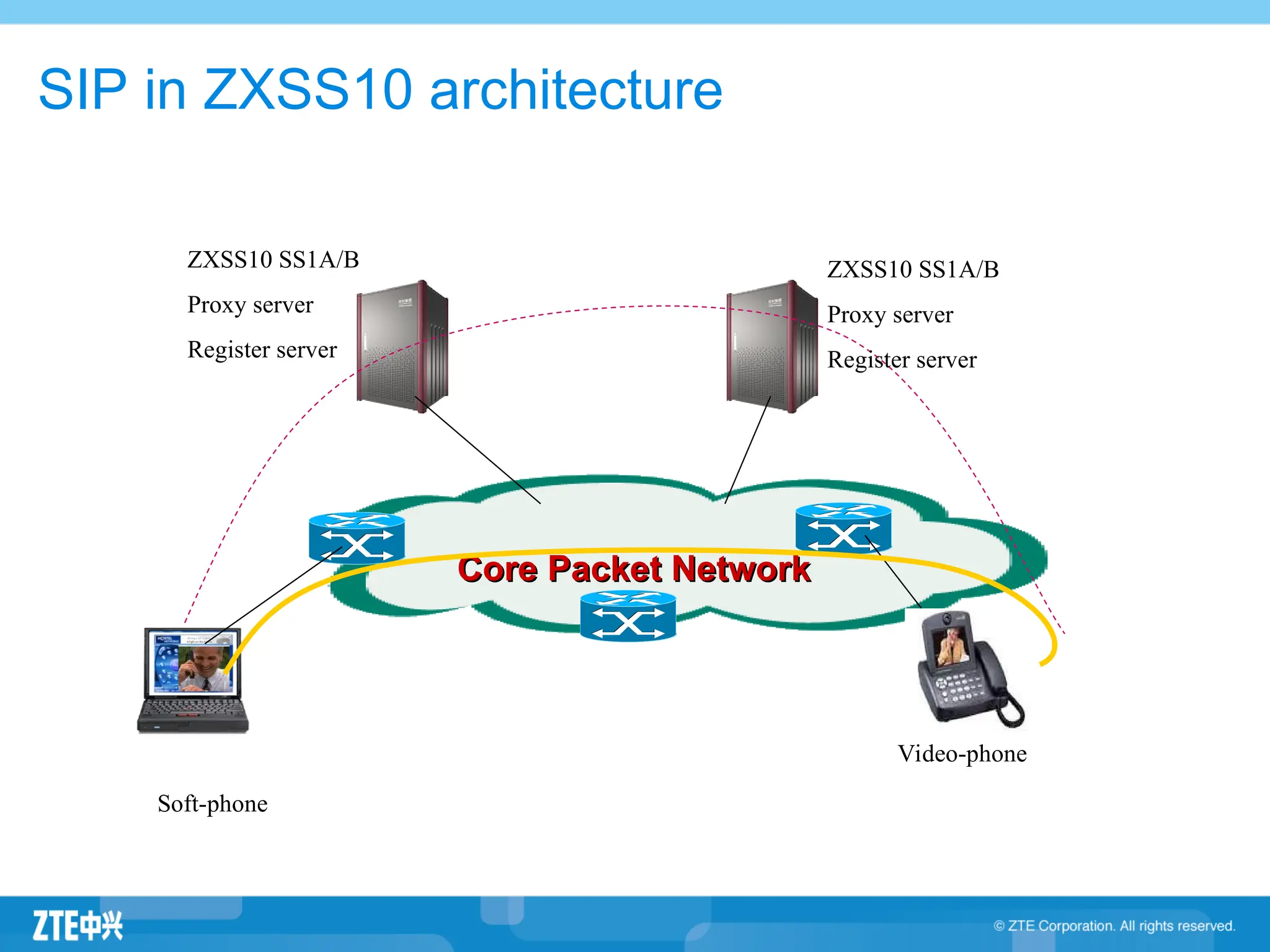
SIP in ZXSS10 architecture
Core Packet Network
Core Packet Network
ZXSS10 SS1A/B
Proxy server
Register server
Soft-phone
Video-phone
ZXSS10 SS1A/B
Proxy server
Register server
Outline
 SIP introduction
 SIP components
 SIP message structure
 Call scenario analysis
 SIP-T introduction
 SIP/H323 comparison
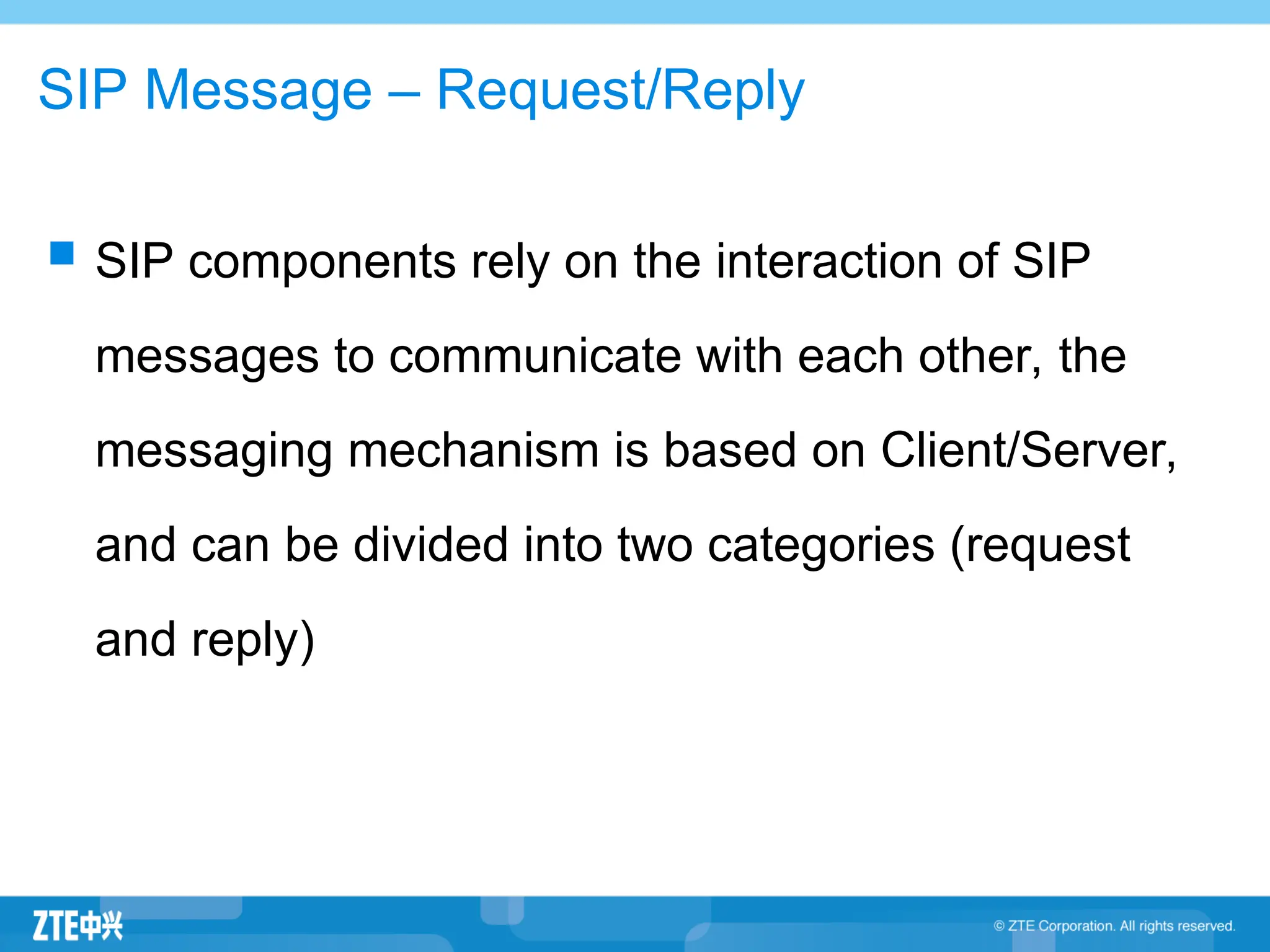
SIP Message – Request/Reply
 SIP components rely on the interaction of SIP
messages to communicate with each other, the
messaging mechanism is based on Client/Server,
and can be divided into two categories (request
and reply)
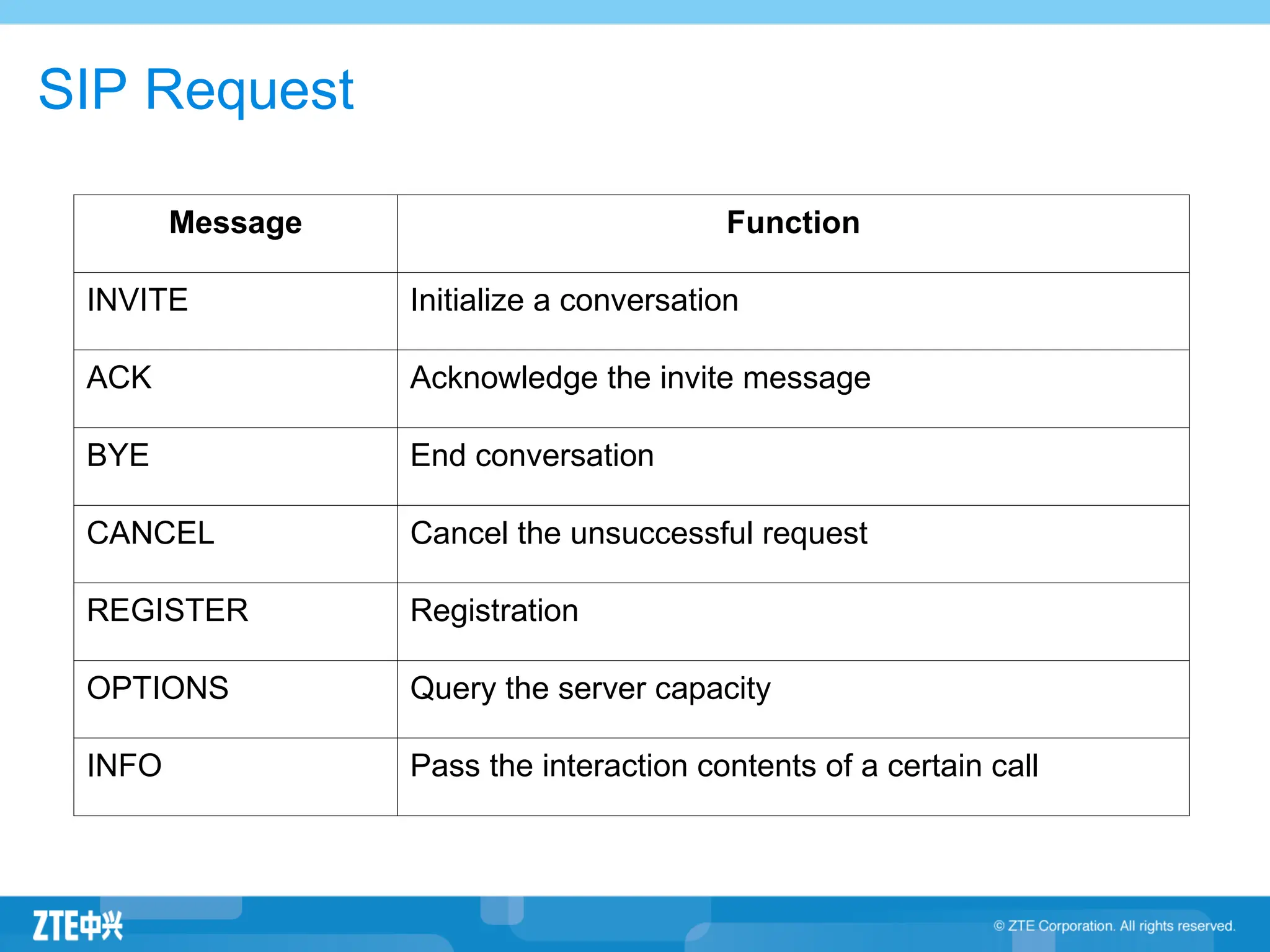
SIP Request
Message Function
INVITE Initialize a conversation
ACK Acknowledge the invite message
BYE End conversation
CANCEL Cancel the unsuccessful request
REGISTER Registration
OPTIONS Query the server capacity
INFO Pass the interaction contents of a certain call
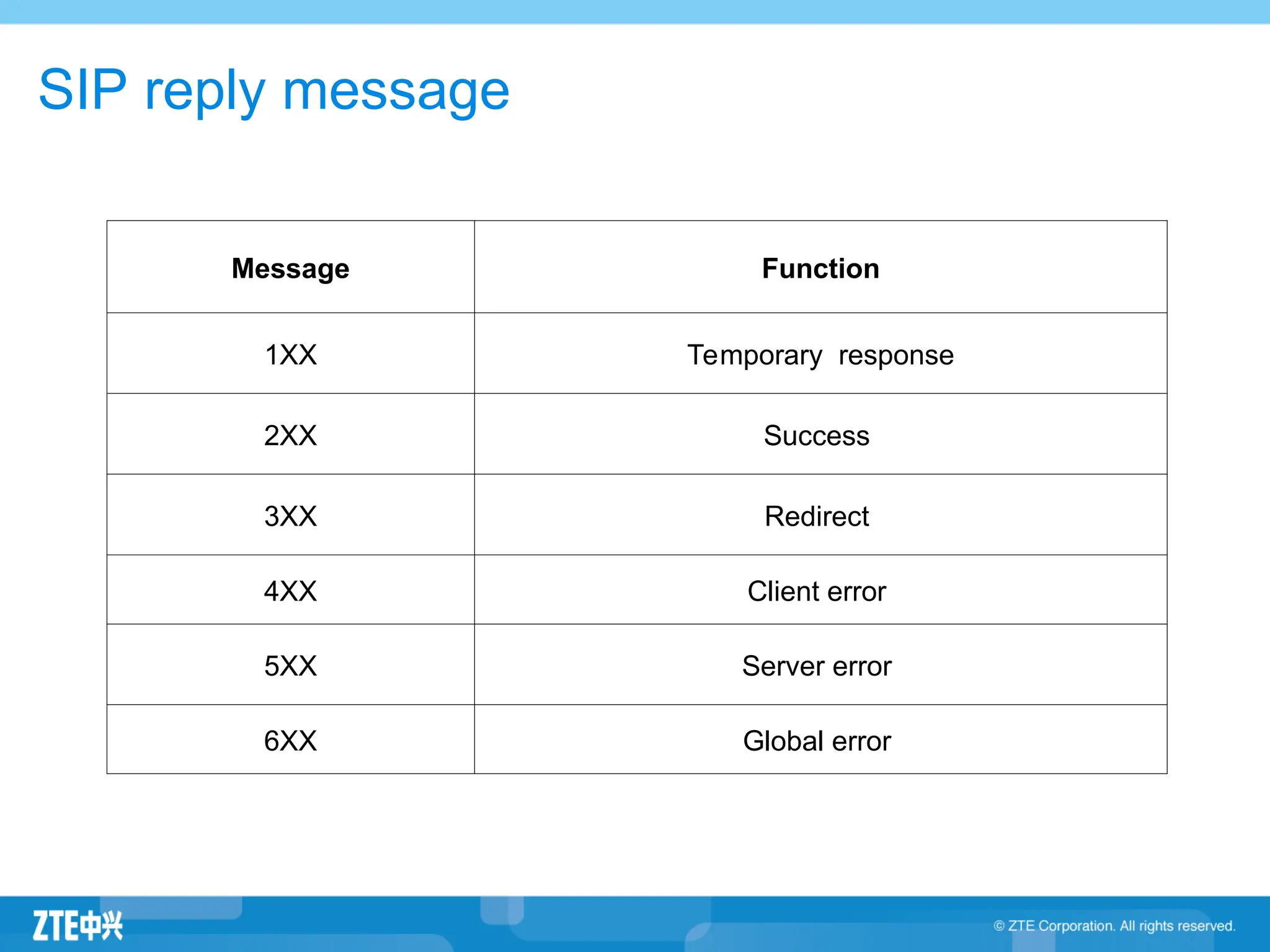
SIP reply message
Message Function
1XX Temporary response
2XX Success
3XX Redirect
4XX Client error
5XX Server error
6XX Global error
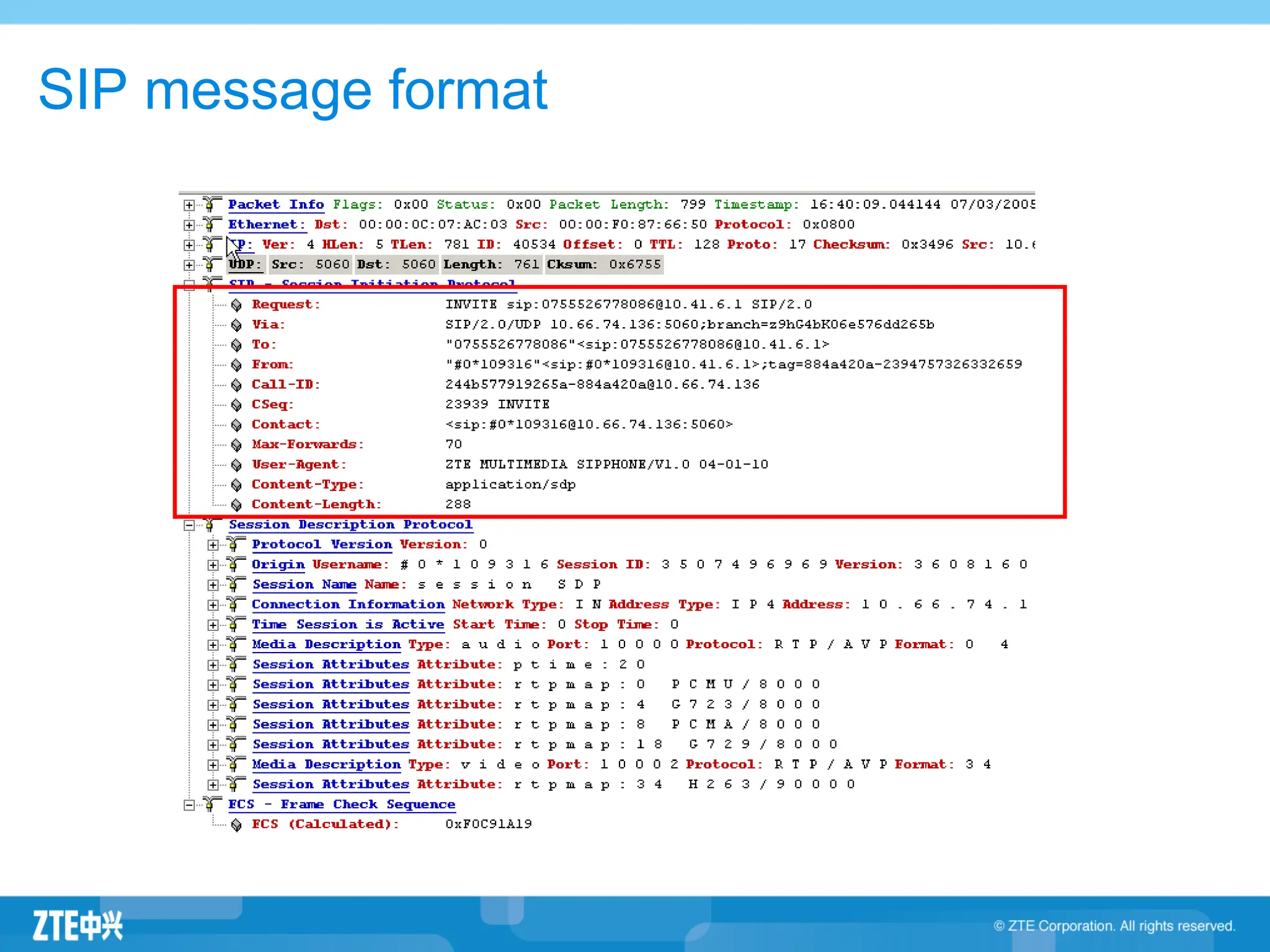
SIP message format
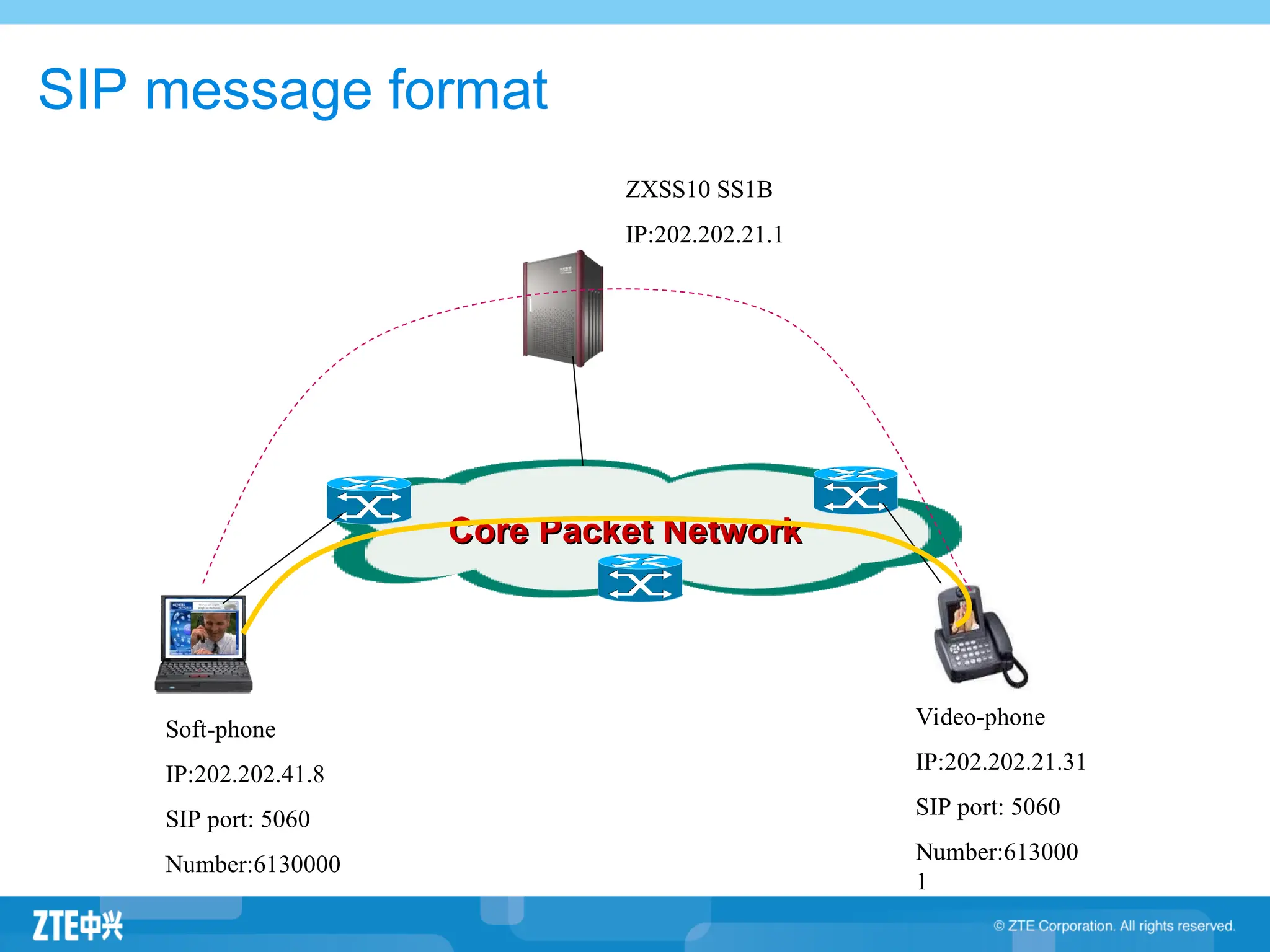
SIP message format
Core Packet Network
Core Packet Network
ZXSS10 SS1B
IP:202.202.21.1
Soft-phone
IP:202.202.41.8
SIP port: 5060
Number:6130000
Video-phone
IP:202.202.21.31
SIP port: 5060
Number:613000
1
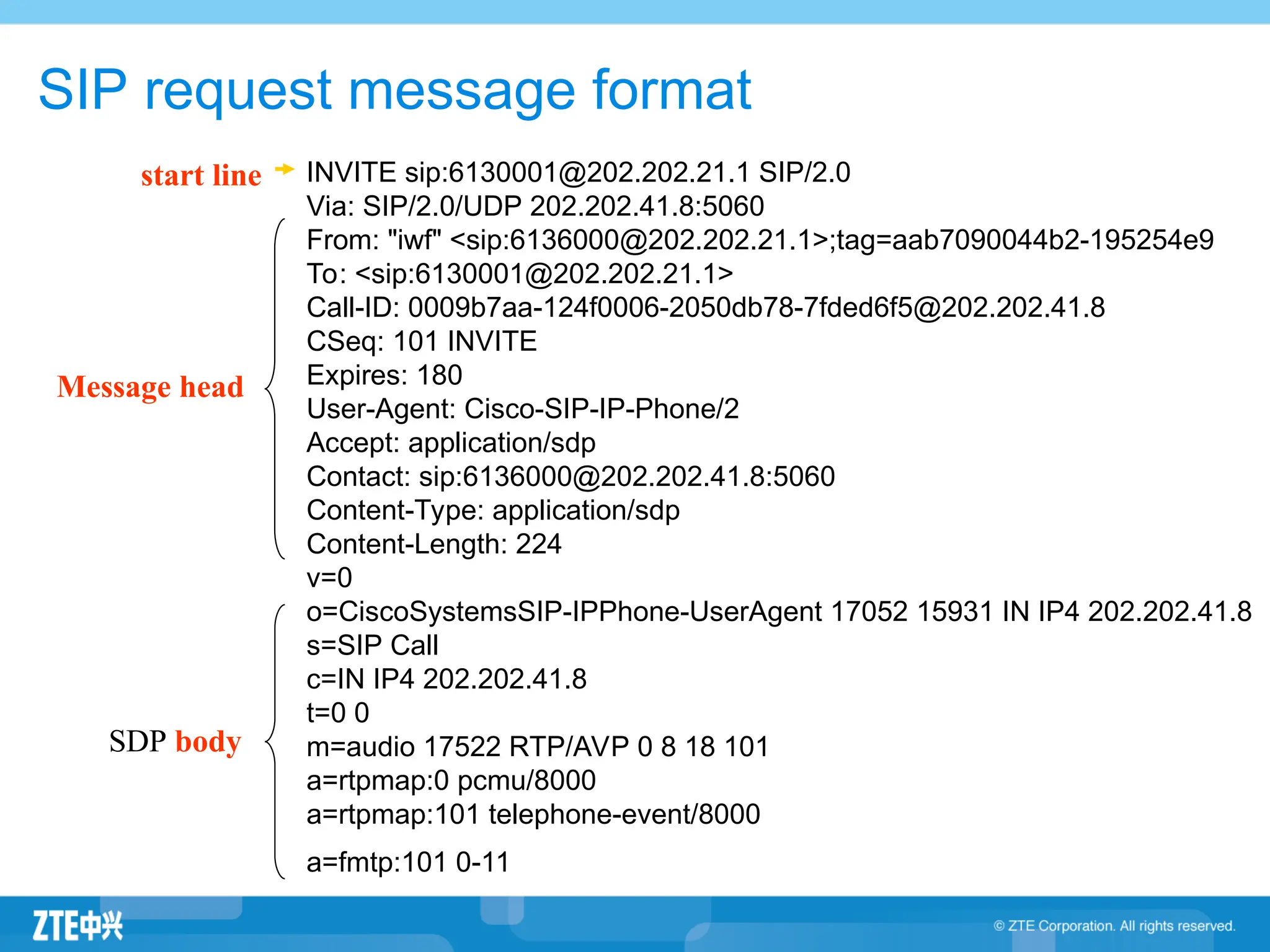
SDP body
start line INVITE sip:6130001@202.202.21.1 SIP/2.0
Via: SIP/2.0/UDP 202.202.41.8:5060
From: "iwf" <sip:6136000@202.202.21.1>;tag=aab7090044b2-195254e9
To: <sip:6130001@202.202.21.1>
Call-ID: 0009b7aa-124f0006-2050db78-7fded6f5@202.202.41.8
CSeq: 101 INVITE
Expires: 180
User-Agent: Cisco-SIP-IP-Phone/2
Accept: application/sdp
Contact: sip:6136000@202.202.41.8:5060
Content-Type: application/sdp
Content-Length: 224
v=0
o=CiscoSystemsSIP-IPPhone-UserAgent 17052 15931 IN IP4 202.202.41.8
s=SIP Call
c=IN IP4 202.202.41.8
t=0 0
m=audio 17522 RTP/AVP 0 8 18 101
a=rtpmap:0 pcmu/8000
a=rtpmap:101 telephone-event/8000
a=fmtp:101 0-11
Message head
SIP request message format
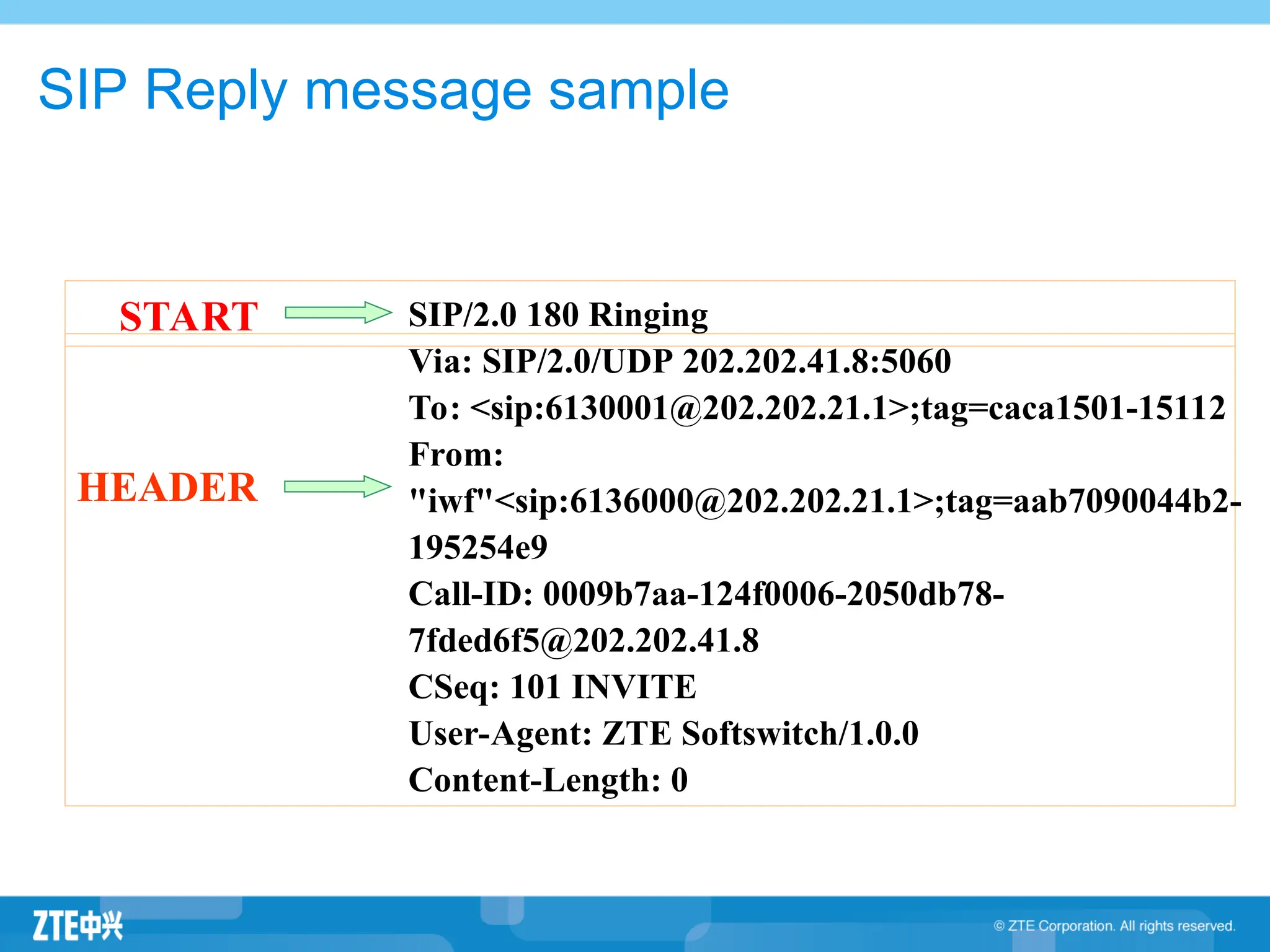
START SIP/2.0 180 Ringing
Via: SIP/2.0/UDP 202.202.41.8:5060
To: <sip:6130001@202.202.21.1>;tag=caca1501-15112
From:
"iwf"<sip:6136000@202.202.21.1>;tag=aab7090044b2-
195254e9
Call-ID: 0009b7aa-124f0006-2050db78-
7fded6f5@202.202.41.8
CSeq: 101 INVITE
User-Agent: ZTE Softswitch/1.0.0
Content-Length: 0
HEADER
SIP Reply message sample
Outline
 SIP introduction
 SIP components
 SIP message structure
 Call scenario analysis
 SIP-T introduction
 SIP/H323 comparison
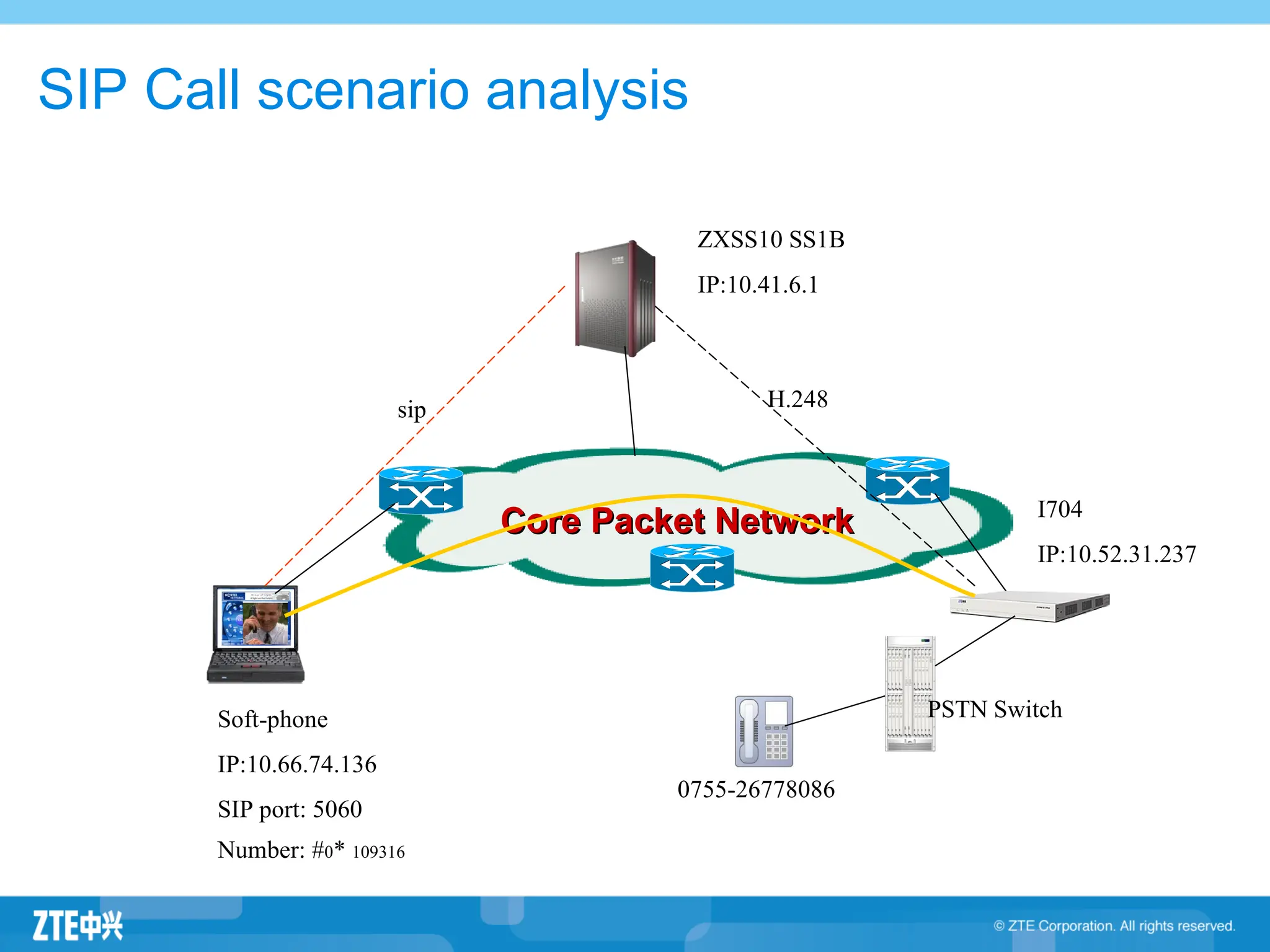
SIP Call scenario analysis
Core Packet Network
Core Packet Network
ZXSS10 SS1B
IP:10.41.6.1
Soft-phone
IP:10.66.74.136
SIP port: 5060
Number: #0* 109316
I704
IP:10.52.31.237
0755-26778086
PSTN Switch
sip H.248
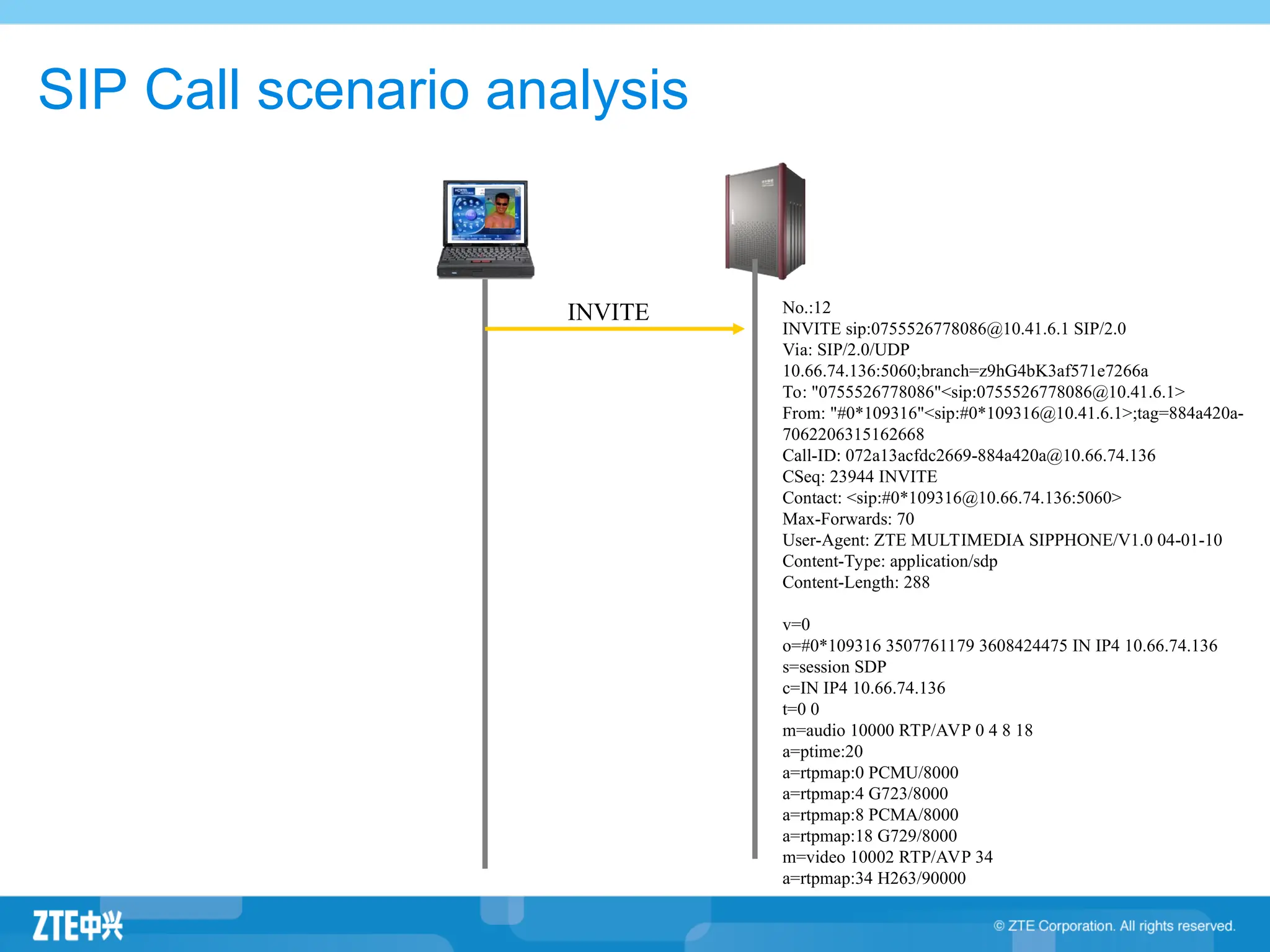
No.:12
INVITE sip:0755526778086@10.41.6.1 SIP/2.0
Via: SIP/2.0/UDP
10.66.74.136:5060;branch=z9hG4bK3af571e7266a
To: "0755526778086"<sip:0755526778086@10.41.6.1>
From: "#0*109316"<sip:#0*109316@10.41.6.1>;tag=884a420a-
7062206315162668
Call-ID: 072a13acfdc2669-884a420a@10.66.74.136
CSeq: 23944 INVITE
Contact: <sip:#0*109316@10.66.74.136:5060>
Max-Forwards: 70
User-Agent: ZTE MULTIMEDIA SIPPHONE/V1.0 04-01-10
Content-Type: application/sdp
Content-Length: 288
v=0
o=#0*109316 3507761179 3608424475 IN IP4 10.66.74.136
s=session SDP
c=IN IP4 10.66.74.136
t=0 0
m=audio 10000 RTP/AVP 0 4 8 18
a=ptime:20
a=rtpmap:0 PCMU/8000
a=rtpmap:4 G723/8000
a=rtpmap:8 PCMA/8000
a=rtpmap:18 G729/8000
m=video 10002 RTP/AVP 34
a=rtpmap:34 H263/90000
INVITE
SIP Call scenario analysis
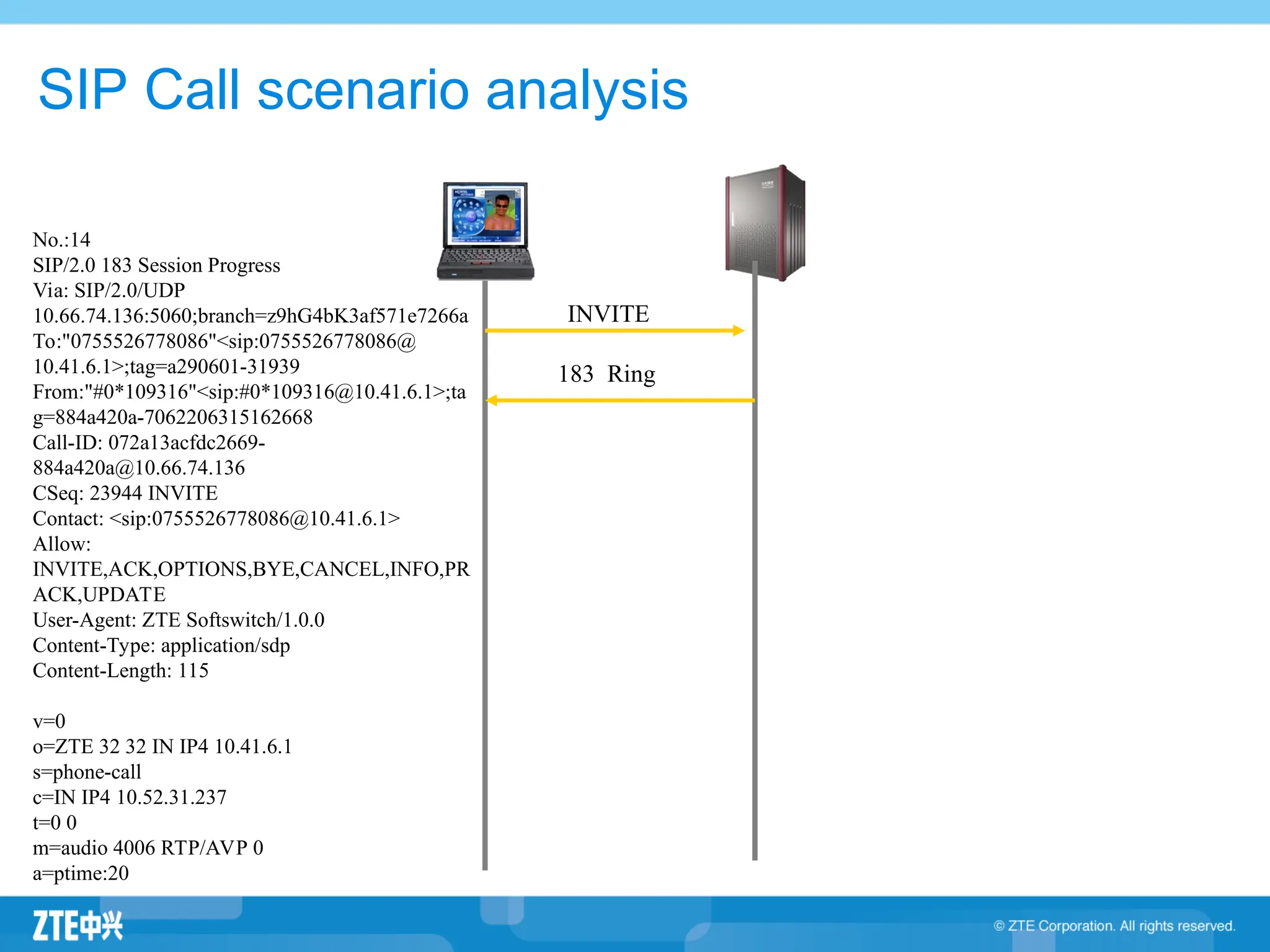
No.:14
SIP/2.0 183 Session Progress
Via: SIP/2.0/UDP
10.66.74.136:5060;branch=z9hG4bK3af571e7266a
To:"0755526778086"<sip:0755526778086@
10.41.6.1>;tag=a290601-31939
From:"#0*109316"<sip:#0*109316@10.41.6.1>;ta
g=884a420a-7062206315162668
Call-ID: 072a13acfdc2669-
884a420a@10.66.74.136
CSeq: 23944 INVITE
Contact: <sip:0755526778086@10.41.6.1>
Allow:
INVITE,ACK,OPTIONS,BYE,CANCEL,INFO,PR
ACK,UPDATE
User-Agent: ZTE Softswitch/1.0.0
Content-Type: application/sdp
Content-Length: 115
v=0
o=ZTE 32 32 IN IP4 10.41.6.1
s=phone-call
c=IN IP4 10.52.31.237
t=0 0
m=audio 4006 RTP/AVP 0
a=ptime:20
INVITE
183 Ring
SIP Call scenario analysis
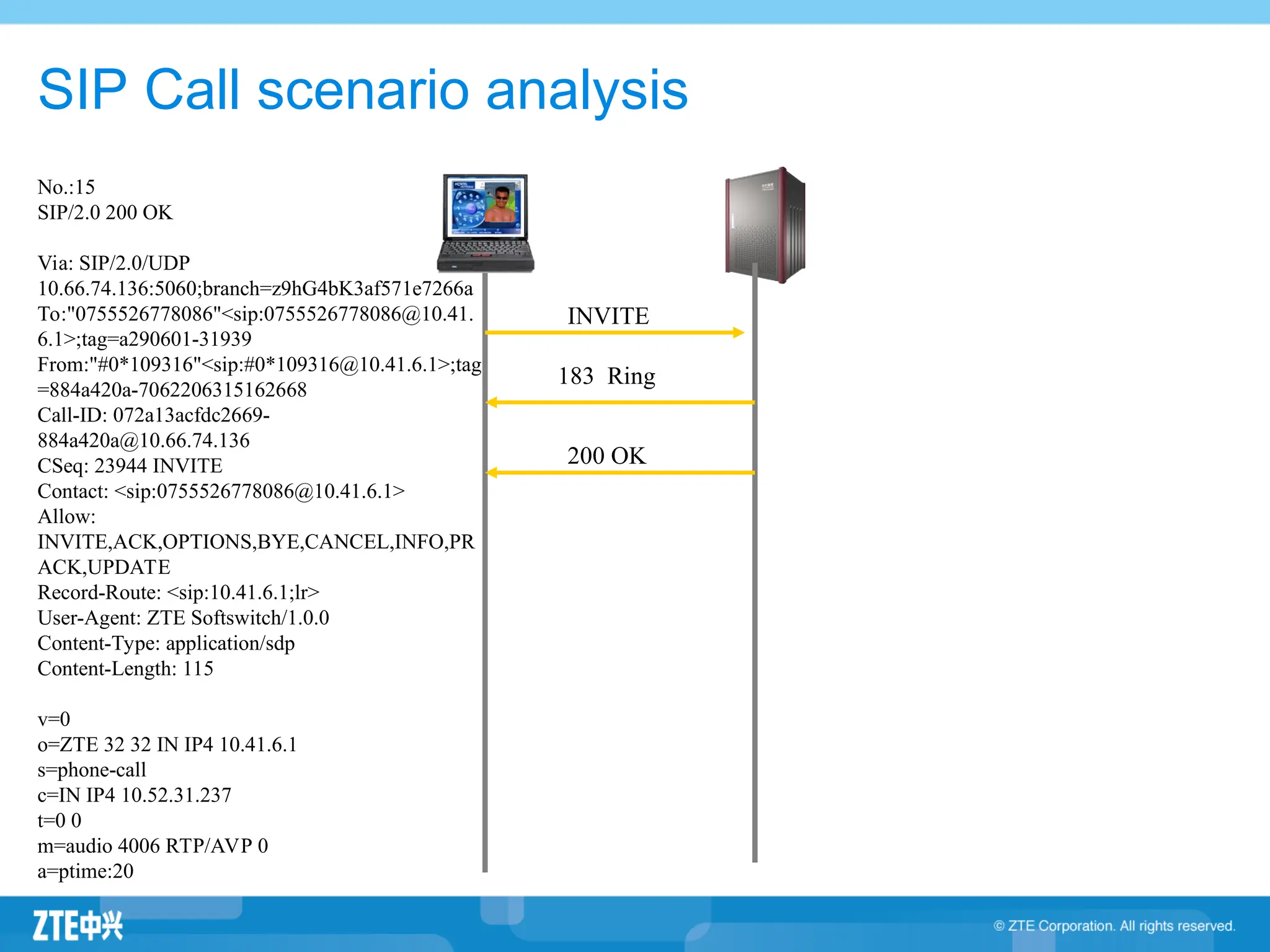
No.:15
SIP/2.0 200 OK
Via: SIP/2.0/UDP
10.66.74.136:5060;branch=z9hG4bK3af571e7266a
To:"0755526778086"<sip:0755526778086@10.41.
6.1>;tag=a290601-31939
From:"#0*109316"<sip:#0*109316@10.41.6.1>;tag
=884a420a-7062206315162668
Call-ID: 072a13acfdc2669-
884a420a@10.66.74.136
CSeq: 23944 INVITE
Contact: <sip:0755526778086@10.41.6.1>
Allow:
INVITE,ACK,OPTIONS,BYE,CANCEL,INFO,PR
ACK,UPDATE
Record-Route: <sip:10.41.6.1;lr>
User-Agent: ZTE Softswitch/1.0.0
Content-Type: application/sdp
Content-Length: 115
v=0
o=ZTE 32 32 IN IP4 10.41.6.1
s=phone-call
c=IN IP4 10.52.31.237
t=0 0
m=audio 4006 RTP/AVP 0
a=ptime:20
INVITE
183 Ring
200 OK
SIP Call scenario analysis
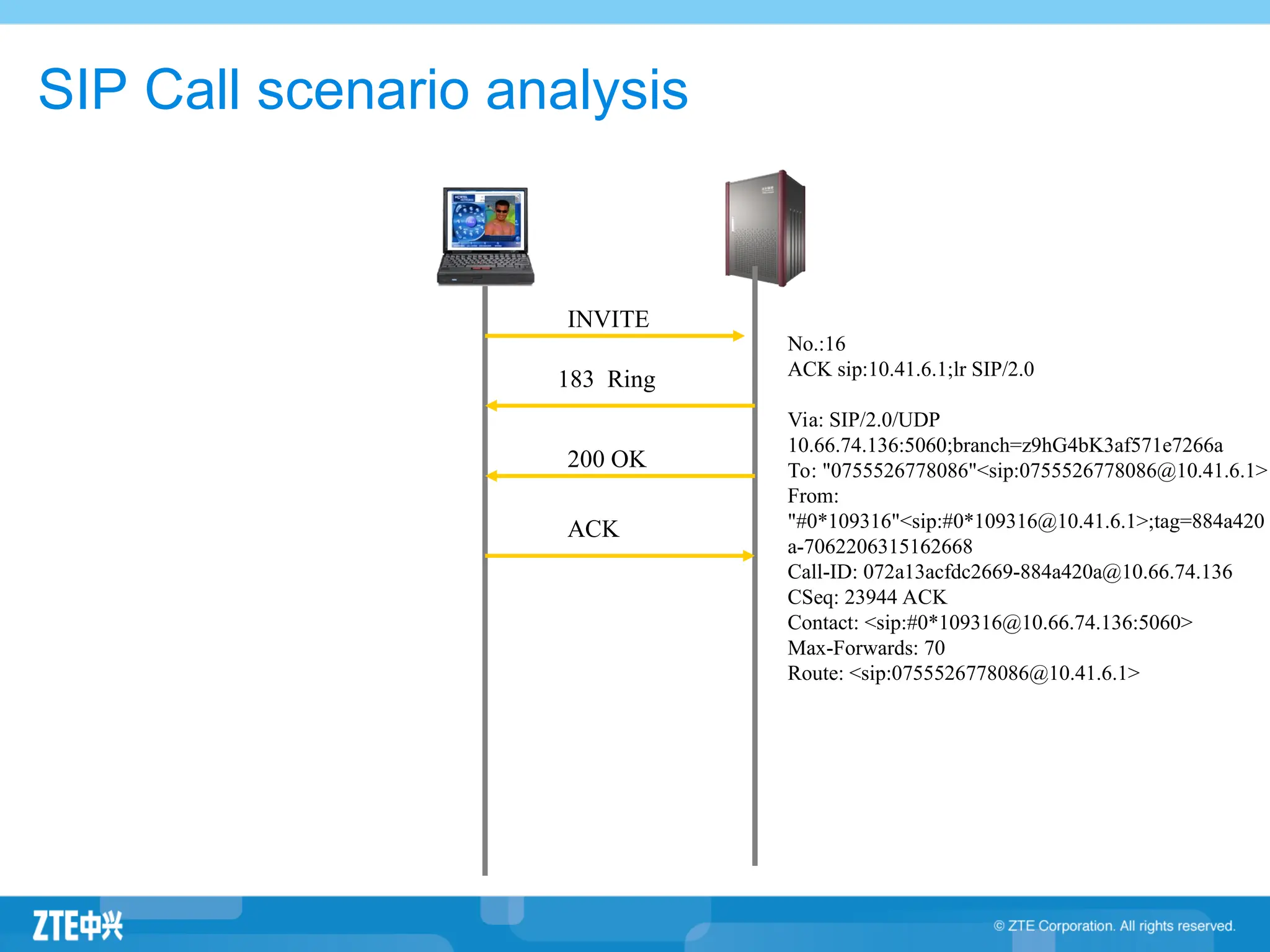
No.:16
ACK sip:10.41.6.1;lr SIP/2.0
Via: SIP/2.0/UDP
10.66.74.136:5060;branch=z9hG4bK3af571e7266a
To: "0755526778086"<sip:0755526778086@10.41.6.1>
From:
"#0*109316"<sip:#0*109316@10.41.6.1>;tag=884a420
a-7062206315162668
Call-ID: 072a13acfdc2669-884a420a@10.66.74.136
CSeq: 23944 ACK
Contact: <sip:#0*109316@10.66.74.136:5060>
Max-Forwards: 70
Route: <sip:0755526778086@10.41.6.1>
INVITE
183 Ring
200 OK
ACK
SIP Call scenario analysis
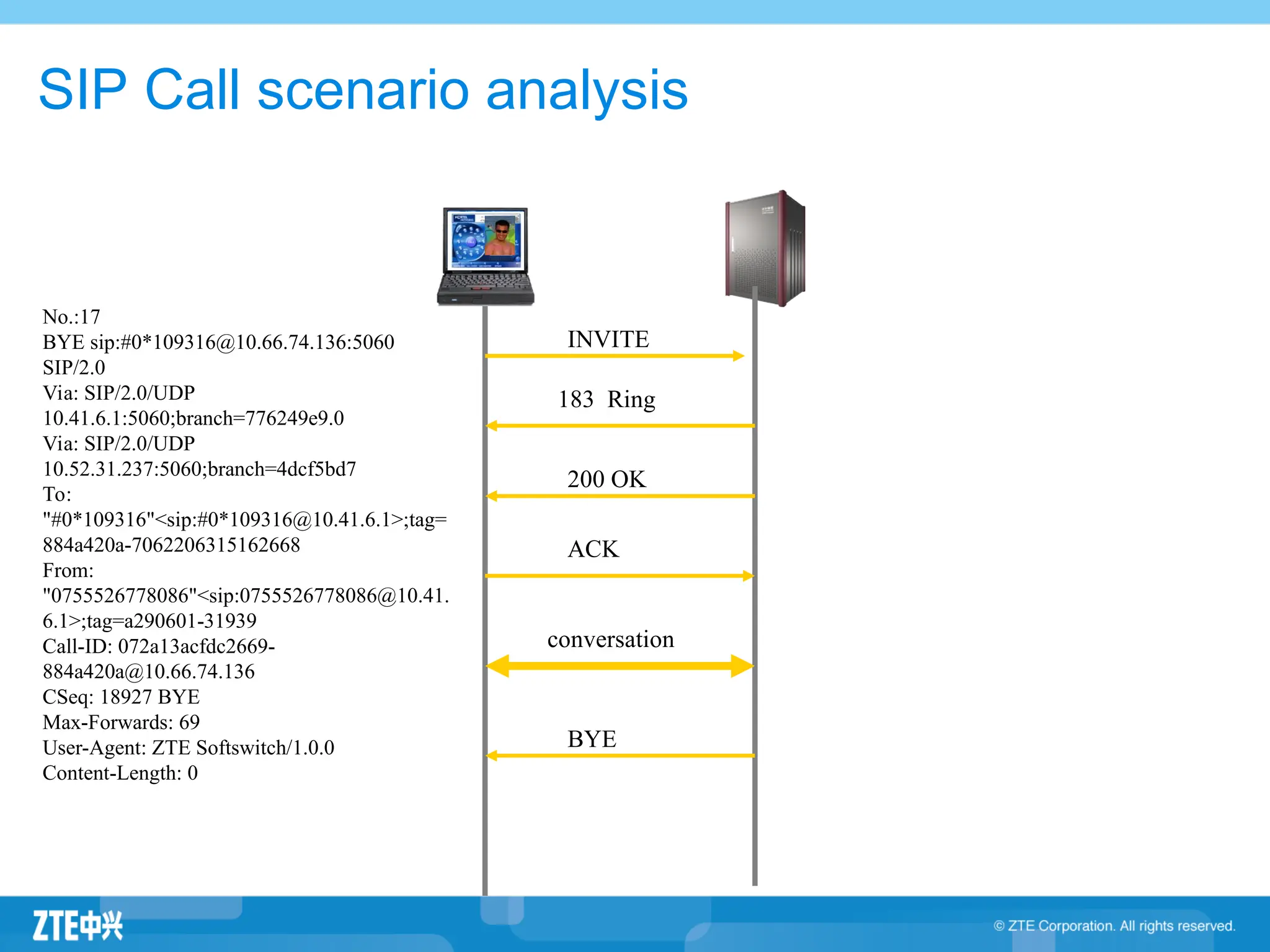
No.:17
BYE sip:#0*109316@10.66.74.136:5060
SIP/2.0
Via: SIP/2.0/UDP
10.41.6.1:5060;branch=776249e9.0
Via: SIP/2.0/UDP
10.52.31.237:5060;branch=4dcf5bd7
To:
"#0*109316"<sip:#0*109316@10.41.6.1>;tag=
884a420a-7062206315162668
From:
"0755526778086"<sip:0755526778086@10.41.
6.1>;tag=a290601-31939
Call-ID: 072a13acfdc2669-
884a420a@10.66.74.136
CSeq: 18927 BYE
Max-Forwards: 69
User-Agent: ZTE Softswitch/1.0.0
Content-Length: 0
INVITE
183 Ring
200 OK
ACK
conversation
BYE
SIP Call scenario analysis
INVITE
183 Ring
200 OK
ACK
conversation
BYE
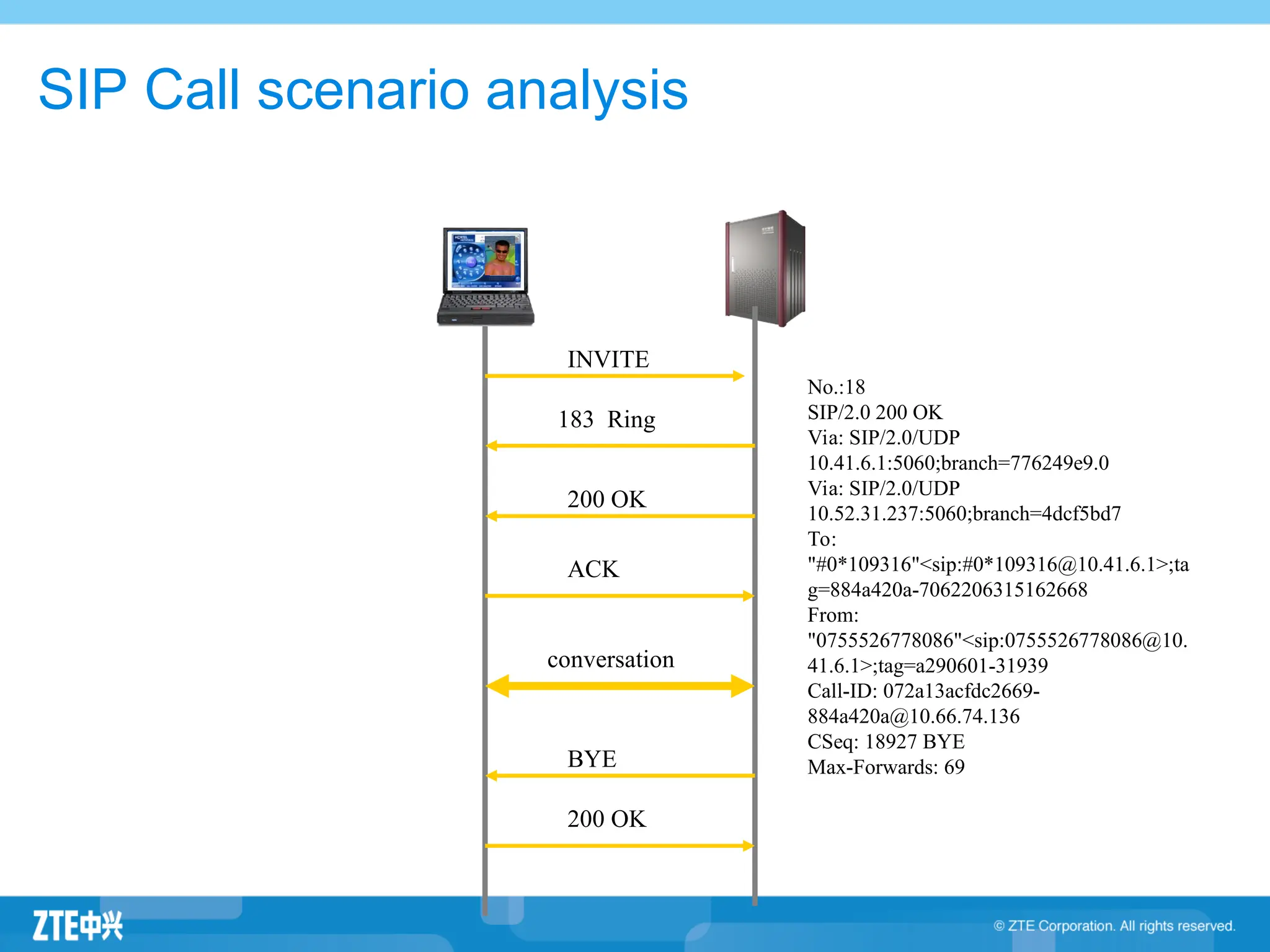
No.:18
SIP/2.0 200 OK
Via: SIP/2.0/UDP
10.41.6.1:5060;branch=776249e9.0
Via: SIP/2.0/UDP
10.52.31.237:5060;branch=4dcf5bd7
To:
"#0*109316"<sip:#0*109316@10.41.6.1>;ta
g=884a420a-7062206315162668
From:
"0755526778086"<sip:0755526778086@10.
41.6.1>;tag=a290601-31939
Call-ID: 072a13acfdc2669-
884a420a@10.66.74.136
CSeq: 18927 BYE
Max-Forwards: 69
200 OK
SIP Call scenario analysis
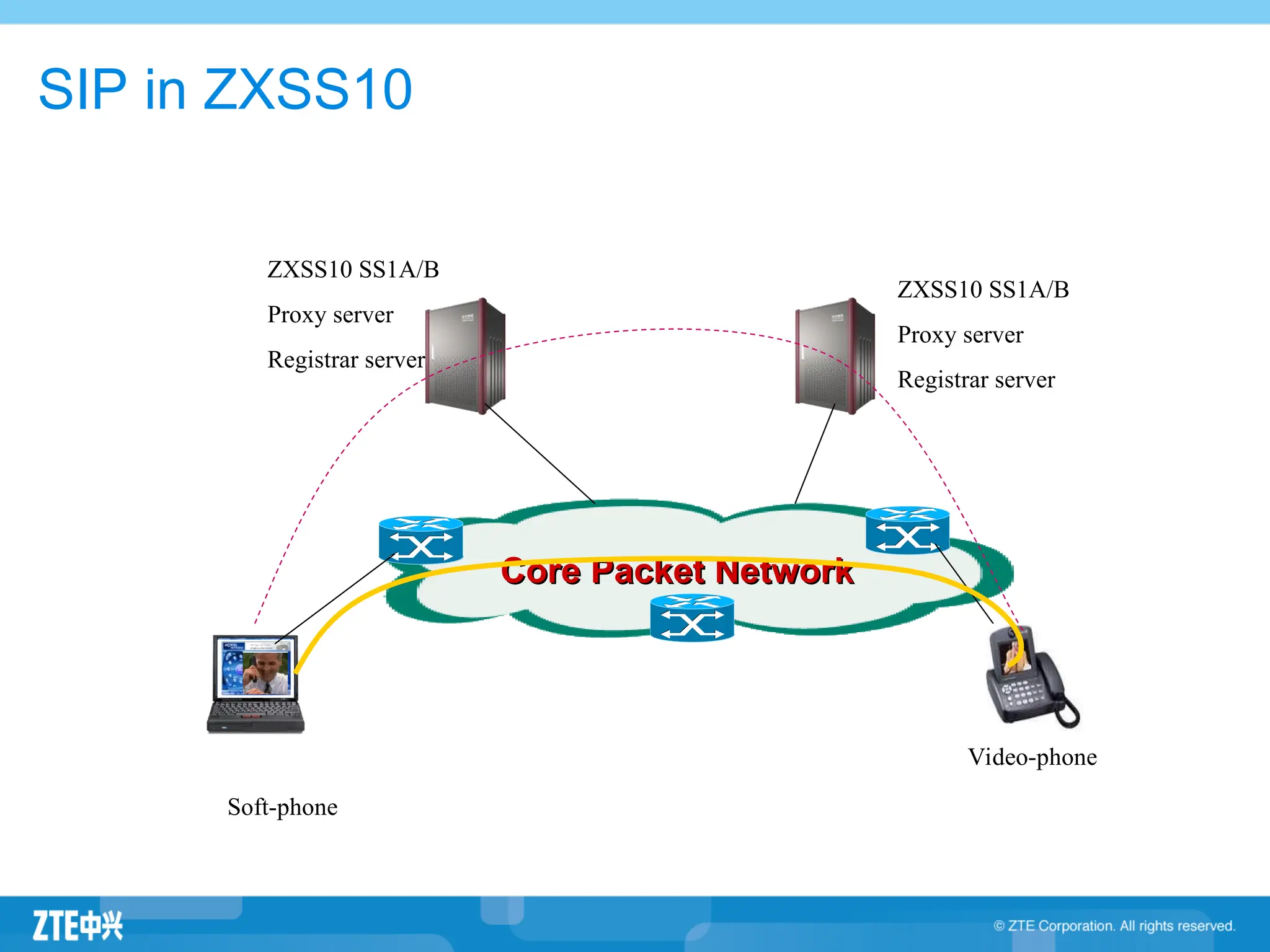
SIP in ZXSS10
ZXSS10 SS1A/B
Proxy server
Registrar server
ZXSS10 SS1A/B
Proxy server
Registrar server
Core Packet Network
Core Packet Network
Soft-phone
Video-phone
Outline
 SIP introduction
 SIP components
 SIP message structure
 Call scenario analysis
 SIP-T introduction
 SIP/H323 comparison
SIP-T introduction
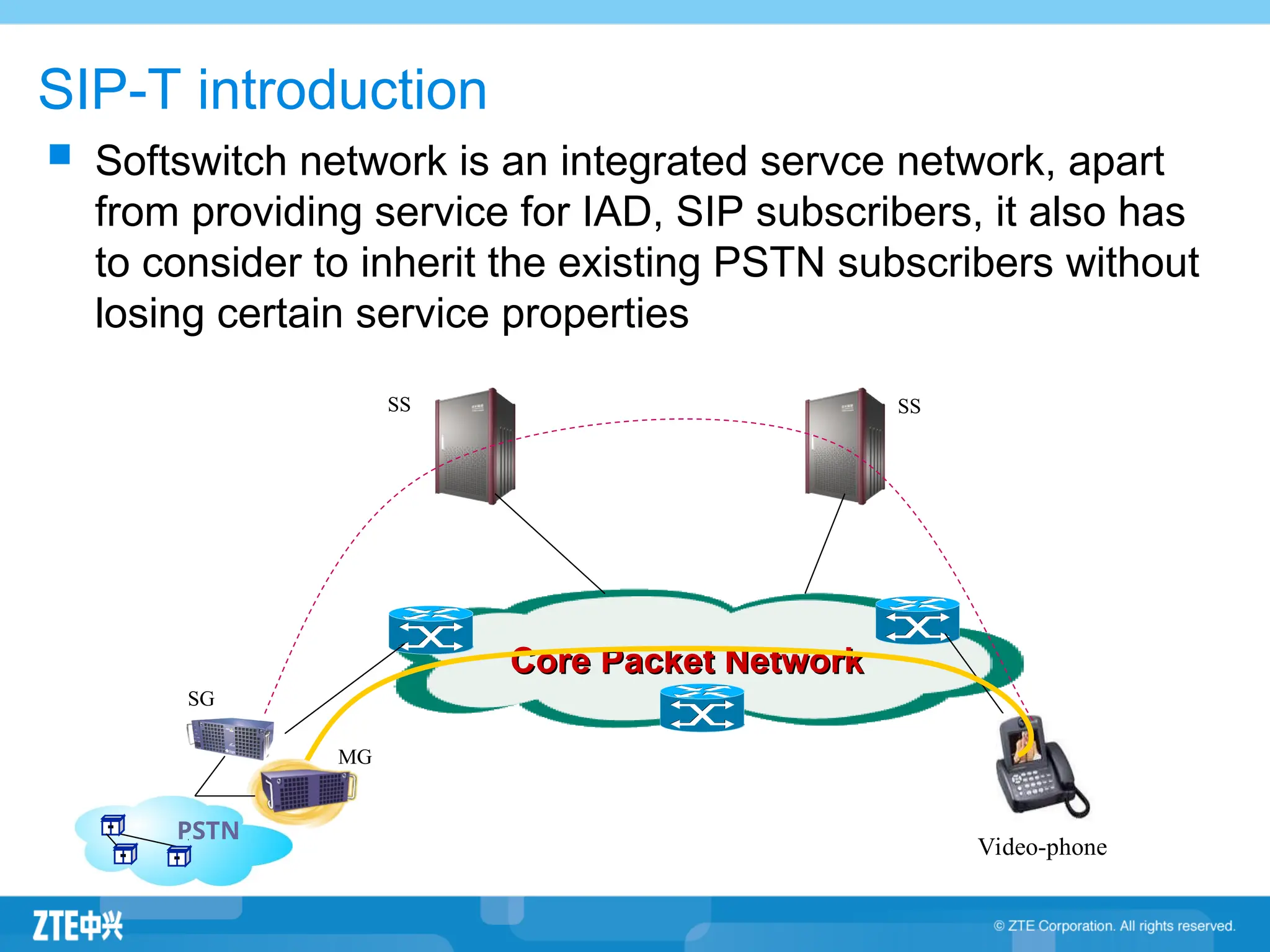
 Softswitch network is an integrated servce network, apart
from providing service for IAD, SIP subscribers, it also has
to consider to inherit the existing PSTN subscribers without
losing certain service properties
PSTN
Core Packet Network
Core Packet Network
Video-phone
SG
MG
SS SS
SIP-T introduction
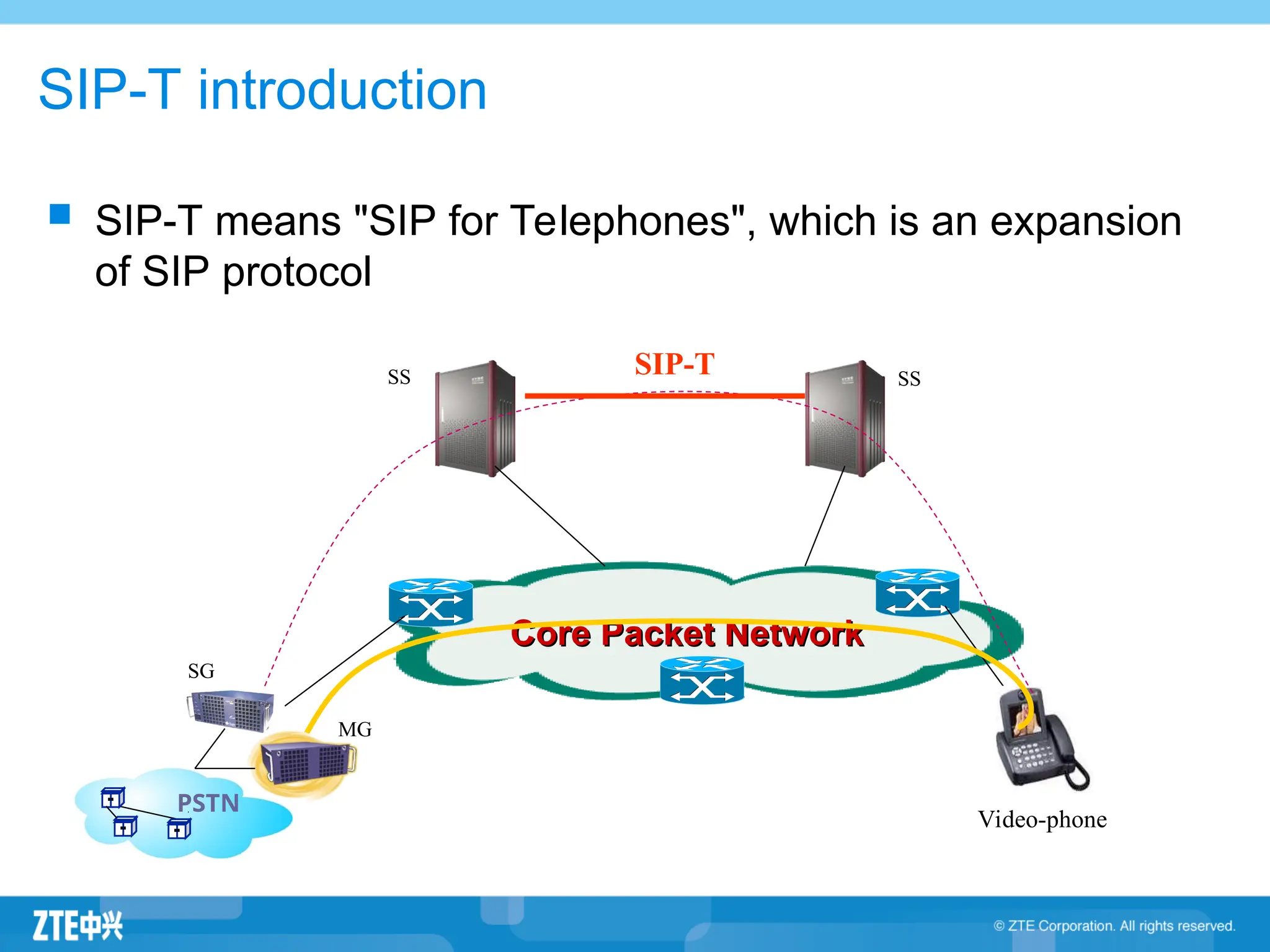
 SIP-T means "SIP for Telephones", which is an expansion
of SIP protocol
PSTN
Core Packet Network
Core Packet Network
Video-phone
SG
MG
SS SS
SIP-T
Essentials of SIP-T
 SIP-T is trying to provide a framework to
incorporate the traditional PSTN signals into SIP
message. SIP-T uses encapsulation and
translation to achieve the two essentials for SIP
network: transparency and routable
 In the inter-connecting node of PSTN and SIP
network, SS7 ISUP message has been
encapsulated into SIP message to make sure that
the service content will remain intact, while the
associating specific message has been extracted
and translated into corresponding SIP header to
make the routing possible
SIP-T example
LS-1
Core Packet Network
Core Packet Network
SG-1
MG-1
SS-1 SS-2
SIP-T
LS-2
SG-2
MG-2
SIP-T sample analysis
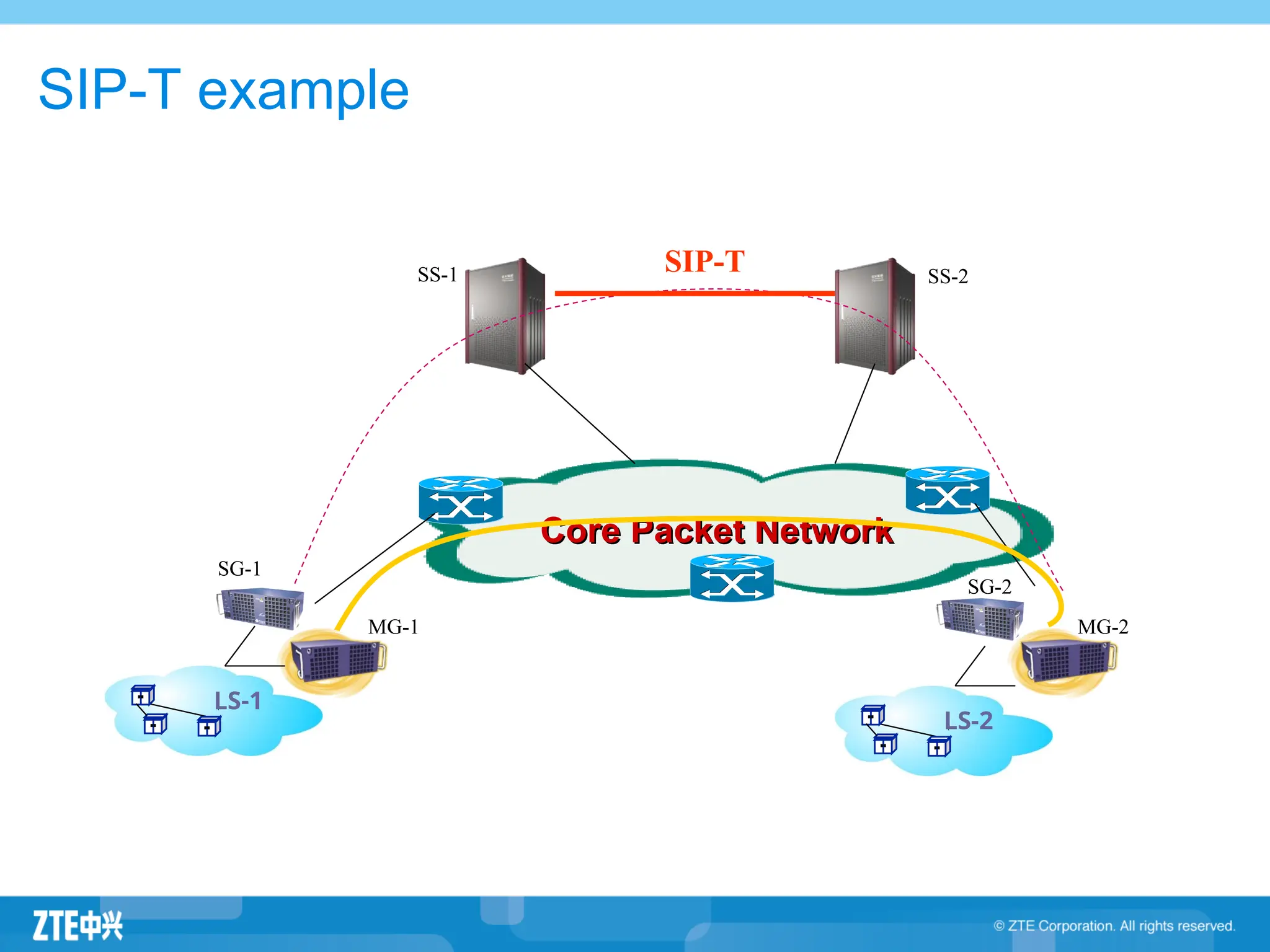
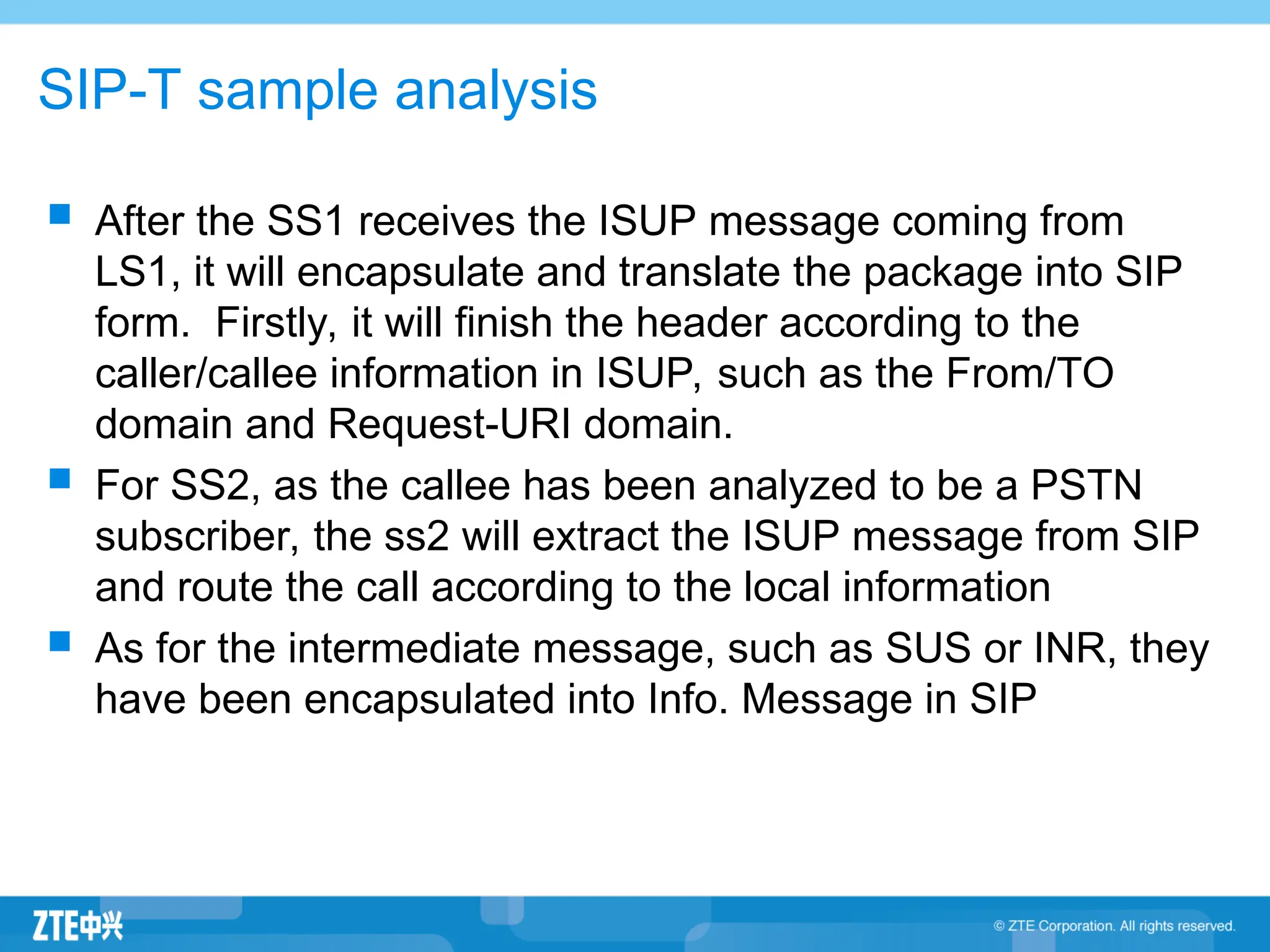
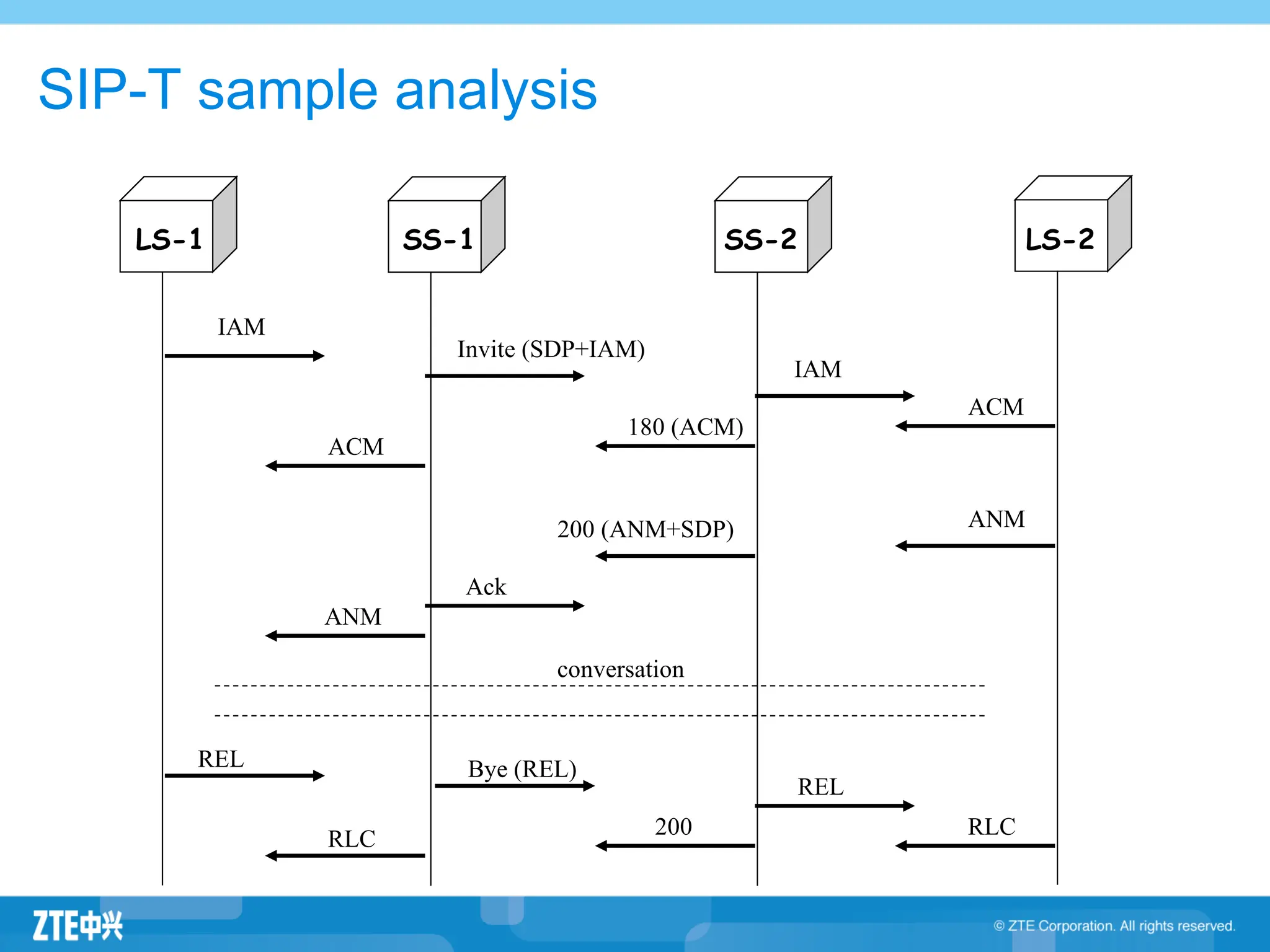
 After the SS1 receives the ISUP message coming from
LS1, it will encapsulate and translate the package into SIP
form. Firstly, it will finish the header according to the
caller/callee information in ISUP, such as the From/TO
domain and Request-URI domain.
 For SS2, as the callee has been analyzed to be a PSTN
subscriber, the ss2 will extract the ISUP message from SIP
and route the call according to the local information
 As for the intermediate message, such as SUS or INR, they
have been encapsulated into Info. Message in SIP
SIP-T sample analysis
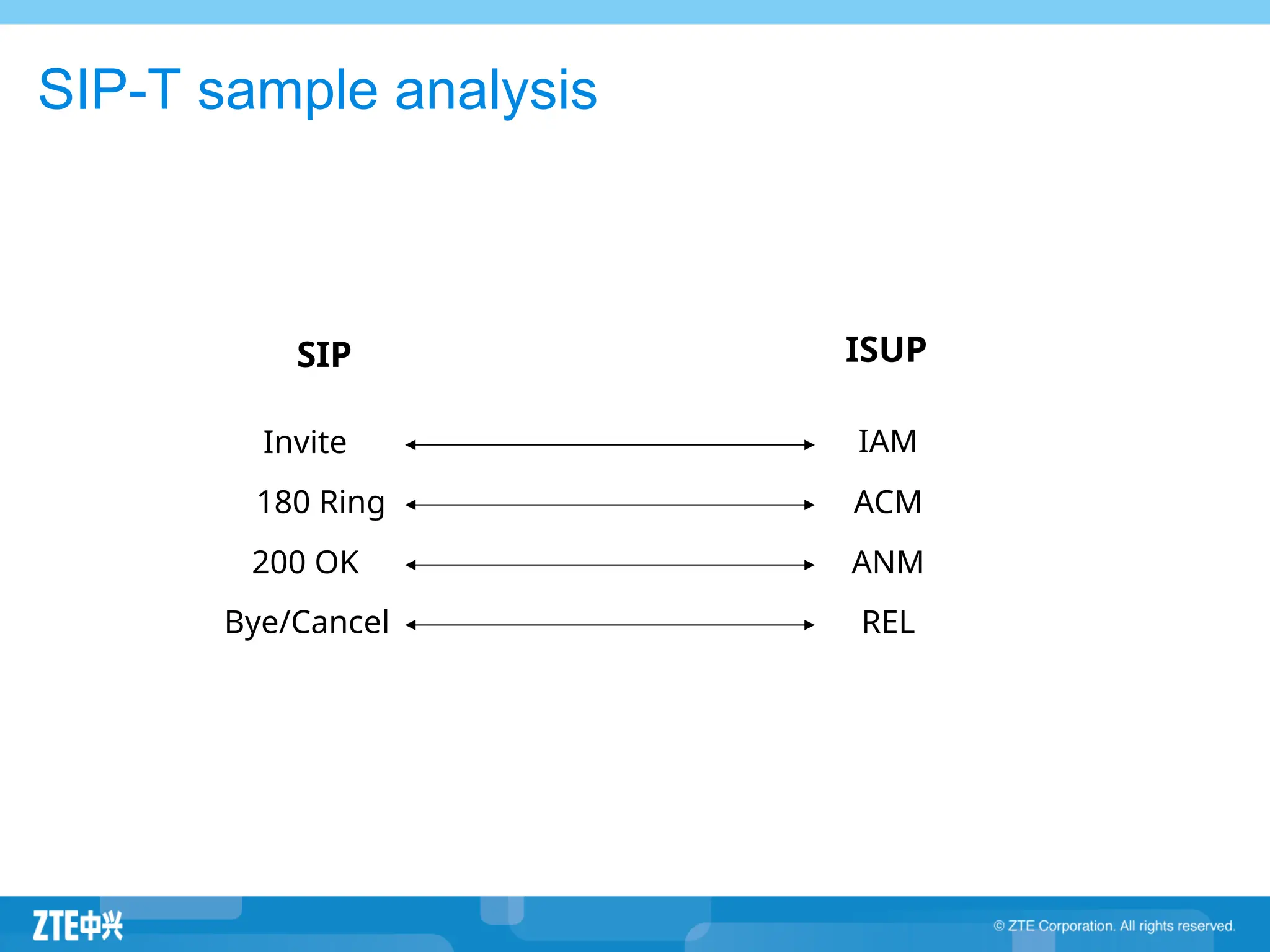
SIP ISUP
Invite
180 Ring
200 OK ANM
Bye/Cancel
ACM
REL
IAM
SIP-T sample analysis
LS-1 SS-2 LS-2
SS-1
IAM
Invite (SDP+IAM)
IAM
ACM
180 (ACM)
ACM
ANM
200 (ANM+SDP)
Ack
ANM
conversation
REL Bye (REL)
REL
RLC
RLC 200
Outline
 SIP introduction
 SIP components
 SIP message structure
 Call scenario analysis
 SIP-T introduction
 SIP/H323 comparison
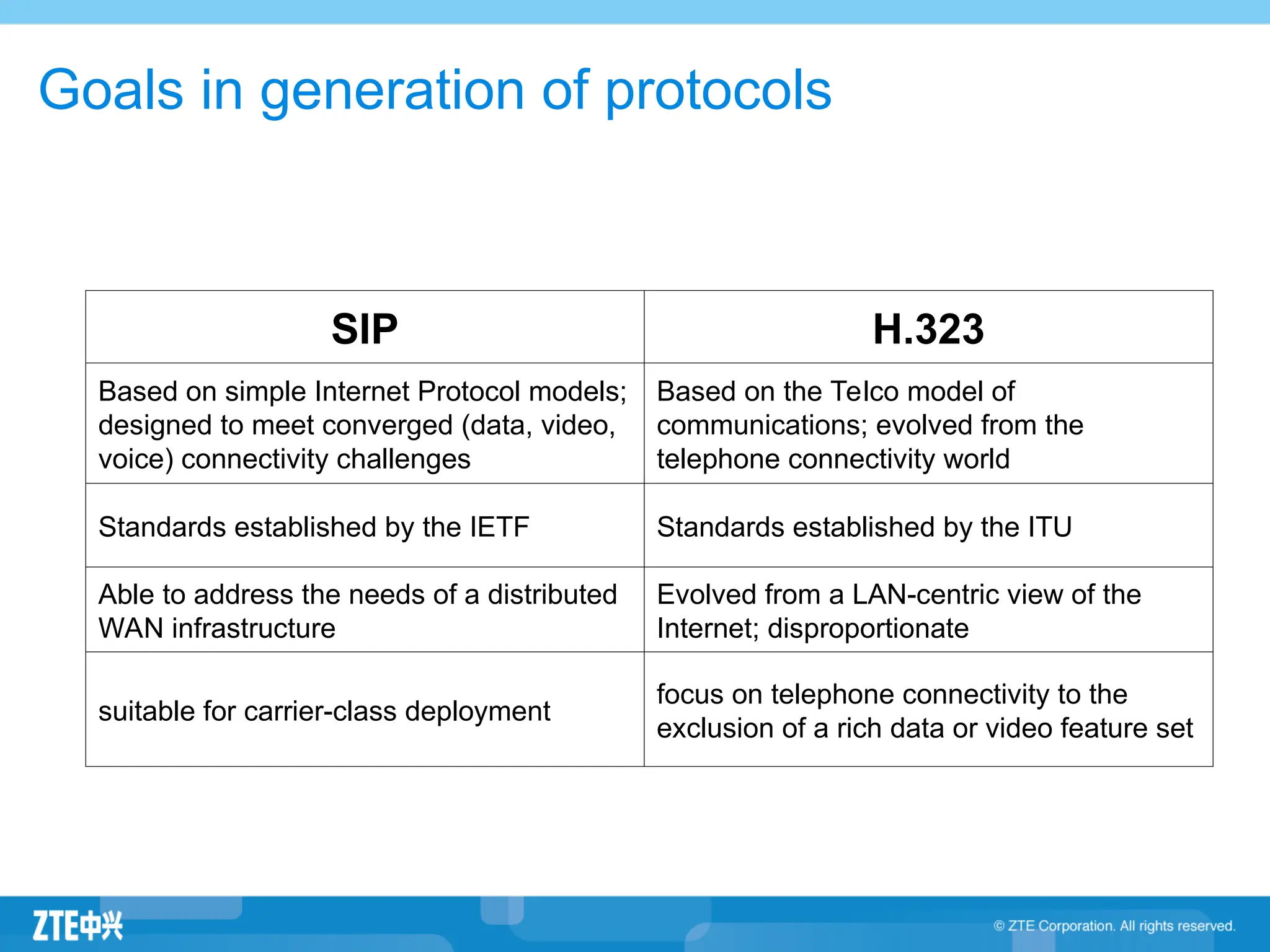
Goals in generation of protocols
SIP H.323
Based on simple Internet Protocol models;
designed to meet converged (data, video,
voice) connectivity challenges
Based on the Telco model of
communications; evolved from the
telephone connectivity world
Standards established by the IETF Standards established by the ITU
Able to address the needs of a distributed
WAN infrastructure
Evolved from a LAN-centric view of the
Internet; disproportionate
suitable for carrier-class deployment
focus on telephone connectivity to the
exclusion of a rich data or video feature set
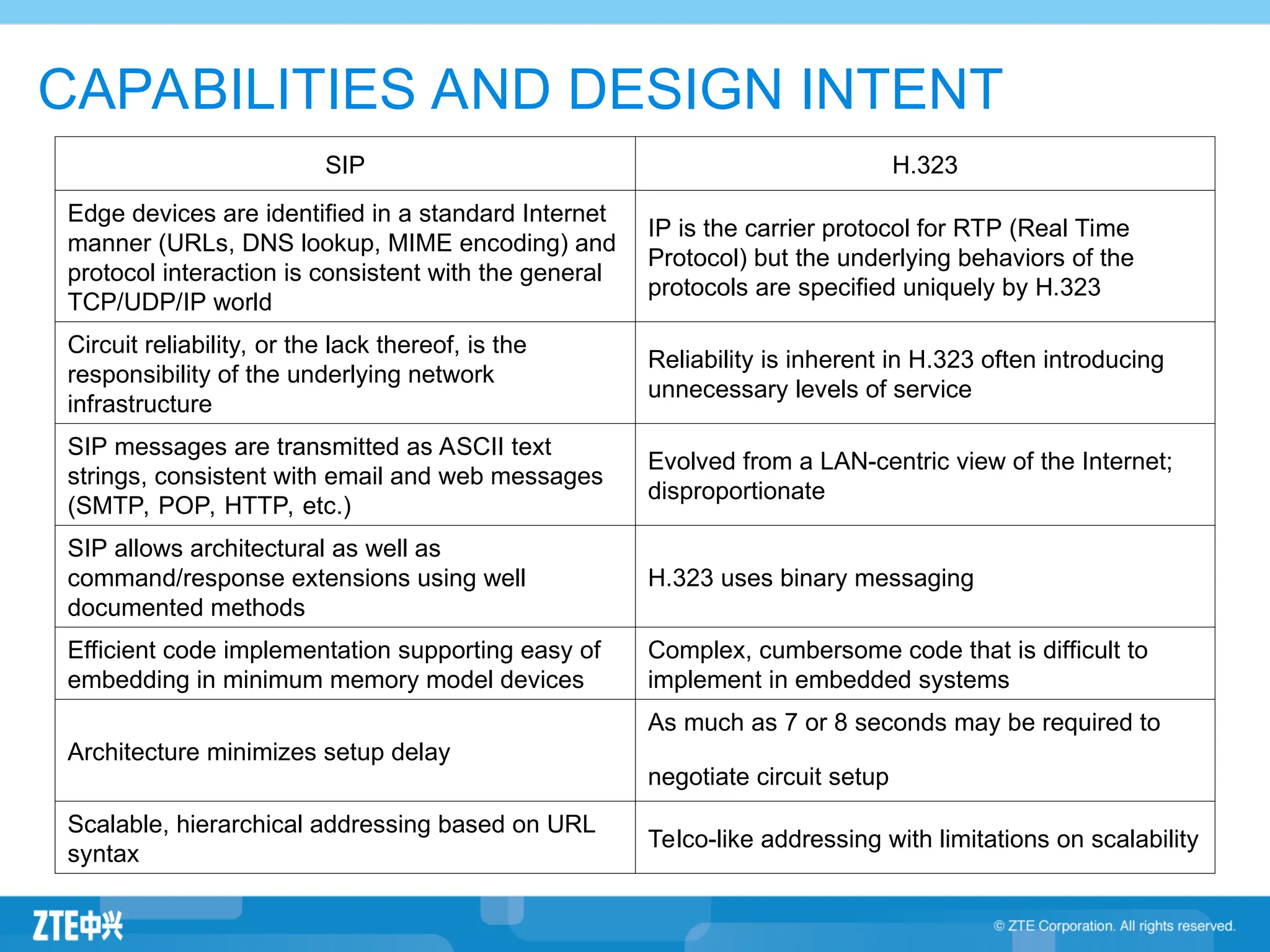
CAPABILITIES AND DESIGN INTENT
SIP H.323
Edge devices are identified in a standard Internet
manner (URLs, DNS lookup, MIME encoding) and
protocol interaction is consistent with the general
TCP/UDP/IP world
IP is the carrier protocol for RTP (Real Time
Protocol) but the underlying behaviors of the
protocols are specified uniquely by H.323
Circuit reliability, or the lack thereof, is the
responsibility of the underlying network
infrastructure
Reliability is inherent in H.323 often introducing
unnecessary levels of service
SIP messages are transmitted as ASCII text
strings, consistent with email and web messages
(SMTP, POP, HTTP, etc.)
Evolved from a LAN-centric view of the Internet;
disproportionate
SIP allows architectural as well as
command/response extensions using well
documented methods
H.323 uses binary messaging
Efficient code implementation supporting easy of
embedding in minimum memory model devices
Complex, cumbersome code that is difficult to
implement in embedded systems
Architecture minimizes setup delay
As much as 7 or 8 seconds may be required to
negotiate circuit setup
Scalable, hierarchical addressing based on URL
syntax
Telco-like addressing with limitations on scalability
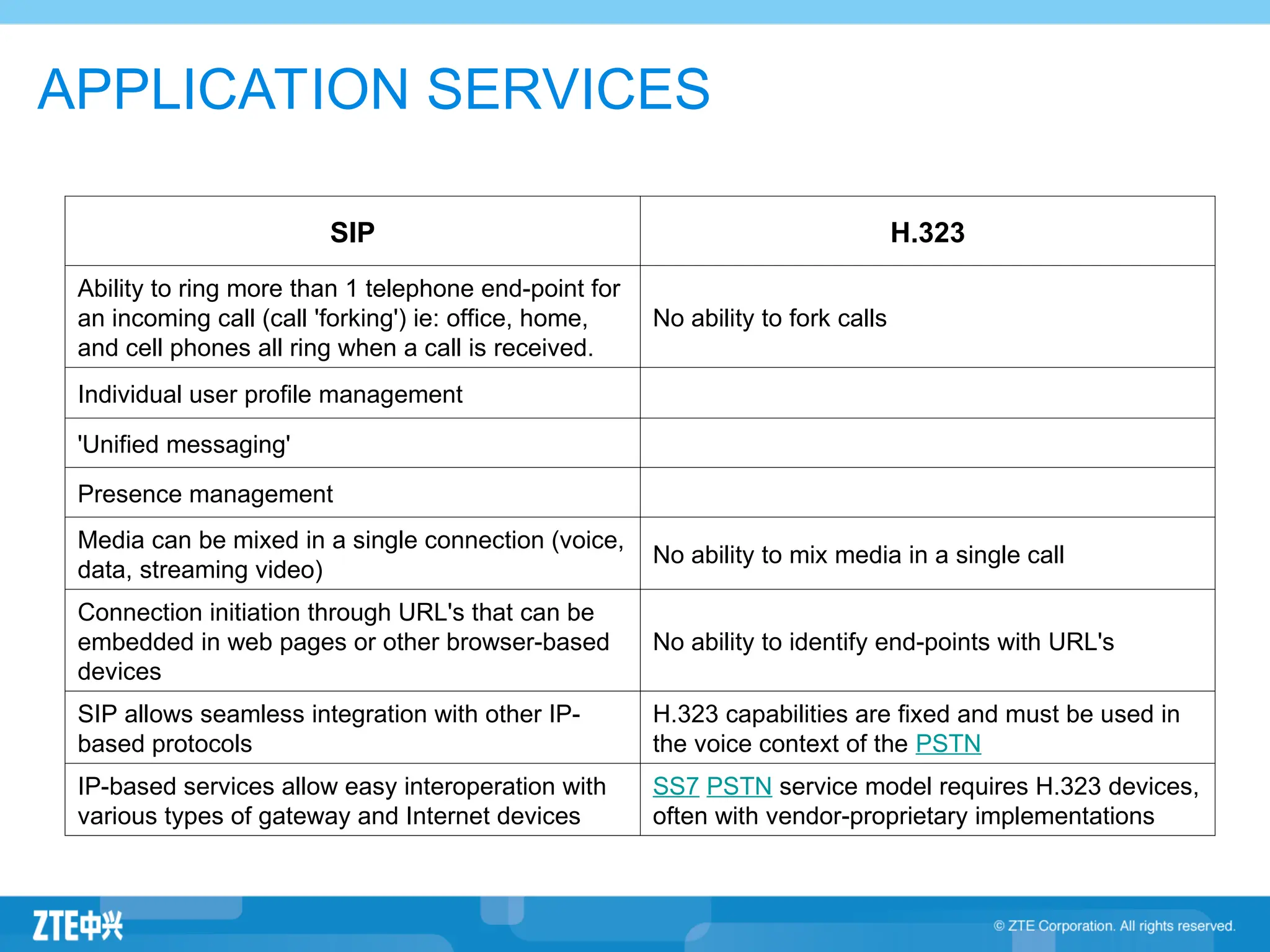
APPLICATION SERVICES
SIP H.323
Ability to ring more than 1 telephone end-point for
an incoming call (call 'forking') ie: office, home,
and cell phones all ring when a call is received.
No ability to fork calls
Individual user profile management
'Unified messaging'
Presence management
Media can be mixed in a single connection (voice,
data, streaming video)
No ability to mix media in a single call
Connection initiation through URL's that can be
embedded in web pages or other browser-based
devices
No ability to identify end-points with URL's
SIP allows seamless integration with other IP-
based protocols
H.323 capabilities are fixed and must be used in
the voice context of the PSTN
IP-based services allow easy interoperation with
various types of gateway and Internet devices
SS7 PSTN service model requires H.323 devices,
often with vendor-proprietary implementations
03 SS_SP004_E01_1 SIP_Protocol ZTE-44p.ppt

03 SS_SP004_E01_1 SIP_Protocol ZTE-44p.ppt

  • 1.
  • 2.
    Objectives  Upon thecompletion of this chapter, you should be able to understand :  Network entities defined by SIP  Addressing solution defined by SIP  Commands defined by SIP  Communication mechanism defined by SIP  Simple call Scenario flow
  • 3.
    Outline  SIP introduction SIP components  SIP message structure  Call scenario analysis  SIP-T introduction  SIP/H323 comparison
  • 4.
    RTCP RTP SIP, H.323 andH.248 IP H.248/Megaco Call Control and Signaling Gateway control Media H.225 Q.931 H.323 TCP RAS UDP SIP H.245 Video/ Audio RTSP
  • 5.
    What is SIP? “ ” SIP:Session Initiation Protocol SIP is a multimedia communication protocol established by IETF. It is a text-based application-layer control protocol independent of lower-layer protocols, designed to establish, modify and terminate two-party or multi-party multimedia sessions over the IP network.
  • 6.
    What is SIP? “ ” SIPwas firstly researched by the MMUSIC IETF workgroup in 1995 and recommended to be a standard by IETF in 1999. SIP uses HTTP and SMTP protocols. SIP is still developing now. Relevant equipment vendors and service providers have created an SIP forum: www.sipforum.org
  • 7.
    Outline  SIP introduction SIP components  SIP message structure  Call scenario analysis  SIP-T introduction  SIP/H323 comparison
  • 8.
    Redirect Server SIP Components –distributed architecture Location Server Registrar Server User Agent Proxy Server Gateway PSTN Proxy Server SIP SIP SIP SIP SIP LDAP LDAP
  • 9.
    Basic SIP components(1/5)  User agents  User agent client (UAC)  A user agent client is a logical entity that creates a new request, and then uses the client transaction state machinery to send it.  User agent server (UAS)  A user agent server is a logical entity that generates a response to a SIP request. The response accepts, rejects, or redirects the request.
  • 10.
    Basic SIP components(2/5)  Network servers  Redirect server  reduce the processing load on proxy servers  improve signaling path robustness  push routing information for a request back in a response to the client
  • 11.
    Basic SIP components(3/5)  Network Servers  Proxy server  An intermediary entity that acts as both a server and a client for the purpose of making requests on behalf of other clients  ensure that a request is sent to another entity "closer" to the targeted user
  • 12.
    Basic SIP components(4/5)  Network servers  Registrar server  accepts REGISTER requests  places the information it receives in those requests into the location service
  • 13.
    Basic SIP components(5/5)  Network servers  location server  is used by a SIP redirect or proxy server  store information about a callee's possible location(s).  a list of bindings of address-of- record keys to zero or more contact addresses  The bindings can be created and removed in many way
  • 14.
    SIP in ZXSS10architecture Core Packet Network Core Packet Network ZXSS10 SS1A/B Proxy server Register server Soft-phone Video-phone ZXSS10 SS1A/B Proxy server Register server
  • 15.
    Outline  SIP introduction SIP components  SIP message structure  Call scenario analysis  SIP-T introduction  SIP/H323 comparison
  • 16.
    SIP Message –Request/Reply  SIP components rely on the interaction of SIP messages to communicate with each other, the messaging mechanism is based on Client/Server, and can be divided into two categories (request and reply)
  • 17.
    SIP Request Message Function INVITEInitialize a conversation ACK Acknowledge the invite message BYE End conversation CANCEL Cancel the unsuccessful request REGISTER Registration OPTIONS Query the server capacity INFO Pass the interaction contents of a certain call
  • 18.
    SIP reply message MessageFunction 1XX Temporary response 2XX Success 3XX Redirect 4XX Client error 5XX Server error 6XX Global error
  • 19.
  • 20.
    SIP message format CorePacket Network Core Packet Network ZXSS10 SS1B IP:202.202.21.1 Soft-phone IP:202.202.41.8 SIP port: 5060 Number:6130000 Video-phone IP:202.202.21.31 SIP port: 5060 Number:613000 1
  • 21.
    SDP body start lineINVITE sip:6130001@202.202.21.1 SIP/2.0 Via: SIP/2.0/UDP 202.202.41.8:5060 From: "iwf" <sip:6136000@202.202.21.1>;tag=aab7090044b2-195254e9 To: <sip:6130001@202.202.21.1> Call-ID: 0009b7aa-124f0006-2050db78-7fded6f5@202.202.41.8 CSeq: 101 INVITE Expires: 180 User-Agent: Cisco-SIP-IP-Phone/2 Accept: application/sdp Contact: sip:6136000@202.202.41.8:5060 Content-Type: application/sdp Content-Length: 224 v=0 o=CiscoSystemsSIP-IPPhone-UserAgent 17052 15931 IN IP4 202.202.41.8 s=SIP Call c=IN IP4 202.202.41.8 t=0 0 m=audio 17522 RTP/AVP 0 8 18 101 a=rtpmap:0 pcmu/8000 a=rtpmap:101 telephone-event/8000 a=fmtp:101 0-11 Message head SIP request message format
  • 22.
    START SIP/2.0 180Ringing Via: SIP/2.0/UDP 202.202.41.8:5060 To: <sip:6130001@202.202.21.1>;tag=caca1501-15112 From: "iwf"<sip:6136000@202.202.21.1>;tag=aab7090044b2- 195254e9 Call-ID: 0009b7aa-124f0006-2050db78- 7fded6f5@202.202.41.8 CSeq: 101 INVITE User-Agent: ZTE Softswitch/1.0.0 Content-Length: 0 HEADER SIP Reply message sample
  • 23.
    Outline  SIP introduction SIP components  SIP message structure  Call scenario analysis  SIP-T introduction  SIP/H323 comparison
  • 24.
    SIP Call scenarioanalysis Core Packet Network Core Packet Network ZXSS10 SS1B IP:10.41.6.1 Soft-phone IP:10.66.74.136 SIP port: 5060 Number: #0* 109316 I704 IP:10.52.31.237 0755-26778086 PSTN Switch sip H.248
  • 25.
    No.:12 INVITE sip:0755526778086@10.41.6.1 SIP/2.0 Via:SIP/2.0/UDP 10.66.74.136:5060;branch=z9hG4bK3af571e7266a To: "0755526778086"<sip:0755526778086@10.41.6.1> From: "#0*109316"<sip:#0*109316@10.41.6.1>;tag=884a420a- 7062206315162668 Call-ID: 072a13acfdc2669-884a420a@10.66.74.136 CSeq: 23944 INVITE Contact: <sip:#0*109316@10.66.74.136:5060> Max-Forwards: 70 User-Agent: ZTE MULTIMEDIA SIPPHONE/V1.0 04-01-10 Content-Type: application/sdp Content-Length: 288 v=0 o=#0*109316 3507761179 3608424475 IN IP4 10.66.74.136 s=session SDP c=IN IP4 10.66.74.136 t=0 0 m=audio 10000 RTP/AVP 0 4 8 18 a=ptime:20 a=rtpmap:0 PCMU/8000 a=rtpmap:4 G723/8000 a=rtpmap:8 PCMA/8000 a=rtpmap:18 G729/8000 m=video 10002 RTP/AVP 34 a=rtpmap:34 H263/90000 INVITE SIP Call scenario analysis
  • 26.
    No.:14 SIP/2.0 183 SessionProgress Via: SIP/2.0/UDP 10.66.74.136:5060;branch=z9hG4bK3af571e7266a To:"0755526778086"<sip:0755526778086@ 10.41.6.1>;tag=a290601-31939 From:"#0*109316"<sip:#0*109316@10.41.6.1>;ta g=884a420a-7062206315162668 Call-ID: 072a13acfdc2669- 884a420a@10.66.74.136 CSeq: 23944 INVITE Contact: <sip:0755526778086@10.41.6.1> Allow: INVITE,ACK,OPTIONS,BYE,CANCEL,INFO,PR ACK,UPDATE User-Agent: ZTE Softswitch/1.0.0 Content-Type: application/sdp Content-Length: 115 v=0 o=ZTE 32 32 IN IP4 10.41.6.1 s=phone-call c=IN IP4 10.52.31.237 t=0 0 m=audio 4006 RTP/AVP 0 a=ptime:20 INVITE 183 Ring SIP Call scenario analysis
  • 27.
    No.:15 SIP/2.0 200 OK Via:SIP/2.0/UDP 10.66.74.136:5060;branch=z9hG4bK3af571e7266a To:"0755526778086"<sip:0755526778086@10.41. 6.1>;tag=a290601-31939 From:"#0*109316"<sip:#0*109316@10.41.6.1>;tag =884a420a-7062206315162668 Call-ID: 072a13acfdc2669- 884a420a@10.66.74.136 CSeq: 23944 INVITE Contact: <sip:0755526778086@10.41.6.1> Allow: INVITE,ACK,OPTIONS,BYE,CANCEL,INFO,PR ACK,UPDATE Record-Route: <sip:10.41.6.1;lr> User-Agent: ZTE Softswitch/1.0.0 Content-Type: application/sdp Content-Length: 115 v=0 o=ZTE 32 32 IN IP4 10.41.6.1 s=phone-call c=IN IP4 10.52.31.237 t=0 0 m=audio 4006 RTP/AVP 0 a=ptime:20 INVITE 183 Ring 200 OK SIP Call scenario analysis
  • 28.
    No.:16 ACK sip:10.41.6.1;lr SIP/2.0 Via:SIP/2.0/UDP 10.66.74.136:5060;branch=z9hG4bK3af571e7266a To: "0755526778086"<sip:0755526778086@10.41.6.1> From: "#0*109316"<sip:#0*109316@10.41.6.1>;tag=884a420 a-7062206315162668 Call-ID: 072a13acfdc2669-884a420a@10.66.74.136 CSeq: 23944 ACK Contact: <sip:#0*109316@10.66.74.136:5060> Max-Forwards: 70 Route: <sip:0755526778086@10.41.6.1> INVITE 183 Ring 200 OK ACK SIP Call scenario analysis
  • 29.
    No.:17 BYE sip:#0*109316@10.66.74.136:5060 SIP/2.0 Via: SIP/2.0/UDP 10.41.6.1:5060;branch=776249e9.0 Via:SIP/2.0/UDP 10.52.31.237:5060;branch=4dcf5bd7 To: "#0*109316"<sip:#0*109316@10.41.6.1>;tag= 884a420a-7062206315162668 From: "0755526778086"<sip:0755526778086@10.41. 6.1>;tag=a290601-31939 Call-ID: 072a13acfdc2669- 884a420a@10.66.74.136 CSeq: 18927 BYE Max-Forwards: 69 User-Agent: ZTE Softswitch/1.0.0 Content-Length: 0 INVITE 183 Ring 200 OK ACK conversation BYE SIP Call scenario analysis
  • 30.
    INVITE 183 Ring 200 OK ACK conversation BYE No.:18 SIP/2.0200 OK Via: SIP/2.0/UDP 10.41.6.1:5060;branch=776249e9.0 Via: SIP/2.0/UDP 10.52.31.237:5060;branch=4dcf5bd7 To: "#0*109316"<sip:#0*109316@10.41.6.1>;ta g=884a420a-7062206315162668 From: "0755526778086"<sip:0755526778086@10. 41.6.1>;tag=a290601-31939 Call-ID: 072a13acfdc2669- 884a420a@10.66.74.136 CSeq: 18927 BYE Max-Forwards: 69 200 OK SIP Call scenario analysis
  • 31.
    SIP in ZXSS10 ZXSS10SS1A/B Proxy server Registrar server ZXSS10 SS1A/B Proxy server Registrar server Core Packet Network Core Packet Network Soft-phone Video-phone
  • 32.
    Outline  SIP introduction SIP components  SIP message structure  Call scenario analysis  SIP-T introduction  SIP/H323 comparison
  • 33.
    SIP-T introduction  Softswitchnetwork is an integrated servce network, apart from providing service for IAD, SIP subscribers, it also has to consider to inherit the existing PSTN subscribers without losing certain service properties PSTN Core Packet Network Core Packet Network Video-phone SG MG SS SS
  • 34.
    SIP-T introduction  SIP-Tmeans "SIP for Telephones", which is an expansion of SIP protocol PSTN Core Packet Network Core Packet Network Video-phone SG MG SS SS SIP-T
  • 35.
    Essentials of SIP-T SIP-T is trying to provide a framework to incorporate the traditional PSTN signals into SIP message. SIP-T uses encapsulation and translation to achieve the two essentials for SIP network: transparency and routable  In the inter-connecting node of PSTN and SIP network, SS7 ISUP message has been encapsulated into SIP message to make sure that the service content will remain intact, while the associating specific message has been extracted and translated into corresponding SIP header to make the routing possible
  • 36.
    SIP-T example LS-1 Core PacketNetwork Core Packet Network SG-1 MG-1 SS-1 SS-2 SIP-T LS-2 SG-2 MG-2
  • 37.
    SIP-T sample analysis After the SS1 receives the ISUP message coming from LS1, it will encapsulate and translate the package into SIP form. Firstly, it will finish the header according to the caller/callee information in ISUP, such as the From/TO domain and Request-URI domain.  For SS2, as the callee has been analyzed to be a PSTN subscriber, the ss2 will extract the ISUP message from SIP and route the call according to the local information  As for the intermediate message, such as SUS or INR, they have been encapsulated into Info. Message in SIP
  • 38.
    SIP-T sample analysis SIPISUP Invite 180 Ring 200 OK ANM Bye/Cancel ACM REL IAM
  • 39.
    SIP-T sample analysis LS-1SS-2 LS-2 SS-1 IAM Invite (SDP+IAM) IAM ACM 180 (ACM) ACM ANM 200 (ANM+SDP) Ack ANM conversation REL Bye (REL) REL RLC RLC 200
  • 40.
    Outline  SIP introduction SIP components  SIP message structure  Call scenario analysis  SIP-T introduction  SIP/H323 comparison
  • 41.
    Goals in generationof protocols SIP H.323 Based on simple Internet Protocol models; designed to meet converged (data, video, voice) connectivity challenges Based on the Telco model of communications; evolved from the telephone connectivity world Standards established by the IETF Standards established by the ITU Able to address the needs of a distributed WAN infrastructure Evolved from a LAN-centric view of the Internet; disproportionate suitable for carrier-class deployment focus on telephone connectivity to the exclusion of a rich data or video feature set
  • 42.
    CAPABILITIES AND DESIGNINTENT SIP H.323 Edge devices are identified in a standard Internet manner (URLs, DNS lookup, MIME encoding) and protocol interaction is consistent with the general TCP/UDP/IP world IP is the carrier protocol for RTP (Real Time Protocol) but the underlying behaviors of the protocols are specified uniquely by H.323 Circuit reliability, or the lack thereof, is the responsibility of the underlying network infrastructure Reliability is inherent in H.323 often introducing unnecessary levels of service SIP messages are transmitted as ASCII text strings, consistent with email and web messages (SMTP, POP, HTTP, etc.) Evolved from a LAN-centric view of the Internet; disproportionate SIP allows architectural as well as command/response extensions using well documented methods H.323 uses binary messaging Efficient code implementation supporting easy of embedding in minimum memory model devices Complex, cumbersome code that is difficult to implement in embedded systems Architecture minimizes setup delay As much as 7 or 8 seconds may be required to negotiate circuit setup Scalable, hierarchical addressing based on URL syntax Telco-like addressing with limitations on scalability
  • 43.
    APPLICATION SERVICES SIP H.323 Abilityto ring more than 1 telephone end-point for an incoming call (call 'forking') ie: office, home, and cell phones all ring when a call is received. No ability to fork calls Individual user profile management 'Unified messaging' Presence management Media can be mixed in a single connection (voice, data, streaming video) No ability to mix media in a single call Connection initiation through URL's that can be embedded in web pages or other browser-based devices No ability to identify end-points with URL's SIP allows seamless integration with other IP- based protocols H.323 capabilities are fixed and must be used in the voice context of the PSTN IP-based services allow easy interoperation with various types of gateway and Internet devices SS7 PSTN service model requires H.323 devices, often with vendor-proprietary implementations

Editor's Notes

  • #4 H.323 – packet based multimedia communication system H.225 – call signaling protocol H.245 – call control protocol RAS – Registration Admission Signaling SIP – Session Initiation Protocol (RFC 2543) MGCP - Media Gateway Control Protocol H.248/Megaco – Media Gateway Control Protocol RTP – Real Time Transport Protocol (RFC 1889) RTCP – Real Time Transport Control Protocol (RFC 1889) RTSP – Real Time Streaming Protocol (RFC2324) UDP – User Datagram Protocol TCP - Transmission Control Protocol IP – Internet Protocol
  • #8 .
  • #21 V=协议版本号 O=会话源或着会话生成者 S=会话名称 t=会话时间 m=媒体类型,audio表示语音,17522表示自己的UDP端口,RTP/AVP 0 8 18 101 表示支持的编码类型 a=对于各种编码算法属性的说明。
  • #24 如图中所示:软终端设备拨打PSTN电话。软交换域通过I704设备和PSTN交换机通讯。
  • #44 With many years experiences on network installation, test and commissioning, ZTE engineering teams can provide customers with comprehensive Project Implementation services including site survey, network planning and design, on-site supervision, project management, infrastructure construction, system debugging, on-site training project acceptance implementation, etc. We have Captured our expertise in a Flexible Portfolio of Turnkey Services As one of the key telecom vendors in China and important worldwide telecom vendors, ZTE can not only provide operators telecom equipment such as switch, GSM, CDMA, transmission equipment, but also provide I&C services for these telecom products.