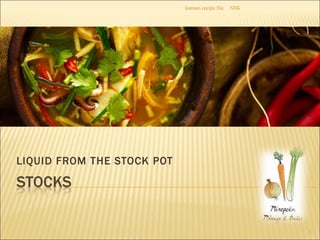
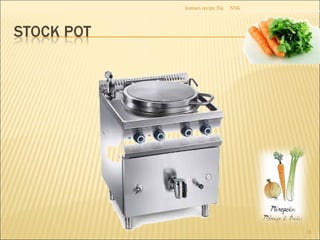
LIQUID FROM THE STOCK POT
NSKkumars recipe file
1
 WHAT IS A STOCK?
 WHY ARE THEY KNOWN AS ‘FOND
DE CUISINE’?
 INGREDIENTS THAT GO IN A
STOCK
 DIFFERENT TYPES OF STOCKS
 USES OF STOCKS
 GUIDELINES FOR STOCK
PRODUCTION
NSKkumars recipe file
2
 Stock is a liquid containing some of the soluble
nutrients and flavor of the food in which are
extracted by prolonged and gentle simmering
(except for the fish stock which takes only 20
minutes of simmering).
 Stock is the basic ingredient of making good
soups, sauces, gravies etc. stocks are the
foundations of many important kitchen
preparation. So greater care should be taken in
their preparation and storage.
NSKkumars recipe file
3
 Stock liquor has the base of water into which
flavors from selected bones and vegetables are
extracted by gentle simmering. Other flavors
are infused into the stock in the form of
bouquet garni. Once cooking time is finished
the resultant liquor is termed as STOCK.
NSKkumars recipe file
4
 Use fresh ingredients as far as possible to
retain the maximum flavors, longer life for the
stock and to avoid unpleasant flavor.
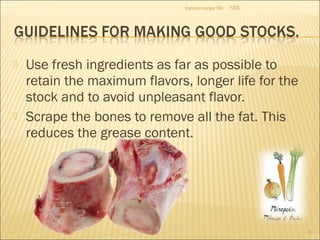
 Scrape the bones to remove all the fat. This
reduces the grease content.
NSKkumars recipe file
5
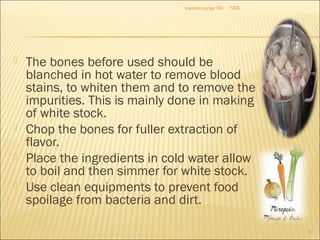
 The bones before used should be
blanched in hot water to remove blood
stains, to whiten them and to remove the
impurities. This is mainly done in making
of white stock.
 Chop the bones for fuller extraction of
flavor.
 Place the ingredients in cold water allow
to boil and then simmer for white stock.
 Use clean equipments to prevent food
spoilage from bacteria and dirt.
NSKkumars recipe file
6
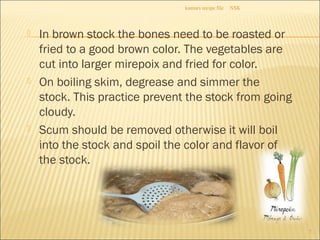
 In brown stock the bones need to be roasted or
fried to a good brown color. The vegetables are
cut into larger mirepoix and fried for color.
 On boiling skim, degrease and simmer the
stock. This practice prevent the stock from going
cloudy.
 Scum should be removed otherwise it will boil
into the stock and spoil the color and flavor of
the stock.
NSKkumars recipe file
7
 Fat should be skimmed otherwise it will taste
grease.
 Stocks should always simmer gently, for if it is
allowed to boil quickly it will evaporate and go
cloudy.
 Stock pot should never be covered with a lid.
NSKkumars recipe file
8
 Never allow the stock to go off the simmering
point or in hot weather there is a danger of its
going sour.
 Seasonings mainly salt should never be added
to the stock while making.
 If stocks to be kept, strain, reboil, cool quickly
and place it in a refrigerator covered.
NSKkumars recipe file
9
 Avoid using coloring vegetables in making of
white stocks.
 Stock essence is the resultant of stock reduced
by half to a more concentrated form.
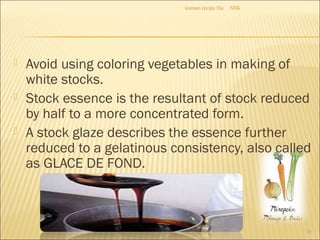
 A stock glaze describes the essence further
reduced to a gelatinous consistency, also called
as GLACE DE FOND.
NSKkumars recipe file
10
 BONES 2 KG.
 WATER 4 LIT.
 VEGETABLES ½ KG.
 BOUQUET GARNI 1. ( thyme, bay leaf,
parsley, peppercorns).
VEGETABLES
50% ONION
25% CARROT
25% CELERY
NSKkumars recipe file
11
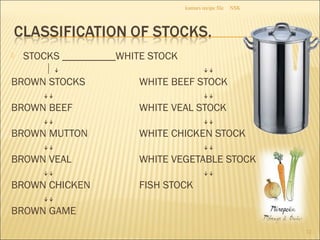
 STOCKS __________WHITE STOCK
|↓ ↓↓
BROWN STOCKS WHITE BEEF STOCK
↓↓ ↓↓
BROWN BEEF WHITE VEAL STOCK
↓↓ ↓↓
BROWN MUTTON WHITE CHICKEN STOCK
↓↓ ↓↓
BROWN VEAL WHITE VEGETABLE STOCK
↓↓ ↓↓
BROWN CHICKEN FISH STOCK
↓↓
BROWN GAME
NSKkumars recipe file
12
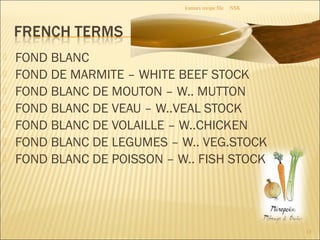
 FOND BLANC
 FOND DE MARMITE – WHITE BEEF STOCK
 FOND BLANC DE MOUTON – W.. MUTTON
 FOND BLANC DE VEAU – W..VEAL STOCK
 FOND BLANC DE VOLAILLE – W..CHICKEN
 FOND BLANC DE LEGUMES – W.. VEG.STOCK
 FOND BLANC DE POISSON – W.. FISH STOCK
NSKkumars recipe file
13
 FOND BRUN
 ESTOUFFADE – BROWN BEEF STOCK
 FOND BRUN DE MOUTON – B. MUTTON
 FOND BRUN DE VEAU – B..VEAL STOCK
 FOND BRUN DE VOLAILLE – B.. CHICKEN
 FOND BRUN DE GIBIER – B..GAME STOCK
 FOND BRUN DE LEGUMES – B.. VEG..STOCK
NSKkumars recipe file
14
CHINOIS
NSKkumars recipe file
15
NSKkumars recipe file
16
NSKkumars recipe file
17
NSKkumars recipe file
18
 Matignon
 Matignon is a combination of minced
vegetables, usually onion (and/or leek),
celery, and carrot, with a sprig of thyme
and half a bay leaf, sautéed in butter over
a low flame until softened and translucent
("melted" but not browned), seasoned to
taste with a pinch of salt and a pinch of
sugar
NSKkumars recipe file
19
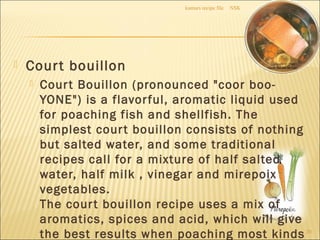
 Court bouillon
 Court Bouillon (pronounced "coor boo-
YONE") is a flavorful, aromatic liquid used
for poaching fish and shellfish. The
simplest court bouillon consists of nothing
but salted water, and some traditional
recipes call for a mixture of half salted
water, half milk , vinegar and mirepoix
vegetables.
The court bouillon recipe uses a mix of
aromatics, spices and acid, which will give
the best results when poaching most kinds
NSKkumars recipe file
20
 The name Court bouillon is a French name which
literally means – ‘short broth” and is often prepared
as the cooking liquid for fish or vegetables.
 The basic components of a court bouillon include
aromatic vegetables and herbs, an acid such as
vinegar, whiter wine or lemon juice and water.
 A court bouillon is usually used as liquid for
poaching or stewing fish and other meat items.
NSKkumars recipe file
21
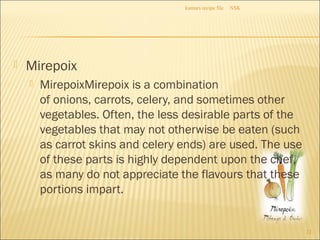
 Mirepoix
 MirepoixMirepoix is a combination
of onions, carrots, celery, and sometimes other
vegetables. Often, the less desirable parts of the
vegetables that may not otherwise be eaten (such
as carrot skins and celery ends) are used. The use
of these parts is highly dependent upon the chef,
as many do not appreciate the flavours that these
portions impart.
NSKkumars recipe file
22
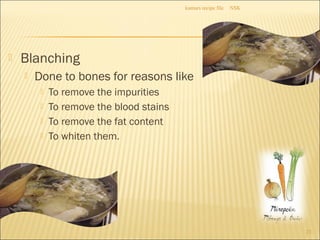
 Blanching
 Done to bones for reasons like
 To remove the impurities
 To remove the blood stains
 To remove the fat content
 To whiten them.
NSKkumars recipe file
23
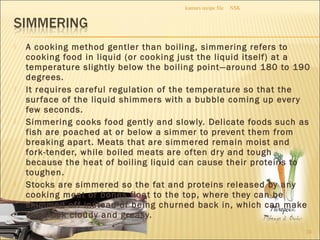
 A cooking method gentler than boiling, simmering refers to
cooking food in liquid (or cooking just the liquid itself) at a
temperature slightly below the boiling point―around 180 to 190
degrees.
 It requires careful regulation of the temperature so that the
surface of the liquid shimmers with a bubble coming up every
few seconds.
 Simmering cooks food gently and slowly. Delicate foods such as
fish are poached at or below a simmer to prevent them from
breaking apart. Meats that are simmered remain moist and
fork-tender, while boiled meats are often dry and tough
because the heat of boiling liquid can cause their proteins to
toughen.
 Stocks are simmered so the fat and proteins released by any
cooking meat or bones float to the top, where they can be
skimmed off instead of being churned back in, which can make
the stock cloudy and greasy.
NSKkumars recipe file
24
 The scum is denatured protein, mostly comprising
the same proteins that make up egg whites. It is
harmless and flavorless, but visually unappealing.
Eventually, the foam will break up into microscopic
particles and disperse into your stock, leaving it
grayish and cloudy. The more vigorously your stock
bubbles, the faster this process will occur.
 If the grayness or cloudiness bothers you but
skimming is not an option for some reason, you can
always remove the micro-particulates later through
the clarification process used to make consomme.
NSKkumars recipe file
25
 The difference between broth and stock is one of
both cultural and colloquial terminology but certain
definitions prevail. Stock is the thin liquid produced
by simmering raw ingredients: solids are removed,
leaving a thin, highly flavoured liquid. This yields
classic stock as made from beef, veal, chicken, fish
and vegetables.
 Broth differs in that it is a basic soup where the
solid pieces of flavouring meat or fish, along with
some vegetables, remain. It is often made more
substantial by adding starches such as rice, barley
or pulses.
 Traditionally, broth contained some form of meat or
fish; however, nowadays it is acceptable to refer to a
strictly vegetable soup as a broth.
NSKkumars recipe file
26
 Remouillage is a stock made from bones that
have already been used those used for jus lie.
The second stock is less strong and is usually
reduced to make a glace.
 Remouillage may also replace water in the
making of a stock.
NSKkumars recipe file
27
NSKkumars recipe file
28

Stocks

  • 1.
    LIQUID FROM THESTOCK POT NSKkumars recipe file 1
  • 2.
     WHAT ISA STOCK?  WHY ARE THEY KNOWN AS ‘FOND DE CUISINE’?  INGREDIENTS THAT GO IN A STOCK  DIFFERENT TYPES OF STOCKS  USES OF STOCKS  GUIDELINES FOR STOCK PRODUCTION NSKkumars recipe file 2
  • 3.
     Stock isa liquid containing some of the soluble nutrients and flavor of the food in which are extracted by prolonged and gentle simmering (except for the fish stock which takes only 20 minutes of simmering).  Stock is the basic ingredient of making good soups, sauces, gravies etc. stocks are the foundations of many important kitchen preparation. So greater care should be taken in their preparation and storage. NSKkumars recipe file 3
  • 4.
     Stock liquorhas the base of water into which flavors from selected bones and vegetables are extracted by gentle simmering. Other flavors are infused into the stock in the form of bouquet garni. Once cooking time is finished the resultant liquor is termed as STOCK. NSKkumars recipe file 4
  • 5.
     Use freshingredients as far as possible to retain the maximum flavors, longer life for the stock and to avoid unpleasant flavor.  Scrape the bones to remove all the fat. This reduces the grease content. NSKkumars recipe file 5
  • 6.
     The bonesbefore used should be blanched in hot water to remove blood stains, to whiten them and to remove the impurities. This is mainly done in making of white stock.  Chop the bones for fuller extraction of flavor.  Place the ingredients in cold water allow to boil and then simmer for white stock.  Use clean equipments to prevent food spoilage from bacteria and dirt. NSKkumars recipe file 6
  • 7.
     In brownstock the bones need to be roasted or fried to a good brown color. The vegetables are cut into larger mirepoix and fried for color.  On boiling skim, degrease and simmer the stock. This practice prevent the stock from going cloudy.  Scum should be removed otherwise it will boil into the stock and spoil the color and flavor of the stock. NSKkumars recipe file 7
  • 8.
     Fat shouldbe skimmed otherwise it will taste grease.  Stocks should always simmer gently, for if it is allowed to boil quickly it will evaporate and go cloudy.  Stock pot should never be covered with a lid. NSKkumars recipe file 8
  • 9.
     Never allowthe stock to go off the simmering point or in hot weather there is a danger of its going sour.  Seasonings mainly salt should never be added to the stock while making.  If stocks to be kept, strain, reboil, cool quickly and place it in a refrigerator covered. NSKkumars recipe file 9
  • 10.
     Avoid usingcoloring vegetables in making of white stocks.  Stock essence is the resultant of stock reduced by half to a more concentrated form.  A stock glaze describes the essence further reduced to a gelatinous consistency, also called as GLACE DE FOND. NSKkumars recipe file 10
  • 11.
     BONES 2KG.  WATER 4 LIT.  VEGETABLES ½ KG.  BOUQUET GARNI 1. ( thyme, bay leaf, parsley, peppercorns). VEGETABLES 50% ONION 25% CARROT 25% CELERY NSKkumars recipe file 11
  • 12.
     STOCKS __________WHITESTOCK |↓ ↓↓ BROWN STOCKS WHITE BEEF STOCK ↓↓ ↓↓ BROWN BEEF WHITE VEAL STOCK ↓↓ ↓↓ BROWN MUTTON WHITE CHICKEN STOCK ↓↓ ↓↓ BROWN VEAL WHITE VEGETABLE STOCK ↓↓ ↓↓ BROWN CHICKEN FISH STOCK ↓↓ BROWN GAME NSKkumars recipe file 12
  • 13.
     FOND BLANC FOND DE MARMITE – WHITE BEEF STOCK  FOND BLANC DE MOUTON – W.. MUTTON  FOND BLANC DE VEAU – W..VEAL STOCK  FOND BLANC DE VOLAILLE – W..CHICKEN  FOND BLANC DE LEGUMES – W.. VEG.STOCK  FOND BLANC DE POISSON – W.. FISH STOCK NSKkumars recipe file 13
  • 14.
     FOND BRUN ESTOUFFADE – BROWN BEEF STOCK  FOND BRUN DE MOUTON – B. MUTTON  FOND BRUN DE VEAU – B..VEAL STOCK  FOND BRUN DE VOLAILLE – B.. CHICKEN  FOND BRUN DE GIBIER – B..GAME STOCK  FOND BRUN DE LEGUMES – B.. VEG..STOCK NSKkumars recipe file 14
  • 15.
  • 16.
  • 17.
  • 18.
  • 19.
     Matignon  Matignonis a combination of minced vegetables, usually onion (and/or leek), celery, and carrot, with a sprig of thyme and half a bay leaf, sautéed in butter over a low flame until softened and translucent ("melted" but not browned), seasoned to taste with a pinch of salt and a pinch of sugar NSKkumars recipe file 19
  • 20.
     Court bouillon Court Bouillon (pronounced "coor boo- YONE") is a flavorful, aromatic liquid used for poaching fish and shellfish. The simplest court bouillon consists of nothing but salted water, and some traditional recipes call for a mixture of half salted water, half milk , vinegar and mirepoix vegetables. The court bouillon recipe uses a mix of aromatics, spices and acid, which will give the best results when poaching most kinds NSKkumars recipe file 20
  • 21.
     The nameCourt bouillon is a French name which literally means – ‘short broth” and is often prepared as the cooking liquid for fish or vegetables.  The basic components of a court bouillon include aromatic vegetables and herbs, an acid such as vinegar, whiter wine or lemon juice and water.  A court bouillon is usually used as liquid for poaching or stewing fish and other meat items. NSKkumars recipe file 21
  • 22.
     Mirepoix  MirepoixMirepoix isa combination of onions, carrots, celery, and sometimes other vegetables. Often, the less desirable parts of the vegetables that may not otherwise be eaten (such as carrot skins and celery ends) are used. The use of these parts is highly dependent upon the chef, as many do not appreciate the flavours that these portions impart. NSKkumars recipe file 22
  • 23.
     Blanching  Doneto bones for reasons like  To remove the impurities  To remove the blood stains  To remove the fat content  To whiten them. NSKkumars recipe file 23
  • 24.
     A cookingmethod gentler than boiling, simmering refers to cooking food in liquid (or cooking just the liquid itself) at a temperature slightly below the boiling point―around 180 to 190 degrees.  It requires careful regulation of the temperature so that the surface of the liquid shimmers with a bubble coming up every few seconds.  Simmering cooks food gently and slowly. Delicate foods such as fish are poached at or below a simmer to prevent them from breaking apart. Meats that are simmered remain moist and fork-tender, while boiled meats are often dry and tough because the heat of boiling liquid can cause their proteins to toughen.  Stocks are simmered so the fat and proteins released by any cooking meat or bones float to the top, where they can be skimmed off instead of being churned back in, which can make the stock cloudy and greasy. NSKkumars recipe file 24
  • 25.
     The scumis denatured protein, mostly comprising the same proteins that make up egg whites. It is harmless and flavorless, but visually unappealing. Eventually, the foam will break up into microscopic particles and disperse into your stock, leaving it grayish and cloudy. The more vigorously your stock bubbles, the faster this process will occur.  If the grayness or cloudiness bothers you but skimming is not an option for some reason, you can always remove the micro-particulates later through the clarification process used to make consomme. NSKkumars recipe file 25
  • 26.
     The differencebetween broth and stock is one of both cultural and colloquial terminology but certain definitions prevail. Stock is the thin liquid produced by simmering raw ingredients: solids are removed, leaving a thin, highly flavoured liquid. This yields classic stock as made from beef, veal, chicken, fish and vegetables.  Broth differs in that it is a basic soup where the solid pieces of flavouring meat or fish, along with some vegetables, remain. It is often made more substantial by adding starches such as rice, barley or pulses.  Traditionally, broth contained some form of meat or fish; however, nowadays it is acceptable to refer to a strictly vegetable soup as a broth. NSKkumars recipe file 26
  • 27.
     Remouillage isa stock made from bones that have already been used those used for jus lie. The second stock is less strong and is usually reduced to make a glace.  Remouillage may also replace water in the making of a stock. NSKkumars recipe file 27
  • 28.