About Assignment #4
WRIT 250 for ACCY Interns
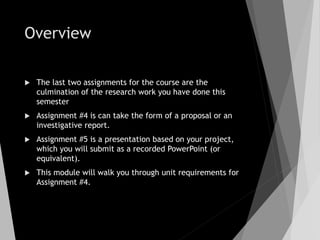
Overview
 The last two assignments for the course are the
culmination of the research work you have done this
semester
 Assignment #4 is can take the form of a proposal or an
investigative report.
 Assignment #5 is a presentation based on your project,
which you will submit as a recorded PowerPoint (or
equivalent).
 This module will walk you through unit requirements for
Assignment #4.
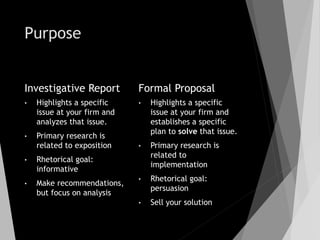
Purpose
Investigative Report
• Highlights a specific
issue at your firm and
analyzes that issue.
• Primary research is
related to exposition
• Rhetorical goal:
informative
• Make recommendations,
but focus on analysis
Formal Proposal
• Highlights a specific
issue at your firm and
establishes a specific
plan to solve that issue.
• Primary research is
related to
implementation
• Rhetorical goal:
persuasion
• Sell your solution
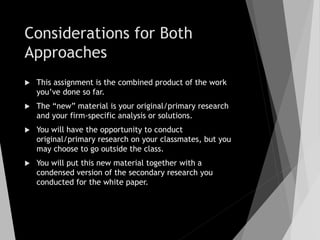
Considerations for Both
Approaches
 This assignment is the combined product of the work
you’ve done so far.
 The “new” material is your original/primary research
and your firm-specific analysis or solutions.
 You will have the opportunity to conduct
original/primary research on your classmates, but you
may choose to go outside the class.
 You will put this new material together with a
condensed version of the secondary research you
conducted for the white paper.
Investigative Report
• Primarily expository
• Based on an exploratory research question
• Investigative reports should:
• Clearly state the research question and goal
• Objectively report on secondary research
• Conduct primary research transparently
• Analyze findings and make recommendations
• Investigative reports should not:
• Outline specific implementation of recommendations
• Propose timelines, budgets, and policy changes in support of
recommendations
• Persuade or sell an idea, concept, approach, or change
• In many ways, an investigative report is like an audit
report that you might prepare for a client.
Parts of an Investigative
Report
Memo of Transmittal
The “cover page” for the report. Use standard memo
format. Content should mirror what’s in the executive
summary. In practice, the memo of transmittal serves
mostly an administrative purpose.
Title Page (optional)
The title page should reflect the style of your firm and
should include the firm’s name, your name, and the title.
Include any confidentiality statements on this page.
Parts of an Investigative
Report
Executive Summary
Just like you wrote for the white paper. Give the
abstract/Reader’s Digest version of the entire report.
Should be less than 10% of the report’s total length
Table of Contents (optional)
If your report is complex or is divided up into several
distinct sections, a TOC can aid in readability and
navigation. This really depends on the length of your
report.
Parts of an Investigative
Report
Introduction
Introduce the report just like you would introduce an essay.
This is not the same as an executive summary. Treat the
introduction as the actual beginning of the report (it should
make sense if all the other front matter is removed).
Parts of an Investigative Report:
Methods/Primary Research
 Your investigative report should include a primary research
component. Primary research is original fact-finding that
you conduct. Examples for ACCY include:
 Surveys
 Interviews
 Examination of primary documents (financial data– think
spreadsheets or ledgers)
 The Reality: you might have a hard time finding conducting
authentic primary research because you’re done with your
internship.
 The Solution: use your classmates as subjects. Many of
them worked at similar firms (even the same firms). You
can email them surveys, interview them, or examine the
non-confidential work they did.
Parts of an Investigative
Report
Methods
The methods section should explain your research process.
Basically, explain what you did. Include supporting
documentation in an appendix.
Discussion
Discuss and evaluate your primary findings and connect to
your secondary research. This will be the longest section
of the report. You should divide into headings/subheadings
where appropriate. Your primary study may play a major or
minor role depending on what your project is about.
Parts of an Investigative
Report
Recommendations
Based on the information you collected and your primary study, outline
general recommendations for the firm. Do not structure this section as a
proposal. You are objectively presenting options.
Conclusion
Tie it all together, mirror the introduction
References
Cite all sources used. Style guide is up to you as long as you are consistent
Appendix
Include copies of surveys, interview transcripts, or other things you
collected.
Summary
You should choose an investigative report if you are more
interested in exploring an issue, concept, topic, or
problem. You may not already have a specific solution.
Choose this option if you white paper research was more
theoretical and broad, and you want to apply that research
to the specific situation at your firm.
Formal Proposals
• Primarily persuasive
• Based on an a specific change or implementation of
change
• Formal proposals should
• Clearly state the overall purpose and goal of the change
• Use secondary research to justify the proposed change
• Conduct primary research transparently
• Use findings to add credibility
• Propose specific timelines, budgets, and policy changes in
support of changes.
• Formal Proposals should not:
• Rely too heavily on theory or exposition.
• A formal proposal is ultimately trying to sell an idea.
Parts of a Formal Proposal
Cover Page/Letter
Review the proposed project in summary. Since you are not
writing an executive summary for the proposal, it should
meet similar goals.
Project Description
The first part of the proposal proper. Introduce the project
and review the components of the proposal.
Parts of a Formal Proposal
Objectives/Goals
Formally outline the “why” of the proposal. It is a good
idea to have specific goals or outcomes (you can even list
them with bullet points). This section should ensure that
your audience is open-minded to what you have to say
Evaluation/Literature Review
Review secondary research findings (repurposed from your
white paper) and present your preliminary original research
findings (see next slide).
Parts of a Formal Report:
Primary Research
 Your formal proposal should include a primary research
component. Primary research is original fact-finding that
you conduct. Examples for ACCY include:
 Surveys
 Interviews
 Examination of primary documents (financial data– think
spreadsheets or ledgers)
 The Reality: you might have a hard time finding conducting
authentic primary research because you’re done with your
internship.
 The Solution: use your classmates as subjects. Many of
them worked at similar firms (even the same firms). You
can email them surveys, interview them, or examine the
non-confidential work they did.
Parts of a Formal Proposal
Methodology
The methodology section should explain how you will
implement the proposed changes.
Evaluation
Explain why you want to implement the proposed changes
the way you outlined in your methodology.
Parts of a Formal Proposal
Budget, Personnel, Resources Justification
Outline the specifics of your implementation
Conclusion
Make your final push to sell the project, summarize it into
most essential points.
Appendix
Include any necessary supporting documents (surveys,
interview questions, etc).
Summary
You should choose this option if you already have a specific
solution in mind or a way to address a problem you outlined
in your white paper. Many of you have articulated what this
might be.
Choose this option if you want to engage in persuasive
writing and you want to sell an idea, concept, or change in
policy.
Connections to Assignment #1
 This project is similar in principle to the work you did
for assignment #1.
 In assignment 1, you explored and issue and proposed
solutions.
 In this assignment, you will be doing one of those in
greater detail: either exploring an issue or proposing a
specific change.
 This class is designed to come full circle, so if you are
revisiting thoughts and questions you had at the very
beginning, you are on the right track.

About assignment #4

  • 1.
    About Assignment #4 WRIT250 for ACCY Interns
  • 2.
    Overview  The lasttwo assignments for the course are the culmination of the research work you have done this semester  Assignment #4 is can take the form of a proposal or an investigative report.  Assignment #5 is a presentation based on your project, which you will submit as a recorded PowerPoint (or equivalent).  This module will walk you through unit requirements for Assignment #4.
  • 3.
    Purpose Investigative Report • Highlightsa specific issue at your firm and analyzes that issue. • Primary research is related to exposition • Rhetorical goal: informative • Make recommendations, but focus on analysis Formal Proposal • Highlights a specific issue at your firm and establishes a specific plan to solve that issue. • Primary research is related to implementation • Rhetorical goal: persuasion • Sell your solution
  • 4.
    Considerations for Both Approaches This assignment is the combined product of the work you’ve done so far.  The “new” material is your original/primary research and your firm-specific analysis or solutions.  You will have the opportunity to conduct original/primary research on your classmates, but you may choose to go outside the class.  You will put this new material together with a condensed version of the secondary research you conducted for the white paper.
  • 5.
    Investigative Report • Primarilyexpository • Based on an exploratory research question • Investigative reports should: • Clearly state the research question and goal • Objectively report on secondary research • Conduct primary research transparently • Analyze findings and make recommendations • Investigative reports should not: • Outline specific implementation of recommendations • Propose timelines, budgets, and policy changes in support of recommendations • Persuade or sell an idea, concept, approach, or change • In many ways, an investigative report is like an audit report that you might prepare for a client.
  • 6.
    Parts of anInvestigative Report Memo of Transmittal The “cover page” for the report. Use standard memo format. Content should mirror what’s in the executive summary. In practice, the memo of transmittal serves mostly an administrative purpose. Title Page (optional) The title page should reflect the style of your firm and should include the firm’s name, your name, and the title. Include any confidentiality statements on this page.
  • 7.
    Parts of anInvestigative Report Executive Summary Just like you wrote for the white paper. Give the abstract/Reader’s Digest version of the entire report. Should be less than 10% of the report’s total length Table of Contents (optional) If your report is complex or is divided up into several distinct sections, a TOC can aid in readability and navigation. This really depends on the length of your report.
  • 8.
    Parts of anInvestigative Report Introduction Introduce the report just like you would introduce an essay. This is not the same as an executive summary. Treat the introduction as the actual beginning of the report (it should make sense if all the other front matter is removed).
  • 9.
    Parts of anInvestigative Report: Methods/Primary Research  Your investigative report should include a primary research component. Primary research is original fact-finding that you conduct. Examples for ACCY include:  Surveys  Interviews  Examination of primary documents (financial data– think spreadsheets or ledgers)  The Reality: you might have a hard time finding conducting authentic primary research because you’re done with your internship.  The Solution: use your classmates as subjects. Many of them worked at similar firms (even the same firms). You can email them surveys, interview them, or examine the non-confidential work they did.
  • 10.
    Parts of anInvestigative Report Methods The methods section should explain your research process. Basically, explain what you did. Include supporting documentation in an appendix. Discussion Discuss and evaluate your primary findings and connect to your secondary research. This will be the longest section of the report. You should divide into headings/subheadings where appropriate. Your primary study may play a major or minor role depending on what your project is about.
  • 11.
    Parts of anInvestigative Report Recommendations Based on the information you collected and your primary study, outline general recommendations for the firm. Do not structure this section as a proposal. You are objectively presenting options. Conclusion Tie it all together, mirror the introduction References Cite all sources used. Style guide is up to you as long as you are consistent Appendix Include copies of surveys, interview transcripts, or other things you collected.
  • 12.
    Summary You should choosean investigative report if you are more interested in exploring an issue, concept, topic, or problem. You may not already have a specific solution. Choose this option if you white paper research was more theoretical and broad, and you want to apply that research to the specific situation at your firm.
  • 13.
    Formal Proposals • Primarilypersuasive • Based on an a specific change or implementation of change • Formal proposals should • Clearly state the overall purpose and goal of the change • Use secondary research to justify the proposed change • Conduct primary research transparently • Use findings to add credibility • Propose specific timelines, budgets, and policy changes in support of changes. • Formal Proposals should not: • Rely too heavily on theory or exposition. • A formal proposal is ultimately trying to sell an idea.
  • 14.
    Parts of aFormal Proposal Cover Page/Letter Review the proposed project in summary. Since you are not writing an executive summary for the proposal, it should meet similar goals. Project Description The first part of the proposal proper. Introduce the project and review the components of the proposal.
  • 15.
    Parts of aFormal Proposal Objectives/Goals Formally outline the “why” of the proposal. It is a good idea to have specific goals or outcomes (you can even list them with bullet points). This section should ensure that your audience is open-minded to what you have to say Evaluation/Literature Review Review secondary research findings (repurposed from your white paper) and present your preliminary original research findings (see next slide).
  • 16.
    Parts of aFormal Report: Primary Research  Your formal proposal should include a primary research component. Primary research is original fact-finding that you conduct. Examples for ACCY include:  Surveys  Interviews  Examination of primary documents (financial data– think spreadsheets or ledgers)  The Reality: you might have a hard time finding conducting authentic primary research because you’re done with your internship.  The Solution: use your classmates as subjects. Many of them worked at similar firms (even the same firms). You can email them surveys, interview them, or examine the non-confidential work they did.
  • 17.
    Parts of aFormal Proposal Methodology The methodology section should explain how you will implement the proposed changes. Evaluation Explain why you want to implement the proposed changes the way you outlined in your methodology.
  • 18.
    Parts of aFormal Proposal Budget, Personnel, Resources Justification Outline the specifics of your implementation Conclusion Make your final push to sell the project, summarize it into most essential points. Appendix Include any necessary supporting documents (surveys, interview questions, etc).
  • 19.
    Summary You should choosethis option if you already have a specific solution in mind or a way to address a problem you outlined in your white paper. Many of you have articulated what this might be. Choose this option if you want to engage in persuasive writing and you want to sell an idea, concept, or change in policy.
  • 20.
    Connections to Assignment#1  This project is similar in principle to the work you did for assignment #1.  In assignment 1, you explored and issue and proposed solutions.  In this assignment, you will be doing one of those in greater detail: either exploring an issue or proposing a specific change.  This class is designed to come full circle, so if you are revisiting thoughts and questions you had at the very beginning, you are on the right track.