ABNORMAL LABOR
Outline
■ DYSTOCIA Definition
■ 3Ps of dystocia
■ FETOPELVIC DISPROPORTION
■ PELVIC CAPACITY
■ FACE PRESENTATION
■ BROW PRESENTATION
■ TRANSVERSE LIE
■ COMPOUND PRESENTATION
■ COMPLICATIONS OF DYSTOCIA
■ PRECIPITOUS LABOR AND DELIVERY
Dystocia
Dystocia literally means “difficult labor” or “dysfunctional labor”; abnormally
slow labor progress.
“cephalopelvic disproportion”; “failure to progress”
It arises from 3 distinct abnormalities (”3Ps”) that may exist singly or in
combination:
• “POWER”: Expulsive forces may be abnormalinadequate uterine contractions;
inadequate voluntary maternal muscle effort during second-stage labor.
• “PASSENGER”: Fetal abnormalities of presentation, position (“asynclitism”), or
development
• “PASSAGES”: Abnormalities of the maternal bony pelvis may create a contracted
pelvis; soft tissue abnormalities of the reproductive tract may form an obstacle to fetal
descent.
TABLE 23-1. Common Clinical Findings in Women with Ineffective Labor
Inadequate cervical dilation or fetal descent:
Protracted labor—slow progress
Arrested labor—no progress
Inadequate expulsive effort—ineffective pushing
Fetopelvic disproportion:
Excessive fetal size
Inadequate pelvic capacity
Malpresentation or position of the fetus
Abnormal fetal anatomy
Ruptured membranes without labor
Abnormal labor patterns
TABLE 23-2. Abnormal Labor Patterns, Diagnostic Criteria, and Methods of
Treatment
1st “P”: Power
ABNORMALITIES OF THE EXPULSIVE FORCES
■ Normal spontaneous contractions often exert pressures
approximating 60 mm Hg.
■ lower limit of contraction pressure required to dilate the cervix
is 15 mm Hg.
■ adequate uterine contractions > 200 Montevideo units
MONTEVIDEO UNITS
1st“P”:Power
ABNORMALITIES OF THE EXPULSIVE FORCES
■ 2 physiological types of uterine dysfunction:
■ hypotonic uterine dysfunction: no basal hypertonus and uterine
contractions have a normal gradient pattern (synchronous), but
pressure during a contraction is insufficient to dilate the cervix.
■ hypertonic uterine dysfunction: or “incoordinate uterine
dysfunction”, either basal tone is elevated appreciably or the pressure
gradient is distorted.
– Gradient distortion may result from more forceful contraction of the
uterine midsegment than the fundus or from complete asynchrony
of the impulses originating in each cornu or a combination of these
two.
Labor disorders:
Latent Phase Prolongation
■ Defined as LATENT PHASE >20 hours in nulliparas; > 14 hours
in multiparas
■ Often managed with bed rest, or some prefer starting
oxytocin stimulation
Labor disorders:
Active Phase Disorder
■ divided into either:
– Protraction disorder : or a slower-than- normal
progress
– Arrest disorder: a complete cessation of progress.
■ A woman must be in the active phase of labor which is
defined by cervical change.
Active Phase protraction
■ WHO defines this as rate of cervical dilatation of < 1
cm/hour, for a minimum of 4 hours.
■ Observation of further progress is appropriate
treatment
■ If MV units are insufficient  oxytocin augmentation
■ Slow but progressive first-stage of labor SHOULD not
be an indication for ceserian delivery
Active Phase arrest
■ Defined as NO CERVICAL dilatation for > 2 hours
– Latent phase should be completed
– Cervix dilated > 4cm
– Uterine contraction pattern > 200 MV units in a 10
minute period has been present for at least 4 hours
Obstetric care consensus committee (2016):
4 recommendations
1. A prolonged latent phase is NOT an indication for cesarean
delivery
2. A slow but progressive labor (protraction disorder) is NOT an
indication for cesarean delivery
3. Active labor starts at cervical dilatation of 6cms (Not 4cms)
4. Cesarean delivery for active phase arrest should be reserved
for women at or beyond 6 cms of cervical dilatation with
ruptured membranes, who fail to progress despite 4 hours of
adequate uterine activity, or at least 6 hours of oxytocin
administration
Second-stage descent disorders
■ Second stage in nulliparas: 2 hours (3 hours if with
regional anesthesia)
■ Second stage in multiparas: 1 hour (2 hours if with
regional anesthesia)
■ Conensus committee (2016) recommends allowing a
nullipara to push for at least 3 hours, and a multipara
to push for at least 2 hours before 2nd stage labor
arrest is diagnosed
– Maternal and fetal status should be reassuring
Reported Causes of Uterine Dysfunction
(“Powers”)
1. Epidural Analgesia
– Epidural analgesia can slow labor; associated with lengthening
of both first- and second- stage labor and with slowing of the
rate of fetal descent.
2. Chorioamnionitis
– Infection diagnosed late in labor was found to be a marker of
cesarean delivery performed for dystocia, whereas this was not
a marker in women diagnosed as having chorioamnionitis early
in labor.
■ Fetopelvic disproportion arises from diminished pelvic
capacity, excessive fetal size, or more usually both.
■ There may be a contraction of the pelvic inlet, the
midpelvis, or the pelvic outlet, or a generally
contracted pelvis may be caused by combinations of
these.
2nd “P”: Passages
Fetopelvic Disproportion
FETOPELVIC DISPROPORTION:
Contracted inlet
■ The pelvic inlet usually is considered to be contracted if its
shortest anteroposterior (AP) diameter is < 10 cm or if the
greatest transverse diameter is < 12 cm (xray pelvimetry)
■ usually is defined as a diagonal
conjugate < 11.5cm
FETOPELVIC DISPROPORTION:
Contracted inlet
■ In a contracted pelvis, the entire force exerted by the uterus
acts directly on the portion of membranes that contact the
dilating cervix  early spontaneous rupture of the
membranes is more likely.
■ After membrane rupture, absent pressure by the head against
the cervix and lower uterine segment predisposes to less
effective contractions  dilatation may proceed very slowly or
not at all.
FETOPELVIC DISPROPORTION:
Contracted inlet
■ In women with contracted pelvis, face and shoulder
presentations are encountered three times more
frequently, and the cord prolapses four to six times
more often.
FETOPELVIC DISPROPORTION:
Contracted midplane/midpelvis
■ more common than inlet contraction.
■ causes transverse arrest of the fetal head, which potentially
can lead to a difficult midforceps operation or to cesarean
delivery.
■ the midpelvis extends from the inferior margin of the
symphysis pubis, through the ischial spines, and touches the
sacrum near the junction of the 4th and 5th vertebrae (S4-S5)
FETOPELVIC DISPROPORTION:
Contracted midplane/midpelvis
■ Average midpelvis measurements are
as follows:
– Interspinous diameter: 10.5cm
– Anteroposterior diameter: 11.5 cm
– Posterior sagittal: 5 cm
 midpelvis is likely contracted when:
– the sum of the interspinous and
posterior sagittal diameters < 13.5 cm
– Interspinous diameter< 8 cm
FETOPELVIC DISPROPORTION:
Contracted midplane/midpelvis
■ Other midplane findings suggesting contraction:
1. the spines are prominent
2. the pelvic sidewalls converge
3. sacrosciatic notch is narrow.
■ narrowing of the interspinous diameter can be anticipated when the
intertuberous diameter is narrow. A normal intertuberous diameter,
however, does not always exclude a narrow interspinous diameter.
FETOPELVIC DISPROPORTION:
Contracted outlet
■ interischial tuberous diameter of 8 cm or less.
■ A contracted outlet may cause dystocia not so much
by itself but by an often-associated midpelvic
contraction. Outlet contraction without concomitant
midplane contraction is rare.
■ Contracted outlet often gives rise to perineal tears.
■ Fetopelvic disproportion can also arise
from large fetal head size, or malposition
of the head (includes asynclitism, occiput
posterior position, face or brow
presentation)
3rd “P”:Passenger
Fetopelvic Disproportion
Mueller-Hillis Maneuver (MHM)
• Traditionally used to “predict dystocia” where the
fetal brow and suboccipital region are grasped through
the abdominal wall with the fingers, and firm pressure is
directed downward in the axis of the inlet
• If no disproportion exists, the head readily enters the
pelvis, and vaginal delivery can be predicted
• “Modified” MHM: The Mueller-Hillis maneuver was
modified by limiting its use to the second stage of
labor during a contracted
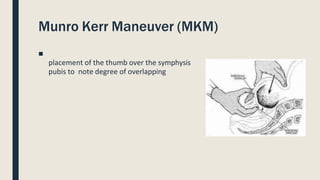
Munro Kerr Maneuver (MKM)
■
placement of the thumb over the symphysis
pubis to note degree of overlapping
Face Presentation
■ Rarely deliver vaginally
■ head is hyperextended so that the occiput is in
contact with the fetal back, and the chin
(mentum) is presenting
■ the fetal brow (bregma) is pressed against the
maternal symphysis pubis  this position
precludes flexion of the fetal head necessary to
negotiate the birth canal.
■ Thus, a mentum posterior presentation is
undeliverable except with a very preterm
fetus.
■ Term fetus with face presentation and mentum
anterior may be delivered vaginally
Face Presentation: Etiology
Cunningham FG, Leveno KJ, Bloom SL, et al (eds).William’s Obstetrics 25th edition; 2018; chapter 23 Abnormal Labor
■ include conditions that favor extension or prevent head flexion:
1. Preterm infants, with their smaller head dimensions, can
engage before conversion to vertex position
2. Marked enlargement of the neck or coils of cord around the
neck may cause extension.
3. Fetal malformations and hydramnios
4. Anencephalic fetuses naturally present by the face.
5. pelvis is contracted or the fetus is very large.
6. High parity (pendulous abdomen permits the back of the fetus to sag
forward or laterally  promotes extension of the cervical and thoracic
spine. )
Face Presentation: Management
■ Because face presentations among term-size fetuses are more
common when there is some degree of pelvic inlet
contraction, cesarean delivery frequently is indicated.
■ Attempts to convert a face presentation manually into a vertex
presentation (manual or forceps rotation of a persistently
posterior chin to a mentum anterior position) and internal
podalic version and extraction are dangerous and should not
be attempted.
Brow Presentation
FIGURE 23-8 Brow posterior presentation.
■ diagnosed when that portion of the fetal
head between the orbital ridge and the
anterior fontanel presents at the pelvic
inlet.
■ the fetal head thus occupies a position
midway between full flexion (occiput)
and extension (face).
■ Engagement of the fetal head and
subsequent delivery cannot take place as
long as the brow presentation persists.
(Except when the fetal head is small or the pelvis
is unusually large)
Transverse Lie
■ Long axis of the fetus is approximately
perpendicular to that of the mother.
■ Shoulder is usually positioned over the pelvic
inlet.
■ Head occupies one iliac fossa, and the breech
the other  this creates a shoulder
presentation in which the side of the mother
on which the acromion rests determines the
designation of the lie as right or left acromial.
Transverse Lie: Etiology
■ common causes:
1. abdominal wall relaxation from high parity
2. preterm fetus
3. placenta previa
4. abnormal uterine anatomy
5. hydramnios
6. contracted pelvis.
■ A relaxed and pendulous abdomen allows the uterus to fall forward, deflecting
the long axis of the fetus away from the axis of the birth canal and into an
oblique or transverse position.
Neglected transverse lie
■ After rupture of the membranes, the fetal shoulder is
forced into the pelvis, and the arm prolapses
■ Shoulder is arrested by the margins of the pelvic
inlet, with the head in one iliac fossa and the breech
in the other.
■ Uterus contracts vigorously in an unsuccessful
attempt to overcome the obstacle.
■ With time, a retraction ring rises increasingly higher
and becomes more marked.
■ With this neglected transverse lie, the uterus will
eventually rupture.
Neglected shoulder presentation
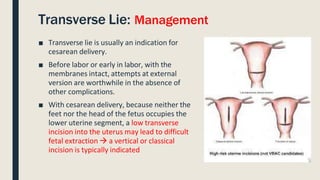
Transverse Lie: Management
■ Transverse lie is usually an indication for
cesarean delivery.
■ Before labor or early in labor, with the
membranes intact, attempts at external
version are worthwhile in the absence of
other complications.
■ With cesarean delivery, because neither the
feet nor the head of the fetus occupies the
lower uterine segment, a low transverse
incision into the uterus may lead to difficult
fetal extraction  a vertical or classical
incision is typically indicated
Transverse Lie: Management
■ If the fetus is small (< 800g) and the pelvis
is large, vaginal delivery is possible:
– Fetus is compressed with the fetal head
forced against its abdomen  portion
of the thoracic wall becomes the most
dependent part, appearing at the
vulva.
– The fetus is doubled upon itself,
sometime called ”conduplicato
corpore”
Compound presentation
■ In a compound presentation, an
extremity prolapses alongside the
presenting part, and both present
simultaneously in the pelvis
■ Causes of compound presentations
are conditions that prevent
complete occlusion of the pelvic
inlet by the fetal head, including
preterm labor.
A
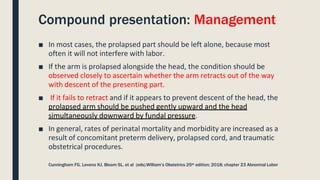
Compound presentation: Management
Cunningham FG, Leveno KJ, Bloom SL, et al (eds).William’s Obstetrics 25th edition; 2018; chapter 23 Abnormal Labor
■ In most cases, the prolapsed part should be left alone, because most
often it will not interfere with labor.
■ If the arm is prolapsed alongside the head, the condition should be
observed closely to ascertain whether the arm retracts out of the way
with descent of the presenting part.
■ If it fails to retract and if it appears to prevent descent of the head, the
prolapsed arm should be pushed gently upward and the head
simultaneously downward by fundal pressure.
■ In general, rates of perinatal mortality and morbidity are increased as a
result of concomitant preterm delivery, prolapsed cord, and traumatic
obstetrical procedures.
Complications with Dystocia: Maternal
1. Uterine Rupture
■ Abnormal thinning of the lower uterine
segment during prolonged labor (women
of high parity and in those with a prior
cesarean delivery)
■ When disproportion is so pronounced
that there is no engagement or
descent, the lower uterine segment
becomes increasingly stretched, and
rupture may follow.
Cunningham FG, Leveno KJ, Bloom SL, et al (eds).William’s Obstetrics 25th edition; 2018; chapter 23 Abnormal Labor
Complications with Dystocia: Maternal
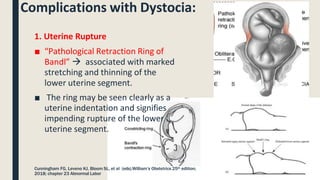
1. Uterine Rupture
■ “Pathological Retraction Ring of
Bandl”  associated with marked
stretching and thinning of the
lower uterine segment.
■ The ring may be seen clearly as a
uterine indentation and signifies
impending rupture of the lower
uterine segment.
Cunningham FG, Leveno KJ, Bloom SL, et al (eds).William’s Obstetrics 25th edition;
2018; chapter 23 Abnormal Labor
Complications with Dystocia: Maternal
2. Fistula Formation
■ With dystocia, soft tissues of the birth canal
lying between the leading part and the
pelvic wall may be subjected to excessive
pressure.
■ Because of impaired circulation, necrosis
may result and become evident several days
after delivery as vesicovaginal,
vesicocervical, or rectovaginal fistulas.
Complications with Dystocia: Maternal
3. Pelvic Floor Injury
■ During childbirth, the pelvic floor is exposed to direct
compression from the fetal head and to downward pressure
from maternal expulsive efforts.
■ These forces stretch and distend the pelvic floor, resulting in
functional and anatomical alterations in the muscles, nerves,
and connective tissues  leading to urinary incontinence and
to pelvic organ prolapse
Complications with Dystocia: Maternal
4. Postpartum Lower Extremity Nerve Injury
■ Most common mechanism is external compression of the
common fibular (formerly common peroneal) nerve.
■ Usually caused by inappropriate leg positioning in stirrups,
especially during prolonged second-stage labor.
■ Fortunately, symptoms resolve within 6 months of delivery in
most women.
Complications with Dystocia: Maternal
5. Infection
■ Intrapartum chorioamnionitis or postpartum pelvic infection
6. Postpartum hemorrhage
■ Secondary to atony due to prolonged and augmented labors
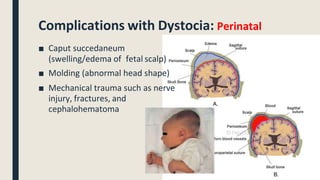
Complications with Dystocia: Perinatal
■ Caput succedaneum
(swelling/edema of fetal scalp)
■ Molding (abnormal head shape)
■ Mechanical trauma such as nerve
injury, fractures, and
cephalohematoma
PRECIPITOUS LABOR AND DELIVERY
■ Precipitous labor and delivery is extremely rapid labor and
delivery.
■ It may result from an abnormally low resistance of the soft
parts of the birth canal, from abnormally strong uterine and
abdominal contractions, or rarely from the absence of painful
sensations and thus a lack of awareness of vigorous labor.
■ According to Hughes (1972), precipitous labor terminates in
expulsion of the fetus in < 3 hours.
PRECIPITOUS LABOR AND DELIVERY:
Maternal effects
■ Vigorous uterine contractions combined with a long, firm
cervix and a non- compliant birth canal may lead to uterine
rupture or extensive lacerations of the cervix, vagina, vulva, or
perineum.
■ It is in these latter circumstances that the rare condition of
amnionic fluid embolism most likely develops
■ Precipitous labor is frequently followed by uterine atony 
uterus that contracts with unusual vigor before delivery is
likely to be hypotonic after delivery  Postpartum
hemorrhage
PRECIPITOUS LABOR AND DELIVERY:
Maternal effects
■ Short labor (rate of cervical dilatation of 5 cm/hr or faster for
nulliparas and 10 cm/hr for multiparas)
– associated with placental abruption, meconium,
postpartum hemorrhage, cocaine abuse, and low Apgar
scores.
PRECIPITOUS LABOR AND DELIVERY:
Fetal and neonatal effects
■ Tumultuous uterine contractions, often with negligible
intervals of relaxation, prevent appropriate uterine blood flow
and fetal oxygenation.
■ Acker and coworkers (1988) reported that Erb or Duchenne
brachial palsy was associated with such labors
■ during an unattended birth, the newborn may fall to the floor
and be injured, or it may need resuscitation that is not
immediately available.

Obstetrics Reference Lec abnormal-labor.pptx

  • 1.
  • 2.
    Outline ■ DYSTOCIA Definition ■3Ps of dystocia ■ FETOPELVIC DISPROPORTION ■ PELVIC CAPACITY ■ FACE PRESENTATION ■ BROW PRESENTATION ■ TRANSVERSE LIE ■ COMPOUND PRESENTATION ■ COMPLICATIONS OF DYSTOCIA ■ PRECIPITOUS LABOR AND DELIVERY
  • 3.
    Dystocia Dystocia literally means“difficult labor” or “dysfunctional labor”; abnormally slow labor progress. “cephalopelvic disproportion”; “failure to progress” It arises from 3 distinct abnormalities (”3Ps”) that may exist singly or in combination: • “POWER”: Expulsive forces may be abnormalinadequate uterine contractions; inadequate voluntary maternal muscle effort during second-stage labor. • “PASSENGER”: Fetal abnormalities of presentation, position (“asynclitism”), or development • “PASSAGES”: Abnormalities of the maternal bony pelvis may create a contracted pelvis; soft tissue abnormalities of the reproductive tract may form an obstacle to fetal descent.
  • 4.
    TABLE 23-1. CommonClinical Findings in Women with Ineffective Labor Inadequate cervical dilation or fetal descent: Protracted labor—slow progress Arrested labor—no progress Inadequate expulsive effort—ineffective pushing Fetopelvic disproportion: Excessive fetal size Inadequate pelvic capacity Malpresentation or position of the fetus Abnormal fetal anatomy Ruptured membranes without labor
  • 5.
    Abnormal labor patterns TABLE23-2. Abnormal Labor Patterns, Diagnostic Criteria, and Methods of Treatment
  • 6.
    1st “P”: Power ABNORMALITIESOF THE EXPULSIVE FORCES ■ Normal spontaneous contractions often exert pressures approximating 60 mm Hg. ■ lower limit of contraction pressure required to dilate the cervix is 15 mm Hg. ■ adequate uterine contractions > 200 Montevideo units
  • 7.
  • 8.
    1st“P”:Power ABNORMALITIES OF THEEXPULSIVE FORCES ■ 2 physiological types of uterine dysfunction: ■ hypotonic uterine dysfunction: no basal hypertonus and uterine contractions have a normal gradient pattern (synchronous), but pressure during a contraction is insufficient to dilate the cervix. ■ hypertonic uterine dysfunction: or “incoordinate uterine dysfunction”, either basal tone is elevated appreciably or the pressure gradient is distorted. – Gradient distortion may result from more forceful contraction of the uterine midsegment than the fundus or from complete asynchrony of the impulses originating in each cornu or a combination of these two.
  • 9.
    Labor disorders: Latent PhaseProlongation ■ Defined as LATENT PHASE >20 hours in nulliparas; > 14 hours in multiparas ■ Often managed with bed rest, or some prefer starting oxytocin stimulation
  • 10.
    Labor disorders: Active PhaseDisorder ■ divided into either: – Protraction disorder : or a slower-than- normal progress – Arrest disorder: a complete cessation of progress. ■ A woman must be in the active phase of labor which is defined by cervical change.
  • 11.
    Active Phase protraction ■WHO defines this as rate of cervical dilatation of < 1 cm/hour, for a minimum of 4 hours. ■ Observation of further progress is appropriate treatment ■ If MV units are insufficient  oxytocin augmentation ■ Slow but progressive first-stage of labor SHOULD not be an indication for ceserian delivery
  • 12.
    Active Phase arrest ■Defined as NO CERVICAL dilatation for > 2 hours – Latent phase should be completed – Cervix dilated > 4cm – Uterine contraction pattern > 200 MV units in a 10 minute period has been present for at least 4 hours
  • 13.
    Obstetric care consensuscommittee (2016): 4 recommendations 1. A prolonged latent phase is NOT an indication for cesarean delivery 2. A slow but progressive labor (protraction disorder) is NOT an indication for cesarean delivery 3. Active labor starts at cervical dilatation of 6cms (Not 4cms) 4. Cesarean delivery for active phase arrest should be reserved for women at or beyond 6 cms of cervical dilatation with ruptured membranes, who fail to progress despite 4 hours of adequate uterine activity, or at least 6 hours of oxytocin administration
  • 14.
    Second-stage descent disorders ■Second stage in nulliparas: 2 hours (3 hours if with regional anesthesia) ■ Second stage in multiparas: 1 hour (2 hours if with regional anesthesia) ■ Conensus committee (2016) recommends allowing a nullipara to push for at least 3 hours, and a multipara to push for at least 2 hours before 2nd stage labor arrest is diagnosed – Maternal and fetal status should be reassuring
  • 15.
    Reported Causes ofUterine Dysfunction (“Powers”) 1. Epidural Analgesia – Epidural analgesia can slow labor; associated with lengthening of both first- and second- stage labor and with slowing of the rate of fetal descent. 2. Chorioamnionitis – Infection diagnosed late in labor was found to be a marker of cesarean delivery performed for dystocia, whereas this was not a marker in women diagnosed as having chorioamnionitis early in labor.
  • 16.
    ■ Fetopelvic disproportionarises from diminished pelvic capacity, excessive fetal size, or more usually both. ■ There may be a contraction of the pelvic inlet, the midpelvis, or the pelvic outlet, or a generally contracted pelvis may be caused by combinations of these. 2nd “P”: Passages Fetopelvic Disproportion
  • 17.
    FETOPELVIC DISPROPORTION: Contracted inlet ■The pelvic inlet usually is considered to be contracted if its shortest anteroposterior (AP) diameter is < 10 cm or if the greatest transverse diameter is < 12 cm (xray pelvimetry) ■ usually is defined as a diagonal conjugate < 11.5cm
  • 18.
    FETOPELVIC DISPROPORTION: Contracted inlet ■In a contracted pelvis, the entire force exerted by the uterus acts directly on the portion of membranes that contact the dilating cervix  early spontaneous rupture of the membranes is more likely. ■ After membrane rupture, absent pressure by the head against the cervix and lower uterine segment predisposes to less effective contractions  dilatation may proceed very slowly or not at all.
  • 19.
    FETOPELVIC DISPROPORTION: Contracted inlet ■In women with contracted pelvis, face and shoulder presentations are encountered three times more frequently, and the cord prolapses four to six times more often.
  • 20.
    FETOPELVIC DISPROPORTION: Contracted midplane/midpelvis ■more common than inlet contraction. ■ causes transverse arrest of the fetal head, which potentially can lead to a difficult midforceps operation or to cesarean delivery. ■ the midpelvis extends from the inferior margin of the symphysis pubis, through the ischial spines, and touches the sacrum near the junction of the 4th and 5th vertebrae (S4-S5)
  • 21.
    FETOPELVIC DISPROPORTION: Contracted midplane/midpelvis ■Average midpelvis measurements are as follows: – Interspinous diameter: 10.5cm – Anteroposterior diameter: 11.5 cm – Posterior sagittal: 5 cm  midpelvis is likely contracted when: – the sum of the interspinous and posterior sagittal diameters < 13.5 cm – Interspinous diameter< 8 cm
  • 22.
    FETOPELVIC DISPROPORTION: Contracted midplane/midpelvis ■Other midplane findings suggesting contraction: 1. the spines are prominent 2. the pelvic sidewalls converge 3. sacrosciatic notch is narrow. ■ narrowing of the interspinous diameter can be anticipated when the intertuberous diameter is narrow. A normal intertuberous diameter, however, does not always exclude a narrow interspinous diameter.
  • 23.
    FETOPELVIC DISPROPORTION: Contracted outlet ■interischial tuberous diameter of 8 cm or less. ■ A contracted outlet may cause dystocia not so much by itself but by an often-associated midpelvic contraction. Outlet contraction without concomitant midplane contraction is rare. ■ Contracted outlet often gives rise to perineal tears.
  • 24.
    ■ Fetopelvic disproportioncan also arise from large fetal head size, or malposition of the head (includes asynclitism, occiput posterior position, face or brow presentation) 3rd “P”:Passenger Fetopelvic Disproportion
  • 25.
    Mueller-Hillis Maneuver (MHM) •Traditionally used to “predict dystocia” where the fetal brow and suboccipital region are grasped through the abdominal wall with the fingers, and firm pressure is directed downward in the axis of the inlet • If no disproportion exists, the head readily enters the pelvis, and vaginal delivery can be predicted • “Modified” MHM: The Mueller-Hillis maneuver was modified by limiting its use to the second stage of labor during a contracted
  • 26.
    Munro Kerr Maneuver(MKM) ■ placement of the thumb over the symphysis pubis to note degree of overlapping
  • 27.
    Face Presentation ■ Rarelydeliver vaginally ■ head is hyperextended so that the occiput is in contact with the fetal back, and the chin (mentum) is presenting ■ the fetal brow (bregma) is pressed against the maternal symphysis pubis  this position precludes flexion of the fetal head necessary to negotiate the birth canal. ■ Thus, a mentum posterior presentation is undeliverable except with a very preterm fetus. ■ Term fetus with face presentation and mentum anterior may be delivered vaginally
  • 28.
    Face Presentation: Etiology CunninghamFG, Leveno KJ, Bloom SL, et al (eds).William’s Obstetrics 25th edition; 2018; chapter 23 Abnormal Labor ■ include conditions that favor extension or prevent head flexion: 1. Preterm infants, with their smaller head dimensions, can engage before conversion to vertex position 2. Marked enlargement of the neck or coils of cord around the neck may cause extension. 3. Fetal malformations and hydramnios 4. Anencephalic fetuses naturally present by the face. 5. pelvis is contracted or the fetus is very large. 6. High parity (pendulous abdomen permits the back of the fetus to sag forward or laterally  promotes extension of the cervical and thoracic spine. )
  • 29.
    Face Presentation: Management ■Because face presentations among term-size fetuses are more common when there is some degree of pelvic inlet contraction, cesarean delivery frequently is indicated. ■ Attempts to convert a face presentation manually into a vertex presentation (manual or forceps rotation of a persistently posterior chin to a mentum anterior position) and internal podalic version and extraction are dangerous and should not be attempted.
  • 30.
    Brow Presentation FIGURE 23-8Brow posterior presentation. ■ diagnosed when that portion of the fetal head between the orbital ridge and the anterior fontanel presents at the pelvic inlet. ■ the fetal head thus occupies a position midway between full flexion (occiput) and extension (face). ■ Engagement of the fetal head and subsequent delivery cannot take place as long as the brow presentation persists. (Except when the fetal head is small or the pelvis is unusually large)
  • 31.
    Transverse Lie ■ Longaxis of the fetus is approximately perpendicular to that of the mother. ■ Shoulder is usually positioned over the pelvic inlet. ■ Head occupies one iliac fossa, and the breech the other  this creates a shoulder presentation in which the side of the mother on which the acromion rests determines the designation of the lie as right or left acromial.
  • 32.
    Transverse Lie: Etiology ■common causes: 1. abdominal wall relaxation from high parity 2. preterm fetus 3. placenta previa 4. abnormal uterine anatomy 5. hydramnios 6. contracted pelvis. ■ A relaxed and pendulous abdomen allows the uterus to fall forward, deflecting the long axis of the fetus away from the axis of the birth canal and into an oblique or transverse position.
  • 33.
    Neglected transverse lie ■After rupture of the membranes, the fetal shoulder is forced into the pelvis, and the arm prolapses ■ Shoulder is arrested by the margins of the pelvic inlet, with the head in one iliac fossa and the breech in the other. ■ Uterus contracts vigorously in an unsuccessful attempt to overcome the obstacle. ■ With time, a retraction ring rises increasingly higher and becomes more marked. ■ With this neglected transverse lie, the uterus will eventually rupture. Neglected shoulder presentation
  • 34.
    Transverse Lie: Management ■Transverse lie is usually an indication for cesarean delivery. ■ Before labor or early in labor, with the membranes intact, attempts at external version are worthwhile in the absence of other complications. ■ With cesarean delivery, because neither the feet nor the head of the fetus occupies the lower uterine segment, a low transverse incision into the uterus may lead to difficult fetal extraction  a vertical or classical incision is typically indicated
  • 35.
    Transverse Lie: Management ■If the fetus is small (< 800g) and the pelvis is large, vaginal delivery is possible: – Fetus is compressed with the fetal head forced against its abdomen  portion of the thoracic wall becomes the most dependent part, appearing at the vulva. – The fetus is doubled upon itself, sometime called ”conduplicato corpore”
  • 36.
    Compound presentation ■ Ina compound presentation, an extremity prolapses alongside the presenting part, and both present simultaneously in the pelvis ■ Causes of compound presentations are conditions that prevent complete occlusion of the pelvic inlet by the fetal head, including preterm labor. A
  • 37.
    Compound presentation: Management CunninghamFG, Leveno KJ, Bloom SL, et al (eds).William’s Obstetrics 25th edition; 2018; chapter 23 Abnormal Labor ■ In most cases, the prolapsed part should be left alone, because most often it will not interfere with labor. ■ If the arm is prolapsed alongside the head, the condition should be observed closely to ascertain whether the arm retracts out of the way with descent of the presenting part. ■ If it fails to retract and if it appears to prevent descent of the head, the prolapsed arm should be pushed gently upward and the head simultaneously downward by fundal pressure. ■ In general, rates of perinatal mortality and morbidity are increased as a result of concomitant preterm delivery, prolapsed cord, and traumatic obstetrical procedures.
  • 38.
    Complications with Dystocia:Maternal 1. Uterine Rupture ■ Abnormal thinning of the lower uterine segment during prolonged labor (women of high parity and in those with a prior cesarean delivery) ■ When disproportion is so pronounced that there is no engagement or descent, the lower uterine segment becomes increasingly stretched, and rupture may follow. Cunningham FG, Leveno KJ, Bloom SL, et al (eds).William’s Obstetrics 25th edition; 2018; chapter 23 Abnormal Labor
  • 39.
    Complications with Dystocia:Maternal 1. Uterine Rupture ■ “Pathological Retraction Ring of Bandl”  associated with marked stretching and thinning of the lower uterine segment. ■ The ring may be seen clearly as a uterine indentation and signifies impending rupture of the lower uterine segment. Cunningham FG, Leveno KJ, Bloom SL, et al (eds).William’s Obstetrics 25th edition; 2018; chapter 23 Abnormal Labor
  • 40.
    Complications with Dystocia:Maternal 2. Fistula Formation ■ With dystocia, soft tissues of the birth canal lying between the leading part and the pelvic wall may be subjected to excessive pressure. ■ Because of impaired circulation, necrosis may result and become evident several days after delivery as vesicovaginal, vesicocervical, or rectovaginal fistulas.
  • 41.
    Complications with Dystocia:Maternal 3. Pelvic Floor Injury ■ During childbirth, the pelvic floor is exposed to direct compression from the fetal head and to downward pressure from maternal expulsive efforts. ■ These forces stretch and distend the pelvic floor, resulting in functional and anatomical alterations in the muscles, nerves, and connective tissues  leading to urinary incontinence and to pelvic organ prolapse
  • 42.
    Complications with Dystocia:Maternal 4. Postpartum Lower Extremity Nerve Injury ■ Most common mechanism is external compression of the common fibular (formerly common peroneal) nerve. ■ Usually caused by inappropriate leg positioning in stirrups, especially during prolonged second-stage labor. ■ Fortunately, symptoms resolve within 6 months of delivery in most women.
  • 43.
    Complications with Dystocia:Maternal 5. Infection ■ Intrapartum chorioamnionitis or postpartum pelvic infection 6. Postpartum hemorrhage ■ Secondary to atony due to prolonged and augmented labors
  • 44.
    Complications with Dystocia:Perinatal ■ Caput succedaneum (swelling/edema of fetal scalp) ■ Molding (abnormal head shape) ■ Mechanical trauma such as nerve injury, fractures, and cephalohematoma
  • 45.
    PRECIPITOUS LABOR ANDDELIVERY ■ Precipitous labor and delivery is extremely rapid labor and delivery. ■ It may result from an abnormally low resistance of the soft parts of the birth canal, from abnormally strong uterine and abdominal contractions, or rarely from the absence of painful sensations and thus a lack of awareness of vigorous labor. ■ According to Hughes (1972), precipitous labor terminates in expulsion of the fetus in < 3 hours.
  • 46.
    PRECIPITOUS LABOR ANDDELIVERY: Maternal effects ■ Vigorous uterine contractions combined with a long, firm cervix and a non- compliant birth canal may lead to uterine rupture or extensive lacerations of the cervix, vagina, vulva, or perineum. ■ It is in these latter circumstances that the rare condition of amnionic fluid embolism most likely develops ■ Precipitous labor is frequently followed by uterine atony  uterus that contracts with unusual vigor before delivery is likely to be hypotonic after delivery  Postpartum hemorrhage
  • 47.
    PRECIPITOUS LABOR ANDDELIVERY: Maternal effects ■ Short labor (rate of cervical dilatation of 5 cm/hr or faster for nulliparas and 10 cm/hr for multiparas) – associated with placental abruption, meconium, postpartum hemorrhage, cocaine abuse, and low Apgar scores.
  • 48.
    PRECIPITOUS LABOR ANDDELIVERY: Fetal and neonatal effects ■ Tumultuous uterine contractions, often with negligible intervals of relaxation, prevent appropriate uterine blood flow and fetal oxygenation. ■ Acker and coworkers (1988) reported that Erb or Duchenne brachial palsy was associated with such labors ■ during an unattended birth, the newborn may fall to the floor and be injured, or it may need resuscitation that is not immediately available.