Virtual Human Resource Development
PresentedattheAmericanAssociationforAdult
&ContinuingEducationConference on October29,2010
Rochell R. McWhorter, ABD
Texas A&M University and The University of Texas at Tyler
Elisabeth E. Bennett, PhD
Tufts University School of Medicine and Baystate Health
Donna S. Mancuso, M. S.
Texas A&M University
Copyright 2010 Rochell R. McWhorter, Elisabeth E. Bennett and Donna S. Mancuso
Virtual HRD:
Tools for Enhancing Practice or Paradigm Shift?
• There is a vast array of digital options for virtual
communication and collaboration.
• The time is right for dialogue in the field of HRD to push
the boundaries of research and practice to develop a greater
understanding of technology-mediated work, learning, and
human development.
• It is vital we understand that “humans shape and are shaped
by…technology” (Palloff & Pratt, 1999) and vHRD seeks
to examine both the human and the technological
components of the phenomenon.
Copyright 2010 Rochell R. McWhorter, Elisabeth E. Bennett and Donna S. Mancuso
Two Definitions offered for vHRD
• “a process of developing and unleashing human expertise for
the purpose of improving individual, team, work process, and
organizational system performance within technology-enabled
environments” (McWhorter, Mancuso & Hurt, 2008; Swanson
& Holton, 2009, p. 4).
• “a media rich and culturally relevant web environment that
strategically improves expertise, performance, innovation, and
community-building through formal and informal learning”
(Bennett, 2009).
Copyright 2010 Rochell R. McWhorter, Elisabeth E. Bennett and Donna S. Mancuso
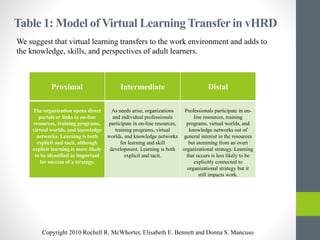
Table 1: Model of Virtual LearningTransferin vHRD
Proximal Intermediate Distal
The organization opens direct
portals or links to on-line
resources, training programs,
virtual worlds, and knowledge
networks. Learning is both
explicit and tacit, although
explicit learning is more likely
to be identified as important
for success of a strategy.
As needs arise, organizations
and individual professionals
participate in on-line resources,
training programs, virtual
worlds, and knowledge networks
for learning and skill
development. Learning is both
explicit and tacit.
Professionals participate in on-
line resources, training
programs, virtual worlds, and
knowledge networks out of
general interest in the resources
but stemming from an overt
organizational strategy. Learning
that occurs is less likely to be
explicitly connected to
organizational strategy but it
still impacts work.
We suggest that virtual learning transfers to the work environment and adds to
the knowledge, skills, and perspectives of adult learners.
Copyright 2010 Rochell R. McWhorter, Elisabeth E. Bennett and Donna S. Mancuso
Emergence of VHRD
• Once only considered a useful tool for training or learning, the
Web has become an integrated dynamic environment where the
work of virtual HRD (vHRD) is accomplished through the
advent of virtual teams, virtual learning, virtual learning
communities, virtual communities of practice, virtual
mentoring, virtual career development and virtual worlds.
• The Emergence of vHRD was explored over the past 20 years
by analyzing the impact that technology has changed the way
we research and practice.
• The shift from technology as tool to technology as an
integrative environment can be demonstrated by deeply
analyzing the published literature.
Copyright 2010 Rochell R. McWhorter, Elisabeth E. Bennett and Donna S. Mancuso
ExploringAdult Learning
in Virtual Environments
• Technology has had an enormous impact on adult educators
and learners.
• Knowles, Holton, and Swanson (2005) suggested that
technology provides a “rich learning experience in the
andragogical” tradition (p. 237).
• Virtual environments can enable lifelong learning by providing
flexibility in the pace of learning for the learner’s own
competence and circumstances (Macpherson, Elliot, Harris, &
Homan, 2004).
• An empirical study within a virtual world explored the
construct of adult learning in the 3D environment.
• Results included both enablers and barriers to success in a
virtual world which may be useful for adult educators.
Copyright 2010 Rochell R. McWhorter, Elisabeth E. Bennett and Donna S. Mancuso
Table 2: Discussion of Empirical Study
in a Virtual World
Enablers of Adult
Learning in a
Virtual World
Participant Extracts Discussion1
A variety of educational topics are
available.
“I have more of a variety of people to
meet. Thus, increasing the variety of
topics I learn with this method.”
Participant linked greater social
networking opportunities to an increase in
educational opportunities, reminding us of
what Nussbaum (1999) called the need for
affiliation.
Second Life™ provides
opportunities for multi-
disciplinary collaboration.
“As an engineer, I view SL™ as another
tool for helping me collaborate as well as a
tool to help me in designing RL [real life]
projects…I have a “code house” to show
the building code in 3D.”
Participants’ comments reveal how Second
Life as a tool leads to new multi-discipline
collaborations and an increase in
opportunities not only for learning but for
work.
Second Life™ facilitates
collaboration across geographical
boundaries.
“This is a fantastic medium for social
networking and for educational
forums…conversed with others that I
would have never done in RL [real life]
due to cultural, geographical and
economical and time constraints.”
This quote illustrates the value Second
Life™ users place on making social
contacts in a virtual environment
1Collaborative analysis with Dominique T. Chlup
Copyright 2010 Rochell R. McWhorter, Elisabeth E. Bennett and Donna S. Mancuso
References
Bennett, E. E. (2009). Virtual HRD: The intersection of knowledge management, culture and intranets.
In G. McLean, Y. Cho, & E. Cho’s (Eds.), HRD’s Role in Knowledge Management, Advances in
Developing Human resources 11(3), 362-374.
Knowles, M. S.,Holton, E. F. H. III, & Swanson, R. A. (2005). The Adult Learner (6th ed.). Burlington,
MA: Elsevier.
Macpherson, A., Elliot, M., Harris, I., & Homan, G. (2004). E-learning: Reflections and evaluation of
corporate programmes. Human Resource Development International, 7(3), 295-313.
McWhorter, R. R., Mancuso, D. S., & Hurt, A. C. (2008). Adult learning in a virtual environment. In T.
J. Chermack, J. Storberg-Walker, & C. M. Graham (Eds.), Refereed Proceedings of the 2008 Academy
of Human Resource Development Annual Research Conference (pp. 1148-1152). Bowling Green, OH:
Academy of Human Resource Development.
Palloff, R. M., & Pratt, K. (1999). Building learning communities in cyberspace: Effective strategies for
the online classroom. San Francisco: Jossey-Bass.
Swanson, R. A., & Holton, E. F. (2009). Foundations of human resource development (2nd ed.). San
Francisco: Berrett-Koehler.

Virtual HRD Presentation

  • 1.
    Virtual Human ResourceDevelopment PresentedattheAmericanAssociationforAdult &ContinuingEducationConference on October29,2010 Rochell R. McWhorter, ABD Texas A&M University and The University of Texas at Tyler Elisabeth E. Bennett, PhD Tufts University School of Medicine and Baystate Health Donna S. Mancuso, M. S. Texas A&M University Copyright 2010 Rochell R. McWhorter, Elisabeth E. Bennett and Donna S. Mancuso
  • 2.
    Virtual HRD: Tools forEnhancing Practice or Paradigm Shift? • There is a vast array of digital options for virtual communication and collaboration. • The time is right for dialogue in the field of HRD to push the boundaries of research and practice to develop a greater understanding of technology-mediated work, learning, and human development. • It is vital we understand that “humans shape and are shaped by…technology” (Palloff & Pratt, 1999) and vHRD seeks to examine both the human and the technological components of the phenomenon. Copyright 2010 Rochell R. McWhorter, Elisabeth E. Bennett and Donna S. Mancuso
  • 3.
    Two Definitions offeredfor vHRD • “a process of developing and unleashing human expertise for the purpose of improving individual, team, work process, and organizational system performance within technology-enabled environments” (McWhorter, Mancuso & Hurt, 2008; Swanson & Holton, 2009, p. 4). • “a media rich and culturally relevant web environment that strategically improves expertise, performance, innovation, and community-building through formal and informal learning” (Bennett, 2009). Copyright 2010 Rochell R. McWhorter, Elisabeth E. Bennett and Donna S. Mancuso
  • 4.
    Table 1: Modelof Virtual LearningTransferin vHRD Proximal Intermediate Distal The organization opens direct portals or links to on-line resources, training programs, virtual worlds, and knowledge networks. Learning is both explicit and tacit, although explicit learning is more likely to be identified as important for success of a strategy. As needs arise, organizations and individual professionals participate in on-line resources, training programs, virtual worlds, and knowledge networks for learning and skill development. Learning is both explicit and tacit. Professionals participate in on- line resources, training programs, virtual worlds, and knowledge networks out of general interest in the resources but stemming from an overt organizational strategy. Learning that occurs is less likely to be explicitly connected to organizational strategy but it still impacts work. We suggest that virtual learning transfers to the work environment and adds to the knowledge, skills, and perspectives of adult learners. Copyright 2010 Rochell R. McWhorter, Elisabeth E. Bennett and Donna S. Mancuso
  • 5.
    Emergence of VHRD •Once only considered a useful tool for training or learning, the Web has become an integrated dynamic environment where the work of virtual HRD (vHRD) is accomplished through the advent of virtual teams, virtual learning, virtual learning communities, virtual communities of practice, virtual mentoring, virtual career development and virtual worlds. • The Emergence of vHRD was explored over the past 20 years by analyzing the impact that technology has changed the way we research and practice. • The shift from technology as tool to technology as an integrative environment can be demonstrated by deeply analyzing the published literature. Copyright 2010 Rochell R. McWhorter, Elisabeth E. Bennett and Donna S. Mancuso
  • 6.
    ExploringAdult Learning in VirtualEnvironments • Technology has had an enormous impact on adult educators and learners. • Knowles, Holton, and Swanson (2005) suggested that technology provides a “rich learning experience in the andragogical” tradition (p. 237). • Virtual environments can enable lifelong learning by providing flexibility in the pace of learning for the learner’s own competence and circumstances (Macpherson, Elliot, Harris, & Homan, 2004). • An empirical study within a virtual world explored the construct of adult learning in the 3D environment. • Results included both enablers and barriers to success in a virtual world which may be useful for adult educators. Copyright 2010 Rochell R. McWhorter, Elisabeth E. Bennett and Donna S. Mancuso
  • 7.
    Table 2: Discussionof Empirical Study in a Virtual World Enablers of Adult Learning in a Virtual World Participant Extracts Discussion1 A variety of educational topics are available. “I have more of a variety of people to meet. Thus, increasing the variety of topics I learn with this method.” Participant linked greater social networking opportunities to an increase in educational opportunities, reminding us of what Nussbaum (1999) called the need for affiliation. Second Life™ provides opportunities for multi- disciplinary collaboration. “As an engineer, I view SL™ as another tool for helping me collaborate as well as a tool to help me in designing RL [real life] projects…I have a “code house” to show the building code in 3D.” Participants’ comments reveal how Second Life as a tool leads to new multi-discipline collaborations and an increase in opportunities not only for learning but for work. Second Life™ facilitates collaboration across geographical boundaries. “This is a fantastic medium for social networking and for educational forums…conversed with others that I would have never done in RL [real life] due to cultural, geographical and economical and time constraints.” This quote illustrates the value Second Life™ users place on making social contacts in a virtual environment 1Collaborative analysis with Dominique T. Chlup Copyright 2010 Rochell R. McWhorter, Elisabeth E. Bennett and Donna S. Mancuso
  • 8.
    References Bennett, E. E.(2009). Virtual HRD: The intersection of knowledge management, culture and intranets. In G. McLean, Y. Cho, & E. Cho’s (Eds.), HRD’s Role in Knowledge Management, Advances in Developing Human resources 11(3), 362-374. Knowles, M. S.,Holton, E. F. H. III, & Swanson, R. A. (2005). The Adult Learner (6th ed.). Burlington, MA: Elsevier. Macpherson, A., Elliot, M., Harris, I., & Homan, G. (2004). E-learning: Reflections and evaluation of corporate programmes. Human Resource Development International, 7(3), 295-313. McWhorter, R. R., Mancuso, D. S., & Hurt, A. C. (2008). Adult learning in a virtual environment. In T. J. Chermack, J. Storberg-Walker, & C. M. Graham (Eds.), Refereed Proceedings of the 2008 Academy of Human Resource Development Annual Research Conference (pp. 1148-1152). Bowling Green, OH: Academy of Human Resource Development. Palloff, R. M., & Pratt, K. (1999). Building learning communities in cyberspace: Effective strategies for the online classroom. San Francisco: Jossey-Bass. Swanson, R. A., & Holton, E. F. (2009). Foundations of human resource development (2nd ed.). San Francisco: Berrett-Koehler.