THE TERTIARY SECTOR:
SERVICES,
COMMUNICATION AND
INNOVATION
Do tertiray sector only have
an economic function?
SERVICES TODAY
- Which tertiary activities
employ the most people in
Spain?
- Why do you think is this?
TERTIARY SECTOR ACTIVITIES
- Very diverse: Number of services, workers qualifications, size of
companies…
- Intangible and immaterial
- Cannot be stored: Not carried out or be standardised.
- Close to consumers: direct contact between supply and demand
- Unevenly distributed: 70% of working population in developed countries,
30% in less developed countries.
CLASSIFICATION OF TERTIARY
ACTIVITIES
 Social Services: Administration, education, healthcare… Public and private.
 Distribution services: Transport, communication and wholesale trade.
 Business services: Advertising, banking, insurance, legal advice…
 Consumer activities: Retail, hospitality, leisure, domestic help…
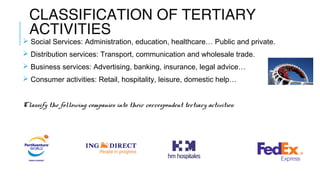
Classify the following companies into their correspondent tertiary activities:
CASE OF STUDY: HEALTHCARE AND
EDUCATION IN SPAIN
 Education:
Since 1970’s compulsory education has expanded
Nowadays is compulsory to the ages of 6 to 16
Voluntary for children aged 0 to 6. The “Pre k” (Infantil) from 3
to 6 is free and commonly widespread.
On the other hand Spain has high level of academic failure
(20%), higher than the average of the EU (11%)
Healthcare:
Spain has a high standard of quality
Primary services and specialist care are universal and free
services
Economic crisis prompted cuts in healthcare expenditure:
 Reduction in the number of workers and the expenditure on medical products
 Generated longer waiting lists
CASE OF STUDY: HEALTHCARE AND
EDUCATION IN SPAIN
 Education:
Since 1970’s compulsory education has expanded
Nowadays is compulsory to the ages of 6 to 16
Voluntary for children aged 0 to 6. The “Pre k” (Infantil) from 3
to 6 is free and commonly widespread.
On the other hand Spain has high level of academic failure
(20%), higher than the average of the EU (11%)
Healthcare:
Spain has a high standard of quality
Primary services and specialist care are universal and free
services
Economic crisis prompted cuts in healthcare expenditure:
 Reduction in the number of workers and the expenditure on medical products
 Generated longer waiting lists

Unit 6 the tertiary sector

  • 1.
    THE TERTIARY SECTOR: SERVICES, COMMUNICATIONAND INNOVATION Do tertiray sector only have an economic function?
  • 2.
    SERVICES TODAY - Whichtertiary activities employ the most people in Spain? - Why do you think is this?
  • 3.
    TERTIARY SECTOR ACTIVITIES -Very diverse: Number of services, workers qualifications, size of companies… - Intangible and immaterial - Cannot be stored: Not carried out or be standardised. - Close to consumers: direct contact between supply and demand - Unevenly distributed: 70% of working population in developed countries, 30% in less developed countries.
  • 4.
    CLASSIFICATION OF TERTIARY ACTIVITIES Social Services: Administration, education, healthcare… Public and private.  Distribution services: Transport, communication and wholesale trade.  Business services: Advertising, banking, insurance, legal advice…  Consumer activities: Retail, hospitality, leisure, domestic help… Classify the following companies into their correspondent tertiary activities:
  • 5.
    CASE OF STUDY:HEALTHCARE AND EDUCATION IN SPAIN  Education: Since 1970’s compulsory education has expanded Nowadays is compulsory to the ages of 6 to 16 Voluntary for children aged 0 to 6. The “Pre k” (Infantil) from 3 to 6 is free and commonly widespread. On the other hand Spain has high level of academic failure (20%), higher than the average of the EU (11%) Healthcare: Spain has a high standard of quality Primary services and specialist care are universal and free services Economic crisis prompted cuts in healthcare expenditure:  Reduction in the number of workers and the expenditure on medical products  Generated longer waiting lists
  • 6.
    CASE OF STUDY:HEALTHCARE AND EDUCATION IN SPAIN  Education: Since 1970’s compulsory education has expanded Nowadays is compulsory to the ages of 6 to 16 Voluntary for children aged 0 to 6. The “Pre k” (Infantil) from 3 to 6 is free and commonly widespread. On the other hand Spain has high level of academic failure (20%), higher than the average of the EU (11%) Healthcare: Spain has a high standard of quality Primary services and specialist care are universal and free services Economic crisis prompted cuts in healthcare expenditure:  Reduction in the number of workers and the expenditure on medical products  Generated longer waiting lists