Culturally Competent Leaders:
Exploring Cultural Intelligence
(CI) in Higher Education
A3, Pod B
Stephen Lyons, Robert Outerbridge, Natascha Saunders
Patricia Steiner, Tonia Teresh
EDU 7281 Research Process (R2)
Spring 2014
Billye Sankofa Waters, Ph.D. – Dr. B
Research Topic
Cultural Competence in Higher
Education Leaders
Problem Statement
Administrative leaders at a mid-sized liberal arts college that is in the beginning stages
of an internationalization effort may have disparate perceptions of what it means to be
culturally competent. Their ability to consistently show tolerance, empathy, respect,
appreciation toward and the ability to work with people who are different from oneself
is essential. The success of this internationalization process which includes diversifying
the study body, establishing study programs, and globalizing curriculum hangs in the
balance. This study will provide important insight into senior leaders’ impressions of
cultural competence as a concept and it will inform professional development policy
moving forward.
Research Questions
How can cultural intelligence improve leadership in higher education?
 Sub-questions:
1. What is cultural intelligence?
2. What are leaders’ perceptions of cultural intelligence?
3. How is cultural intelligence measured?
4. What is the need for cultural intelligence in higher education leadership?
landscapes?
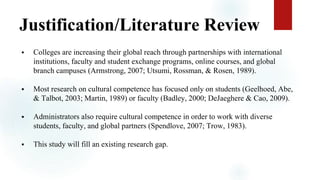
Justification/Literature Review
 Colleges are increasing their global reach through partnerships with international
institutions, faculty and student exchange programs, online courses, and global
branch campuses (Armstrong, 2007; Utsumi, Rossman, & Rosen, 1989).
 Most research on cultural competence has focused only on students (Geelhoed, Abe,
& Talbot, 2003; Martin, 1989) or faculty (Badley, 2000; DeJaeghere & Cao, 2009).
 Administrators also require cultural competence in order to work with diverse
students, faculty, and global partners (Spendlove, 2007; Trow, 1983).
 This study will fill an existing research gap.
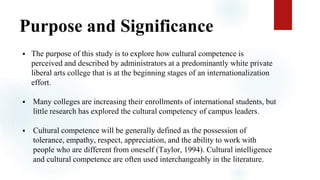
Purpose and Significance
 The purpose of this study is to explore how cultural competence is
perceived and described by administrators at a predominantly white private
liberal arts college that is at the beginning stages of an internationalization
effort.
 Many colleges are increasing their enrollments of international students, but
little research has explored the cultural competency of campus leaders.
 Cultural competence will be generally defined as the possession of
tolerance, empathy, respect, appreciation, and the ability to work with
people who are different from oneself (Taylor, 1994). Cultural intelligence
and cultural competence are often used interchangeably in the literature.
Positionality
 Insiders/Outsiders
 Gender
 Doctoral Students
 Education is a priority
 Diverse Backgrounds
 Leadership
 Age
 Bias
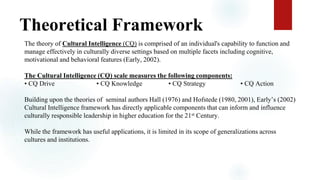
Theoretical Framework
The theory of Cultural Intelligence (CQ) is comprised of an individual's capability to function and
manage effectively in culturally diverse settings based on multiple facets including cognitive,
motivational and behavioral features (Early, 2002).
The Cultural Intelligence (CQ) scale measures the following components:
▪ CQ Drive ▪ CQ Knowledge ▪ CQ Strategy ▪ CQ Action
Building upon the theories of seminal authors Hall (1976) and Hofstede (1980, 2001), Early’s (2002)
Cultural Intelligence framework has directly applicable components that can inform and influence
culturally responsible leadership in higher education for the 21st Century.
While the framework has useful applications, it is limited in its scope of generalizations across
cultures and institutions.
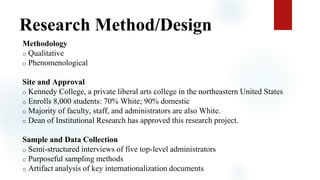
Research Method/Design
Methodology
o Qualitative
o Phenomenological
Site and Approval
o Kennedy College, a private liberal arts college in the northeastern United States
o Enrolls 8,000 students: 70% White; 90% domestic
o Majority of faculty, staff, and administrators are also White.
o Dean of Institutional Research has approved this research project.
Sample and Data Collection
o Semi-structured interviews of five top-level administrators
o Purposeful sampling methods
o Artifact analysis of key internationalization documents
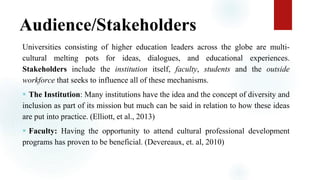
Audience/Stakeholders
Universities consisting of higher education leaders across the globe are multi-
cultural melting pots for ideas, dialogues, and educational experiences.
Stakeholders include the institution itself, faculty, students and the outside
workforce that seeks to influence all of these mechanisms.
 The Institution: Many institutions have the idea and the concept of diversity and
inclusion as part of its mission but much can be said in relation to how these ideas
are put into practice. (Elliott, et al., 2013)
 Faculty: Having the opportunity to attend cultural professional development
programs has proven to be beneficial. (Devereaux, et. al, 2010)
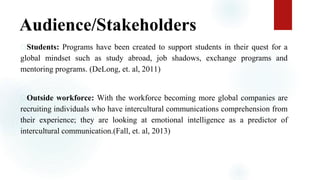
Audience/Stakeholders
Students: Programs have been created to support students in their quest for a
global mindset such as study abroad, job shadows, exchange programs and
mentoring programs. (DeLong, et. al, 2011)
Outside workforce: With the workforce becoming more global companies are
recruiting individuals who have intercultural communications comprehension from
their experience; they are looking at emotional intelligence as a predictor of
intercultural communication.(Fall, et. al, 2013)
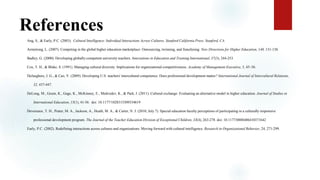
References
Ang, S., & Early, P.C. (2003). Cultural Intelligence: Individual Interactions Across Cultures. Stanford California Press. Stanford, CA.
Armstrong, L. (2007). Competing in the global higher education marketplace: Outsourcing, twinning, and franchising. New Directions for Higher Education, 140, 131-138.
Badley, G. (2000). Developing globally-competent university teachers. Innovations in Education and Training International, 37(3), 244-253.
Cox, T. H., & Blake, S. (1991). Managing cultural diversity: Implications for organizational competitiveness. Academy of Management Executive, 5, 45–56.
DeJaeghere, J. G., & Cao, Y. (2009). Developing U.S. teachers' intercultural competence: Does professional development matter? International Journal of Intercultural Relations,
32, 437-447.
DeLong, M., Geum, K., Gage, K., McKinney, E., Medvedev, K., & Park, J. (2011). Cultural exchange: Evaluating an alternative model in higher education. Journal of Studies in
International Education, 15(1), 41-56. doi: 10.1177/1028315309334619 to ne
Devereaux, T. H., Prater, M. A., Jackson, A., Heath, M. A., & Carter, N. J. (2010, July 7). Special education faculty perceptions of participating in a culturally responsive
professional development program. The Journal of the Teacher Education Division of Exceptional Children, 33(4), 263-278. doi: 10.1177/0888406410371642
Early, P.C. (2002). Redefining interactions across cultures and organizations: Moving forward with cultural intelligence. Research in Organizational Behavior, 24, 271-299.
References
Elliott II, C. M., Stransky, O., Negron, R., Bowlby, M., Lickiss, J., Dutt, D., ... Barbosa, P. (2013). Institutional barriers to diversity change work in higher education. Sage
Publications, (April-June), 1-9. http://dx.doi.org/10.1177/2158244013489686
Fall, L. T., Kelly, S., MacDonald, P., Primm, C., & Holmes, W. (2013, ). Intercultural communication apprehension and emotional intelligence in higher education: Preparing
business students for career success. Business Communication Quarterly, 76(4), 412-426. http://dx.doi.org/10.1177/1081569913501861
Geelhoed, R., Abe, J., & Talbot, D. M. (2003). A qualitative investigation of U.S. students' experiences in an international peer program. Journal of College Student Development,
44(1), 5-17.
Hall, E. T. (1976). Beyond culture. New York: Doubleday.
Hofstede, G. (1980). Culture’s Consequences: International Differences in Work-Related Values. Beverly Hills, CA: SAGE.
Hofstede, G. (2001). Culture’s Consequences: Comparing values, behaviors, institutions and Organizations across nations. Thousand Oaks, CA: SAGE.
Hofstede, G., Hofstede, G.J., & Minkov, M. (2010). Cultures and organizations: Software of the minds: Intercultural cooperation and its impertinence for survival. New York:
McGraw-Hill.
Livermore, D. A. (2009). Leading with cultural intelligence. New York: AMACOM.
References
Martin, J. (1989). Predeparture orientation: Preparing college sojourners for intercultural interaction. Communication Education, 38 (3), 249-258. doi: 10.1080/03634528909378761
Martin, J., Nakayama, T. (2014). Experiencing intercultural communication (5th ed.). New York, NY: McGraw-Hill.
Spendlove, M. (2007). Competencies for effective leadership in higher education. International Journal of Educational Management, 21(5), 407-417.Stanford, CA: Stanford
University Press.
Taylor, E. W. (1994). A learning model for becoming interculturally competent. International Journal of Intercultural Relations, 18(3), 389-408 Values. Beverly Hills, CA: SAGE
Utsumi, T., Rossman, P., & Rosen, S. M. (1989). Global education for the 21st century: the Global "electronic" University Consortium. Technological Horizons In Education, 16(7),
75-78.
Trow, M. (1983). Defining the issues in university-government relations: An international perspective. Studies in Higher Education, (8) 2, 115-128. doi:
10.1080/03075078312331378984

Culturally Competent Leaders: Exploring Cultural Intelligence

  • 1.
    Culturally Competent Leaders: ExploringCultural Intelligence (CI) in Higher Education A3, Pod B Stephen Lyons, Robert Outerbridge, Natascha Saunders Patricia Steiner, Tonia Teresh EDU 7281 Research Process (R2) Spring 2014 Billye Sankofa Waters, Ph.D. – Dr. B
  • 2.
    Research Topic Cultural Competencein Higher Education Leaders
  • 3.
    Problem Statement Administrative leadersat a mid-sized liberal arts college that is in the beginning stages of an internationalization effort may have disparate perceptions of what it means to be culturally competent. Their ability to consistently show tolerance, empathy, respect, appreciation toward and the ability to work with people who are different from oneself is essential. The success of this internationalization process which includes diversifying the study body, establishing study programs, and globalizing curriculum hangs in the balance. This study will provide important insight into senior leaders’ impressions of cultural competence as a concept and it will inform professional development policy moving forward.
  • 4.
    Research Questions How cancultural intelligence improve leadership in higher education?  Sub-questions: 1. What is cultural intelligence? 2. What are leaders’ perceptions of cultural intelligence? 3. How is cultural intelligence measured? 4. What is the need for cultural intelligence in higher education leadership? landscapes?
  • 5.
    Justification/Literature Review  Collegesare increasing their global reach through partnerships with international institutions, faculty and student exchange programs, online courses, and global branch campuses (Armstrong, 2007; Utsumi, Rossman, & Rosen, 1989).  Most research on cultural competence has focused only on students (Geelhoed, Abe, & Talbot, 2003; Martin, 1989) or faculty (Badley, 2000; DeJaeghere & Cao, 2009).  Administrators also require cultural competence in order to work with diverse students, faculty, and global partners (Spendlove, 2007; Trow, 1983).  This study will fill an existing research gap.
  • 6.
    Purpose and Significance The purpose of this study is to explore how cultural competence is perceived and described by administrators at a predominantly white private liberal arts college that is at the beginning stages of an internationalization effort.  Many colleges are increasing their enrollments of international students, but little research has explored the cultural competency of campus leaders.  Cultural competence will be generally defined as the possession of tolerance, empathy, respect, appreciation, and the ability to work with people who are different from oneself (Taylor, 1994). Cultural intelligence and cultural competence are often used interchangeably in the literature.
  • 7.
    Positionality  Insiders/Outsiders  Gender Doctoral Students  Education is a priority  Diverse Backgrounds  Leadership  Age  Bias
  • 8.
    Theoretical Framework The theoryof Cultural Intelligence (CQ) is comprised of an individual's capability to function and manage effectively in culturally diverse settings based on multiple facets including cognitive, motivational and behavioral features (Early, 2002). The Cultural Intelligence (CQ) scale measures the following components: ▪ CQ Drive ▪ CQ Knowledge ▪ CQ Strategy ▪ CQ Action Building upon the theories of seminal authors Hall (1976) and Hofstede (1980, 2001), Early’s (2002) Cultural Intelligence framework has directly applicable components that can inform and influence culturally responsible leadership in higher education for the 21st Century. While the framework has useful applications, it is limited in its scope of generalizations across cultures and institutions.
  • 9.
    Research Method/Design Methodology o Qualitative oPhenomenological Site and Approval o Kennedy College, a private liberal arts college in the northeastern United States o Enrolls 8,000 students: 70% White; 90% domestic o Majority of faculty, staff, and administrators are also White. o Dean of Institutional Research has approved this research project. Sample and Data Collection o Semi-structured interviews of five top-level administrators o Purposeful sampling methods o Artifact analysis of key internationalization documents
  • 10.
    Audience/Stakeholders Universities consisting ofhigher education leaders across the globe are multi- cultural melting pots for ideas, dialogues, and educational experiences. Stakeholders include the institution itself, faculty, students and the outside workforce that seeks to influence all of these mechanisms.  The Institution: Many institutions have the idea and the concept of diversity and inclusion as part of its mission but much can be said in relation to how these ideas are put into practice. (Elliott, et al., 2013)  Faculty: Having the opportunity to attend cultural professional development programs has proven to be beneficial. (Devereaux, et. al, 2010)
  • 11.
    Audience/Stakeholders Students: Programs havebeen created to support students in their quest for a global mindset such as study abroad, job shadows, exchange programs and mentoring programs. (DeLong, et. al, 2011) Outside workforce: With the workforce becoming more global companies are recruiting individuals who have intercultural communications comprehension from their experience; they are looking at emotional intelligence as a predictor of intercultural communication.(Fall, et. al, 2013)
  • 12.
    References Ang, S., &Early, P.C. (2003). Cultural Intelligence: Individual Interactions Across Cultures. Stanford California Press. Stanford, CA. Armstrong, L. (2007). Competing in the global higher education marketplace: Outsourcing, twinning, and franchising. New Directions for Higher Education, 140, 131-138. Badley, G. (2000). Developing globally-competent university teachers. Innovations in Education and Training International, 37(3), 244-253. Cox, T. H., & Blake, S. (1991). Managing cultural diversity: Implications for organizational competitiveness. Academy of Management Executive, 5, 45–56. DeJaeghere, J. G., & Cao, Y. (2009). Developing U.S. teachers' intercultural competence: Does professional development matter? International Journal of Intercultural Relations, 32, 437-447. DeLong, M., Geum, K., Gage, K., McKinney, E., Medvedev, K., & Park, J. (2011). Cultural exchange: Evaluating an alternative model in higher education. Journal of Studies in International Education, 15(1), 41-56. doi: 10.1177/1028315309334619 to ne Devereaux, T. H., Prater, M. A., Jackson, A., Heath, M. A., & Carter, N. J. (2010, July 7). Special education faculty perceptions of participating in a culturally responsive professional development program. The Journal of the Teacher Education Division of Exceptional Children, 33(4), 263-278. doi: 10.1177/0888406410371642 Early, P.C. (2002). Redefining interactions across cultures and organizations: Moving forward with cultural intelligence. Research in Organizational Behavior, 24, 271-299.
  • 13.
    References Elliott II, C.M., Stransky, O., Negron, R., Bowlby, M., Lickiss, J., Dutt, D., ... Barbosa, P. (2013). Institutional barriers to diversity change work in higher education. Sage Publications, (April-June), 1-9. http://dx.doi.org/10.1177/2158244013489686 Fall, L. T., Kelly, S., MacDonald, P., Primm, C., & Holmes, W. (2013, ). Intercultural communication apprehension and emotional intelligence in higher education: Preparing business students for career success. Business Communication Quarterly, 76(4), 412-426. http://dx.doi.org/10.1177/1081569913501861 Geelhoed, R., Abe, J., & Talbot, D. M. (2003). A qualitative investigation of U.S. students' experiences in an international peer program. Journal of College Student Development, 44(1), 5-17. Hall, E. T. (1976). Beyond culture. New York: Doubleday. Hofstede, G. (1980). Culture’s Consequences: International Differences in Work-Related Values. Beverly Hills, CA: SAGE. Hofstede, G. (2001). Culture’s Consequences: Comparing values, behaviors, institutions and Organizations across nations. Thousand Oaks, CA: SAGE. Hofstede, G., Hofstede, G.J., & Minkov, M. (2010). Cultures and organizations: Software of the minds: Intercultural cooperation and its impertinence for survival. New York: McGraw-Hill. Livermore, D. A. (2009). Leading with cultural intelligence. New York: AMACOM.
  • 14.
    References Martin, J. (1989).Predeparture orientation: Preparing college sojourners for intercultural interaction. Communication Education, 38 (3), 249-258. doi: 10.1080/03634528909378761 Martin, J., Nakayama, T. (2014). Experiencing intercultural communication (5th ed.). New York, NY: McGraw-Hill. Spendlove, M. (2007). Competencies for effective leadership in higher education. International Journal of Educational Management, 21(5), 407-417.Stanford, CA: Stanford University Press. Taylor, E. W. (1994). A learning model for becoming interculturally competent. International Journal of Intercultural Relations, 18(3), 389-408 Values. Beverly Hills, CA: SAGE Utsumi, T., Rossman, P., & Rosen, S. M. (1989). Global education for the 21st century: the Global "electronic" University Consortium. Technological Horizons In Education, 16(7), 75-78. Trow, M. (1983). Defining the issues in university-government relations: An international perspective. Studies in Higher Education, (8) 2, 115-128. doi: 10.1080/03075078312331378984