College Access and Success –College Access and Success –
Creating a College ReadinessCreating a College Readiness
CultureCulture
Dr. Nilka Avilés, IDRA Senior Education
Associate
National Migrant Conference, April 7, 2014
Listen to the related Classnotes Podcast
eposide (#141) at www.idra.org/Podcasts/
Agenda
• Welcome and Introductions
• Background and Context Information of the
Importance of a College Education
• Creating a College Culture
• College Readiness Competencies
• Developing College Readiness Competencies Activity
• Best Practices in Action
• Exit Ticket
Objectives
• To cultivate the importance of a college
education and prepare students to be college
ready.
• To build a college going culture and lead
others to pursue a post secondary education.
• To examine the college readiness
competencies for success.
Background and Context
• Significant college completion gap for Hispanic
students and dire need to address the roots of this
gap (Census Bureau, 2009; NCES, 2011)
• Lack of college readiness has a direct impact to the
future of the nation with the changes in
demographics (Glover-Blackwell, Kwoh & Pastor, 2010)
• Achievement and opportunity gap, deficit-based
thinking, lack of college access and culturally
responsive curricula (Darling-Hammond, 2010; Contreras, 2011; Valencia, 1997; Ladson-Billings, 1994; Howard
2010)
4
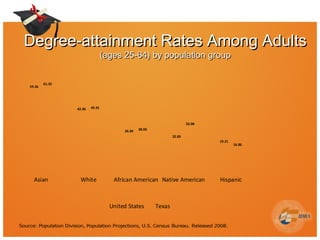
Degree-attainment Rates Among AdultsDegree-attainment Rates Among Adults
(ages 25-64) by population group(ages 25-64) by population group
59.36
42.96
26.84
22.83
19.21
61.32
43.91
28.06
32.08
16.86
Asian White African American Native American Hispanic
United States Texas
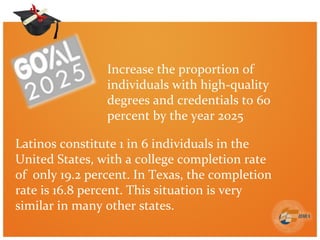
Increase the proportion of
individuals with high-quality
degrees and credentials to 60
percent by the year 2025
Latinos constitute 1 in 6 individuals in the
United States, with a college completion rate
of only 19.2 percent. In Texas, the completion
rate is 16.8 percent. This situation is very
similar in many other states.
Creating a College Readiness Culture
• State requirements for a college going culture
“What does college readiness mean to you?”
• Stand up, hand up, pair up
- Home partner
- Emergency partner
- High 5 partner
• Reflection circle; Share your responses
Random Teams
•Team Roles
Reporter – Shares team information with the class
Gatekeeper – equalizes participation and gather
materials for the group
Praiser – encourages participation of all
members
Reflector – leads the team in looking back
•How do we start creating a college culture?
Creating a College Readiness Culture
•Increase college readiness developing a
community-wide college-going culture
•Address the attitudes, beliefs and mental
blocks that may be hindering students' progress
•Increase PK-20 collaborative partnerships
9
College Readiness Competencies
• Goal Setting
• Inquiry/Creativity
• Expression/Communication
• Critical Thinking/Problem
Solving
• Collaboration
• Organization
• Self-discipline and self-
directed learning
• Attentiveness
• Involvement
• Reflection
• Persistence/Resiliency
• Study Skills
• Time Management
• Determination
• Sense of efficacy
Developing Successful Competencies Activity
• What are your views on each of these
competencies?
• How do you assist students in having the
competencies they need in order to be
successful in school and in college?
• What are the educational implications if
students are prepared?
Developing Successful Competencies Activity
• What attitudes and beliefs we should strive
for and model for students?
• What is your commitment in ensuring your
students master these competencies to be
successful in college and in life?
• Present your work
Best Practices in Action for College
Access and Success
• Review the description on slips provided
• Decide which heading fits your description
• Reflect with each other and report to the
group
Intercultural Development Research
Association
Dr. María “Cuca” Robledo Montecel, President & CEO
5815 Callaghan Road, Suite 101
San Antonio, Texas 78228
210-444-1710 • contact@idra.org
www.www.idraidra.org.org
Assuring educational opportunity for every child
@IDRAedu
www.linkedin.com/company/
interculturaldevelopment-
researchassociation
facebook.com/IDRAed
pinterest.com/idraedu
www.slideshare.net/
IDRAedu
flickr.com/
photos/idraedu
Sign up to receive IDRA news by email at
www.idra.org/Receive_IDRA_News

Creating a college readiness culture

  • 1.
    College Access andSuccess –College Access and Success – Creating a College ReadinessCreating a College Readiness CultureCulture Dr. Nilka Avilés, IDRA Senior Education Associate National Migrant Conference, April 7, 2014 Listen to the related Classnotes Podcast eposide (#141) at www.idra.org/Podcasts/
  • 2.
    Agenda • Welcome andIntroductions • Background and Context Information of the Importance of a College Education • Creating a College Culture • College Readiness Competencies • Developing College Readiness Competencies Activity • Best Practices in Action • Exit Ticket
  • 3.
    Objectives • To cultivatethe importance of a college education and prepare students to be college ready. • To build a college going culture and lead others to pursue a post secondary education. • To examine the college readiness competencies for success.
  • 4.
    Background and Context •Significant college completion gap for Hispanic students and dire need to address the roots of this gap (Census Bureau, 2009; NCES, 2011) • Lack of college readiness has a direct impact to the future of the nation with the changes in demographics (Glover-Blackwell, Kwoh & Pastor, 2010) • Achievement and opportunity gap, deficit-based thinking, lack of college access and culturally responsive curricula (Darling-Hammond, 2010; Contreras, 2011; Valencia, 1997; Ladson-Billings, 1994; Howard 2010) 4
  • 5.
    Degree-attainment Rates AmongAdultsDegree-attainment Rates Among Adults (ages 25-64) by population group(ages 25-64) by population group 59.36 42.96 26.84 22.83 19.21 61.32 43.91 28.06 32.08 16.86 Asian White African American Native American Hispanic United States Texas
  • 6.
    Increase the proportionof individuals with high-quality degrees and credentials to 60 percent by the year 2025 Latinos constitute 1 in 6 individuals in the United States, with a college completion rate of only 19.2 percent. In Texas, the completion rate is 16.8 percent. This situation is very similar in many other states.
  • 7.
    Creating a CollegeReadiness Culture • State requirements for a college going culture “What does college readiness mean to you?” • Stand up, hand up, pair up - Home partner - Emergency partner - High 5 partner • Reflection circle; Share your responses
  • 8.
    Random Teams •Team Roles Reporter– Shares team information with the class Gatekeeper – equalizes participation and gather materials for the group Praiser – encourages participation of all members Reflector – leads the team in looking back •How do we start creating a college culture?
  • 9.
    Creating a CollegeReadiness Culture •Increase college readiness developing a community-wide college-going culture •Address the attitudes, beliefs and mental blocks that may be hindering students' progress •Increase PK-20 collaborative partnerships 9
  • 10.
    College Readiness Competencies •Goal Setting • Inquiry/Creativity • Expression/Communication • Critical Thinking/Problem Solving • Collaboration • Organization • Self-discipline and self- directed learning • Attentiveness • Involvement • Reflection • Persistence/Resiliency • Study Skills • Time Management • Determination • Sense of efficacy
  • 11.
    Developing Successful CompetenciesActivity • What are your views on each of these competencies? • How do you assist students in having the competencies they need in order to be successful in school and in college? • What are the educational implications if students are prepared?
  • 12.
    Developing Successful CompetenciesActivity • What attitudes and beliefs we should strive for and model for students? • What is your commitment in ensuring your students master these competencies to be successful in college and in life? • Present your work
  • 13.
    Best Practices inAction for College Access and Success • Review the description on slips provided • Decide which heading fits your description • Reflect with each other and report to the group
  • 14.
    Intercultural Development Research Association Dr.María “Cuca” Robledo Montecel, President & CEO 5815 Callaghan Road, Suite 101 San Antonio, Texas 78228 210-444-1710 • contact@idra.org www.www.idraidra.org.org Assuring educational opportunity for every child @IDRAedu www.linkedin.com/company/ interculturaldevelopment- researchassociation facebook.com/IDRAed pinterest.com/idraedu www.slideshare.net/ IDRAedu flickr.com/ photos/idraedu Sign up to receive IDRA news by email at www.idra.org/Receive_IDRA_News

Editor's Notes

  • #5 Common tracking practices, overrepresentation and underrepresentation of minority students (O’Connor & Deluca-Fernandez, 2006; Solórzano & Ornelas, 2002)
  • #10 Structural refers the school performance model as measure by academic competence, motivation, self-determination, efficacy, etc. Administrative and instructional modifications we refer to initiatives in place to increase academic achievement to meet local, state and federal standards District benchmarks, graduation, STAAR, CCRS etc. Transformational practices refer to the eradication of negative attitudes, beliefs and mental blocks that hinder the magnitude of students success.