Question 1: In what ways
does your media product use,
develop or challenge forms
and conventions of real
media products?
I have created a music video, print advert and digipak based around
the promotion of an indie-rock song, Adrenaline Junkie by Wyson (the
Digipak is of the same name). My products use many of the
conventions of professional, real media products. They also fit with
the conventions of the music genre, which is confirmed by my
audience feedback. This is essential, as otherwise they would be
unrecognisable as the products that I was required to create. The
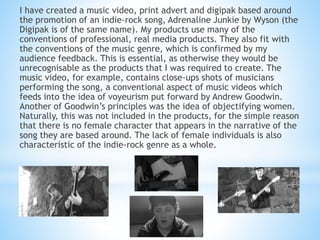
music video, for example, contains close-ups shots of musicians
performing the song, a conventional aspect of music videos which
feeds into the idea of voyeurism put forward by Andrew Goodwin.
Another of Goodwin’s principles was the idea of objectifying women.
Naturally, this was not included in the products, for the simple reason
that there is no female character that appears in the narrative of the
song they are based around. The lack of female individuals is also
characteristic of the indie-rock genre as a whole.
The video, a mixture of performance and narrative-based shots,
also contains the standard feature of lip-synching, and the
digipak contains the generic legal information that is usually
present on such items. Due to this, the music video is fairly
redundant. I chose to construct the products in this manner to
ensure that they are comparable to real-life examples. There
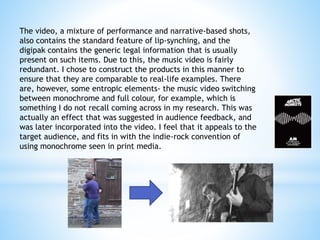
are, however, some entropic elements- the music video switching
between monochrome and full colour, for example, which is
something I do not recall coming across in my research. This was
actually an effect that was suggested in audience feedback, and
was later incorporated into the video. I feel that it appeals to the
target audience, and fits in with the indie-rock convention of
using monochrome seen in print media.
The advert and digipak are mostly redundant too, though the mixture of
monochrome and full-colour panels on the digipak may, again, be an element
of entropy. As with music videos, I did not find any instances where the two
colouring formats were used together, at least to such an extent. I chose to
use a mixture because I felt that the contrast between the two created an
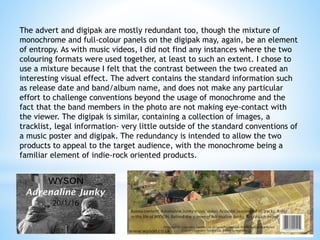
interesting visual effect. The advert contains the standard information such
as release date and band/album name, and does not make any particular
effort to challenge conventions beyond the usage of monochrome and the
fact that the band members in the photo are not making eye-contact with
the viewer. The digipak is similar, containing a collection of images, a
tracklist, legal information- very little outside of the standard conventions of
a music poster and digipak. The redundancy is intended to allow the two
products to appeal to the target audience, with the monochrome being a
familiar element of indie-rock oriented products.
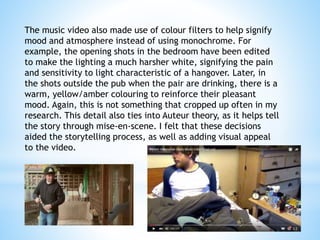
The music video also made use of colour filters to help signify
mood and atmosphere instead of using monochrome. For
example, the opening shots in the bedroom have been edited
to make the lighting a much harsher white, signifying the pain
and sensitivity to light characteristic of a hangover. Later, in
the shots outside the pub when the pair are drinking, there is a
warm, yellow/amber colouring to reinforce their pleasant
mood. Again, this is not something that cropped up often in my
research. This detail also ties into Auteur theory, as it helps tell
the story through mise-en-scene. I felt that these decisions
aided the storytelling process, as well as adding visual appeal
to the video.
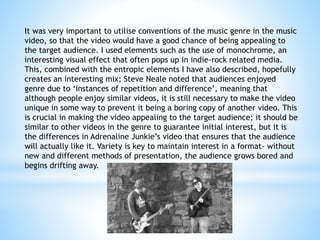
It was very important to utilise conventions of the music genre in the music
video, so that the video would have a good chance of being appealing to
the target audience. I used elements such as the use of monochrome, an
interesting visual effect that often pops up in indie-rock related media.
This, combined with the entropic elements I have also described, hopefully
creates an interesting mix; Steve Neale noted that audiences enjoyed
genre due to ‘instances of repetition and difference’, meaning that
although people enjoy similar videos, it is still necessary to make the video
unique in some way to prevent it being a boring copy of another video. This
is crucial in making the video appealing to the target audience; it should be
similar to other videos in the genre to guarantee initial interest, but it is
the differences in Adrenaline Junkie’s video that ensures that the audience
will actually like it. Variety is key to maintain interest in a format- without
new and different methods of presentation, the audience grows bored and
begins drifting away.
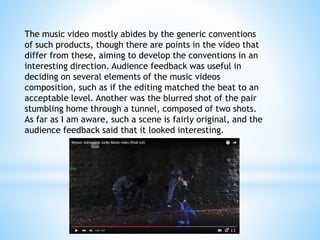
The music video mostly abides by the generic conventions
of such products, though there are points in the video that
differ from these, aiming to develop the conventions in an
interesting direction. Audience feedback was useful in
deciding on several elements of the music videos
composition, such as if the editing matched the beat to an
acceptable level. Another was the blurred shot of the pair
stumbling home through a tunnel, composed of two shots.
As far as I am aware, such a scene is fairly original, and the
audience feedback said that it looked interesting.
The narrative of the video is based on the song lyrics, as
Goodwin’s theory proposes. It is linear, and fairly basic;
two friends meet-up, go to a pub, get drunk and go
home, in what is implied to be something of a repeating
cycle of events. The structure of the narrative, as it
stands, does not conform to Torodov’s structure- there is
no real disruption to the equilibrium in the world of the
narrative. This was not out of any conscious decision,
rather simply a matter of how the narrative developed
during the brainstorming and subsequent storyboarding
processes.
There are, naturally, differences between our work and real
products. For example, the video is slightly pixelated at times, a lack
of quality that would not be found in a real music video. This can be
put down, in part, to lack of foresight when filming in regards to
close-ups, but the quality of our equipment also plays a factor; a
professional-grade camera may have minimised these visual issues.
Additionally, an actual digipak tends to have more legal writing on
the back, as well as logos denoting region codes and the like. My
digipak does not contain these additional elements. This is because I
found the legal complexities a bit hard to get to grips with, and was
uncomfortable with including details that may not have been
accurate. I was also unsure over several of the logos I could have
inserted, and so decided to omit those as well. The placement of
them was also giving me issues, as to fit it all in I found the legal
text around it became nearly illegible to the naked eye.

A2media evaluation q1

  • 1.
    Question 1: Inwhat ways does your media product use, develop or challenge forms and conventions of real media products?
  • 2.
    I have createda music video, print advert and digipak based around the promotion of an indie-rock song, Adrenaline Junkie by Wyson (the Digipak is of the same name). My products use many of the conventions of professional, real media products. They also fit with the conventions of the music genre, which is confirmed by my audience feedback. This is essential, as otherwise they would be unrecognisable as the products that I was required to create. The music video, for example, contains close-ups shots of musicians performing the song, a conventional aspect of music videos which feeds into the idea of voyeurism put forward by Andrew Goodwin. Another of Goodwin’s principles was the idea of objectifying women. Naturally, this was not included in the products, for the simple reason that there is no female character that appears in the narrative of the song they are based around. The lack of female individuals is also characteristic of the indie-rock genre as a whole.
  • 3.
    The video, amixture of performance and narrative-based shots, also contains the standard feature of lip-synching, and the digipak contains the generic legal information that is usually present on such items. Due to this, the music video is fairly redundant. I chose to construct the products in this manner to ensure that they are comparable to real-life examples. There are, however, some entropic elements- the music video switching between monochrome and full colour, for example, which is something I do not recall coming across in my research. This was actually an effect that was suggested in audience feedback, and was later incorporated into the video. I feel that it appeals to the target audience, and fits in with the indie-rock convention of using monochrome seen in print media.
  • 4.
    The advert anddigipak are mostly redundant too, though the mixture of monochrome and full-colour panels on the digipak may, again, be an element of entropy. As with music videos, I did not find any instances where the two colouring formats were used together, at least to such an extent. I chose to use a mixture because I felt that the contrast between the two created an interesting visual effect. The advert contains the standard information such as release date and band/album name, and does not make any particular effort to challenge conventions beyond the usage of monochrome and the fact that the band members in the photo are not making eye-contact with the viewer. The digipak is similar, containing a collection of images, a tracklist, legal information- very little outside of the standard conventions of a music poster and digipak. The redundancy is intended to allow the two products to appeal to the target audience, with the monochrome being a familiar element of indie-rock oriented products.
  • 5.
    The music videoalso made use of colour filters to help signify mood and atmosphere instead of using monochrome. For example, the opening shots in the bedroom have been edited to make the lighting a much harsher white, signifying the pain and sensitivity to light characteristic of a hangover. Later, in the shots outside the pub when the pair are drinking, there is a warm, yellow/amber colouring to reinforce their pleasant mood. Again, this is not something that cropped up often in my research. This detail also ties into Auteur theory, as it helps tell the story through mise-en-scene. I felt that these decisions aided the storytelling process, as well as adding visual appeal to the video.
  • 6.
    It was veryimportant to utilise conventions of the music genre in the music video, so that the video would have a good chance of being appealing to the target audience. I used elements such as the use of monochrome, an interesting visual effect that often pops up in indie-rock related media. This, combined with the entropic elements I have also described, hopefully creates an interesting mix; Steve Neale noted that audiences enjoyed genre due to ‘instances of repetition and difference’, meaning that although people enjoy similar videos, it is still necessary to make the video unique in some way to prevent it being a boring copy of another video. This is crucial in making the video appealing to the target audience; it should be similar to other videos in the genre to guarantee initial interest, but it is the differences in Adrenaline Junkie’s video that ensures that the audience will actually like it. Variety is key to maintain interest in a format- without new and different methods of presentation, the audience grows bored and begins drifting away.
  • 7.
    The music videomostly abides by the generic conventions of such products, though there are points in the video that differ from these, aiming to develop the conventions in an interesting direction. Audience feedback was useful in deciding on several elements of the music videos composition, such as if the editing matched the beat to an acceptable level. Another was the blurred shot of the pair stumbling home through a tunnel, composed of two shots. As far as I am aware, such a scene is fairly original, and the audience feedback said that it looked interesting.
  • 8.
    The narrative ofthe video is based on the song lyrics, as Goodwin’s theory proposes. It is linear, and fairly basic; two friends meet-up, go to a pub, get drunk and go home, in what is implied to be something of a repeating cycle of events. The structure of the narrative, as it stands, does not conform to Torodov’s structure- there is no real disruption to the equilibrium in the world of the narrative. This was not out of any conscious decision, rather simply a matter of how the narrative developed during the brainstorming and subsequent storyboarding processes.
  • 9.
    There are, naturally,differences between our work and real products. For example, the video is slightly pixelated at times, a lack of quality that would not be found in a real music video. This can be put down, in part, to lack of foresight when filming in regards to close-ups, but the quality of our equipment also plays a factor; a professional-grade camera may have minimised these visual issues. Additionally, an actual digipak tends to have more legal writing on the back, as well as logos denoting region codes and the like. My digipak does not contain these additional elements. This is because I found the legal complexities a bit hard to get to grips with, and was uncomfortable with including details that may not have been accurate. I was also unsure over several of the logos I could have inserted, and so decided to omit those as well. The placement of them was also giving me issues, as to fit it all in I found the legal text around it became nearly illegible to the naked eye.