Software Architecture & Design
 Architecture
 From n-Tier to SOA
 From SOAP to REST
 Technical Debt
 Design
 From SQL to ORM, NoSQL and ODM
 From RAD to MVC
 SOLID principles
 Domain Driven Design (DDD)
Applying patterns on Delphi code using mORMot
Software Architecture & Design
From SOAP to REST
From SOAP to REST
 SOAP
 REST
 JSON
 Security
 practice
From SOAP to REST
Simple Object Access Protocol
 SOAP
 XML
 WSDL
 Defines
 Processing model
 Extensibility model
 Underlying protocol binding
 Message construct
From SOAP to REST
Simple Object Access Protocol
 
 Standard
 Feature complete
 Time proof
From SOAP to REST
Simple? Object Access Protocol
 
 Standard
 Feature complete
 Time proof
 
 Several implementations (1.0/1.1/WCF/J2EE)
 Verbose and heavy (slow)
 Complex
From SOAP to REST
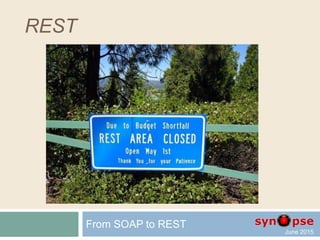
REST
From SOAP to REST
REpresentational State Transfer
 Share the 5 basic fundamentals of the web:
 Everything is a resource
 Every resource is identified
by a unique identifier
 Use simple and uniform interfaces
 Communication is done by representation
 Every request is stateless
From SOAP to REST
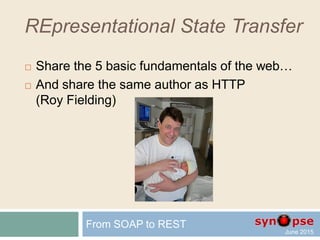
REpresentational State Transfer
 Share the 5 basic fundamentals of the web…
 And share the same author as HTTP
(Roy Fielding)
From SOAP to REST
REpresentational State Transfer
 Share the 5 basic fundamentals of the web
and the same author
 But HTTP is not REST
 REST may be transmitted without HTTP
 e.g. mORMot supports direct in-process access,
named pipes, Windows messages or WebSockets
 REST does not define nor expect anything like
headers, sessions, cookies, https
From SOAP to REST
REST is Resource-based
 On Internet, data can be:
 web page, image, video, file, etc.
 It can also be dynamic output like
“get customers who are newly subscribed”
 With REST, we start thinking
 in terms of resources
 rather than physical files or API
From SOAP to REST
REST Unique Identifier
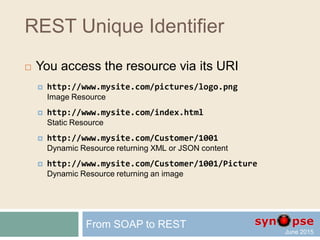
 You access the resource via its URI
 http://www.mysite.com/pictures/logo.png
Image Resource
 http://www.mysite.com/index.html
Static Resource
 http://www.mysite.com/Customer/1001
Dynamic Resource returning XML or JSON content
 http://www.mysite.com/Customer/1001/Picture
Dynamic Resource returning an image
From SOAP to REST
Unique Identifier
 Older web techniques, (aspx or ColdFusion),
requested a resource by specifying parameters, e.g.
http://www.mysite.com/Default.aspx?a=1;a=2&b=1&a=3
 Several URIs may return the same data
 Evolving parameters
 In REST, we add constraints to the URI
 In fact, every URI should uniquely
represent one item of the data collection
From SOAP to REST
REST Unique Identifier
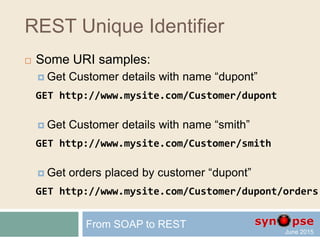
 Some URI samples:
 Get Customer details with name “dupont”
GET http://www.mysite.com/Customer/dupont
 Get Customer details with name “smith”
GET http://www.mysite.com/Customer/smith
 Get orders placed by customer “dupont”
GET http://www.mysite.com/Customer/dupont/orders
From SOAP to REST
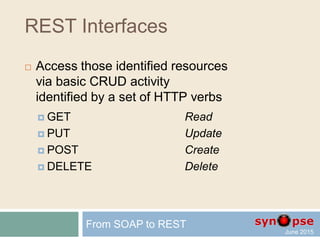
REST Interfaces
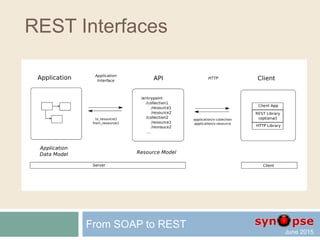
 Access those identified resources
via basic CRUD activity
identified by a set of HTTP verbs
 GET Read
 PUT Update
 POST Create
 DELETE Delete
From SOAP to REST
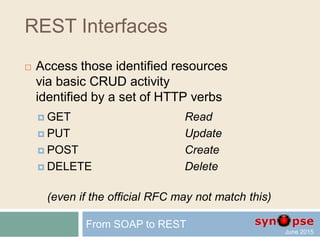
REST Interfaces
 Access those identified resources
via basic CRUD activity
identified by a set of HTTP verbs
 GET Read
 PUT Update
 POST Create
 DELETE Delete
(even if the official RFC may not match this)
From SOAP to REST
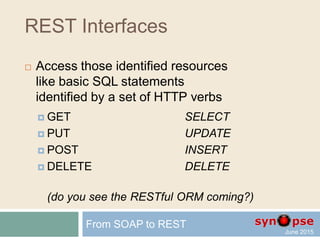
REST Interfaces
 Access those identified resources
like basic SQL statements
identified by a set of HTTP verbs
 GET SELECT
 PUT UPDATE
 POST INSERT
 DELETE DELETE
(do you see the RESTful ORM coming?)
From SOAP to REST
REST Interfaces
 Combination of
 HTTP method/verb
 and resource URI
replaces a list of English-based methods, like
GetCustomer / InsertCustomer /
UpdateOrder / RemoveOrder
From SOAP to REST
REST Interfaces
From SOAP to REST
REST is Stateless
 Every request should be independent
 so that we can scale up (load balancing)
 so that modeling stays simple
 as HTTP/1.1
 i.e. as an independent transaction
that is unrelated to any previous request
 Server-side is the only reference
 Need conflict resolution (optimistic/pessimistic)
From SOAP to REST
REST transfert by Representation
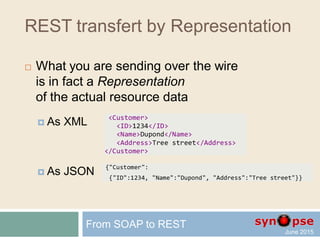
 What you are sending over the wire
is in fact a Representation
of the actual resource data
 As XML
 As JSON
From SOAP to REST
<Customer>
<ID>1234</ID>
<Name>Dupond</Name>
<Address>Tree street</Address>
</Customer>
{"Customer":
{"ID":1234, "Name":"Dupond", "Address":"Tree street"}}
REST transfert by Representation
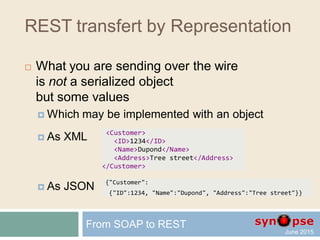
 What you are sending over the wire
is not a serialized object
but some values
 Which may be implemented with an object
 As XML
 As JSON
From SOAP to REST
<Customer>
<ID>1234</ID>
<Name>Dupond</Name>
<Address>Tree street</Address>
</Customer>
{"Customer":
{"ID":1234, "Name":"Dupond", "Address":"Tree street"}}
JSON
 JavaScript Object Notation (JSON)
 Standard
 Open
 Simple and lightweight
text-based, human-readable format
for representing simple data structures
and associative arrays (called objects)
 Designed for data Representation
From SOAP to REST
JSON types
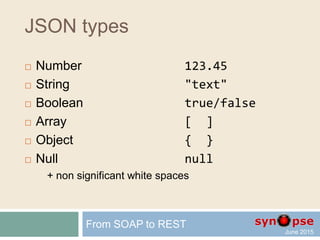
 Number 123.45
 String "text"
 Boolean true/false
 Array [ ]
 Object { }
 Null null
+ non significant white spaces
From SOAP to REST
JSON types
 Number 123.45
 String "text"
 Boolean true/false
 Array [ ]
 Object { }
 Null null
+ non significant white spaces
 Date/Time? Iso8601 Blob? Base64
From SOAP to REST
JSON sample
{
"firstName": "John",
"lastName": "Smith",
"age": 25,
"address": {
"streetAddress": "21 2nd Street",
"city": "New York",
"state": "NY",
"postalCode": 10021
},
"phoneNumbers": [
{
"type": "home",
"number": "212 555-1234"
},
{
"type": "fax",
"number": "646 555-4567"
};
]
}
From SOAP to REST
<Troll>XML</Troll>
{"Troll":"JSON"}
 JSON
 Truly human-readable
 Native AJAX / JavaScript format
 Compact (UTF-8 friendly)
 Simple to implement and use
 XML
 Any complex (even custom) types
 SOAP standard
 Binary (CDATA)
 Validation (XSDL)
From SOAP to REST
JSON/XML alternatives
 Text
 INI
 TOML
 YAML
 Binary
 BSON
 MessagePack
 Protocol Buffers
 WCF
From SOAP to REST
RESTful Security
 Security in Client-Server
is usually implemented by:
 Process safety
 Authentication
 Authorization
From SOAP to REST
RESTful Security
 Security in Client-Server
is usually implemented by:
 Process safety
 Does quality matters?
 Authentication
 Are you who you claim to be?
 Authorization
 What are you allowed to do?
From SOAP to REST
RESTful Security
 Process safety
 Code quality
 Risk management
 Testing
 Feedback, peer review
 Transmission encryption
 Do not reinvent the wheel
From SOAP to REST
RESTful Security
 Authentication
 Authentication (from Greek: "real" or "genuine", from
"author") is the act of confirming the truth of an
attribute of a datum or entity. This might involve
confirming the identity of a person or software
program, tracing the origins of an artifact, or ensuring
that a product is what its packaging and labeling
claims to be. Authentication often involves verifying
the validity of at least one form of identification.
(Wikipedia)
From SOAP to REST
RESTful Security
 RESTful Authentication
 HTTP basic auth over HTTPS
 Not user-friendly (weird popup)
 Password is transmitted
 Cookies and session management (OAuth)
 HTTP-based: not RESTful
 Man-In-the-Middle (MIM) and replay issues
 Query Authentication with additional signature
 Each resource request is authenticated
 Signatures can be strong
 Can be stateless
From SOAP to REST
RESTful Security
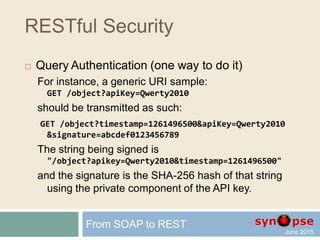
 Query Authentication (one way to do it)
For instance, a generic URI sample:
GET /object?apiKey=Qwerty2010
should be transmitted as such:
GET /object?timestamp=1261496500&apiKey=Qwerty2010
&signature=abcdef0123456789
The string being signed is
"/object?apikey=Qwerty2010&timestamp=1261496500"
and the signature is the SHA-256 hash of that string
using the private component of the API key.
From SOAP to REST
RESTful Security
 Authentication patterns
 Password stored as hash
 N-way challenge
 Single sign-on
 Reinvent the wheel is unsafe
From SOAP to REST
RESTful Security
 Authorization
 Define an access policy for the resources
 For an authenticated user
 May handle a guest user (public content)
 Via Access Control Lists (ACL),
capabilities or groups
 Following the principle of least privilege
 Part of a trust chain (e.g. AD token, LDAP)
From SOAP to REST
mORMot’s REST
From SOAP to REST
mORMot’s REST
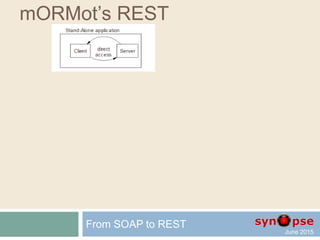
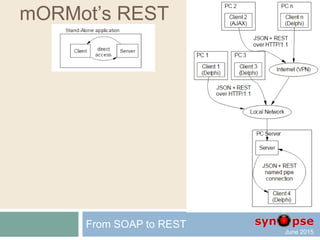
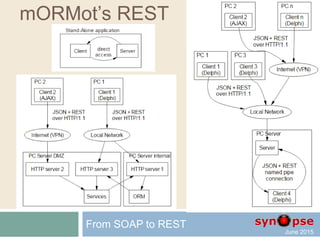
 RESTful Local and Client-Server
 In-process
Stand-alone client, fast server-side access
 Named pipes or Windows messages
Stand-alone client, fast server-side access
 HTTP/1.1 via kernel-mode http.sys API
 Kernel-mode execution, IOCP driven – Windows specific
 HTTP/1.1 via OS socket API
 Windows or Linux
 Upgradable to WebSockets
From SOAP to REST
mORMot’s REST
 RESTful Local and Client-Server
 In-process
 Named pipes or Windows messages
 HTTP/1.1 via kernel-mode http.sys API
 Part of the OS since Windows XP SP2, used by IIS and WCF
 Kernel-mode execution, IOCP driven
 System-wide URI registration: share root and port
 HTTP/1.1 via OS socket API
 Cross platform Server and Client classes
 Upgradable to WebSockets for asynchronous callbacks
From SOAP to REST
mORMot’s REST
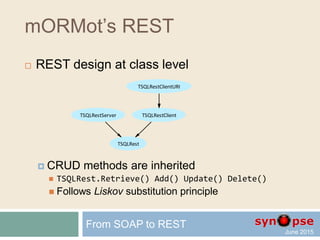
 REST design at class level
 CRUD methods are inherited
 TSQLRest.Retrieve() Add() Update() Delete()
 Follows Liskov substitution principle
From SOAP to REST
TSQLRestServer
TSQLRest
TSQLRestClientURI
TSQLRestClient
mORMot’s REST
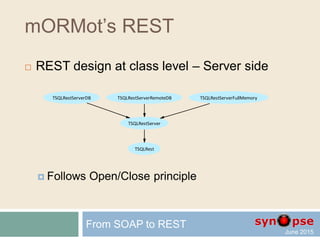
 REST design at class level – Server side
 Follows Open/Close principle
From SOAP to REST
TSQLRestServerDB
TSQLRestServer
TSQLRest
TSQLRestServerRemoteDB TSQLRestServerFullMemory
mORMot’s REST
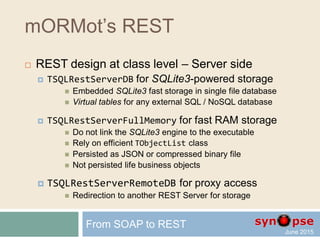
 REST design at class level – Server side
 TSQLRestServerDB for SQLite3-powered storage
 Embedded SQLite3 fast storage in single file database
 Virtual tables for any external SQL / NoSQL database
 TSQLRestServerFullMemory for fast RAM storage
 Do not link the SQLite3 engine to the executable
 Rely on efficient TObjectList class
 Persisted as JSON or compressed binary file
 Not persisted life business objects
 TSQLRestServerRemoteDB for proxy access
 Redirection to another REST Server for storage
From SOAP to REST
mORMot’s REST
 REST design at class level – Server side
 TSQLRestServerDB for SQLite3-powered storage
 mORMot.pas mORMotSQLite3.pas SynSQlite3.pas
 + mORMotDB.pas mORMotMongoDB.pas
 TSQLRestServerFullMemory for fast RAM storage
 mORMot.pas
 TSQLRestServerRemoteDB for proxy access
 mORMot.pas
From SOAP to REST
mORMot’s REST
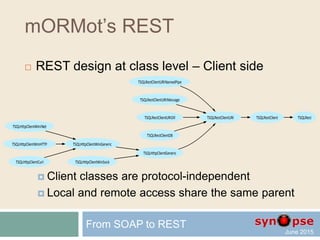
 REST design at class level – Client side
 Client classes are protocol-independent
 Local and remote access share the same parent
From SOAP to REST
TSQLRestClientURINamedPipe
TSQLRestClientURI TSQLRestClient
TSQLRestClientURIMessage
TSQLRestClientURIDll
TSQLRestClientDB
TSQLHttpClientWinINet
TSQLHttpClientWinGeneric
TSQLHttpClientGeneric
TSQLHttpClientWinHTTP
TSQLHttpClientWinSockTSQLHttpClientCurl
TSQLRest
mORMot’s REST
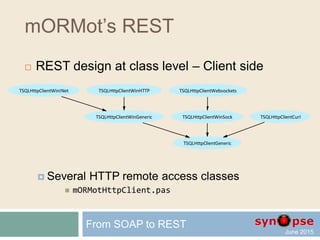
 REST design at class level – Client side
 Several HTTP remote access classes
 mORMotHttpClient.pas
From SOAP to REST
TSQLHttpClientWinINet
TSQLHttpClientWinGeneric
TSQLHttpClientGeneric
TSQLHttpClientWinHTTP
TSQLHttpClientWinSock TSQLHttpClientCurl
TSQLHttpClientWebsockets
mORMot’s REST
From SOAP to REST
mORMot’s REST
From SOAP to REST
mORMot’s REST
From SOAP to REST
mORMot’s REST
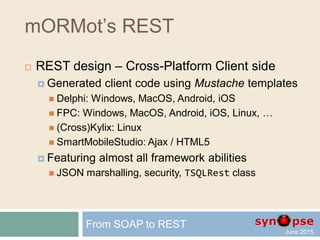
 REST design – Cross-Platform Client side
 Generated client code using Mustache templates
 Delphi: Windows, MacOS, Android, iOS
 FPC: Windows, MacOS, Android, iOS, Linux, …
 (Cross)Kylix: Linux
 SmartMobileStudio: Ajax / HTML5
 Featuring almost all framework abilities
 JSON marshalling, security, batch, TSQLRest class
From SOAP to REST
mORMot’s REST
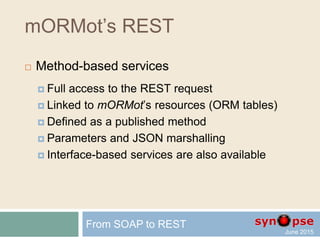
 Method-based services
 Full access to the REST request
 Linked to mORMot’s resources (ORM tables)
 Defined as a published method
 Parameters and JSON marshalling
 Interface-based services are also available
From SOAP to REST
mORMot’s REST
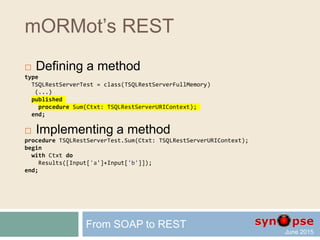
 Defining a method
type
TSQLRestServerTest = class(TSQLRestServerFullMemory)
(...)
published
procedure Sum(Ctxt: TSQLRestServerURIContext);
end;
 Implementing a method
procedure TSQLRestServerTest.Sum(Ctxt: TSQLRestServerURIContext);
begin
with Ctxt do
Results([Input['a']+Input['b']]);
end;
From SOAP to REST
mORMot’s REST
 Defining a method
type
TSQLRestServerTest = class(TSQLRestServerFullMemory)
(...)
published
procedure Sum(Ctxt: TSQLRestServerURIContext);
end;
 Implementing a method
procedure TSQLRestServerTest.Sum(Ctxt: TSQLRestServerURIContext);
begin
Ctxt.Results([Ctxt['a']+Ctxt['b']]);
end;
From SOAP to REST
mORMot’s REST
 Automatic URI and JSON content marshalling
 For instance, the following request URI:
GET /root/Sum?a=3.12&b=4.2
will let our server method return:
{"Result":7.32}
 That is, a perfectly AJAX-friendly request
 With no restriction on the routing or marshalling
 But not yet RESTful (where is the resource?)
From SOAP to REST
mORMot’s REST
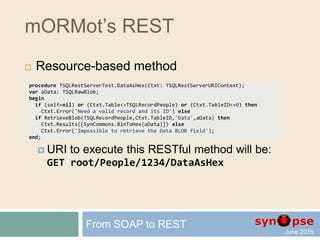
 Resource-based method
 URI to execute this RESTful method will be:
GET root/People/1234/DataAsHex
From SOAP to REST
procedure TSQLRestServerTest.DataAsHex(Ctxt: TSQLRestServerURIContext);
var aData: TSQLRawBlob;
begin
if (self=nil) or (Ctxt.Table<>TSQLRecordPeople) or (Ctxt.TableID<=0) then
Ctxt.Error('Need a valid record and its ID') else
if RetrieveBlob(TSQLRecordPeople,Ctxt.TableID,'Data',aData) then
Ctxt.Results([SynCommons.BinToHex(aData)]) else
Ctxt.Error('Impossible to retrieve the Data BLOB field');
end;
mORMot’s REST
 Resource-based method
TSQLRestServerURIContext
 Properties
 Method Table TableID Parameters
 Session SessionGroup SessionUser SessionUserName
 Input[] Input*[] InHeader[] InCookie[]
 Methods
 Returns() Results()
 ReturnsJson() ReturnBlob()
ReturnFile() ReturnFileFromFolder()
 OutSetCookie()
 Redirect() Success() Error()
From SOAP to REST
mORMot’s REST
 REST routing defined by classes
From SOAP to REST
TSQLRestRoutingJSON_RPC
TSQLRestServerURIContext
TSQLRestRoutingREST
TSQLRestServerURIContext = class
protected
...
function URIDecodeREST: boolean; virtual;
procedure URIDecodeSOAByMethod; virtual;
procedure URIDecodeSOAByInterface; virtual; abstract;
function Authenticate: boolean; virtual;
procedure ExecuteSOAByMethod; virtual;
procedure ExecuteSOAByInterface; virtual; abstract;
procedure ExecuteORMGet; virtual;
procedure ExecuteORMWrite; virtual;
...
mORMot’s REST
 REST routing defined by classes
 You can customize every aspect of the routing
for method-based services
 JSON/RPC and REST are available by default
for interface-based services
 Resource access via ORM is also customizable
From SOAP to REST
TSQLRestRoutingJSON_RPC
TSQLRestServerURIContext
TSQLRestRoutingREST
mORMot’s REST
 HTTP Server
 A single TSQLHttpServer can handle
one or several TSQLRestServer instances
 Automated routing using TSQLModel.Root
 Via http.sys or Sockets or WebSockets
 mORMotHttpServer.pas
 Advanced features
 Virtual hosts, redirection, shared port (http.sys)
 Deflate / SynLZ / AES compression/encryption
 As application or service/daemon
From SOAP to REST
mORMot’s REST
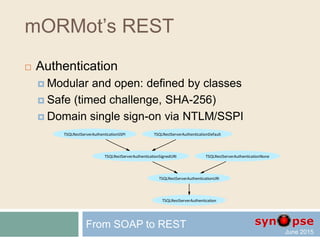
 Authentication
 Modular and open: defined by classes
 Safe (timed challenge, SHA-256)
 Domain single sign-on via NTLM/SSPI
From SOAP to REST
TSQLRestServerAuthenticationSSPI
TSQLRestServerAuthenticationSignedURI
TSQLRestServerAuthenticationURI
TSQLRestServerAuthenticationDefault
TSQLRestServerAuthentication
TSQLRestServerAuthenticationNone
mORMot’s REST
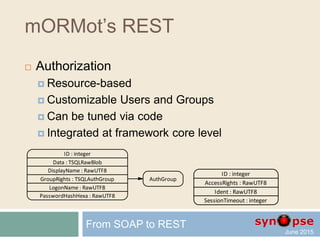
 Authorization
 Resource-based
 Customizable Users and Groups
 Can be tuned via code
 Integrated at framework core level
From SOAP to REST
ID : integer
AccessRights : RawUTF8
Ident : RawUTF8
SessionTimeout : integer
ID : integer
Data : TSQLRawBlob
DisplayName : RawUTF8
GroupRights : TSQLAuthGroup
LogonName : RawUTF8
PasswordHashHexa : RawUTF8
AuthGroup
mORMot’s JSON
 JSON and UTF-8
 UTF-8 from the ground up
 UTF-8 is Unicode
 Unicode even for Delphi < 2009, or FPC
 Dedicated RawUTF8 string type for business logic
 JSON used for transmission and internal storage
 for client-server ORM and SOA
 e.g. for cache on server or client side
 direct in-place parsing to avoid memory allocation
From SOAP to REST
mORMot’s JSON
 UTF-8 JSON from the ground up
 Optimized functions and classes (TTextWriter)
 Bypass the RTL on purpose (e.g. Win64, FPC)
 SynCommons.pas unit shared by ORM, SynDB, SOA
 Universal mean of transmission and storage
 Extended types (date/time, blob, BSON)
 Dynamic array, record, class and variant
 TDocVariant custom type for late-binding
From SOAP to REST
mORMot’s JSON
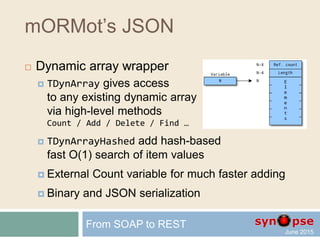
 Dynamic array wrapper
 TDynArray gives access
to any existing dynamic array
via high-level methods
Count / Add / Delete / Find …
 TDynArrayHashed add hash-based
fast O(1) search of item values
 External Count variable for much faster adding
 Binary and JSON serialization
From SOAP to REST
mORMot’s JSON
 TDocVariant custom type
 Stores any transient value as document:
 Object
 Array
 Any nested combination of the two
 Low memory overhead
 Data allocation per blocks of variants
 Copy by reference can be enabled
 Instance lifetime managed by the compiler
 Direct JSON support
 Late-binding magic
From SOAP to REST
mORMot’s JSON
 Create TDocVariant instances
 TDocVariant.New()
 _Obj() _ObjFast()
 _Arr() _ArrFast()
 _Json() _JsonFast() _JsonFmt() _JsonFastFmt()
_*() for per-value instances
 will copy the whole document content
_*Fast() for per-reference instances
 will copy a reference of the document content
From SOAP to REST
mORMot’s JSON
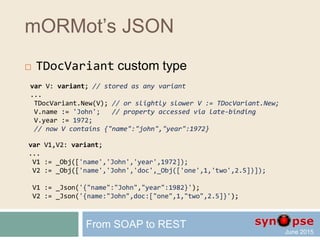
 TDocVariant custom type
var V: variant; // stored as any variant
...
TDocVariant.New(V); // or slightly slower V := TDocVariant.New;
V.name := 'John'; // property accessed via late-binding
V.year := 1972;
// now V contains {"name":"john","year":1972}
var V1,V2: variant;
...
V1 := _Obj(['name','John','year',1972]);
V2 := _Obj(['name','John','doc',_Obj(['one',1,'two',2.5])]);
V1 := _Json('{"name":"John","year":1982}');
V2 := _Json('{name:"John",doc:["one",1,"two",2.5]}');
From SOAP to REST
mORMot’s JSON
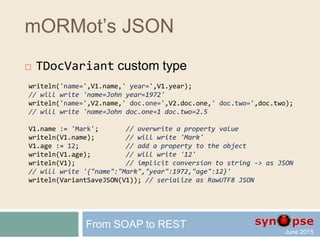
 TDocVariant custom type
writeln('name=',V1.name,' year=',V1.year);
// will write 'name=John year=1972'
writeln('name=',V2.name,' doc.one=',V2.doc.one,' doc.two=',doc.two);
// will write 'name=John doc.one=1 doc.two=2.5
V1.name := 'Mark'; // overwrite a property value
writeln(V1.name); // will write 'Mark'
V1.age := 12; // add a property to the object
writeln(V1.age); // will write '12'
writeln(V1); // implicit conversion to string -> as JSON
// will write '{"name":"Mark","year":1972,"age":12}'
writeln(VariantSaveJSON(V1)); // serialize as RawUTF8 JSON
From SOAP to REST
mORMot’s JSON
 TDocVariant custom type
 Pseudo-methods:
 _Json/_Count/_Kind for objects
 Add/Delete/Count/_ for arrays
var V: variant;
...
V := _Json('{arr:[1,2]}');
writeln(V._Count); // will write 1 (one property in the V object)
V.arr.Add(3); // will work, since V.arr is returned by reference (varByRef)
writeln(V); // will write '{"arr":[1,2,3]}'
V.arr.Delete(1);
writeln(V); // will write '{"arr":[1,3]}‘
From SOAP to REST
mORMot’s JSON
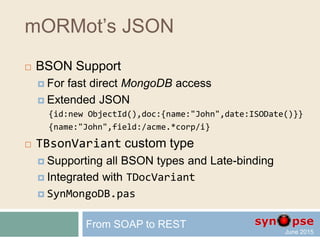
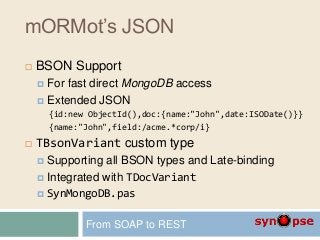
 BSON Support
 For fast direct MongoDB access
 Extended JSON
{id:new ObjectId(),doc:{name:"John",date:ISODate()}}
{name:"John",field:/acme.*corp/i}
 TBsonVariant custom type
 Supporting all BSON types and Late-binding
 Integrated with TDocVariant
 SynMongoDB.pas
From SOAP to REST
From SOAP to REST
… back to mORMot SOA implementation

A2 from soap to rest

  • 1.
    Software Architecture &Design  Architecture  From n-Tier to SOA  From SOAP to REST  Technical Debt  Design  From SQL to ORM, NoSQL and ODM  From RAD to MVC  SOLID principles  Domain Driven Design (DDD) Applying patterns on Delphi code using mORMot Software Architecture & Design
  • 2.
  • 3.
    From SOAP toREST  SOAP  REST  JSON  Security  practice From SOAP to REST
  • 4.
    Simple Object AccessProtocol  SOAP  XML  WSDL  Defines  Processing model  Extensibility model  Underlying protocol binding  Message construct From SOAP to REST
  • 5.
    Simple Object AccessProtocol    Standard  Feature complete  Time proof From SOAP to REST
  • 6.
    Simple? Object AccessProtocol    Standard  Feature complete  Time proof    Several implementations (1.0/1.1/WCF/J2EE)  Verbose and heavy (slow)  Complex From SOAP to REST
  • 7.
  • 8.
    REpresentational State Transfer Share the 5 basic fundamentals of the web:  Everything is a resource  Every resource is identified by a unique identifier  Use simple and uniform interfaces  Communication is done by representation  Every request is stateless From SOAP to REST
  • 9.
    REpresentational State Transfer Share the 5 basic fundamentals of the web…  And share the same author as HTTP (Roy Fielding) From SOAP to REST
  • 10.
    REpresentational State Transfer Share the 5 basic fundamentals of the web and the same author  But HTTP is not REST  REST may be transmitted without HTTP  e.g. mORMot supports direct in-process access, named pipes, Windows messages or WebSockets  REST does not define nor expect anything like headers, sessions, cookies, https From SOAP to REST
  • 11.
    REST is Resource-based On Internet, data can be:  web page, image, video, file, etc.  It can also be dynamic output like “get customers who are newly subscribed”  With REST, we start thinking  in terms of resources  rather than physical files or API From SOAP to REST
  • 12.
    REST Unique Identifier You access the resource via its URI  http://www.mysite.com/pictures/logo.png Image Resource  http://www.mysite.com/index.html Static Resource  http://www.mysite.com/Customer/1001 Dynamic Resource returning XML or JSON content  http://www.mysite.com/Customer/1001/Picture Dynamic Resource returning an image From SOAP to REST
  • 13.
    Unique Identifier  Olderweb techniques, (aspx or ColdFusion), requested a resource by specifying parameters, e.g. http://www.mysite.com/Default.aspx?a=1;a=2&b=1&a=3  Several URIs may return the same data  Evolving parameters  In REST, we add constraints to the URI  In fact, every URI should uniquely represent one item of the data collection From SOAP to REST
  • 14.
    REST Unique Identifier Some URI samples:  Get Customer details with name “dupont” GET http://www.mysite.com/Customer/dupont  Get Customer details with name “smith” GET http://www.mysite.com/Customer/smith  Get orders placed by customer “dupont” GET http://www.mysite.com/Customer/dupont/orders From SOAP to REST
  • 15.
    REST Interfaces  Accessthose identified resources via basic CRUD activity identified by a set of HTTP verbs  GET Read  PUT Update  POST Create  DELETE Delete From SOAP to REST
  • 16.
    REST Interfaces  Accessthose identified resources via basic CRUD activity identified by a set of HTTP verbs  GET Read  PUT Update  POST Create  DELETE Delete (even if the official RFC may not match this) From SOAP to REST
  • 17.
    REST Interfaces  Accessthose identified resources like basic SQL statements identified by a set of HTTP verbs  GET SELECT  PUT UPDATE  POST INSERT  DELETE DELETE (do you see the RESTful ORM coming?) From SOAP to REST
  • 18.
    REST Interfaces  Combinationof  HTTP method/verb  and resource URI replaces a list of English-based methods, like GetCustomer / InsertCustomer / UpdateOrder / RemoveOrder From SOAP to REST
  • 19.
  • 20.
    REST is Stateless Every request should be independent  so that we can scale up (load balancing)  so that modeling stays simple  as HTTP/1.1  i.e. as an independent transaction that is unrelated to any previous request  Server-side is the only reference  Need conflict resolution (optimistic/pessimistic) From SOAP to REST
  • 21.
    REST transfert byRepresentation  What you are sending over the wire is in fact a Representation of the actual resource data  As XML  As JSON From SOAP to REST <Customer> <ID>1234</ID> <Name>Dupond</Name> <Address>Tree street</Address> </Customer> {"Customer": {"ID":1234, "Name":"Dupond", "Address":"Tree street"}}
  • 22.
    REST transfert byRepresentation  What you are sending over the wire is not a serialized object but some values  Which may be implemented with an object  As XML  As JSON From SOAP to REST <Customer> <ID>1234</ID> <Name>Dupond</Name> <Address>Tree street</Address> </Customer> {"Customer": {"ID":1234, "Name":"Dupond", "Address":"Tree street"}}
  • 23.
    JSON  JavaScript ObjectNotation (JSON)  Standard  Open  Simple and lightweight text-based, human-readable format for representing simple data structures and associative arrays (called objects)  Designed for data Representation From SOAP to REST
  • 24.
    JSON types  Number123.45  String "text"  Boolean true/false  Array [ ]  Object { }  Null null + non significant white spaces From SOAP to REST
  • 25.
    JSON types  Number123.45  String "text"  Boolean true/false  Array [ ]  Object { }  Null null + non significant white spaces  Date/Time? Iso8601 Blob? Base64 From SOAP to REST
  • 26.
    JSON sample { "firstName": "John", "lastName":"Smith", "age": 25, "address": { "streetAddress": "21 2nd Street", "city": "New York", "state": "NY", "postalCode": 10021 }, "phoneNumbers": [ { "type": "home", "number": "212 555-1234" }, { "type": "fax", "number": "646 555-4567" }; ] } From SOAP to REST
  • 27.
    <Troll>XML</Troll> {"Troll":"JSON"}  JSON  Trulyhuman-readable  Native AJAX / JavaScript format  Compact (UTF-8 friendly)  Simple to implement and use  XML  Any complex (even custom) types  SOAP standard  Binary (CDATA)  Validation (XSDL) From SOAP to REST
  • 28.
    JSON/XML alternatives  Text INI  TOML  YAML  Binary  BSON  MessagePack  Protocol Buffers  WCF From SOAP to REST
  • 29.
    RESTful Security  Securityin Client-Server is usually implemented by:  Process safety  Authentication  Authorization From SOAP to REST
  • 30.
    RESTful Security  Securityin Client-Server is usually implemented by:  Process safety  Does quality matters?  Authentication  Are you who you claim to be?  Authorization  What are you allowed to do? From SOAP to REST
  • 31.
    RESTful Security  Processsafety  Code quality  Risk management  Testing  Feedback, peer review  Transmission encryption  Do not reinvent the wheel From SOAP to REST
  • 32.
    RESTful Security  Authentication Authentication (from Greek: "real" or "genuine", from "author") is the act of confirming the truth of an attribute of a datum or entity. This might involve confirming the identity of a person or software program, tracing the origins of an artifact, or ensuring that a product is what its packaging and labeling claims to be. Authentication often involves verifying the validity of at least one form of identification. (Wikipedia) From SOAP to REST
  • 33.
    RESTful Security  RESTfulAuthentication  HTTP basic auth over HTTPS  Not user-friendly (weird popup)  Password is transmitted  Cookies and session management (OAuth)  HTTP-based: not RESTful  Man-In-the-Middle (MIM) and replay issues  Query Authentication with additional signature  Each resource request is authenticated  Signatures can be strong  Can be stateless From SOAP to REST
  • 34.
    RESTful Security  QueryAuthentication (one way to do it) For instance, a generic URI sample: GET /object?apiKey=Qwerty2010 should be transmitted as such: GET /object?timestamp=1261496500&apiKey=Qwerty2010 &signature=abcdef0123456789 The string being signed is "/object?apikey=Qwerty2010&timestamp=1261496500" and the signature is the SHA-256 hash of that string using the private component of the API key. From SOAP to REST
  • 35.
    RESTful Security  Authenticationpatterns  Password stored as hash  N-way challenge  Single sign-on  Reinvent the wheel is unsafe From SOAP to REST
  • 36.
    RESTful Security  Authorization Define an access policy for the resources  For an authenticated user  May handle a guest user (public content)  Via Access Control Lists (ACL), capabilities or groups  Following the principle of least privilege  Part of a trust chain (e.g. AD token, LDAP) From SOAP to REST
  • 37.
  • 38.
    mORMot’s REST  RESTfulLocal and Client-Server  In-process Stand-alone client, fast server-side access  Named pipes or Windows messages Stand-alone client, fast server-side access  HTTP/1.1 via kernel-mode http.sys API  Kernel-mode execution, IOCP driven – Windows specific  HTTP/1.1 via OS socket API  Windows or Linux  Upgradable to WebSockets From SOAP to REST
  • 39.
    mORMot’s REST  RESTfulLocal and Client-Server  In-process  Named pipes or Windows messages  HTTP/1.1 via kernel-mode http.sys API  Part of the OS since Windows XP SP2, used by IIS and WCF  Kernel-mode execution, IOCP driven  System-wide URI registration: share root and port  HTTP/1.1 via OS socket API  Cross platform Server and Client classes  Upgradable to WebSockets for asynchronous callbacks From SOAP to REST
  • 40.
    mORMot’s REST  RESTdesign at class level  CRUD methods are inherited  TSQLRest.Retrieve() Add() Update() Delete()  Follows Liskov substitution principle From SOAP to REST TSQLRestServer TSQLRest TSQLRestClientURI TSQLRestClient
  • 41.
    mORMot’s REST  RESTdesign at class level – Server side  Follows Open/Close principle From SOAP to REST TSQLRestServerDB TSQLRestServer TSQLRest TSQLRestServerRemoteDB TSQLRestServerFullMemory
  • 42.
    mORMot’s REST  RESTdesign at class level – Server side  TSQLRestServerDB for SQLite3-powered storage  Embedded SQLite3 fast storage in single file database  Virtual tables for any external SQL / NoSQL database  TSQLRestServerFullMemory for fast RAM storage  Do not link the SQLite3 engine to the executable  Rely on efficient TObjectList class  Persisted as JSON or compressed binary file  Not persisted life business objects  TSQLRestServerRemoteDB for proxy access  Redirection to another REST Server for storage From SOAP to REST
  • 43.
    mORMot’s REST  RESTdesign at class level – Server side  TSQLRestServerDB for SQLite3-powered storage  mORMot.pas mORMotSQLite3.pas SynSQlite3.pas  + mORMotDB.pas mORMotMongoDB.pas  TSQLRestServerFullMemory for fast RAM storage  mORMot.pas  TSQLRestServerRemoteDB for proxy access  mORMot.pas From SOAP to REST
  • 44.
    mORMot’s REST  RESTdesign at class level – Client side  Client classes are protocol-independent  Local and remote access share the same parent From SOAP to REST TSQLRestClientURINamedPipe TSQLRestClientURI TSQLRestClient TSQLRestClientURIMessage TSQLRestClientURIDll TSQLRestClientDB TSQLHttpClientWinINet TSQLHttpClientWinGeneric TSQLHttpClientGeneric TSQLHttpClientWinHTTP TSQLHttpClientWinSockTSQLHttpClientCurl TSQLRest
  • 45.
    mORMot’s REST  RESTdesign at class level – Client side  Several HTTP remote access classes  mORMotHttpClient.pas From SOAP to REST TSQLHttpClientWinINet TSQLHttpClientWinGeneric TSQLHttpClientGeneric TSQLHttpClientWinHTTP TSQLHttpClientWinSock TSQLHttpClientCurl TSQLHttpClientWebsockets
  • 46.
  • 47.
  • 48.
  • 49.
    mORMot’s REST  RESTdesign – Cross-Platform Client side  Generated client code using Mustache templates  Delphi: Windows, MacOS, Android, iOS  FPC: Windows, MacOS, Android, iOS, Linux, …  (Cross)Kylix: Linux  SmartMobileStudio: Ajax / HTML5  Featuring almost all framework abilities  JSON marshalling, security, batch, TSQLRest class From SOAP to REST
  • 50.
    mORMot’s REST  Method-basedservices  Full access to the REST request  Linked to mORMot’s resources (ORM tables)  Defined as a published method  Parameters and JSON marshalling  Interface-based services are also available From SOAP to REST
  • 51.
    mORMot’s REST  Defininga method type TSQLRestServerTest = class(TSQLRestServerFullMemory) (...) published procedure Sum(Ctxt: TSQLRestServerURIContext); end;  Implementing a method procedure TSQLRestServerTest.Sum(Ctxt: TSQLRestServerURIContext); begin with Ctxt do Results([Input['a']+Input['b']]); end; From SOAP to REST
  • 52.
    mORMot’s REST  Defininga method type TSQLRestServerTest = class(TSQLRestServerFullMemory) (...) published procedure Sum(Ctxt: TSQLRestServerURIContext); end;  Implementing a method procedure TSQLRestServerTest.Sum(Ctxt: TSQLRestServerURIContext); begin Ctxt.Results([Ctxt['a']+Ctxt['b']]); end; From SOAP to REST
  • 53.
    mORMot’s REST  AutomaticURI and JSON content marshalling  For instance, the following request URI: GET /root/Sum?a=3.12&b=4.2 will let our server method return: {"Result":7.32}  That is, a perfectly AJAX-friendly request  With no restriction on the routing or marshalling  But not yet RESTful (where is the resource?) From SOAP to REST
  • 54.
    mORMot’s REST  Resource-basedmethod  URI to execute this RESTful method will be: GET root/People/1234/DataAsHex From SOAP to REST procedure TSQLRestServerTest.DataAsHex(Ctxt: TSQLRestServerURIContext); var aData: TSQLRawBlob; begin if (self=nil) or (Ctxt.Table<>TSQLRecordPeople) or (Ctxt.TableID<=0) then Ctxt.Error('Need a valid record and its ID') else if RetrieveBlob(TSQLRecordPeople,Ctxt.TableID,'Data',aData) then Ctxt.Results([SynCommons.BinToHex(aData)]) else Ctxt.Error('Impossible to retrieve the Data BLOB field'); end;
  • 55.
    mORMot’s REST  Resource-basedmethod TSQLRestServerURIContext  Properties  Method Table TableID Parameters  Session SessionGroup SessionUser SessionUserName  Input[] Input*[] InHeader[] InCookie[]  Methods  Returns() Results()  ReturnsJson() ReturnBlob() ReturnFile() ReturnFileFromFolder()  OutSetCookie()  Redirect() Success() Error() From SOAP to REST
  • 56.
    mORMot’s REST  RESTrouting defined by classes From SOAP to REST TSQLRestRoutingJSON_RPC TSQLRestServerURIContext TSQLRestRoutingREST TSQLRestServerURIContext = class protected ... function URIDecodeREST: boolean; virtual; procedure URIDecodeSOAByMethod; virtual; procedure URIDecodeSOAByInterface; virtual; abstract; function Authenticate: boolean; virtual; procedure ExecuteSOAByMethod; virtual; procedure ExecuteSOAByInterface; virtual; abstract; procedure ExecuteORMGet; virtual; procedure ExecuteORMWrite; virtual; ...
  • 57.
    mORMot’s REST  RESTrouting defined by classes  You can customize every aspect of the routing for method-based services  JSON/RPC and REST are available by default for interface-based services  Resource access via ORM is also customizable From SOAP to REST TSQLRestRoutingJSON_RPC TSQLRestServerURIContext TSQLRestRoutingREST
  • 58.
    mORMot’s REST  HTTPServer  A single TSQLHttpServer can handle one or several TSQLRestServer instances  Automated routing using TSQLModel.Root  Via http.sys or Sockets or WebSockets  mORMotHttpServer.pas  Advanced features  Virtual hosts, redirection, shared port (http.sys)  Deflate / SynLZ / AES compression/encryption  As application or service/daemon From SOAP to REST
  • 59.
    mORMot’s REST  Authentication Modular and open: defined by classes  Safe (timed challenge, SHA-256)  Domain single sign-on via NTLM/SSPI From SOAP to REST TSQLRestServerAuthenticationSSPI TSQLRestServerAuthenticationSignedURI TSQLRestServerAuthenticationURI TSQLRestServerAuthenticationDefault TSQLRestServerAuthentication TSQLRestServerAuthenticationNone
  • 60.
    mORMot’s REST  Authorization Resource-based  Customizable Users and Groups  Can be tuned via code  Integrated at framework core level From SOAP to REST ID : integer AccessRights : RawUTF8 Ident : RawUTF8 SessionTimeout : integer ID : integer Data : TSQLRawBlob DisplayName : RawUTF8 GroupRights : TSQLAuthGroup LogonName : RawUTF8 PasswordHashHexa : RawUTF8 AuthGroup
  • 61.
    mORMot’s JSON  JSONand UTF-8  UTF-8 from the ground up  UTF-8 is Unicode  Unicode even for Delphi < 2009, or FPC  Dedicated RawUTF8 string type for business logic  JSON used for transmission and internal storage  for client-server ORM and SOA  e.g. for cache on server or client side  direct in-place parsing to avoid memory allocation From SOAP to REST
  • 62.
    mORMot’s JSON  UTF-8JSON from the ground up  Optimized functions and classes (TTextWriter)  Bypass the RTL on purpose (e.g. Win64, FPC)  SynCommons.pas unit shared by ORM, SynDB, SOA  Universal mean of transmission and storage  Extended types (date/time, blob, BSON)  Dynamic array, record, class and variant  TDocVariant custom type for late-binding From SOAP to REST
  • 63.
    mORMot’s JSON  Dynamicarray wrapper  TDynArray gives access to any existing dynamic array via high-level methods Count / Add / Delete / Find …  TDynArrayHashed add hash-based fast O(1) search of item values  External Count variable for much faster adding  Binary and JSON serialization From SOAP to REST
  • 64.
    mORMot’s JSON  TDocVariantcustom type  Stores any transient value as document:  Object  Array  Any nested combination of the two  Low memory overhead  Data allocation per blocks of variants  Copy by reference can be enabled  Instance lifetime managed by the compiler  Direct JSON support  Late-binding magic From SOAP to REST
  • 65.
    mORMot’s JSON  CreateTDocVariant instances  TDocVariant.New()  _Obj() _ObjFast()  _Arr() _ArrFast()  _Json() _JsonFast() _JsonFmt() _JsonFastFmt() _*() for per-value instances  will copy the whole document content _*Fast() for per-reference instances  will copy a reference of the document content From SOAP to REST
  • 66.
    mORMot’s JSON  TDocVariantcustom type var V: variant; // stored as any variant ... TDocVariant.New(V); // or slightly slower V := TDocVariant.New; V.name := 'John'; // property accessed via late-binding V.year := 1972; // now V contains {"name":"john","year":1972} var V1,V2: variant; ... V1 := _Obj(['name','John','year',1972]); V2 := _Obj(['name','John','doc',_Obj(['one',1,'two',2.5])]); V1 := _Json('{"name":"John","year":1982}'); V2 := _Json('{name:"John",doc:["one",1,"two",2.5]}'); From SOAP to REST
  • 67.
    mORMot’s JSON  TDocVariantcustom type writeln('name=',V1.name,' year=',V1.year); // will write 'name=John year=1972' writeln('name=',V2.name,' doc.one=',V2.doc.one,' doc.two=',doc.two); // will write 'name=John doc.one=1 doc.two=2.5 V1.name := 'Mark'; // overwrite a property value writeln(V1.name); // will write 'Mark' V1.age := 12; // add a property to the object writeln(V1.age); // will write '12' writeln(V1); // implicit conversion to string -> as JSON // will write '{"name":"Mark","year":1972,"age":12}' writeln(VariantSaveJSON(V1)); // serialize as RawUTF8 JSON From SOAP to REST
  • 68.
    mORMot’s JSON  TDocVariantcustom type  Pseudo-methods:  _Json/_Count/_Kind for objects  Add/Delete/Count/_ for arrays var V: variant; ... V := _Json('{arr:[1,2]}'); writeln(V._Count); // will write 1 (one property in the V object) V.arr.Add(3); // will work, since V.arr is returned by reference (varByRef) writeln(V); // will write '{"arr":[1,2,3]}' V.arr.Delete(1); writeln(V); // will write '{"arr":[1,3]}‘ From SOAP to REST
  • 69.
    mORMot’s JSON  BSONSupport  For fast direct MongoDB access  Extended JSON {id:new ObjectId(),doc:{name:"John",date:ISODate()}} {name:"John",field:/acme.*corp/i}  TBsonVariant custom type  Supporting all BSON types and Late-binding  Integrated with TDocVariant  SynMongoDB.pas From SOAP to REST
  • 70.
    From SOAP toREST … back to mORMot SOA implementation