API
API
What is API?
●
API: is a software-to-software interface, not a user
interface.
●
With API, applications talk to each other without any
user knowledge or intervention.
●
Main goal of API is code/program reusable
●
An API resembles Software as a Service (SaaS), since
software developers don’t have to start from scratch
every time they write a program.
●
Instead of building one core application that tries to do
everything, the same application can contract out
certain responsibilities to remote software that does it
better.
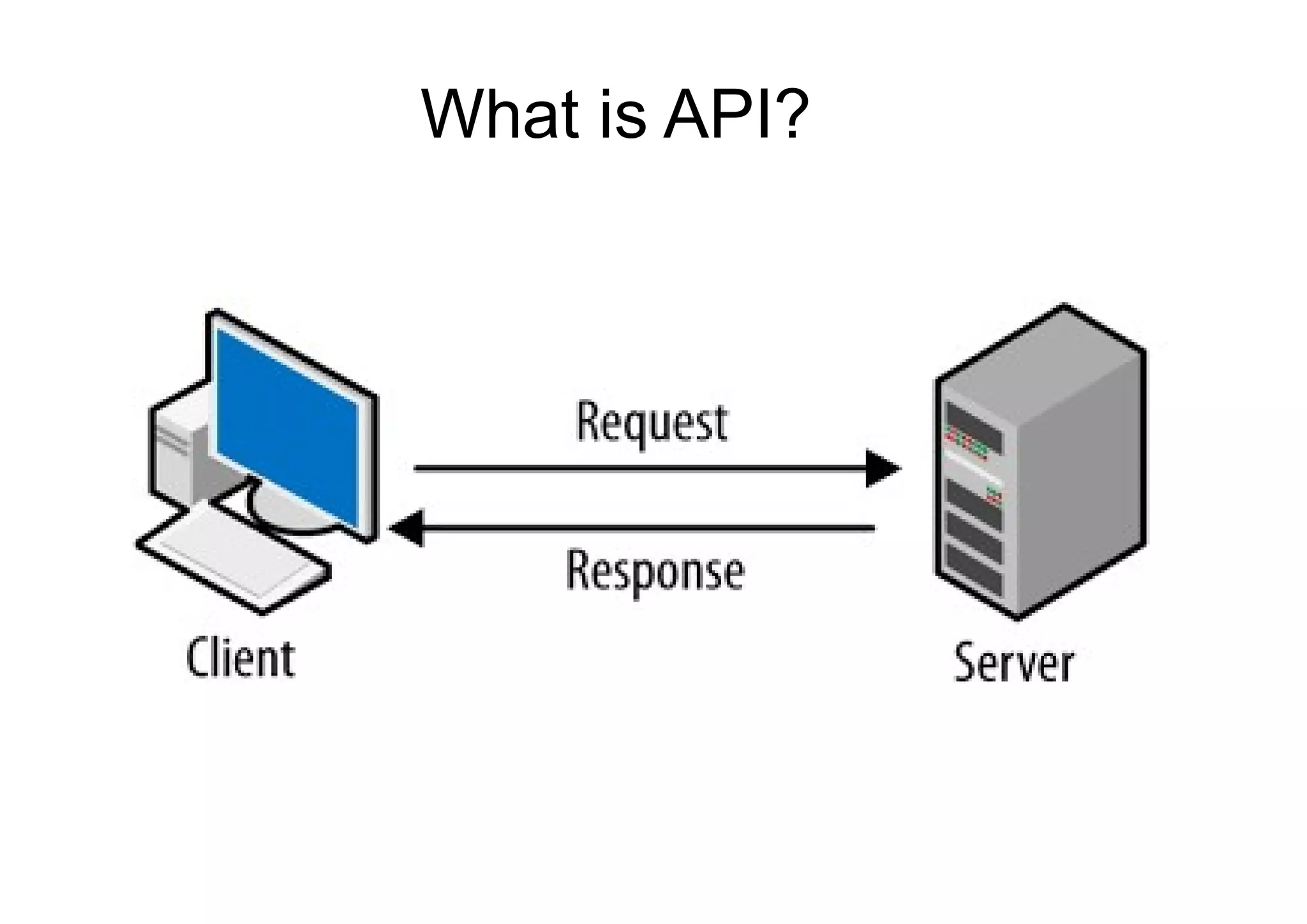
What is API?
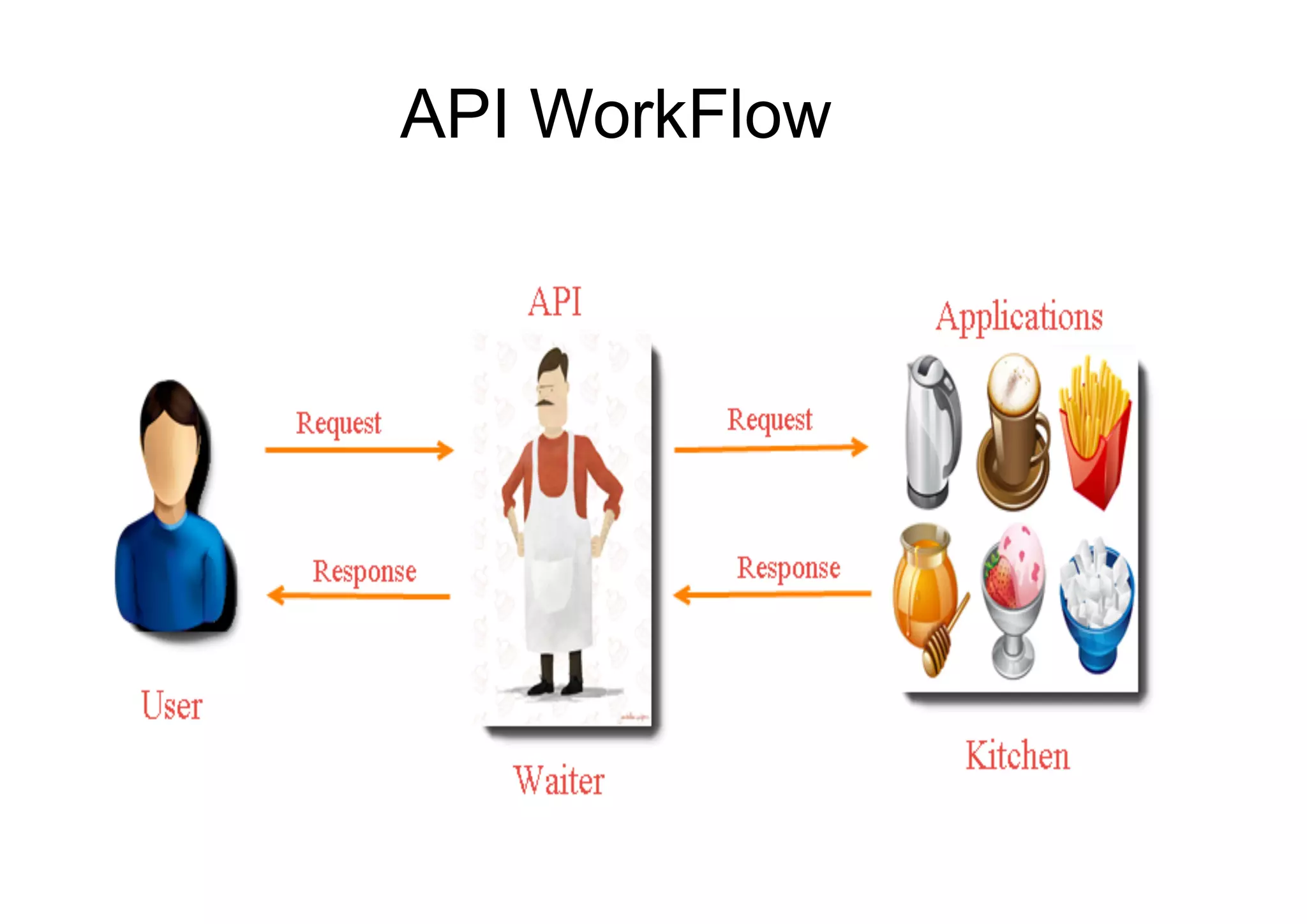
API WorkFlow
What is RESTful Web Service?
●
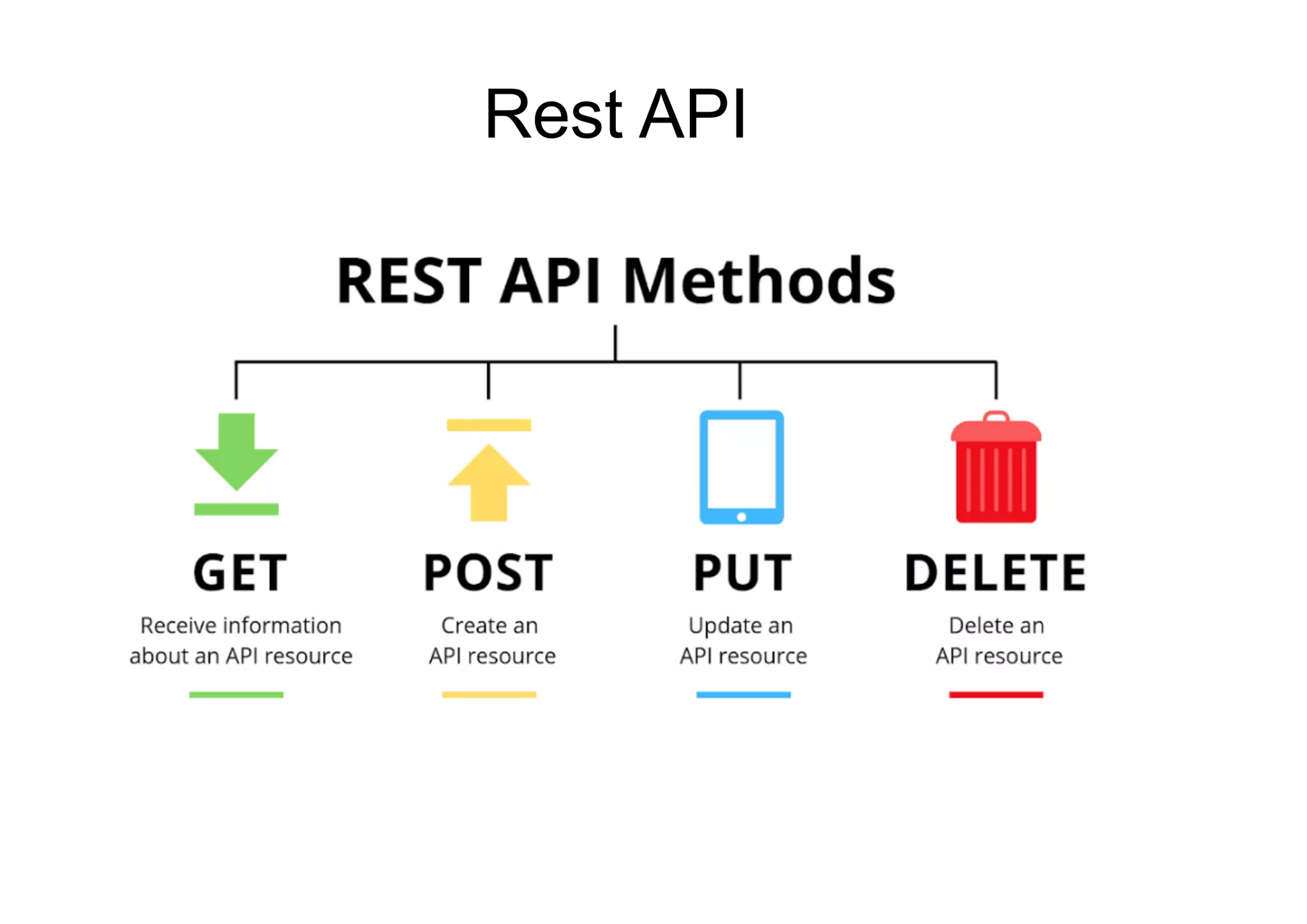
RESTful (REpresentational State Transfer) Web
Service: also known as RESTful API, is based
on REST technology which is an web
application that uses HTTP requests to GET,
PUT, POST and DELETE data.
●
REST technology is generally preferred to the
more robust Simple Object Access Protocol
(SOAP) technology because REST leverages
less bandwidth, making it more suitable for
internet usage.
RESTful Web Service..Cont..,
●
With cloud use on the rise, APIs are emerging
to expose web services. REST is a logical
choice for building APIs that allow users to
connect and interact with cloud services.
Types of API
●
Local API: is the original form of API which is
the OS APIs that provide services to application
programs (Front-end/GUI) requesting services
or data from the back-end such as voice service
or data from DB.
●
Program API: is based on RPC (Remote
Procedure Call) technology that making a
remote program execution from another
servers. SOA (Service Oriented Architecture)
APIs are sample of Program API.
Types of API...Cont..,
●
Web API: also known as Web Service, is
application/device communicate to each others
via World Wide Web (HTTP architecture).
●
There are two kinds of Web Service: SOAP
(Simple Object Access Protocol) and RESTful
(REpresentational State Transfer)
Rest API
●
What is SOAP Web Service?
●
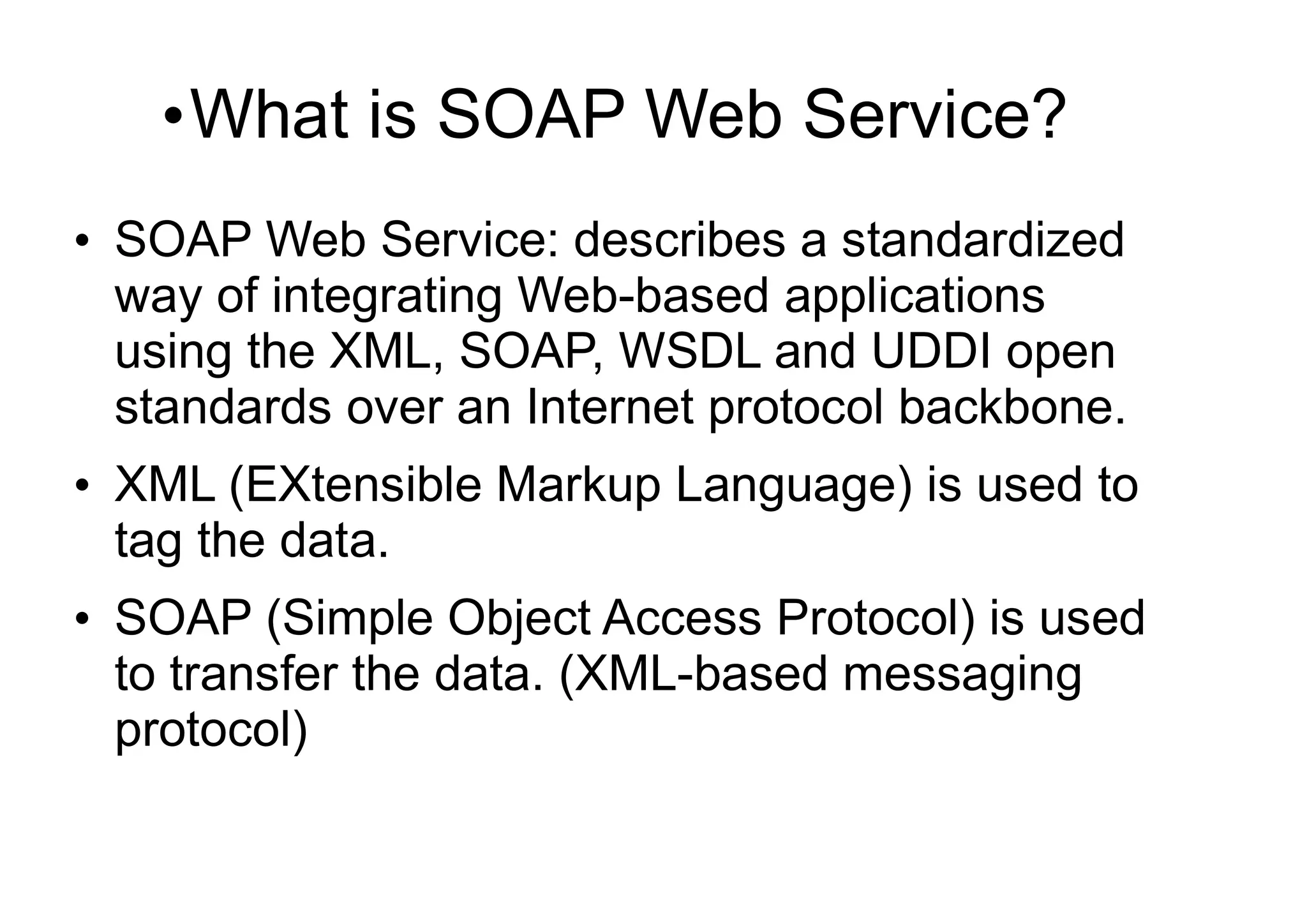
SOAP Web Service: describes a standardized
way of integrating Web-based applications
using the XML, SOAP, WSDL and UDDI open
standards over an Internet protocol backbone.
●
XML (EXtensible Markup Language) is used to
tag the data.
●
SOAP (Simple Object Access Protocol) is used
to transfer the data. (XML-based messaging
protocol)
SOAP Web Service...Cont...
●
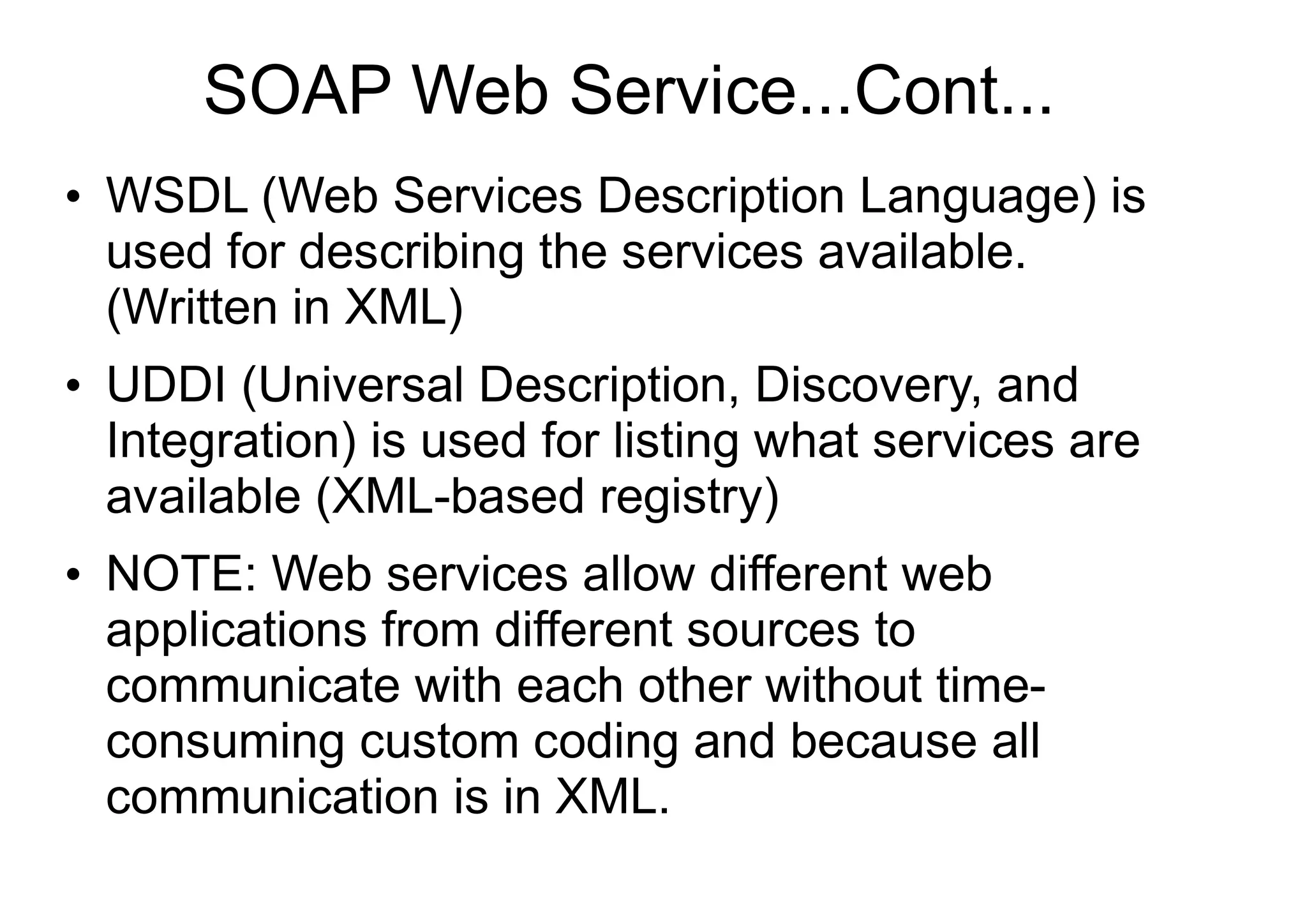
WSDL (Web Services Description Language) is
used for describing the services available.
(Written in XML)
●
UDDI (Universal Description, Discovery, and
Integration) is used for listing what services are
available (XML-based registry)
●
NOTE: Web services allow different web
applications from different sources to
communicate with each other without time-
consuming custom coding and because all
communication is in XML.
SOAP Web Service...Cont...
●
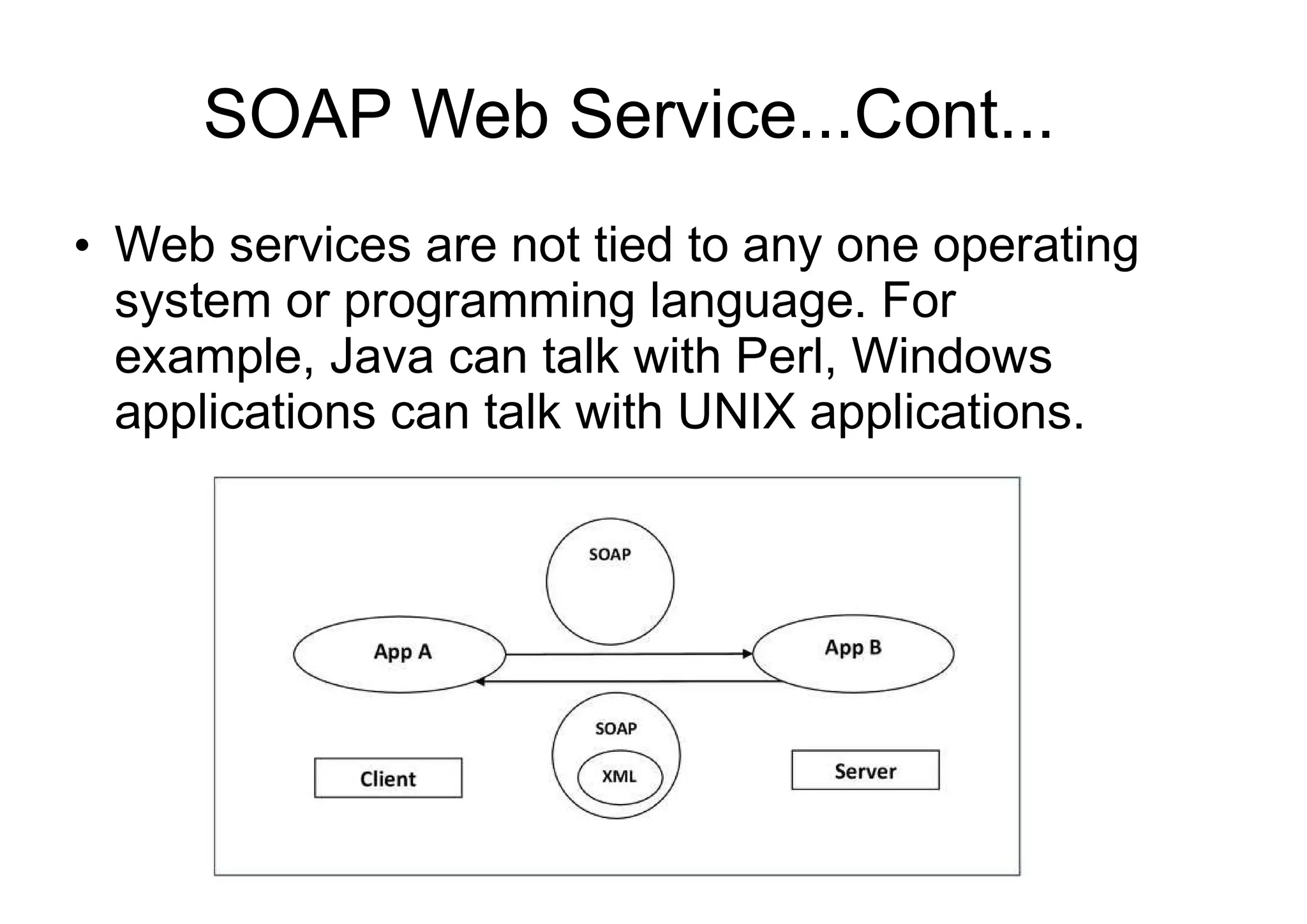
Web services are not tied to any one operating
system or programming language. For
example, Java can talk with Perl, Windows
applications can talk with UNIX applications.
REST vs SOAP Web Services
REST Web Services:
●
RESTful web services are stateless. You can
test this condition by restarting the server and
checking if interactions survive.
●
For most servers, RESTful web services
provide a good caching infrastructure over an
HTTP GET method. This can improve the
performance if the information the service
returns is not altered frequently and is not
dynamic.
REST vs SOAP Web
Services..Cont..,
●
Service producers and consumers must
understand the context and content being
passed along as there is no standard set of
rules to describe the REST web services
interface.
●
REST is useful for restricted-profile devices,
such as mobile, for which the overhead of
additional parameters are less (e.g., headers).
REST vs SOAP Web
Services..Cont..,
●
REST services are easy to integrate with
existing websites and are exposed with XML so
the HTML pages can consume the same with
ease. There is little need to refactor the existing
site architecture. As such, developers are more
productive because they don't need to rewrite
everything from scratch; instead, they just need
to add on the existing functionality.
●
A REST-based implementation is simple
compared to SOAP.
REST vs SOAP Web
Services..Cont..,
●
REST does not enforce any message format
such as XML or JSON. Whereas, SOAP is XML
based messaging protocol.
●
The Web Services Description Language
(WSDL) describes a common set of rules to
define the messages, bindings, operations and
location of the service. WSDL is akin to a
contract to define the interface that the service
offers.
REST vs SOAP Web
Services..Cont..,
●
SOAP requires less plumbing code than REST
services design (e.g., transactions, security,
coordination, addressing and trust). Most real-
world applications are not simple and support
complex operations, which require
conversational state and contextual information
to be maintained. With the SOAP approach,
developers don't need to write plumbing code
into the application layer.
REST vs SOAP Web
Services..Cont..,
●
SOAP web services, such as JAX-WS, are
useful for asynchronous processing and
invocation.
●
SOAP supports several protocols and
technologies, including WSDL, XSDs and WS-
Addressing.

Application.pdf

  • 1.
  • 2.
    What is API? ● API:is a software-to-software interface, not a user interface. ● With API, applications talk to each other without any user knowledge or intervention. ● Main goal of API is code/program reusable ● An API resembles Software as a Service (SaaS), since software developers don’t have to start from scratch every time they write a program. ● Instead of building one core application that tries to do everything, the same application can contract out certain responsibilities to remote software that does it better.
  • 3.
  • 4.
  • 5.
    What is RESTfulWeb Service? ● RESTful (REpresentational State Transfer) Web Service: also known as RESTful API, is based on REST technology which is an web application that uses HTTP requests to GET, PUT, POST and DELETE data. ● REST technology is generally preferred to the more robust Simple Object Access Protocol (SOAP) technology because REST leverages less bandwidth, making it more suitable for internet usage.
  • 6.
    RESTful Web Service..Cont.., ● Withcloud use on the rise, APIs are emerging to expose web services. REST is a logical choice for building APIs that allow users to connect and interact with cloud services.
  • 7.
    Types of API ● LocalAPI: is the original form of API which is the OS APIs that provide services to application programs (Front-end/GUI) requesting services or data from the back-end such as voice service or data from DB. ● Program API: is based on RPC (Remote Procedure Call) technology that making a remote program execution from another servers. SOA (Service Oriented Architecture) APIs are sample of Program API.
  • 8.
    Types of API...Cont.., ● WebAPI: also known as Web Service, is application/device communicate to each others via World Wide Web (HTTP architecture). ● There are two kinds of Web Service: SOAP (Simple Object Access Protocol) and RESTful (REpresentational State Transfer)
  • 9.
  • 10.
    ● What is SOAPWeb Service? ● SOAP Web Service: describes a standardized way of integrating Web-based applications using the XML, SOAP, WSDL and UDDI open standards over an Internet protocol backbone. ● XML (EXtensible Markup Language) is used to tag the data. ● SOAP (Simple Object Access Protocol) is used to transfer the data. (XML-based messaging protocol)
  • 11.
    SOAP Web Service...Cont... ● WSDL(Web Services Description Language) is used for describing the services available. (Written in XML) ● UDDI (Universal Description, Discovery, and Integration) is used for listing what services are available (XML-based registry) ● NOTE: Web services allow different web applications from different sources to communicate with each other without time- consuming custom coding and because all communication is in XML.
  • 12.
    SOAP Web Service...Cont... ● Webservices are not tied to any one operating system or programming language. For example, Java can talk with Perl, Windows applications can talk with UNIX applications.
  • 13.
    REST vs SOAPWeb Services REST Web Services: ● RESTful web services are stateless. You can test this condition by restarting the server and checking if interactions survive. ● For most servers, RESTful web services provide a good caching infrastructure over an HTTP GET method. This can improve the performance if the information the service returns is not altered frequently and is not dynamic.
  • 14.
    REST vs SOAPWeb Services..Cont.., ● Service producers and consumers must understand the context and content being passed along as there is no standard set of rules to describe the REST web services interface. ● REST is useful for restricted-profile devices, such as mobile, for which the overhead of additional parameters are less (e.g., headers).
  • 15.
    REST vs SOAPWeb Services..Cont.., ● REST services are easy to integrate with existing websites and are exposed with XML so the HTML pages can consume the same with ease. There is little need to refactor the existing site architecture. As such, developers are more productive because they don't need to rewrite everything from scratch; instead, they just need to add on the existing functionality. ● A REST-based implementation is simple compared to SOAP.
  • 16.
    REST vs SOAPWeb Services..Cont.., ● REST does not enforce any message format such as XML or JSON. Whereas, SOAP is XML based messaging protocol. ● The Web Services Description Language (WSDL) describes a common set of rules to define the messages, bindings, operations and location of the service. WSDL is akin to a contract to define the interface that the service offers.
  • 17.
    REST vs SOAPWeb Services..Cont.., ● SOAP requires less plumbing code than REST services design (e.g., transactions, security, coordination, addressing and trust). Most real- world applications are not simple and support complex operations, which require conversational state and contextual information to be maintained. With the SOAP approach, developers don't need to write plumbing code into the application layer.
  • 18.
    REST vs SOAPWeb Services..Cont.., ● SOAP web services, such as JAX-WS, are useful for asynchronous processing and invocation. ● SOAP supports several protocols and technologies, including WSDL, XSDs and WS- Addressing.