International Journal of Electrical and Computer Engineering (IJECE)
Vol.8, No.6, December2018, pp. 5041~5049
ISSN: 2088-8708, DOI: 10.11591/ijece.v8i6.pp5041-5049  5041
Journal homepage: http://iaescore.com/journals/index.php/IJECE
A Two Channel Analog Front end Design AFE Design with
Continuous Time ∑-∆ Modulator for ECG Signal
Mohammed Abdul Raheem1
, K Manjunathachari2
1
Department of Electronics and Communication Engineering, Muffakham Jah College of Engineering and Technology,
India
2
Department of Electronics and Communication Engineering, GITAM University, India
Article Info ABSTRACT
Article history:
Received Mar 8, 2018
Revised Jul 23, 2018
Accepted Sep 2, 2018
In this context, the AFE with 2-channels is described, which has high
impedance for low power application of bio-medical electrical activity. The
challenge in obtaining accurate recordings of biomedical signals such as
EEG/ECG to study the human body in research work. This paper is to
propose Multi-Vt in AFE circuit design cascaded with CT modulator. The
new architecture is anticipated with two dissimilar input signals filtered from
2-channel to one modulator. In this methodology, the amplifier is low
powered multi-VT Analog Front-End which consumes less power by
applying dual threshold voltage. Type -I category 2 channel signals of the
first mode: 50 and 150 Hz amplified from AFE are given to 2nd CT sigma-
delta ADC. Depict the SNR and SNDR as 63dB and 60dB respectively,
consuming the power of 11mW. The design was simulated in a 0.18 um
standard UMC CMOS process at 1.8V supply. The AFE measured frequency
response from 50 Hz to 360 Hz, depict the SNR and SNDR as 63dB and
60dB respectively, consuming the power of 11mW. The design was
simulated in 0.18 m standard UMC CMOS process at 1.8V supply. The AFE
measured frequency response from 50 Hz to 360 Hz, programmable gains
from 52.6 dB to 72 dB, input referred noise of 3.5 µV in the amplifier
bandwidth, NEF of 3.
Keyword:
Analog Front End
Continuous Time (CT)
Discrete Time (DT)
Sigma Delta Modulator
Signal Noise Ratio (SNR)
SNDR
Copyright © 2018Institute of Advanced Engineering and Science.
All rights reserved.
Corresponding Author:
M.A. Raheem,
Department of Electronics and Communication Engineering,
MJCET, Osmania University, Hyderabad, India.
Email: abdulraheem.mj@gmail.com
1. INTRODUCTION
ADVANCES in Complementary MOSFET technologies and low powered integrated circuits have
stimulated considerable interests in wearable gadgets, anoccurrence which can potentially transfigure the
healthcare devices. Sensor interface is the main part in the wearable gadgets, design of which should meet
many uncompromising requirements both in digital block and in analog block. In designing AFE circuits, the
corporal signals' nature is of much concern. The amplitude of these signals ranges from volts to mV and the
frequencies vary from DC to a few kilo Hz, as described in figure 1 [1]. The signals, the AFE should possess
lowest input referred noise, reconfigurable bandwidth, and programmable gain to accommodate the weak
signals and giant dynamic range. Furthermore, the skin-electrode interface instigates a high DC potential in
an input signal that should be minimized by high pass filtration, cutting-off frequencies below 1Hz. While,
such a high-pass filter with external capacitors and resistors can be easily implemented [2], it is further cost-
effective to integrate the filter on-chip. Switched-capacitor [3] are two possible approaches that could give
good trade-offs between performance, power, and area as demonstrated in [4], [5]. It is noteworthy that an
approach of pseudo-resistor not only diminishes the area but also ease reconfigurable design of band-pass
filters [6]-[9]. A very high variation of resistances could be the drawback in existing pseudo-resistors which
 ISSN:2088-8708
Int J Elec & Comp Eng, Vol. 8, No. 6, December 2018 : 5041 - 5049
5042
are tunable under negative and positive biased conditions. While working on low-voltage, it leads to a critical
DC. In this, recognizing the programmable BE with reconfiguring amplifier the switch in four modes.
Figure 1. Voltage and frequency ranges of familiar physiological signals
Table 1. Medical Characteristics of the Familiar Physiology
Parameter Signal Frequency Standard Sensor
Electroretinography (ERG) DC ~ 50 Hz Contact electrode
Electroencephalography (EEG) DC ~ 150 Hz Scalp electrode
Electrocardiography (ECG) 0.01 Hz ~ 250 Hz Skin electrode
Electroneurography (ENG) 250 Hz ~ 5000 Hz Surface/needle
electrode
This paper is sectioned as described hereafter. Section-II depicts a Proposed System level
architecture of AFE with Programmable Procedure. An AFE with sigma-delta modulator is delineated in
Section III. Results from simulation and related thoughts are furnished in Section IV. Hence, the conclusions
are derived under Section V.
2. THE PROPOSED ARCHITECTURE 2- CHANNEL AFE FOR ECG SIGNAL MODULATOR
This paper addresses a chip that comprises a low noise (TB-FEA), a programmable gain amplifier
(PGA) and a 10-bitƩΔ (SDM-ADC). The overall gain is programmed through the flip-over-capacitor
feedback and proposed reconfiguring in the PGA. This allows the chip to offer FOUR operational modes,
ERG, EEG, ECG, and ENG.
The microsystem for acquisition of bio-potential is as shown in figure 2. Bio-signals are amplified
by AFE circuits and then they are converted into digital codes by ADCs [3]. In addition, analog multiplexers
with large output current are designed to select the corresponding signals to ADCs. A trade-off in the
microsystem exists between power and the area. The ratio between count of AFEs and ADCs affects the
inclusivefunctioning.
Int J Elec& Comp Eng ISSN: 2088-8708 
A Two Channel Analog Front End Design AFE Design with Continuous Time ∑-∆ … (M.A. Raheem)
5043
+
_
+
_
RBIAS
RBIAS
LPF
LPF
ANALOG FRONT END
AmplifierECG
HEART
RATE
INSTRUMENTATION
AMPLIFIERS
Second order
∑-∆ ADC
Amplifier
ANALOGMULTIPLEXER
ON
LPF1
PGA
CLOCK GENERATOR
ANALOGMULTIPLEXER
SAMPLED
CLOCK
SYSTEM
CLOCK
PROBE 1
PROBE 2
OUTPUT
BIASING CIRCUITS
Control
Switch BW
& Gain
CT ADC –
2nd
Order
Front End
Differential
Amplifier
Figure 2. Proposed architecture of 2 channel
2.1. Noise Contribution at AFE design
The Flicker Noise 1/f reduction always remains a challenge in the bio-signal acquisition. This
problem cannot be avoided completely 1/f noise exist in all the devices of MOSFET due to their surface
conduction mechanism. For a MOS working in saturation region the total flicker noise power spectrum could
be calculated as
gm = √2. meff. Cox.
W
L
. Ids (1)
if
2
= al.
q.mf. (Vgs−Vt).Ids
L2.f
(2)
The spectral density for a MOSFET is given from [9] as:
vf
2
= 4kT
2
3
1
gm
+
Kf
WLCoxf
(3)
Thermal Flicker
 ISSN:2088-8708
Int J Elec & Comp Eng, Vol. 8, No. 6, December 2018 : 5041 - 5049
5044
CMCM
CL
CL
VDD
M2B
M2
INP
M3B
M1BM1
M0
M4B
M4
INN
OUTP
OUTN
M3
M4B
CMCM
CL
CL
VDD
M2B
M2
INP
M3B
M1BM1
M0
M4B
M4
INN
OUTP
OUTN
M3
M4B
CMCM
CL
CL
VDD
M2B
M2
INP
M3B
M1BM1
M0
M4B
M4
INN
OUTP
OUTN
M3
M4B
CMCM
CL
CL
VDD
M2B
M2
INP
M3B
M1BM1
M0
M4B
M4
INN
OUTP
OUTN
M3
M4B
PGA
PGA
SW2
SW1OTA
Gm
CMCM
CL
CL
VDD
M2B
M2
INP
M3B
M1BM1
M0
M4B
M4
INN
OUTP
OUTN
M3
M4B
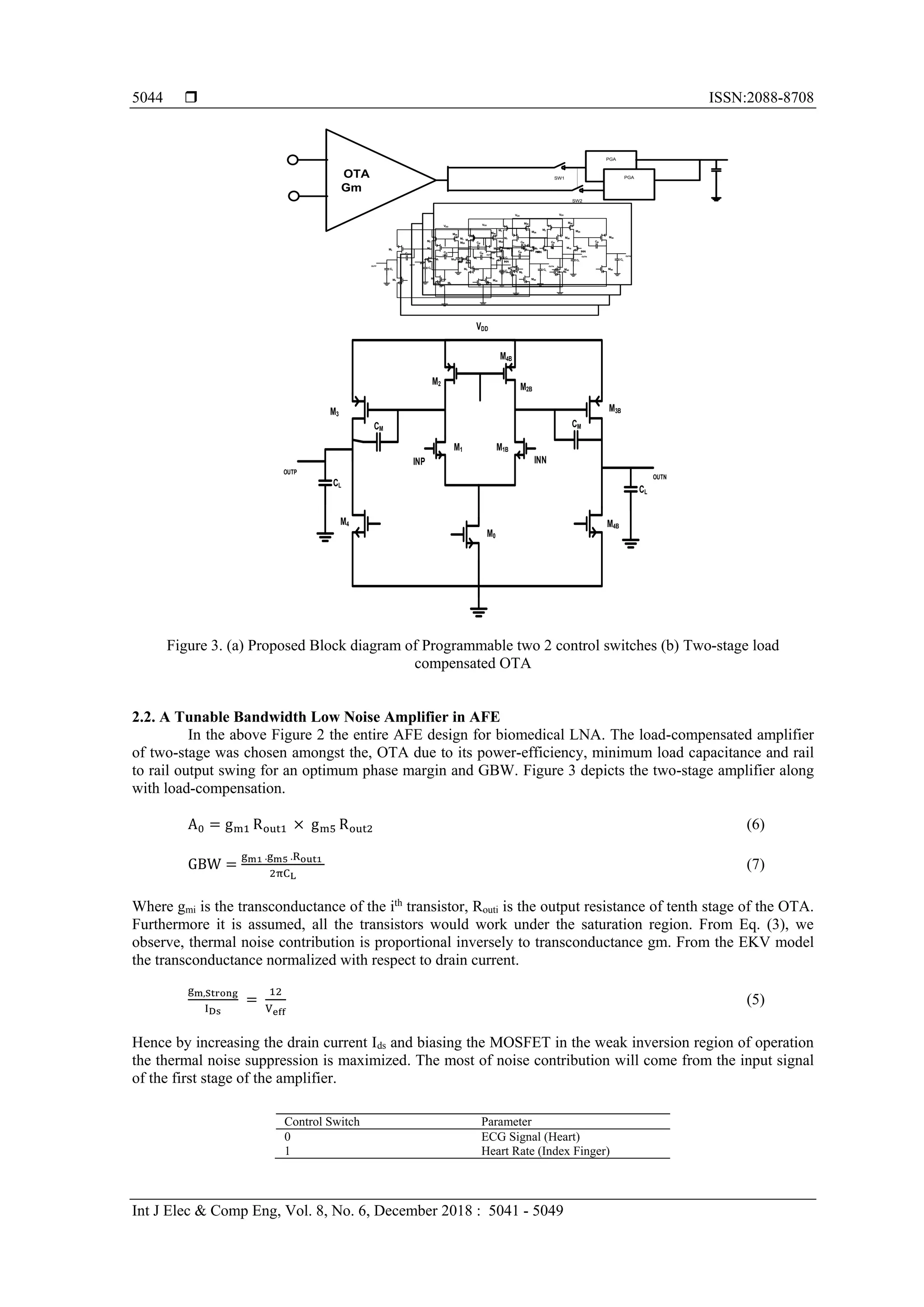
Figure 3. (a) Proposed Block diagram of Programmable two 2 control switches (b) Two-stage load
compensated OTA
2.2. A Tunable Bandwidth Low Noise Amplifier in AFE
In the above Figure 2 the entire AFE design for biomedical LNA. The load-compensated amplifier
of two-stage was chosen amongst the, OTA due to its power-efficiency, minimum load capacitance and rail
to rail output swing for an optimum phase margin and GBW. Figure 3 depicts the two-stage amplifier along
with load-compensation.
A0 = gm1 Rout1 × gm5 Rout2 (6)
GBW =
gm1 .gm5 .Rout1
2πCL
(7)
Where gmi is the transconductance of the ith
transistor, Routi is the output resistance of tenth stage of the OTA.
Furthermore it is assumed, all the transistors would work under the saturation region. From Eq. (3), we
observe, thermal noise contribution is proportional inversely to transconductance gm. From the EKV model
the transconductance normalized with respect to drain current.
gm,Strong
IDs
=
12
Veff
(5)
Hence by increasing the drain current Ids and biasing the MOSFET in the weak inversion region of operation
the thermal noise suppression is maximized. The most of noise contribution will come from the input signal
of the first stage of the amplifier.
Control Switch Parameter
0 ECG Signal (Heart)
1 Heart Rate (Index Finger)
Int J Elec& Comp Eng ISSN: 2088-8708 
A Two Channel Analog Front End Design AFE Design with Continuous Time ∑-∆ … (M.A. Raheem)
5045
2.3. Modulator Circuit
The device sizing W/L of input pair should be large to optimize the noise level at input. The OTA
which acts as the key component in the modulator is used by the integrator and must possess high gain for
smooth integration. The general two-stage amplifier consists of the single-ended differential amplifier having
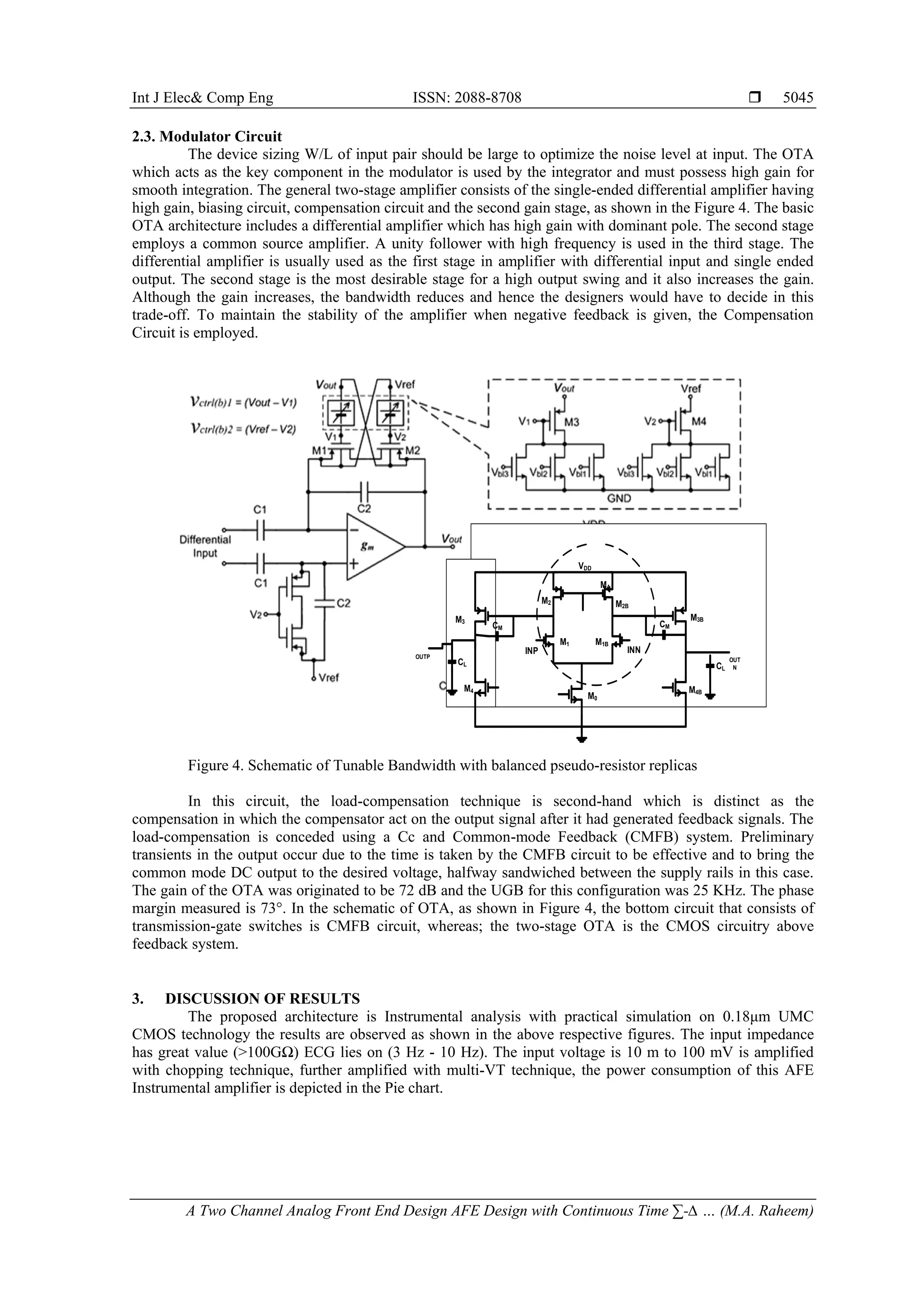
high gain, biasing circuit, compensation circuit and the second gain stage, as shown in the Figure 4. The basic
OTA architecture includes a differential amplifier which has high gain with dominant pole. The second stage
employs a common source amplifier. A unity follower with high frequency is used in the third stage. The
differential amplifier is usually used as the first stage in amplifier with differential input and single ended
output. The second stage is the most desirable stage for a high output swing and it also increases the gain.
Although the gain increases, the bandwidth reduces and hence the designers would have to decide in this
trade-off. To maintain the stability of the amplifier when negative feedback is given, the Compensation
Circuit is employed.
CMCM
CL CL
VDD
M2B
M2
INP
M3B
M1BM1
M0
M4BM4
INN
OUTP OUT
N
M3
M4
B
Figure 4. Schematic of Tunable Bandwidth with balanced pseudo-resistor replicas
In this circuit, the load-compensation technique is second-hand which is distinct as the
compensation in which the compensator act on the output signal after it had generated feedback signals. The
load-compensation is conceded using a Cc and Common-mode Feedback (CMFB) system. Preliminary
transients in the output occur due to the time is taken by the CMFB circuit to be effective and to bring the
common mode DC output to the desired voltage, halfway sandwiched between the supply rails in this case.
The gain of the OTA was originated to be 72 dB and the UGB for this configuration was 25 KHz. The phase
margin measured is 73°. In the schematic of OTA, as shown in Figure 4, the bottom circuit that consists of
transmission-gate switches is CMFB circuit, whereas; the two-stage OTA is the CMOS circuitry above
feedback system.
3. DISCUSSION OF RESULTS
The proposed architecture is Instrumental analysis with practical simulation on 0.18μm UMC
CMOS technology the results are observed as shown in the above respective figures. The input impedance
has great value (>100GΩ) ECG lies on (3 Hz - 10 Hz). The input voltage is 10 m to 100 mV is amplified
with chopping technique, further amplified with multi-VT technique, the power consumption of this AFE
Instrumental amplifier is depicted in the Pie chart.
 ISSN:2088-8708
Int J Elec & Comp Eng, Vol. 8, No. 6, December 2018 : 5041 - 5049
5046
Figure 8. Transient Analysis of signal of 0.2 V and frequency of 500 Hz modulator
Table II. Performance of two different Modulators
Parameter Mode A Mode B
Technology 0.18µm CMOS
Supply Voltage 1 V
Sampling Frequency 64 kHz 32 kHz
Signal Bandwidth 250 Hz 50 Hz
Oversampling ratio 128 320
Peak SNR 63 dB 85 dB
Dynamic Range 58.5 dB 73 dB
Power Consumption 990 nW 685 nW
FOM pJ/step .175 0.878
FOMS 137.43 129.20
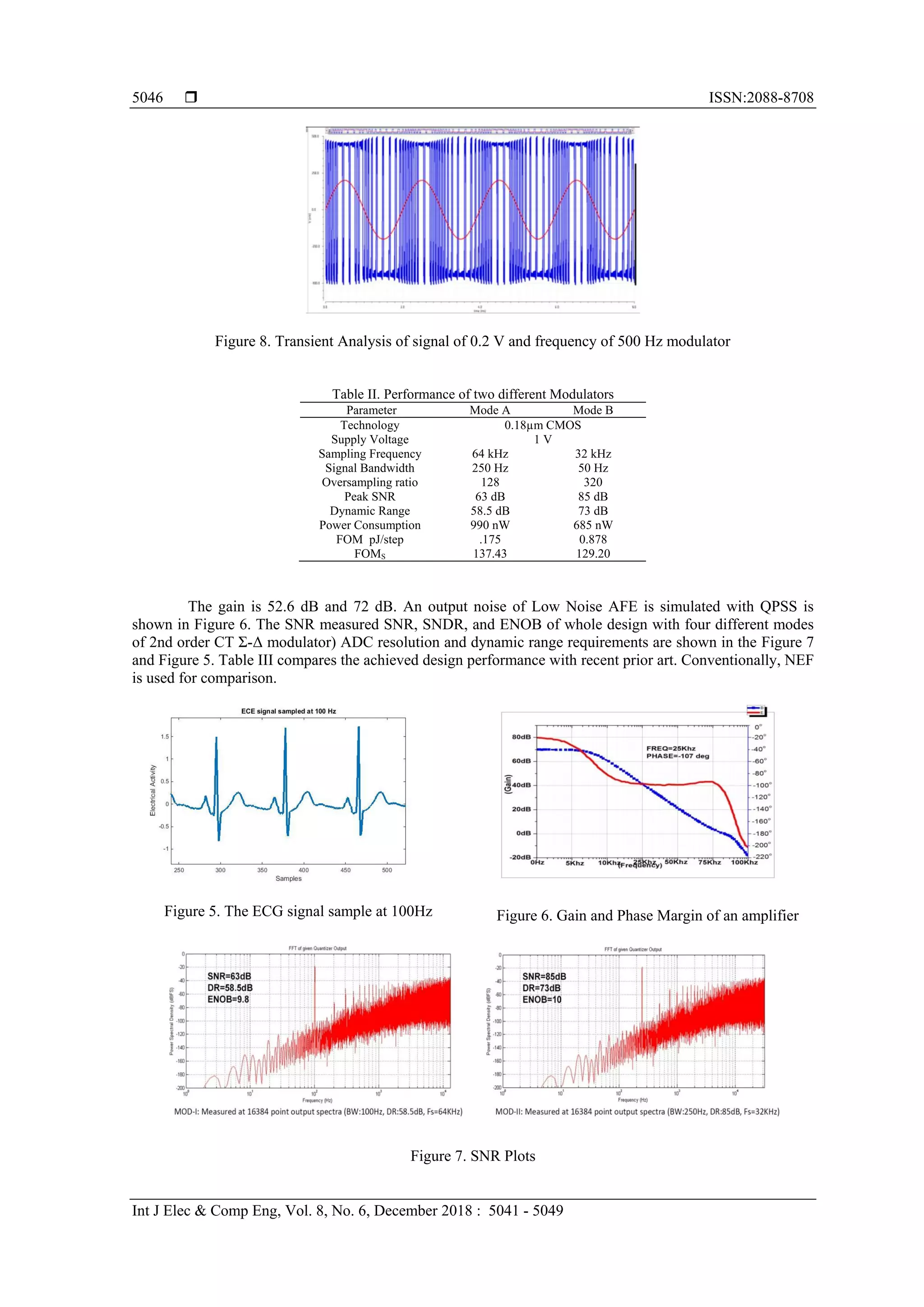
The gain is 52.6 dB and 72 dB. An output noise of Low Noise AFE is simulated with QPSS is
shown in Figure 6. The SNR measured SNR, SNDR, and ENOB of whole design with four different modes
of 2nd order CT Ʃ-Δ modulator) ADC resolution and dynamic range requirements are shown in the Figure 7
and Figure 5. Table III compares the achieved design performance with recent prior art. Conventionally, NEF
is used for comparison.
Figure 5. The ECG signal sample at 100Hz Figure 6. Gain and Phase Margin of an amplifier
Figure 7. SNR Plots
Int J Elec& Comp Eng ISSN: 2088-8708 
A Two Channel Analog Front End Design AFE Design with Continuous Time ∑-∆ … (M.A. Raheem)
5047
NEF = Vrms, in√
2 I total
πVt.4kT.Bandwidth
(8)
where Vrmsin is the input-referred noise, is the total current, is the thermal voltage, and BWis the
bandwidth of the AFE with chopping technique.Usually AFE circuits attain a NEF of 2.5 to 10. The complete
layout design with IO pad of the 2 channel AFE with modulator is shown in Figure 8. The Area occupied by
the filter is 209.41 µm × 80.21 µm = 0.0167 mm2
.
Figure 8. Final Layout of AFE with Dual Sigma-Delta Modulator
Power role of the different blocks is shown in Figure 9. As seen in Figure, more than half of the
power budget is dedicated to the different mode of 2nd order CT Ʃ-Δ modulator. The chopping switch and
clock generator are consumed more power when compared to amplifier due to noise considerations.
Figure 9. Power Consumption and distribution in Pie chart of whole design
Table III. Comparison of PRIOR ART
Parameter [7] [8] [9] [11] This Work
Tech.(μm) 0.5 0.18 0.8 0.13 0.18
Supply (V) 2.8 1.5 1.8 1.2 1
Bias (nA) 743 5000 1050 580a
/902b
500
Gain (dB) 40.9 40.8 41-50.5 40-83 52.8-72
Input Ref.Noise(µVrms) 1.66 1.27 0.98 2.06 3.5
HPF (Hz) 0.4 0.5 0.05- 0.4 0.17 0.1
LPF (KHz) 0.045-5.3 0.1-0.4 0.120 0.34-7.5 7.0
NEF 3.21 6.1 4.6 – 5.4 3.28a
/4.1b
3.04
Progamm
able
amplifier
with
switches,
36%
Low Noise
Amplifier
7%
output
stage; 4%
Two
Modes
Modulato
r, 544%
CMFB; 9%
 ISSN:2088-8708
Int J Elec & Comp Eng, Vol. 8, No. 6, December 2018 : 5041 - 5049
5048
4. CONCLUSION
In this paper, a 2-channel ECG amplifier with appropriate features for dry and non-contact
biopotential applications is presented. Unable to compare the complete design with other design this paper
proposed the architectural system level design which is suitable for biomedical application targeted to ECG
for 10 mV to 100 mV. Especially, in this paper the multi-VT concept is implemented in the circuit level
which reduces the power consumption and the gain achieved by amplifier 52.9dB and 72 dB with an NEF
3.0, noise performance is satisfactory. Furthermore, another important approach the two different 2nd order
CT Ʃ-Δ modulator to improve the performance.
ACKNOWLEDGEMENTS
The authors would like to express their great appreciations and gratitude to Muffakham Jah College
of Engineering and Technology for providing research facilities, technical support, and research
environment.
REFERENCES
[1] Y.M. Chi, Y.T. Wang, Y. Wang, Ch. Maier, T.P. Jung, and G. Cauwenberghs, “Dry and non-contact EEG sensors
for mobile brain-computer interfaces”, IEEE Transactions on Neural Systems and Rehabilitation Engineering, vol.
20, no. 2, March 2012
[2] M. Steffen, A. Aleksandrowicz, and S. Leonhardt, “Mobile noncontact monitoring of heart and lung activity”, IEEE
Transactionson Biomedical Circuits and Systems, vol. 1, no. 4, pp. 250-257, Dec. 2007.
[3] J. Kranjec, S. Beguš, J. Drnovšek, and G. Geršak, “Novel methods for non-contact heart rate measurement: A
feasibility study”, IEEE Transactions on Instrumentation and Measurement, vol. 63, no. 4, April 2014
[4] Y.G. Lim, K.K. Kim, and K.S. Park, "ECG recording on a bed during sleep without direct skin-contact", IEEE
Transactions on Biomedical Engineering, vol. 54, pp. 718-725, 2007.
[5] S. Leonhardt, and A. Aleksandrowicz, “Non-contact ECG monitoring for automotive application”, 5th
International Summer Schooland Symposium on Medical Devices and Biosensors, ISSS-MDBS, June 2008, pp. 183-
185.
[6] X.X. Chen, Y. Lv, R.R. Zhen Fang, Sh. H. Xia, and H. Li, Li. Tian,“A wireless non-contact ECG detection system
based on capacitive coupling”, IEEE 14th International Conference on e-Health Network.
[7] W. Wattanapanitch, et al., “An energy-efficient micropower neural recording amplifier”, IEEE Trans. on
Biomedical Circuits and Systems, vol. 1, pp. 136-147, June 2007.
[8] S. Kao, et al., “A 1.5V 7.5µW programmable gain amplifier for multiple biomedical signal acquisition”, IEEE
Biomedical Circuits and Systems Conference, 2009, pp. 73-76.
[9] T. Denison, et al., “A 2µW 100nV/rt Hz chopper-stabilized instrumentation amplifier for chronic measurement of
neural field potentials”, IEEE J. of Solid-State Circuits, vol. 42, pp. 2934-2945, Dec. 2007.
[10] T. Yoshida,et al., “A high-linearity low-noise amplifier with variable bandwidth for neural recording systems”,
Japanese J. of Applied Physics, vol. 50, pp. 1-4, April 2011.
[11] Christopher J. Mandic, DebashishGangopadhyay and David J. Alls, “ A 1.1µW 2.1µVRMS Input Noise Chopper-
stabilized Amplifier for Bio-medical Applications”, Circuits and Systems (ISCAS), 2012 IEEE International
Symposium on 20-23 May 2012, Seoul, South Korea
[12] Y.M. Chi, T.P. Jung, and G. Cauwenberghs, “Dry-contact and noncontactbiopotential electrodes: methodological
review”, IEEE Reviews in Biomedical Engineering, vol. 3, 2010
[13] Y. Ch. Chen, B. Sh. Lin, and J. Sh. Pan, “Novel non-contact dry electrode withanadaptive mechanical design for
measuring EEG in ahairy site”, IEEE Transactions on Instrumentation and Measurement, vol. 64, no. 12, pp. 3361
– 3368, Dec. 2015.
[14] Y.M. Chi, Ch. Maier, and G. Cauwenberghs, “Ultra-high input impedance, low noise integrated amplifier for non-
contact biopotential sensing”, IEEE Journal on Emerging and Selected Topics in Circuitsand Systems, vol. 1, no. 4,
Dec. 2011.
[15] F. Rummens, S. Renaud and N. Lewis, “CMOS differential neural amplifier with high input impedance”, The 13th
IEEE International NEW Circuits and Systems (NEWCAS) conference, June 2015, pp. 1-4.
[16] P. Monsurro, S. Pennisi, G. Scotti, and A. Trifiletti, “Inverting closed loop amplifier architecture with reduced gain
error and high input impedance”, IEEE International Symposium on Circuits and Systems (ISCAS), May 2006.
[17] N. Verma, A. Shoeb, J. Bohorquez, J. Dawson, J. Guttag, and A. P.Chandrakasan, “A micro-power EEG
acquisition SoC with integrated feature extraction processor for a chronic seizure detection system”, IEEE J. Solid-
State Circuits, vol. 45, no. 4, pp. 804–816, Apr. 2010.
[18] L. Fay, V. Misra, and R. Sarpeshkar, “A micropower electrocardiogram amplifier”, IEEE Transaction Biomedical
Circuitand System, vol. 3, no. 5, Oct. 2009.
[19] S. Ha et al., “Integrated circuits and electrode interfaces for Noninvasive physiological monitoring”, IEEE
Transactions on Biomedical Engineering, vol. 61, no. 5, pp. 1522-1537, May 2014.
[20] H.F. Achigui, M. Sawan, C.J.B. Fayomi, “A 1 V Low Power, Low Noise DTMOS based NIRS Front-End
Receiver”, in Proc. WMSCI, Jully 2005.
Int J Elec& Comp Eng ISSN: 2088-8708 
A Two Channel Analog Front End Design AFE Design with Continuous Time ∑-∆ … (M.A. Raheem)
5049
[21] Qu Ruoyuan, Li Tong, Li Xiao, XuMinglu, Chen Yueyang, Wang Xinghua, “Wireless Neural Acquisition System
Design”, 2013 35th
Annual International Conference of the IEEE Engineering in Medicine and Biology Society.
[22] A. FazliYeknami and A. Alvandpour, “A 0.5-V 250-NW 65-dB SNDR Passive ΔΣ Modulator for Medical Implant
Devices”, in Proc. IEEE InternationalSym.Circuits and Systems, May 2013, pp. 2010-2013.
[23] M.A. Raheem, K. Manjunathaachari, and Arifuddinsohel. “A Design of 2nd
Order DT Sigma-Delta Modulator for
Medical Implants”, in Proc. IEEE PrimeAsia, Dec 2015,978-1-5090-0136-1/15/$31.00 ©2015 IEEE
[24] M.A. Raheem, K. Manjunathaachari, “presented as paper presentation IEEE paper “A Logarithmic DWA based
Discrete Time MultibitSigma-DeltaModulator”, IEEE sponsored conference INBUSH ERA 2015. ISBN:978-1-
4799-8432-9 at Amity University Greater Noida Feb25 -27 2015”
[25] M.A. Raheem, Mohammed Arifuddin Sohel and Maliha Naaz “Design of Discrete-Time Notch Filter for
Biomedical Applications”, in Conference Proc. IEEE Device of Integrated Circuits DevIC 2017 10.1109/DEVIC
2017.8073997
[26] Maizan Muhamad, NorhayatiSoin and Harikrishna Ramiah “Design of Low power Low Noise Amplifier using
Gm- boosted Technique”, in Indonesian Journal of Electrical Engineering and Computer Science ISSN: 2502-
4752, DOI: 10.11591/ijeecs. v9. i3. pp685-689
[27] M.A. Raheem, Mohammed Arifuddin Sohel and Maliha Naaz “Design of Discrete-Time Notch Filter for
Biomedical Applications”, in International Journal of Innovative Research in Electrical, Electronics,
Instrumentation, and control Engineering, Vol 4 issue 12, December 2016
[28] Ahmed Al-Hashimi, Anis Nurashikin Nordin*, Amelia Wong Azman, “Design of a Reconfigurable, Modular and
Multi-Channel Bioimpedance Spectroscopy System”, in Indonesian Journal of Electrical Engineering and
Computer Science, DOI: 10.11591/ijeecs. v8. i2. pp428-440
[29] M.A. Raheem, Mohammed Arifuddin Sohel and Maliha Naaz, “Quad Mode of Sixteen-Channel Chopper AFE
Design and Cascaded with Continuous Time ∑-∆ Modulator for Electroencephalogy Monitory System”, in
International Journal of Simulation, Systems, Science and Technology ISSN 1473-8031Research in Electrical,
Electronics, Instrumentation and control Engineering, Vol 8 Number 3, September 2017
[30] A. AAmin, M.S. Islam, M.A. Masud, M.N.H. Khan, “Design and Performance Analysis of 1.8 GHz Low Noise
Amplifier for Wireless Receiver Application”, in Indonesian Journal of Electrical Engineering and Computer
Science DOI: 10.11591/ijeecs. v6. i3. pp656-662
BIOGRAPHIES OF AUTHORS
Abdul Raheem is a research scholar from Hyderabad, Telangana, India. He has completed id
Bachelors in Engineering in 2005, and Masters in VLSI System Design from GRIET, JNTU
Hyderabad, currently doing P.hD at Gitam University As a research Scholar in Micro-electronics
in Analog & amplifiers; Mixed Signal, Hyderabad, India. His Current research mainly focuses
on CMOS Analog- Mixed signal Integrated Circuits. His current focus to design Low power
architectures for biomedical application. His ongoing work design are focus to Analog Front
Design, low power design of Sigma Delta Modulator and bandgap reference circuits. He is
expert in IC EDA tools interfacing with Specification to GDSII. He has presented a papers 21
National and International IEEE Conference. He also received best paper award in IEEE
Conference of Post Graduate Research in Micro-Electronics ASIA (PRIME ASIA 2015)
K Manjuanthachari is currently a professor and Head of the Electronic & Communication
Engineering Department at Gitam University Hyderabad Telangana, and his research in Signal
Processing and Image Processing, MPEG, with Interfacing with FPGA, He has enormous
experience in teaching and industry, he is guiding the 12 research scholar at Gitam University.
He has 50 plus publications in National and International Journal /Conferences.

A Two Channel Analog Front end Design AFE Design with Continuous Time ∑-∆ Modulator for ECG Signal

  • 1.
    International Journal ofElectrical and Computer Engineering (IJECE) Vol.8, No.6, December2018, pp. 5041~5049 ISSN: 2088-8708, DOI: 10.11591/ijece.v8i6.pp5041-5049  5041 Journal homepage: http://iaescore.com/journals/index.php/IJECE A Two Channel Analog Front end Design AFE Design with Continuous Time ∑-∆ Modulator for ECG Signal Mohammed Abdul Raheem1 , K Manjunathachari2 1 Department of Electronics and Communication Engineering, Muffakham Jah College of Engineering and Technology, India 2 Department of Electronics and Communication Engineering, GITAM University, India Article Info ABSTRACT Article history: Received Mar 8, 2018 Revised Jul 23, 2018 Accepted Sep 2, 2018 In this context, the AFE with 2-channels is described, which has high impedance for low power application of bio-medical electrical activity. The challenge in obtaining accurate recordings of biomedical signals such as EEG/ECG to study the human body in research work. This paper is to propose Multi-Vt in AFE circuit design cascaded with CT modulator. The new architecture is anticipated with two dissimilar input signals filtered from 2-channel to one modulator. In this methodology, the amplifier is low powered multi-VT Analog Front-End which consumes less power by applying dual threshold voltage. Type -I category 2 channel signals of the first mode: 50 and 150 Hz amplified from AFE are given to 2nd CT sigma- delta ADC. Depict the SNR and SNDR as 63dB and 60dB respectively, consuming the power of 11mW. The design was simulated in a 0.18 um standard UMC CMOS process at 1.8V supply. The AFE measured frequency response from 50 Hz to 360 Hz, depict the SNR and SNDR as 63dB and 60dB respectively, consuming the power of 11mW. The design was simulated in 0.18 m standard UMC CMOS process at 1.8V supply. The AFE measured frequency response from 50 Hz to 360 Hz, programmable gains from 52.6 dB to 72 dB, input referred noise of 3.5 µV in the amplifier bandwidth, NEF of 3. Keyword: Analog Front End Continuous Time (CT) Discrete Time (DT) Sigma Delta Modulator Signal Noise Ratio (SNR) SNDR Copyright © 2018Institute of Advanced Engineering and Science. All rights reserved. Corresponding Author: M.A. Raheem, Department of Electronics and Communication Engineering, MJCET, Osmania University, Hyderabad, India. Email: abdulraheem.mj@gmail.com 1. INTRODUCTION ADVANCES in Complementary MOSFET technologies and low powered integrated circuits have stimulated considerable interests in wearable gadgets, anoccurrence which can potentially transfigure the healthcare devices. Sensor interface is the main part in the wearable gadgets, design of which should meet many uncompromising requirements both in digital block and in analog block. In designing AFE circuits, the corporal signals' nature is of much concern. The amplitude of these signals ranges from volts to mV and the frequencies vary from DC to a few kilo Hz, as described in figure 1 [1]. The signals, the AFE should possess lowest input referred noise, reconfigurable bandwidth, and programmable gain to accommodate the weak signals and giant dynamic range. Furthermore, the skin-electrode interface instigates a high DC potential in an input signal that should be minimized by high pass filtration, cutting-off frequencies below 1Hz. While, such a high-pass filter with external capacitors and resistors can be easily implemented [2], it is further cost- effective to integrate the filter on-chip. Switched-capacitor [3] are two possible approaches that could give good trade-offs between performance, power, and area as demonstrated in [4], [5]. It is noteworthy that an approach of pseudo-resistor not only diminishes the area but also ease reconfigurable design of band-pass filters [6]-[9]. A very high variation of resistances could be the drawback in existing pseudo-resistors which
  • 2.
     ISSN:2088-8708 Int JElec & Comp Eng, Vol. 8, No. 6, December 2018 : 5041 - 5049 5042 are tunable under negative and positive biased conditions. While working on low-voltage, it leads to a critical DC. In this, recognizing the programmable BE with reconfiguring amplifier the switch in four modes. Figure 1. Voltage and frequency ranges of familiar physiological signals Table 1. Medical Characteristics of the Familiar Physiology Parameter Signal Frequency Standard Sensor Electroretinography (ERG) DC ~ 50 Hz Contact electrode Electroencephalography (EEG) DC ~ 150 Hz Scalp electrode Electrocardiography (ECG) 0.01 Hz ~ 250 Hz Skin electrode Electroneurography (ENG) 250 Hz ~ 5000 Hz Surface/needle electrode This paper is sectioned as described hereafter. Section-II depicts a Proposed System level architecture of AFE with Programmable Procedure. An AFE with sigma-delta modulator is delineated in Section III. Results from simulation and related thoughts are furnished in Section IV. Hence, the conclusions are derived under Section V. 2. THE PROPOSED ARCHITECTURE 2- CHANNEL AFE FOR ECG SIGNAL MODULATOR This paper addresses a chip that comprises a low noise (TB-FEA), a programmable gain amplifier (PGA) and a 10-bitƩΔ (SDM-ADC). The overall gain is programmed through the flip-over-capacitor feedback and proposed reconfiguring in the PGA. This allows the chip to offer FOUR operational modes, ERG, EEG, ECG, and ENG. The microsystem for acquisition of bio-potential is as shown in figure 2. Bio-signals are amplified by AFE circuits and then they are converted into digital codes by ADCs [3]. In addition, analog multiplexers with large output current are designed to select the corresponding signals to ADCs. A trade-off in the microsystem exists between power and the area. The ratio between count of AFEs and ADCs affects the inclusivefunctioning.
  • 3.
    Int J Elec&Comp Eng ISSN: 2088-8708  A Two Channel Analog Front End Design AFE Design with Continuous Time ∑-∆ … (M.A. Raheem) 5043 + _ + _ RBIAS RBIAS LPF LPF ANALOG FRONT END AmplifierECG HEART RATE INSTRUMENTATION AMPLIFIERS Second order ∑-∆ ADC Amplifier ANALOGMULTIPLEXER ON LPF1 PGA CLOCK GENERATOR ANALOGMULTIPLEXER SAMPLED CLOCK SYSTEM CLOCK PROBE 1 PROBE 2 OUTPUT BIASING CIRCUITS Control Switch BW & Gain CT ADC – 2nd Order Front End Differential Amplifier Figure 2. Proposed architecture of 2 channel 2.1. Noise Contribution at AFE design The Flicker Noise 1/f reduction always remains a challenge in the bio-signal acquisition. This problem cannot be avoided completely 1/f noise exist in all the devices of MOSFET due to their surface conduction mechanism. For a MOS working in saturation region the total flicker noise power spectrum could be calculated as gm = √2. meff. Cox. W L . Ids (1) if 2 = al. q.mf. (Vgs−Vt).Ids L2.f (2) The spectral density for a MOSFET is given from [9] as: vf 2 = 4kT 2 3 1 gm + Kf WLCoxf (3) Thermal Flicker
  • 4.
     ISSN:2088-8708 Int JElec & Comp Eng, Vol. 8, No. 6, December 2018 : 5041 - 5049 5044 CMCM CL CL VDD M2B M2 INP M3B M1BM1 M0 M4B M4 INN OUTP OUTN M3 M4B CMCM CL CL VDD M2B M2 INP M3B M1BM1 M0 M4B M4 INN OUTP OUTN M3 M4B CMCM CL CL VDD M2B M2 INP M3B M1BM1 M0 M4B M4 INN OUTP OUTN M3 M4B CMCM CL CL VDD M2B M2 INP M3B M1BM1 M0 M4B M4 INN OUTP OUTN M3 M4B PGA PGA SW2 SW1OTA Gm CMCM CL CL VDD M2B M2 INP M3B M1BM1 M0 M4B M4 INN OUTP OUTN M3 M4B Figure 3. (a) Proposed Block diagram of Programmable two 2 control switches (b) Two-stage load compensated OTA 2.2. A Tunable Bandwidth Low Noise Amplifier in AFE In the above Figure 2 the entire AFE design for biomedical LNA. The load-compensated amplifier of two-stage was chosen amongst the, OTA due to its power-efficiency, minimum load capacitance and rail to rail output swing for an optimum phase margin and GBW. Figure 3 depicts the two-stage amplifier along with load-compensation. A0 = gm1 Rout1 × gm5 Rout2 (6) GBW = gm1 .gm5 .Rout1 2πCL (7) Where gmi is the transconductance of the ith transistor, Routi is the output resistance of tenth stage of the OTA. Furthermore it is assumed, all the transistors would work under the saturation region. From Eq. (3), we observe, thermal noise contribution is proportional inversely to transconductance gm. From the EKV model the transconductance normalized with respect to drain current. gm,Strong IDs = 12 Veff (5) Hence by increasing the drain current Ids and biasing the MOSFET in the weak inversion region of operation the thermal noise suppression is maximized. The most of noise contribution will come from the input signal of the first stage of the amplifier. Control Switch Parameter 0 ECG Signal (Heart) 1 Heart Rate (Index Finger)
  • 5.
    Int J Elec&Comp Eng ISSN: 2088-8708  A Two Channel Analog Front End Design AFE Design with Continuous Time ∑-∆ … (M.A. Raheem) 5045 2.3. Modulator Circuit The device sizing W/L of input pair should be large to optimize the noise level at input. The OTA which acts as the key component in the modulator is used by the integrator and must possess high gain for smooth integration. The general two-stage amplifier consists of the single-ended differential amplifier having high gain, biasing circuit, compensation circuit and the second gain stage, as shown in the Figure 4. The basic OTA architecture includes a differential amplifier which has high gain with dominant pole. The second stage employs a common source amplifier. A unity follower with high frequency is used in the third stage. The differential amplifier is usually used as the first stage in amplifier with differential input and single ended output. The second stage is the most desirable stage for a high output swing and it also increases the gain. Although the gain increases, the bandwidth reduces and hence the designers would have to decide in this trade-off. To maintain the stability of the amplifier when negative feedback is given, the Compensation Circuit is employed. CMCM CL CL VDD M2B M2 INP M3B M1BM1 M0 M4BM4 INN OUTP OUT N M3 M4 B Figure 4. Schematic of Tunable Bandwidth with balanced pseudo-resistor replicas In this circuit, the load-compensation technique is second-hand which is distinct as the compensation in which the compensator act on the output signal after it had generated feedback signals. The load-compensation is conceded using a Cc and Common-mode Feedback (CMFB) system. Preliminary transients in the output occur due to the time is taken by the CMFB circuit to be effective and to bring the common mode DC output to the desired voltage, halfway sandwiched between the supply rails in this case. The gain of the OTA was originated to be 72 dB and the UGB for this configuration was 25 KHz. The phase margin measured is 73°. In the schematic of OTA, as shown in Figure 4, the bottom circuit that consists of transmission-gate switches is CMFB circuit, whereas; the two-stage OTA is the CMOS circuitry above feedback system. 3. DISCUSSION OF RESULTS The proposed architecture is Instrumental analysis with practical simulation on 0.18μm UMC CMOS technology the results are observed as shown in the above respective figures. The input impedance has great value (>100GΩ) ECG lies on (3 Hz - 10 Hz). The input voltage is 10 m to 100 mV is amplified with chopping technique, further amplified with multi-VT technique, the power consumption of this AFE Instrumental amplifier is depicted in the Pie chart.
  • 6.
     ISSN:2088-8708 Int JElec & Comp Eng, Vol. 8, No. 6, December 2018 : 5041 - 5049 5046 Figure 8. Transient Analysis of signal of 0.2 V and frequency of 500 Hz modulator Table II. Performance of two different Modulators Parameter Mode A Mode B Technology 0.18µm CMOS Supply Voltage 1 V Sampling Frequency 64 kHz 32 kHz Signal Bandwidth 250 Hz 50 Hz Oversampling ratio 128 320 Peak SNR 63 dB 85 dB Dynamic Range 58.5 dB 73 dB Power Consumption 990 nW 685 nW FOM pJ/step .175 0.878 FOMS 137.43 129.20 The gain is 52.6 dB and 72 dB. An output noise of Low Noise AFE is simulated with QPSS is shown in Figure 6. The SNR measured SNR, SNDR, and ENOB of whole design with four different modes of 2nd order CT Ʃ-Δ modulator) ADC resolution and dynamic range requirements are shown in the Figure 7 and Figure 5. Table III compares the achieved design performance with recent prior art. Conventionally, NEF is used for comparison. Figure 5. The ECG signal sample at 100Hz Figure 6. Gain and Phase Margin of an amplifier Figure 7. SNR Plots
  • 7.
    Int J Elec&Comp Eng ISSN: 2088-8708  A Two Channel Analog Front End Design AFE Design with Continuous Time ∑-∆ … (M.A. Raheem) 5047 NEF = Vrms, in√ 2 I total πVt.4kT.Bandwidth (8) where Vrmsin is the input-referred noise, is the total current, is the thermal voltage, and BWis the bandwidth of the AFE with chopping technique.Usually AFE circuits attain a NEF of 2.5 to 10. The complete layout design with IO pad of the 2 channel AFE with modulator is shown in Figure 8. The Area occupied by the filter is 209.41 µm × 80.21 µm = 0.0167 mm2 . Figure 8. Final Layout of AFE with Dual Sigma-Delta Modulator Power role of the different blocks is shown in Figure 9. As seen in Figure, more than half of the power budget is dedicated to the different mode of 2nd order CT Ʃ-Δ modulator. The chopping switch and clock generator are consumed more power when compared to amplifier due to noise considerations. Figure 9. Power Consumption and distribution in Pie chart of whole design Table III. Comparison of PRIOR ART Parameter [7] [8] [9] [11] This Work Tech.(μm) 0.5 0.18 0.8 0.13 0.18 Supply (V) 2.8 1.5 1.8 1.2 1 Bias (nA) 743 5000 1050 580a /902b 500 Gain (dB) 40.9 40.8 41-50.5 40-83 52.8-72 Input Ref.Noise(µVrms) 1.66 1.27 0.98 2.06 3.5 HPF (Hz) 0.4 0.5 0.05- 0.4 0.17 0.1 LPF (KHz) 0.045-5.3 0.1-0.4 0.120 0.34-7.5 7.0 NEF 3.21 6.1 4.6 – 5.4 3.28a /4.1b 3.04 Progamm able amplifier with switches, 36% Low Noise Amplifier 7% output stage; 4% Two Modes Modulato r, 544% CMFB; 9%
  • 8.
     ISSN:2088-8708 Int JElec & Comp Eng, Vol. 8, No. 6, December 2018 : 5041 - 5049 5048 4. CONCLUSION In this paper, a 2-channel ECG amplifier with appropriate features for dry and non-contact biopotential applications is presented. Unable to compare the complete design with other design this paper proposed the architectural system level design which is suitable for biomedical application targeted to ECG for 10 mV to 100 mV. Especially, in this paper the multi-VT concept is implemented in the circuit level which reduces the power consumption and the gain achieved by amplifier 52.9dB and 72 dB with an NEF 3.0, noise performance is satisfactory. Furthermore, another important approach the two different 2nd order CT Ʃ-Δ modulator to improve the performance. ACKNOWLEDGEMENTS The authors would like to express their great appreciations and gratitude to Muffakham Jah College of Engineering and Technology for providing research facilities, technical support, and research environment. REFERENCES [1] Y.M. Chi, Y.T. Wang, Y. Wang, Ch. Maier, T.P. Jung, and G. Cauwenberghs, “Dry and non-contact EEG sensors for mobile brain-computer interfaces”, IEEE Transactions on Neural Systems and Rehabilitation Engineering, vol. 20, no. 2, March 2012 [2] M. Steffen, A. Aleksandrowicz, and S. Leonhardt, “Mobile noncontact monitoring of heart and lung activity”, IEEE Transactionson Biomedical Circuits and Systems, vol. 1, no. 4, pp. 250-257, Dec. 2007. [3] J. Kranjec, S. Beguš, J. Drnovšek, and G. Geršak, “Novel methods for non-contact heart rate measurement: A feasibility study”, IEEE Transactions on Instrumentation and Measurement, vol. 63, no. 4, April 2014 [4] Y.G. Lim, K.K. Kim, and K.S. Park, "ECG recording on a bed during sleep without direct skin-contact", IEEE Transactions on Biomedical Engineering, vol. 54, pp. 718-725, 2007. [5] S. Leonhardt, and A. Aleksandrowicz, “Non-contact ECG monitoring for automotive application”, 5th International Summer Schooland Symposium on Medical Devices and Biosensors, ISSS-MDBS, June 2008, pp. 183- 185. [6] X.X. Chen, Y. Lv, R.R. Zhen Fang, Sh. H. Xia, and H. Li, Li. Tian,“A wireless non-contact ECG detection system based on capacitive coupling”, IEEE 14th International Conference on e-Health Network. [7] W. Wattanapanitch, et al., “An energy-efficient micropower neural recording amplifier”, IEEE Trans. on Biomedical Circuits and Systems, vol. 1, pp. 136-147, June 2007. [8] S. Kao, et al., “A 1.5V 7.5µW programmable gain amplifier for multiple biomedical signal acquisition”, IEEE Biomedical Circuits and Systems Conference, 2009, pp. 73-76. [9] T. Denison, et al., “A 2µW 100nV/rt Hz chopper-stabilized instrumentation amplifier for chronic measurement of neural field potentials”, IEEE J. of Solid-State Circuits, vol. 42, pp. 2934-2945, Dec. 2007. [10] T. Yoshida,et al., “A high-linearity low-noise amplifier with variable bandwidth for neural recording systems”, Japanese J. of Applied Physics, vol. 50, pp. 1-4, April 2011. [11] Christopher J. Mandic, DebashishGangopadhyay and David J. Alls, “ A 1.1µW 2.1µVRMS Input Noise Chopper- stabilized Amplifier for Bio-medical Applications”, Circuits and Systems (ISCAS), 2012 IEEE International Symposium on 20-23 May 2012, Seoul, South Korea [12] Y.M. Chi, T.P. Jung, and G. Cauwenberghs, “Dry-contact and noncontactbiopotential electrodes: methodological review”, IEEE Reviews in Biomedical Engineering, vol. 3, 2010 [13] Y. Ch. Chen, B. Sh. Lin, and J. Sh. Pan, “Novel non-contact dry electrode withanadaptive mechanical design for measuring EEG in ahairy site”, IEEE Transactions on Instrumentation and Measurement, vol. 64, no. 12, pp. 3361 – 3368, Dec. 2015. [14] Y.M. Chi, Ch. Maier, and G. Cauwenberghs, “Ultra-high input impedance, low noise integrated amplifier for non- contact biopotential sensing”, IEEE Journal on Emerging and Selected Topics in Circuitsand Systems, vol. 1, no. 4, Dec. 2011. [15] F. Rummens, S. Renaud and N. Lewis, “CMOS differential neural amplifier with high input impedance”, The 13th IEEE International NEW Circuits and Systems (NEWCAS) conference, June 2015, pp. 1-4. [16] P. Monsurro, S. Pennisi, G. Scotti, and A. Trifiletti, “Inverting closed loop amplifier architecture with reduced gain error and high input impedance”, IEEE International Symposium on Circuits and Systems (ISCAS), May 2006. [17] N. Verma, A. Shoeb, J. Bohorquez, J. Dawson, J. Guttag, and A. P.Chandrakasan, “A micro-power EEG acquisition SoC with integrated feature extraction processor for a chronic seizure detection system”, IEEE J. Solid- State Circuits, vol. 45, no. 4, pp. 804–816, Apr. 2010. [18] L. Fay, V. Misra, and R. Sarpeshkar, “A micropower electrocardiogram amplifier”, IEEE Transaction Biomedical Circuitand System, vol. 3, no. 5, Oct. 2009. [19] S. Ha et al., “Integrated circuits and electrode interfaces for Noninvasive physiological monitoring”, IEEE Transactions on Biomedical Engineering, vol. 61, no. 5, pp. 1522-1537, May 2014. [20] H.F. Achigui, M. Sawan, C.J.B. Fayomi, “A 1 V Low Power, Low Noise DTMOS based NIRS Front-End Receiver”, in Proc. WMSCI, Jully 2005.
  • 9.
    Int J Elec&Comp Eng ISSN: 2088-8708  A Two Channel Analog Front End Design AFE Design with Continuous Time ∑-∆ … (M.A. Raheem) 5049 [21] Qu Ruoyuan, Li Tong, Li Xiao, XuMinglu, Chen Yueyang, Wang Xinghua, “Wireless Neural Acquisition System Design”, 2013 35th Annual International Conference of the IEEE Engineering in Medicine and Biology Society. [22] A. FazliYeknami and A. Alvandpour, “A 0.5-V 250-NW 65-dB SNDR Passive ΔΣ Modulator for Medical Implant Devices”, in Proc. IEEE InternationalSym.Circuits and Systems, May 2013, pp. 2010-2013. [23] M.A. Raheem, K. Manjunathaachari, and Arifuddinsohel. “A Design of 2nd Order DT Sigma-Delta Modulator for Medical Implants”, in Proc. IEEE PrimeAsia, Dec 2015,978-1-5090-0136-1/15/$31.00 ©2015 IEEE [24] M.A. Raheem, K. Manjunathaachari, “presented as paper presentation IEEE paper “A Logarithmic DWA based Discrete Time MultibitSigma-DeltaModulator”, IEEE sponsored conference INBUSH ERA 2015. ISBN:978-1- 4799-8432-9 at Amity University Greater Noida Feb25 -27 2015” [25] M.A. Raheem, Mohammed Arifuddin Sohel and Maliha Naaz “Design of Discrete-Time Notch Filter for Biomedical Applications”, in Conference Proc. IEEE Device of Integrated Circuits DevIC 2017 10.1109/DEVIC 2017.8073997 [26] Maizan Muhamad, NorhayatiSoin and Harikrishna Ramiah “Design of Low power Low Noise Amplifier using Gm- boosted Technique”, in Indonesian Journal of Electrical Engineering and Computer Science ISSN: 2502- 4752, DOI: 10.11591/ijeecs. v9. i3. pp685-689 [27] M.A. Raheem, Mohammed Arifuddin Sohel and Maliha Naaz “Design of Discrete-Time Notch Filter for Biomedical Applications”, in International Journal of Innovative Research in Electrical, Electronics, Instrumentation, and control Engineering, Vol 4 issue 12, December 2016 [28] Ahmed Al-Hashimi, Anis Nurashikin Nordin*, Amelia Wong Azman, “Design of a Reconfigurable, Modular and Multi-Channel Bioimpedance Spectroscopy System”, in Indonesian Journal of Electrical Engineering and Computer Science, DOI: 10.11591/ijeecs. v8. i2. pp428-440 [29] M.A. Raheem, Mohammed Arifuddin Sohel and Maliha Naaz, “Quad Mode of Sixteen-Channel Chopper AFE Design and Cascaded with Continuous Time ∑-∆ Modulator for Electroencephalogy Monitory System”, in International Journal of Simulation, Systems, Science and Technology ISSN 1473-8031Research in Electrical, Electronics, Instrumentation and control Engineering, Vol 8 Number 3, September 2017 [30] A. AAmin, M.S. Islam, M.A. Masud, M.N.H. Khan, “Design and Performance Analysis of 1.8 GHz Low Noise Amplifier for Wireless Receiver Application”, in Indonesian Journal of Electrical Engineering and Computer Science DOI: 10.11591/ijeecs. v6. i3. pp656-662 BIOGRAPHIES OF AUTHORS Abdul Raheem is a research scholar from Hyderabad, Telangana, India. He has completed id Bachelors in Engineering in 2005, and Masters in VLSI System Design from GRIET, JNTU Hyderabad, currently doing P.hD at Gitam University As a research Scholar in Micro-electronics in Analog & amplifiers; Mixed Signal, Hyderabad, India. His Current research mainly focuses on CMOS Analog- Mixed signal Integrated Circuits. His current focus to design Low power architectures for biomedical application. His ongoing work design are focus to Analog Front Design, low power design of Sigma Delta Modulator and bandgap reference circuits. He is expert in IC EDA tools interfacing with Specification to GDSII. He has presented a papers 21 National and International IEEE Conference. He also received best paper award in IEEE Conference of Post Graduate Research in Micro-Electronics ASIA (PRIME ASIA 2015) K Manjuanthachari is currently a professor and Head of the Electronic & Communication Engineering Department at Gitam University Hyderabad Telangana, and his research in Signal Processing and Image Processing, MPEG, with Interfacing with FPGA, He has enormous experience in teaching and industry, he is guiding the 12 research scholar at Gitam University. He has 50 plus publications in National and International Journal /Conferences.