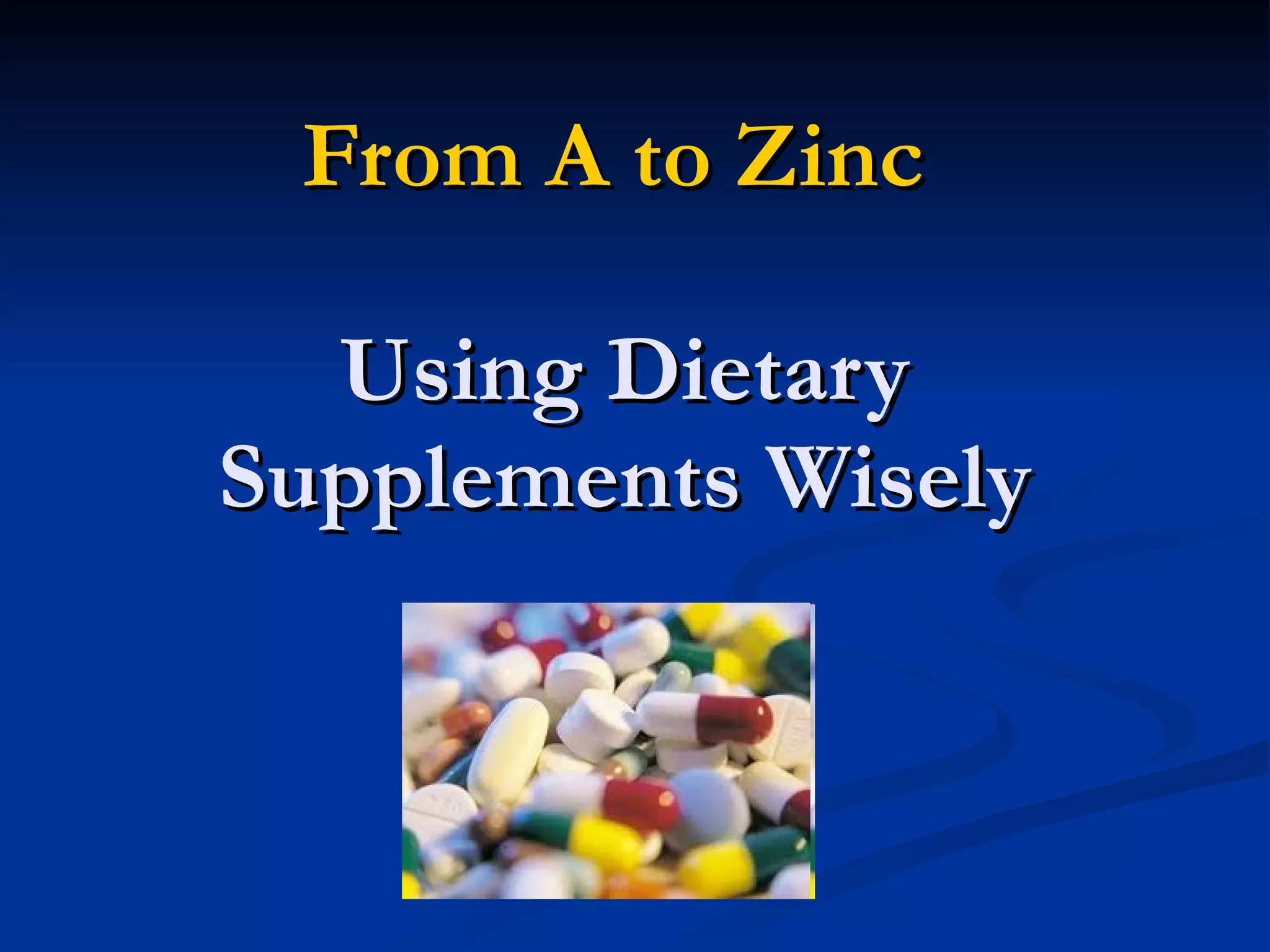
From A to Zinc  Using Dietary Supplements Wisely
A Dietary Supplement is a product that: is intended to supplement the diet contains 1 or more dietary ingredients or their constituents is intended to be taken by mouth is labeled as being a dietary supplement
Dietary Supplement Use in the U.S. Surveys reveal >50% of American adults have used some type of  dietary supplement in the last 30 days Total annual sales of 25.2 billion per year
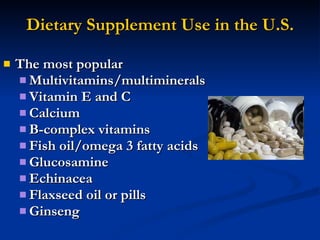
Dietary Supplement Use in the U.S. The most popular Multivitamins/multiminerals  Vitamin E and C  Calcium  B-complex vitamins  Fish oil/omega 3 fatty acids Glucosamine Echinacea Flaxseed oil or pills Ginseng
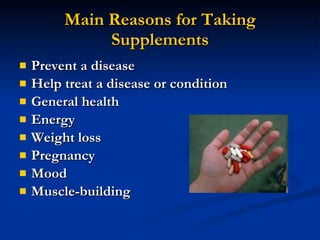
Main Reasons for Taking Supplements Prevent a disease Help treat a disease or condition General health Energy Weight loss Pregnancy Mood Muscle-building
Federal Regulation of Dietary Supplements Not the same as those for prescription or over the counter drugs-in general they are less strict A manufacturer  DOES NOT  have to prove a product’s safety and effectiveness  before it is marketed
Federal Regulation of Dietary Supplements A manufacturer is permitted to say that a supplement addresses: supports health a nutrient deficiency is linked to a particular  body function (like immunity or heart health) if  there is research to support the claim.
Federal Regulation of Dietary Supplements Claim must be followed by the words  “ This statement has not been evaluated by the US FDA.  This product is not intended to diagnose, treat, cure, prevent any disease”.
Federal Regulation of Dietary Supplements Manufacturers are expected to follow practices that ensure supplements are: processed consistently meet quality standards
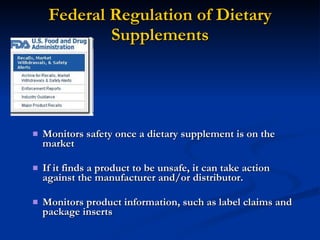
Federal Regulation of Dietary Supplements Monitors safety once a dietary supplement is on the market If it finds a product to be unsafe, it can take action against the manufacturer and/or distributor. Monitors product information, such as label claims and package inserts
Federal Regulation of Dietary Supplements Polices product advertising and requires all information to be truthful and not misleading
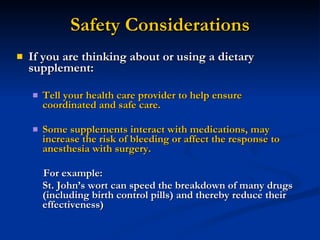
Safety Considerations If you are thinking about or using a dietary supplement: Tell your health care provider to help ensure coordinated and safe care. Some supplements interact with medications, may increase the risk of bleeding or affect the response to anesthesia with surgery. For example: St. John’s wort can speed the breakdown of many drugs (including birth control pills) and thereby reduce their effectiveness)
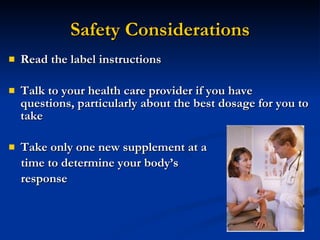
Safety Considerations Read the label instructions Talk to your health care provider if you have questions, particularly about the best dosage for you to take Take only one new supplement at a  time to determine your body’s  response
Safety Considerations If you experience any side effects that concern you,  STOP  taking the dietary supplement and contact your health care provider. Report your experience to the FDA’s MedWatch safety information line at  http://www.fda.gov/medwatch/report/consumer/consumer.htm  or call  1-800-FDA-1088
Safety Considerations Although many dietary supplements come from natural sources,  “natural” does not always mean “safe”. For example, the herbs comfrey and kava can cause serious harm to the liver
Safety Considerations Be Aware An herbal supplement may contain dozens of compounds  and that its active ingredients may not be known Researchers are studying many of these products in an effort to identify active ingredients and understand their effects in the body
Safety Considerations Be Aware What’s on the label may not be what’s in the bottle Analyses sometimes find differences between labeled and actual ingredients. For example: An herbal supplement may not contain the correct plant species
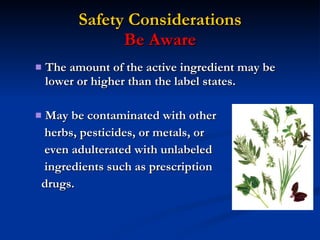
Safety Considerations Be Aware The amount of the active ingredient may be lower or higher than the label states. May be contaminated with other  herbs, pesticides, or metals, or  even adulterated with unlabeled  ingredients such as prescription drugs.
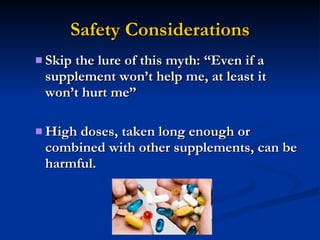
Safety Considerations Skip the lure of this myth: “Even if a supplement won’t help me, at least it won’t hurt me” High doses, taken long enough or combined with other supplements, can be harmful.
Safety Considerations Look for products labeled with the voluntary USP (U.S. Pharmacopeia) or NF (National Formulary) letters Indicates the manufacturer self-reports voluntary standards of quality.
Reliable Sources of Information Office of Dietary Supplements,  National Institutes of Health http://ods.od.nih.gov Accurate, science-based facts on dietary supplements
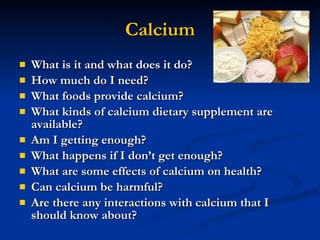
Calcium What is it and what does it do? How much do I need? What foods provide calcium? What kinds of calcium dietary supplement are available? Am I getting enough? What happens if I don’t get enough? What are some effects of calcium on health? Can calcium be harmful? Are there any interactions with calcium that I should know about?
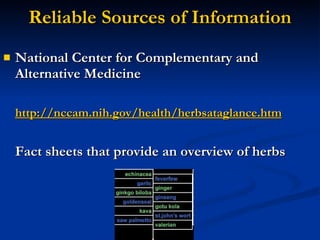
Reliable Sources of Information National Center for Complementary and Alternative Medicine http://nccam.nih.gov/health/herbsataglance.htm Fact sheets that provide an overview of herbs
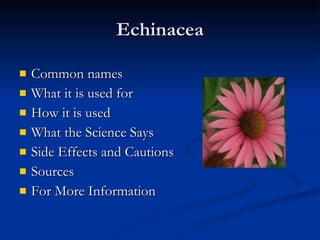
Echinacea Common names What it is used for How it is used  What the Science Says  Side Effects and Cautions Sources For More Information
Reliable Sources of  Information MedlinePlus:  Supplements & Herbal Information http://nlm.nih.gov/medlineplus/druginformation./html Browse to learn about their effectiveness, usual dosage and drug interactions
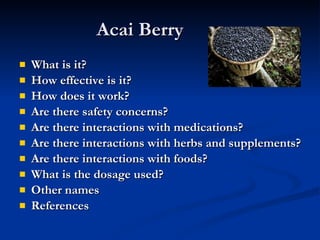
Acai Berry What is it? How effective is it? How does it work? Are there safety concerns? Are there interactions with medications? Are there interactions with herbs and supplements? Are there interactions with foods? What is the dosage used? Other names References
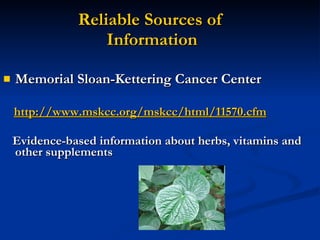
Reliable Sources of  Information Memorial Sloan-Kettering Cancer Center http://www.mskcc.org/mskcc/html/11570.cfm Evidence-based information about herbs, vitamins and other supplements
Reliable Sources of  Information http://www.fda.gov/Food/DietarySupplements/default.htm Q and A Overview Tips for the Dietary Supplement User: Making Informed Decisions and Evaluating Web Information
Final Thoughts Do your best to ensure good health by following a healthy diet  http://www.MyPyramid.gov Don’t expect a pill to make up for unhealthy  food choices Be informed about any supplement you choose to take!
  Karen Palmer, RD,LD,CDE     763-520-5489   [email_address]

A to zinc using dietary supplements wisely 3-5-2011

  • 1.
    From A toZinc Using Dietary Supplements Wisely
  • 2.
    A Dietary Supplementis a product that: is intended to supplement the diet contains 1 or more dietary ingredients or their constituents is intended to be taken by mouth is labeled as being a dietary supplement
  • 3.
    Dietary Supplement Usein the U.S. Surveys reveal >50% of American adults have used some type of dietary supplement in the last 30 days Total annual sales of 25.2 billion per year
  • 4.
    Dietary Supplement Usein the U.S. The most popular Multivitamins/multiminerals Vitamin E and C Calcium B-complex vitamins Fish oil/omega 3 fatty acids Glucosamine Echinacea Flaxseed oil or pills Ginseng
  • 5.
    Main Reasons forTaking Supplements Prevent a disease Help treat a disease or condition General health Energy Weight loss Pregnancy Mood Muscle-building
  • 6.
    Federal Regulation ofDietary Supplements Not the same as those for prescription or over the counter drugs-in general they are less strict A manufacturer DOES NOT have to prove a product’s safety and effectiveness before it is marketed
  • 7.
    Federal Regulation ofDietary Supplements A manufacturer is permitted to say that a supplement addresses: supports health a nutrient deficiency is linked to a particular body function (like immunity or heart health) if there is research to support the claim.
  • 8.
    Federal Regulation ofDietary Supplements Claim must be followed by the words “ This statement has not been evaluated by the US FDA. This product is not intended to diagnose, treat, cure, prevent any disease”.
  • 9.
    Federal Regulation ofDietary Supplements Manufacturers are expected to follow practices that ensure supplements are: processed consistently meet quality standards
  • 10.
    Federal Regulation ofDietary Supplements Monitors safety once a dietary supplement is on the market If it finds a product to be unsafe, it can take action against the manufacturer and/or distributor. Monitors product information, such as label claims and package inserts
  • 11.
    Federal Regulation ofDietary Supplements Polices product advertising and requires all information to be truthful and not misleading
  • 12.
    Safety Considerations Ifyou are thinking about or using a dietary supplement: Tell your health care provider to help ensure coordinated and safe care. Some supplements interact with medications, may increase the risk of bleeding or affect the response to anesthesia with surgery. For example: St. John’s wort can speed the breakdown of many drugs (including birth control pills) and thereby reduce their effectiveness)
  • 13.
    Safety Considerations Readthe label instructions Talk to your health care provider if you have questions, particularly about the best dosage for you to take Take only one new supplement at a time to determine your body’s response
  • 14.
    Safety Considerations Ifyou experience any side effects that concern you, STOP taking the dietary supplement and contact your health care provider. Report your experience to the FDA’s MedWatch safety information line at http://www.fda.gov/medwatch/report/consumer/consumer.htm or call 1-800-FDA-1088
  • 15.
    Safety Considerations Althoughmany dietary supplements come from natural sources, “natural” does not always mean “safe”. For example, the herbs comfrey and kava can cause serious harm to the liver
  • 16.
    Safety Considerations BeAware An herbal supplement may contain dozens of compounds and that its active ingredients may not be known Researchers are studying many of these products in an effort to identify active ingredients and understand their effects in the body
  • 17.
    Safety Considerations BeAware What’s on the label may not be what’s in the bottle Analyses sometimes find differences between labeled and actual ingredients. For example: An herbal supplement may not contain the correct plant species
  • 18.
    Safety Considerations BeAware The amount of the active ingredient may be lower or higher than the label states. May be contaminated with other herbs, pesticides, or metals, or even adulterated with unlabeled ingredients such as prescription drugs.
  • 19.
    Safety Considerations Skipthe lure of this myth: “Even if a supplement won’t help me, at least it won’t hurt me” High doses, taken long enough or combined with other supplements, can be harmful.
  • 20.
    Safety Considerations Lookfor products labeled with the voluntary USP (U.S. Pharmacopeia) or NF (National Formulary) letters Indicates the manufacturer self-reports voluntary standards of quality.
  • 21.
    Reliable Sources ofInformation Office of Dietary Supplements, National Institutes of Health http://ods.od.nih.gov Accurate, science-based facts on dietary supplements
  • 22.
    Calcium What isit and what does it do? How much do I need? What foods provide calcium? What kinds of calcium dietary supplement are available? Am I getting enough? What happens if I don’t get enough? What are some effects of calcium on health? Can calcium be harmful? Are there any interactions with calcium that I should know about?
  • 23.
    Reliable Sources ofInformation National Center for Complementary and Alternative Medicine http://nccam.nih.gov/health/herbsataglance.htm Fact sheets that provide an overview of herbs
  • 24.
    Echinacea Common namesWhat it is used for How it is used What the Science Says Side Effects and Cautions Sources For More Information
  • 25.
    Reliable Sources of Information MedlinePlus: Supplements & Herbal Information http://nlm.nih.gov/medlineplus/druginformation./html Browse to learn about their effectiveness, usual dosage and drug interactions
  • 26.
    Acai Berry Whatis it? How effective is it? How does it work? Are there safety concerns? Are there interactions with medications? Are there interactions with herbs and supplements? Are there interactions with foods? What is the dosage used? Other names References
  • 27.
    Reliable Sources of Information Memorial Sloan-Kettering Cancer Center http://www.mskcc.org/mskcc/html/11570.cfm Evidence-based information about herbs, vitamins and other supplements
  • 28.
    Reliable Sources of Information http://www.fda.gov/Food/DietarySupplements/default.htm Q and A Overview Tips for the Dietary Supplement User: Making Informed Decisions and Evaluating Web Information
  • 29.
    Final Thoughts Doyour best to ensure good health by following a healthy diet http://www.MyPyramid.gov Don’t expect a pill to make up for unhealthy food choices Be informed about any supplement you choose to take!
  • 30.
    KarenPalmer, RD,LD,CDE 763-520-5489 [email_address]