Download to read offline
![Journal of Theoretical and Applied Information Technology
31st
January 2019. Vol.97. No 2
© 2005 – ongoing JATIT & LLS
ISSN: 1992-8645 www.jatit.org E-ISSN: 1817-3195
434
A SYSTEMATIC LITERATURE REVIEW ON METHODS FOR
SOFTWARE EFFORT ESTIMATION
1
ROBERT MARCO, 2
NANNA SURYANA, 3
SHARIFAH SAKINAH SYED AHMAD
1
Department of Information Technology, University of Amikom Yogyakarta, Yogyakarta, Indonesia
1,2,3
University Teknikal Malaysia Melaka, Melaka, Malaysia
E-mail: 1
robertmarco@amikom.ac.id, 2
nsuryana@utem.edu.my,3
sakinah@utem.edu.my
ABSTRACT
There have been many researchers who proposed research in an effort to develop the field of improving
accuracy in the Software Effort Estimation (SEE). Collected results from a series of studies selected in the
Software Effort Estimation, which was published in the period 2000-2017, using systematic mapping and
review procedures. The purpose of this review is to provide a classification of study areas of SEE related to
publication channels, research approaches, types of contributions, techniques used in combination. To
analyze: 1) The precise estimation of SEE techniques; 2) Accuracy of the SEE model estimate compared with
other models; 3) A favorable outcome context for the use of the SEE model; and 4) The impact of other
techniques into the SEE model by combining models and implementation for models and tools. We have
identified 74 major studies that are relevant to the purpose of this study. After investigating, we found that
eight types of techniques were used in the Software effort estimation model. that techniques used for SEE
usually produce acceptable estimation accuracy, and the facts are more accurate.
Keywords: Systematic Literature Review, Software Effort Estimation, Datasets, Methods, Validation.
1. INTRODUCTION
The complexity of software development
projects, making estimation of development efforts
is something that must be taken seriously into the
early stages of the project. Although many models of
software development effort estimations have been
proposed over the past decade, the accuracy is not
satisfactory. According to Jørgensen et al (2007), the
major deviations between actual and estimated
efforts do not necessarily reflect poor estimation
skills. Therefore, it requires knowledge of the level
of uncertainty estimation [1]. Improved accuracy in
enhancing adaptability and flexibility to deal with
the complexity and uncertainty that exist in the field
of software development effort estimations [2]. SEE
play an important role in controlling software costs,
reducing software risk, and ensuring software quality
[3]. Both over and underestimation efforts can cause
problems for the company, while low estimates can
result in poor quality software projects, pending or
unfinished [4]. Effort estimation as the main factor
to accurately estimate the model [5].
Various estimation methods have been proposed
to improve the accuracy of estimates, so based on a
comprehensive review, these estimation methods
can be classified in types: expert judgment;
regression-based methods; parametric models; case-
based reasoning (CBR) method (Analogy based
Estimation); dynamics-based models; and composite
methods [6]; machine learning methods [7][8]; and
algorithmic method [9].
Many researchers have proposed several
techniques to improve accuracy for SEE. Many
studies have tried to modify it new models using
machine learning to improve accuracy in SEE
[10][11][12][13]. Using a random sampling
technique to assess the method [14], Based feature
selection [15][16][17][18][19], by using bagging
algorithm [20][21], or parameter optimization used
classifiers [22][23][24]. Some prediction techniques
have been suggested but none have proved
consistently successful in predicting software
development efforts [7].
Classifications for embedded software
development projects based on whether the amount
of effort is an outlier, classifications for embedded
software development projects using an Artificial
Neural Network (ANN) and Support Vector
Machine (SVM) [25][26]. The machine learning
technique parameters used for regression using
Support Vector Regression (SVR) had the best
performance [16][15]. Regression using SVM
perform well [27]. Genetic algorithm (GA) with
SVM can find the best parameters [28]. The most
widely used method is NN, followed by Model Tree,
Classification and Regression Trees (CART), and](https://image.slidesharecdn.com/asystematicliteraturereviewonmethodsforsoftwareeffortestimation-230805170018-c2df8d74/85/A-Systematic-Literature-Review-On-Methods-For-Software-Effort-Estimation-1-320.jpg)
![Journal of Theoretical and Applied Information Technology
31st
January 2019. Vol.97. No 2
© 2005 – ongoing JATIT & LLS
ISSN: 1992-8645 www.jatit.org E-ISSN: 1817-3195
434
A SYSTEMATIC LITERATURE REVIEW ON METHODS FOR
SOFTWARE EFFORT ESTIMATION
1
ROBERT MARCO, 2
NANNA SURYANA, 3
SHARIFAH SAKINAH SYED AHMAD
1
Department of Information Technology, University of Amikom Yogyakarta, Yogyakarta, Indonesia
1,2,3
University Teknikal Malaysia Melaka, Melaka, Malaysia
E-mail: 1
robertmarco@amikom.ac.id, 2
nsuryana@utem.edu.my,3
sakinah@utem.edu.my
ABSTRACT
There have been many researchers who proposed research in an effort to develop the field of improving
accuracy in the Software Effort Estimation (SEE). Collected results from a series of studies selected in the
Software Effort Estimation, which was published in the period 2000-2017, using systematic mapping and
review procedures. The purpose of this review is to provide a classification of study areas of SEE related to
publication channels, research approaches, types of contributions, techniques used in combination. To
analyze: 1) The precise estimation of SEE techniques; 2) Accuracy of the SEE model estimate compared with
other models; 3) A favorable outcome context for the use of the SEE model; and 4) The impact of other
techniques into the SEE model by combining models and implementation for models and tools. We have
identified 74 major studies that are relevant to the purpose of this study. After investigating, we found that
eight types of techniques were used in the Software effort estimation model. that techniques used for SEE
usually produce acceptable estimation accuracy, and the facts are more accurate.
Keywords: Systematic Literature Review, Software Effort Estimation, Datasets, Methods, Validation.
1. INTRODUCTION
The complexity of software development
projects, making estimation of development efforts
is something that must be taken seriously into the
early stages of the project. Although many models of
software development effort estimations have been
proposed over the past decade, the accuracy is not
satisfactory. According to Jørgensen et al (2007), the
major deviations between actual and estimated
efforts do not necessarily reflect poor estimation
skills. Therefore, it requires knowledge of the level
of uncertainty estimation [1]. Improved accuracy in
enhancing adaptability and flexibility to deal with
the complexity and uncertainty that exist in the field
of software development effort estimations [2]. SEE
play an important role in controlling software costs,
reducing software risk, and ensuring software quality
[3]. Both over and underestimation efforts can cause
problems for the company, while low estimates can
result in poor quality software projects, pending or
unfinished [4]. Effort estimation as the main factor
to accurately estimate the model [5].
Various estimation methods have been proposed
to improve the accuracy of estimates, so based on a
comprehensive review, these estimation methods
can be classified in types: expert judgment;
regression-based methods; parametric models; case-
based reasoning (CBR) method (Analogy based
Estimation); dynamics-based models; and composite
methods [6]; machine learning methods [7][8]; and
algorithmic method [9].
Many researchers have proposed several
techniques to improve accuracy for SEE. Many
studies have tried to modify it new models using
machine learning to improve accuracy in SEE
[10][11][12][13]. Using a random sampling
technique to assess the method [14], Based feature
selection [15][16][17][18][19], by using bagging
algorithm [20][21], or parameter optimization used
classifiers [22][23][24]. Some prediction techniques
have been suggested but none have proved
consistently successful in predicting software
development efforts [7].
Classifications for embedded software
development projects based on whether the amount
of effort is an outlier, classifications for embedded
software development projects using an Artificial
Neural Network (ANN) and Support Vector
Machine (SVM) [25][26]. The machine learning
technique parameters used for regression using
Support Vector Regression (SVR) had the best
performance [16][15]. Regression using SVM
perform well [27]. Genetic algorithm (GA) with
SVM can find the best parameters [28]. The most
widely used method is NN, followed by Model Tree,
Classification and Regression Trees (CART), and](https://image.slidesharecdn.com/asystematicliteraturereviewonmethodsforsoftwareeffortestimation-230805170018-c2df8d74/75/A-Systematic-Literature-Review-On-Methods-For-Software-Effort-Estimation-1-2048.jpg)
![Journal of Theoretical and Applied Information Technology
31st
January 2019. Vol.97. No 2
© 2005 – ongoing JATIT & LLS
ISSN: 1992-8645 www.jatit.org E-ISSN: 1817-3195
435
GA [29]. SVM and Nearest Neighbor Approach
(kNN) [30]. Combination of Analogy Based
Estimation (ABE) and Particle Swarm Optimization
(PSO) algorithm [31]. There are software projects
using NASA datasets showing that SVR
significantly outperforms Radial Basis Functions
Neural Networks (RBFNs) and linear regression
[32]. Adaptive Regression (AR) techniques to
produce better results when managing problems with
complex connections and there are distortions with
high noise levels [33]. Although classifiers based
approaches have been introduced, they still have
potential problems to provide accurate and stable
effort estimates. So software development using
classification algorithms to produce more reliable
and accuracy development is still needed in this field
of research.
Attribute noise, incomplete, and inconsistent in
the software measurement dataset lowers the
performance of machine-learning classifiers [34].
Data quality will decrease when used on
heterogeneous and inconsistent datasets [35].
Irrelevant and inconsistent project effects on
downhill estimates by designing frameworks, where
all projects are clustered [36]. Implying that the
effort of any not normally distributed dataset will
pose a challenge to develop an accurate method [37].
The feature selection it functions to reduce the
dimensions of the feature space, removes data that is
excessive, irrelevant, or noise, to speed up data
mining algorithms and improve data quality [38]
[39]. Datasets with relevant features that can lead to
an increase in the accuracy of their estimates [39].
Feature selection are often implied to explore the
effects of attributes that are irrelevant to classifier
system performance [40]. The data can also greatly
affect the predictive accuracy of the Machine
learning model [41]. So it is necessary to prepare
data in the process of building machine learning
models, where data is preprocessed through
selection, cleaning, reduction, transformation and
feature selection [42][41][34].
That the level of accuracy in SEE is highly
dependent on the parameter values of the method. In
addition, the selection of input features may also
have an important influence on the estimation
accuracy [16]. Estimation by analogy is one of the
machine learning techniques that predicts the
software effort based on the premise that the more
similar features the software project description [43].
SEE are optimization issues so that they can also be
solved with Meta-heuristic algorithms. There are
more than one algorithm available today to find the
optimal solution for a particular problem [5]. GA as
one of the feature selection models and improve the
classification performance of the classifier
[27][44][45][15]. SVM to get the optimal feature
section and parameters must occur simultaneously
[46]. Feature subset selection algorithm based on
fuzzy logic can be optimized for SEE [47]. Fuzzy
and NN provide objective estimates [48]. Adaptive
neuro-fuzzy inference system (ANFIS) models are
more efficient and stable in terms of reduced errors
during training [49]; and able to provide good
estimation capabilities [50]. Fuzzy Analogy
ensembles achieve better performance across all
datasets and no evidence concerning the best
combiner [51]. Expertise judgment and Machine
Learning methods with the assumption that this
method is widely used by researchers and with
accurate results [52]. Estimates of development
efforts are a challenging issue that must be taken
seriously at the early stages of the project.
Inadequate information and uncertain requirements
are the main reasons behind unreliable forecasts in
this area. Although many models of effort estimation
have been proposed over the past decade, the
accuracy level is not quite satisfactory. Aims to make
the connection between the problem of software
effort estimation. Due to the uncertainty, complexity
and lack of information in SEE, using the
optimization algorithm can be the right choice to
address this problem. The SEE have used many
smart methods to improve estimation.
SEE is one of the methods used to make
development efforts on software projects. SEE is the
most important part in the early stages of software
development, this is done to reduce cost and time
losses. Many researchers have developed a model on
SEE in improving accuracy, but researchers rarely
carry out empirical evidence in the SEE field. The
aims of this Systematic Literature Review (SLR), as
a search strategy designed to find out the study
relevant to the research question. This stage involves
both determining the search terms and selection of
literature sources, which are necessary for the
subsequent search process [7]. The need to evaluate
how some researchers conducted a systematic
mapping process and identified from the systematic
maps and existing SLR guidelines [53]. As a result,
in this study, it collected the results of a series of
selected studies on SEE, published in the 2000-2017
period, using systematic mapping and review
procedures. this study aims to provide a
classification of SEE field studies related to:
publication channels, research approaches,
contribution types, techniques used in combination.
This paper is arranged as follows. In section 2,
contains an explanation of the research
methodology. Section 3, it is used to answer research](https://image.slidesharecdn.com/asystematicliteraturereviewonmethodsforsoftwareeffortestimation-230805170018-c2df8d74/85/A-Systematic-Literature-Review-On-Methods-For-Software-Effort-Estimation-2-320.jpg)
![Journal of Theoretical and Applied Information Technology
31st
January 2019. Vol.97. No 2
© 2005 – ongoing JATIT & LLS
ISSN: 1992-8645 www.jatit.org E-ISSN: 1817-3195
436
questions. While, the final section will summarize
the overall results of the study.
2. METHOD
A systematic mapping study is a type of
Systematic Literature Review (SLR) aimed at
collecting and classifying research related to a
particular topic [53]. This study has been conducted
as a review of systematic literature based on the
initial guidelines proposed by Kitchenham (2007).
This review aims to assess systematic literature
review (secondary studies), so that this study is
categorized as a tertiary literature study [54]. The use
of this procedure is motivated by the quality and
accuracy of the methodology proposed [54]. Steps in
how to work on the systematic literature review
carried out below.
In this SLR, will propose 7 stages, In the first
stage, we propose a series of research questions
based on the SLR Objectives. The second stage,
directing research questions, a search strategy
designed to find out the study relevant to the research
question. Then, In the third stage, define the criteria
of research selection to identify relevant studies that
can really contribute to answering research
questions. Furthermore, relevant studies undergo a
quality assessment process in which we design a
number of quality checklists to facilitate assessment.
The two remaining stages involve data extraction
and data synthesis. At the data extraction stage, to
design the data extraction form and then refine it by
data extraction. Finally, at the synthesis stage of the
data, we determined the appropriate methodology
for synthesizing the data retrieved based on the data
types and research questions. The review protocol is
essential for an SLR. In Section 2.1 below, 2.2, 2.3,
2.4, 2.5, 2.6,2.7 will present the details of the review
protocol. At the end of this session, will analyze the
threat to the validity of the review protocol.
Figure 1: Mapping and Review Process
2.1. Research questions
The aims of this study, will describe the four
Research Questions (RQ). A series of questions
reviewing the different types of studies inside review
that defines the question for systematic review
technically does not involve four components, but
five: Population, Intervention, Comparison,
Outcome, Context (PICOC) [55].
1. Population (P): Software development project.
2. Intervention (I): Method of estimation
/technique/metric size/dataset.
3. Comparison (C): No comparison intervention
4. Outcome (O): Accuracy of
method/methodology of effort estimation.
5. Context (C): Any possible study, during
empirical studies in the context of SEE will be
considered.
The purpose of the research was proposed to
describe seven research questions (RQ).
Table 1: Research Questions on Literature Review
ID Research Questions Motivation
RQ1 What are the types of
research topic trends
chosen by researchers
in the field of SEE?
Identification of research
topics that are trends in the
field of SEE
RQ2 What types of datasets
are most widely used
in the field of SEE?
Identify the type of dataset
that is most widely used in
the field of SEE
RQ3 What method is most
often used for SEE?
Identify the method most
often used for SEE
Research Questions
Search Strategy
Study Selection
Inclusion Criteria Exclusion Criteria
Quality Assessment Question
Data Extraction Form
Data Synthesis Methods](https://image.slidesharecdn.com/asystematicliteraturereviewonmethodsforsoftwareeffortestimation-230805170018-c2df8d74/85/A-Systematic-Literature-Review-On-Methods-For-Software-Effort-Estimation-3-320.jpg)
![Journal of Theoretical and Applied Information Technology
31st
January 2019. Vol.97. No 2
© 2005 – ongoing JATIT & LLS
ISSN: 1992-8645 www.jatit.org E-ISSN: 1817-3195
437
RQ4 What types of
validation and
evaluation are used to
measure the accuracy
of the overall estimates
of the model in the
field of SEE?
Identify the types of
validation and evaluation
used to measure the
accuracy of the overall
estimate of the model in
the field of SEE
2.2. Search strategy
After determining the research question, devise
a strategy to define the search string and apply this
search string to a set of selected digital libraries to
extract all relevant documents, develop search
procedures, and identify the primary study. The
following is a list of digital databases that are used
to search for relevant journals:
1. ACM Digital Library
2. IEEE eXplore
3. ScienceDirect
4. Springer
5. Google Scholar
To avoid bias of the researcher, we use the
following procedure to determine the search string
used in this study [56][57]:
1. Analyze questions and identify key words in
terms of population, intervention, results and
context
2. Identify key requirements relevant to the
mapping questions and reviews listed.
3. Search all synonyms and spelling variations of
the main term, if any.
4. Connect the main requirements of the
population, intervention, results and context by
using Boolean AND, to retrieve records
containing all the requirements.
5. Use the Boolean operator OR to join the same
term, to retrieve records that contain any (or
all) requirements.
Steps one through five are performed by the
author, As a result, obtain the following search
string:
(Software* OR System OR Application OR
Development* OR Web) AND (Effort* OR Cost OR
Resource) AND (Estimate* OR Predict* OR
Forecest OR Classification*).
2.3. Study Selection
To identify relevant studies it answers research
questions based on titles, abstracts, and keywords.
each candidate document identified at the initial
search stage is evaluated, using inclusion and
exclusion criteria, used to determine whether it must
be accepted or rejected. If this decision can not be
made using the title and/or abstract only, the full
paper has been reviewed. The inclusion criteria and
exclusion criteria are linked using the OR Boolean
operator.
Inclusion criteria:
1. Use of software effort estimation techniques
for software development estimation, and
compare the performance of these techniques
with other software effort estimation
techniques.
2. The use of hybrid models that combine
analogies with other techniques (eg GA, SVM
or NN) to SEE.
3. Comparison of two or more software effort
estimation techniques
4. Apply quality assessment criteria (defined in
the next section) to the relevant paper so that to
select a paper of acceptable quality, which is
ultimately used for data extraction.
5. Define the following inclusion and exclusion
criteria, which has been refined through pilot
selection.
6. Do study selection by reading the title,
abstract, or full text of the paper
Exclusion criteria:
1. Duplicate publication of the same study.
2. Estimated maintenance effort or testing effort.
3. Estimated size of software or time without
effort estimates.
4. The topic of study is the accuracy of software
development projects.
5. Review research will be excluded.
Figure 2: Study Selection
Search in electronic
database
Study selection
(inclusion and
exclusion criteria)
Quality
Assessment
Digital Libraries
Yes
1351 Candidate Articles:
IEEE Explore (259);
ScienceDirect (347);
ACM (253);
SpringerLink (469);
Google scholar (23);
189 Relevant Articles:
IEEE Explore (76);
ScienceDirect (39);
ACM (27);
SpringerLink (35);
Google scholar (12);
74 Selected Articles:
IEEE Explore (8);
ScienceDirect (39);
ACM (1);
SpringerLink (26);
Google scholar (0);
No](https://image.slidesharecdn.com/asystematicliteraturereviewonmethodsforsoftwareeffortestimation-230805170018-c2df8d74/85/A-Systematic-Literature-Review-On-Methods-For-Software-Effort-Estimation-4-320.jpg)
![Journal of Theoretical and Applied Information Technology
31st
January 2019. Vol.97. No 2
© 2005 – ongoing JATIT & LLS
ISSN: 1992-8645 www.jatit.org E-ISSN: 1817-3195
438
2.4. Study Quality Assessment
Assessment of the quality of the study as a
mapping study of data synthesis, to improve the
research and strength of the conclusions described.
By collecting evidence from selected studies to
answer some of the research questions that have
been proposed. The data taken in this review include
as quantitative and qualitative data.
2.5. Data Extraction Form
With data extraction, studies are selected to
collect data that contribute to answering research
questions related in this review. By designing cards
to facilitate the extraction of data presented in Table
2. For easy synthesis of data, items in the Table will
be grouped according to the research question. Table
2, shows that the extracted data is related to the
experiments performed.
Table 2: Data extraction
Data extractor
Data checker
Field of study
Year of publication
Authors
Article title
Type of study (experiment)
RQ1 : What are the types of research topic trends
chosen by researchers in the field of SEE?
- Trends and topic research
RQ2 : What types of datasets are most widely used in
the field of SEE?
- Datasets software effort
RQ3 : What method is most often used for SEE?
- Methods in terms of software effort
estimation
RQ4 : What types of validation and evaluation are used
to measure the accuracy of the overall estimates of the
model in the field of SEE?
- Validation methods
- Metrics used to measure estimation
accuracy
2.6. Data Synthesis Methods
Data extracted, to be synthesized and tabulated
in accordance with the research questions discussed,
to collect evidence to answer them. Because this data
includes both quantitative and qualitative data, and
since the review discusses different types of research
questions, various data synthesis approaches are
used narrative synthesis. In this method, To improve
the presentation of these findings, some visualization
tools, including bar graphs, pie charts, and tables are
also used to improve the presentation of data
distribution and software effort estimation.
2.7. Threats to Validity
In this section will review searches in
accordance with research questions and have used
them to take relevant studies in five electronic
databases. This search is done manually, by reading
each title, abstract, and keywords in the journal and
conference proceedings. It is done to avoid bias on
journal selection searches on software effort
estimation. According Wen et al (2012), to the
validity of this review protocol is analyzed from the
following three aspects: selection bias study,
publication bias, and possible inaccuracies in data
extraction [7].
3. RESULT AND DISCUSSION
The section present result and discussion in
literature review. The first, present overview about
selection study. Seconds, present report review
findings according to the research questions. Thrid,
present implications for research. Four, present
limitations of this review. Finally, present
conclusion and future research.
3.1. Selection Study
3.1.1. Significant Journal Publications
In this literature review, 74 main studies were
used to analyze the SEE. Distribution is conducted
from January 2000 to December 2017, this is to
demonstrate how the research interest in software
engineering on the topic of software effort
estimation is changing over time. A brief overview
of the distribution studies over the years is shown in
Figure 3, indicating that research on SEE is still
highly relevant today. Regarding the type of study
selected, all the studies were experimental studies
and no survey and review studies were used.
Although most selected studies use at least one set of
public data to validate machine learning and Non
machine learning models, it does not mean that the
validation results adequately reflect the real situation
in the industry. In fact, the lack of case studies and
industry surveys can imply that the application of
models/techniques in SEE is still immature.](https://image.slidesharecdn.com/asystematicliteraturereviewonmethodsforsoftwareeffortestimation-230805170018-c2df8d74/85/A-Systematic-Literature-Review-On-Methods-For-Software-Effort-Estimation-5-320.jpg)
![Journal of Theoretical and Applied Information Technology
31st
January 2019. Vol.97. No 2
© 2005 – ongoing JATIT & LLS
ISSN: 1992-8645 www.jatit.org E-ISSN: 1817-3195
440
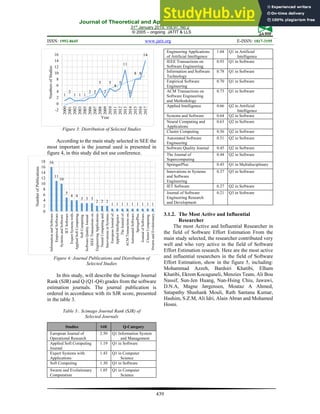
Figure 5: Influential Researchers and
Number of Studies
3.2. Research Topic Trends (RQ1)
Although the use of methods in software
development is increasing, the problem of effort
estimation remains a challenge in software
development efforts, largely because of the lack of
many standard metrics that will be used for plan-
based prediction [58]. Term estimation are applied
when used to predict future award value, provided
by the effort, in terms of monthly programmers, to
conclude software development [59].
Discussed the issue of SEE projects, Research
found in such areas [60] [61] [62][63] : 1) Creation
and evaluation of estimation methods; 2) Calibration
of estimation model; 3) Software system size
measures; 4) Assessment of uncertainty; 5)
Measurement and analysis of error estimation; 6)
Organizational problems related to estimation; 7)
Measure and analyze estimation errors; and 8) Data
set properties.
The accuracy of estimation by analogue means
that the estimation of software attempts by analogy
is an appropriate estimation method. The estimation-
based analogy also offers several advantages: easy to
understand the approximate basis and this is useful
where the domain is difficult to model [64].
Estimation by analogy, subjective choice of
comparison criterion and process of difference
identification and requires analogues project for
comparison which is rarely achievable in software
development [41]. The analysis of primary studies
selected in this study, will focus on five topics in
software effort estimation, among others:
The first type of Classification, presents a
classification for embedded software development
projects using ANN and SVM. After determining the
classification, the effort estimation model was
created for each class by using linear regression,
ANN, and the SVR [65]. Context of effort-aware
classification scenario, text mining based models
perform similarly to software metrics based models
in most cases [66] [67]. Using Model Tree has the
advantage of dealing with categorical attributes,
minimizing user interaction and improving the
efficiency of the learning model through
classification [68]. Selective classification of
software projects based on fundamental attributes to
localize the process of estimating development
efforts in models using Analogy-Based Estimation
(ABE) [69]. Hybrid model that consists of
classification and prediction stages using a SVM and
Radial Basis Neural Networks (RBNN) [70]. The
Localized multi-estimator model avoids the blind
classification methods and follows the classification
of projects based on underlying attributes [2]. Using
classification and data structures can also assist in
optimizing the accuracy of Analogy Software effort
Estimation. The option of a Fuzzy Feature Subset
(FFSS) has a significant impact on accuracy [47].
The second type of Clustering, Although a
clustering-based approach has been introduced, it
still has potential problems to provide accurate and
stable effort estimates [71] and SVR [72]. Clustering
techniques, especially the clustering of K-Means
[73] [74] [75] [76] [77], and Univariat, to know the
unit test metrics that are less volatile, that is less
influenced by the style adopted by the developer
when writing unit test code [78]. In the case of
clustering, each document is forced to join exactly
one cluster. topic analysis and labeling have been
combined to identify latent patterns and trends in the
dataset. The two main topic modeling techniques are
Latent Semantic Indexing (LSI) and Latent Dirichlet
Allocation (LDA) [79]. This variant is clustering
using Scott-Knott statistical test and is ranked by
using four unbiased measurement errors [51].
Classified into an effort class, refer to the models
generated in this study as duplex output models as
they return two outputs [80]. The proposed fuzzy set
generation process is based on the Fuzzy C-Means
Clustering Technique (FCM) [11] [81] and a Real
Coded Genetic Algorithm (RCGA) [82]. Used one-
way ANOVA, t-tests, boxplots and Tukey’s post-
hoc test in order to examine if the clusters found by
the clustering procedure have significant differences
with respect to the size of the project [83]. Clusters
using c-means clustering technique [2]. Fuzzy
Subtractive Clustering and Artificial Neural
Networks to estimate the development effort using
class points [84]. The hybrid method is proposed to
improve the accuracy of estimation of development
0
1
2
3
4
5
6
7
8
Azzeh,
Mohammad
Khatibi
Bardsiri,
V.
Khatibi,
E.
Kocaguneli,
Ekrem
Menzies,
Tim
Nassif,
Ali
Bou
Huang,
Sun‐Jen
Chiu,
Nan‐Hsing
Jawawi,
D.N.A.
Jørgensen,
Magne
Ahmed,
Moataz
A.
Satapathy,…
Rath,
Santanu
Kumar
Hashim,
S.Z.M.
Idri,
Ali
Abran,
Alain
Hosni,
Mohamed
Number
of
Studies
Researchers
First Author Non‐First Author](https://image.slidesharecdn.com/asystematicliteraturereviewonmethodsforsoftwareeffortestimation-230805170018-c2df8d74/85/A-Systematic-Literature-Review-On-Methods-For-Software-Effort-Estimation-7-320.jpg)
![Journal of Theoretical and Applied Information Technology
31st
January 2019. Vol.97. No 2
© 2005 – ongoing JATIT & LLS
ISSN: 1992-8645 www.jatit.org E-ISSN: 1817-3195
441
effort based on the combination of fuzzy clustering,
ABE method and ANN [13]. The clustering
algorithms used in this work are Density Based
Spatial Clustering Of Application With Noise
(DBSCAN) and unsupervised k-windows [85]. The
k-means and Scheffe methods are adapted for
constructing data clustering models [86]. Clustering
techniques improves the estimation accuracy of
analogy-based effort estimation techniques [87]. The
fuzzy k-mode algorithm, a well-known clustering
technique for large datasets containing categorical
values [88].
The thrid type of Estimation, In this paper,
results from using Linear Regression Model (LRM),
compared with three Fuzzy Logic Models (FLM).
There are two stages of the comparison model in the
estimation model: (1) checking the adequacy of the
model should be determined; and (2) the estimation
model is validated using new data. The results show
slightly better prediction accuracy between FLM and
LRM to estimate development effort on a personal
level when small programs are developed [89]. GRA
(Gray Relational Analysis) is used to reduce the
uncertainty in the distance of the distance between
two software projects for both continuous and
categorical features. That the use of GRA integration
with fuzzy logic produces credible estimates when
compared with Case Based Reasoning (CBR),
Multiple Linear Regression (MLR) and ANN
methods [43]. The combination of ANN into the
fuzzy inference process for software effort
estimation has the advantage of providing an
objective set of fuzzy rules by utilizing the learning
mechanisms of ANN methods [48]. Bagging
ensembles of Regression Trees (RTs) show to
perform well, being highly ranked in terms of
performance across different data sets [20]. Need to
consider outlier elimination and to conduct a detailed
analysis of effort estimation results to improve the
accuracy of software estimates within the software
organization [90].
The fourth type of Predicting, Software
development efforts can be predicted using various
approaches and require large datasets from past
projects while others require strong input from
domain experts [91]. There are two current models
that have been widely used to predict rework
attempts for changing needs that are algorithmic and
non-algorithmic models [92]. The uncertainty
inherent in the software development process
presents special challenges for predictive software
attempts, systematically dealing with missing data
values, outlier detection, selection of subset features
and all of this in the context of noisy data [93]. To
get predictions on better software projects, it is
necessary to make more accurate predictions about
their development efforts. Based on mathematical
models, such as statistical regression or machine
learning (ML) [94]. The accuracy of the prediction
accuracy of the general regression neural network is
statistically equal to or better than that obtained with
the fuzzy logic model as well as by multiple linear
regression [95] and CBR [96].
The five type of Dataset Analysis, the dataset
obtained after the pre-processing and attribute
selection of the original dataset. For a project's
estimated effort, various machine learning models
have been selected. There are various machine
learning tools that will help for data analysis.
Standard dataset for software effort estimation
available mostly from data sources, such as the
ISBSG (International Software Benchmarking
Standars Group), Koten and Gray, COCOMO,
NASA, Albrecht, Desharnais, Maxwell and
Kemerer. Given that ISBSG is a large and
heterogeneous data set, it is necessary to prepare data
before applying any analysis to obtain minimal
homogeneity in the sample to be studied [97].
Conduct a thorough statistical analysis of the five
most popular datasets for estimating software effort
to provide researchers with useful information and to
help them choose an appropriate repository. The
software engineering community must be aware of
and responsible for the problem of software related
data sets when evaluating the validity of research
results [98]. The ISBSG has estimated it in the form
of a normal effort and calculates a variable called
ratio of normalization. The normalization ratio is
derived from the division of normal effort by
reported effort, which shows the difference between
the reported effort and the estimated effort [2].
It can be concluded that most of the software
researcher estimates choose classification as a
research topic. Because the topic of research related
to the classification is still a lot of opportunities in
the industry, the reason is related to the cost and
time, if there is a mistake in estimating software
development will result in losses in a company. and
subsequently relates to the use of public dataset
which in testing software estimation. based on the
total distribution of research topics on estimation of
software efforts from 2000 to 2017. 6% obtained
from research studies related to predicting technique
topics, 28% of the studies focused on estimation
topics, 57% of the studies focused on classification
topics and 8% of the major studies related to the
topic clustering. and the last is the research topic of
dataset analysis of 1% coverage, show in the figure
6.](https://image.slidesharecdn.com/asystematicliteraturereviewonmethodsforsoftwareeffortestimation-230805170018-c2df8d74/85/A-Systematic-Literature-Review-On-Methods-For-Software-Effort-Estimation-8-320.jpg)
![Journal of Theoretical and Applied Information Technology
31st
January 2019. Vol.97. No 2
© 2005 – ongoing JATIT & LLS
ISSN: 1992-8645 www.jatit.org E-ISSN: 1817-3195
442
Figure 6: Distribution of Research Topics
3.3. Datasets Used (RQ2)
Raise awareness of how dataset properties affect
results when evaluating estimation methods.
Establishing effort estimation models from different
historical datasets reveals various levels of accuracy
in estimation [86]. However, in this case many
studies have reported a comparison of the relative
accuracy of data estimation efforts with dataset
classification, but there are still many shortcomings
in the classification of datasets. Thus, to determine
the effect of estimation accuracy when the data
classification method is used to determine the
appropriate software group for the effort
development estimation model, this is important in
this study.
Historical data is very important and valuable
for software development. The quality of the
repository greatly affects the results and efficiency
of the effort estimation model [99]. The dataset
allows specialists to perform their analysis on a
recurring and comparable basis in one field of study.
However, it is impossible to compare the results of
the research of a proposed model, because their
datasets can not be assessed. so the importance of
using public datasets, so as to compare the results of
the model. In the past decade, many researchers have
used various types of datasets for various purposes
and have tried to find their own features, including:
DPS (Data Processing Services), ISBSG
(International standard benchmarking software
group), Desharnais, Maxwell, and CF (Canadian
financial) are the most popular among these data set
for software effort estimation [98]. In the literature
review on studies, the most dataset for software
effort estimation is NASA, ISBSG, COCOMO,
Desharnias and Albercht.
The datasets used for evaluation is important
because its performance depends on dataset
characteristics such as size, number of features,
missing data and outliers [100]. They usage of public
datasets for evaluate and compared these models in
software development effort estimation [101] [102]
[103]. Selecting an optimal feature subset that
describes the software project is believed to provide
the most accurate estimation [51][87][82]. That the
prediction accuracy for each technique varies
depending on the dataset used, with feature selection
will produce the most accurate prediction across all
datasets [91]. These datasets have been built and
developed by various companies, some of which are
cross-business and others are projects related to a
single company [104]. The datasets is made publicly
available in order to encourage repeatable,
verifiable, refutable, and improvable predictive
models of software engineering [105]. Different by
Martín et al (2008), where the estimate of
development effort at the personal level when small
programs are developed [89].
In a review of this literature, 74 key studies that
analyzed the performance of software effort
estimation were included. Figure 7, shows the
distribution of dataset types from 2000 to 2017. 86%
of the study studies used public datasets and 14% of
the study studies used a private dataset.
Figure 7: Total Distribution of Datasets
Shown in Figure 8, is a collection of published
studies, mostly using more public datasets for
software effort estimation studies since 2006 (see
Appendix B).
Predicting
6% Estimation
28%
Classification
57%
Dataset
Analysis
1%
Clustering
8%
Public dataset
86%
Private dataset
14%](https://image.slidesharecdn.com/asystematicliteraturereviewonmethodsforsoftwareeffortestimation-230805170018-c2df8d74/85/A-Systematic-Literature-Review-On-Methods-For-Software-Effort-Estimation-9-320.jpg)
![Journal of Theoretical and Applied Information Technology
31st
January 2019. Vol.97. No 2
© 2005 – ongoing JATIT & LLS
ISSN: 1992-8645 www.jatit.org E-ISSN: 1817-3195
443
Figure 8: Distribution of Private and Public Datasets
In Appendix B, the most widely used dataset
and those related to software effort estimation are
Repository in PROMISE and ISBSG, which is one
of the most popular datasets [98][106][107][108]. In
using and selecting the right subset of data, it must
fully understand the concepts and meanings of each
dataset, because the problem of pre-processing and
data preparation is an important task in the data
mining domain [98]. The selection of inappropriate
datasets will lead to unreal and biased results [98].
The level of accuracy in the algorithm is very
dependent on the dataset used in the field of software
effort estimation, because each dataset has different
characteristics. So the importance of using datasets
in this study.
Table 4 describes each feature of the dataset set,
and summarizes the number of projects collected,
the minimum and maximum values of the software
effort in each data set.
Tabel 4: Data Set Summary
Dataset Project Features
Min
Effort
Max
Effort
ISBSG 148 10 24 60.270
COCOMO 63 17 5.9 11.400
NASA93 93 17 8.4 8.211
NASA 60 16 8.4 3.240
Desharnias 81 9 546 23.940
Albercht 24 7 0.50 105.20
Sdr 12 23 1 22
China 499 18 26 54.620
Kemerer 15 7 23 1.170
Miyaki 48 8 5.6 1.586
Maxwell 62 25 583 63.694
Finnish 38 5 460 26.670
Errors in the selection of inappropriate datasets
can cause difficulties in developing the estimation
model, so that it will get biased research results. in
this section is used to analyze the characteristics of
the most popular datasets used in the field of
software effort estimation.
3.4. Most Used methods (RQ3)
3.4.1. Distribution of methods
From the selected study, we identified Sixteen
(16) types of methods have been applied to software
effort estimation (Appendix B). Nine (9) of the most
widely applied, They are listed as follows: Neural
Networks (NN); Case-Based Reasoning (CBR);
Linear Regression (LiR); Fuzzy Logic (FL); Genetic
Algorithms (GA); K-Nearest Neighbor (k-NN);
Support Vector Regression (SVR); Logistic
Regression (LR); and Decission Tree (DT).
Based on the results of a review of several
studies, then obtained eight frequently used
methods, presented in the figure 9.
Figure 9: Distribution of the studies over
publication year
Neural network (NN) and Decission tree (DT)
are the two most commonly used algorithms. As
illustrated in Figure 10.
Figure 10: Distribution of Methods
Based on the previous figure, the comparison
of the techniques used in software effort estimation
is the most widely used NN and DT in recent
decades. How to identify techniques in the software
1 1 1
0 0
1
2
1
5
2
3
4
5
11
2
6 6
13
0
1
0
1
0 0 0
1
0 0
2
0 0 0 0
2 2
1
0
2
4
6
8
10
12
14
1995 2000 2005 2010 2015 2020
Numbers
of
Studies
Year
Public dataset Private dataset
0
10
20
30
40
2000
2001
2002
2003
2004
2005
2006
2007
2008
2009
2010
2011
2012
2013
2014
2015
2016
2017
Number
of
studies
Year
Neural network Genetic
Case‐based reasoning Logistic Regression
Linear regression Support vector regression
Decision tree K‐nearest neighborhood
Neural
network
21%
Genetic
7%
Case‐based
reasoning
7%
Logistic
Regression
12%
Linear
regression…
Support vector
regression
5%
Decision
tree
13%
K‐nearest
neighborho
od
6%
Fuzzy
10%
Other
10%](https://image.slidesharecdn.com/asystematicliteraturereviewonmethodsforsoftwareeffortestimation-230805170018-c2df8d74/85/A-Systematic-Literature-Review-On-Methods-For-Software-Effort-Estimation-10-320.jpg)
![Journal of Theoretical and Applied Information Technology
31st
January 2019. Vol.97. No 2
© 2005 – ongoing JATIT & LLS
ISSN: 1992-8645 www.jatit.org E-ISSN: 1817-3195
444
effort estimation can be done by: stand alone or in
combination, either a combination using two or more
machine learning techniques (ML) or a combination
of ML with Non Machine Learning (Non-ML).
Stand-alone algorithms using machine
learning are NN [109] [110], CBR [3][111][112] and
k-NN [82][113][114], while those using Non-ML
are fuzzy [51][115]. Furthermore the combination
method that is done using two or more ML is NN and
Genetic [116] or using a combination of ML and
Non-ML is NN and fuzzy [117][118].
We found out about the ML technique used
for software effort estimation that has the highest
and most relevant accuracy values in this literature
review.
3.4.2. Machine Learning Method
An important process in software is to the
right and accurate software efforts estimation. The
current software estimates have switched to various
machine learning methods (ML). The accurate
estimate of software development efforts is closely
related to the success or failure of software projects.
The lack of accuracy and versatility in this field has
attracted the attention of researchers over the past
few years. Despite the improvements achieved in the
estimating effort, there is no strong agreement on
which individual models work best [2]. Some
estimation models of software development efforts
have been developed in recent decades. Determining
which is the best estimation model is difficult to
decide for the software management team [119].
Since 2008 interest in using Machine
Learning for improved accuracy, the most widely
used method is NN, followed by Model Tree,
Classification and Regression Trees (CART), and
GA [29]. Specific cross-validation approaches on
different datasets to evaluate the accuracy of the
learning model forecast and testing to analyze
strengths and weaknesses in terms of accuracy,
toughness and generalization [81]. A new
comprehensive methodology for estimating software
development efforts during the initial phase of
development needs using the software's functional
size as the main variable. Although, effort estimates
in practice are mostly done by subjective evaluation,
there are many works in this field trying to build
parametric models for estimating effort [120].
Approaches for comparison of these models are
often invalid and may make things worse. Identified
several theoretical problems with a study comparing
different estimation models in several common
datasets to produce the best models [121]. This
shows that developing a comparative study is an
open issue, so it is still worth developing again.
GA-based approach significantly improves
the classification accuracy and has fewer input
features for SVM [122]. Integration of the GRA with
GA method presents more precise estimates over the
results using the CBR, CART, and ANN methods
[123]. GA are applied to include feature selection
and parameter optimization of machine learning
methods, proving to be very efficient for the search
for optimal or optimal solutions in a wide range of
problems [16]. SVM and ANN models show better
estimation capabilities compared to linear regression
model [26].
NN result in performance improvements over
conventional regression analysis in terms of average
absolute error percentages [124]. k-NN parametric
techniques in which the reaction reaction for a
predetermined input value is obtained by finding out
the average training case closest to a predetermined
value, resulting in a minimum error and a higher
prediction accuracy achieved by applying an effort
estimation model [33]. Comparison of accuracy
between Multiple Linear Regression (MLR),
General Regression Neural Network (GRNN), and
Fuzzy Logic model using Magnitude of Error
Relative (MER) and Mean Square Error (MSE) to
the estimate, statistically the accuracy results are the
same [95].
The resulting model performance uses
various neural networks compared and analyzed to
improve the prediction accuracy of the software
effort estimation process [73]. The ranking method
ranks each feature in the dataset. The results are
validated using different algorithms for
classification. There are several classification
algorithms available, where each algorithm has its
own strengths and weaknesses. In all supervised
learning problems, there is no learning algorithm
that works best for individuals [38]. The existing
machine learning algorithms provide good accuracy
when classifying major class instances, but
ignore/classify minority classification [125]. High
levels of non-normality and variance and complex
relationships between attributes and development
efforts can cause serious problems for efficient
project classification [31].
We found that ML techniques used in the field
of software effort estimation are very consistent with
the findings of several other relevant review works
in a few years. For example, Huang et al (2008)
conducting experiments on 5 learning machine
methods, by integrating GRA with the GA method
presents a more precise estimate of the results using
CBR, CART, and ANN [123]. Hybrid estimators
show a more accurate estimate than a single
estimator for the dataset. Experimental results show](https://image.slidesharecdn.com/asystematicliteraturereviewonmethodsforsoftwareeffortestimation-230805170018-c2df8d74/85/A-Systematic-Literature-Review-On-Methods-For-Software-Effort-Estimation-11-320.jpg)
![Journal of Theoretical and Applied Information Technology
31st
January 2019. Vol.97. No 2
© 2005 – ongoing JATIT & LLS
ISSN: 1992-8645 www.jatit.org E-ISSN: 1817-3195
445
that both single and hybrids are used in the chosen
combination proven that the approximate
combination achieved by a single and hybrid
estimator can reduce the bias in the final estimate [2].
3.4.3. Proposed Method Improvements
Some researchers have proposed the best
technique in terms of increasing accuracy in
software program estimation. The proposed
technique has recently tried to improve the accuracy
in the estimation of the resulting model by: the
ensemble methods available generally improve the
software effort estimation provided by the machine
learning [126][127][25][52]; using bagging
algorithm [9][15]; add feature selection
[16][17][15][47]; using optimization parameters for
classifier [16][10][128].
The value of the method parameters depends
on the accuracy. In addition, the selection of input
features may also have an important influence on the
estimation accuracy [16]. Estimation by analogy is
one of the machine learning techniques that predicts
the software effort based on the premise that the
more similar features the software project
description [43]. Software effort estimation are
optimization issues so that they can also be solved
with Meta-heuristic algorithms. There are more than
one algorithm available today to find the optimal
solution for a particular problem [5].
Researchers proposed various ensemble
methods such as boosting, bagging and random
sampling techniques [129]. Sampling technique is a
method of balancing data to classify unbalanced data
[125]. Random Undersampling and oversampling
are common types of sampling techniques [130]; and
Synthetic Minority Over-sample Technique [131].
Some representative approaches combine
oversampling and undersampling data preprocessing
with classifier ensembles through boosting
[132][133] or bagging [134][133][22]. The
combined clustering-based undersampling approach
yields optimal performance in small and large data
sets [130]. Bagging techniques generally outperform
boosting, and hence in noisy data environments,
bagging is the preferred method for handling class
imbalance [135]. Then in this bagging technique to
handle the class imbalance.
Non-linear optimization problems can be
solved effectively by Meta-heuristic Algorithms [5].
Implementation of this algorithm can be calculated
in various ways to solve the optimization problem
[136][5]. As for the use of meta-heuristics to explore
the parameter setting with the aim to improve effort
predictions [137]. The features adopted by the
classifier are then selected as an optimal feature with
the wrapper model, using a meta-heuristic approach
to help search for the best feature parts [24]. Meta-
heuristic methods tailored to solve this problem are:
GA and three local search methods using annealing
simulations, tabu search, and iterated local searches
[138]. Ant Colony Optimization (ACO) and Bee
Colony Optimization (BCO) are famous meta-
heuristic search algorithms used in solving
numerous combinatorial optimization problems
[139]; satin bower bird optimization algorithm
(SBO) [10]; Particle Swarm Optimization (PSO)
[140]. PSO algorithm is chosen as an optimization
algorithm because it can present acceptable
performance in the field of estimating software
development efforts [2].
Accurate software effort estimates are
essential for efficient project planning software,
because to the complex nature of the software.
Estimation of development efforts has become a
challenging issue that must be taken seriously.
Although many models of effort estimation have
been proposed over the last decade, the degree of
accuracy is not satisfactory enough.
3.4.4. Feature Selection
Feature selection is how to identify and
remove irrelevant and excessive features. Because in
the selection of features is very important on large
data to address a large number of input features. The
feature selection is done by searching for subset
feature space and evaluating each part. The search
method is selected to perform searches and
evaluators assign values to each feature section
[141]. Feature selection to extract relevant data in
feature space, so feature sets are more suitable for
classification [139]. Feature selection is an important
task in most classification problems, it still needs a
new approach to determine the sub-feature options
to improve the accuracy of classification [142].
Features selection in supervised learning has the
primary goal of finding parts of features that produce
higher classification accuracy [143][27]. The
characteristic dataset affects the performance of
feature selection techniques, this has an impact on
classifier accuracy issues and the time complexity of
various feature selection techniques.
Attribute noisy is caused by an error in the
value of the attribute (the variable being measured
incorrectly, the missing value) while the class
interruption is caused by a sample that is labeled to
be owned in more than one class [144]. In
predictions or estimation problems, better
performance can be achieved by removing some
variables or features, that is, reducing the data
dimension [15]. Estimates based on analogy, there](https://image.slidesharecdn.com/asystematicliteraturereviewonmethodsforsoftwareeffortestimation-230805170018-c2df8d74/85/A-Systematic-Literature-Review-On-Methods-For-Software-Effort-Estimation-12-320.jpg)
![Journal of Theoretical and Applied Information Technology
31st
January 2019. Vol.97. No 2
© 2005 – ongoing JATIT & LLS
ISSN: 1992-8645 www.jatit.org E-ISSN: 1817-3195
446
have been a number of studies that investigate the
impact of selecting feature subsets on prediction
accuracy [47]. Lack of analogy-based systems such
as noisy intolerance, intolerance of irrelevant
features, sensitivity to choice of algorithms,
similarity functions, etc [145]. With the feature
selection most techniques provide higher predictive
accuracy and this accuracy is more stable across
different datasets [91]. Feature selection for the
purpose of reducing dimension of dataset size by
eliminating irrelevant and redundant features.
datasets with relevant features that can lead to an
increase in the accuracy of their estimates [39].
Feature selection must be created for the creation of
a subset of candidate variables, because feature
selection affects the prediction accuracy of each
performance model [143].
Traditional method of feature selection has
been widely used for some purposes, especially for
better classification, but some specific feature data
exist in the database that can change the class. So it
needs to refine the feature data for several different
classes compared to the traditional class.
Additionally there are some sensitive feature values
(sub-features) of individual features playing an
important role leading to a new class or a unique
class [142]. Feature selection is a difficult task in
pattern recognition, because it requires searching
through spaces that may be of high dimension.
Complete search is a computing barrier especially
when there are a large number of features that cause
a reduction in dimensions [146].
Classification problems generally involve a
number of features, as not all features are just as
important for a particular task. there is even the
possibility of excessive or even irrelevant. Will
result in better performance by removing some
features. In other circumstances, the dimensions of
the input space can be reduced to save some
computing effort, although this may slightly lower
the classification accuracy [24]. Features selection
based on feature prediction and redundancy by using
cross validation for each method [141].
The feature selection algorithm is separated
into three categories [147]: (1) method of this filter,
because they filter attributes that are irrelevant
before the induction process occurs; (2) the wrapper
method, which produces a set of candidate features,
run induction algorithm in the training data, and use
the precision of the resulting description to evaluate
the feature set; and (3) Embedded techniques that
combine the feature selection step and classifier
construction.
Here are six feature selection techniques, the
purpose of this technique is to remove the irrelevant
or redundant features of the feature vector provided.
The filter method is used to evaluate each section.
commonly used methods, statistics and entropy-
based, with good performance across multiple
domains: Information Gain (IG) attribute evaluation,
Gain Ratio (GR) attribute evaluation, Symmetrical
Uncertainty (SU) attribute evaluation, Relief-F (RF)
attribute evaluation, One-R (OR) attribute
evaluation, and Chi-Squared (CS) attribute
evaluation [38].
3.4.5. Ensemble Machine Learning
Ensemble learning is one technique that
combines at least two different solo variants of the
same software effort estimation technique or a
combination of one ensemble learning (such as
Bagging, Negative Correlation or Random and one
solo technique [51].
SEE is a strategic task that is important in
software management. Several studies have used
machine learning ensembles for this task. investigate
the use of ensemble learning machines for SEE.
Machine learning ensembles are a set of students
who are trained to perform the same tasks and are
combined with the aim of improving predictive
performance. When combining students in an effort
to get more accurate predictions, it is generally
agreed that students must be different from each
other. If not, the overall prediction will not be better
than individual predictions. So, different ensemble
learning approaches can be seen as different ways to
produce diversity among basic learners [126].
This methodology has the following
advantages compared to previous work using
ensembles [126]:
1. Use of principled experiments, taking into
account the choice of parameters and statistical
tests.
2. Comparison using three different ensemble
methods.
3. Use of a large number of data sets.
4. Experimental analysis that prioritizes the most
frequent method behavior among the best to
improve SEE.
5. Risk analysis for outlier evaluation.
This approach falls into two main categories:
parametric models, and machine learning models.
The importance of accurate effort estimates has led
to extensive research efforts in this area. The current
method can be classified into the following
categories: (1) Parametric models: COCOMO,
Software Lifecycle Management (SLIM) and
Software Evaluation and Estimation of Resources -
Software Estimating Model (SEER-SEM); (2)
Expert judgment; (3) Learning oriented techniques:](https://image.slidesharecdn.com/asystematicliteraturereviewonmethodsforsoftwareeffortestimation-230805170018-c2df8d74/85/A-Systematic-Literature-Review-On-Methods-For-Software-Effort-Estimation-13-320.jpg)
![Journal of Theoretical and Applied Information Technology
31st
January 2019. Vol.97. No 2
© 2005 – ongoing JATIT & LLS
ISSN: 1992-8645 www.jatit.org E-ISSN: 1817-3195
447
machine learning methods and analogy based
estimation; (4) Regression based methods: ordinary
least square regression and robust regression; (5)
Dynamics based models; and (6) Composite
methods [10].
That ensembles are not statistically better than
single learners, our study reports that (through the
right strategy) ensembles can outperform single
learners [129]. The main idea of ensemble is training
every MultiLayer Perceptrons (MLP) with a special
training set. Each training set is produced by a
training project randomly selected from the original
training device, which contains all previous projects.
After each project is selected, it is replaced back to
the original set. This method is called bootstrapping
and it is considered the best way to form specific
training sets for domains with very small datasets
such as software estimation [148]. Bagging, like
boosting, is a meta-learning technique that
constructs an ensemble of models in order to
improve classification performance [135].
3.5. Validation Methods to Accuracy (RQ4)
Accroding Idri et al (2015), accuracy in
software effort estimation depends on several
categories of parameters, including: (1) Dataset
characteristics used (size, missing value, outliers,
etc.); (2) Analogy process configuration (feature
selection, uniformity measure, adaptation formula,
etc.); and (3) The evaluation method used (out-of-
out cross validation, disagreement, n-fold cross
validation, evaluation criteria, etc.) [149].
Several methods are used to evaluate the
approximate accuracy value of the software effort
estimation approach. Accuracy of effort estimates
can be measured by various metrics, and different
metrics measure the accuracy of various aspects.
these are some of the most popular accuracy
assessments of these are Leave-One-Out Cross
Validation (LOOCV), n-fold cross validation (n> 1)
and holdout [150][7]. While selection criteria to
define accuracy evaluation methods for software
engineering estimation as follows; Mean Magnitude
of Relative Error (MMRE), Median Magnitude of
Relative Error (MdMRE), and predicted percentage
(Pred (25)) [150][7]. which are calculated as follows
[151][69]:
𝑀𝑅𝐸
|𝑒𝑠𝑡𝑖𝑚𝑎𝑡𝑒𝑑 𝑎𝑐𝑡𝑢𝑎𝑙|
𝑎𝑐𝑡𝑢𝑎𝑙
1
𝑀𝑀𝑅𝐸
∑ 𝑀𝑅𝐸
𝑁
2
𝑃𝑅𝐸𝐷 𝑋
𝐴
𝑁
3
Cross-validation testing is a standard procedure
used to evaluate many machine learning algorithms.
Behind this test is to divide training data into a
number of partitions, also known as folds. The
classifier is evaluated by its classification accuracy
on one partition after learning of the remaining. This
procedure is then repeated until all partitions have
been used for evaluation [152]. The cross validation
methodology is used to compare the model by
dividing the data into two segments: (1) to learn or
train the model and (2) for testing to validate the
model. In typical cross-validation, the training set
and test set must be cross-over in successive rounds
so that each data point has a chance to be validated
[81]. It is shown in Table 4, that various historical
project data sets are most often used and present
relevant information to validate the Machine
Learning (ML) model.
Accuracy metrics is an evaluation method in the
ML model that must be considered, in addition to
data sets and validation. besides that, accuracy
metrics need to be used in testing to determine the
effect of the reduction results on the work of the
Machine Learning model. in this study the accuracy
matrix used is MMRE (Mean Magnitude of Relative
Error), Pred (25), and MdMRE (Median Magnitude
of Relative Error) are the three most popular
accuracy metrics (Appendix C) by adopting them to
evaluate the accuracy of model estimates Machine
Learning.
Table 5 in Appendix C, presents the results of
the algorithm performance evaluation. in this case
GA has a little performance evaluation, because the
GA technique is more often to evaluate the weight
that is most suitable for each software driver as
feature selection and feature weighting in the
combined ML model. Measurement metrics in this
study, to measure the direction of the study. Because
this study focuses on three known and widely used
metrics, MMRE, MdMRE, and PRED (0.25) are
used to measure estimator accuracy. this selection of
metrics makes the results comparable to previous
studies. In addition to evaluating performance
metrics and measurement metric tables to show the
results of accuracy in the estimation model, in an
effort to reveal the truth or bias value of performance
metrics.
The accuracy of the ML model is acceptable and
better than the statistics, with an average MMRE
relative error ranging from 35%-55%, PRED (25)
45%-75% and MdMRE of 30%-55%. But it also
depends on the dataset that is applied to build the](https://image.slidesharecdn.com/asystematicliteraturereviewonmethodsforsoftwareeffortestimation-230805170018-c2df8d74/85/A-Systematic-Literature-Review-On-Methods-For-Software-Effort-Estimation-14-320.jpg)
![Journal of Theoretical and Applied Information Technology
31st
January 2019. Vol.97. No 2
© 2005 – ongoing JATIT & LLS
ISSN: 1992-8645 www.jatit.org E-ISSN: 1817-3195
448
model and the preprocessing approach of the data
taken, the ML algorithm can produce different
results.
In the ML performance model measured in
MMRE and Pred (25) (see Appendix C), NN has the
most accurate performance with a median MMRE of
about 35% and the Pred median (25) of around 70%.
NN-based models have demonstrated the ability to
estimate different predictions from previous
experiences [153]. Followed by Fuzzy, LR, k-NN ,
CBR, and DT with median MMRE and median Pred
(25) around 45%, while GA has the worst accuracy,
because most GA is only used as feature selection
and parameter optimization.
3.6. Implications for Research
The most important part in the process of
estimating a soft device is an accurate estimate.
because excessive or underestimated estimates can
have consequences or result in losses in a company.
because this is very much related to the cost and
scheduling of the project. based on the results of the
review there have been a number of estimation
models proposed, but none of the models provide
accurate estimation results on different datasets.
many studies have developed an estimation model
using ML and non-ML techniques, even doing
hybrids with both models. The results in this
literature review, by reviewing several techniques
used in software effort estimation include Neural
Networks (NN); Case-Based Reasoning (CBR);
Linear Regression (LiR); Fuzzy Logic (FL); Genetic
Algorithms (GA); K-Nearest Neighbor (k-NN);
Support Vector Regression (SVR); Logistic
Regression (LR); and Decision Tree (DT).
Therefore, researchers are encouraged to
conduct research in this field by using ML
techniques to produce even better accuracy. By
looking for some ML techniques that are not
presented in this literature review or doing hybrids
with several algorithms. Because the field of
software effort estimation using ML techniques can
still be developed again. in addition, the problems
that affect the accuracy of ML performance are very
much dependent on historical software project data,
because each dataset has different characteristics
that affect the way to analyze the ML model.
Without uniformity of use of datasets, it will produce
various comparisons in each ML technique. The
need for feature selection and parameter
optimization in the dataset to improve accuracy. In
this review study only limited to relevant studies and
limited to experimental studies used to determine
and compare each performance in ML techniques.
So that it is important to use historical software
project data that can be used to make improvements,
so that it can be developed again in the ML model to
achieve significant accuracy and be based on a new
estimation system model. After analyzing the results
of the empirical study, that with different datasets
and different machine learning algorithms shows
different results with different algorithms.
3.7. Limitations of This Review
This section will review the performance of the
ML model and compare the performance results of
each technique in ML. because most of the reviews
in this study, using accuracy accuracy to measure
accuracy results, where measurement accuracy in
ML techniques is very important. What is used is
knowing the strengths and weaknesses of each ML
technique by using several historical datasets.
The results of the analysis on RQ4 are very
important to identify the software effort estimation
model and ML technique that are precise and have
very significant accuracy, so that it can be used as a
reference for the development of research in this
field. Researchers are encouraged to be able to
develop the best ML model and technique. By
referring to the results of this review, to find out
which ML techniques have good performance and
historical datasets that are most suitable for making
estimates for accurate and unbiased results.
In this study, we conducted a review of the
sharing of previous experimental studies involving
several ML algorithms and several public datasets
that were used to develop and build estimation
models. As well as to find out the accuracy results of
most experimental studies using validation methods
(MMRE, PRED (25) and MdMRE). Besides that,
data preparation is a very important process in
building the ML model, which includes several
stages such as: selection, cleaning, reduction,
transformation and selection of features used to
avoid bias in accuracy. In the data preparation
process used to build the ML model, resulting in
accurate accuracy in predictions.
Several studies that have been analyzed have
found several strengths and weaknesses in
estimating the ML model and historical dataset.
Therefore, it is possible that some opinions are only
used to represent the results of their studies. Here the
importance of researchers is to be able to analyze and
develop new models, by looking for several
opportunities available from previous studies. As
well as need to remember that the results of the
accuracy are very dependent on the collection of
historical datasets.](https://image.slidesharecdn.com/asystematicliteraturereviewonmethodsforsoftwareeffortestimation-230805170018-c2df8d74/85/A-Systematic-Literature-Review-On-Methods-For-Software-Effort-Estimation-15-320.jpg)
![Journal of Theoretical and Applied Information Technology
31st
January 2019. Vol.97. No 2
© 2005 – ongoing JATIT & LLS
ISSN: 1992-8645 www.jatit.org E-ISSN: 1817-3195
449
In addition, the quality assessment process from
the study can ensure that these strengths and
weaknesses come from research, where quality
results are acceptable.
Limitations and disadvantages of the empirical
study, writing only applies to a number of studies
selected in the SEE field in the year previously
determined. Therefore there are several possibilities,
that excellence, strength and weakness in the
Machine learning technique presented based on the
reviews in the selected study are only the opinions of
the author and cannot be relied on fully. It is
expected that the readers will be wiser in comparing
the previous studies that are used as references in the
SEE field. So that the author, in providing reliability
in this emperical study, was supported by several
studies that chose significantly. Besides, the quality
of the study chosen has the strengths and weaknesses
of each that can be accepted. Therefore it is
important to sort out the results of studies from this
empirical study.
4. CONCLUSION AND FUTURE WORKS
This paper presents an overview of related
literature in the field of software effort estimation.
The purpose of identifying and analyzing the
methods used is in the literature review in research
published between January 2000 and December
2017. The software effort estimation is a very
important field of science, because The ability to
accurately and consistently predict software
development efforts is required in planning and
conducting software development activities.
It can be concluded that some of the benefits of
software effort estimation are as follows: 1)
Establishment and evaluation of estimation methods
in developing software; 2) improving software
quality and knowing estimated effort; 3) identify
effort estimation in the software; 4) Improved
estimation techniques will facilitate time and budget;
and 5) can predict, monitor, control, and assess
software development. Note that this research
question is a research question for literature review.
They are different from research questions for the
main research in this paper.
Research topic trends chosen by researchers in
the field of software effort estimation, there are 9
topics: Estimation methods, Production functions,
Calibration of models, Size measures,
Organizational issues, Effort uncertainty
assessments, Measures of estimation performance,
and Data set properties.
We identified fiveteen (15) types of methods
have been applied to software effort estimation
(Appendix B). Nine (9) of the most widely applied,
They are listed as follows: Neural Networks (NN);
Case-Based Reasoning (CBR); Linear Regression
(LiR); Fuzzy Logic (FL); Genetic Algorithms (GA);
K-Nearest Neighbor (k-NN); Support Vector
Regression (SVR); Logistic Regression (LR); and
Decission Tree (DT).
What types of validation and evaluation are used
to measure the accuracy of the overall estimates of
the model in the field of software effort estimation
are Leave-One-Out Cross-Validation (LOOCV), n-
fold Cross-Validation, and Holdout. Selection
criteria to determine the method of accuracy
evaluation for software engineering estimation as
follows; Average Relative Error (MMRE), Median
Magnitude of Relative Error (MdMRE), and
percentage prediction (Pred (25)).
This paper is to answer system questions and
provide past and present works found in the
literature. Many research opportunities are still
available along this line and further investigations
for SEE in different methods and classification of
questions. Finally, the list of major studies is
presented in Table 4. This list consists of 6 attributes
(years, primary studies, publications, datasets, and
methods) and 74 primary studies on SEE (Appendix
B).
For future work, it is important to review the SEE
field using complete and general machine learning
techniques, by increasing the number of studies that
must be done in machine learning techniques to
compare performance.
REFERENCES:
[1] M. Jørgensen, K. H. Teigen, and K.
Moløkken, “Better sure than safe? Over-
confidence in judgement based software
development effort prediction intervals,” J.
Syst. Softw., vol. 70, no. 1–2, pp. 79–93,
2004.
[2] V. K. Bardsiri, D. N. A. Jawawi, A. K.
Bardsiri, and E. Khatibi, “LMES: A
localized multi-estimator model to estimate
software development effort,” Eng. Appl.
Artif. Intell., vol. 26, no. 10, pp. 2624–2640,
2013.
[3] D. Wu, J. Li, and Y. Liang, “Linear
combination of multiple case-based
reasoning with optimized weight for
software effort estimation,” J.
Supercomput., vol. 64, no. 3, pp. 898–918,
2013.
[4] L. L. Minku and X. Yao, “Which models of
the past are relevant to the present? A](https://image.slidesharecdn.com/asystematicliteraturereviewonmethodsforsoftwareeffortestimation-230805170018-c2df8d74/85/A-Systematic-Literature-Review-On-Methods-For-Software-Effort-Estimation-16-320.jpg)
![Journal of Theoretical and Applied Information Technology
31st
January 2019. Vol.97. No 2
© 2005 – ongoing JATIT & LLS
ISSN: 1992-8645 www.jatit.org E-ISSN: 1817-3195
450
software effort estimation approach to
exploiting useful past models,” Autom.
Softw. Eng., vol. 24, no. 3, pp. 499–542,
2017.
[5] R. Kishore and D. . Gupta, “Software Effort
Estimation using Satin Bowerbird
Algorithm,” vol. 5, no. 3, pp. 216–218,
2012.
[6] K. Dejaeger, W. Verbeke, D. Martens, and
B. Baesens, “Data mining techniques for
software effort estimation: A comparative
study,” IEEE Trans. Softw. Eng., vol. 38, no.
2, pp. 375–397, 2012.
[7] J. Wen, S. Li, Z. Lin, Y. Hu, and C. Huang,
“Systematic literature review of machine
learning based software development effort
estimation models,” Inf. Softw. Technol.,
vol. 54, no. 1, pp. 41–59, 2012.
[8] M. Hosni, A. Idri, A. Abran, and A. Bou,
“On the value of parameter tuning in
heterogeneous ensembles effort estimation,”
Soft Comput., 2017.
[9] N. Saini and B. Khalid, “Effectiveness of
Feature Selection and Machine Learning
Techniques for Software Effort Estimation,”
IOSR J. Comput. Eng., vol. 16, no. 1, pp. 34–
38, 2014.
[10] S. H. Samareh Moosavi and V. Khatibi
Bardsiri, “Satin bowerbird optimizer: A new
optimization algorithm to optimize ANFIS
for software development effort estimation,”
Eng. Appl. Artif. Intell., vol. 60, no. May
2016, pp. 1–15, 2017.
[11] M. Azzeh, D. Neagu, and P. I. Cowling,
“Analogy-based software effort estimation
using Fuzzy numbers,” J. Syst. Softw., vol.
84, no. 2, pp. 270–284, 2011.
[12] S. Aljahdali and A. F. Sheta, “Software
effort estimation by tuning COOCMO
model parameters using differential
evolution,” ACS/IEEE Int. Conf. Comput.
Syst. Appl. - AICCSA 2010, pp. 1–6, 2010.
[13] V. Khatibi Bardsiri, D. N. A. Jawawi, S. Z.
M. Hashim, and E. Khatibi, “Increasing the
accuracy of software development effort
estimation using projects clustering,” IET
Softw., vol. 6, no. 6, p. 461, 2012.
[14] T. Urbanek, Z. Prokopova, R. Silhavy, and
V. Vesela, “Prediction accuracy
measurements as a fitness function for
software effort estimation,” Springerplus,
vol. 4, no. 1, pp. 1–17, 2015.
[15] P. L. Braga, A. L. I. Oliveira, and S. R. L.
Meira, “A GA-based Feature Selection and
Parameters Optimization for Support Vector
Regression Applied to Software Effort
Estimation Chromosome design,” pp. 1788–
1792, 2008.
[16] A. L. I. Oliveira, P. L. Braga, R. M. F. Lima,
and M. L. Cornelio, “GA-based method for
feature selection and parameters
optimization for machine learning
regression applied to software effort
estimation,” Inf. Softw. Technol., vol. 52, no.
11, pp. 1155–1166, 2010.
[17] Q. Liu, J. Xiao, and H. Zhu, “Feature
selection for software effort estimation with
localized neighborhood mutual
information,” Cluster Comput., vol.
3456789, no. 1, 2018.
[18] J. Huang, Y. F. Li, J. W. Keung, Y. T. Yu,
and W. K. Chan, “An empirical analysis of
three-stage data-preprocessing for analogy-
based software effort estimation on the
ISBSG data,” Proc. - 2017 IEEE Int. Conf.
Softw. Qual. Reliab. Secur. QRS 2017, pp.
442–449, 2017.
[19] P. Phannachitta, J. Keung, A. Monden, and
K. Matsumoto, “A stability assessment of
solution adaptation techniques for analogy-
based software effort estimation,” Empir.
Softw. Eng., vol. 22, no. 1, pp. 474–504,
2017.
[20] L. L. Minku and X. Yao, “Ensembles and
locality: Insight on improving software
effort estimation,” Inf. Softw. Technol., vol.
55, no. 8, pp. 1512–1528, 2013.
[21] R. Malhotra, “Software Effort Prediction
using Statistical and Machine Learning
Methods,” vol. 2, no. 1, pp. 145–152, 2011.
[22] J. Błaszczyński and J. Stefanowski,
“Neighbourhood sampling in bagging for
imbalanced data,” Neurocomputing, vol.
150, no. PB, pp. 529–542, 2014.
[23] H. Velarde, C. Santiesteban, A. Garcia, and
J. Casillas, “Software Development Effort
Estimation based-on multiple classifier
system and Lines of Code,” IEEE Lat. Am.
Trans., vol. 14, no. 8, pp. 3907–3913, 2016.
[24] S. W. Lin, K. C. Ying, S. C. Chen, and Z. J.
Lee, “Particle swarm optimization for
parameter determination and feature
selection of support vector machines,”
Expert Syst. Appl., vol. 35, no. 4, pp. 1817–
1824, 2008.
[25] K. Iwata, T. Nakashima, Y. Anan, and N.
Ishii, “Effort Estimation for Embedded](https://image.slidesharecdn.com/asystematicliteraturereviewonmethodsforsoftwareeffortestimation-230805170018-c2df8d74/85/A-Systematic-Literature-Review-On-Methods-For-Software-Effort-Estimation-17-320.jpg)
![Journal of Theoretical and Applied Information Technology
31st
January 2019. Vol.97. No 2
© 2005 – ongoing JATIT & LLS
ISSN: 1992-8645 www.jatit.org E-ISSN: 1817-3195
451
Software Development Projects by
Combining Machine Learning with
Classification,” 2016.
[26] S. Aljahdali, A. F. Sheta, and narayan C.
Debnath, “Estimating Software Effort and
Function Point Using Regression , Support
Vector Machine and Artificial Neural
Networks Models,” IEEE Access, 2015.
[27] İ. Babaoglu, O. Findik, and E. Ülker, “A
comparison of feature selection models
utilizing binary particle swarm optimization
and genetic algorithm in determining
coronary artery disease using support vector
machine,” Expert Syst. Appl., vol. 37, no. 4,
pp. 3177–3183, 2010.
[28] J.-C. Lin, C.-T. Chang, and S.-Y. Huang,
“Research on Software Effort Estimation
Combined with Genetic Algorithm and
Support Vector Regression,” 2011 Int.
Symp. Comput. Sci. Soc., pp. 349–352, 2011.
[29] M. Fernández-diego and F. González-
ladrón-de-guevara, “Potential and
limitations of the ISBSG dataset in
enhancing software engineering research : A
mapping review,” vol. 56, pp. 527–544,
2014.
[30] A. Klair and R. Kaur, “Software Effort
Estimation using SVM and kNN,” Int. Conf.
Comput. Graph. Simul. Model., pp. 28–29,
2012.
[31] V. Khatibi Bardsiri, D. N. A. Jawawi, S. Z.
M. Hashim, and E. Khatibi, “A flexible
method to estimate the software
development effort based on the
classification of projects and localization of
comparisons,” Empir. Softw. Eng., vol. 19,
no. 4, pp. 857–884, 2014.
[32] A. L. I. Oliveira, “Estimation of software
project effort with support vector
regression,” Neurocomputing, vol. 69, no.
13–15, pp. 1749–1753, 2006.
[33] S. M. Satapathy, “Empirical Assessment of
Machine Learning Models for Effort
Estimation of Web-based Applications,”
ISEC ’17, ACM, pp. 74–84, 2017.
[34] C. Catal, O. Alan, and K. Balkan, “Class
noise detection based on software metrics
and ROC curves,” Inf. Sci. (Ny)., vol. 181,
no. 21, pp. 4867–4877, 2011.
[35] V. Khatibi Bardsiri and E. Khatibi,
“Insightful analogy-based software
development effort estimation through
selective classification and localization,”
Innov. Syst. Softw. Eng., vol. 11, no. 1, pp.
25–38, 2015.
[36] V. Resmi, S. Vijayalakshmi, and R. S.
Chandrabose, “An effective software project
effort estimation system using optimal
firefly algorithm,” Cluster Comput., 2017.
[37] E. Kocaguneli and T. Menzies, “Software
effort models should be assessed via leave-
one-out validation,” J. Syst. Softw., vol. 86,
no. 7, pp. 1879–1890, 2013.
[38] J. Novaković, P. Strbac, and D. Bulatović,
“Toward optimal feature selection using
ranking methods and classification
algorithms,” Yugosl. J. Oper. Res., vol. 21,
no. 1, pp. 119–135, 2011.
[39] M. Hosni, A. Idri, and A. Abran,
“Investigating Heterogeneous Ensembles
with Filter Feature Selection for Software
Effort Estimation,” ACM, no. 2, 2017.
[40] N. Acir, Ö. Özdamar, and C. Güzeliş,
“Automatic classification of auditory
brainstem responses using SVM-based
feature selection algorithm for threshold
detection,” Eng. Appl. Artif. Intell., vol. 19,
no. 2, pp. 209–218, 2006.
[41] P. Pospieszny, B. Czarnacka-Chrobot, and
A. Kobyliński, “An effective approach for
software project effort and duration
estimation with machine learning
algorithms,” J. Syst. Softw., 2017.
[42] J. Huang, Y. F. Li, and M. Xie, “An
empirical analysis of data preprocessing for
machine learning-based software cost
estimation,” Inf. Softw. Technol., vol. 67, pp.
108–127, 2015.
[43] M. Azzeh, D. Neagu, and P. I. Cowling,
“Fuzzy grey relational analysis for software
effort estimation,” Empir. Softw. Eng., vol.
15, no. 1, pp. 60–90, 2010.
[44] A. Bhardwaj, A. Tiwari, H. Bhardwaj, and
A. Bhardwaj, “A genetically optimized
neural network model for multi-class
classification,” Expert Syst. Appl., vol. 60,
pp. 211–221, 2016.
[45] K. L. Do Tuan, K. A. Yoon, Y. S. Seo, and
D. H. Bae, “Filtering of inconsistent
software project data for analogy-based
effort estimation,” Proc. - Int. Comput.
Softw. Appl. Conf., pp. 503–508, 2010.
[46] C. L. Huang and C. J. Wang, “A GA-based
feature selection and parameters
optimizationfor support vector machines,”
Expert Syst. Appl., vol. 31, no. 2, pp. 231–
240, 2006.](https://image.slidesharecdn.com/asystematicliteraturereviewonmethodsforsoftwareeffortestimation-230805170018-c2df8d74/85/A-Systematic-Literature-Review-On-Methods-For-Software-Effort-Estimation-18-320.jpg)
![Journal of Theoretical and Applied Information Technology
31st
January 2019. Vol.97. No 2
© 2005 – ongoing JATIT & LLS
ISSN: 1992-8645 www.jatit.org E-ISSN: 1817-3195
452
[47] M. Azzeh, D. Neagu, and P. Cowling,
“Improving Analogy Software Effort
Estimation using Fuzzy Feature Subset
Selection Algorithm,” PROMISE ACM, pp.
71–78, 2008.
[48] S.-J. Huang and N.-H. Chiu, “Applying
fuzzy neural network to estimate software
development effort,” Appl. Intell., vol. 30,
no. 2, pp. 73–83, 2009.
[49] Suharjito, S. Nanda, and B. Soewito,
“Modeling software effort estimation using
hybrid PSO-ANFIS,” 2016 Int. Semin.
Intell. Technol. Its Appl., pp. 219–224, 2016.
[50] U. R. Saxena and S. P. Singh, “Software
effort estimation using Neuro-fuzzy
approach,” 2012 CSI Sixth Int. Conf. Softw.
Eng., pp. 1–6, 2012.
[51] A. Idri, M. Hosni, and A. Abran, “Improved
estimation of software development effort
using Classical and Fuzzy Analogy
ensembles,” Appl. Soft Comput. J., vol. 49,
pp. 990–1019, 2016.
[52] J. J. Cuadrado-Gallego, P. Rodríguez-Soria,
and B. Martín-Herrera, “Analogies and
Differences between Machine Learning and
Expert Based Software Project Effort
Estimation,” 2010 11th ACIS Int. Conf.
Softw. Eng. Artif. Intell. Netw.
Parallel/Distributed Comput., pp. 269–276,
2010.
[53] K. Petersen, S. Vakkalanka, and L.
Kuzniarz, “Guidelines for conducting
systematic mapping studies in software
engineering : An update,” Inf. Softw.
Technol., vol. 64, pp. 1–18, 2015.
[54] B. Kitchenham and S. Charters, “Guidelines
for performing Systematic Literature
Reviews in Software Engineering,” 2007.
[55] M. Petticrew and H. Roberts, Systematic
Reviews in the Social Sciences. 2005.
[56] H. Zhang, T. Irish, S. Engineering, and M.
A. Babar, “On Searching Relevant Studies in
Software Engineering,” pp. 1–10, 2005.
[57] B. A. Kitchenham, I. C. Society, E. Mendes,
and G. H. Travassos, “Cross versus Within-
Company Cost Estimation Studies : A
Systematic Review,” vol. 33, no. 5, pp. 316–
329, 2007.
[58] S. Dragicevic, S. Celar, and M. Turic,
“Bayesian network model for task effort
estimation in agile software development,”
J. Syst. Softw., vol. 127, pp. 109–119, 2017.
[59] R. D. A. Araújo, S. Soares, and A. L. I.
Oliveira, “Hybrid morphological
methodology for software development cost
estimation,” Expert Syst. Appl., vol. 39, pp.
6129–6139, 2012.
[60] M. Sadiq, F. Mariyam, A. Alil, S. Khan, and
P. Tripathi, “Prediction of software project
effort using fuzzy logic,” 2011 3rd Int. Conf.
Electron. Comput. Technol., vol. 4, pp. 353–
358, 2011.
[61] M. Shepperd and M. Cartwright, “Predicting
with sparse data,” IEEE Trans. Softw. Eng.,
vol. 27, no. 11, pp. 987–998, 2001.
[62] G. C. Low and D. R. Jeffery, “Function
Points in the Estimation and Evaluation of
the Software Process,” vol. 16, no. 893, pp.
64–71, 1990.
[63] M. Jorgensen and M. Shepperd, “A
Systematic Review of Software
Development Cost Estimation Studies,”
IEEE Trans. Softw. Eng., vol. 33, no. 1, pp.
33–53, 2007.
[64] P. R. Hill, Practical Software Project
Estimation : A Toolkit for Estimating
Software Development Effort & Duration.
Mc Graw Hill, 2011.
[65] K. Iwata, T. Nakashima, Y. Anan, and N.
Ishii, “Effort prediction models using self-
organizing maps for embedded software
development projects,” Proc. - Int. Conf.
Tools with Artif. Intell. ICTAI, pp. 142–147,
2011.
[66] Y. Tang, F. Zhao, Y. Yang, H. Lu, Y. Zhou,
and B. Xu, “Predicting Vulnerable
Components via Text Mining or Software
Metrics? An Effort-Aware Perspective,”
Proc. - 2015 IEEE Int. Conf. Softw. Qual.
Reliab. Secur. QRS 2015, pp. 27–36, 2015.
[67] A. K. Pandey and N. K. Goyal, “Test effort
optimization by prediction and ranking of
fault-prone software modules,” 2010 2nd
Int. Conf. Reliab. Saf. Hazard, ICRESH-
2010 Risk-Based Technol. Physics-of-
Failure Methods, pp. 136–142, 2010.
[68] M. Azzeh, “Model Tree based adaption
strategy for software effort estimation by
analogy,” Proc. - 11th IEEE Int. Conf.
Comput. Inf. Technol. CIT 2011, pp. 328–
335, 2011.
[69] V. Khatibi Bardsiri and E. Khatibi, “Model
to estimate the software development effort
based on in-depth analysis of project
attributes,” IET Softw., vol. 9, no. 4, pp. 109–
118, 2015.](https://image.slidesharecdn.com/asystematicliteraturereviewonmethodsforsoftwareeffortestimation-230805170018-c2df8d74/85/A-Systematic-Literature-Review-On-Methods-For-Software-Effort-Estimation-19-320.jpg)
![Journal of Theoretical and Applied Information Technology
31st
January 2019. Vol.97. No 2
© 2005 – ongoing JATIT & LLS
ISSN: 1992-8645 www.jatit.org E-ISSN: 1817-3195
453
[70] M. Azzeh and A. B. Nassif, “A hybrid model
for estimating software project effort from
Use Case Points,” Appl. Soft Comput. J., vol.
49, pp. 981–989, 2016.
[71] Y. S. Seo, D. H. Bae, and R. Jeffery,
“AREION: Software effort estimation based
on multiple regressions with adaptive
recursive data partitioning,” Inf. Softw.
Technol., vol. 55, no. 10, pp. 1710–1725,
2013.
[72] E. Kocaguneli, A. Tosun, and A. Bener, “AI-
based models for software effort
estimation,” Proc. - 36th EUROMICRO
Conf. Softw. Eng. Adv. Appl. SEAA 2010, pp.
323–326, 2010.
[73] A. Panda, S. M. Satapathy, and S. K. Rath,
“Empirical Validation of Neural Network
Models for Agile Software Effort Estimation
based on Story Points,” Procedia Comput.
Sci., vol. 57, pp. 772–781, 2015.
[74] O. F. Sarac and N. Duru, “A novel method
for software effort estimation: Estimating
with boundaries,” Innov. Intell. Syst. Appl.
(INISTA), 2013 IEEE Int. Symp., pp. 1–5,
2013.
[75] J. Lin, “Applying Particle Swarm
Optimization to Estimate Software Effort by
Multiple Factors Software Project
Clustering,” Int. Comput. Symp., pp. 0–5,
2010.
[76] G. Nagpal, M. Uddin, and A. Kaur,
“Analyzing Software Effort Estimation
using k means Clustered Regression
Approach,” ACM SIGSOFT Softw. Eng.,
vol. 38, no. 1, pp. 1–9, 2013.
[77] S. K. Sehra, J. Kaur, Y. S. Brar, and N. Kaur,
“Analysis of Data Mining Techniques for
Software Effort Estimation,” 2014 11th Int.
Conf. Inf. Technol. New Gener., pp. 633–
638, 2014.
[78] F. Toure, M. Badri, and L. Lamontagne, “A
metrics suite for JUnit test code: a multiple
case study on open source software,” J.
Softw. Eng. Res. Dev., vol. 2, no. 1, p. 14,
2014.
[79] S. K. Sehra, Y. S. Brar, N. Kaur, and S. S.
Sehra, “Research patterns and trends in
software effort estimation,” Inf. Softw.
Technol., vol. 91, pp. 1–21, 2017.
[80] S. Mensah, J. Keung, M. F. Bosu, and K. E.
Bennin, “Duplex output software effort
estimation model with self-guided
interpretation,” Inf. Softw. Technol., vol. 94,
pp. 1–13, 2018.
[81] A. Idri, A. Hassani, and A. Abran, “RBFN
networks-based models for estimating
software development effort: A cross-
validation study,” Proc. - 2015 IEEE Symp.
Ser. Comput. Intell. SSCI 2015, no. Ml, pp.
925–932, 2015.
[82] A. Idri, I. Abnane, and A. Abran, “Missing
data techniques in analogy-based software
development effort estimation,” J. Syst.
Softw., vol. 117, pp. 595–611, 2016.
[83] P. Chatzipetrou, E. Papatheocharous, L.
Angelis, and A. S. Andreou, “A multivariate
statistical framework for the analysis of
software effort phase distribution,” Inf.
Softw. Technol., vol. 59, pp. 149–169, 2015.
[84] S. Kanmani, “Class Point Based Effort
Estimation of OO Systems using Fuzzy
Subtractive Clustering and Artificial Neural
Networks,” pp. 141–142, 2008.
[85] T. R. Benala, S. Dehuri, and R. Mall, “ACM
SIGSOFT Software Engineering Notes
Computational Intelligence in Software Cost
Estimation : An Emerging Paradigm
Satchidananda Dehuri Rajib Mall ACM
SIGSOFT Software Engineering Notes 1 . 2
Why Computational Intelligence in
Software Cost Estimation ?,” ACM
SIGSOFT Softw. Eng., vol. 37, no. 3, pp. 1–
7, 2012.
[86] S. J. Huang, N. H. Chiu, and Y. J. Liu, “A
comparative evaluation on the accuracies of
software effort estimates from clustered
data,” Inf. Softw. Technol., vol. 50, no. 9–10,
pp. 879–888, 2008.
[87] F. A. Amazal, A. Idri, and A. Abran,
“Improving Fuzzy Analogy Based Software
Development Effort Estimation,” 2014 21st
Asia-Pacific Softw. Eng. Conf., pp. 247–254,
2014.
[88] F.-A. Amazal, A. Idri, and A. Abran, “An
Analogy-Based Approach to Estimation of
Software Development Effort Using
Categorical Data,” 2014 Jt. Conf. Int. Work.
Softw. Meas. Int. Conf. Softw. Process Prod.
Meas., pp. 252–262, 2014.
[89] C. López-Martín, C. Yáñez-Márquez, and
A. Gutiérrez-Tornés, “Predictive accuracy
comparison of fuzzy models for software
development effort of small programs,” J.
Syst. Softw., vol. 81, no. 6, pp. 949–960,
2008.
[90] Y. S. Seo and D. H. Bae, On the value of
outlier elimination on software effort
estimation research, vol. 18, no. 4. 2013.](https://image.slidesharecdn.com/asystematicliteraturereviewonmethodsforsoftwareeffortestimation-230805170018-c2df8d74/85/A-Systematic-Literature-Review-On-Methods-For-Software-Effort-Estimation-20-320.jpg)
![Journal of Theoretical and Applied Information Technology
31st
January 2019. Vol.97. No 2
© 2005 – ongoing JATIT & LLS
ISSN: 1992-8645 www.jatit.org E-ISSN: 1817-3195
454
[91] L. Radlinski and W. Hoffmann, “On
predicting software development effort
using machine learning techniques and local
data,” Int. J. Softw. …, vol. 2, no. 2, 2010.
[92] S. Basri, N. Kama, F. Haneem, and S. A.
Ismail, “Predicting Effort for Requirement
Changes during Software Development,”
pp. 380–387, 2016.
[93] Q. Song and M. Shepperd, “Predicting
software project effort: A grey relational
analysis based method,” Expert Syst. Appl.,
vol. 38, no. 6, pp. 7302–7316, 2011.
[94] C. López-Martín, “Predictive accuracy
comparison between neural networks and
statistical regression for development effort
of software projects,” Appl. Soft Comput. J.,
vol. 27, pp. 434–449, 2014.
[95] C. Lopez-Martin, “Applying a general
regression neural network for predicting
development effort of short-scale
programs,” Neural Comput. Appl., vol. 20,
no. 3, pp. 389–401, 2011.
[96] S. G. Macdonell and A. R. Gray, “A
Comparison of Modeling Techniques for
Software Development Effort Prediction,”
pp. 869–872, 1997.
[97] M. Fernández-diego, “Discretization
Methods for NBC in Effort Estimation : An
Empirical Comparison based on ISBSG
Projects,” pp. 103–106, 2012.
[98] A. K. Bardsiri, S. M. Hashemi, and M.
Razzazi, “Statistical Analysis of the Most
Popular Software Service Effort Estimation
Datasets,” J. Telecommun. Electron.
Comput. Eng., vol. 7, no. 1, pp. 87–96, 2015.
[99] B. Turhan, “On the dataset shift problem in
software engineering prediction models,”
Empir. Softw. Eng., vol. 17, no. 1–2, pp. 62–
74, 2012.
[100] S. El Koutbi, A. Idri, and A. Abran,
“Systematic Mapping Study of Dealing with
Error in Software Development Effort
Estimation,” 2016 42th Euromicro Conf.
Softw. Eng. Adv. Appl., no. 2, pp. 140–147,
2016.
[101] S. Tariq, M. Usman, R. Wong, Y. Zhuang,
and S. Fong, “On Learning Software Effort
Estimation,” 2015 3rd Int. Symp. Comput.
Bus. Intell., pp. 79–84, 2015.
[102] F. Sarro, “Search-Based Approaches for
Software Development Effort Estimation,”
pp. 38–43, 2011.
[103] A. Bakir, B. Turhan, and A. Bener, “A
comparative study for estimating software
development effort intervals,” Softw. Qual.
J., vol. 19, no. 3, pp. 537–552, 2011.
[104] O. Hidmi and B. E. Sakar, “Software
Development Effort Estimation Using
Ensemble Machine Learning,” Int’l J.
Comput. Commun. Instrum. Engg., no.
March, 2017.
[105] K. Jeet and D. A. V Jalandhar, “A Model for
Estimating Efforts required to make
Changes in a Software Development
Project,” pp. 175–178, 2011.
[106] B. Vasilescu, A. Serebrenik, and T. Mens,
“A historical dataset of software engineering
conferences,” IEEE Int. Work. Conf. Min.
Softw. Repos., pp. 373–376, 2013.
[107] tirimula rao Benala, R. Mall, P. Srikavya,
and V. HariPriya, “Software Effort
Estimation Using Data Mining Techniques,”
Adv. Intell. Syst. Comput., vol. 248
VOLUME, pp. 85–86, 2014.
[108] D. Déry and A. Abran, “Investigation of the
effort data consistency in the ISBSG
repository,” … 15th Intern. Work. Softw. …,
no. June, 2005.
[109] L. L. Minku and X. I. N. Yao, “Software
Effort Estimation as a Multiobjective
Learning Problem,” ACM Trans. Softw. Eng.
Methodol., vol. 22, no. 4, 2013.
[110] A. B. Nassif, M. Azzeh, L. F. Capretz, and
D. Ho, “Neural network models for software
development effort estimation: a
comparative study,” Neural Comput. Appl.,
vol. 27, no. 8, pp. 2369–2381, 2016.
[111] J. Li, G. Ruhe, A. Al-Emran, and M. M.
Richter, “A flexible method for software
effort estimation by analogy,” Empir. Softw.
Eng., vol. 12, no. 1, pp. 65–106, 2007.
[112] D. Wu, J. Li, and C. Bao, “Case-based
reasoning with optimized weight derived by
particle swarm optimization for software
effort estimation,” Soft Comput., pp. 1–12,
2017.
[113] E. Kocaguneli, T. Menzies, J. Keung, D.
Cok, and R. Madachy, “Active Learning and
effort estimation: Finding the essential
content of software effort estimation data,”
IEEE Trans. Softw. Eng., vol. 39, no. 8, pp.
1040–1053, 2013.
[114] E. Kocaguneli, T. Menzies, and E. Mendes,
“Transfer learning in effort estimation,”
Empir. Softw. Eng., vol. 20, no. 3, pp. 813–
843, 2015.](https://image.slidesharecdn.com/asystematicliteraturereviewonmethodsforsoftwareeffortestimation-230805170018-c2df8d74/85/A-Systematic-Literature-Review-On-Methods-For-Software-Effort-Estimation-21-320.jpg)
![Journal of Theoretical and Applied Information Technology
31st
January 2019. Vol.97. No 2
© 2005 – ongoing JATIT & LLS
ISSN: 1992-8645 www.jatit.org E-ISSN: 1817-3195
455
[115] Z. Muzaffar and M. A. Ahmed, “Software
development effort prediction: A study on
the factors impacting the accuracy of fuzzy
logic systems,” Inf. Softw. Technol., vol. 52,
no. 1, pp. 92–109, 2010.
[116] K. K. Shukla, “Neuro-genetic prediction of
software development effort,” Inf. Softw.
Technol., vol. 42, no. 10, pp. 701–713, 2000.
[117] X. Huang, D. Ho, J. Ren, and L. F. Capretz,
“A soft computing framework for software
effort estimation,” Soft Comput., vol. 10, no.
2, pp. 170–177, 2006.
[118] M. Azzeh, A. B. Nassif, and S. Banitaan,
“Comparative analysis of soft computing
techniques for predicting software effort
based use case points,” IET Softw., vol. 12,
no. 1, pp. 19–29, 2017.
[119] V. S. Dave and K. Dutta, “Comparison of
Regression model , Feed-forward Neural
Network and Radial Basis Neural Network
for Software Development Effort
Estimation,” ACM SIGSOFT Softw. Eng.,
vol. 36, no. 5, pp. 1–5, 2011.
[120] R. Abdukalykov, I. Hussain, M. Kassab, and
O. Ormandjieva, “Quantifying the impact of
different non-functional requirements and
problem domains on software effort
estimation,” Proc. - 2011 9th Int. Conf.
Softw. Eng. Res. Manag. Appl. SERA 2011,
pp. 158–165, 2011.
[121] B. Kitchenham and E. Mendes, “Why
Comparative Effort Prediction Studies may
be Invalid,” 2009.
[122] S. J. Huang and N. H. Chiu, “Optimization
of analogy weights by genetic algorithm for
software effort estimation,” Inf. Softw.
Technol., vol. 48, no. 11, pp. 1034–1045,
2006.
[123] S.-J. Huang, N.-H. Chiu, and L.-W. Chen,
“Integration of the grey relational analysis
with genetic algorithm for software effort
estimation,” Eur. J. Oper. Res., vol. 188, no.
3, pp. 898–909, 2008.
[124] A. Heiat, “Comparison of artificial neural
network and regression models for
estimating software development effort,”
Inf. Softw. Technol., vol. 44, no. 15, pp. 911–
922, 2002.
[125] Y. Arafat, S. Hoque, and D. Farid, “Cluster-
based Under-sampling with Random Forest
for Multi-Class Imbalanced Classification,”
pp. 1–6, 2017.
[126] L. L. Minku and X. Yao, “A Principled
Evaluation of Ensembles of Learning
Machines for Software Effort Estimation
Categories and Subject Descriptors,”
PROMISE ACM, 2011.
[127] Monika and O. P. Sangwan, “Software
Effort Estimation Using Machine Learning
Techniques,” Ieee, vol. 5, pp. 92–98, 2017.
[128] V. Khatibi Bardsiri, D. N. A. Jawawi, S. Z.
M. Hashim, and E. Khatibi, “A PSO-based
model to increase the accuracy of software
development effort estimation,” Softw.
Qual. J., vol. 21, no. 3, pp. 501–526, 2013.
[129] E. Kocaguneli, T. Menzies, and J. W.
Keung, “On the value of ensemble effort
estimation,” IEEE Trans. Softw. Eng., vol.
38, no. 6, pp. 1403–1416, 2012.
[130] W. C. Lin, C. F. Tsai, Y. H. Hu, and J. S.
Jhang, “Clustering-based undersampling in
class-imbalanced data,” Inf. Sci. (Ny)., vol.
409–410, pp. 17–26, 2017.
[131] M. Hamill and K. Goseva-Popstojanova,
“Analyzing and predicting effort associated
with finding and fixing software faults,” Inf.
Softw. Technol., vol. 87, pp. 1–18, 2017.
[132] R. E. Schapire, “The Strength of Weak
Learnability (Extended Abstract),” Mach.
Learn., vol. 227, no. October, pp. 28–33,
1989.
[133] Y. Liu, E. Shriberg, A. Stolcke, and M.
Harper, “Using machine learning to cope
with imbalanced classes in natural speech:
evidence from sentence boundary and
disfluency detection.,” Interspeech, no. 1,
pp. 2–5, 2004.
[134] L. Breiman, “Bagging predictors,” Mach.
Learn., vol. 24, no. 2, pp. 123–140, 1996.
[135] T. M. Khoshgoftaar, J. Van Hulse, and A.
Napolitano, “Comparing boosting and
bagging techniques with noisy and
imbalanced data,” IEEE Trans. Syst. Man,
Cybern. Part ASystems Humans, vol. 41, no.
3, pp. 552–568, 2011.
[136] A. Kaveh and V. R. Mahdavi, “Colliding
bodies optimization: A novel meta-heuristic
method,” Comput. Struct., vol. 139, pp. 18–
27, 2014.
[137] A. Corazza, S. Di Martino, F. Ferrucci, C.
Gravino, F. Sarro, and E. Mendes, “Using
tabu search to configure support vector
regression for effort estimation,” Empir.
Softw. Eng., vol. 18, no. 3, pp. 506–546,
2013.
[138] J. Reca, J. Martínez, C. Gil, and R. Baños,](https://image.slidesharecdn.com/asystematicliteraturereviewonmethodsforsoftwareeffortestimation-230805170018-c2df8d74/85/A-Systematic-Literature-Review-On-Methods-For-Software-Effort-Estimation-22-320.jpg)
![Journal of Theoretical and Applied Information Technology
31st
January 2019. Vol.97. No 2
© 2005 – ongoing JATIT & LLS
ISSN: 1992-8645 www.jatit.org E-ISSN: 1817-3195
456
“Application of several meta-heuristic
techniques to the optimization of real looped
water distribution networks,” Water Resour.
Manag., vol. 22, no. 10, pp. 1367–1379,
2008.
[139] P. Shunmugapriya and S. Kanmani, “A
hybrid algorithm using ant and bee colony
optimization for feature selection and
classification (AC-ABC Hybrid),” Swarm
Evol. Comput., vol. 36, pp. 27–36, 2017.
[140] J. Mercieca and S. G. Fabri, “A
Metaheuristic Particle Swarm Optimization
Approach to Nonlinear Model Predictive
Control,” vol. 5, no. 3, pp. 357–369, 2012.
[141] D. Oreski, S. Oreski, and B. Klicek, “Effects
of dataset characteristics on the performance
of feature selection techniques,” Appl. Soft
Comput. J., vol. 52, pp. 109–119, 2017.
[142] H. K. Bhuyan and N. K. Kamila, “Privacy
preserving sub-feature selection in
distributed data mining,” Appl. Soft Comput.
J., vol. 36, pp. 552–569, 2015.
[143] M. Ramaswami and R. Bhaskaran, “A Study
on Feature Selection Techniques in
Educational Data Mining,” J. Comput., vol.
1, no. 1, pp. 7–11, 2009.
[144] Zena M. Hira and D. F. Gillies, “A Review
of Feature Selection and Feature Extraction
Methods Applied on Microarray Data,” Adv.
Bioinformatics, vol. 2015, no. 1, 2015.
[145] P. S. Bishnu and V. Bhattacherjee,
“Software cost estimation based on modified
K-Modes clustering Algorithm,” Nat.
Comput., vol. 15, no. 3, pp. 415–422, 2016.
[146] Y. Chtioui, D. Bertrand, and D. Barba,
“Feature selection by a genetic algorithm.
Application to seed discrimination by
artificial vision,” J. Sci. Food Agric., vol. 76,
no. 1, pp. 77–86, 1998.
[147] P. (Institute for the S. of L. and E. Langley,
“Selection of Relevant Features in Machine
Learning,” Proc. AAAI Fall Symp. Relev.,
pp. 140–144, 1994.
[148] Y. Kultur, B. Turhan, and A. B. Bener,
“ENNA : Software Effort Estimation Using
Ensemble of Neural Networks with
Associative Memory,” pp. 330–338, 2008.
[149] A. Idri, F. A. Amazal, and A. Abran,
“Analogy-based software development
effort estimation: A systematic mapping and
review,” Inf. Softw. Technol., vol. 58, pp.
206–230, 2015.
[150] A. Idri and A. Abran, “Analogy-based
software development effort estimation : A
systematic mapping and review,” Inf. Softw.
Technol., 2014.
[151] I. (Norwegian S. of M. Myrtveit, E.
(Buskerud U. C. Stensrud, and M.
(Bournemouth U. Shepperd, “Reliability
and validity in comparative studies of
software prediction models,” IEEE Trans.
Softw. Eng., vol. 31, no. 5, pp. 380–391,
2005.
[152] J. Murillo-Morera, C. Castro-Herrera, J.
Arroyo, and R. Fuentes-Fernández, “An
automated defect prediction framework
using genetic algorithms: A validation of
empirical studies,” Iberamia, vol. 19, no. 57,
pp. 114–137, 2016.
[153] V. S. Dave and K. Dutta, “Neural network
based models for software effort estimation:
A review,” Artif. Intell. Rev., vol. 42, no. 2,
pp. 295–307, 2014.
[154] M. Jorgensen and D. I. K. Sjoberg, “Impact
of effort estimates on software project
work,” Inf. Softw. Technol., vol. 43, no. 15,
pp. 939–948, 2001.
[155] C. J. Burgess and M. Lefley, “Can genetic
programming improve software effort
estimation? A comparative evaluation,” Inf.
Softw. Technol., vol. 43, no. 14, pp. 863–
873, 2001.
[156] S. G. MacDonell and M. J. Shepperd,
“Combining techniques to optimize effort
predictions in software project
management,” J. Syst. Softw., vol. 66, no. 2,
pp. 91–98, 2003.
[157] M. A. Ahmed, M. O. Saliu, and J. Alghamdi,
“Adaptive fuzzy logic-based framework for
software development effort prediction,”
Inf. Softw. Technol., vol. 47, no. 1, pp. 31–
48, 2005.
[158] S. Grimstad and M. Jørgensen,
“Inconsistency of expert judgment-based
estimates of software development effort,”
J. Syst. Softw., vol. 80, no. 11, pp. 1770–
1777, 2007.
[159] J. Li and G. Ruhe, Analysis of attribute
weighting heuristics for analogy-based
software effort estimation method AQUA+,
vol. 13, no. 1. 2008.
[160] M. A. Ahmed and Z. Muzaffar, “Handling
imprecision and uncertainty in software
development effort prediction: A type-2
fuzzy logic based framework,” Inf. Softw.
Technol., vol. 51, no. 3, pp. 640–654, 2008.](https://image.slidesharecdn.com/asystematicliteraturereviewonmethodsforsoftwareeffortestimation-230805170018-c2df8d74/85/A-Systematic-Literature-Review-On-Methods-For-Software-Effort-Estimation-23-320.jpg)
![Journal of Theoretical and Applied Information Technology
31st
January 2019. Vol.97. No 2
© 2005 – ongoing JATIT & LLS
ISSN: 1992-8645 www.jatit.org E-ISSN: 1817-3195
457
[161] M. O. Elish, “Improved estimation of
software project effort using multiple
additive regression trees,” Expert Syst.
Appl., vol. 36, no. 7, pp. 10774–10778,
2009.
[162] M. Jorgensen, “Contrasting ideal and
realistic conditions as a means to improve
judgment-based software development
effort estimation,” Inf. Softw. Technol., vol.
53, no. 12, pp. 1382–1390, 2010.
[163] C.-J. Hsu and C.-Y. Huang, “Comparison of
weighted grey relational analysis for
software effort estimation,” Softw. Qual. J.,
vol. 19, no. 1, pp. 165–200, 2011.
[164] C. Lopez-Martin, C. Isaza, and A. Chavoya,
“Software development effort prediction of
industrial projects applying a general
regression neural network,” Empir. Softw.
Eng., vol. 17, no. 6, pp. 738–756, 2012.
[165] M. Azzeh, “A replicated assessment and
comparison of adaptation techniques for
analogy-based effort estimation,” Empir.
Softw. Eng., vol. 17, no. 1–2, pp. 90–127,
2012.
[166] E. Kocaguneli and T. Menzies, “The Journal
of Systems and Software Software effort
models should be assessed via leave-one-out
validation,” J. Syst. Softw., vol. 86, no. 7, pp.
1879–1890, 2013.
[167] J. Keung, E. Kocaguneli, and T. Menzies,
“Finding conclusion stability for selecting
the best effort predictor in software effort
estimation,” Autom. Softw. Eng., vol. 20, no.
4, pp. 543–567, 2013.
[168] M. Azzeh, A. B. Nassif, S. Banitaan, and F.
Almasalha, “Pareto efficient multi-objective
optimization for local tuning of analogy-
based estimation,” Neural Comput. Appl.,
vol. 27, no. 8, pp. 2241–2265, 2015.
[169] S. M. Satapathy, B. P. Acharya, and S. K.
Rath, “Early stage software effort estimation
using random forest technique based on use
case points,” IET Softw., vol. 10, no. 1, pp.
10–17, 2015.
[170] E. Løhre and M. Jørgensen, “Numerical
anchors and their strong effects on software
development effort estimates,” J. Syst.
Softw., vol. 116, pp. 49–56, 2015.
[171] W. Zhang, Y. Yang, and Q. Wang, “Using
Bayesian regression and EM algorithm with
missing handling for software effort
prediction,” Inf. Softw. Technol., vol. 58, pp.
58–70, 2015.
[172] M. Jørgensen, “Unit effects in software
project effort estimation: Work-hours gives
lower effort estimates than workdays,” J.
Syst. Softw., vol. 117, pp. 274–281, 2016.
[173] T. Menzies, Y. Yang, G. Mathew, B.
Boehm, and J. Hihn, “Negative results for
software effort estimation,” Empir. Softw.
Eng., vol. 22, no. 5, pp. 2658–2683, 2016.
[174] M. Bisi and N. K. Goyal, “Software
development efforts prediction using
artificial neural network,” IET Softw., vol.
10, no. 3, pp. 63–71, 2016.
[175] D. Ph, H. Khademi, and M. Fallahnezhad,
“Software effort estimation based on the
optimal Bayesian belief network,” Appl. Soft
Comput. J., 2016.
[176] M. Hosni, A. Idri, A. Abran, and A. B.
Nassif, “On the value of parameter tuning in
heterogeneous ensembles effort estimation,”
Soft Comput., pp. 1–34, 2017.
[177] J. Murillo-Morera, C. Quesada-López, C.
Castro-Herrera, and M. Jenkins, A genetic
algorithm based framework for software
effort prediction, vol. 5, no. 1. Journal of
Software Engineering Research and
Development, 2017.
[178] R. de A. Araújo, A. L. I. Oliveira, and S.
Meira, “A class of hybrid multilayer
perceptrons for software development effort
estimation problems,” Expert Syst. Appl.,
vol. 90, pp. 1–12, 2017.
[179] C. Lokan and E. Mendes, “Investigating the
use of moving windows to improve software
effort prediction: a replicated study,” Inf.
Softw. Technol., vol. 22, no. 2, pp. 716–767,
2017.
[180] T. R. Benala and R. Mall, “DABE:
Differential evolution in analogy-based
software development effort estimation,”
Swarm Evol. Comput., 2017.
[181] S. M. Satapathy and S. K. Rath, “Empirical
assessment of machine learning models for
agile software development effort
estimation using story points,” Innov. Syst.
Softw. Eng., vol. 13, no. 2–3, pp. 191–200,
2017.
[182] F. Qi, X.-Y. Jing, X. Zhu, X. Xie, B. Xu, and
S. Ying, “Software effort estimation based
on open source projects: Case study of
Github,” Inf. Softw. Technol., 2017.](https://image.slidesharecdn.com/asystematicliteraturereviewonmethodsforsoftwareeffortestimation-230805170018-c2df8d74/85/A-Systematic-Literature-Review-On-Methods-For-Software-Effort-Estimation-24-320.jpg)
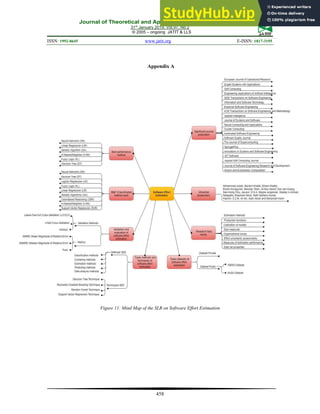
![Journal of Theoretical and Applied Information Technology
31st
January 2019. Vol.97. No 2
© 2005 – ongoing JATIT & LLS
ISSN: 1992-8645 www.jatit.org E-ISSN: 1817-3195
459
Appendix B
Table 4: The list Of primary studies
Year Ref. Publications Dataset Evaluation Methods Method
2000 [116] Information and
Software Technology
COCOMO and Kemerer - Neural network (NN); Genetic
2001 [154] Information and
Software Technology
38 under-graduate computer
science
students
- -
[155] Information and
Software Technology
Desharnais and ASMA
(Australian Software Metrics
Association)
AMSE, MMRE,
BMMRE, PRED (25)
Case-based reasoning (CBR); Genetic
programming (GP); Neural networks (NN)
2002 [124] Information and
Software Technology
The IBM DP, Kemerer, and
Hallmark data set
MAPE Artificial neural network; Regression models
2003 [156] Systems and Software medical records information MMRE Expert judgment; Least squares regression
(LSR); Case-based reasoning (CBR)
2005 [157] Information and
Software Technology
COCOMO RMSRE, PRED (25) Fuzzy logic
2006 [117] Soft Computing COCOMO81 PRED (25) Neural networks (NN); Fuzzy logic
[122] Information and
Software Technology
ISBSG and the IBM DP MMRE, MdMRE, PRED
(25)
Unweighted analogy (UA) ; Unequally
weighted analogy (UWA); Linearly weighted
analogy (LWA); Nonlinearly weighted
analogy (NWA); Genetic algorithm; CART;
ANN; Ordinary least square (OLS)
2007 [158] Systems and Software web-based database system MMRE Expert judgment
[111] Empirical Software
Engineering
USP05-FT, USP05-RQ,
ISBSG04, KEM87, Mends03,
Leung02
MMRE, MdMRE, PRED
(25)
Case-based reasoning (CBR); Collaborative
Filtering; AQUA
2008 [89] Systems and Software COCOMO81 MMRE, MdMRE, Fuzzy logic ;Linear regression
[123] European Journal of
Operational Research
COCOMO and Albrecht MMRE, PRED (25) Grey relational analysis (GRA); Genetic;
case- based reasoning (CBR); classification
and regression trees (CART); artificial neural
networks (ANN)
[159] Empirical Software
Engineering
USP05-FT and USP05-RQ,
ISBSG04, Mends03,
Kemerer87, and Desharnais89
MMRE, MdMRE, PRED
(25)
Rough set analysis; AQUA
[86] Information and
Software Technology
ISBSG MMRE, MdMRE, PRED
(25)
Ordinary least square (OLS)
[160] Information and
Software Technology
COCOMO RMSRE, PRED (10),
PRED (25)
Fuzzy logic
2009 [161] Expert Systems with
Applications
NASA MMRE, PRED (25) Multiple additive regression trees (MART);
Classification and regression trees (CART)
[48] Applied Intelligence COCOMO AND COCOMO II MMRE, PRED (25) Fuzzy logic; Artificial neural network (ANN);
Fuzzy neural network
2010 [162] Information and
Software Technology
Historical dataset - Human judgment
[43] Empirical Software
Engineering
ISBSG, COCOMO’81,
Desharnais, The IBM DP,
Kemerer
MRE, MMRE, MdMRE,
MMER, PRED (25)
Grey relational analysis (GRA);Fuzzy set
theory; Case-based reasoning (CBR);
Artificial Neural network (ANN); Multi linear
regression (MLR)
[27] Expert Systems with
Applications
Exercise Stress Testing (EST)
dataset
- Genetic algorithm; Support vector machine
(SVM); Exercise stress testing
[16] Information and
Software Technology
Desharnais, NASA, COCOMO,
Albrecht, Kemerer and Koten
and Gray
MMRE, PRED (25) Genetic algorithms; Support vector regression
(SVR); Multi layer perceptron (MLP) ANN;
M5P (Decision Tree)
[115] Information and
Software Technology
COCOMO RMSRE, PRED (10),
PRED (25)
Fuzzy logic
2011 [11] Systems and Software COCOMO, Desharnias,
kemerer, Albrecht
MMRE, MdMRE, PRED
(25)
Fuzzy numbers; Case-based reasoning (CBR);
Stepwise Regression (SR)
[103] Software Quality
Journal
Promise (COCOMO_v1,
COC’81, Desharnais_1_1,
NASA93) and SoftLab (sdr05,
sdr06, sdr07)
MRE, MMRE, MdMRE,
PRED (25)
Linear discrimination; K-nearest
neighborhood (k-NN); Decision tree (DT)
[163] Software Quality
Journal
Desharnais, ISBSG,
COCOMO, Kemerer
MMRE, PRED (25) Grey relational analysis (GRA)
[93] Expert Systems with
Applications
Desharnais, Albrecht,
COCOMONASA,
COCOMO’81, Kemerer
MMRE, PRED (25) Grey relational analysis (GRA)](https://image.slidesharecdn.com/asystematicliteraturereviewonmethodsforsoftwareeffortestimation-230805170018-c2df8d74/85/A-Systematic-Literature-Review-On-Methods-For-Software-Effort-Estimation-26-320.jpg)
![Journal of Theoretical and Applied Information Technology
31st
January 2019. Vol.97. No 2
© 2005 – ongoing JATIT & LLS
ISSN: 1992-8645 www.jatit.org E-ISSN: 1817-3195
460
Year Ref. Publications Dataset Evaluation Methods Method
2012 [129] IEEE Transactions on
Software Engineering
Desharnais, Albrecht, finnish,
NASA93, COCOMO’81,
Kemerer, sdr, Maxwell,
miyazaki94, telecom, china
MRE, MER, MMRE,
PRED (25), MBRE,
MIBRE
Regression trees (RT); Support vector
machines (SVM); NN; K-nearest
neighborhood (k-NN)
[13] IET Software Desharnais, Maxwell MMRE, PRED (25) Artificial neural networks; Fuzzy; Analogy
based-estimation (ABE); Classification and
regression trees (CART); Stepwise regression
(SWR); Multiple linear regression (MLR);
ABE with MS function and inverse distance
weighted mean solution function (ABEMA);
ABE with ES function and inverse distance
weighted mean solution function (ABEI);
ABE with ES function and mean solution
function (ABEM)
[164] Empirical Software
Engineering
ISBSG MER, MMER Neural network (NN); General regression
neural network
[6] IEEE Transactions on
Software Engineering
the Experience, ESA, ISBSG,
and Euroclear data
MRE, MMRE, MdMRE,
PRED (25)
Ordinary least square (OLS)
[165] Empirical Software
Engineering
Maxwell, Desharnias,
COCOMO’81, Kemerer,
Albrecht, Telecom, China
MMRE Mean of closest effort (M); Weighted mean of
closest effort (WM); Single size feature
adaptation (SS); Multiple size feature
adaptation (MS); AQUA; Regression
Towards the mean (RTM); Genetic algorithm;
Neural network (NN)
2013 [20] Information and
Software Technology
ISBSG,
COCOMO81,NASA93, NASA,
sdr, desharnais
MMRE, PRED (25) Bagging; Regression tree (RT)
[2] Engineering
Applications of
Artificial Intelligence
ISBSG, Maxwell and
COCOMO
MRE, MMRE, MdMRE,
BMMRE, PRED (25)
Analogy based estimation (ABE); CART;
Multi linear regression (MLR); Artificial
neural networks (ANN); Genetic algorithm;
Grey relational analysis (GRA); C-means;
localized multi-estimator (LMES); stepwise
regression (SWR); PSO
[137] Empirical Software
Engineering
Albrecht, China, Desharnais1,
Desharnais2, Desharnais3,
Finnish, Kemerer, MaxwellA2,
MaxwellA3, MaxwellS2,
MaxwellT1, Miyazaki,
Telecom
MRE, MMRE, PRED
(25), MdAR, MAR
Support vector regression (SVR); Tabu search
[3] The Journal of
Supercomputing
Miyazaki, Derhanais MMRE, MdMRE, PRED
(25)
Case-based reasoning (CBR)
[166] Systems and Software Telecom, Kemerer,
COCOMO’81, Desharnias,
Albrecht, NASA93, Maxwell,
sdr, Miyazaki, Finnish, China
- Calculate bias and variance
[109] ACM Transactions on
Software Engineering
and Methodology
ISBSG MMRE, PRED (25), LSD Multi layer perceptron (MLP) NN; Pareto
ensemble
[71] Information and
Software Technology
ISBSG R9 MMRE, MdMRE, PRED
(25), PRED (50), MMER,
BMMRE
Least squares regression (LSR); Fuzzy
[113] IEEE Transactions on
Software Engineering
Albrecht, China, Desharnais1,
Desharnais2, Desharnais3,
Finnish, Kemerer, Maxwell,
Miyazaki, NASA93_1,
NASA93_2, NASA93_3,
COCOMO’81e,
COCOMO’81o, COCOMO’81s
MRE, MAR, PRED(25),
MBRE, MIBRE, MMER
K-nearest neighborhood (k-NN)
[90] Empirical Software
Engineering
ISBSG R9, Bank and Stock
data sets that are collected from
financial companies,
Desharnais
MMRE, MdMRE,
PREDMRE (25)
PREMMRE (50),
BMMRE
Least trimmed squares; Cook’s distance; K-
means clustering; Box plot, and Mantel
leverage metric; Least squares regression
(LSR); Analogy Based Estimation (ABE)
[167] Automated Software
Engineering
Albrecht, China, Desharnais1,
Desharnais2, Desharnais3,
Finnish, Kemerer, Maxwell,
Miyazaki94, NASA93_1,
NASA93_2, NASA93_3,
COCOMO’81e,
COCOMO’81o,
COCOMO’81s, Finnish,
telecom, china
RE, MRE, MER, MMRE,
MdMRE, PRED (25),
MBRE, MIBRE
Linear regression; Classification and
regression trees (CART); Neural networks
(NN)
[128] Software Quality
Journal
IBM data processing services
(DPS) organization, Canadian
financial
(CF) organization, ISBSG
RE, MRE, MMRE, PRED
(25)
K-nearest neighborhood (k-NN); stepwise
regression (SWR); multiple regression
(MLR); CART; Analogy based Estimation
(ABE); artificial neural network (ANN)
2014 [31] Empirical Software
Engineering
ISBSG, COCOMO’81 RE, MRE, MMRE, PRED
(25)
Analogy Based Estimation(ABE) ; CART;
ANN; SWR; MLR.
[94] Applied Soft
Computing Journal
ISBSG R11 AR, MAR, MdAR Radial Basis Function Neural Network;
General regression neural network;](https://image.slidesharecdn.com/asystematicliteraturereviewonmethodsforsoftwareeffortestimation-230805170018-c2df8d74/85/A-Systematic-Literature-Review-On-Methods-For-Software-Effort-Estimation-27-320.jpg)
![Journal of Theoretical and Applied Information Technology
31st
January 2019. Vol.97. No 2
© 2005 – ongoing JATIT & LLS
ISSN: 1992-8645 www.jatit.org E-ISSN: 1817-3195
461
Year Ref. Publications Dataset Evaluation Methods Method
Feedforward multilayer perceptron (MLP);
Statistical regression
2015 [168] Neural Computing and
Applications
Albrecht, China, Desharnais1,
Desharnais2, Desharnais3,
Finnish, Kemerer, Maxwell,
Miyazaki, NASA, COCOMO,
COCOMO’81e,
COCOMO’81o,
COCOMO’81s, Telecom,
ISBSG
SA, BRE, IBRE, MBRE,
MIBRE
Analogy Based Estimation (ABE): Genetic
algorithm; AQUA; Regression toward the
mean (RTM); linear size extrapolation (LSE).
[14] SpringerPlus Poznan University of
Technology dataset
MMRE, PRED (25), MSE Analytical programming; Differential
evolution generate regression functions
[169] IET Software Albrecht, COCOMO,
Desharnais, NASA
MSE, MMRE, PRE (100),
PRED (75), PRED (50),
PRED (25)
Random forest (RF)
[170] Systems and Software 423 software professionals from
Romania, Ukraine, Argentina
and Poland
- Anchoring effects; Numerical preciseness
[35] Innovations in Systems
and Software
Engineering
ISBSG RE, MRE, MMRE, PRED
(25)
Analogy Based Estimation (ABE)
[69] IET Software ISBSG MRE, MMRE, PRED
(25)
Analogy Based Estimation (ABE); Classified;
); stepwise regression (SWR); multiple
regression (MLR); CART; artificial neural
network (ANN)
[114] Empirical Software
Engineering
Tuku, NASA, COCOMO,
NASA93, Desharnias, Finnish,
Kemerer, Maxwell
AE, MRE, MER, MMRE,
MdMRE, PRED (25),
MBRE, MIBRE, SA
K-nearest neighborhood (k-NN)
[171] Information and
Software Technology
ISBSG, CSBSG MAR, BREM Linear regression; Bayesian regression;
Support Vector Regression (SVR)
2016 [172] Systems and Software online survey with 77 software
professionals from Norway
- Judgment bias
[173] Empirical Software
Engineering
COCOMO - COCOMO ; Classification and regression
trees (CART); Nearest neighbor
[70] Applied Soft
Computing Journal
Historical dataset1, dataset2,
dataset3
AE, MAE, MBRE, SA Use Case Points (UCP); Radial basis neural
networks; Support vector machine (SVM)
[110] Neural Computing and
Applications
ISBSG MR, MAR Neural network (NN); Multilayer perceptron
(MLP); General regression neural network
(GRNN); Radial basis function neural
network (RBFNN); Cascade correlation
neural network
[51] Applied Soft
Computing Journal
ISBSG, Albrecht,
COCOMO81, China dataset,
Desharnais, Kemerer, and
Miyazaki
MAE, MIBRE, MBRE,
LSD, SA, PRED (25)
Fuzzy logic
[174] IET Software COCOMO, Derharnais,
Albrecht
MMRE, PRED (25) Genetic; Multilayer perceptron (MLP);
Artificial neural network; SVR; Decision tree
(M5P);
[82] Systems and Software ISBSG repository (release 8),
COCOMO81, Desharnais,
Maxwell, Miyazaki, China and
Albrecht
- K-nearest neighborhood (k-NN)
[175] Applied Soft
Computing Journal
COCOMO NASA - Bayesian belief network; Genetic; Fuzzy
numbers
2017 [176] Soft Computing Albrecht, COCOMO’81, China,
Desharnais, ISBSG, Kemerer,
Miyazaki
AE, MRE, MMRE, PRED
(25), MBRE, MIBRE,
MAE, LSD, SA, ∆
K-nearest neighbor (k-NN); Support vector
regression (SVR); Multilayer perceptron
(MLP); Decision trees (DT)
[177] Journal of Software
Engineering Research
and Development
ISBSG R12 MdMRE, MMAR, SA,
PRED (25)
Genetic; Gaussian Processes (GP); Least
MedSq (LMS); LinearRegression (LR);
MultilayerPerceptron (MP); RBFNetwork
(RBFN; SMOreg (SMO); AdditiveRegression
(AR); Bagging (BAG); ConjunctiveRule
(CR); DecisionTable (DT); M5Rules (M5R);
ZeroR (ZR); DecisionStump (DS); M5P
(M5P); REPTree (RT)
[41] Systems and Software ISBSG ME, MAE, MSE, RMSE,
MMRE, MMER, MBRE,
PRED (25), PRED (30)
Support vector machines (SVM); Multi-Layer
Perceptron Artificial Neural Network (MLP-
ANN); Generalized linear models (GLM)
[112] Soft Computing Maxwell, Desharnais MMRE, PRED (25),
MdMRE
Case-based reasoning (CBR)
[178] Expert Systems with
Applications
Albrecht, COCOMO,
Desharnais, Kemerer,
KotenGray, NASA
MMRE, PRED (25) Multilayer perceptrons (MLP); linear
regression (LR); logistic regression;
Morphological rank linear neural network,
Radial basis function; Regression tree (RT);
support vector regression (SVR).
[179] Information and
Software Technology
ISBSG, Finnish MAE Linear Regression](https://image.slidesharecdn.com/asystematicliteraturereviewonmethodsforsoftwareeffortestimation-230805170018-c2df8d74/85/A-Systematic-Literature-Review-On-Methods-For-Software-Effort-Estimation-28-320.jpg)
![Journal of Theoretical and Applied Information Technology
31st
January 2019. Vol.97. No 2
© 2005 – ongoing JATIT & LLS
ISSN: 1992-8645 www.jatit.org E-ISSN: 1817-3195
462
Year Ref. Publications Dataset Evaluation Methods Method
[10] Engineering
Applications of
Artificial Intelligence
ISBSG R11, Kemerer RE, MRE, MMRE, PRED
(25)
OABE; Classification and regression trees
(CART); SWR; Artificial neural network
(ANN); Fuzzy inference system; Non linear
adjustment to ABE (NABE); Multiple linear
regression (MLR); PSO; SBO
[36] Cluster Computing NASA 93, NASA 60,
COCOMO81, Deshnaris
MMRE, MRE, PRED
(25)
Artificial neural network (ANN); Fuzzy logic;
Case-based reasoning (CBR)
[180] Swarm and
Evolutionary
Computation
Desharnais, NASA, COCOMO,
China, Maxwell, Albrecht
MMRE, PRED (25),
MdMRE, SA, ∆
Analogy Based Estimation (ABE); K-nearest
neighborhood (k-NN); genetic
[58] Systems and Software 160 tasks from real agile project MMRE, MRE, MAE,
RMSE, RAE, RRSE
Bayesian Network
[181] Innovations in Systems
and Software
Engineering
Dataset of 21 software projects
developed by six number of
software houses
MAE, MMER, PRED
(25)
Decision tree (DT); Random forest;
Stochastic gradient boosting
[182] Information and
Software Technology
Albrecht, China, Kitchenham,
Kemerer, Maxwell, NASA93,
COCOMO’81
MRE, PRED (25) AdaBoost and Classification And Regression
Tree (ABCART)
[19] Empirical Software
Engineering
Albrecht, China, Desharnais,
Finnish, Kemerer, Maxwell,
Miyazaki94, NASA93-c1,
NASA93-c2, NASA93-c5,
COCOMO’81, COCOMO-sdr
MAR, MdAR, SD, LSD,
RSD
Case-based reasoning (CBR); Analogy based
effort estimation (ABE);AQUA; Multiple size
adaptation (MSA); Linear size adaptation
(LSA); Regression towards the mean (RTM);
Unweighted mean of the k analogues
(UAVG); Inverse-rank weighted mean of the
k analogues (IRWM); Genetic; Neural
network (NN)
[118] IET Software 234 projects from previous
studies, 110 projects developed
from information systems
projects such as chains of
hotels, multi-branch universities
and multi-warehouse book
stores, and 71 projects
developed for different
governmental and commercial
sectors
AE, MAE, MBRE,
MIBRE, SA, ∆
Use case points (UCP); Neural network;
ANFIS; Support vector regression (SVR)](https://image.slidesharecdn.com/asystematicliteraturereviewonmethodsforsoftwareeffortestimation-230805170018-c2df8d74/85/A-Systematic-Literature-Review-On-Methods-For-Software-Effort-Estimation-29-320.jpg)
![Journal of Theoretical and Applied Information Technology
31st
January 2019. Vol.97. No 2
© 2005 – ongoing JATIT & LLS
ISSN: 1992-8645 www.jatit.org E-ISSN: 1817-3195
463
Appendix C
Table 5: The list Of Accuracy Values
ID Dataset
MMRE
(%)
PRED
(25) (%)
MdMRE
(%)
ID Dataset
MMR
E (%)
PRED (25)
(%)
MdMRE
(%)
CBR
[111] Mends03 25 76.47 - [11] Desharnais 38.2 42.9 30.8
[112] Derharnais 36 33 40 [11] Albrecht 63.5 33.3 38.9
[112] Maxwell 28 67 19 [11] Kemerer 63.8 40 33.33
[156] Medical records 54 - - [43] ISBSG 53 41.1 36
[11] ISBSG 52.32 42.71 30.23 [43] Desharnais 38.2 42.9 30.8
[11] COCOMO 47.3 35 33.8 [43] COCOMO81 29 51.67 25
[123] COCOMO 446 12 - [43] Kemerer 59.6 40 40.9
[123] Albrecht 58 39 - [43] Albrecht 64 33.3 38.9
NN
[155] Desharnais 59.23 56 - [109] Desharnais 49.86 33.33 -
[48] COCOMO81-1 38 33 41 [109] NASA93 178.66 19.70 -
[48] COCOMO81-2 44 43 30 [109] ISBSG 203.17 17.44 -
[48] COCOMO81-3 29 43 28 [2] COCOMO 75 29 64
[48] COCOMO81 37 40 28 [2] ISBSG 122 17 108
[13] Desharnais 51 33.641 - [2] maxwell 97 28 88
[13] Maxwell 127.27 24.127 - [167] Kemerer - 27 -
[2] ISBSG 122 17 108 [167] DesharnaisL3 - 40 -
[2] Maxwell 97 28 88 [167] NASA93_center_2 - 57 -
[2] COCOMO 75 29 64 [167] NASA93 - 39 -
[41] ISBSG 21 64.65 - [167] COCOMO81s - 18 -
[10] Albrecht 92.5 25 - [167] Albrecht - 42 -
[10] Kemerer 57 40 - [167] Telecom1 - 39 -
[10] ISBSG 100 24.1 - [167] COCOMO81 - 16 -
[10] Albrecht 23.5 62.5 - [167] NASA93_center_5 - 33 -
[10] Kemerer 26.8 60 - [167] DesharnaisL1 - 35 -
[10] ISBSG 49 63.7 - [167] COCOMO81o - 21 -
[16] Desharnais 31.54 72.22 - [167] DerharnaisL2 - 40 -
[16] NASA 19.50 94.44 - [167] COCOMO81e - 7 -
[16] COCOMO 21.94 78.74 - [167] Desharnais - 32 -
[16] Albrecht 68.63 61.67 - [167] Sdr - 29 -
[16] Kemerer 33.49 64 - [167] Miyazaki94 - 25 -
[16] Koten & Gray 12.19 92.94 - [167] Maxwell - 15 -
[117] COCOMO81 - 71 - [167] Finnish - 37 -
[165] Maxwell 182.6 - - [167] NASA93_center_1 33
[165] Desharnais 60.2 - - [167] China - 43 -
[165] COCOMO 158.6 - - [36] Desharnais 72 28.3 -
[165] Kemerer 56.4 - - [36] COCOMO81 143 47.6 -
[165] Albrecht 80.6 - - [36] COCOMONASA60 19 73 -
[165] Telecom 60.3 - - [36] COCOMONASA93 111 34 -
[174] NASA 19.50 94.44 - [165] China 54.3 - -
[174] Desharnais 31.54 72.22 - [43] ISBSG 9.5 44.9 29.5
[174] Albrecht 68.63 61.67 - [43] Desharnais 61.2 44 42.1
[122] IBM DP 104 17 51 [43] COCOMO81 55.5 50 42.2
[122] ISBSG 170 12 94 [43] Kemerer 47.9 50 37.6
[109] COCOMO81 279.14 13 - [43] Albrecht 79.6 25 52.6
[109] Sdr 192.54 14.44 - [123] COCOMO 143 11 -
[109] NASA 108.05 42.67 - [123] Albrecht 86 21 -
[128] DPS 90 22 - [178] Albrecht 14.84 95.83 -
[128] CF 70 10 - [178] COCOMO 10.96 89.9 -
[128] ISBSG 96 22 - [178] Desharnais 15.28 83.48 -
[178] Kemerer 45.81 40 -
[178] Kotengray 46.99 47.05 -
[178] NASA 15.38 77.77 -
LiR
[89] Gathered 26 67 13 [11] Kemerer 161.73 6.7 74.88
[165] Maxwell 48.2 - - [43] COCOMO81 130.2 25 58.9
[165] Desharnais 47.2 - - [43] Kemerer 54.3 46.7 39.7
[165] COCOMO 58.5 - - [43] Albrecht 59.3 20.8 47.1
[165] Kemerer 81.4 - - [2] COCOMO 154 15 131
[165] Albrecht 71.4 - - [2] ISBSG 149 12 113
[165] Telecom - - - [2] maxwell 108 23 97
[165] China 77.7 - - [13] Desharnais 54 33.641 -
[167] COCOMO 81 78 76 [13] Maxwell 196.07 16.11 -
[43] ISBSG 33.2 48.6 26.5 [10] Albrecht 101 25 -
[43] Desharnais 39.9 42 38.2 [10] Kemerer 71 20 -
[11] ISBSG 48.75 36.80 38.29 [10] ISBSG 89.1 23.4 -
[11] COCOMO 96.6 23.1 82.4 [128] DPS 73 30 -
[11] Desharnasi 34.6 45.5 28.6 [128] CF 98 27 -
[11] Albrecht 61.24 37.5 32.3 [128] ISBSG 132 16 -](https://image.slidesharecdn.com/asystematicliteraturereviewonmethodsforsoftwareeffortestimation-230805170018-c2df8d74/85/A-Systematic-Literature-Review-On-Methods-For-Software-Effort-Estimation-30-320.jpg)
![Journal of Theoretical and Applied Information Technology
31st
January 2019. Vol.97. No 2
© 2005 – ongoing JATIT & LLS
ISSN: 1992-8645 www.jatit.org E-ISSN: 1817-3195
464
ID Dataset
MMRE
(%)
PRED
(25) (%)
MdMRE
(%)
ID Dataset
MMR
E (%)
PRED (25)
(%)
MdMRE
(%)
[178] Albrecht 9.25 95.83 -
[178] COCOMO 11.33 94 -
[178] Desharnais 9.58 91.69 -
[178] Kemerer 18.75 73.33 -
[178] Kotengray 20.8 76.47 -
[178] NASA 18.07 77.77 -
Fuzzy
[89] Gathered 23 67 18 [10] Kemerer 26.8 60 -
[157] COCOMO - 70.59 - [10] ISBSG 49 63.7 -
[48] COCOMO81-1 24 86 10 [11] ISBSG 28.55 59.80 17.80
[48] COCOMO81-2 22 71 15 [11] COCOMO 33.37 62.33 20.36
[48] COCOMO81-3 21 67 12 [11] Desharnais 26.89 64.94 19.32
[48] COCOMO81 22 75 12 [11] Albrecht 50.08 50 30.75
[43] ISBSG 33.3 55.2 22 [11] Kemerer 55.65 53.33 24.24
[43] Desharnais 30.6 64.7 17.5 [36] Desharnais 4.10 79.63 -
[43] COCOMO81 23.2 66.7 14.8 [36] COCOMO81 15.6 81 -
[43] Kemerer 36.2 52.9 33.2 [36] COCOMONASA60 7.81 85.5 -
[43] Albrecht 51.1 48.6 38 [36] COCOMONASA93 5.62 88.25 -
[117] COCOMO81 - 71 - [160] COCOMO - 45.7 -
[10] Albrecht 23.5 62.5 - [115] COCOMO - 97.35 -
GA
[165] Maxwell 159.7 - - [180] Albrecht 1.8 25 1.8
[165] Desharnais 56.7 - - [180] China 10 16.7 10
[165] COCOMO 76.3 - - [180] COCOMO81 9.7 73.5 9.8
[165] Kemerer 33.7 - - [180] NASA93 0.9 11.8 0.9
[165] Albrecht 55.8 - - [2] COCOMO 62 41 50
[165] Telecom 53.1 - - [2] ISBSG 69 28 55
[165] China 53.2 - - [2] maxwell 81 31 76
SVM
[41] ISBSG 13 76.91 -
GRA
[43] ISBSG 33.3 55.2 22 [163] Desharnais 36 57.1 -
[43] Desharnais 30.6 64.7 17.5 [163] ISBSG 269.3 19.2 -
[43] COCOMO81 23.2 66.7 14.8 [123] COCOMO 69 38 -
[43] Kemerer 36.2 52.9 33.2 [123] Albrecht 31 48 -
[43] Albrecht 51.1 48.6 38 [93] Albrecht 66.2 42.1 26.7
[2] COCOMO 41 53 36 [93] COCOMONASA 29.5 58.3 18.1
[2] ISBSG 41 49 33 [93] COCOMO81 59.5 30.2 55.6
[2] maxwell 59 50 50 [93] Desharnais 49.75 45.5 29.8
[163] Kemerer 65.3 20 - [93] Kemerer 47.8 53.3 23.2
[163] COCOMO 86.5 14.2 -
k-NN
[103] COCOMO81 189 33 183 [180] Albrecht 2 37.5 1.9
[103] COCOMONASA_V1 69 42 45 [180] China 6.8 57.3 3.9
[103] Desharnais_1_1 13 84.14 12 [180] COCOMO81 5 81.6 4.2
[103] NASA93 69 55.5 52 [180] NASA93 7.4 15.7 1.8
[103] Sdr05 45 45.5 28 [128] DPS 26 62 -
[103] Sdr06 30 50.5 31 [128] CF 38 69 -
[103] Sdr07 14 81.33 13 [128] ISBSG 64 51 -
‘‘+’’ means combining data sets, ‘‘-’’ means not applicable
mean of accuracy values.
accuracy value under optimal model configuration](https://image.slidesharecdn.com/asystematicliteraturereviewonmethodsforsoftwareeffortestimation-230805170018-c2df8d74/85/A-Systematic-Literature-Review-On-Methods-For-Software-Effort-Estimation-31-320.jpg)

This document summarizes a systematic literature review on methods for software effort estimation. It identifies 74 relevant studies published between 2000-2017. The studies are classified based on publication channels, research approaches, contribution types, and techniques used. The review finds that eight types of techniques are commonly used for software effort estimation, including expert judgment, regression-based methods, and machine learning methods. It also analyzes factors that impact estimation accuracy, such as dataset quality, feature selection, and parameter optimization. The goal of the review is to provide an overview of the software effort estimation field and techniques used to improve accuracy.


