Group feedback on Africa RISING site level 
accomplishments in 
Endamehoni District, Ethiopia 
Mohammed Ebrahim 
ILRI 
Africa RISING Ethiopia Review and Planning meeting 
Addis Ababa, 2-3 December 2014
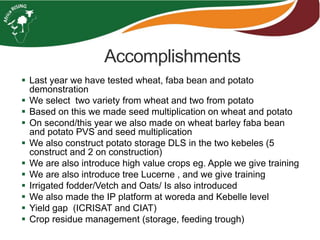
Accomplishments 
 Last year we have tested wheat, faba bean and potato 
demonstration 
 We select two variety from wheat and two from potato 
 Based on this we made seed multiplication on wheat and potato 
 On second/this year we also made on wheat barley faba bean 
and potato PVS and seed multiplication 
 We also construct potato storage DLS in the two kebeles (5 
construct and 2 on construction) 
 We are also introduce high value crops eg. Apple we give training 
 We are also introduce tree Lucerne , and we give training 
 Irrigated fodder/Vetch and Oats/ Is also introduced 
 We also made the IP platform at woreda and Kebelle level 
 Yield gap (ICRISAT and CIAT) 
 Crop residue management (storage, feeding trough)
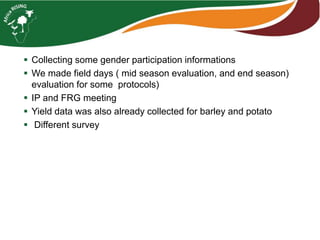
 Collecting some gender participation informations 
 We made field days ( mid season evaluation, and end season) 
evaluation for some protocols) 
 IP and FRG meeting 
 Yield data was also already collected for barley and potato 
 Different survey
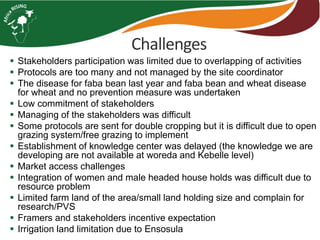
Challenges 
 Stakeholders participation was limited due to overlapping of activities 
 Protocols are too many and not managed by the site coordinator 
 The disease for faba bean last year and faba bean and wheat disease 
for wheat and no prevention measure was undertaken 
 Low commitment of stakeholders 
 Managing of the stakeholders was difficult 
 Some protocols are sent for double cropping but it is difficult due to open 
grazing system/free grazing to implement 
 Establishment of knowledge center was delayed (the knowledge we are 
developing are not available at woreda and Kebelle level) 
 Market access challenges 
 Integration of women and male headed house holds was difficult due to 
resource problem 
 Limited farm land of the area/small land holding size and complain for 
research/PVS 
 Framers and stakeholders incentive expectation 
 Irrigation land limitation due to Ensosula
Partnership and scaling up 
opportunities 
 Establishment of Community based seed multiplication (wheat, 
potato, faba bean) 
 Zonal, woreda and Kebele administrations and BoARD head as we 
as other stakeholders visiting to the fields and create to scaling up to 
other kebeles (potato wheat, faba bean) 
 Undertaken of Field day was also help to scaling up of the 
technologies 
 Value chain information was help to link market issue and create the 
scaling up of the best technologies e.g.. Potato 
 Availability of the research institution as source of improved 
technologies can facilitate the scaling up 
 Farmers interest on the introduced technologies 
 Existence of Innovation plat form system at woreda and Kebelle level
CGIAR Project partners 
Ethiopia
Local partners Ethiopia 
 Academic institutions: 
 Wachemo, Mekelle, Madawolabu, Debre Berhan and Hawassa universities; Maichew Agricultural College 
 Regional research organizations: 
 Amhara Regional Agricultrural Research Institute, Southern Agricultural Research Institute, Tigray Agricultural 
Research Institute, Oromia Agricultural Research Institute 
 Federal research organizations: 
 Ethiopian Institute for Agricultural Research, Ethiopian Health and Nutrition Research Institute 
 Offices of Agriculture: 
 Endamekoni (Tigray), Basona Worena (Amhara), Lemo (SNNRP) and Sinana (Oromia) 
 Agricultural Transformation Agency
Thank You 
Africa Research in Sustainable Intensification for the Next Generation 
africa-rising.net 
The presentation has a Creative Commons licence. You are free to re-use or distribute this work, provided credit is given to ILRI.

Group feedback on Africa RISING site level accomplishments in Endamehoni District, Ethiopia

  • 1.
    Group feedback onAfrica RISING site level accomplishments in Endamehoni District, Ethiopia Mohammed Ebrahim ILRI Africa RISING Ethiopia Review and Planning meeting Addis Ababa, 2-3 December 2014
  • 2.
    Accomplishments  Lastyear we have tested wheat, faba bean and potato demonstration  We select two variety from wheat and two from potato  Based on this we made seed multiplication on wheat and potato  On second/this year we also made on wheat barley faba bean and potato PVS and seed multiplication  We also construct potato storage DLS in the two kebeles (5 construct and 2 on construction)  We are also introduce high value crops eg. Apple we give training  We are also introduce tree Lucerne , and we give training  Irrigated fodder/Vetch and Oats/ Is also introduced  We also made the IP platform at woreda and Kebelle level  Yield gap (ICRISAT and CIAT)  Crop residue management (storage, feeding trough)
  • 3.
     Collecting somegender participation informations  We made field days ( mid season evaluation, and end season) evaluation for some protocols)  IP and FRG meeting  Yield data was also already collected for barley and potato  Different survey
  • 4.
    Challenges  Stakeholdersparticipation was limited due to overlapping of activities  Protocols are too many and not managed by the site coordinator  The disease for faba bean last year and faba bean and wheat disease for wheat and no prevention measure was undertaken  Low commitment of stakeholders  Managing of the stakeholders was difficult  Some protocols are sent for double cropping but it is difficult due to open grazing system/free grazing to implement  Establishment of knowledge center was delayed (the knowledge we are developing are not available at woreda and Kebelle level)  Market access challenges  Integration of women and male headed house holds was difficult due to resource problem  Limited farm land of the area/small land holding size and complain for research/PVS  Framers and stakeholders incentive expectation  Irrigation land limitation due to Ensosula
  • 5.
    Partnership and scalingup opportunities  Establishment of Community based seed multiplication (wheat, potato, faba bean)  Zonal, woreda and Kebele administrations and BoARD head as we as other stakeholders visiting to the fields and create to scaling up to other kebeles (potato wheat, faba bean)  Undertaken of Field day was also help to scaling up of the technologies  Value chain information was help to link market issue and create the scaling up of the best technologies e.g.. Potato  Availability of the research institution as source of improved technologies can facilitate the scaling up  Farmers interest on the introduced technologies  Existence of Innovation plat form system at woreda and Kebelle level
  • 6.
  • 7.
    Local partners Ethiopia  Academic institutions:  Wachemo, Mekelle, Madawolabu, Debre Berhan and Hawassa universities; Maichew Agricultural College  Regional research organizations:  Amhara Regional Agricultrural Research Institute, Southern Agricultural Research Institute, Tigray Agricultural Research Institute, Oromia Agricultural Research Institute  Federal research organizations:  Ethiopian Institute for Agricultural Research, Ethiopian Health and Nutrition Research Institute  Offices of Agriculture:  Endamekoni (Tigray), Basona Worena (Amhara), Lemo (SNNRP) and Sinana (Oromia)  Agricultural Transformation Agency
  • 8.
    Thank You AfricaResearch in Sustainable Intensification for the Next Generation africa-rising.net The presentation has a Creative Commons licence. You are free to re-use or distribute this work, provided credit is given to ILRI.

Editor's Notes