A  research and innovation perspective  on Free and Open Source Software (FOSS) Dr Derek W. Keats dKeats Innovations [trading under of Kenga (Pty) Ltd] http://www.dkeats.com derek@dkeats.com  +27 82 787 0169
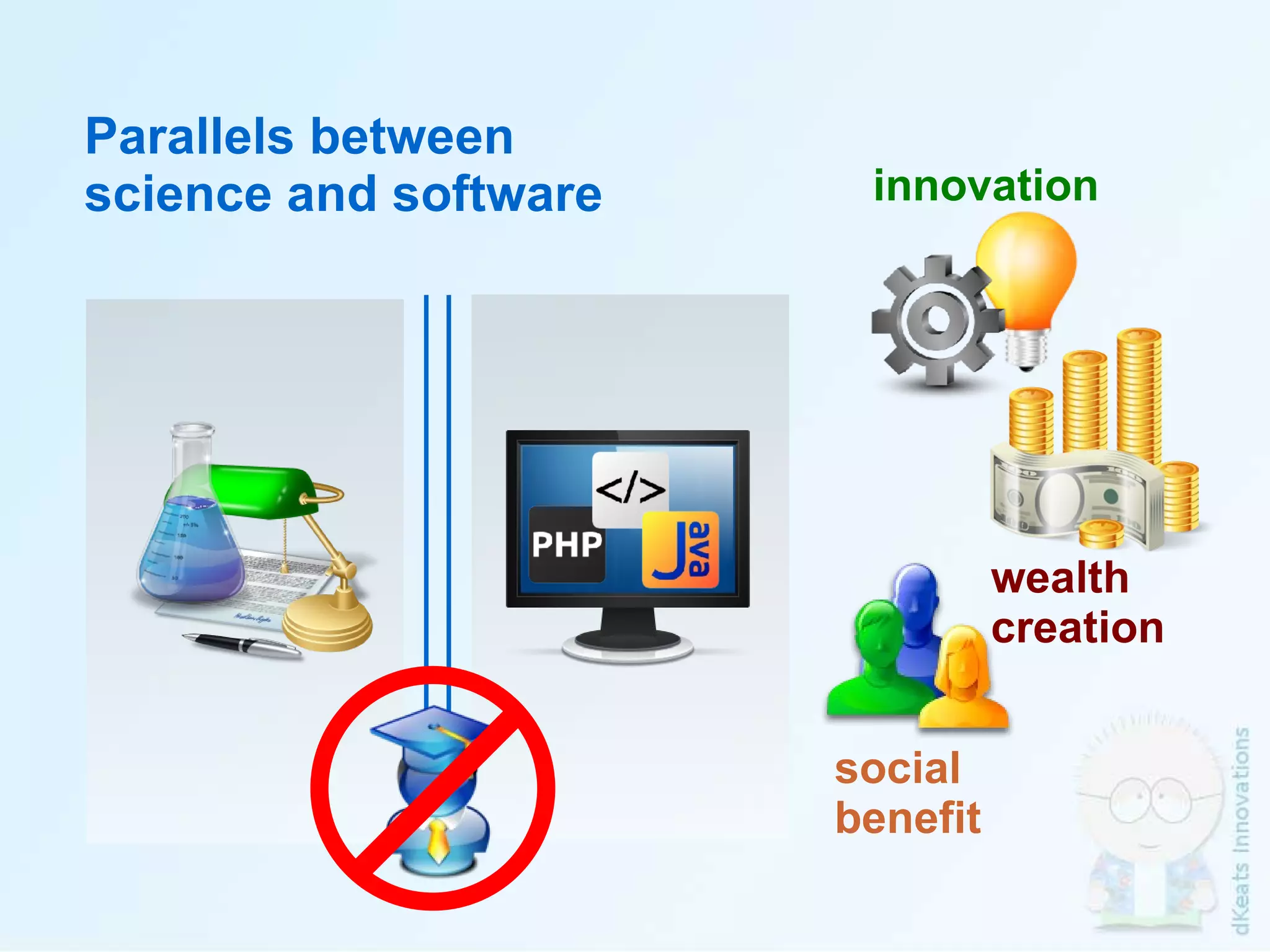
Parallels between  science and software wealth creation innovation social benefit
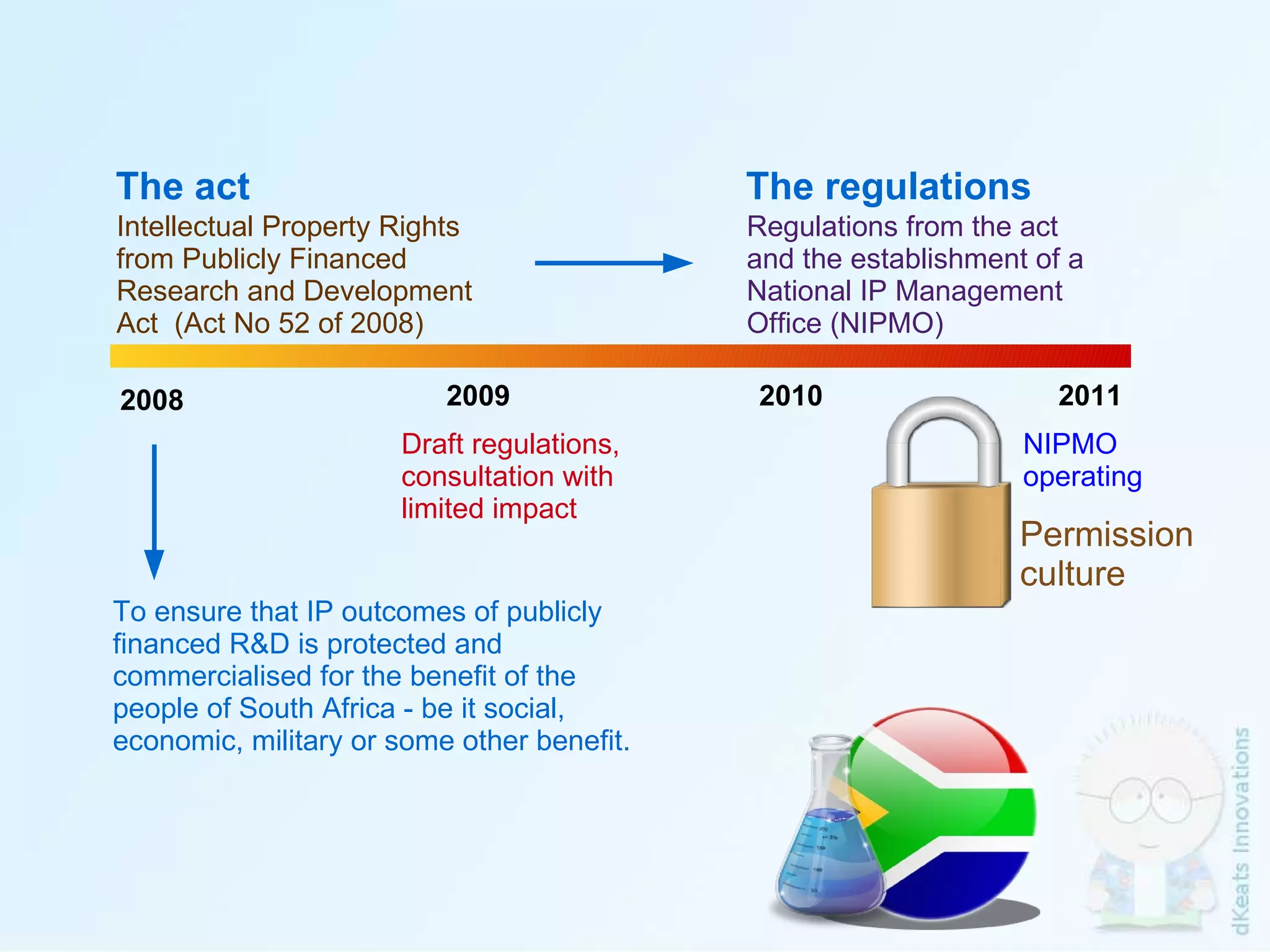
The act 2008 Intellectual Property Rights from Publicly Financed Research and Development Act  (Act No 52 of 2008) 2011 2010 2009 Draft regulations,  consultation with  limited impact NIPMO  operating Permission  culture To ensure that IP outcomes of publicly financed R&D is protected and commercialised for the benefit of the people of South Africa - be it social, economic, military or some other benefit.  The regulations Regulations from the act  and the establishment of a National IP Management  Office (NIPMO)
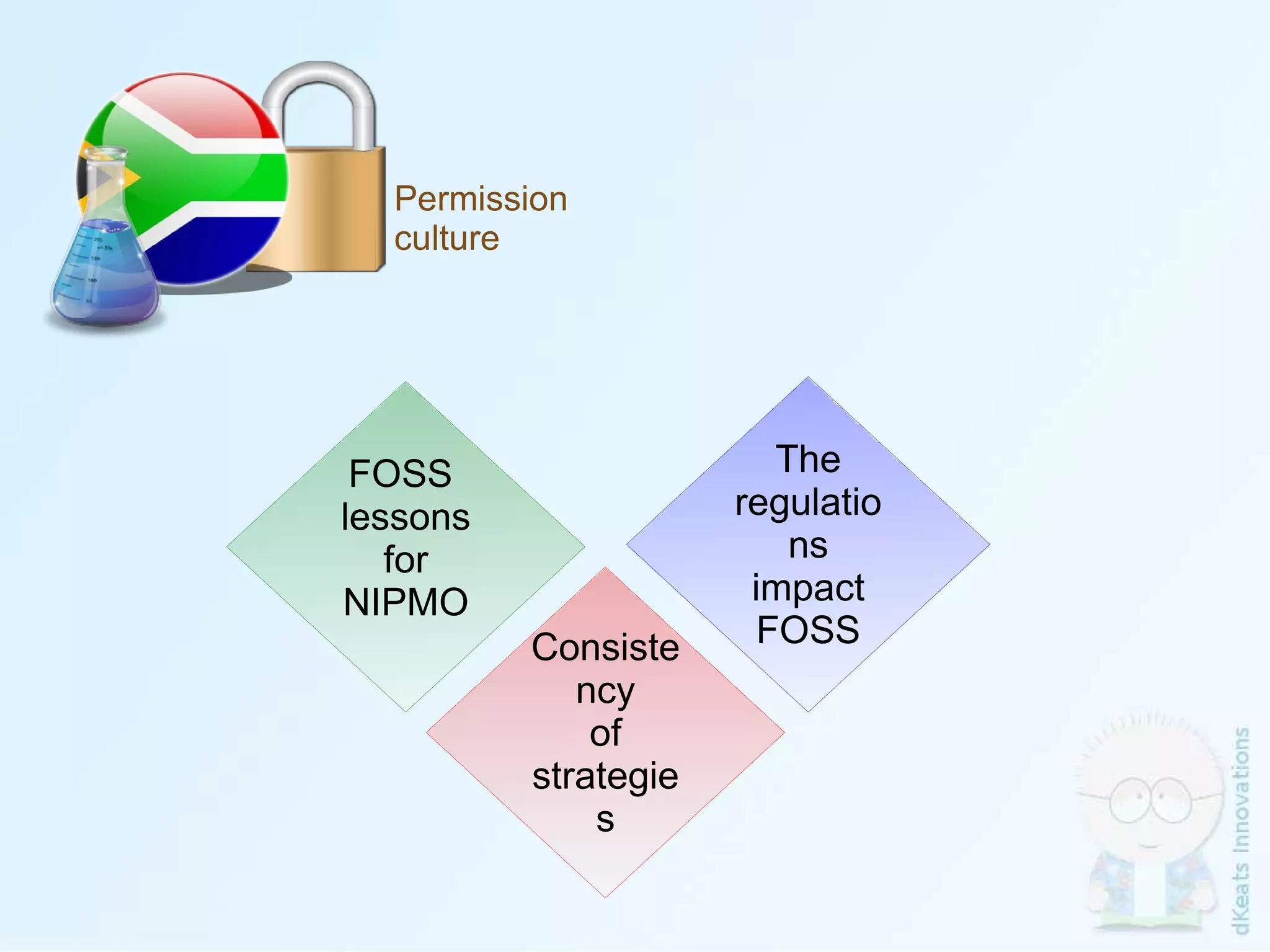
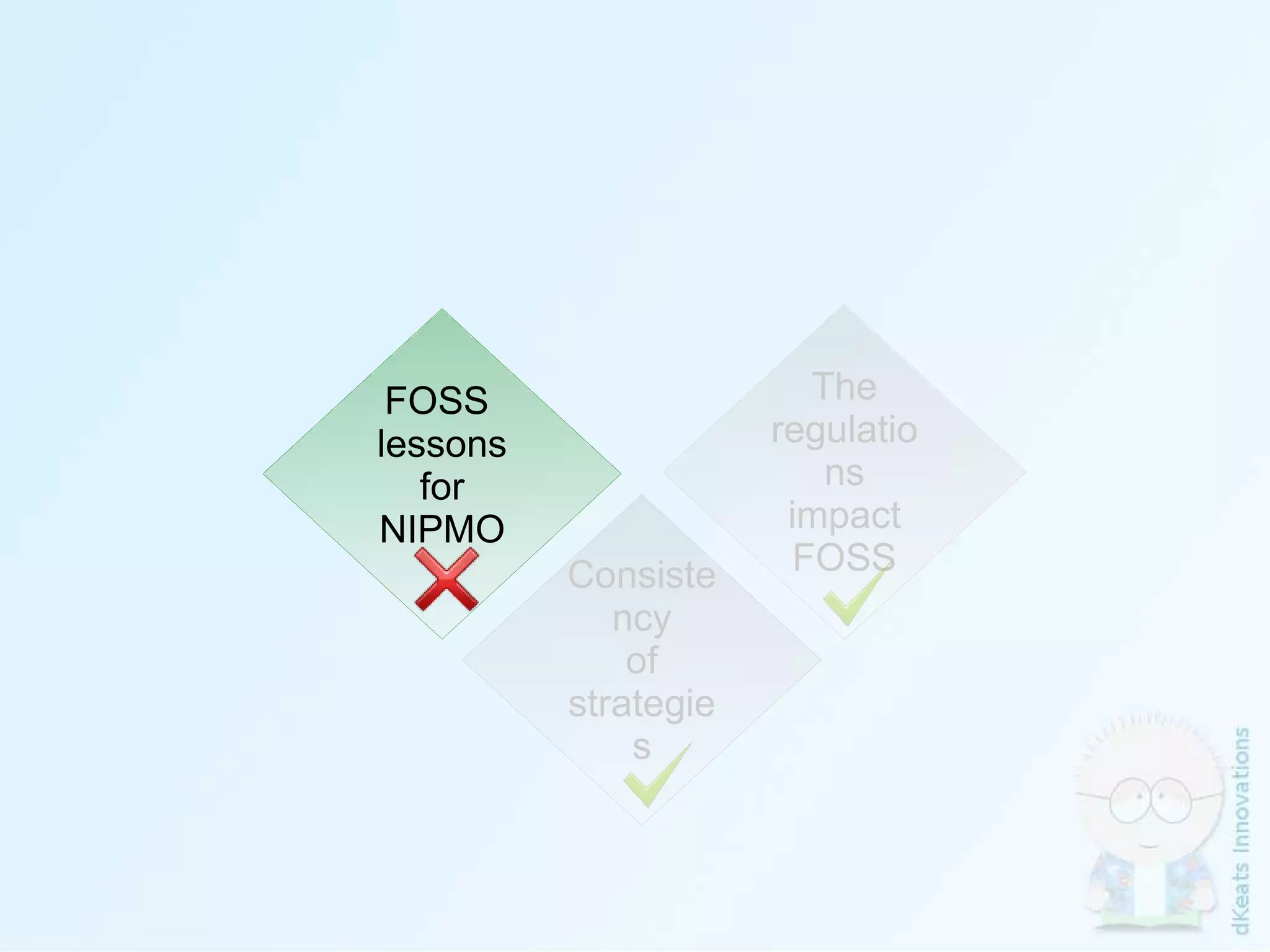
Consistency of strategies The regulations impact FOSS FOSS  lessons for NIPMO Permission  culture
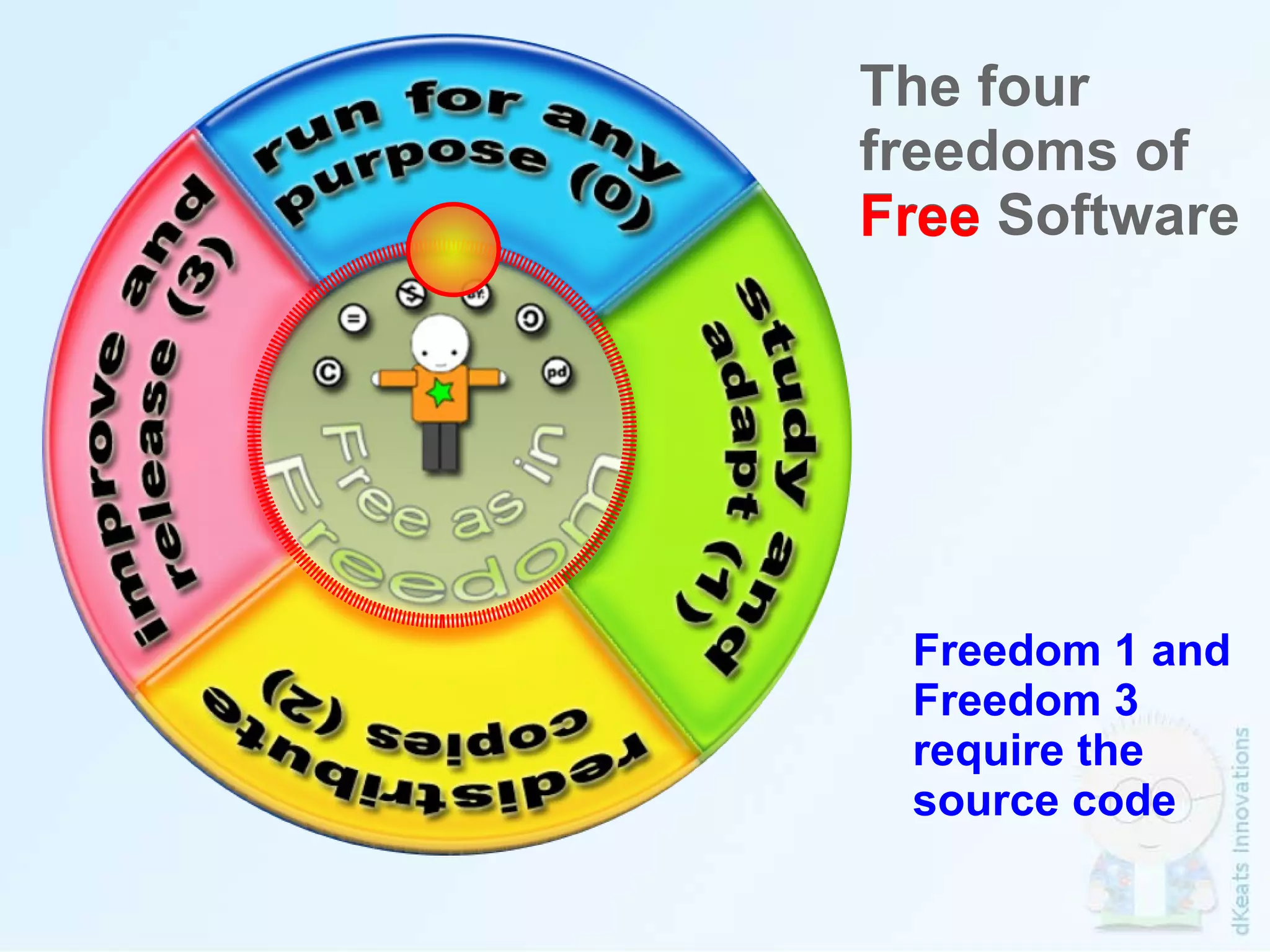
Freedom 1 and Freedom 3 require the source code The four freedoms of  Free Software Open Source Free and  Software (F OS S) Free
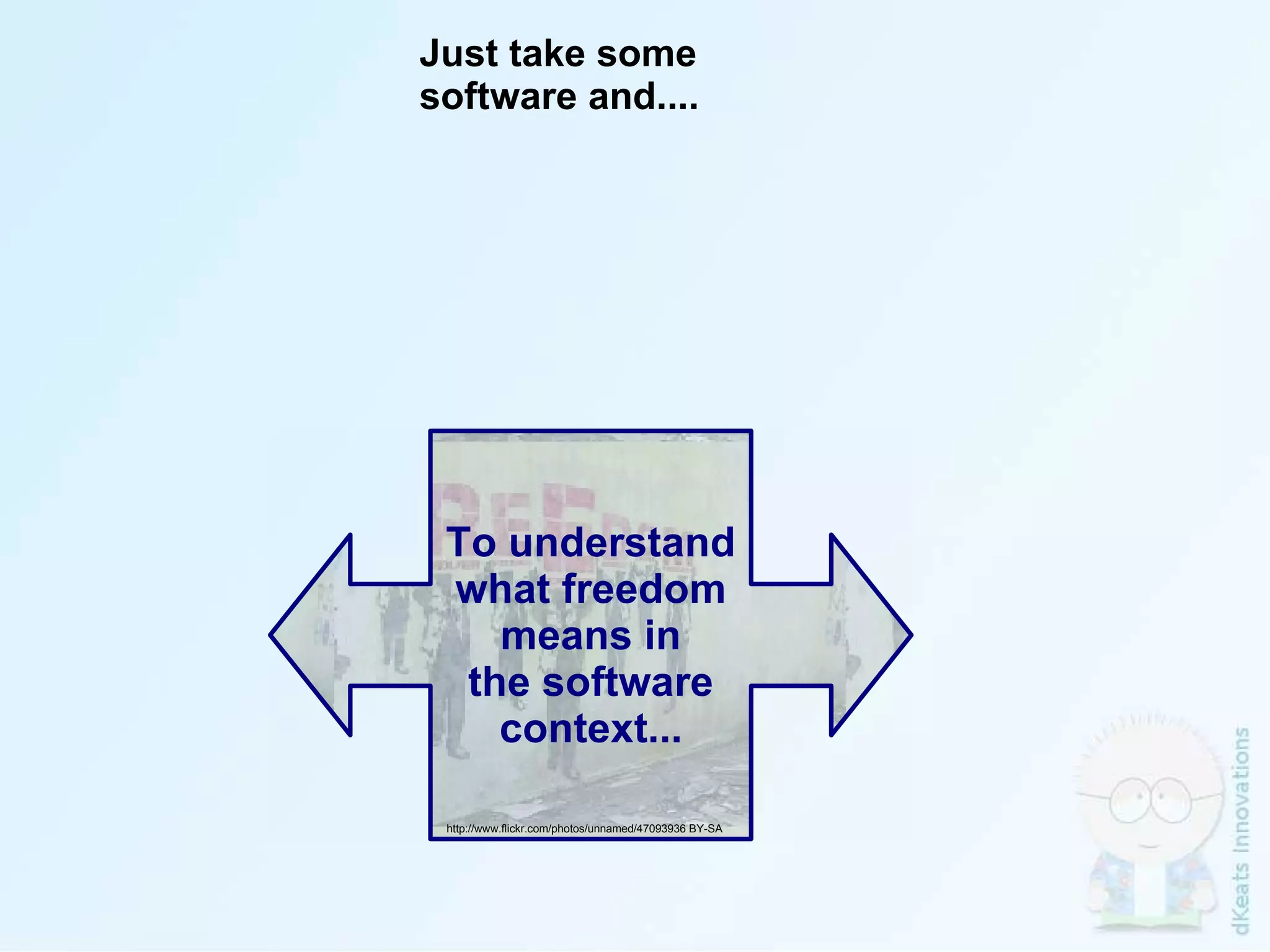
Just take some  software and.... To understand what freedom means in the software context... http://www.flickr.com/photos/unnamed/47093936 BY-SA
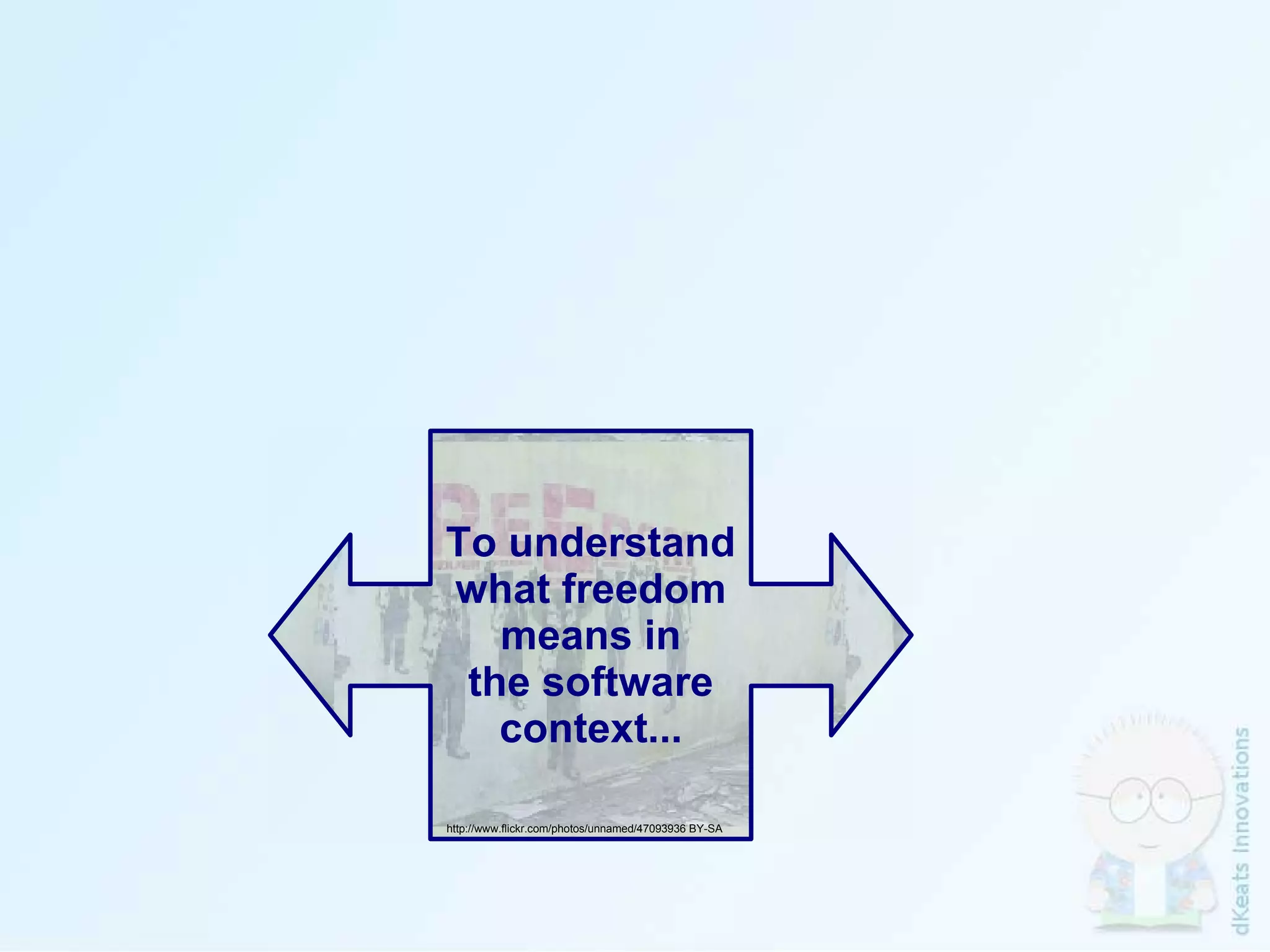
To understand what freedom means in the software context... http://www.flickr.com/photos/unnamed/47093936 BY-SA
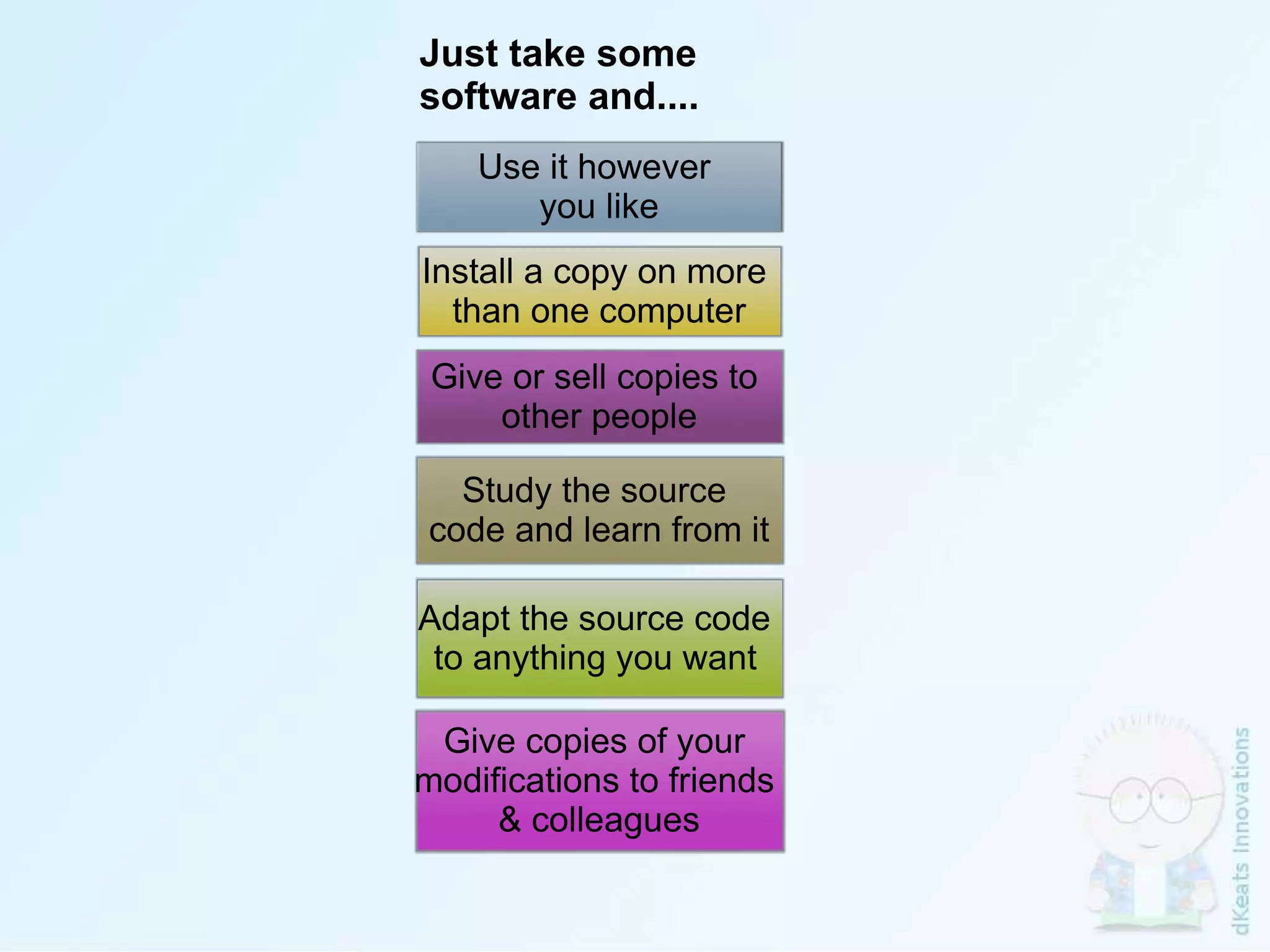
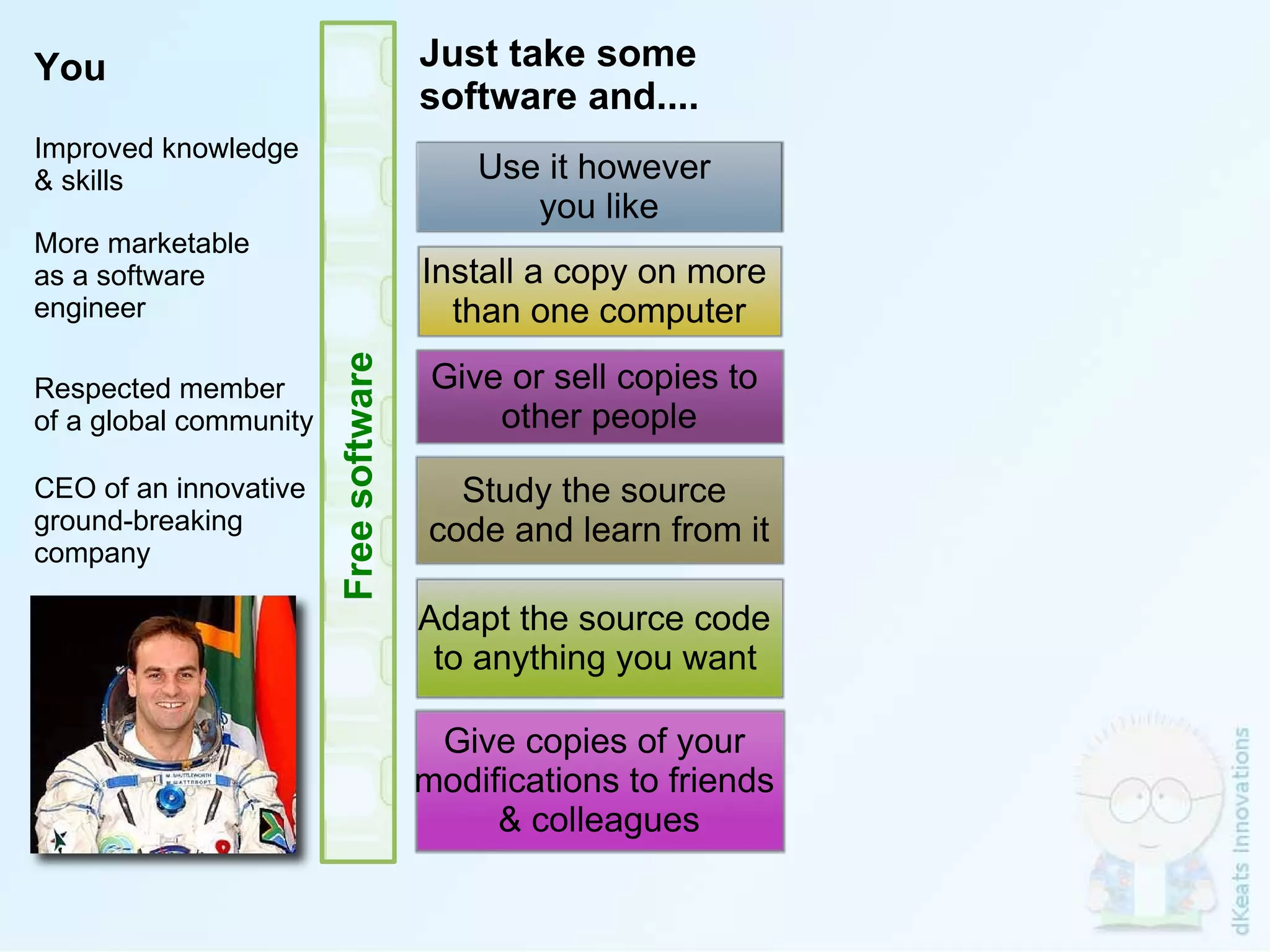
Use it however  you like Install a copy on more  than one computer Give or sell copies to  other people Study the source  code and learn from it Adapt the source code  to anything you want   Give copies of your  modifications to friends  &  colleagues Just take some  software and....
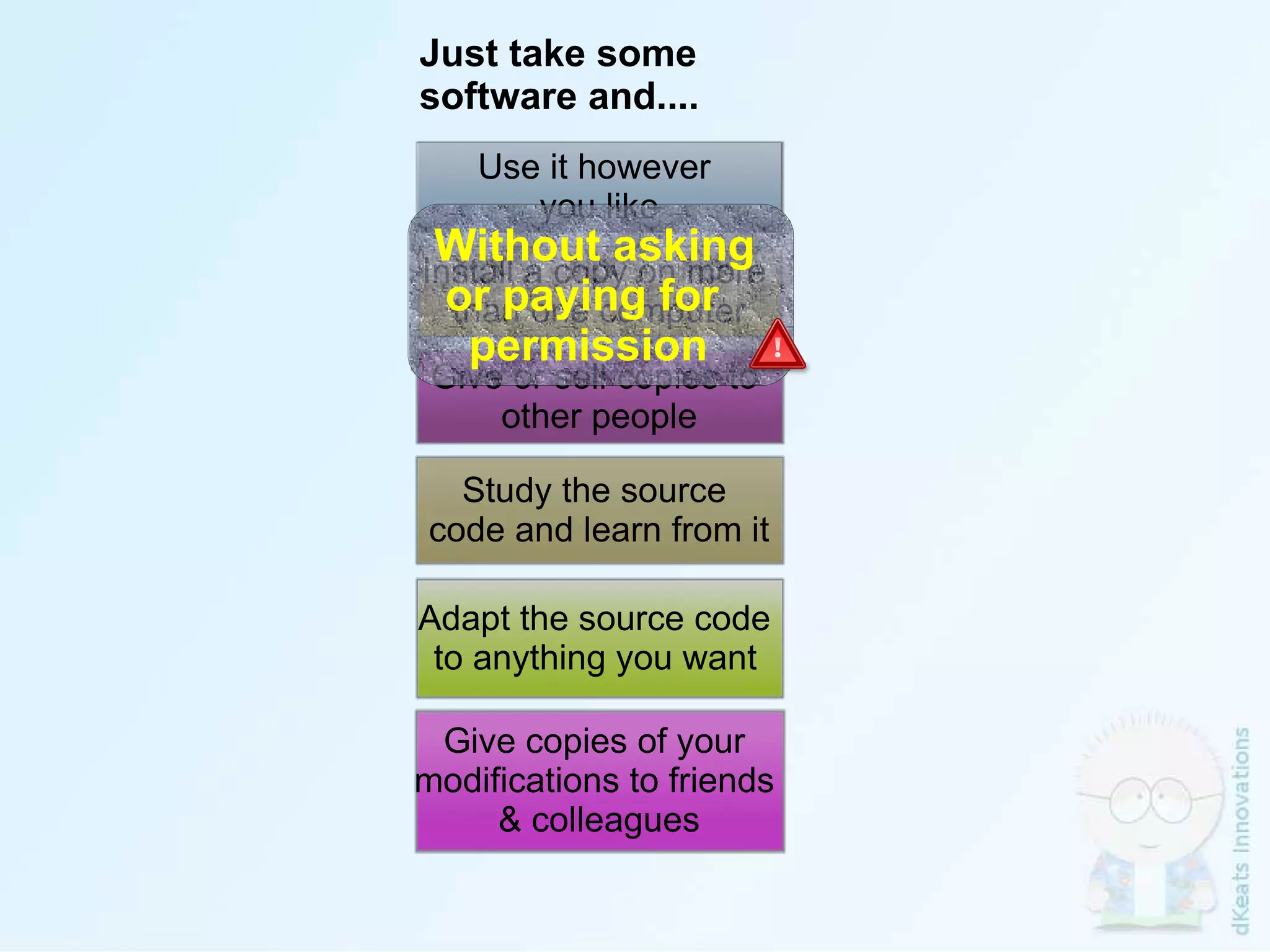
Use it however  you like Install a copy on more  than one computer Give or sell copies to  other people Study the source  code and learn from it Adapt the source code  to anything you want   Give copies of your  modifications to friends  &  colleagues Just take some  software and.... Without asking  or paying for  permission
Use it however  you like Install a copy on more  than one computer Give or sell copies to  other people Study the source  code and learn from it Adapt the source code  to anything you want   Give copies of your  modifications to friends  &  colleagues Respected member of a global community More marketable as a software  engineer Just take some  software and.... Free software Improved knowledge & skills You CEO of an innovative ground-breaking  company
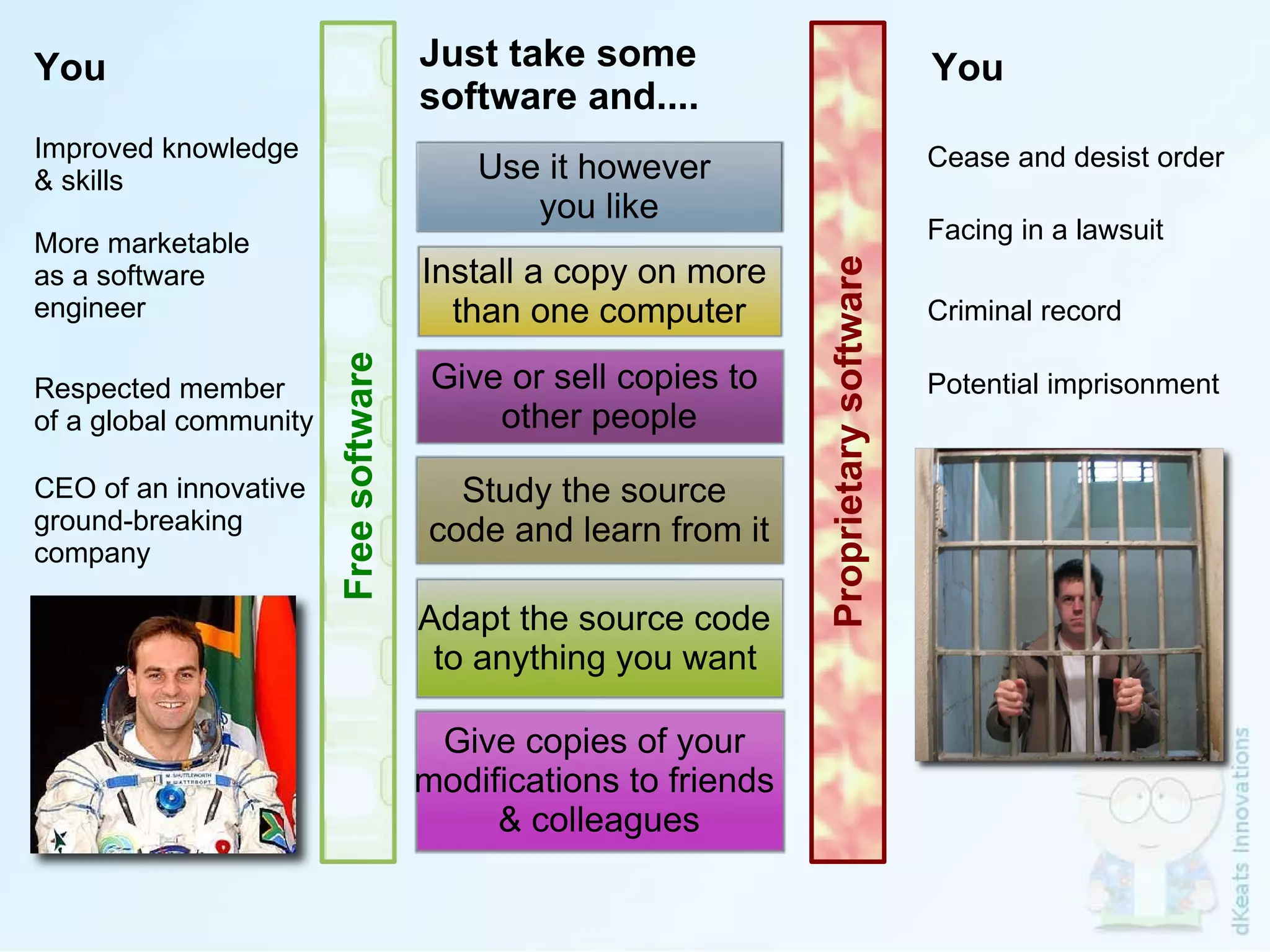
Use it however  you like Install a copy on more  than one computer Give or sell copies to  other people Study the source  code and learn from it Adapt the source code  to anything you want   Give copies of your  modifications to friends  &  colleagues Respected member of a global community Facing in a lawsuit More marketable as a software  engineer Criminal record Just take some  software and.... Proprietary software Free software Improved knowledge & skills You Cease and desist order You Potential imprisonment CEO of an innovative ground-breaking  company
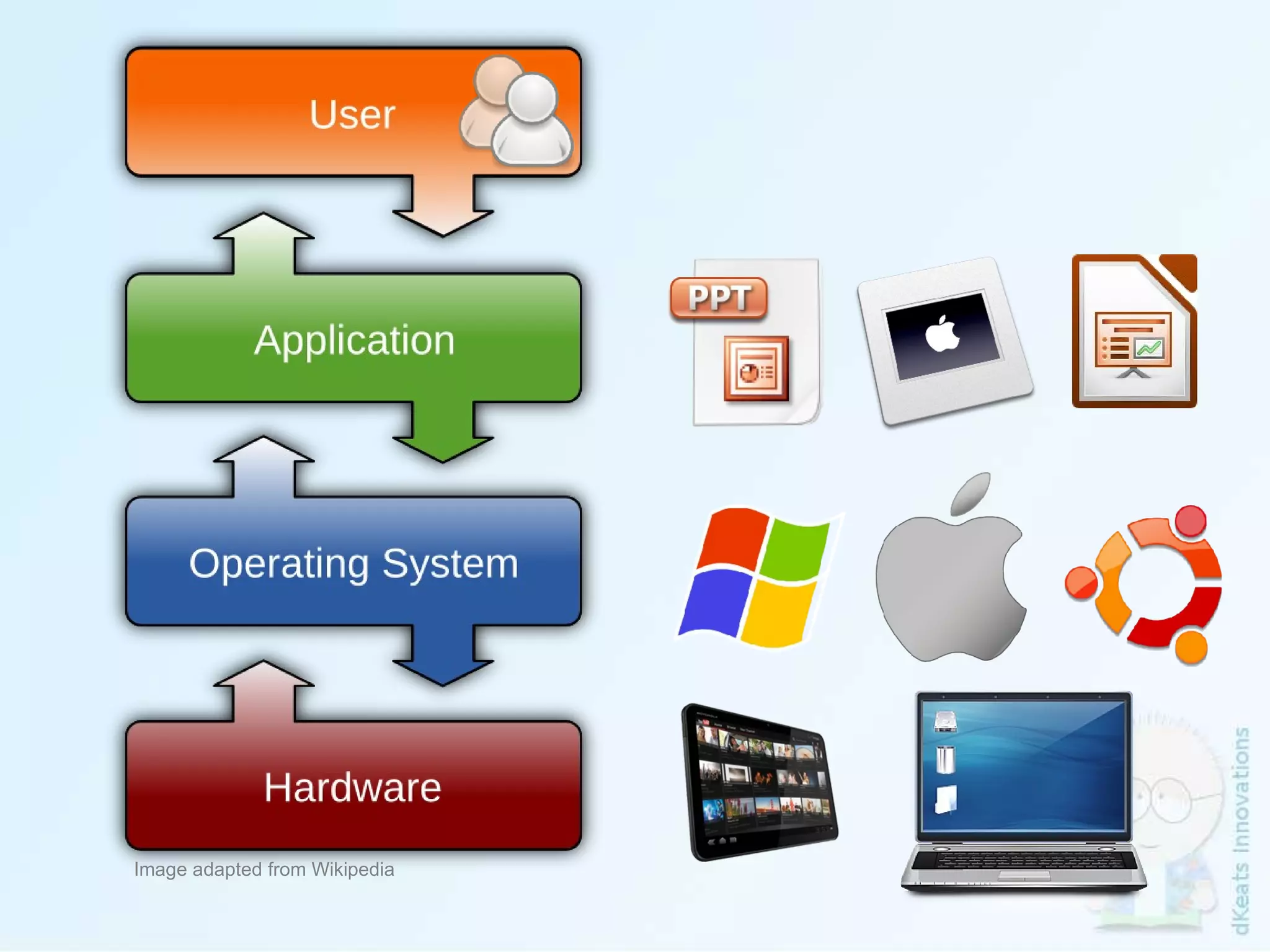
Image adapted from Wikipedia
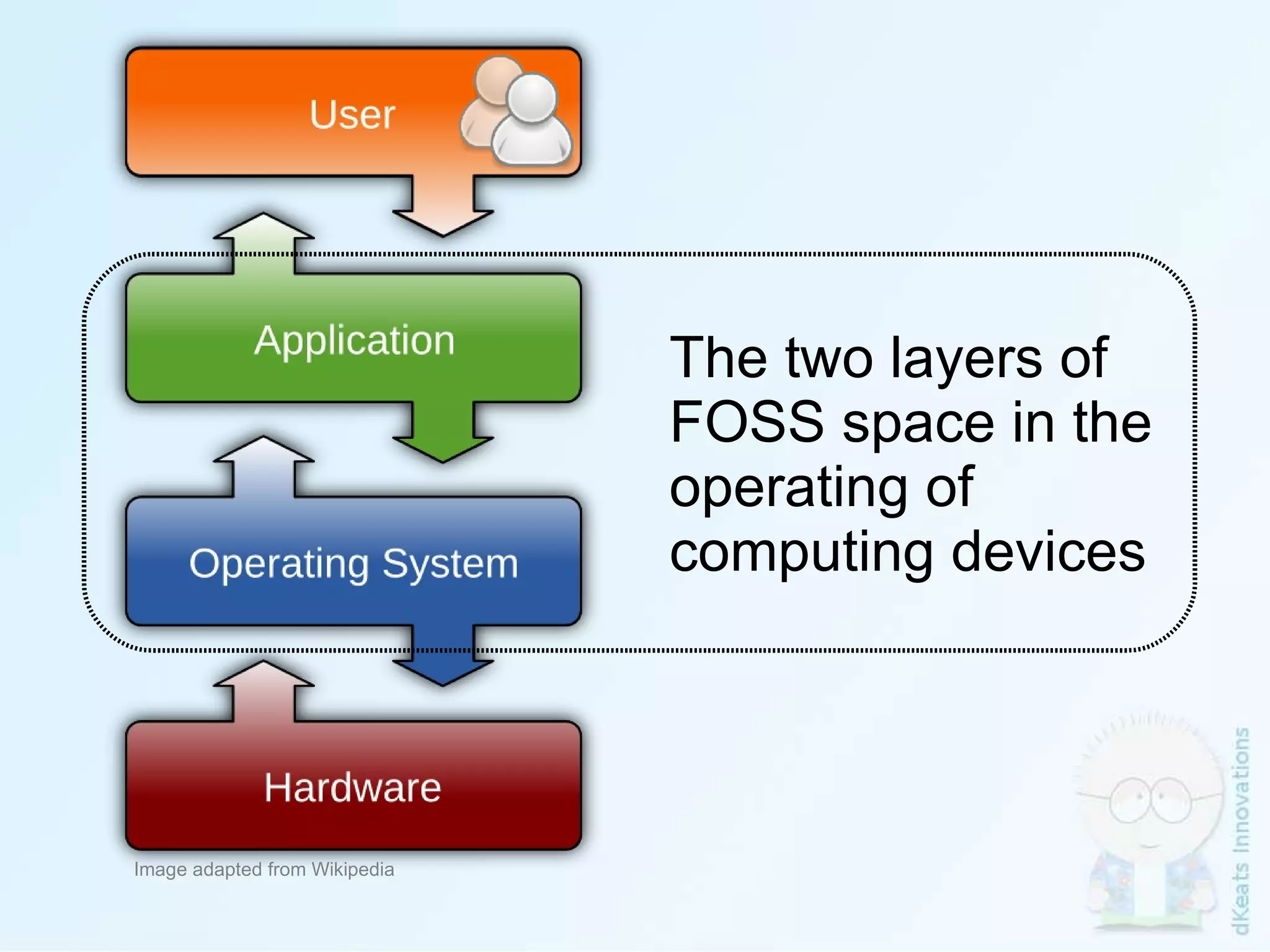
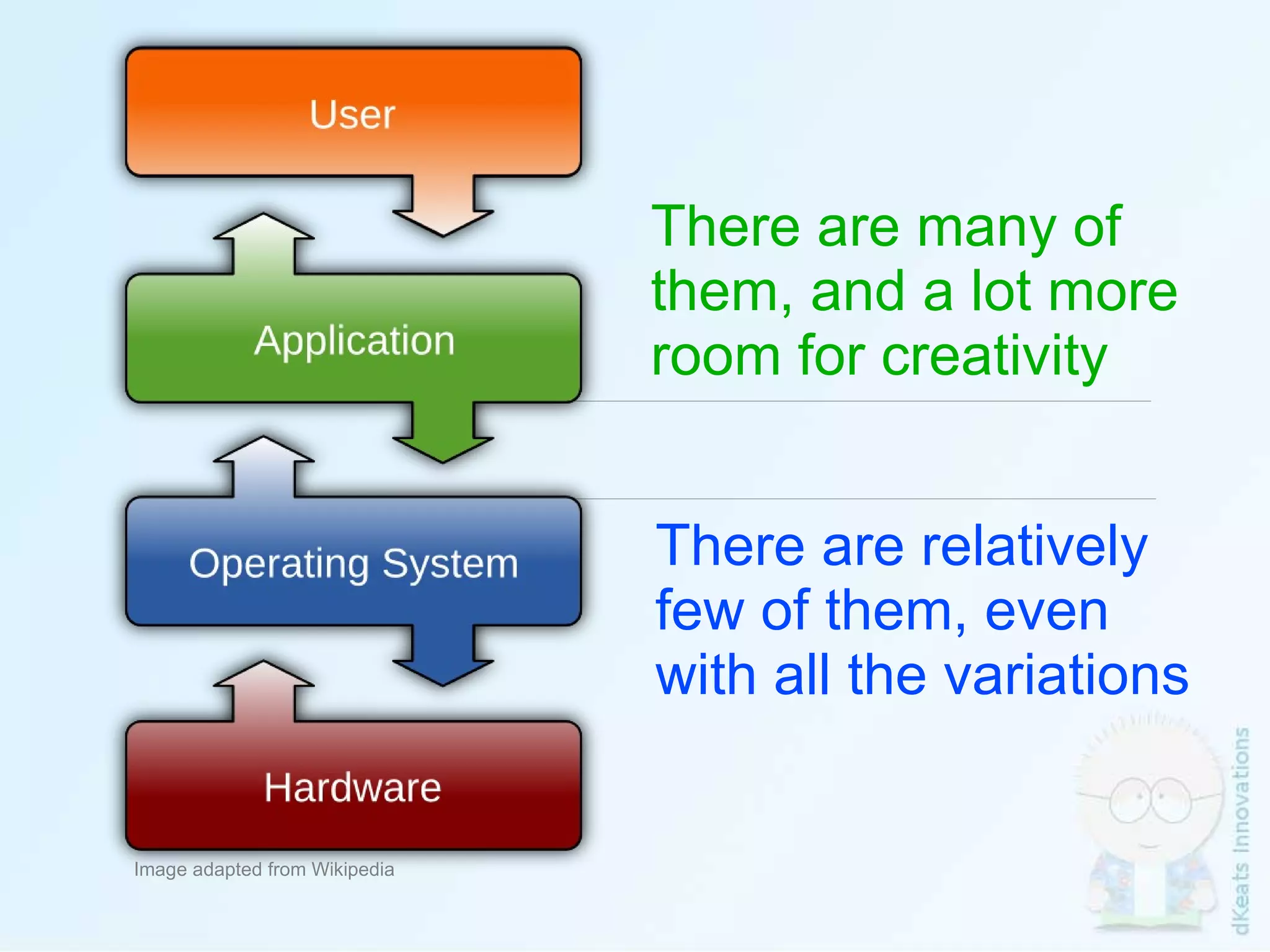
Image adapted from Wikipedia The two layers of  FOSS space in the  operating of computing devices
Image from Wikipedia There are relatively few of them, even  with all the variations There are many of them, and a lot more  room for creativity Image adapted from Wikipedia
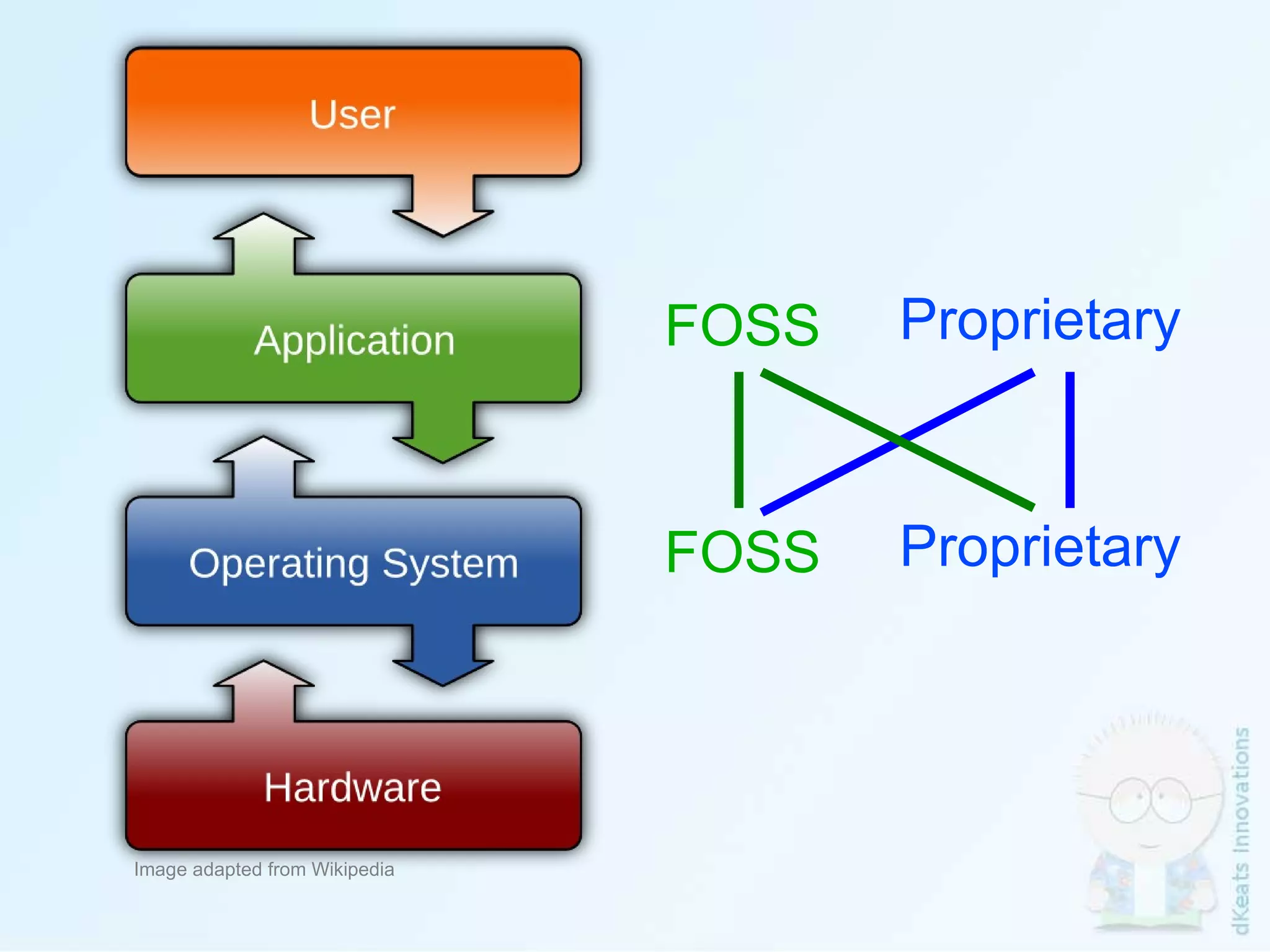
FOSS Proprietary FOSS Proprietary Image adapted from Wikipedia
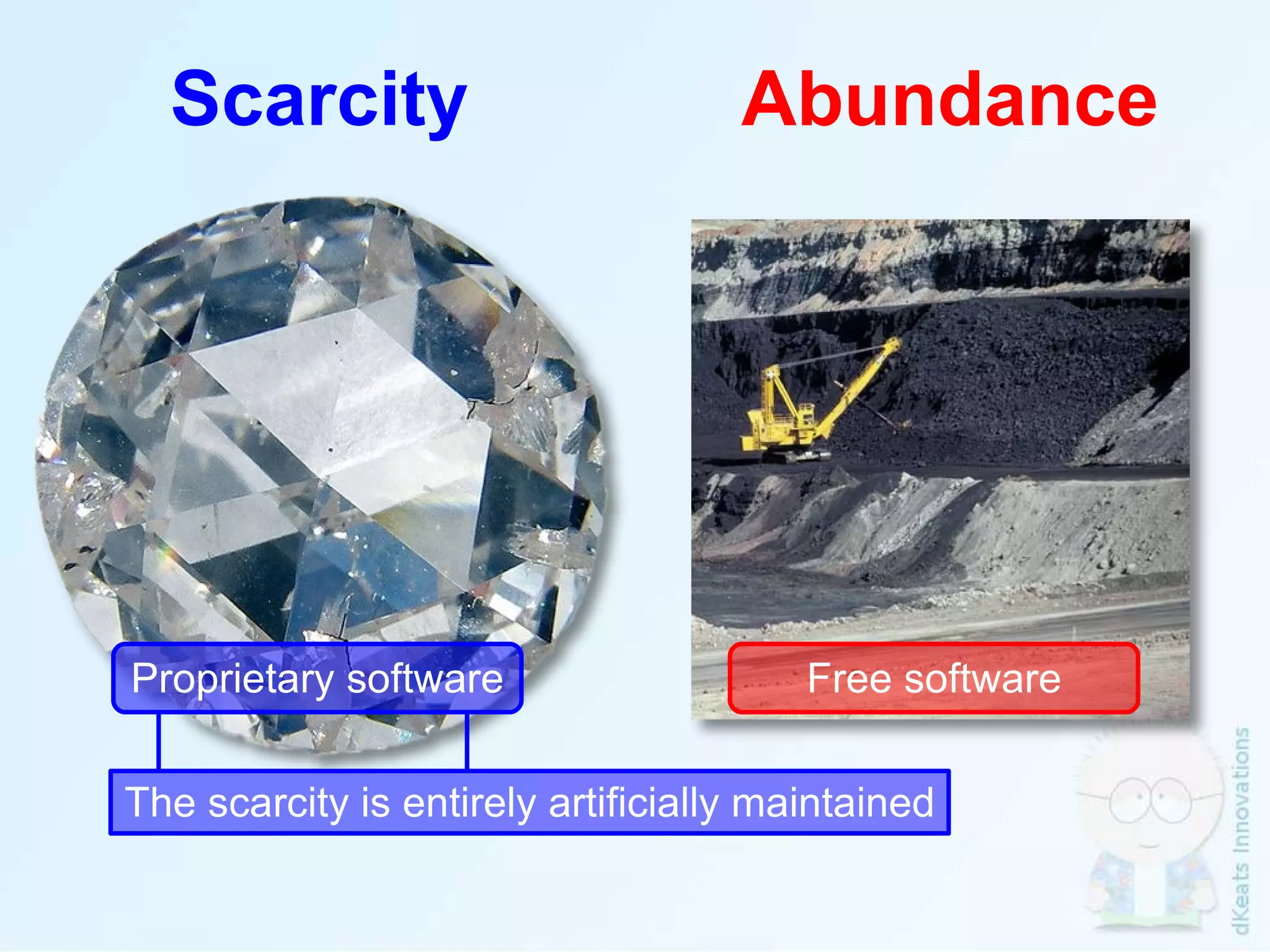
Scarcity Abundance Proprietary software Free software The scarcity is entirely artificially maintained
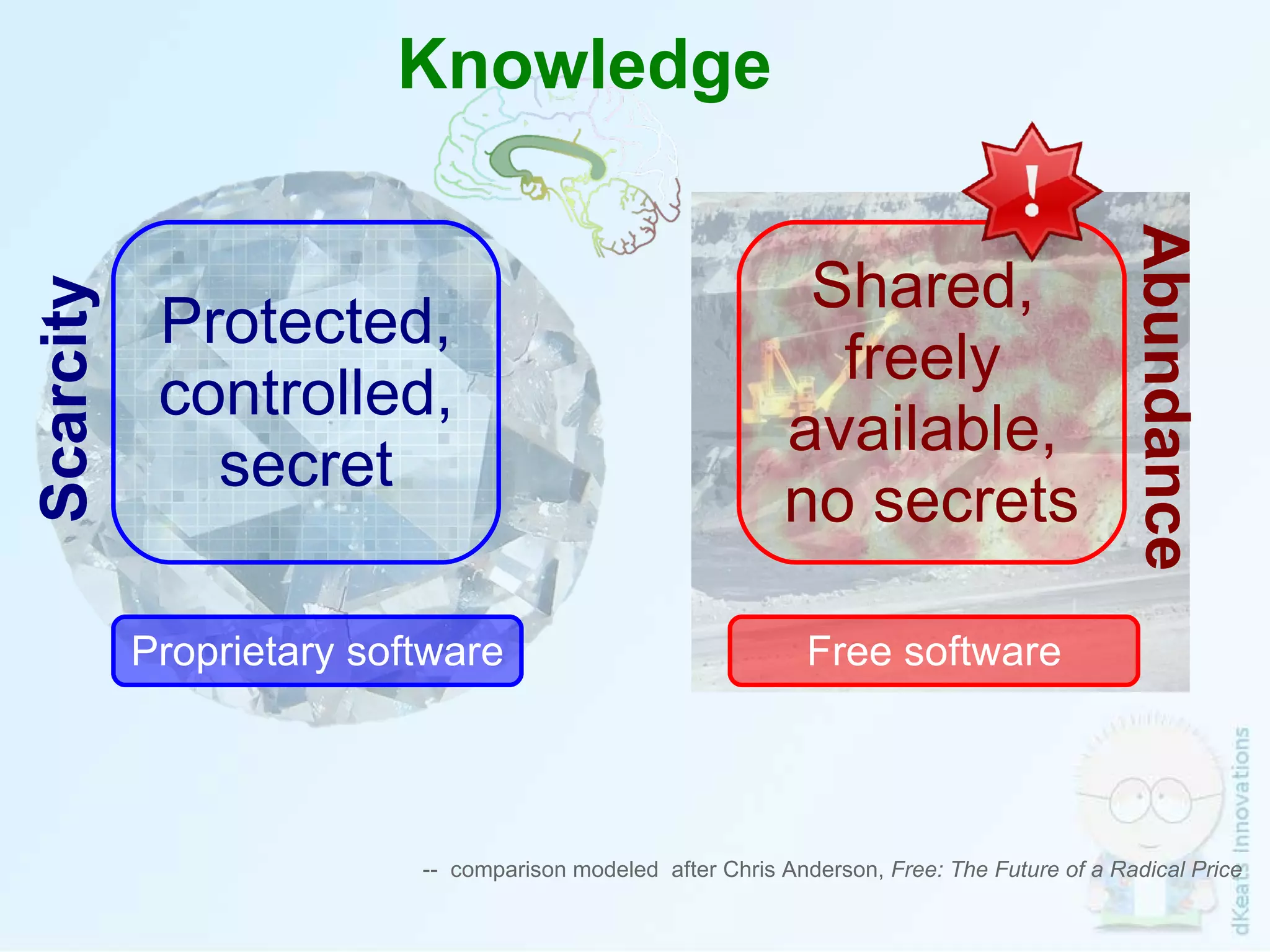
Scarcity Abundance Knowledge --  comparison modeled  after Chris Anderson,  Free: The Future of a Radical Price Protected, controlled, secret Shared,  freely  available,  no secrets Proprietary software Free software
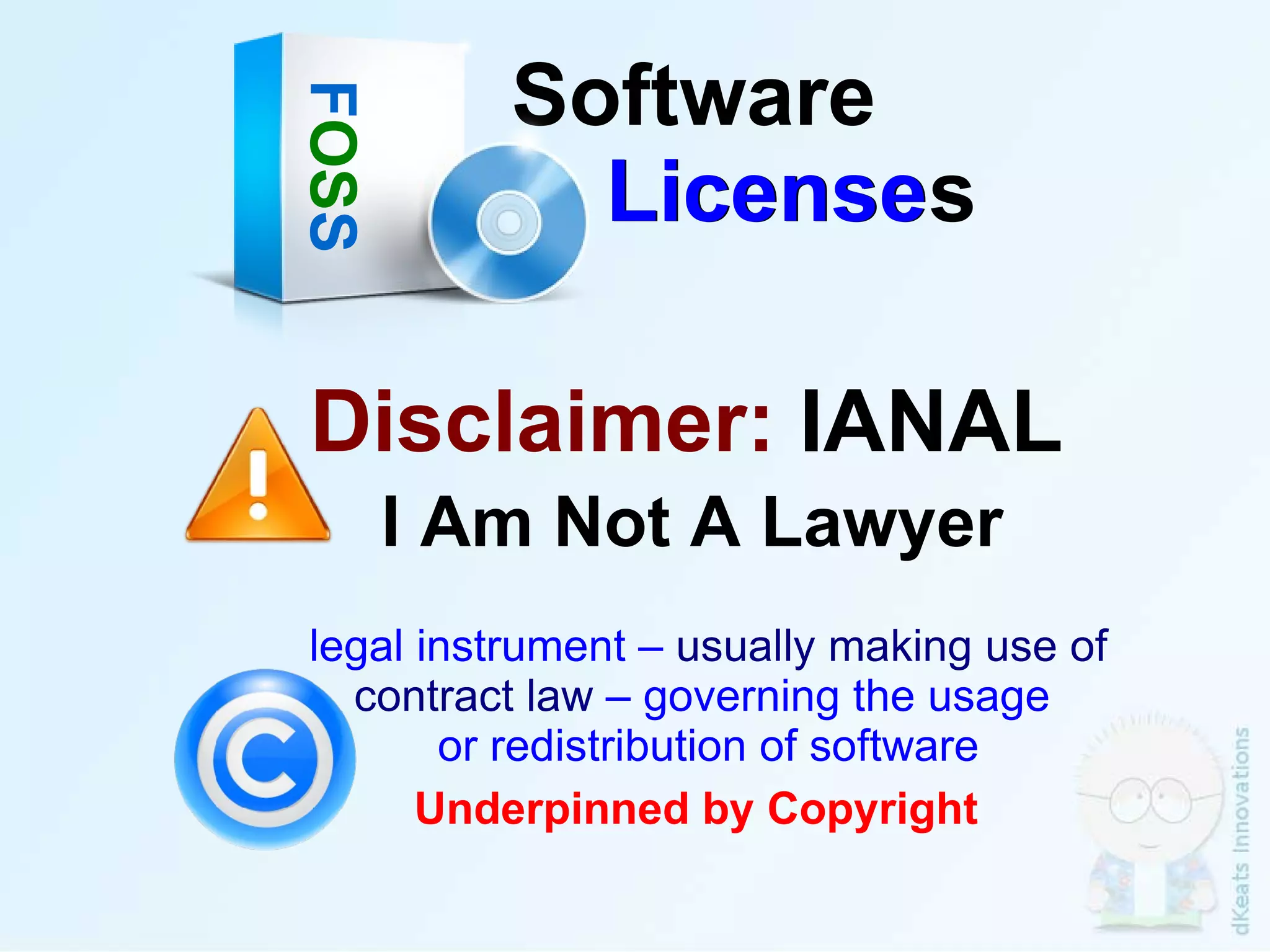
I Am Not A Lawyer F OS S Software    Licenses Disclaimer:  IANAL License legal instrument –  usually making use of contract law  – governing the usage  or redistribution of software Underpinned by Copyright
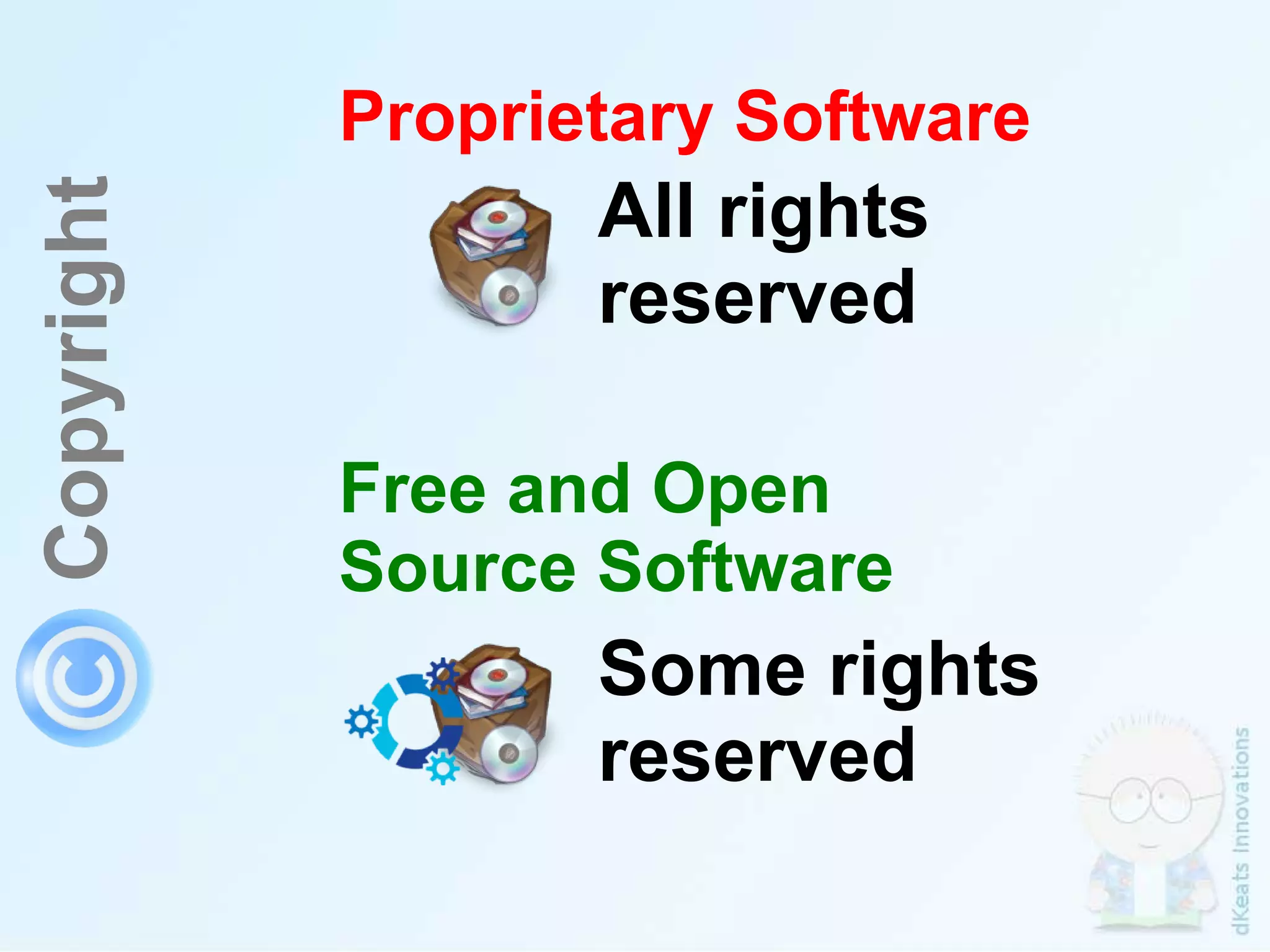
Copyright All rights  reserved Proprietary Software Some rights  reserved Free and Open  Source Software
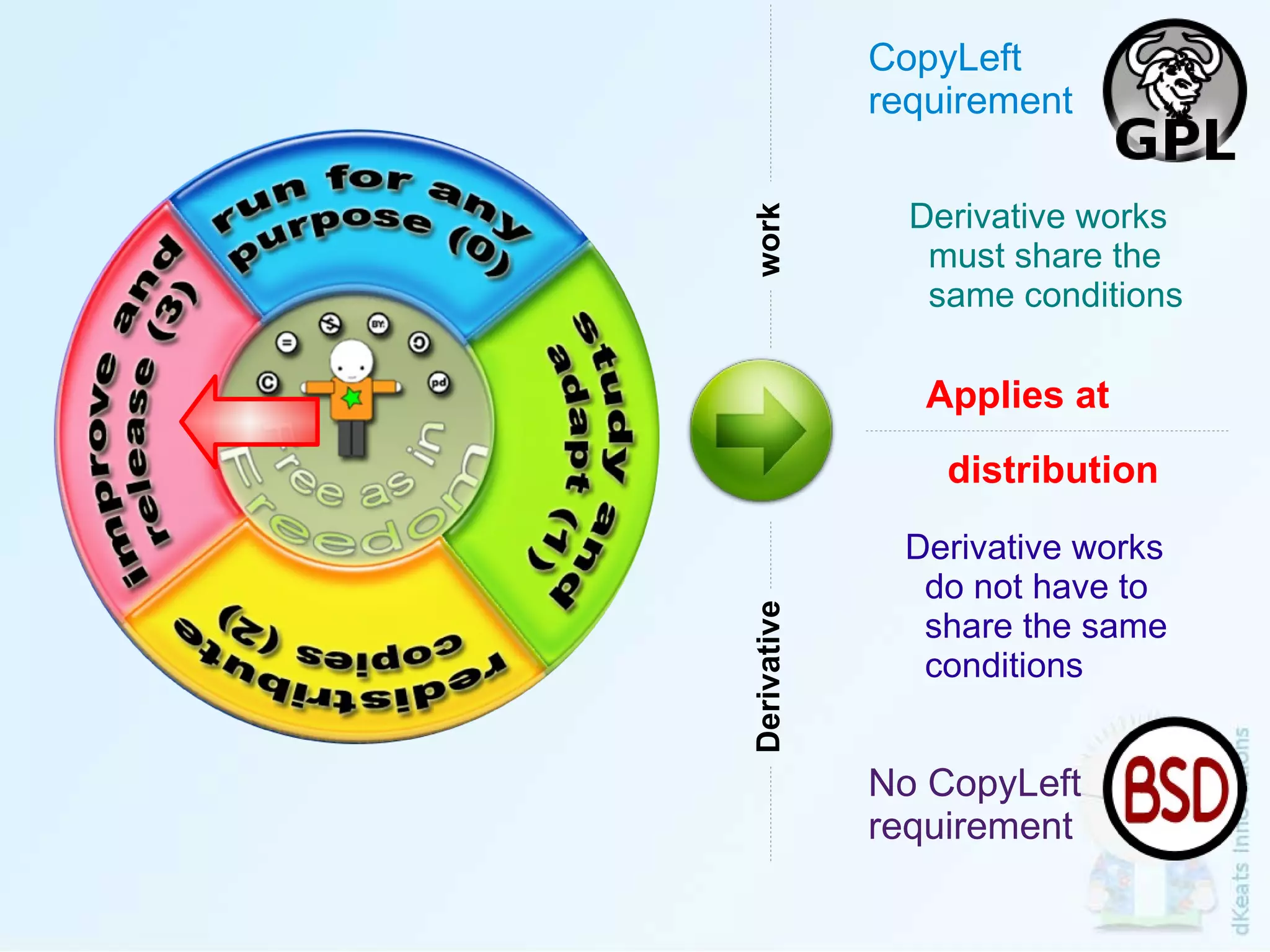
Derivative work CopyLeft requirement Derivative works   must share the    same conditions No CopyLeft requirement Derivative works   do not have to    share the same   conditions Applies at distribution
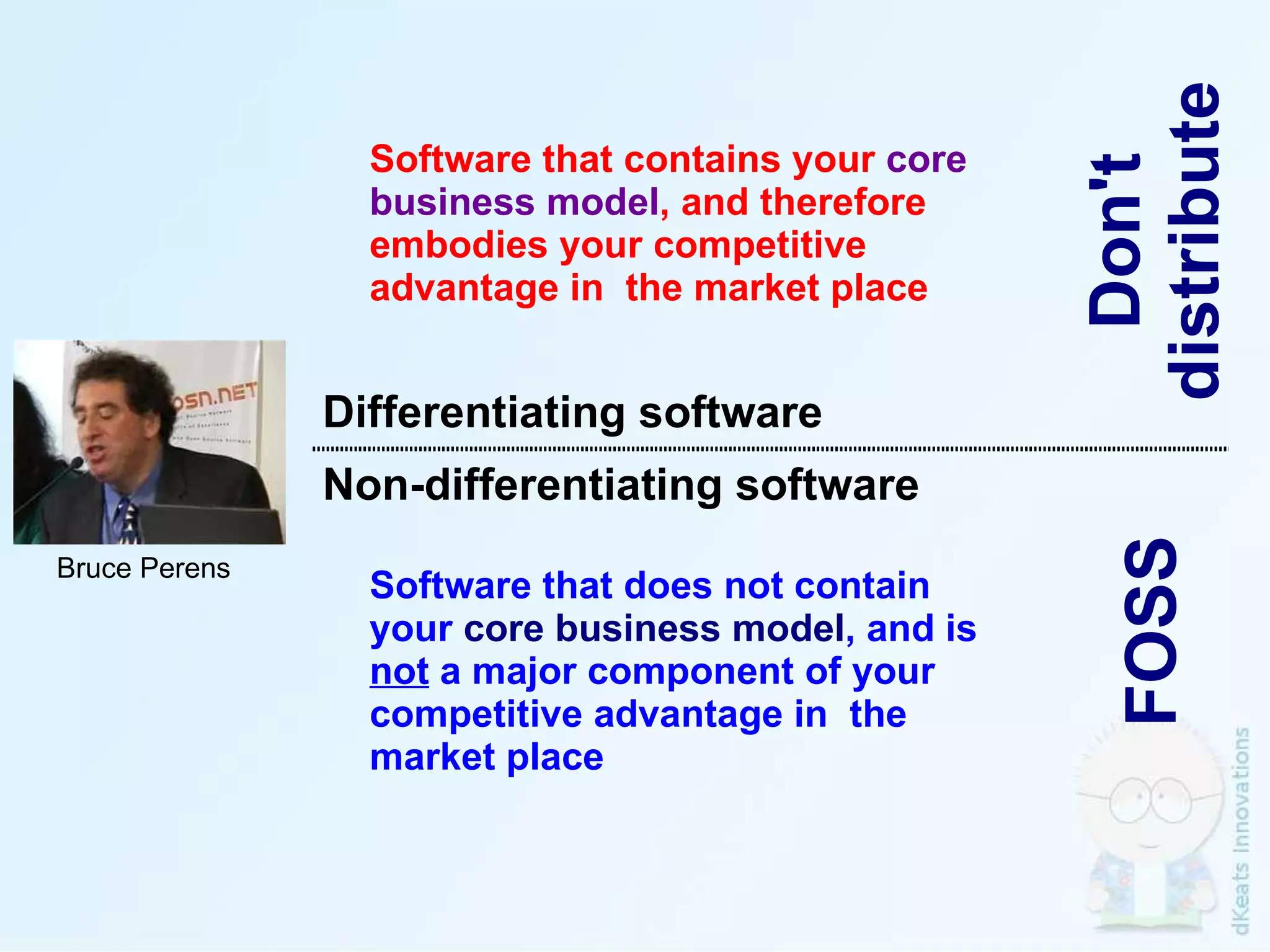
Software that contains your   core business model , and therefore embodies your competitive advantage in  the market place Software that does not contain your  core business model , and is  not  a major component of your competitive advantage in  the market place FOSS Don't distribute Bruce Perens Differentiating software Non-differentiating software
Economic  perspective
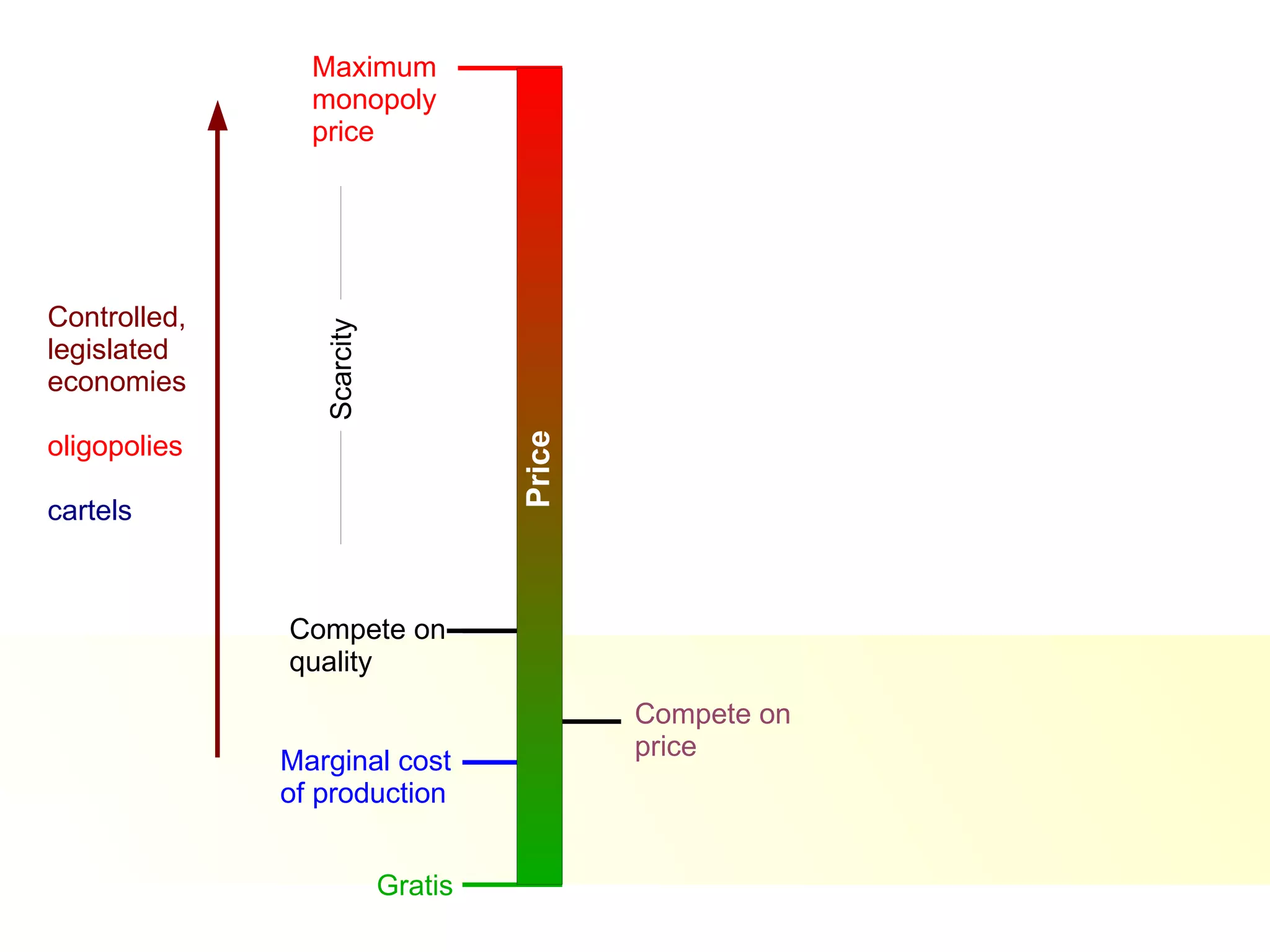
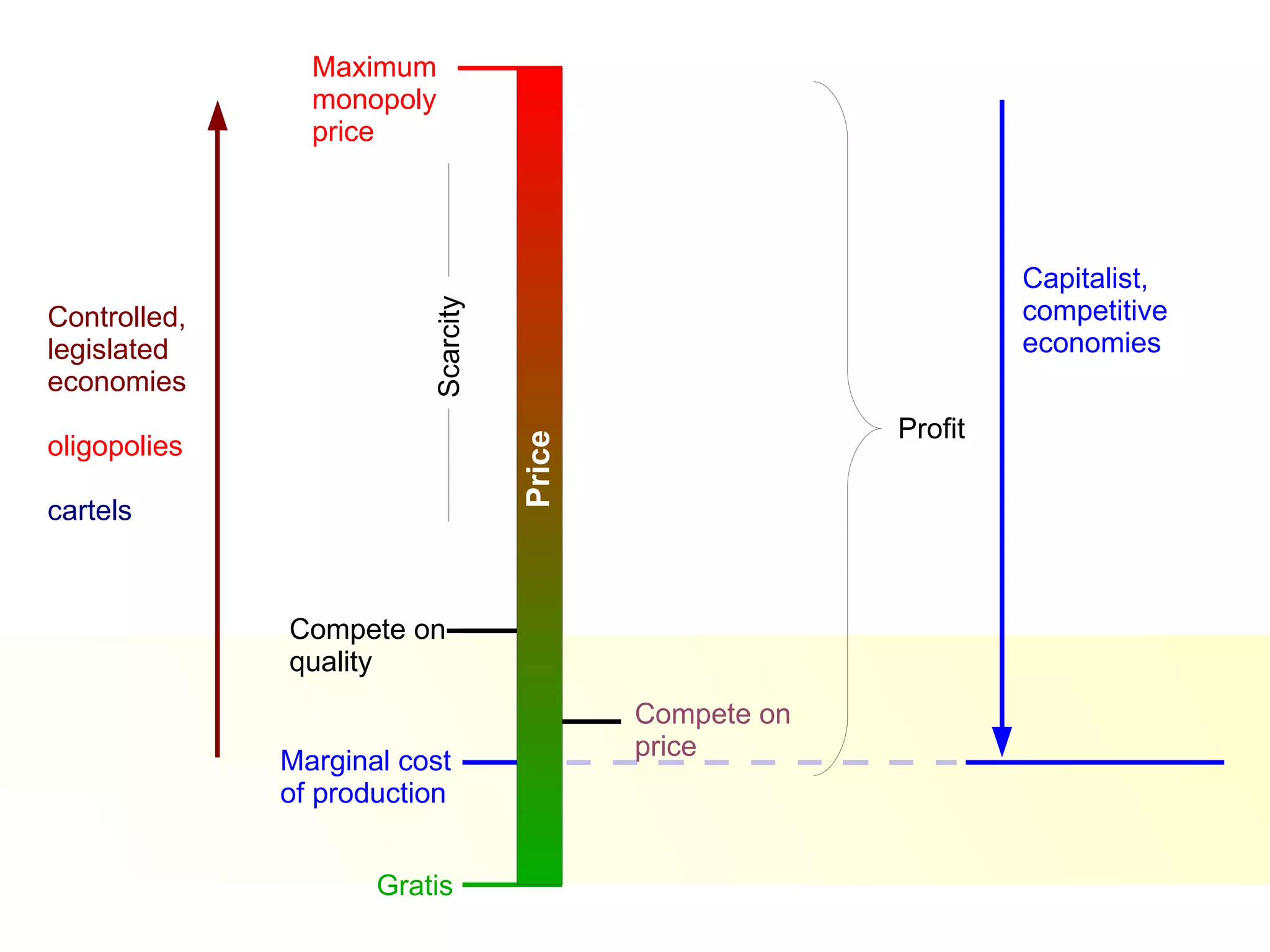
Compete on quality Maximum  monopoly  price Controlled, legislated economies   oligopolies cartels Gratis Price Marginal cost of production Compete on price Scarcity
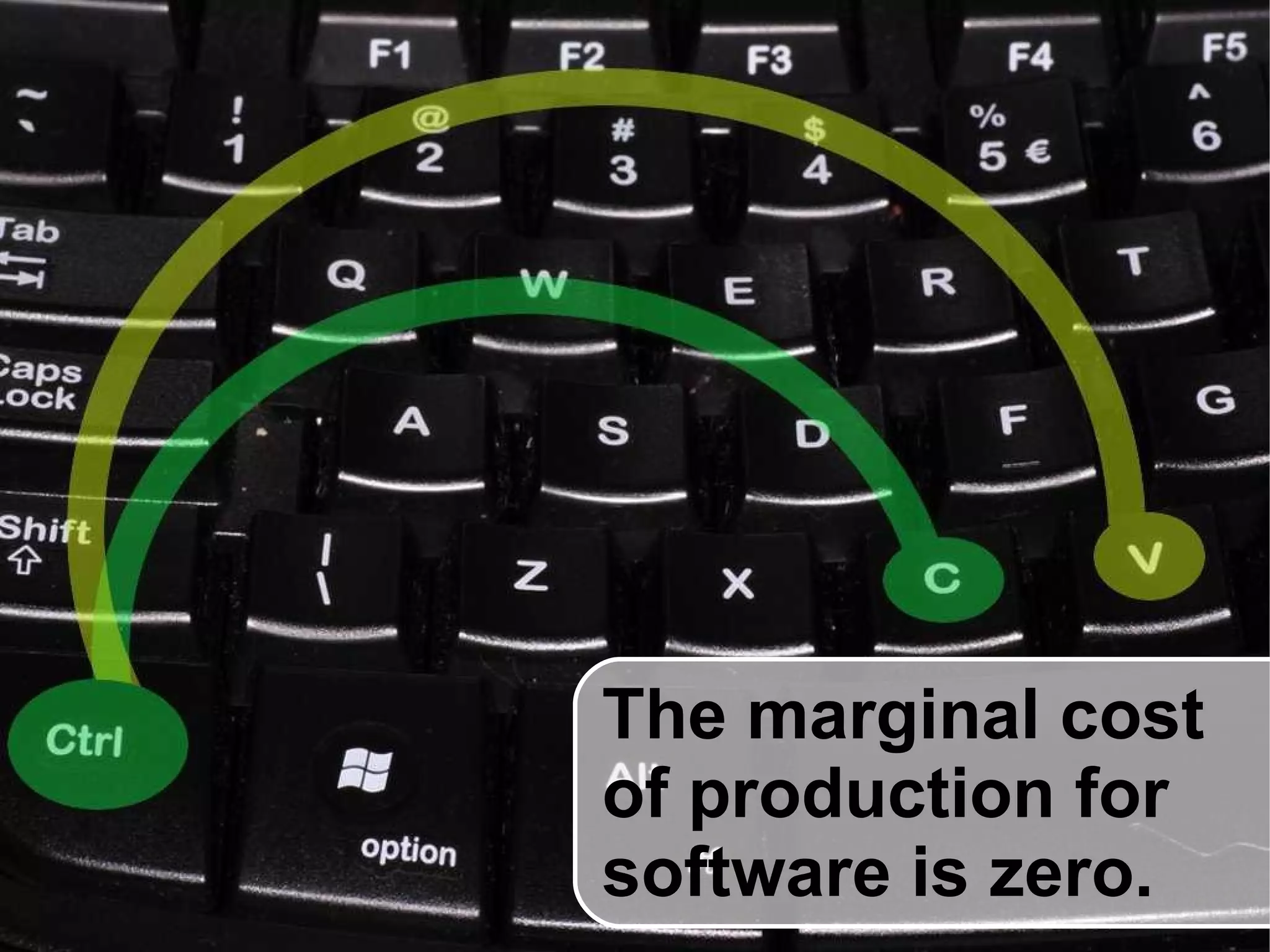
The marginal cost  of production for  software is zero.
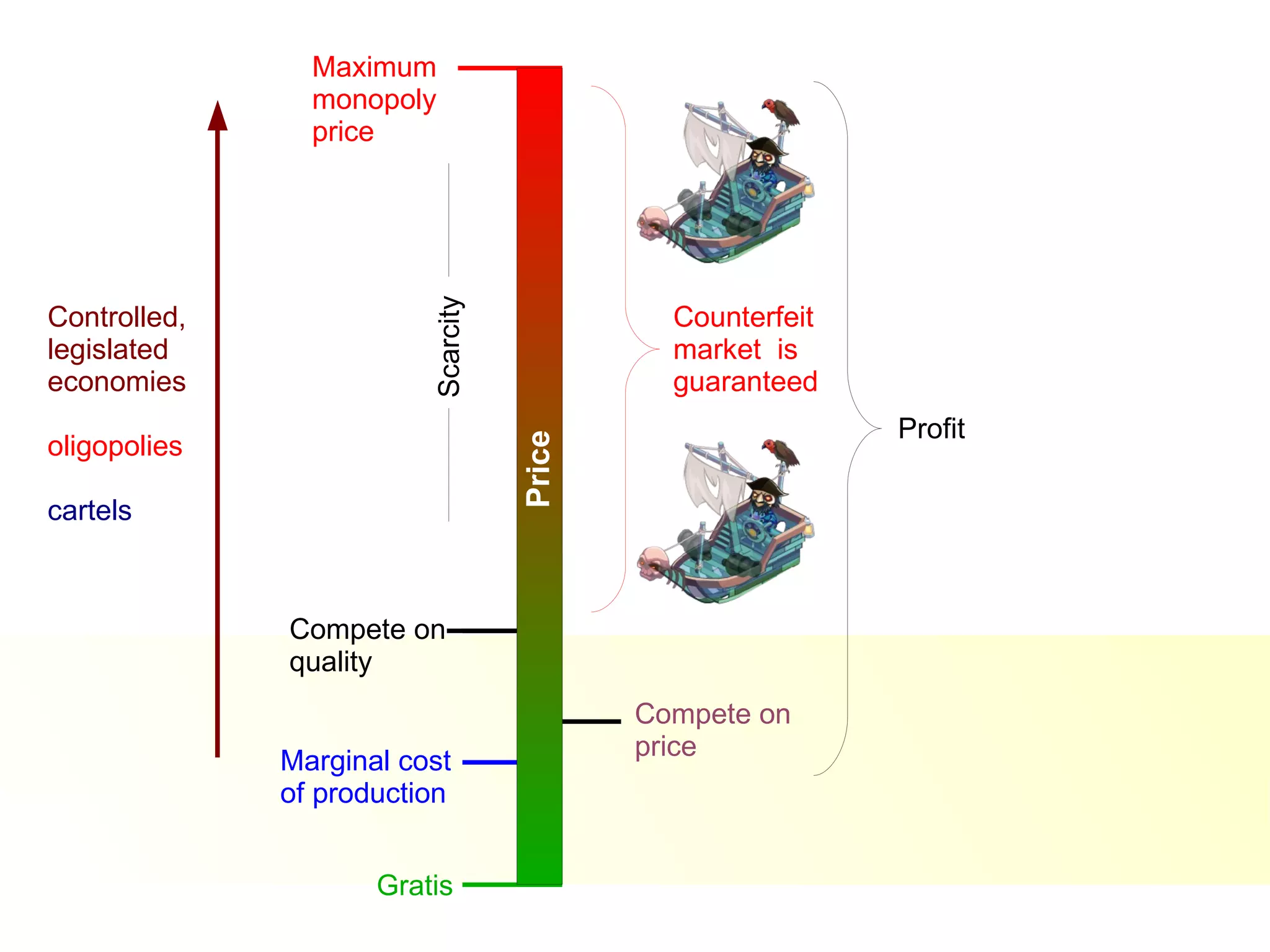
Compete on quality Maximum  monopoly  price Controlled, legislated economies   oligopolies cartels Gratis Price Marginal cost of production Compete on price Counterfeit market  is guaranteed Profit Scarcity
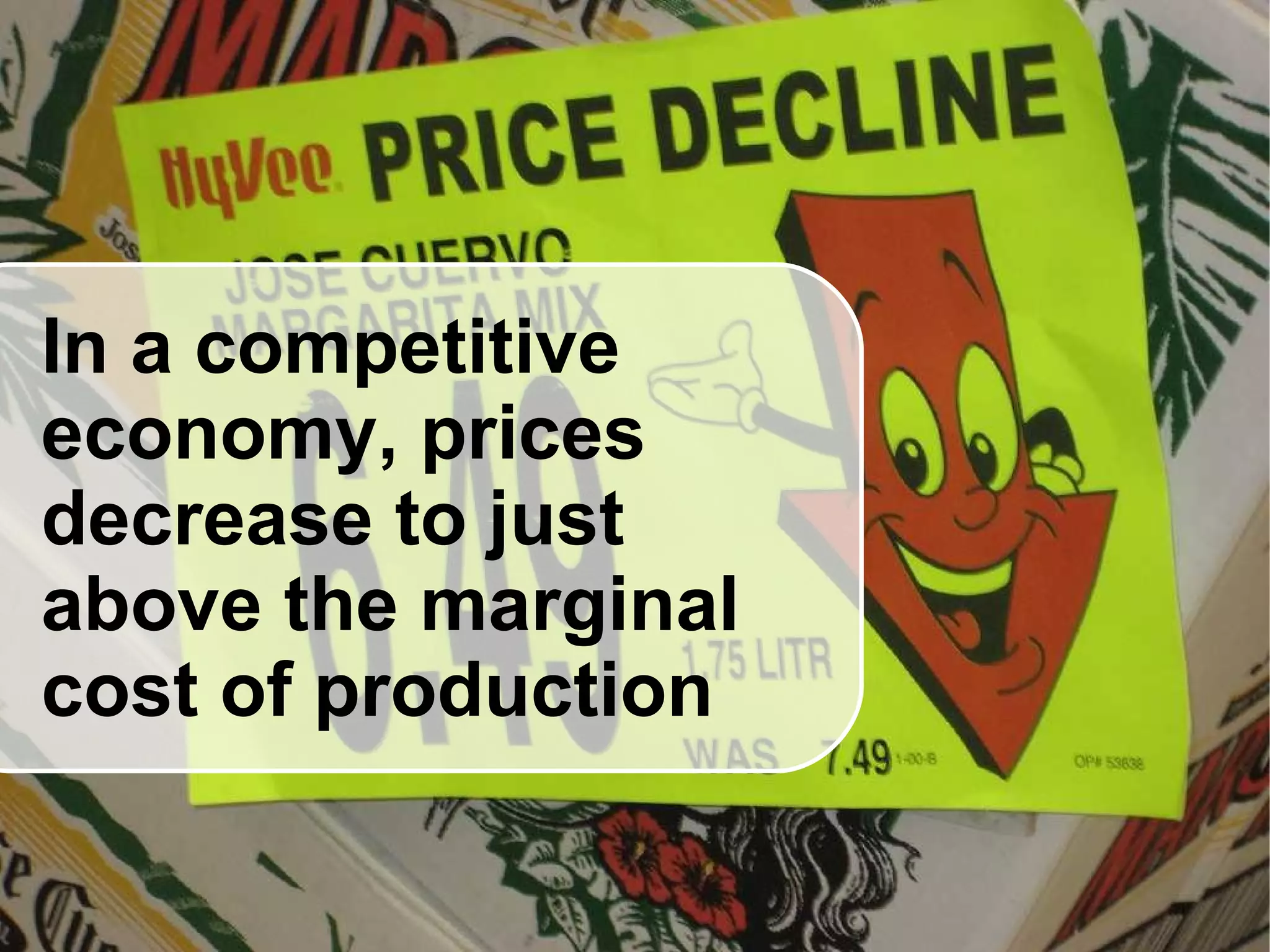
In a competitive  economy, prices  decrease to just  above the marginal  cost of production
Marginal cost of production Compete on quality Maximum  monopoly  price Controlled, legislated economies   oligopolies cartels Gratis Price Compete on price Capitalist,  competitive economies Profit Scarcity
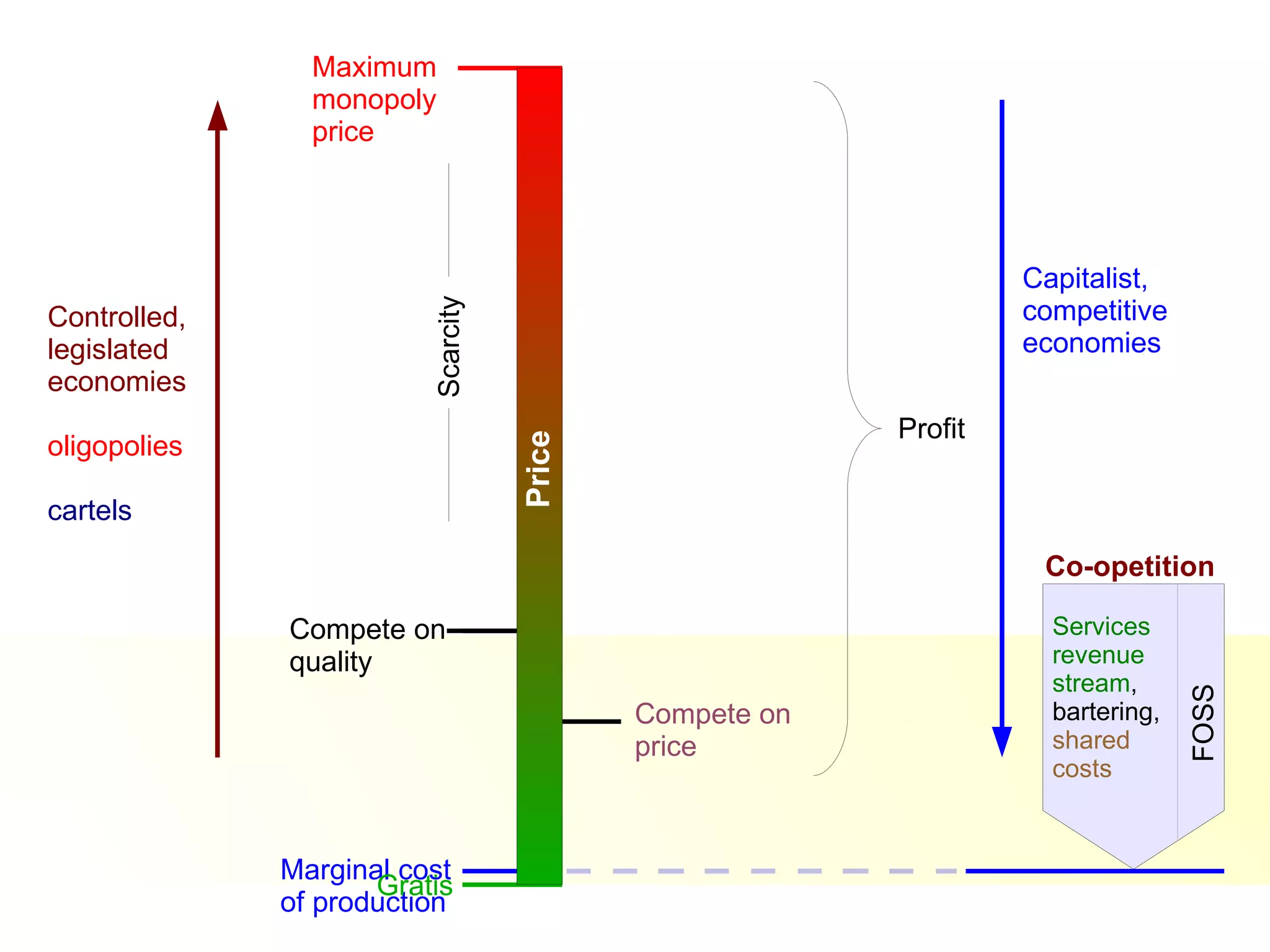
Marginal cost of production Compete on quality Maximum  monopoly  price Controlled, legislated economies   oligopolies cartels Gratis Price Co-opetition Compete on price Capitalist,  competitive economies Profit Services  revenue  stream ,  bartering,   shared  costs FOSS Scarcity
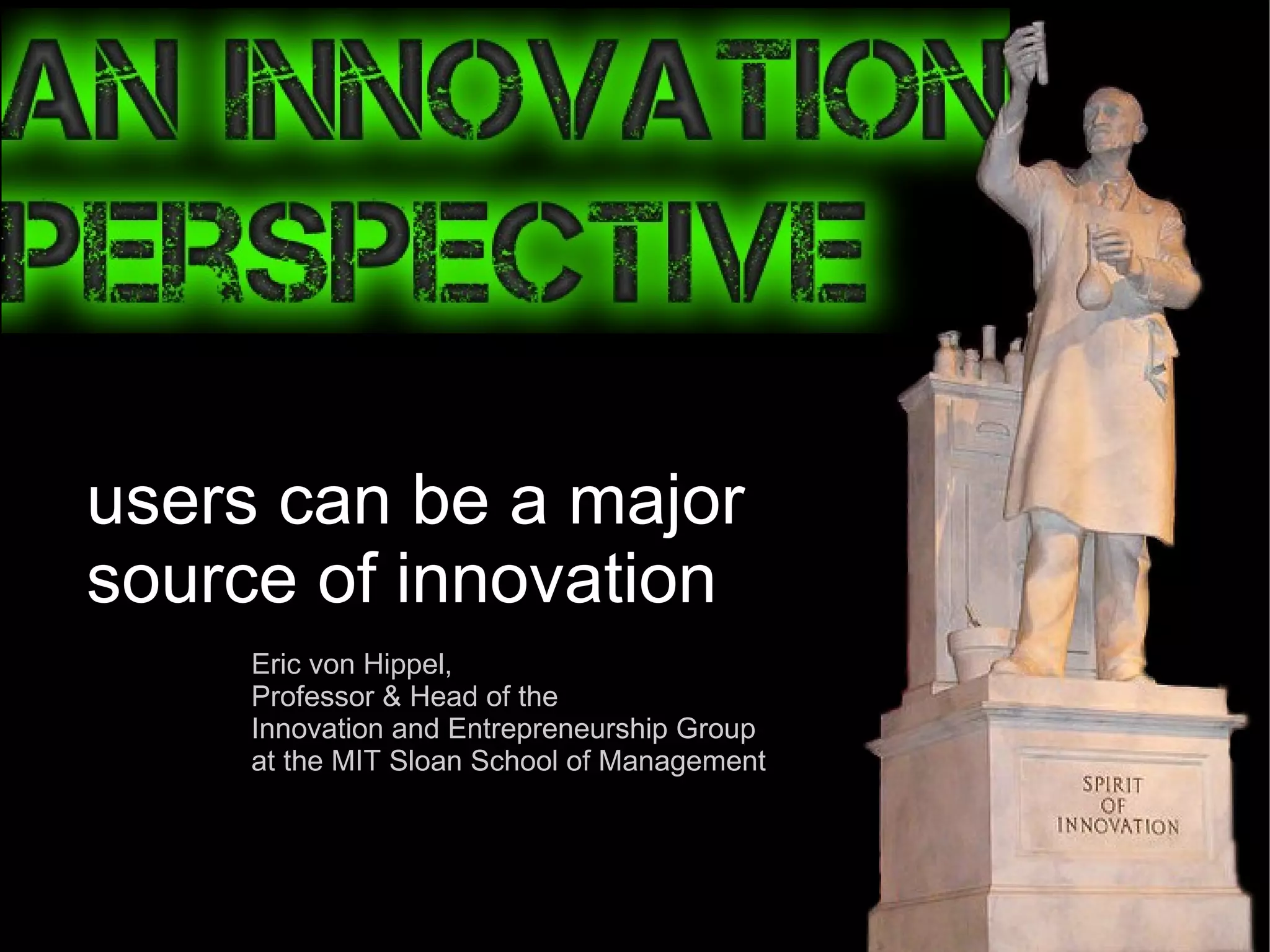
users can be a major source of innovation Eric von Hippel,  Professor & Head of the  Innovation and Entrepreneurship Group  at the MIT Sloan School of Management
Barriers to  innovation The Internet – a radical  decentralisation of innovation Yochai Benkler,  Professor of Law at Harvard at the eG8 Forum on May 26th
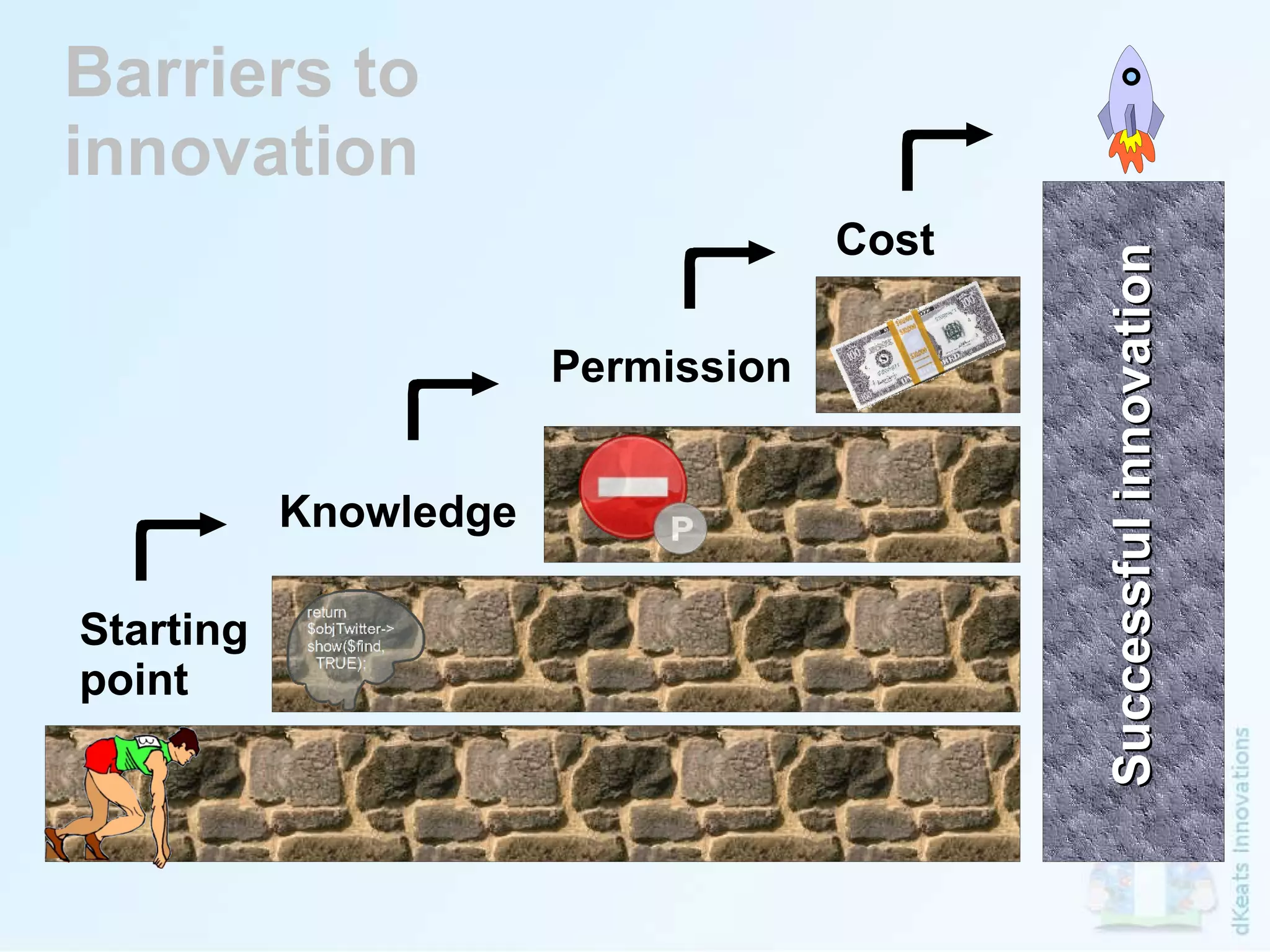
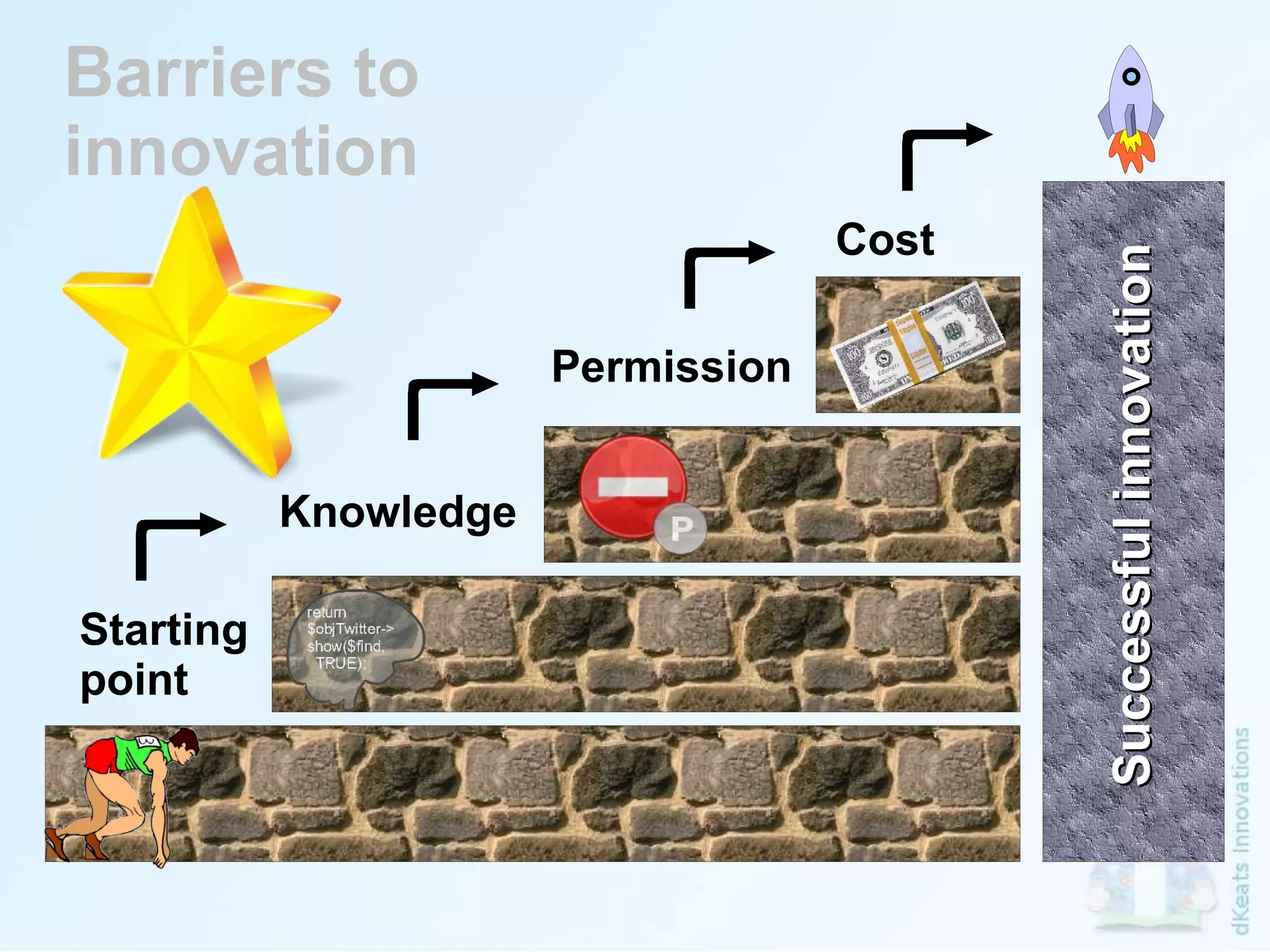
Barriers to  innovation Successful innovation Starting point Knowledge Permission Cost
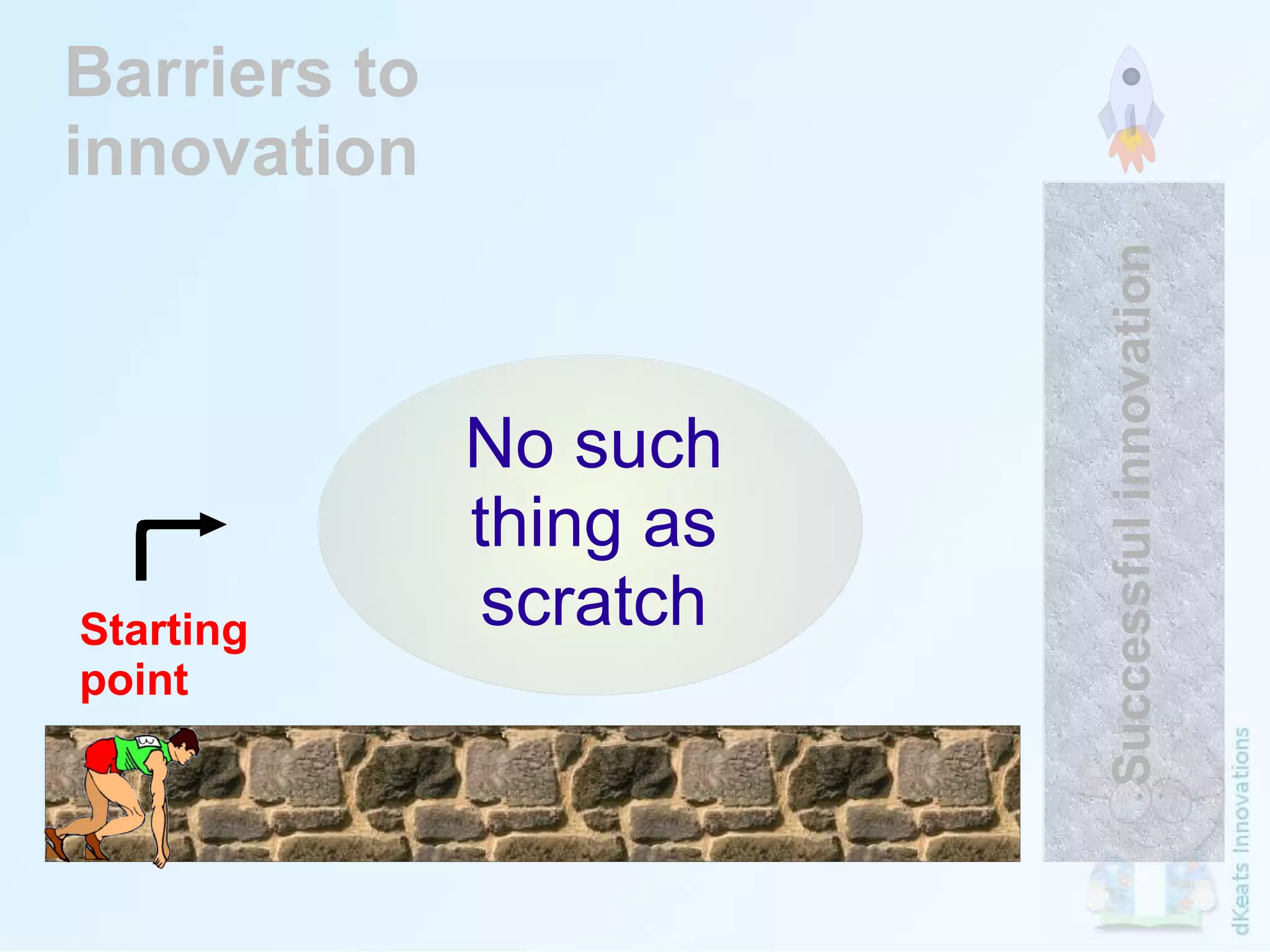
Barriers to  innovation Successful innovation Starting point No such thing as scratch
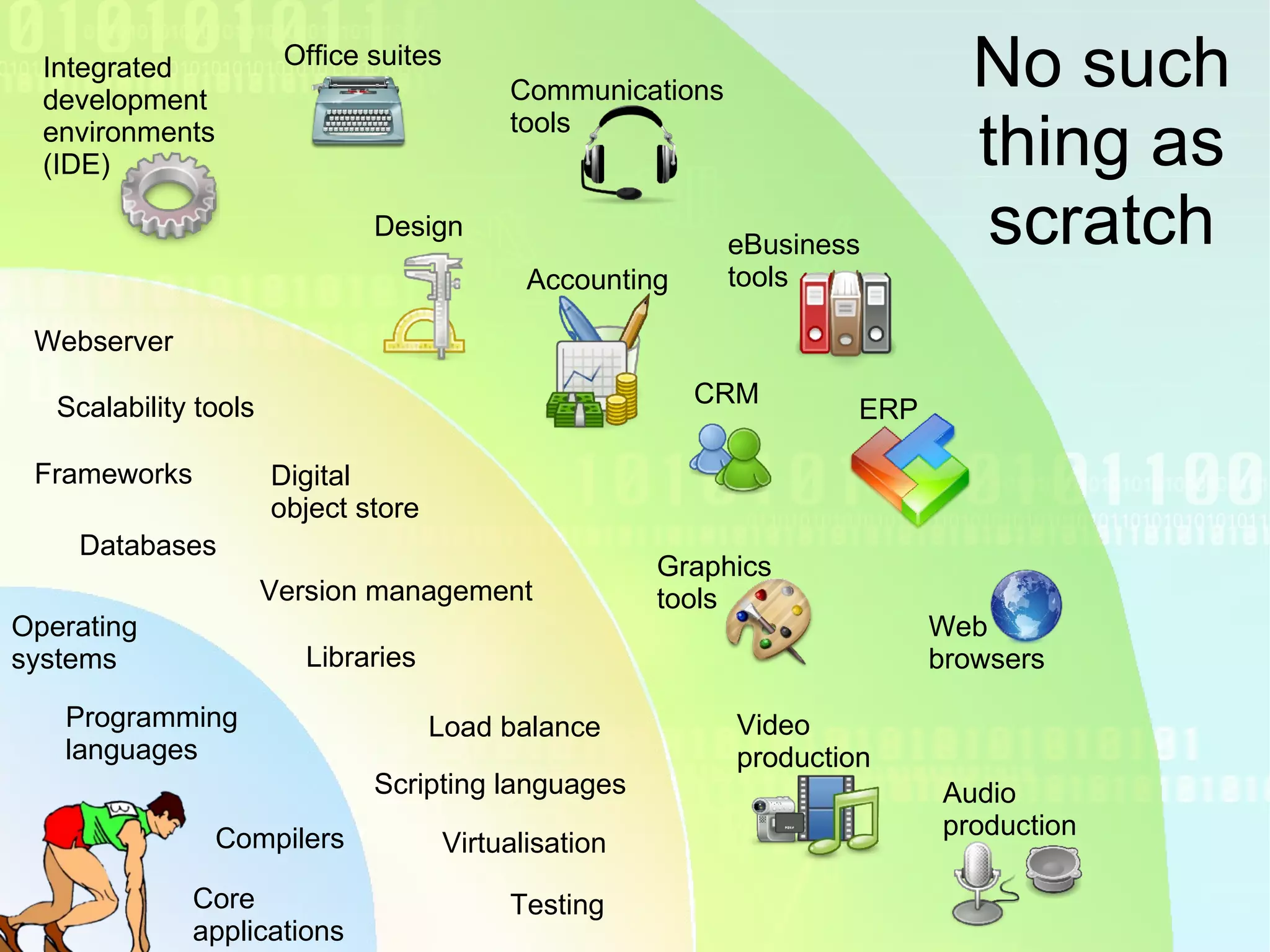
No such thing as scratch Operating systems Compilers Programming languages Core applications Databases Webserver Frameworks Digital object store Libraries Version management Scalability tools Load balance Scripting languages Virtualisation Testing eBusiness tools Graphics tools Communications tools Integrated development environments (IDE) Video production Audio production Office suites Design Web browsers CRM Accounting ERP
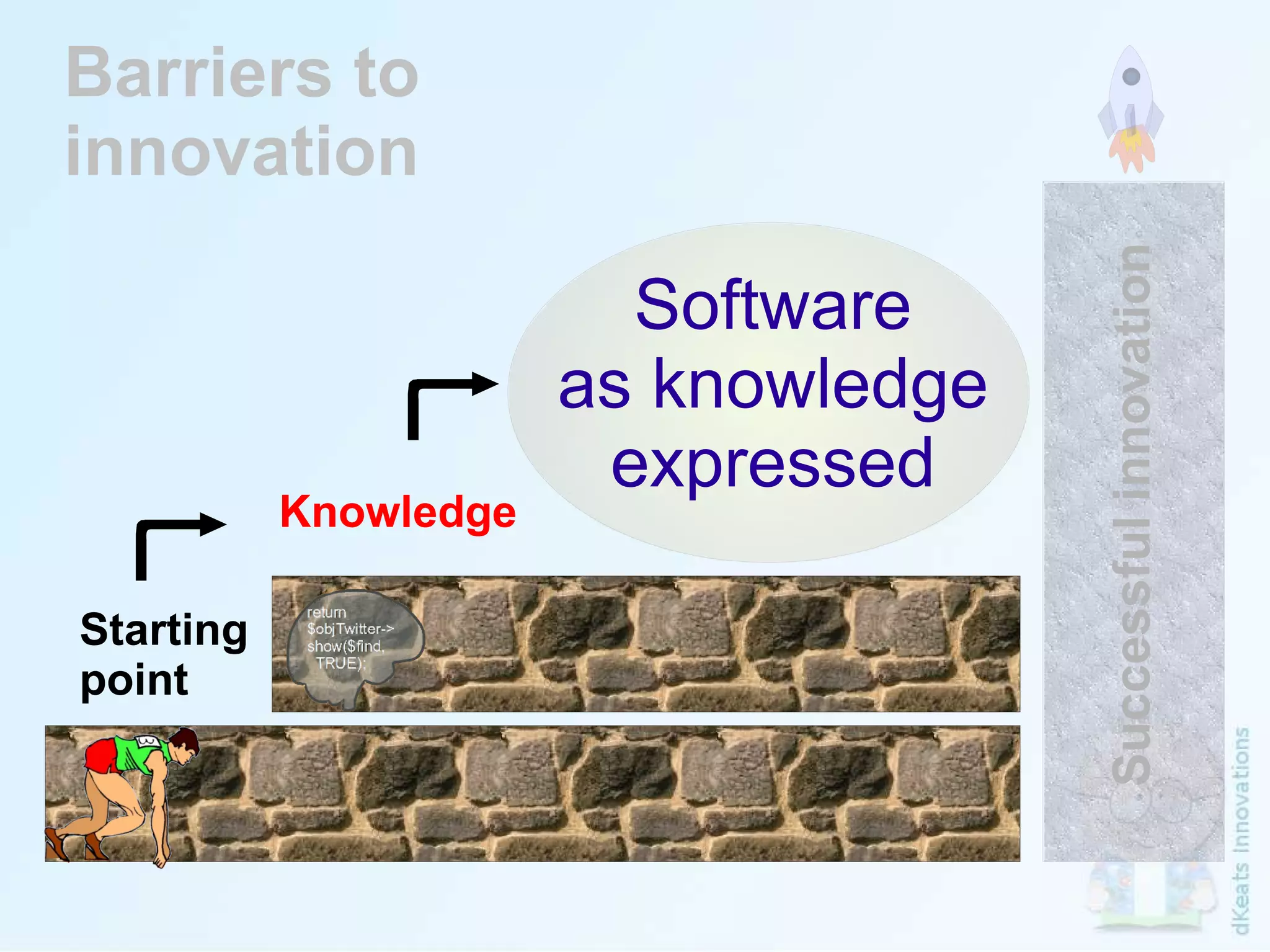
Barriers to  innovation Successful innovation Starting point Knowledge Software as knowledge expressed
Knowledge
Knowledge
Knowledge
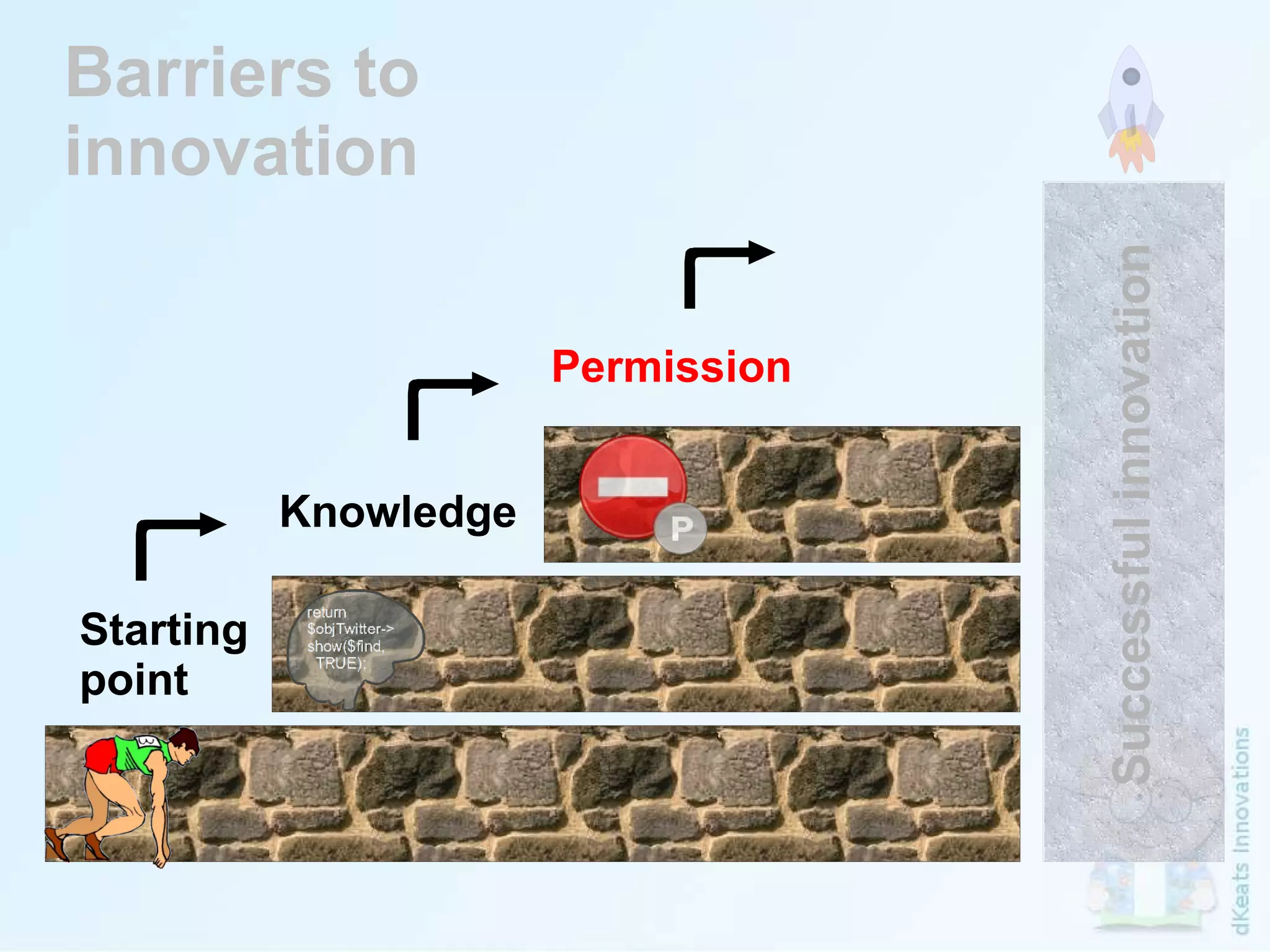
Barriers to  innovation Starting point Knowledge Permission Successful innovation
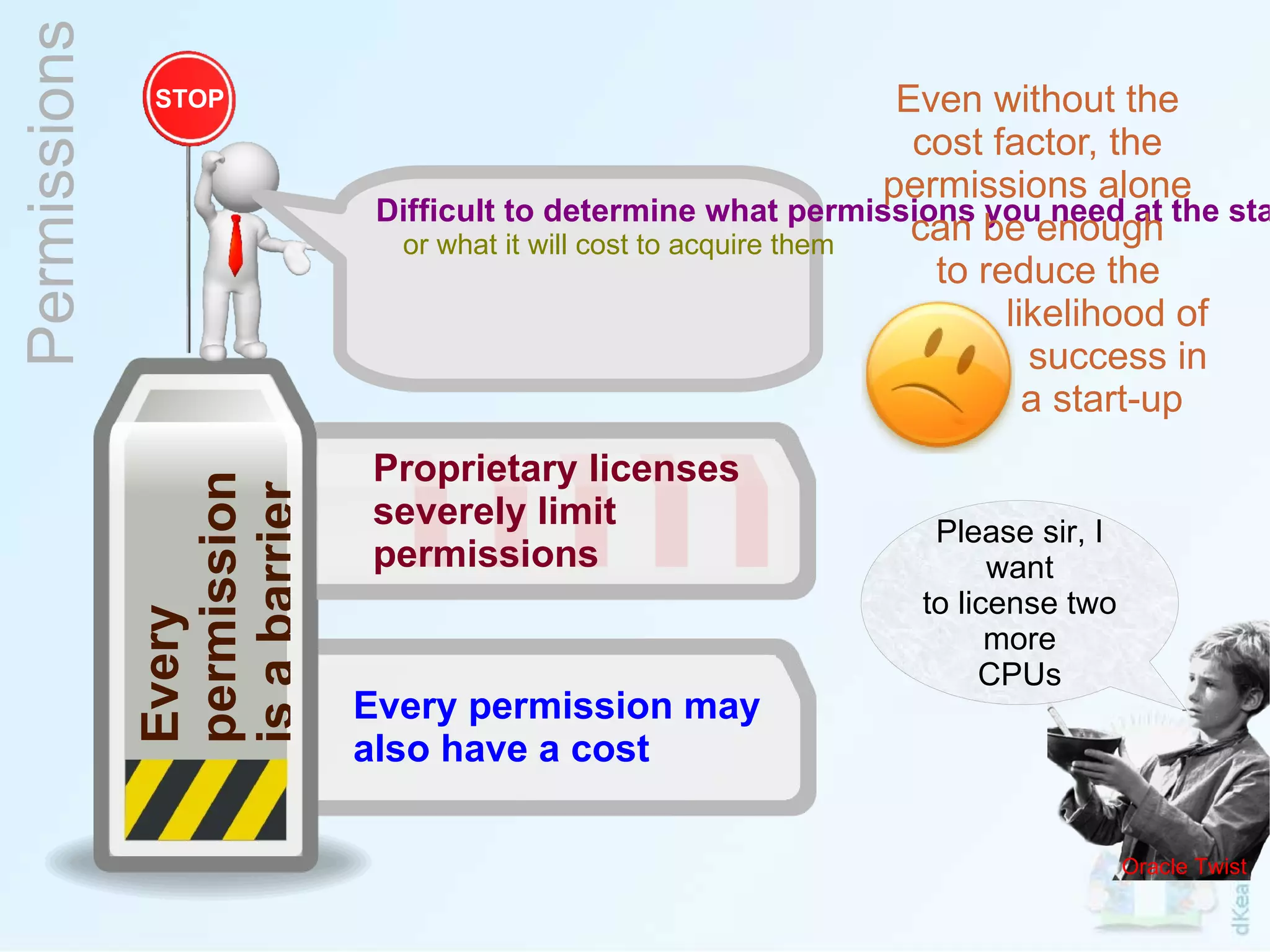
Every permission may  also have a cost Permissions Every  permission is a barrier Difficult to determine what permissions you need at the start or what it will cost to acquire them Please sir, I want to license two more CPUs Oracle Twist Proprietary licenses  severely limit  permissions STOP Even without the  cost factor, the  permissions alone  can be enough    to reduce the    likelihood of    success in    a start-up
Permissions Every  permission is a barrier NIPMO take note!
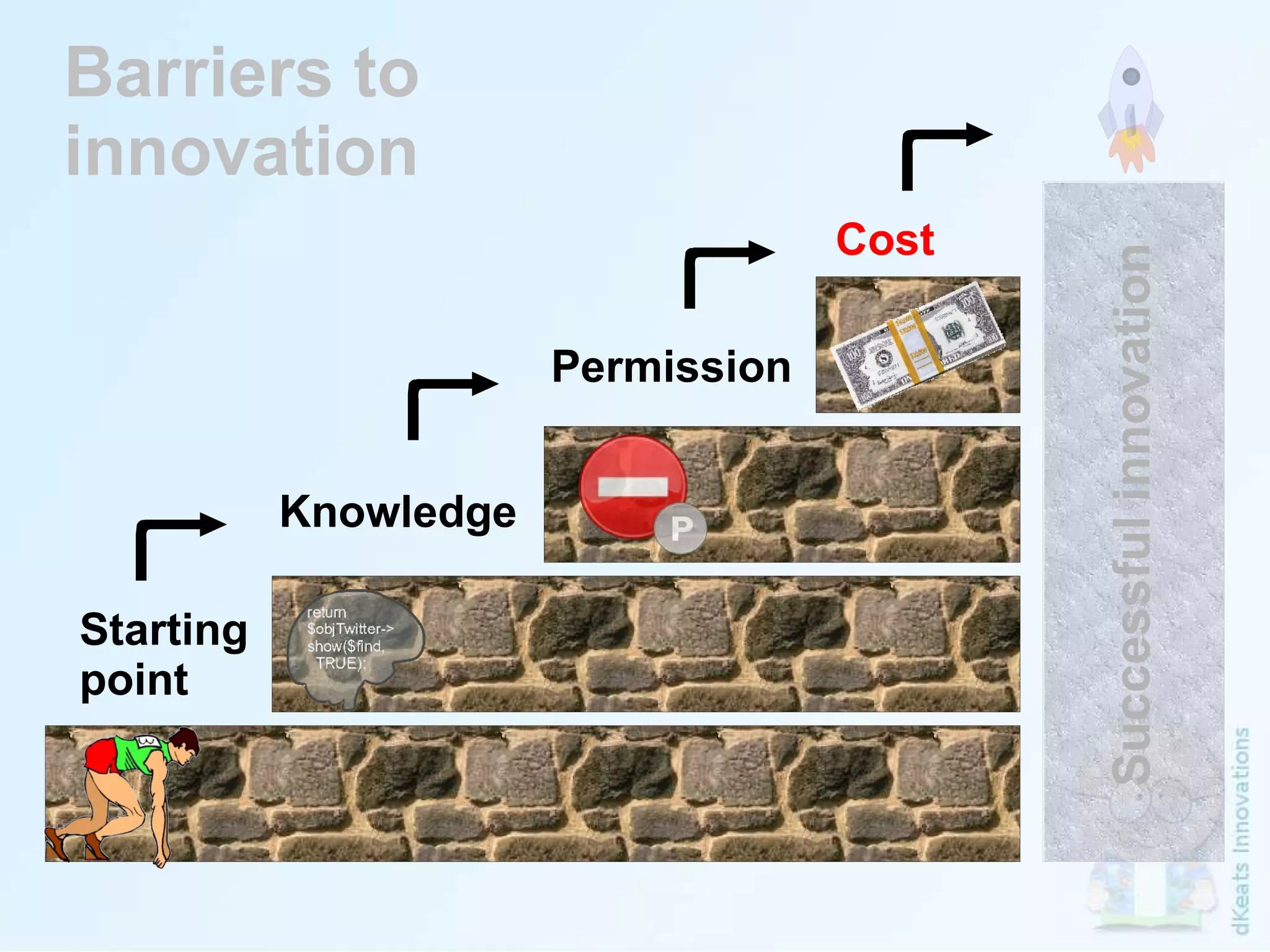
Barriers to  innovation Starting point Knowledge Permission Cost Successful innovation
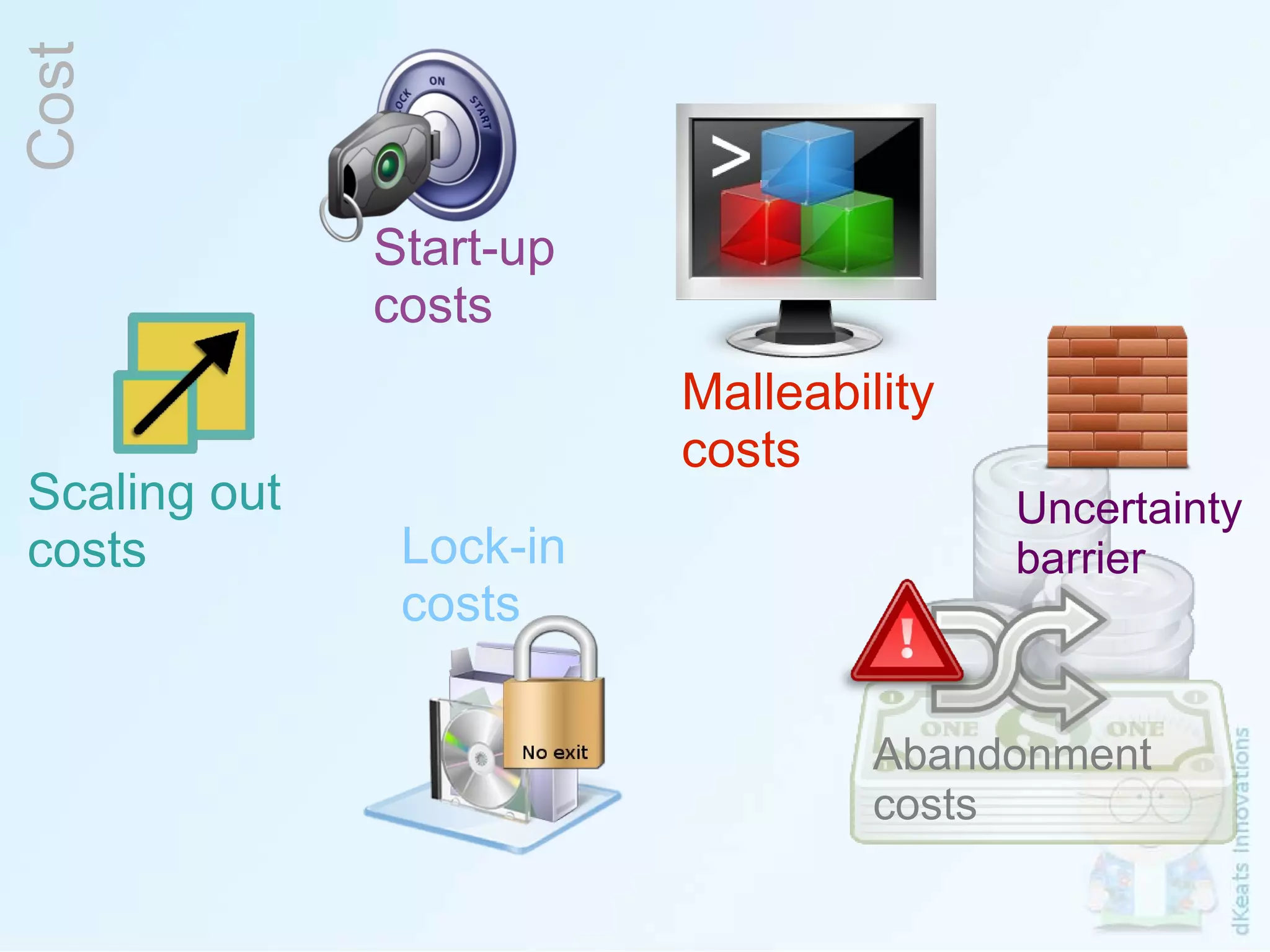
Cost Start-up  costs Scaling out  costs Lock-in costs Malleability costs Abandonment  costs Uncertainty barrier
Barriers to  innovation Successful innovation Starting point Knowledge Permission Cost
A wealth-creation perspective
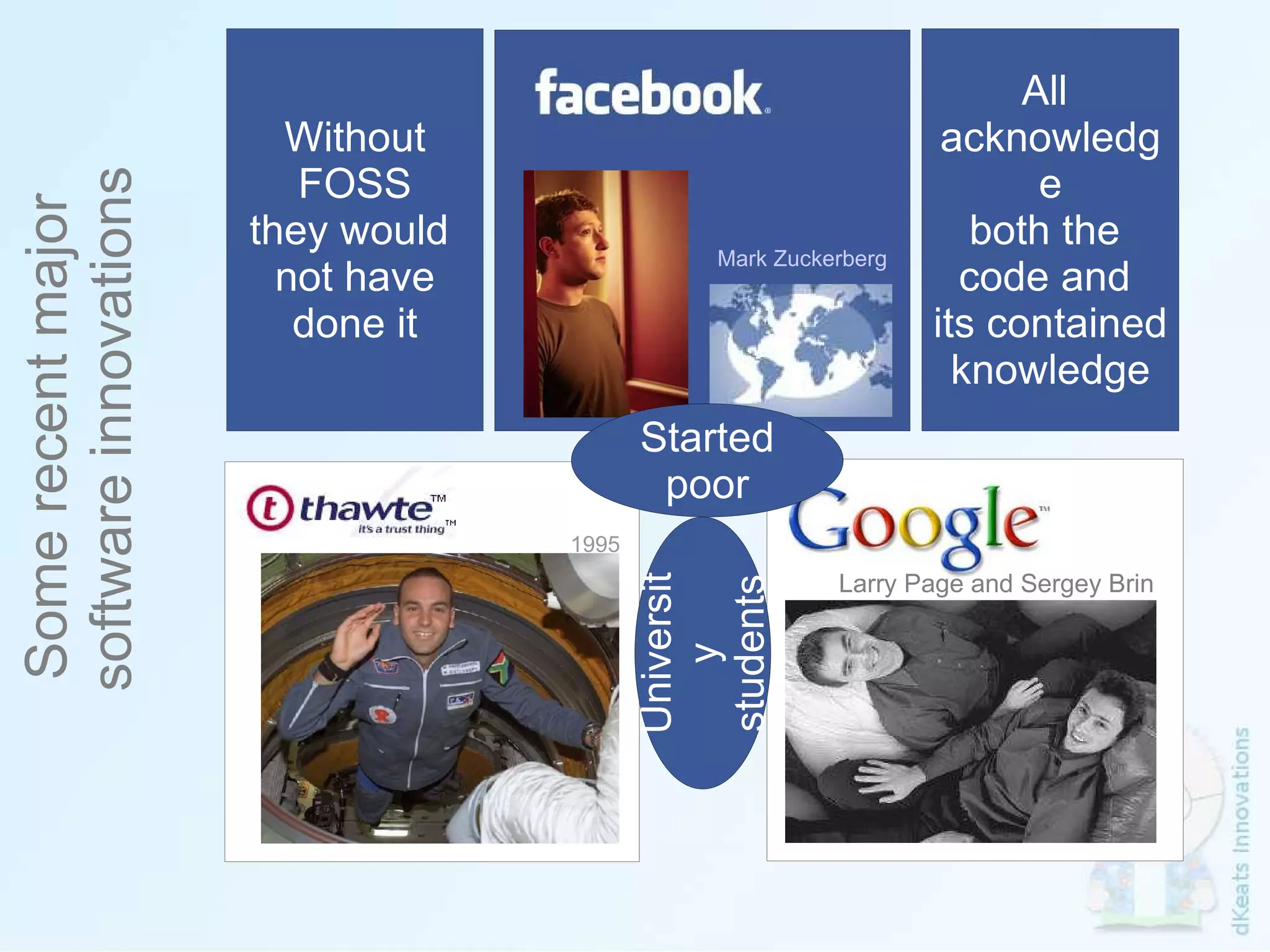
Some recent major  software innovations Started poor University students Without FOSS they would  not have done it All  acknowledge both the  code and  its contained knowledge 1995 Mark Zuckerberg Larry Page and Sergey Brin
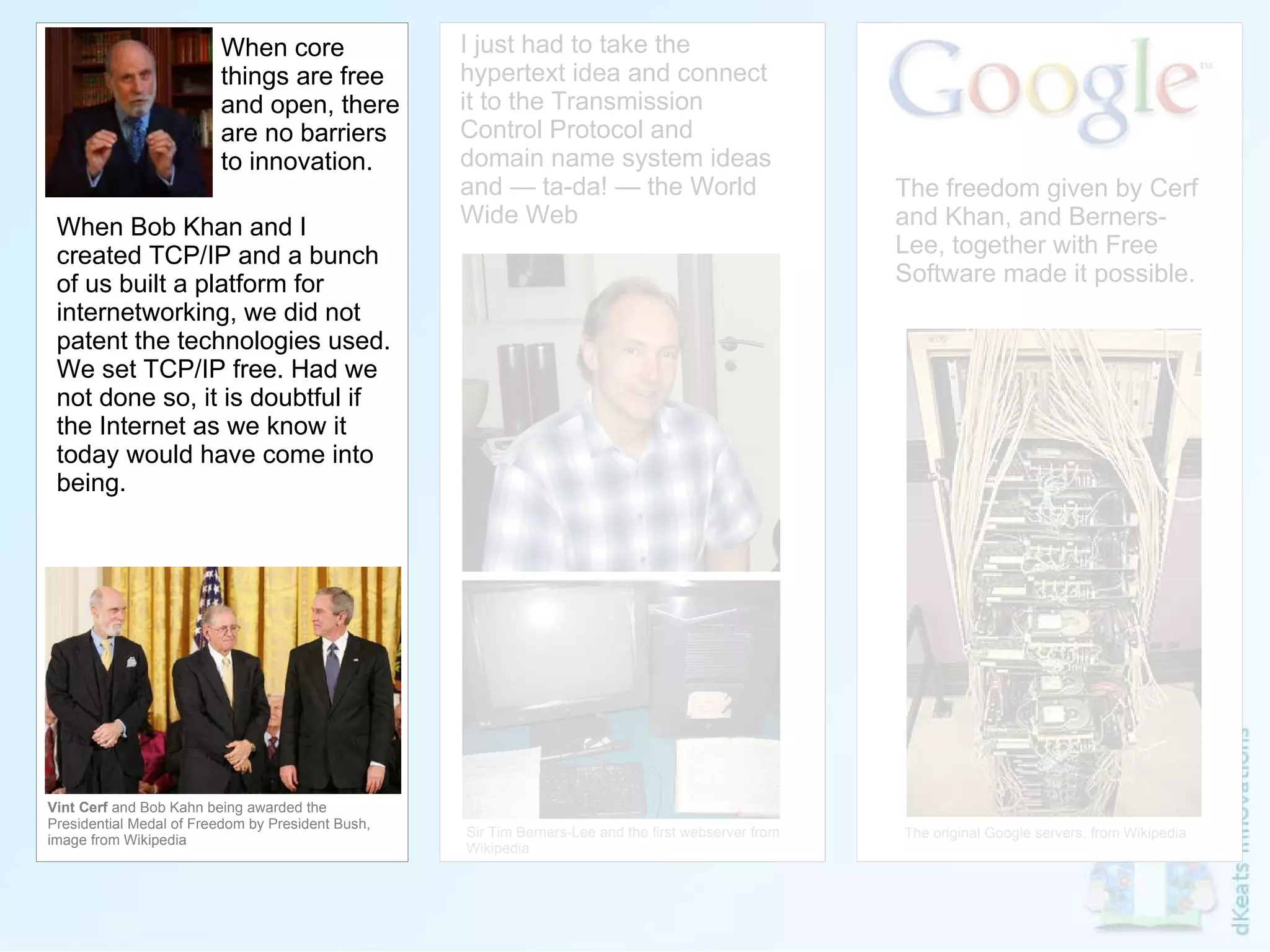
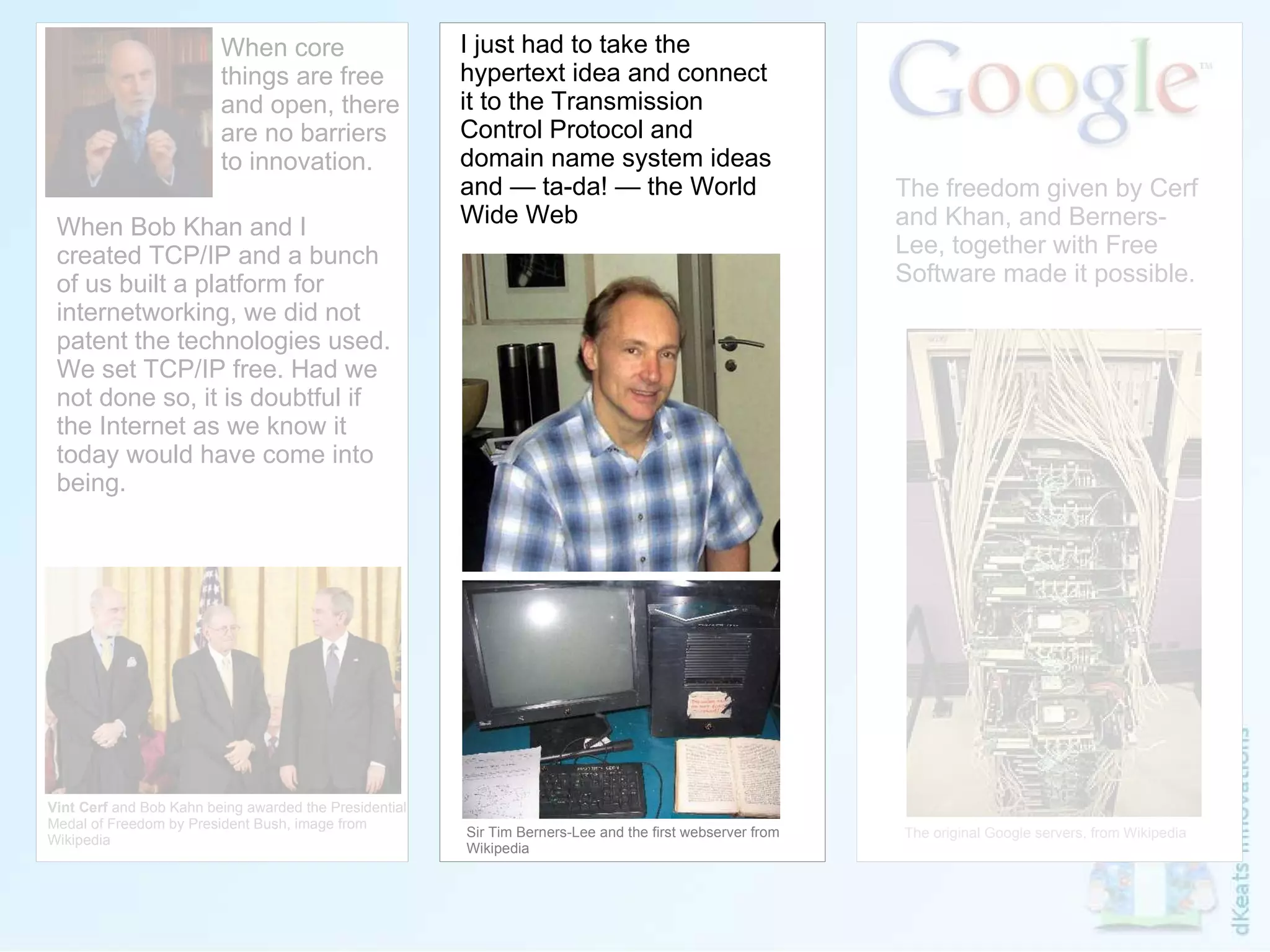
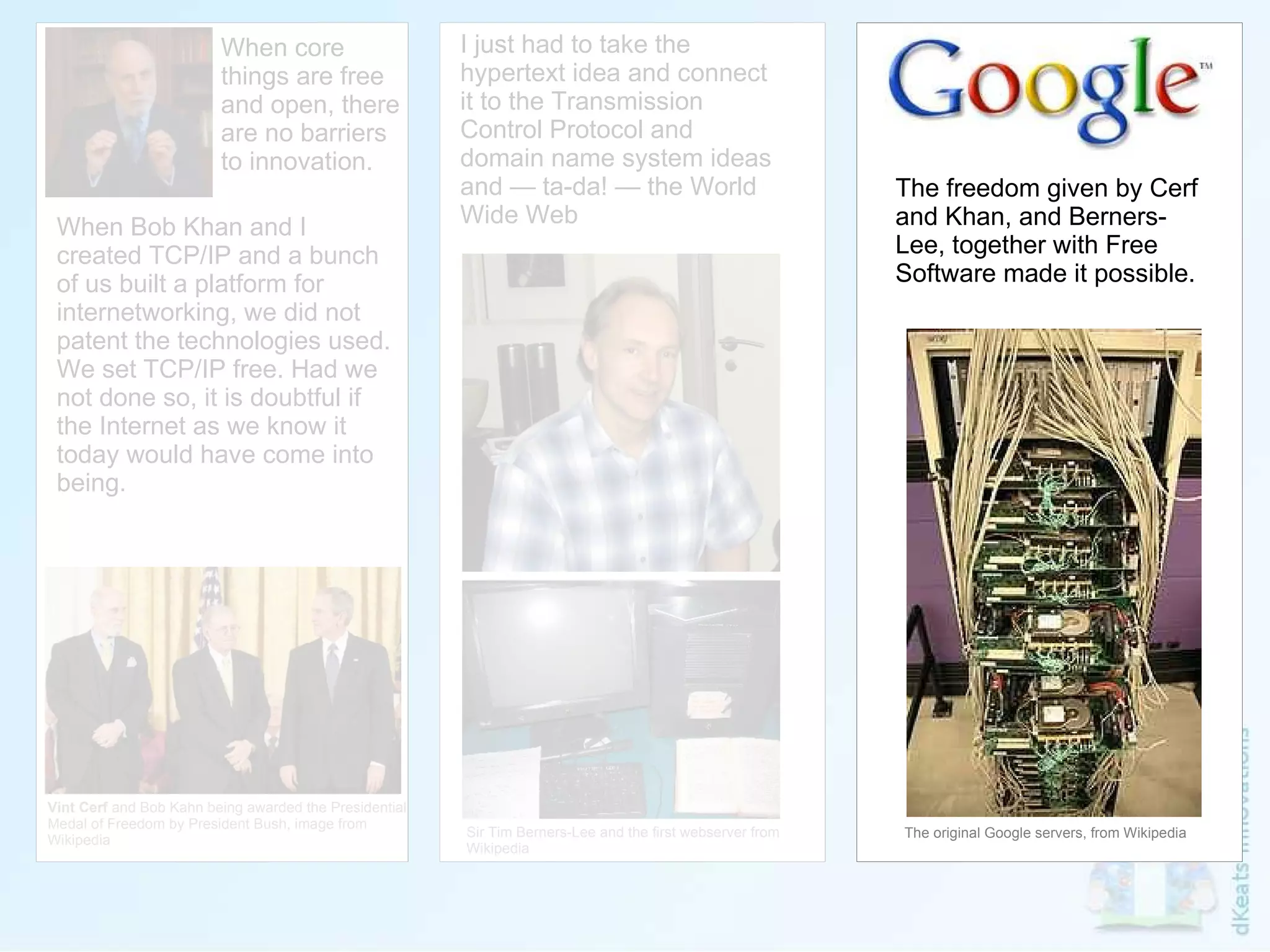
Vint Cerf  and Bob Kahn being awarded the Presidential Medal of Freedom by President Bush, image from Wikipedia I just had to take the hypertext idea and connect it to the Transmission Control Protocol and domain name system ideas and — ta-da! — the World Wide Web Sir Tim Berners-Lee and the first webserver from Wikipedia When core things are free and open, there are no barriers to innovation. When Bob Khan and I created TCP/IP and a bunch of us built a platform for internetworking, we did not patent the technologies used. We set TCP/IP free. Had we not done so, it is doubtful if the Internet as we know it today would have come into being. The freedom given by Cerf and Khan, and Berners-Lee, together with Free Software made it possible. The original Google servers, from Wikipedia
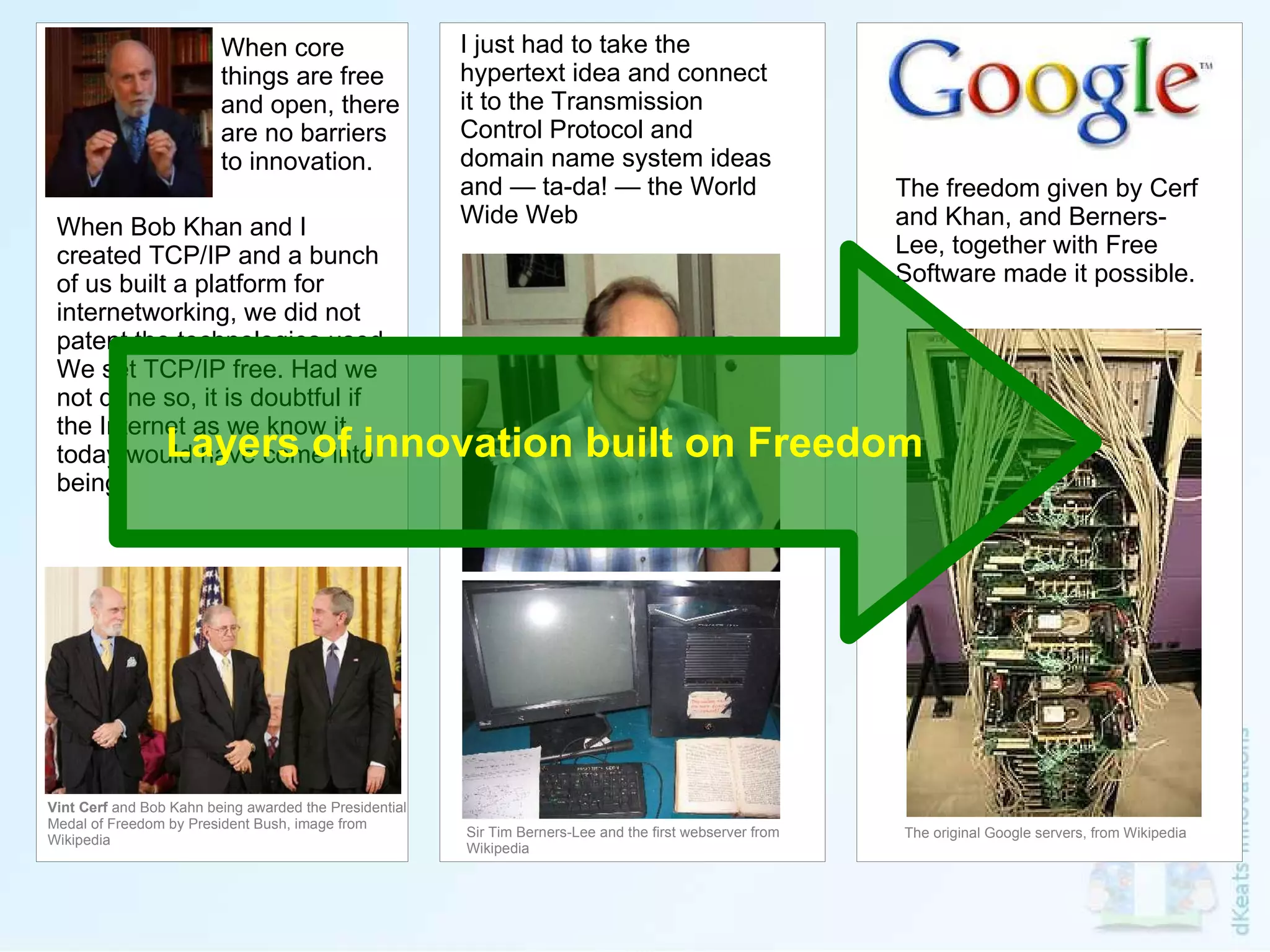
Vint Cerf  and Bob Kahn being awarded the Presidential  Medal of Freedom by President Bush, image from  Wikipedia I just had to take the hypertext idea and connect it to the Transmission Control Protocol and domain name system ideas and — ta-da! — the World Wide Web Sir Tim Berners-Lee and the first webserver from Wikipedia When core things are free and open, there are no barriers to innovation. When Bob Khan and I created TCP/IP and a bunch of us built a platform for internetworking, we did not patent the technologies used. We set TCP/IP free. Had we not done so, it is doubtful if the Internet as we know it today would have come into being. The freedom given by Cerf and Khan, and Berners-Lee, together with Free Software made it possible. The original Google servers, from Wikipedia
Vint Cerf  and Bob Kahn being awarded the Presidential  Medal of Freedom by President Bush, image from  Wikipedia I just had to take the hypertext idea and connect it to the Transmission Control Protocol and domain name system ideas and — ta-da! — the World Wide Web Sir Tim Berners-Lee and the first webserver from Wikipedia When core things are free and open, there are no barriers to innovation. When Bob Khan and I created TCP/IP and a bunch of us built a platform for internetworking, we did not patent the technologies used. We set TCP/IP free. Had we not done so, it is doubtful if the Internet as we know it today would have come into being. The freedom given by Cerf and Khan, and Berners-Lee, together with Free Software made it possible. The original Google servers, from Wikipedia Layers of innovation built on Freedom
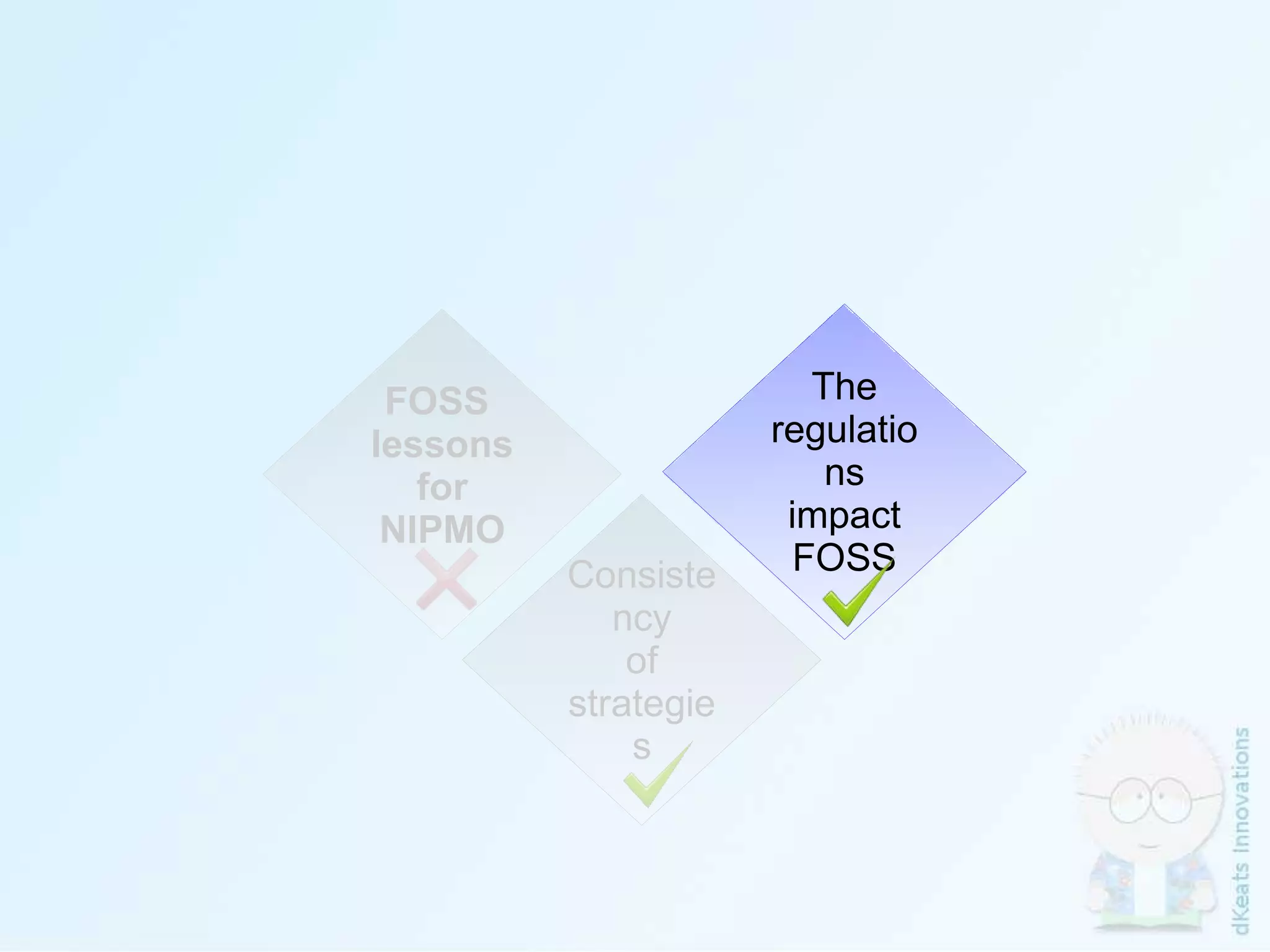
Consistency of strategies The regulations impact FOSS FOSS  lessons for NIPMO
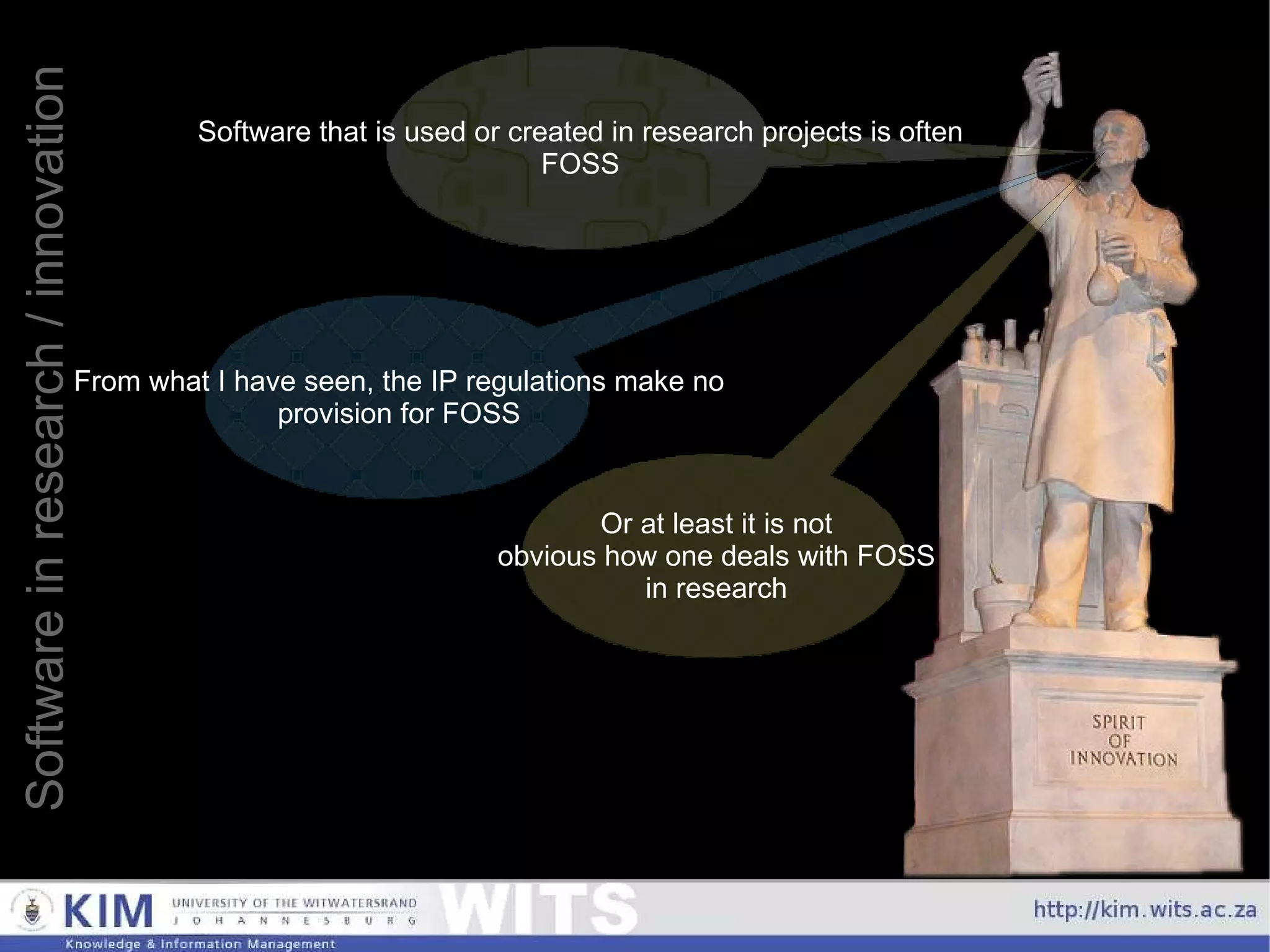
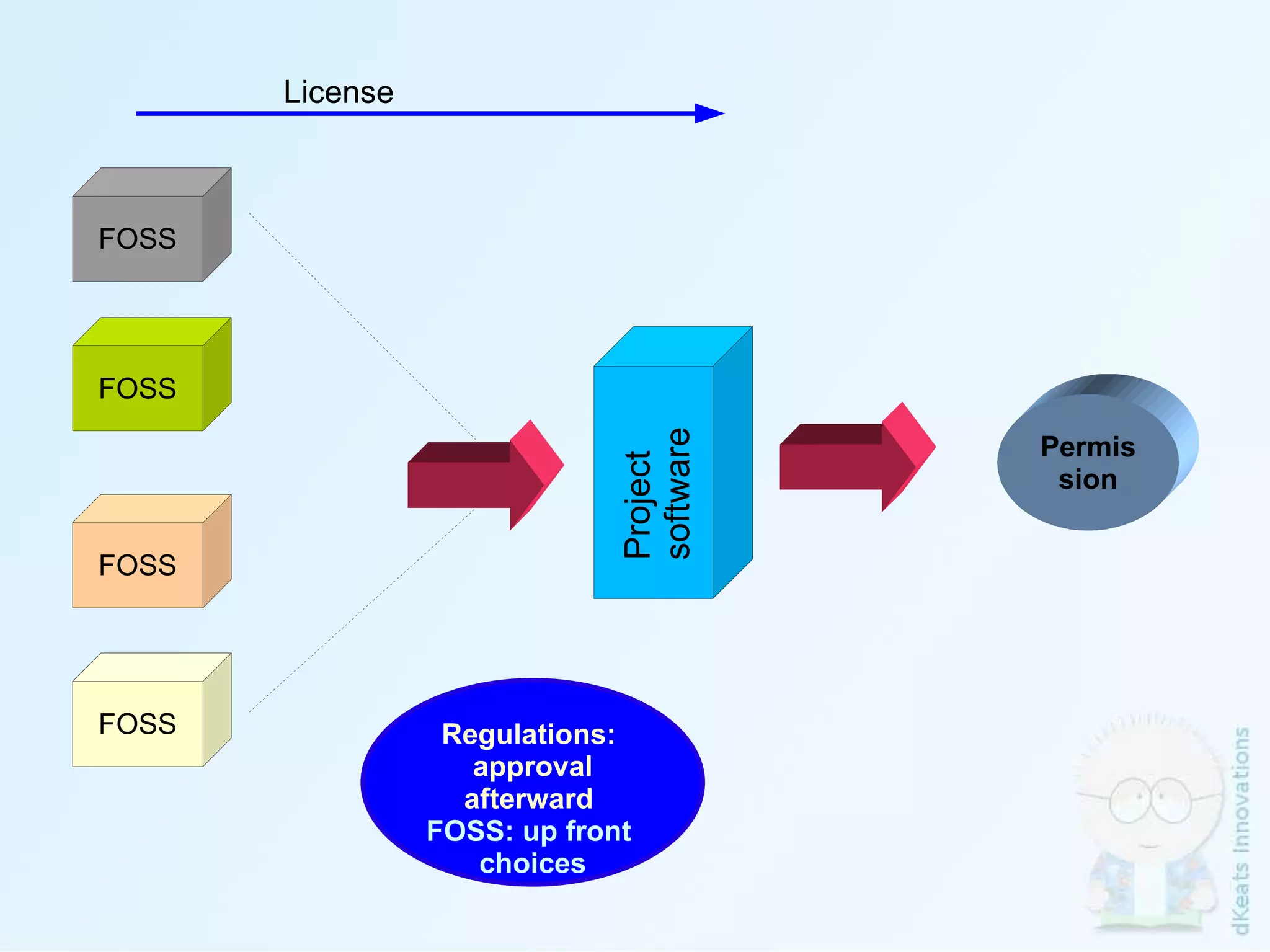
Software in research / innovation Software that is used or created in research projects is often FOSS From what I have seen, the IP regulations make no provision for FOSS Or at least it is not obvious how one deals with FOSS in research
Project software FOSS FOSS FOSS FOSS Permission Regulations:  approval afterward  FOSS: up front  choices License
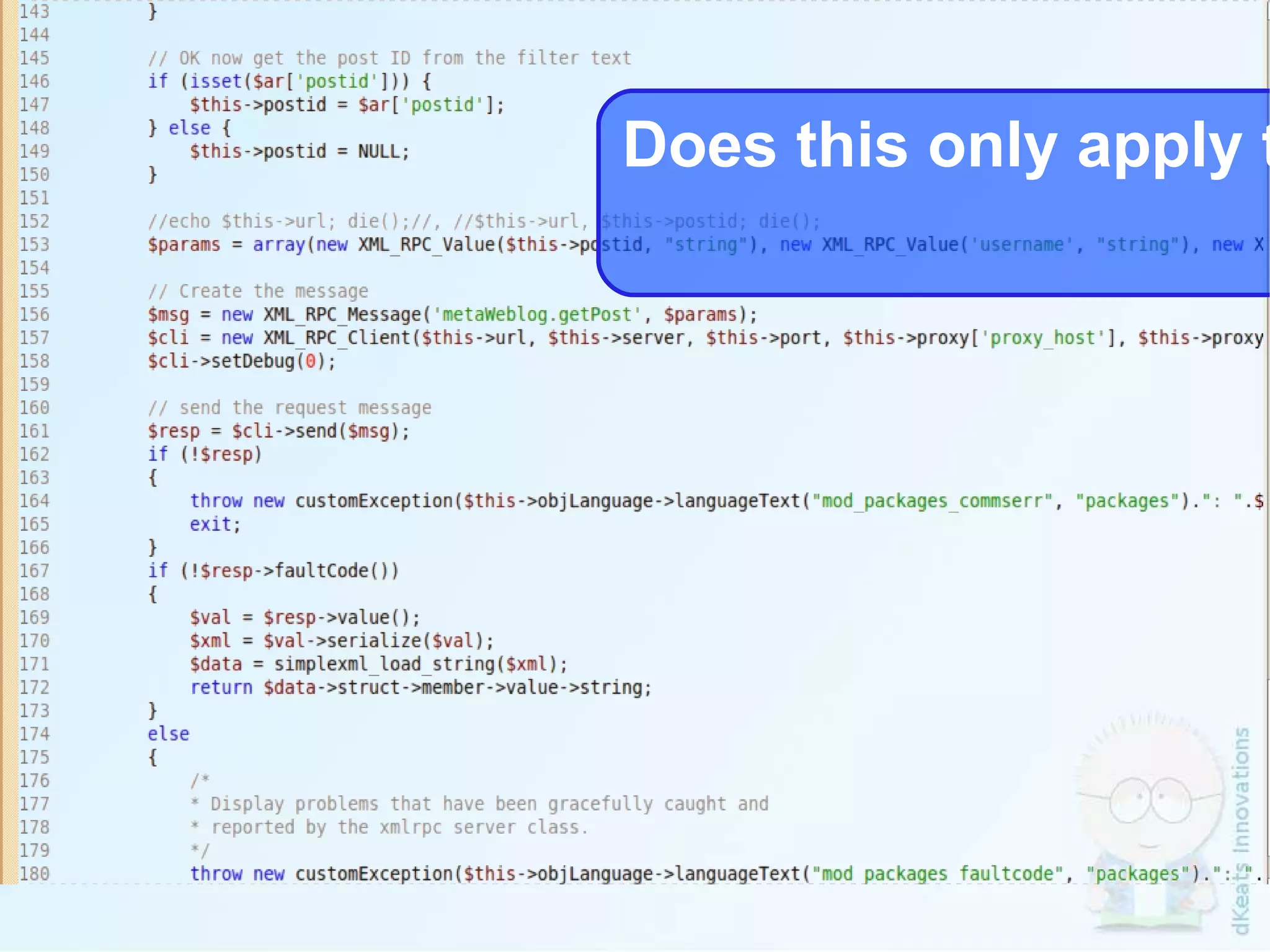
Does this only apply to software?
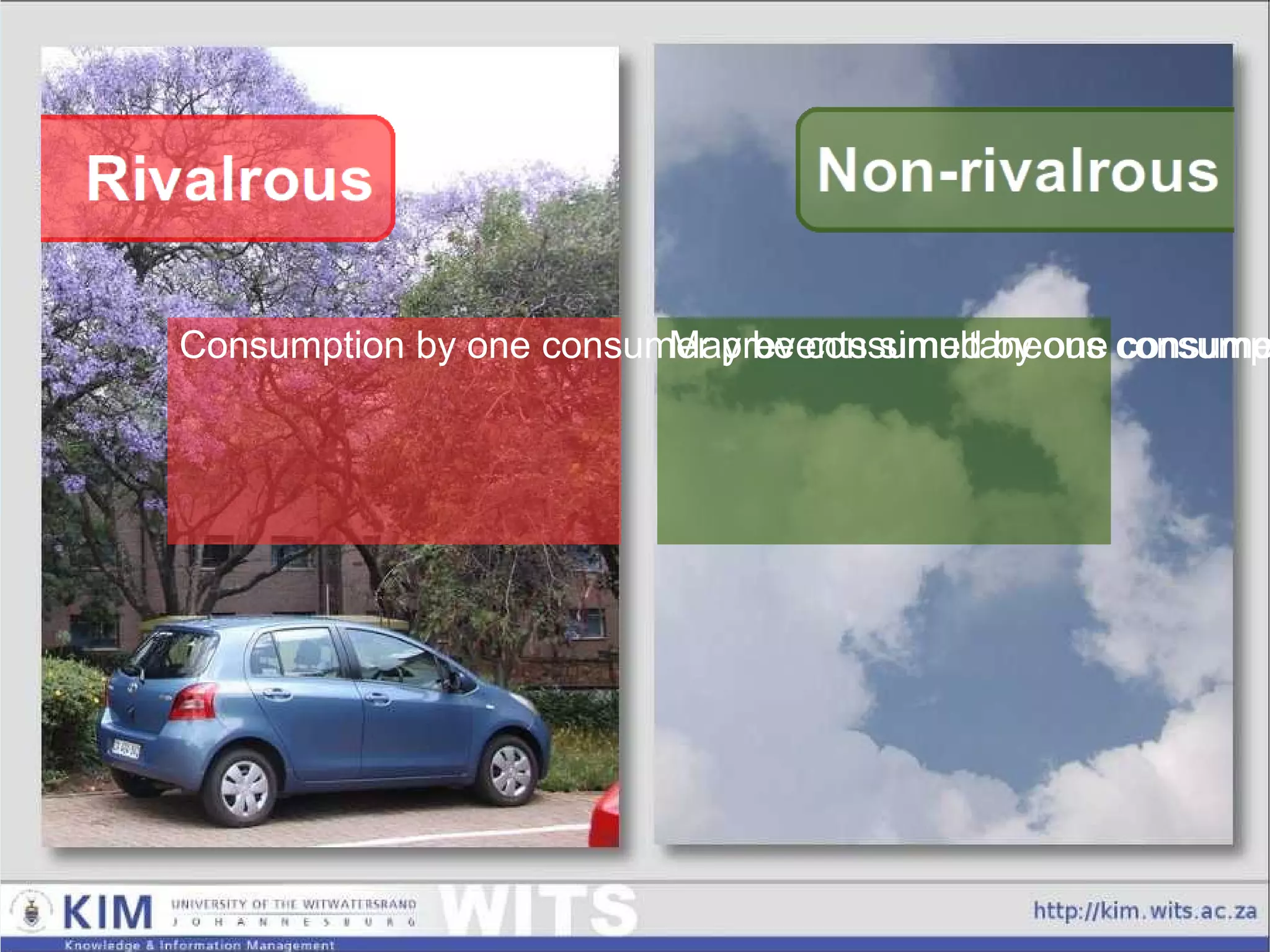
May be consumed by one consumer without preventing simultaneous consumption by others Consumption by one consumer prevents simultaneous consump-tion by other consumers
Consistency of strategies The regulations impact FOSS FOSS  lessons for NIPMO
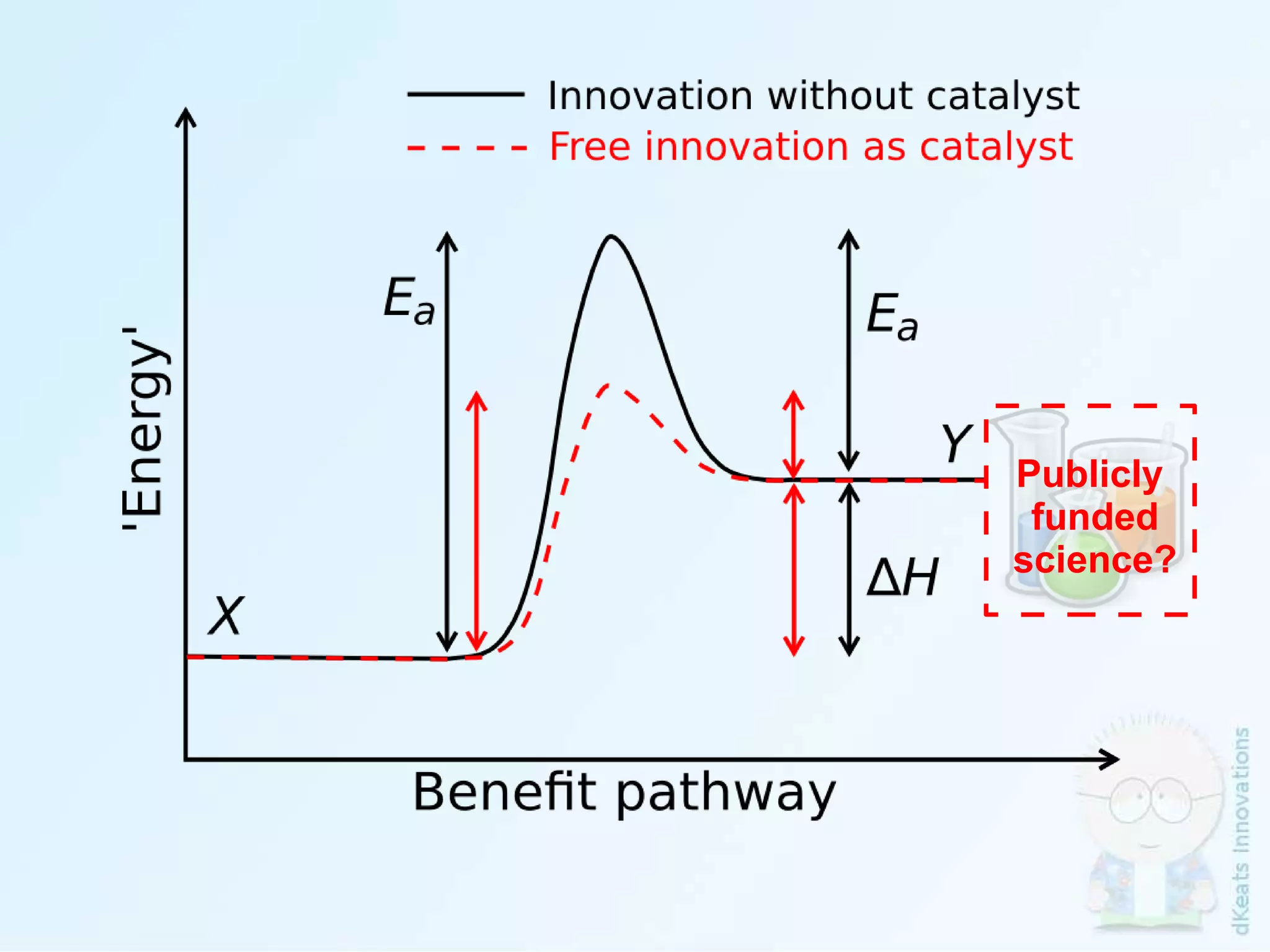
Publicly  funded science?
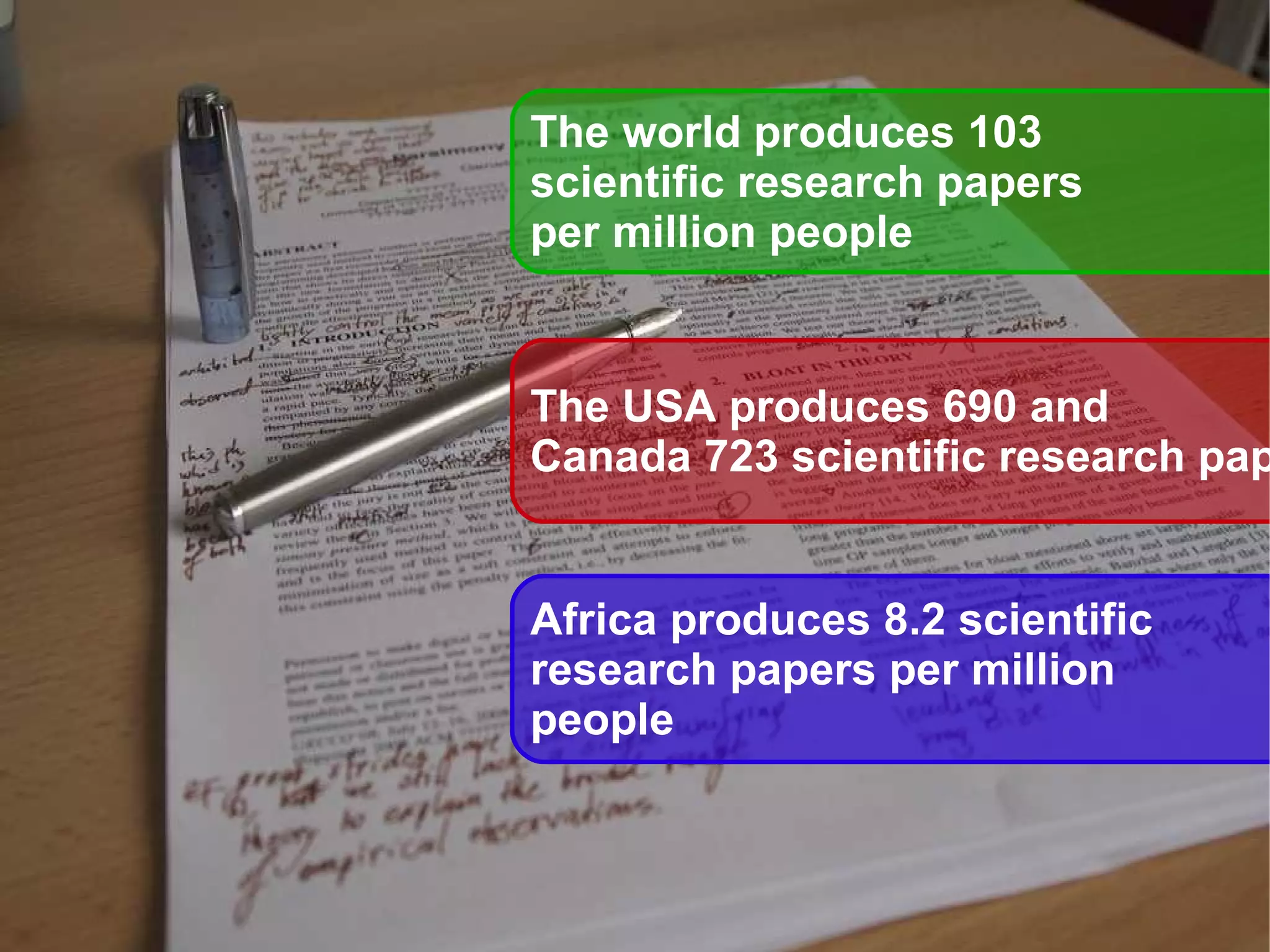
Africa produces 8.2 scientific  research papers per million  people The world produces 103  scientific research papers  per million people The USA produces 690 and  Canada 723 scientific research papers per million people
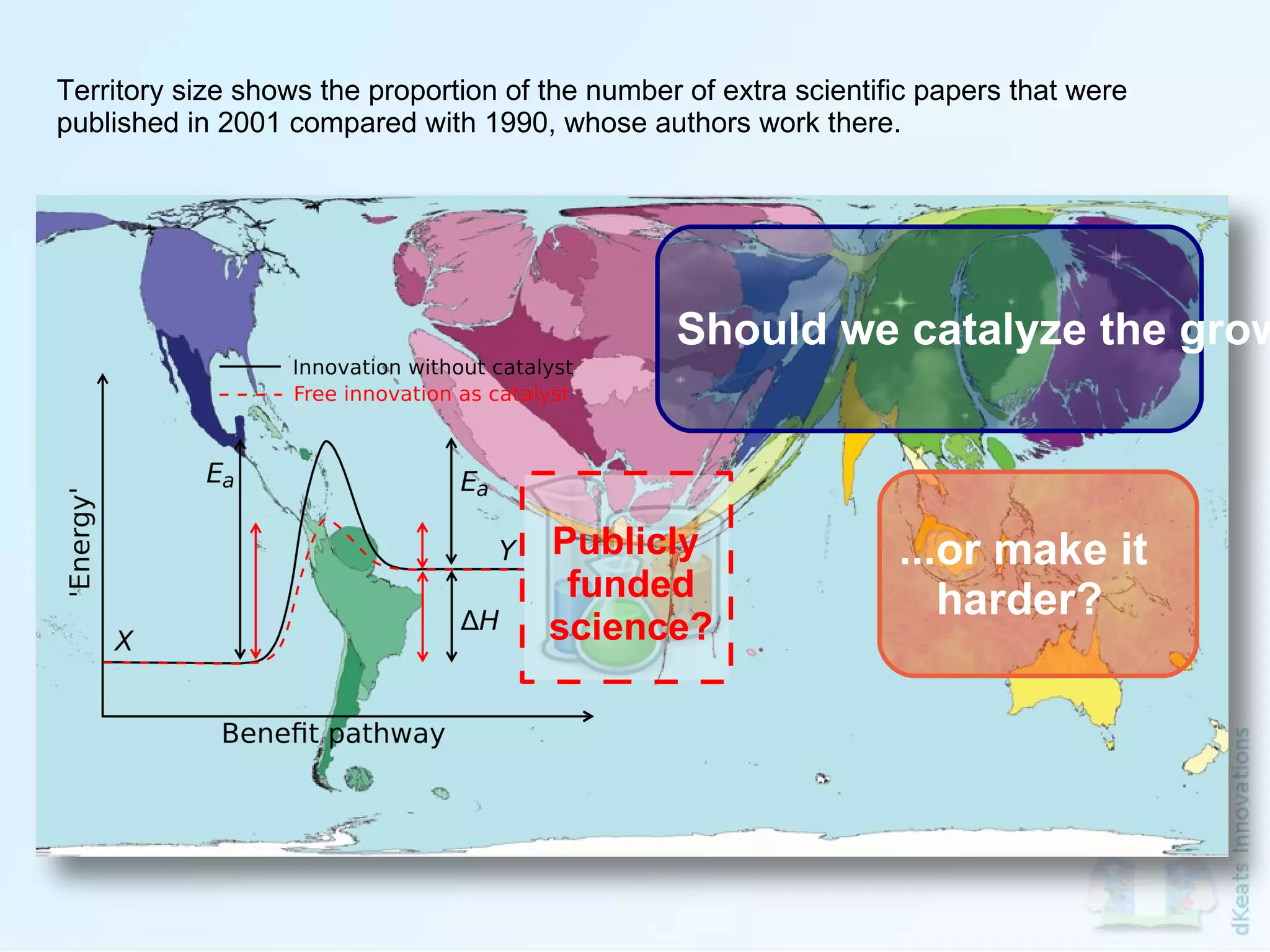
Territory size shows the proportion of the number of extra scientific papers that were published in 2001 compared with 1990, whose authors work there. Should we catalyze the growth of science in Africa? ... or make it   harder? Publicly  funded science?
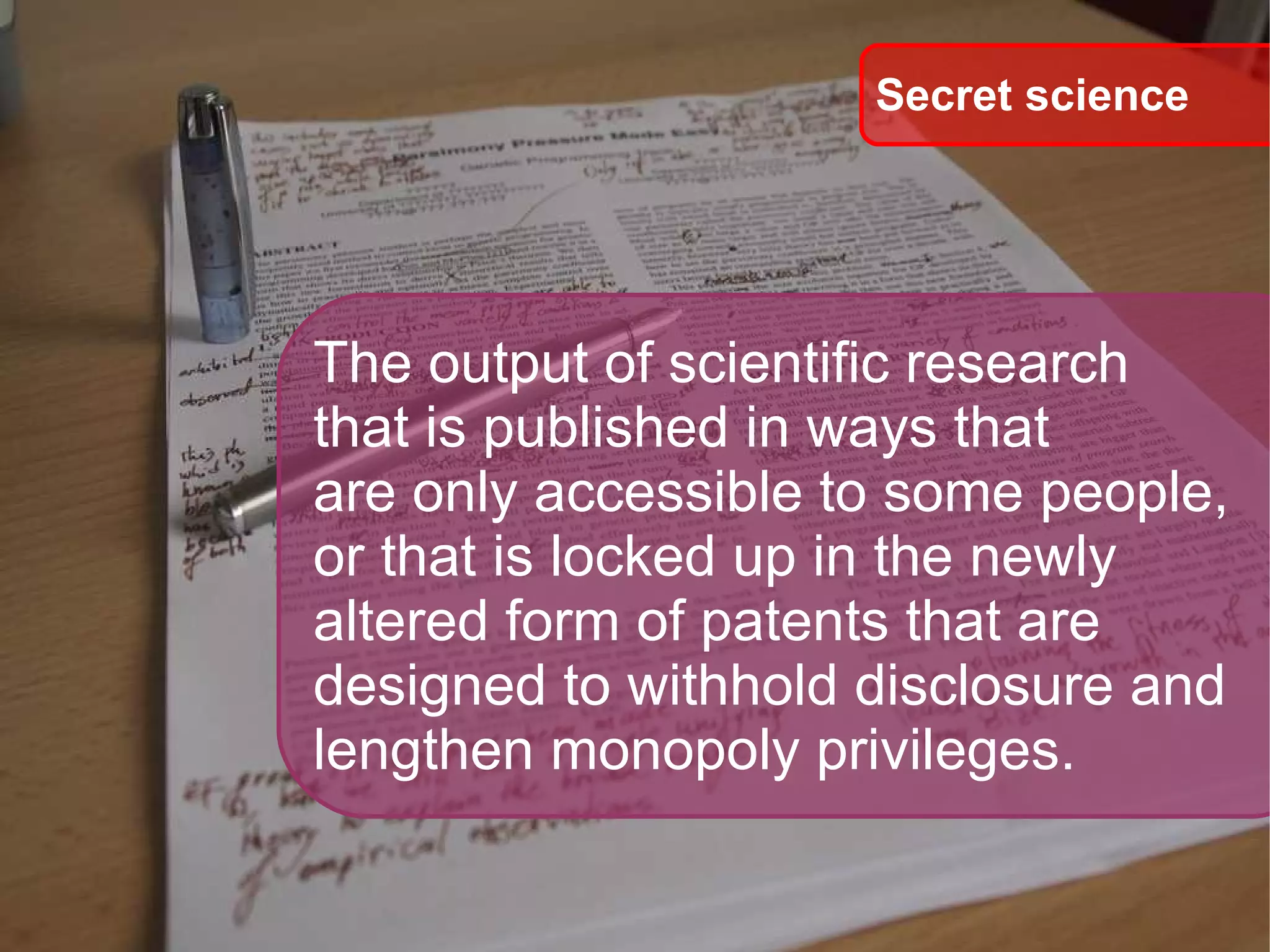
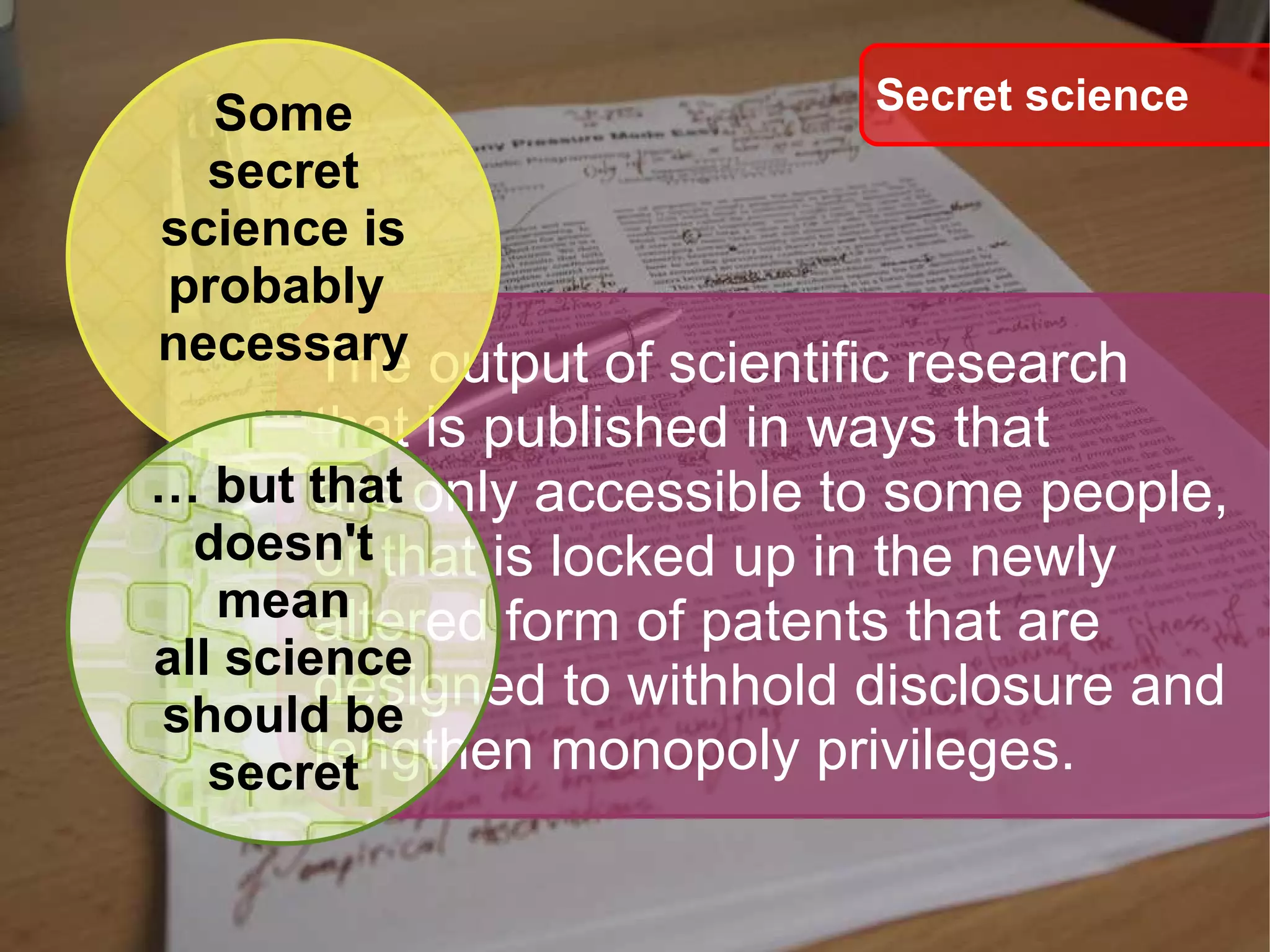
The output of scientific research  that is published in ways that are only accessible to some people, or that is locked up in the newly  altered form of patents that are  designed to withhold disclosure and  lengthen monopoly privileges. Secret science
The output of scientific research  that is published in ways that are only accessible to some people, or that is locked up in the newly  altered form of patents that are  designed to withhold disclosure and  lengthen monopoly privileges. Secret science Some secret science is probably  necessary ... …  but that  doesn't mean all science should be secret
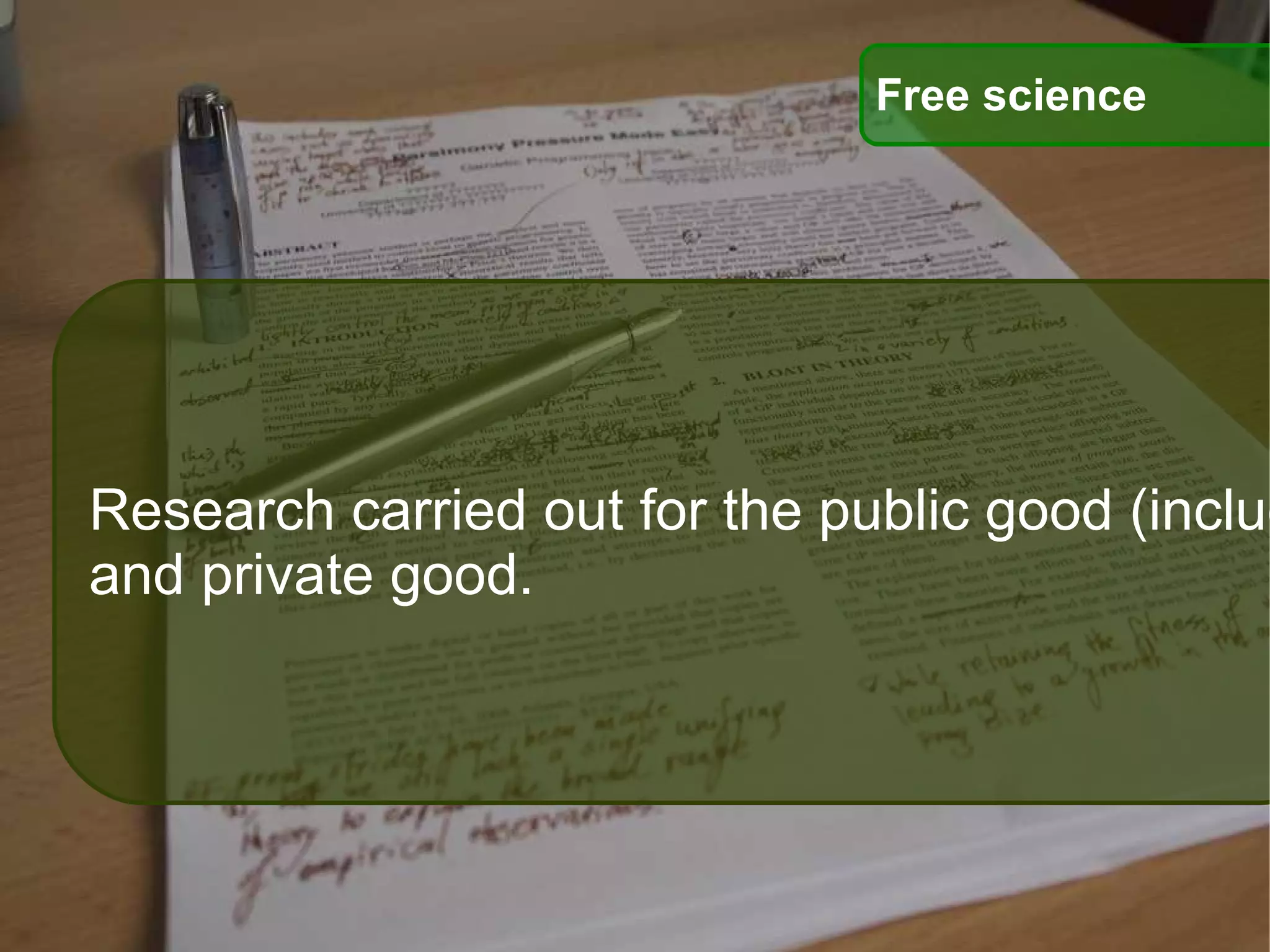
Free science Research carried out for the public good (including knowledge growth), that is published in ways that are accessible to anyone with a networked computing device, and that can be freely built upon to create innovations that  contribute to both public  and private good.
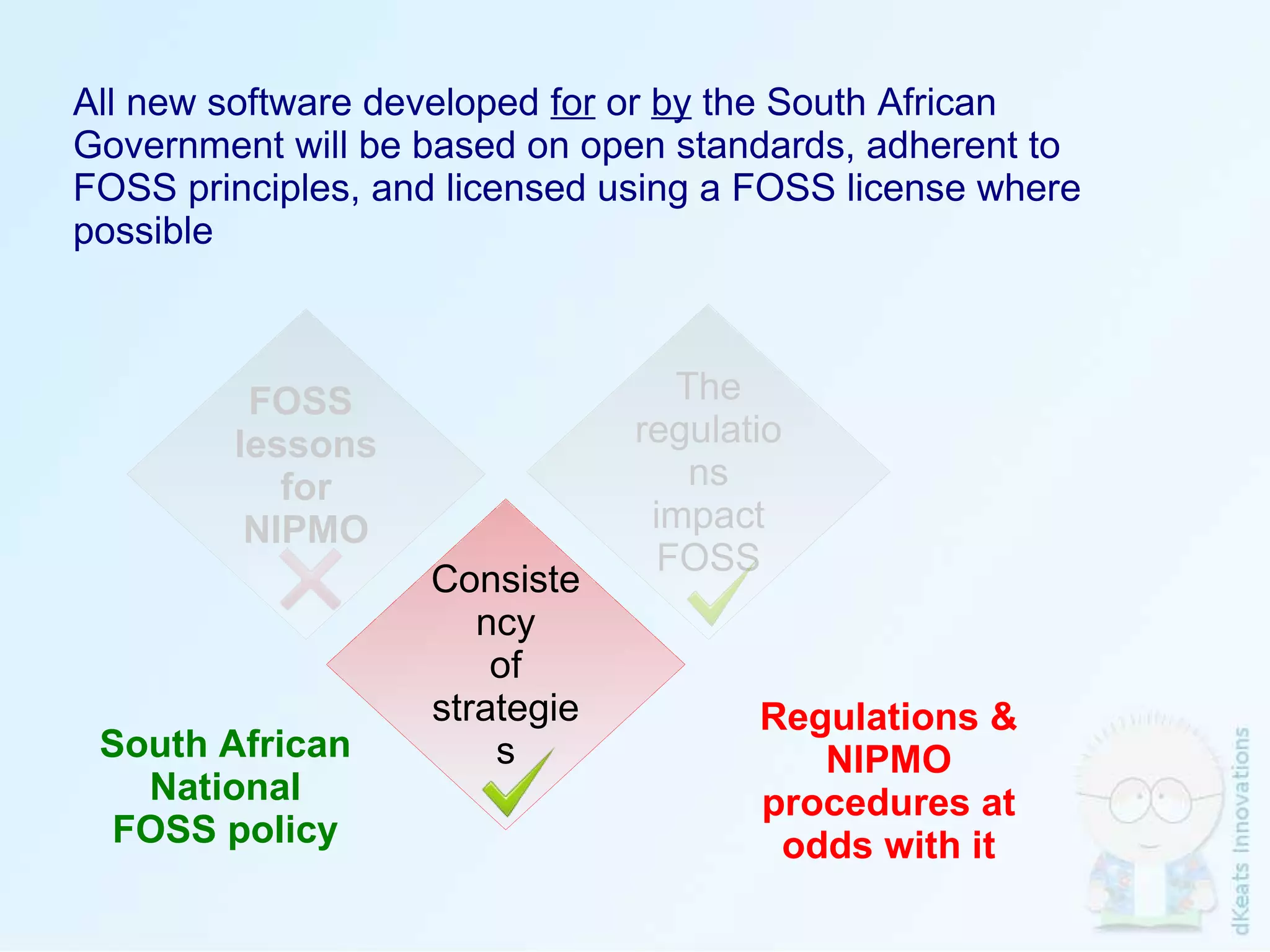
South African National FOSS policy All new software developed  for  or  by  the South African Government will be based on open standards, adherent to FOSS principles, and licensed using a FOSS license where possible Regulations & NIPMO procedures at odds with it The regulations impact FOSS FOSS  lessons for NIPMO Consistency of strategies
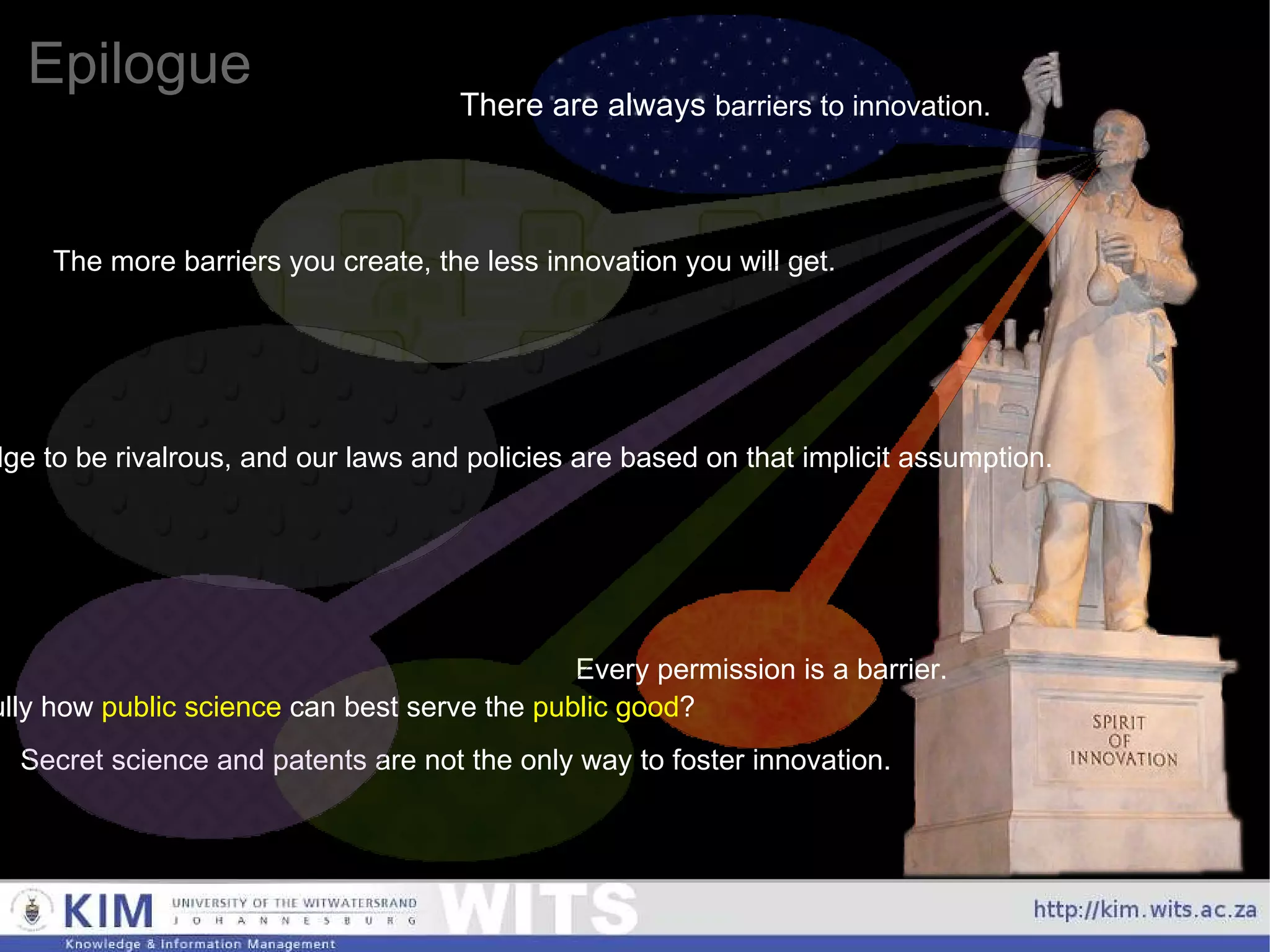
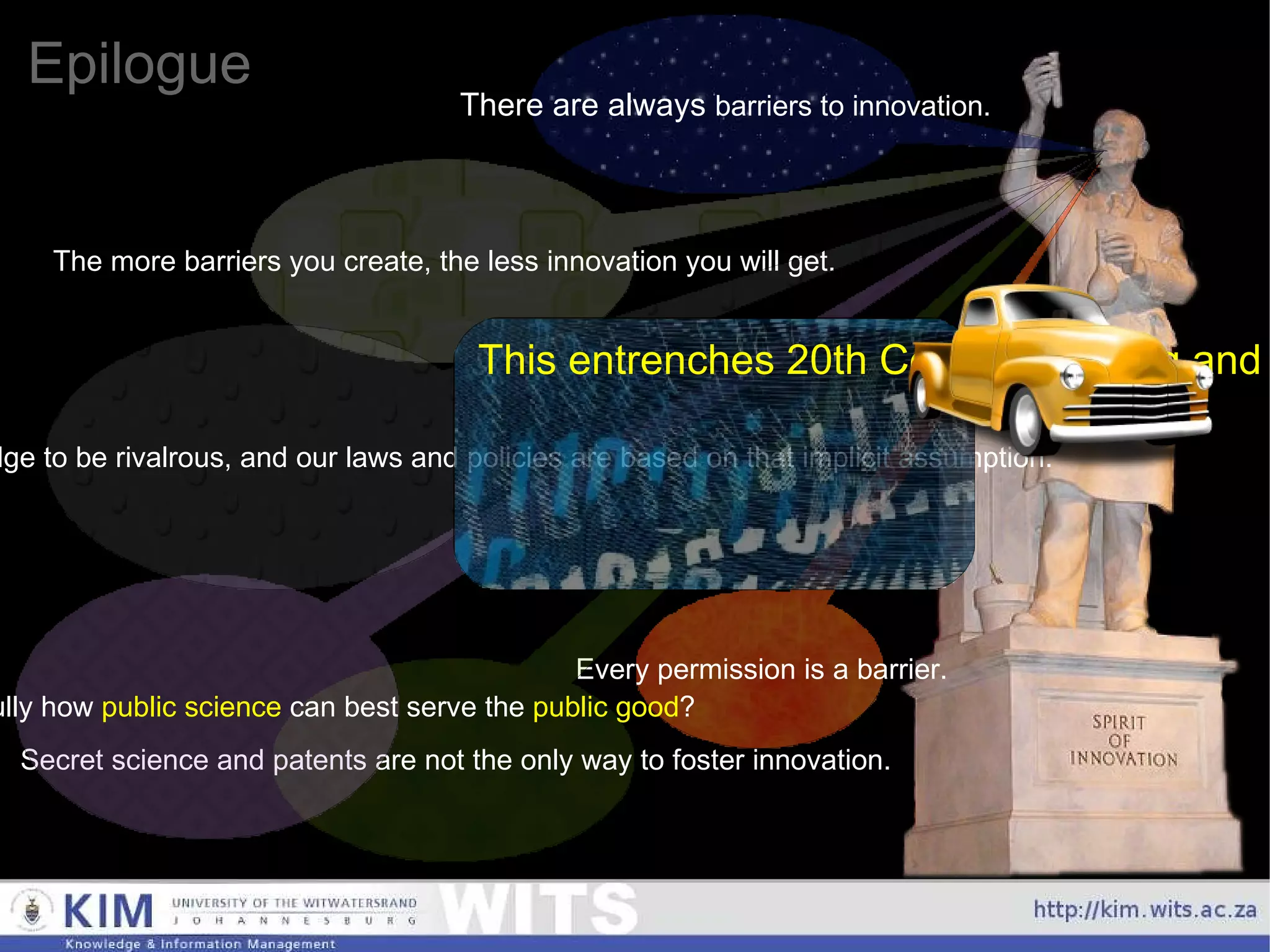
Epilogue There are always  barriers to innovation. The more barriers you create, the less innovation you will get. Every permission is a barrier. Secret science and patents are not the only way to foster innovation. Should we look carefully how  public science  can best serve the  public good ? Currently, we implicitly assume knowledge to be rivalrous, and our laws and policies are based on that implicit assumption.
Epilogue There are always  barriers to innovation. The more barriers you create, the less innovation you will get. Every permission is a barrier. Secret science and patents are not the only way to foster innovation. Should we look carefully how  public science  can best serve the  public good ? Currently, we implicitly assume knowledge to be rivalrous, and our laws and policies are based on that implicit assumption. This entrenches 20th Century thinking and business models, and is a major impediment to 21st Century innovation.
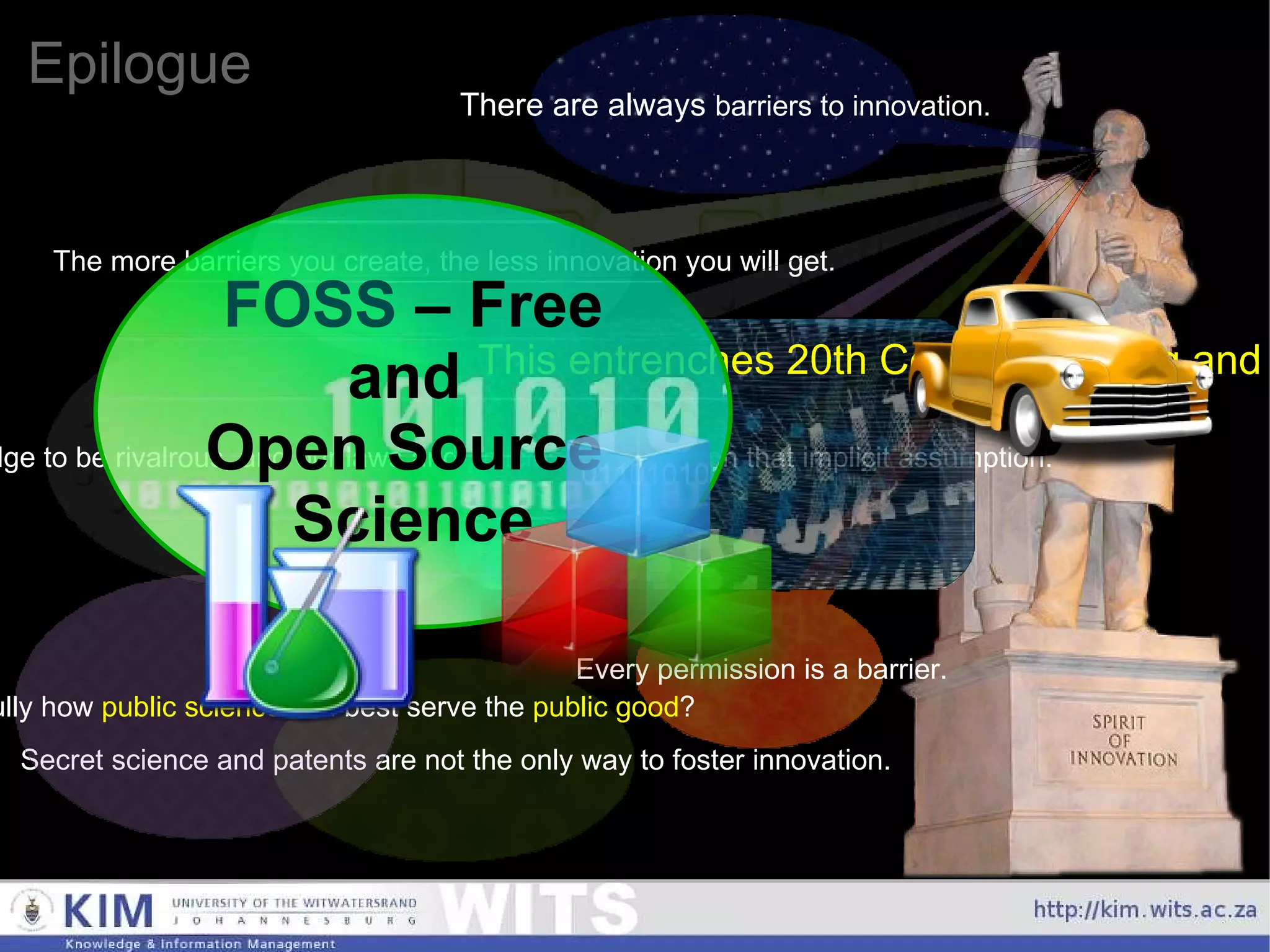
Epilogue There are always  barriers to innovation. The more barriers you create, the less innovation you will get. Every permission is a barrier. Secret science and patents are not the only way to foster innovation. Should we look carefully how  public science  can best serve the  public good ? Currently, we implicitly assume knowledge to be rivalrous, and our laws and policies are based on that implicit assumption. This entrenches 20th Century thinking and business models, and is a major impediment to 21st Century innovation. FOSS  – Free and  Open Source  Science
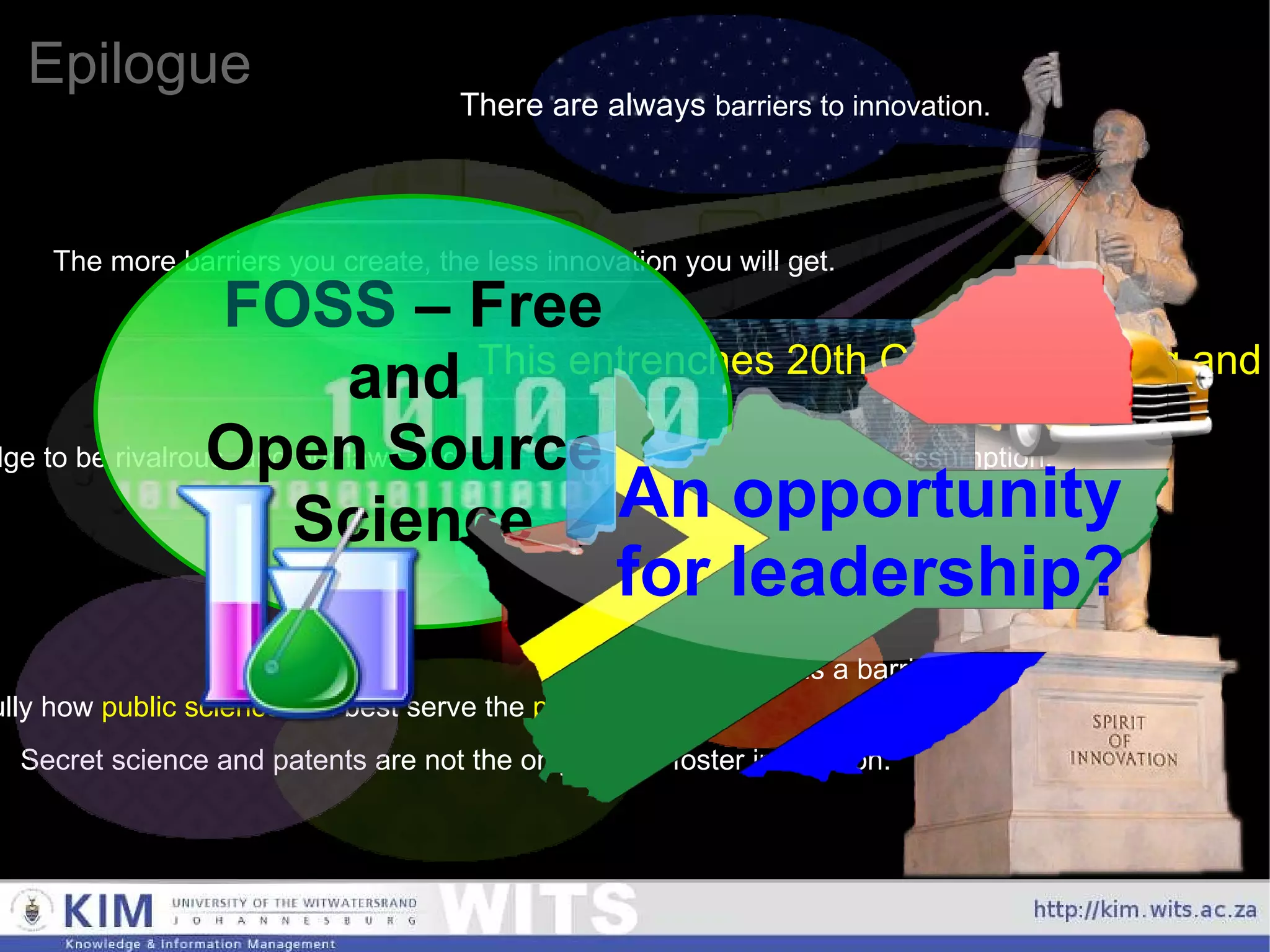
Epilogue An opportunity    for leadership? There are always  barriers to innovation. The more barriers you create, the less innovation you will get. Every permission is a barrier. Secret science and patents are not the only way to foster innovation. Should we look carefully how  public science  can best serve the  public good ? Currently, we implicitly assume knowledge to be rivalrous, and our laws and policies are based on that implicit assumption. This entrenches 20th Century thinking and business models, and is a major impediment to 21st Century innovation. FOSS  – Free and  Open Source  Science
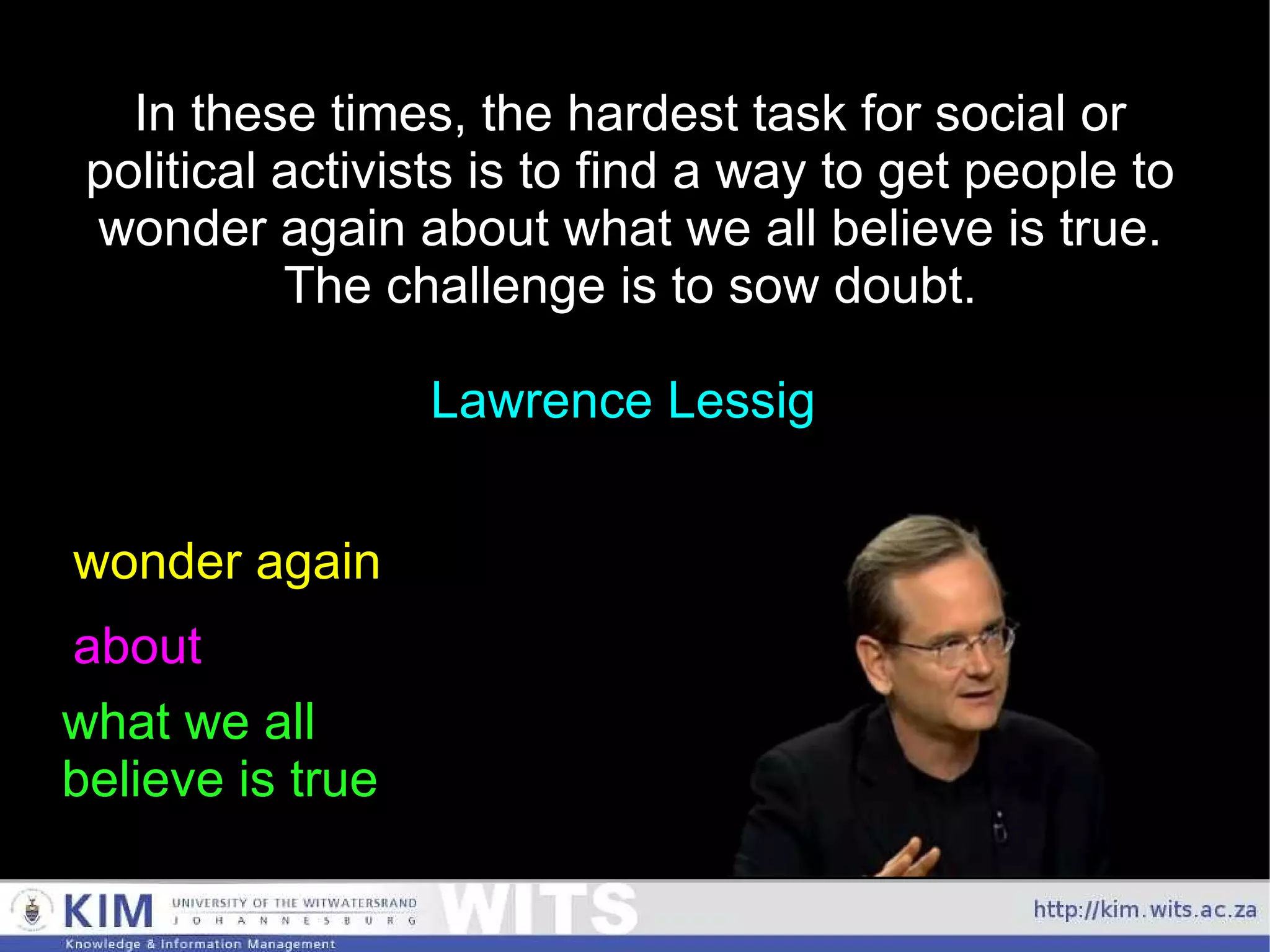
In these times, the hardest task for social or political activists is to find a way to get people to wonder again about what we all believe is true. The challenge is to sow doubt. Lawrence Lessig  wonder again about what we all  believe is true
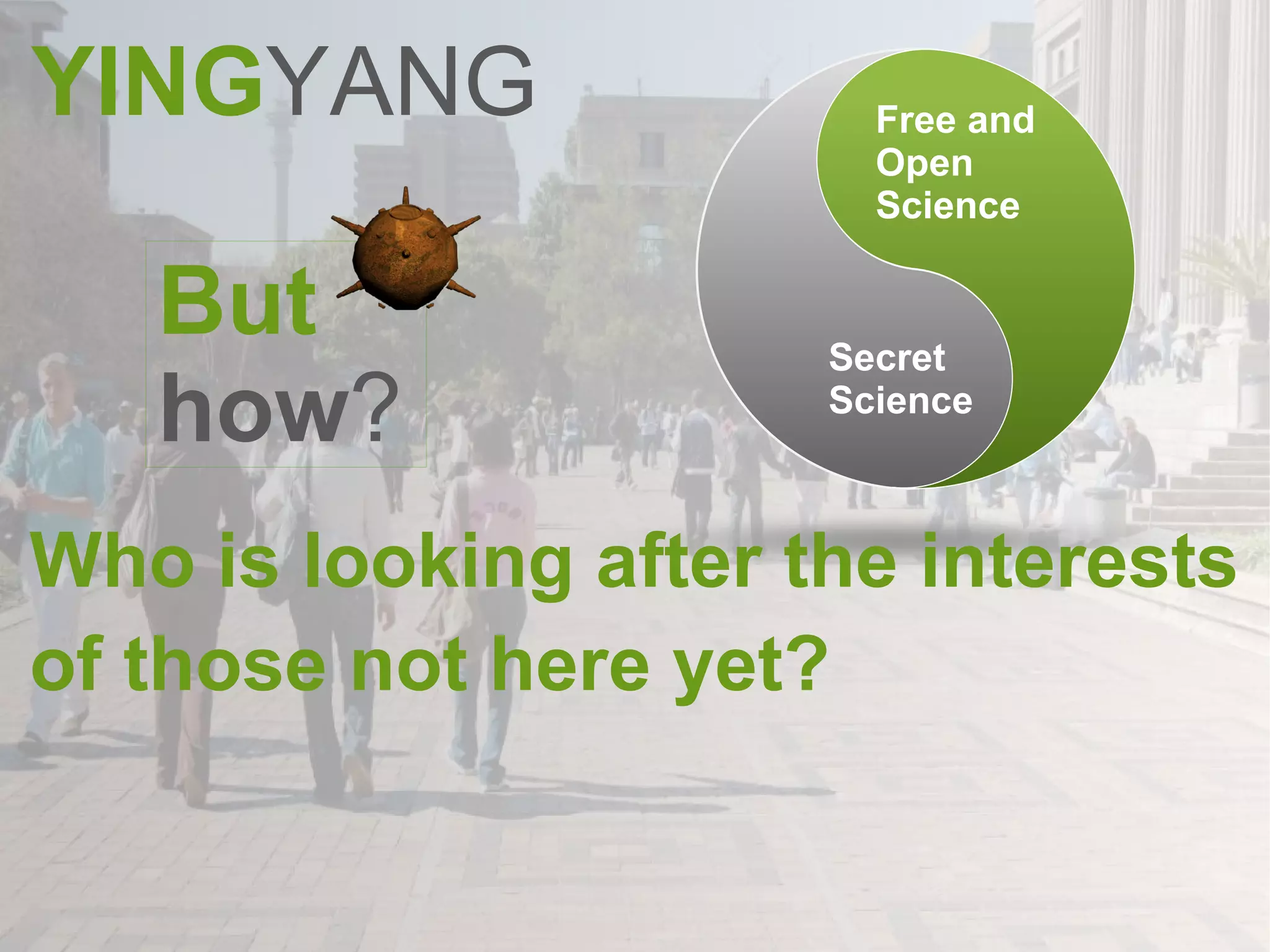
YING YANG Who is looking after the interests of those not here yet?   Free and Open  Science Secret Science But how ?
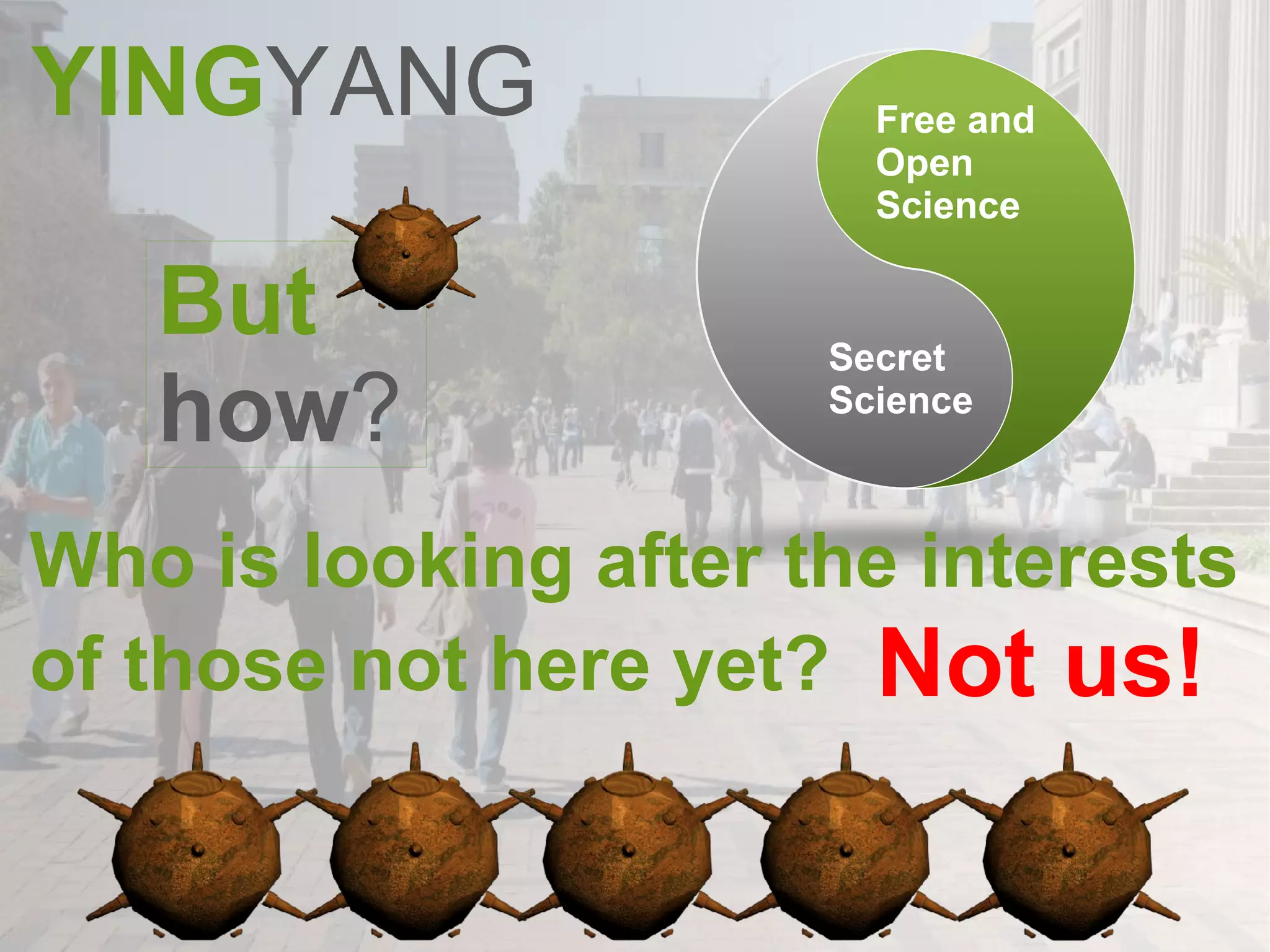
YING YANG Who is looking after the interests of those not here yet?   Not us! Free and Open  Science Secret Science But how ?
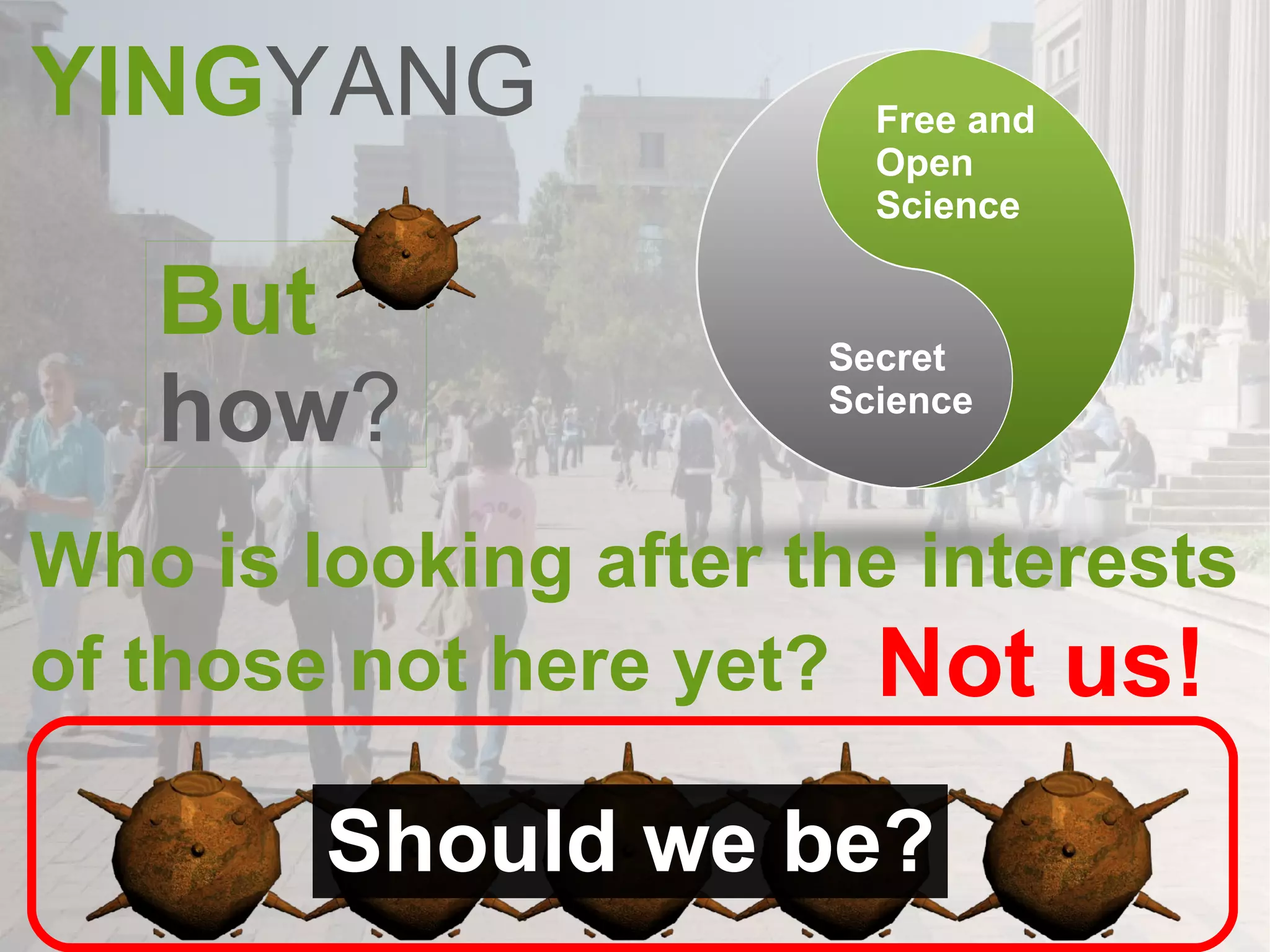
YING YANG Who is looking after the interests of those not here yet?   Not us! Should we be? Free and Open  Science Secret Science But how ?
Attribution file:  http://www.dkeats.com/usrfiles/users/   1563080430/attribution/attrib.txt With public  funds No  secret science

A research and innovation perspective on Free and Open Source Software (FOSS)

  • 1.
    A researchand innovation perspective on Free and Open Source Software (FOSS) Dr Derek W. Keats dKeats Innovations [trading under of Kenga (Pty) Ltd] http://www.dkeats.com derek@dkeats.com +27 82 787 0169
  • 2.
    Parallels between science and software wealth creation innovation social benefit
  • 3.
    The act 2008Intellectual Property Rights from Publicly Financed Research and Development Act (Act No 52 of 2008) 2011 2010 2009 Draft regulations, consultation with limited impact NIPMO operating Permission culture To ensure that IP outcomes of publicly financed R&D is protected and commercialised for the benefit of the people of South Africa - be it social, economic, military or some other benefit. The regulations Regulations from the act and the establishment of a National IP Management Office (NIPMO)
  • 4.
    Consistency of strategiesThe regulations impact FOSS FOSS lessons for NIPMO Permission culture
  • 5.
    Freedom 1 andFreedom 3 require the source code The four freedoms of Free Software Open Source Free and Software (F OS S) Free
  • 6.
    Just take some software and.... To understand what freedom means in the software context... http://www.flickr.com/photos/unnamed/47093936 BY-SA
  • 7.
    To understand whatfreedom means in the software context... http://www.flickr.com/photos/unnamed/47093936 BY-SA
  • 8.
    Use it however you like Install a copy on more than one computer Give or sell copies to other people Study the source code and learn from it Adapt the source code to anything you want Give copies of your modifications to friends & colleagues Just take some software and....
  • 9.
    Use it however you like Install a copy on more than one computer Give or sell copies to other people Study the source code and learn from it Adapt the source code to anything you want Give copies of your modifications to friends & colleagues Just take some software and.... Without asking or paying for permission
  • 10.
    Use it however you like Install a copy on more than one computer Give or sell copies to other people Study the source code and learn from it Adapt the source code to anything you want Give copies of your modifications to friends & colleagues Respected member of a global community More marketable as a software engineer Just take some software and.... Free software Improved knowledge & skills You CEO of an innovative ground-breaking company
  • 11.
    Use it however you like Install a copy on more than one computer Give or sell copies to other people Study the source code and learn from it Adapt the source code to anything you want Give copies of your modifications to friends & colleagues Respected member of a global community Facing in a lawsuit More marketable as a software engineer Criminal record Just take some software and.... Proprietary software Free software Improved knowledge & skills You Cease and desist order You Potential imprisonment CEO of an innovative ground-breaking company
  • 12.
  • 13.
    Image adapted fromWikipedia The two layers of FOSS space in the operating of computing devices
  • 14.
    Image from WikipediaThere are relatively few of them, even with all the variations There are many of them, and a lot more room for creativity Image adapted from Wikipedia
  • 15.
    FOSS Proprietary FOSSProprietary Image adapted from Wikipedia
  • 16.
    Scarcity Abundance Proprietarysoftware Free software The scarcity is entirely artificially maintained
  • 17.
    Scarcity Abundance Knowledge-- comparison modeled after Chris Anderson, Free: The Future of a Radical Price Protected, controlled, secret Shared, freely available, no secrets Proprietary software Free software
  • 18.
    I Am NotA Lawyer F OS S Software Licenses Disclaimer: IANAL License legal instrument – usually making use of contract law – governing the usage or redistribution of software Underpinned by Copyright
  • 19.
    Copyright All rights reserved Proprietary Software Some rights reserved Free and Open Source Software
  • 20.
    Derivative work CopyLeftrequirement Derivative works must share the same conditions No CopyLeft requirement Derivative works do not have to share the same conditions Applies at distribution
  • 21.
    Software that containsyour core business model , and therefore embodies your competitive advantage in the market place Software that does not contain your core business model , and is not a major component of your competitive advantage in the market place FOSS Don't distribute Bruce Perens Differentiating software Non-differentiating software
  • 22.
  • 23.
    Compete on qualityMaximum monopoly price Controlled, legislated economies oligopolies cartels Gratis Price Marginal cost of production Compete on price Scarcity
  • 24.
    The marginal cost of production for software is zero.
  • 25.
    Compete on qualityMaximum monopoly price Controlled, legislated economies oligopolies cartels Gratis Price Marginal cost of production Compete on price Counterfeit market is guaranteed Profit Scarcity
  • 26.
    In a competitive economy, prices decrease to just above the marginal cost of production
  • 27.
    Marginal cost ofproduction Compete on quality Maximum monopoly price Controlled, legislated economies oligopolies cartels Gratis Price Compete on price Capitalist, competitive economies Profit Scarcity
  • 28.
    Marginal cost ofproduction Compete on quality Maximum monopoly price Controlled, legislated economies oligopolies cartels Gratis Price Co-opetition Compete on price Capitalist, competitive economies Profit Services revenue stream , bartering, shared costs FOSS Scarcity
  • 29.
    users can bea major source of innovation Eric von Hippel, Professor & Head of the Innovation and Entrepreneurship Group at the MIT Sloan School of Management
  • 30.
    Barriers to innovation The Internet – a radical decentralisation of innovation Yochai Benkler, Professor of Law at Harvard at the eG8 Forum on May 26th
  • 31.
    Barriers to innovation Successful innovation Starting point Knowledge Permission Cost
  • 32.
    Barriers to innovation Successful innovation Starting point No such thing as scratch
  • 33.
    No such thingas scratch Operating systems Compilers Programming languages Core applications Databases Webserver Frameworks Digital object store Libraries Version management Scalability tools Load balance Scripting languages Virtualisation Testing eBusiness tools Graphics tools Communications tools Integrated development environments (IDE) Video production Audio production Office suites Design Web browsers CRM Accounting ERP
  • 34.
    Barriers to innovation Successful innovation Starting point Knowledge Software as knowledge expressed
  • 35.
  • 36.
  • 37.
  • 38.
    Barriers to innovation Starting point Knowledge Permission Successful innovation
  • 39.
    Every permission may also have a cost Permissions Every permission is a barrier Difficult to determine what permissions you need at the start or what it will cost to acquire them Please sir, I want to license two more CPUs Oracle Twist Proprietary licenses severely limit permissions STOP Even without the cost factor, the permissions alone can be enough to reduce the likelihood of success in a start-up
  • 40.
    Permissions Every permission is a barrier NIPMO take note!
  • 41.
    Barriers to innovation Starting point Knowledge Permission Cost Successful innovation
  • 42.
    Cost Start-up costs Scaling out costs Lock-in costs Malleability costs Abandonment costs Uncertainty barrier
  • 43.
    Barriers to innovation Successful innovation Starting point Knowledge Permission Cost
  • 44.
  • 45.
    Some recent major software innovations Started poor University students Without FOSS they would not have done it All acknowledge both the code and its contained knowledge 1995 Mark Zuckerberg Larry Page and Sergey Brin
  • 46.
    Vint Cerf and Bob Kahn being awarded the Presidential Medal of Freedom by President Bush, image from Wikipedia I just had to take the hypertext idea and connect it to the Transmission Control Protocol and domain name system ideas and — ta-da! — the World Wide Web Sir Tim Berners-Lee and the first webserver from Wikipedia When core things are free and open, there are no barriers to innovation. When Bob Khan and I created TCP/IP and a bunch of us built a platform for internetworking, we did not patent the technologies used. We set TCP/IP free. Had we not done so, it is doubtful if the Internet as we know it today would have come into being. The freedom given by Cerf and Khan, and Berners-Lee, together with Free Software made it possible. The original Google servers, from Wikipedia
  • 47.
    Vint Cerf and Bob Kahn being awarded the Presidential Medal of Freedom by President Bush, image from Wikipedia I just had to take the hypertext idea and connect it to the Transmission Control Protocol and domain name system ideas and — ta-da! — the World Wide Web Sir Tim Berners-Lee and the first webserver from Wikipedia When core things are free and open, there are no barriers to innovation. When Bob Khan and I created TCP/IP and a bunch of us built a platform for internetworking, we did not patent the technologies used. We set TCP/IP free. Had we not done so, it is doubtful if the Internet as we know it today would have come into being. The freedom given by Cerf and Khan, and Berners-Lee, together with Free Software made it possible. The original Google servers, from Wikipedia
  • 48.
    Vint Cerf and Bob Kahn being awarded the Presidential Medal of Freedom by President Bush, image from Wikipedia I just had to take the hypertext idea and connect it to the Transmission Control Protocol and domain name system ideas and — ta-da! — the World Wide Web Sir Tim Berners-Lee and the first webserver from Wikipedia When core things are free and open, there are no barriers to innovation. When Bob Khan and I created TCP/IP and a bunch of us built a platform for internetworking, we did not patent the technologies used. We set TCP/IP free. Had we not done so, it is doubtful if the Internet as we know it today would have come into being. The freedom given by Cerf and Khan, and Berners-Lee, together with Free Software made it possible. The original Google servers, from Wikipedia
  • 49.
    Vint Cerf and Bob Kahn being awarded the Presidential Medal of Freedom by President Bush, image from Wikipedia I just had to take the hypertext idea and connect it to the Transmission Control Protocol and domain name system ideas and — ta-da! — the World Wide Web Sir Tim Berners-Lee and the first webserver from Wikipedia When core things are free and open, there are no barriers to innovation. When Bob Khan and I created TCP/IP and a bunch of us built a platform for internetworking, we did not patent the technologies used. We set TCP/IP free. Had we not done so, it is doubtful if the Internet as we know it today would have come into being. The freedom given by Cerf and Khan, and Berners-Lee, together with Free Software made it possible. The original Google servers, from Wikipedia Layers of innovation built on Freedom
  • 50.
    Consistency of strategiesThe regulations impact FOSS FOSS lessons for NIPMO
  • 51.
    Software in research/ innovation Software that is used or created in research projects is often FOSS From what I have seen, the IP regulations make no provision for FOSS Or at least it is not obvious how one deals with FOSS in research
  • 52.
    Project software FOSSFOSS FOSS FOSS Permission Regulations: approval afterward FOSS: up front choices License
  • 53.
    Does this onlyapply to software?
  • 54.
    May be consumedby one consumer without preventing simultaneous consumption by others Consumption by one consumer prevents simultaneous consump-tion by other consumers
  • 55.
    Consistency of strategiesThe regulations impact FOSS FOSS lessons for NIPMO
  • 56.
  • 57.
    Africa produces 8.2scientific research papers per million people The world produces 103 scientific research papers per million people The USA produces 690 and Canada 723 scientific research papers per million people
  • 58.
    Territory size showsthe proportion of the number of extra scientific papers that were published in 2001 compared with 1990, whose authors work there. Should we catalyze the growth of science in Africa? ... or make it harder? Publicly funded science?
  • 59.
    The output ofscientific research that is published in ways that are only accessible to some people, or that is locked up in the newly altered form of patents that are designed to withhold disclosure and lengthen monopoly privileges. Secret science
  • 60.
    The output ofscientific research that is published in ways that are only accessible to some people, or that is locked up in the newly altered form of patents that are designed to withhold disclosure and lengthen monopoly privileges. Secret science Some secret science is probably necessary ... … but that doesn't mean all science should be secret
  • 61.
    Free science Researchcarried out for the public good (including knowledge growth), that is published in ways that are accessible to anyone with a networked computing device, and that can be freely built upon to create innovations that contribute to both public and private good.
  • 62.
    South African NationalFOSS policy All new software developed for or by the South African Government will be based on open standards, adherent to FOSS principles, and licensed using a FOSS license where possible Regulations & NIPMO procedures at odds with it The regulations impact FOSS FOSS lessons for NIPMO Consistency of strategies
  • 63.
    Epilogue There arealways barriers to innovation. The more barriers you create, the less innovation you will get. Every permission is a barrier. Secret science and patents are not the only way to foster innovation. Should we look carefully how public science can best serve the public good ? Currently, we implicitly assume knowledge to be rivalrous, and our laws and policies are based on that implicit assumption.
  • 64.
    Epilogue There arealways barriers to innovation. The more barriers you create, the less innovation you will get. Every permission is a barrier. Secret science and patents are not the only way to foster innovation. Should we look carefully how public science can best serve the public good ? Currently, we implicitly assume knowledge to be rivalrous, and our laws and policies are based on that implicit assumption. This entrenches 20th Century thinking and business models, and is a major impediment to 21st Century innovation.
  • 65.
    Epilogue There arealways barriers to innovation. The more barriers you create, the less innovation you will get. Every permission is a barrier. Secret science and patents are not the only way to foster innovation. Should we look carefully how public science can best serve the public good ? Currently, we implicitly assume knowledge to be rivalrous, and our laws and policies are based on that implicit assumption. This entrenches 20th Century thinking and business models, and is a major impediment to 21st Century innovation. FOSS – Free and Open Source Science
  • 66.
    Epilogue An opportunity for leadership? There are always barriers to innovation. The more barriers you create, the less innovation you will get. Every permission is a barrier. Secret science and patents are not the only way to foster innovation. Should we look carefully how public science can best serve the public good ? Currently, we implicitly assume knowledge to be rivalrous, and our laws and policies are based on that implicit assumption. This entrenches 20th Century thinking and business models, and is a major impediment to 21st Century innovation. FOSS – Free and Open Source Science
  • 67.
    In these times,the hardest task for social or political activists is to find a way to get people to wonder again about what we all believe is true. The challenge is to sow doubt. Lawrence Lessig wonder again about what we all believe is true
  • 68.
    YING YANG Whois looking after the interests of those not here yet? Free and Open Science Secret Science But how ?
  • 69.
    YING YANG Whois looking after the interests of those not here yet? Not us! Free and Open Science Secret Science But how ?
  • 70.
    YING YANG Whois looking after the interests of those not here yet? Not us! Should we be? Free and Open Science Secret Science But how ?
  • 71.
    Attribution file: http://www.dkeats.com/usrfiles/users/ 1563080430/attribution/attrib.txt With public funds No secret science

Editor's Notes

  • #40 Oliver Twist
  • #41 Oliver Twist
  • #64 It has been a busy week for research. The UK Research Councils (RCUK) and HEFCE announced plans to work together on open access. JISC’s Executive Secretary, Dr Malcolm Read, gave oral evidence to the House of Commons Science and Technology Committee Inquiry into peer review, alongside Mark Patterson from the Public Library of Science, (a leading open access publisher) and in Denmark, there have been meetings at the ministry with the European Commission holding a public hearing on access to scientific information next Monday in Luxembourg.
  • #65 It has been a busy week for research. The UK Research Councils (RCUK) and HEFCE announced plans to work together on open access. JISC’s Executive Secretary, Dr Malcolm Read, gave oral evidence to the House of Commons Science and Technology Committee Inquiry into peer review, alongside Mark Patterson from the Public Library of Science, (a leading open access publisher) and in Denmark, there have been meetings at the ministry with the European Commission holding a public hearing on access to scientific information next Monday in Luxembourg.
  • #66 It has been a busy week for research. The UK Research Councils (RCUK) and HEFCE announced plans to work together on open access. JISC’s Executive Secretary, Dr Malcolm Read, gave oral evidence to the House of Commons Science and Technology Committee Inquiry into peer review, alongside Mark Patterson from the Public Library of Science, (a leading open access publisher) and in Denmark, there have been meetings at the ministry with the European Commission holding a public hearing on access to scientific information next Monday in Luxembourg.
  • #67 It has been a busy week for research. The UK Research Councils (RCUK) and HEFCE announced plans to work together on open access. JISC’s Executive Secretary, Dr Malcolm Read, gave oral evidence to the House of Commons Science and Technology Committee Inquiry into peer review, alongside Mark Patterson from the Public Library of Science, (a leading open access publisher) and in Denmark, there have been meetings at the ministry with the European Commission holding a public hearing on access to scientific information next Monday in Luxembourg.