by Smit S. Patil
   102010029
    S.Y.M.C.A.
     Early computers came with source
     Commercial focus was on hardware
     Strong academic influence


   Software was not portable
       No commercial advantage to restricting
       distribution
      Each machine vendor needed to develop their
       own
      'users' and 'developers' were often the same
       people
We did not call our software “free software”, because that term
did not yet exist; but that is what it was. Whenever people from
Another university or a company wanted to port and use a
program, we gladly let them. If you saw someone using an
unfamiliar and interesting program, you could always ask to see
the source code, so that you could read it, change it, or
cannibalize parts of it to make a new program.

                     (Richard Stallman, The GNU Project)
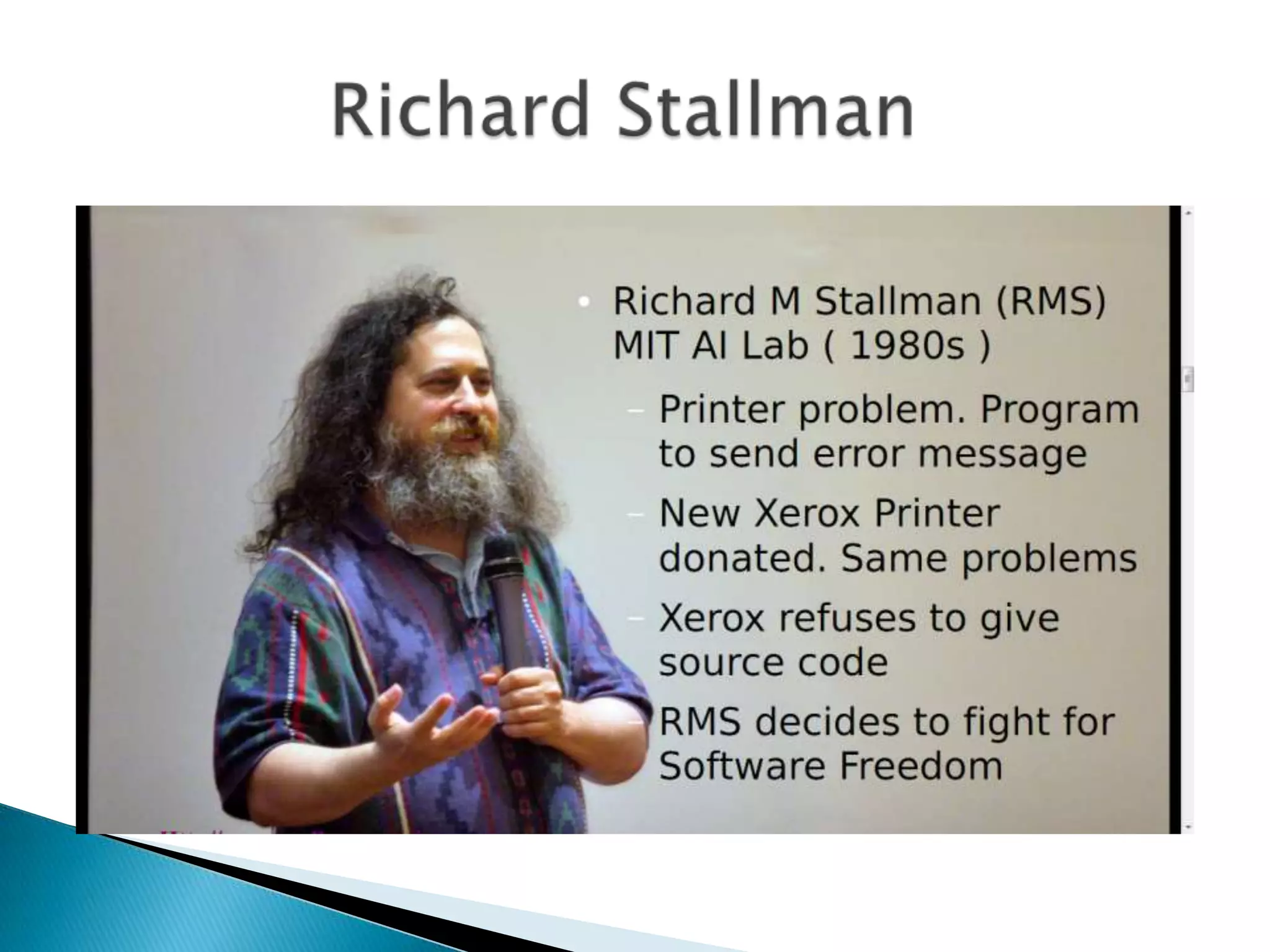
   MIT AI Lab
    • Strong hacker culture
    • Switch to proprietary software in early 80s
    • The infamous 'Xerox printer' incident
   Richard Stallman
      Firm stance on software freedom
      Founded GNU project in 1983
      Founded FSF in 1985
I consider that the golden rule requires that if I like a
Program I must share it with other people who like it. I
cannot in good conscience sign a nondisclosure
agreement or a software license agreement
         (Richard Stallman “new UNIX implementation”)
   Kick-started an explosion in FOSS interest
    ◦ Pioneered a new style of 'bazaar' development
    ◦ Built on many existing GNU projects
    ◦ Drew on existing Minix community


    I can (well, almost) hear you asking yourselves "why?". Hurd will
    Be out in a year (or two, or next month, who knows), and I've
    already got minix.This is a program for hackers by a hacker. I've
    enjoyed doing it, and somebody might enjoy looking at it and even
    modifying it for their own needs. It is still small enough to
    understand, use and modify, and I'm looking forward to any
    comments you might have.
    (Linus Torvalds “Free minix-like kernel sources for 386-AT” 1991)
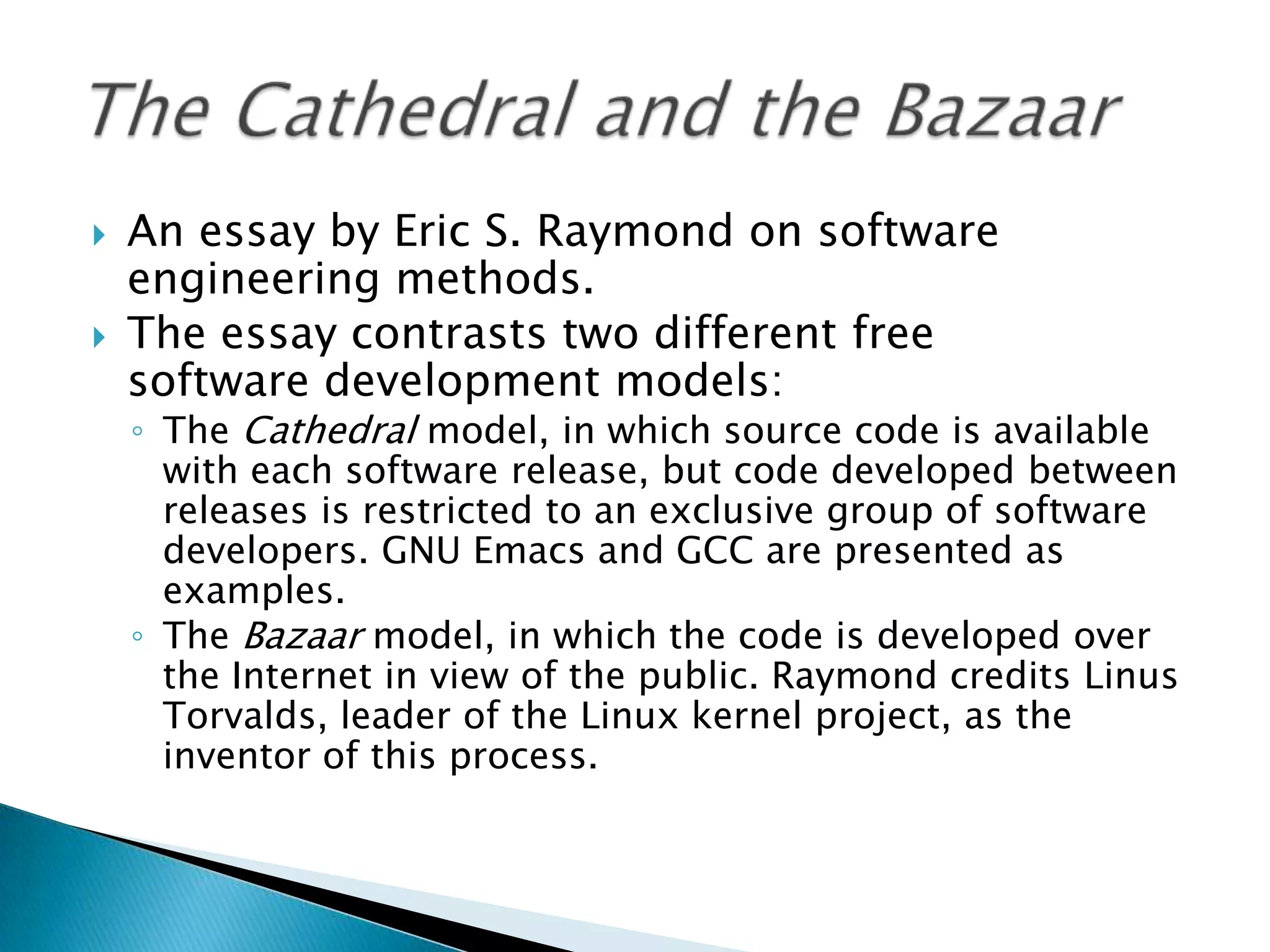
   An essay by Eric S. Raymond on software
    engineering methods.
   The essay contrasts two different free
    software development models:
    ◦ The Cathedral model, in which source code is available
      with each software release, but code developed between
      releases is restricted to an exclusive group of software
      developers. GNU Emacs and GCC are presented as
      examples.
    ◦ The Bazaar model, in which the code is developed over
      the Internet in view of the public. Raymond credits Linus
      Torvalds, leader of the Linux kernel project, as the
      inventor of this process.
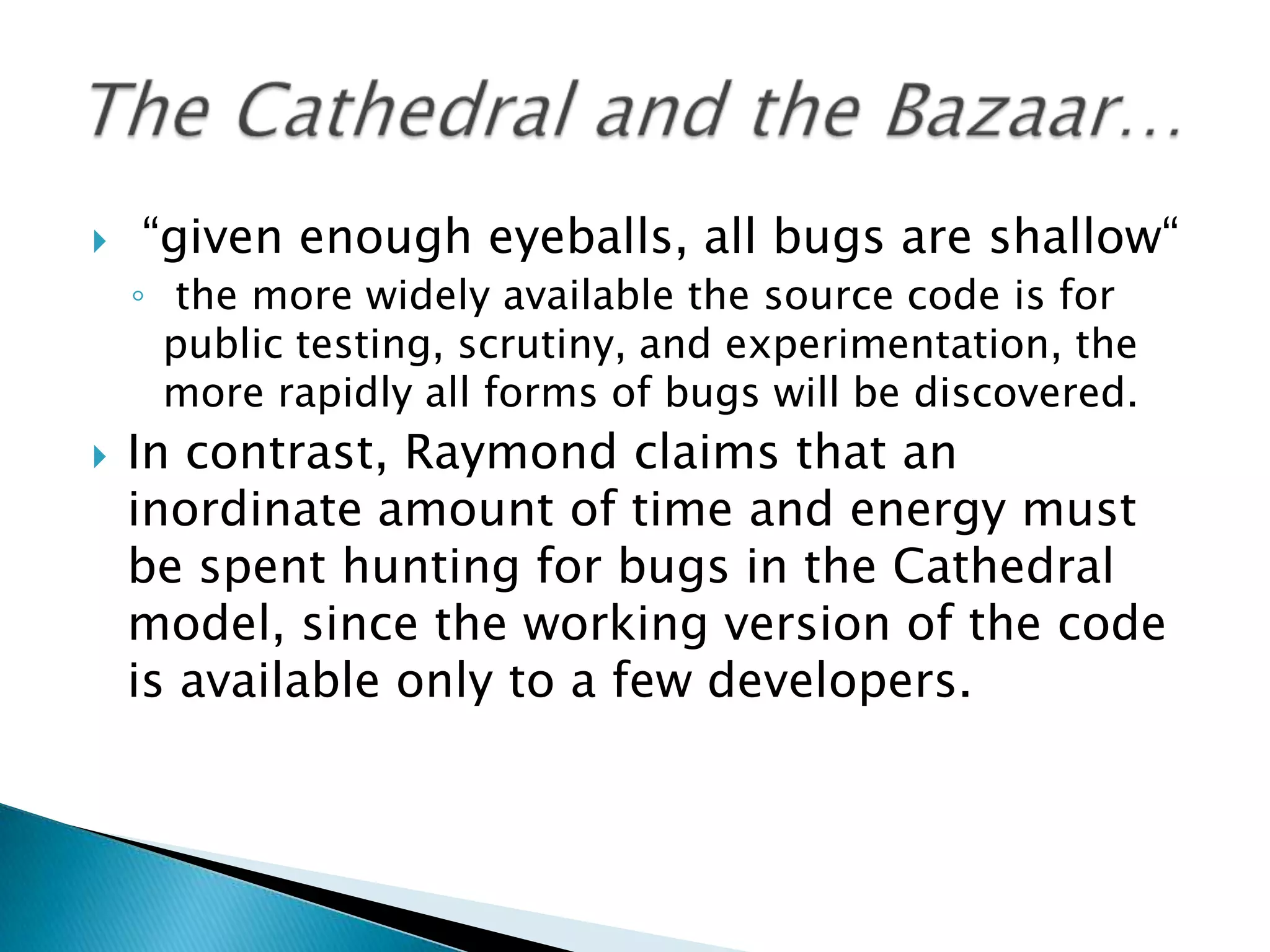
   “given enough eyeballs, all bugs are shallow“
    ◦ the more widely available the source code is for
      public testing, scrutiny, and experimentation, the
      more rapidly all forms of bugs will be discovered.
   In contrast, Raymond claims that an
    inordinate amount of time and energy must
    be spent hunting for bugs in the Cathedral
    model, since the working version of the code
    is available only to a few developers.
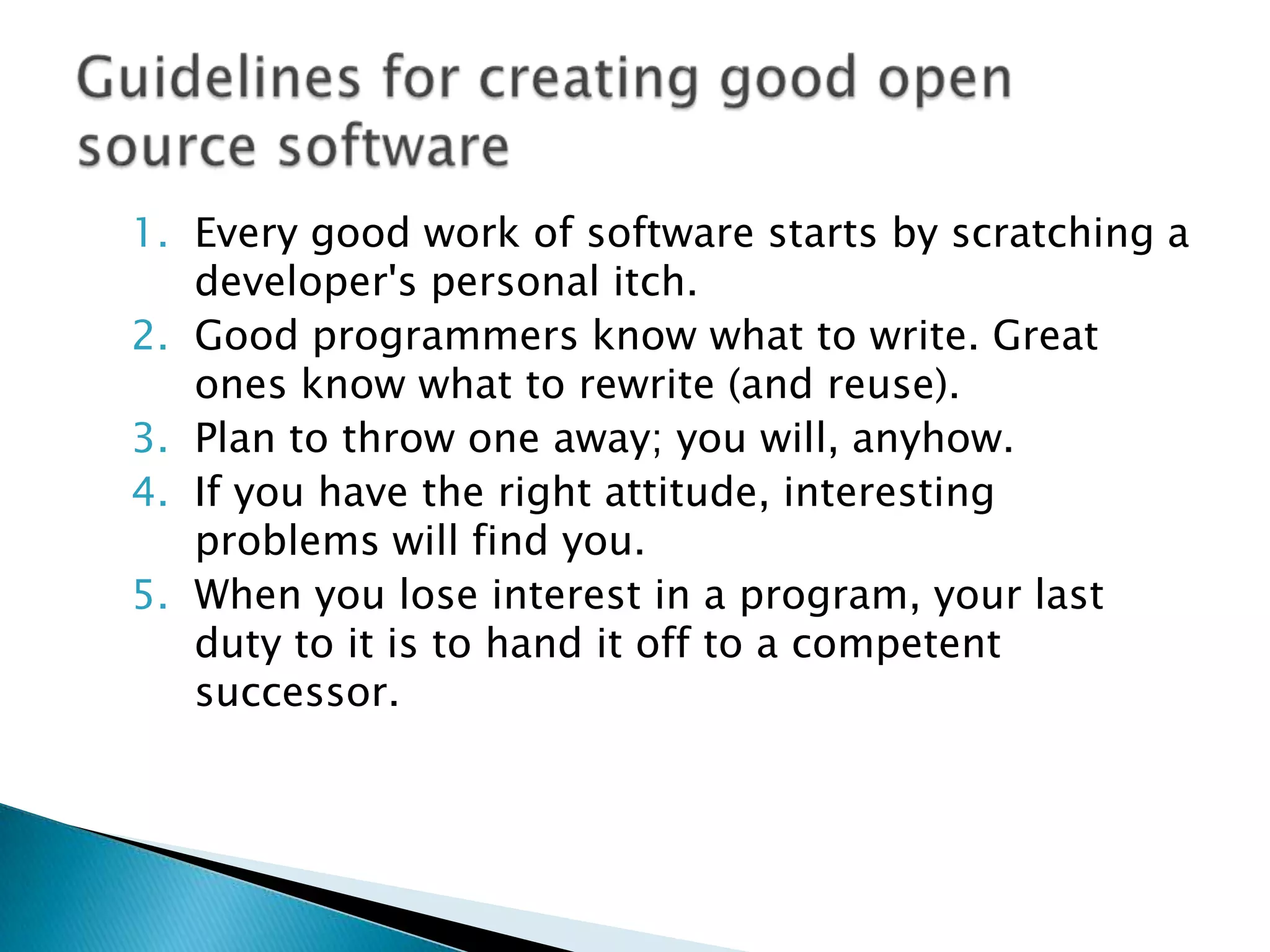
1. Every good work of software starts by scratching a
   developer's personal itch.
2. Good programmers know what to write. Great
   ones know what to rewrite (and reuse).
3. Plan to throw one away; you will, anyhow.
4. If you have the right attitude, interesting
   problems will find you.
5. When you lose interest in a program, your last
   duty to it is to hand it off to a competent
   successor.
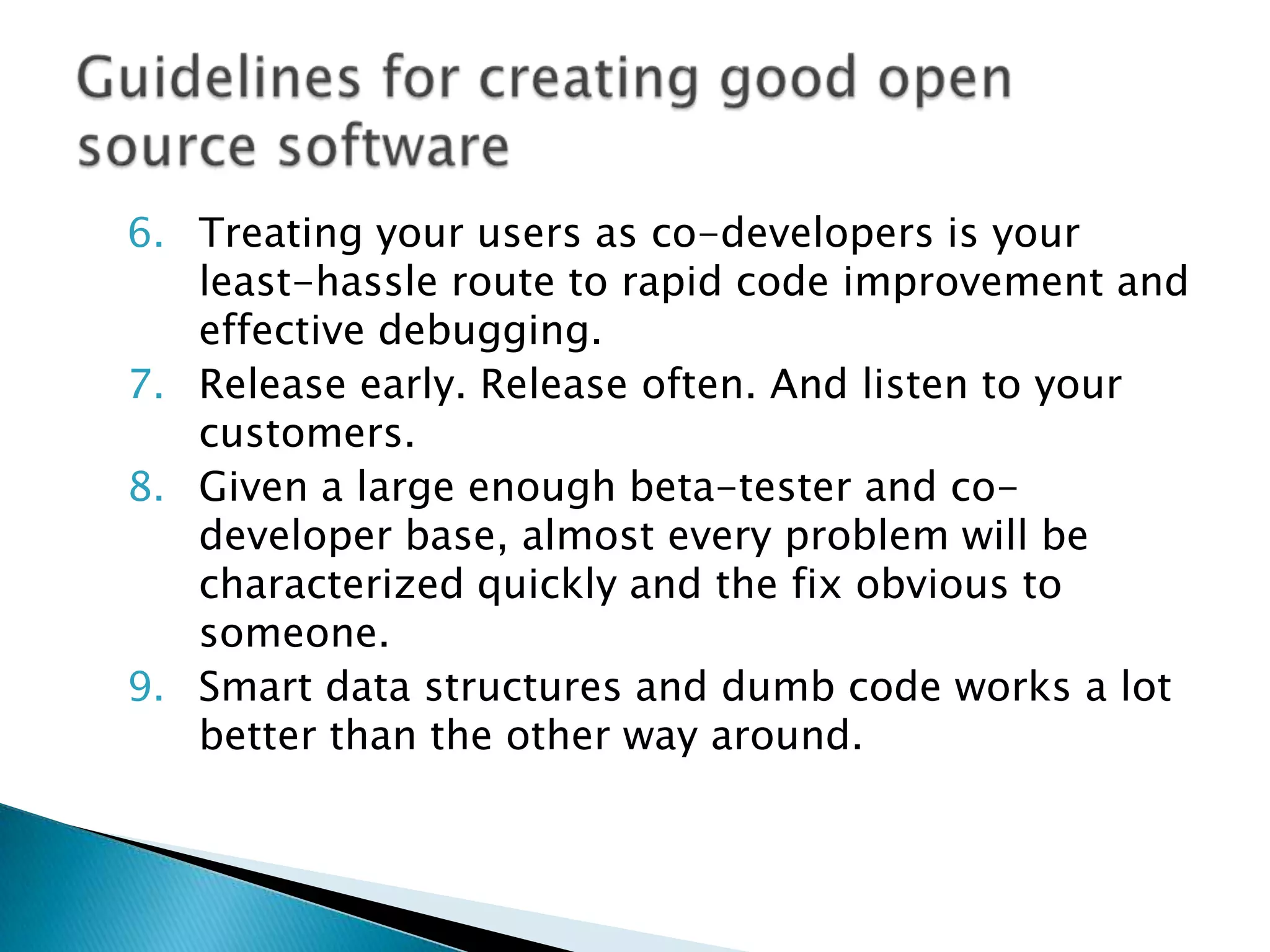
6. Treating your users as co-developers is your
   least-hassle route to rapid code improvement and
   effective debugging.
7. Release early. Release often. And listen to your
   customers.
8. Given a large enough beta-tester and co-
   developer base, almost every problem will be
   characterized quickly and the fix obvious to
   someone.
9. Smart data structures and dumb code works a lot
   better than the other way around.
10.   If you treat your beta-testers as if they're
      your most valuable resource, they will
      respond by becoming your most valuable
      resource.
11.   The next best thing to having good ideas is
      recognizing good ideas from your users.
      Sometimes the latter is better.
12.   Often, the most striking and innovative
      solutions come from realizing that your
      concept of the problem was wrong.
13.   Perfection (in design) is achieved not when
      there is nothing more to add, but rather
      when there is nothing more to take away.
14.   To solve an interesting problem, start by
      finding a problem that is interesting to you.
15.   development coordinator has a
      communications medium at least as good
      as the Internet, and knows how to lead
      without coercion, many heads are inevitably
      better than one.
   Convince most existing open source and free
    software projects to adopt Bazaar-style open
    development models.
   In 1998 it also provided the final push
    for Netscape Communications Corporation to
    release the source code for Netscape
    Communicator and start the Mozilla project.
   Free software is the most visible part of a new
    economy of commons-based peer production
    of information, knowledge, and culture.
   This new economy is already under
    development. In order to commercialize
    FOSS, many companies, Google being the
    most successful.
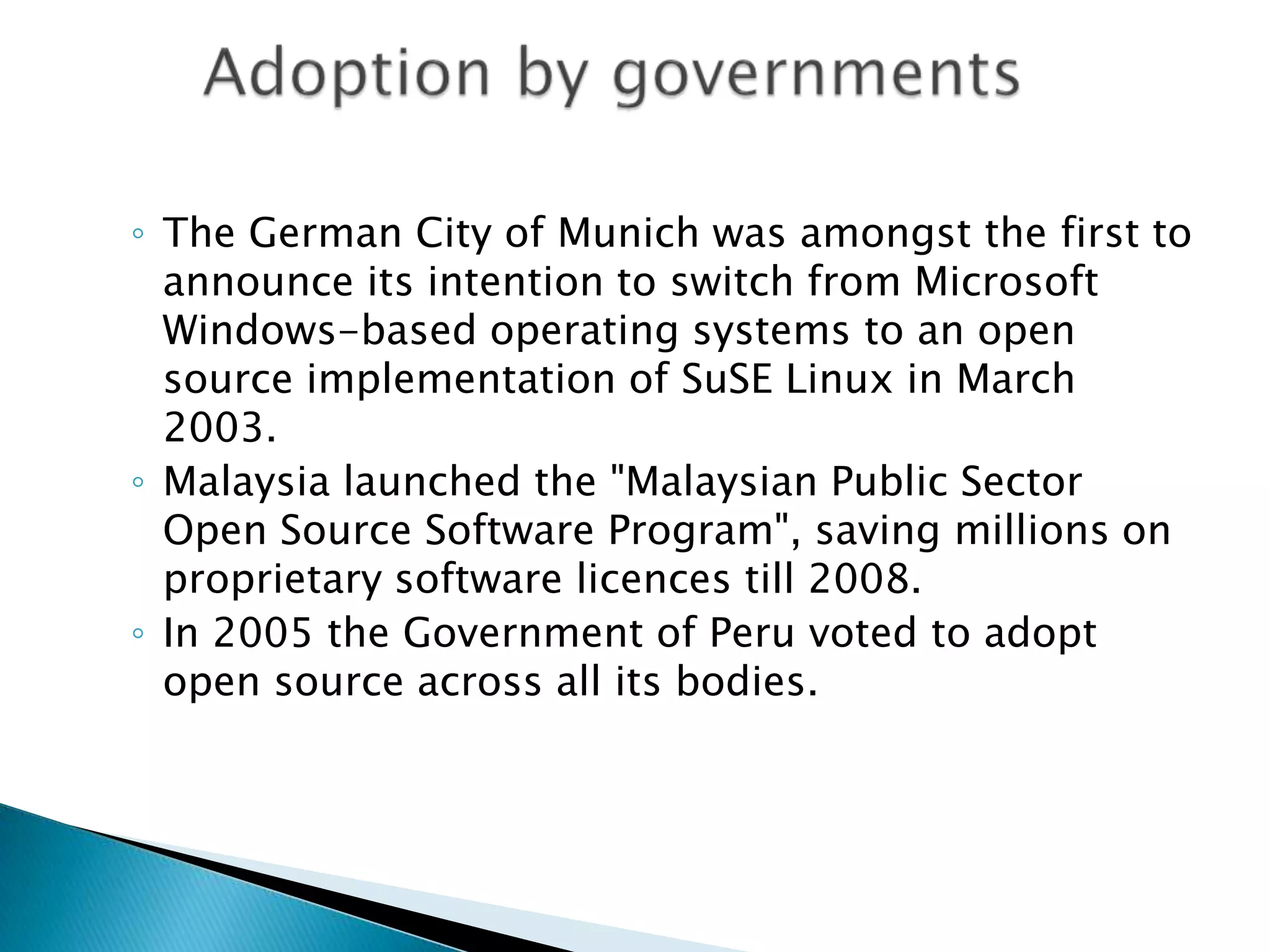
◦ The German City of Munich was amongst the first to
  announce its intention to switch from Microsoft
  Windows-based operating systems to an open
  source implementation of SuSE Linux in March
  2003.
◦ Malaysia launched the "Malaysian Public Sector
  Open Source Software Program", saving millions on
  proprietary software licences till 2008.
◦ In 2005 the Government of Peru voted to adopt
  open source across all its bodies.
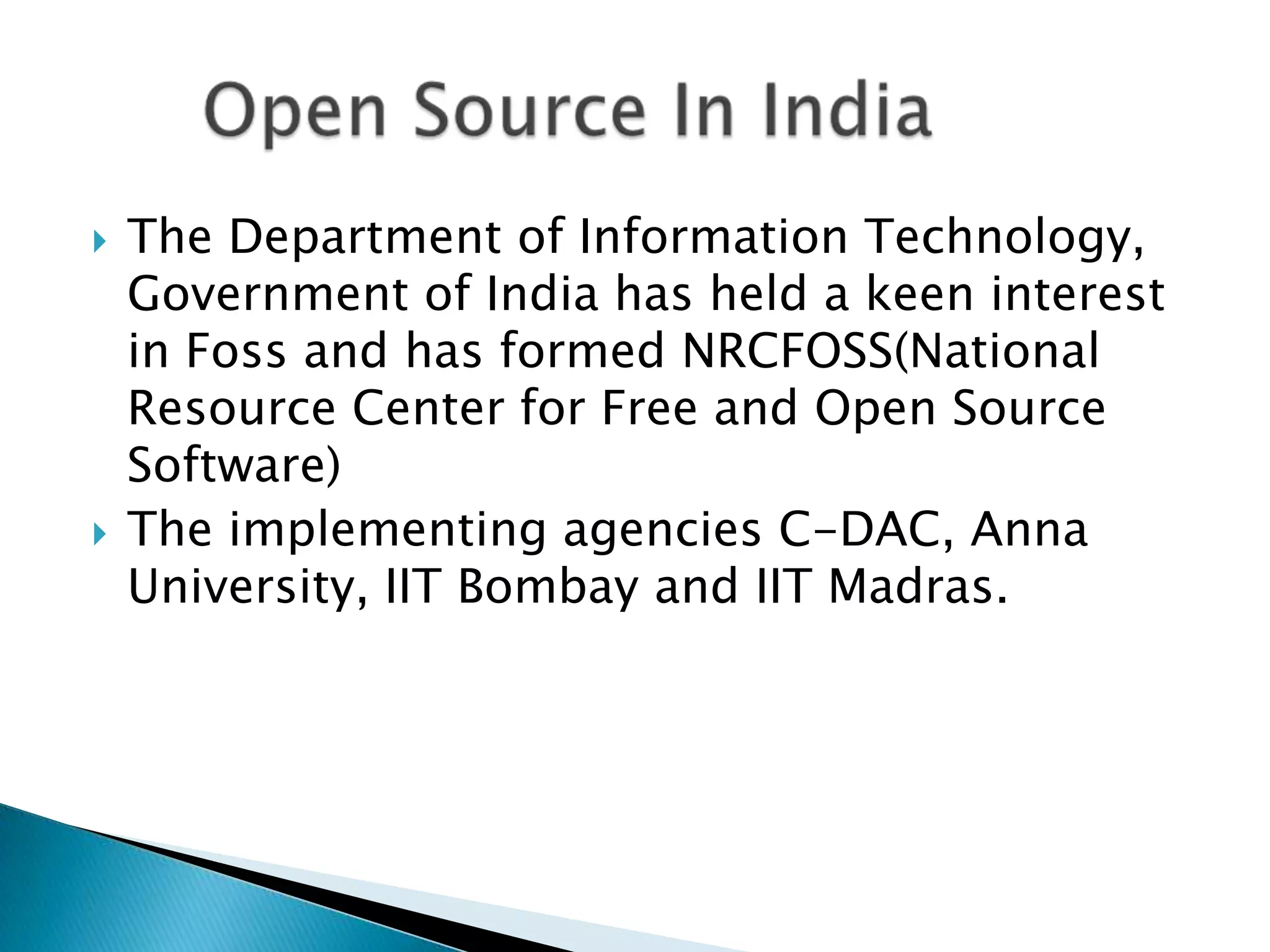
   The Department of Information Technology,
    Government of India has held a keen interest
    in Foss and has formed NRCFOSS(National
    Resource Center for Free and Open Source
    Software)
   The implementing agencies C-DAC, Anna
    University, IIT Bombay and IIT Madras.
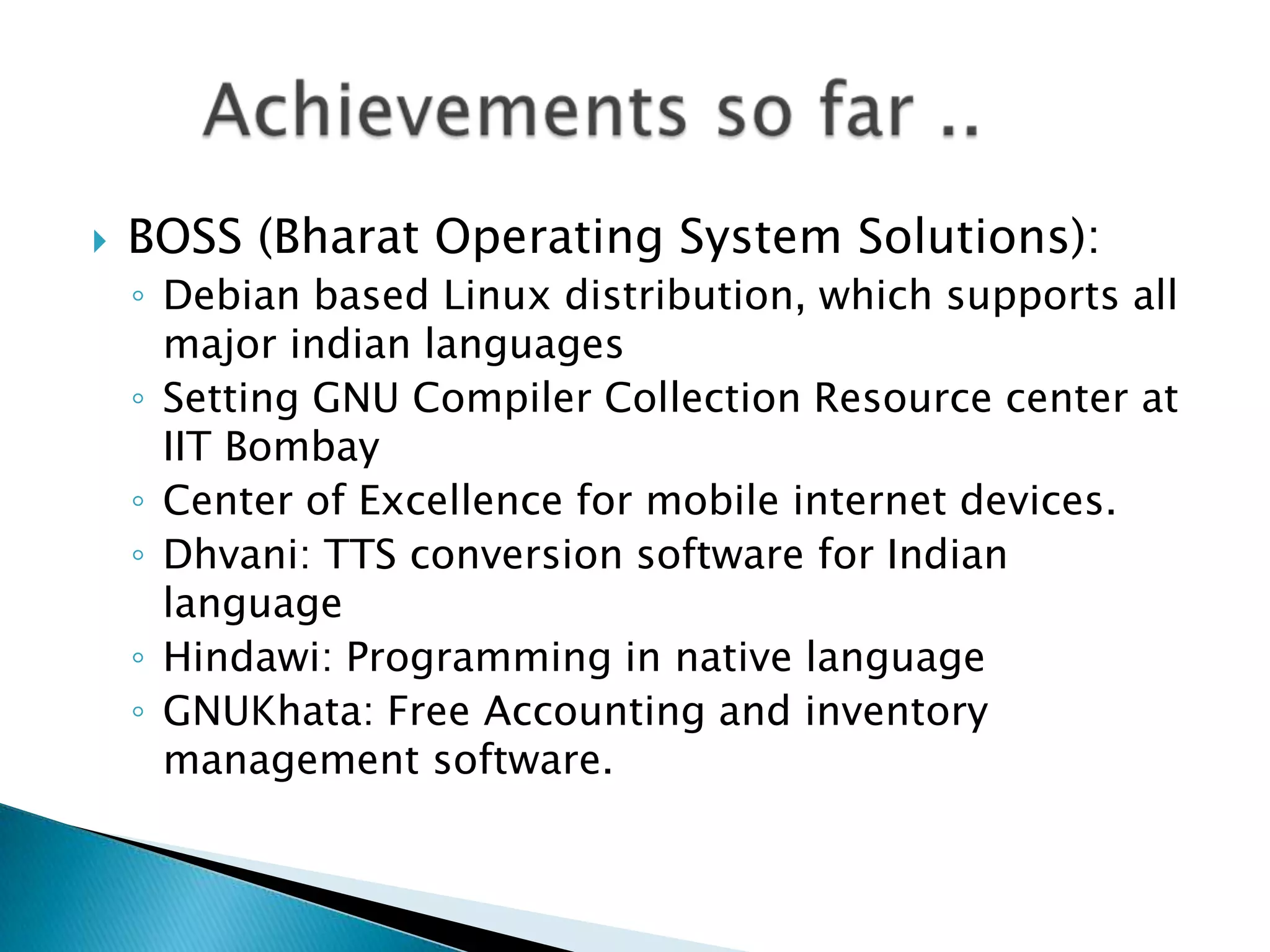
   BOSS (Bharat Operating System Solutions):
    ◦ Debian based Linux distribution, which supports all
      major indian languages
    ◦ Setting GNU Compiler Collection Resource center at
      IIT Bombay
    ◦ Center of Excellence for mobile internet devices.
    ◦ Dhvani: TTS conversion software for Indian
      language
    ◦ Hindawi: Programming in native language
    ◦ GNUKhata: Free Accounting and inventory
      management software.
Foss final seminar

Foss final seminar

  • 1.
    by Smit S.Patil 102010029 S.Y.M.C.A.
  • 2.
    Early computers came with source  Commercial focus was on hardware  Strong academic influence  Software was not portable  No commercial advantage to restricting distribution Each machine vendor needed to develop their own 'users' and 'developers' were often the same people
  • 3.
    We did notcall our software “free software”, because that term did not yet exist; but that is what it was. Whenever people from Another university or a company wanted to port and use a program, we gladly let them. If you saw someone using an unfamiliar and interesting program, you could always ask to see the source code, so that you could read it, change it, or cannibalize parts of it to make a new program. (Richard Stallman, The GNU Project)
  • 5.
    MIT AI Lab • Strong hacker culture • Switch to proprietary software in early 80s • The infamous 'Xerox printer' incident  Richard Stallman  Firm stance on software freedom  Founded GNU project in 1983  Founded FSF in 1985
  • 6.
    I consider thatthe golden rule requires that if I like a Program I must share it with other people who like it. I cannot in good conscience sign a nondisclosure agreement or a software license agreement (Richard Stallman “new UNIX implementation”)
  • 8.
    Kick-started an explosion in FOSS interest ◦ Pioneered a new style of 'bazaar' development ◦ Built on many existing GNU projects ◦ Drew on existing Minix community I can (well, almost) hear you asking yourselves "why?". Hurd will Be out in a year (or two, or next month, who knows), and I've already got minix.This is a program for hackers by a hacker. I've enjoyed doing it, and somebody might enjoy looking at it and even modifying it for their own needs. It is still small enough to understand, use and modify, and I'm looking forward to any comments you might have. (Linus Torvalds “Free minix-like kernel sources for 386-AT” 1991)
  • 9.
    An essay by Eric S. Raymond on software engineering methods.  The essay contrasts two different free software development models: ◦ The Cathedral model, in which source code is available with each software release, but code developed between releases is restricted to an exclusive group of software developers. GNU Emacs and GCC are presented as examples. ◦ The Bazaar model, in which the code is developed over the Internet in view of the public. Raymond credits Linus Torvalds, leader of the Linux kernel project, as the inventor of this process.
  • 10.
    “given enough eyeballs, all bugs are shallow“ ◦ the more widely available the source code is for public testing, scrutiny, and experimentation, the more rapidly all forms of bugs will be discovered.  In contrast, Raymond claims that an inordinate amount of time and energy must be spent hunting for bugs in the Cathedral model, since the working version of the code is available only to a few developers.
  • 11.
    1. Every goodwork of software starts by scratching a developer's personal itch. 2. Good programmers know what to write. Great ones know what to rewrite (and reuse). 3. Plan to throw one away; you will, anyhow. 4. If you have the right attitude, interesting problems will find you. 5. When you lose interest in a program, your last duty to it is to hand it off to a competent successor.
  • 12.
    6. Treating yourusers as co-developers is your least-hassle route to rapid code improvement and effective debugging. 7. Release early. Release often. And listen to your customers. 8. Given a large enough beta-tester and co- developer base, almost every problem will be characterized quickly and the fix obvious to someone. 9. Smart data structures and dumb code works a lot better than the other way around.
  • 13.
    10. If you treat your beta-testers as if they're your most valuable resource, they will respond by becoming your most valuable resource. 11. The next best thing to having good ideas is recognizing good ideas from your users. Sometimes the latter is better. 12. Often, the most striking and innovative solutions come from realizing that your concept of the problem was wrong.
  • 14.
    13. Perfection (in design) is achieved not when there is nothing more to add, but rather when there is nothing more to take away. 14. To solve an interesting problem, start by finding a problem that is interesting to you. 15. development coordinator has a communications medium at least as good as the Internet, and knows how to lead without coercion, many heads are inevitably better than one.
  • 15.
    Convince most existing open source and free software projects to adopt Bazaar-style open development models.  In 1998 it also provided the final push for Netscape Communications Corporation to release the source code for Netscape Communicator and start the Mozilla project.
  • 16.
    Free software is the most visible part of a new economy of commons-based peer production of information, knowledge, and culture.  This new economy is already under development. In order to commercialize FOSS, many companies, Google being the most successful.
  • 17.
    ◦ The GermanCity of Munich was amongst the first to announce its intention to switch from Microsoft Windows-based operating systems to an open source implementation of SuSE Linux in March 2003. ◦ Malaysia launched the "Malaysian Public Sector Open Source Software Program", saving millions on proprietary software licences till 2008. ◦ In 2005 the Government of Peru voted to adopt open source across all its bodies.
  • 18.
    The Department of Information Technology, Government of India has held a keen interest in Foss and has formed NRCFOSS(National Resource Center for Free and Open Source Software)  The implementing agencies C-DAC, Anna University, IIT Bombay and IIT Madras.
  • 19.
    BOSS (Bharat Operating System Solutions): ◦ Debian based Linux distribution, which supports all major indian languages ◦ Setting GNU Compiler Collection Resource center at IIT Bombay ◦ Center of Excellence for mobile internet devices. ◦ Dhvani: TTS conversion software for Indian language ◦ Hindawi: Programming in native language ◦ GNUKhata: Free Accounting and inventory management software.