A Regional Perspective  from Latin America Sergio Sanchez The Clean Air Institute Washington DC February 15, 2008
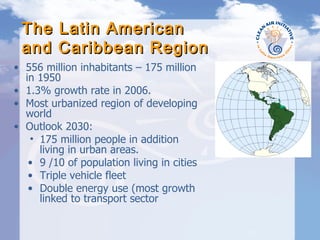
The Latin American  and Caribbean Region 556 million inhabitants – 175 million in 1950  1.3% growth rate in 2006. Most urbanized region of developing world Outlook 2030: 175 million people in addition living in urban areas. 9 /10 of population living in cities Triple vehicle fleet Double energy use (most growth linked to transport sector
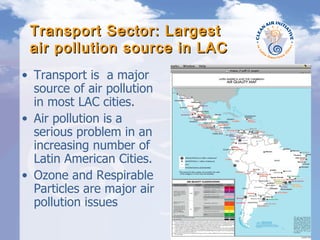
Transport Sector: Largest air pollution source in LAC Transport is  a major  source of air pollution in most LAC cities. Air pollution is a serious problem in an increasing number of Latin American Cities. Ozone and Respirable Particles are major air pollution issues Fuente: SMA, Gobierno del Distrito Federal, 2004 b
Impacts of air pollution 110 premature deaths/hour globally PM10 premature deaths could double to 2030. Premature deaths caused by ozone would quadruple worldwide by 2030. Developing countries most affected. In LAC, >100 M inhabitants are exposed to air pollution levels exceeding WHO standards. Air pollution costs in LAC: 1-2% of GDP (WB 2007).
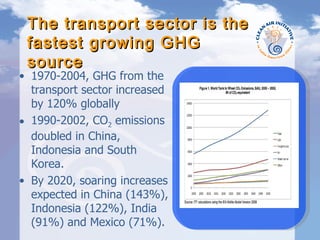
The transport sector is the fastest growing GHG source  1970-2004, GHG from the transport sector increased by 120% globally 1990-2002, CO 2  emissions doubled in China, Indonesia and South Korea.  By 2020, soaring increases expected in China (143%), Indonesia (122%), India (91%) and Mexico (71%).
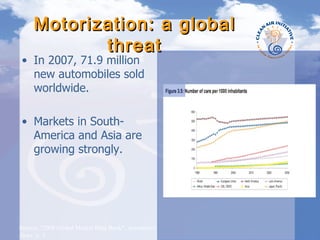
Motorization: a global threat In 2007, 71.9 million new automobiles sold worldwide.  Markets in South-America and Asia are growing strongly. Source: "2008 Global Market Data Book",  Automotive News, p. 5
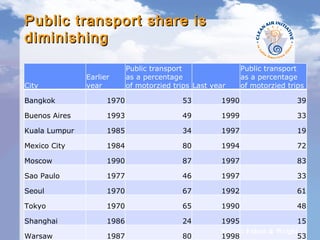
Public transport share is diminishing Source: Fulton & Wright City Earlier year Public transport as a percentage of motorzied trips Last year Public transport as a percentage of motorzied trips Bangkok 1970 53 1990 39 Buenos Aires 1993 49 1999 33 Kuala Lumpur 1985 34 1997 19 Mexico City 1984 80 1994 72 Moscow 1990 87 1997 83 Sao Paulo 1977 46 1997 33 Seoul 1970 67 1992 61 Tokyo 1970 65 1990 48 Shanghai 1986 24 1995 15 Warsaw 1987 80 1998 53
Traffic congestion: Among the worst in the world Sao Paulo 37 percent increase on registered vehicles since 2003. Record gridlock of 266 km on May 9 2006. Daily average trip: 1 hour, 40 minutes Congestion economic cost: 4.1 billion reais/year. Source: Sao Paulo Traffic Jams Mean Lost Business, Stress, Helicopters, Bloomberg, July 14, 2008 Mexico City Roughly 4 million vehicles. Vehicle fleet has doubled in the last 15 years regardless economic fluctuations. More than 300 thousand vehicles added to circulation each year, only 10% retires. Average speed at peak hour: less than 10 km/hr. Average time trip: 1 - 1.5 hrs.
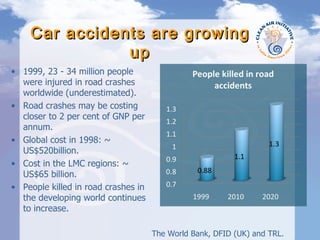
Car accidents are growing up 1999, 23 - 34 million people were injured in road crashes worldwide (underestimated).  Road crashes may be costing closer to 2 per cent of GNP per annum.  Global cost in 1998: ~ US$520billion.  Cost in the LMC regions: ~ US$65 billion. People killed in road crashes in the developing world continues to increase. The World Bank, DFID (UK) and TRL.
Regional GEF Sustainable Transport and Air Quality Program Purpose  Reduce GHG and improve air quality by supporting policy development and barriers removal for SUT. Four Projects A) Argentina, b) Brazil, c) Mexico and c) Regional. Financiamiento Up to $79.3 million USD Includes $20.8 million USD 4-year funding from the GEF. $2.9 million USD for the Regional Project
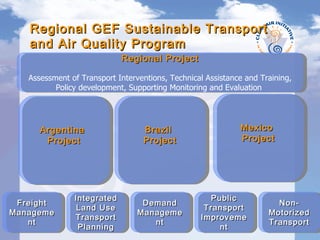
Regional GEF Sustainable Transport  and Air Quality Program Regional Project Assessment of Transport Interventions, Technical Assistance and Training, Policy development, Supporting Monitoring and Evaluation  Mexico  Project Integrated Land Use Transport Planning Freight Management Public Transport Improvement Non-Motorized Transport Demand Management Brazil  Project Argentina  Project
Municipalities, national governments, private sector businesses, international development organizations, universities, professional associations, social community organizations, communities and individuals Working together to improve air quality, mitigate climate change and enhance quality of life
Contact information Sergio Sanchez Executive Director Clean Air Institute [email_address] 1 (202) 785 4222 x 30

A Regional Perspective from Latin America

  • 1.
    A Regional Perspective from Latin America Sergio Sanchez The Clean Air Institute Washington DC February 15, 2008
  • 2.
    The Latin American and Caribbean Region 556 million inhabitants – 175 million in 1950 1.3% growth rate in 2006. Most urbanized region of developing world Outlook 2030: 175 million people in addition living in urban areas. 9 /10 of population living in cities Triple vehicle fleet Double energy use (most growth linked to transport sector
  • 3.
    Transport Sector: Largestair pollution source in LAC Transport is a major source of air pollution in most LAC cities. Air pollution is a serious problem in an increasing number of Latin American Cities. Ozone and Respirable Particles are major air pollution issues Fuente: SMA, Gobierno del Distrito Federal, 2004 b
  • 4.
    Impacts of airpollution 110 premature deaths/hour globally PM10 premature deaths could double to 2030. Premature deaths caused by ozone would quadruple worldwide by 2030. Developing countries most affected. In LAC, >100 M inhabitants are exposed to air pollution levels exceeding WHO standards. Air pollution costs in LAC: 1-2% of GDP (WB 2007).
  • 5.
    The transport sectoris the fastest growing GHG source 1970-2004, GHG from the transport sector increased by 120% globally 1990-2002, CO 2 emissions doubled in China, Indonesia and South Korea. By 2020, soaring increases expected in China (143%), Indonesia (122%), India (91%) and Mexico (71%).
  • 6.
    Motorization: a globalthreat In 2007, 71.9 million new automobiles sold worldwide. Markets in South-America and Asia are growing strongly. Source: "2008 Global Market Data Book", Automotive News, p. 5
  • 7.
    Public transport shareis diminishing Source: Fulton & Wright City Earlier year Public transport as a percentage of motorzied trips Last year Public transport as a percentage of motorzied trips Bangkok 1970 53 1990 39 Buenos Aires 1993 49 1999 33 Kuala Lumpur 1985 34 1997 19 Mexico City 1984 80 1994 72 Moscow 1990 87 1997 83 Sao Paulo 1977 46 1997 33 Seoul 1970 67 1992 61 Tokyo 1970 65 1990 48 Shanghai 1986 24 1995 15 Warsaw 1987 80 1998 53
  • 8.
    Traffic congestion: Amongthe worst in the world Sao Paulo 37 percent increase on registered vehicles since 2003. Record gridlock of 266 km on May 9 2006. Daily average trip: 1 hour, 40 minutes Congestion economic cost: 4.1 billion reais/year. Source: Sao Paulo Traffic Jams Mean Lost Business, Stress, Helicopters, Bloomberg, July 14, 2008 Mexico City Roughly 4 million vehicles. Vehicle fleet has doubled in the last 15 years regardless economic fluctuations. More than 300 thousand vehicles added to circulation each year, only 10% retires. Average speed at peak hour: less than 10 km/hr. Average time trip: 1 - 1.5 hrs.
  • 9.
    Car accidents aregrowing up 1999, 23 - 34 million people were injured in road crashes worldwide (underestimated). Road crashes may be costing closer to 2 per cent of GNP per annum. Global cost in 1998: ~ US$520billion. Cost in the LMC regions: ~ US$65 billion. People killed in road crashes in the developing world continues to increase. The World Bank, DFID (UK) and TRL.
  • 10.
    Regional GEF SustainableTransport and Air Quality Program Purpose Reduce GHG and improve air quality by supporting policy development and barriers removal for SUT. Four Projects A) Argentina, b) Brazil, c) Mexico and c) Regional. Financiamiento Up to $79.3 million USD Includes $20.8 million USD 4-year funding from the GEF. $2.9 million USD for the Regional Project
  • 11.
    Regional GEF SustainableTransport and Air Quality Program Regional Project Assessment of Transport Interventions, Technical Assistance and Training, Policy development, Supporting Monitoring and Evaluation Mexico Project Integrated Land Use Transport Planning Freight Management Public Transport Improvement Non-Motorized Transport Demand Management Brazil Project Argentina Project
  • 12.
    Municipalities, national governments,private sector businesses, international development organizations, universities, professional associations, social community organizations, communities and individuals Working together to improve air quality, mitigate climate change and enhance quality of life
  • 13.
    Contact information SergioSanchez Executive Director Clean Air Institute [email_address] 1 (202) 785 4222 x 30