International Journal of Wireless & Mobile Networks (IJWMN), Vol.14, No.1, February 2022
DOI:10.5121/ijwmn.2022.14101 1
A PROACTIVE GREEDY ROUTING PROTOCOL
PRECLUDES SINK-HOLE FORMATION IN WIRELESS
SENSOR NETWORKS
Mayada S. A. Mustafa1
, Borhanuddin M Ali2
, MFA Rasid 2
,
Shaiful J. Hashim2
, · I. A. Saeed3
1
Faculty of Telecommunication and Space Technology, Future University, Khartoum,
Sudan
2
Wireless and Photonics Research Centre (WiPNET), Faculty of Engineering, Universiti
Putra Malaysia, Serdang, Selangor, Malaysia
3
Department of Information Systems, Faculty of Computer Engineering and Sciences,
Prince Sattam Bin Abdalaziz University, Alkharj, Kingdom of Saudia Arabia
ABSTRACT
A tree topology is a commonly employed topology for wireless sensor networks (WSN) to connect sensors to
one or more remote gateways. In many-to-one traffic, routing imposes a heavy burden on downstream nodes,
as the same routes are repeatedly used for packet forwarding from one or more sensor chains. The challenge
is traffic paths that ensure balanced energy consumption at sink-hole to protect sensors from fast death. This
paper proposes an energy consumption pattern-aware greedy routing protocol that proactively protects
many-to-one topology from the sink-hole formation. The proposed protocol, Energy Balance-Based Energy
Hole Alleviation in Tree Topology (EBEHA-T), precludes energy hole formation rather than retrospectively
responding to a hole detection. Updated status of variations in energy consumption patterns at the sink-hole
and construction feature of joint nodes in the tree topology aids in routing decision. Performance evaluation
of EBEHA-T against benchmark method RaSMaLai shows increased energy-saving across the entire network
and a marked improvement in energy consumption balance in energy hole zones. This precludes energy hole
formation and the consequent network partitioning, leading to improved network lifetime beyond that of the
RasMaLai.
KEYWORDS
WSN, Lifetime, Energy Hole, Tree Topology, Greedy Routing
1. INTRODUCTION
Wireless sensor nodes are energy-constrained devices that can transfer sensed data from the field
to servers in remote locations. This is generally done over multi-hop networks comprising of other
similar nodes. Sensor nodes that are one-hop away from their respective gateways (referred to
hereinafter as deputy nodes, (DNs) are responsible for major traffic delivery to this sink node
(gateway node). The energy consumption rate is proportional to the amount of the data traffic
handled by sensor node; received (𝑅𝑥) or transmitted (𝑇𝑥). Fast energy consumption of such a node
“DN” end up in fast node death that causes energy holes in the sink zone. This hole isolates the
sink node from its connected network and henceforth, a short network lifetime [1][2][3]. Thus,
efficient use of energy consumption and how to prolong the lifetime of the network has become
the subject of much research [4][5][6][7]. A first sensor node that runs out of energy constitutes
one important metric of network life [8]. The problem of fast energy consumption is addressed
International Journal of Wireless & Mobile Networks (IJWMN), Vol.14, No.1, February 2022
2
from different perspectives [9][10][11][12]. The authors in [13] proposed cooperative routing to
minimize energy consumption, particularly at the sink zone. In [14], an associative header is a
cluster member with the highest energy that replaces the cluster head when an energy hole is
detected. The study in [15] presented On-Hole Children Reconnection (OHCR) and On-Hole Alert
(OHA) in a tree topology. In this study, the number of interconnected child nodes is identified as a
factor influencing the energy consumption pattern in the network.
In recent years, balanced energy consumption over the network has been identified as one of the
promising solutions to extend the network lifetime [16][17] [18]. The study [11] proposed is
energy-aware balanced energy consumption and hole alleviating algorithm (BECHA). Its strategy
is to balance load distribution among nodes of minimum and maximum energy consumption. The
studies [11][19][20][21] are routing protocols targeted at fair energy consumption to alleviate hole
formation. Their selection of relaying nodes was based on maximum residual energy, maximum
load, least hop count, and optimum distance.
However, the certainty of the shortest distance, as well as the high residual energy of candidate
next-node-based routing protocol does not necessarily guarantee balanced energy consumption at
the sink zone. In addition to that, a lack of study that consider the correlation between energy
balance-based traffic routing and the drawbacks of many-to-one long-distance communications.
In this paper, we propose Energy Balance-Based Energy Hole Alleviation in tree topology
(EBEHA-T) routing protocol that addresses these gaps in a way that has not been previously
considered. It precludes energy sink-hole formation through traffic forwarding management that
balances energy consumption among hols nodes. It is a greedy routing protocol that selects its next-
hop relaying nodes in such a way that ensures proactive protection against large variation in energy
consumption at sink-holes. The proposed metric-based the candidates for next-node combines the
updates of energy consumption pattern at sink zone and significant construction features of the tree
topology; such as hop count and joint nodes, that influence energy consumption behaviour.
Extensive simulations using Omnet++ have been carried out to validate the performance of
EBEHA-T. The rest of this paper is organized as follows: Section 2 discusses previous works for
energy hole in WSN and presents a taxonomy of major remedies. Theoretical Analysis for Tree
Topology in WSN and Traffic Routings and inefficiency in energy consumption are discussed in
Section 3. Node association manners to tree topology and its impact on energy consumption
patterns in critical zones are analyzed in Section 4 Description of our proposed work and discussion
of simulation results are presented in Section 5 and 6, respectively. Finally, the conclusion and
future direction of the research are given in Section 7.
2. RELATED WORKS
This section discusses previous works that tackled the problem of energy hole alleviation in WSN.
Figure 1 illustrates a taxonomy of major remedies proposed by several researchers; topology
control, node deployment, traffic routing, and hybrid mechanisms. The topology control is
classified into power control and power management [22][23]. One of the Power control studies
was Dynamic re-adjustment of transmission power by sensor nodes where neighbour nodes
association, and subsequently network connectivity and coverage of node are affected. The node
deployment is another strategy for hole alleviation classified into; sensor node distribution, sink
mobility, and multiple sinks [24][25][26]. The study in [14] proposed dividing the network into
hierarchical circles where the inner ones decrease gradually in size as they get closer to the sink
nodes. Each layer is divided into sectors each with a header node to accumulate data. One of the
important remedies is routing protocols that address the problem of non-fair energy consumption
in critical zones. These protocols are classified into heuristic routing and greedy routing as in
[27][28]. The heuristic routing is based on a function estimate cost of routing paths from the source
International Journal of Wireless & Mobile Networks (IJWMN), Vol.14, No.1, February 2022
3
node to destination node. The heuristic value changes are infrequently occurring because most
sensor nodes are statics and adjust routes, particularly when unpredictable topological changes
occur. Little overhead is introduced by the transmission of heuristic value. The authors in [29]
proposed a Heuristic Load Distribution algorithm (HeLD) multipath routing to achieve equal
energy consumption rate among nodes of the same depth which subsequently saves the cost of
transmission. A sensor node compares its parents in a pairwise manner and switch to other parents
if the cost of the route of current parent is higher than the others. Traffic flow is controlled by a
central agent with full knowledge of the network topology. On the other hand, the greedy routing;
which is the focus of this study, is based on the selection of a candidate neighbor node in the path
to the destination. Common key criteria based on the next node election are node position, hop
count and node energy [28][30][31]. The authors in [32] proposed Adaptive Greedy-Compass
Energy-Aware Multipath (AGEM) which gives a score to each one-hop neighbor and selects a set
with smallest angular offset from a virtual line toward the destination. This set of neighbors ensures
multiple paths from a source node. The routing decisions are performed based on limited and
localized knowledge of the network. A packet with the smallest number of hops is forwarded
through the neighbor nodes with higher energy consumption and vice versa where a packet with
the highest number of hops is forwarded through neighbor nodes with the lowest energy
consumption. Multipath capabilities ensure uniform energy consumption and meets the delay and
packet loss constraint. The algorithm confirms the occurrence of an energy a hole when it fails to
find a set of neighbors, it accordingly forwards the responsibility to the neighbors nearer to the
source node. The paper in [33]proposed a supervisory routing control for dynamic load balancing.
This greedy algorithm avoids the early death of relatively overloaded nodes that cause network
partition. The traffic load of nodes is monitored and overloaded nodes are identified. Monitoring
is done by means of in-network path tagging which is deterministic and light-weight. The ch of the
overloaded node is then instructed to switch from its parent node. The instruction is sent via the
Sink to the child node while acknowledge for successful switching is sent back from child to sink.
The research in [34] proposed Hole Avoiding In advance Routing protocol (HAIR) where local
information about one-hop neighbors is maintained. If a hole is detected by a node, then neighbors
are informed by the “a hole detection” message via “push” action. Accordingly, neighbors reroute
their data traffic to another parent node according to traditional geographic routing protocols where
distance is considered for the selection of the next hop is the shortest distance to the destination.
The paper in [35] proposed a supervisory routing control for dynamic load balancing algorithm to
avoid early death of relatively overloaded nodes. The child nodes of the overloaded node are
instructed to switch from their parent nodes to another downstream route. The instruction is sent
via the Sink to the child node while acknowledgement for successful switching is sent back from
child to sink. The study [36] proposed optimum candidate nodes selection criteria; distance to the
target, link quality, density of nodes, and the priority for data transmission. Due to the mobility of
the vehicular the link is prone to be lost and accordingly the node will be discarded as one of the
candidate nodes. A hybrid remedies integrates a number of previously discussed mechanisms to
alleviate energy holes are also introduced [38].
The result of this extensive study is that variation reduction in energy consumption pattern to
prolongs the lifetime of the network is a hot research area. In particular, proactive protection
precludes energy hole formation-based greedy routing mechanism instead of hole detection. The
analysis is needed to identify significant construction features of the tree topology that affects
energy behaviour pattern.
International Journal of Wireless & Mobile Networks (IJWMN), Vol.14, No.1, February 2022
4
Figure 1 Sink energy hole remedies and the framework
3. THEORETICAL ANALYSIS FOR TREE TOPOLOGY
Generally, the main WSN topology studied is of type hierarchical, flat and location-based.
However, the most well-known tree topology is either of type cluster or flat-based network [39]. A
flat topology is when all nodes play equal roles in network formation while in hierarchical network
nodes are different in their roles. Different topologies lay on the exact radio propagation model of
WSN most likely consumes different amounts of energy [40]. Moreover, a previous study [41]
verifies that performance in terms of average energy consumption, delay, lifetime, and coverage is
topology dependent.
The tree topology is considered a promising underlying topology in WSN. Three phases are
essential in a tree setting; topology construction, routing phase, and transmission phase, following
the many-to-one traffic pattern in Figure 2.
Figure 2. Tree Topology in WSN.
International Journal of Wireless & Mobile Networks (IJWMN), Vol.14, No.1, February 2022
5
The sensor nodes closer to the sink consumed more energy and got their energy depleted sooner as
compared with the other distant sensor nodes. Researchers have verified that 90% to 80% of nodes’
energy at a higher level of a tree topology is still available by the time the sensor nodes that
surround the sink node have consumed their entire energy budget [42][43]. Figure 3 illustrates that
the amount of energy consumption of the sensor node is inversely proportional to its distance from
the sink node. The early death of nodes at a lower level in tree topology creates energy sink-holes
and isolates descendent nodes from their sink node and prevents data from reaching their
destination. Consequently, the functioning time of the network is cut short, rendering the lifetime
span insufficient for accomplishing targeted tasks.
Figure 3. Energy consumption with respect to distance from the sink.
3.1.Traffic Routings and Inefficiency in Energy Consumption
As explained in Section 1, tree-based sensor networks that follow a many-to-one traffic flow
pattern, are prone to energy-hole formation around the sink node, which will disconnect the
network from the gateway or cause it to partition. Thus, the challenge is how to delay this
phenomenon so as not to end the network prematurely. Sensor nodes with similar residual energy
levels do not necessarily share the same lifespan, as the nodes may be randomly distributed in the
network and the traffic intensity across the entire network may vary.
During data transmission phase, nodes that receive data packets from a number of descendent nodes
is considered a node with the largest forwarding loads in its subtree. Thus, the parent nodes in tree
topology are selected by considering several parameters such as remaining energy, position, hop
count [27][32]. It consumes more energies than the other nodes in the subtree, raising the energy
unbalance problem [44]. Several researches stated that energy consumption at a sensor node is less
as long as the topology with fewer neighbour nodes is deployed, even if a longer hop-count is
encountered to deliver traffic to a sink node. The heaviest energy consumption occurs at the lower
level of the tree where the root nodes that deliver the entire data traffic to the sink are likely to
deplete their energy soon and die relatively earlier than other nodes.
An energy-efficient routing protocol decreases the consumption of the nodes by routing data
through a path with the least amount of energy consumption[45]. Auto-routing in conventional tree
topology inherently causes sensor nodes in the primary path to consume high energy from
repeatedly using the same path. The inefficiency in energy consumption is made worst when the
data traffic traverses the same path repeatedly.
International Journal of Wireless & Mobile Networks (IJWMN), Vol.14, No.1, February 2022
6
Keeping WSN alive for as long as possible is dependent upon the energy balancing among nodes
in the network coupled with reducing energy consumption during network communications [46].
Reliable and energy-efficient data routing mechanisms in tree topology requires improvement in
route discovery and decision making as well as end-to-end transmissions. The basic information
that is required by each source node to send its packet includes destination ID, hop count, parent
ID and link quality; however, the information needed varies according to the aim of the routing
mechanism and should be updated synchronously with the dynamic nature of the sensor topology.
Therefore, the early energy exhaustion around the sink area is a problem that needs to be addressed.
Recent research in this area focuses on determining the most significant parameters that influence
energy behaviour in a tree topology. However, most of the proposals are based on reactive
strategies that react to energy hole detection [15][47]. In contrast, proactive-based strategies
approach the problem by managing the energy-consumption pattern across the network,
particularly of those in the hole zones [14][48][49].
Figure 4 illustrates the framework of our study showing topology construction, identification of
critical gaps in energy consumption, and exploration of key factors contributing to energy
performance enhancement in WSN.
Figure 4. Model of Research Flow.
4. ENERGY HOLE ADAPTABILITY TO TREE TOPOLOGY FEATURE
This section analyses energy consumption in energy hole zones closest to the sink nodes and the
impact of different tree topology constructions. Energy consumption based on radio energy model
in Figure 5 is discussed in [50].
In this paper, relaying sensor node (RN) is defined as the nodes having at least one child node or
one sensor chain. As shown in Figure 6, nodes at the lower levels of a tree (closer to the sink node)
which merge several upper-level branches, tend to be more prone to energy exhaustion compared
with nodes at the upper levels.
International Journal of Wireless & Mobile Networks (IJWMN), Vol.14, No.1, February 2022
7
Figure 5. Basic sensor node energy dissipation model.
Figure 6. Tree topology of joint nodes.
An analysis is made on such joint nodes, denoted by zeta (ζ) and how the distribution of ζ impacts
the diversity of variations in energy dissipation amongst all subtrees in a tree topology. A joint
node is characterized by more than one child node or more than one chain of descendant nodes.
The energy consumption behavior is strictly correlated to the node association manners in tree
topology alongside the traffic route that satisfies the performance requirement. Energy
consumption in RN associated to a subtree can be given as a function of transmission and reception
of packets [51], given as follows:
𝐸𝑇𝑡𝑏𝑟𝑖
(𝐿, 𝑑) = ∑ [
𝑅𝑁
𝑙=1 𝐸𝑙
𝑎
+ 𝐸𝑙
𝑏
] (1)
where RN is the entire number of sensor nodes in tree topology
𝐸𝑎
= 𝐸𝑐𝑜𝑛𝑠𝑢𝑻𝒙(L, d) = 𝐸𝑒𝑙𝑒𝑐 ∗L + 𝐸𝑎𝑚𝑝 ∗ 𝐿 ∗ 𝑑2
(2)
𝐸𝑏
= 𝐸𝑐𝑜𝑛𝑠𝑢𝑹𝒙(L) = 𝐸𝑒𝑙𝑒𝑐* L (3)
Econsu is the energy consumed by a sensor node to transmit and receive data.
Rx and Tx denote the function of reception and transmission of packets, respectively.
L is the number of bits in a packet.
D is the distance between two communicating sensor nodes,
Eamp is the sensor node amplification energy for transmitting.
International Journal of Wireless & Mobile Networks (IJWMN), Vol.14, No.1, February 2022
8
Eelec is the sensor node circuit energy consumption.
ζ is not the same as with relaying node (RN) in its rate of energy consumption pattern but is similar
in that the amount of energy consumption is inversely proportional to its distance from the sink
node. From Equation (3), the increase in energy consumption E(b∗ )
to receive packets in a joint
node ζ is based on the number of downstream traffic,
𝐸𝑏∗
= ∑𝜔
j=2 𝐸𝑗
𝑏
(4)
Where 𝜔 is the number of child nodes or chains of leaf nodes interconnected to joint node ζ.
Hence, while the total number of nodes is fixed in a tree topology, the diversity and variations in
energy consumption EConsuRx due to packet receive is influenced by the number of joint nodes in
each subtree out of its total number of nodes. The total energy consumed by the number of nodes,
n during packet reception in a subtree tbri can be expressed as follows:
𝐸𝑡𝑜𝑡𝑅𝑥𝑡𝑏𝑟𝑖
(𝐿) = ∑ 𝐸𝑏
𝑖
𝑛
𝑖=1 (5)
If h is the number of relay nodes in a subtree not including joint nodes, then the total energy
consumed by a sensor node to receive a packet can be given as:
𝐸𝑡𝑜𝑡𝑅𝑥𝑡𝑏𝑟𝑖
(𝐿)= ∑ 𝐸𝑘
𝑏
ℎ
k=1 + ∑ 𝐸𝑚
𝑏∗
𝜁
m=1 (6)
Accordingly,
𝐸𝑡𝑜𝑡𝑅𝑥𝑡𝑏𝑟𝑖
(𝐿)= ∑ 𝐸𝑘
𝑏
+
𝒉
k=1 ∑ ∑ 𝐸𝑚𝑗
𝑏
𝜔
j=2
𝜁
m=1 (7)
The smallest number of interconnected children or chains of leaf nodes is ω = 2. From the second
part of Equation (7), the total energy consumption will be influenced by the number of child nodes
or chains of leaf nodes (ω) interconnected to the joint nodes (ζ).
The variation in energy consumption pattern between the primary route and that of alternative
routes, particularly when more than one subtree 𝑡(𝑏𝑟𝑖) are interconnected to a sink node is very
important to be compared. The rate of energy consumption by relay nodes (h) is different from the
consumption rate by the cumulative number of joint nodes (ζ); each traversed by a number of
packets proportional to the value 𝜔; ∑ ∑ 𝐸𝑏
𝑚𝑗
𝜔
j=2 .
𝜁
m=1 Accordingly, the second part of Equation (7)
aids in determining the level of energy consumption balance among multiple subtrees. Standard
deviation (STD) of energy consumption is an important energy balance indicator used to explore
fairness and even performance among a number of 𝑡(𝑏𝑟𝑖). In such a network, a small STD indicates
that energy consumption of all the nodes is close to each other[52]. The average energy
consumption in a subtree is given by 𝐸𝑡𝑜𝑡𝑅𝑥,𝑇𝑥 (𝑡𝑏𝑟𝑖)
̅̅̅̅̅̅̅̅̅̅̅̅̅̅̅̅, where the sum of joint nodes ζ and the
remaining regular nodes h equals to the total number of node n:
International Journal of Wireless & Mobile Networks (IJWMN), Vol.14, No.1, February 2022
9
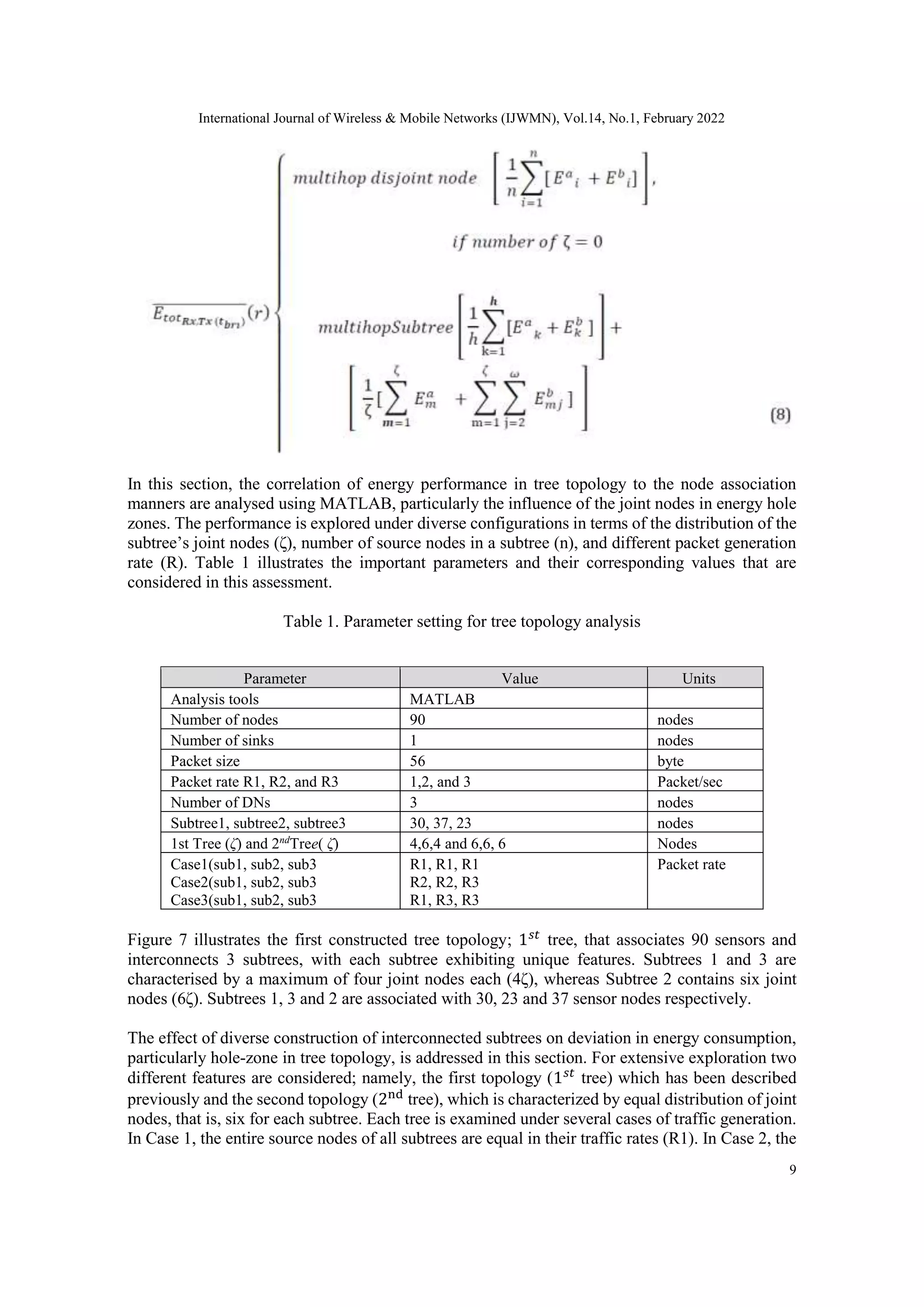
In this section, the correlation of energy performance in tree topology to the node association
manners are analysed using MATLAB, particularly the influence of the joint nodes in energy hole
zones. The performance is explored under diverse configurations in terms of the distribution of the
subtree’s joint nodes (ζ), number of source nodes in a subtree (n), and different packet generation
rate (R). Table 1 illustrates the important parameters and their corresponding values that are
considered in this assessment.
Table 1. Parameter setting for tree topology analysis
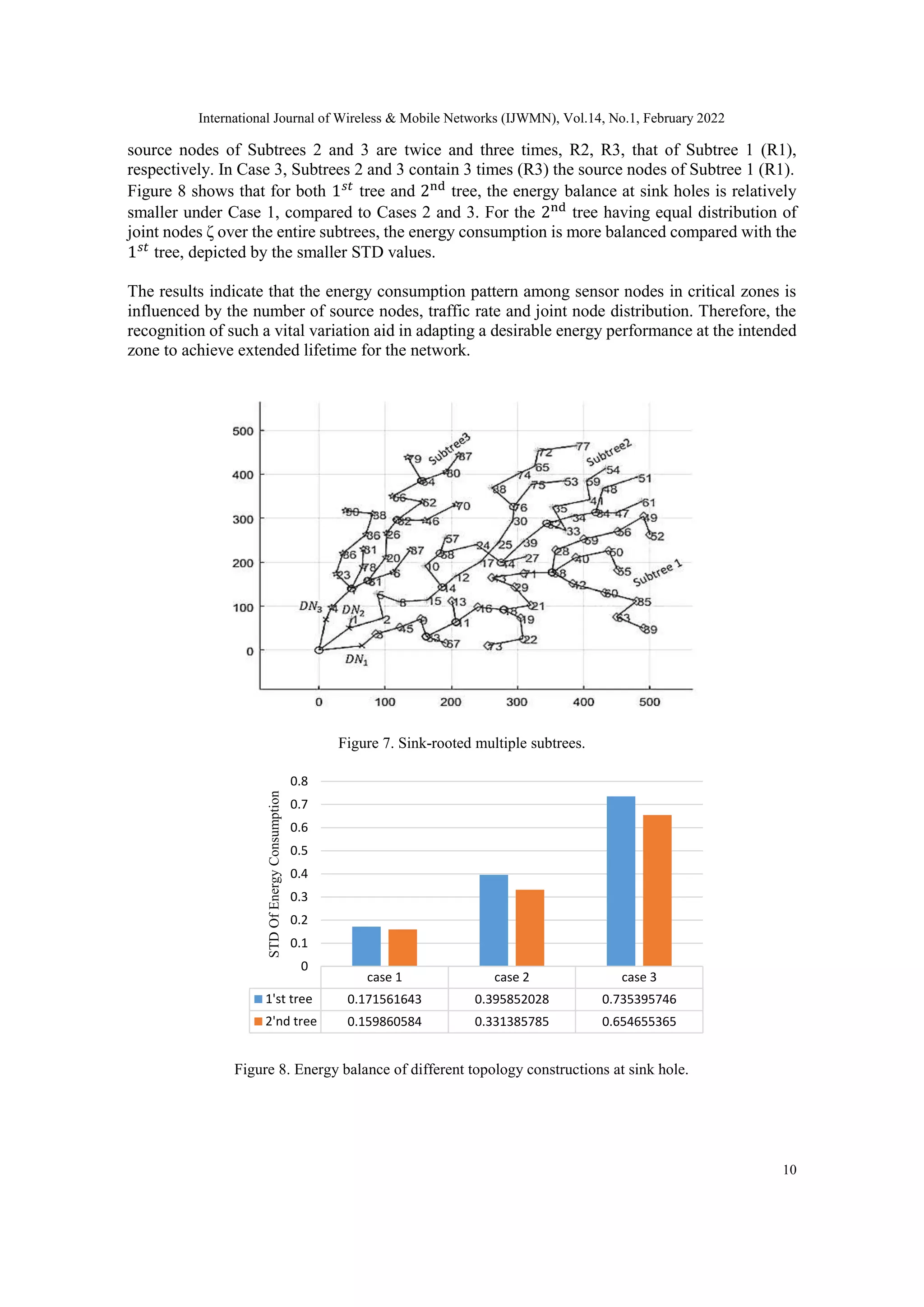
Figure 7 illustrates the first constructed tree topology; 1𝑠𝑡
tree, that associates 90 sensors and
interconnects 3 subtrees, with each subtree exhibiting unique features. Subtrees 1 and 3 are
characterised by a maximum of four joint nodes each (4ζ), whereas Subtree 2 contains six joint
nodes (6ζ). Subtrees 1, 3 and 2 are associated with 30, 23 and 37 sensor nodes respectively.
The effect of diverse construction of interconnected subtrees on deviation in energy consumption,
particularly hole-zone in tree topology, is addressed in this section. For extensive exploration two
different features are considered; namely, the first topology (1𝑠𝑡
tree) which has been described
previously and the second topology (2nd
tree), which is characterized by equal distribution of joint
nodes, that is, six for each subtree. Each tree is examined under several cases of traffic generation.
In Case 1, the entire source nodes of all subtrees are equal in their traffic rates (R1). In Case 2, the
Parameter Value Units
Analysis tools MATLAB
Number of nodes 90 nodes
Number of sinks 1 nodes
Packet size 56 byte
Packet rate R1, R2, and R3 1,2, and 3 Packet/sec
Number of DNs 3 nodes
Subtree1, subtree2, subtree3 30, 37, 23 nodes
1st Tree (ζ) and 2nd
Tree( ζ) 4,6,4 and 6,6, 6 Nodes
Case1(sub1, sub2, sub3
Case2(sub1, sub2, sub3
Case3(sub1, sub2, sub3
R1, R1, R1
R2, R2, R3
R1, R3, R3
Packet rate
International Journal of Wireless & Mobile Networks (IJWMN), Vol.14, No.1, February 2022
10
source nodes of Subtrees 2 and 3 are twice and three times, R2, R3, that of Subtree 1 (R1),
respectively. In Case 3, Subtrees 2 and 3 contain 3 times (R3) the source nodes of Subtree 1 (R1).
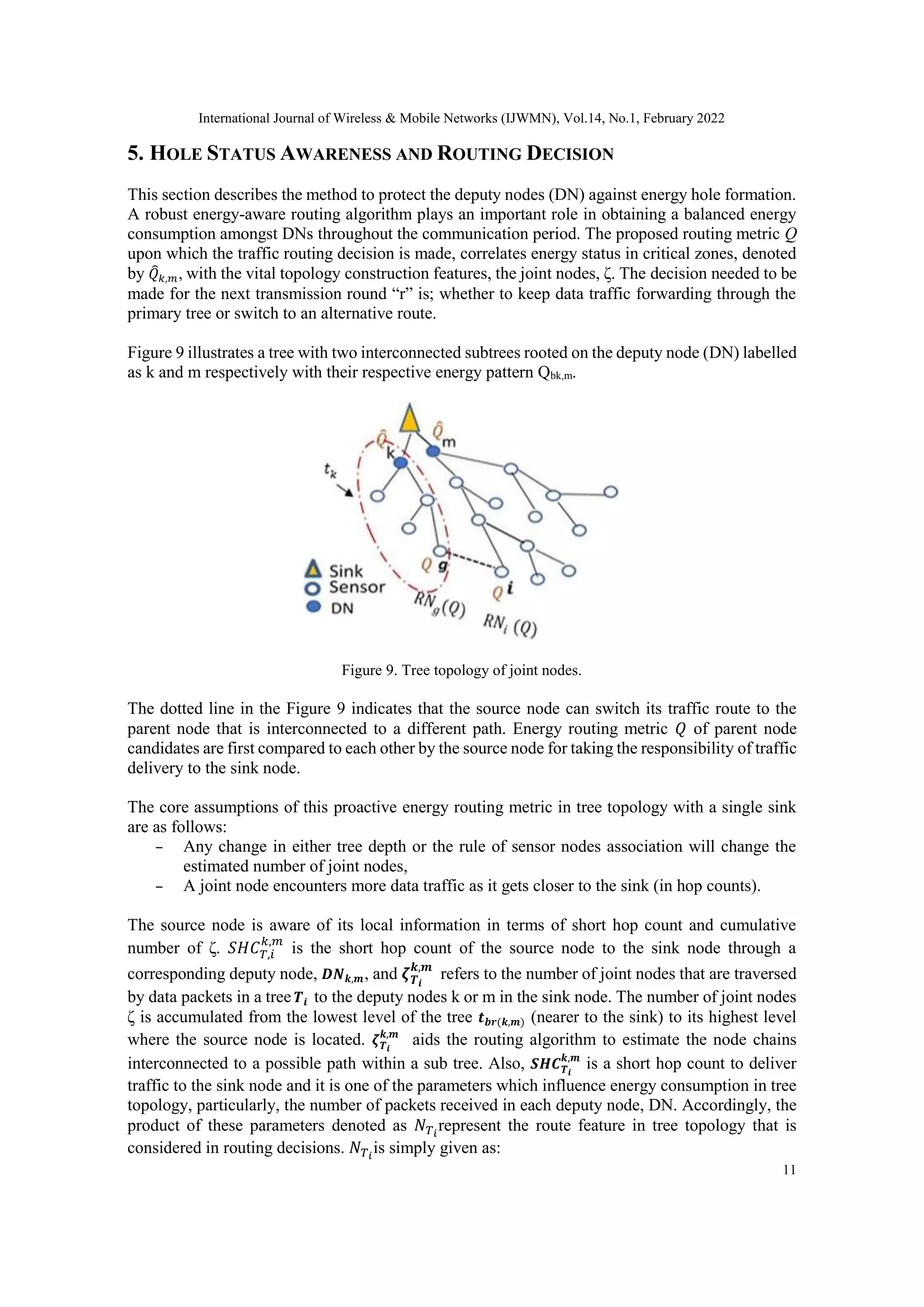
Figure 8 shows that for both 1𝑠𝑡
tree and 2nd
tree, the energy balance at sink holes is relatively
smaller under Case 1, compared to Cases 2 and 3. For the 2nd
tree having equal distribution of
joint nodes ζ over the entire subtrees, the energy consumption is more balanced compared with the
1𝑠𝑡
tree, depicted by the smaller STD values.
The results indicate that the energy consumption pattern among sensor nodes in critical zones is
influenced by the number of source nodes, traffic rate and joint node distribution. Therefore, the
recognition of such a vital variation aid in adapting a desirable energy performance at the intended
zone to achieve extended lifetime for the network.
Figure 7. Sink-rooted multiple subtrees.
Figure 8. Energy balance of different topology constructions at sink hole.
case 1 case 2 case 3
1'st tree 0.171561643 0.395852028 0.735395746
2'nd tree 0.159860584 0.331385785 0.654655365
0
0.1
0.2
0.3
0.4
0.5
0.6
0.7
0.8
STD
Of
Energy
Consumption
International Journal of Wireless & Mobile Networks (IJWMN), Vol.14, No.1, February 2022
11
5. HOLE STATUS AWARENESS AND ROUTING DECISION
This section describes the method to protect the deputy nodes (DN) against energy hole formation.
A robust energy-aware routing algorithm plays an important role in obtaining a balanced energy
consumption amongst DNs throughout the communication period. The proposed routing metric Q
upon which the traffic routing decision is made, correlates energy status in critical zones, denoted
by 𝑄
̂𝑘,𝑚, with the vital topology construction features, the joint nodes, ζ. The decision needed to be
made for the next transmission round “r” is; whether to keep data traffic forwarding through the
primary tree or switch to an alternative route.
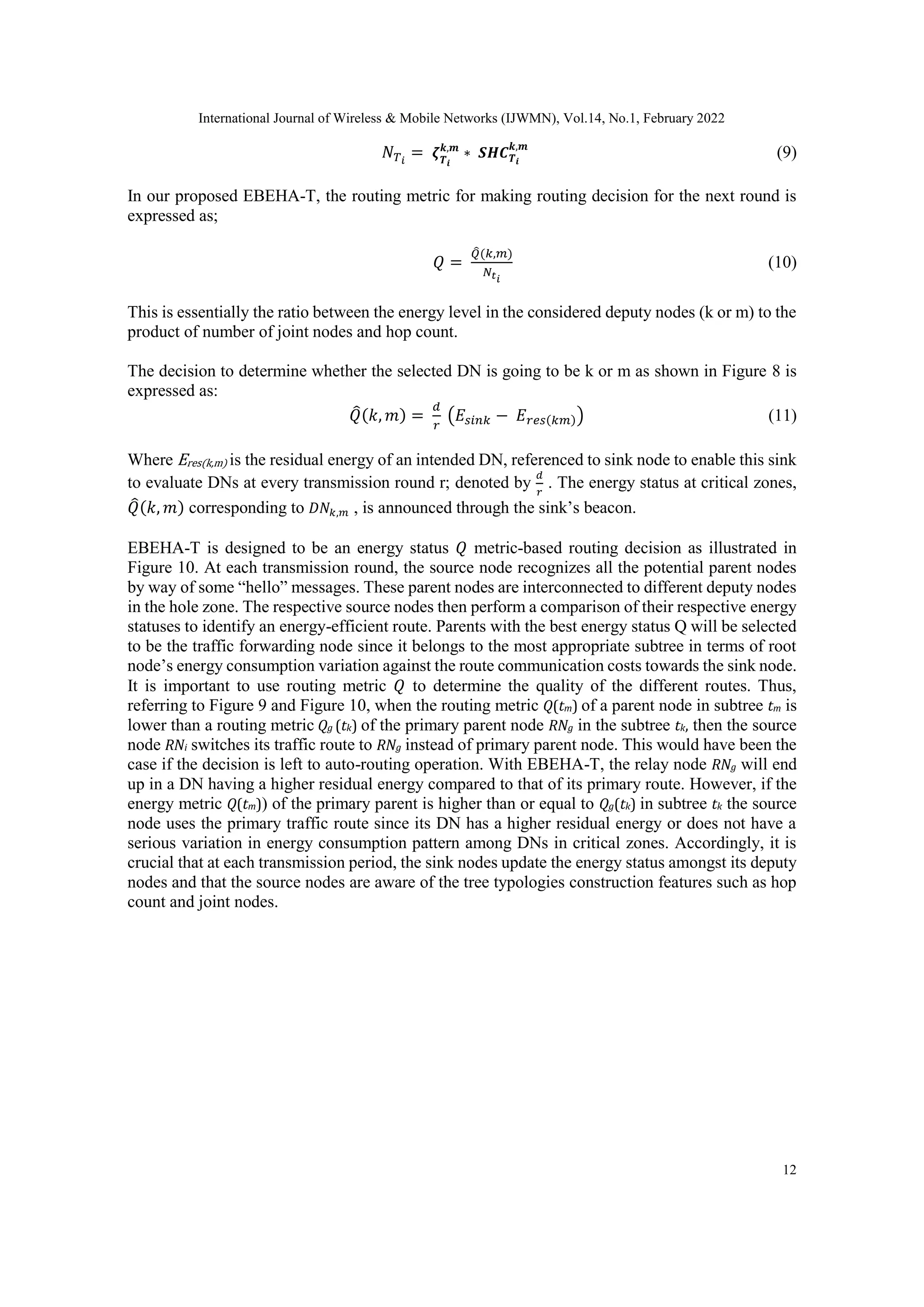
Figure 9 illustrates a tree with two interconnected subtrees rooted on the deputy node (DN) labelled
as k and m respectively with their respective energy pattern Qbk,m.
Figure 9. Tree topology of joint nodes.
The dotted line in the Figure 9 indicates that the source node can switch its traffic route to the
parent node that is interconnected to a different path. Energy routing metric 𝑄 of parent node
candidates are first compared to each other by the source node for taking the responsibility of traffic
delivery to the sink node.
The core assumptions of this proactive energy routing metric in tree topology with a single sink
are as follows:
– Any change in either tree depth or the rule of sensor nodes association will change the
estimated number of joint nodes,
– A joint node encounters more data traffic as it gets closer to the sink (in hop counts).
The source node is aware of its local information in terms of short hop count and cumulative
number of ζ. 𝑆𝐻𝐶𝑇,𝑖
𝑘,𝑚
is the short hop count of the source node to the sink node through a
corresponding deputy node, 𝑫𝑵𝒌,𝒎, and 𝜻𝑻𝒊
𝒌,𝒎
refers to the number of joint nodes that are traversed
by data packets in a tree 𝑻𝒊 to the deputy nodes k or m in the sink node. The number of joint nodes
ζ is accumulated from the lowest level of the tree 𝒕𝒃𝒓(𝒌,𝒎) (nearer to the sink) to its highest level
where the source node is located. 𝜻𝑻𝒊
𝒌,𝒎
aids the routing algorithm to estimate the node chains
interconnected to a possible path within a sub tree. Also, 𝑺𝑯𝑪𝑻𝒊
𝒌,𝒎
is a short hop count to deliver
traffic to the sink node and it is one of the parameters which influence energy consumption in tree
topology, particularly, the number of packets received in each deputy node, DN. Accordingly, the
product of these parameters denoted as 𝑁𝑇𝑖
represent the route feature in tree topology that is
considered in routing decisions. 𝑁𝑇𝑖
is simply given as:
International Journal of Wireless & Mobile Networks (IJWMN), Vol.14, No.1, February 2022
12
𝑁𝑇𝑖
= 𝜻𝑻𝒊
𝒌,𝒎
∗ 𝑺𝑯𝑪𝑻𝒊
𝒌,𝒎
(9)
In our proposed EBEHA-T, the routing metric for making routing decision for the next round is
expressed as;
𝑄 =
𝑄
̂(𝑘,𝑚)
𝑁𝑡𝑖
(10)
This is essentially the ratio between the energy level in the considered deputy nodes (k or m) to the
product of number of joint nodes and hop count.
The decision to determine whether the selected DN is going to be k or m as shown in Figure 8 is
expressed as:
𝑄
̂(𝑘, 𝑚) =
𝑑
𝑟
(𝐸𝑠𝑖𝑛𝑘 − 𝐸𝑟𝑒𝑠(𝑘𝑚)) (11)
Where Eres(k,m) is the residual energy of an intended DN, referenced to sink node to enable this sink
to evaluate DNs at every transmission round r; denoted by
𝑑
𝑟
. The energy status at critical zones,
𝑄
̂(𝑘, 𝑚) corresponding to 𝐷𝑁𝑘,𝑚 , is announced through the sink’s beacon.
EBEHA-T is designed to be an energy status 𝑄 metric-based routing decision as illustrated in
Figure 10. At each transmission round, the source node recognizes all the potential parent nodes
by way of some “hello” messages. These parent nodes are interconnected to different deputy nodes
in the hole zone. The respective source nodes then perform a comparison of their respective energy
statuses to identify an energy-efficient route. Parents with the best energy status Q will be selected
to be the traffic forwarding node since it belongs to the most appropriate subtree in terms of root
node’s energy consumption variation against the route communication costs towards the sink node.
It is important to use routing metric 𝑄 to determine the quality of the different routes. Thus,
referring to Figure 9 and Figure 10, when the routing metric Q(tm) of a parent node in subtree tm is
lower than a routing metric Qg (tk) of the primary parent node RNg in the subtree tk, then the source
node RNi switches its traffic route to RNg instead of primary parent node. This would have been the
case if the decision is left to auto-routing operation. With EBEHA-T, the relay node RNg will end
up in a DN having a higher residual energy compared to that of its primary route. However, if the
energy metric Q(tm)) of the primary parent is higher than or equal to Qg(tk) in subtree tk the source
node uses the primary traffic route since its DN has a higher residual energy or does not have a
serious variation in energy consumption pattern among DNs in critical zones. Accordingly, it is
crucial that at each transmission period, the sink nodes update the energy status amongst its deputy
nodes and that the source nodes are aware of the tree typologies construction features such as hop
count and joint nodes.
International Journal of Wireless & Mobile Networks (IJWMN), Vol.14, No.1, February 2022
13
Figure 10. Flowchart of proactive energy routing metric-based traffic routing.
6. SIMULATION RESULTS AND DISCUSSIONS
This section presents the performance of our proposed EBEHA-T routing algorithm compared to
Randomized Switching for Maximizing Lifetime (RaSMaLai) [53]. RaSMaLai has been selected
as the benchmark method as it is one of the latest works in the literature that addresses the energy
hole problem in a tree topology-based traffic routing. It aims to maximize the lifetime of a sensor
network by using a routing decision considering load balance parameters to switch from original
paths to other paths with lower load.
Several simulations of these schemes have been carried out using OmNet++ which is a popular
open-source network simulation package. Standard radio parameters and energy dissipation model
has been implemented. Table 2 presents the simulation parameters used to assess the performance
of the tree topology.
Different network situations which we refer to as case studies (CS) have been modelled to study
the performance of EBEHA-T and RaSMaLai under different tree topologies. The cases are
International Journal of Wireless & Mobile Networks (IJWMN), Vol.14, No.1, February 2022
14
basically referred to a single sink tree topology varying in sink energy hole size from four deputy
nodes (4DN) to eight deputy nodes (8DN), and total number of sensor nodes from 30 to 75 for CS1
and CS2, respectively.
Table 2. Simulation parameters used in OmNet++ v4.6
Parameter Value Units
Number of static nodes 30 -75 nodes
Number of static sinks 1 nodes
CS1 and CS2 3 and 4 DN
Initial Energy 0.5 joule
Circuit energy to transmit /receive (Tx /Rx) 50 nJoule/bit
Energy of amplification 10 pJoule/bit/m2
Packet rates
R1 1 packet/sec
R2 0.5
MAC CSMA/CA
6.1.Average Energy Consumption
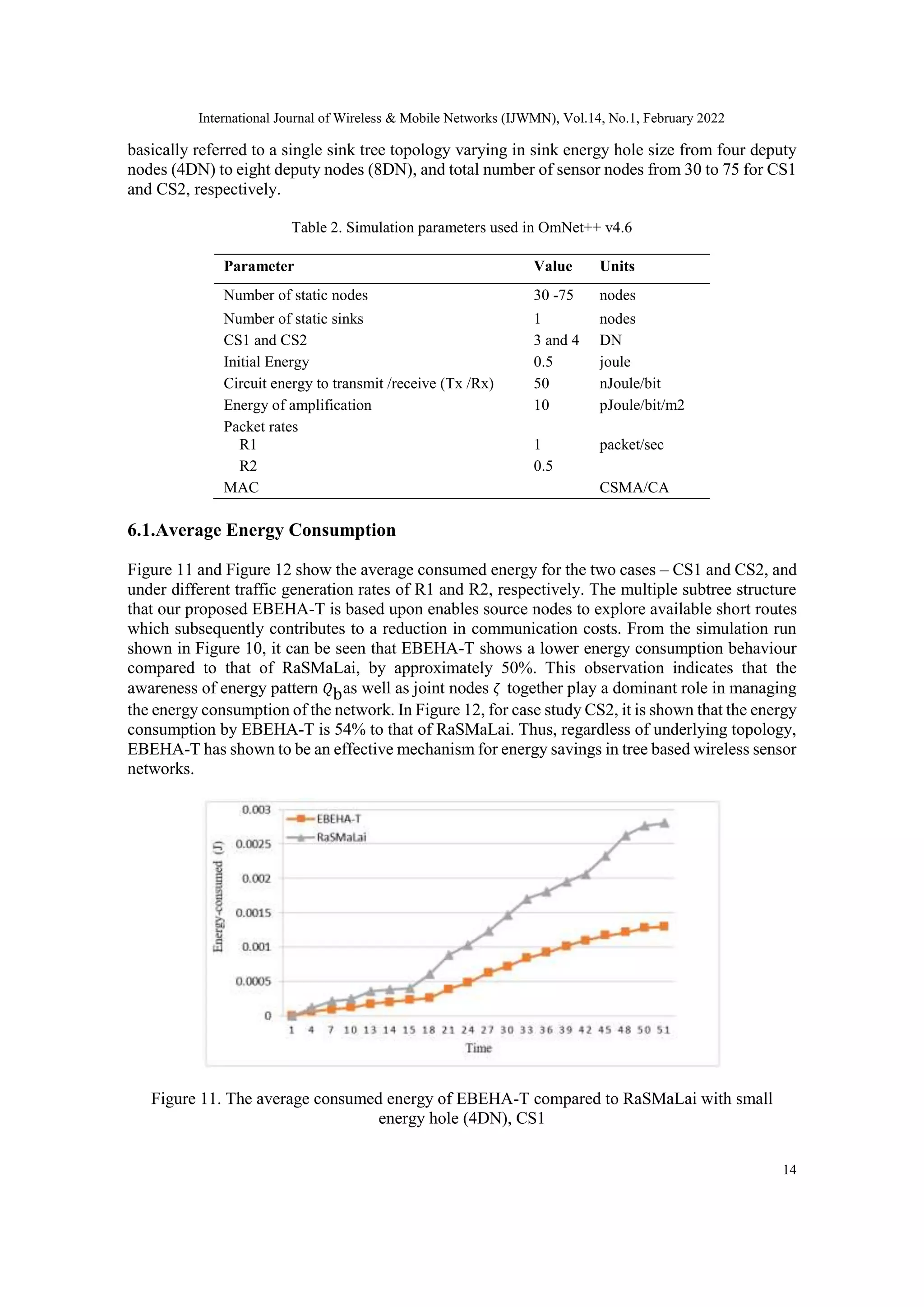
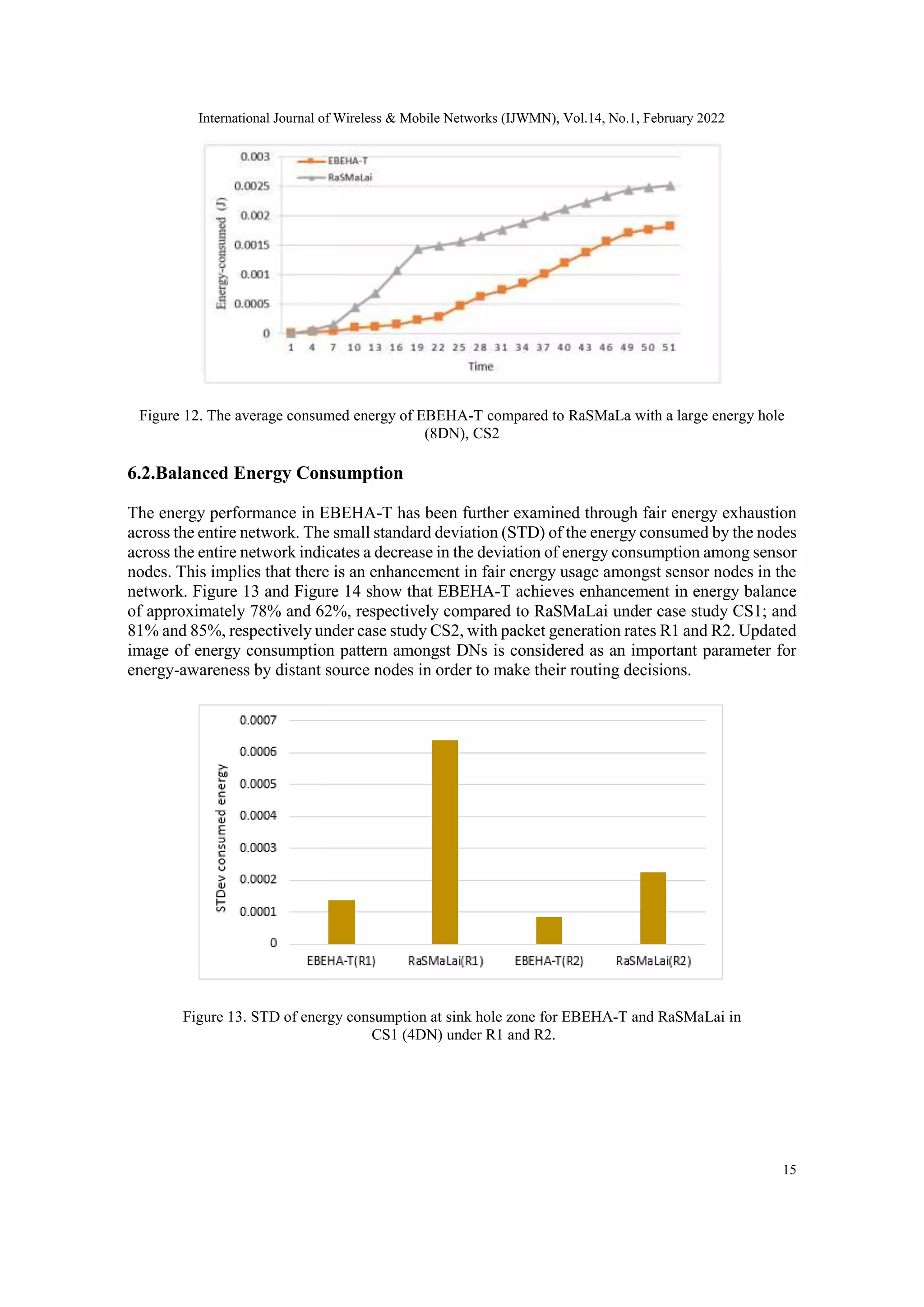
Figure 11 and Figure 12 show the average consumed energy for the two cases – CS1 and CS2, and
under different traffic generation rates of R1 and R2, respectively. The multiple subtree structure
that our proposed EBEHA-T is based upon enables source nodes to explore available short routes
which subsequently contributes to a reduction in communication costs. From the simulation run
shown in Figure 10, it can be seen that EBEHA-T shows a lower energy consumption behaviour
compared to that of RaSMaLai, by approximately 50%. This observation indicates that the
awareness of energy pattern 𝑄bas well as joint nodes ζ together play a dominant role in managing
the energy consumption of the network. In Figure 12, for case study CS2, it is shown that the energy
consumption by EBEHA-T is 54% to that of RaSMaLai. Thus, regardless of underlying topology,
EBEHA-T has shown to be an effective mechanism for energy savings in tree based wireless sensor
networks.
Figure 11. The average consumed energy of EBEHA-T compared to RaSMaLai with small
energy hole (4DN), CS1
International Journal of Wireless & Mobile Networks (IJWMN), Vol.14, No.1, February 2022
15
Figure 12. The average consumed energy of EBEHA-T compared to RaSMaLa with a large energy hole
(8DN), CS2
6.2.Balanced Energy Consumption
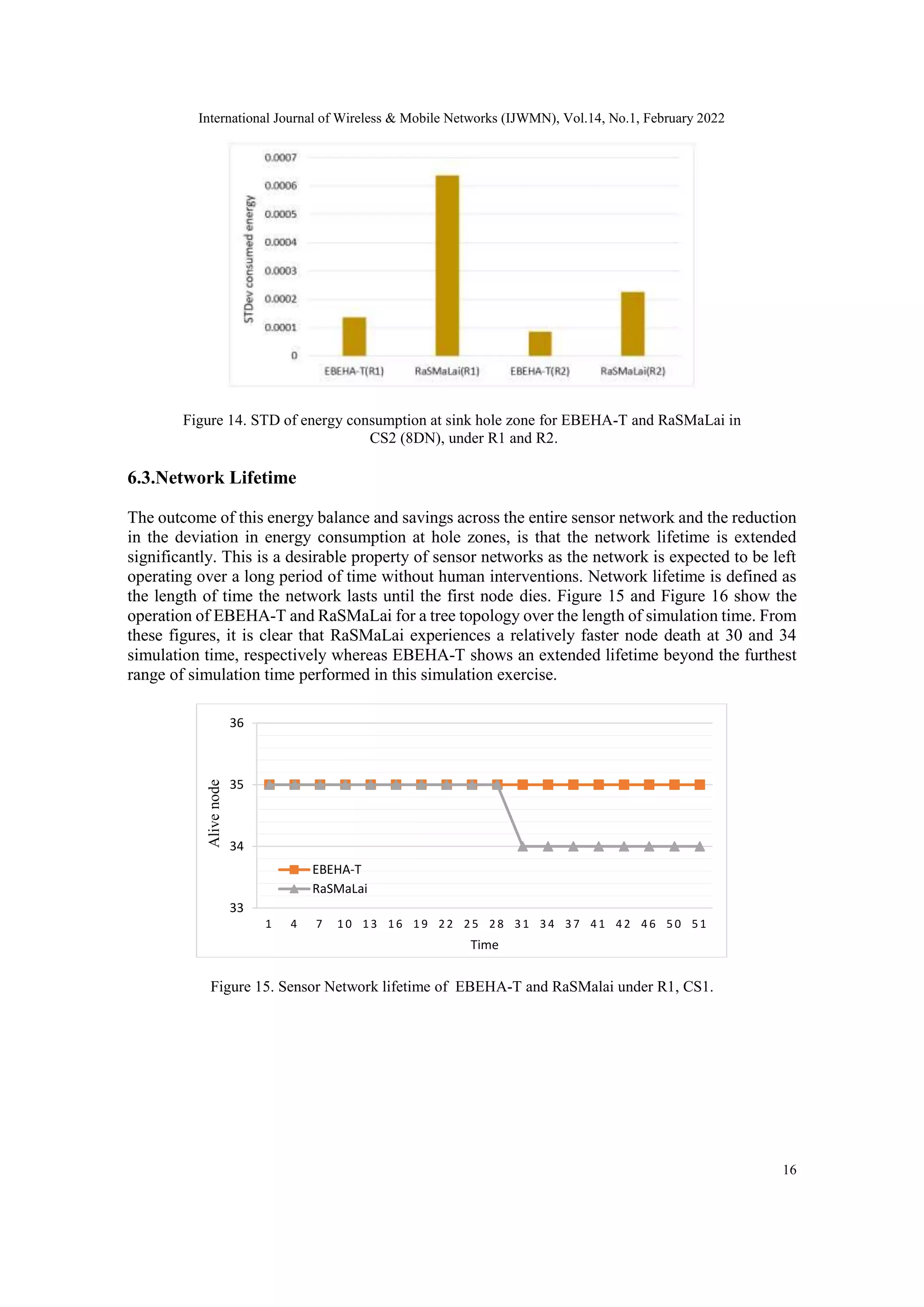
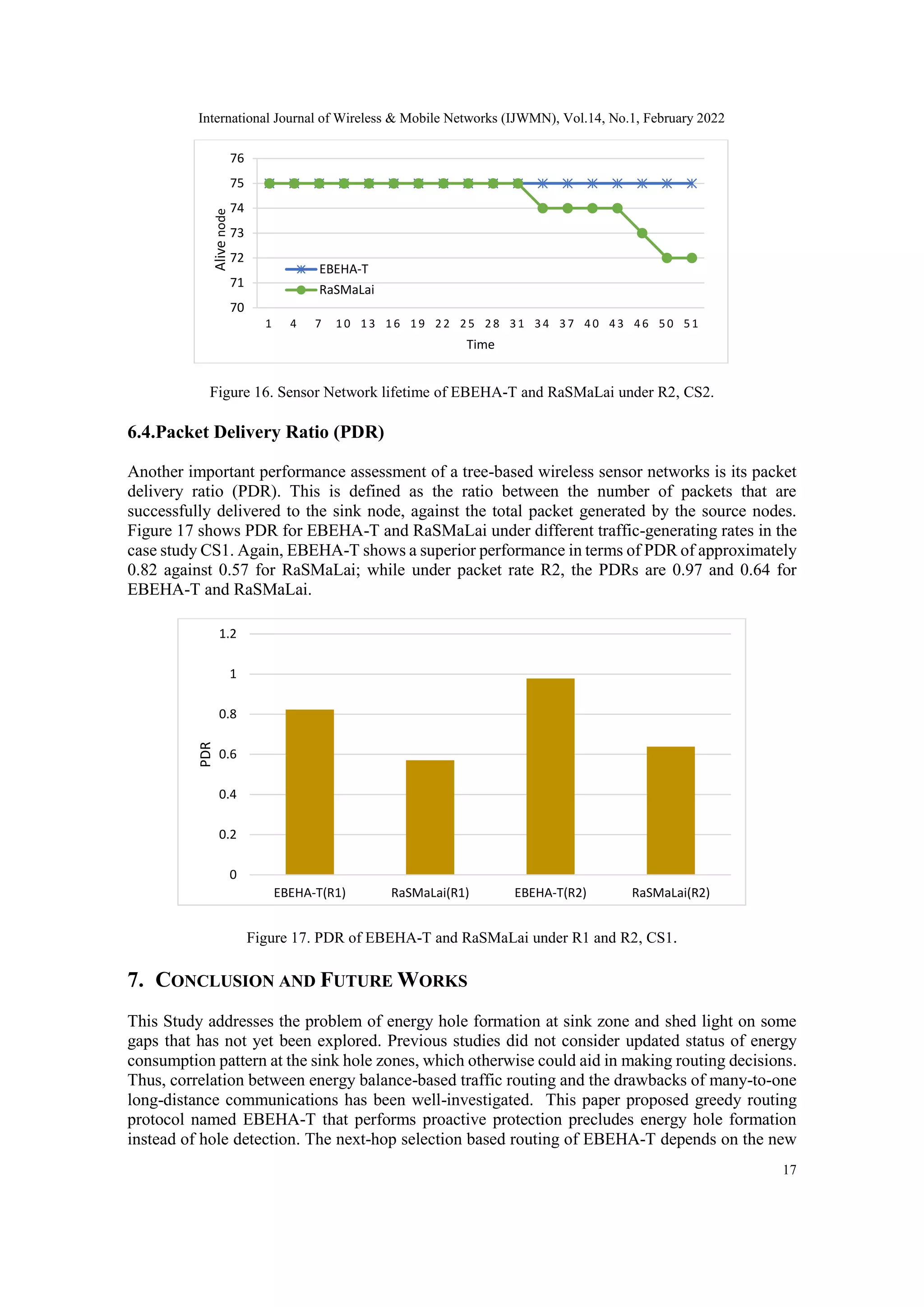
The energy performance in EBEHA-T has been further examined through fair energy exhaustion
across the entire network. The small standard deviation (STD) of the energy consumed by the nodes
across the entire network indicates a decrease in the deviation of energy consumption among sensor
nodes. This implies that there is an enhancement in fair energy usage amongst sensor nodes in the
network. Figure 13 and Figure 14 show that EBEHA-T achieves enhancement in energy balance
of approximately 78% and 62%, respectively compared to RaSMaLai under case study CS1; and
81% and 85%, respectively under case study CS2, with packet generation rates R1 and R2. Updated
image of energy consumption pattern amongst DNs is considered as an important parameter for
energy-awareness by distant source nodes in order to make their routing decisions.
Figure 13. STD of energy consumption at sink hole zone for EBEHA-T and RaSMaLai in
CS1 (4DN) under R1 and R2.
International Journal of Wireless & Mobile Networks (IJWMN), Vol.14, No.1, February 2022
16
Figure 14. STD of energy consumption at sink hole zone for EBEHA-T and RaSMaLai in
CS2 (8DN), under R1 and R2.
6.3.Network Lifetime
The outcome of this energy balance and savings across the entire sensor network and the reduction
in the deviation in energy consumption at hole zones, is that the network lifetime is extended
significantly. This is a desirable property of sensor networks as the network is expected to be left
operating over a long period of time without human interventions. Network lifetime is defined as
the length of time the network lasts until the first node dies. Figure 15 and Figure 16 show the
operation of EBEHA-T and RaSMaLai for a tree topology over the length of simulation time. From
these figures, it is clear that RaSMaLai experiences a relatively faster node death at 30 and 34
simulation time, respectively whereas EBEHA-T shows an extended lifetime beyond the furthest
range of simulation time performed in this simulation exercise.
Figure 15. Sensor Network lifetime of EBEHA-T and RaSMalai under R1, CS1.
33
34
35
36
1 4 7 10 13 16 1 9 22 25 28 31 34 37 41 42 46 50 51
Alive
node
Time
EBEHA-T
RaSMaLai
International Journal of Wireless & Mobile Networks (IJWMN), Vol.14, No.1, February 2022
17
Figure 16. Sensor Network lifetime of EBEHA-T and RaSMaLai under R2, CS2.
6.4.Packet Delivery Ratio (PDR)
Another important performance assessment of a tree-based wireless sensor networks is its packet
delivery ratio (PDR). This is defined as the ratio between the number of packets that are
successfully delivered to the sink node, against the total packet generated by the source nodes.
Figure 17 shows PDR for EBEHA-T and RaSMaLai under different traffic-generating rates in the
case study CS1. Again, EBEHA-T shows a superior performance in terms of PDR of approximately
0.82 against 0.57 for RaSMaLai; while under packet rate R2, the PDRs are 0.97 and 0.64 for
EBEHA-T and RaSMaLai.
Figure 17. PDR of EBEHA-T and RaSMaLai under R1 and R2, CS1.
7. CONCLUSION AND FUTURE WORKS
This Study addresses the problem of energy hole formation at sink zone and shed light on some
gaps that has not yet been explored. Previous studies did not consider updated status of energy
consumption pattern at the sink hole zones, which otherwise could aid in making routing decisions.
Thus, correlation between energy balance-based traffic routing and the drawbacks of many-to-one
long-distance communications has been well-investigated. This paper proposed greedy routing
protocol named EBEHA-T that performs proactive protection precludes energy hole formation
instead of hole detection. The next-hop selection based routing of EBEHA-T depends on the new
70
71
72
73
74
75
76
1 4 7 10 13 16 19 22 25 28 31 34 3 7 40 43 46 50 51
Alive
node
Time
EBEHA-T
RaSMaLai
0
0.2
0.4
0.6
0.8
1
1.2
EBEHA-T(R1) RaSMaLai(R1) EBEHA-T(R2) RaSMaLai(R2)
PDR
International Journal of Wireless & Mobile Networks (IJWMN), Vol.14, No.1, February 2022
18
metric that combines updates energy consumption pattern amongst deputy nodes (DNs) together
with estimated cumulative joint nodes in tree topology is based. The superior performance of
Energy Balance-Based Energy Hole Alleviation in tree topology (EBEHA-T) compared to the
state-of-the-art RaSMaLai method verifies that its energy-aware routing decisions results in
significant improvement in a sensor network’s energy consumption balance, particularly amongst
deputy nodes (DN) in hole zones. It also affords a higher reliability in terms of packet delivery to
the sink node which eventually results in a prolonged network lifetime. Future studies should
include protection against relatively overwhelmed traffic at some sinks in a tree topology with
multiple sinks to achieve a longer network lifetime.
REFERENCES
[1] S. Jannu and P. K. Jana, “Energy Efficient Algorithms to Maximize Lifetime of Wireless Sensor
Networks,” Conf. Adv. Comput. Commun. Informatics, pp. 63–68, 2016.
[2] N. Jan, A. R. Hameed, B. Ali, R. Ullah, K. Ullah, and N. Javaid, “A wireless sensor networks balanced
energy consumption protocol,” Proc. - 31st IEEE Int. Conf. Adv. Inf. Netw. Appl. Work. WAINA 2017,
pp. 730–736, 2017.
[3] N. Sharmin, A. Karmaker, W. L. Lambert, M. S. Alam, and M. S. T. S. A. Shawkat, “Minimizing the
energy hole problem in wireless sensor networks: A wedge merging approach,” Sensors
(Switzerland), vol. 20, no. 1, 2020.
[4] M. Shafiq, H. Ashraf, A. Ullah, and S. Tahira, “Systematic Literature Review on Energy Efficient
Routing Schemes in WSN – A Survey,” Mob. Networks Appl., vol. 25, no. 3, pp. 882–895, 2020.
[5] A. Pathak, Zaheeruddin, and M. K. Tiwari, “Minimizing the energy hole problem in wireless sensor
networks by normal distribution of nodes and relaying range regulation,” 4th Int. Conf. Comput. Intell.
Commun. Networks, CICN 2012, pp. 154–157, 2012.
[6] S. Wan, Y. Zhang, and and J. Chen, “On the Construction of Data Aggregation Tree With
Maximizing Lifetime in Large-Scale Wireless Sensor Networks,” IEEE Sens. J., vol. 16, no. 20, pp.
7433–7440, 2016.
[7] K. Latif, N. Javaid, A. Ahmad, Z. A. Khan, N. Alrajeh, and M. I. Khan, “On Energy Hole and
Coverage Hole Avoidance in Underwater Wireless Sensor Networks,” IEEE Sens. J., vol. 16, no. 11,
pp. 4431–4442, 2016.
[8] X. Chen, C. He, and L. Jiang, “The tradeoff between transmission cost and network lifetime of data
gathering tree in Wireless Sensor Networks,” IEEE Int. Conf. Commun., pp. 1790–1794, 2013.
[9] H. Asharioun, H. Asadollahi, T. C. Wan, and N. Gharaei, “A Survey on Analytical Modeling and
Mitigation Techniques for the Energy Hole Problem in Corona-Based Wireless Sensor Network,”
Wirel. Pers. Commun., vol. 81, no. 1, pp. 161–187, 2015.
[10] K. Haseeb, K. A. Bakar, A. Ahmed, T. Darwish, and I. Ahmed, “WECRR: Weighted Energy-Efficient
Clustering with Robust Routing for Wireless Sensor Networks,” Wirel. Pers. Commun., pp. 1–27,
2017.
[11] N. Jan et al., “A balanced energy consuming and hole alleviating algorithm for wireless sensor
networks,” IEEE Access, vol. 3536, no. c, pp. 1–1, 2016.
[12] R. Velmani and B. Kaarthick, “An efficient cluster-tree based data collection scheme for large mobile
wireless sensor networks,” IEEE Sens. J., vol. 15, no. 4, pp. 2377–2390, 2015.
[13] J. Jung, “Methods of Cooperative Routing to Optimize The Lifetime of Multi-Hop Wireless Sensor
Networks,” Ph.D thesis, Georgia Institute of Technology, 2013.
[14] P. Chanak, I. Banerjee, and H. Rahaman, “Load management scheme for energy holes reduction in
wireless sensor networks,” Comput. Electr. Eng., vol. 48, pp. 343–357, 2015.
[15] R. E. Mohemed, A. I. Saleh, M. Abdelrazzak, and A. S. Samra, “Energy-efficient routing protocols
for solving energy hole problem in wireless sensor networks,” Comput. Networks, vol. 114, pp. 51–
66, 2017.
[16] M. A. Abd, S. F. M. Al-Rubeaai, B. K. Singh, K. E. Tepe, and R. Benlamri, “Extending Wireless
Sensor Network Lifetime with Global Energy Balance,” IEEE Sens. J., vol. 15, no. 9, pp. 5053–5063,
2015.
[17] J. Chang and T. Shen, “An Efficient Tree-Based Power Saving Scheme for Wireless Sensor Networks
With Mobile Sink,” IEEE Sens. J., vol. 16, no. 20, pp. 7545–7557, 2016.
[18] X. Liu, “A typical hierarchical routing protocols for wireless sensor networks : A review,” IEEE Sens.
International Journal of Wireless & Mobile Networks (IJWMN), Vol.14, No.1, February 2022
19
J., vol. 15, no. 10, pp. 5372–5383, 2015.
[19] F.-C. Jiang, D.-C. Huang, C.-T. Yang, and K.-H. Wang, “Mitigation techniques for the energy hole
problem in sensor networks using N-policy M/G/1 queuing models,” IET Int. Conf. Front. Comput.
Theory, Technol. Appl., pp. 1–6, 2010.
[20] V. Tran-Quang, P. Nguyen Huu, and T. Miyoshi, “A transmission range optimization algorithm to
avoid energy holes in wireless sensor networks,” IEICE Trans. Commun., vol. E94-B, no. 11, pp.
3026–3036, 2011.
[21] D. Carels, N. Derdaele, E. De Poorter, W. Vandenberghe, I. Moerman, and P. Demeester, “Support
of multiple sinks via a virtual root for the RPL routing protocol,” Eurasip J. Wirel. Commun. Netw.,
vol. 2014, no. 1, pp. 1–23, 2014.
[22] J. W. Jung and M. A. Ingram, “Residual-energy-activated cooperative transmission (REACT) to avoid
the energy hole,” in 2010 IEEE International Conference on Communications Workshops, ICC 2010,
2010.
[23] C. Song, J. Cao, M. Liu, Y. Zheng, H. Gong, and G. Chen, “Mitigating energy holes based on
transmission range adjustment in wireless sensor networks,” 5th Int. Conf. Heterog. Netw. Qual.
Reliab. Secur. Robustness, 2008.
[24] R. Wang, G. He, X. Wu, F. Wang, and Y. Hu, “Research on suboptimal energy balance of non-
uniform distributed nodes in WSN,” J. Supercomput., vol. 76, no. 5, pp. 3527–3541, 2018.
[25] N. Kumar and D. Dash, “Flow based efficient data gathering in wireless sensor network using path-
constrained mobile sink,” J. Ambient Intell. Humaniz. Comput., vol. 11, no. 3, pp. 1163–1175, 2020.
[26] M. Naghibi and H. Barati, “EGRPM: Energy efficient geographic routing protocol based on mobile
sink in wireless sensor networks,” Sustain. Comput. Informatics Syst., vol. 25, p. 100377, 2020.
[27] R. Vinodhini and C. Gomathy, “MOMHR: A Dynamic Multi-hop Routing Protocol for WSN Using
Heuristic Based Multi-objective Function,” Wirel. Pers. Commun., vol. 111, no. 2, pp. 883–907, 2019.
[28] S. Li, H. Gao, and D. Wu, “An Energy-balanced Routing Protocol with Greedy Forwarding for WSNs
in Cropland,” IEEE Int. Conf. Electron. Inf. Commun. Technol., pp. 1–7, 2016.
[29] M. N. Moghadam and H. Taheri, “High throughput load balanced multipath routing in homogeneous
wireless sensor networks,” 22nd Iran. Conf. Electr. Eng. ICEE 2014, no. Icee, pp. 1516–1521, 2014.
[30] S.-F. Hwang, H.-H. Lin, and C.-R. Dow, “An Energy-Efficient Routing Protocol in Wireless Sensor
Networks with Holes,” IEEE Proc. 4th ICUFN, pp. 17–22, 2012.
[31] S. R. Nabavi, N. O. Eraghi, and J. A. Torkestani, “WSN Routing Protocol Using a Multiobjective
Greedy Approach,” Wirel. Commun. Mob. Comput., vol. 2021, 2021.
[32] M. E. Haque and U. Baroudi, “Dynamic energy efficient routing protocol in wireless sensor
networks,” Sptinger , Wirel. Networks, vol. 26, no. 5, pp. 3715–3733, 2020.
[33] S. Medjiah, T. Ahmed, and F. Krief, “AGEM : Adaptive Greedy-Compass Energy-aware Multipath
Routing Protocol for WMSNs,” IEEE 17th Consum. Commun. asd Netw. Conf., pp. 1–6, 2010.
[34] A. Mahani, A. Kargar, Y. S. Kavian, and H. F. Rashvand, “Non-uniform distribution of multi-hop
sensor networks: performance improvement and energy hole mitigation,” IET Wirel. Sens. Syst., vol.
2, no. 4, pp. 302–308, 2012.
[35] A. R. M. Kamal and M. A. Hamid, “Supervisory routing control for dynamic load balancing in low
data rate wireless sensor networks,” Wirel. Networks, vol. 23, no. 4, pp. 1085–1099, 2016.
[36] A. Ghaffari, “Hybrid opportunistic and position-based routing protocol in vehicular ad hoc networks,”
J. Ambient Intell. Humaniz. Comput., vol. 11, no. 4, pp. 1593–1603, 2020.
[37] A. Pathak, Zaheeruddin, and D. K. Lobiyal, “Maximization the lifetime of wireless sensor network
by minimizing energy hole problem with exponential node distribution and hybrid routing,” IEEE
Students Conf. Eng. Syst. SCES 2012, 2012.
[38] S. M. Amini, A. Karimi, and M. Esnaashari, “Energy-efficient data dissemination algorithm based on
virtual hexagonal cell-based infrastructure and multi-mobile sink for wireless sensor networks,” J.
Supercomput., vol. 76, no. 1, pp. 150–173, 2020.
[39] Q. Mamun, “A qualitative comparison of different logical topologies for Wireless Sensor Networks,”
Sensors (Switzerland), vol. 12, no. 11, pp. 14887–14913, 2012.
[40] D. Ari, M. Çibuk, and F. Aǧgün, “The Comparison of Energy Consumption of Different Topologies
in Multi-hop Wireless Sensor Networks,” 2018 Int. Conf. Artif. Intell. Data Process. IDAP 2018, pp.
1–5, 2018.
[41] F. Cuomo, E. Cipollone, and A. Abbagnale, “Performance analysis of IEEE 802.15.4 wireless sensor
networks: An insight into the topology formation process,” Comput. Networks, vol. 53, no. 18, pp.
3057–3075, 2009.
International Journal of Wireless & Mobile Networks (IJWMN), Vol.14, No.1, February 2022
20
[42] T. Liu, “Avoiding energy holes to maximize network lifetime in gradient sinking sensor networks,”
Wirel. Pers. Commun., vol. 70, no. 2, pp. 581–600, 2013.
[43] J. Ren, Y. Zhang, K. Zhang, A. Liu, J. Chen, and X. S. Shen, “Lifetime and Energy Hole Evolution
Analysis in Data-Gathering Wireless Sensor Networks,” IEEE Trans. Ind. Informatics, vol. 12, no. 2,
pp. 788–800, 2016.
[44] Z. Lin, H. C. Keh, R. Wu, and D. S. Roy, “Joint Data Collection and Fusion Using Mobile Sink in
Heterogeneous Wireless Sensor Networks,” IEEE Sens. J., vol. 21, no. 2, pp. 2364–2376, 2021.
[45] C. Del-Valle-Soto, C. Mex-Perera, J. A. Nolazco-Flores, R. Velázquez, and A. Rossa-Sierra,
“Wireless sensor network energy model and its use in the optimization of routing protocols,”
Energies, vol. 13, no. 3, pp. 1–33, 2020.
[46] M. Elshrkawey, S. M. Elsherif, and M. Elsayed Wahed, “An Enhancement Approach for Reducing
the Energy Consumption in Wireless Sensor Networks,” J. King Saud Univ. - Comput. Inf. Sci., pp.
0–8, 2017.
[47] M. A. H. M. I. K. N.-E.-A. S. M. M. Reza, “Energy Hole Minimization Using Redundant Route in
Wireless Sensor Network,” Int. J. Sci. Res., vol. 6, no. 9, pp. 1909–1913, 2017.
[48] A.SARANYA, R.SENTHILKUMARAN, and Dr.G.NAGARAJAN, “Enhancing Network Lifetime
using Tree Based Routing Protocol in Wireless Sensor Networks,” 2nd IEEE Int. Conf. Electron.
Commun., pp. 1392–1396, 2015.
[49] A. Koliousis and J. Sventek, “Proactive vs reactive routing for wireless sensor networks,” Tech.
report, Dep. Comput. Sci. Univ. Glas. UK, p. http://www.doc.ic.ac.uk/~akolious/documents/TR-200,
2007.
[50] N. Mittal, U. Singh, and B. S. Sohi, “A stable energy efficient clustering protocol for wireless sensor
networks,” Wirel. Networks, vol. March, no. 6, pp. 1809–1821, 2016.
[51] F. Shebli, I. Dayoub, a. O. M’foubat, a. Rivenq, and J. M. Rouvaen, “Minimizing energy
consumption within wireless sensors networks using optimal transmission range between nodes,”
2007 IEEE Int. Conf. Signal Process. Commun., pp. 105–108, 2007.
[52] L. Tang, Z. Lu, and B. Fan, “Energy efficient and reliable routing algorithm for wireless sensors
networks,” Appl. Sci., vol. 10, no. 5, 2020.
[53] S. K. A. Imon, A. Khan, M. Di Francesco, and S. K. Das, “Energy-efficient randomized switching for
maximizing lifetime in tree-based wireless sensor networks,” IEEE/ACM Trans. Netw., vol. 23, no.
5, pp. 1401–1415, 2015.

A Proactive Greedy Routing Protocol Precludes Sink-Hole Formation in Wireless Sensor Networks

  • 1.
    International Journal ofWireless & Mobile Networks (IJWMN), Vol.14, No.1, February 2022 DOI:10.5121/ijwmn.2022.14101 1 A PROACTIVE GREEDY ROUTING PROTOCOL PRECLUDES SINK-HOLE FORMATION IN WIRELESS SENSOR NETWORKS Mayada S. A. Mustafa1 , Borhanuddin M Ali2 , MFA Rasid 2 , Shaiful J. Hashim2 , · I. A. Saeed3 1 Faculty of Telecommunication and Space Technology, Future University, Khartoum, Sudan 2 Wireless and Photonics Research Centre (WiPNET), Faculty of Engineering, Universiti Putra Malaysia, Serdang, Selangor, Malaysia 3 Department of Information Systems, Faculty of Computer Engineering and Sciences, Prince Sattam Bin Abdalaziz University, Alkharj, Kingdom of Saudia Arabia ABSTRACT A tree topology is a commonly employed topology for wireless sensor networks (WSN) to connect sensors to one or more remote gateways. In many-to-one traffic, routing imposes a heavy burden on downstream nodes, as the same routes are repeatedly used for packet forwarding from one or more sensor chains. The challenge is traffic paths that ensure balanced energy consumption at sink-hole to protect sensors from fast death. This paper proposes an energy consumption pattern-aware greedy routing protocol that proactively protects many-to-one topology from the sink-hole formation. The proposed protocol, Energy Balance-Based Energy Hole Alleviation in Tree Topology (EBEHA-T), precludes energy hole formation rather than retrospectively responding to a hole detection. Updated status of variations in energy consumption patterns at the sink-hole and construction feature of joint nodes in the tree topology aids in routing decision. Performance evaluation of EBEHA-T against benchmark method RaSMaLai shows increased energy-saving across the entire network and a marked improvement in energy consumption balance in energy hole zones. This precludes energy hole formation and the consequent network partitioning, leading to improved network lifetime beyond that of the RasMaLai. KEYWORDS WSN, Lifetime, Energy Hole, Tree Topology, Greedy Routing 1. INTRODUCTION Wireless sensor nodes are energy-constrained devices that can transfer sensed data from the field to servers in remote locations. This is generally done over multi-hop networks comprising of other similar nodes. Sensor nodes that are one-hop away from their respective gateways (referred to hereinafter as deputy nodes, (DNs) are responsible for major traffic delivery to this sink node (gateway node). The energy consumption rate is proportional to the amount of the data traffic handled by sensor node; received (𝑅𝑥) or transmitted (𝑇𝑥). Fast energy consumption of such a node “DN” end up in fast node death that causes energy holes in the sink zone. This hole isolates the sink node from its connected network and henceforth, a short network lifetime [1][2][3]. Thus, efficient use of energy consumption and how to prolong the lifetime of the network has become the subject of much research [4][5][6][7]. A first sensor node that runs out of energy constitutes one important metric of network life [8]. The problem of fast energy consumption is addressed
  • 2.
    International Journal ofWireless & Mobile Networks (IJWMN), Vol.14, No.1, February 2022 2 from different perspectives [9][10][11][12]. The authors in [13] proposed cooperative routing to minimize energy consumption, particularly at the sink zone. In [14], an associative header is a cluster member with the highest energy that replaces the cluster head when an energy hole is detected. The study in [15] presented On-Hole Children Reconnection (OHCR) and On-Hole Alert (OHA) in a tree topology. In this study, the number of interconnected child nodes is identified as a factor influencing the energy consumption pattern in the network. In recent years, balanced energy consumption over the network has been identified as one of the promising solutions to extend the network lifetime [16][17] [18]. The study [11] proposed is energy-aware balanced energy consumption and hole alleviating algorithm (BECHA). Its strategy is to balance load distribution among nodes of minimum and maximum energy consumption. The studies [11][19][20][21] are routing protocols targeted at fair energy consumption to alleviate hole formation. Their selection of relaying nodes was based on maximum residual energy, maximum load, least hop count, and optimum distance. However, the certainty of the shortest distance, as well as the high residual energy of candidate next-node-based routing protocol does not necessarily guarantee balanced energy consumption at the sink zone. In addition to that, a lack of study that consider the correlation between energy balance-based traffic routing and the drawbacks of many-to-one long-distance communications. In this paper, we propose Energy Balance-Based Energy Hole Alleviation in tree topology (EBEHA-T) routing protocol that addresses these gaps in a way that has not been previously considered. It precludes energy sink-hole formation through traffic forwarding management that balances energy consumption among hols nodes. It is a greedy routing protocol that selects its next- hop relaying nodes in such a way that ensures proactive protection against large variation in energy consumption at sink-holes. The proposed metric-based the candidates for next-node combines the updates of energy consumption pattern at sink zone and significant construction features of the tree topology; such as hop count and joint nodes, that influence energy consumption behaviour. Extensive simulations using Omnet++ have been carried out to validate the performance of EBEHA-T. The rest of this paper is organized as follows: Section 2 discusses previous works for energy hole in WSN and presents a taxonomy of major remedies. Theoretical Analysis for Tree Topology in WSN and Traffic Routings and inefficiency in energy consumption are discussed in Section 3. Node association manners to tree topology and its impact on energy consumption patterns in critical zones are analyzed in Section 4 Description of our proposed work and discussion of simulation results are presented in Section 5 and 6, respectively. Finally, the conclusion and future direction of the research are given in Section 7. 2. RELATED WORKS This section discusses previous works that tackled the problem of energy hole alleviation in WSN. Figure 1 illustrates a taxonomy of major remedies proposed by several researchers; topology control, node deployment, traffic routing, and hybrid mechanisms. The topology control is classified into power control and power management [22][23]. One of the Power control studies was Dynamic re-adjustment of transmission power by sensor nodes where neighbour nodes association, and subsequently network connectivity and coverage of node are affected. The node deployment is another strategy for hole alleviation classified into; sensor node distribution, sink mobility, and multiple sinks [24][25][26]. The study in [14] proposed dividing the network into hierarchical circles where the inner ones decrease gradually in size as they get closer to the sink nodes. Each layer is divided into sectors each with a header node to accumulate data. One of the important remedies is routing protocols that address the problem of non-fair energy consumption in critical zones. These protocols are classified into heuristic routing and greedy routing as in [27][28]. The heuristic routing is based on a function estimate cost of routing paths from the source
  • 3.
    International Journal ofWireless & Mobile Networks (IJWMN), Vol.14, No.1, February 2022 3 node to destination node. The heuristic value changes are infrequently occurring because most sensor nodes are statics and adjust routes, particularly when unpredictable topological changes occur. Little overhead is introduced by the transmission of heuristic value. The authors in [29] proposed a Heuristic Load Distribution algorithm (HeLD) multipath routing to achieve equal energy consumption rate among nodes of the same depth which subsequently saves the cost of transmission. A sensor node compares its parents in a pairwise manner and switch to other parents if the cost of the route of current parent is higher than the others. Traffic flow is controlled by a central agent with full knowledge of the network topology. On the other hand, the greedy routing; which is the focus of this study, is based on the selection of a candidate neighbor node in the path to the destination. Common key criteria based on the next node election are node position, hop count and node energy [28][30][31]. The authors in [32] proposed Adaptive Greedy-Compass Energy-Aware Multipath (AGEM) which gives a score to each one-hop neighbor and selects a set with smallest angular offset from a virtual line toward the destination. This set of neighbors ensures multiple paths from a source node. The routing decisions are performed based on limited and localized knowledge of the network. A packet with the smallest number of hops is forwarded through the neighbor nodes with higher energy consumption and vice versa where a packet with the highest number of hops is forwarded through neighbor nodes with the lowest energy consumption. Multipath capabilities ensure uniform energy consumption and meets the delay and packet loss constraint. The algorithm confirms the occurrence of an energy a hole when it fails to find a set of neighbors, it accordingly forwards the responsibility to the neighbors nearer to the source node. The paper in [33]proposed a supervisory routing control for dynamic load balancing. This greedy algorithm avoids the early death of relatively overloaded nodes that cause network partition. The traffic load of nodes is monitored and overloaded nodes are identified. Monitoring is done by means of in-network path tagging which is deterministic and light-weight. The ch of the overloaded node is then instructed to switch from its parent node. The instruction is sent via the Sink to the child node while acknowledge for successful switching is sent back from child to sink. The research in [34] proposed Hole Avoiding In advance Routing protocol (HAIR) where local information about one-hop neighbors is maintained. If a hole is detected by a node, then neighbors are informed by the “a hole detection” message via “push” action. Accordingly, neighbors reroute their data traffic to another parent node according to traditional geographic routing protocols where distance is considered for the selection of the next hop is the shortest distance to the destination. The paper in [35] proposed a supervisory routing control for dynamic load balancing algorithm to avoid early death of relatively overloaded nodes. The child nodes of the overloaded node are instructed to switch from their parent nodes to another downstream route. The instruction is sent via the Sink to the child node while acknowledgement for successful switching is sent back from child to sink. The study [36] proposed optimum candidate nodes selection criteria; distance to the target, link quality, density of nodes, and the priority for data transmission. Due to the mobility of the vehicular the link is prone to be lost and accordingly the node will be discarded as one of the candidate nodes. A hybrid remedies integrates a number of previously discussed mechanisms to alleviate energy holes are also introduced [38]. The result of this extensive study is that variation reduction in energy consumption pattern to prolongs the lifetime of the network is a hot research area. In particular, proactive protection precludes energy hole formation-based greedy routing mechanism instead of hole detection. The analysis is needed to identify significant construction features of the tree topology that affects energy behaviour pattern.
  • 4.
    International Journal ofWireless & Mobile Networks (IJWMN), Vol.14, No.1, February 2022 4 Figure 1 Sink energy hole remedies and the framework 3. THEORETICAL ANALYSIS FOR TREE TOPOLOGY Generally, the main WSN topology studied is of type hierarchical, flat and location-based. However, the most well-known tree topology is either of type cluster or flat-based network [39]. A flat topology is when all nodes play equal roles in network formation while in hierarchical network nodes are different in their roles. Different topologies lay on the exact radio propagation model of WSN most likely consumes different amounts of energy [40]. Moreover, a previous study [41] verifies that performance in terms of average energy consumption, delay, lifetime, and coverage is topology dependent. The tree topology is considered a promising underlying topology in WSN. Three phases are essential in a tree setting; topology construction, routing phase, and transmission phase, following the many-to-one traffic pattern in Figure 2. Figure 2. Tree Topology in WSN.
  • 5.
    International Journal ofWireless & Mobile Networks (IJWMN), Vol.14, No.1, February 2022 5 The sensor nodes closer to the sink consumed more energy and got their energy depleted sooner as compared with the other distant sensor nodes. Researchers have verified that 90% to 80% of nodes’ energy at a higher level of a tree topology is still available by the time the sensor nodes that surround the sink node have consumed their entire energy budget [42][43]. Figure 3 illustrates that the amount of energy consumption of the sensor node is inversely proportional to its distance from the sink node. The early death of nodes at a lower level in tree topology creates energy sink-holes and isolates descendent nodes from their sink node and prevents data from reaching their destination. Consequently, the functioning time of the network is cut short, rendering the lifetime span insufficient for accomplishing targeted tasks. Figure 3. Energy consumption with respect to distance from the sink. 3.1.Traffic Routings and Inefficiency in Energy Consumption As explained in Section 1, tree-based sensor networks that follow a many-to-one traffic flow pattern, are prone to energy-hole formation around the sink node, which will disconnect the network from the gateway or cause it to partition. Thus, the challenge is how to delay this phenomenon so as not to end the network prematurely. Sensor nodes with similar residual energy levels do not necessarily share the same lifespan, as the nodes may be randomly distributed in the network and the traffic intensity across the entire network may vary. During data transmission phase, nodes that receive data packets from a number of descendent nodes is considered a node with the largest forwarding loads in its subtree. Thus, the parent nodes in tree topology are selected by considering several parameters such as remaining energy, position, hop count [27][32]. It consumes more energies than the other nodes in the subtree, raising the energy unbalance problem [44]. Several researches stated that energy consumption at a sensor node is less as long as the topology with fewer neighbour nodes is deployed, even if a longer hop-count is encountered to deliver traffic to a sink node. The heaviest energy consumption occurs at the lower level of the tree where the root nodes that deliver the entire data traffic to the sink are likely to deplete their energy soon and die relatively earlier than other nodes. An energy-efficient routing protocol decreases the consumption of the nodes by routing data through a path with the least amount of energy consumption[45]. Auto-routing in conventional tree topology inherently causes sensor nodes in the primary path to consume high energy from repeatedly using the same path. The inefficiency in energy consumption is made worst when the data traffic traverses the same path repeatedly.
  • 6.
    International Journal ofWireless & Mobile Networks (IJWMN), Vol.14, No.1, February 2022 6 Keeping WSN alive for as long as possible is dependent upon the energy balancing among nodes in the network coupled with reducing energy consumption during network communications [46]. Reliable and energy-efficient data routing mechanisms in tree topology requires improvement in route discovery and decision making as well as end-to-end transmissions. The basic information that is required by each source node to send its packet includes destination ID, hop count, parent ID and link quality; however, the information needed varies according to the aim of the routing mechanism and should be updated synchronously with the dynamic nature of the sensor topology. Therefore, the early energy exhaustion around the sink area is a problem that needs to be addressed. Recent research in this area focuses on determining the most significant parameters that influence energy behaviour in a tree topology. However, most of the proposals are based on reactive strategies that react to energy hole detection [15][47]. In contrast, proactive-based strategies approach the problem by managing the energy-consumption pattern across the network, particularly of those in the hole zones [14][48][49]. Figure 4 illustrates the framework of our study showing topology construction, identification of critical gaps in energy consumption, and exploration of key factors contributing to energy performance enhancement in WSN. Figure 4. Model of Research Flow. 4. ENERGY HOLE ADAPTABILITY TO TREE TOPOLOGY FEATURE This section analyses energy consumption in energy hole zones closest to the sink nodes and the impact of different tree topology constructions. Energy consumption based on radio energy model in Figure 5 is discussed in [50]. In this paper, relaying sensor node (RN) is defined as the nodes having at least one child node or one sensor chain. As shown in Figure 6, nodes at the lower levels of a tree (closer to the sink node) which merge several upper-level branches, tend to be more prone to energy exhaustion compared with nodes at the upper levels.
  • 7.
    International Journal ofWireless & Mobile Networks (IJWMN), Vol.14, No.1, February 2022 7 Figure 5. Basic sensor node energy dissipation model. Figure 6. Tree topology of joint nodes. An analysis is made on such joint nodes, denoted by zeta (ζ) and how the distribution of ζ impacts the diversity of variations in energy dissipation amongst all subtrees in a tree topology. A joint node is characterized by more than one child node or more than one chain of descendant nodes. The energy consumption behavior is strictly correlated to the node association manners in tree topology alongside the traffic route that satisfies the performance requirement. Energy consumption in RN associated to a subtree can be given as a function of transmission and reception of packets [51], given as follows: 𝐸𝑇𝑡𝑏𝑟𝑖 (𝐿, 𝑑) = ∑ [ 𝑅𝑁 𝑙=1 𝐸𝑙 𝑎 + 𝐸𝑙 𝑏 ] (1) where RN is the entire number of sensor nodes in tree topology 𝐸𝑎 = 𝐸𝑐𝑜𝑛𝑠𝑢𝑻𝒙(L, d) = 𝐸𝑒𝑙𝑒𝑐 ∗L + 𝐸𝑎𝑚𝑝 ∗ 𝐿 ∗ 𝑑2 (2) 𝐸𝑏 = 𝐸𝑐𝑜𝑛𝑠𝑢𝑹𝒙(L) = 𝐸𝑒𝑙𝑒𝑐* L (3) Econsu is the energy consumed by a sensor node to transmit and receive data. Rx and Tx denote the function of reception and transmission of packets, respectively. L is the number of bits in a packet. D is the distance between two communicating sensor nodes, Eamp is the sensor node amplification energy for transmitting.
  • 8.
    International Journal ofWireless & Mobile Networks (IJWMN), Vol.14, No.1, February 2022 8 Eelec is the sensor node circuit energy consumption. ζ is not the same as with relaying node (RN) in its rate of energy consumption pattern but is similar in that the amount of energy consumption is inversely proportional to its distance from the sink node. From Equation (3), the increase in energy consumption E(b∗ ) to receive packets in a joint node ζ is based on the number of downstream traffic, 𝐸𝑏∗ = ∑𝜔 j=2 𝐸𝑗 𝑏 (4) Where 𝜔 is the number of child nodes or chains of leaf nodes interconnected to joint node ζ. Hence, while the total number of nodes is fixed in a tree topology, the diversity and variations in energy consumption EConsuRx due to packet receive is influenced by the number of joint nodes in each subtree out of its total number of nodes. The total energy consumed by the number of nodes, n during packet reception in a subtree tbri can be expressed as follows: 𝐸𝑡𝑜𝑡𝑅𝑥𝑡𝑏𝑟𝑖 (𝐿) = ∑ 𝐸𝑏 𝑖 𝑛 𝑖=1 (5) If h is the number of relay nodes in a subtree not including joint nodes, then the total energy consumed by a sensor node to receive a packet can be given as: 𝐸𝑡𝑜𝑡𝑅𝑥𝑡𝑏𝑟𝑖 (𝐿)= ∑ 𝐸𝑘 𝑏 ℎ k=1 + ∑ 𝐸𝑚 𝑏∗ 𝜁 m=1 (6) Accordingly, 𝐸𝑡𝑜𝑡𝑅𝑥𝑡𝑏𝑟𝑖 (𝐿)= ∑ 𝐸𝑘 𝑏 + 𝒉 k=1 ∑ ∑ 𝐸𝑚𝑗 𝑏 𝜔 j=2 𝜁 m=1 (7) The smallest number of interconnected children or chains of leaf nodes is ω = 2. From the second part of Equation (7), the total energy consumption will be influenced by the number of child nodes or chains of leaf nodes (ω) interconnected to the joint nodes (ζ). The variation in energy consumption pattern between the primary route and that of alternative routes, particularly when more than one subtree 𝑡(𝑏𝑟𝑖) are interconnected to a sink node is very important to be compared. The rate of energy consumption by relay nodes (h) is different from the consumption rate by the cumulative number of joint nodes (ζ); each traversed by a number of packets proportional to the value 𝜔; ∑ ∑ 𝐸𝑏 𝑚𝑗 𝜔 j=2 . 𝜁 m=1 Accordingly, the second part of Equation (7) aids in determining the level of energy consumption balance among multiple subtrees. Standard deviation (STD) of energy consumption is an important energy balance indicator used to explore fairness and even performance among a number of 𝑡(𝑏𝑟𝑖). In such a network, a small STD indicates that energy consumption of all the nodes is close to each other[52]. The average energy consumption in a subtree is given by 𝐸𝑡𝑜𝑡𝑅𝑥,𝑇𝑥 (𝑡𝑏𝑟𝑖) ̅̅̅̅̅̅̅̅̅̅̅̅̅̅̅̅, where the sum of joint nodes ζ and the remaining regular nodes h equals to the total number of node n:
  • 9.
    International Journal ofWireless & Mobile Networks (IJWMN), Vol.14, No.1, February 2022 9 In this section, the correlation of energy performance in tree topology to the node association manners are analysed using MATLAB, particularly the influence of the joint nodes in energy hole zones. The performance is explored under diverse configurations in terms of the distribution of the subtree’s joint nodes (ζ), number of source nodes in a subtree (n), and different packet generation rate (R). Table 1 illustrates the important parameters and their corresponding values that are considered in this assessment. Table 1. Parameter setting for tree topology analysis Figure 7 illustrates the first constructed tree topology; 1𝑠𝑡 tree, that associates 90 sensors and interconnects 3 subtrees, with each subtree exhibiting unique features. Subtrees 1 and 3 are characterised by a maximum of four joint nodes each (4ζ), whereas Subtree 2 contains six joint nodes (6ζ). Subtrees 1, 3 and 2 are associated with 30, 23 and 37 sensor nodes respectively. The effect of diverse construction of interconnected subtrees on deviation in energy consumption, particularly hole-zone in tree topology, is addressed in this section. For extensive exploration two different features are considered; namely, the first topology (1𝑠𝑡 tree) which has been described previously and the second topology (2nd tree), which is characterized by equal distribution of joint nodes, that is, six for each subtree. Each tree is examined under several cases of traffic generation. In Case 1, the entire source nodes of all subtrees are equal in their traffic rates (R1). In Case 2, the Parameter Value Units Analysis tools MATLAB Number of nodes 90 nodes Number of sinks 1 nodes Packet size 56 byte Packet rate R1, R2, and R3 1,2, and 3 Packet/sec Number of DNs 3 nodes Subtree1, subtree2, subtree3 30, 37, 23 nodes 1st Tree (ζ) and 2nd Tree( ζ) 4,6,4 and 6,6, 6 Nodes Case1(sub1, sub2, sub3 Case2(sub1, sub2, sub3 Case3(sub1, sub2, sub3 R1, R1, R1 R2, R2, R3 R1, R3, R3 Packet rate
  • 10.
    International Journal ofWireless & Mobile Networks (IJWMN), Vol.14, No.1, February 2022 10 source nodes of Subtrees 2 and 3 are twice and three times, R2, R3, that of Subtree 1 (R1), respectively. In Case 3, Subtrees 2 and 3 contain 3 times (R3) the source nodes of Subtree 1 (R1). Figure 8 shows that for both 1𝑠𝑡 tree and 2nd tree, the energy balance at sink holes is relatively smaller under Case 1, compared to Cases 2 and 3. For the 2nd tree having equal distribution of joint nodes ζ over the entire subtrees, the energy consumption is more balanced compared with the 1𝑠𝑡 tree, depicted by the smaller STD values. The results indicate that the energy consumption pattern among sensor nodes in critical zones is influenced by the number of source nodes, traffic rate and joint node distribution. Therefore, the recognition of such a vital variation aid in adapting a desirable energy performance at the intended zone to achieve extended lifetime for the network. Figure 7. Sink-rooted multiple subtrees. Figure 8. Energy balance of different topology constructions at sink hole. case 1 case 2 case 3 1'st tree 0.171561643 0.395852028 0.735395746 2'nd tree 0.159860584 0.331385785 0.654655365 0 0.1 0.2 0.3 0.4 0.5 0.6 0.7 0.8 STD Of Energy Consumption
  • 11.
    International Journal ofWireless & Mobile Networks (IJWMN), Vol.14, No.1, February 2022 11 5. HOLE STATUS AWARENESS AND ROUTING DECISION This section describes the method to protect the deputy nodes (DN) against energy hole formation. A robust energy-aware routing algorithm plays an important role in obtaining a balanced energy consumption amongst DNs throughout the communication period. The proposed routing metric Q upon which the traffic routing decision is made, correlates energy status in critical zones, denoted by 𝑄 ̂𝑘,𝑚, with the vital topology construction features, the joint nodes, ζ. The decision needed to be made for the next transmission round “r” is; whether to keep data traffic forwarding through the primary tree or switch to an alternative route. Figure 9 illustrates a tree with two interconnected subtrees rooted on the deputy node (DN) labelled as k and m respectively with their respective energy pattern Qbk,m. Figure 9. Tree topology of joint nodes. The dotted line in the Figure 9 indicates that the source node can switch its traffic route to the parent node that is interconnected to a different path. Energy routing metric 𝑄 of parent node candidates are first compared to each other by the source node for taking the responsibility of traffic delivery to the sink node. The core assumptions of this proactive energy routing metric in tree topology with a single sink are as follows: – Any change in either tree depth or the rule of sensor nodes association will change the estimated number of joint nodes, – A joint node encounters more data traffic as it gets closer to the sink (in hop counts). The source node is aware of its local information in terms of short hop count and cumulative number of ζ. 𝑆𝐻𝐶𝑇,𝑖 𝑘,𝑚 is the short hop count of the source node to the sink node through a corresponding deputy node, 𝑫𝑵𝒌,𝒎, and 𝜻𝑻𝒊 𝒌,𝒎 refers to the number of joint nodes that are traversed by data packets in a tree 𝑻𝒊 to the deputy nodes k or m in the sink node. The number of joint nodes ζ is accumulated from the lowest level of the tree 𝒕𝒃𝒓(𝒌,𝒎) (nearer to the sink) to its highest level where the source node is located. 𝜻𝑻𝒊 𝒌,𝒎 aids the routing algorithm to estimate the node chains interconnected to a possible path within a sub tree. Also, 𝑺𝑯𝑪𝑻𝒊 𝒌,𝒎 is a short hop count to deliver traffic to the sink node and it is one of the parameters which influence energy consumption in tree topology, particularly, the number of packets received in each deputy node, DN. Accordingly, the product of these parameters denoted as 𝑁𝑇𝑖 represent the route feature in tree topology that is considered in routing decisions. 𝑁𝑇𝑖 is simply given as:
  • 12.
    International Journal ofWireless & Mobile Networks (IJWMN), Vol.14, No.1, February 2022 12 𝑁𝑇𝑖 = 𝜻𝑻𝒊 𝒌,𝒎 ∗ 𝑺𝑯𝑪𝑻𝒊 𝒌,𝒎 (9) In our proposed EBEHA-T, the routing metric for making routing decision for the next round is expressed as; 𝑄 = 𝑄 ̂(𝑘,𝑚) 𝑁𝑡𝑖 (10) This is essentially the ratio between the energy level in the considered deputy nodes (k or m) to the product of number of joint nodes and hop count. The decision to determine whether the selected DN is going to be k or m as shown in Figure 8 is expressed as: 𝑄 ̂(𝑘, 𝑚) = 𝑑 𝑟 (𝐸𝑠𝑖𝑛𝑘 − 𝐸𝑟𝑒𝑠(𝑘𝑚)) (11) Where Eres(k,m) is the residual energy of an intended DN, referenced to sink node to enable this sink to evaluate DNs at every transmission round r; denoted by 𝑑 𝑟 . The energy status at critical zones, 𝑄 ̂(𝑘, 𝑚) corresponding to 𝐷𝑁𝑘,𝑚 , is announced through the sink’s beacon. EBEHA-T is designed to be an energy status 𝑄 metric-based routing decision as illustrated in Figure 10. At each transmission round, the source node recognizes all the potential parent nodes by way of some “hello” messages. These parent nodes are interconnected to different deputy nodes in the hole zone. The respective source nodes then perform a comparison of their respective energy statuses to identify an energy-efficient route. Parents with the best energy status Q will be selected to be the traffic forwarding node since it belongs to the most appropriate subtree in terms of root node’s energy consumption variation against the route communication costs towards the sink node. It is important to use routing metric 𝑄 to determine the quality of the different routes. Thus, referring to Figure 9 and Figure 10, when the routing metric Q(tm) of a parent node in subtree tm is lower than a routing metric Qg (tk) of the primary parent node RNg in the subtree tk, then the source node RNi switches its traffic route to RNg instead of primary parent node. This would have been the case if the decision is left to auto-routing operation. With EBEHA-T, the relay node RNg will end up in a DN having a higher residual energy compared to that of its primary route. However, if the energy metric Q(tm)) of the primary parent is higher than or equal to Qg(tk) in subtree tk the source node uses the primary traffic route since its DN has a higher residual energy or does not have a serious variation in energy consumption pattern among DNs in critical zones. Accordingly, it is crucial that at each transmission period, the sink nodes update the energy status amongst its deputy nodes and that the source nodes are aware of the tree typologies construction features such as hop count and joint nodes.
  • 13.
    International Journal ofWireless & Mobile Networks (IJWMN), Vol.14, No.1, February 2022 13 Figure 10. Flowchart of proactive energy routing metric-based traffic routing. 6. SIMULATION RESULTS AND DISCUSSIONS This section presents the performance of our proposed EBEHA-T routing algorithm compared to Randomized Switching for Maximizing Lifetime (RaSMaLai) [53]. RaSMaLai has been selected as the benchmark method as it is one of the latest works in the literature that addresses the energy hole problem in a tree topology-based traffic routing. It aims to maximize the lifetime of a sensor network by using a routing decision considering load balance parameters to switch from original paths to other paths with lower load. Several simulations of these schemes have been carried out using OmNet++ which is a popular open-source network simulation package. Standard radio parameters and energy dissipation model has been implemented. Table 2 presents the simulation parameters used to assess the performance of the tree topology. Different network situations which we refer to as case studies (CS) have been modelled to study the performance of EBEHA-T and RaSMaLai under different tree topologies. The cases are
  • 14.
    International Journal ofWireless & Mobile Networks (IJWMN), Vol.14, No.1, February 2022 14 basically referred to a single sink tree topology varying in sink energy hole size from four deputy nodes (4DN) to eight deputy nodes (8DN), and total number of sensor nodes from 30 to 75 for CS1 and CS2, respectively. Table 2. Simulation parameters used in OmNet++ v4.6 Parameter Value Units Number of static nodes 30 -75 nodes Number of static sinks 1 nodes CS1 and CS2 3 and 4 DN Initial Energy 0.5 joule Circuit energy to transmit /receive (Tx /Rx) 50 nJoule/bit Energy of amplification 10 pJoule/bit/m2 Packet rates R1 1 packet/sec R2 0.5 MAC CSMA/CA 6.1.Average Energy Consumption Figure 11 and Figure 12 show the average consumed energy for the two cases – CS1 and CS2, and under different traffic generation rates of R1 and R2, respectively. The multiple subtree structure that our proposed EBEHA-T is based upon enables source nodes to explore available short routes which subsequently contributes to a reduction in communication costs. From the simulation run shown in Figure 10, it can be seen that EBEHA-T shows a lower energy consumption behaviour compared to that of RaSMaLai, by approximately 50%. This observation indicates that the awareness of energy pattern 𝑄bas well as joint nodes ζ together play a dominant role in managing the energy consumption of the network. In Figure 12, for case study CS2, it is shown that the energy consumption by EBEHA-T is 54% to that of RaSMaLai. Thus, regardless of underlying topology, EBEHA-T has shown to be an effective mechanism for energy savings in tree based wireless sensor networks. Figure 11. The average consumed energy of EBEHA-T compared to RaSMaLai with small energy hole (4DN), CS1
  • 15.
    International Journal ofWireless & Mobile Networks (IJWMN), Vol.14, No.1, February 2022 15 Figure 12. The average consumed energy of EBEHA-T compared to RaSMaLa with a large energy hole (8DN), CS2 6.2.Balanced Energy Consumption The energy performance in EBEHA-T has been further examined through fair energy exhaustion across the entire network. The small standard deviation (STD) of the energy consumed by the nodes across the entire network indicates a decrease in the deviation of energy consumption among sensor nodes. This implies that there is an enhancement in fair energy usage amongst sensor nodes in the network. Figure 13 and Figure 14 show that EBEHA-T achieves enhancement in energy balance of approximately 78% and 62%, respectively compared to RaSMaLai under case study CS1; and 81% and 85%, respectively under case study CS2, with packet generation rates R1 and R2. Updated image of energy consumption pattern amongst DNs is considered as an important parameter for energy-awareness by distant source nodes in order to make their routing decisions. Figure 13. STD of energy consumption at sink hole zone for EBEHA-T and RaSMaLai in CS1 (4DN) under R1 and R2.
  • 16.
    International Journal ofWireless & Mobile Networks (IJWMN), Vol.14, No.1, February 2022 16 Figure 14. STD of energy consumption at sink hole zone for EBEHA-T and RaSMaLai in CS2 (8DN), under R1 and R2. 6.3.Network Lifetime The outcome of this energy balance and savings across the entire sensor network and the reduction in the deviation in energy consumption at hole zones, is that the network lifetime is extended significantly. This is a desirable property of sensor networks as the network is expected to be left operating over a long period of time without human interventions. Network lifetime is defined as the length of time the network lasts until the first node dies. Figure 15 and Figure 16 show the operation of EBEHA-T and RaSMaLai for a tree topology over the length of simulation time. From these figures, it is clear that RaSMaLai experiences a relatively faster node death at 30 and 34 simulation time, respectively whereas EBEHA-T shows an extended lifetime beyond the furthest range of simulation time performed in this simulation exercise. Figure 15. Sensor Network lifetime of EBEHA-T and RaSMalai under R1, CS1. 33 34 35 36 1 4 7 10 13 16 1 9 22 25 28 31 34 37 41 42 46 50 51 Alive node Time EBEHA-T RaSMaLai
  • 17.
    International Journal ofWireless & Mobile Networks (IJWMN), Vol.14, No.1, February 2022 17 Figure 16. Sensor Network lifetime of EBEHA-T and RaSMaLai under R2, CS2. 6.4.Packet Delivery Ratio (PDR) Another important performance assessment of a tree-based wireless sensor networks is its packet delivery ratio (PDR). This is defined as the ratio between the number of packets that are successfully delivered to the sink node, against the total packet generated by the source nodes. Figure 17 shows PDR for EBEHA-T and RaSMaLai under different traffic-generating rates in the case study CS1. Again, EBEHA-T shows a superior performance in terms of PDR of approximately 0.82 against 0.57 for RaSMaLai; while under packet rate R2, the PDRs are 0.97 and 0.64 for EBEHA-T and RaSMaLai. Figure 17. PDR of EBEHA-T and RaSMaLai under R1 and R2, CS1. 7. CONCLUSION AND FUTURE WORKS This Study addresses the problem of energy hole formation at sink zone and shed light on some gaps that has not yet been explored. Previous studies did not consider updated status of energy consumption pattern at the sink hole zones, which otherwise could aid in making routing decisions. Thus, correlation between energy balance-based traffic routing and the drawbacks of many-to-one long-distance communications has been well-investigated. This paper proposed greedy routing protocol named EBEHA-T that performs proactive protection precludes energy hole formation instead of hole detection. The next-hop selection based routing of EBEHA-T depends on the new 70 71 72 73 74 75 76 1 4 7 10 13 16 19 22 25 28 31 34 3 7 40 43 46 50 51 Alive node Time EBEHA-T RaSMaLai 0 0.2 0.4 0.6 0.8 1 1.2 EBEHA-T(R1) RaSMaLai(R1) EBEHA-T(R2) RaSMaLai(R2) PDR
  • 18.
    International Journal ofWireless & Mobile Networks (IJWMN), Vol.14, No.1, February 2022 18 metric that combines updates energy consumption pattern amongst deputy nodes (DNs) together with estimated cumulative joint nodes in tree topology is based. The superior performance of Energy Balance-Based Energy Hole Alleviation in tree topology (EBEHA-T) compared to the state-of-the-art RaSMaLai method verifies that its energy-aware routing decisions results in significant improvement in a sensor network’s energy consumption balance, particularly amongst deputy nodes (DN) in hole zones. It also affords a higher reliability in terms of packet delivery to the sink node which eventually results in a prolonged network lifetime. Future studies should include protection against relatively overwhelmed traffic at some sinks in a tree topology with multiple sinks to achieve a longer network lifetime. REFERENCES [1] S. Jannu and P. K. Jana, “Energy Efficient Algorithms to Maximize Lifetime of Wireless Sensor Networks,” Conf. Adv. Comput. Commun. Informatics, pp. 63–68, 2016. [2] N. Jan, A. R. Hameed, B. Ali, R. Ullah, K. Ullah, and N. Javaid, “A wireless sensor networks balanced energy consumption protocol,” Proc. - 31st IEEE Int. Conf. Adv. Inf. Netw. Appl. Work. WAINA 2017, pp. 730–736, 2017. [3] N. Sharmin, A. Karmaker, W. L. Lambert, M. S. Alam, and M. S. T. S. A. Shawkat, “Minimizing the energy hole problem in wireless sensor networks: A wedge merging approach,” Sensors (Switzerland), vol. 20, no. 1, 2020. [4] M. Shafiq, H. Ashraf, A. Ullah, and S. Tahira, “Systematic Literature Review on Energy Efficient Routing Schemes in WSN – A Survey,” Mob. Networks Appl., vol. 25, no. 3, pp. 882–895, 2020. [5] A. Pathak, Zaheeruddin, and M. K. Tiwari, “Minimizing the energy hole problem in wireless sensor networks by normal distribution of nodes and relaying range regulation,” 4th Int. Conf. Comput. Intell. Commun. Networks, CICN 2012, pp. 154–157, 2012. [6] S. Wan, Y. Zhang, and and J. Chen, “On the Construction of Data Aggregation Tree With Maximizing Lifetime in Large-Scale Wireless Sensor Networks,” IEEE Sens. J., vol. 16, no. 20, pp. 7433–7440, 2016. [7] K. Latif, N. Javaid, A. Ahmad, Z. A. Khan, N. Alrajeh, and M. I. Khan, “On Energy Hole and Coverage Hole Avoidance in Underwater Wireless Sensor Networks,” IEEE Sens. J., vol. 16, no. 11, pp. 4431–4442, 2016. [8] X. Chen, C. He, and L. Jiang, “The tradeoff between transmission cost and network lifetime of data gathering tree in Wireless Sensor Networks,” IEEE Int. Conf. Commun., pp. 1790–1794, 2013. [9] H. Asharioun, H. Asadollahi, T. C. Wan, and N. Gharaei, “A Survey on Analytical Modeling and Mitigation Techniques for the Energy Hole Problem in Corona-Based Wireless Sensor Network,” Wirel. Pers. Commun., vol. 81, no. 1, pp. 161–187, 2015. [10] K. Haseeb, K. A. Bakar, A. Ahmed, T. Darwish, and I. Ahmed, “WECRR: Weighted Energy-Efficient Clustering with Robust Routing for Wireless Sensor Networks,” Wirel. Pers. Commun., pp. 1–27, 2017. [11] N. Jan et al., “A balanced energy consuming and hole alleviating algorithm for wireless sensor networks,” IEEE Access, vol. 3536, no. c, pp. 1–1, 2016. [12] R. Velmani and B. Kaarthick, “An efficient cluster-tree based data collection scheme for large mobile wireless sensor networks,” IEEE Sens. J., vol. 15, no. 4, pp. 2377–2390, 2015. [13] J. Jung, “Methods of Cooperative Routing to Optimize The Lifetime of Multi-Hop Wireless Sensor Networks,” Ph.D thesis, Georgia Institute of Technology, 2013. [14] P. Chanak, I. Banerjee, and H. Rahaman, “Load management scheme for energy holes reduction in wireless sensor networks,” Comput. Electr. Eng., vol. 48, pp. 343–357, 2015. [15] R. E. Mohemed, A. I. Saleh, M. Abdelrazzak, and A. S. Samra, “Energy-efficient routing protocols for solving energy hole problem in wireless sensor networks,” Comput. Networks, vol. 114, pp. 51– 66, 2017. [16] M. A. Abd, S. F. M. Al-Rubeaai, B. K. Singh, K. E. Tepe, and R. Benlamri, “Extending Wireless Sensor Network Lifetime with Global Energy Balance,” IEEE Sens. J., vol. 15, no. 9, pp. 5053–5063, 2015. [17] J. Chang and T. Shen, “An Efficient Tree-Based Power Saving Scheme for Wireless Sensor Networks With Mobile Sink,” IEEE Sens. J., vol. 16, no. 20, pp. 7545–7557, 2016. [18] X. Liu, “A typical hierarchical routing protocols for wireless sensor networks : A review,” IEEE Sens.
  • 19.
    International Journal ofWireless & Mobile Networks (IJWMN), Vol.14, No.1, February 2022 19 J., vol. 15, no. 10, pp. 5372–5383, 2015. [19] F.-C. Jiang, D.-C. Huang, C.-T. Yang, and K.-H. Wang, “Mitigation techniques for the energy hole problem in sensor networks using N-policy M/G/1 queuing models,” IET Int. Conf. Front. Comput. Theory, Technol. Appl., pp. 1–6, 2010. [20] V. Tran-Quang, P. Nguyen Huu, and T. Miyoshi, “A transmission range optimization algorithm to avoid energy holes in wireless sensor networks,” IEICE Trans. Commun., vol. E94-B, no. 11, pp. 3026–3036, 2011. [21] D. Carels, N. Derdaele, E. De Poorter, W. Vandenberghe, I. Moerman, and P. Demeester, “Support of multiple sinks via a virtual root for the RPL routing protocol,” Eurasip J. Wirel. Commun. Netw., vol. 2014, no. 1, pp. 1–23, 2014. [22] J. W. Jung and M. A. Ingram, “Residual-energy-activated cooperative transmission (REACT) to avoid the energy hole,” in 2010 IEEE International Conference on Communications Workshops, ICC 2010, 2010. [23] C. Song, J. Cao, M. Liu, Y. Zheng, H. Gong, and G. Chen, “Mitigating energy holes based on transmission range adjustment in wireless sensor networks,” 5th Int. Conf. Heterog. Netw. Qual. Reliab. Secur. Robustness, 2008. [24] R. Wang, G. He, X. Wu, F. Wang, and Y. Hu, “Research on suboptimal energy balance of non- uniform distributed nodes in WSN,” J. Supercomput., vol. 76, no. 5, pp. 3527–3541, 2018. [25] N. Kumar and D. Dash, “Flow based efficient data gathering in wireless sensor network using path- constrained mobile sink,” J. Ambient Intell. Humaniz. Comput., vol. 11, no. 3, pp. 1163–1175, 2020. [26] M. Naghibi and H. Barati, “EGRPM: Energy efficient geographic routing protocol based on mobile sink in wireless sensor networks,” Sustain. Comput. Informatics Syst., vol. 25, p. 100377, 2020. [27] R. Vinodhini and C. Gomathy, “MOMHR: A Dynamic Multi-hop Routing Protocol for WSN Using Heuristic Based Multi-objective Function,” Wirel. Pers. Commun., vol. 111, no. 2, pp. 883–907, 2019. [28] S. Li, H. Gao, and D. Wu, “An Energy-balanced Routing Protocol with Greedy Forwarding for WSNs in Cropland,” IEEE Int. Conf. Electron. Inf. Commun. Technol., pp. 1–7, 2016. [29] M. N. Moghadam and H. Taheri, “High throughput load balanced multipath routing in homogeneous wireless sensor networks,” 22nd Iran. Conf. Electr. Eng. ICEE 2014, no. Icee, pp. 1516–1521, 2014. [30] S.-F. Hwang, H.-H. Lin, and C.-R. Dow, “An Energy-Efficient Routing Protocol in Wireless Sensor Networks with Holes,” IEEE Proc. 4th ICUFN, pp. 17–22, 2012. [31] S. R. Nabavi, N. O. Eraghi, and J. A. Torkestani, “WSN Routing Protocol Using a Multiobjective Greedy Approach,” Wirel. Commun. Mob. Comput., vol. 2021, 2021. [32] M. E. Haque and U. Baroudi, “Dynamic energy efficient routing protocol in wireless sensor networks,” Sptinger , Wirel. Networks, vol. 26, no. 5, pp. 3715–3733, 2020. [33] S. Medjiah, T. Ahmed, and F. Krief, “AGEM : Adaptive Greedy-Compass Energy-aware Multipath Routing Protocol for WMSNs,” IEEE 17th Consum. Commun. asd Netw. Conf., pp. 1–6, 2010. [34] A. Mahani, A. Kargar, Y. S. Kavian, and H. F. Rashvand, “Non-uniform distribution of multi-hop sensor networks: performance improvement and energy hole mitigation,” IET Wirel. Sens. Syst., vol. 2, no. 4, pp. 302–308, 2012. [35] A. R. M. Kamal and M. A. Hamid, “Supervisory routing control for dynamic load balancing in low data rate wireless sensor networks,” Wirel. Networks, vol. 23, no. 4, pp. 1085–1099, 2016. [36] A. Ghaffari, “Hybrid opportunistic and position-based routing protocol in vehicular ad hoc networks,” J. Ambient Intell. Humaniz. Comput., vol. 11, no. 4, pp. 1593–1603, 2020. [37] A. Pathak, Zaheeruddin, and D. K. Lobiyal, “Maximization the lifetime of wireless sensor network by minimizing energy hole problem with exponential node distribution and hybrid routing,” IEEE Students Conf. Eng. Syst. SCES 2012, 2012. [38] S. M. Amini, A. Karimi, and M. Esnaashari, “Energy-efficient data dissemination algorithm based on virtual hexagonal cell-based infrastructure and multi-mobile sink for wireless sensor networks,” J. Supercomput., vol. 76, no. 1, pp. 150–173, 2020. [39] Q. Mamun, “A qualitative comparison of different logical topologies for Wireless Sensor Networks,” Sensors (Switzerland), vol. 12, no. 11, pp. 14887–14913, 2012. [40] D. Ari, M. Çibuk, and F. Aǧgün, “The Comparison of Energy Consumption of Different Topologies in Multi-hop Wireless Sensor Networks,” 2018 Int. Conf. Artif. Intell. Data Process. IDAP 2018, pp. 1–5, 2018. [41] F. Cuomo, E. Cipollone, and A. Abbagnale, “Performance analysis of IEEE 802.15.4 wireless sensor networks: An insight into the topology formation process,” Comput. Networks, vol. 53, no. 18, pp. 3057–3075, 2009.
  • 20.
    International Journal ofWireless & Mobile Networks (IJWMN), Vol.14, No.1, February 2022 20 [42] T. Liu, “Avoiding energy holes to maximize network lifetime in gradient sinking sensor networks,” Wirel. Pers. Commun., vol. 70, no. 2, pp. 581–600, 2013. [43] J. Ren, Y. Zhang, K. Zhang, A. Liu, J. Chen, and X. S. Shen, “Lifetime and Energy Hole Evolution Analysis in Data-Gathering Wireless Sensor Networks,” IEEE Trans. Ind. Informatics, vol. 12, no. 2, pp. 788–800, 2016. [44] Z. Lin, H. C. Keh, R. Wu, and D. S. Roy, “Joint Data Collection and Fusion Using Mobile Sink in Heterogeneous Wireless Sensor Networks,” IEEE Sens. J., vol. 21, no. 2, pp. 2364–2376, 2021. [45] C. Del-Valle-Soto, C. Mex-Perera, J. A. Nolazco-Flores, R. Velázquez, and A. Rossa-Sierra, “Wireless sensor network energy model and its use in the optimization of routing protocols,” Energies, vol. 13, no. 3, pp. 1–33, 2020. [46] M. Elshrkawey, S. M. Elsherif, and M. Elsayed Wahed, “An Enhancement Approach for Reducing the Energy Consumption in Wireless Sensor Networks,” J. King Saud Univ. - Comput. Inf. Sci., pp. 0–8, 2017. [47] M. A. H. M. I. K. N.-E.-A. S. M. M. Reza, “Energy Hole Minimization Using Redundant Route in Wireless Sensor Network,” Int. J. Sci. Res., vol. 6, no. 9, pp. 1909–1913, 2017. [48] A.SARANYA, R.SENTHILKUMARAN, and Dr.G.NAGARAJAN, “Enhancing Network Lifetime using Tree Based Routing Protocol in Wireless Sensor Networks,” 2nd IEEE Int. Conf. Electron. Commun., pp. 1392–1396, 2015. [49] A. Koliousis and J. Sventek, “Proactive vs reactive routing for wireless sensor networks,” Tech. report, Dep. Comput. Sci. Univ. Glas. UK, p. http://www.doc.ic.ac.uk/~akolious/documents/TR-200, 2007. [50] N. Mittal, U. Singh, and B. S. Sohi, “A stable energy efficient clustering protocol for wireless sensor networks,” Wirel. Networks, vol. March, no. 6, pp. 1809–1821, 2016. [51] F. Shebli, I. Dayoub, a. O. M’foubat, a. Rivenq, and J. M. Rouvaen, “Minimizing energy consumption within wireless sensors networks using optimal transmission range between nodes,” 2007 IEEE Int. Conf. Signal Process. Commun., pp. 105–108, 2007. [52] L. Tang, Z. Lu, and B. Fan, “Energy efficient and reliable routing algorithm for wireless sensors networks,” Appl. Sci., vol. 10, no. 5, 2020. [53] S. K. A. Imon, A. Khan, M. Di Francesco, and S. K. Das, “Energy-efficient randomized switching for maximizing lifetime in tree-based wireless sensor networks,” IEEE/ACM Trans. Netw., vol. 23, no. 5, pp. 1401–1415, 2015.