Erythrocy
te
Maturatio
n
Here is where your
presentation begins
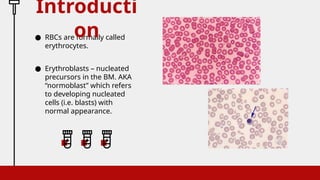
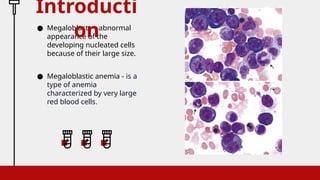
● RBCs are formally called
erythrocytes.
● Erythroblasts – nucleated
precursors in the BM. AKA
“normoblast” which refers
to developing nucleated
cells (i.e. blasts) with
normal appearance.
Introducti
on
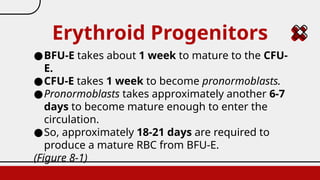
● Megaloblasts – abnormal
appearance of the
developing nucleated cells
because of their large size.
● Megaloblastic anemia - is a
type of anemia
characterized by very large
red blood cells.
Introducti
on
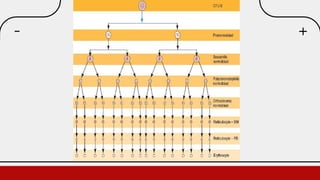
●BFU-E takes about 1 week to mature to the CFU-
E.
●CFU-E takes 1 week to become pronormoblasts.
●Pronormoblasts takes approximately another 6-7
days to become mature enough to enter the
circulation.
●So, approximately 18-21 days are required to
produce a mature RBC from BFU-E.
(Figure 8-1)
Erythroid Progenitors
● The stage of maturation of any blood cell is determined by
careful examination of nucleus and the cytoplasm.
● Important qualities in identification of RBCs are:
a. Nuclear chromatin pattern
b. Nuclear diameter
c. Nucleus : cytoplasm (N:C) ratio
d. Presence or absence of nucleoli
e. Cytoplasmic color
Maturation Process
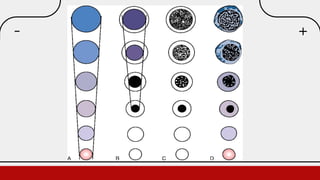
● As RBCs mature, several general trends affect their
appearance:
1. The overall diameter of the cell decreases.
2. The diameter of the nucleus decreases more rapidly than
does the size of the cell. As a result, N:C ratio also decreases.
3. The nuclear chromatin pattern becomes coarser, clumped,
and condensed.
4. Nucleoli disappear.
Maturation Process
Stage
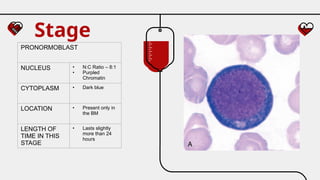
PRONORMOBLAST
NUCLEUS • N:C Ratio – 8:1
• Purpled
Chromatin
CYTOPLASM • Dark blue
LOCATION • Present only in
the BM
LENGTH OF
TIME IN THIS
STAGE
• Lasts slightly
more than 24
hours
Stage
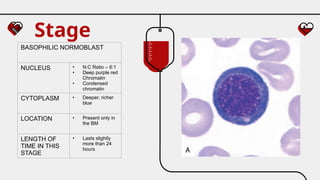
BASOPHILIC NORMOBLAST
NUCLEUS • N:C Ratio – 6:1
• Deep purple red
Chromatin
• Condensed
chromatin
CYTOPLASM • Deeper, richer
blue
LOCATION • Present only in
the BM
LENGTH OF
TIME IN THIS
STAGE
• Lasts slightly
more than 24
hours
Stage
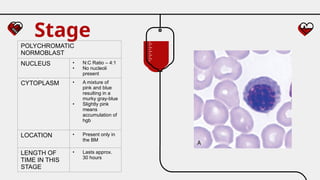
POLYCHROMATIC
NORMOBLAST
NUCLEUS • N:C Ratio – 4:1
• No nucleoli
present
CYTOPLASM • A mixture of
pink and blue
resulting in a
murky gray-blue
• Slightly pink
means
accumulation of
hgb
LOCATION • Present only in
the BM
LENGTH OF
TIME IN THIS
STAGE
• Lasts approx.
30 hours
Stage
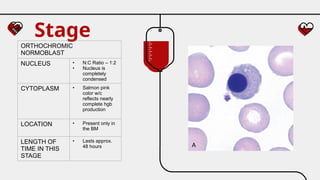
ORTHOCHROMIC
NORMOBLAST
NUCLEUS • N:C Ratio – 1:2
• Nucleus is
completely
condensed
CYTOPLASM • Salmon pink
color w/c
reflects nearly
complete hgb
production
LOCATION • Present only in
the BM
LENGTH OF
TIME IN THIS
STAGE
• Lasts approx.
48 hours
Stage
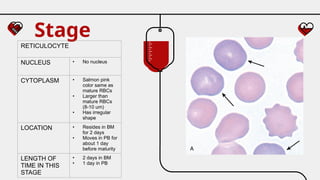
RETICULOCYTE
NUCLEUS • No nucleus
CYTOPLASM • Salmon pink
color same as
mature RBCs
• Larger than
mature RBCs
(8-10 um)
• Has irregular
shape
LOCATION • Resides in BM
for 2 days
• Moves in PB for
about 1 day
before maturity
LENGTH OF
TIME IN THIS
STAGE
• 2 days in BM
• 1 day in PB
Stage
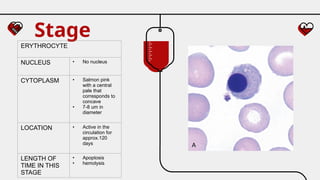
ERYTHROCYTE
NUCLEUS • No nucleus
CYTOPLASM • Salmon pink
with a central
pale that
corresponds to
concave
• 7-8 um in
diameter
LOCATION • Active in the
circulation for
approx.120
days
LENGTH OF
TIME IN THIS
STAGE
• Apoptosis
• hemolysis
CREDITS: This presentation template was created by Slidesgo,
including icons by Flaticon, infographics & images by Freepik
and illustrations by Stories
Please keep this slide for attribution.
Thanks!
Do you have any questions?
youremail@freepik.com
+91 620 421 838
yourcompany.com

A presentation in ERYTHROCYTE-MATURATION.pptx

  • 1.
  • 2.
    ● RBCs areformally called erythrocytes. ● Erythroblasts – nucleated precursors in the BM. AKA “normoblast” which refers to developing nucleated cells (i.e. blasts) with normal appearance. Introducti on
  • 3.
    ● Megaloblasts –abnormal appearance of the developing nucleated cells because of their large size. ● Megaloblastic anemia - is a type of anemia characterized by very large red blood cells. Introducti on
  • 4.
    ●BFU-E takes about1 week to mature to the CFU- E. ●CFU-E takes 1 week to become pronormoblasts. ●Pronormoblasts takes approximately another 6-7 days to become mature enough to enter the circulation. ●So, approximately 18-21 days are required to produce a mature RBC from BFU-E. (Figure 8-1) Erythroid Progenitors
  • 6.
    ● The stageof maturation of any blood cell is determined by careful examination of nucleus and the cytoplasm. ● Important qualities in identification of RBCs are: a. Nuclear chromatin pattern b. Nuclear diameter c. Nucleus : cytoplasm (N:C) ratio d. Presence or absence of nucleoli e. Cytoplasmic color Maturation Process
  • 8.
    ● As RBCsmature, several general trends affect their appearance: 1. The overall diameter of the cell decreases. 2. The diameter of the nucleus decreases more rapidly than does the size of the cell. As a result, N:C ratio also decreases. 3. The nuclear chromatin pattern becomes coarser, clumped, and condensed. 4. Nucleoli disappear. Maturation Process
  • 9.
    Stage PRONORMOBLAST NUCLEUS • N:CRatio – 8:1 • Purpled Chromatin CYTOPLASM • Dark blue LOCATION • Present only in the BM LENGTH OF TIME IN THIS STAGE • Lasts slightly more than 24 hours
  • 10.
    Stage BASOPHILIC NORMOBLAST NUCLEUS •N:C Ratio – 6:1 • Deep purple red Chromatin • Condensed chromatin CYTOPLASM • Deeper, richer blue LOCATION • Present only in the BM LENGTH OF TIME IN THIS STAGE • Lasts slightly more than 24 hours
  • 11.
    Stage POLYCHROMATIC NORMOBLAST NUCLEUS • N:CRatio – 4:1 • No nucleoli present CYTOPLASM • A mixture of pink and blue resulting in a murky gray-blue • Slightly pink means accumulation of hgb LOCATION • Present only in the BM LENGTH OF TIME IN THIS STAGE • Lasts approx. 30 hours
  • 12.
    Stage ORTHOCHROMIC NORMOBLAST NUCLEUS • N:CRatio – 1:2 • Nucleus is completely condensed CYTOPLASM • Salmon pink color w/c reflects nearly complete hgb production LOCATION • Present only in the BM LENGTH OF TIME IN THIS STAGE • Lasts approx. 48 hours
  • 13.
    Stage RETICULOCYTE NUCLEUS • Nonucleus CYTOPLASM • Salmon pink color same as mature RBCs • Larger than mature RBCs (8-10 um) • Has irregular shape LOCATION • Resides in BM for 2 days • Moves in PB for about 1 day before maturity LENGTH OF TIME IN THIS STAGE • 2 days in BM • 1 day in PB
  • 14.
    Stage ERYTHROCYTE NUCLEUS • Nonucleus CYTOPLASM • Salmon pink with a central pale that corresponds to concave • 7-8 um in diameter LOCATION • Active in the circulation for approx.120 days LENGTH OF TIME IN THIS STAGE • Apoptosis • hemolysis
  • 15.
    CREDITS: This presentationtemplate was created by Slidesgo, including icons by Flaticon, infographics & images by Freepik and illustrations by Stories Please keep this slide for attribution. Thanks! Do you have any questions? youremail@freepik.com +91 620 421 838 yourcompany.com