A PARADIGM SHIFTA PARADIGM SHIFT
Prof. K. Jeyakumar, M.E., Ph.D.,
SCAD Group of Institutions
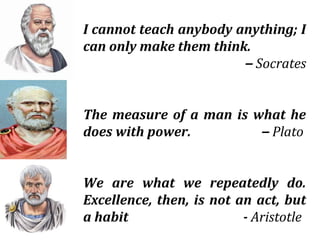
I cannot teach anybody anything; I
can only make them think.
– Socrates
The measure of a man is what he
does with power. – Plato
We are what we repeatedly do.
Excellence, then, is not an act, but
a habit - Aristotle
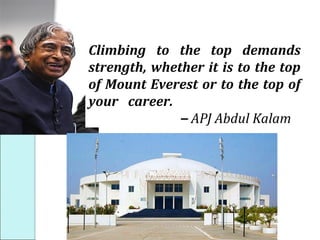
Climbing to the top demands
strength, whether it is to the top
of Mount Everest or to the top of
your career.
– APJ Abdul Kalam
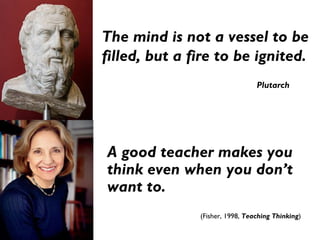
A good teacher makes you
think even when you don’t
want to.
(Fisher, 1998, Teaching Thinking)
The mind is not a vessel to be
filled, but a fire to be ignited.
Plutarch
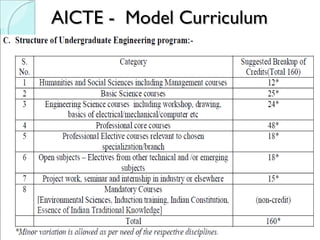
AICTE - Model CurriculumAICTE - Model Curriculum
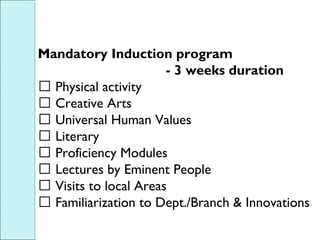
Mandatory Induction program
- 3 weeks duration
 Physical activity
 Creative Arts
 Universal Human Values
 Literary
 Proficiency Modules
 Lectures by Eminent People
 Visits to local Areas
 Familiarization to Dept./Branch & Innovations
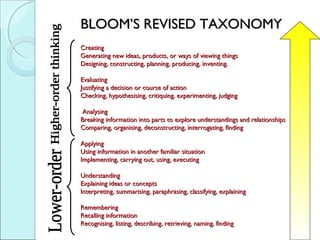
BLOOM’S REVISED TAXONOMYBLOOM’S REVISED TAXONOMY
CreatingCreating
Generating new ideas, products, or ways of viewing thingsGenerating new ideas, products, or ways of viewing things
Designing, constructing, planning, producing, inventing.Designing, constructing, planning, producing, inventing.
  
EvaluatingEvaluating
Justifying a decision or course of actionJustifying a decision or course of action
Checking, hypothesising, critiquing, experimenting, judgingChecking, hypothesising, critiquing, experimenting, judging
  
 Analysing Analysing
Breaking information into parts to explore understandings and relationshipsBreaking information into parts to explore understandings and relationships
Comparing, organising, deconstructing, interrogating, findingComparing, organising, deconstructing, interrogating, finding
  
ApplyingApplying
Using information in another familiar situationUsing information in another familiar situation
Implementing, carrying out, using, executingImplementing, carrying out, using, executing
  
UnderstandingUnderstanding
Explaining ideas or conceptsExplaining ideas or concepts
Interpreting, summarising, paraphrasing, classifying, explainingInterpreting, summarising, paraphrasing, classifying, explaining
  
RememberingRemembering
Recalling informationRecalling information
Recognising, listing, describing, retrieving, naming, findingRecognising, listing, describing, retrieving, naming, finding
  
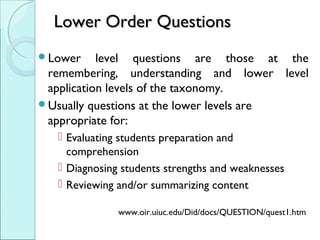
Lower Order QuestionsLower Order Questions
Lower level questions are those at the
remembering, understanding and lower level
application levels of the taxonomy.
Usually questions at the lower levels are
appropriate for:
 Evaluating students preparation and
comprehension
 Diagnosing students strengths and weaknesses
 Reviewing and/or summarizing content
www.oir.uiuc.edu/Did/docs/QUESTION/quest1.htm
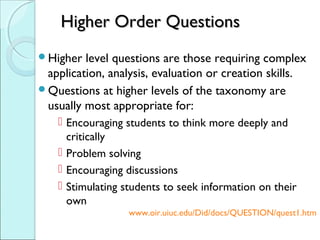
Higher Order QuestionsHigher Order Questions
Higher level questions are those requiring complex
application, analysis, evaluation or creation skills.
Questions at higher levels of the taxonomy are
usually most appropriate for:
 Encouraging students to think more deeply and
critically
 Problem solving
 Encouraging discussions
 Stimulating students to seek information on their
own
www.oir.uiuc.edu/Did/docs/QUESTION/quest1.htm
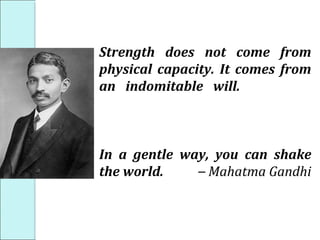
Strength does not come from
physical capacity. It comes from
an indomitable will.
In a gentle way, you can shake
the world. – Mahatma Gandhi
Technology is just a tool. In
terms of getting the kids
working together and
motivating them, the
teacher is the most
important.
– Bill Gates
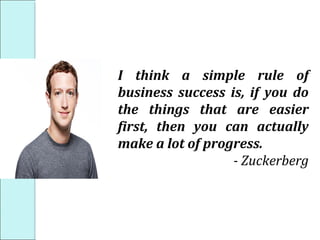
I think a simple rule of
business success is, if you do
the things that are easier
first, then you can actually
make a lot of progress.
- Zuckerberg
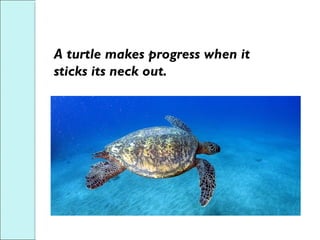
A turtle makes progress when it
sticks its neck out.
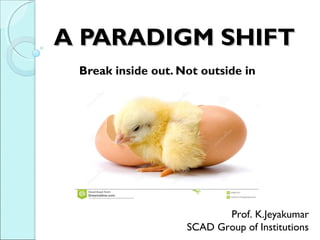
A PARADIGM SHIFTA PARADIGM SHIFT
Break inside out. Not outside in
Prof. K.Jeyakumar
SCAD Group of Institutions

A Paradigm Shift

  • 1.
    A PARADIGM SHIFTAPARADIGM SHIFT Prof. K. Jeyakumar, M.E., Ph.D., SCAD Group of Institutions
  • 2.
    I cannot teachanybody anything; I can only make them think. – Socrates The measure of a man is what he does with power. – Plato We are what we repeatedly do. Excellence, then, is not an act, but a habit - Aristotle
  • 7.
    Climbing to thetop demands strength, whether it is to the top of Mount Everest or to the top of your career. – APJ Abdul Kalam
  • 9.
    A good teachermakes you think even when you don’t want to. (Fisher, 1998, Teaching Thinking) The mind is not a vessel to be filled, but a fire to be ignited. Plutarch
  • 10.
    AICTE - ModelCurriculumAICTE - Model Curriculum
  • 11.
    Mandatory Induction program -3 weeks duration  Physical activity  Creative Arts  Universal Human Values  Literary  Proficiency Modules  Lectures by Eminent People  Visits to local Areas  Familiarization to Dept./Branch & Innovations
  • 12.
    BLOOM’S REVISED TAXONOMYBLOOM’SREVISED TAXONOMY CreatingCreating Generating new ideas, products, or ways of viewing thingsGenerating new ideas, products, or ways of viewing things Designing, constructing, planning, producing, inventing.Designing, constructing, planning, producing, inventing.    EvaluatingEvaluating Justifying a decision or course of actionJustifying a decision or course of action Checking, hypothesising, critiquing, experimenting, judgingChecking, hypothesising, critiquing, experimenting, judging     Analysing Analysing Breaking information into parts to explore understandings and relationshipsBreaking information into parts to explore understandings and relationships Comparing, organising, deconstructing, interrogating, findingComparing, organising, deconstructing, interrogating, finding    ApplyingApplying Using information in another familiar situationUsing information in another familiar situation Implementing, carrying out, using, executingImplementing, carrying out, using, executing    UnderstandingUnderstanding Explaining ideas or conceptsExplaining ideas or concepts Interpreting, summarising, paraphrasing, classifying, explainingInterpreting, summarising, paraphrasing, classifying, explaining    RememberingRemembering Recalling informationRecalling information Recognising, listing, describing, retrieving, naming, findingRecognising, listing, describing, retrieving, naming, finding   
  • 13.
    Lower Order QuestionsLowerOrder Questions Lower level questions are those at the remembering, understanding and lower level application levels of the taxonomy. Usually questions at the lower levels are appropriate for:  Evaluating students preparation and comprehension  Diagnosing students strengths and weaknesses  Reviewing and/or summarizing content www.oir.uiuc.edu/Did/docs/QUESTION/quest1.htm
  • 14.
    Higher Order QuestionsHigherOrder Questions Higher level questions are those requiring complex application, analysis, evaluation or creation skills. Questions at higher levels of the taxonomy are usually most appropriate for:  Encouraging students to think more deeply and critically  Problem solving  Encouraging discussions  Stimulating students to seek information on their own www.oir.uiuc.edu/Did/docs/QUESTION/quest1.htm
  • 16.
    Strength does notcome from physical capacity. It comes from an indomitable will. In a gentle way, you can shake the world. – Mahatma Gandhi
  • 17.
    Technology is justa tool. In terms of getting the kids working together and motivating them, the teacher is the most important. – Bill Gates
  • 18.
    I think asimple rule of business success is, if you do the things that are easier first, then you can actually make a lot of progress. - Zuckerberg
  • 19.
    A turtle makesprogress when it sticks its neck out.
  • 20.
    A PARADIGM SHIFTAPARADIGM SHIFT Break inside out. Not outside in Prof. K.Jeyakumar SCAD Group of Institutions