HOW TO OVERCOME THE
CHALLENGE OF DEVELOPING HIGHER
ORDER THINKING SKILLS
BY
Dr.Ami Rathore
Assistant Professor
LMTT College Dabok
Udaipur (Raj)
The mind is noT aThe mind is noT a
vesselvessel
To be filled,To be filled,
buT a fire To bebuT a fire To be
igniTedigniTed
Lower-Order
Thinking
Higher-Order
Thinking
Bloom’s Revised Taxonomy
 Taxonomy of Cognitive
Objectives.
 1950’s- developed by
Benjamin Bloom.
 Means of qualitatively
expressing different
kinds of thinking.
 Adapted for classroom
use as a planning tool.
 Continues to be one of
the most universally
applied models.
 Provides a way to
organize thinking skills
into six levels, from
the most basic to the
higher order levels of
thinking.
 1990’s- Lorin
Anderson (former
student of Bloom)
revisited the
taxonomy.
 As a result, a number
of changes were made.
Change in Terms
 The names of six major categories were changed from
noun to verb forms.
 Bloom’s Taxonomy reflects different forms of thinking, and
because thinking is an active process, verbs presented a
more accurate representation of the six categories.
 Subcategories of the six major categories were also
replaced by verbs, and some subcategories were
reorganized and renamed.
 The knowledge category was renamed. Knowledge is a
product of thinking and was inappropriate to describe the
category of thinking, therefore, it was replaced with the
word remembering.
 Comprehension became understanding and synthesis was
renamed creating in order to better reflect the nature of
the thinking skills described by each category.
Original Terms New Terms
Evaluation
Synthesis
Analysis
Application
Comprehension
Knowledge
Creating
Evaluating
Analyzing
Applying
Understanding
Remembering
(Based on Pohl, 2000, Learning to Think, Thinking to Learn, p. 8)
STRATERGIES TO BE
APPLIED IN
CLASSROOMS
ALIGN LEARNING GOALS , OBjECTIvES,
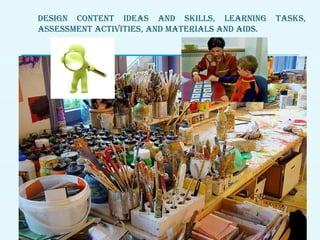
DESIGN CONTENT IDEAS AND SkILLS, LEARNING TASkS,
ASSESSMENT ACTIvITIES, AND MATERIALS AND AIDS.
PREPARE A TASk ANALySIS Of ThE ThINkING SkILL TO BE LEARNED:
IDENTIfy ThE PARTICuLAR ThINkING SkILL TO BE LEARNED, ThE
PREREquISITE kNOwLEDGE AND SkILLS, ThE SEquENCE Of RELATED SuB
SkILLS, AND ThE READINESS Of STuDENTS TO LEARN
PREPARE
SAMPLE
PROBLEMS,
ExAMPLES, AND
ExPLANATIONS.
PrePare
questions that
go beyond
simPle recall
of factual
information to
focus on
advanced
levels of
comPrehension
, such as how?
why? and how
well?
Plan strategies for diagnosis, guidance, Practice,
and remediation.
convey
enthusiasm,
genuine interest in
a toPic, warmth,
and with thorough
PreParation and
organization,
minimal transition
time between
activities, clear
exPectations, and
a comfortable,
nonthreatening
atmosPhere.
introduce tasks with a clear and simPle organizing
framework such as a diagram, chart, Preview, or one
ParagraPh overview.
exPress
briefly what
will be
learned, why
it is imPortant,
when it will be
useful, and
how it should
be aPPlied.
use visual
disPlays to
organize
information—
networks,
hierarchies,
schematic
diagrams, and
matrices show
relationshiPs
among ideas
or concePts
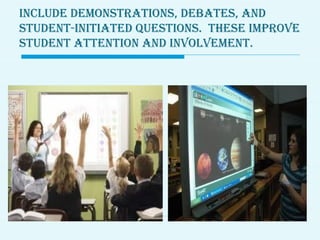
Include demonstratIons, debates, and
student-InItIated questIons. these Improve
student attentIon and Involvement.
are we ready for this?are we ready for this?
THANK YOU

Higher order thinking skills

  • 2.
    HOW TO OVERCOMETHE CHALLENGE OF DEVELOPING HIGHER ORDER THINKING SKILLS BY Dr.Ami Rathore Assistant Professor LMTT College Dabok Udaipur (Raj)
  • 3.
    The mind isnoT aThe mind is noT a vesselvessel To be filled,To be filled, buT a fire To bebuT a fire To be igniTedigniTed
  • 4.
  • 5.
    Bloom’s Revised Taxonomy Taxonomy of Cognitive Objectives.  1950’s- developed by Benjamin Bloom.  Means of qualitatively expressing different kinds of thinking.  Adapted for classroom use as a planning tool.  Continues to be one of the most universally applied models.  Provides a way to organize thinking skills into six levels, from the most basic to the higher order levels of thinking.  1990’s- Lorin Anderson (former student of Bloom) revisited the taxonomy.  As a result, a number of changes were made.
  • 6.
    Change in Terms The names of six major categories were changed from noun to verb forms.  Bloom’s Taxonomy reflects different forms of thinking, and because thinking is an active process, verbs presented a more accurate representation of the six categories.  Subcategories of the six major categories were also replaced by verbs, and some subcategories were reorganized and renamed.  The knowledge category was renamed. Knowledge is a product of thinking and was inappropriate to describe the category of thinking, therefore, it was replaced with the word remembering.  Comprehension became understanding and synthesis was renamed creating in order to better reflect the nature of the thinking skills described by each category.
  • 7.
    Original Terms NewTerms Evaluation Synthesis Analysis Application Comprehension Knowledge Creating Evaluating Analyzing Applying Understanding Remembering (Based on Pohl, 2000, Learning to Think, Thinking to Learn, p. 8)
  • 8.
  • 9.
    ALIGN LEARNING GOALS, OBjECTIvES,
  • 10.
    DESIGN CONTENT IDEASAND SkILLS, LEARNING TASkS, ASSESSMENT ACTIvITIES, AND MATERIALS AND AIDS.
  • 11.
    PREPARE A TASkANALySIS Of ThE ThINkING SkILL TO BE LEARNED: IDENTIfy ThE PARTICuLAR ThINkING SkILL TO BE LEARNED, ThE PREREquISITE kNOwLEDGE AND SkILLS, ThE SEquENCE Of RELATED SuB SkILLS, AND ThE READINESS Of STuDENTS TO LEARN
  • 12.
  • 13.
    PrePare questions that go beyond simPlerecall of factual information to focus on advanced levels of comPrehension , such as how? why? and how well?
  • 14.
    Plan strategies fordiagnosis, guidance, Practice, and remediation.
  • 15.
    convey enthusiasm, genuine interest in atoPic, warmth, and with thorough PreParation and organization, minimal transition time between activities, clear exPectations, and a comfortable, nonthreatening atmosPhere.
  • 16.
    introduce tasks witha clear and simPle organizing framework such as a diagram, chart, Preview, or one ParagraPh overview.
  • 17.
    exPress briefly what will be learned,why it is imPortant, when it will be useful, and how it should be aPPlied.
  • 18.
  • 19.
    Include demonstratIons, debates,and student-InItIated questIons. these Improve student attentIon and Involvement.
  • 20.
    are we readyfor this?are we ready for this?
  • 21.