Creating Value through
the Sales Force
Vassilis Engonopoulos
Fani Petraki
Vassilis Kassimatis
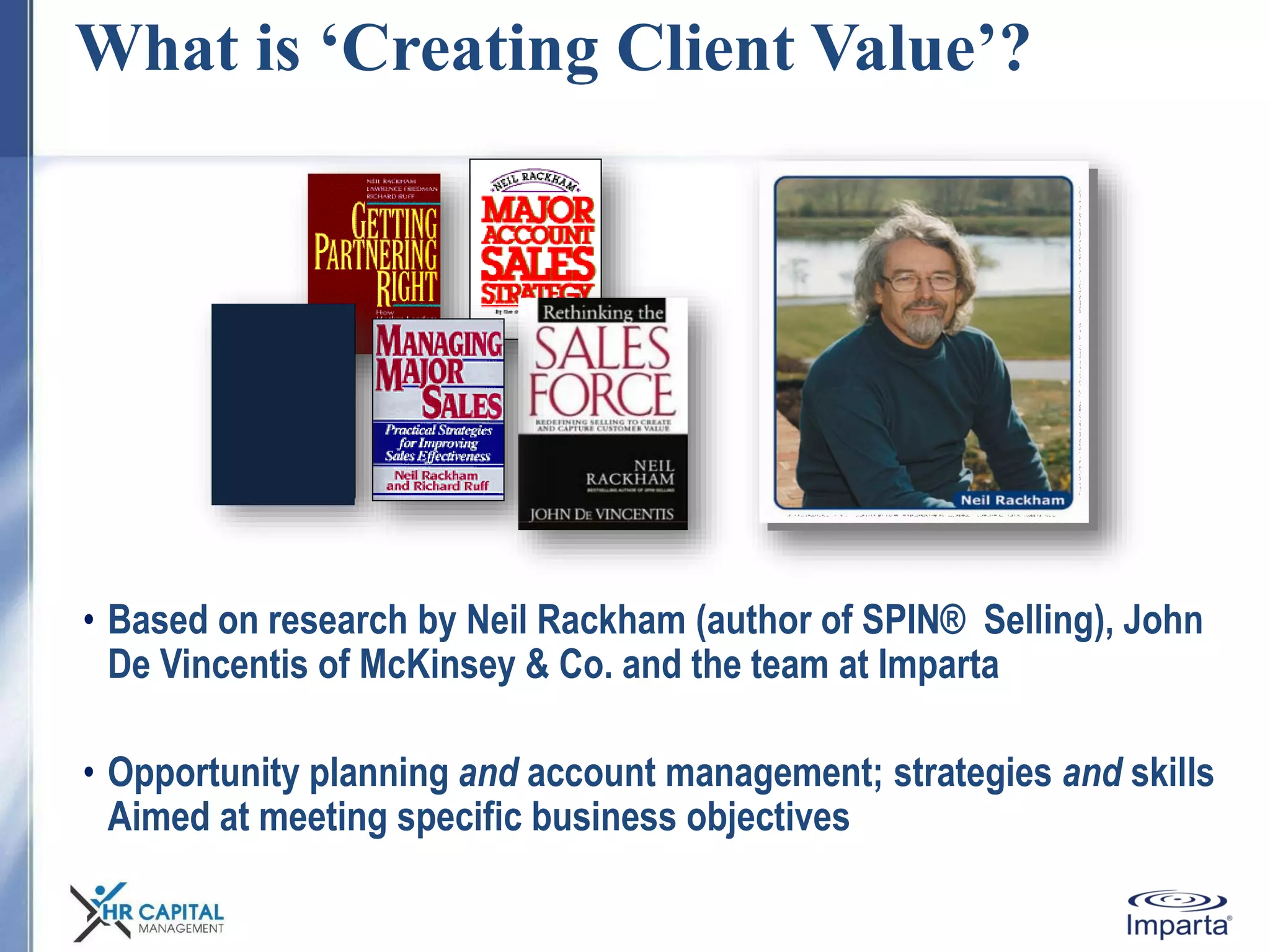
• Based on research by Neil Rackham (author of SPIN® Selling), John
De Vincentis of McKinsey & Co. and the team at Imparta
• Opportunity planning and account management; strategies and skills
Aimed at meeting specific business objectives
What is ‘Creating Client Value’?
What’s the purpose
of a sales force?
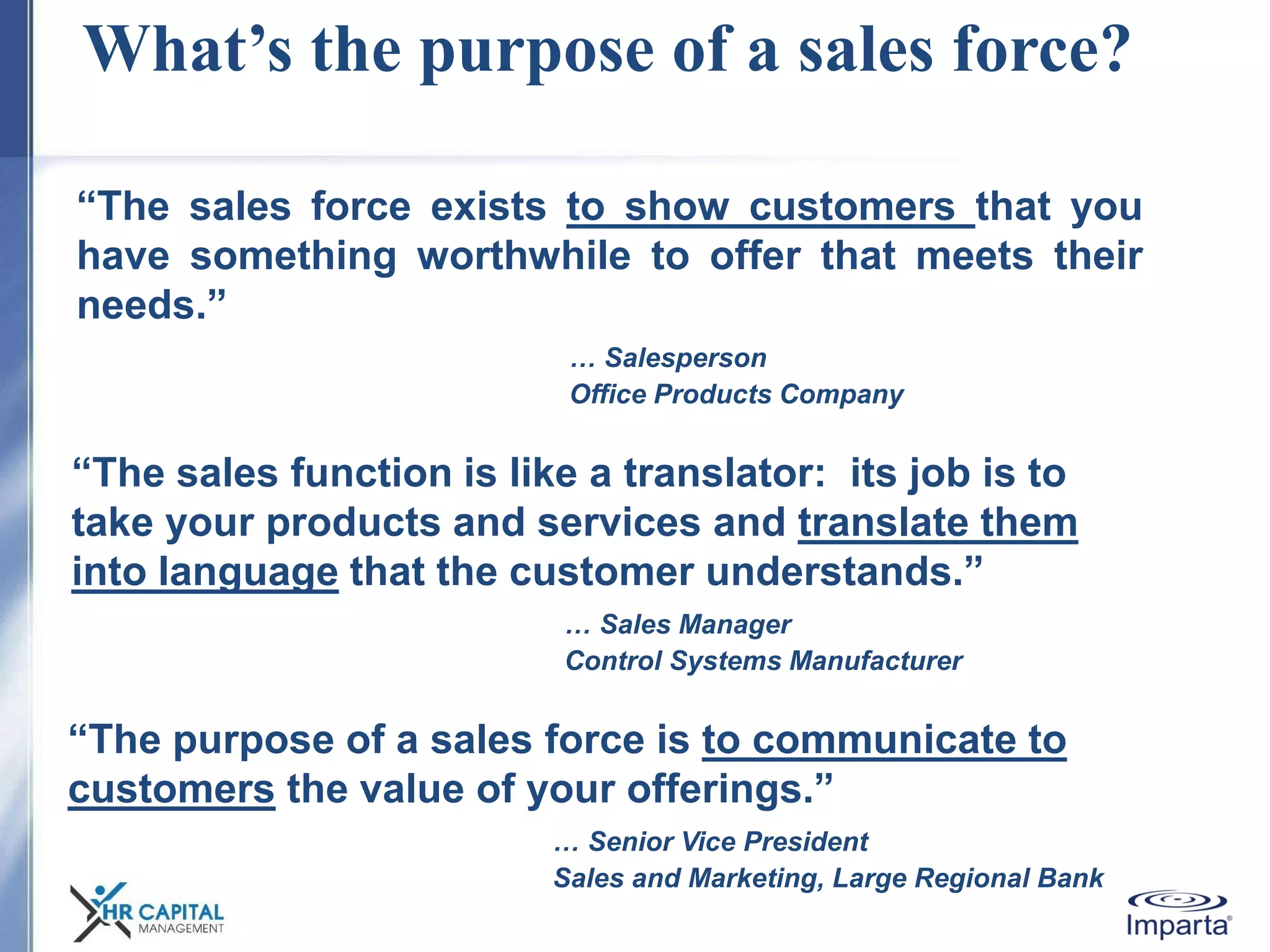
What’s the purpose of a sales force?
“The reason for a sales force is to ensure that the
customer has the right information about the
advantages of your products at the right time, so that
the purchasing decision is influenced in your favor.”
… Regional Sales Manager
Printing Equipment Company
“The sales force convinces the client to buy from you
rather than from a competitor by showing how your
services are superior.”
… Senior Consultant
Systems Integration and Software Company
What’s the purpose of a sales force?
“The sales force exists to show customers that you
have something worthwhile to offer that meets their
needs.”
… Salesperson
Office Products Company
“The sales function is like a translator: its job is to
take your products and services and translate them
into language that the customer understands.”
… Sales Manager
Control Systems Manufacturer
“The purpose of a sales force is to communicate to
customers the value of your offerings.”
… Senior Vice President
Sales and Marketing, Large Regional Bank
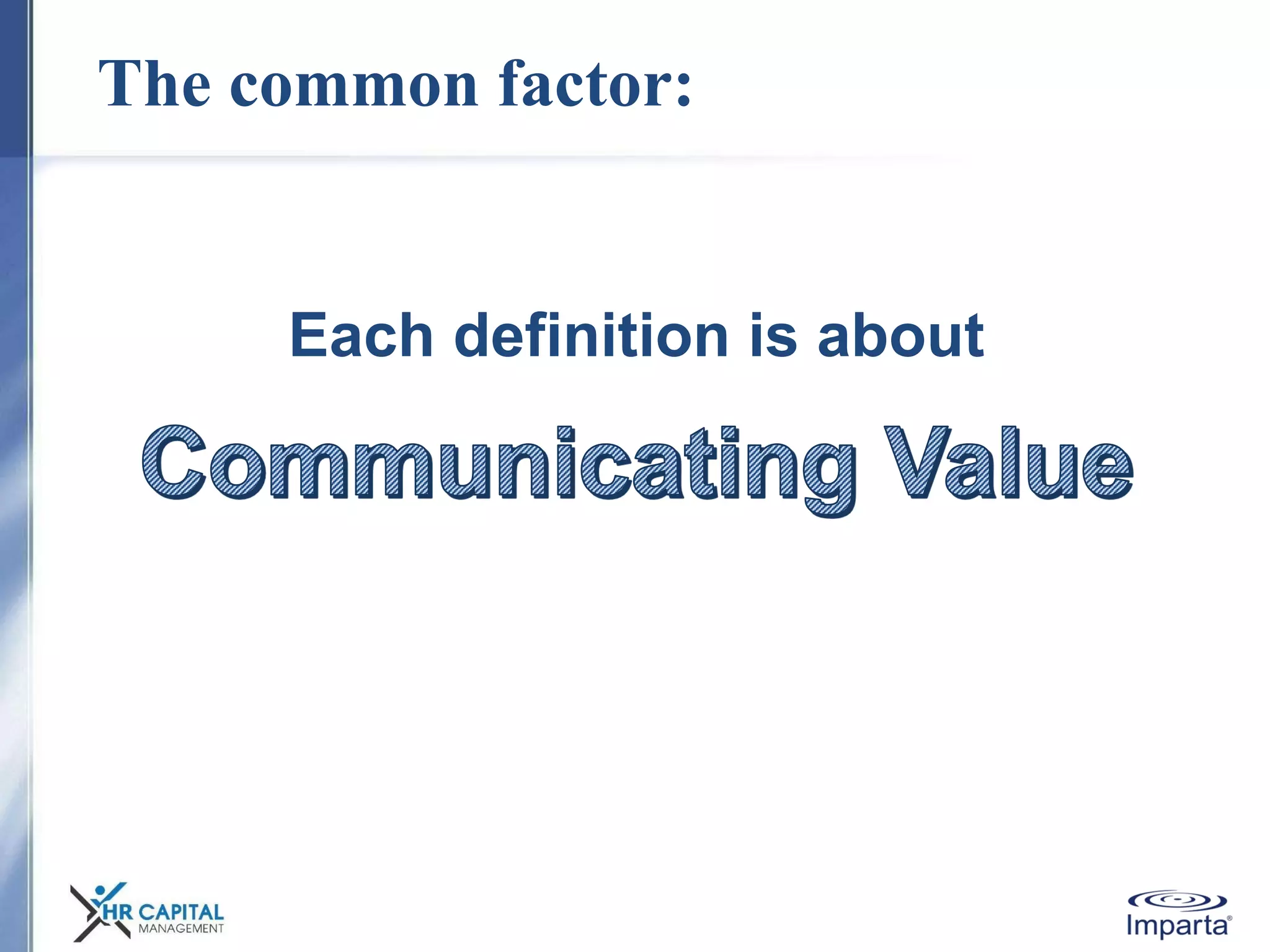
The common factor:
Each definition is about
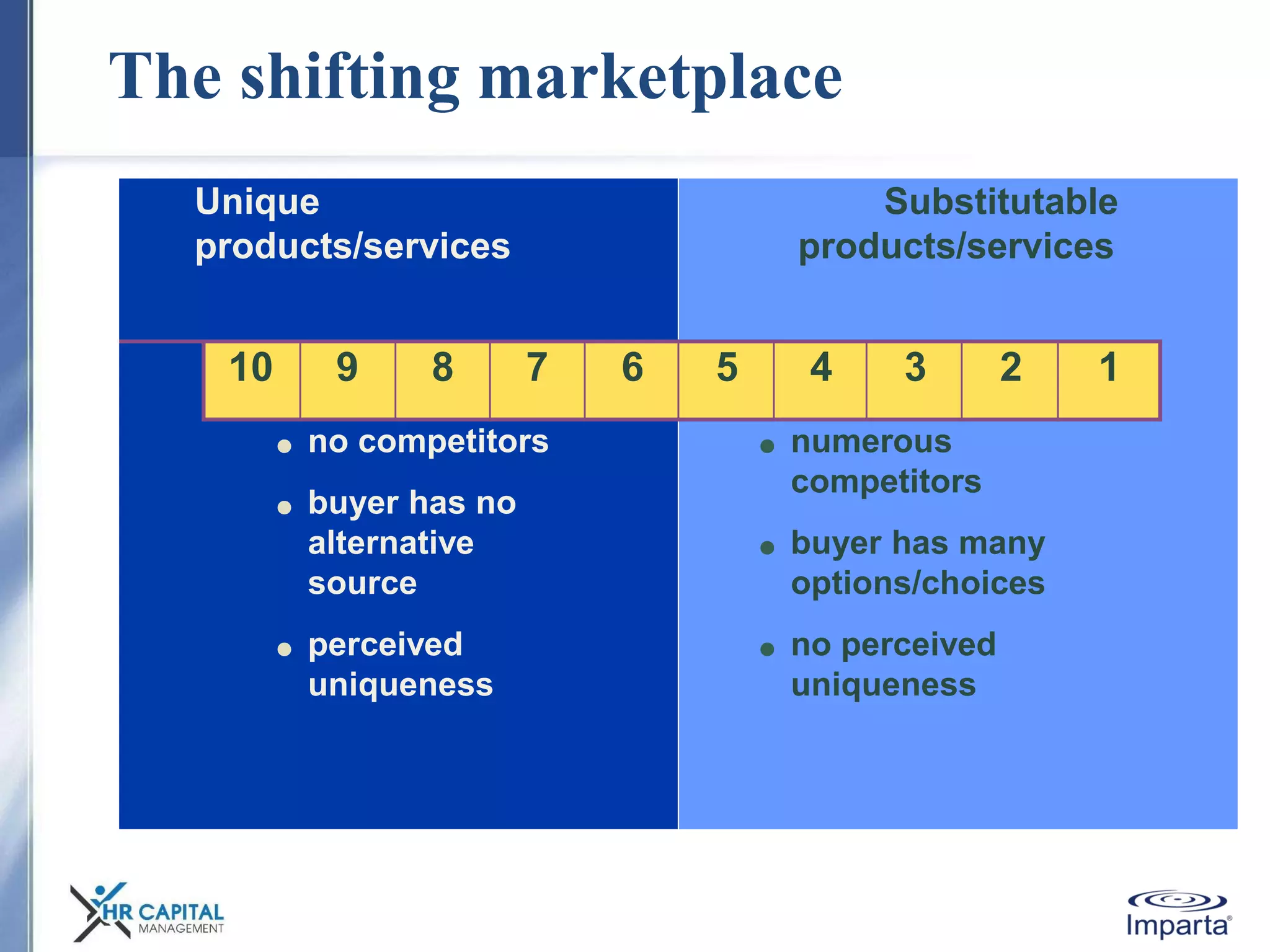
The shifting marketplace
Unique
products/services
Substitutable
products/services
10 9 8 7 6 5 4 3 2 1
● no competitors
● buyer has no
alternative
source
● perceived
uniqueness
● numerous
competitors
● buyer has many
options/choices
● no perceived
uniqueness
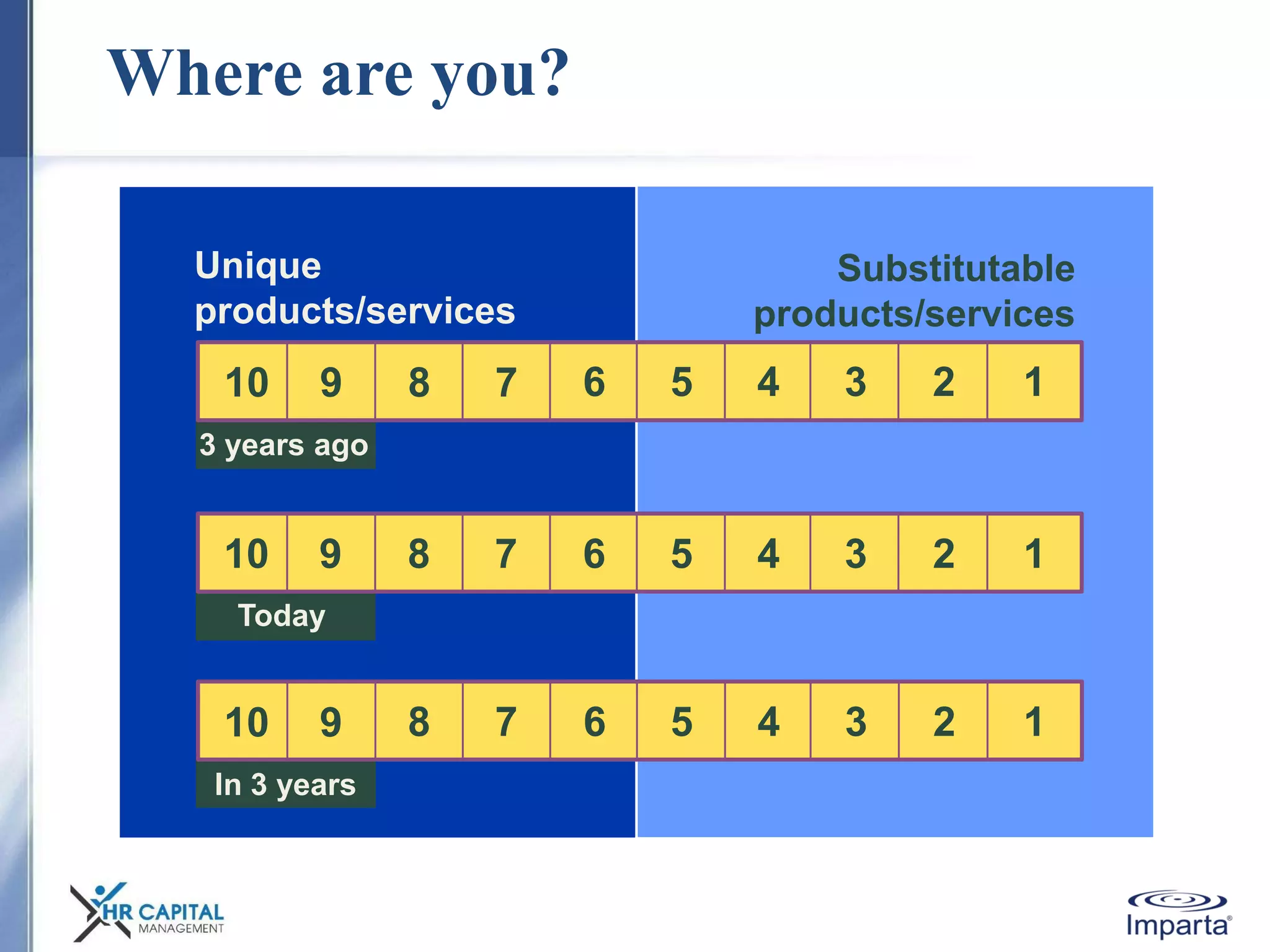
Where are you?
Today
10 9
In 3 years
Unique
products/services
10 9 8 7
3 years ago
Substitutable
products/services
6 5 4 3 2 1
10 9 8 7 6 5 4 3 2 1
8 7 6 5 4 3 2 1
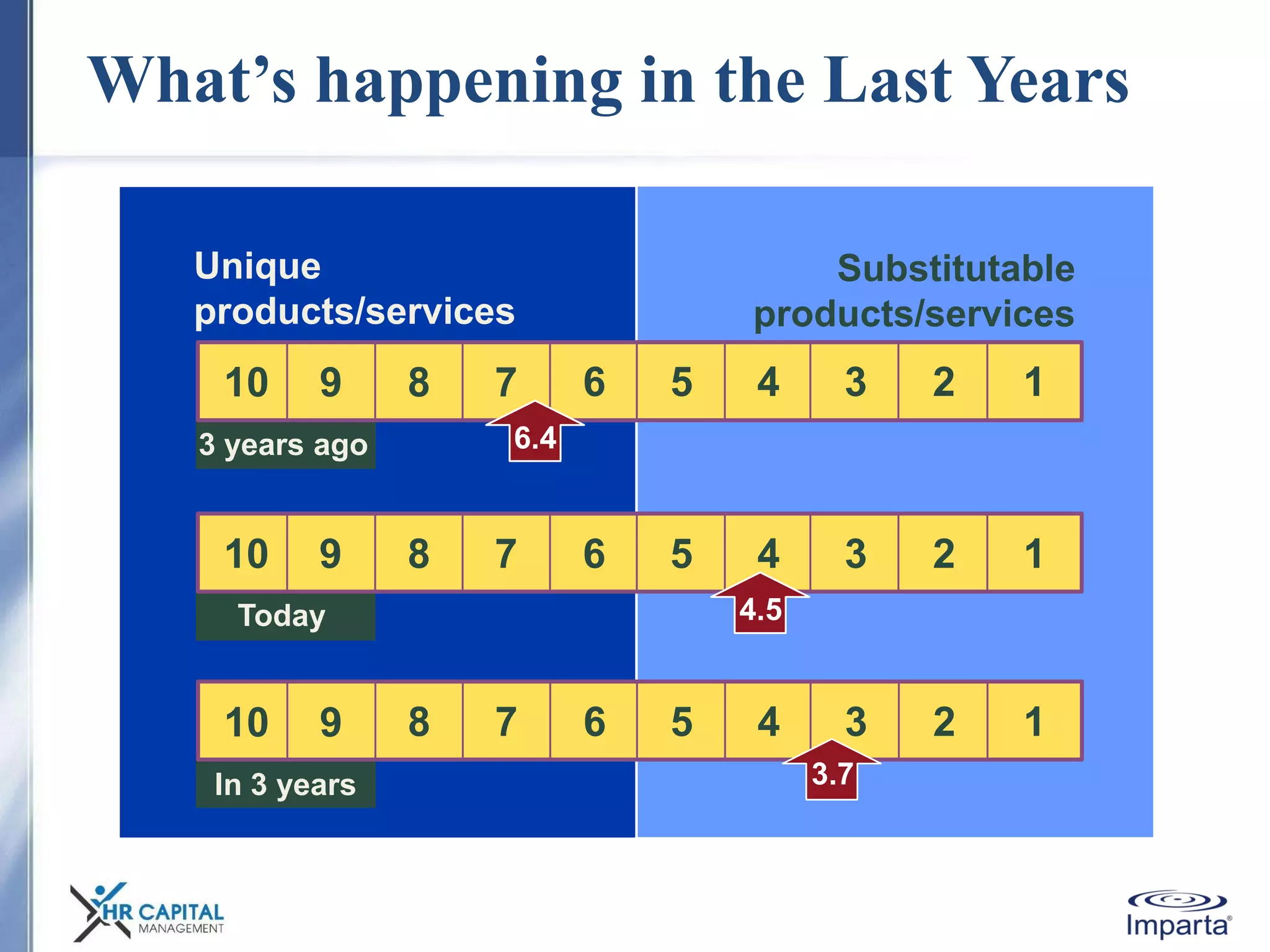
What’s happening in the Last Years
Today
10 9
In 3 years
10 9 8 7
3 years ago 6.4
Substitutable
products/services
6 5 4 3 2 1
Unique
products/services
10 9 8 7 6 5 4 3 2 1
8 7 6 5 4 3 2 1
4.5
3.7
SSI Data: 47 corporations 773
sales
executives
Why are products and
services in most markets
becoming less unique?
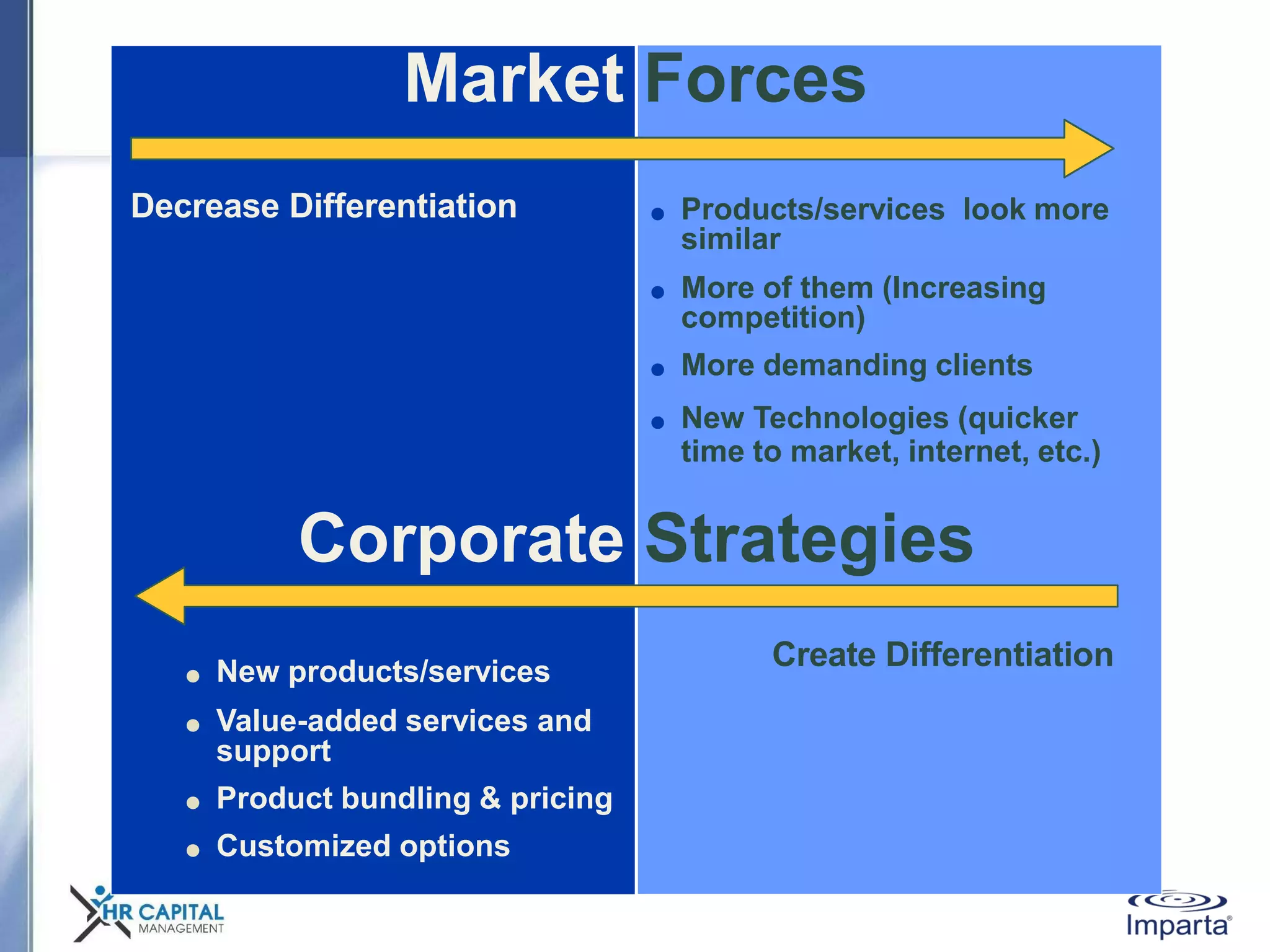
● New products/services
● Value-added services and
support
● Product bundling & pricing
● Customized options
Create Differentiation
Market Forces
Corporate Strategies
Decrease Differentiation ● Products/services look more
similar
● More of them (Increasing
competition)
● More demanding clients
● New Technologies (quicker
time to market, internet, etc.)
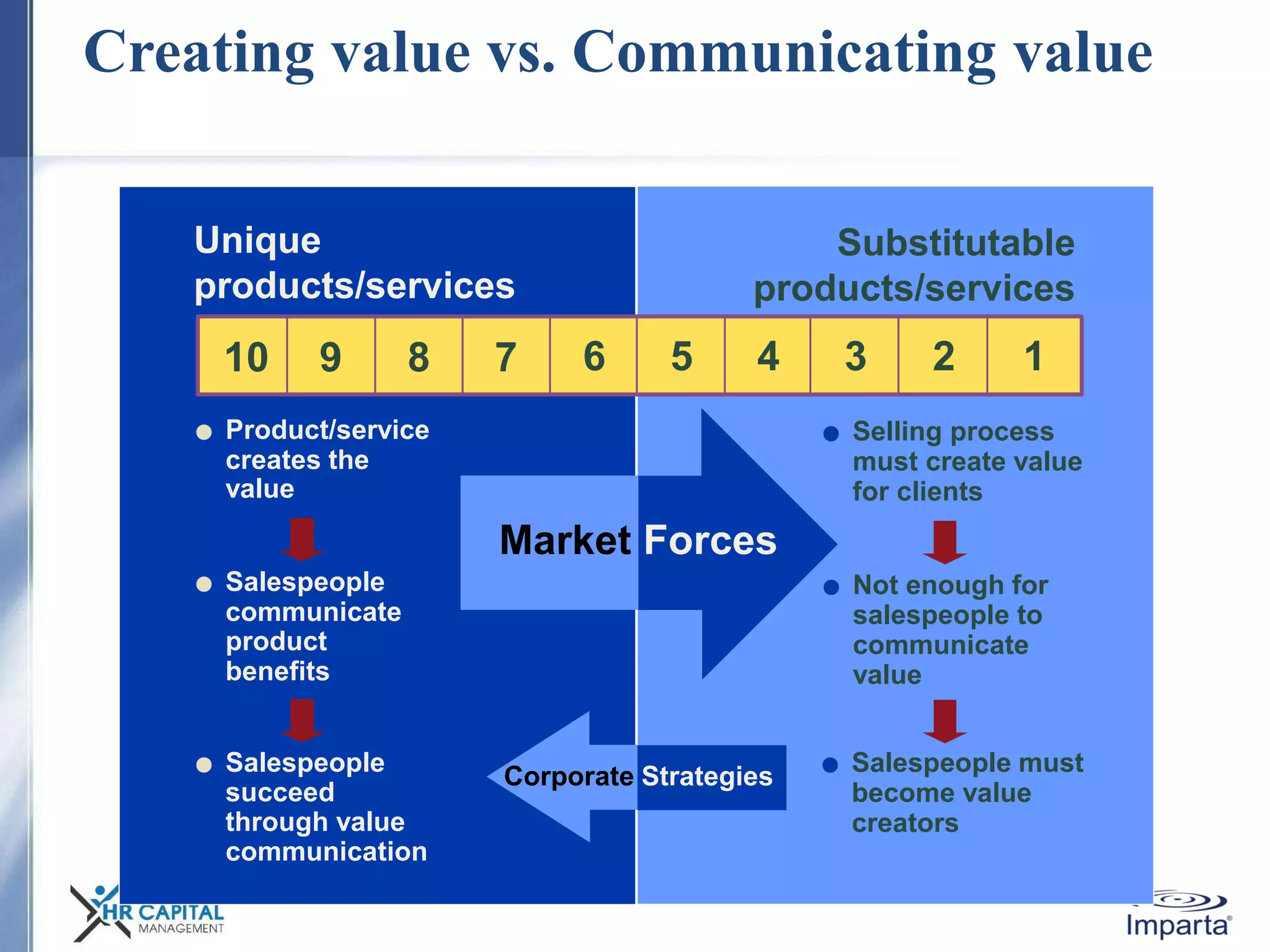
Creating value vs. Communicating value
● Selling process
must create value
for clients
● Not enough for
salespeople to
communicate
value
● Salespeople must
become value
creators
Market Forces
● Product/service
creates the
value
● Salespeople
communicate
product
benefits
● Salespeople
succeed
through value
communication
Corporate Strategies
Substitutable
products/services
6 5 4 3 2 1
Unique
products/services
10 9 8 7
…and customers are changing too.
What’s the biggest difference in
how major customers behave
today compared with 3 years
ago?
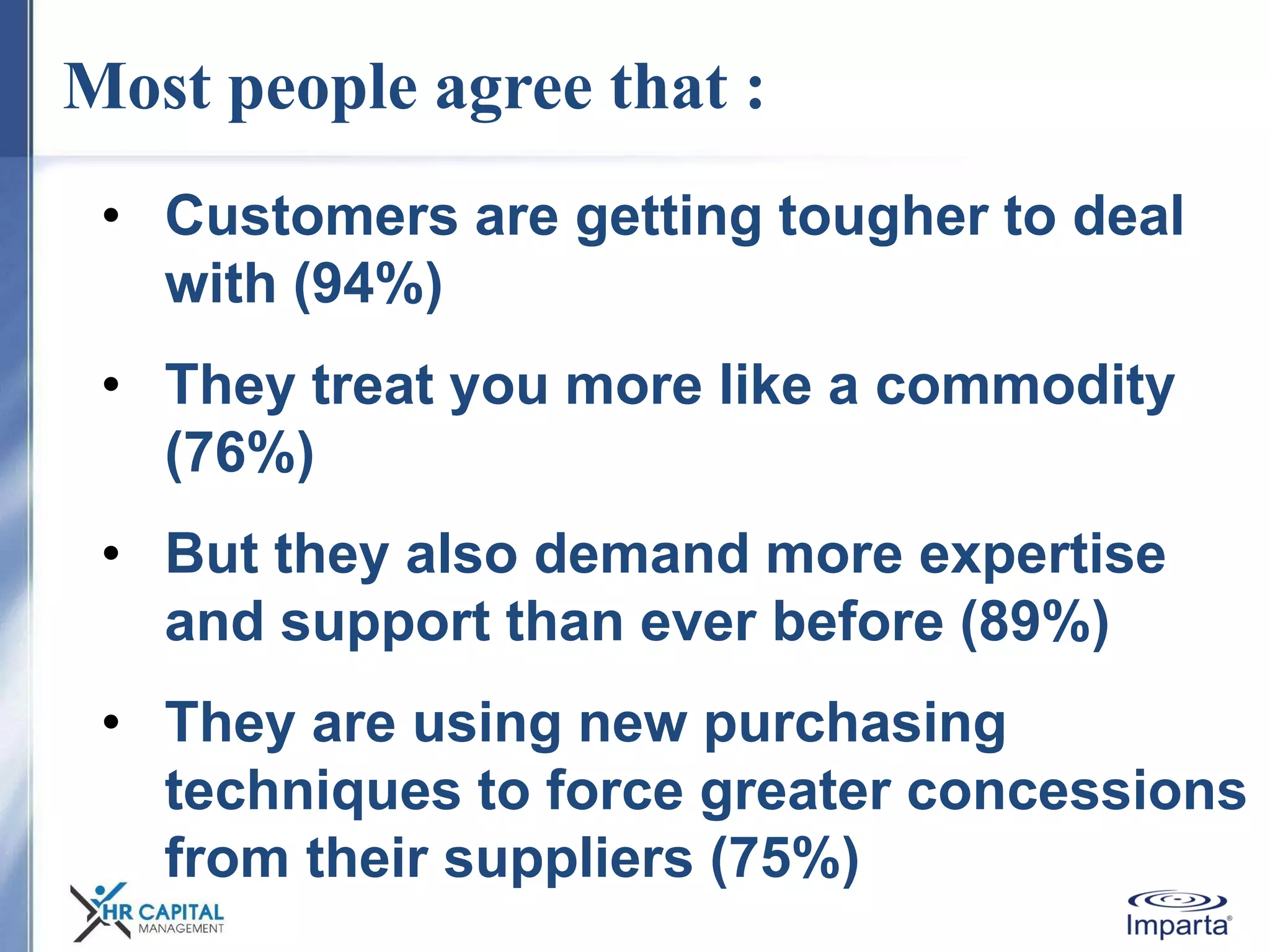
Most people agree that :
• Customers are getting tougher to deal
with (94%)
• They treat you more like a commodity
(76%)
• But they also demand more expertise
and support than ever before (89%)
• They are using new purchasing
techniques to force greater concessions
from their suppliers (75%)
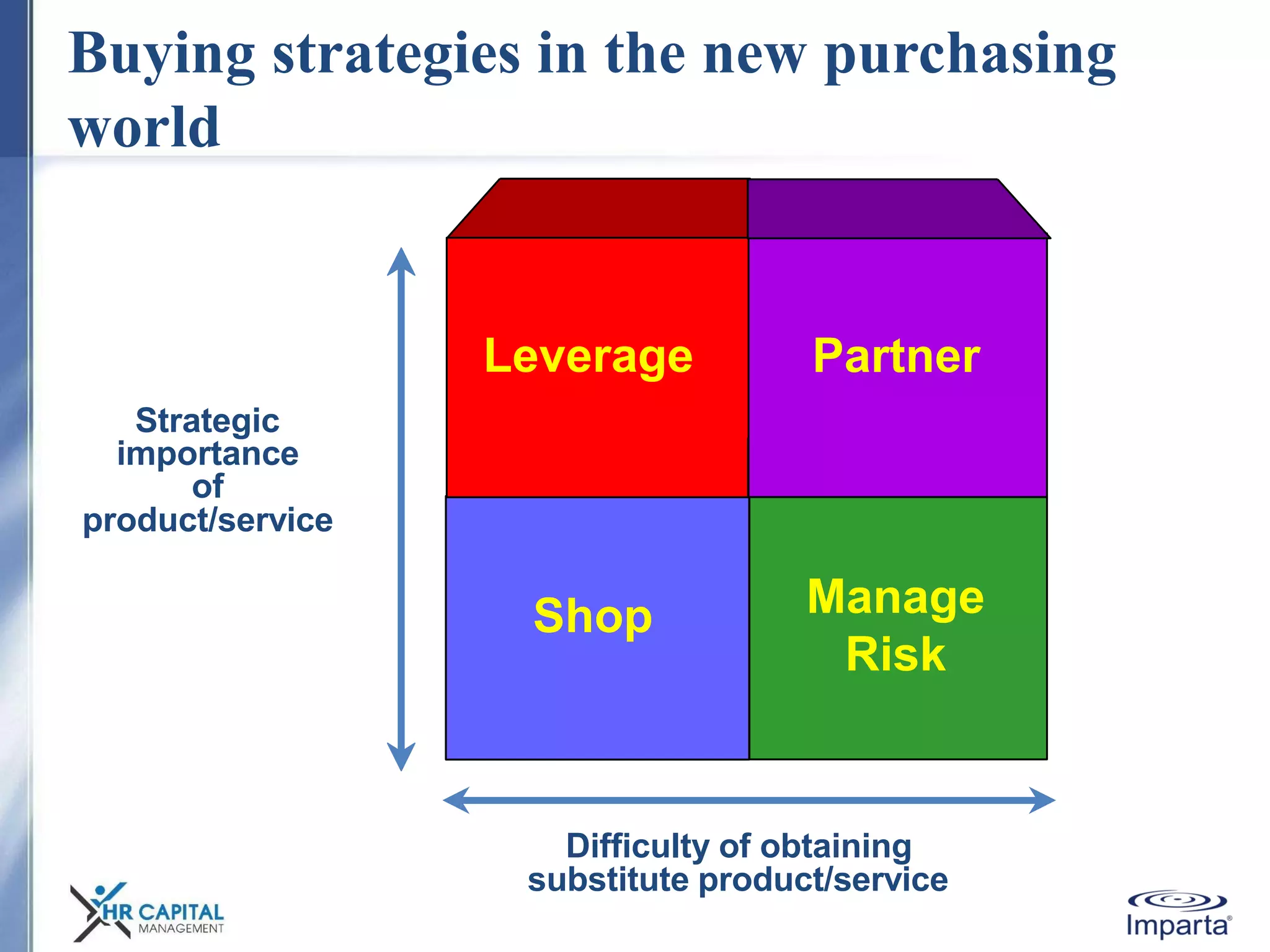
Buying strategies in the new purchasing
world
Difficulty of obtaining
substitute product/service
Strategic
importance
of
product/service
high
low high
Shop
Leverage
Manage
Risk
Partner
Define “Value”
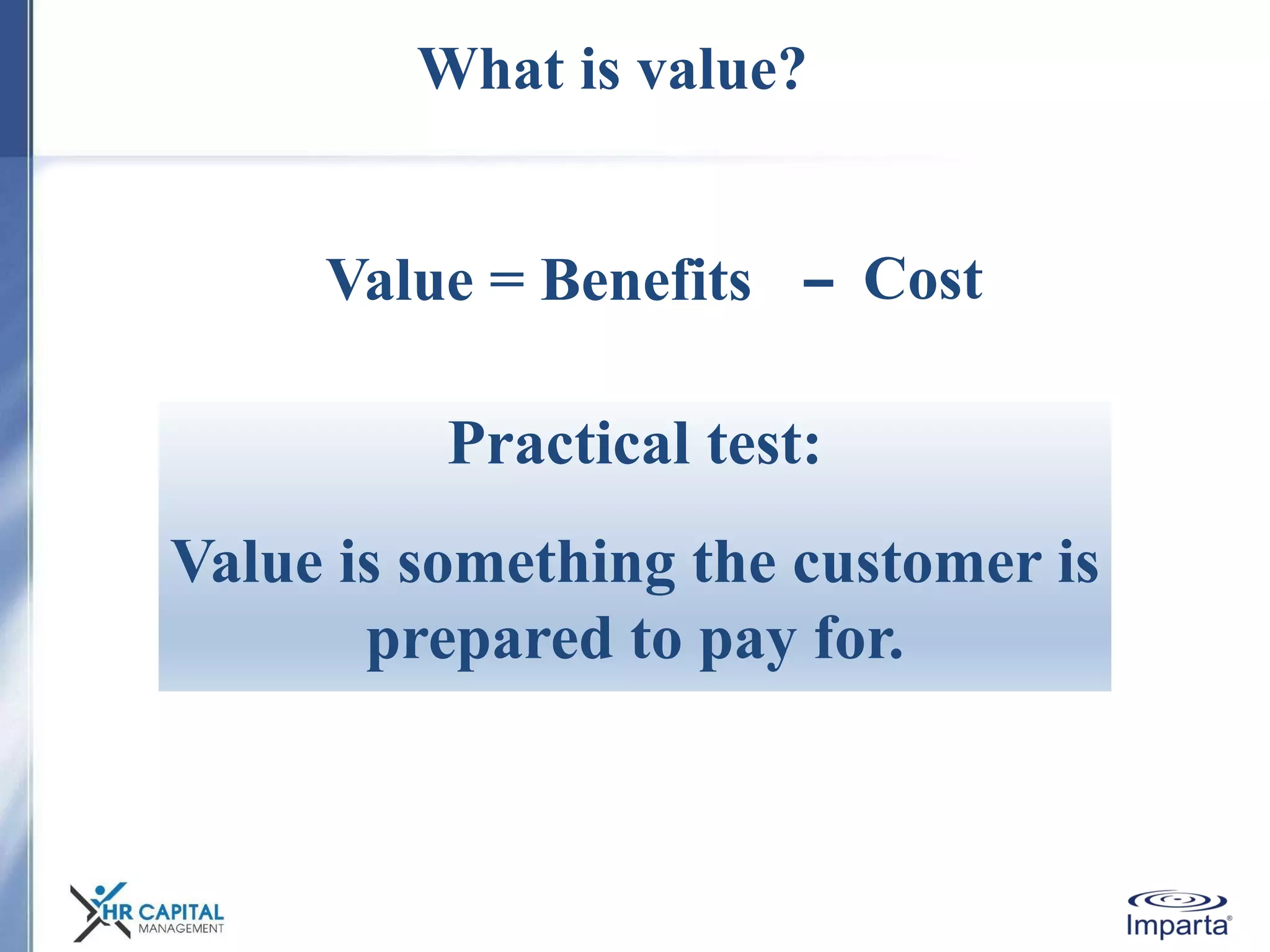
What is value?
Value = Benefits Cost
Practical test:
Value is something the customer is
prepared to pay for.
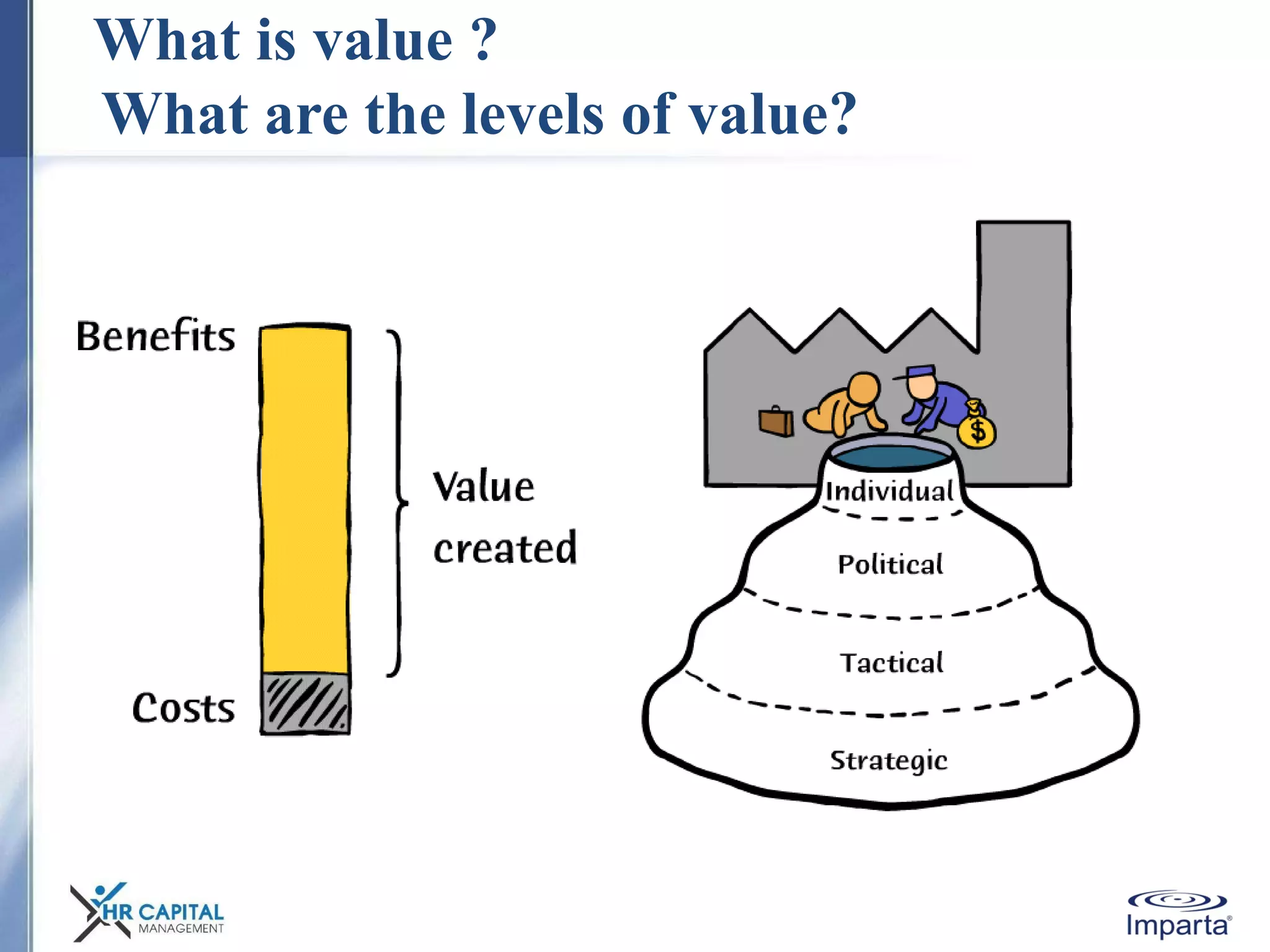
What is value ?
What are the levels of value?
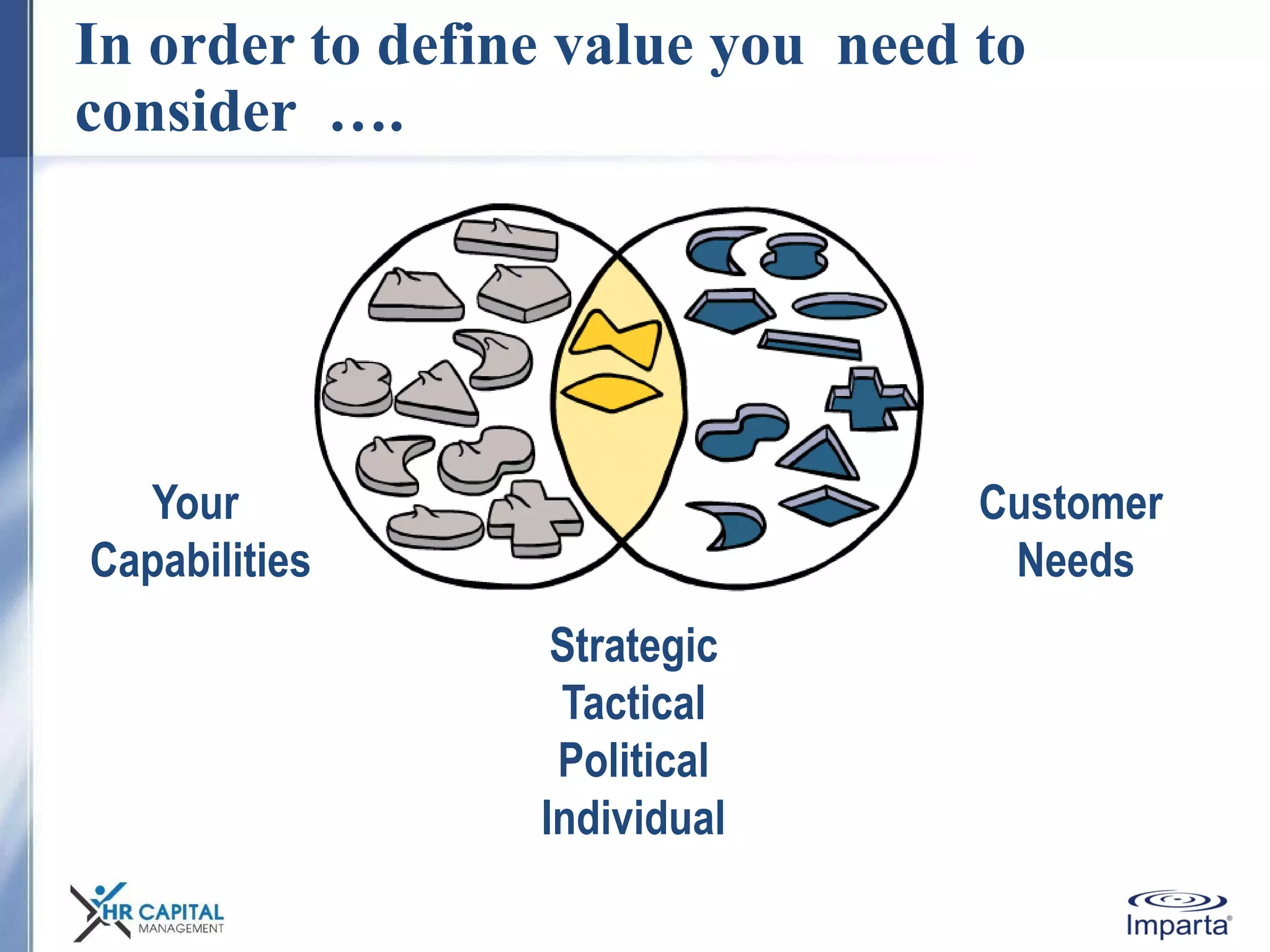
Your
Capabilities
Customer
Needs
Strategic
Tactical
Political
Individual
In order to define value you need to
consider ….
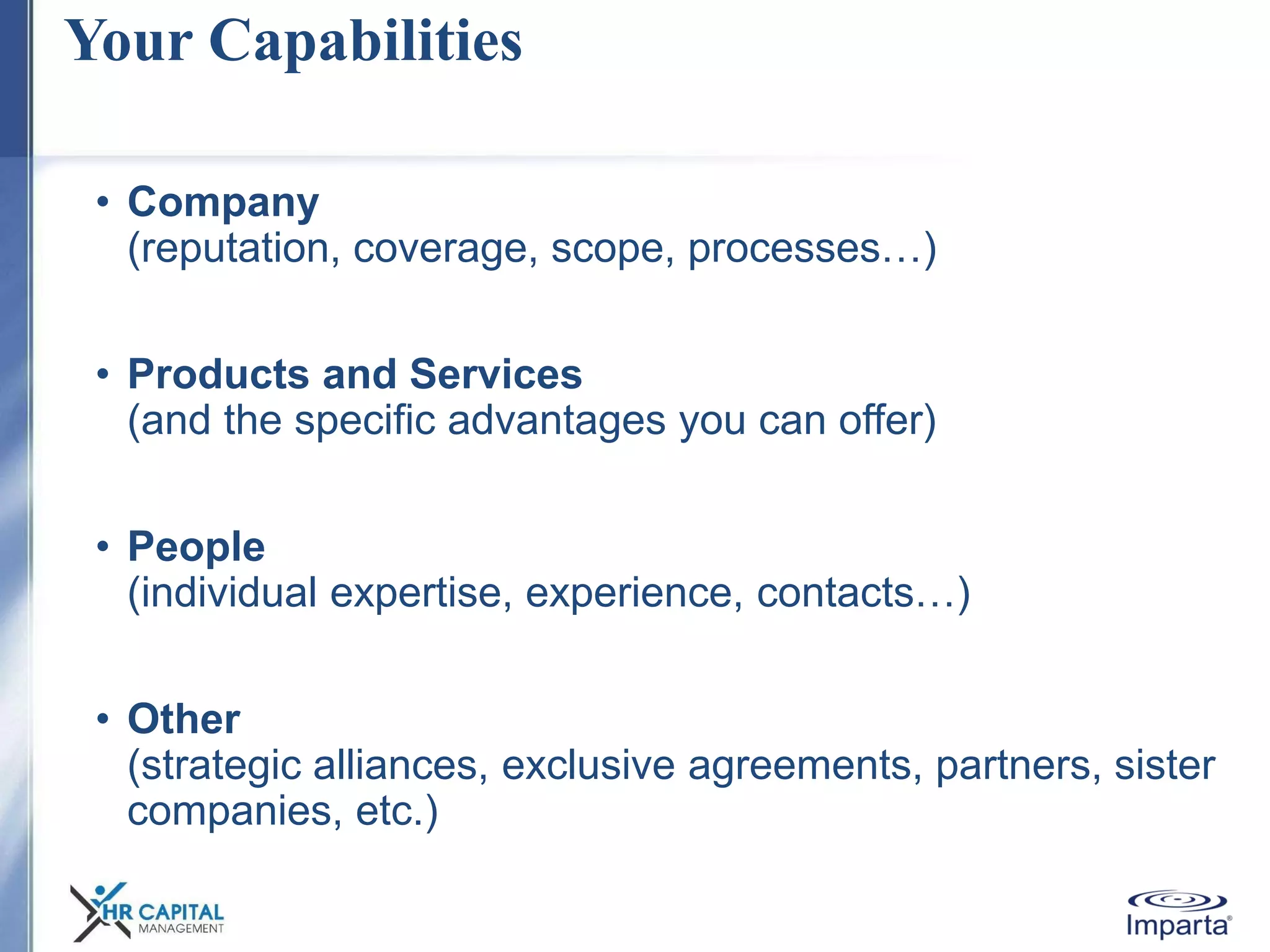
Your Capabilities
• Company
(reputation, coverage, scope, processes…)
• Products and Services
(and the specific advantages you can offer)
• People
(individual expertise, experience, contacts…)
• Other
(strategic alliances, exclusive agreements, partners, sister
companies, etc.)
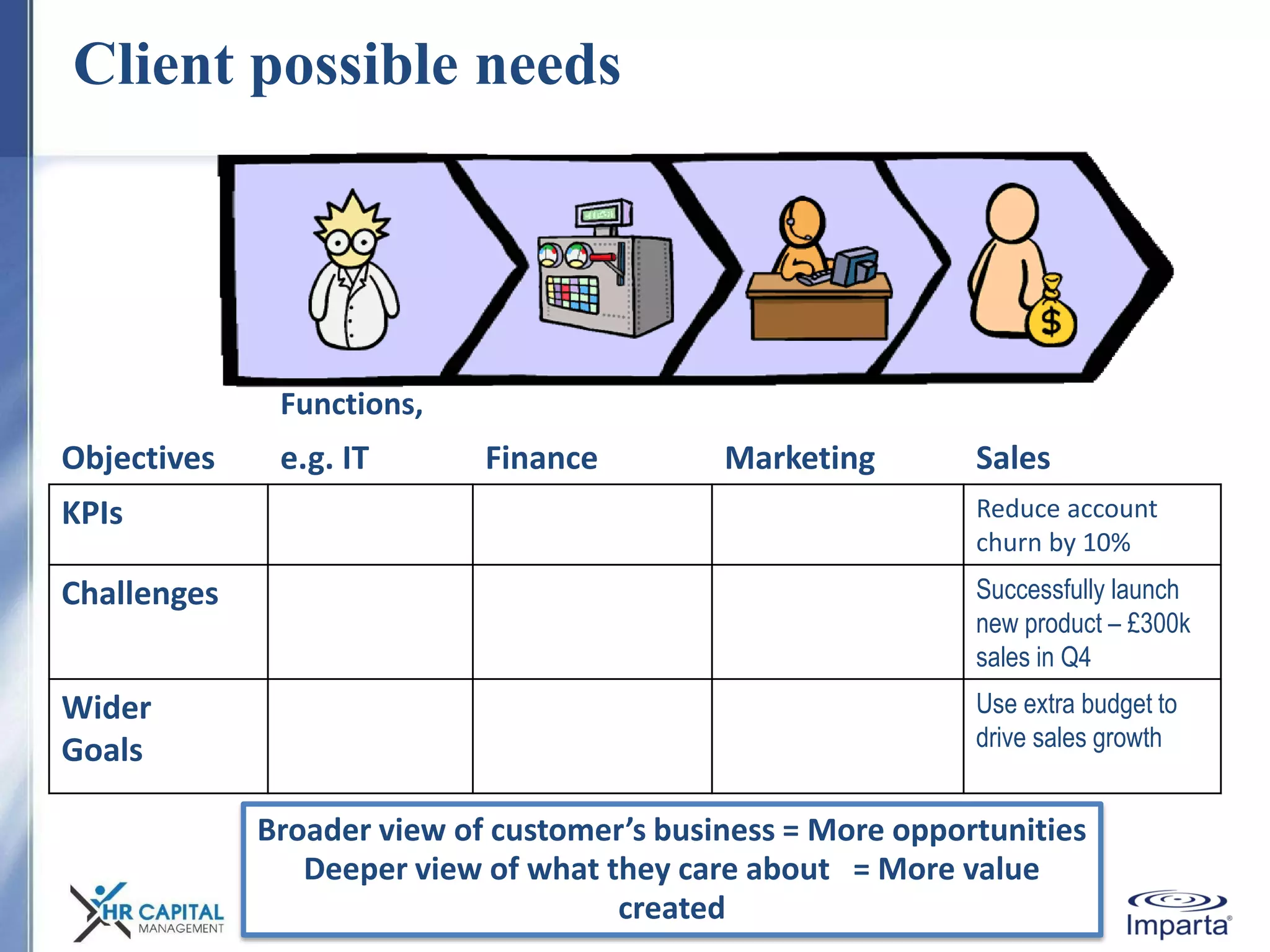
Client possible needs
Broader view of customer’s business = More opportunities
Deeper view of what they care about = More value
created
Functions,
Finance Marketing SalesObjectives e.g. IT
KPIs Reduce account
churn by 10%
Challenges Successfully launch
new product – £300k
sales in Q4
Wider
Goals
Use extra budget to
drive sales growth
What things do we do for our
customers during the sales
process that are so valuable
that customers would be
prepared to pay for them?
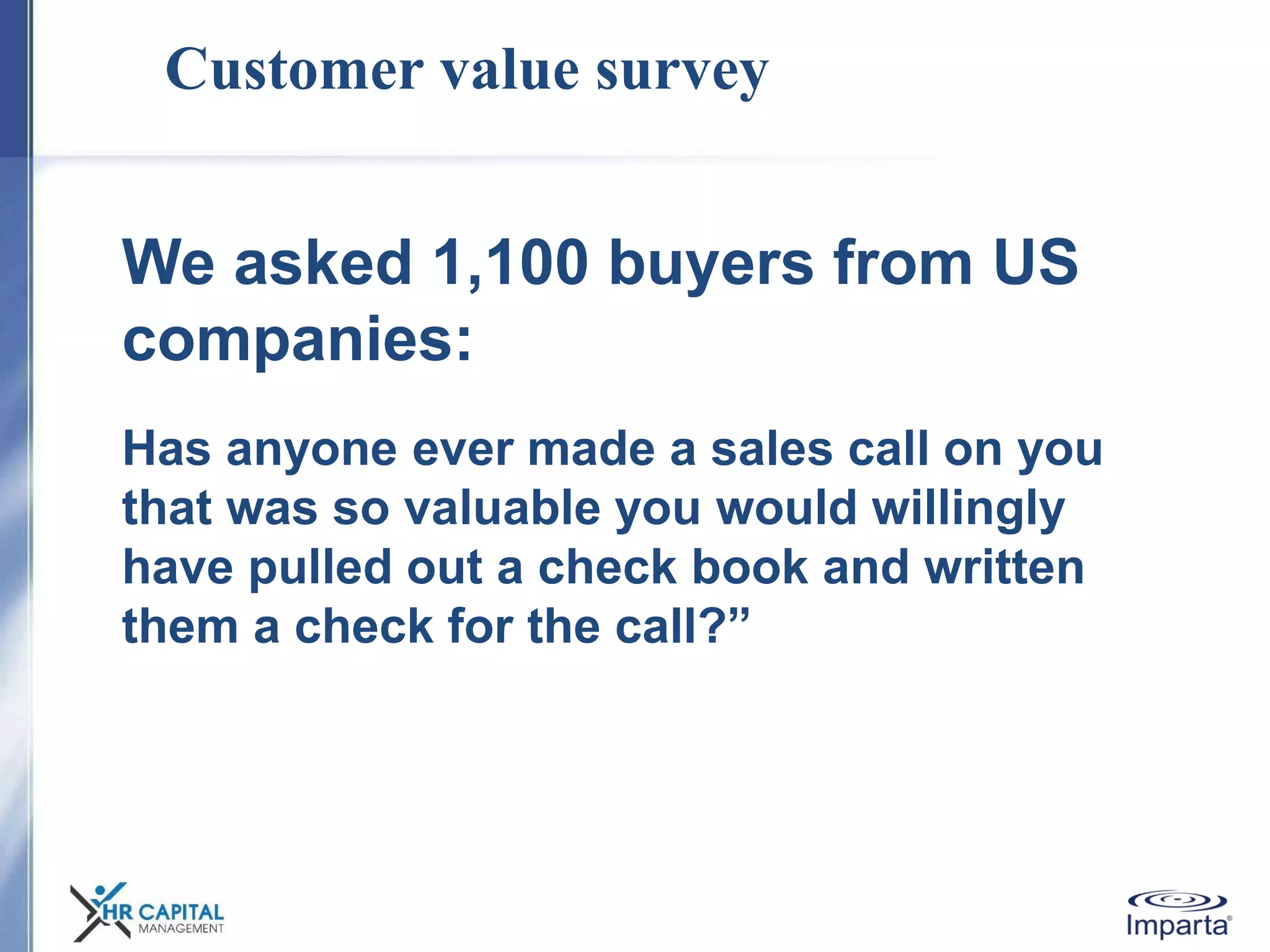
Customer value survey
We asked 1,100 buyers from US
companies:
Has anyone ever made a sales call on you
that was so valuable you would willingly
have pulled out a check book and written
them a check for the call?”
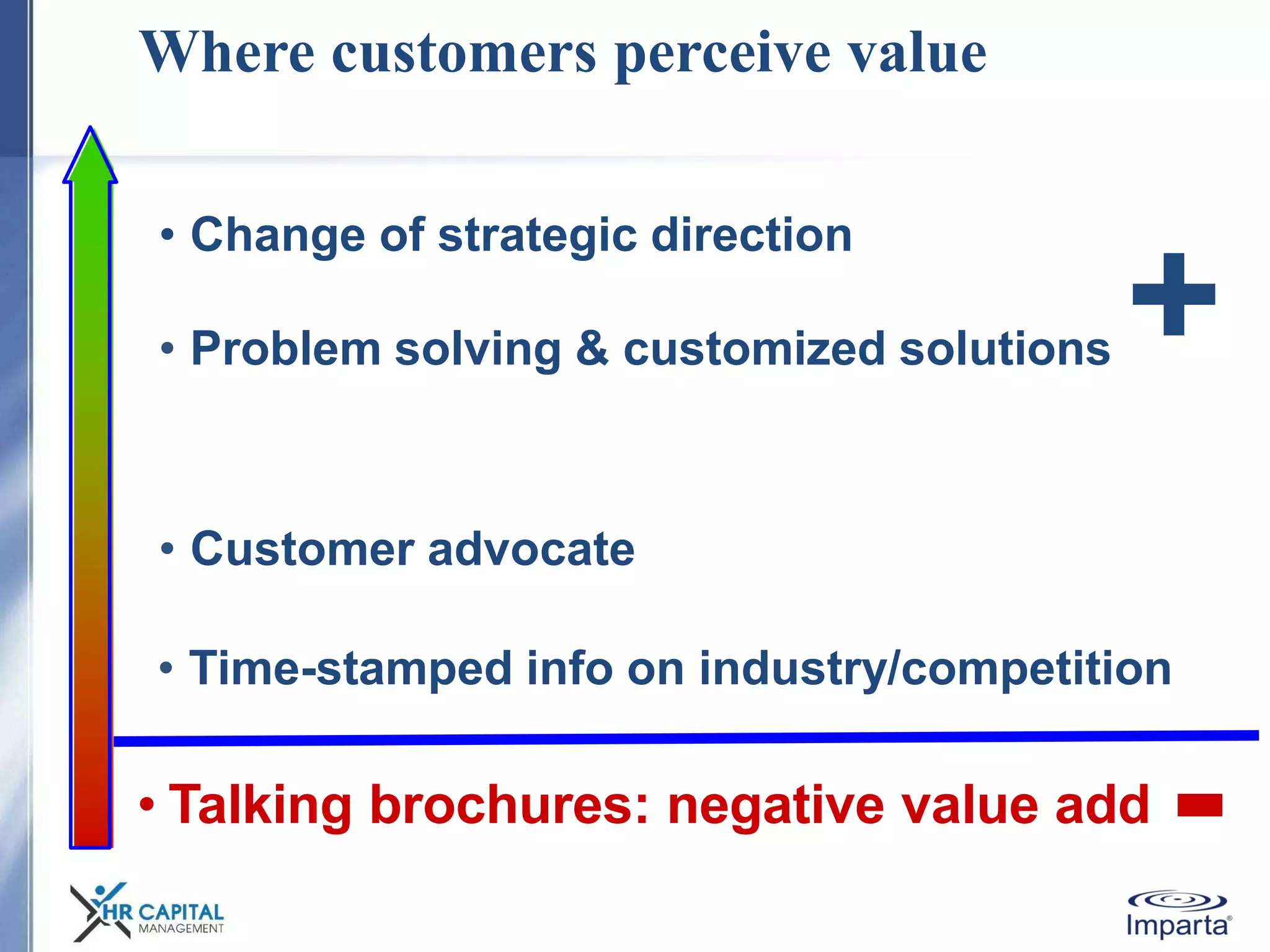
Where customers perceive value
• Talking brochures: negative value add
• Customer advocate
• Time-stamped info on industry/competition
• Problem solving & customized solutions +
• Change of strategic direction
-
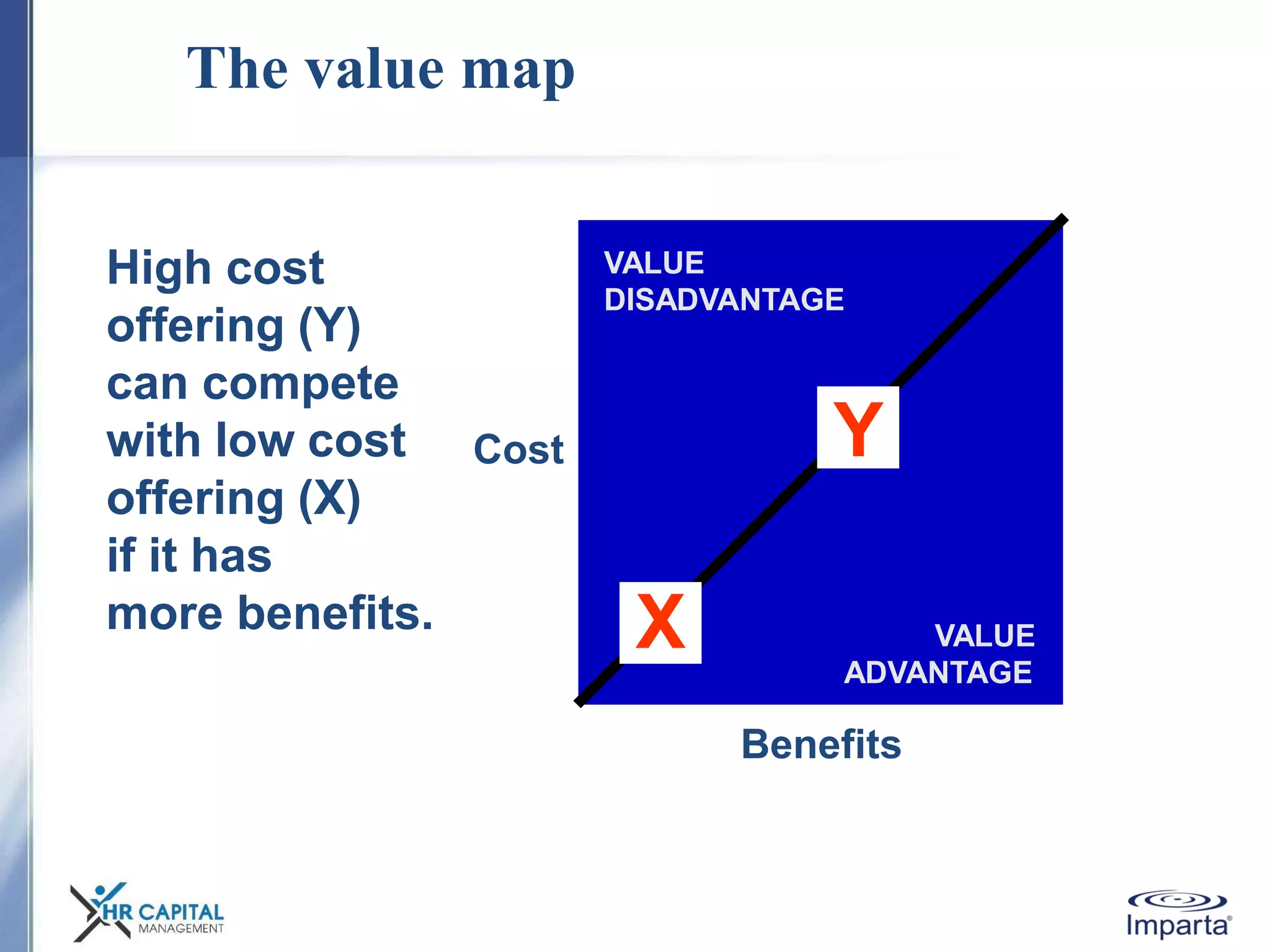
The value map
VALUE
DISADVANTAGE
VALUE
ADVANTAGE
High cost
offering (Y)
can compete
with low cost
offering (X)
if it has
more benefits. X
YCost
Benefits
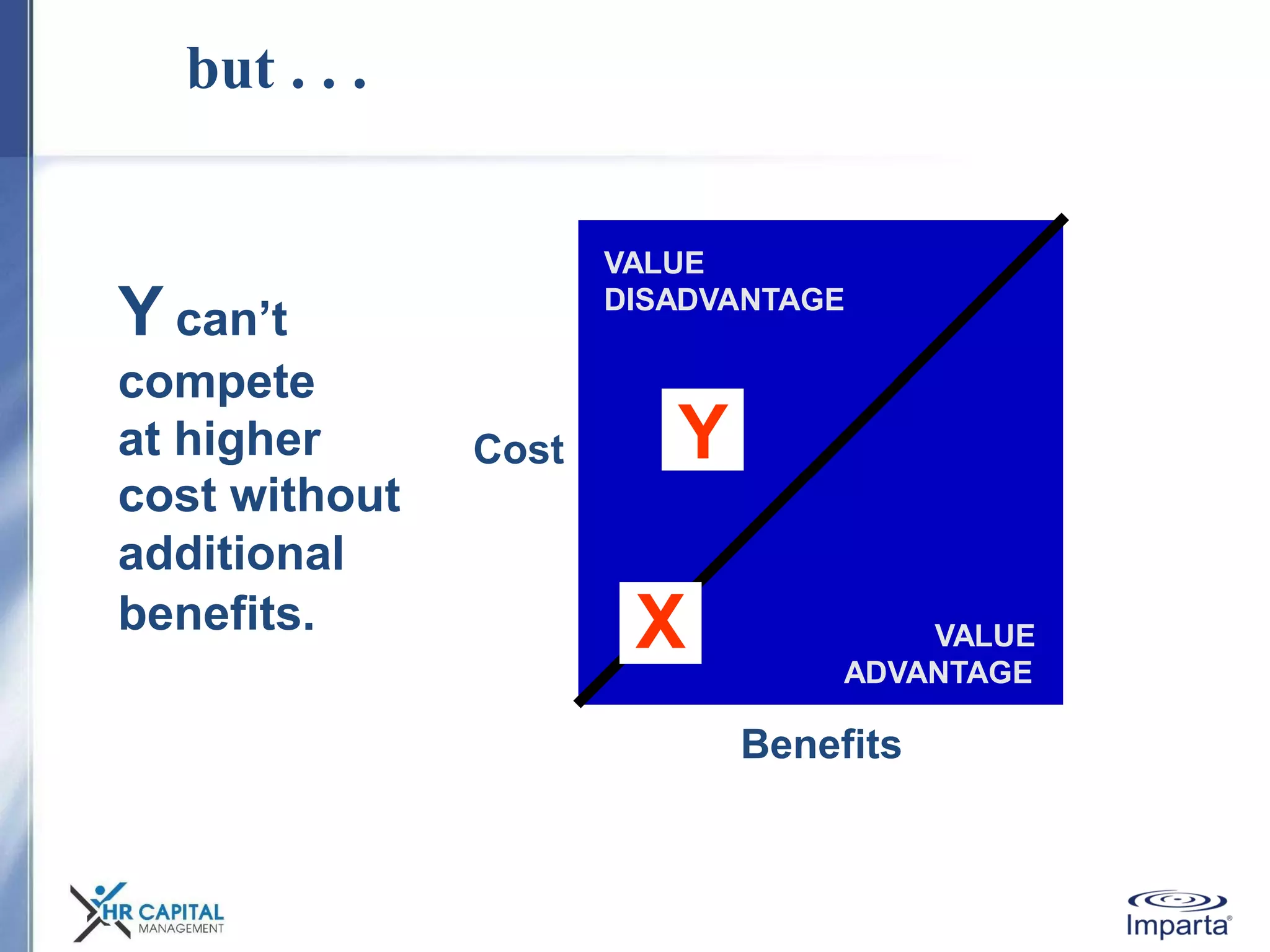
but . . .
VALUE
DISADVANTAGE
VALUE
ADVANTAGE
Y can’t
compete
at higher
cost without
additional
benefits. X
YYYCost
Benefits
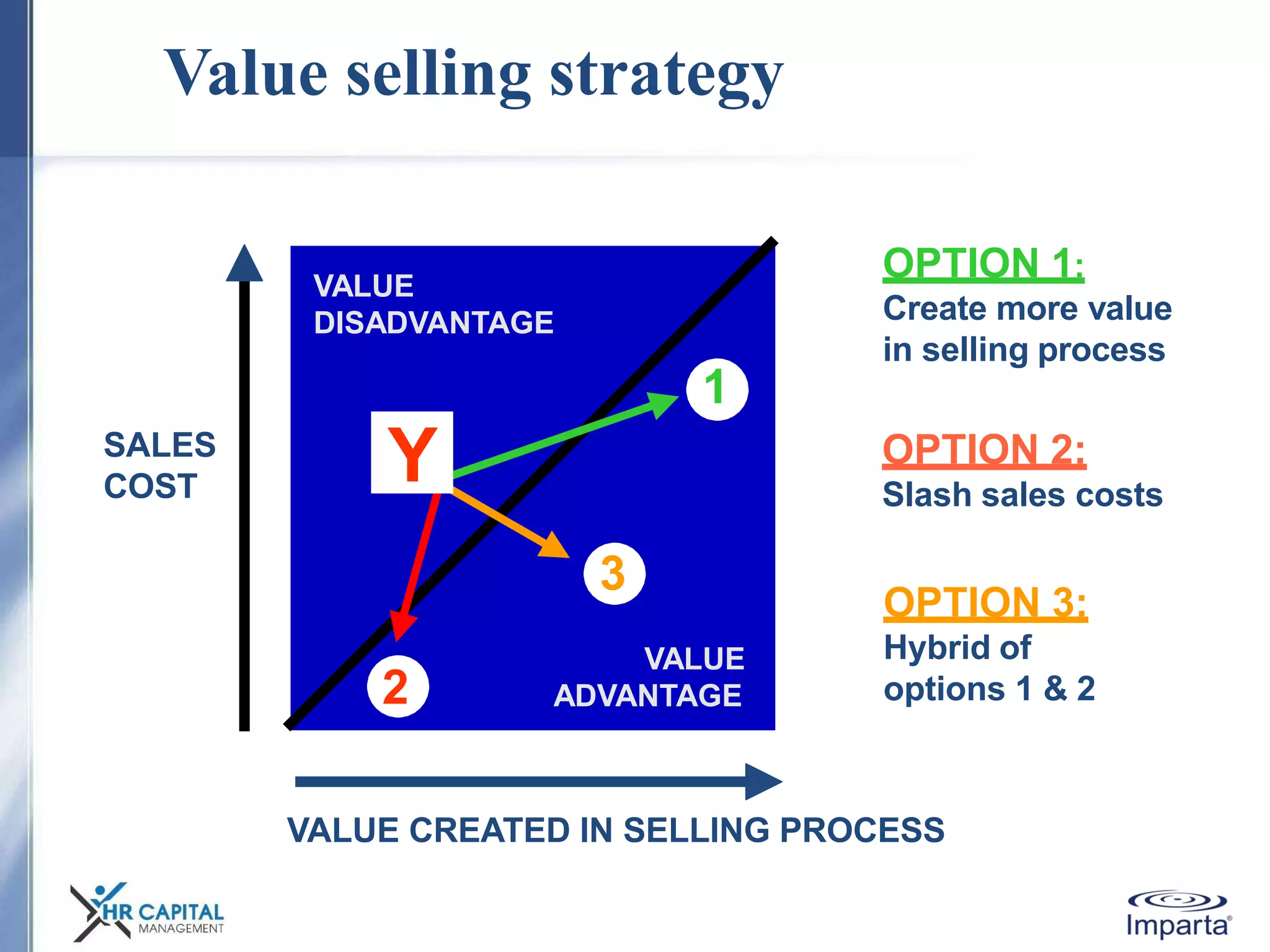
Value selling strategy
VALUE
DISADVANTAGE
VALUE
ADVANTAGE
OPTION 1:
Create more value
in selling process
1
OPTION 3:
Hybrid of
options 1 & 2
3
OPTION 2:
Slash sales costs
2
YSALES
COST
VALUE CREATED IN SELLING PROCESS
Which option
has the
highest
success rate?
VALUE
DISADVANTAGE
VALUE
ADVANTAGE
1
3
Y
2
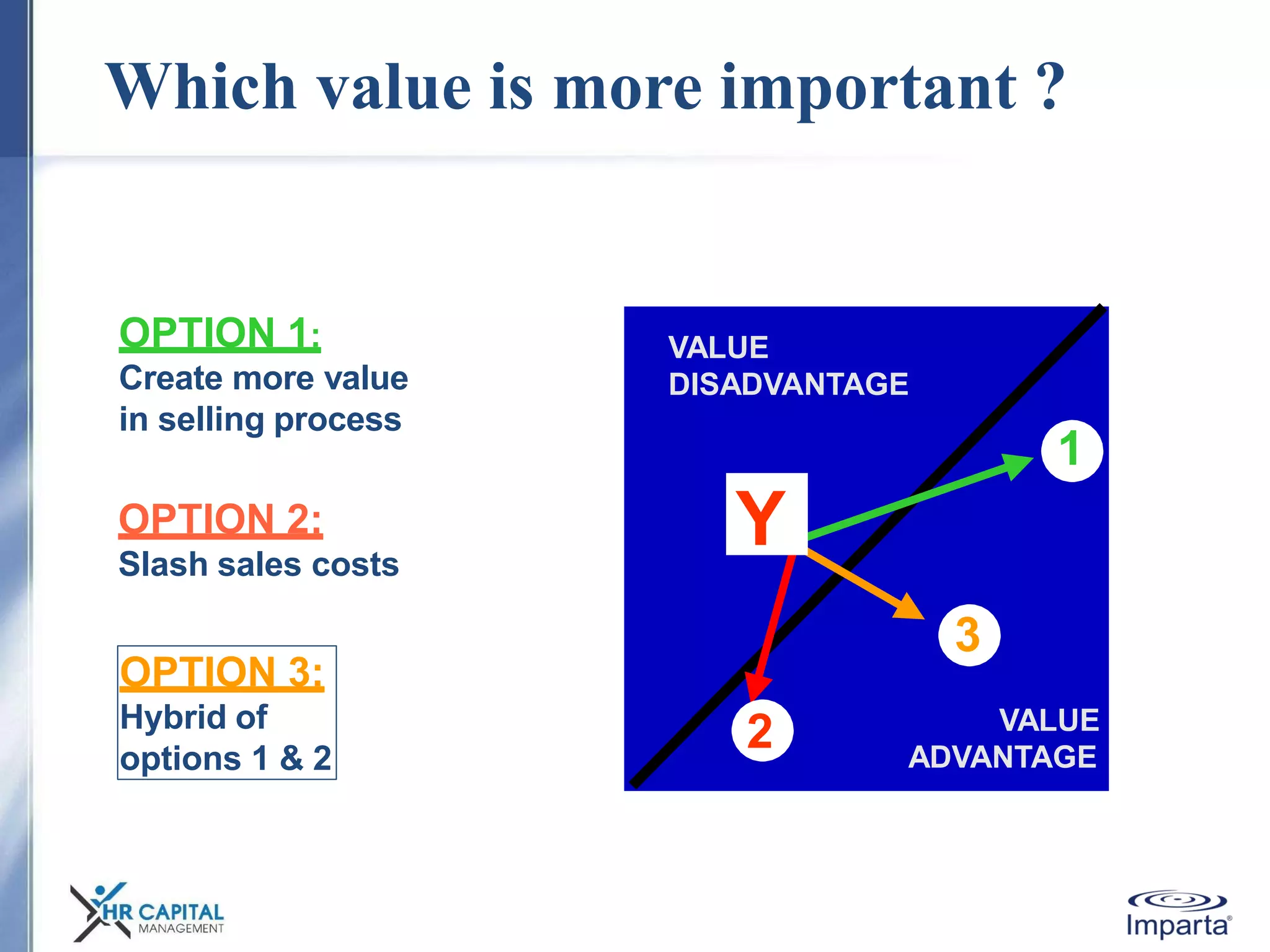
Which value is more important ?
OPTION 1:
Create more value
in selling process
OPTION 3:
Hybrid of
options 1 & 2
OPTION 2:
Slash sales costs
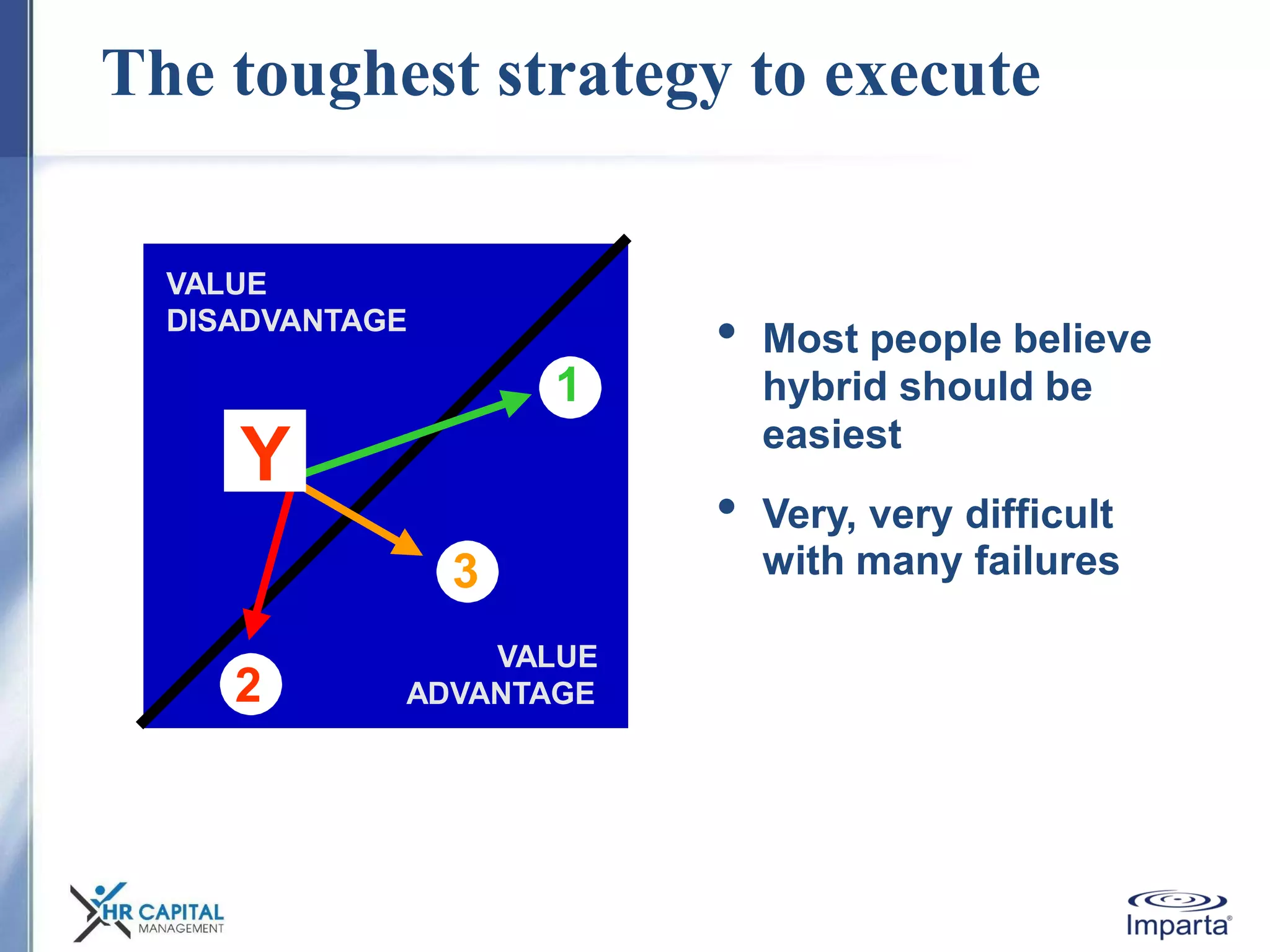
The toughest strategy to execute
VALUE
ADVANTAGE
1
3
2
VALUE
DISADVANTAGE
Y
• Most people believe
hybrid should be
easiest
• Very, very difficult
with many failures
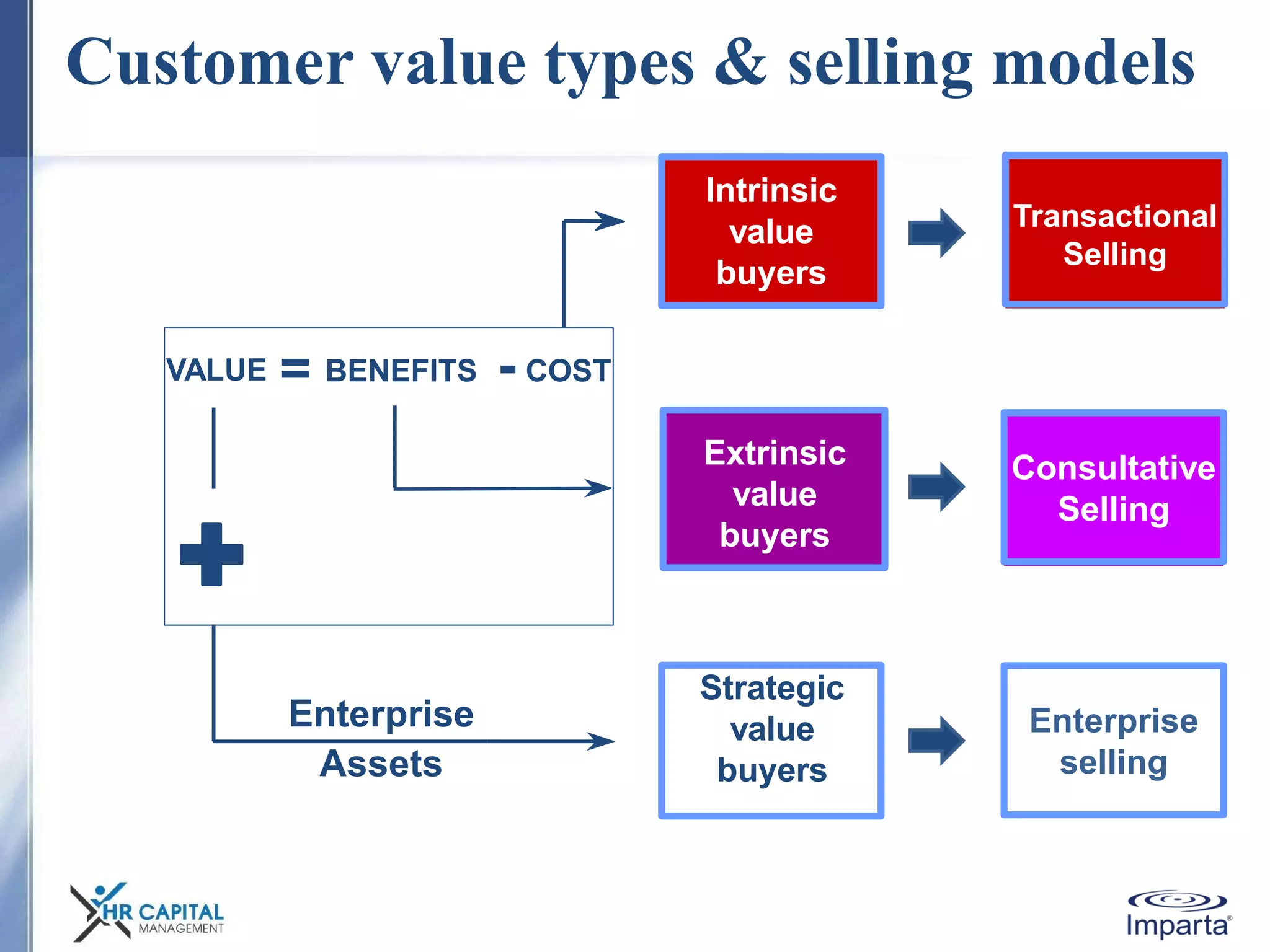
Customer value types & selling models
• “a cheaper, no-hassle pie”
Extrinsic
value
buyers
• “a bigger, better tasting pie”
Strategic
value
buyers
• “a balanced diet”
VALUE = BENEFITS - COST
+
Enterprise
Assets
Intrinsic
value
buyers
Transactional
Selling
Consultative
Selling
Enterprise
selling
©2010 Neil
How do you position your
sales force?
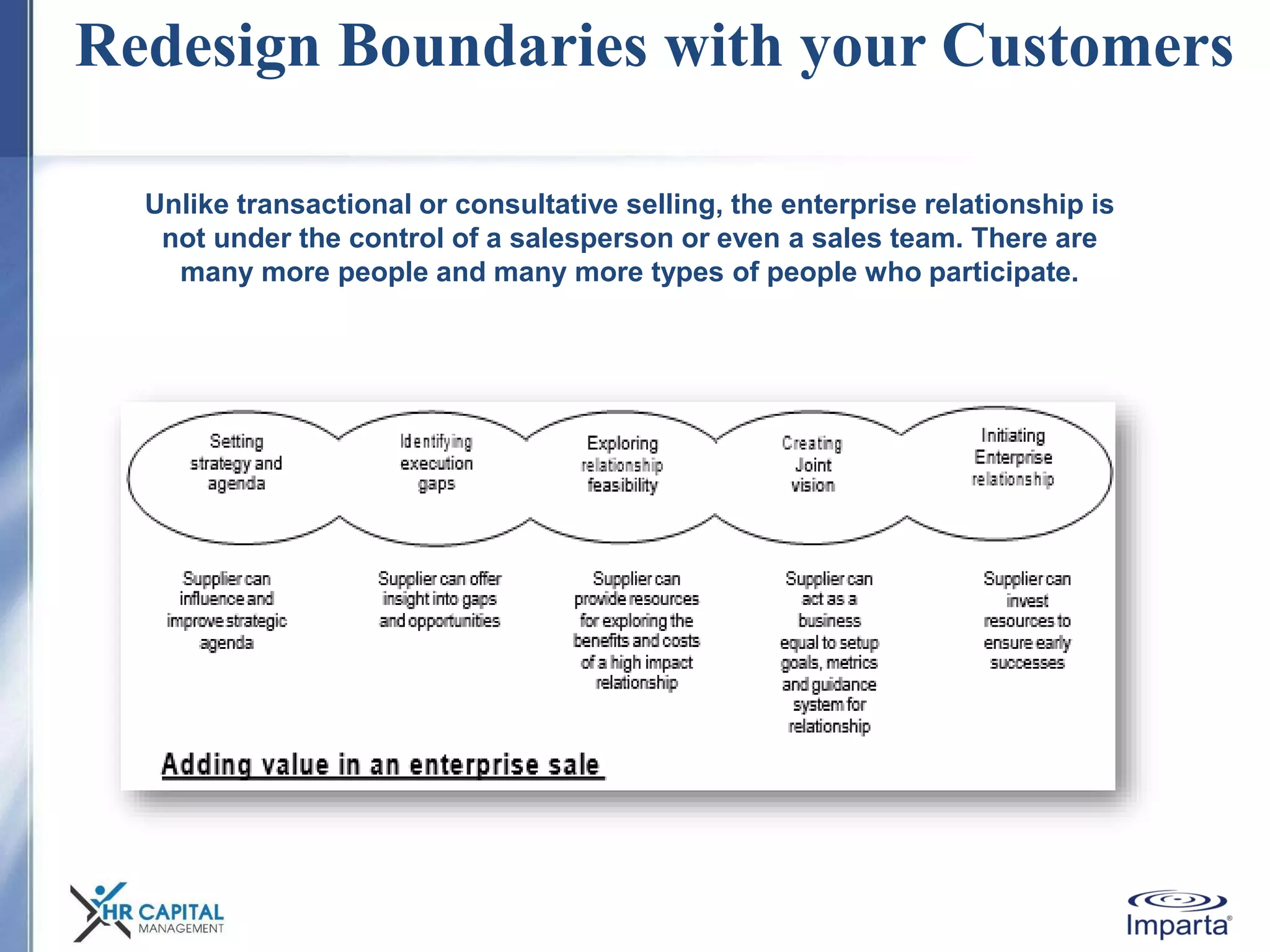
Redesign Boundaries with your Customers
Unlike transactional or consultative selling, the enterprise relationship is
not under the control of a salesperson or even a sales team. There are
many more people and many more types of people who participate.
Enterprise Sales: Erase Functional Walls
• The key to successful enterprise selling is to eliminate
the inefficiencies and waste that exist at the boundary
between the customer and the selling organization.
• Boundary problems, however, exist not only between
companies but also between functions or other
departments within a company.
• The guiding principle of process thinking is to break
down these barriers by organizing work around
cross‐functional core processes instead of separate
functional departments.
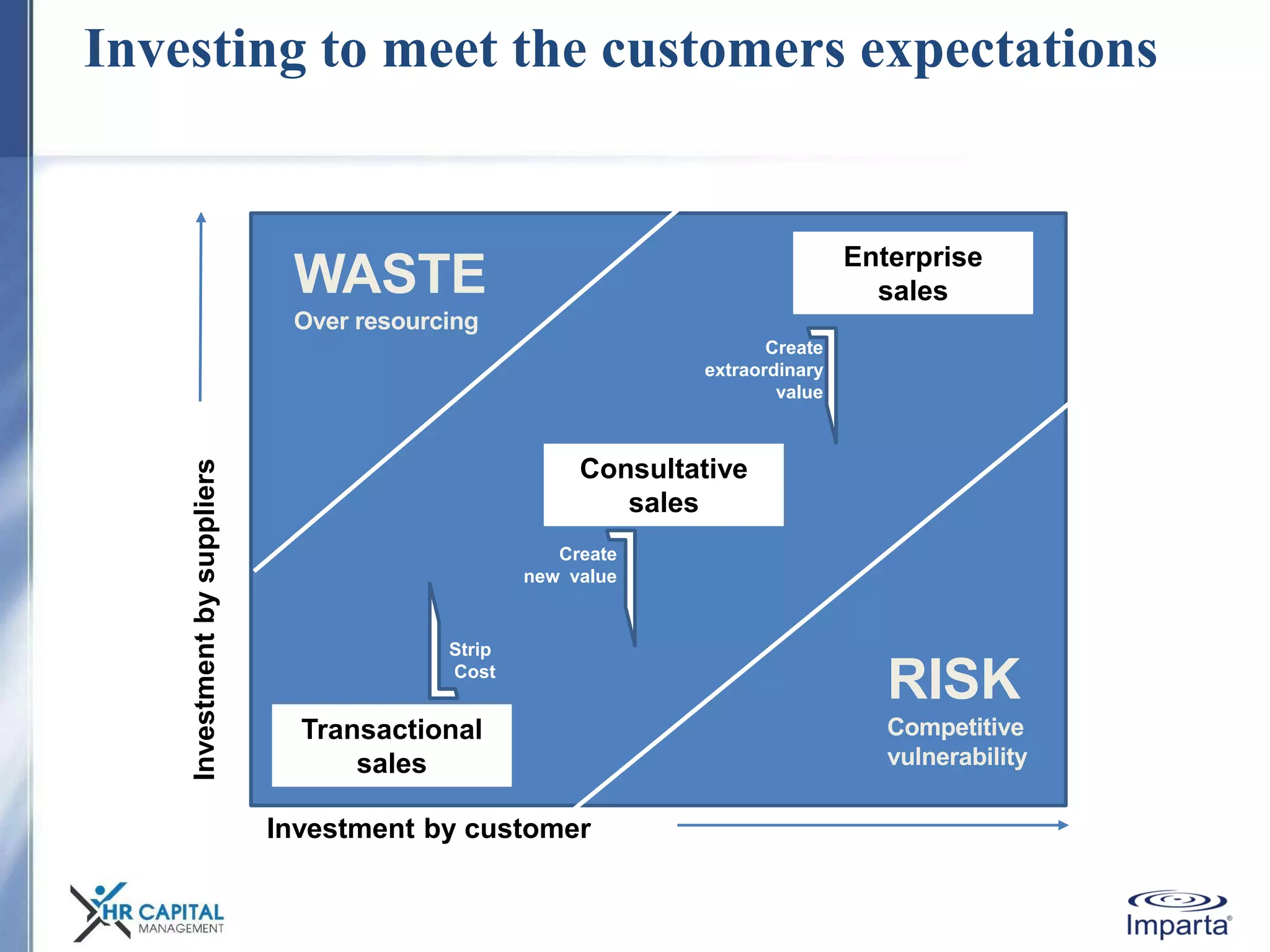
Investing to meet the customers expectations
Investment by customer
Investmentbysuppliers
Consultative
sales
WASTE
Over resourcing
RISK
Competitive
vulnerability
Transactional
sales
Enterprise
sales
Create
extraordinary
value
Create
new value
Strip
Cost
Is this for real?
Are these things happening
to our industry?
If so, what should we do
about it?
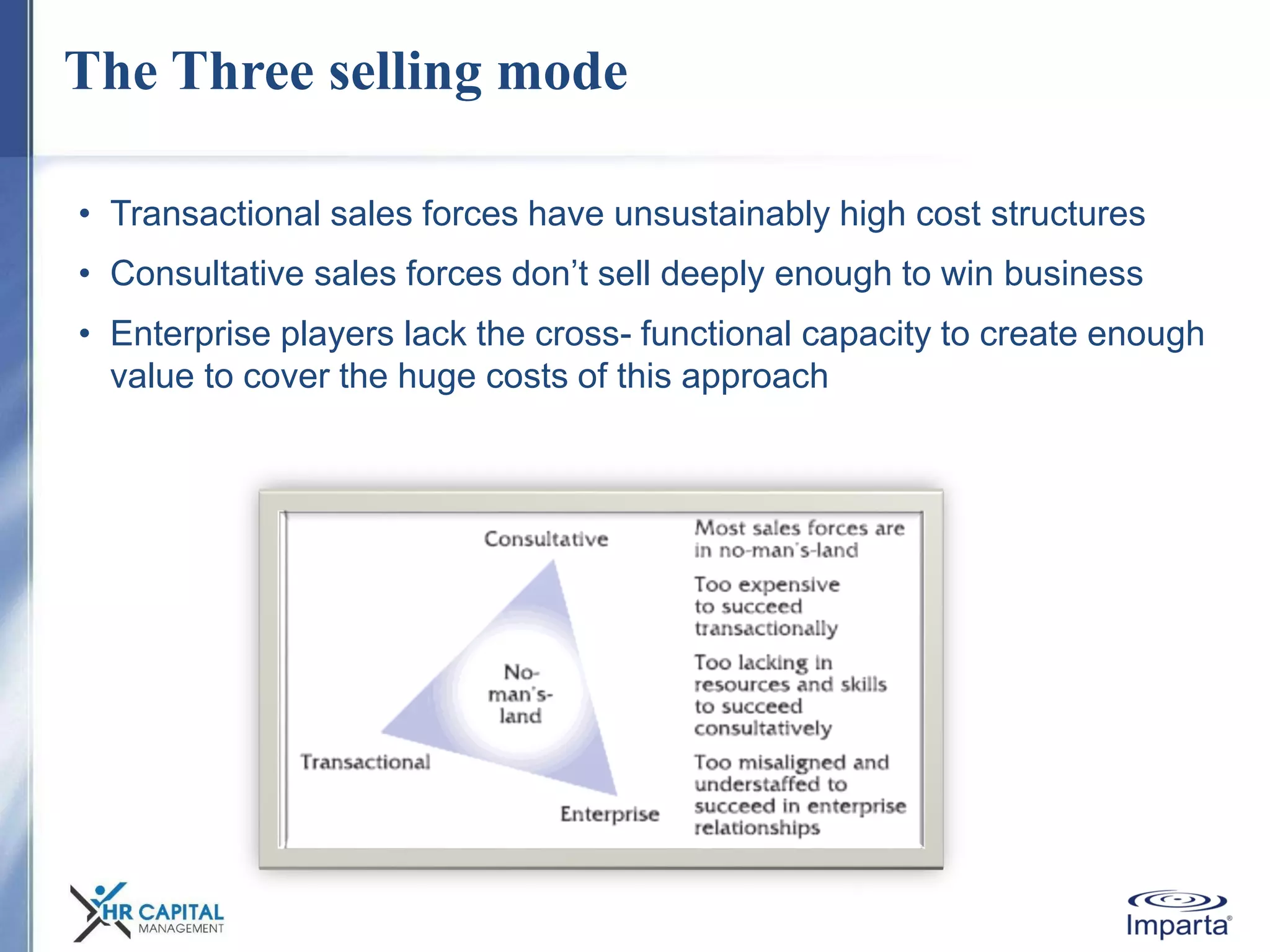
The Three selling mode
• Transactional sales forces have unsustainably high cost structures
• Consultative sales forces don’t sell deeply enough to win business
• Enterprise players lack the cross- functional capacity to create enough
value to cover the huge costs of this approach
Using sales resources
• We can no longer afford to put the most resources to the
biggest customers: this is the era of lean selling,
especially in transactional sales.
• We must put our sales resources where we can create
most customer value.
• The winners shift transactional business to cheaper
channels.
• They put more resources into the opportunities where they
can create most value.
. . . So what do I do about it?
Talking brochures can’t survive. So don’t
be caught in the vanishing middle; up the
bar and aim for bigger consultative sales.
1
2
3
Ask yourself, “would the customer write a
check for this call?” -- that’s how you know
if you’re a value creator not just a value
communicator.
Create more value through understanding
customers more deeply than ever before,
by problem solving and by customizing
solutions. See products & services as
tools, not ends in themselves.

A new sales approach - Creating Clients Value

  • 1.
    Creating Value through theSales Force Vassilis Engonopoulos Fani Petraki Vassilis Kassimatis
  • 2.
    • Based onresearch by Neil Rackham (author of SPIN® Selling), John De Vincentis of McKinsey & Co. and the team at Imparta • Opportunity planning and account management; strategies and skills Aimed at meeting specific business objectives What is ‘Creating Client Value’?
  • 3.
  • 4.
    What’s the purposeof a sales force? “The reason for a sales force is to ensure that the customer has the right information about the advantages of your products at the right time, so that the purchasing decision is influenced in your favor.” … Regional Sales Manager Printing Equipment Company “The sales force convinces the client to buy from you rather than from a competitor by showing how your services are superior.” … Senior Consultant Systems Integration and Software Company
  • 5.
    What’s the purposeof a sales force? “The sales force exists to show customers that you have something worthwhile to offer that meets their needs.” … Salesperson Office Products Company “The sales function is like a translator: its job is to take your products and services and translate them into language that the customer understands.” … Sales Manager Control Systems Manufacturer “The purpose of a sales force is to communicate to customers the value of your offerings.” … Senior Vice President Sales and Marketing, Large Regional Bank
  • 6.
    The common factor: Eachdefinition is about
  • 7.
    The shifting marketplace Unique products/services Substitutable products/services 109 8 7 6 5 4 3 2 1 ● no competitors ● buyer has no alternative source ● perceived uniqueness ● numerous competitors ● buyer has many options/choices ● no perceived uniqueness
  • 8.
    Where are you? Today 109 In 3 years Unique products/services 10 9 8 7 3 years ago Substitutable products/services 6 5 4 3 2 1 10 9 8 7 6 5 4 3 2 1 8 7 6 5 4 3 2 1
  • 9.
    What’s happening inthe Last Years Today 10 9 In 3 years 10 9 8 7 3 years ago 6.4 Substitutable products/services 6 5 4 3 2 1 Unique products/services 10 9 8 7 6 5 4 3 2 1 8 7 6 5 4 3 2 1 4.5 3.7 SSI Data: 47 corporations 773 sales executives
  • 10.
    Why are productsand services in most markets becoming less unique?
  • 11.
    ● New products/services ●Value-added services and support ● Product bundling & pricing ● Customized options Create Differentiation Market Forces Corporate Strategies Decrease Differentiation ● Products/services look more similar ● More of them (Increasing competition) ● More demanding clients ● New Technologies (quicker time to market, internet, etc.)
  • 12.
    Creating value vs.Communicating value ● Selling process must create value for clients ● Not enough for salespeople to communicate value ● Salespeople must become value creators Market Forces ● Product/service creates the value ● Salespeople communicate product benefits ● Salespeople succeed through value communication Corporate Strategies Substitutable products/services 6 5 4 3 2 1 Unique products/services 10 9 8 7
  • 13.
    …and customers arechanging too. What’s the biggest difference in how major customers behave today compared with 3 years ago?
  • 14.
    Most people agreethat : • Customers are getting tougher to deal with (94%) • They treat you more like a commodity (76%) • But they also demand more expertise and support than ever before (89%) • They are using new purchasing techniques to force greater concessions from their suppliers (75%)
  • 15.
    Buying strategies inthe new purchasing world Difficulty of obtaining substitute product/service Strategic importance of product/service high low high Shop Leverage Manage Risk Partner
  • 16.
  • 17.
    What is value? Value= Benefits Cost Practical test: Value is something the customer is prepared to pay for.
  • 18.
    What is value? What are the levels of value?
  • 19.
  • 20.
    Your Capabilities • Company (reputation,coverage, scope, processes…) • Products and Services (and the specific advantages you can offer) • People (individual expertise, experience, contacts…) • Other (strategic alliances, exclusive agreements, partners, sister companies, etc.)
  • 21.
    Client possible needs Broaderview of customer’s business = More opportunities Deeper view of what they care about = More value created Functions, Finance Marketing SalesObjectives e.g. IT KPIs Reduce account churn by 10% Challenges Successfully launch new product – £300k sales in Q4 Wider Goals Use extra budget to drive sales growth
  • 22.
    What things dowe do for our customers during the sales process that are so valuable that customers would be prepared to pay for them?
  • 23.
    Customer value survey Weasked 1,100 buyers from US companies: Has anyone ever made a sales call on you that was so valuable you would willingly have pulled out a check book and written them a check for the call?”
  • 24.
    Where customers perceivevalue • Talking brochures: negative value add • Customer advocate • Time-stamped info on industry/competition • Problem solving & customized solutions + • Change of strategic direction -
  • 25.
    The value map VALUE DISADVANTAGE VALUE ADVANTAGE Highcost offering (Y) can compete with low cost offering (X) if it has more benefits. X YCost Benefits
  • 26.
    but . .. VALUE DISADVANTAGE VALUE ADVANTAGE Y can’t compete at higher cost without additional benefits. X YYYCost Benefits
  • 27.
    Value selling strategy VALUE DISADVANTAGE VALUE ADVANTAGE OPTION1: Create more value in selling process 1 OPTION 3: Hybrid of options 1 & 2 3 OPTION 2: Slash sales costs 2 YSALES COST VALUE CREATED IN SELLING PROCESS
  • 28.
    Which option has the highest successrate? VALUE DISADVANTAGE VALUE ADVANTAGE 1 3 Y 2 Which value is more important ? OPTION 1: Create more value in selling process OPTION 3: Hybrid of options 1 & 2 OPTION 2: Slash sales costs
  • 29.
    The toughest strategyto execute VALUE ADVANTAGE 1 3 2 VALUE DISADVANTAGE Y • Most people believe hybrid should be easiest • Very, very difficult with many failures
  • 30.
    Customer value types& selling models • “a cheaper, no-hassle pie” Extrinsic value buyers • “a bigger, better tasting pie” Strategic value buyers • “a balanced diet” VALUE = BENEFITS - COST + Enterprise Assets Intrinsic value buyers Transactional Selling Consultative Selling Enterprise selling
  • 31.
    ©2010 Neil How doyou position your sales force?
  • 32.
    Redesign Boundaries withyour Customers Unlike transactional or consultative selling, the enterprise relationship is not under the control of a salesperson or even a sales team. There are many more people and many more types of people who participate.
  • 33.
    Enterprise Sales: EraseFunctional Walls • The key to successful enterprise selling is to eliminate the inefficiencies and waste that exist at the boundary between the customer and the selling organization. • Boundary problems, however, exist not only between companies but also between functions or other departments within a company. • The guiding principle of process thinking is to break down these barriers by organizing work around cross‐functional core processes instead of separate functional departments.
  • 34.
    Investing to meetthe customers expectations Investment by customer Investmentbysuppliers Consultative sales WASTE Over resourcing RISK Competitive vulnerability Transactional sales Enterprise sales Create extraordinary value Create new value Strip Cost
  • 35.
    Is this forreal? Are these things happening to our industry? If so, what should we do about it?
  • 36.
    The Three sellingmode • Transactional sales forces have unsustainably high cost structures • Consultative sales forces don’t sell deeply enough to win business • Enterprise players lack the cross- functional capacity to create enough value to cover the huge costs of this approach
  • 37.
    Using sales resources •We can no longer afford to put the most resources to the biggest customers: this is the era of lean selling, especially in transactional sales. • We must put our sales resources where we can create most customer value. • The winners shift transactional business to cheaper channels. • They put more resources into the opportunities where they can create most value.
  • 38.
    . . .So what do I do about it? Talking brochures can’t survive. So don’t be caught in the vanishing middle; up the bar and aim for bigger consultative sales. 1 2 3 Ask yourself, “would the customer write a check for this call?” -- that’s how you know if you’re a value creator not just a value communicator. Create more value through understanding customers more deeply than ever before, by problem solving and by customizing solutions. See products & services as tools, not ends in themselves.