ReThinking The Sales Force Daniel Schwartz RethinkingSalesForce.ppt(28)
Selling Nothing Happens Until Something is Sold! Focus on the Customer What is in it for Me! That is what the Customer is thinking Some Practical Techniques
Two Fundamental Concepts: From ReThinking the Sales Force by Neil Rakham The purpose of the sales force has changed Three types of customers cause three types of sales
Interesting Opening Question for the Group What is the purpose of the sales force? _________________________________________________ _________________________________________________ _________________________________________________ _________________________________________________ _________________________________________________ _________________________________________________
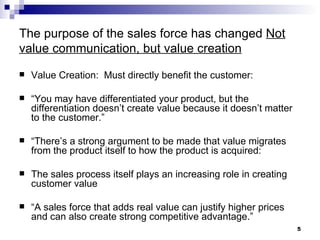
The purpose of the sales force has changed  Not value communication, but value creation Value Creation:  Must directly benefit the customer: “ You may have differentiated your product, but the differentiation doesn’t create value because it doesn’t matter to the customer.” “ There’s a strong argument to be made that value migrates from the product itself to how the product is acquired: The sales process itself plays an increasing role in creating customer value “ A sales force that adds real value can justify higher prices and can also create strong competitive advantage.”
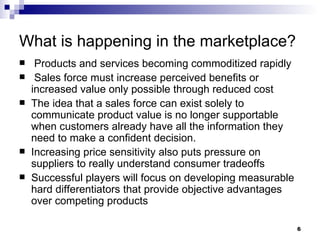
What is happening in the marketplace? Products and services becoming commoditized rapidly  Sales force must increase perceived benefits or increased value only possible through reduced cost The idea that a sales force can exist solely to communicate product value is no longer supportable when customers already have all the information they need to make a confident decision. Increasing price sensitivity also puts pressure on suppliers to really understand consumer tradeoffs Successful players will focus on developing measurable hard differentiators that provide objective advantages over competing products
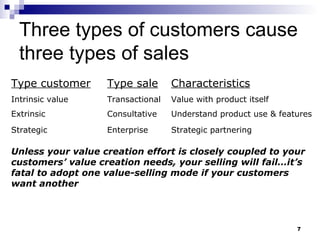
Three types of customers cause three types of sales Type customer Type sale Characteristics Intrinsic value Transactional Value with product itself Extrinsic Consultative Understand product use & features Strategic Enterprise Strategic partnering Unless your value creation effort is closely coupled to your customers’ value creation needs, your selling will fail…it’s fatal to adopt one value-selling mode if your customers want another
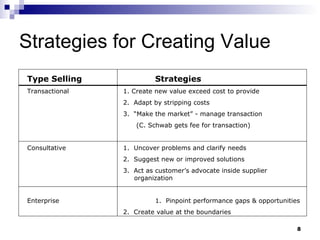
Strategies for Creating Value Type Selling Strategies Transactional 1. Create new value exceed cost to provide 2.  Adapt by stripping costs  3.  “Make the market” - manage transaction   (C. Schwab gets fee for transaction) Consultative 1.  Uncover problems and clarify needs 2.  Suggest new or improved solutions 3.  Act as customer’s advocate inside supplier    organization Enterprise 1.  Pinpoint performance gaps & opportunities 2.  Create value at the boundaries
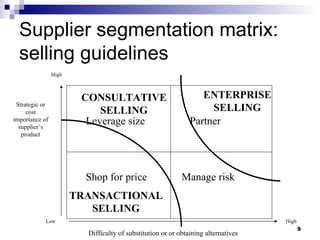
Supplier segmentation matrix: selling guidelines Strategic or cost importance of supplier’s product Difficulty of substitution or or obtaining alternatives High High Low Leverage size   Partner Shop for price  Manage risk ENTERPRISE SELLING CONSULTATIVE SELLING TRANSACTIONAL SELLING
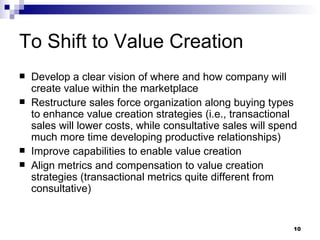
To Shift to Value Creation Develop a clear vision of where and how company will create value within the marketplace Restructure sales force organization along buying types to enhance value creation strategies (i.e., transactional sales will lower costs, while consultative sales will spend much more time developing productive relationships) Improve capabilities to enable value creation Align metrics and compensation to value creation strategies (transactional metrics quite different from consultative)
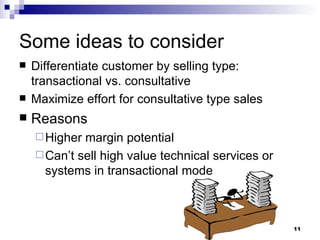
Some ideas to consider Differentiate customer by selling type:  transactional vs. consultative Maximize effort for consultative type sales  Reasons Higher margin potential Can’t sell high value technical services or systems in transactional mode
SUMMARY: Final Thinking Exercise: What are specific ways to: 1.  Help customers understand their problems, issues and opportunities? 2.  Show customers new or better solutions to their problems? 3.  Act as advocates for customers within your Company?

Rethinking Sales Force Toastmasters Short Version

  • 1.
    ReThinking The SalesForce Daniel Schwartz RethinkingSalesForce.ppt(28)
  • 2.
    Selling Nothing HappensUntil Something is Sold! Focus on the Customer What is in it for Me! That is what the Customer is thinking Some Practical Techniques
  • 3.
    Two Fundamental Concepts:From ReThinking the Sales Force by Neil Rakham The purpose of the sales force has changed Three types of customers cause three types of sales
  • 4.
    Interesting Opening Questionfor the Group What is the purpose of the sales force? _________________________________________________ _________________________________________________ _________________________________________________ _________________________________________________ _________________________________________________ _________________________________________________
  • 5.
    The purpose ofthe sales force has changed Not value communication, but value creation Value Creation: Must directly benefit the customer: “ You may have differentiated your product, but the differentiation doesn’t create value because it doesn’t matter to the customer.” “ There’s a strong argument to be made that value migrates from the product itself to how the product is acquired: The sales process itself plays an increasing role in creating customer value “ A sales force that adds real value can justify higher prices and can also create strong competitive advantage.”
  • 6.
    What is happeningin the marketplace? Products and services becoming commoditized rapidly Sales force must increase perceived benefits or increased value only possible through reduced cost The idea that a sales force can exist solely to communicate product value is no longer supportable when customers already have all the information they need to make a confident decision. Increasing price sensitivity also puts pressure on suppliers to really understand consumer tradeoffs Successful players will focus on developing measurable hard differentiators that provide objective advantages over competing products
  • 7.
    Three types ofcustomers cause three types of sales Type customer Type sale Characteristics Intrinsic value Transactional Value with product itself Extrinsic Consultative Understand product use & features Strategic Enterprise Strategic partnering Unless your value creation effort is closely coupled to your customers’ value creation needs, your selling will fail…it’s fatal to adopt one value-selling mode if your customers want another
  • 8.
    Strategies for CreatingValue Type Selling Strategies Transactional 1. Create new value exceed cost to provide 2. Adapt by stripping costs 3. “Make the market” - manage transaction (C. Schwab gets fee for transaction) Consultative 1. Uncover problems and clarify needs 2. Suggest new or improved solutions 3. Act as customer’s advocate inside supplier organization Enterprise 1. Pinpoint performance gaps & opportunities 2. Create value at the boundaries
  • 9.
    Supplier segmentation matrix:selling guidelines Strategic or cost importance of supplier’s product Difficulty of substitution or or obtaining alternatives High High Low Leverage size Partner Shop for price Manage risk ENTERPRISE SELLING CONSULTATIVE SELLING TRANSACTIONAL SELLING
  • 10.
    To Shift toValue Creation Develop a clear vision of where and how company will create value within the marketplace Restructure sales force organization along buying types to enhance value creation strategies (i.e., transactional sales will lower costs, while consultative sales will spend much more time developing productive relationships) Improve capabilities to enable value creation Align metrics and compensation to value creation strategies (transactional metrics quite different from consultative)
  • 11.
    Some ideas toconsider Differentiate customer by selling type: transactional vs. consultative Maximize effort for consultative type sales Reasons Higher margin potential Can’t sell high value technical services or systems in transactional mode
  • 12.
    SUMMARY: Final ThinkingExercise: What are specific ways to: 1. Help customers understand their problems, issues and opportunities? 2. Show customers new or better solutions to their problems? 3. Act as advocates for customers within your Company?

Editor's Notes

  • #2 Got brochure from type of sales training called SPIN Stands for Situation Problem Implication Need-payoff Rather than investing $1495 for two-day course, decided to get book for $27. I found some powerful ideas, and have been sharing them with my guys. I think there’s some important messages for your business development efforts, so appreciate the chance to cover this with you. As you go through, you will not be surprised at anything presented in the book. It takes time to get used to some of the terms, but the concepts make sense. The challenge for us is to see what we can use to change our sales team approaches. I’ll tell you in advance, fully implementing the approaches here will not be simple. This should take 45 minutes or so, but let’s make this a discussion.