Sales Force Effectiveness:
A “Street Level” View
Research Report
© 2016 The Forum Corporation. All Rights Reserved.
• SALES FORCE EFFECTIVENESS: A “STREET LEVEL”
VIEW
What factors enable some sales forces to gain competitive advantage while others
stumble?
Forum has conducted extensive, global research since the 1980s to answer this
question, including identifying the practices of top-performing consultative
salespeople, determining how customers perceive value, and identifying the
management and organizational factors that underlie success. The purpose of the
present study was to re-validate and extend this research in today’s business
environment. In doing so, we took a “street level” view—that is, we gathered
input directly from salespeople and customers.
The research addressed the following questions:
 What are the business priorities of sales organizations? How clearly do
salespeople understand their sales organization’s strategy?
In a major study of sales force effectiveness conducted previously1
, Forum
found that sales forces focused on a range of priorities, from marketing
strategies, such as launching new products or cross-selling into existing
accounts; through implementing internal systems and processes, such as
Strategic Account Management (SAM), to enhancing sales manager
effectiveness. We expected that these priorities would still be important, and
we intended to determine the extent to which companies are choosing each
approach.
 What sales practices do customers view as adding the most value? To
what extent do salespeople’s views of these practices coincide with
customers’?
Forum’s prior research2
has identified practices of top performing
salespeople, such as listening to the customer’s needs, building relationships
and demonstrating value. The present study aimed to determine the relative
importance of these practices from the customer’s standpoint, and to compare
the perceptions of customers with those of salespeople. We expected that
these practices would still be rated as important, but were curious to find out
if some were deemed more important than others, as well as whether or not
salespeople and manager views were aligned.
1
“How Sales Forces Sustain Competitive Advantage,” Sales Force Research Report, The Forum
Corporation, 2004.
2
See www.forum.com for Forum sales research reports.
• SALES FORCE EFFECTIVENESS: A “STREET LEVEL” VIEW
 What sales management practices are linked most closely to sales
performance?
Forum’s previous research pointed to the sales manager as playing a pivotal
role in the success of a sales organization. Specifically, in top performing
sales organizations managers are good at four things: developing strategy for
their team and their accounts; being a coach and providing regular feedback;
creating a motivating environment; and creating accountability and providing
support around disciplined sales processes. Our hypothesis was that all four
of these management practices would remain important, although we were
uncertain about whether they would be equally important to sales
effectiveness.
Methods
Forum conducted an electronic survey of 391 salespeople and 557 customers
from a cross section of industries, including business and professional services,
health care, hospitality and retail, telecommunications and high technology3
.
Within those populations, for this report, we selected the 93 sales representatives
and 130 customers who were involved in purchasing products or services costing
$50,000 or more4
. Our assumption is that these sales represented the most
complex buying processes and would require the salesperson to apply
consultative selling skills.
We asked customers what sources of value they looked for in a salesperson,
including three categories: Product or service (such as, offering options);
Relationships and support (such as following up after the sale to ensure
satisfaction); and Advice and information (such as, assessing needs). We also
asked them for examples of salespeople who stood out in their mind and what
they wished salespeople would do more of, less of or differently.
We asked salespeople to rate the sources of value they provide to customers, so
we could compare their perceptions with those of customers. In addition, we
asked salespeople to rate the extent to which they understood their company’s
sales strategy, the effectiveness of their manager and senior management, and
what advice they would offer other salespeople in situations like theirs.
3
The survey was conducted in the US in May, 2007 and in the United Kingdom in September.
4
The US survey had 153 respondents (77 salespeople and 76 customers) and the UK survey had 70
(16 salespeople and 54 customers).
• SALES FORCE EFFECTIVENESS: A “STREET LEVEL” VIEW
Findings
Strategic Priorities
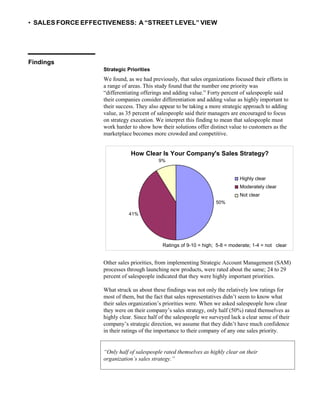
We found, as we had previously, that sales organizations focused their efforts in
a range of areas. This study found that the number one priority was
“differentiating offerings and adding value.” Forty percent of salespeople said
their companies consider differentiation and adding value as highly important to
their success. They also appear to be taking a more strategic approach to adding
value, as 35 percent of salespeople said their managers are encouraged to focus
on strategy execution. We interpret this finding to mean that salespeople must
work harder to show how their solutions offer distinct value to customers as the
marketplace becomes more crowded and competitive.
Other sales priorities, from implementing Strategic Account Management (SAM)
processes through launching new products, were rated about the same; 24 to 29
percent of salespeople indicated that they were highly important priorities.
What struck us about these findings was not only the relatively low ratings for
most of them, but the fact that sales representatives didn’t seem to know what
their sales organization’s priorities were. When we asked salespeople how clear
they were on their company’s sales strategy, only half (50%) rated themselves as
highly clear. Since half of the salespeople we surveyed lack a clear sense of their
company’s strategic direction, we assume that they didn’t have much confidence
in their ratings of the importance to their company of any one sales priority.
How Clear Is Your Company's Sales Strategy?
9%
Highly clear
Moderately clear
Not clear
50%
41%
Ratings of 9-10 = high; 5-8 = moderate; 1-4 = not clear
“Only half of salespeople rated themselves as highly clear on their
organization’s sales strategy.”
• SALES FORCE EFFECTIVENESS: A “STREET LEVEL” VIEW
What Customers' Value: Products & Services
70%
60%
50%
40%
30%
20%
10%
0%
Product meets needs Craf t asolution Provide options Low est price
Customer Salesperson
What Customers Value
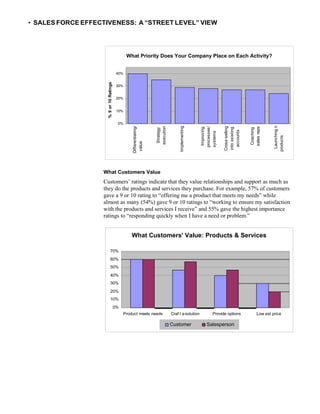
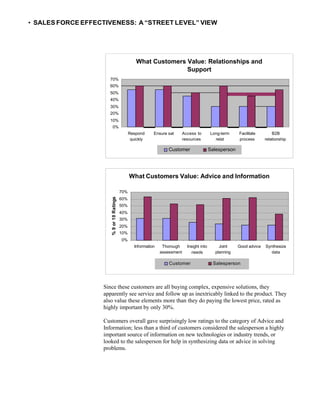
Customers’ ratings indicate that they value relationships and support as much as
they do the products and services they purchase. For example, 57% of customers
gave a 9 or 10 rating to “offering me a product that meets my needs” while
almost as many (54%) gave 9 or 10 ratings to “working to ensure my satisfaction
with the products and services I receive” and 55% gave the highest importance
ratings to “responding quickly when I have a need or problem.”
What Priority Does Your Company Place on Each Activity?
40%
30%
20%
10%
0%
%9or10Ratings
Differentiating/adding
value
Strategy
execution
ImplementingSAM
Improving
processes/
systems
Cross-selling
intoexisting
accounts
Coaching
salesreps
Launchingnew
products
• SALES FORCE EFFECTIVENESS: A “STREET LEVEL” VIEW
What Customers Value: Relationships and
Support
70%
60%
50%
40%
30%
20%
10%
0%
Respond Ensure sat Access to Long-term Facilitate B2B
quickly resources relat process relationship
Customer Salesperson
Since these customers are all buying complex, expensive solutions, they
apparently see service and follow up as inextricably linked to the product. They
also value these elements more than they do paying the lowest price, rated as
highly important by only 30%.
Customers overall gave surprisingly low ratings to the category of Advice and
Information; less than a third of customers considered the salesperson a highly
important source of information on new technologies or industry trends, or
looked to the salesperson for help in synthesizing data or advice in solving
problems.
Customer Salesperson
What Customers Value: Advice and Information
70%
60%
50%
40%
30%
20%
10%
0%
Information Thorough Insight into
assessment needs
Joint Good advice Synthesize
planning data
%9or10Ratings
• SALES FORCE EFFECTIVENESS: A “STREET LEVEL” VIEW
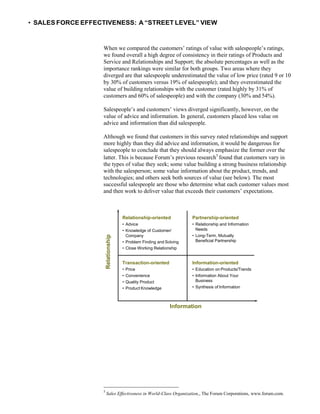
When we compared the customers’ ratings of value with salespeople’s ratings,
we found overall a high degree of consistency in their ratings of Products and
Service and Relationships and Support; the absolute percentages as well as the
importance rankings were similar for both groups. Two areas where they
diverged are that salespeople underestimated the value of low price (rated 9 or 10
by 30% of customers versus 19% of salespeople); and they overestimated the
value of building relationships with the customer (rated highly by 31% of
customers and 60% of salespeople) and with the company (30% and 54%).
Salespeople’s and customers’ views diverged significantly, however, on the
value of advice and information. In general, customers placed less value on
advice and information than did salespeople.
Although we found that customers in this survey rated relationships and support
more highly than they did advice and information, it would be dangerous for
salespeople to conclude that they should always emphasize the former over the
latter. This is because Forum’s previous research5
found that customers vary in
the types of value they seek; some value building a strong business relationship
with the salesperson; some value information about the product, trends, and
technologies; and others seek both sources of value (see below). The most
successful salespeople are those who determine what each customer values most
and then work to deliver value that exceeds their customers’ expectations.
Information
5
Sales Effectiveness in World-Class Organization,, The Forum Corporations, www.forum.com.
Relationship-oriented
• Advice
• Knowledge of Customer/
Company
• Problem Finding and Solving
• Close Working Relationship
Partnership-oriented
• Relationship and Information
Needs
• Long-Term, Mutually
Beneficial Partnership
Transaction-oriented
• Price
• Convenience
• Quality Product
• Product Knowledge
Information-oriented
• Education on Products/Trends
• Information About Your
Business
• Synthesis of Information
Relationship
• SALES FORCE EFFECTIVENESS: A “STREET LEVEL” VIEW
What Practices By Sales Organizations Stand Out?
25%
20%
15%
10%
5%
0%
Sales Practices that Customers Value
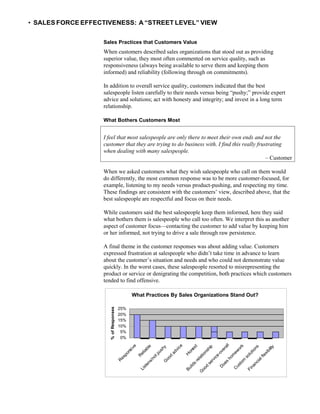
When customers described sales organizations that stood out as providing
superior value, they most often commented on service quality, such as
responsiveness (always being available to serve them and keeping them
informed) and reliability (following through on commitments).
In addition to overall service quality, customers indicated that the best
salespeople listen carefully to their needs versus being “pushy;” provide expert
advice and solutions; act with honesty and integrity; and invest in a long term
relationship.
What Bothers Customers Most
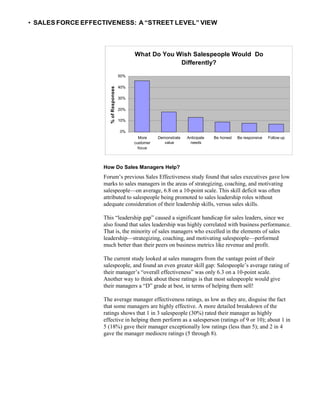
When we asked customers what they wish salespeople who call on them would
do differently, the most common response was to be more customer-focused, for
example, listening to my needs versus product-pushing, and respecting my time.
These findings are consistent with the customers’ view, described above, that the
best salespeople are respectful and focus on their needs.
While customers said the best salespeople keep them informed, here they said
what bothers them is salespeople who call too often. We interpret this as another
aspect of customer focus—contacting the customer to add value by keeping him
or her informed, not trying to drive a sale through raw persistence.
A final theme in the customer responses was about adding value. Customers
expressed frustration at salespeople who didn’t take time in advance to learn
about the customer’s situation and needs and who could not demonstrate value
quickly. In the worst cases, these salespeople resorted to misrepresenting the
product or service or denigrating the competition, both practices which customers
tended to find offensive.
I feel that most salespeople are only there to meet their own ends and not the
customer that they are trying to do business with. I find this really frustrating
when dealing with many salespeople.
– Customer
%ofResponses
• SALES FORCE EFFECTIVENESS: A “STREET LEVEL” VIEW
How Do Sales Managers Help?
Forum’s previous Sales Effectiveness study found that sales executives gave low
marks to sales managers in the areas of strategizing, coaching, and motivating
salespeople—on average, 6.8 on a 10-point scale. This skill deficit was often
attributed to salespeople being promoted to sales leadership roles without
adequate consideration of their leadership skills, versus sales skills.
This “leadership gap” caused a significant handicap for sales leaders, since we
also found that sales leadership was highly correlated with business performance.
That is, the minority of sales managers who excelled in the elements of sales
leadership—strategizing, coaching, and motivating salespeople—performed
much better than their peers on business metrics like revenue and profit.
The current study looked at sales managers from the vantage point of their
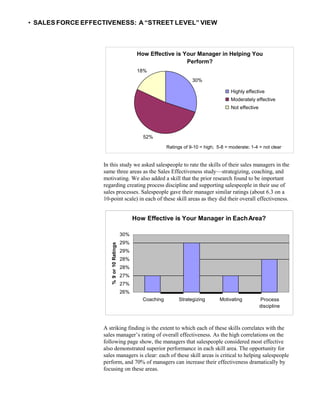
salespeople, and found an even greater skill gap: Salespeople’s average rating of
their manager’s “overall effectiveness” was only 6.3 on a 10-point scale.
Another way to think about these ratings is that most salespeople would give
their managers a “D” grade at best, in terms of helping them sell!
The average manager effectiveness ratings, as low as they are, disguise the fact
that some managers are highly effective. A more detailed breakdown of the
ratings shows that 1 in 3 salespeople (30%) rated their manager as highly
effective in helping them perform as a salesperson (ratings of 9 or 10); about 1 in
5 (18%) gave their manager exceptionally low ratings (less than 5); and 2 in 4
gave the manager mediocre ratings (5 through 8).
What Do You Wish Salespeople Would Do
Differently?
50%
40%
30%
20%
10%
0%
More
customer
focus
Demonstrate
value
Anticipate Be honest Be responsive Follow up
needs
%ofResponses
• SALES FORCE EFFECTIVENESS: A “STREET LEVEL” VIEW
How Effective is Your Manager in EachArea?
30%
29%
29%
28%
28%
27%
27%
26%
Coaching Strategizing Motivating Process
discipline
In this study we asked salespeople to rate the skills of their sales managers in the
same three areas as the Sales Effectiveness study—strategizing, coaching, and
motivating. We also added a skill that the prior research found to be important
regarding creating process discipline and supporting salespeople in their use of
sales processes. Salespeople gave their manager similar ratings (about 6.3 on a
10-point scale) in each of these skill areas as they did their overall effectiveness.
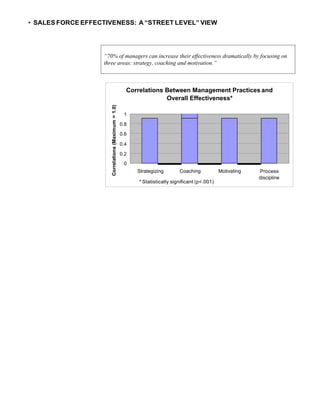
A striking finding is the extent to which each of these skills correlates with the
sales manager’s rating of overall effectiveness. As the high correlations on the
following page show, the managers that salespeople considered most effective
also demonstrated superior performance in each skill area. The opportunity for
sales managers is clear: each of these skill areas is critical to helping salespeople
perform, and 70% of managers can increase their effectiveness dramatically by
focusing on these areas.
How Effective is Your Manager in Helping You
Perform?
18%
30%
Highly effective
Moderately effective
Not effective
52%
Ratings of 9-10 = high; 5-8 = moderate; 1-4 = not clear
%9or10Ratings
• SALES FORCE EFFECTIVENESS: A “STREET LEVEL” VIEW
Correlations Between Management Practices and
Overall Effectiveness*
1
0.8
0.6
0.4
0.2
0
Strategizing Coaching Motivating
* Statistically significant (p<.001)
Process
discipline
“70% of managers can increase their effectiveness dramatically by focusing on
three areas: strategy, coaching and motivation.”
Correlations(Maximum=1.0)
• SALES FORCE EFFECTIVENESS: A “STREET LEVEL” VIEW
CONCLUSIONS AND RECOMMENDATIONS
This study provided a unique, “street-level” perspective on factors that lead to effective sales
performance. The results confirm and build upon our earlier research on sales force
effectiveness, specifically:
 Demonstrating unique value. Sales forces continue to pursue a range of priorities, and only
half of salespeople understand clearly their company’s business priorities. The greatest
common challenge they face is differentiating their offerings and adding value. Sales
managers can improve their results by paying more attention to communicating the
company’s sales strategy and providing coaching and direction in how to demonstrate distinct
value in every part of the sales process.
 Focusing on the customer. Customers value service quality as much as the products and
services they buy. They value salespeople who communicate often and follow up to ensure
their satisfaction. They also have little patience for salespeople who seem unprepared, who
try to “push” products, or who don’t focus on the customer’s situation and needs. Most
salespeople seem to have a good understanding of the customer’s viewpoint, although they
tend to overestimate the value of advice and information. Salespeople can improve their
performance by understanding and delivering the right mix of product, service, advice, and
information for each customer.
 Improving sales manager capabilities. Salespeople who view their managers as most
helpful in facilitating their sales performance give them high marks in four aspects of
leadership: Strategizing, coaching, motivating and providing training and support around sales
processes. Most sales managers have skill gaps in one or more of these areas. Many managers
are highly skilled salespeople. By attending to the “art of leadership,” as well as being a
model salesperson, managers can accelerate their team’s performance significantly.
Companies have high expectations for their sales forces as engines of growth. At the same time,
the global marketplace is becoming increasingly competitive and clients more demanding. The
role of the salesperson has never been more complex and challenging. The good news is that some
sales forces are able to excel consistently even in this tough environment. Our continuing research
aims to learn from their experience and to guide more sales forces into the “winner’s circle.”

Sales Force Effectiveness - Street Level View

  • 1.
    Sales Force Effectiveness: A“Street Level” View Research Report © 2016 The Forum Corporation. All Rights Reserved.
  • 3.
    • SALES FORCEEFFECTIVENESS: A “STREET LEVEL” VIEW What factors enable some sales forces to gain competitive advantage while others stumble? Forum has conducted extensive, global research since the 1980s to answer this question, including identifying the practices of top-performing consultative salespeople, determining how customers perceive value, and identifying the management and organizational factors that underlie success. The purpose of the present study was to re-validate and extend this research in today’s business environment. In doing so, we took a “street level” view—that is, we gathered input directly from salespeople and customers. The research addressed the following questions:  What are the business priorities of sales organizations? How clearly do salespeople understand their sales organization’s strategy? In a major study of sales force effectiveness conducted previously1 , Forum found that sales forces focused on a range of priorities, from marketing strategies, such as launching new products or cross-selling into existing accounts; through implementing internal systems and processes, such as Strategic Account Management (SAM), to enhancing sales manager effectiveness. We expected that these priorities would still be important, and we intended to determine the extent to which companies are choosing each approach.  What sales practices do customers view as adding the most value? To what extent do salespeople’s views of these practices coincide with customers’? Forum’s prior research2 has identified practices of top performing salespeople, such as listening to the customer’s needs, building relationships and demonstrating value. The present study aimed to determine the relative importance of these practices from the customer’s standpoint, and to compare the perceptions of customers with those of salespeople. We expected that these practices would still be rated as important, but were curious to find out if some were deemed more important than others, as well as whether or not salespeople and manager views were aligned. 1 “How Sales Forces Sustain Competitive Advantage,” Sales Force Research Report, The Forum Corporation, 2004. 2 See www.forum.com for Forum sales research reports.
  • 4.
    • SALES FORCEEFFECTIVENESS: A “STREET LEVEL” VIEW  What sales management practices are linked most closely to sales performance? Forum’s previous research pointed to the sales manager as playing a pivotal role in the success of a sales organization. Specifically, in top performing sales organizations managers are good at four things: developing strategy for their team and their accounts; being a coach and providing regular feedback; creating a motivating environment; and creating accountability and providing support around disciplined sales processes. Our hypothesis was that all four of these management practices would remain important, although we were uncertain about whether they would be equally important to sales effectiveness. Methods Forum conducted an electronic survey of 391 salespeople and 557 customers from a cross section of industries, including business and professional services, health care, hospitality and retail, telecommunications and high technology3 . Within those populations, for this report, we selected the 93 sales representatives and 130 customers who were involved in purchasing products or services costing $50,000 or more4 . Our assumption is that these sales represented the most complex buying processes and would require the salesperson to apply consultative selling skills. We asked customers what sources of value they looked for in a salesperson, including three categories: Product or service (such as, offering options); Relationships and support (such as following up after the sale to ensure satisfaction); and Advice and information (such as, assessing needs). We also asked them for examples of salespeople who stood out in their mind and what they wished salespeople would do more of, less of or differently. We asked salespeople to rate the sources of value they provide to customers, so we could compare their perceptions with those of customers. In addition, we asked salespeople to rate the extent to which they understood their company’s sales strategy, the effectiveness of their manager and senior management, and what advice they would offer other salespeople in situations like theirs. 3 The survey was conducted in the US in May, 2007 and in the United Kingdom in September. 4 The US survey had 153 respondents (77 salespeople and 76 customers) and the UK survey had 70 (16 salespeople and 54 customers).
  • 5.
    • SALES FORCEEFFECTIVENESS: A “STREET LEVEL” VIEW Findings Strategic Priorities We found, as we had previously, that sales organizations focused their efforts in a range of areas. This study found that the number one priority was “differentiating offerings and adding value.” Forty percent of salespeople said their companies consider differentiation and adding value as highly important to their success. They also appear to be taking a more strategic approach to adding value, as 35 percent of salespeople said their managers are encouraged to focus on strategy execution. We interpret this finding to mean that salespeople must work harder to show how their solutions offer distinct value to customers as the marketplace becomes more crowded and competitive. Other sales priorities, from implementing Strategic Account Management (SAM) processes through launching new products, were rated about the same; 24 to 29 percent of salespeople indicated that they were highly important priorities. What struck us about these findings was not only the relatively low ratings for most of them, but the fact that sales representatives didn’t seem to know what their sales organization’s priorities were. When we asked salespeople how clear they were on their company’s sales strategy, only half (50%) rated themselves as highly clear. Since half of the salespeople we surveyed lack a clear sense of their company’s strategic direction, we assume that they didn’t have much confidence in their ratings of the importance to their company of any one sales priority. How Clear Is Your Company's Sales Strategy? 9% Highly clear Moderately clear Not clear 50% 41% Ratings of 9-10 = high; 5-8 = moderate; 1-4 = not clear “Only half of salespeople rated themselves as highly clear on their organization’s sales strategy.”
  • 6.
    • SALES FORCEEFFECTIVENESS: A “STREET LEVEL” VIEW What Customers' Value: Products & Services 70% 60% 50% 40% 30% 20% 10% 0% Product meets needs Craf t asolution Provide options Low est price Customer Salesperson What Customers Value Customers’ ratings indicate that they value relationships and support as much as they do the products and services they purchase. For example, 57% of customers gave a 9 or 10 rating to “offering me a product that meets my needs” while almost as many (54%) gave 9 or 10 ratings to “working to ensure my satisfaction with the products and services I receive” and 55% gave the highest importance ratings to “responding quickly when I have a need or problem.” What Priority Does Your Company Place on Each Activity? 40% 30% 20% 10% 0% %9or10Ratings Differentiating/adding value Strategy execution ImplementingSAM Improving processes/ systems Cross-selling intoexisting accounts Coaching salesreps Launchingnew products
  • 7.
    • SALES FORCEEFFECTIVENESS: A “STREET LEVEL” VIEW What Customers Value: Relationships and Support 70% 60% 50% 40% 30% 20% 10% 0% Respond Ensure sat Access to Long-term Facilitate B2B quickly resources relat process relationship Customer Salesperson Since these customers are all buying complex, expensive solutions, they apparently see service and follow up as inextricably linked to the product. They also value these elements more than they do paying the lowest price, rated as highly important by only 30%. Customers overall gave surprisingly low ratings to the category of Advice and Information; less than a third of customers considered the salesperson a highly important source of information on new technologies or industry trends, or looked to the salesperson for help in synthesizing data or advice in solving problems. Customer Salesperson What Customers Value: Advice and Information 70% 60% 50% 40% 30% 20% 10% 0% Information Thorough Insight into assessment needs Joint Good advice Synthesize planning data %9or10Ratings
  • 8.
    • SALES FORCEEFFECTIVENESS: A “STREET LEVEL” VIEW When we compared the customers’ ratings of value with salespeople’s ratings, we found overall a high degree of consistency in their ratings of Products and Service and Relationships and Support; the absolute percentages as well as the importance rankings were similar for both groups. Two areas where they diverged are that salespeople underestimated the value of low price (rated 9 or 10 by 30% of customers versus 19% of salespeople); and they overestimated the value of building relationships with the customer (rated highly by 31% of customers and 60% of salespeople) and with the company (30% and 54%). Salespeople’s and customers’ views diverged significantly, however, on the value of advice and information. In general, customers placed less value on advice and information than did salespeople. Although we found that customers in this survey rated relationships and support more highly than they did advice and information, it would be dangerous for salespeople to conclude that they should always emphasize the former over the latter. This is because Forum’s previous research5 found that customers vary in the types of value they seek; some value building a strong business relationship with the salesperson; some value information about the product, trends, and technologies; and others seek both sources of value (see below). The most successful salespeople are those who determine what each customer values most and then work to deliver value that exceeds their customers’ expectations. Information 5 Sales Effectiveness in World-Class Organization,, The Forum Corporations, www.forum.com. Relationship-oriented • Advice • Knowledge of Customer/ Company • Problem Finding and Solving • Close Working Relationship Partnership-oriented • Relationship and Information Needs • Long-Term, Mutually Beneficial Partnership Transaction-oriented • Price • Convenience • Quality Product • Product Knowledge Information-oriented • Education on Products/Trends • Information About Your Business • Synthesis of Information Relationship
  • 9.
    • SALES FORCEEFFECTIVENESS: A “STREET LEVEL” VIEW What Practices By Sales Organizations Stand Out? 25% 20% 15% 10% 5% 0% Sales Practices that Customers Value When customers described sales organizations that stood out as providing superior value, they most often commented on service quality, such as responsiveness (always being available to serve them and keeping them informed) and reliability (following through on commitments). In addition to overall service quality, customers indicated that the best salespeople listen carefully to their needs versus being “pushy;” provide expert advice and solutions; act with honesty and integrity; and invest in a long term relationship. What Bothers Customers Most When we asked customers what they wish salespeople who call on them would do differently, the most common response was to be more customer-focused, for example, listening to my needs versus product-pushing, and respecting my time. These findings are consistent with the customers’ view, described above, that the best salespeople are respectful and focus on their needs. While customers said the best salespeople keep them informed, here they said what bothers them is salespeople who call too often. We interpret this as another aspect of customer focus—contacting the customer to add value by keeping him or her informed, not trying to drive a sale through raw persistence. A final theme in the customer responses was about adding value. Customers expressed frustration at salespeople who didn’t take time in advance to learn about the customer’s situation and needs and who could not demonstrate value quickly. In the worst cases, these salespeople resorted to misrepresenting the product or service or denigrating the competition, both practices which customers tended to find offensive. I feel that most salespeople are only there to meet their own ends and not the customer that they are trying to do business with. I find this really frustrating when dealing with many salespeople. – Customer %ofResponses
  • 10.
    • SALES FORCEEFFECTIVENESS: A “STREET LEVEL” VIEW How Do Sales Managers Help? Forum’s previous Sales Effectiveness study found that sales executives gave low marks to sales managers in the areas of strategizing, coaching, and motivating salespeople—on average, 6.8 on a 10-point scale. This skill deficit was often attributed to salespeople being promoted to sales leadership roles without adequate consideration of their leadership skills, versus sales skills. This “leadership gap” caused a significant handicap for sales leaders, since we also found that sales leadership was highly correlated with business performance. That is, the minority of sales managers who excelled in the elements of sales leadership—strategizing, coaching, and motivating salespeople—performed much better than their peers on business metrics like revenue and profit. The current study looked at sales managers from the vantage point of their salespeople, and found an even greater skill gap: Salespeople’s average rating of their manager’s “overall effectiveness” was only 6.3 on a 10-point scale. Another way to think about these ratings is that most salespeople would give their managers a “D” grade at best, in terms of helping them sell! The average manager effectiveness ratings, as low as they are, disguise the fact that some managers are highly effective. A more detailed breakdown of the ratings shows that 1 in 3 salespeople (30%) rated their manager as highly effective in helping them perform as a salesperson (ratings of 9 or 10); about 1 in 5 (18%) gave their manager exceptionally low ratings (less than 5); and 2 in 4 gave the manager mediocre ratings (5 through 8). What Do You Wish Salespeople Would Do Differently? 50% 40% 30% 20% 10% 0% More customer focus Demonstrate value Anticipate Be honest Be responsive Follow up needs %ofResponses
  • 11.
    • SALES FORCEEFFECTIVENESS: A “STREET LEVEL” VIEW How Effective is Your Manager in EachArea? 30% 29% 29% 28% 28% 27% 27% 26% Coaching Strategizing Motivating Process discipline In this study we asked salespeople to rate the skills of their sales managers in the same three areas as the Sales Effectiveness study—strategizing, coaching, and motivating. We also added a skill that the prior research found to be important regarding creating process discipline and supporting salespeople in their use of sales processes. Salespeople gave their manager similar ratings (about 6.3 on a 10-point scale) in each of these skill areas as they did their overall effectiveness. A striking finding is the extent to which each of these skills correlates with the sales manager’s rating of overall effectiveness. As the high correlations on the following page show, the managers that salespeople considered most effective also demonstrated superior performance in each skill area. The opportunity for sales managers is clear: each of these skill areas is critical to helping salespeople perform, and 70% of managers can increase their effectiveness dramatically by focusing on these areas. How Effective is Your Manager in Helping You Perform? 18% 30% Highly effective Moderately effective Not effective 52% Ratings of 9-10 = high; 5-8 = moderate; 1-4 = not clear %9or10Ratings
  • 12.
    • SALES FORCEEFFECTIVENESS: A “STREET LEVEL” VIEW Correlations Between Management Practices and Overall Effectiveness* 1 0.8 0.6 0.4 0.2 0 Strategizing Coaching Motivating * Statistically significant (p<.001) Process discipline “70% of managers can increase their effectiveness dramatically by focusing on three areas: strategy, coaching and motivation.” Correlations(Maximum=1.0)
  • 13.
    • SALES FORCEEFFECTIVENESS: A “STREET LEVEL” VIEW CONCLUSIONS AND RECOMMENDATIONS This study provided a unique, “street-level” perspective on factors that lead to effective sales performance. The results confirm and build upon our earlier research on sales force effectiveness, specifically:  Demonstrating unique value. Sales forces continue to pursue a range of priorities, and only half of salespeople understand clearly their company’s business priorities. The greatest common challenge they face is differentiating their offerings and adding value. Sales managers can improve their results by paying more attention to communicating the company’s sales strategy and providing coaching and direction in how to demonstrate distinct value in every part of the sales process.  Focusing on the customer. Customers value service quality as much as the products and services they buy. They value salespeople who communicate often and follow up to ensure their satisfaction. They also have little patience for salespeople who seem unprepared, who try to “push” products, or who don’t focus on the customer’s situation and needs. Most salespeople seem to have a good understanding of the customer’s viewpoint, although they tend to overestimate the value of advice and information. Salespeople can improve their performance by understanding and delivering the right mix of product, service, advice, and information for each customer.  Improving sales manager capabilities. Salespeople who view their managers as most helpful in facilitating their sales performance give them high marks in four aspects of leadership: Strategizing, coaching, motivating and providing training and support around sales processes. Most sales managers have skill gaps in one or more of these areas. Many managers are highly skilled salespeople. By attending to the “art of leadership,” as well as being a model salesperson, managers can accelerate their team’s performance significantly. Companies have high expectations for their sales forces as engines of growth. At the same time, the global marketplace is becoming increasingly competitive and clients more demanding. The role of the salesperson has never been more complex and challenging. The good news is that some sales forces are able to excel consistently even in this tough environment. Our continuing research aims to learn from their experience and to guide more sales forces into the “winner’s circle.”