Fabien Gandon, Wendy Hall
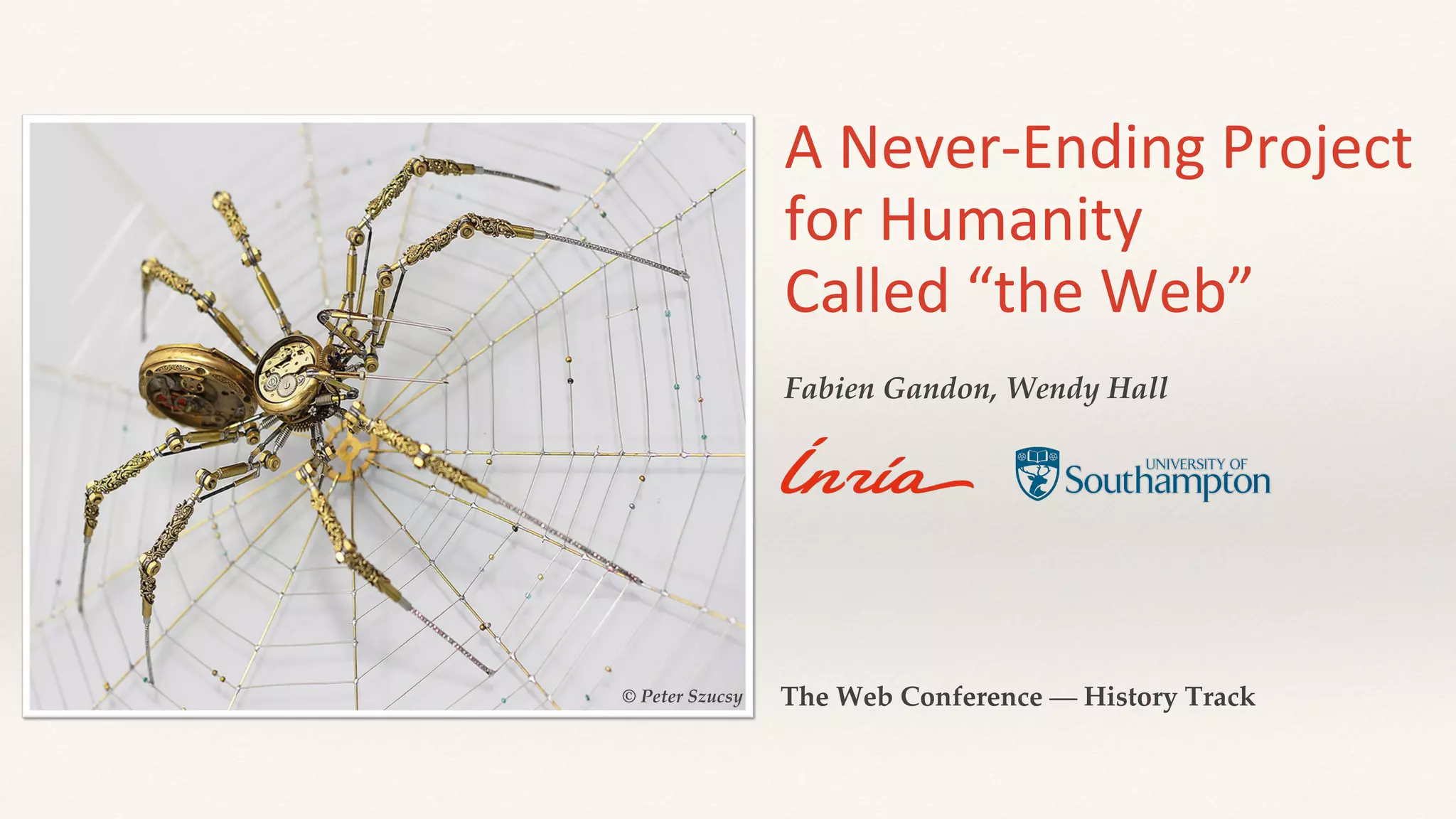
A Never-Ending Project
for Humanity
Called “the Web”
The Web Conference ⸺ History Track
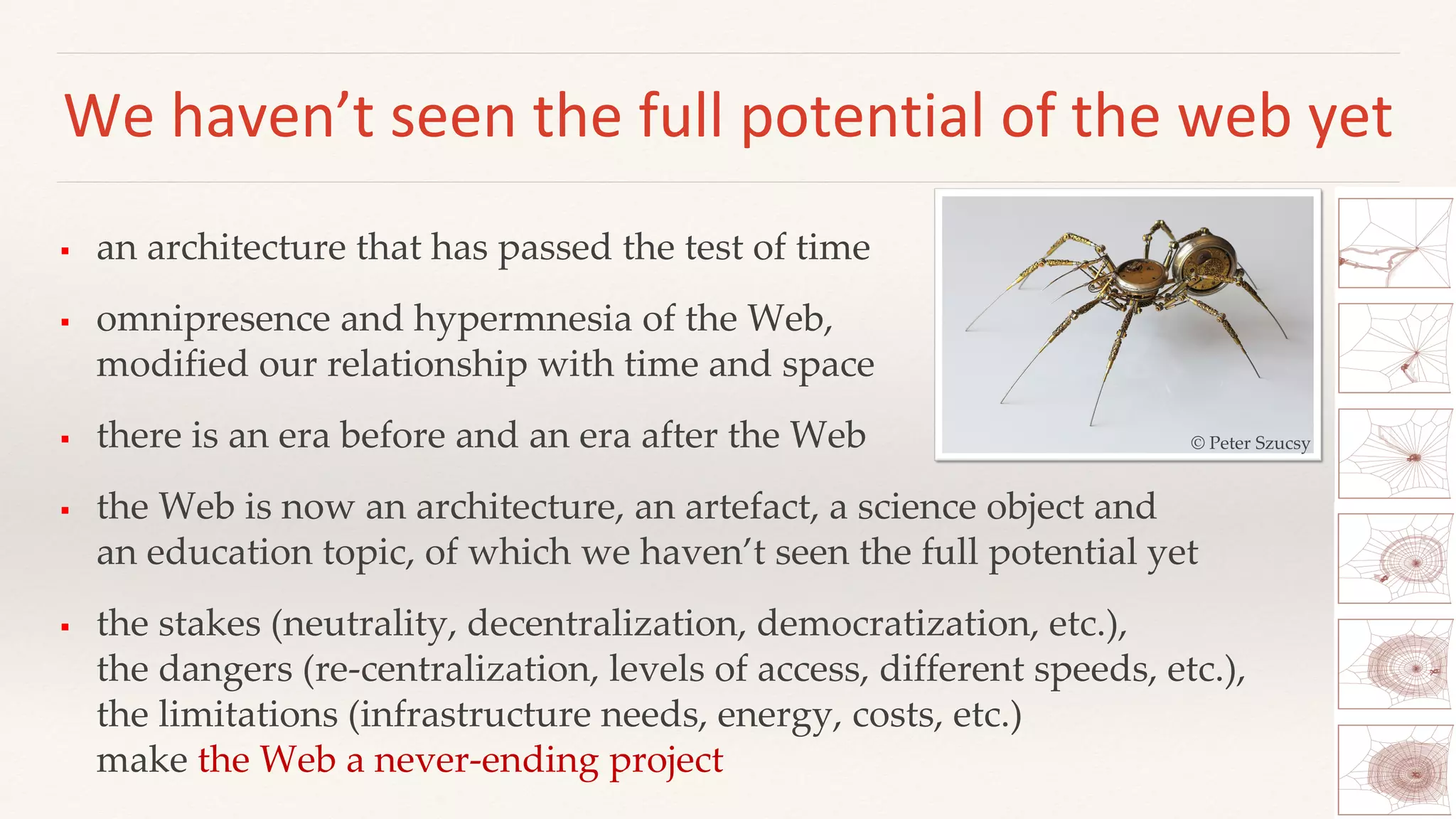
© Peter Szucsy
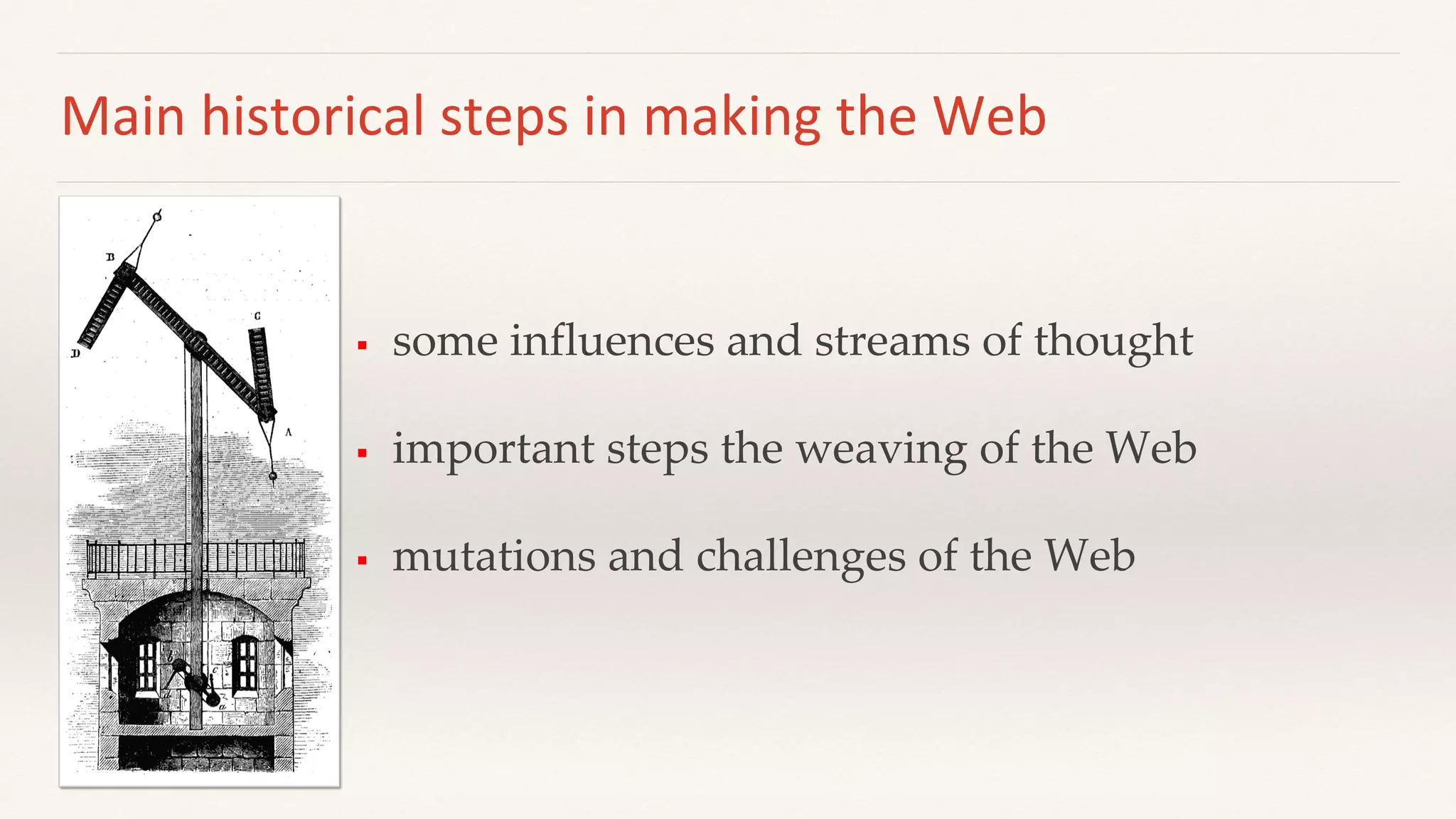
Main historical steps in making the Web
 some influences and streams of thought
 important steps the weaving of the Web
 mutations and challenges of the Web
Organize and access masses of information
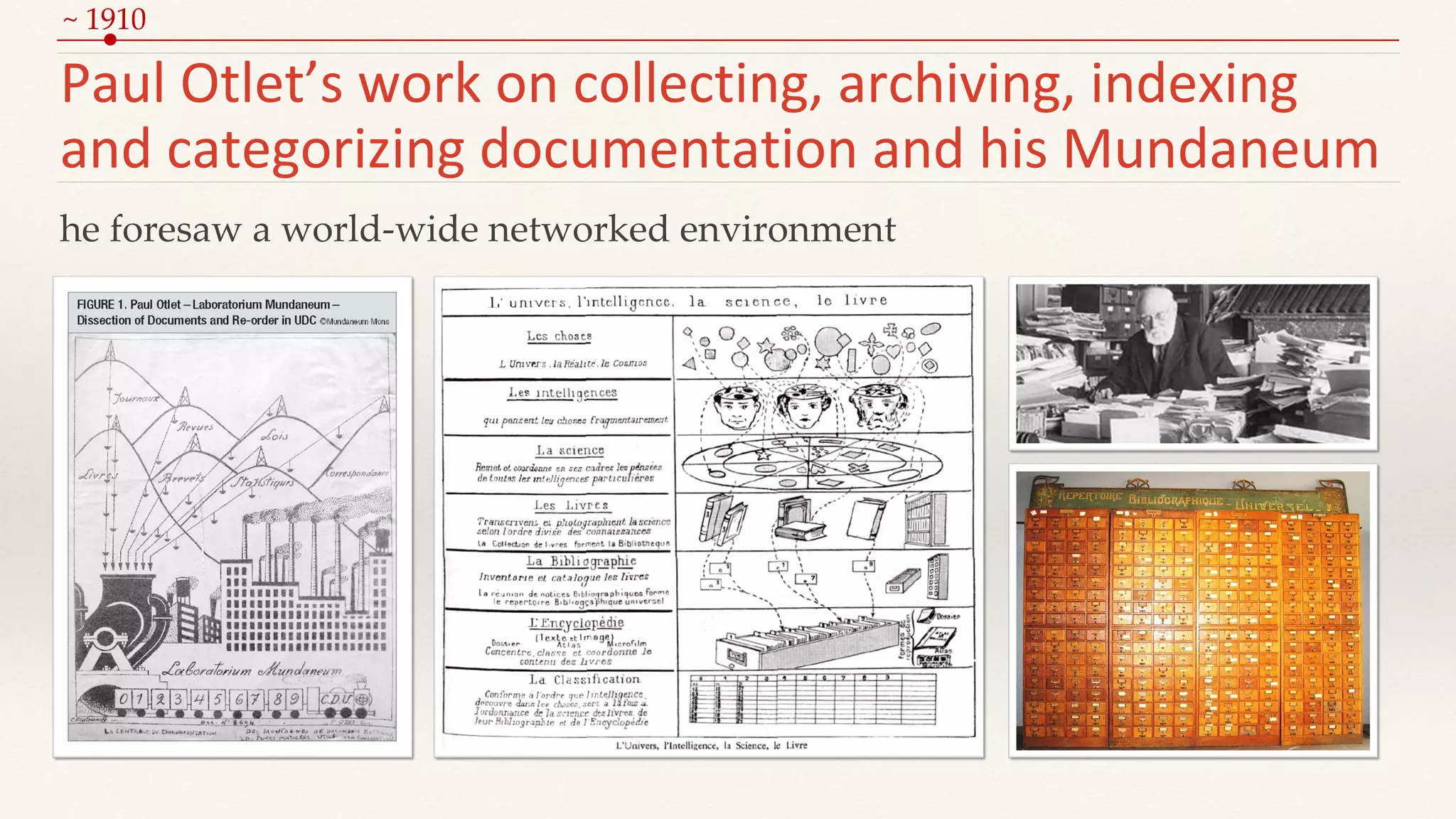
Paul Otlet’s work on collecting, archiving, indexing
and categorizing documentation and his Mundaneum
he foresaw a world-wide networked environment
~ 1910
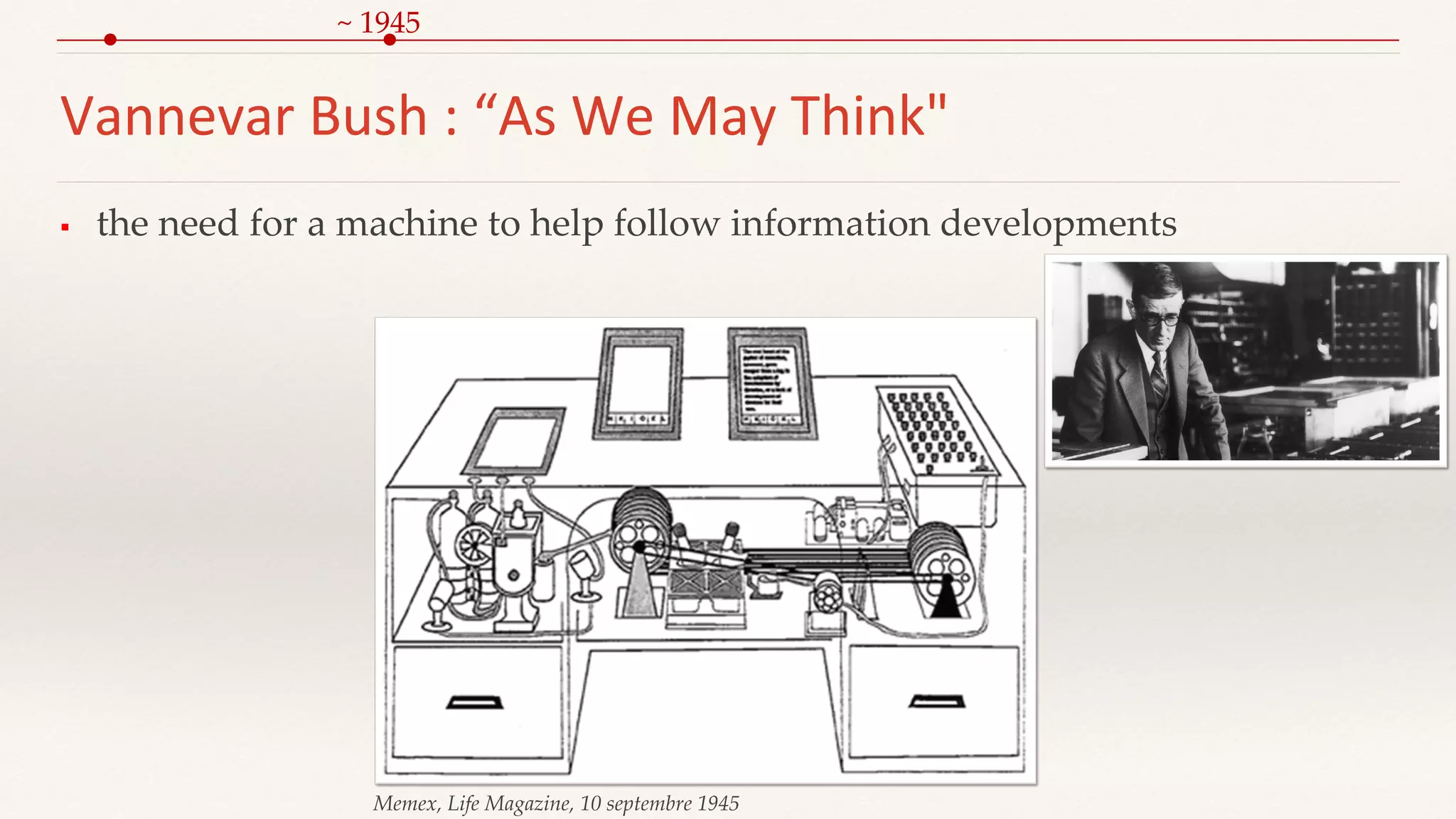
Vannevar Bush : “As We May Think"
 the need for a machine to help follow information developments
~ 1945
Memex, Life Magazine, 10 septembre 1945
Vannevar Bush : “As We May Think"
 the need for a machine to help follow information developments
 externalizing the points and links of association…
Memex, Life Magazine, 10 septembre 1945
“the association
of thoughts, in
accordance with
some intricate
web [sic] of trails
carried by the
cells of the brain”
~ 1945
Vannevar Bush : “As We May Think"
 the need for a machine to help follow information developments
 externalizing the points and links of association…
Memex, Life Magazine, 10 septembre 1945
“the association
of thoughts, in
accordance with
some intricate
web [sic] of trails
carried by the
cells of the brain”
~ 1945
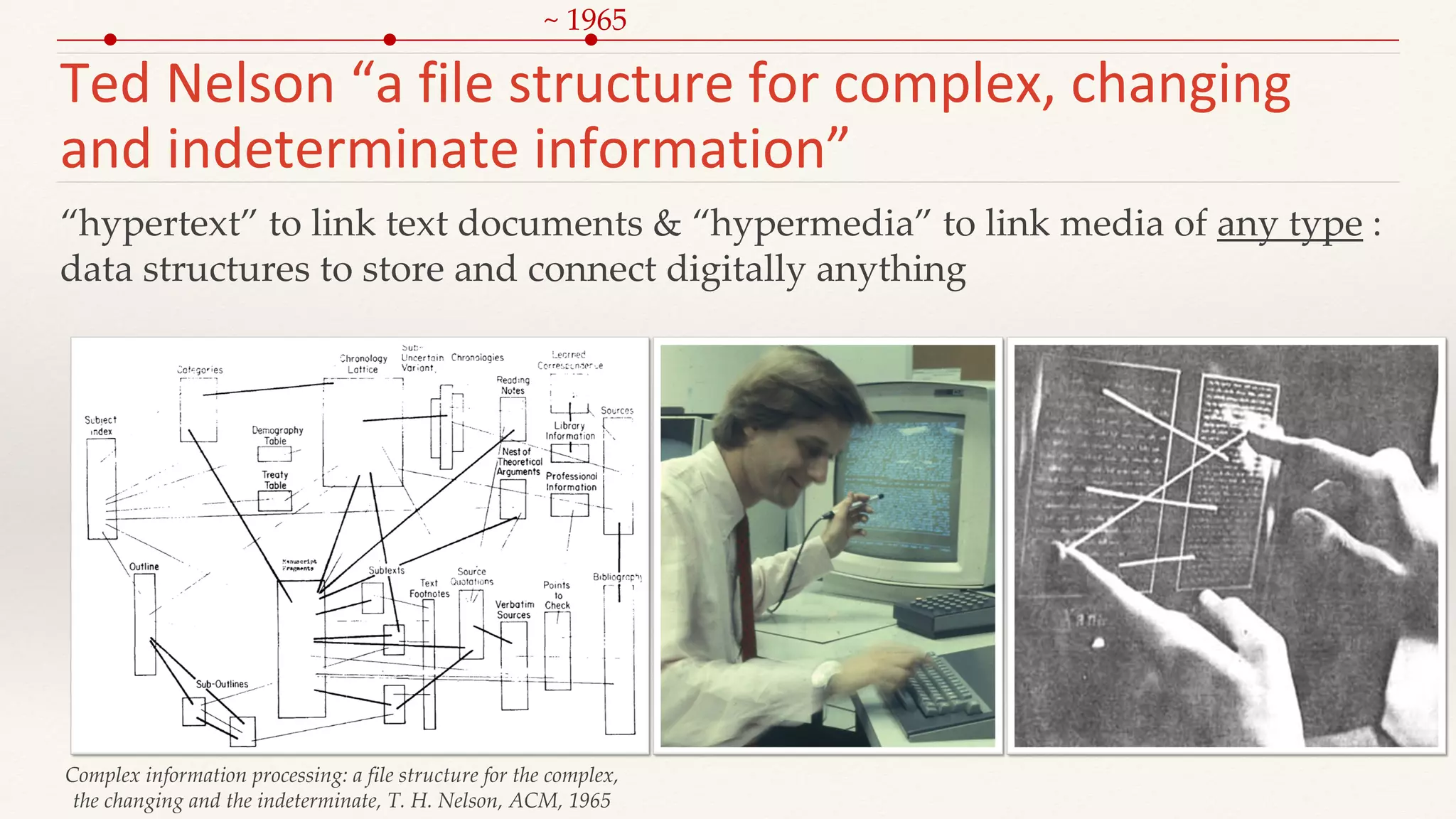
Ted Nelson “a file structure for complex, changing
and indeterminate information”
“hypertext” to link text documents & “hypermedia” to link media of any type :
data structures to store and connect digitally anything
Complex information processing: a file structure for the complex,
the changing and the indeterminate, T. H. Nelson, ACM, 1965
~ 1965
Hypertexts evolution
 First generation : mainframes and largely text-based.
 Second generation : more advanced user interfaces
on workstations (e.g. graphical overviews) and
multi-user support
 Third generation available on PCs and in 1987:
 HyperCard available for free on every Macintosh
 first ACM Hypertext conference
 Crossing between internet and hypertext
ex. Hyper-G [2], Microcosm [15], and of course…
1965
Xanadu overview
1980
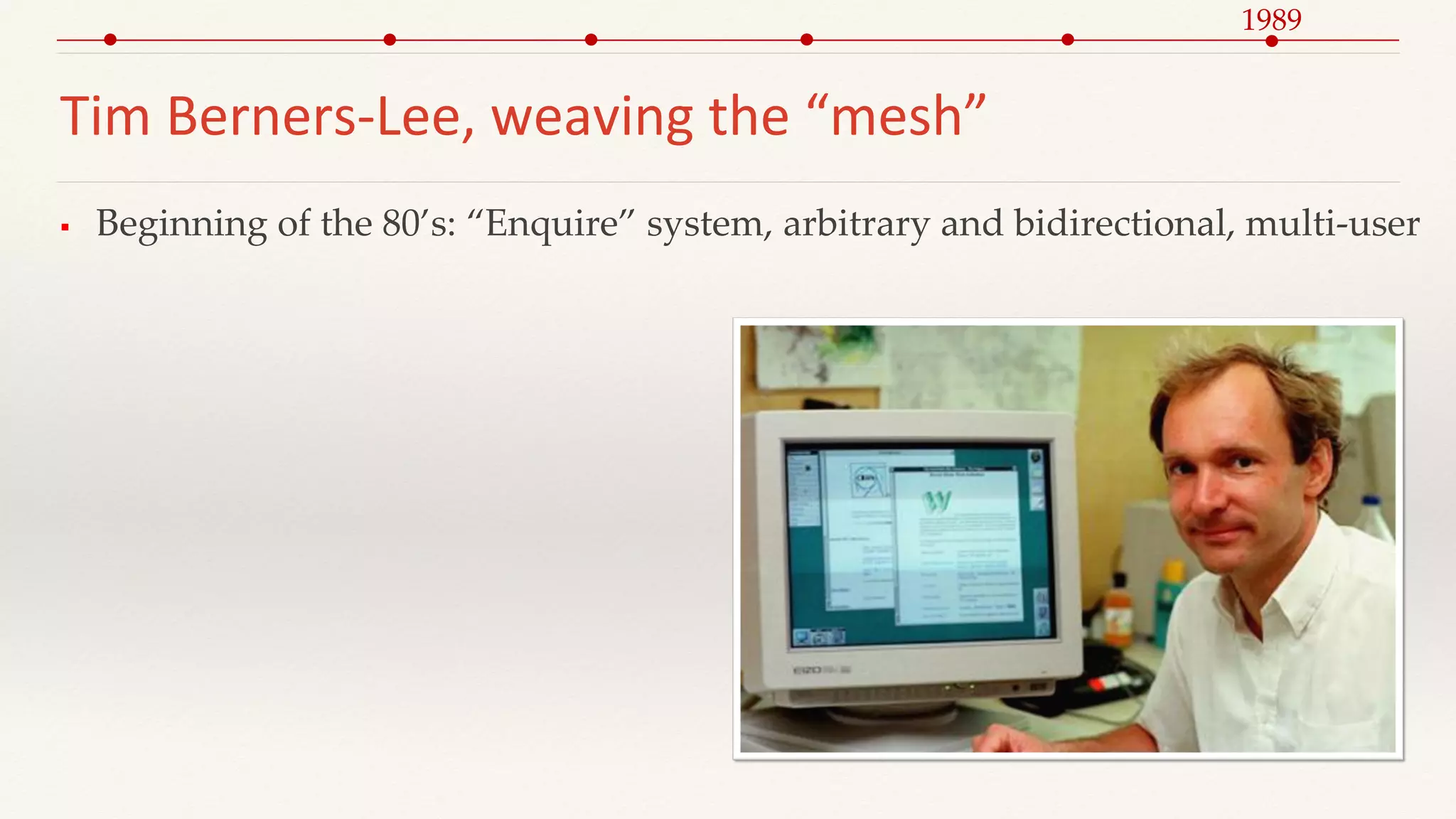
Tim Berners-Lee, weaving the “mesh”
 Beginning of the 80’s: “Enquire” system, arbitrary and bidirectional, multi-user
1989
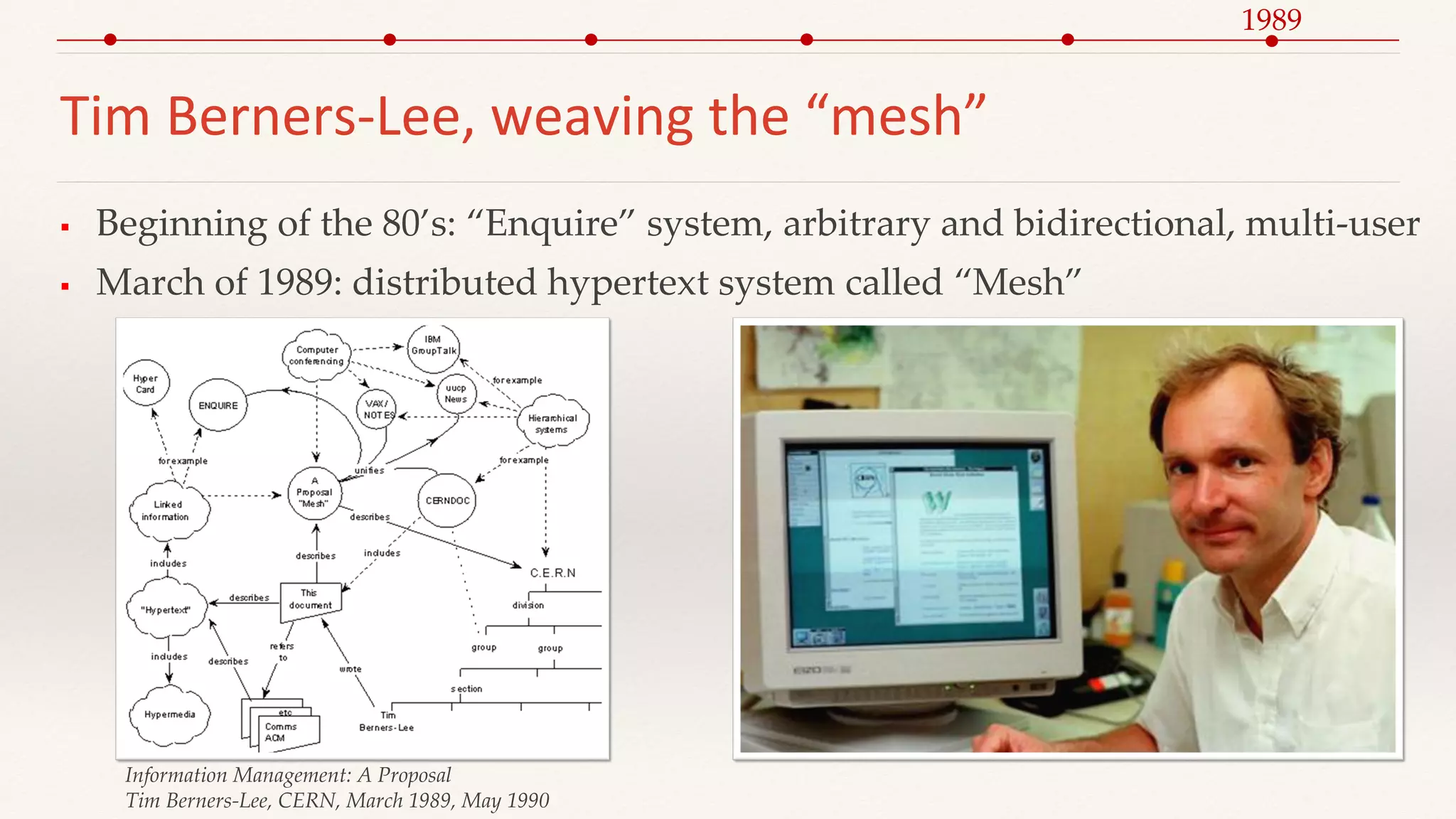
Tim Berners-Lee, weaving the “mesh”
 Beginning of the 80’s: “Enquire” system, arbitrary and bidirectional, multi-user
 March of 1989: distributed hypertext system called “Mesh”
Information Management: A Proposal
Tim Berners-Lee, CERN, March 1989, May 1990
1989
Weaving the… “Mesh”
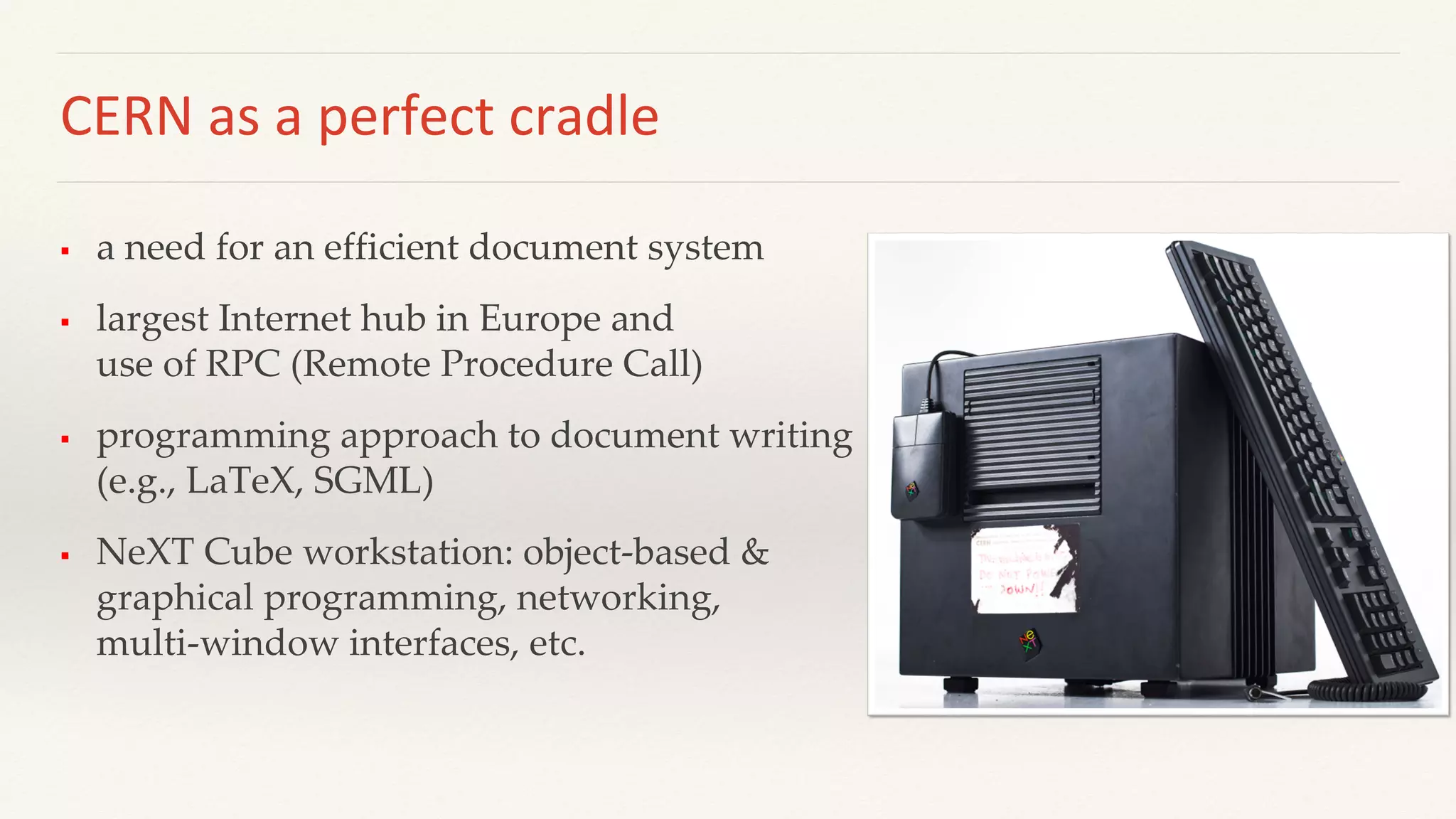
CERN as a perfect cradle
 a need for an efficient document system
 largest Internet hub in Europe and
use of RPC (Remote Procedure Call)
 programming approach to document writing
(e.g., LaTeX, SGML)
 NeXT Cube workstation: object-based &
graphical programming, networking,
multi-window interfaces, etc.
Weaving the “Mesh”
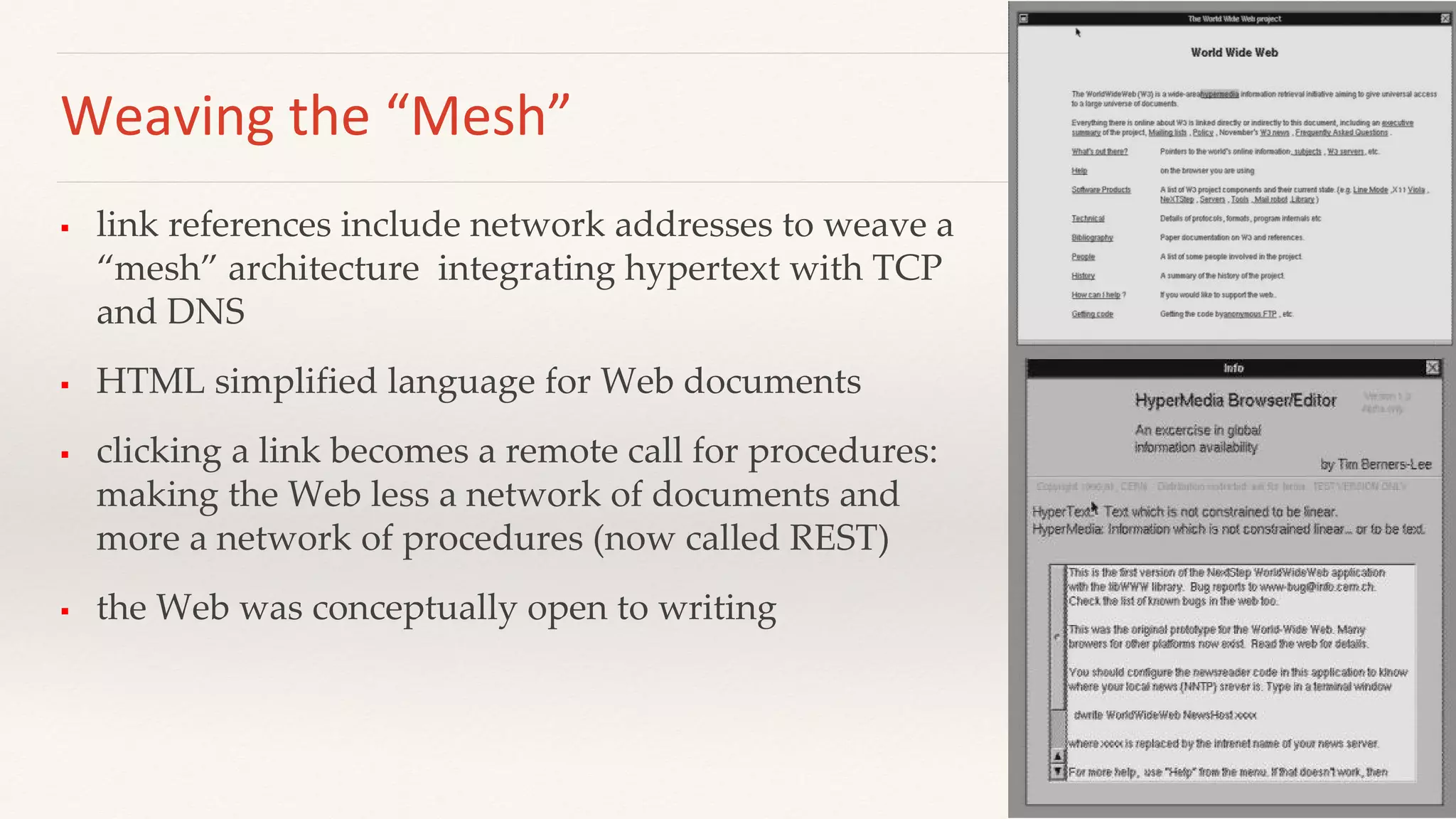
 link references include network addresses to weave a
“mesh” architecture integrating hypertext with TCP
and DNS
 HTML simplified language for Web documents
 clicking a link becomes a remote call for procedures:
making the Web less a network of documents and
more a network of procedures (now called REST)
 the Web was conceptually open to writing
Weaving the “Mesh”
 link references include network addresses to weave a
“mesh” architecture integrating hypertext with TCP
and DNS
 HTML simplified language for Web documents
 clicking a link becomes a remote call for procedures:
making the Web less a network of documents and
more a network of procedures (now called REST)
 the Web was conceptually open to writing
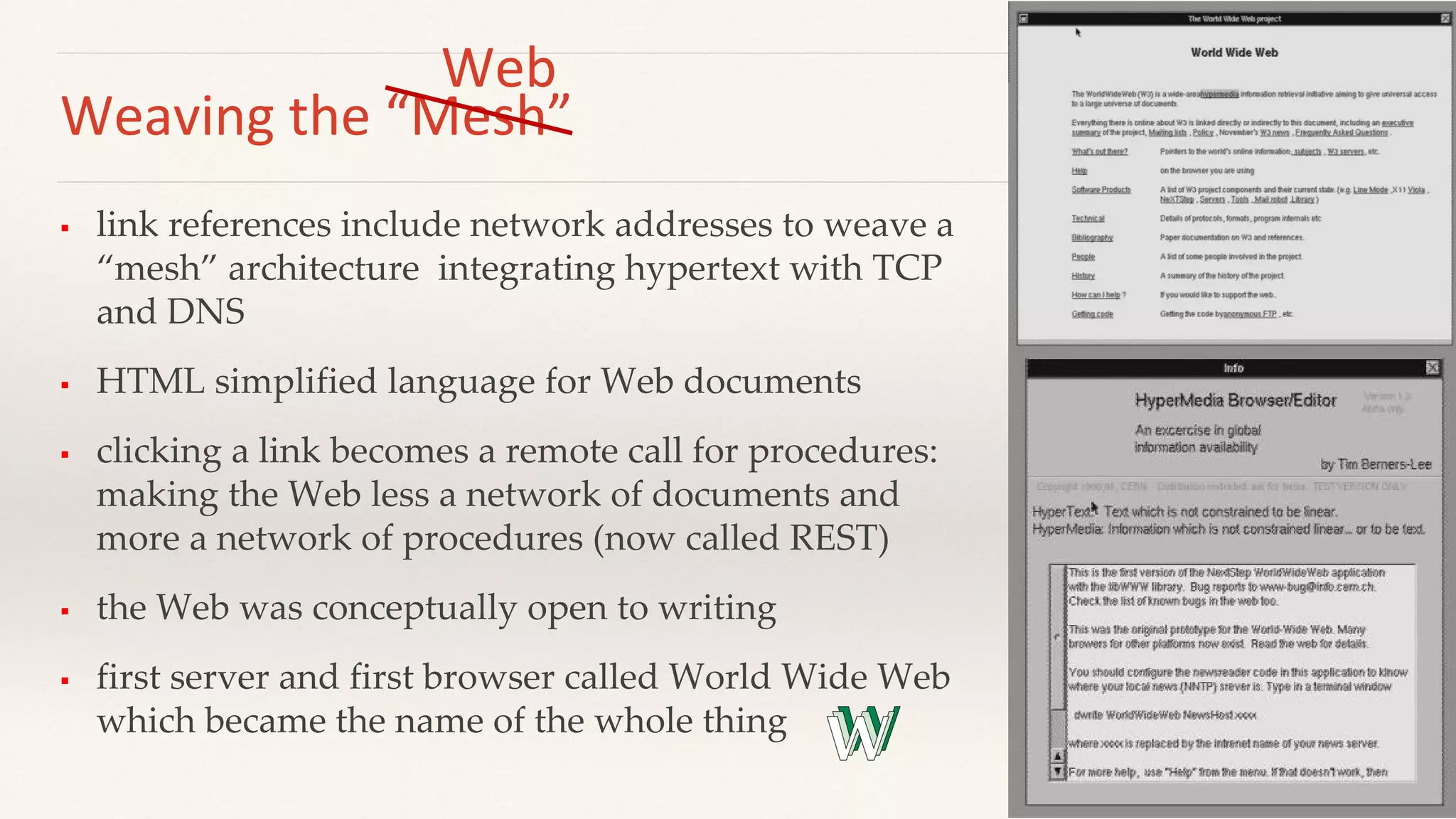
 first server and first browser called World Wide Web
which became the name of the whole thing
Web
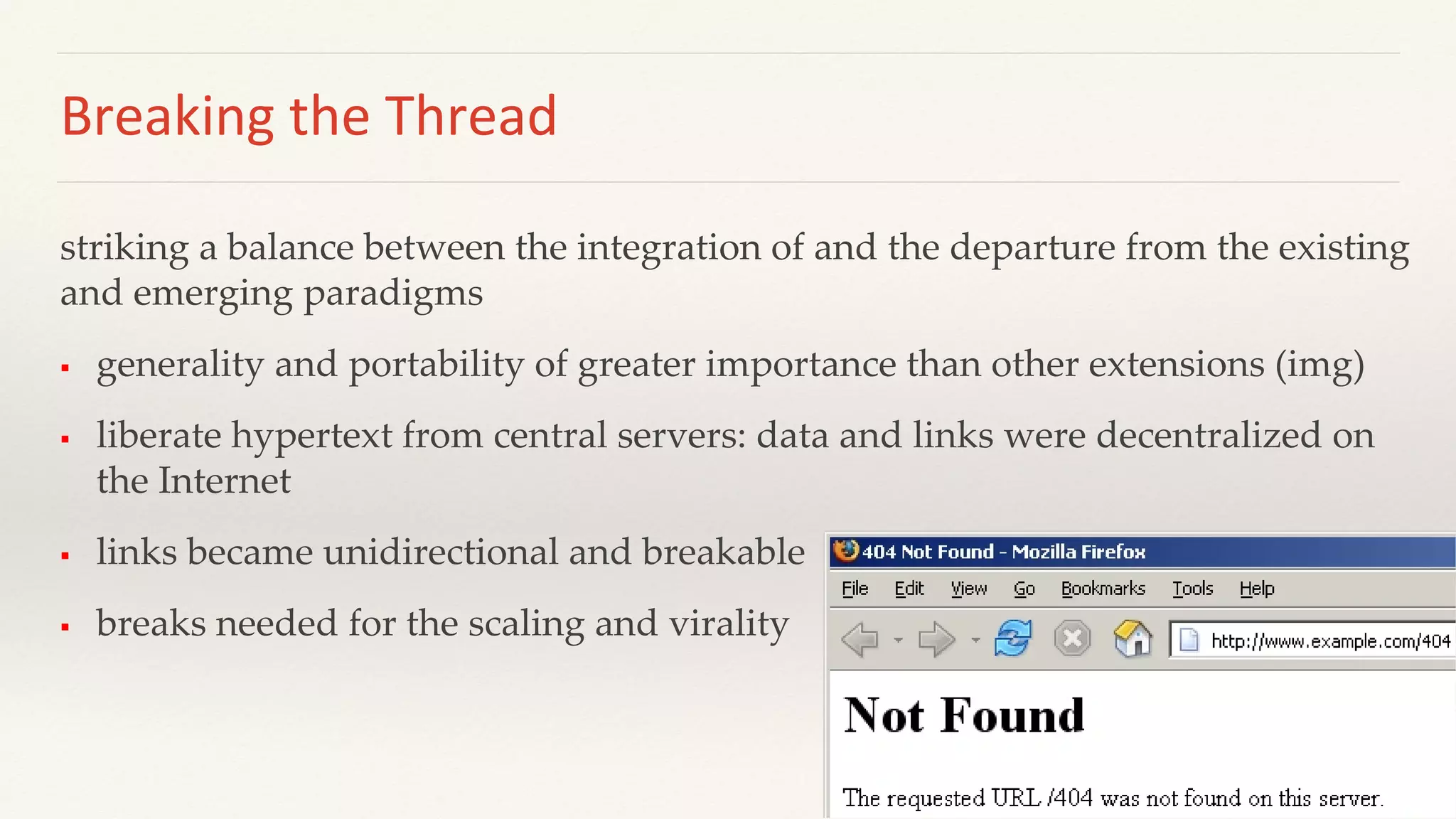
Breaking the Thread
striking a balance between the integration of and the departure from the existing
and emerging paradigms
 generality and portability of greater importance than other extensions (img)
 liberate hypertext from central servers: data and links were decentralized on
the Internet
 links became unidirectional and breakable
 breaks needed for the scaling and virality
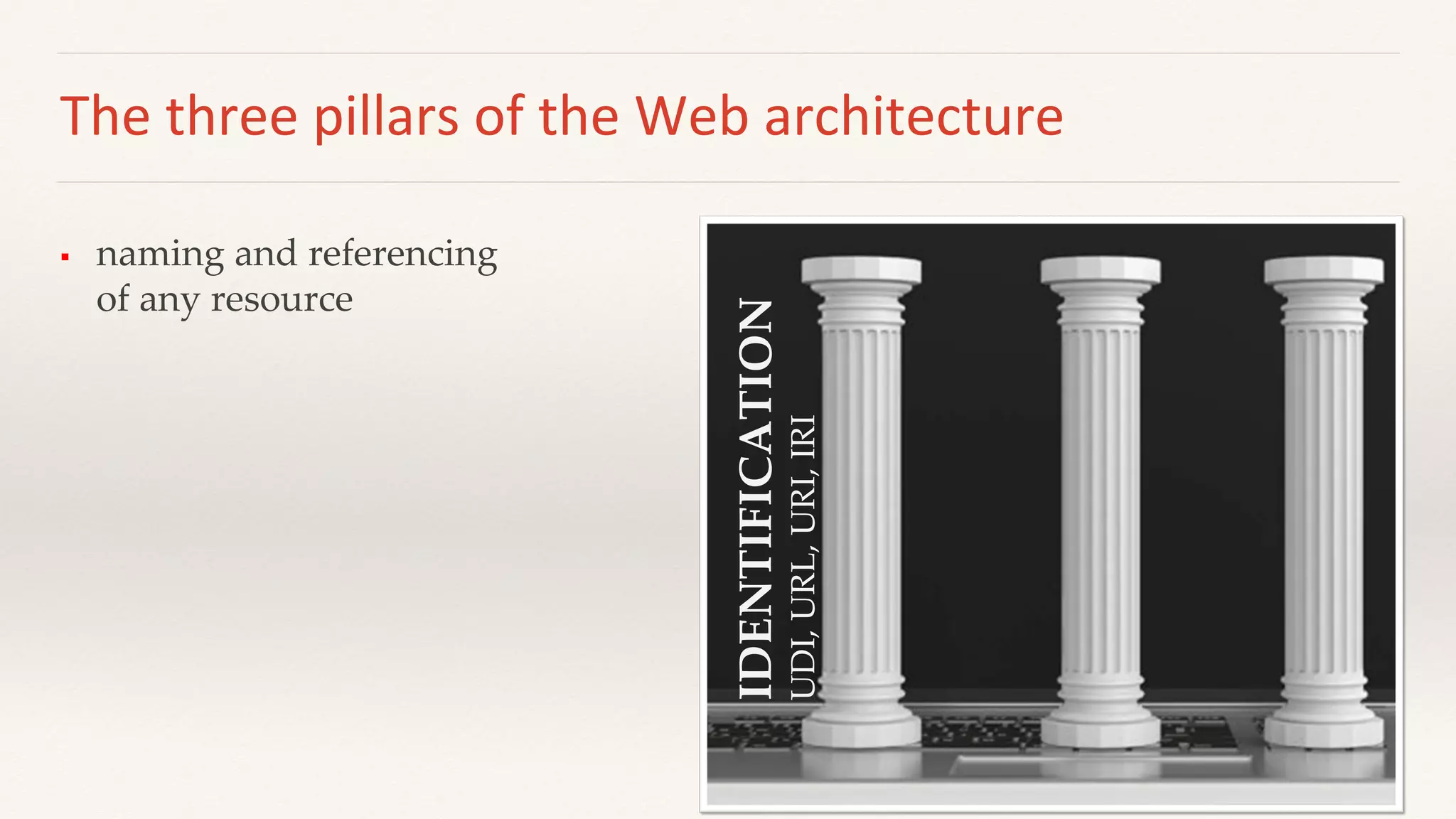
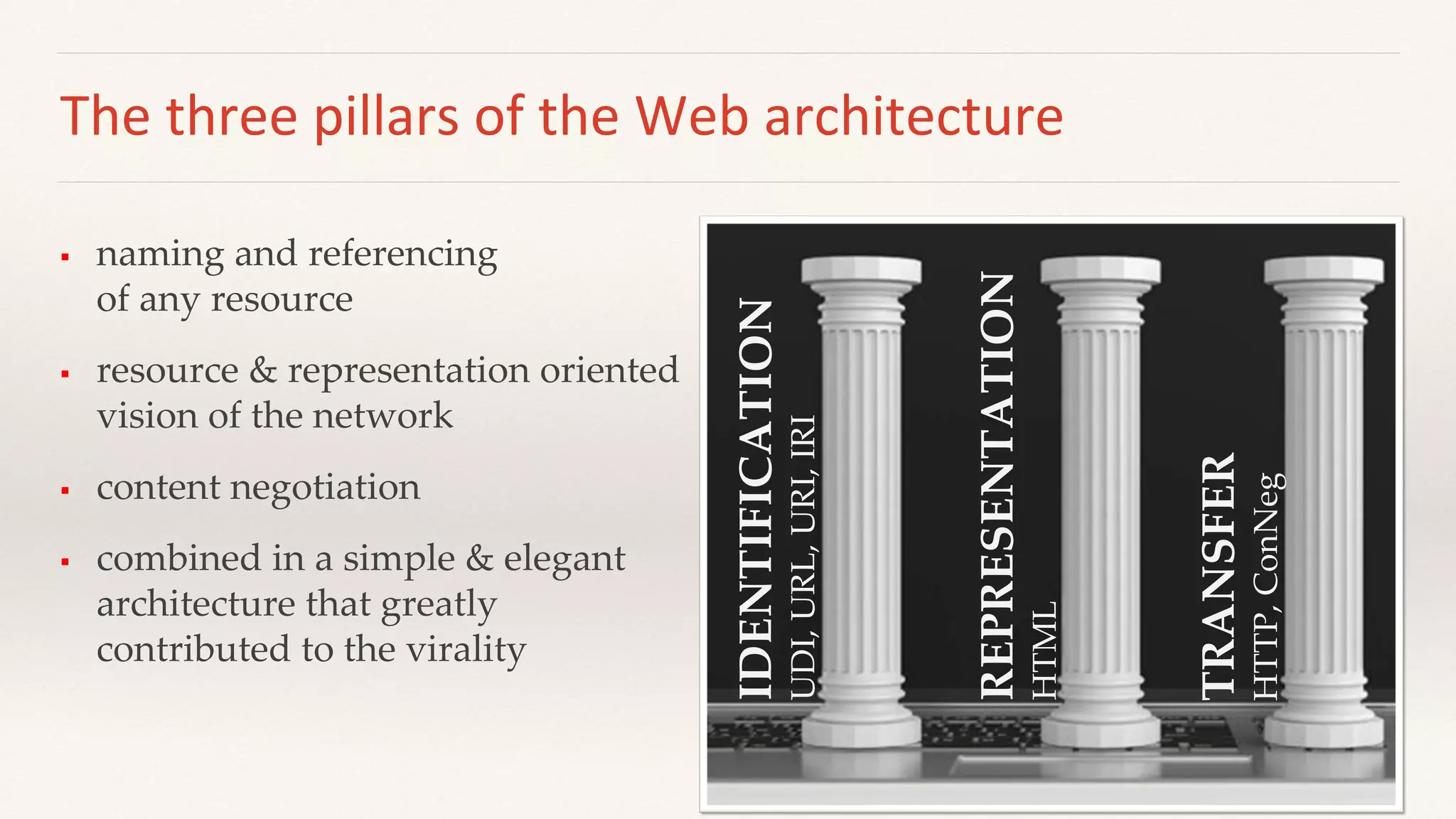
The three pillars of the Web architecture
 naming and referencing
of any resource
IDENTIFICATION
UDI,
URL,
URI,
IRI
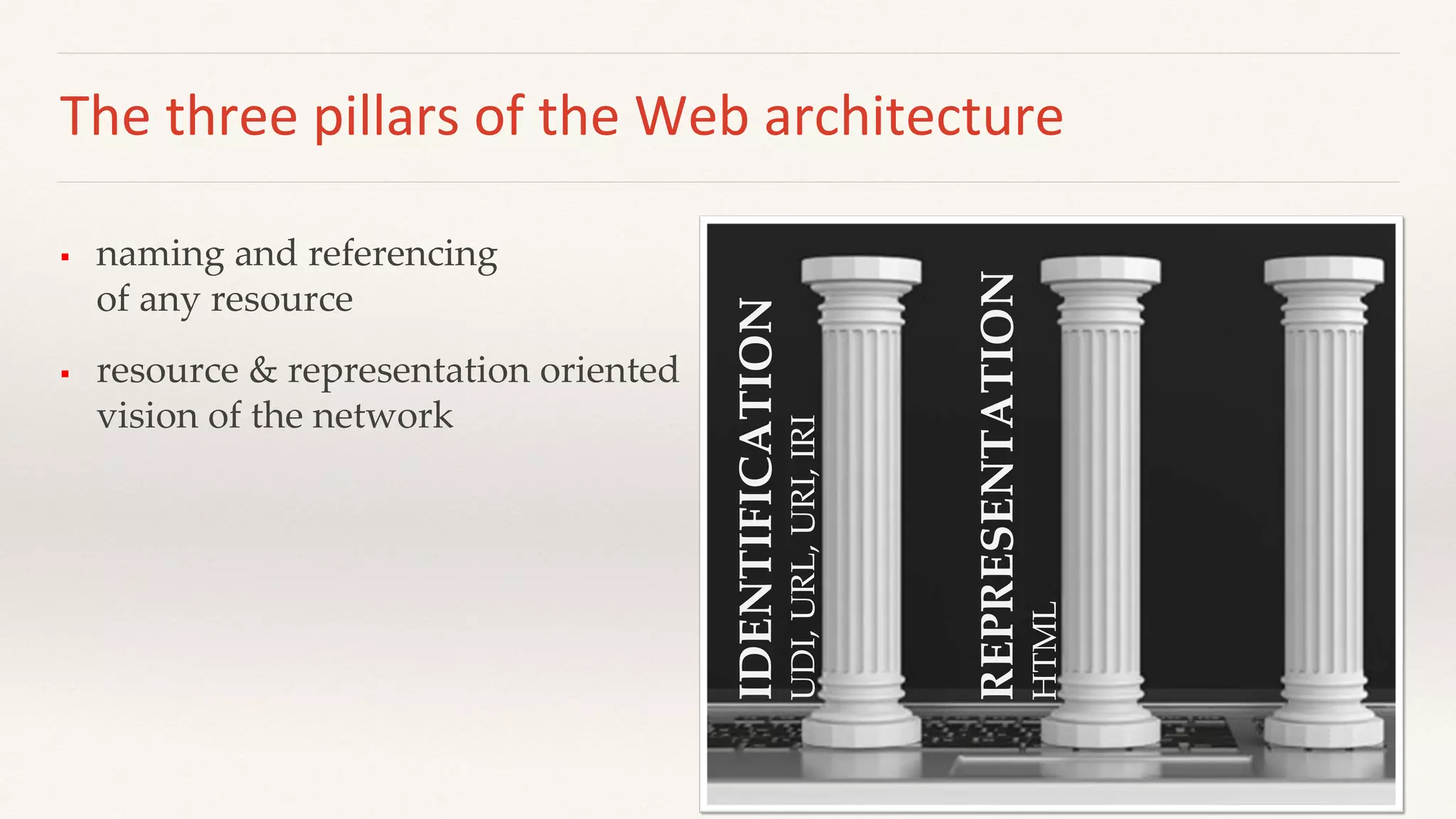
The three pillars of the Web architecture
 naming and referencing
of any resource
 resource & representation oriented
vision of the network
IDENTIFICATION
UDI,
URL,
URI,
IRI
REPRESENTATION
HTML
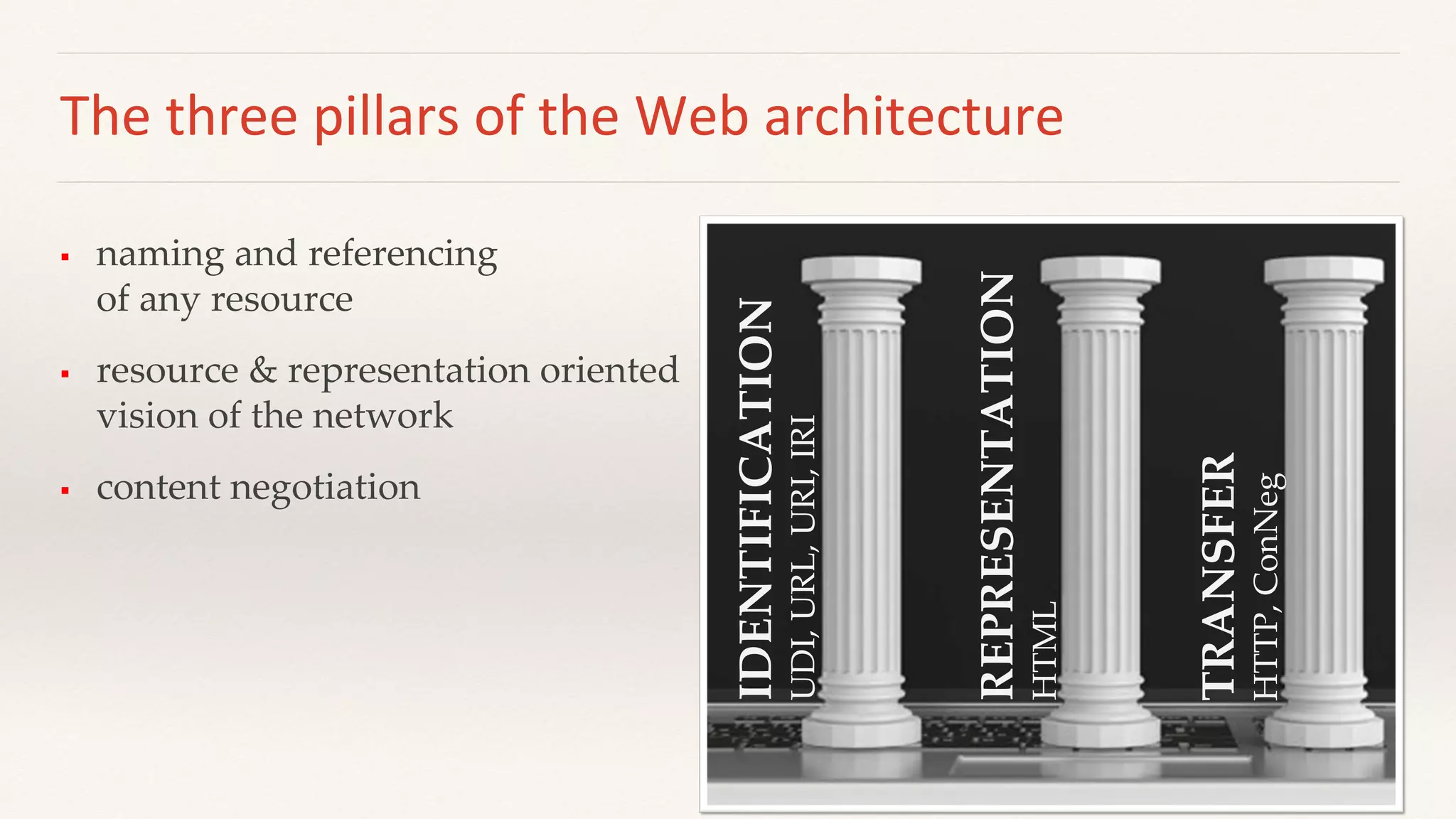
The three pillars of the Web architecture
 naming and referencing
of any resource
 resource & representation oriented
vision of the network
 content negotiation
IDENTIFICATION
UDI,
URL,
URI,
IRI
REPRESENTATION
HTML
TRANSFER
HTTP,
ConNeg
The three pillars of the Web architecture
 naming and referencing
of any resource
 resource & representation oriented
vision of the network
 content negotiation
 combined in a simple & elegant
architecture that greatly
contributed to the virality
IDENTIFICATION
UDI,
URL,
URI,
IRI
REPRESENTATION
HTML
TRANSFER
HTTP,
ConNeg
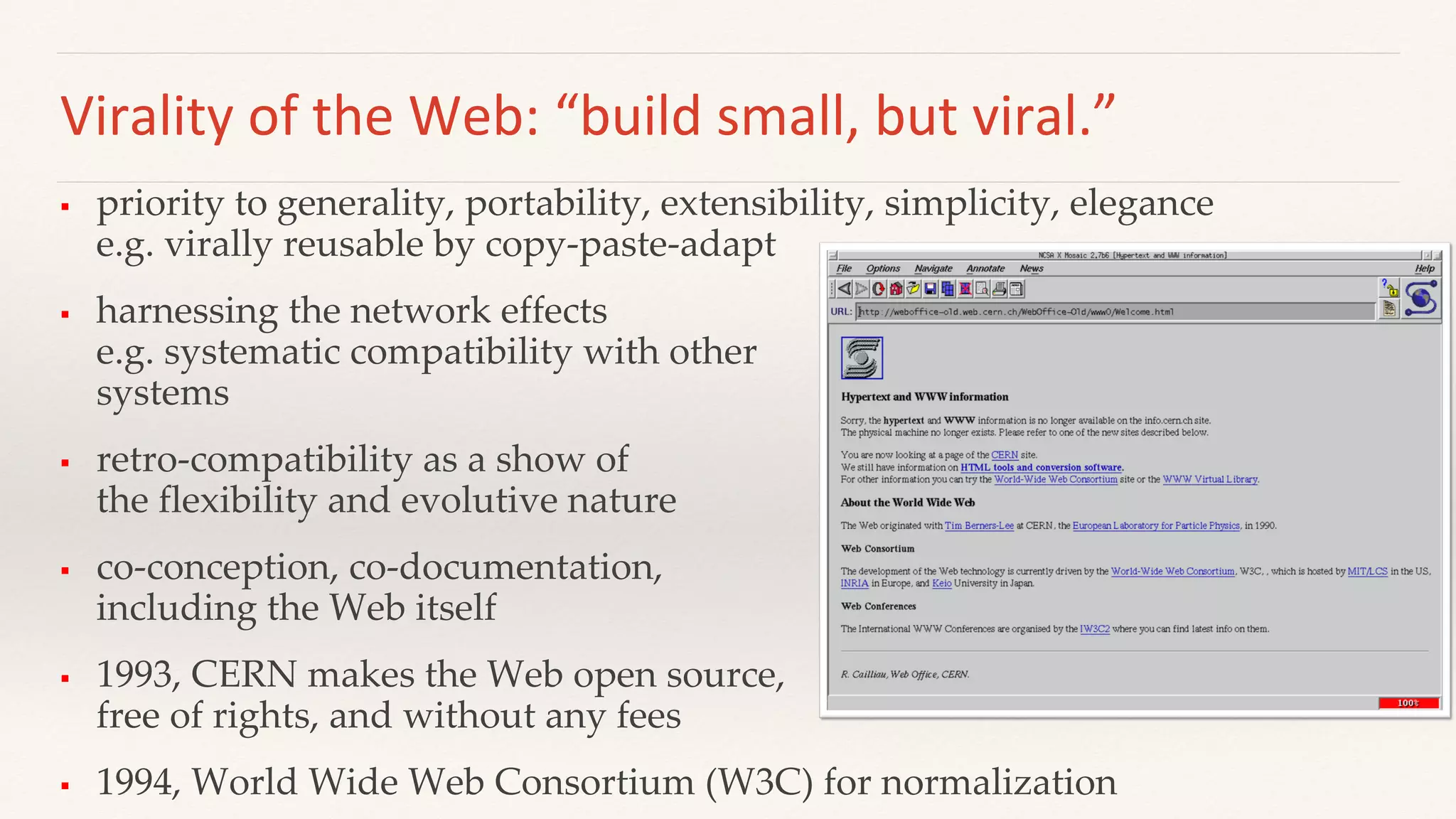
Virality of the Web: “build small, but viral.”
 priority to generality, portability, extensibility, simplicity, elegance
e.g. virally reusable by copy-paste-adapt
 harnessing the network effects
e.g. systematic compatibility with other
systems
 retro-compatibility as a show of
the flexibility and evolutive nature
 co-conception, co-documentation,
including the Web itself
 1993, CERN makes the Web open source,
free of rights, and without any fees
 1994, World Wide Web Consortium (W3C) for normalization
Mutations and future of the Web
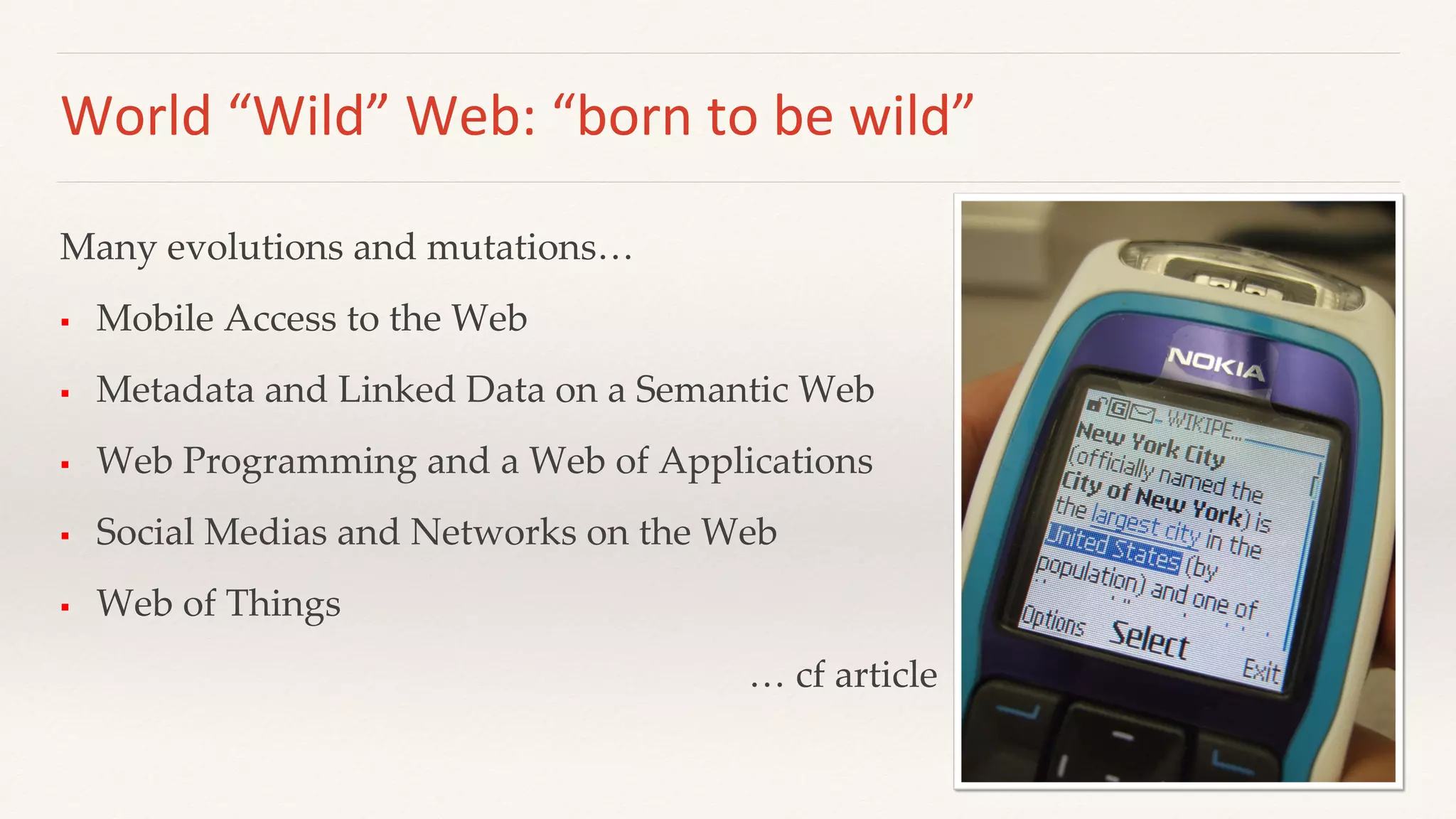
World “Wild” Web: “born to be wild”
Many evolutions and mutations…
 Mobile Access to the Web
 Metadata and Linked Data on a Semantic Web
 Web Programming and a Web of Applications
 Social Medias and Networks on the Web
 Web of Things
… cf article
Artifact & research object
 well-known but poorly understood (eg Web vs Internet)
 a software architecture vs. the object that emerged from it
 both aspects exhibit complexity that calls for R&D
 constantly bringing solutions, problems and needs
 Web Science: the study of Web evolution and its impact
 “The three W’s of the World Wide Web call for
the three M’s of a Massive Multidisciplinary Method”[16]
We haven’t seen the full potential of the web yet
 an architecture that has passed the test of time
 omnipresence and hypermnesia of the Web,
modified our relationship with time and space
 there is an era before and an era after the Web
 the Web is now an architecture, an artefact, a science object and
an education topic, of which we haven’t seen the full potential yet
 the stakes (neutrality, decentralization, democratization, etc.),
the dangers (re-centralization, levels of access, different speeds, etc.),
the limitations (infrastructure needs, energy, costs, etc.)
make the Web a never-ending project
© Peter Szucsy
links, links, links,…
 Fabien Gandon. For everything: Tim Berners-Lee, winner of the 2016 Turing award for having invented… the
Web. 1024 : Bulletin de la Société Informatique de France, Société Informatique de France, 2017, pp.21.
https://hal.inria.fr/hal-01843967v2/
 Hall, W. (2011). Network Theory| The Ever Evolving Web: The Power of Networks. International Journal Of
Communication, 5, 14. Retrieved from
https://ijoc.org/index.php/ijoc/article/view/1120
 Fabien Gandon and Wendy Hall. 2022. A Never-Ending Project for Humanity Called “the Web”. In
Proceedings of the ACM Web Conference 2022 (WWW ’22), April 25–29, 2022, Virtual Event, Lyon,
France. ACM, New York, NY, USA,8 pages.
https://doi.org/10.1145/3485447.3514195
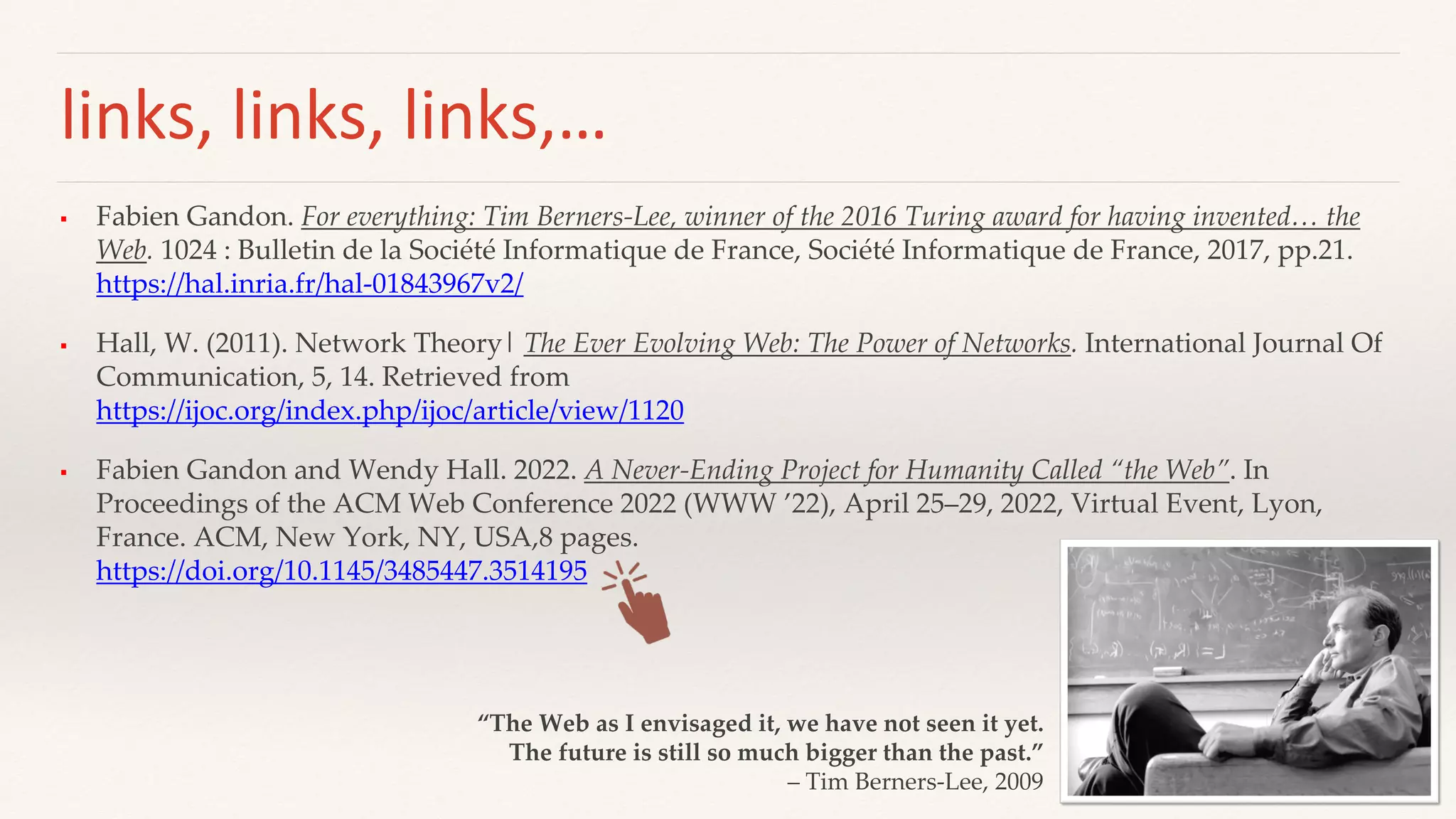
“The Web as I envisaged it, we have not seen it yet.
The future is still so much bigger than the past.”
– Tim Berners-Lee, 2009

A Never-Ending Project for Humanity Called “the Web”

  • 1.
    Fabien Gandon, WendyHall A Never-Ending Project for Humanity Called “the Web” The Web Conference ⸺ History Track © Peter Szucsy
  • 2.
    Main historical stepsin making the Web  some influences and streams of thought  important steps the weaving of the Web  mutations and challenges of the Web
  • 3.
    Organize and accessmasses of information
  • 4.
    Paul Otlet’s workon collecting, archiving, indexing and categorizing documentation and his Mundaneum he foresaw a world-wide networked environment ~ 1910
  • 5.
    Vannevar Bush :“As We May Think"  the need for a machine to help follow information developments ~ 1945 Memex, Life Magazine, 10 septembre 1945
  • 6.
    Vannevar Bush :“As We May Think"  the need for a machine to help follow information developments  externalizing the points and links of association… Memex, Life Magazine, 10 septembre 1945 “the association of thoughts, in accordance with some intricate web [sic] of trails carried by the cells of the brain” ~ 1945
  • 7.
    Vannevar Bush :“As We May Think"  the need for a machine to help follow information developments  externalizing the points and links of association… Memex, Life Magazine, 10 septembre 1945 “the association of thoughts, in accordance with some intricate web [sic] of trails carried by the cells of the brain” ~ 1945
  • 8.
    Ted Nelson “afile structure for complex, changing and indeterminate information” “hypertext” to link text documents & “hypermedia” to link media of any type : data structures to store and connect digitally anything Complex information processing: a file structure for the complex, the changing and the indeterminate, T. H. Nelson, ACM, 1965 ~ 1965
  • 9.
    Hypertexts evolution  Firstgeneration : mainframes and largely text-based.  Second generation : more advanced user interfaces on workstations (e.g. graphical overviews) and multi-user support  Third generation available on PCs and in 1987:  HyperCard available for free on every Macintosh  first ACM Hypertext conference  Crossing between internet and hypertext ex. Hyper-G [2], Microcosm [15], and of course… 1965 Xanadu overview 1980
  • 10.
    Tim Berners-Lee, weavingthe “mesh”  Beginning of the 80’s: “Enquire” system, arbitrary and bidirectional, multi-user 1989
  • 11.
    Tim Berners-Lee, weavingthe “mesh”  Beginning of the 80’s: “Enquire” system, arbitrary and bidirectional, multi-user  March of 1989: distributed hypertext system called “Mesh” Information Management: A Proposal Tim Berners-Lee, CERN, March 1989, May 1990 1989
  • 12.
  • 13.
    CERN as aperfect cradle  a need for an efficient document system  largest Internet hub in Europe and use of RPC (Remote Procedure Call)  programming approach to document writing (e.g., LaTeX, SGML)  NeXT Cube workstation: object-based & graphical programming, networking, multi-window interfaces, etc.
  • 14.
    Weaving the “Mesh” link references include network addresses to weave a “mesh” architecture integrating hypertext with TCP and DNS  HTML simplified language for Web documents  clicking a link becomes a remote call for procedures: making the Web less a network of documents and more a network of procedures (now called REST)  the Web was conceptually open to writing
  • 15.
    Weaving the “Mesh” link references include network addresses to weave a “mesh” architecture integrating hypertext with TCP and DNS  HTML simplified language for Web documents  clicking a link becomes a remote call for procedures: making the Web less a network of documents and more a network of procedures (now called REST)  the Web was conceptually open to writing  first server and first browser called World Wide Web which became the name of the whole thing Web
  • 16.
    Breaking the Thread strikinga balance between the integration of and the departure from the existing and emerging paradigms  generality and portability of greater importance than other extensions (img)  liberate hypertext from central servers: data and links were decentralized on the Internet  links became unidirectional and breakable  breaks needed for the scaling and virality
  • 17.
    The three pillarsof the Web architecture  naming and referencing of any resource IDENTIFICATION UDI, URL, URI, IRI
  • 18.
    The three pillarsof the Web architecture  naming and referencing of any resource  resource & representation oriented vision of the network IDENTIFICATION UDI, URL, URI, IRI REPRESENTATION HTML
  • 19.
    The three pillarsof the Web architecture  naming and referencing of any resource  resource & representation oriented vision of the network  content negotiation IDENTIFICATION UDI, URL, URI, IRI REPRESENTATION HTML TRANSFER HTTP, ConNeg
  • 20.
    The three pillarsof the Web architecture  naming and referencing of any resource  resource & representation oriented vision of the network  content negotiation  combined in a simple & elegant architecture that greatly contributed to the virality IDENTIFICATION UDI, URL, URI, IRI REPRESENTATION HTML TRANSFER HTTP, ConNeg
  • 21.
    Virality of theWeb: “build small, but viral.”  priority to generality, portability, extensibility, simplicity, elegance e.g. virally reusable by copy-paste-adapt  harnessing the network effects e.g. systematic compatibility with other systems  retro-compatibility as a show of the flexibility and evolutive nature  co-conception, co-documentation, including the Web itself  1993, CERN makes the Web open source, free of rights, and without any fees  1994, World Wide Web Consortium (W3C) for normalization
  • 22.
  • 23.
    World “Wild” Web:“born to be wild” Many evolutions and mutations…  Mobile Access to the Web  Metadata and Linked Data on a Semantic Web  Web Programming and a Web of Applications  Social Medias and Networks on the Web  Web of Things … cf article
  • 24.
    Artifact & researchobject  well-known but poorly understood (eg Web vs Internet)  a software architecture vs. the object that emerged from it  both aspects exhibit complexity that calls for R&D  constantly bringing solutions, problems and needs  Web Science: the study of Web evolution and its impact  “The three W’s of the World Wide Web call for the three M’s of a Massive Multidisciplinary Method”[16]
  • 25.
    We haven’t seenthe full potential of the web yet  an architecture that has passed the test of time  omnipresence and hypermnesia of the Web, modified our relationship with time and space  there is an era before and an era after the Web  the Web is now an architecture, an artefact, a science object and an education topic, of which we haven’t seen the full potential yet  the stakes (neutrality, decentralization, democratization, etc.), the dangers (re-centralization, levels of access, different speeds, etc.), the limitations (infrastructure needs, energy, costs, etc.) make the Web a never-ending project © Peter Szucsy
  • 26.
    links, links, links,… Fabien Gandon. For everything: Tim Berners-Lee, winner of the 2016 Turing award for having invented… the Web. 1024 : Bulletin de la Société Informatique de France, Société Informatique de France, 2017, pp.21. https://hal.inria.fr/hal-01843967v2/  Hall, W. (2011). Network Theory| The Ever Evolving Web: The Power of Networks. International Journal Of Communication, 5, 14. Retrieved from https://ijoc.org/index.php/ijoc/article/view/1120  Fabien Gandon and Wendy Hall. 2022. A Never-Ending Project for Humanity Called “the Web”. In Proceedings of the ACM Web Conference 2022 (WWW ’22), April 25–29, 2022, Virtual Event, Lyon, France. ACM, New York, NY, USA,8 pages. https://doi.org/10.1145/3485447.3514195 “The Web as I envisaged it, we have not seen it yet. The future is still so much bigger than the past.” – Tim Berners-Lee, 2009