The Evolving Architecture  of the Web William Grosso Twofish
In the past few years, the world of web applications has changed dramatically. Some of the changes have been obvious and fully chronicled: The rise of rich internet applications, the reliance on advertising models? But while the world has noted these user-facing changes, another, more profound, shift has been occurring with less fanfare: Web applications have become deeply linked, not just in the HTML but at the service level. As a result, web applications are growing exponentially more complex and functional, and new opportunities are rising for service providers AND application developers. In this talk, I'll give an overview of the emerging architecture of the web, talk about how its evolution is changing the breadth of what application providers can offer, and dive into some real lessons from building out an internet-scale virtual economy service.
AKA Andreeson, Berners-Lee, Bray, …. et al were somewhat wrong in the large and in the long-term, but they built some cool stuff and man did they change the world.
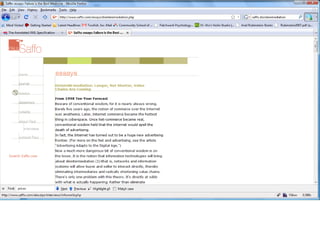
AKA Disintermediation and you (great web page note:  http://www.saffo.com/essays/disinteremediation.php  and  http://en.wikipedia.org/wiki/Disintermediation  for background)
 
Outline Who Am I / Standard Caveats The first 10 years of the web The second 10 years of the web Where we’re going from here Concrete Predictions
Who Am I?
End of Year Talk Traditionally a time to be a little “forward thinking” Goal is to take a step back and look at large-scale trends Goal is also to be somewhat provocative “ I would rather be vaguely correct than precisely wrong” – John Maynard Keynes “ The references are not without merit” – George Santayana
I’m Predicting the Future of the Web This is a seriously wacky thing to do 2 billion users At least 10 million people coding various bits and pieces Nobody really has a handle on what it is or what it’s used for. And most of you got in for free anyway “ Opinions are like nipples. Everyone has two.” – Brian Goncher.
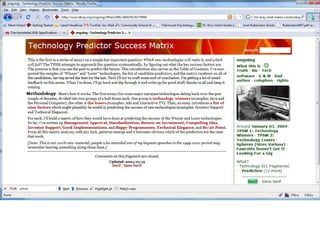
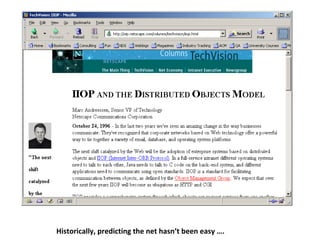
Historically, predicting the net hasn’t been easy ….
My Employer is Not To Blame Twofish is a great company We make software to support virtual economies (SaaS backend play) I’m the CTO You ain’t the customer, I ain’t here to sell you nothing, and this is mostly my opinion “ And besides, the wench is dead.” – Christopher Marlowe.
Interrupt at Any Time A lot of this talk is historical in nature. I strongly believe that predictions should be grounded in trends And accurately spotting trends requires paying attention to what has happened. You guys were here too Stop me if I get something wrong!
Outline Who Am I / Standard Caveats The first 10 years of the web The second 10 years of the web Where we’re going from here Concrete Predictions
It Started in 1990 Wikipedia “ In 1989, Berners-Lee and CERN data systems engineer Robert Cailliau each submitted separate proposals for an Internet-based hypertext system providing similar functionality. The following year, they collaborated on a joint proposal, the WorldWideWeb (W3) project,[1] which was accepted by CERN.” “ The first publicly available description of HTML was a document called HTML Tags, first mentioned on the Internet by Berners-Lee in late 1991”
Design Center of Original Web Better publishing Easier way to get scientific papers You go to a web site, see a list of things you can read, and choose one. The document is written in an SGML-defined markup language (HTML) The browser renders it
1993 Nothing much happened (apparently, the world was busy playing with CD-Roms) Well, okay, one thing happened. Adobe defined PDF 1.0
1994 Netscape founded W3C founded SSL 2.0 released SSL 1.0 was never released SSL 2.0 had huge security holes that made it unusable for serious security needs.  Cookies implemented in Navigator, though not announced to world Apache Group begins working on Apache Server
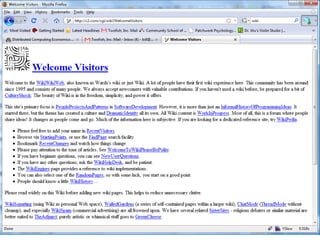
1995 HTML 2.0 was published as IETF RFC 1866 Not the W3C – it had been created in 1994, but didn’t own the HTML standard yet.  Java released Java Applets released First wiki released by Ward Cunningham Keynote Systems founded (monitoring websites became a viable business) PHP created (first web-native language) Amazon.com launched (but was only about books) Squid-proxy spun out of Harvest cache daemon Netscape releases first version of Javascript in Navigator 2 Named after “Java” because Java was hot.  Not supported in Internet Explorer until version 3 (1996) CGI defined and implemented
 
1996 SSL 3.0 released. For the first time, the internet had secure browsing functionality. HTML gains tables and imagemaps. FastCGI defined and implemented World learns about cookies. CSS Level 1 becomes a W3C recommendation Flash 1 released by Macromedia Amazon launches Amazon Affiliates
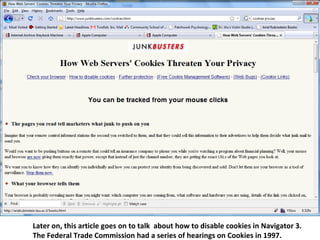
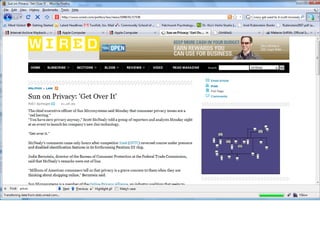
Later on, this article goes on to talk  about how to disable cookies in Navigator 3. The Federal Trade Commission had a series of hearings on Cookies in 1997.
1997 ActiveX controls introduced by Microsoft HTML 3.2[11] was published as a W3C Recommendation. It was the first version developed and standardized exclusively WAP 1.0 defined  HTML 4.0 was published as a W3C Recommendation.
1998 “ Open Source” coined as a term Note that GNU had been around since the 1980’s, Linux since the early 1990’s, and the Apache Group since 1994 Microsoft introduces the HttpRequestObject but nobody really notices CSS Level 2 becomes a W3C recommendation XML 1.0 defined Akamai Founded Netscape Navigator open-sourced
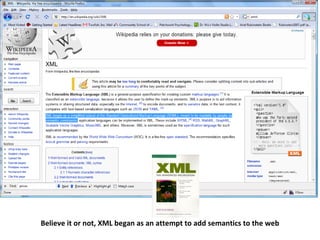
Believe it or not, XML began as an attempt to add semantics to the web
1999 HTML 4.01 was published as a W3C Recommendation. Apache Software Foundation legally incorporated from Apache Group Dave Winer publishes XML-RPC specification RSS .91 created RDF becomes a W3C recommendation Blogger launched (acquired by Google in 2003) “ Information Rules” published
2000 Flash 5 released with ActionScript 1.0 (essentially Javascript) Struts launched First serious MVC platform XHTML becomes a W3C recommendation
 
 
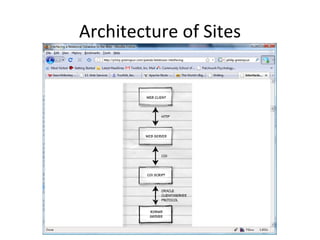
Architecture of Sites
Architecture of Internet Content wells Sites mostly inward-facing This is why we needed search engines so much
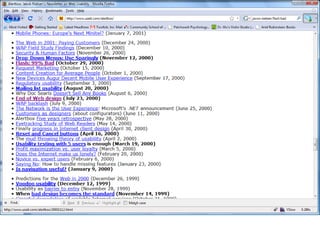
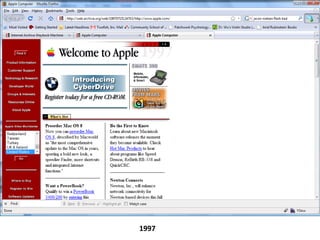
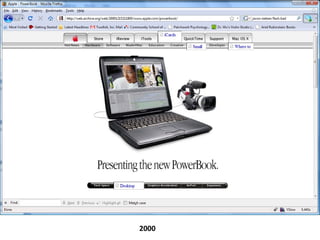
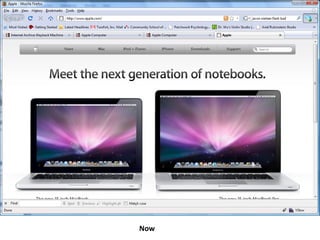
What Really Happened High speed innovation on standards (especially front-end) “ Internet Time” High speed changes in design standards Cultural Assimilation The idea of a website entered the popular culture People got used to cookies and search engines and javascript on pages and bookmarking and …. The Browser Wars By the end of the decade, Netscape was just plain dead The Rise of Open Source Publishing and Subscriptions as the Central Business Model Most of the innovation was around display technology, identifying users (and security) and server-side infrastructure Sophisticated client functionality mostly speculative
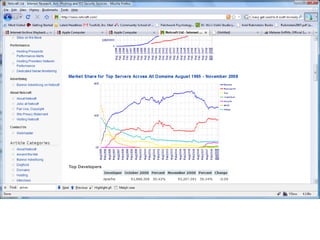
1997
2000
Now
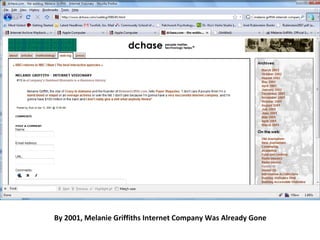
By 2001, Melanie Griffiths Internet Company Was Already Gone


Key Technology Lessons HTTP enabled very loose client-server coupling.  This made rapid changes in HTML possible. Enabled the creation of many different server platforms An empirical observation on internet technology adoption. From initial splash to high profile adoption is less than 2 years for all known successful internet technology standards.  From high profile adoption to large scale adoption is less than 3 years for all known successful internet technology standards.
Outline Who Am I / Standard Caveats The first 10 years of the web The second 10 years of the web Where we’re going from here Concrete Predictions
Foreshadowing In the 2000’s, the things that changed were completely different Massive changes in how the web was used Massive changes in the underlying computational substrate Massive changes in the power of the client machines
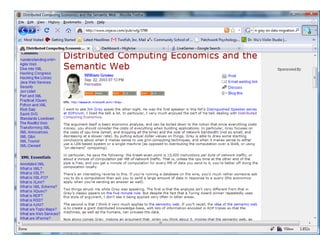
2001 Wikipedia founded on idea of collaborative editing of an encyclopedia.  Tim Berners-Lee publishes an article in Scientific American on the semantic web
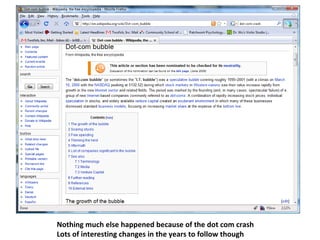
Nothing much else happened because of the dot com crash Lots of interesting changes in the years to follow though
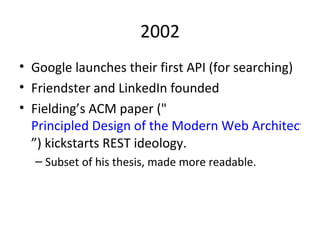
2002 Google launches their first API (for searching) Friendster and LinkedIn founded Fielding’s ACM paper (" Principled Design of the Modern Web Architecture ”) kickstarts REST ideology.  Subset of his thesis, made more readable.
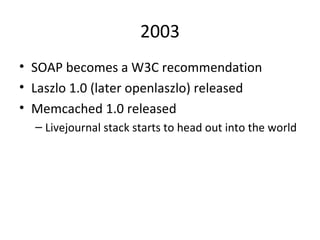
2003 SOAP becomes a W3C recommendation Laszlo 1.0 (later openlaszlo) released Memcached 1.0 released Livejournal stack starts to head out into the world
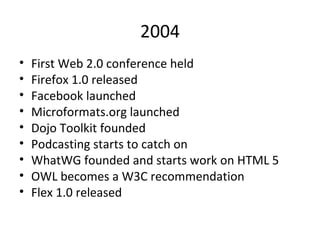
2004 First Web 2.0 conference held Firefox 1.0 released Facebook launched Microformats.org launched Dojo Toolkit founded Podcasting starts to catch on WhatWG founded and starts work on HTML 5 OWL becomes a W3C recommendation Flex 1.0 released
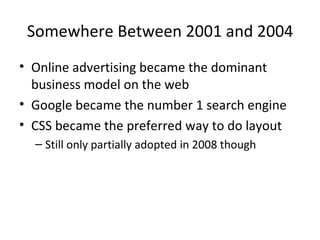
Somewhere Between 2001 and 2004 Online advertising became the dominant business model on the web Google became the number 1 search engine CSS became the preferred way to do layout Still only partially adopted in 2008 though
2005 The term “Ajax” coined “ User Generated Content” coined and enters mainstream usage “ Vertical Search Market quickly becomes crowded”  (http://www.ecommercetimes.com/story/41982.html)  Ruby on Rails hits 1.0 “ Mashups” briefly become all the rage (before settling into “Add a Map to your App”) Dutch Police accidentally find a botnet with 1.5 million PCs http://www.securityfocus.com/brief/19
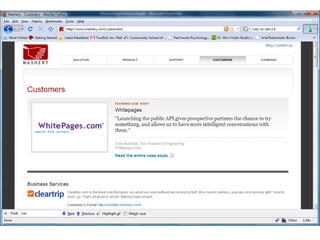
2006 Prototype (JS toolkit) started Amazon EC2 enters beta Mashery founded First version of Facebook API released Focus on collective intelligence Wisdom of crowds / Prediction markets / GATE and Lingpipe iPhone released “ The Mobile Web” becomes a reality with Safari browser CafePress brought down by botnet attack http://camelsnose.wordpress.com/2007/01/07/al-firdaws-cyberspace-terrorists-or-script-kiddies/ http://irregulartimes.com/index.php/archives/2007/01/05/umran-javed-cafepress/#comment-254171 http://www.darknet.org.uk/2007/02/cafepresscom-under-heavy-ddos-attack/
 
2007 Amazon releases the Kindle “ Social Graph” coined Facebook Platform launched OpenSocial founded Adobe and Yahoo put ads in PDF
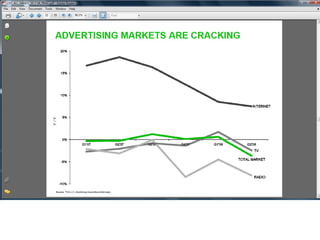
2008 Facebook hits 50000 widgets Microsoft launches LiveMesh Yahoo launches BOSS and SearchMonkey Twitter becomes stable with 6M users The great financial collapse
 
 
Somewhere Between 2004 and 2008 Chat becomes an important feature of many major websites The “danga stack” wins for the consumer internet
 
 
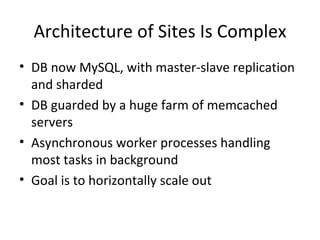
Architecture of Sites Is Complex DB now MySQL, with master-slave replication and sharded DB guarded by a huge farm of memcached servers Asynchronous worker processes handling most tasks in background Goal is to horizontally scale out
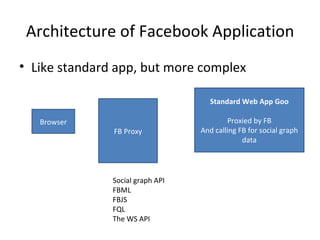
Architecture of Facebook Application Like standard app, but more complex Browser FB Proxy Standard Web App Goo Proxied by FB And calling FB for social graph data Social graph API FBML FBJS FQL The WS API
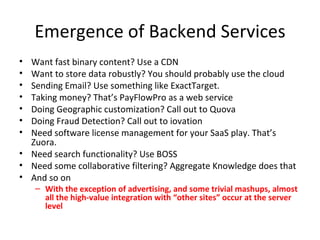
Emergence of Backend Services Want fast binary content? Use a CDN Want to store data robustly? You should probably use the cloud Sending Email? Use something like ExactTarget. Taking money? That’s PayFlowPro as a web service Doing Geographic customization? Call out to Quova Doing Fraud Detection? Call out to iovation Need software license management for your SaaS play. That’s Zuora. Need search functionality? Use BOSS  Need some collaborative filtering? Aggregate Knowledge does that And so on With the exception of advertising, and some trivial mashups, almost all the high-value integration with “other sites” occur at the server level
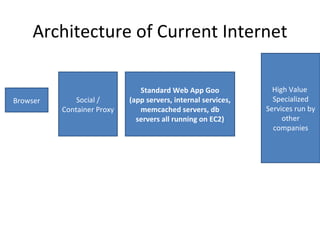
Architecture of Current Internet Browser Social / Container Proxy Standard Web App Goo (app servers, internal services, memcached servers, db servers all running on EC2) High Value  Specialized Services run by other companies
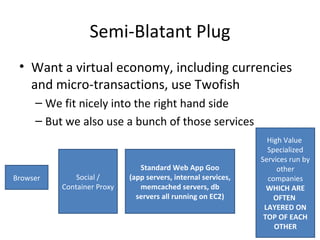
Semi-Blatant Plug Want a virtual economy, including currencies and micro-transactions, use Twofish We fit nicely into the right hand side But we also use a bunch of those services Browser Social / Container Proxy Standard Web App Goo (app servers, internal services, memcached servers, db servers all running on EC2) High Value  Specialized Services run by other companies WHICH ARE OFTEN  LAYERED ON TOP OF EACH OTHER
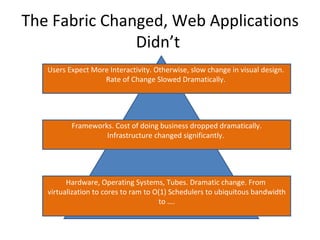
The Fabric Changed, Web Applications Didn’t  Users Expect More Interactivity. Otherwise, slow change in visual design.  Rate of Change Slowed Dramatically.  Frameworks. Cost of doing business dropped dramatically. Infrastructure changed significantly.  Hardware, Operating Systems, Tubes. Dramatic change. From  virtualization to cores to ram to O(1) Schedulers to ubiquitous bandwidth to ….
 
Outline Who Am I / Standard Caveats The first 10 years of the web The second 10 years of the web Where we’re going from here Concrete Predictions
CSS is a Huge Learning Point Nobody wants to admit it, but HTML 4 wasn’t that bad You could get a lot done and it had a pretty easy initial learning curve If you can get stuff done already in a widely available technology with a low learning curve, new stuff has a huge hurdle in front of it. CSS still isn’t ubiquitous (not even close)
It’s Much Easier to Build Smaller Services and Connect Them By and large, people aren’t moving lots of data back and forth between websites Instead, they’re calling APIs This is huge and important. There are two basic forms of “information collaboration” I can give you the data Or I can answer your questions
The Web Is Moving to Question Answering, Not Information Sharing Easier to build, easier to scale, and easier to Monetize Google pioneered this with their search API in 2002 They didn’t give you the index They answered very specific questions And they rate limited people, so that you can’t get the information
 
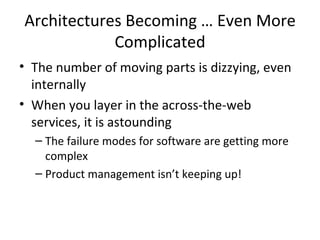
Architectures Becoming … Even More Complicated The number of moving parts is dizzying, even internally When you layer in the across-the-web services, it is astounding The failure modes for software are getting more complex Product management isn’t keeping up!
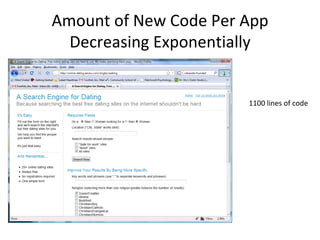
Amount of New Code Per App Decreasing Exponentially 1100 lines of code
Outline Who Am I / Standard Caveats The first 10 years of the web The second 10 years of the web Where we’re going from here Concrete Predictions
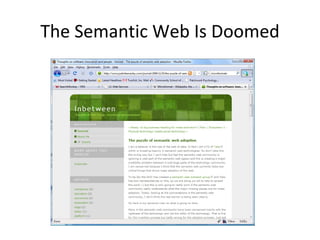
The Semantic Web Is Doomed
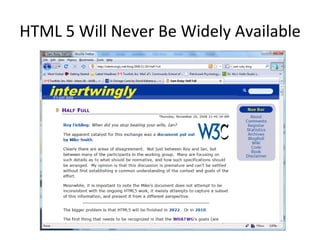
HTML 5 Will Never Be Widely Available
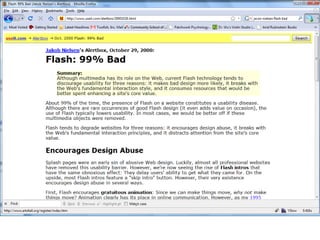
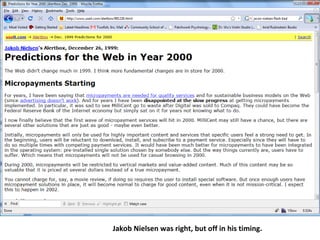
Jakob Nielsen was right, but off in his timing.
The Client Will Remain (mostly) Thin Too many different devices, too many distinct display modalities Web browsers (5 or 6 now?) Game consoles Special purpose web devices IP TV Phones Logic is going to mostly remain on the servers
SOAP Will Win Over REST That’s unnecessarily antagonistic.  REST has its place. But SOAP will become ubiquitous.  The need for complex datatypes and interoperability will drive SOAP to the heart of internet-scale computing.
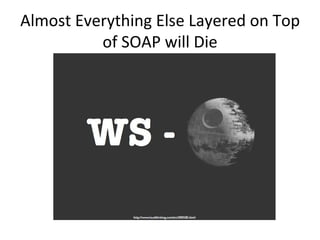
Almost Everything Else Layered on Top of SOAP will Die
Long Value Chains in Building Web Apps We’ve already seen the first level of this That was the slide listing some of the functionality that is currently outsourced to other data centers Those services rely on other services, which rely on other services.
A Web of Search Engines The ubiquity of high quality search engines From Lucene to BOSS The growing availability of text analysis engines From Gate to OpenCalais The utter ease of UI layer creation And the ease of deployment onto the cloud Google’s market share for search on the web will steadily decrease from now on. Though the standard measurements may not show it.
OpenID Will Become Ubiquitous Logins? That’s a function of identity All the major web apps already support OpenID.  The arguments for accepting OpenID are compelling for small web apps After that, it’s a question of how the 5 biggest OpenID players will form a consortium
An Internet Scale Message Queue Framework Will Emerge We’ve got layers and layers Cross-internet calls for value added services Standard web architectures are already building the backends with asynchronous services Polling, asking for results later, and background uploading are common patterns Amazon’s SMS is interesting here …
Frameworks Like Grails Will Become Dominant in the Java Universe And then dominant everywhere Marries Rails-like productivity with Java robustness and back-end libraries In the coming world of interop and disintermediated chains, this is a huge winner
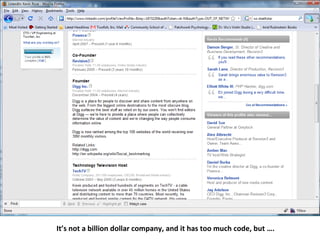
There Will Be A A billion dollar (valuation) company  With under 10K lines of non-marketing code And no data center And under 50 employees By 2012
It’s not a billion dollar company, and it has too much code, but ….
Additional Reading
 

The Evolving Architecture

  • 1.
    The Evolving Architecture of the Web William Grosso Twofish
  • 2.
    In the pastfew years, the world of web applications has changed dramatically. Some of the changes have been obvious and fully chronicled: The rise of rich internet applications, the reliance on advertising models? But while the world has noted these user-facing changes, another, more profound, shift has been occurring with less fanfare: Web applications have become deeply linked, not just in the HTML but at the service level. As a result, web applications are growing exponentially more complex and functional, and new opportunities are rising for service providers AND application developers. In this talk, I'll give an overview of the emerging architecture of the web, talk about how its evolution is changing the breadth of what application providers can offer, and dive into some real lessons from building out an internet-scale virtual economy service.
  • 3.
    AKA Andreeson, Berners-Lee,Bray, …. et al were somewhat wrong in the large and in the long-term, but they built some cool stuff and man did they change the world.
  • 4.
    AKA Disintermediation andyou (great web page note: http://www.saffo.com/essays/disinteremediation.php and http://en.wikipedia.org/wiki/Disintermediation for background)
  • 5.
  • 6.
    Outline Who AmI / Standard Caveats The first 10 years of the web The second 10 years of the web Where we’re going from here Concrete Predictions
  • 7.
    Outline Who AmI / Standard Caveats The first 10 years of the web The second 10 years of the web Where we’re going from here Concrete Predictions
  • 8.
  • 9.
    End of YearTalk Traditionally a time to be a little “forward thinking” Goal is to take a step back and look at large-scale trends Goal is also to be somewhat provocative “ I would rather be vaguely correct than precisely wrong” – John Maynard Keynes “ The references are not without merit” – George Santayana
  • 10.
    I’m Predicting theFuture of the Web This is a seriously wacky thing to do 2 billion users At least 10 million people coding various bits and pieces Nobody really has a handle on what it is or what it’s used for. And most of you got in for free anyway “ Opinions are like nipples. Everyone has two.” – Brian Goncher.
  • 11.
    Historically, predicting thenet hasn’t been easy ….
  • 12.
    My Employer isNot To Blame Twofish is a great company We make software to support virtual economies (SaaS backend play) I’m the CTO You ain’t the customer, I ain’t here to sell you nothing, and this is mostly my opinion “ And besides, the wench is dead.” – Christopher Marlowe.
  • 13.
    Interrupt at AnyTime A lot of this talk is historical in nature. I strongly believe that predictions should be grounded in trends And accurately spotting trends requires paying attention to what has happened. You guys were here too Stop me if I get something wrong!
  • 14.
    Outline Who AmI / Standard Caveats The first 10 years of the web The second 10 years of the web Where we’re going from here Concrete Predictions
  • 15.
    It Started in1990 Wikipedia “ In 1989, Berners-Lee and CERN data systems engineer Robert Cailliau each submitted separate proposals for an Internet-based hypertext system providing similar functionality. The following year, they collaborated on a joint proposal, the WorldWideWeb (W3) project,[1] which was accepted by CERN.” “ The first publicly available description of HTML was a document called HTML Tags, first mentioned on the Internet by Berners-Lee in late 1991”
  • 16.
    Design Center ofOriginal Web Better publishing Easier way to get scientific papers You go to a web site, see a list of things you can read, and choose one. The document is written in an SGML-defined markup language (HTML) The browser renders it
  • 17.
    1993 Nothing muchhappened (apparently, the world was busy playing with CD-Roms) Well, okay, one thing happened. Adobe defined PDF 1.0
  • 18.
    1994 Netscape foundedW3C founded SSL 2.0 released SSL 1.0 was never released SSL 2.0 had huge security holes that made it unusable for serious security needs. Cookies implemented in Navigator, though not announced to world Apache Group begins working on Apache Server
  • 19.
    1995 HTML 2.0was published as IETF RFC 1866 Not the W3C – it had been created in 1994, but didn’t own the HTML standard yet. Java released Java Applets released First wiki released by Ward Cunningham Keynote Systems founded (monitoring websites became a viable business) PHP created (first web-native language) Amazon.com launched (but was only about books) Squid-proxy spun out of Harvest cache daemon Netscape releases first version of Javascript in Navigator 2 Named after “Java” because Java was hot. Not supported in Internet Explorer until version 3 (1996) CGI defined and implemented
  • 20.
  • 21.
    1996 SSL 3.0released. For the first time, the internet had secure browsing functionality. HTML gains tables and imagemaps. FastCGI defined and implemented World learns about cookies. CSS Level 1 becomes a W3C recommendation Flash 1 released by Macromedia Amazon launches Amazon Affiliates
  • 22.
    Later on, thisarticle goes on to talk about how to disable cookies in Navigator 3. The Federal Trade Commission had a series of hearings on Cookies in 1997.
  • 23.
    1997 ActiveX controlsintroduced by Microsoft HTML 3.2[11] was published as a W3C Recommendation. It was the first version developed and standardized exclusively WAP 1.0 defined HTML 4.0 was published as a W3C Recommendation.
  • 24.
    1998 “ OpenSource” coined as a term Note that GNU had been around since the 1980’s, Linux since the early 1990’s, and the Apache Group since 1994 Microsoft introduces the HttpRequestObject but nobody really notices CSS Level 2 becomes a W3C recommendation XML 1.0 defined Akamai Founded Netscape Navigator open-sourced
  • 25.
    Believe it ornot, XML began as an attempt to add semantics to the web
  • 26.
    1999 HTML 4.01was published as a W3C Recommendation. Apache Software Foundation legally incorporated from Apache Group Dave Winer publishes XML-RPC specification RSS .91 created RDF becomes a W3C recommendation Blogger launched (acquired by Google in 2003) “ Information Rules” published
  • 27.
    2000 Flash 5released with ActionScript 1.0 (essentially Javascript) Struts launched First serious MVC platform XHTML becomes a W3C recommendation
  • 28.
  • 29.
  • 30.
  • 31.
    Architecture of InternetContent wells Sites mostly inward-facing This is why we needed search engines so much
  • 32.
    What Really HappenedHigh speed innovation on standards (especially front-end) “ Internet Time” High speed changes in design standards Cultural Assimilation The idea of a website entered the popular culture People got used to cookies and search engines and javascript on pages and bookmarking and …. The Browser Wars By the end of the decade, Netscape was just plain dead The Rise of Open Source Publishing and Subscriptions as the Central Business Model Most of the innovation was around display technology, identifying users (and security) and server-side infrastructure Sophisticated client functionality mostly speculative
  • 33.
  • 34.
  • 35.
  • 36.
    By 2001, MelanieGriffiths Internet Company Was Already Gone
  • 37.
  • 38.
  • 39.
  • 40.
    Key Technology LessonsHTTP enabled very loose client-server coupling. This made rapid changes in HTML possible. Enabled the creation of many different server platforms An empirical observation on internet technology adoption. From initial splash to high profile adoption is less than 2 years for all known successful internet technology standards. From high profile adoption to large scale adoption is less than 3 years for all known successful internet technology standards.
  • 41.
    Outline Who AmI / Standard Caveats The first 10 years of the web The second 10 years of the web Where we’re going from here Concrete Predictions
  • 42.
    Foreshadowing In the2000’s, the things that changed were completely different Massive changes in how the web was used Massive changes in the underlying computational substrate Massive changes in the power of the client machines
  • 43.
    2001 Wikipedia foundedon idea of collaborative editing of an encyclopedia. Tim Berners-Lee publishes an article in Scientific American on the semantic web
  • 44.
    Nothing much elsehappened because of the dot com crash Lots of interesting changes in the years to follow though
  • 45.
    2002 Google launchestheir first API (for searching) Friendster and LinkedIn founded Fielding’s ACM paper (" Principled Design of the Modern Web Architecture ”) kickstarts REST ideology. Subset of his thesis, made more readable.
  • 46.
    2003 SOAP becomesa W3C recommendation Laszlo 1.0 (later openlaszlo) released Memcached 1.0 released Livejournal stack starts to head out into the world
  • 47.
    2004 First Web2.0 conference held Firefox 1.0 released Facebook launched Microformats.org launched Dojo Toolkit founded Podcasting starts to catch on WhatWG founded and starts work on HTML 5 OWL becomes a W3C recommendation Flex 1.0 released
  • 48.
    Somewhere Between 2001and 2004 Online advertising became the dominant business model on the web Google became the number 1 search engine CSS became the preferred way to do layout Still only partially adopted in 2008 though
  • 49.
    2005 The term“Ajax” coined “ User Generated Content” coined and enters mainstream usage “ Vertical Search Market quickly becomes crowded” (http://www.ecommercetimes.com/story/41982.html) Ruby on Rails hits 1.0 “ Mashups” briefly become all the rage (before settling into “Add a Map to your App”) Dutch Police accidentally find a botnet with 1.5 million PCs http://www.securityfocus.com/brief/19
  • 50.
    2006 Prototype (JStoolkit) started Amazon EC2 enters beta Mashery founded First version of Facebook API released Focus on collective intelligence Wisdom of crowds / Prediction markets / GATE and Lingpipe iPhone released “ The Mobile Web” becomes a reality with Safari browser CafePress brought down by botnet attack http://camelsnose.wordpress.com/2007/01/07/al-firdaws-cyberspace-terrorists-or-script-kiddies/ http://irregulartimes.com/index.php/archives/2007/01/05/umran-javed-cafepress/#comment-254171 http://www.darknet.org.uk/2007/02/cafepresscom-under-heavy-ddos-attack/
  • 51.
  • 52.
    2007 Amazon releasesthe Kindle “ Social Graph” coined Facebook Platform launched OpenSocial founded Adobe and Yahoo put ads in PDF
  • 53.
    2008 Facebook hits50000 widgets Microsoft launches LiveMesh Yahoo launches BOSS and SearchMonkey Twitter becomes stable with 6M users The great financial collapse
  • 54.
  • 55.
  • 56.
    Somewhere Between 2004and 2008 Chat becomes an important feature of many major websites The “danga stack” wins for the consumer internet
  • 57.
  • 58.
  • 59.
    Architecture of SitesIs Complex DB now MySQL, with master-slave replication and sharded DB guarded by a huge farm of memcached servers Asynchronous worker processes handling most tasks in background Goal is to horizontally scale out
  • 60.
    Architecture of FacebookApplication Like standard app, but more complex Browser FB Proxy Standard Web App Goo Proxied by FB And calling FB for social graph data Social graph API FBML FBJS FQL The WS API
  • 61.
    Emergence of BackendServices Want fast binary content? Use a CDN Want to store data robustly? You should probably use the cloud Sending Email? Use something like ExactTarget. Taking money? That’s PayFlowPro as a web service Doing Geographic customization? Call out to Quova Doing Fraud Detection? Call out to iovation Need software license management for your SaaS play. That’s Zuora. Need search functionality? Use BOSS Need some collaborative filtering? Aggregate Knowledge does that And so on With the exception of advertising, and some trivial mashups, almost all the high-value integration with “other sites” occur at the server level
  • 62.
    Architecture of CurrentInternet Browser Social / Container Proxy Standard Web App Goo (app servers, internal services, memcached servers, db servers all running on EC2) High Value Specialized Services run by other companies
  • 63.
    Semi-Blatant Plug Wanta virtual economy, including currencies and micro-transactions, use Twofish We fit nicely into the right hand side But we also use a bunch of those services Browser Social / Container Proxy Standard Web App Goo (app servers, internal services, memcached servers, db servers all running on EC2) High Value Specialized Services run by other companies WHICH ARE OFTEN LAYERED ON TOP OF EACH OTHER
  • 64.
    The Fabric Changed,Web Applications Didn’t Users Expect More Interactivity. Otherwise, slow change in visual design. Rate of Change Slowed Dramatically. Frameworks. Cost of doing business dropped dramatically. Infrastructure changed significantly. Hardware, Operating Systems, Tubes. Dramatic change. From virtualization to cores to ram to O(1) Schedulers to ubiquitous bandwidth to ….
  • 65.
  • 66.
    Outline Who AmI / Standard Caveats The first 10 years of the web The second 10 years of the web Where we’re going from here Concrete Predictions
  • 67.
    CSS is aHuge Learning Point Nobody wants to admit it, but HTML 4 wasn’t that bad You could get a lot done and it had a pretty easy initial learning curve If you can get stuff done already in a widely available technology with a low learning curve, new stuff has a huge hurdle in front of it. CSS still isn’t ubiquitous (not even close)
  • 68.
    It’s Much Easierto Build Smaller Services and Connect Them By and large, people aren’t moving lots of data back and forth between websites Instead, they’re calling APIs This is huge and important. There are two basic forms of “information collaboration” I can give you the data Or I can answer your questions
  • 69.
    The Web IsMoving to Question Answering, Not Information Sharing Easier to build, easier to scale, and easier to Monetize Google pioneered this with their search API in 2002 They didn’t give you the index They answered very specific questions And they rate limited people, so that you can’t get the information
  • 70.
  • 71.
    Architectures Becoming …Even More Complicated The number of moving parts is dizzying, even internally When you layer in the across-the-web services, it is astounding The failure modes for software are getting more complex Product management isn’t keeping up!
  • 72.
    Amount of NewCode Per App Decreasing Exponentially 1100 lines of code
  • 73.
    Outline Who AmI / Standard Caveats The first 10 years of the web The second 10 years of the web Where we’re going from here Concrete Predictions
  • 74.
  • 75.
    HTML 5 WillNever Be Widely Available
  • 76.
    Jakob Nielsen wasright, but off in his timing.
  • 77.
    The Client WillRemain (mostly) Thin Too many different devices, too many distinct display modalities Web browsers (5 or 6 now?) Game consoles Special purpose web devices IP TV Phones Logic is going to mostly remain on the servers
  • 78.
    SOAP Will WinOver REST That’s unnecessarily antagonistic. REST has its place. But SOAP will become ubiquitous. The need for complex datatypes and interoperability will drive SOAP to the heart of internet-scale computing.
  • 79.
    Almost Everything ElseLayered on Top of SOAP will Die
  • 80.
    Long Value Chainsin Building Web Apps We’ve already seen the first level of this That was the slide listing some of the functionality that is currently outsourced to other data centers Those services rely on other services, which rely on other services.
  • 81.
    A Web ofSearch Engines The ubiquity of high quality search engines From Lucene to BOSS The growing availability of text analysis engines From Gate to OpenCalais The utter ease of UI layer creation And the ease of deployment onto the cloud Google’s market share for search on the web will steadily decrease from now on. Though the standard measurements may not show it.
  • 82.
    OpenID Will BecomeUbiquitous Logins? That’s a function of identity All the major web apps already support OpenID. The arguments for accepting OpenID are compelling for small web apps After that, it’s a question of how the 5 biggest OpenID players will form a consortium
  • 83.
    An Internet ScaleMessage Queue Framework Will Emerge We’ve got layers and layers Cross-internet calls for value added services Standard web architectures are already building the backends with asynchronous services Polling, asking for results later, and background uploading are common patterns Amazon’s SMS is interesting here …
  • 84.
    Frameworks Like GrailsWill Become Dominant in the Java Universe And then dominant everywhere Marries Rails-like productivity with Java robustness and back-end libraries In the coming world of interop and disintermediated chains, this is a huge winner
  • 85.
    There Will BeA A billion dollar (valuation) company With under 10K lines of non-marketing code And no data center And under 50 employees By 2012
  • 86.
    It’s not abillion dollar company, and it has too much code, but ….
  • 87.
  • 88.