Raising achievement and
ensuring success for
students of History
Auditing History
 What would be the ideal set of circumstances?
 What are the core basics students need?
 What does the most recent publicly available data show?
 Pre-audit analysis:
 A major issue will be literacy and numeracy (Even with C’s)
 The socio-economic situation is such that students are not
guaranteed to have access to resources at home or be able
to purchase them.
 Many students will be enrolled with lower grade profiles
than other colleges… But…
Encouraging Student Investment
 Achievement is malleable. Independence is fostered by
the educator, a lack of not the fault of the learner.
 Abridged from Hattie, J. – Visible Learning (2009)
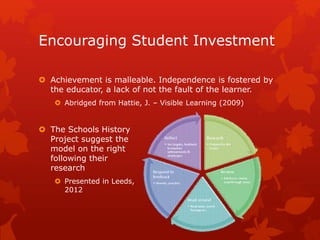
 The Schools History
Project suggest the
model on the right
following their
research
 Presented in Leeds,
2012
What a history course requires…
 Student investment, which remains the priority
 Resources (Which don’t require funds)
 Accessibility for all, regardless of personal resources
 Development of literacy and numeracy
 Stability and Sustainability of delivery
 Opportunity (Academic and vocational)
 An understanding of academic life
 Developing them ready for the future
 “Pancake teaching”
Improving success isn’t just
about History results!
 Cross-course development
 Use of local resources
 Raising the profile of the course and the college
 Improving enrolments and competing with other colleges
 Internal and external events
 Trips!
…nor is it about just improving
the course in general.
 Keeping up to date with national standards in secondary, FE and HE
 The curriculum is changing from “All, many, some” differentiation to
“emerging, expecting, exceeding”
 Mastery learning is “in vogue” with some institutions
 Achieve 80% to move on… But is it appropriate?
 Schemes of Work need to be solid and stand up to scrutiny from
OFSTED and service users.
 That scheme of work needs to be visible on walls – Ready for anyone
to inspect.
 Units need to be appropriate for the changing, vocational nature of
degrees
 Work placements are now more widely accessible
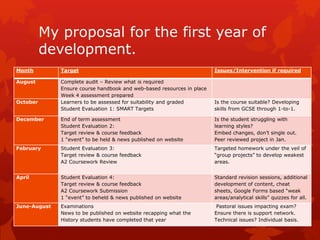
My proposal for the first year of
development.
Month Target Issues/Intervention if required
August Complete audit – Review what is required
Ensure course handbook and web-based resources in place
Week 4 assessment prepared
October Learners to be assessed for suitability and graded
Student Evaluation 1: SMART Targets
Is the course suitable? Developing
skills from GCSE through 1-to-1.
December End of term assessment
Student Evaluation 2:
Target review & course feedback
1 “event” to be held & news published on website
Is the student struggling with
learning styles?
Embed changes, don’t single out.
Peer reviewed project in Jan.
February Student Evaluation 3:
Target review & course feedback
A2 Coursework Review
Targeted homework under the veil of
“group projects” to develop weakest
areas.
April Student Evaluation 4:
Target review & course feedback
A2 Coursework Submission
1 “event” to beheld & news published on website
Standard revision sessions, additional
development of content, cheat
sheets, Google Forms based “weak
areas/analytical skills” quizzes for all.
June-August Examinations
News to be published on website recapping what the
History students have completed that year
Pastoral issues impacting exam?
Ensure there is support network.
Technical issues? Individual basis.
Before the academic year begins,
the following would be in place…
 Have a course handbook ready highlighting at minimum:
 Weekly content/topics/important dates
 Essay titles for all future assessments and deadlines
 Tracking embedded into the handbook/Moodle
 Explanations of grade boundaries and referencing
 Have as many accessible resources for students as
possible
 Google Forms for reading/assessing understanding in
personal time
 Links to online texts which can be read on any device
 Week 4 assessment to judge suitability for History would
be prepared (Early indications are key)
During the academic year, this
would be in place
 Regular tracking/feedback for students and relevant staff
 1 week turn around on all essays would be the target
 Instant turn-around on quizzes
 All results to be logged for personal student/staff reference on
Moodle/Course Handbooks
 Mini-events to promote history within the college and externally
 Students encouraged to partake in the FotE debate
 Win it away from the reigning champions!
 Celebrating occasions relevant to the history course
 Encouragement to attend relevant public lectures at UoP
 Where possible, an authorised trip to one would be ideal
 Feeder schools participating in a competitive history project
 ILP’s and progression
 Students need 1-to-1’s in office hours
 Individual target setting specific to history and interventions
To be developed alongside the
course
 Tracking software/apps if appropriate
 An extensive database catered to the specific needs of
the units delivered
 Contacts with local institutions
 Teaching and learning software/interfaces to speed up
delivery and increase ease of use in any circumstances
 A repository of relevant books held by history
 I bring my own books which are unit specific regardless
which History students can take advantage of…
The following would be for the
wider context…
 I can not only utilise a very broad base of software and
tools to improve the delivery of history, but I can work with
my team to help them develop their own ICT skills and
knowledge of learning tools if they desire.
 I can develop a sturdy, inspection-ready course which from
the moment it begins can be tracked through simple, web-
based tools (and have data printed off for inspection), from
students to SMT.
 I can do this stand-alone or simply utilise a VLE effectively.
 I can develop software specific not just to history but the
college.
 I have a broad background of teaching other areas, so as
the need calls for it I am willing to assist with cover.
A summary of a two year path…
 The first year would require a great deal of work.
 Whether classroom approaches are suitable – Trialling
techniques (Some tried and tested at other institutions)
 Monitoring of results – Achievement expected to improve
 Year 2 would be smoother, all plans settled and only
minor adjustments made
 Anything that didn’t work would fall by the wayside
 Monitoring of results – Achievement improving further
In conclusion
 There is a plan for difficulties in place and ideas for
interventions
 5P’s: Prior Planning Prevents Poor Performance
 Solid structure alongside a broad variety of resources
which are freely accessible (and cheap/free!) is
essential.
 Determination, a strong work ethic and teamwork with
other subject areas will secure the future and raise the
profile (perception and grades) of History.

Raising achievement and ensuring success for students of History

  • 1.
    Raising achievement and ensuringsuccess for students of History
  • 2.
    Auditing History  Whatwould be the ideal set of circumstances?  What are the core basics students need?  What does the most recent publicly available data show?  Pre-audit analysis:  A major issue will be literacy and numeracy (Even with C’s)  The socio-economic situation is such that students are not guaranteed to have access to resources at home or be able to purchase them.  Many students will be enrolled with lower grade profiles than other colleges… But…
  • 3.
    Encouraging Student Investment Achievement is malleable. Independence is fostered by the educator, a lack of not the fault of the learner.  Abridged from Hattie, J. – Visible Learning (2009)  The Schools History Project suggest the model on the right following their research  Presented in Leeds, 2012
  • 4.
    What a historycourse requires…  Student investment, which remains the priority  Resources (Which don’t require funds)  Accessibility for all, regardless of personal resources  Development of literacy and numeracy  Stability and Sustainability of delivery  Opportunity (Academic and vocational)  An understanding of academic life  Developing them ready for the future  “Pancake teaching”
  • 5.
    Improving success isn’tjust about History results!  Cross-course development  Use of local resources  Raising the profile of the course and the college  Improving enrolments and competing with other colleges  Internal and external events  Trips!
  • 6.
    …nor is itabout just improving the course in general.  Keeping up to date with national standards in secondary, FE and HE  The curriculum is changing from “All, many, some” differentiation to “emerging, expecting, exceeding”  Mastery learning is “in vogue” with some institutions  Achieve 80% to move on… But is it appropriate?  Schemes of Work need to be solid and stand up to scrutiny from OFSTED and service users.  That scheme of work needs to be visible on walls – Ready for anyone to inspect.  Units need to be appropriate for the changing, vocational nature of degrees  Work placements are now more widely accessible
  • 7.
    My proposal forthe first year of development. Month Target Issues/Intervention if required August Complete audit – Review what is required Ensure course handbook and web-based resources in place Week 4 assessment prepared October Learners to be assessed for suitability and graded Student Evaluation 1: SMART Targets Is the course suitable? Developing skills from GCSE through 1-to-1. December End of term assessment Student Evaluation 2: Target review & course feedback 1 “event” to be held & news published on website Is the student struggling with learning styles? Embed changes, don’t single out. Peer reviewed project in Jan. February Student Evaluation 3: Target review & course feedback A2 Coursework Review Targeted homework under the veil of “group projects” to develop weakest areas. April Student Evaluation 4: Target review & course feedback A2 Coursework Submission 1 “event” to beheld & news published on website Standard revision sessions, additional development of content, cheat sheets, Google Forms based “weak areas/analytical skills” quizzes for all. June-August Examinations News to be published on website recapping what the History students have completed that year Pastoral issues impacting exam? Ensure there is support network. Technical issues? Individual basis.
  • 8.
    Before the academicyear begins, the following would be in place…  Have a course handbook ready highlighting at minimum:  Weekly content/topics/important dates  Essay titles for all future assessments and deadlines  Tracking embedded into the handbook/Moodle  Explanations of grade boundaries and referencing  Have as many accessible resources for students as possible  Google Forms for reading/assessing understanding in personal time  Links to online texts which can be read on any device  Week 4 assessment to judge suitability for History would be prepared (Early indications are key)
  • 9.
    During the academicyear, this would be in place  Regular tracking/feedback for students and relevant staff  1 week turn around on all essays would be the target  Instant turn-around on quizzes  All results to be logged for personal student/staff reference on Moodle/Course Handbooks  Mini-events to promote history within the college and externally  Students encouraged to partake in the FotE debate  Win it away from the reigning champions!  Celebrating occasions relevant to the history course  Encouragement to attend relevant public lectures at UoP  Where possible, an authorised trip to one would be ideal  Feeder schools participating in a competitive history project  ILP’s and progression  Students need 1-to-1’s in office hours  Individual target setting specific to history and interventions
  • 10.
    To be developedalongside the course  Tracking software/apps if appropriate  An extensive database catered to the specific needs of the units delivered  Contacts with local institutions  Teaching and learning software/interfaces to speed up delivery and increase ease of use in any circumstances  A repository of relevant books held by history  I bring my own books which are unit specific regardless which History students can take advantage of…
  • 11.
    The following wouldbe for the wider context…  I can not only utilise a very broad base of software and tools to improve the delivery of history, but I can work with my team to help them develop their own ICT skills and knowledge of learning tools if they desire.  I can develop a sturdy, inspection-ready course which from the moment it begins can be tracked through simple, web- based tools (and have data printed off for inspection), from students to SMT.  I can do this stand-alone or simply utilise a VLE effectively.  I can develop software specific not just to history but the college.  I have a broad background of teaching other areas, so as the need calls for it I am willing to assist with cover.
  • 12.
    A summary ofa two year path…  The first year would require a great deal of work.  Whether classroom approaches are suitable – Trialling techniques (Some tried and tested at other institutions)  Monitoring of results – Achievement expected to improve  Year 2 would be smoother, all plans settled and only minor adjustments made  Anything that didn’t work would fall by the wayside  Monitoring of results – Achievement improving further
  • 13.
    In conclusion  Thereis a plan for difficulties in place and ideas for interventions  5P’s: Prior Planning Prevents Poor Performance  Solid structure alongside a broad variety of resources which are freely accessible (and cheap/free!) is essential.  Determination, a strong work ethic and teamwork with other subject areas will secure the future and raise the profile (perception and grades) of History.