International Journal of Innovative Research in Advanced Engineering (IJIRAE) ISSN: 2349-2763
Issue 02, Volume 4 (February 2017) www.ijirae.com
_________________________________________________________________________________________________
IJIRAE: Impact Factor Value – SJIF: Innospace, Morocco (2015): 3.361 | PIF: 2.469 | Jour Info: 4.085 |
Index Copernicus 2014 = 6.57
© 2014- 17, IJIRAE- All Rights Reserved Page -6
A Literature Survey on Mobile-Learning Management
Systems
Rahul B. Mannade1
Hirendra H. Hazare2
P. G. Scholar, Gondwana University,
Gadchiroli, Maharashtra (India)
Assistant Professor, Gondwana University,
Gadchiroli, Maharashtra (India)
Abstract— In today’s digital era, due to development in wireless communication technology, proliferation of
electronics gazettes usage especially smartphones is at peak point across the globe. Without smartphone, most of the
individuals feel inconvenience in their daily routine India is not an exception for it, today; India has the second-
biggest smartphone market in terms of active unique smartphone users, which crossed 220 million users. These
innovations and developments in mobile technologies have an impact on education and learning systems which in
turn resulted into the potential to develop an education system that enables individuals and groups to learn bypassing
the time and place constraints. This paper gives a glimpse on characteristics, elements, security risks, design issues
and challenges of mobile learning management system.
Keywords — Access point, GPRS, LMS, M-Learning, MOODLE, NFC, PDA, RFID, schoolOGY, Tablets, Wi-Fi.
I. INTRODUCTION
The emergence of the knowledge society poses new requirements for education and training: the knowledge-based
economy requires a flexible, very well-trained workforce; and the citizens of the information society need to be
continuously trained in order to remain competitive within this workforce and to fully exploit the learning opportunities
offered by the knowledge society for their personal development, fulfilment and enjoyment [11]. The rapid evolution of
learning technologies exploiting the respective developments in information and communication technologies (ICT)
create numerous new opportunities for meeting these requirements. Web-based learning environments like learning
management systems, learning content management systems delivers a life-long education, training applications and
learning services to anyone, anytime, anyplace and just-in-time, which resulted into the emergence of E-Learning. Digital
technologies continue to influence the way we find, create, share, and negotiate information and ideas – even influencing
the ways that we think about knowledge itself.
Learning, education, and training continue to extend the reach of classrooms and training rooms by including a more
organic, integrated array of learning experiences [1]. Perceptions of competence have expanded; work styles are shifting
from individual accomplishment to teams, communities of practice, and collaboration. In spite of these, individual
accomplishment is still important which provides a measure of the contribution that each individual offers. Smart
enterprises identified that the investments in people and in technologies that serve their needs can have a direct positive
effect on business success metrics. Therefore, many business enterprises started to implement the E-Learning based
Learning Management Systems (LMS) or Knowledge Management Systems to educate and train their employees. LMSs
have been adopted by many organizations all over the globe to establish and provide access to online learning services.
Nowadays, LMSs are successful to greater extent. Table - I shows the recent adoption of LMSs. Not only educational
organizations but many businesses implement learning management systems (LMS) as a way to help train and educate
newly joined as well as existing employees so they can succeed in their roles.
International Journal of Innovative Research in Advanced Engineering (IJIRAE) ISSN: 2349-2763
Issue 02, Volume 4 (February 2017) www.ijirae.com
_________________________________________________________________________________________________
IJIRAE: Impact Factor Value – SJIF: Innospace, Morocco (2015): 3.361 | PIF: 2.469 | Jour Info: 4.085 |
Index Copernicus 2014 = 6.57
© 2014- 17, IJIRAE- All Rights Reserved Page -7
LMS solutions provide businesses and educational institutions with the ability to manage online training and learning
programs for their employees. Some of the successful LMSs are MOODLE, Absorb, NEO, schoolOGY etc. Although
LMS has pretty good market, only 19% access to LMSs is done through the smartphones [2]. Figure 1 shows usage of
various computing devices used to access the LMS this is because; almost all LMSs are designed for the desktop or
laptop computers.
But, nowadays, scenario is changed. In recent days, number of smartphone users has increased tremendously. "India will
exceed 200 million smartphone users, topping the US as the world's second largest smartphone market by 2016 due to
increasing penetration of affordable smart mobile devices in the country," the US-based research firm said in a report and
these predictions have become reality today. India has become the second-biggest smartphone market in terms of active
unique smartphone users, crossing 220 million users, surpassing the US market, according to a report by Counterpoint
Research [3].
Fig. 2: Number of smartphone users in India from 2015 to 2020
Forecast of the number of smartphone user for the year 2020 is 2.8 million globally and this statics for India is 444.7
million. Figure- 2 shows the forecast of number of smartphone users in India from 2015 to 2020. Hence, LMSs need to
be needed to change to adapt to new user requirements and technologies. This need gave a birth to the emergence of M-
Learning or Mobile-Learning.
TABLE I - ADOPTION OF LMSS
Sr. No. Countries that adopted LMSs Percentage
01. United States (corporations and
educational institutions)
74 %
02. Spain (universities and Colleges) 90 %
03. Turkey(Banking & retailing sector) 29 %
04. Companies all over globe (Training) 79.5 %
International Journal of Innovative Research in Advanced Engineering (IJIRAE) ISSN: 2349-2763
Issue 02, Volume 4 (February 2017) www.ijirae.com
_________________________________________________________________________________________________
IJIRAE: Impact Factor Value – SJIF: Innospace, Morocco (2015): 3.361 | PIF: 2.469 | Jour Info: 4.085 |
Index Copernicus 2014 = 6.57
© 2014- 17, IJIRAE- All Rights Reserved Page -8
II. M-LEARNING AND M-LEARNING ENVIRONMENT
“The use of handheld devices, together with wireless and mobile phone networks, to facilitate, support, enhance,
collaborate and extend the reach of teaching and learning” is known as M-Learning. Mobile learning is highly situated,
personal, collaborative and long term; in other words, it is truly learner-cantered learning.
A. Features of M-Learning
Portability:- The small size and weight of mobile devices means they can be carried everywhere. This easy access
enables learning activities to be undertaken outside the traditional learning environment, anywhere and at anytime.
Connectivity:- As well as providing learners with access to content, mobile devices also provide them with connections
to other learners. For example, a shared network can be created by connecting to other devices or to a common network.
Context Sensitivity:- Mobile devices can both gather and respond to real or simulated data unique to the current location,
environment and time. This enables learning to take place which can make greater use of a person’s immediate context
and surroundings and facilitate the application of knowledge, skill development and communication. In this way, mobile
technologies can facilitate learning both in context and learning across contexts.
Lifelong:- Mobile content consumption is continuous: there is no beginning, middle or end. Learning does not have to be
linear, given and received at a fixed time and within a fixed period.
Individuality:- Scaffolding’ (i.e. offering appropriate support to facilitate a learner) for difficult activities can be
customized for individual learners. As well as being able to customize preferences for how a learner interfaces with
materials, there is also the possibility of basing learning on previous learning experiences.
III. M-LEARNING ENVIRONMENT
“M-learning environment is a digital learning atmosphere or infrastructure in which mobile devices like tablets,
palmtops, smartphones and some communication channel like Wi-Fi or mobile data (3G/4G networks) is used for
teaching learning process”. Figure 3 depicts the typical M-Learning environment.
Fig. 3: Typical M-Learning Environment
As shown in figure 3, M-Learning Environment includes the learning contents stored on server; each student is already
registered with server through user management. In M-learning student or learner can have access to the learning
material anytime and from any place i.e. from home or from outside of campus or in the class room. Mobile learning is
developed by using multi platforms, languages, and technologies. Thus, learning can be carried out anywhere, anytime
for as long as an institution’s networking system can gain access to the wireless coverage [4]. This approach of learning
is highly receptive to students as they are more likely to seek and use learning contents via mobile services rather than to
find proprietary courseware that is not easily accessed. Propelled by the growing market of smart phones, M-learning is
becoming more acceptable in teaching and learning process as these mobile devices are smart as they claimed to be –
customizing their contents according to users’ specific needs [5].Teaching and learning has become more manageable
and diverse as students can perform many learning activities freely and easily, for instance, they can download lectures
notes almost instantaneously for lectures that they had missed. There is a huge application base of learning materials and
contents, which is continually expanding, that can be easily accessed by students and instructors alike. For example,
students can download and practice short tests or quizzes on their mobile phones where prompt feedback is instantly
displayed to improve comprehension.
International Journal of Innovative Research in Advanced Engineering (IJIRAE) ISSN: 2349-2763
Issue 02, Volume 4 (February 2017) www.ijirae.com
_________________________________________________________________________________________________
IJIRAE: Impact Factor Value – SJIF: Innospace, Morocco (2015): 3.361 | PIF: 2.469 | Jour Info: 4.085 |
Index Copernicus 2014 = 6.57
© 2014- 17, IJIRAE- All Rights Reserved Page -9
IV.ELEMENTS OF M-LEARNING SYSTEM
The elements of M-learning can be categorized into three groups: i. Mobile Technologies ii. Wireless Network
Infrastructure iii. Mobile Devices. Wireless communication techniques may help student obtain the necessary
information. Besides this, it also teachers and the learning systems can direct students to the information by using these
techniques. Therefore, students can use their mobiles or PDAs (Personal Digital Assistant) in order to access to the
information they need. Mobile devices and technologies that can provide support for mobile learning are:
A. Mobile Technologies
Nowadays many students carry a smartphone or a tablet to perform various learning activities like: communication, web
browsing, tweeting, status sharing, video watching, recording or uploading, task scheduling etc. Mobile technologies are
attractive and easy way to maintain literacy skills and gain constant access to learning materials [6]. Figure 4 shows the
numerous ways through which mobile device can be used for learning.
Fig. 4: Use of mobile devices for learning
Mobile technologies that can provide support for mobile learning are:
 GPRS (General Packet Radio Service)
 Wi-Fi
 Bluetooth
 Infrared
These mobile technologies are available in some mobile devices. The mobile devices that do not have these technologies
are supplied with communication ability by using one of the transferring technologies such as USB, Compact Flash Card
and PC Card.
B. Wireless Network Infrastructure
It comprises wireless communication channel. It may be wireless internet access through one of the internet technologies
like GPRS, Satellite communication, Infrared, 3G/4G mobile data network etc.
C. Mobile Devices
Mobile devices used in M-learning systems can be one of following:
Laptop: Laptops and another kind of it, known as notebook, are some of the portable devices that are mostly used in our
daily life. These laptops enable users to obtain the information they want by means of such wireless connection types as
USB, wireless network, Bluetooth and infrared devices independent from time and place.
Tablet PC. Tablet PC is the most popular computer which is a portable personal computer typically smaller than a
notebook computer but larger than a smart phone, and it is easy to transfer the data by means of its internet and memory
device.
PDA. Personal Digital Assistant, also known as palmtop computer, is a mobile device that functions as a personal
information manager such as keeping addresses or names. It has the ability to connect to the internet and, it is also
portable.
Smart Phone. It is a kind of communication device that has been designed by adding the features of PDA. Due to the
fact that smart phones have mobile operating system and many applications, they are very common devices used actively
in all areas for different purposes.
V. CHALLENGES OF M-LEARNING SYSTEMS
The mobile devices mentioned in previous section are smaller in size (small enough to be handheld), lightweight (they
weigh less than a kilo) and have a display screen with touch input or a small keyboard. Although mobile devices have
plenty of useful characteristics, there are several technical challenges that influence on usage of mobile devices for
educational purposes. Those can be seen as limitations of mobile learning:
International Journal of Innovative Research in Advanced Engineering (IJIRAE) ISSN: 2349-2763
Issue 02, Volume 4 (February 2017) www.ijirae.com
_________________________________________________________________________________________________
IJIRAE: Impact Factor Value – SJIF: Innospace, Morocco (2015): 3.361 | PIF: 2.469 | Jour Info: 4.085 |
Index Copernicus 2014 = 6.57
© 2014- 17, IJIRAE- All Rights Reserved Page -10
A. Device Diversity
Currently, plenty mobile device manufacturers with different mobile platforms e. g. iOS of Apple, Android of Google,
Windows of Microsoft, Symbian of Symbian Inc. etc. It is cumbersome task to implement M-learning application that
runs on every possible mobile device since students possess different types of mobile devices [7].
B. Connectivity issues
In M-learning systems all communication occurs through wireless network. Since wireless communication is so
susceptible to disconnection, it is of great concern when designing successful mobile computers [8]. Wireless networks
deliver lower bandwidth than wired networks; hence mobile computing designs need to be very concerned about
bandwidth consumption.
C. Security Risk
Connection to a wireless link is so easy; the security of wireless communication can be compromised much more easily
than that of wired communication [8].
D. Small screen sizes with poor resolution, colour and contrast
In order to stick with mobility or portability feature, mobile device manufacturers tries to reduce the size and weight of
device. But, this aspect affects the user friendliness of mobile device. In M-learning, due to small screen students can
accidently select a function they don't need, e.g. delete document [7], [9].
E. Low Power
Batteries are the largest single source of weight in a portable computer. While reducing battery weight is important, too
small a battery can undermine the value of portability by causing users to recharge frequently, carry spare batteries, or
use their mobile computers less[8].
F. Risks to Data
Mobile devices have the risk of physical damage, unauthorized access, loss and theft. Breaches of privacy or total loss of
data become more likely in case of handheld devices [8].
G. Small Storage Capacity
Storage space on portable devices is limited by physical size and power requirements. Every activity on a mobile device
wastes a battery life, whether this activity is associated with learning or something else [9].
Besides of technical challenges, mobile learning is also facing some other issues. One of them is the cost of mobile
devices and required software, since ownership of the mobile device is one of the critical success factors to adopt m-
learning. Copyright of learning materials and issues of security and privacy are also of a great importance when
introducing m-learning into learning environment.
VI.DESIGN ISSUES OF M-LEARNING SYSTEM
The use of advanced computing and information technology in educational domain has increased significantly during the
last decade [10]. In earlier days, computer-based training were used, but later on due to the evolution of world-wide-web,
a networked-based learning led to the emergence of the concept of e-learning. Nowadays, advancements in mobile and
wireless technologies have an impact on learning activities, thus generating a new approach for technology enhanced
learning called m-learning or mobile learning. While this mobile/wireless computing revolution is having a major impact
on the ways people communicate and interact, this transformation does not live up to the promises and expectations when
it comes to schools and universities.
Thus, challenging question in designing m-learning system is- “Which learning aspects and processes should be
considered while designing new mobile solutions? What new scenarios and applications will emerge?” Therefore, while
designing m-learning system following issues must be taken into consideration:
Context: - In which educational environment the innovative educational practice will take place.
Challenge: - What is the challenge we are facing while trying to design innovative educational practices?
Scenario, activities and tools: - Virtualizing and designing a specific educational activity supported by mobile
technologies that illustrates innovative practice.
Another design issue of m-learning includes the rapid advancements in mobile technology, the general incompatibility
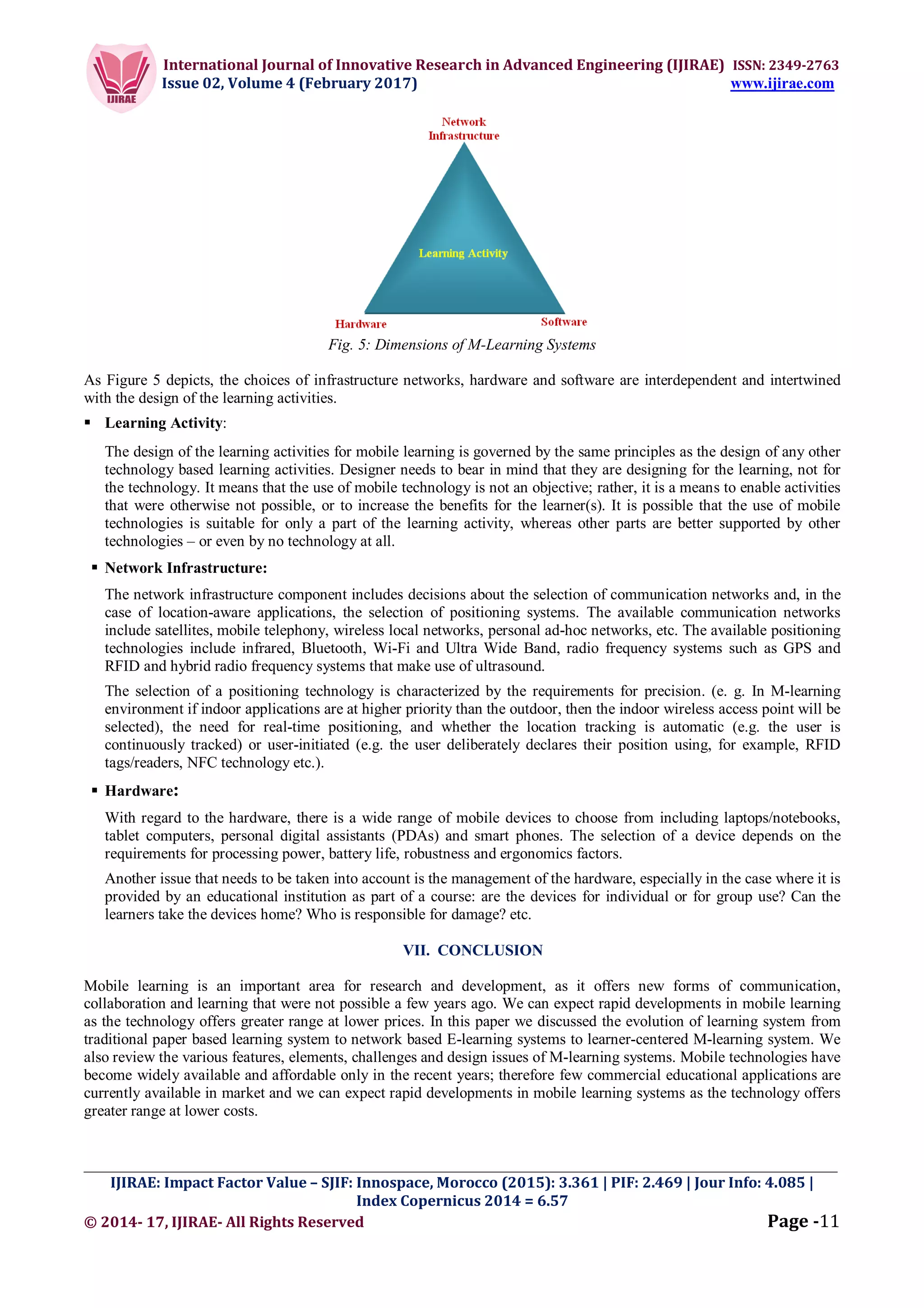
between devices, operating systems and applications, the limited resources in relation to desktop technologies. Figure 5
shows the main dimensions of design of mobile learning systems in relation to currently available technologies.
International Journal of Innovative Research in Advanced Engineering (IJIRAE) ISSN: 2349-2763
Issue 02, Volume 4 (February 2017) www.ijirae.com
_________________________________________________________________________________________________
IJIRAE: Impact Factor Value – SJIF: Innospace, Morocco (2015): 3.361 | PIF: 2.469 | Jour Info: 4.085 |
Index Copernicus 2014 = 6.57
© 2014- 17, IJIRAE- All Rights Reserved Page -11
Fig. 5: Dimensions of M-Learning Systems
As Figure 5 depicts, the choices of infrastructure networks, hardware and software are interdependent and intertwined
with the design of the learning activities.
 Learning Activity:
The design of the learning activities for mobile learning is governed by the same principles as the design of any other
technology based learning activities. Designer needs to bear in mind that they are designing for the learning, not for
the technology. It means that the use of mobile technology is not an objective; rather, it is a means to enable activities
that were otherwise not possible, or to increase the benefits for the learner(s). It is possible that the use of mobile
technologies is suitable for only a part of the learning activity, whereas other parts are better supported by other
technologies – or even by no technology at all.
 Network Infrastructure:
The network infrastructure component includes decisions about the selection of communication networks and, in the
case of location-aware applications, the selection of positioning systems. The available communication networks
include satellites, mobile telephony, wireless local networks, personal ad-hoc networks, etc. The available positioning
technologies include infrared, Bluetooth, Wi-Fi and Ultra Wide Band, radio frequency systems such as GPS and
RFID and hybrid radio frequency systems that make use of ultrasound.
The selection of a positioning technology is characterized by the requirements for precision. (e. g. In M-learning
environment if indoor applications are at higher priority than the outdoor, then the indoor wireless access point will be
selected), the need for real-time positioning, and whether the location tracking is automatic (e.g. the user is
continuously tracked) or user-initiated (e.g. the user deliberately declares their position using, for example, RFID
tags/readers, NFC technology etc.).
 Hardware:
With regard to the hardware, there is a wide range of mobile devices to choose from including laptops/notebooks,
tablet computers, personal digital assistants (PDAs) and smart phones. The selection of a device depends on the
requirements for processing power, battery life, robustness and ergonomics factors.
Another issue that needs to be taken into account is the management of the hardware, especially in the case where it is
provided by an educational institution as part of a course: are the devices for individual or for group use? Can the
learners take the devices home? Who is responsible for damage? etc.
VII. CONCLUSION
Mobile learning is an important area for research and development, as it offers new forms of communication,
collaboration and learning that were not possible a few years ago. We can expect rapid developments in mobile learning
as the technology offers greater range at lower prices. In this paper we discussed the evolution of learning system from
traditional paper based learning system to network based E-learning systems to learner-centered M-learning system. We
also review the various features, elements, challenges and design issues of M-learning systems. Mobile technologies have
become widely available and affordable only in the recent years; therefore few commercial educational applications are
currently available in market and we can expect rapid developments in mobile learning systems as the technology offers
greater range at lower costs.
International Journal of Innovative Research in Advanced Engineering (IJIRAE) ISSN: 2349-2763
Issue 02, Volume 4 (February 2017) www.ijirae.com
_________________________________________________________________________________________________
IJIRAE: Impact Factor Value – SJIF: Innospace, Morocco (2015): 3.361 | PIF: 2.469 | Jour Info: 4.085 |
Index Copernicus 2014 = 6.57
© 2014- 17, IJIRAE- All Rights Reserved Page -12
REFERENCES
[1] Beth Davis, Colleen Carmean, Ellen D. Wagner, “The Evolution of the LMS: From Management to Learning :
Deep Analysis of Trends Shaping the Future of e-Learning”
[2] http://www.softwareadvice.com/hr/userview/lms-report-2015/.
[3] http://www.thehindu.com/news/cities/mumbai/business/with-220mn-users-india-is-now-worlds-secondbiggest-
smartphone-market/article8186543.ece
[4] Shanmugapriya M.& Tamilarasia, A.(2011), Designing an m-learning application for ubiquitous learning
environment in the android based mobile devices using web services, Indian Journal of Computer Science and
Engineering(IJCSE) ,22-30.
[5] Winters, N.& Mor.Y (2008)’IDR: a participatory methodology for interdisciplinary design in technology enhanced
learning’ (Computers & Education, 50(2),579-600).
[6] Jasmina Kljunić, Dijana Plantak Vukovac, “A Survey on Usage of Mobile Devices for Learning among Tertiary
Students in Croatia”, Central Europian Conference on Information and Intelligent Systems, Sept. 23-25,2016.(pp.
97-104).
[7] Elias, T. Universal Instructional Design for Mobile Learning. International Review of Research in Open and
Distance Learning 12 (2), pages 143-156, 2011.
[8] Rahul B. Mannade, Amol B. Bhande, “Challenges of Mobile Computing: An Overview”, International Journal of
Advanced Research in Computer and Communication Engineering, Vol. 2, Issue 8, August 2013, pp.3109-3114.
[9] Bidin, S., Ziden, A. Adoption and application of mobile learning in the education industry. The 6th International
Conference on University Learning and Teaching, pages 720-729, 2013.
[10] Marcelo Milrad, “How should learning activities using mobile technologies be designed to support innovative
educational practices?”, Report of a workshop by the Kaleidoscope Network of Excellence Mobile Learning
Initiative.
[11] Giasemi Vavoula and Charalampos Karagiannidis: “Designing Mobile Learning Experiences”.

A Literature Survey on Mobile-Learning Management Systems

  • 1.
    International Journal ofInnovative Research in Advanced Engineering (IJIRAE) ISSN: 2349-2763 Issue 02, Volume 4 (February 2017) www.ijirae.com _________________________________________________________________________________________________ IJIRAE: Impact Factor Value – SJIF: Innospace, Morocco (2015): 3.361 | PIF: 2.469 | Jour Info: 4.085 | Index Copernicus 2014 = 6.57 © 2014- 17, IJIRAE- All Rights Reserved Page -6 A Literature Survey on Mobile-Learning Management Systems Rahul B. Mannade1 Hirendra H. Hazare2 P. G. Scholar, Gondwana University, Gadchiroli, Maharashtra (India) Assistant Professor, Gondwana University, Gadchiroli, Maharashtra (India) Abstract— In today’s digital era, due to development in wireless communication technology, proliferation of electronics gazettes usage especially smartphones is at peak point across the globe. Without smartphone, most of the individuals feel inconvenience in their daily routine India is not an exception for it, today; India has the second- biggest smartphone market in terms of active unique smartphone users, which crossed 220 million users. These innovations and developments in mobile technologies have an impact on education and learning systems which in turn resulted into the potential to develop an education system that enables individuals and groups to learn bypassing the time and place constraints. This paper gives a glimpse on characteristics, elements, security risks, design issues and challenges of mobile learning management system. Keywords — Access point, GPRS, LMS, M-Learning, MOODLE, NFC, PDA, RFID, schoolOGY, Tablets, Wi-Fi. I. INTRODUCTION The emergence of the knowledge society poses new requirements for education and training: the knowledge-based economy requires a flexible, very well-trained workforce; and the citizens of the information society need to be continuously trained in order to remain competitive within this workforce and to fully exploit the learning opportunities offered by the knowledge society for their personal development, fulfilment and enjoyment [11]. The rapid evolution of learning technologies exploiting the respective developments in information and communication technologies (ICT) create numerous new opportunities for meeting these requirements. Web-based learning environments like learning management systems, learning content management systems delivers a life-long education, training applications and learning services to anyone, anytime, anyplace and just-in-time, which resulted into the emergence of E-Learning. Digital technologies continue to influence the way we find, create, share, and negotiate information and ideas – even influencing the ways that we think about knowledge itself. Learning, education, and training continue to extend the reach of classrooms and training rooms by including a more organic, integrated array of learning experiences [1]. Perceptions of competence have expanded; work styles are shifting from individual accomplishment to teams, communities of practice, and collaboration. In spite of these, individual accomplishment is still important which provides a measure of the contribution that each individual offers. Smart enterprises identified that the investments in people and in technologies that serve their needs can have a direct positive effect on business success metrics. Therefore, many business enterprises started to implement the E-Learning based Learning Management Systems (LMS) or Knowledge Management Systems to educate and train their employees. LMSs have been adopted by many organizations all over the globe to establish and provide access to online learning services. Nowadays, LMSs are successful to greater extent. Table - I shows the recent adoption of LMSs. Not only educational organizations but many businesses implement learning management systems (LMS) as a way to help train and educate newly joined as well as existing employees so they can succeed in their roles.
  • 2.
    International Journal ofInnovative Research in Advanced Engineering (IJIRAE) ISSN: 2349-2763 Issue 02, Volume 4 (February 2017) www.ijirae.com _________________________________________________________________________________________________ IJIRAE: Impact Factor Value – SJIF: Innospace, Morocco (2015): 3.361 | PIF: 2.469 | Jour Info: 4.085 | Index Copernicus 2014 = 6.57 © 2014- 17, IJIRAE- All Rights Reserved Page -7 LMS solutions provide businesses and educational institutions with the ability to manage online training and learning programs for their employees. Some of the successful LMSs are MOODLE, Absorb, NEO, schoolOGY etc. Although LMS has pretty good market, only 19% access to LMSs is done through the smartphones [2]. Figure 1 shows usage of various computing devices used to access the LMS this is because; almost all LMSs are designed for the desktop or laptop computers. But, nowadays, scenario is changed. In recent days, number of smartphone users has increased tremendously. "India will exceed 200 million smartphone users, topping the US as the world's second largest smartphone market by 2016 due to increasing penetration of affordable smart mobile devices in the country," the US-based research firm said in a report and these predictions have become reality today. India has become the second-biggest smartphone market in terms of active unique smartphone users, crossing 220 million users, surpassing the US market, according to a report by Counterpoint Research [3]. Fig. 2: Number of smartphone users in India from 2015 to 2020 Forecast of the number of smartphone user for the year 2020 is 2.8 million globally and this statics for India is 444.7 million. Figure- 2 shows the forecast of number of smartphone users in India from 2015 to 2020. Hence, LMSs need to be needed to change to adapt to new user requirements and technologies. This need gave a birth to the emergence of M- Learning or Mobile-Learning. TABLE I - ADOPTION OF LMSS Sr. No. Countries that adopted LMSs Percentage 01. United States (corporations and educational institutions) 74 % 02. Spain (universities and Colleges) 90 % 03. Turkey(Banking & retailing sector) 29 % 04. Companies all over globe (Training) 79.5 %
  • 3.
    International Journal ofInnovative Research in Advanced Engineering (IJIRAE) ISSN: 2349-2763 Issue 02, Volume 4 (February 2017) www.ijirae.com _________________________________________________________________________________________________ IJIRAE: Impact Factor Value – SJIF: Innospace, Morocco (2015): 3.361 | PIF: 2.469 | Jour Info: 4.085 | Index Copernicus 2014 = 6.57 © 2014- 17, IJIRAE- All Rights Reserved Page -8 II. M-LEARNING AND M-LEARNING ENVIRONMENT “The use of handheld devices, together with wireless and mobile phone networks, to facilitate, support, enhance, collaborate and extend the reach of teaching and learning” is known as M-Learning. Mobile learning is highly situated, personal, collaborative and long term; in other words, it is truly learner-cantered learning. A. Features of M-Learning Portability:- The small size and weight of mobile devices means they can be carried everywhere. This easy access enables learning activities to be undertaken outside the traditional learning environment, anywhere and at anytime. Connectivity:- As well as providing learners with access to content, mobile devices also provide them with connections to other learners. For example, a shared network can be created by connecting to other devices or to a common network. Context Sensitivity:- Mobile devices can both gather and respond to real or simulated data unique to the current location, environment and time. This enables learning to take place which can make greater use of a person’s immediate context and surroundings and facilitate the application of knowledge, skill development and communication. In this way, mobile technologies can facilitate learning both in context and learning across contexts. Lifelong:- Mobile content consumption is continuous: there is no beginning, middle or end. Learning does not have to be linear, given and received at a fixed time and within a fixed period. Individuality:- Scaffolding’ (i.e. offering appropriate support to facilitate a learner) for difficult activities can be customized for individual learners. As well as being able to customize preferences for how a learner interfaces with materials, there is also the possibility of basing learning on previous learning experiences. III. M-LEARNING ENVIRONMENT “M-learning environment is a digital learning atmosphere or infrastructure in which mobile devices like tablets, palmtops, smartphones and some communication channel like Wi-Fi or mobile data (3G/4G networks) is used for teaching learning process”. Figure 3 depicts the typical M-Learning environment. Fig. 3: Typical M-Learning Environment As shown in figure 3, M-Learning Environment includes the learning contents stored on server; each student is already registered with server through user management. In M-learning student or learner can have access to the learning material anytime and from any place i.e. from home or from outside of campus or in the class room. Mobile learning is developed by using multi platforms, languages, and technologies. Thus, learning can be carried out anywhere, anytime for as long as an institution’s networking system can gain access to the wireless coverage [4]. This approach of learning is highly receptive to students as they are more likely to seek and use learning contents via mobile services rather than to find proprietary courseware that is not easily accessed. Propelled by the growing market of smart phones, M-learning is becoming more acceptable in teaching and learning process as these mobile devices are smart as they claimed to be – customizing their contents according to users’ specific needs [5].Teaching and learning has become more manageable and diverse as students can perform many learning activities freely and easily, for instance, they can download lectures notes almost instantaneously for lectures that they had missed. There is a huge application base of learning materials and contents, which is continually expanding, that can be easily accessed by students and instructors alike. For example, students can download and practice short tests or quizzes on their mobile phones where prompt feedback is instantly displayed to improve comprehension.
  • 4.
    International Journal ofInnovative Research in Advanced Engineering (IJIRAE) ISSN: 2349-2763 Issue 02, Volume 4 (February 2017) www.ijirae.com _________________________________________________________________________________________________ IJIRAE: Impact Factor Value – SJIF: Innospace, Morocco (2015): 3.361 | PIF: 2.469 | Jour Info: 4.085 | Index Copernicus 2014 = 6.57 © 2014- 17, IJIRAE- All Rights Reserved Page -9 IV.ELEMENTS OF M-LEARNING SYSTEM The elements of M-learning can be categorized into three groups: i. Mobile Technologies ii. Wireless Network Infrastructure iii. Mobile Devices. Wireless communication techniques may help student obtain the necessary information. Besides this, it also teachers and the learning systems can direct students to the information by using these techniques. Therefore, students can use their mobiles or PDAs (Personal Digital Assistant) in order to access to the information they need. Mobile devices and technologies that can provide support for mobile learning are: A. Mobile Technologies Nowadays many students carry a smartphone or a tablet to perform various learning activities like: communication, web browsing, tweeting, status sharing, video watching, recording or uploading, task scheduling etc. Mobile technologies are attractive and easy way to maintain literacy skills and gain constant access to learning materials [6]. Figure 4 shows the numerous ways through which mobile device can be used for learning. Fig. 4: Use of mobile devices for learning Mobile technologies that can provide support for mobile learning are:  GPRS (General Packet Radio Service)  Wi-Fi  Bluetooth  Infrared These mobile technologies are available in some mobile devices. The mobile devices that do not have these technologies are supplied with communication ability by using one of the transferring technologies such as USB, Compact Flash Card and PC Card. B. Wireless Network Infrastructure It comprises wireless communication channel. It may be wireless internet access through one of the internet technologies like GPRS, Satellite communication, Infrared, 3G/4G mobile data network etc. C. Mobile Devices Mobile devices used in M-learning systems can be one of following: Laptop: Laptops and another kind of it, known as notebook, are some of the portable devices that are mostly used in our daily life. These laptops enable users to obtain the information they want by means of such wireless connection types as USB, wireless network, Bluetooth and infrared devices independent from time and place. Tablet PC. Tablet PC is the most popular computer which is a portable personal computer typically smaller than a notebook computer but larger than a smart phone, and it is easy to transfer the data by means of its internet and memory device. PDA. Personal Digital Assistant, also known as palmtop computer, is a mobile device that functions as a personal information manager such as keeping addresses or names. It has the ability to connect to the internet and, it is also portable. Smart Phone. It is a kind of communication device that has been designed by adding the features of PDA. Due to the fact that smart phones have mobile operating system and many applications, they are very common devices used actively in all areas for different purposes. V. CHALLENGES OF M-LEARNING SYSTEMS The mobile devices mentioned in previous section are smaller in size (small enough to be handheld), lightweight (they weigh less than a kilo) and have a display screen with touch input or a small keyboard. Although mobile devices have plenty of useful characteristics, there are several technical challenges that influence on usage of mobile devices for educational purposes. Those can be seen as limitations of mobile learning:
  • 5.
    International Journal ofInnovative Research in Advanced Engineering (IJIRAE) ISSN: 2349-2763 Issue 02, Volume 4 (February 2017) www.ijirae.com _________________________________________________________________________________________________ IJIRAE: Impact Factor Value – SJIF: Innospace, Morocco (2015): 3.361 | PIF: 2.469 | Jour Info: 4.085 | Index Copernicus 2014 = 6.57 © 2014- 17, IJIRAE- All Rights Reserved Page -10 A. Device Diversity Currently, plenty mobile device manufacturers with different mobile platforms e. g. iOS of Apple, Android of Google, Windows of Microsoft, Symbian of Symbian Inc. etc. It is cumbersome task to implement M-learning application that runs on every possible mobile device since students possess different types of mobile devices [7]. B. Connectivity issues In M-learning systems all communication occurs through wireless network. Since wireless communication is so susceptible to disconnection, it is of great concern when designing successful mobile computers [8]. Wireless networks deliver lower bandwidth than wired networks; hence mobile computing designs need to be very concerned about bandwidth consumption. C. Security Risk Connection to a wireless link is so easy; the security of wireless communication can be compromised much more easily than that of wired communication [8]. D. Small screen sizes with poor resolution, colour and contrast In order to stick with mobility or portability feature, mobile device manufacturers tries to reduce the size and weight of device. But, this aspect affects the user friendliness of mobile device. In M-learning, due to small screen students can accidently select a function they don't need, e.g. delete document [7], [9]. E. Low Power Batteries are the largest single source of weight in a portable computer. While reducing battery weight is important, too small a battery can undermine the value of portability by causing users to recharge frequently, carry spare batteries, or use their mobile computers less[8]. F. Risks to Data Mobile devices have the risk of physical damage, unauthorized access, loss and theft. Breaches of privacy or total loss of data become more likely in case of handheld devices [8]. G. Small Storage Capacity Storage space on portable devices is limited by physical size and power requirements. Every activity on a mobile device wastes a battery life, whether this activity is associated with learning or something else [9]. Besides of technical challenges, mobile learning is also facing some other issues. One of them is the cost of mobile devices and required software, since ownership of the mobile device is one of the critical success factors to adopt m- learning. Copyright of learning materials and issues of security and privacy are also of a great importance when introducing m-learning into learning environment. VI.DESIGN ISSUES OF M-LEARNING SYSTEM The use of advanced computing and information technology in educational domain has increased significantly during the last decade [10]. In earlier days, computer-based training were used, but later on due to the evolution of world-wide-web, a networked-based learning led to the emergence of the concept of e-learning. Nowadays, advancements in mobile and wireless technologies have an impact on learning activities, thus generating a new approach for technology enhanced learning called m-learning or mobile learning. While this mobile/wireless computing revolution is having a major impact on the ways people communicate and interact, this transformation does not live up to the promises and expectations when it comes to schools and universities. Thus, challenging question in designing m-learning system is- “Which learning aspects and processes should be considered while designing new mobile solutions? What new scenarios and applications will emerge?” Therefore, while designing m-learning system following issues must be taken into consideration: Context: - In which educational environment the innovative educational practice will take place. Challenge: - What is the challenge we are facing while trying to design innovative educational practices? Scenario, activities and tools: - Virtualizing and designing a specific educational activity supported by mobile technologies that illustrates innovative practice. Another design issue of m-learning includes the rapid advancements in mobile technology, the general incompatibility between devices, operating systems and applications, the limited resources in relation to desktop technologies. Figure 5 shows the main dimensions of design of mobile learning systems in relation to currently available technologies.
  • 6.
    International Journal ofInnovative Research in Advanced Engineering (IJIRAE) ISSN: 2349-2763 Issue 02, Volume 4 (February 2017) www.ijirae.com _________________________________________________________________________________________________ IJIRAE: Impact Factor Value – SJIF: Innospace, Morocco (2015): 3.361 | PIF: 2.469 | Jour Info: 4.085 | Index Copernicus 2014 = 6.57 © 2014- 17, IJIRAE- All Rights Reserved Page -11 Fig. 5: Dimensions of M-Learning Systems As Figure 5 depicts, the choices of infrastructure networks, hardware and software are interdependent and intertwined with the design of the learning activities.  Learning Activity: The design of the learning activities for mobile learning is governed by the same principles as the design of any other technology based learning activities. Designer needs to bear in mind that they are designing for the learning, not for the technology. It means that the use of mobile technology is not an objective; rather, it is a means to enable activities that were otherwise not possible, or to increase the benefits for the learner(s). It is possible that the use of mobile technologies is suitable for only a part of the learning activity, whereas other parts are better supported by other technologies – or even by no technology at all.  Network Infrastructure: The network infrastructure component includes decisions about the selection of communication networks and, in the case of location-aware applications, the selection of positioning systems. The available communication networks include satellites, mobile telephony, wireless local networks, personal ad-hoc networks, etc. The available positioning technologies include infrared, Bluetooth, Wi-Fi and Ultra Wide Band, radio frequency systems such as GPS and RFID and hybrid radio frequency systems that make use of ultrasound. The selection of a positioning technology is characterized by the requirements for precision. (e. g. In M-learning environment if indoor applications are at higher priority than the outdoor, then the indoor wireless access point will be selected), the need for real-time positioning, and whether the location tracking is automatic (e.g. the user is continuously tracked) or user-initiated (e.g. the user deliberately declares their position using, for example, RFID tags/readers, NFC technology etc.).  Hardware: With regard to the hardware, there is a wide range of mobile devices to choose from including laptops/notebooks, tablet computers, personal digital assistants (PDAs) and smart phones. The selection of a device depends on the requirements for processing power, battery life, robustness and ergonomics factors. Another issue that needs to be taken into account is the management of the hardware, especially in the case where it is provided by an educational institution as part of a course: are the devices for individual or for group use? Can the learners take the devices home? Who is responsible for damage? etc. VII. CONCLUSION Mobile learning is an important area for research and development, as it offers new forms of communication, collaboration and learning that were not possible a few years ago. We can expect rapid developments in mobile learning as the technology offers greater range at lower prices. In this paper we discussed the evolution of learning system from traditional paper based learning system to network based E-learning systems to learner-centered M-learning system. We also review the various features, elements, challenges and design issues of M-learning systems. Mobile technologies have become widely available and affordable only in the recent years; therefore few commercial educational applications are currently available in market and we can expect rapid developments in mobile learning systems as the technology offers greater range at lower costs.
  • 7.
    International Journal ofInnovative Research in Advanced Engineering (IJIRAE) ISSN: 2349-2763 Issue 02, Volume 4 (February 2017) www.ijirae.com _________________________________________________________________________________________________ IJIRAE: Impact Factor Value – SJIF: Innospace, Morocco (2015): 3.361 | PIF: 2.469 | Jour Info: 4.085 | Index Copernicus 2014 = 6.57 © 2014- 17, IJIRAE- All Rights Reserved Page -12 REFERENCES [1] Beth Davis, Colleen Carmean, Ellen D. Wagner, “The Evolution of the LMS: From Management to Learning : Deep Analysis of Trends Shaping the Future of e-Learning” [2] http://www.softwareadvice.com/hr/userview/lms-report-2015/. [3] http://www.thehindu.com/news/cities/mumbai/business/with-220mn-users-india-is-now-worlds-secondbiggest- smartphone-market/article8186543.ece [4] Shanmugapriya M.& Tamilarasia, A.(2011), Designing an m-learning application for ubiquitous learning environment in the android based mobile devices using web services, Indian Journal of Computer Science and Engineering(IJCSE) ,22-30. [5] Winters, N.& Mor.Y (2008)’IDR: a participatory methodology for interdisciplinary design in technology enhanced learning’ (Computers & Education, 50(2),579-600). [6] Jasmina Kljunić, Dijana Plantak Vukovac, “A Survey on Usage of Mobile Devices for Learning among Tertiary Students in Croatia”, Central Europian Conference on Information and Intelligent Systems, Sept. 23-25,2016.(pp. 97-104). [7] Elias, T. Universal Instructional Design for Mobile Learning. International Review of Research in Open and Distance Learning 12 (2), pages 143-156, 2011. [8] Rahul B. Mannade, Amol B. Bhande, “Challenges of Mobile Computing: An Overview”, International Journal of Advanced Research in Computer and Communication Engineering, Vol. 2, Issue 8, August 2013, pp.3109-3114. [9] Bidin, S., Ziden, A. Adoption and application of mobile learning in the education industry. The 6th International Conference on University Learning and Teaching, pages 720-729, 2013. [10] Marcelo Milrad, “How should learning activities using mobile technologies be designed to support innovative educational practices?”, Report of a workshop by the Kaleidoscope Network of Excellence Mobile Learning Initiative. [11] Giasemi Vavoula and Charalampos Karagiannidis: “Designing Mobile Learning Experiences”.