
Crafted
INFORMATION
PPC Remarketing
Crafted
INFORMATION
Crafted
INFORMATION
Contents
1.0	Introduction
2.0	Lists
3.0	 Custom combinations
4.0	 Dynamic remarketing
5.0	Control
6.0	PolicyBee
7.0	Notcutts
8.0	 Useful data you can get from Remarketing campaigns
9.0	 Privacy questions
10.0	 Best practice
11.0	 Top tips for success
Crafted
INFORMATION
1.0
Introduction
Remarketing is an incredibly powerful tool for
re-engaging with people who have visited your
website. Remarketing can help you:
•	 Decrease your CPA (Cost per acquisition)
•	 Increase your brand awareness
•	 Increase your conversion rate by getting
	 people 	back to abandoned checkouts
•	 Promote additional products and services
	 to the right audience
The main difference between remarketing and
standard display is how the audience is targeted.
remarketing targets ‘the person’ who has already
visited your site and engaged with your brand,
products or services. This is where the true power
of Remarketing lays and, when the right strategy
is applied, it can drive great results.
Google AdWords is the system that is used to run
display advertising across the Google Display
Network (GDN).
Formally known as the Google Content Network
it has undergone many changes over the years.
Targeting is one area that has seen much
effectively. The visual element means the user
has to do less when being reminded about what
they were doing on your site. A relevant well
presented banner will receive a much better
response and as they say “a picture is worth
a thousand words”.
improvement and the traditional methods of
targeting contextually or by placement has been
expanded. Advertisers are now able to use
demographics, behavioural and interests to
target or exclude audiences.
The Display Ad Builder is another development
and a tool which offers many banner templates
for businesses to use. Branding, product images
and messaging just need adding. Often the cost
of having creative designed and built can be a
barrier for companies wanting to run banner
advertising. The Display Ad Builder offers a range
of banner sizes and styles with animation already
built in that can make set up quicker and more
cost effective. It is worth noting that, although it is
possible to make visually appealing creative in the
Display Ad Builder it will rarely look as good as
when it has been crafted by a design team.
Businesses can run remarketing campaigns
through AdWords using standard PPC text ads.
This is by far the quickest way of setting up a
campaign, but rarely performs as well. Banner ads
stand out much more on page and communicate
the brand, product or service visually and more
A picture is worth
a thousand words.
Crafted
INFORMATION
Crafted
INFORMATION
How does it work?
Crafted
INFORMATION
2.0
Lists
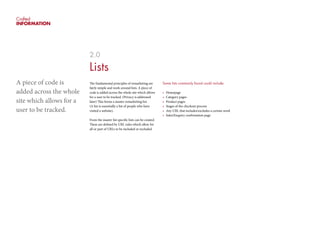
The fundamental principles of remarketing are
fairly simple and work around lists. A piece of
code is added across the whole site which allows
for a user to be tracked. (Privacy is addressed
later) This forms a master remarketing list.
(A list is essentially a list of people who have
visited a website).
From the master list specific lists can be created.
These are defined by URL rules which allow for
all or part of URLs to be included or excluded.
Some lists commonly found could include:
•	 Homepage
•	 Category pages
•	 Product pages
•	 Stages of the checkout process
•	 Any URL that includes/excludes a certain word
•	 Sales/Enquiry confirmation page
A piece of code is
added across the whole
site which allows for a
user to be tracked.
Crafted
INFORMATION
3.0
Custom combinations
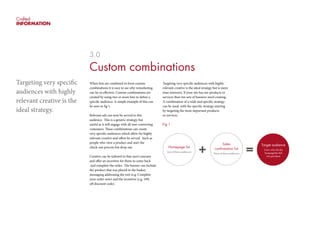
When lists are combined to form custom
combinations it is easy to see why remarketing
can be so effective. Custom combinations are
created by using two or more lists to define a
specific audience. A simple example of this can
be seen in fig 1.
Relevant ads can now be served to this
audience. This is a generic strategy, but
useful as it will engage with all non-converting
costumers. These combinations can create
very specific audiences which allow for highly
relevant creative and offers be served. Such as
people who view a product and start the
check-out process but drop out.
Creative can be tailored to that user’s journey
and offer an incentive for them to come back
and complete the order. The banner can include
the product that was placed in the basket,
messaging addressing the exit (e.g. Complete
your order now) and the incentive (e.g. 10%
off discount code).
Targeting very specific audiences with highly
relevant creative is the ideal strategy but is more
time intensive. If your site has ten products or
services then ten sets of banners need creating.
A combination of a wide and specific strategy
can be used, with the specific strategy starting
by targeting the most important products
or services.
Fig 1.
Targeting very specific
audiences with highly
relevant creative is the
ideal strategy.
Homepage list
Any of these audiences
Sales
confirmation list
None of these audiences
Target audience
Users who hit the
hompagebut did
not purchase
Crafted
INFORMATION
4.0
Dynamic remarketing
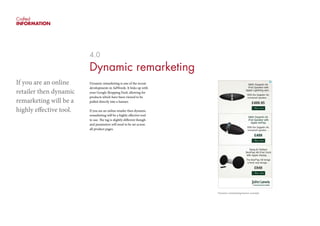
Dynamic remarketing is one of the recent
developments in AdWords. It links up with
your Google Shopping Feed, allowing for
products which have been viewed to be
pulled directly into a banner.
If you are an online retailer then dynamic
remarketing will be a highly effective tool
to use. The tag is slightly different though
and parameters will need to be set across
all product pages.
If you are an online
retailer then dynamic
remarketing will be a
highly effective tool.
Dynamic remarketing banner example.
Crafted
INFORMATION
4.0
Dynamic remarketing
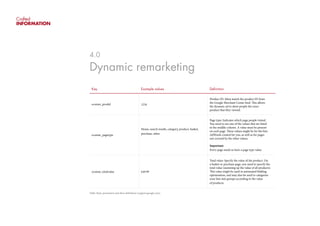
Key Example values Definition
ecomm_prodid 1234
Product ID: Must match the product ID from
the Google Merchant Center feed. This allows
the dynamic ad to show people the exact
product that they viewed.
ecomm_pagetype
Home, search results, category, product, basket,
purchase, other
Page type: Indicates which page people visited.
You need to use one of the values that are listed
in the middle column. A value must be present
on each page. These values might be for the lists
AdWords created for you, as well as for pages
not covered by the other values.
Important:
Every page needs to have a page type value.
ecomm_totalvalue £49.99
Total value: Specify the value of the product. On
a basket or purchase page, you need to specify the
total value (summing up the value of all products).
This value might be used in automated bidding
optimisation, and may also be used to categorise
your lists into groups according to the value
of products.
Table: Basic parameters and their definitions (support.google.com)
Crafted
INFORMATION
5.0
Control
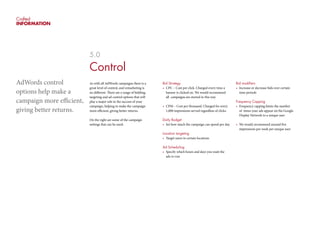
As with all AdWords campaigns there is a
great level of control, and remarketing is
no different. There are a range of bidding,
targeting and ad control options that will
play a major role in the success of your
campaign, helping to make the campaign
more efficient, giving better returns.
On the right are some of the campaign
settings that can be used:
Bid modifiers
•	 Increase or decrease bids over certain
	 time periods
Frequency Capping
•	 Frequency capping limits the number
	 of times your ads appear on the Google 	
	 Display Network to a unique user
•	 We would recommend around five
	 impressions per week per unique user
Bid Strategy
•	 CPC – Cost per click. Charged every time a 	
	 banner is clicked on. We would recommend
	 all campaigns are started in this way
•	 CPM – Cost per thousand. Charged for every 	
	 1,000 impressions served regardless of clicks
Daily Budget
•	 Set how much the campaign can spend per day
Location targeting
•	 Target users in certain locations
Ad Scheduling
•	 Specify which hours and days you want the
	 ads to run
AdWords control
options help make a
campaign more efficient,
giving better returns.
Crafted
INFORMATION
6.0
PolicyBee
PolicyBee is an independent, professional
insurance broker, providing dedicated
insurance services to consultancies,
freelancers and contractors.
Paid search is a major channel for PolicyBee
which operates in an incredibly competitive
market place. To help stay engaged with
potential costumers PolicyBee uses
remarketing in a number of strategic ways.
PolicyBee uses both generic and very
specific lists to target users who have either
not obtained a quote or purchased a policy.
Example of custom combination lists:
Wide
•	 Homepage-no-quote
•	 Quote-no-policy
Profession specific
•	 Accounting-no quote
•	 Photography-no-quote
•	 IT-Insurance-quote-no-policy
•	 Teachers-quote-no-policy
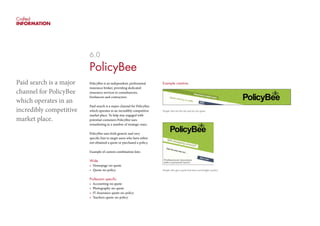
Example creative:
People who hit the site and do not quote
People who get a quote but have not bought a policy
Paid search is a major
channel for PolicyBee
which operates in an
incredibly competitive
market place.
Crafted
INFORMATION
6.0
PolicyBee
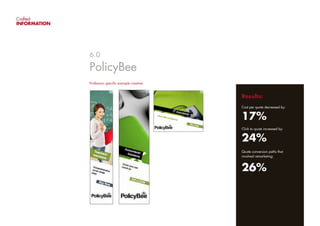
Profession specific example creative:
Results:
Cost per quote decreased by:
	
17%
Click to quote increased by:
	
24%
Quote conversion paths that
involved remarketing:
	
26%
Crafted
INFORMATION
7.0
Notcutts
Notcutts is a well-established brand and has been
helping gardeners since 1897. It has a number of
gardening centres around the UK and also an
online shop.
Remarketing for ecommerce is even more
essential since Google Shopping has been
completely moved over to a paid model.
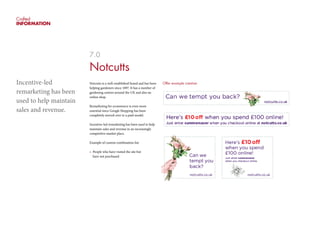
Incentive-led remarketing has been used to help
maintain sales and revenue in an increasingly
competitive market place.
Example of custom combination list:
•	 People who have visited the site but
	 have not purchased
Offer example creative:Incentive-led
remarketing has been
used to help maintain
sales and revenue.
Crafted
INFORMATION
7.0
Notcutts
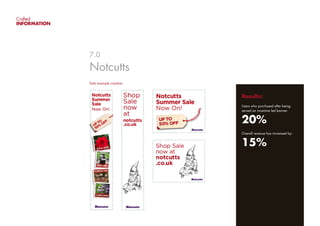
Sale example creative:
Results:
Users who purchased after being 		
served an incentive led banner:
	
20%
Overall revenue has increased by:
	
15%
Crafted
INFORMATION
8.0
Useful data you can get
from remarketing campaigns
Within AdWords-reporting a range of useful
information can be pulled through any display
campaign that is running. These reports can tell
you some useful information about who is
interacting with your ads and where it is
taking place.
Some of the data that can be seen is:
•	 Age
•	 Gender
•	 Locations
•	 Placements (websites)
•	 Time reports (month,week, day, hour)
As we have already established, remarketing serves
ads to people who have already engaged with your
site. If they do come back and convert it can be a
good indication of the type of audience that could
be targeted in a traditional display campaign.
By looking at this data you may find that the
majoity of your conversions come on Monday
evenings from males aged 25-30 who live in
London and use eBay, YouTube and Autotrader,
for example.
This profile can then be used to build out a
display campaign which targets only this criteria,
with relevant creative, increasing your Brand
visibility to the whole of this audience.
AdWords-reporting
can tell you some useful
information about who
is interacting with your
ads and where it is
taking place.
Crafted
INFORMATION
9.0
Privacy questions
Some people view advertising like remarketing,
as an invasion of privacy, stalking or a little bit
creepy. It is perfectly legal, but there are policies
and guidelines that advertisers need to follow:
Policy for advertising based on interests
and location
•	 Your Privacy Policy must include information 		
	 on any use of AdWords features which happens 		
	 on your site or app
•	 You aren’t allowed to run interest-based 		
	 advertising campaigns that collect personally 		
	 identifiable information (PII) including, but not 	
	 limited to, email addresses, telephone numbers 		
	 and credit card number
•	 You aren’t allowed to use or associate
	 personally identifiable information with 		
remarketing lists, cookies, data feeds or
	 other anonymous identifiers
•	 You aren’t allowed to use or associate targeting 	
	 information, such as demographics or location, 	
	 with any personally identifiable information 	
	 collected from the ad or its landing page
•	 You aren’t allowed to share any personally 	
	 identifiable information with Google through 	
	 your remarketing tag or any product data feeds 	
	 which might be associated with your ads
Full policy requirements can be found here:
https://support.google.com/adwordspolicy/
answer/143465?hl=en-GB
Crafted
INFORMATION
10.0
Best practice
Remarketing is not about bombarding a user until
they give in and click on an ad. Some advertisers
take this strategy, but it will affect your click
through rates (CTR’s). It can also annoy the user
who, in turn, gets annoyed with your business.
This is why frequency capping is so important
and in many cases the lower the better. We would
recommend only serving ads to a user around
three-five times per week.
Different industry sectors may require additional
levels of sensitivity when remarketing. If you are a
solicitor, provide health advice or dealing with any
personal and sensitive matters how and when ads
are served needs to be taken into consideration or
you could damage your brand reputation.
Example:
An employee has a dispute at work which
escalates and legal advice is needed. The
employee searches for solicitors at work and
the site he lands on is running a remarketing
campaign. The campaign then serves ads to the
employee at work which the company could
potentially see.
In this case it is worth considering if remarketing
is the right channel. If a campaign was to run, one
way around the issue of ads being served in work
hours is to implement ad scheduling.
The campaign could be set to run only between
1900-0000 weekdays and all day on the weekends.
We would recommend
only serving ads to a
user around three-five
times a week.
Crafted
INFORMATION
11.0
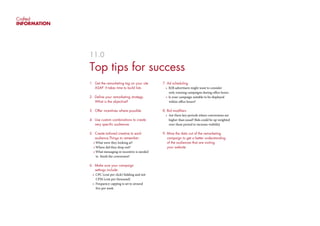
Top tips for success
1. Get the remarketing tag on your site 		
	 ASAP. It takes time to build lists
2. Define your remarketing strategy.
	 What is the objective?
3. Offer incentives where possible
4. Use custom combinations to create
	 very specific audiences
5. Create tailored creative to each
audience.Things to remember:
	 • What were they looking at?
	 • Where did they drop out?
	 • What messaging or incentive is needed
	 to finish the conversion?
6. Make sure your campaign
	 settings include:
	 •  CPC (cost per click) bidding and not
	 CPM (cost per thousand)
	 •  Frequency capping is set to around
	 five per week
7. Ad scheduling
	 •  B2B advertisers might want to consider
	 only running campaigns during office hours
	 •  Is your campaign suitable to be displayed 	
	 within office hours?
8. Bid modifiers
	 •  Are there key periods where conversions are 	
	 higher than usual? Bids could be up weighted 	
	 over these period to increase visibility
9. Mine the data out of the remarketing 	
	 campaign to get a better understanding
	 of the audiences that are visiting
	 your website
Crafted
INFORMATION
Ipswich Studio
32 Fore Street
Ipswich IP4 1JU
T.	 +44 (0) 1473 213222
E.	 hello@crafted.co.uk
London Office
Clerkenwell Workshops
27/31 Clerkenwell Close
London EC1R 0AT
T.	 +44 (0) 20 3393 3852
www.crafted.co.uk

A guide to remarketing with Adwords

  • 1.
  • 2.
    Crafted INFORMATION Crafted INFORMATION Contents 1.0 Introduction 2.0 Lists 3.0 Custom combinations 4.0 Dynamic remarketing 5.0 Control 6.0 PolicyBee 7.0 Notcutts 8.0 Useful data you can get from Remarketing campaigns 9.0 Privacy questions 10.0 Best practice 11.0 Top tips for success
  • 3.
    Crafted INFORMATION 1.0 Introduction Remarketing is anincredibly powerful tool for re-engaging with people who have visited your website. Remarketing can help you: • Decrease your CPA (Cost per acquisition) • Increase your brand awareness • Increase your conversion rate by getting people back to abandoned checkouts • Promote additional products and services to the right audience The main difference between remarketing and standard display is how the audience is targeted. remarketing targets ‘the person’ who has already visited your site and engaged with your brand, products or services. This is where the true power of Remarketing lays and, when the right strategy is applied, it can drive great results. Google AdWords is the system that is used to run display advertising across the Google Display Network (GDN). Formally known as the Google Content Network it has undergone many changes over the years. Targeting is one area that has seen much effectively. The visual element means the user has to do less when being reminded about what they were doing on your site. A relevant well presented banner will receive a much better response and as they say “a picture is worth a thousand words”. improvement and the traditional methods of targeting contextually or by placement has been expanded. Advertisers are now able to use demographics, behavioural and interests to target or exclude audiences. The Display Ad Builder is another development and a tool which offers many banner templates for businesses to use. Branding, product images and messaging just need adding. Often the cost of having creative designed and built can be a barrier for companies wanting to run banner advertising. The Display Ad Builder offers a range of banner sizes and styles with animation already built in that can make set up quicker and more cost effective. It is worth noting that, although it is possible to make visually appealing creative in the Display Ad Builder it will rarely look as good as when it has been crafted by a design team. Businesses can run remarketing campaigns through AdWords using standard PPC text ads. This is by far the quickest way of setting up a campaign, but rarely performs as well. Banner ads stand out much more on page and communicate the brand, product or service visually and more A picture is worth a thousand words.
  • 4.
  • 5.
    Crafted INFORMATION 2.0 Lists The fundamental principlesof remarketing are fairly simple and work around lists. A piece of code is added across the whole site which allows for a user to be tracked. (Privacy is addressed later) This forms a master remarketing list. (A list is essentially a list of people who have visited a website). From the master list specific lists can be created. These are defined by URL rules which allow for all or part of URLs to be included or excluded. Some lists commonly found could include: • Homepage • Category pages • Product pages • Stages of the checkout process • Any URL that includes/excludes a certain word • Sales/Enquiry confirmation page A piece of code is added across the whole site which allows for a user to be tracked.
  • 6.
    Crafted INFORMATION 3.0 Custom combinations When listsare combined to form custom combinations it is easy to see why remarketing can be so effective. Custom combinations are created by using two or more lists to define a specific audience. A simple example of this can be seen in fig 1. Relevant ads can now be served to this audience. This is a generic strategy, but useful as it will engage with all non-converting costumers. These combinations can create very specific audiences which allow for highly relevant creative and offers be served. Such as people who view a product and start the check-out process but drop out. Creative can be tailored to that user’s journey and offer an incentive for them to come back and complete the order. The banner can include the product that was placed in the basket, messaging addressing the exit (e.g. Complete your order now) and the incentive (e.g. 10% off discount code). Targeting very specific audiences with highly relevant creative is the ideal strategy but is more time intensive. If your site has ten products or services then ten sets of banners need creating. A combination of a wide and specific strategy can be used, with the specific strategy starting by targeting the most important products or services. Fig 1. Targeting very specific audiences with highly relevant creative is the ideal strategy. Homepage list Any of these audiences Sales confirmation list None of these audiences Target audience Users who hit the hompagebut did not purchase
  • 7.
    Crafted INFORMATION 4.0 Dynamic remarketing Dynamic remarketingis one of the recent developments in AdWords. It links up with your Google Shopping Feed, allowing for products which have been viewed to be pulled directly into a banner. If you are an online retailer then dynamic remarketing will be a highly effective tool to use. The tag is slightly different though and parameters will need to be set across all product pages. If you are an online retailer then dynamic remarketing will be a highly effective tool. Dynamic remarketing banner example.
  • 8.
    Crafted INFORMATION 4.0 Dynamic remarketing Key Examplevalues Definition ecomm_prodid 1234 Product ID: Must match the product ID from the Google Merchant Center feed. This allows the dynamic ad to show people the exact product that they viewed. ecomm_pagetype Home, search results, category, product, basket, purchase, other Page type: Indicates which page people visited. You need to use one of the values that are listed in the middle column. A value must be present on each page. These values might be for the lists AdWords created for you, as well as for pages not covered by the other values. Important: Every page needs to have a page type value. ecomm_totalvalue £49.99 Total value: Specify the value of the product. On a basket or purchase page, you need to specify the total value (summing up the value of all products). This value might be used in automated bidding optimisation, and may also be used to categorise your lists into groups according to the value of products. Table: Basic parameters and their definitions (support.google.com)
  • 9.
    Crafted INFORMATION 5.0 Control As with allAdWords campaigns there is a great level of control, and remarketing is no different. There are a range of bidding, targeting and ad control options that will play a major role in the success of your campaign, helping to make the campaign more efficient, giving better returns. On the right are some of the campaign settings that can be used: Bid modifiers • Increase or decrease bids over certain time periods Frequency Capping • Frequency capping limits the number of times your ads appear on the Google Display Network to a unique user • We would recommend around five impressions per week per unique user Bid Strategy • CPC – Cost per click. Charged every time a banner is clicked on. We would recommend all campaigns are started in this way • CPM – Cost per thousand. Charged for every 1,000 impressions served regardless of clicks Daily Budget • Set how much the campaign can spend per day Location targeting • Target users in certain locations Ad Scheduling • Specify which hours and days you want the ads to run AdWords control options help make a campaign more efficient, giving better returns.
  • 10.
    Crafted INFORMATION 6.0 PolicyBee PolicyBee is anindependent, professional insurance broker, providing dedicated insurance services to consultancies, freelancers and contractors. Paid search is a major channel for PolicyBee which operates in an incredibly competitive market place. To help stay engaged with potential costumers PolicyBee uses remarketing in a number of strategic ways. PolicyBee uses both generic and very specific lists to target users who have either not obtained a quote or purchased a policy. Example of custom combination lists: Wide • Homepage-no-quote • Quote-no-policy Profession specific • Accounting-no quote • Photography-no-quote • IT-Insurance-quote-no-policy • Teachers-quote-no-policy Example creative: People who hit the site and do not quote People who get a quote but have not bought a policy Paid search is a major channel for PolicyBee which operates in an incredibly competitive market place.
  • 11.
    Crafted INFORMATION 6.0 PolicyBee Profession specific examplecreative: Results: Cost per quote decreased by: 17% Click to quote increased by: 24% Quote conversion paths that involved remarketing: 26%
  • 12.
    Crafted INFORMATION 7.0 Notcutts Notcutts is awell-established brand and has been helping gardeners since 1897. It has a number of gardening centres around the UK and also an online shop. Remarketing for ecommerce is even more essential since Google Shopping has been completely moved over to a paid model. Incentive-led remarketing has been used to help maintain sales and revenue in an increasingly competitive market place. Example of custom combination list: • People who have visited the site but have not purchased Offer example creative:Incentive-led remarketing has been used to help maintain sales and revenue.
  • 13.
    Crafted INFORMATION 7.0 Notcutts Sale example creative: Results: Userswho purchased after being served an incentive led banner: 20% Overall revenue has increased by: 15%
  • 14.
    Crafted INFORMATION 8.0 Useful data youcan get from remarketing campaigns Within AdWords-reporting a range of useful information can be pulled through any display campaign that is running. These reports can tell you some useful information about who is interacting with your ads and where it is taking place. Some of the data that can be seen is: • Age • Gender • Locations • Placements (websites) • Time reports (month,week, day, hour) As we have already established, remarketing serves ads to people who have already engaged with your site. If they do come back and convert it can be a good indication of the type of audience that could be targeted in a traditional display campaign. By looking at this data you may find that the majoity of your conversions come on Monday evenings from males aged 25-30 who live in London and use eBay, YouTube and Autotrader, for example. This profile can then be used to build out a display campaign which targets only this criteria, with relevant creative, increasing your Brand visibility to the whole of this audience. AdWords-reporting can tell you some useful information about who is interacting with your ads and where it is taking place.
  • 15.
    Crafted INFORMATION 9.0 Privacy questions Some peopleview advertising like remarketing, as an invasion of privacy, stalking or a little bit creepy. It is perfectly legal, but there are policies and guidelines that advertisers need to follow: Policy for advertising based on interests and location • Your Privacy Policy must include information on any use of AdWords features which happens on your site or app • You aren’t allowed to run interest-based advertising campaigns that collect personally identifiable information (PII) including, but not limited to, email addresses, telephone numbers and credit card number • You aren’t allowed to use or associate personally identifiable information with remarketing lists, cookies, data feeds or other anonymous identifiers • You aren’t allowed to use or associate targeting information, such as demographics or location, with any personally identifiable information collected from the ad or its landing page • You aren’t allowed to share any personally identifiable information with Google through your remarketing tag or any product data feeds which might be associated with your ads Full policy requirements can be found here: https://support.google.com/adwordspolicy/ answer/143465?hl=en-GB
  • 16.
    Crafted INFORMATION 10.0 Best practice Remarketing isnot about bombarding a user until they give in and click on an ad. Some advertisers take this strategy, but it will affect your click through rates (CTR’s). It can also annoy the user who, in turn, gets annoyed with your business. This is why frequency capping is so important and in many cases the lower the better. We would recommend only serving ads to a user around three-five times per week. Different industry sectors may require additional levels of sensitivity when remarketing. If you are a solicitor, provide health advice or dealing with any personal and sensitive matters how and when ads are served needs to be taken into consideration or you could damage your brand reputation. Example: An employee has a dispute at work which escalates and legal advice is needed. The employee searches for solicitors at work and the site he lands on is running a remarketing campaign. The campaign then serves ads to the employee at work which the company could potentially see. In this case it is worth considering if remarketing is the right channel. If a campaign was to run, one way around the issue of ads being served in work hours is to implement ad scheduling. The campaign could be set to run only between 1900-0000 weekdays and all day on the weekends. We would recommend only serving ads to a user around three-five times a week.
  • 17.
    Crafted INFORMATION 11.0 Top tips forsuccess 1. Get the remarketing tag on your site ASAP. It takes time to build lists 2. Define your remarketing strategy. What is the objective? 3. Offer incentives where possible 4. Use custom combinations to create very specific audiences 5. Create tailored creative to each audience.Things to remember: • What were they looking at? • Where did they drop out? • What messaging or incentive is needed to finish the conversion? 6. Make sure your campaign settings include: • CPC (cost per click) bidding and not CPM (cost per thousand) • Frequency capping is set to around five per week 7. Ad scheduling • B2B advertisers might want to consider only running campaigns during office hours • Is your campaign suitable to be displayed within office hours? 8. Bid modifiers • Are there key periods where conversions are higher than usual? Bids could be up weighted over these period to increase visibility 9. Mine the data out of the remarketing campaign to get a better understanding of the audiences that are visiting your website
  • 18.
    Crafted INFORMATION Ipswich Studio 32 ForeStreet Ipswich IP4 1JU T. +44 (0) 1473 213222 E. hello@crafted.co.uk London Office Clerkenwell Workshops 27/31 Clerkenwell Close London EC1R 0AT T. +44 (0) 20 3393 3852 www.crafted.co.uk