a guide for training
PUBLIC DIALOGUE facilitators
a guide for training
PUBLIC DIALOGUE
facilitators
EVERYDAY DEMOCRACY
A Project of The Paul J. Aicher Foundation
ii a guide for training PUBLIC DIALOGUE facilitators EVERYDAY DEMOCRACY www.EVERYDAY-DEMOCRACY.org
A Guide for Training Public Dialogue Facilitators is the third edition of our training guide,
first published in 1998 by Everyday Democracy (formerly the Study Circles Resource
Center). Note that the title is new; it reflects the continuing expansion of Everyday
Democracy’s work, from “study circles” to a model that uses proven organizing
strategies to create large-scale public dialogue which can lead to changes in community
institutions and policies. We are pleased to offer this up-to-date, effective tool to help
you train people to conduct productive, public conversations in your community.
Everyday Democracy is the primary project of The Paul J. Aicher Foundation, a
national nonpartisan, nonprofit organization. We help communities find ways to bring
all kinds of people together to solve community problems and bring about long-lasting
community change. We work with neighborhoods, cities and towns, regions, and
states. Our ultimate goal: communities that work better for everyone, every day.
Everyday Democracy has been helping people do this work across the country since
1989. We provide advice and training, and then use what we learn to benefit other
communities.
We would like to help you organize facilitator trainings using this material. This new
edition of A Guide for Training Public Dialogue Facilitators is available on our
website and in print from Everyday Democracy.
Please go to www.everyday-democracy.org for information about how to create
large-scale, dialogue-to-action programs that engage hundreds (and sometimes
thousands) of residents. On our site, you will also find discussion guides on a number
of topics.
Writer/Managing Editor: Sarah vL. Campbell
Writing Assistance: Susan McCormack
Editing: Molly Holme Barrett
Design: OmniStudio
Production: Carrie Boron, Amy Malick, and Francine Nichols
©
2008, 2006, 1998 by The Paul J. Aicher Foundation
East Hartford, Connecticut
Permissions Policy
Yes:	 Photocopying portions of this book is encouraged for the purpose of
training facilitators.
Maybe:	Reproducing portions of this book to conduct fee-for-service training,
or incorporating these materials into other publications, requires our written
permission.
Everyday Democracy
111 Founders Plaza, Suite 1403
East Hartford, CT 06108
860.928.2616
860.928.3713 Fax
info@everyday-democracy.org
iiia guide for training PUBLIC DIALOGUE facilitators EVERYDAY DEMOCRACY www.EVERYDAY-DEMOCRACY.org
Contents
Introduction
	 The Purpose of this Guide................................................................................... 1
	 Using this Guide................................................................................................... 1
Chapter 1: PUBLIC DIALOGUE as a Tool for Community Change
	 Guiding Principles................................................................................................ 4
Chapter 2: Building a Training Program from the Ground Up
	 Co-Facilitation...................................................................................................... 6
	 Finding Trainees................................................................................................... 6
	 Planning Successful Trainings.............................................................................. 7
	 Supplemental Data............................................................................................... 8
	 Training Sites........................................................................................................ 9
	 Timing.................................................................................................................. 9
	 Paid or Unpaid?.................................................................................................... 9
	 More Than a One-Time Thing......................................................................... 10
	 Maintaining High-Quality Facilitation.............................................................. 11
Chapter 3: The Training Agenda  at  a Glance
	 Goals of the Training.......................................................................................... 13
	 Preparing for the Training.................................................................................. 13
	 Outline of the Training Agenda......................................................................... 14
Chapter 4: Annotated Training Agenda
	 Day One.............................................................................................................. 16
		 Welcome....................................................................................................... 17
		 A Dialogue Experience................................................................................ 18
		 Overview of the Community Dialogue-to-Change Program..................... 19
		 Cross-Cultural Communication.................................................................. 19
	 Day Two.............................................................................................................. 20
		 Overview....................................................................................................... 20
		 Fishbowl Demonstration and Debrief......................................................... 21
		 Key Facilitation Skills: Part 1...................................................................... 23
iv a guide for training PUBLIC DIALOGUE facilitators EVERYDAY DEMOCRACY www.EVERYDAY-DEMOCRACY.org
		 Key Facilitation Skills: Part 2...................................................................... 26
		 Optional One-Day Training Agenda........................................................... 30
Chapter 5: Tips  Takeaways
	 Cultural Communication Styles: Part A............................................................ 32
	 Cultural Communication Styles: Part B............................................................ 33
	 Overview of a Dialogue-to-Change Process...................................................... 37
	 A Community Dialogue-to-Change Program................................................... 38
	 A Dialogue Circle............................................................................................... 39
	 What Dialogue Circles Are and Are Not: A Comparison................................. 40
	 A Typical Two-Hour Session.............................................................................. 41
	 Typical Progression of Sessions.......................................................................... 42
	 Sample Ground Rules......................................................................................... 43
	 Key Facilitation Skills......................................................................................... 44
	 The Art of Recording......................................................................................... 45
	 Leading a Brainstorm......................................................................................... 46
	 Developing Action Ideas..................................................................................... 47
	 How to Prioritize a List of Ideas........................................................................ 48
	 Setting Priorities for Action............................................................................... 49
	 Managing Conflict.............................................................................................. 50
	 Facilitating Viewpoints and Approaches............................................................ 51
	 A Neutral Facilitator........................................................................................... 52
	 Tips for Facilitators............................................................................................ 53
	 Responses to Typical Facilitation Challenges.................................................... 55
	 Facilitation Tips for Special Situations.............................................................. 58
	 Tips for Participants........................................................................................... 62
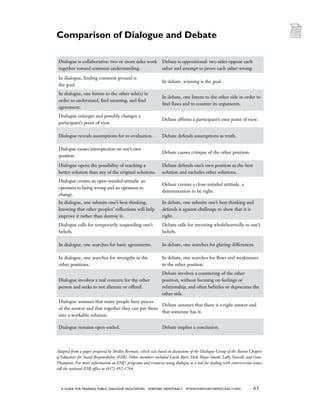
	 Comparison of Dialogue and Debate................................................................. 63
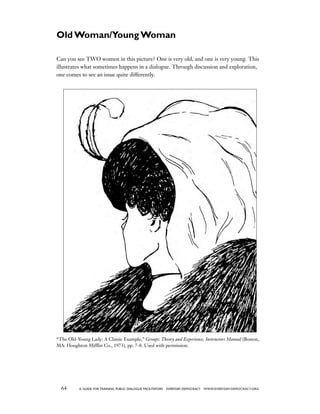
	 Old Woman/Young Woman............................................................................... 64
	 Chinese Characters “To Listen”......................................................................... 65
va guide for training PUBLIC DIALOGUE facilitators EVERYDAY DEMOCRACY www.EVERYDAY-DEMOCRACY.org
Chapter 6: Training Young People to Facilitate SMALL-GROUP
DIALOGUE
	 Introduction ....................................................................................................... 67
	 Annotated Training Agenda............................................................................... 68
		 Overview....................................................................................................... 69
		 Fishbowl Demonstration............................................................................. 74
		 Key Facilitation Skills.................................................................................. 76
		 Practice and Debrief.................................................................................... 82
		 Next Steps, Evaluation, and Wrap-Up........................................................ 84
Chapter 7: Evaluation Tools: How are Things Going?
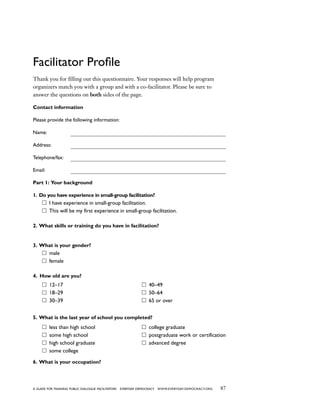
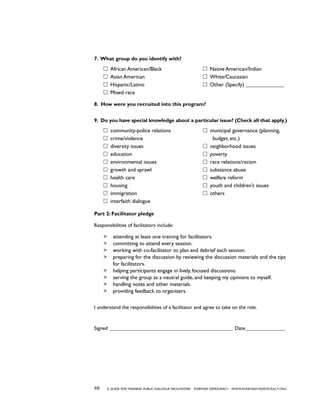
	 Facilitator Profile................................................................................................ 87
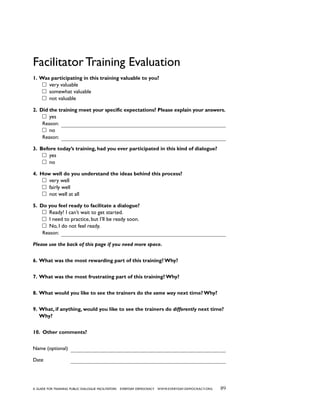
	 Facilitator Training Evaluation.......................................................................... 89
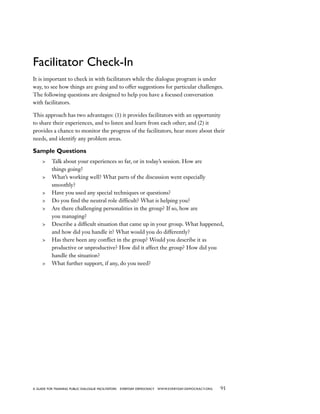
	 Facilitator Check-In........................................................................................... 91
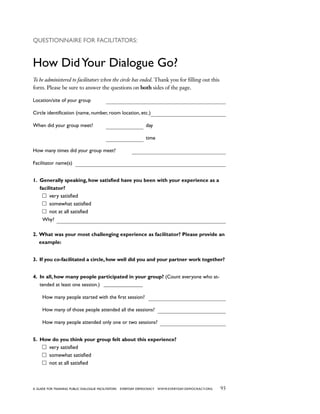
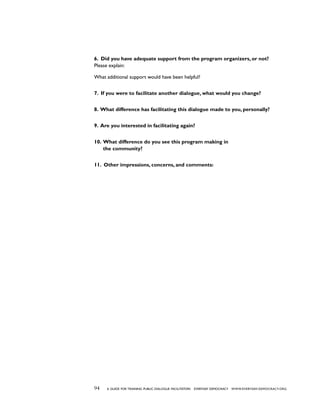
	 Questionnaire for Facilitators: How Did Your Dialogue Go?............................... 93
	 Questionnaire for Participants: How Did Your Dialogue Go?............................. 95
Resources/Acknowledgments
	 Recommended Reading...................................................................................... 97
	 Organizations...................................................................................................... 98
	 Acknowledgments............................................................................................. 101
Introduction
INTRODUCTION
1a guide for training PUBLIC DIALOGUE facilitators EVERYDAY DEMOCRACY www.EVERYDAY-DEMOCRACY.org
Introduction
The Purpose of this Guide
This guide is designed to help you train public dialogue facilitators. It is intended
primarily for trainers who work in community settings where many small dialogue
groups meet simultaneously across a city, town, or region. However, the principles
set out here apply, regardless of the setting, topic, or scale of the effort.
Small-group dialogues where all voices are equal and people listen respectfully
help participants examine complex issues and discuss possible solutions.
Community initiatives usually involve large numbers of people in many circles.
These programs help communities develop their own ability to solve problems, by
bringing all kinds of people together to think, talk, and create change.
In a dialogue circle, the facilitator is essential to helping the members talk and
work together productively. A Guide for Training Public Dialogue Facilitators will
help you develop a comprehensive training program that will yield a team of
well-trained, competent facilitators. 
Using this Guide
Chapter 1: An overview of the Everyday Democracy path to community change,
including an explanation of the special role that facilitators play in large-scale,
citizen engagement efforts.
Chapter 2: Information you will need to lay the foundation for a comprehensive
training program. The material includes guiding principles, information on
recruiting trainees, finding appropriate training sites, scheduling, and other related
information. Be sure you read this chapter before you work with the training
agenda in Chapter Four.
Chapter 3: A snapshot of the training, with goals, a list of supplies and equipment,
and an abbreviated agenda.
Chapter 4: The annotated training agenda, with detailed instructions for each part
of the training.
Chapter 5: Additional training content to supplement the annotated agenda.
Chapter 6: A training agenda for young people (ages 13 to 17).
Chapter 7: Evaluation tools to support your training program.
Additional Resources
Public Dialogue as a Tool for
Community Change
PUBLICDIALOGUEASATOOLFORCOMMUNITYCHANGE
Chapter 1
3a guide for training PUBLIC DIALOGUE facilitators EVERYDAY DEMOCRACY www.EVERYDAY-DEMOCRACY.org
Chapter 1
Public Dialogue as a Tool for
Community Change
This kind of dialogue is at the heart of community change. The process begins
with inclusive community organizing that aims to draw people from all parts of
the community to work on an issue of shared concern. Next, many small facilitated
groups meet simultaneously across the community. They consider the issue from
many perspectives and explore possible solutions. Then, moving to action, people
connect the ideas from the dialogue to outcomes that range from changes in an
individual’s attitudes, behaviors, and beliefs, to new projects and collaborations,
and to institutional and policy change.
In 1989, the Topsfield Foundation launched the Study Circles Resource Center,
known today as Everyday Democracy. (The board of directors later changed the
name to The Paul J. Aicher Foundation to honor the founder.) By promoting
effective citizen participation in public life, study circles became an important
element in civic activities across the country.
Since then, hundreds of communities have organized large-scale, public dialogue
on a range of issues, including racism and racial equity, education reform, youth
issues, neighborhood development, local governance, poverty reduction, police-
community relations, immigration, growth and development, and others.
In these community efforts, facilitators are essential to the quality of these
democratic discussions. They are usually volunteers—people who are willing to
give their time to engage their peers in productive, small-group, public discussions.
Special training and support help them build their skills and expertise.
These initiatives take many forms. Some take place over several weeks or months,
beginning and ending with large-group meetings that are followed by strategic
work on action ideas. Sometimes, dialogues are folded into a one-day forum or
summit to address a community issue.
Some communities hold dialogue circles on the same topic over a number of years.
In other places, a community organization serves as the institutional “home” for
dialogue-to-change efforts and helps the community address a range of issues
over time. Public officials can also use these principles and practices to bring more
voices into ongoing public work.
4 a guide for training PUBLIC DIALOGUE facilitators EVERYDAY DEMOCRACY www.EVERYDAY-DEMOCRACY.org
Guiding Principles
	 Involve everyone. Demonstrate that the whole community is welcome
and needed.
	 Embrace diversity. Reach out to all kinds of people.
	 Share knowledge, resources, power, and decision making.
	 Combine dialogue and deliberation. Create public talk that builds
understanding and explores a range of solutions.
	 Connect deliberative dialogue to social, political, and policy change.
Across the country, more and more communities are using these principles
to strengthen public life. This approach to community building and problem
solving relies on collaborative organizing, broad-based community participation,
facilitative leaders, and public processes that make room for all perspectives and
yield a range of outcomes.
Our vision is that more and more communities will be able to create and sustain
this kind of public dialogue and problem solving. Such strong, local democracies
can form the cornerstone of a vibrant national democracy.
Building a Training Program
from the Ground Up
buildingatrainingprogramfromthegroundup
Chapter 2
5a guide for training PUBLIC DIALOGUE facilitators EVERYDAY DEMOCRACY www.EVERYDAY-DEMOCRACY.org
Chapter 2
Building a Training Program from the
Ground Up
The most successful community-based public dialogue programs lead to
meaningful, lasting change. These programs have several things in common:
They rely on a diverse group of organizers and leaders who plan and carry out the
program, and on a group of well-trained, competent small-group facilitators.
The organizers are responsible for everything that happens “outside” the circles:
	 setting goals for the program
	 clarifying the issue and preparing discussion materials
	 raising funds and securing staffing
	 recruiting and training a diverse pool of facilitators
	 preparing to implement and support action
	 planning communications
	 recruiting participants
	 evaluating the program
The facilitators are responsible for what happens “inside” a circle. They help
participants…
	 speak honestly and listen to others with respect.
	 build trust across differences.
	 explore a range of viewpoints on the issue.
	 explore a range of approaches to address the issue.
	 explore disagreements and identify areas of common ground.
	 develop action ideas to make progress on the issue.
	 think about how they might help implement solutions.
	 understand how their work connects to the larger community effort.
Community organizers may be planning a short-term project, or laying the
foundation for an ongoing effort. To help the effort succeed, whatever its goals,
keep the following “best practices” in mind to support your facilitators:
	 Provide ongoing support and trouble shooting.
	 Offer constructive feedback and evaluation.
	 Create opportunities to sharpen skills.
	 Thank volunteers and recognize their efforts.
	 Connect volunteers with other learning opportunities.
6 a guide for training PUBLIC DIALOGUE facilitators EVERYDAY DEMOCRACY www.EVERYDAY-DEMOCRACY.org
Co-Facilitation
It’s best to have two facilitators per circle of 8 to 12 participants. There are many
benefits to co-facilitation:
	 Modeling diversity. Pair up people from different races, ethnicities,
ages, etc.
	 Providing mutual support. It helps to have two people to watch the
group dynamics.
	 Mentoring beginners. Pairing beginners with more experienced
facilitators provides a rich learning opportunity.
	 Sharing the work. Co-facilitators can take turns playing the roles of
facilitator and note taker, and planning and debriefing the discussion.
	 Combining skills. For example, one person may be an excellent listener,
while the other might be good at asking thought-provoking questions.
	 Planning for co-facilitation gives you flexibility. You can fall back to a
single facilitator if you run short of people at the last minute.
FindingTrainees
Target your recruitment. Instead of putting out a general call, look for people
who have some experience with small-group processes. You need people who can
listen well, work easily with different kinds of people, and help others have a
good conversation.
Your facilitators should mirror the diversity of the community. From high school
students to senior citizens, every community has people who can be trained to fill
this important role.
If a community college or university offers courses in facilitation, conflict
resolution, or mediation, their students or graduates would be an excellent source
to tap. Corporations often employ or train in-house facilitators, and congregations
are full of skilled people who lead discussions. Other groups to consider include
educators, college or graduate students, senior citizens, social workers, clergy,
retired teachers, counselors, and professional mediators.
Since dialogue facilitators must maintain a neutral position, people who are
identified with an “agenda,” or a point of view, should not fill this role. Public
officials, politicians, agency or corporate executives, and activists are likely to fall
into this category. They should be encouraged to take part in the dialogue, so they
can add their voice and viewpoint to the discussion.
7a guide for training PUBLIC DIALOGUE facilitators EVERYDAY DEMOCRACY www.EVERYDAY-DEMOCRACY.org
Planning SuccessfulTrainings
Dialogue is, by definition, highly interactive, and facilitator trainings should be,
too. A general introduction, skill training, and practice sessions for new trainees
are the most essential elements of a training.
Here are some things to keep in mind as you plan:
	 Make the training interactive and experiential.
	 Model what you are teaching.
	 Include elements for many learning styles.
	 Get to know your trainees, and make the training fit their needs.
	 Emphasize practice and feedback.
	 Assess trainees throughout the experience.
	 Evaluate the training.
It is important for trainees to participate in a dialogue circle before they are
trained to facilitate. The Training Agenda in Chapter 4 begins with a brief
dialogue experience led by one or two trained facilitators. In this activity, trainees
participate in the conversation, explore the content of the topic, and witness skilled
facilitation. This helps them prepare to assume the role of facilitator.
We recommend training for 1½ to 2 days. You can do this in two consecutive
days—for example, a partial day on Friday followed by a full day on Saturday.
Another option is two days, back-to-back, on a weekend. Or, you can hold part of
the training on the weekend, followed by a couple of evening sessions during the
week. Feel free to try different approaches to see what works best in your situation.
Program organizers often worry that they won’t be able to find qualified people
who can make the time commitment to be trained as facilitators. They sometimes
try to address this by shortening the training. We say, “Don’t do it!” The facilitator
is the key to a successful dialogue experience. Around the country, there are hundreds
of places where people do find the time to attend a comprehensive training. We
believe if you set the bar high, it will pay off. Your facilitators will be well prepared
and ready to make a contribution.
Introducing Dialogue
Circles to Potential
Facilitators
Some communities hold a
one-hour meeting to describe
dialogue circles. At this
meeting, you can answer
general questions about what
it means to be a facilitator, the
time commitment, training
requirements, etc.This will
help weed out people who are
not suited to the job.
Effective Trainings Include:
	 content
	 demonstration
	 hands-on exercises
and activities
	 practice with feedback
	 evaluation
8 a guide for training PUBLIC DIALOGUE facilitators EVERYDAY DEMOCRACY www.EVERYDAY-DEMOCRACY.org
Your training should allow enough time for…
	 explaining the community program (goals, scope, timing, etc.).
	 a dialogue experience and debrief.
	 explaining principles and practices.
	 explaining the role of a facilitator.
	 skill building.
	 training on program content, data, or fact sheets.
	 practice and feedback.
	 evaluation and next steps.
Trainings vary widely in the number of participants. However, for the training
to work well, you need a minimum of 10 trainees. This will ensure that you have
enough people for the exercises and practice groups. Each practice group needs an
outside “observer” to offer feedback, so line up people who have experience with
small-group processes to help with that part of the training.
For larger trainings, plan for a ratio of 1 trainer to 20 trainees. If you use more
than one trainer, do your best to put together a diverse training team.
Supplemental Data
In addition to the discussion materials, program organizers often provide factual
information or data to inform participants about the issue and enrich the dialogue.
This information can come in many forms. Sometimes, it is presented in a large
public meeting which might include a panel discussion, charts and graphs,
expert testimony, or a video. Or, it can be a simple fact sheet that goes with the
discussion materials.
It’s essential for facilitators to be familiar with the supplemental data. Set aside time
in the training to cover the information; if necessary, bring in an expert to help
out. NOTE: It is not the job of the facilitator to be an “expert” on the topic (this
might cause confusion about the neutral role of the facilitator). But it is important
for facilitators to have a general understanding of the data, so that they can foster a
good discussion among participants.
Essential Training
Elements
If circumstances prevent a
full-length training, you can
shorten or eliminate certain
sections. Above all, focus on…
	 an overview.
	 skills.
	 the practice circle.
9a guide for training PUBLIC DIALOGUE facilitators EVERYDAY DEMOCRACY www.EVERYDAY-DEMOCRACY.org
Training Sites
Your training space is very important. Here are some things to keep in mind when
you select a site for the training:
	 a convenient and safe location
	 good lighting and acoustics
	 comfortable, movable chairs
	 audio/visual equipment and support
	 access to a kitchen or other food service
	 plenty of parking
	 good heat and/or air conditioning
You will need a large enough space to handle activities for the full group, as well
as breakout space for small groups. Churches, community centers, community
colleges or universities, corporate meeting rooms, schools, libraries, public
buildings, and senior citizen centers are all possible training locations. You should
be able to find a good space at little or no cost.
Plan to arrive in plenty of time to check out the site, arrange your materials, test
audio/visual equipment, and make last-minute preparations. Better yet, visit the
day before, to make sure there are no surprises on training day. Once your trainees
begin to arrive, you should be fully focused on them.
Timing
If your training is tied to a large community program, it should fit into the overall
timetable of the project. We recommend training facilitators four weeks or less
before you kick off a round of dialogue. If your program is ongoing, and you are
providing facilitator trainings or skill-building sessions on a regular basis, the
timing can be arranged to accommodate the trainees. Avoid holidays and days of
religious observance, and remember to check school vacation schedules.
Paid or Unpaid?
Occasionally, program organizers consider whether they should pay their
facilitators. Without a doubt, most facilitators are volunteers, and there are good
reasons for this.
In most community-based dialogue programs, funds are needed to cover essential
costs, such as program staff, training expenses, and other things associated with a
large-scale public engagement effort.
10 a guide for training PUBLIC DIALOGUE facilitators EVERYDAY DEMOCRACY www.EVERYDAY-DEMOCRACY.org
There is also good reason for facilitators to offer their time and talent freely.
The skills and experience they gain as facilitators may help them move into new
leadership roles and become more active community members. These people add
to their community’s “social capital,” helping to transform community life.
Everyday Democracy does not have a national accreditation program for facilitators;
however many local programs provide some form of certification, commendation,
or other recognition, such as Continuing Education Units, extra academic credit, or
service-learning credits. To attract qualified volunteers, consider offering a range of
incentives. Provide food and child care at your training events.
Ask businesses in the community to show their support by providing free movie
passes or other giveaways. And consider linking qualified facilitators to local
leadership programs for additional training.
Since skilled facilitators are essential to the quality of the experience, and
contribute directly to the potential for real change, be sure to acknowledge their
contribution publicly. Take time to thank them, and thank them well!
MoreThan a One-TimeThing
A complete facilitator training program is much more than the training alone. It
includes ongoing support and feedback, regular assessment, and opportunities for
continuous learning.
Observe your trainees closely throughout the training event. During the practice,
you can assess their ability to facilitate. Watch them to see if they set a welcoming
tone, interact comfortably with group members, and guide the group through
various parts of the dialogue. Be sure you take detailed notes on each person, so
that you can offer specific feedback. Watch for successful interventions, good
clarifying questions or summarizing techniques. Ask trainees to self-evaluate; then
invite feedback from the other trainees; and finally, offer your observations.
Some new facilitators may want to practice more before they facilitate the “real
thing.” It’s a good idea to plan additional practices to allow co-facilitators to work
together, and try out different skills and techniques.
While the public discussions are under way, bring facilitators together, at least
once, to share their experiences, challenges, and strategies. (See Facilitator
Check-In on page 91 for more ideas.) Or, if your circles are all happening in the
same location, such as a school or community center, ask your facilitators to come
together for 30 minutes before each session to make sure everyone is prepared.
Then, reassemble at the end of the session to debrief (15 minutes) and find out
11a guide for training PUBLIC DIALOGUE facilitators EVERYDAY DEMOCRACY www.EVERYDAY-DEMOCRACY.org
how things went. This is a great way to share information, solve problems, and
help everyone feel supported.
Have an experienced person on call to trouble-shoot and support facilitators when
they need help. This person should be available by phone, e-mail, or in person,
throughout the community effort.
When the circles are complete, it is very important for participants to evaluate their
experience in the circle and assess how the facilitator handled the group process.
(See Questionnaire for Participants on page 95.) Share the feedback with facilitators
and work with them to overcome problems and improve their skills. Some
programs offer more advanced trainings to build skills, and deepen learning around
the toughest facilitation challenges. Ask your facilitators what they need and want,
and plan accordingly.
Maintaining High-Quality Facilitation
Tell your trainees that they will be assessed and evaluated as they go along. Make it
clear that going through the training does not guarantee that they will be asked to
lead a circle. Explain that facilitation is not for everyone, and there are many other
ways to contribute to a large community effort.
Sometimes, a facilitation problem develops after the dialogue is under way. In
that case, you may need to step in to remedy the situation. It may be necessary to
change facilitators or bring in a more experienced partner. While this is not easy,
keep in mind that the success and reputation of the program are at stake.
Establish criteria to assess your facilitators. Set high standards—it will pay off in
the long run. Experienced facilitators use a wide range of styles and approaches,
but there are some “bottom line” requirements that all facilitators must meet:
	 Facilitators must maintain a neutral role and focus on the group process.
They must not use their position to “teach,” persuade, or promote a
particular point of view. This doesn’t mean the facilitator is silent or
passive. The idea is to stay in the guiding role, while keeping one’s
personal opinions out of the conversation.
This can be very challenging for some people, especially when they
are passionate about the topic. In such cases, this person should be a
participant, instead of a facilitator.
	 Facilitators serve the group and help participants do their work. They do
not dominate or control the discussion for their own purposes.
The Training Agenda at a Glance
thetrainingagendaataglance
Chapter 3
13a guide for training PUBLIC DIALOGUE facilitators EVERYDAY DEMOCRACY www.EVERYDAY-DEMOCRACY.org
Chapter 3
The Training Agenda at a Glance
Here is a quick overview of the training. Please see Chapter 4 for the complete,
annotated agenda, with step-by-step instructions.
Goals of theTraining
By the time people have completed the training, they will…
	 understand how small-group dialogue is part of a larger process for
community change.
	 understand the special role of a facilitator.
	 experience the dialogue.
	 learn about the topic.
	 learn and practice facilitation skills.
	 practice facilitating and learn from constructive feedback.
Preparing for theTraining
Facilitator trainings vary widely in size. You need to have at least 10 trainees to
make the experience meaningful. Plan to have 1 trainer for every 20 trainees. Also,
line up some experienced people who can serve as observers and offer feedback to
the practice groups later in the training.
If your training will include people from different cultures and language groups,
think carefully about how you will make everyone feel welcome. Do you need
bilingual trainers? Do you have translations of the discussion materials and
handouts? (See Working with Cultural Differences on page 58.)
Choose a training site that is big enough for you to work with the entire group,
and has plenty of room for small breakout groups. Be sure to plan for meals or
refreshments. You may also need to provide child care and transportation.
You will need the following supplies:
	 flip charts and easels (try to have one for each practice group)
	 equipment for PowerPoint or overhead slides, including a screen (or a
white wall)
	 markers
	 nametags
	 facilitator packets with program information and handouts from Chapter 5
	 copies of the same discussion materials you will use in the community effort
	 copies of the fact sheet or other data that will be included in the discussion
	 evaluation forms
14 a guide for training PUBLIC DIALOGUE facilitators EVERYDAY DEMOCRACY www.EVERYDAY-DEMOCRACY.org
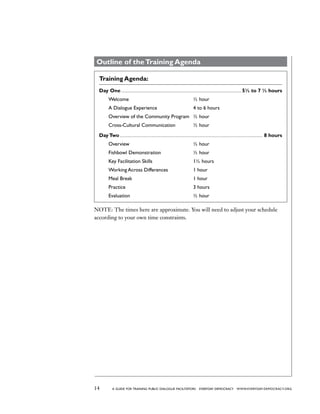
Outline of theTraining Agenda 	
Training Agenda:
Day One................................................................................. 5½ to 7 ½ hours
	Welcome				 ½ hour
	A Dialogue Experience		 4 to 6 hours
	Overview of the Community Program	 ½ hour
	 Cross-Cultural Communication	 ½ hour
DayTwo................................................................................................ 8 hours
	Overview				 ½ hour
	Fishbowl Demonstration		 ½ hour
	Key Facilitation Skills			 1½ hours
	Working Across Differences		 1 hour	
	 Meal Break				 1 hour	
	 Practice				 3 hours
	Evaluation				 ½ hour	
NOTE: The times here are approximate. You will need to adjust your schedule
according to your own time constraints.
Annotated Training Agenda
annotatedtrainingagenda
Chapter 4
15a guide for training PUBLIC DIALOGUE facilitators EVERYDAY DEMOCRACY www.EVERYDAY-DEMOCRACY.org
Fun and Games
For fun, have an assortment
of “toys” scattered around on
the tables, such as Nerf balls,
gadgets, clay, puzzles, crayons
and paper, and other objects.
This will appeal to hands-
on learners. Use pictures,
drawings, cartoons, music, or
movement to add variety to
the training experience.
Chapter 4
Annotated Training Agenda
The following annotated agenda is designed for two full days of training. It
includes some elements—the dialogue experience on Day One and the practice
session on Day Two—that can be expanded or shortened, as time allows.
Chapter 5, Tips and Takeaways, contains information you will need to use as
handouts in the training. You can photo-copy this material or transfer it to
overhead slides, PowerPoint slides, or flip chart paper. Use this material to prepare
packets for facilitators.
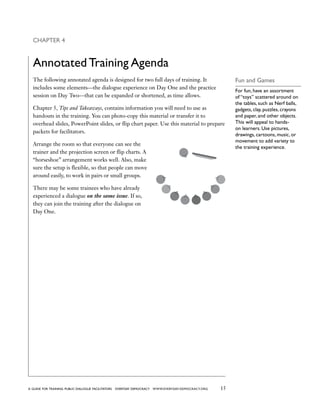
Arrange the room so that everyone can see the
trainer and the projection screen or flip charts. A
“horseshoe” arrangement works well. Also, make
sure the setup is flexible, so that people can move
around easily, to work in pairs or small groups.
There may be some trainees who have already
experienced a dialogue on the same issue. If so,
they can join the training after the dialogue on
Day One.
16 a guide for training PUBLIC DIALOGUE facilitators EVERYDAY DEMOCRACY www.EVERYDAY-DEMOCRACY.org
DAY ONE
Before the training begins, put the following information on four flip chart pages.
You will refer to these pages during the first part of the training.
1.	 Introductions
	 Name
	 Where are you from?
	 Do you have any facilitation experience?
	 What brings you to today’s event?
2.	 Goals of the Training
	 Understand how small-group dialogue is part of a larger process for
community change.
	 Understand the special role of a facilitator.
	 Experience a dialogue.
	 Learn about the topic.
	 Learn and practice facilitation skills.
	 Practice facilitating and learn from constructive feedback.
3.	 Agenda
	 [Write down your schedule for the day.]
4.	 Purpose of the Dialogue Experience
	 To provide a realistic dialogue experience
	 To explore and express personal opinions about the issue
	 To watch an experienced facilitator in action
	 To develop a better understanding of the discussion topic
Keeping Track of Time
If it will help you, ask for
a volunteer to keep track
of time.
17a guide for training PUBLIC DIALOGUE facilitators EVERYDAY DEMOCRACY www.EVERYDAY-DEMOCRACY.org
Welcome, Introductions, and Agenda
Welcome everyone and introduce yourself. Describe the situation in the
community that has led to this effort, or ask one of the organizers to set the
context. To introduce this section, you might say:
This training will prepare you to facilitate a small-group dialogue—a key ele-
ment in a large community effort.This is an approach that hundreds of commu-
nities across the country are using to involve people in solving public problems.
You will take part in the dialogue,watch a trained facilitator in action,learn basic
facilitation skills, and practice leading a group dialogue.
Hand out information packets to trainees, including copies of the material in
Chapter 5, information about the community effort, a copy of the discussion guide
and supplemental data, schedules, key organizers, etc.
Invite group members to introduce themselves and answer the questions on the flip
chart. If your group is large, put people in small groups to exchange information
about themselves. Or, if people have come in teams, you can ask one person to
introduce the team and say where they are from.
The welcome and introductions are very important—you are setting the tone for
the whole training. But beware! Introductions can take a lot of time. Try to strike a
balance between hearing from everyone and watching the clock.
Next, go over the agenda to explain what the training will cover. You might want
to provide a written agenda to hand out, as well as posting it on a flip chart. Invite
comments or questions. Modify the schedule if necessary.
Refer to flip chart paper. The purpose of this exercise is…
	 to provide a realistic dialogue experience.
	 to explore and express personal opinions about the issue.
	 to watch an experienced facilitator in action.
	 to develop a better understanding of the discussion topic.
Figure out how much time you can devote to this activity (see sidebar on page 18).
If you only have a short time to devote to this, try to preserve a sense of how the
dialogue progresses from session to session. Be sure to touch on viewpoints, key
exercises, and approaches.
Welcome
30 minutes
18 a guide for training PUBLIC DIALOGUE facilitators EVERYDAY DEMOCRACY www.EVERYDAY-DEMOCRACY.org
Break
Ask any new trainees who are joining at this point to introduce themselves.
A Dialogue
Experience
4 to 6 hours
Sample Schedule for a
Dialogue Experience
Total time: 4 to 6 hours
Session 1: 45-75 minutes
Session 2: 45-75 minutes
Break with food: 30 minutes
Session 3: 45-75 minutes
Session 4: 45-75 minutes
Debrief: 30 minutes
A Dialogue Experience
Put 8 to 12 trainees in each circle.You’ll need experienced facilitators
for each group. Give each participant copies of the discussion ma-
terials they will be using in their community program, as well as any
data or fact sheets. Explain that it is essential for them to participate
actively in the conversation.This is a chance for them to explore their
own feelings.
After the discussion is complete, spend some time debriefing the
experience.You can do this in individual groups, or as a whole.
Reflect on the process of participating:
•	How was this different from other kinds of conversations?
•	What did you learn about the issue that surprised you?
•	What did you learn about yourself?
Reflect on the facilitator and his/her role:
•	How did the facilitator relate to the group members?
•	What behaviors did you notice?
•	Was there any particular moment or interaction that stood out
for you? Why?
Break
19a guide for training PUBLIC DIALOGUE facilitators EVERYDAY DEMOCRACY www.EVERYDAY-DEMOCRACY.org
Overview
30 minutes
Cross-Cultural
Communication
25 minutes
Overview of the Community Dialogue-to-Change Program
It’s important for facilitators to understand the larger context of their work, and
how their individual circle fits into the bigger community effort. Invite one of the
program organizers to explain…
	 how this effort began.
	 who the key organizers are.
	 the goals of the program.
	 how many people are expected to participate.
	 the plans that are in place to help the dialogue lead to action and change.
This is a good time to focus on the discussion materials. Spend a few minutes
reviewing them, and point out the key elements of each session. You can use an
outline of the sessions on a flip chart to help with this.
Most groups use fact sheets or data to supplement the discussion materials. If the
data is complex, you can bring in an expert to explain the information. Remind
trainees they are not expected to become “experts,” but they do need to have a basic
understanding of the information. Point out the place in the dialogue where the fact
sheets will be used.
Cross-Cultural Communication
Let people know who their partner/co-facilitator will be. As you put the pairs
together, consider diversity (age, gender, race) and level of experience. Pair up
more experienced people with beginners. Let everyone know they will be working
with their partner for much of the training. Occasionally, trainers reassign partners
after the training, when they have a better sense of people’s skills.
Allow 10 minutes for everyone to fill out the questionnaire on page 32, Cultural
Communication Styles: Part A. Then have the pairs talk about it. For homework, ask
people to read Part B (pages 33-36), and think about how it applies to them. Also
ask them to read Working with Cultural Differences on page 58.
Wrap-Up and Look Ahead to DayTwo
Close the day by asking for any final thoughts, comments, or questions. Give last-
minute instructions about the next part of the training. Let trainees know that they
will have a chance to learn more about how dialogue circles work, learn specific
facilitation skills, and practice facilitation by leading part of a practice session.
Thank everyone and remind them to bring the discussion materials to the
next training.
Wrap-Up
5 minutes
20 a guide for training PUBLIC DIALOGUE facilitators EVERYDAY DEMOCRACY www.EVERYDAY-DEMOCRACY.org
DAYTWO
In this part of the training, use an overhead projector or PowerPoint slides to
illustrate key points. Or, you can put information on a flip chart. The material
you need is contained in Chapter 5. Have extra copies of discussion materials and
supplemental data on hand.
Welcome and Review Agenda
Welcome everyone back. Invite people to share their thoughts about the first day
of the training. Go over the agenda for today’s training. Make sure trainees have
their facilitator packets handy.
Overview
To introduce this section, you might say:
Today we’re talking about a democratic process for community change which
has small-group dialogue at its heart.This process invites many people from all
walks of life and all parts of the community to work together to address com-
munity issues.
In recent years, hundreds of communities across the country have used this
approach to address racism and racial equity, school reform, growth and devel-
opment, town budgeting and governance, police-community relations, immigra-
tion, and a range of other public issues.
The following information will complete your overview of this process for
community change. (See Chapter 5.) Use it as slides or handouts. Allow plenty of
time for trainees to read the information. Pause frequently and invite questions.
	 Overview of a Dialogue-to-Change Process
	 A Community Dialogue-to-Change Program
	 A Dialogue Circle
	 What Dialogue Circles Are and Are Not: A Comparison
	 A Typical Two-Hour Session
	 Typical Progression of Sessions
	 Sample Ground Rules
	 A Neutral Facilitator
Welcome and
Review Agenda
5 minutes
Overview
15 minutes
21a guide for training PUBLIC DIALOGUE facilitators EVERYDAY DEMOCRACY www.EVERYDAY-DEMOCRACY.org
Fishbowl Demonstration and Debrief
The purpose of the exercise on page 22 is to highlight key facilitation techniques.
The trainer, or an experienced facilitator, will lead the group for 10 minutes,
demonstrating both “good” and “bad” facilitation. Then, the entire group will
debrief the exercise for another 10 minutes.
Help your facilitator prepare for the fishbowl. Besides demonstrating good
facilitator techniques, he or she might use some inappropriate behaviors, such as
sharing a personal opinion or story, cutting someone off, or interrupting a speaker.
Make it clear that the behaviors shouldn’t be too obvious. The point is to keep
moving along and see if the observers notice what has happened.
Fishbowl
Demonstration
20 minutes
22 a guide for training PUBLIC DIALOGUE facilitators EVERYDAY DEMOCRACY www.EVERYDAY-DEMOCRACY.org
Fishbowl  . . . . . . . . . . . . . . . . . . . . . . . . . . . . . . . . . . . . . . . . . . . . . . . 20 minutes
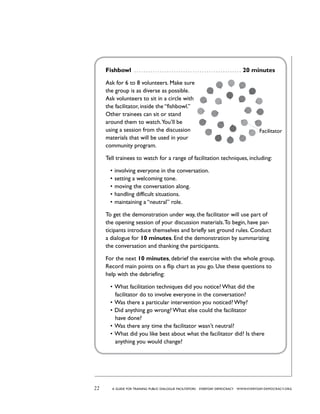
Ask for 6 to 8 volunteers. Make sure
the group is as diverse as possible.
Ask volunteers to sit in a circle with
the facilitator, inside the “fishbowl.”
Other trainees can sit or stand
around them to watch.You’ll be
using a session from the discussion
materials that will be used in your
community program.
Tell trainees to watch for a range of facilitation techniques, including:
•	involving everyone in the conversation.
•	setting a welcoming tone.
•	moving the conversation along.
•	handling difficult situations.
•	maintaining a “neutral” role.  
To get the demonstration under way, the facilitator will use part of
the opening session of your discussion materials.To begin, have par-
ticipants introduce themselves and briefly set ground rules. Conduct
a dialogue for 10 minutes. End the demonstration by summarizing
the conversation and thanking the participants.
For the next 10 minutes, debrief the exercise with the whole group.
Record main points on a flip chart as you go. Use these questions to
help with the debriefing:
•	What facilitation techniques did you notice? What did the
facilitator do to involve everyone in the conversation?
•	Was there a particular intervention you noticed? Why?
•	Did anything go wrong? What else could the facilitator
have done?
•	Was there any time the facilitator wasn’t neutral?
•	What did you like best about what the facilitator did? Is there
anything you would change?
Facilitator
23a guide for training PUBLIC DIALOGUE facilitators EVERYDAY DEMOCRACY www.EVERYDAY-DEMOCRACY.org
Key Facilitation Skills: Part 1
The next part of the training is dedicated to practicing some basic facilitation skills.
Spend 5 minutes talking about Key Facilitation Skills on page 44 of Chapter 5. Be
sure to cover body language and what it communicates.
Listening in a Different Way  . . . . . . . . . . . . . . . . . . . . . . . 10 minutes
Trainees will take turns with their partner for this exercise.The
first speaker will have 3 minutes to answer the question,“Why do
you think it is important for people in our community to talk about
______ in the upcoming public dialogue program?”
The partner will listen actively, noting content and feelings, and tak-
ing care not to interrupt. After 3 minutes, the listener will reflect,
clarify, and summarize the key points, and ask follow-up questions.
When the trainer calls time, the partners switch roles.When each per-
son has had a turn as both speaker and listener, the pair will debrief.
Put these debriefing questions on a flip chart where everyone can see:
•	How did it go?
•	What did you notice in particular?
•	Did you find any part of this exercise especially challenging?
•	Did the speaker feel listened to?
•	What did you notice about body language?
Key Facilitation Skills:
Part 1
60 minutes
24 a guide for training PUBLIC DIALOGUE facilitators EVERYDAY DEMOCRACY www.EVERYDAY-DEMOCRACY.org
Recording  . . . . . . . . . . . . . . . . . . . . . . . . . . . . . . . . . . . . . 5 minutes
Next, briefly describe the role of the recorder in a dialogue circle. Most facilitators
will play this role at some time, or may be coaching a participant in this job. Refer
to The Art of Recording on page 45 in Chapter 5.
Practicing Key Skills . . . . . . . . . . . . . . . . . . . . . . . . . .  10 minutes
This activity includes a demonstration of brainstorming, developing action
ideas, and prioritizing. See the following information on pages 46-48:
	 Leading a Brainstorm
	 Developing Action Ideas
	 How to Prioritize a List of Ideas
25a guide for training PUBLIC DIALOGUE facilitators EVERYDAY DEMOCRACY www.EVERYDAY-DEMOCRACY.org
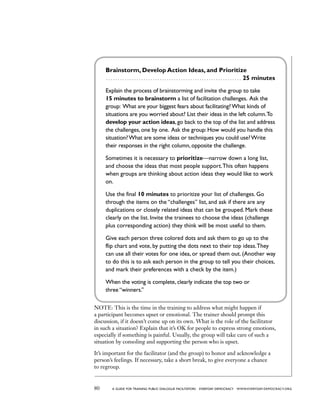
Brainstorm, Develop Action Ideas, and Prioritize
 . . . . . . . . . . . . . . . . . . . . . . . . . . . . . . . . . . . . . . . . . . . . . . . . . . . . . . . . . . 30 minutes
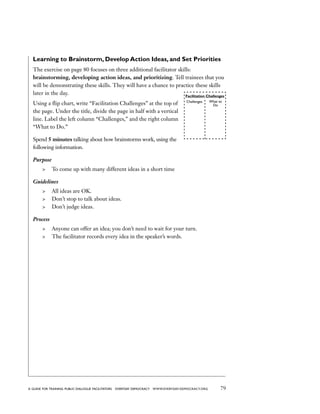
Brainstorm: Using a flip chart, write “Facilitation
Challenges” at the top of the page. Under the
title, divide the page in half with a vertical line.
Label the left column “Challenges,” and the right
column “What to Do.” Ask the whole group to
think about facilitation challenges they have seen,
or are worried about.Write down what they say
in the left-hand column.
Develop Action Ideas:When the list of challenges is complete,
go back to the top of the list and ask people to suggest an action
to address each challenge. List their ideas in the right-hand column
opposite the corresponding challenge.
Prioritize: Now ask the group to choose the three ideas they think
will be most helpful to them. Start to prioritize by putting similar
ideas together and eliminating duplicates. If the group is small, have
an informal discussion about the pros and cons of each idea. Ask
for a show of hands to see which three ideas people think are most
important. Put a star by the three top choices.
If you are working with a large group, hand out colored dots, or use
markers, and ask people to vote for their top three ideas.
When this part of the exercise is finished, review and reinforce the
three key skills you have practiced: brainstorming, developing action
ideas, and prioritizing.
End this exercise by noting any challenges that came up related to
managing conflict in groups. Ask trainees how they would handle
these situations. Refer to Managing Conflict, on page 50 in Chapter 5,
for additional information.
Challenges What to
Do
Facilitation Challenges
Break
Break
20 minutes
26 a guide for training PUBLIC DIALOGUE facilitators EVERYDAY DEMOCRACY www.EVERYDAY-DEMOCRACY.org
Key Facilitation Skills: Part 2
To introduce this section, you might say:
In a dialogue circle, people are free to speak honestly and disagree respect-
fully.They are encouraged to consider different points of view but they are not
required to reach consensus. Looking at a range of viewpoints can help people
work out their differences, find areas of common concern, and come up with
solutions together.
When participants move from dialogue to deliberation, they explore the com-
plexity of the issue and the tradeoffs that are necessary to make progress. As
people consider a range of solutions,they are more likely to come up with action
ideas and strategies that make sense in their community.The facilitator plays a key
role in making these discussions productive.
FacilitatingViewpoints and Approaches  . . . . . . . . 15 minutes
Ask trainees to talk with their partners about the viewpoints and approaches
in the discussion materials.How would they facilitate this discussion?
What techniques would they use? Give trainees a copy of Facilitating
Viewpoints and Approaches, on page 51 in Chapter 5, to use as a reference.
After 10 minutes, ask partners to share their key ideas. Capture ideas
on a flip chart.
What Does It Mean to Be a“Neutral” Facilitator?
 . . . . . . . . . . . . . . . . . . . . . . . . . . . . . . . . . . . . . . . . . . . . . . . . . . . . . . . . . . . . . . . . . 15 minutes
Trainees work with their partners for this exercise.Post the following
questions on a flip chart. Ask them to talk for 10 minutes about
these questions:
•	What does it mean to be“neutral?” Be specific.Give examples.
•	When I think about being a neutral facilitator,what will be most difficult
about the role?
•	What kinds of behaviors do I find challenging?What are my“triggers?”
•	What are some probing questions I could ask that would deepen the
discussion without stepping out of my neutral role? (See Tips for
Facilitators,on pages 53 and 54 in Chapter 5,for ideas).
For the final 5 minutes,bring the whole group together to share insights.
Ask people for examples of their“probing questions.”
Key Facilitation Skills:
Part 2
60 minutes
Dialogue and Deliberation
Dialogue:
Open-ended discussion that
builds trust and understanding
Deliberation:
Careful consideration of
complex issues
27a guide for training PUBLIC DIALOGUE facilitators EVERYDAY DEMOCRACY www.EVERYDAY-DEMOCRACY.org
Working Across Differences
To introduce this section, you might say:
We live in a diverse society, and racial and cultural dynamics are part of our
public life.Facilitators need to be very sensitive to cultural and racial differences
in their groups.The following exercise will help trainees explore this subject.
Communicating Across Cultures . . . . . . . . . . . . . . . . . . 30 minutes
Divide people into small groups (4 to 8 people), keeping facilitator
pairs together. Make the groups as racially and culturally diverse as
possible. Using the following questions, ask groups to talk for 20
minutes about Cultural Communication Styles: Part B (the homework
assignment from Day One).
Post these questions on a flip chart:
•	How might racial and cultural differences affect a small-group dialogue?
•	What will help my ability to facilitate a mixed group? What might
be a barrier?
•	How are racial and cultural dynamics the same? How are they
different?
Then, allow 10 minutes for the groups to share some of their
insights. Capture key ideas on a flip chart.
NOTE: If you are preparing facilitators to lead discussions on racism and race
relations, refer them to Working with Programs that Address Racism on page 61. You
may also wish to provide trainees with additional background reading.
28 a guide for training PUBLIC DIALOGUE facilitators EVERYDAY DEMOCRACY www.EVERYDAY-DEMOCRACY.org
Preparing for the Practice Circle
To prepare for the practice, trainees need to get acquainted with the discussion
materials. Divide your group according to the number of sessions in the discussion
materials, assigning one group to each session. Keep facilitator pairs together. Each
small group will focus on one session of the discussion materials, read it carefully,
and figure out together how to facilitate each part of the conversation.
Adding a Role Play
Before you break for the meal, tell trainees that some of them will be asked to
play a role during the afternoon practice session. Give each trainee a slip of paper.
Leave some blank, or write “be yourself” on them. On others, assign a specific role.
Roles could be behaviors—“quiet,” “argumentative,” “rambling,” “engages in side
conversations,”—or positions or points of view about the issue.
Let trainees know that they should play their roles when they are participating
in the discussion, but NOT when it is their turn to facilitate. Ask trainees not to
show their pieces of paper to one another.
Meal Break
Preparing for the
Practice Circle
30 minutes
Example:
24 trainees:
	 12 pairs of facilitators
	 4 sessions in the
discussion materials
	 3 pairs per session
Meal Break
45 minutes
29a guide for training PUBLIC DIALOGUE facilitators EVERYDAY DEMOCRACY www.EVERYDAY-DEMOCRACY.org
Practice Circle and Debrief
Practice Circle . . . . . . . . . . . . . . . . . . . . . . . . . . . . . . . . . . . . . . . . . . . .  3 hours
This is the most important part of your training. Practice groups should
have approximately 8 to10 people each. Divide trainees so that each
practice group has at least one team prepared to facilitate each
session. Remind trainees that they should participate actively when
they are not facilitating. And remind them about role playing, so
that the conversation seems like what might happen in a real
community setting.
Each practice group should have a quiet, outside observer who is
experienced in small-group work.This person takes notes on the
facilitators, provides feedback, and keeps track of time. Divide the
time so that the practice groups touch on all sessions. Make sure
every facilitator team has a chance to practice at least part of the
session they have prepared.
Observers should be watching for typical mistakes, such as talking
too much,“teaching” the group, responding after every comment,
adding personal information or opinions, or letting someone dominate
the conversation.
After each session, pause to offer feedback to the facilitators. First
ask trainees to evaluate themselves.Then invite feedback from group
members. Finally, the outside observer offers comments.
Practice Circle
3 hours
Giving Feedback to
Trainees
	 Be concrete and as
objective as possible.
	Note specific behaviors
and language.
	 Propose alternative
behaviors.
30 a guide for training PUBLIC DIALOGUE facilitators EVERYDAY DEMOCRACY www.EVERYDAY-DEMOCRACY.org
Evaluation and Wrap-Up
When the practice is complete, bring everyone together. This is the time for final
instructions about the upcoming circles, additional practice sessions, or other
logistics. Remind trainees to spend time reviewing their discussion materials and
facilitator packet before they lead their first circle.
Give trainees the Facilitator Training Evaluation to fill out (see page 89). You can
use this information to learn how people felt about the training—what went well,
and what can be improved.
To close, ask trainees to offer final thoughts or comments about the training.
	 What stood out for you?
	 What surprised you?
	 What touched you?
Thank everyone, and let them know what will happen next.
Optional One-Day Training Agenda.. . . . . . . . . . . . . . . . . . . . . . . . . . . . . . . . . . 7 ½ hours
Welcome and Introductions 	 ½ hour
Overview of Community Dialogue-to-Change	 ¼ hour
Introduction to Dialogue	 ¼ hour
Fishbowl Demonstration	 ½ hour
Break	 ¼ hour
Key Skills	 1 ½ hours
Prepare for Practice	 ½ hour
Lunch Break	 ¾ hour
Practice and Debrief	 2 ½ hours
Evaluation andWrap-Up	 ½ hours
NOTE: This shortened agenda omits the dialogue experience, and allows less
time for cross-cultural communication training. It also allows less time for trainees
to work as partners, and become familiar with the discussion materials and
supplemental data. If you are using complex discussion materials, and if racial and
cultural dynamics are an important factor, we urge you to offer the comprehensive,
two-day training.
Evaluation
30 minutes
Tips  Takeaways
tipstakeaways
Chapter 5
31a guide for training PUBLIC DIALOGUE facilitators EVERYDAY DEMOCRACY www.EVERYDAY-DEMOCRACY.org
Chapter 5
Tips  Takeaways
During the training, you will need pages 32-65 to use as slides and/or handouts.
These pages are clearly referenced in the Annotated Agenda in Chapter 4.
The icons in this chapter indicate ways to use this information.
	 If you see at the top of the page, you can use the entire page as a
handout.
	 When you see , it means that you can adapt the information in the
shaded area for PowerPoint or slides.
We recommend that you prepare a packet of information for trainees, including
specifics about the program, dates and logistics, and program sponsors. Also
include the information in Chapter 5 to reinforce the training experience.
Remind trainees to review these handouts and study the discussion guide as they
prepare to facilitate each session of their circle!
What the Icons Mean
HANDOUTS
SLIDES OR 	OVERHEADS
32 a guide for training PUBLIC DIALOGUE facilitators EVERYDAY DEMOCRACY www.EVERYDAY-DEMOCRACY.org
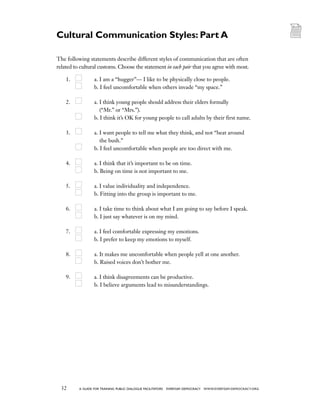
The following statements describe different styles of communication that are often
related to cultural customs. Choose the statement in each pair that you agree with most.
1.	 	 a. I am a “hugger”— I like to be physically close to people.
	 	 b. I feel uncomfortable when others invade “my space.”
2.	 	 a. I think young people should address their elders formally
(“Mr.” or “Mrs.”).
	 	b. I think it’s OK for young people to call adults by their first name.
3.	 	 a. I want people to tell me what they think, and not “beat around
the bush.”
	 	 b. I feel uncomfortable when people are too direct with me.
4.	 	 a. I think that it’s important to be on time.
	 	 b. Being on time is not important to me.
5.	 	 a. I value individuality and independence.
	 	 b. Fitting into the group is important to me.
6.	 	 a. I take time to think about what I am going to say before I speak.
	 	 b. I just say whatever is on my mind.
7.	 	 a. I feel comfortable expressing my emotions.
	 	 b. I prefer to keep my emotions to myself.
8.	 	 a. It makes me uncomfortable when people yell at one another.
	 	 b. Raised voices don’t bother me.
9.	 	 a. I think disagreements can be productive.
	 	 b. I believe arguments lead to misunderstandings.
Cultural Communication Styles: Part A
33a guide for training PUBLIC DIALOGUE facilitators EVERYDAY DEMOCRACY www.EVERYDAY-DEMOCRACY.org
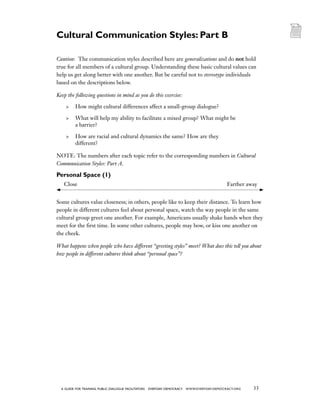
Caution: The communication styles described here are generalizations and do not hold
true for all members of a cultural group. Understanding these basic cultural values can
help us get along better with one another. But be careful not to stereotype individuals
based on the descriptions below.
Keep the following questions in mind as you do this exercise:
	 How might cultural differences affect a small-group dialogue?
	What will help my ability to facilitate a mixed group? What might be
a barrier?
	How are racial and cultural dynamics the same? How are they
different?
NOTE: The numbers after each topic refer to the corresponding numbers in Cultural
Communication Styles: Part A.
Personal Space (1)
	 Close	 Farther away
Some cultures value closeness; in others, people like to keep their distance. To learn how
people in different cultures feel about personal space, watch the way people in the same
cultural group greet one another. For example, Americans usually shake hands when they
meet for the first time. In some other cultures, people may bow, or kiss one another on
the cheek.
What happens when people who have different “greeting styles” meet? What does this tell you about
how people in different cultures think about “personal space”?
Cultural Communication Styles: Part B
34 a guide for training PUBLIC DIALOGUE facilitators EVERYDAY DEMOCRACY www.EVERYDAY-DEMOCRACY.org
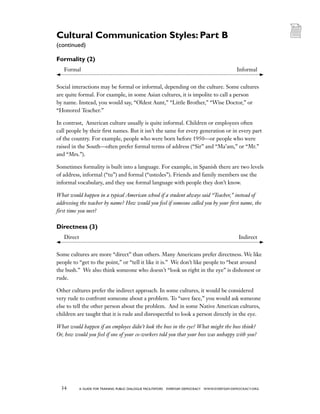
Formality (2)
	 Formal	 Informal
Social interactions may be formal or informal, depending on the culture. Some cultures
are quite formal. For example, in some Asian cultures, it is impolite to call a person
by name. Instead, you would say, “Oldest Aunt,” “Little Brother,” “Wise Doctor,” or
“Honored Teacher.”
In contrast,  American culture usually is quite informal. Children or employees often
call people by their first names. But it isn’t the same for every generation or in every part
of the country. For example, people who were born before 1950—or people who were
raised in the South—often prefer formal terms of address (“Sir” and “Ma’am,” or “Mr.”
and “Mrs.”).
Sometimes formality is built into a language. For example, in Spanish there are two levels
of address, informal (“tu”) and formal (“ustedes”). Friends and family members use the
informal vocabulary, and they use formal language with people they don’t know.
What would happen in a typical American school if a student always said “Teacher,” instead of
addressing the teacher by name? How would you feel if someone called you by your first name, the
first time you met?
Directness (3)
	 Direct	 Indirect
Some cultures are more “direct” than others. Many Americans prefer directness. We like
people to “get to the point,” or “tell it like it is.”  We don’t like people to “beat around
the bush.”  We also think someone who doesn’t “look us right in the eye” is dishonest or
rude.
Other cultures prefer the indirect approach. In some cultures, it would be considered
very rude to confront someone about a problem. To “save face,” you would ask someone
else to tell the other person about the problem.  And in some Native American cultures,
children are taught that it is rude and disrespectful to look a person directly in the eye.
What would happen if an employee didn’t look the boss in the eye? What might the boss think?
Or, how would you feel if one of your co-workers told you that your boss was unhappy with you?
Cultural Communication Styles: Part B
(continued)
35a guide for training PUBLIC DIALOGUE facilitators EVERYDAY DEMOCRACY www.EVERYDAY-DEMOCRACY.org
Importance ofTime (4)
	 Punctuality 	 Time is flexible
Cultural attitudes about time vary a lot. In some cultures, being on time is very
important. People who are late are regarded as rude, lazy, or disorganized.  Americans
say, “time is money.” It’s more important “to make the most of your time” than to spend
time building relationships.
In other cultures, the view of time is flexible. The meeting starts when everyone is
present and ends when people are done talking. Taking time to build relationships
between people may be more important than sticking to a timeline.
How might a teacher react if parents are late for a 10-minute conference? When building
relationships is very important to them, how would parents feel if they were allowed only 10
minutes to meet with a teacher?
Individual vs. Group (5)
	 Individual	 Group
Most Americans put the individual before the group. “I” comes before “we.” In our
culture, we’re expected to “stand on our own.” It’s up to us whether we succeed or
fail.  At school and at work, we single out individuals and reward them. We teach our
children to be independent, and many young people live on their own after they graduate
from high school.
Some other cultures put a high value on interdependence. People in these cultures put
teamwork first. They seldom give rewards for individual achievement. Sticking together
and fitting in with the group is more important than individual success. Children usually
live with their parents until they are married.  And, often, the extended family lives
together, or nearby. Children are taught that they bring shame on the whole family or
community when they do something wrong.
If a person in a company comes up with a great idea for a new product, who should get credit—the
individual or the entire team?
Cultural Communication Styles: Part B
(continued)
36 a guide for training PUBLIC DIALOGUE facilitators EVERYDAY DEMOCRACY www.EVERYDAY-DEMOCRACY.org
Showing Emotion (6  7)
	 Expressive/spontaneous 	 Reserved/reflective
People in some cultures express their emotions freely. For example, Italians and Greeks and
people from Latin American and African/African American cultures tend to be more open.
Other cultures are more reserved. Native American people tend to be more reflective;
their rule is, it is better to listen than to speak. In some Asian countries, people seldom
express strong feelings. (So, we have the stereotype of the “inscrutable Asian.”)
Most Americans are somewhere in the middle. They are likely to “speak their mind.”
And they are fairly comfortable letting people know if they are happy or sad (although
there are some gender stereotypes about expressing emotion).
What might a boss think about an employee who rarely speaks in meetings and always waits to
be invited to join a project? What might people think when they see a diverse group of noisy,
excited teenagers?
Approach to Conflict (8  9)
	 Conflict is OK 	 Conflict is to be avoided
Cultures vary in their comfort with conflict. In some cultures, including American
culture, people are taught to stand up for themselves, even when it leads to a
disagreement. They believe that conflict can lead to “real communication.”
In other cultures, conflict is to be avoided at all cost. Yelling, expressing anger, or even
speaking up is bad behavior. Any kind of disagreement makes people feel uncomfortable.
In Japan, people are taught to blend in and to avoid arguments.
There are also cultures where raised voices may mean that people are just having a lively
discussion, not arguing with each other.
What would people think if two of their co-workers started shouting at one another? What might
you think about a person who talked about you behind your back instead of coming directly to you
about a problem?
Cultural Communication Styles: Part B
(continued)
37a guide for training PUBLIC DIALOGUE facilitators EVERYDAY DEMOCRACY www.EVERYDAY-DEMOCRACY.org
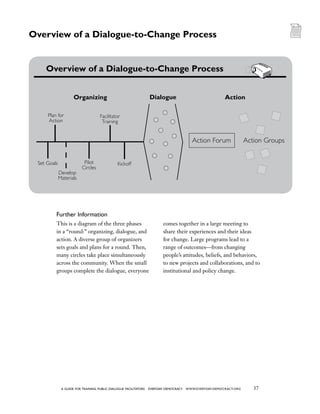
This is a diagram of the three phases
in a “round:” organizing, dialogue, and
action. A diverse group of organizers
sets goals and plans for a round. Then,
many circles take place simultaneously
across the community. When the small
groups complete the dialogue, everyone
comes together in a large meeting to
share their experiences and their ideas
for change. Large programs lead to a
range of outcomes—from changing
people’s attitudes, beliefs, and behaviors,
to new projects and collaborations, and to
institutional and policy change.
	 Overview of a Dialogue-to-Change Process
Action Forum Action Groups
Plan for
Action
Set Goals
Facilitator
Training
KickoffPilot
Circles
Develop
Materials
Organizing Dialogue Action
Further Information
Overview of a Dialogue-to-Change Process
38 a guide for training PUBLIC DIALOGUE facilitators EVERYDAY DEMOCRACY www.EVERYDAY-DEMOCRACY.org
A community dialogue-to-change program
is a process for public dialogue and
problem solving. It begins with planning
and organizing (which often takes several
weeks or months), followed by many
facilitated, small-group dialogues involving
large numbers of people. In these small
groups, people talk and work together to
find solutions to public issues. The action
ideas generated in the circles can lead to
changes that will enable the community to
make progress.
The results of these dialogues can be
powerful. Real change happens when
people gain new understanding of an
issue, and form new relationships—across
the barriers of race, background, political
ideology, income, and geography. By
participating in the dialogue, citizens
take “ownership” of the issues. They
discover connections between public
policies and their own lives, and they gain
a deeper understanding of their own and
others’ concerns. And citizens build new
connections with government, paving the
way for institutional and policy change.
	 A Community Dialogue-to-Change Program…
•	is organized by a diverse group of leaders from different parts
of the community.
•	includes a large number of participants from all walks of life.
•	uses balanced discussion materials, with a range of viewpoints.
•	relies on trained facilitators to run the small-group discussions.
•	helps the community connect dialogue to action and change.
A Community Dialogue-to-Change Program
Further Information
39a guide for training PUBLIC DIALOGUE facilitators EVERYDAY DEMOCRACY www.EVERYDAY-DEMOCRACY.org
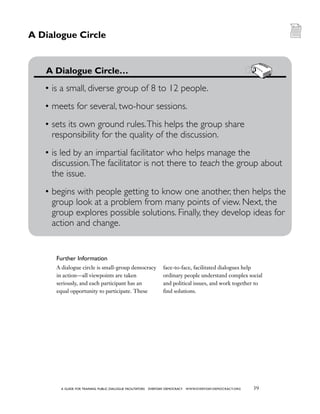
A dialogue circle is small-group democracy
in action—all viewpoints are taken
seriously, and each participant has an
equal opportunity to participate. These
face-to-face, facilitated dialogues help
ordinary people understand complex social
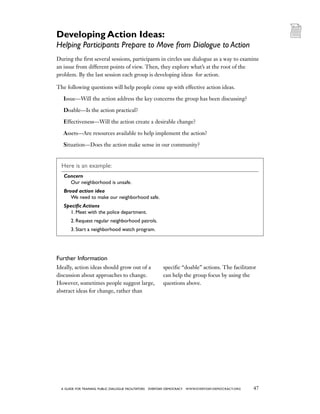
and political issues, and work together to
find solutions.
	 A Dialogue Circle…
•	is a small, diverse group of 8 to 12 people.
•	meets for several, two-hour sessions.
•	sets its own ground rules.This helps the group share
responsibility for the quality of the discussion.
•	is led by an impartial facilitator who helps manage the
discussion.The facilitator is not there to teach the group about 	
the issue.
•	begins with people getting to know one another, then helps the
group look at a problem from many points of view. Next, the
group explores possible solutions. Finally, they develop ideas for
action and change.
Further Information
A Dialogue Circle
40 a guide for training PUBLIC DIALOGUE facilitators EVERYDAY DEMOCRACY www.EVERYDAY-DEMOCRACY.org
Dialogue Circles Are…
	small-group discussions that combine dialogue, deliberation, and problem
solving. Based on balanced discussion materials, the dialogue is enriched by the
members’ knowledge and experience. These groups are aided by an impartial
facilitator whose job is to keep the discussion on track.
	discussions where people examine a public issue from many angles and work
together to find solutions that can lead to change in the community.
Dialogue Circles Are NOT the Same as…
	conflict resolution—a set of principles and techniques used in resolving conflict
between individuals or groups.
	mediation—a process used to settle disputes that relies on an outside neutral
person to help the disputing parties come to an agreement. (Mediators often
make excellent dialogue facilitators, and have many skills in common.)
	 focus groups—small groups organized to gather or test information.
Participants (who are sometimes paid) are often recruited to represent a
particular viewpoint or target audience.
	traditional education—where a teacher instructs students.
	 facilitated meetings with a predetermined agenda—such as a committee or
board meeting with tasks established ahead of time.
	town meetings—large-group meetings where citizens make decisions on
community policies.
	public hearings—large-group public meetings which allow concerns to
be aired.
What Dialogue Circles Are and Are Not:
A Comparison
41a guide for training PUBLIC DIALOGUE facilitators EVERYDAY DEMOCRACY www.EVERYDAY-DEMOCRACY.org
While these small-group discussions vary
in content, they usually have the same
basic structure and last about 2 hours.
	 The welcome and introductions is a
time to gather the group, set the
tone for the discussion, help people
get to know one another, and begin
the conversation.
	 The ground rules are key to the
group’s success. Each group
develops its own ground rules
to ensure that the conversation is
respectful and productive.
	 Dialogue and deliberation are at the
heart of this process. Participants
use dialogue to build trust and
explore the problem. This can
include viewpoints, data, and other
content. Participants also deliber-
ate—weighing the pros and cons
of different choices. This leads to
concrete action ideas.
	 The summary is a time to reflect on
key themes and look for common
ground.
	 The session ends with a wrap-up,
instructions for next time, and a
quick evaluation: “How did things
go? What would we like
to change?”
	 ATypicalTwo-Hour Session
•	Welcome and Introductions
•	Ground Rules
•	Dialogue and Deliberation
•	Summary and Common Ground
•	Evaluation and Wrap-Up
ATypicalTwo-Hour Session
Further Information
42 a guide for training PUBLIC DIALOGUE facilitators EVERYDAY DEMOCRACY www.EVERYDAY-DEMOCRACY.org
Session One:
Getting to know one another: What is my connection to this issue?
SessionTwo:
What is the nature of the problem? (May include supplemental data)
SessionThree:
What are some approaches to change? (May include visioning or asset-mapping)
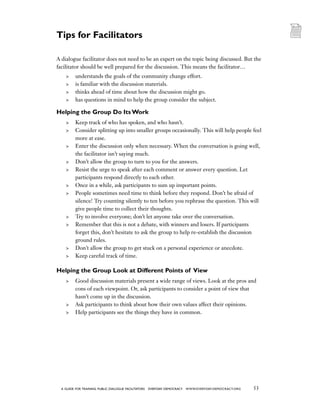
Session Four:
Moving from dialogue to action: What can we do?
Typical Progression of Sessions
43a guide for training PUBLIC DIALOGUE facilitators EVERYDAY DEMOCRACY www.EVERYDAY-DEMOCRACY.org
Ground rules (also known as guidelines
or agreements) help the group members
conduct civil, productive discussions. Each
circle sets its own ground rules at the
beginning, and uses them in all sessions.
These guidelines “belong” to everyone.
Group members can modify them at
any time, and are expected to help
enforce them.
Sample Ground Rules
	 Sample Ground Rules
•	Everyone gets a fair hearing.
•	Seek first to understand, then to be understood.
•	Share “air time.”
•	If you are offended or uncomfortable, say so, and say why.
•	It’s OK to disagree, but don’t personalize it; stick to the issue.
No name-calling or stereotyping.
•	Speak for yourself, not for others.
•	One person speaks at a time.
•	Personal stories stay in the group, unless we all agree that we
can share them.
•	We share responsibility for making the conversation productive.
Further Information
44 a guide for training PUBLIC DIALOGUE facilitators EVERYDAY DEMOCRACY www.EVERYDAY-DEMOCRACY.org
Reflecting and Clarifying—feeding back
or restating an idea or thought to make it
clearer.
	 “Let me see if I’m hearing you
correctly….”
	 “What I believe you are saying is….”
Summarizing—briefly stating the main
thoughts.
	 “It sounds to me as if we have been
talking about a few major themes….”
Shifting Focus—moving from one speaker
or topic to another.
	 “Thank you, John. Do you have
anything to add, Jane?”
	 “We’ve been focusing on views
1 and 2. Does anyone have strong
feelings about the other views?”
Asking Probing or Follow-Up
Questions—using questions to help people
explore disagreements, understand multiple
perspectives, and uncover common ground.
	 “What are the key points here?”
	 “What would someone with a
different point of view say?”
Managing Conflict—helping conflict and
disagreement to be productive.
	 “Let’s refer to our ground rules.”
	 “What seems to be at the heart of this
issue?”
	 “What do others think?”
Using Silence—allowing time and space for
reflection by pausing between comments.
UsingNon-VerbalSignals(BodyLanguage)—
recognizing and understanding how people
communicate without using words.
	 “What signals am I sending with my
body?”
	 “What signals am I reading from
others?”
	 “How do I signal encouragement?”
	 “How do I invite others to
participate?”
For more information on facilitating,
please see pages 53-62, and Managing
Conflict, on page 50.
	 Key Facilitation Skills
•	Reflecting  Clarifying
•	Summarizing
•	Shifting Focus
•	Asking Probing or Follow-Up Questions
•	Managing Conflict
•	Using Silence
•	Using Non-Verbal Signals (Body Language)
Further Information
Key Facilitation Skills
45a guide for training PUBLIC DIALOGUE facilitators EVERYDAY DEMOCRACY www.EVERYDAY-DEMOCRACY.org
	 Capture big ideas and themes, not every word.
	 Use the words of the speaker as closely as possible. Be careful not to alter the
intended meaning.
	 Check with the speaker or the group to make sure your notes are correct.
	 Write neatly so everyone can read the notes.
	 Number each page at the top. Identify each set of notes with a clear title.
	 Use markers that are deep earth tones, such as dark green, brown, blue, and
purple. Use black sparingly. Use light colors (red, yellow, orange, light green) for
highlighting or emphasis only.
	 Be low-key. Stay in the background and don’t distract people from the
conversation. Be aware of times when recording is not appropriate (for example,
when people are sharing personal stories).
	 Create a sheet called “Parking Lot.” Capture—or “park”—ideas that come up in
the conversation that the group wants to return to later.
	 Post the ground rules each time, along with any notes or sheets of paper that the
group will need to refer to during a particular session.
Note taking serves many purposes:
•	 It helps group members stay on track and move the discussion along.
•	 It creates a group memory of the whole dialogue.
•	 It provides a way to capture the wisdom and common themes that develop in the dis-
cussion.
•	 Notes from the circles can help organizers plan for action.
•	 Notes from all the circles in your program can contribute to a summary report of the
activities.
Further Information
Every discussion group can benefit from
having someone take notes. This person’s
job is to listen carefully, keep track of the
big ideas that come up in the discussion,
and record them clearly where everyone
can see them. Sometimes co-facilitators
take turns facilitating and recording.
If you need a group member to serve as a
recorder, make sure different people take
turns, because the recorder cannot fully
participate in the conversation.
The Art of Recording
46 a guide for training PUBLIC DIALOGUE facilitators EVERYDAY DEMOCRACY www.EVERYDAY-DEMOCRACY.org
Brainstorming is a way for a group to come up with lots of ideas in a short period of time.
Purpose
	 To help the group be creative
	 To come up with many different ideas in a short time
Guidelines
	 All ideas are OK.
	 Don’t stop to talk about each idea.
	 Don’t judge ideas.
How to Do It
	 Anyone can offer an idea.
	 People don’t need to wait for their “turn.”
	 Write down every idea.
	 Write ideas in the speaker’s words.
Brainstorming—Variation
•	 Invite people to reflect quietly for a moment.
•	 Ask people to jot down their ideas on a piece of paper.
•	 People can also use markers, clay, paper, etc., to create a picture or symbol of their idea.
•	 Go around the circle and invite each person to share one of their ideas. Repeat until all
ideas have been shared with the group.
Leading a Brainstorm
47a guide for training PUBLIC DIALOGUE facilitators EVERYDAY DEMOCRACY www.EVERYDAY-DEMOCRACY.org
During the first several sessions, participants in circles use dialogue as a way to examine
an issue from different points of view. Then, they explore what’s at the root of the
problem. By the last session each group is developing ideas for action.
The following questions will help people come up with effective action ideas.
Issue—Will the action address the key concerns the group has been discussing?
Doable—Is the action practical?
Effectiveness—Will the action create a desirable change?
Assets—Are resources available to help implement the action?
Situation—Does the action make sense in our community?
Here is an example:
Concern
	Our neighborhood is unsafe.
Broad action idea
	We need to make our neighborhood safe.
Specific Actions
	 1. Meet with the police department.
	 2. Request regular neighborhood patrols.
	 3. Start a neighborhood watch program.
Further Information
Ideally, action ideas should grow out of a
discussion about approaches to change.
However, sometimes people suggest large,
abstract ideas for change, rather than
specific “doable” actions. The facilitator
can help the group focus by using the
questions above.
Developing Action Ideas:
Helping Participants Prepare to Move from Dialogue to Action
48 a guide for training PUBLIC DIALOGUE facilitators EVERYDAY DEMOCRACY www.EVERYDAY-DEMOCRACY.org
Following a brainstorm, here is a way to prioritize ideas:
1)	 Sort ideas by category. Group similar ideas together and remove duplicates.
2)	 Allow time for people to discuss the pros and cons of each idea. After this
discussion invite people to narrow the list. Check with the group to see if there is
general agreement.
3)	 Or, give participants colored dots or markers and ask them to vote for their top
ideas. Use N/3 (number of ideas divided by 3) to determine how many votes each
person gets. People can apply their votes to one idea, or spread them around.
4)	 Identify top choices.
How to Prioritize a List of Ideas
49a guide for training PUBLIC DIALOGUE facilitators EVERYDAY DEMOCRACY www.EVERYDAY-DEMOCRACY.org
This exercise might be useful to a newly formed action group.
1.	 On a flip chart or blackboard, draw a horizontal line and a vertical line, resulting
in a cross with 4 quadrants. See example, below.
2.	 On the left side, running vertically, from top to bottom, write the word “Workable.”
Across the bottom, running left to right, write the word “Important.”
3.	 Label the top 2 quadrants above the horizontal line “Easy.” Label the bottom 2
quadrants below the horizontal line “Hard.”
4.	 At the base of the left-hand column, write “Low.” At the base of the right-hand
column, write “High.”
5.	 Take the list of action ideas, and assign them to the appropriate quadrant. Put
them on Post-it notes, in case they need to be moved around.
6.	 Ideas in the upper right quadrant (which are both “Easy” and “Important”)
might be a good place to begin.
Example:
The numbers in the graphic correspond to the numbered items at the bottom of the box.
Setting Priorities for Action:
Helping a Group DecideWhich Ideas toWork On
HighLow
1
2 34 5
6
Important
Consider implementing
items in this quadrant first.
Action Ideas for Improving Involvement of Limited English Proficiency (LEP) Parents
1.	 Organize English as a Second Language (ESL) classes for parents.
2.	 Translate school documents into other languages.
3.	 Provide interpreters for parent conferences.
4.	 Hold “Family Night” for LEP families (e.g. pizza, bingo, resources,
interpreters).
5.	 Survey LEP parents on needs.
6.	 Provide free English language learning videos to LEP families.
50 a guide for training PUBLIC DIALOGUE facilitators EVERYDAY DEMOCRACY www.EVERYDAY-DEMOCRACY.org
Not all disagreement or conflict is bad. In fact, it can provide an opening to understanding.
However, for dialogue to be productive, disagreements must be handled respectfully. Stick
to the issue at hand. Don’t make the conversation personal.
Using Conflict Constructively
	 Create shared ground rules to cover conflict. Ask the group, “How shall we
handle disagreements between group members?”
	 Encourage speakers to use “I” messages, such as, “I feel strongly that people who
send their children to our school have a responsibility to be involved.” Remind
people to speak for themselves, not for others or a group.
	 Ask the people in conflict, and the larger group, to help focus the conversation,
saying, “What do you think is the root of the disagreement between James and
Jessie? What are the key issues here?” This takes the focus off the people, and
puts it on the issue at hand.
	 Invite people to share the experiences that led to the formation of their opinions,
saying, “Could you tell us more about any experiences in your life that have
affected your feelings and thoughts about this issue?”
	 Invite others into the conversation if conflict is escalating between two people.
For example, say “We’ve heard quite a bit from John and Jane. Would someone
else like to offer an opinion?” By bringing the larger group into the discussion,
the focus shifts to a more general conversation.
Handling Unproductive Conflict
	 Interrupt and remind group members of ground rules, if the conversation
becomes heated.
	 Intervene immediately and stop the conversation if it becomes personal
or confrontational.
	 Take a short break.
	 Speak to individuals privately and ask them to comply with the ground rules.
	 As a last resort, remove anyone who is disruptive.
Managing Conflict
51a guide for training PUBLIC DIALOGUE facilitators EVERYDAY DEMOCRACY www.EVERYDAY-DEMOCRACY.org
How to Facilitate
	 Write the topic sentence for all the views/approaches on a flip chart, to use as a
quick reference.
	 Help people understand they are not choosing a “winner” but rather exploring a
range of ideas.
	 Give people time to look over the information.
	 Ask participants to choose one view to discuss. They can agree or disagree with it.
	 Ask for a volunteer to read the view or approach aloud.
	 Touch on all of the views/approaches, and help people see the connections.
	 Summarize the discussion by noting areas of agreement and disagreement.
	 Help people think about how this issue plays out in their own lives and in their
community.
Helpful Questions
	 Which views are closest to your own? Why?
	 Think about a view you don’t agree with. Why would someone support that
view?
	 Which views conflict with each other?
	 What views would you add?
	 Which approaches appeal to you and why?
	 What approaches would work best in our community? Which wouldn’t?
	 How would this approach help us make progress?
Further Information
Exploring different points of view
about an issue is one of the hallmarks
of this approach to dialogue. These
viewpoints reflect some of the ways that
different kinds of people think and talk
about a public concern.
This method allows participants to
deliberate about different ways to create
change. Looking at different “approaches”
helps people understand the complexity
of an issue and the tradeoffs that are often
necessary to make progress. As the group
develops a sense of what might work in
their situation, they are more likely to
come up with action ideas and strategies
that make sense.
FacilitatingViewpoints and Approaches
52 a guide for training PUBLIC DIALOGUE facilitators EVERYDAY DEMOCRACY www.EVERYDAY-DEMOCRACY.org
Further Information
The most important thing to remember
is that the facilitator should not share
personal views and stories, or try to push
an agenda. The facilitator’s job is to
serve the group and help people have a
productive conversation.
A Neutral Facilitator
	 A Neutral Facilitator…
•	explains his/her role.
•	sets a relaxed and welcoming tone.
•	introduces her/himself, but does not share personal opinions or
push an agenda.
•	does not take sides.
•	makes everyone feel that their opinions are valid and welcome.
•	does not use his/her personal experiences to make a point or
to get people talking.
•	uses probing questions to deepen the discussion.
•	brings up issues that participants have not mentioned.
•	reminds participants of comments they shared in earlier
sessions.
53a guide for training PUBLIC DIALOGUE facilitators EVERYDAY DEMOCRACY www.EVERYDAY-DEMOCRACY.org
A dialogue facilitator does not need to be an expert on the topic being discussed. But the
facilitator should be well prepared for the discussion. This means the facilitator…
	 understands the goals of the community change effort.
	 is familiar with the discussion materials.
	 thinks ahead of time about how the discussion might go.
	 has questions in mind to help the group consider the subject.
Helping the Group Do Its Work
	 Keep track of who has spoken, and who hasn’t.
	 Consider splitting up into smaller groups occasionally. This will help people feel
more at ease.
	 Enter the discussion only when necessary. When the conversation is going well,
the facilitator isn’t saying much.
	 Don’t allow the group to turn to you for the answers.
	 Resist the urge to speak after each comment or answer every question. Let
participants respond directly to each other.
	 Once in a while, ask participants to sum up important points.
	 People sometimes need time to think before they respond. Don’t be afraid of
silence! Try counting silently to ten before you rephrase the question. This will
give people time to collect their thoughts.
	 Try to involve everyone; don’t let anyone take over the conversation.
	 Remember that this is not a debate, with winners and losers. If participants
forget this, don’t hesitate to ask the group to help re-establish the discussion
ground rules.
	 Don’t allow the group to get stuck on a personal experience or anecdote.
	 Keep careful track of time.
Helping the Group Look at Different Points of View
	 Good discussion materials present a wide range of views. Look at the pros and
cons of each viewpoint. Or, ask participants to consider a point of view that
hasn’t come up in the discussion.
	 Ask participants to think about how their own values affect their opinions.
	 Help participants see the things they have in common.
Tips for Facilitators
54 a guide for training PUBLIC DIALOGUE facilitators EVERYDAY DEMOCRACY www.EVERYDAY-DEMOCRACY.org
Asking Open-Ended Questions
Open-ended questions can’t be answered with a quick “yes” or “no.” Open-ended
questions can help people look for connections between different ideas.
General Questions
	 What seems to be the key point here?
	 Do you agree with that? Why?
	 What do other people think of this idea?
	 What would be a strong case against what you just said?
	 What experiences have you had with this?
	 Could you help us understand the reasons behind your opinion?
	 What do you think is really going on here? Why is that important?
	 How might others see this issue?
	 Do you think others in the group see this the way you do? Why?
	 How does this make you feel?
Questions to Use WhenThere is Disagreement
	 What do you think he is saying?
	 What bothers you most about this?
	 What is at the heart of the disagreement?
	 How does this make you feel?
	 What experiences or beliefs might lead a person to support that point of view?
	 What do you think is really important to people who hold that opinion?
	 What is blocking the discussion?
	 What don’t you agree with?
	 What do you find most convincing about that point of view?
	 What is it about that position that you just cannot live with?
	 Could you say more about what you think?
	 What makes this topic hard?
	 What have we missed that we need to talk about?
Questions to Use When People are Feeling Discouraged
	 How does that make you feel?
	 What gives you hope?
	 How can we make progress on these problems? What haven’t we considered yet?
Closing Questions
	 What are the key points of agreement and disagreement in today’s session?
	 What have you heard today that has made you think, or has touched you in
some way?
Tips for Facilitators
(continued)
55a guide for training PUBLIC DIALOGUE facilitators EVERYDAY DEMOCRACY www.EVERYDAY-DEMOCRACY.org
Most dialogue circles go smoothly because participants are there voluntarily and care
about the conversation. But there are challenges in any group process. Here are some
common challenging situations, along with some possible ways to deal with them.
Situation: Certain participants don’t say anything, seem shy.
Possible Responses: Try to draw out quiet participants, but don’t put them on the
spot. Make eye contactit reminds them that you’d like to hear from them. Look
for nonverbal cues that indicate participants are ready to speak. Consider using more
icebreakers and warm-up exercises, in pairs or small groups, to help people feel more
at ease.
Sometimes people feel more comfortable after a few meetings and will begin to
participate. When someone speaks up after staying in the background for a while,
encourage them by showing interest and asking for more information. Make a point of
talking informally with group members before and after sessions, to help everyone feel
more at ease.
Situation: An aggressive or talkative person dominates the discussion.
Possible Responses: As the facilitator, it is your responsibility to handle domineering
participants. Once it becomes clear what this person is doing, you must intervene and
set limits. Start by limiting your eye contact with the speaker. Remind the group that
everyone is invited to participate. Use the ground rules to reinforce the message. You
might say, “Let’s hear from some people who haven’t had a chance to speak yet.” If
necessary, you can speak to the person by name. “Ed, we’ve heard from you; now let’s
hear what Barbara has to say.”
Pay attention to your comments and tone of voiceyou are trying to make a point
without offending the speaker. If necessary, speak to the person privately and ask them to
make room for others to join the conversation.
You might also say, “I notice that some people are doing most of the talking. Do we need
to modify our ground rules, to make sure everyone has a chance to speak?” Ultimately,
your responsibility as facilitator is to the whole group, and if one or two people are taking
over the group, you need to intervene and try to rebalance the conversation.
Responses toTypical Facilitation Challenges
56 a guide for training PUBLIC DIALOGUE facilitators EVERYDAY DEMOCRACY www.EVERYDAY-DEMOCRACY.org
Situation: Lack of focus, not moving forward, participants wander off the topic.
Possible Responses: Responding to this takes judgment and intuition. It is the facilitator’s
role to help move the discussion along. But it is not always clear which way it is going.
Keep an eye on the participants to see how engaged they are, and if you are in doubt,
check it out with the group. “We’re a little off the topic right now. Would you like to
stay with this, or move on to the next question?” If a participant goes into a lengthy
digression, you may have to say: “We are wandering off the subject, and I’d like to invite
others to speak.”
Refer to the suggested times in the discussion materials to keep the conversation moving
along. Or, when a topic comes up that seems off the subject, write it down on a piece of
newsprint marked “Parking Lot.” You can explain to the group that you will “park” this
idea, and revisit the topic at a later time. Be sure to come back to it later.
Situation: Someone puts forth information that you know is false. Or, participants
get hung up in a dispute about facts, but no one knows the answer.
Possible Responses: Ask, “Has anyone heard other information about this?” If no one
offers a correction, you might raise one. Be careful not to present the information in a
way that makes it sound like your opinion.
If the point is not essential put it aside and move on. If the point is central to the
discussion, encourage members to look up the information and bring it to the next
meeting. Remind the group that experts often disagree.
Situation:There is tension or open conflict in the group. Two participants lock
horns and argue. Or, one participant gets angry and confronts another.
Possible Responses: If there is tension, address it directly. Remind participants that airing
different ideas is what a dialogue is all about. Explain that, for conflict to be productive,
it must be focused on the issue. It is OK to challenge someone’s ideas, but attacking the
person is not acceptable. You must interrupt personal attacks, name-calling, or put-downs
as soon as they occur. You will be better able to do so if you have established ground rules
that discourage such behaviors and encourage tolerance for all views.
Don’t hesitate to appeal to the group for help; if group members have bought into the
ground rules, they will support you. You might ask the group, “What seems to be at the
root of this dispute?” This question shifts the focus from the people to their ideas. As a
last resort, consider taking a break to change the energy in the room. You can take the
opportunity to talk one-on-one with the participants in question. (See Managing Conflict,
page 50.)
Responses toTypical Facilitation Challenges
(continued)
57a guide for training PUBLIC DIALOGUE facilitators EVERYDAY DEMOCRACY www.EVERYDAY-DEMOCRACY.org
Situation: Participant is upset by the conversation.The person withdraws or
begins to cry.
Possible Responses: The best approach is to talk about this possibility at the beginning
when you are developing the ground rules. Remind the group that some issues are
difficult to talk about and people may become upset. Ask the group how it wants to
handle such a situation, should it arise. Many groups use the ground rule, “If you are
offended or upset, say so and say why.”
If someone becomes emotional, it is important to acknowledge the situation. Showing
appreciation for someone’s story, especially when it is difficult, can be affirming for the
speaker and important for the other participants. In most cases, the group will offer
support to anyone who is having difficulty.
Ask members if they would like to take a short break to allow everyone to regroup.
Check in with the person privately. Ask them if they are ready to proceed. When the
group reconvenes, it is usually a good idea to talk a little about what has happened, and
then the group will be better able to move on.
Situation: Lack of interest, no excitement, no one wants to talk, only a few
people participating.
Possible Responses: This rarely happens, but it may occur if the facilitator talks too much
or does not give participants enough time to respond to questions. People need time to
think, reflect, and get ready to speak up. It may help to pose a question and go around
the circle asking everyone to respond. Or, pair people up for a few minutes, and ask them
to talk about a particular point. Then bring everyone together again.
Occasionally, you might have a lack of excitement in the discussion because the group
seems to be in agreement and doesn’t appreciate the complexity of the issue. In this
case, your job is to try to bring other views into the discussion, especially if no one in
the group holds them. Try something like, “Do you know people who hold other views?
What would they say about our conversation?”
Responses toTypical Facilitation Challenges
(continued)
58 a guide for training PUBLIC DIALOGUE facilitators EVERYDAY DEMOCRACY www.EVERYDAY-DEMOCRACY.org
Working with Cultural Differences
Awareness of cultural dynamics is important. This is especially true when issues of race
and ethnicity are a part of the conversation.We may not agree on everything, but we have
enough in common as human beings to allow us to talk together in a constructive way.
Sensitivity, empathy, and familiarity with people of different backgrounds are important
qualities for the facilitator. If you have not spent much time with all kinds of people, get
involved in a community program where you can see cross-cultural dynamics in action.
Remind the group that no one can represent his or her entire culture. Each person’s
experiences, as an individual and as a member of a group, are unique and OK.
Encourage group members to think about their own experiences as they try to identify
with people who have been victims of discrimination. Many people have had experiences
that make this discussion a very personal issue. Others—particularly those who are
usually in the majority—may not have thought as much about their own culture and how
it affects their lives.
Encourage people to think about times when they have been treated unfairly, but be
careful not to equate the experiences. To support participants who tell how they have been
mistreated, be sure to explain that you respect their feelings and are trying to help all the
members of the group understand. Remind people that no one can know exactly what it
feels like to be in another person’s shoes.
Invite group members to talk about their own experiences and cultures. This way, they
will be less likely to make false generalizations about other cultures. Also, listening
to others tell about their own experiences breaks down stereotypes and helps people
understand one another.
FacilitationTips for Special Situations
59a guide for training PUBLIC DIALOGUE facilitators EVERYDAY DEMOCRACY www.EVERYDAY-DEMOCRACY.org
Working with Interpreters
	 Remind interpreters that their job is to translate accurately, not to add their own
opinions.
	 At the start, explain that this will be a bilingual discussion. Encourage everyone
to help make the conversation productive and meaningful.
	 Tell the group that it may be awkward at first, but it will get easier as the sessions
progress.
	 Give interpreters written materials ahead of time, and go over the process with
them.
	 Ask interpreters to let you know if they need more time.
	 Speak in short sentences and keep ideas simple. (This gives the interpreter time
to catch up.)
	 After every session, ask interpreters to translate discussion guidelines and notes
that were posted on newsprint.
	 Sometimes participants who speak a different language are reluctant to talk
because they are afraid of making a mistake. Give them time to collect their
thoughts before speaking.
	 Consider putting people in small groups, but don’t separate people by language.
(You may need more than one interpreter per circle.)
	 Try to practice together beforehand.
	 Look at the participant—not the interpreter—when speaking.
Working with Groups Where Literacy is a Concern
At the start, give a simple explanation of how the dialogue will work, and tell participants the
goal of each session. Each time you meet, state the goal of the session.
	 If the people in your group can’t read, or have trouble reading, limit your use of
the flip chart.
	 If participants are required to fill out forms, assign someone to ask the questions
and fill out the forms with/for them.
	 Be prepared to read aloud to the group, or ask for volunteers to read.
	 Ask people to rephrase or summarize to make sure everyone understands.
	 Avoid using jargon or acronyms. When these terms come up and people look
puzzled, ask: “What does that mean?”
	 In between sessions, check in with participants. Make sure they know that what
they have shared is very important to the group.
FacilitationTips for Special Situations
(continued)
60 a guide for training PUBLIC DIALOGUE facilitators EVERYDAY DEMOCRACY www.EVERYDAY-DEMOCRACY.org
Working with Multigenerational Groups
Facilitating multigenerational groups can be extremely rewarding. Young people add
energy, enthusiasm, and innovative ideas while their elders add the benefit of extensive
experience. And including people of all ages helps everyone look at a situation with fresh
eyes.
Here are a few things to help multigenerational circles work well:
	 If young people are not speaking up, divide participants into pairs or threesomes
for part of each session.
	 Use icebreaker exercises at the beginning of each session.
	 Step in and redirect the conversation if the discussion turns into a question-
and-answer session between adult participants and young “experts” about youth
issues.
	 Try to have several people in each age group in every circle. Avoid having a
“token” young person or senior citizen.
Working with Public Officials in the Circles
Dialogue is most effective when people from all walks of life and all parts of the
community take part. This includes public officials, whether they are elected
or appointed.
Public officials—such as a police chief, school superintendent, city manager, mayor,
city workers, school board members, planning board members—play particular roles in
solving community problems. They often have the authority to “make things happen,”
and can provide a different perspective or expertise. Also, working with a range of people
offers a promising alternative to typical public processes that often pit citizens against
officials.
Here are a few things you can do to help your dialogue work well when public officials
are present:
	 Take some extra time to set the context and establish the ground rules.
	Make sure that everyone (including public officials) knows exactly what to expect
from the process.
	Provide ample time for the group to talk about the ground rules including
confidentiality.
	 Remind people that this is a democratic conversation—acknowledge that there
may be people in the room with different levels of authority or expertise in
the community. However, during the dialogue, every person’s experience and
perspective is equally important to the conversation.
FacilitationTips for Special Situations
(continued)
61a guide for training PUBLIC DIALOGUE facilitators EVERYDAY DEMOCRACY www.EVERYDAY-DEMOCRACY.org
	 Step in if the conversation turns into a question-and-answer session between the
public officials and the other participants.
	 If the public official begins to dominate, work to bring in other voices and points
of view.
Working with Programs that Address Racism
Racism is a very challenging issue for many people in our country to talk about. It can be
hard to get to a deep discussion that helps people speak truthfully and work effectively
toward community change.
Here are a few things to remember when addressing this issue:
	 Take some time for self-reflection. Assess how much experience you’ve had
talking about racism. If your experience is limited, you may want to read some
books or articles, or view some videos to help you become more comfortable
with the topic. (See the bibliography in Everyday Democracy’s discussion guide,
Facing Racism in a Diverse Nation.)
	 Talk about the issue with your co-facilitator before you begin.
	 At the beginning of the discussion, acknowledge that this can be a difficult
subject to address and commend the group for being willing to participate.
	 Each circle should have more than one participant from the same racial group.
	 Ideally, a group talking about racism should be racially diverse and co-facilitated
by a biracial team. Avoid having the facilitator(s) from a different racial group
than the participants.
	 When you are setting ground rules, make sure to talk about how to handle
offensive remarks, even if they are unintentional.
	 Briefly describe your own ethnic background before asking other participants to
share theirs.
	 If you are facilitating a discussion using Everyday Democracy’s Facing Racism in
a Diverse Nation, be sure you are familiar with the activities in Session 3—“Move
Forward, Move Back” and “Opportunities and Challenges”—and the Community
Report Card in Session 5. Take extra time to practice so that you feel completely
prepared.
FacilitationTips for Special Situations
(continued)
62 a guide for training PUBLIC DIALOGUE facilitators EVERYDAY DEMOCRACY www.EVERYDAY-DEMOCRACY.org
The following tips will help you succeed:
Listen carefully to others. Make sure everyone has a chance to speak. Don’t interrupt
people. When you show respect for other people, it helps them show respect for you.
Keep an open mind. This is a chance for you to explore ideas that you have rejected or
didn’t consider in the past.
Do your best to understand other points of view. It is important to understand what
other people think and why they feel the way they do. This will help you find solutions
that work for everyone.
Help keep the discussion on track. Make sure your remarks relate to the discussion.
Speak your mind freely, but don’t take over the discussion. If you tend to talk a lot
in groups, leave room for quieter people. Being a good listener shows respect for others.
This makes it easier for quiet people to speak up.
Talk to the group rather than to the facilitator. Try to look around the group when
you talk. That will show others that they are part of the conversation.
Talk to individuals in the group. The dialogue should feel like a natural conversation.
Try to involve everyone. If you feel someone has something to say, draw them out. Ask
them questions about their ideas.
Tell the facilitator what you need. The leader guides the discussion, sums up key ideas,
and helps to make things clear. If something is not clear, say so. Others might have the
same concern.
Value your life stories and opinions. Everyone in the group, including you, is unique.
All our lives have been different. This is what makes this process interesting. Make sure
your voice is heard. Your wisdom and ideas are important.
It’s OK to disagree. Even when we all come from the same group or culture, we are still
different. These differences keep the group lively. If you do not agree with an idea, ask
questions, but don’t get carried away. Be respectful.
Remember that humor and a pleasant manner will help. When you keep your sense
of humor, people will like listening to you. You can disagree with someone without
making a personal attack.
Body language is important. When you talk, your body “talks,” too. Pay attention to
your “body language,” and the messages you are sending.
Tips for Participants
63a guide for training PUBLIC DIALOGUE facilitators EVERYDAY DEMOCRACY www.EVERYDAY-DEMOCRACY.org
Adapted from a paper prepared by Shelley Berman, which was based on discussions of the Dialogue Group of the Boston Chapter
of Educators for Social Responsibility (ESR). Other members included Lucile Burt, Dick Mayo-Smith, Lally Stowell, and Gene
Thompson. For more information on ESR’s programs and resources using dialogue as a tool for dealing with controversial issues,
call the national ESR office at (617) 492-1764.
Comparison of Dialogue and Debate
Dialogue is collaborative: two or more sides work
together toward common understanding.
Debate is oppositional: two sides oppose each
other and attempt to prove each other wrong.
In dialogue, finding common ground is
the goal.
In debate, winning is the goal.
In dialogue, one listens to the other side(s) in
order to understand, find meaning, and find
agreement.
In debate, one listens to the other side in order to
find flaws and to counter its arguments.
Dialogue enlarges and possibly changes a
participant’s point of view.
Debate affirms a participant’s own point of view.
Dialogue reveals assumptions for re-evaluation. Debate defends assumptions as truth.
Dialogue causes introspection on one’s own
position.
Debate causes critique of the other position.
Dialogue opens the possibility of reaching a
better solution than any of the original solutions.
Debate defends one’s own position as the best
solution and excludes other solutions.
Dialogue creates an open-minded attitude: an
openness to being wrong and an openness to
change.
Debate creates a close-minded attitude, a
determination to be right.
In dialogue, one submits one’s best thinking,
knowing that other peoples’ reflections will help
improve it rather than destroy it.
In debate, one submits one’s best thinking and
defends it against challenge to show that it is
right.
Dialogue calls for temporarily suspending one’s
beliefs.
Debate calls for investing wholeheartedly in one’s
beliefs.
In dialogue, one searches for basic agreements. In debate, one searches for glaring differences.
In dialogue, one searches for strengths in the
other positions.
In debate, one searches for flaws and weaknesses
in the other position.
Dialogue involves a real concern for the other
person and seeks to not alienate or offend.
Debate involves a countering of the other
position, without focusing on feelings or
relationship, and often belittles or deprecates the
other side.
Dialogue assumes that many people have pieces
of the answer and that together they can put them
into a workable solution.
Debate assumes that there is a right answer and
that someone has it.
Dialogue remains open-ended. Debate implies a conclusion.
64 a guide for training PUBLIC DIALOGUE facilitators EVERYDAY DEMOCRACY www.EVERYDAY-DEMOCRACY.org
Can you see TWO women in this picture? One is very old, and one is very young. This
illustrates what sometimes happens in a dialogue. Through discussion and exploration,
one comes to see an issue quite differently.
“The Old-Young Lady: A Classic Example,” Groups: Theory and Experience, Instructors Manual (Boston,
MA: Houghton Mifflin Co., 1973), pp. 7-8. Used with permission.
Old Woman/Young Woman
65a guide for training PUBLIC DIALOGUE facilitators EVERYDAY DEMOCRACY www.EVERYDAY-DEMOCRACY.org
The Chinese characters that make up the verb
“to listen” tell us something about this skill.
You
Eyes
Heart
Undivided
Attention
Ear
Chinese Characters “To Listen”
Training Young People to Facilitate
Small-Group Dialogue
trainingyoungpeopletofacilitateSmall-GroupDialogue
Chapter 6
67a guide for training PUBLIC DIALOGUE facilitators EVERYDAY DEMOCRACY www.EVERYDAY-DEMOCRACY.org
Chapter 6
TrainingYoung People to Facilitate
Small-Group Dialogue
Introduction
In dialogues where most or many of the participants are teen-agers, it is very
effective to have young people in the facilitator role. They may work alone, in
pairs, or in partnership with an adult.
Young facilitators are powerful symbols of youth as leaders. They learn—and
model for their peers—a collaborative, respectful, and democratic kind of
leadership. When adults are part of the circle, young facilitators help ensure a
balanced exchange between the generations.
When you are preparing young people to facilitate discussions, use the
same training principles that you would use with adults, but with a few key
modifications. It’s important to spend more time on exercises to help “break the
ice” at the beginning of the training, especially if there are people in the group
who don’t know one another.
Keep presentations short, and allow plenty of time for participants to work in small
groups. Try to set aside some quiet time for reflection or journaling, so that the young
people can think about how these skills and techniques can work for them. Don’t
forget to have plenty of food—and, above all, make the training fun and creative.
In schools and communities across the country, young people are organizing,
facilitating, and participating in dialogue programs. They are learning skills—such
as active listening and critical thinking—that will serve them well in all aspects of
their lives. And as engaged members of their schools and communities, they are
developing habits that will help them make meaningful contributions to their
community. In short, they are finding their voice, and learning that they can make
a difference.
Outline of One-Day Training . . . . . . . . . . . . . . . . . . . . . . . . . . . . . . . . 6 ½ hours
Welcome
Introduction
Fishbowl Demonstration
Key Facilitation Skills
Meal
Practice
Training Note:
This chapter can stand on its
own. It includes everything
you need to train young
people, ages 13 to17. Here, the
emphasis is on experiencing
dialogue, learning facilitation
skills, and practice.
68 a guide for training PUBLIC DIALOGUE facilitators EVERYDAY DEMOCRACY www.EVERYDAY-DEMOCRACY.org
AnnotatedTraining Agenda
You will need the following materials: flip chart, markers, colored dots, copies
of discussion materials for trainees to use in their discussion, and paper for the
exercise on Basic Elements of a Dialogue Session (see page 72).
Before the training begins, put the following information on three flip chart pages.
You will refer to these pages during the first part of the training.
1. Get Acquainted
	 What is one of your favorite things to do?
	 What is something you don’t like to do?
	 What are you good at?
	 What do you worry about?
	 Why do you want to be a facilitator?
2. Goals for the Training
	 Understand what a dialogue is.
	 Understand the special role of the facilitator.
	 Experience a dialogue, both as a participant and a facilitator.
	 Learn and practice facilitation skills.
3. Agenda
[Write down your schedule for the day.]
Welcome, Introductions, and Agenda
Welcome participants and introduce yourself. Invite participants to join in an opening
exercise to get to know one another. After this exercise, ask trainees to say what they
hope to get out of the training.
Fun and Games
For fun, have an assortment
of “toys” scattered around on
the tables, such as Nerf balls,
gadgets, clay, puzzles, crayons
and paper, and other objects.
Include music, movement,
drawing, and other activities in
the training to accommodate
different learning styles.
Welcome
20 minutes
69a guide for training PUBLIC DIALOGUE facilitators EVERYDAY DEMOCRACY www.EVERYDAY-DEMOCRACY.org
Get Acquainted  . . . . . . . . . . . . . . . . . . . . . . . . . . . . . . . . . . . . . 15 minutes
Put people in pairs or groups of three, and ask them to answer the
questions on the flip chart. After 10 minutes, bring the whole group
together. If the group is not too large, ask participants to say their
name and something they shared about themselves.
Review theTraining Goals and Agenda  . . . . . . . . . . 5 minutes
Review the goals of the training. Go over the agenda to explain what is planned for the
day.  You may also invite someone from the sponsoring organization to describe this
activity in the context of the overall program.
Overview
The purpose of this part of the training is to present an overview. Use a flip chart or
overhead projector and slides to illustrate the main points. Pause frequently to invite
questions from the group.
Background  . . . . . . . . . . . . . . . . . . . . . . . . . . . . . . . . . . . 5 minutes
To introduce this section you might say:
Dialogue-to-change programs provide a way for all kinds of people to think,talk,
and work together to solve problems and create change in their communities.
Since the early 1990’s, in communities across the country, thousands of people
have used large-scale public dialogue to address issues, such as: race and diver-
sity; improving public education; police-community relations; intergenerational
issues; and others. Now, more and more young people are using this process to
figure out ways to make a difference on issues they care about.
Overview
40 minutes
70 a guide for training PUBLIC DIALOGUE facilitators EVERYDAY DEMOCRACY www.EVERYDAY-DEMOCRACY.org
BetterTogether  . . . . . . . . . . . . . . . . . . . . . . . . . . . . . . . . . . . . . . 10 minutes
The goal of this exercise is to demonstrate that, together, we can
come up with more ideas than we can on our own.
Hand out paper and pencils to all the participants. Ask each of them
to make a numbered list of all the characteristics of a penny they can
remember. Allow about 30 seconds.When the time is up, find out
who has the longest list, and write that number at the top of the flip
chart.Then, ask people to call out what they wrote on their list. On
the flip chart, record what they say, numbering as you go.
When you get to a number that is twice the number at the top of
the flip chart, stop and debrief, using questions like these:
•	What happened when we worked together?
•	How does this process compare to dialogue?
71a guide for training PUBLIC DIALOGUE facilitators EVERYDAY DEMOCRACY www.EVERYDAY-DEMOCRACY.org
What is a Dialogue Circle?  . . . . . . . . . . . . . . . . . . . . . . . . . . . . . . .  5 minutes
Using a flip chart or slides with the following information, talk about the
characteristics of a dialogue circle.
A Dialogue Circle…
	 is a small, diverse group of 8 to 12 people.
	 meets for several sessions.
	 sets its own ground rules. This helps the group share responsibility for the
quality of the discussion.
	 is led by an impartial facilitator who helps manage the discussion. The
facilitator is not there to teach the group about the issue.
	 begins with people getting to know one another, then helps the group look
at a problem from many points of view. Next, the group explores possible
solutions. Finally, they develop ideas for action and change.
72 a guide for training PUBLIC DIALOGUE facilitators EVERYDAY DEMOCRACY www.EVERYDAY-DEMOCRACY.org
Basic Elements of a Dialogue Session: An Overview
A dialogue group usually meets for one to two hours at a time. The following
exercise illustrates the basic elements of each session.
Before the training, prepare five pieces of paper with the following information. Write
one element per page, with the title on one side and the description on the back.
Elements of a Session
1. Welcome and Introductions
Participants introduce themselves and say why they are taking part. The
facilitator describes his or her role: a neutral person, who helps manage the
discussion. The facilitator also explains why the dialogue is happening.
2. Ground Rules
Under the guidance of the facilitator, the group talks about how to interact with
one another. The ground rules…
	 help the group manage disagreements.
	 make sure everyone has a chance to speak.
	 ensure a respectful, safe, and productive conversation.
3. Dialogue
This is the heart of the experience. People talk about the issue, consider many
different views, and learn from one another. In the final session, the group
reviews earlier conversations, and thinks about ways to make a difference on
the issue.
4. Summary and Common Ground
With the help of the facilitator, the group summarizes the most important
themes in the discussion. Participants may note areas of agreement or
disagreement. They may also talk about ideas for action.
5. Evaluation and Wrap-Up
People have a chance to think about how the discussion went. They can talk
about the ground rules, and decide if they want to change anything for
next time.
73a guide for training PUBLIC DIALOGUE facilitators EVERYDAY DEMOCRACY www.EVERYDAY-DEMOCRACY.org
Five Elements of a Dialogue Session  . . . . . . . . . . . . . 15 minutes
Divide the trainees into five groups. Give each group a sheet of paper
with one of the elements of a session. Working in small groups, train-
ees will have a few minutes to talk about why this element is impor-
tant.Then, bring everyone together.
Beginning with #1,“Welcome and Introductions,” and going in order,
ask for volunteers (one from each group) to describe the purpose
of their element and explain why they think it is important. As each
group reports, write the element on a flip chart to reinforce the mes-
sage. If you have time and space, you may want to post the five papers
on a wall where everyone can see them during the rest of the training.
What Makes a Good Facilitator?  . . . . . . . . . . . . . . . . . . .  5 minutes
To introduce this section, you might say:
The facilitator is key to the success of the dialogue.She or he keeps the conver-
sation on track, does not share personal opinions, and helps participants look
at different points of view.
Invite the group to brainstorm a quick list, answering the following question: “What
would make someone a good study circle facilitator?” Record the group’s ideas on a
flip chart.
Here are some points that may come up in the brainstorm:
	 able to read body language
	 good listener
	 can keep opinions to oneself
	 comfortable with all kinds of people
	 makes people feel welcome and at ease
Break
Break
15 minutes
74 a guide for training PUBLIC DIALOGUE facilitators EVERYDAY DEMOCRACY www.EVERYDAY-DEMOCRACY.org
Fishbowl Demonstration and Debrief
This part of the training demonstrates how a dialogue works, and what good
facilitation looks like. The demonstration happens as a “fishbowl” exercise (see
page 75), where a small number of people in the center take part in the exercise,
while other participants stand or sit outside and observe the process. Use the
discussion materials that participants will be using when they facilitate their
own circles.
Fishbowl
Demonstration
30 minutes
75a guide for training PUBLIC DIALOGUE facilitators EVERYDAY DEMOCRACY www.EVERYDAY-DEMOCRACY.org
Fishbowl  . . . . . . . . . . . . . . . . . . . . . . . . . . . . . . . . . . . . . . . . . . . . . . . 20 minutes
Ask for a few volunteers (5 to
7) and seat them in a circle with
an experienced facilitator or
the trainer who will lead the
“fishbowl.” Make sure this group is
diverse.The other trainees can sit
or stand outside the small group
to observe.
Welcome and Introductions:
The facilitator begins by welcoming everyone, asking people to intro-
duce themselves, and explaining the impartial role of the facilitator.
Set Ground Rules:The facilitator then explains ground rules, and
invites suggestions from the group. Record their ideas.To save time,
post some “sample” ground rules and ask participants to accept them.
NOTE:The facilitator needs to keep an eye on the clock to be sure
there is plenty of time for the discussion.
Hold Discussion:The group begins the discussion and continues for
several minutes. During the discussion, the facilitator can intervene
as necessary, using paraphrasing, clarifying, summarizing, or other
common facilitation techniques.  After about 20 minutes, the facilitator
summarizes major themes, thanks the group, and closes the discussion.
Debrief  . . . . . . . . . . . . . . . . . . . . . . . . . . . . . . . . . . . . . . . . . . . . . . . . 10 minutes
Involve the entire group in debriefing the exercise.You may direct
some questions to the participants, some to the observers, and some
to the entire group.
Use the following questions to help the group reflect on the experi-
ence.What did the facilitator do to…
•	 set a positive tone?
•	 help the group set the ground rules?
•	 invite everyone into the conversation?
•	 keep the conversation moving?
Facilitator
76 a guide for training PUBLIC DIALOGUE facilitators EVERYDAY DEMOCRACY www.EVERYDAY-DEMOCRACY.org
Key Facilitation Skills
In this part of the training, participants will practice some basic facilitation skills
and discuss the meaning of successful discussion leadership. Remember that the
facilitator is there to guide the process, not to “teach.” He or she does not have to
be an expert on the subject, but must know enough about it to be able to ask
probing questions and raise views that have not been considered by the group.
Begin with a brief presentation on the role of the facilitator.
The Role of the Facilitator . . . . . . . . . . . . . . . . . . . . . . . . . . . . .  10 minutes
Good dialogue facilitators…
	 are neutral; the facilitator’s opinions are not part of the discussion.
	 help the group set its ground rules and keep to them.
	 help the group talk about the issue by asking probing questions.
	 help group members identify areas of agreement and disagreement.
	 bring out points of view that haven’t been talked about.
	 help everyone participate.
	 focus the conversation, and keep things moving.
	 summarize the discussion, or ask others to do so.
Key Facilitation Skills
75 minutes
77a guide for training PUBLIC DIALOGUE facilitators EVERYDAY DEMOCRACY www.EVERYDAY-DEMOCRACY.org
Building Facilitation Skills  . . . . . . . . . . . . . . . . . . . . . . . . . . . . . . . 10 minutes
Present the following facilitation skills to the group in preparation for the skill-
building exercise. You can transfer the information to a flip chart, slide, or
handout. See Key Facilitation Skills, on page 44.
Reflecting and Clarifying—feeding back or restating an idea or thought to make
it clearer.
	 “Let me see if I’m hearing you correctly….”
	 “What I believe you’re saying is….”
Summarizing—briefly stating the main thoughts.
	 “It sounds to me as if we have been talking about a few major themes….”
Shifting Focus—moving from one speaker or topic to another.
	 “Thank you, John. Do you have anything to add, Jane?”
	 “We’ve been focusing on views 1 and 2. Does anyone have strong feelings
about the other views?”
Asking Probing or Follow-Up Questions—using questions to help people
explore disagreements, understand multiple perspectives, and uncover
common ground.
	 “What are the key points here?”
	 “What would someone with a different point of view say?”
Managing Conflict—helping conflict and disagreement to be productive.
	 “Let’s refer to our ground rules.”
	 “What seems to be at the heart of this issue?”
	 “What do others think?”
Using Silence—allowing time and space for reflection by pausing between
comments.
Using Non-Verbal Signals (Body Language)—recognizing and understanding
how people communicate without using words.
	 “What signals am I sending with my body?”
	 “What signals am I reading from others?”
	 “How do I signal encouragement?”
	 “How do I invite others to participate?”
78 a guide for training PUBLIC DIALOGUE facilitators EVERYDAY DEMOCRACY www.EVERYDAY-DEMOCRACY.org
Write this question on a flip chart: “Why do you think dialogue on _______ is a
good idea?”
Listening in a Different Way  . . . . . . . . . . . . . . . . . . . . . . . 20 minutes
In this exercise, trainees will pair up and take turns listening and
speaking.The first speaker will have 3 minutes to answer the
question,“Why do you think dialogue on ____________ is a good
idea?” The partner will pay close attention, and take care not to inter-
rupt. After 3 minutes, the listener will reflect, clarify, and summarize
the key points, and ask follow-up questions for a few minutes.
Next, the trainer calls time and the partners switch roles.When
each person has had a turn as both speaker and listener, the pair will
debrief. Put these debriefing questions on a flip chart where everyone
can refer to them:
•	 How did it go?
•	 What did you notice in particular?
•	 Did you find any part of this exercise especially challenging?
•	 Did the speaker feel listened to?
•	 What did you notice about body language?
79a guide for training PUBLIC DIALOGUE facilitators EVERYDAY DEMOCRACY www.EVERYDAY-DEMOCRACY.org
Learning to Brainstorm, Develop Action Ideas, and Set Priorities
The exercise on page 80 focuses on three additional facilitator skills:
brainstorming, developing action ideas, and prioritizing. Tell trainees that you
will be demonstrating these skills. They will have a chance to practice these skills
later in the day.
Using a flip chart, write “Facilitation Challenges” at the top of
the page. Under the title, divide the page in half with a vertical
line. Label the left column “Challenges,” and the right column
“What to Do.”
Spend 5 minutes talking about how brainstorms work, using the
following information.
Purpose
	 To come up with many different ideas in a short time
Guidelines
	 All ideas are OK.
	 Don’t stop to talk about ideas.
	 Don’t judge ideas.
Process
	 Anyone can offer an idea; you don’t need to wait for your turn.
	 The facilitator records every idea in the speaker’s words.
Challenges What to
Do
Facilitation Challenges
80 a guide for training PUBLIC DIALOGUE facilitators EVERYDAY DEMOCRACY www.EVERYDAY-DEMOCRACY.org
Brainstorm, Develop Action Ideas, and Prioritize
 . . . . . . . . . . . . . . . . . . . . . . . . . . . . . . . . . . . . . . . . . . . . . . . . . . . . . . . . . . 25 minutes
Explain the process of brainstorming and invite the group to take
15 minutes to brainstorm a list of facilitation challenges. Ask the
group: What are your biggest fears about facilitating?What kinds of
situations are you worried about? List their ideas in the left column.To
develop your action ideas, go back to the top of the list and address
the challenges, one by one. Ask the group: How would you handle this
situation?What are some ideas or techniques you could use?Write
their responses in the right column, opposite the challenge.
Sometimes it is necessary to prioritize—narrow down a long list,
and choose the ideas that most people support.This often happens
when groups are thinking about action ideas they would like to work
on.
Use the final 10 minutes to prioritize your list of challenges. Go
through the items on the “challenges” list, and ask if there are any
duplications or closely related ideas that can be grouped. Mark these
clearly on the list. Invite the trainees to choose the ideas (challenge
plus corresponding action) they think will be most useful to them.
Give each person three colored dots and ask them to go up to the
flip chart and vote, by putting the dots next to their top ideas.They
can use all their votes for one idea, or spread them out. (Another way
to do this is to ask each person in the group to tell you their choices,
and mark their preferences with a check by the item.)
When the voting is complete, clearly indicate the top two or
three “winners.”
NOTE: This is the time in the training to address what might happen if
a participant becomes upset or emotional. The trainer should prompt this
discussion, if it doesn’t come up on its own. What is the role of the facilitator
in such a situation? Explain that it’s OK for people to express strong emotions,
especially if something is painful. Usually, the group will take care of such a
situation by consoling and supporting the person who is upset.
It’s important for the facilitator (and the group) to honor and acknowledge a
person’s feelings. If necessary, take a short break, to give everyone a chance
to regroup.
81a guide for training PUBLIC DIALOGUE facilitators EVERYDAY DEMOCRACY www.EVERYDAY-DEMOCRACY.org
Wrap-Up Before Meal . . . . . . . . . . . . . . . . . . . . . . . . . . . . . . . . . . . . . . . . . . 5 minutes
Let participants know they will have a chance to practice these facilitation skills after
the meal break. Hand out discussion materials and ask participants to review them
during the break. Also, hand out the Facilitator Training Evaluation (see page 89), and
ask participants to fill it out before they leave the training.
Meal Break
After the meal, do a quick “refresher” exercise. Here is one example. You can use
this exercise, or one of your own that you think is well suited to your group of
trainees. The idea is to do something quick and fun that will re-energize the group.
Prepare a piece of paper with a simple shape drawn on it (such as a heart, triangle,
question mark, etc.)
Refresher . . . . . . . . . . . . . . . . . . . . . . . . . . . . . . . . . . . . . . . . . . . . . . 15 minutes
Ask participants to form a line or circle,facing in one direction.Show the
shape on the paper to the person at one end of the line. Ask that per-
son to use their finger to trace the shape on the back of the person in
front of them.Repeat the exercise until you reach the other end of the
line. Ask the last person to draw the shape on a piece of paper. Com-
pare with the original shape.
Facilitating Multicultural Groups
If your facilitators will be working with participants from a variety of ethnic and
racial backgrounds, you may wish to add this exercise to your training. Make copies
of Cultural Communication Styles: Parts A  B (see pages 32-36).
Meal Break
30 minutes
Facilitating
Multicultural Groups
30 minutes
82 a guide for training PUBLIC DIALOGUE facilitators EVERYDAY DEMOCRACY www.EVERYDAY-DEMOCRACY.org
Cross-Cultural Conversation . . . . . . . . . . . . . . . . . . . . . . 30 minutes
Give each trainee 5 minutes to fill out the questionnaire (Cultural
Communication Styles: Part A).Then, give trainees 10 minutes to talk
with a partner about Parts A and B of this exercise.
Bring the group together and take 15 minutes to debrief the exer-
cise using the following questions:
•	 Why do you think the “caution” section is included at the top of
the handout?
•	 Do you and your partner have similar communication styles?
•	 What differences did you notice?
•	 Did anything surprise you in the communication styles
questionnaire?
•	 Have you ever had a misunderstanding with someone from a
different background because of different communication styles?
What caused the problem?
•	 What will you keep in mind when you are facilitating as the result
of doing this exercise?
Practice and Debrief
This is the most important part of the training. Everyone will have a chance to
participate in the conversation, to practice facilitating, and observe the process.
Remember, the more practice facilitators have, the better prepared they will be.
For this part of the training, participants will be working in groups of 6 to 8
people. Plan to have an experienced facilitator act as an outside, silent observer
for each practice group. This person can also keep time. Divide everyone into
diverse groups, and go over the instructions for the practice. Remind the trainees
at the beginning that this is an artificial setting, but it will provide a taste of real
facilitation.
Practice
2 hours
83a guide for training PUBLIC DIALOGUE facilitators EVERYDAY DEMOCRACY www.EVERYDAY-DEMOCRACY.org
Practice . . . . . . . . . . . . . . . . . . . . . . . . . . . . . . . . . . . . . . . . . . . . . . . . . . . .  2 hours
Each practice group should have an outside observer/timekeeper who
will offer feedback to each person as they practice facilitating the discus-
sion.Each trainee should have at least 10 minutes to facilitate,
with a 5-minute debrief.The more time you have,the better.Remind
everyone that they will have several roles:taking a turn as the facilitator;
being a fully engaged participant;watching how other group members are
doing;and monitoring the overall process.
The first volunteer facilitator begins by welcoming everyone,doing quick
introductions,setting ground rules,and then starting the conversation,us-
ing Session 1 of the discussion guide.When time is up,stop the conversa-
tion and spend a few minutes debriefing the first facilitator. The facilitator
begins by reflecting on his/her own process;then group members offer
comments and observations.Finally,the observer offers comments.
Use these questions in the debrief:
•	What worked well?
•	What would I do differently?
Feedback should be specific and constructive.Whenever possible,offer
an alternative strategy for a challenging situation.When the debriefing is
over,someone else takes a turn as facilitator,picking up the conversation
where it left off.Move through the discussion materials,sampling each
session.This helps facilitators understand how the sessions build on one
another,and also gives them a chance to practice various skills,including
facilitating viewpoints,brainstorming,and prioritizing.
NOTE: Whether trainees will be working alone, or with a partner, it’s a good idea
to schedule additional practice sessions, after the formal training is over. Facilitator
teams need time to get to know each other, and figure out how they will divide
the work.
84 a guide for training PUBLIC DIALOGUE facilitators EVERYDAY DEMOCRACY www.EVERYDAY-DEMOCRACY.org
Next Steps, Evaluation, and Wrap-Up
Discuss Next Steps  . . . . . . . . . . . . . . . . . . . . . . . . . . . . .  10 minutes
This is a good time to go over instructions about the upcoming program.
Here is the kind of information to cover:
	 the time and place of the dialogue circles
	 the time and place of a kickoff (if there is one)
	 what will happen when the dialogue circles are finished (such as a
celebration)
	 the kind of information (if any) facilitators are expected to collect
from participants
	 other scheduled practices
	 facilitator support while the circles are under way
Evaluation and Wrap-Up . . . . . . . . . . . . . . . . . . . . . . . . . . . . . . . . . . . . . . . 5 minutes
Remind participants to fill out a Facilitator Training Evaluation before they leave.
See page 89 for a sample form.
Close the training by asking the entire group to reflect on the day. Use questions
like these:
	 What is something new or interesting you learned today?
	 Does anyone have a final comment or observation to offer?
Finally, thank participants for attending and participating. Wish them well in their
upcoming project!
Evaluation
15 minutes
Evaluation Tools:
How are Things Going?
evaluationtools:howarethingsgoing?
Chapter 7
85a guide for training PUBLIC DIALOGUE facilitators EVERYDAY DEMOCRACY www.EVERYDAY-DEMOCRACY.org
Chapter 7
Evaluation Tools: How are Things
Going?
Evaluation is a key part of training and supporting facilitators. Done well,
evaluation can help you…
	 learn what is and isn't working well.
	 monitor how the facilitators are doing and respond to their needs.
	 come up with new strategies to improve trainings and support facilitators.
	 explore the impact of the dialogue process on the facilitators.
A good evaluation should promote practical learning for both the trainer and
trainee. We recommend that organizers of the dialogue program should conduct a
comprehensive evaluation to measure the impact and progress of the community
program. In particular, facilitation should be carefully evaluated, since facilitators
play such an important role, and so much of the program’s success depends on
what happens inside the individual circles.
On the following pages are several evaluation tools. These forms can be used in
conjunction with Everyday Democracy’s Organizing Community-wide Dialogue for
Action and Change, in the section called Documentation. Also, see the our website
at www.everyday-democracy.org for further resources.
The most important thing is finding an evaluation strategy that works for your
program. Be sure to tell the facilitators how they will be evaluated during the
training session. Also, let them know that they will be asked to comment on the
effectiveness of the training, and to assess their own readiness to facilitate.
Other Useful Strategies
In addition to the evaluation tools offered here, there are other things you can do
to collect information and find out how things are going:
	 Facilitator diaries furnish a log of facilitators’ activities and experiences.
It’s a good idea to provide some key questions that you’d like them to
reflect on after each session.
	 Observers are especially valuable when it comes to monitoring the quality
of facilitation and offering constructive feedback to new facilitators.
	 One-on-one interviews allow for in-depth discussions about a set of key
questions. These can be time-consuming, but they can also provide a rich
level of detail and insight.
	 Mentors are very helpful in supporting new facilitators as they gain
experience.
86 a guide for training PUBLIC DIALOGUE facilitators EVERYDAY DEMOCRACY www.EVERYDAY-DEMOCRACY.org
Tailoring the Evaluation
If time allows, or if you’re working with an independent evaluator, you may decide
to develop your own research design and evaluation tools. Please feel free to adapt
the sample evaluation forms in this guide.
Contact Everyday Democracy with your evaluation questions, and we will assist
you. Also, please share your evaluation tools with us, so that we can learn with you
and share the information with other programs.
Look for the following evaluation forms in this chapter:
	 The Facilitator Profile collects basic information about new facilitators
(demographics, experience, and contact information) before they attend a
facilitator training.
	 The Facilitator Training Evaluation measures the effectiveness of a
facilitator training event.
	 Facilitator Check-In presents a range of questions for a focused
conversation with facilitators, to be used while the program is under way.
This can be done at the mid-point, or could be used weekly.
	 Questionnaire for Facilitators: How Did Your Dialogue Go? is designed
for facilitators to provide feedback to program organizers at the end of the
program.
	 Questionnaire for Participants: How Did Your Dialogue Go? is
designed for participants to fill out at the end of the last session. This
form provides an opportunity for participants to comment on their
group facilitation.
87a guide for training PUBLIC DIALOGUE facilitators EVERYDAY DEMOCRACY www.EVERYDAY-DEMOCRACY.org
Facilitator Profile
Thank you for filling out this questionnaire. Your responses will help program
organizers match you with a group and with a co-facilitator. Please be sure to
answer the questions on both sides of the page.
Contact information
Please provide the following information:
Name: 	
Address: 	
Telephone/fax: 	
Email: 	
Part 1: Your background
1. Do you have experience in small-group facilitation?
I have experience in small-group facilitation.
This will be my first experience in small-group facilitation.
2. What skills or training do you have in facilitation?
3. What is your gender?
male
female
4. How old are you?
12–17
18–29
30–39
40–49
50–64
65 or over
5. What is the last year of school you completed?
less than high school
some high school
high school graduate
some college
college graduate
postgraduate work or certification
advanced degree
6. What is your occupation?
88 a guide for training PUBLIC DIALOGUE facilitators EVERYDAY DEMOCRACY www.EVERYDAY-DEMOCRACY.org
7. What group do you identify with?
	 African American/Black
	 Asian American
	 Hispanic/Latino
	 Mixed race
	 Native American/Indian
	 White/Caucasian
	 Other (Specify) ______________
8. How were you recruited into this program?
9. Do you have special knowledge about a particular issue? (Check all that apply.)
community-police relations
crime/violence
diversity issues
education
environmental issues
growth and sprawl	
health care
housing
immigration
interfaith dialogue
municipal governance (planning,
budget, etc.)
neighborhood issues
poverty
race relations/racism
substance abuse
welfare reform
youth and children’s issues
others
Part 2: Facilitator pledge
Responsibilities of facilitators include:
	 attending at least one training for facilitators.
	 committing to attend every session.
	 working with co-facilitator to plan and debrief each session.
	 preparing for the discussion by reviewing the discussion materials and the tips
for facilitators.
	 helping participants engage in lively, focused discussions.
	 serving the group as a neutral guide, and keeping my opinions to myself.
	 handling notes and other materials.
	 providing feedback to organizers.
I understand the responsibilities of a facilitator and agree to take on the role.
Signed________________________________________________ Date________________
89a guide for training PUBLIC DIALOGUE facilitators EVERYDAY DEMOCRACY www.EVERYDAY-DEMOCRACY.org
Facilitator Training Evaluation
1. Was participating in this training valuable to you?
very valuable
somewhat valuable
not valuable
2. Did the training meet your specific expectations? Please explain your answers.
yes
Reason:
no
Reason:
3. Before today’s training, had you ever participated in this kind of dialogue?
yes
no
4. How well do you understand the ideas behind this process?
very well
fairly well
not well at all
5. Do you feel ready to facilitate a dialogue?
Ready! I can’t wait to get started.	
I need to practice, but I’ll be ready soon.
No, I do not feel ready.
Reason:
Please use the back of this page if you need more space.
6. What was the most rewarding part of this training? Why?
7. What was the most frustrating part of this training? Why?
8. What would you like to see the trainers do the same way next time? Why?
9. What, if anything, would you like to see the trainers do differently next time?
Why?
10. Other comments?
Name (optional)
Date
91a guide for training PUBLIC DIALOGUE facilitators EVERYDAY DEMOCRACY www.EVERYDAY-DEMOCRACY.org
Facilitator Check-In
It is important to check in with facilitators while the dialogue program is under
way, to see how things are going and to offer suggestions for particular challenges.
The following questions are designed to help you have a focused conversation
with facilitators.
This approach has two advantages: (1) it provides facilitators with an opportunity
to share their experiences, and to listen and learn from each other; and (2) it
provides a chance to monitor the progress of the facilitators, hear more about their
needs, and identify any problem areas.
Sample Questions
	 Talk about your experiences so far, or in today’s session. How are
things going?
	 What’s working well? What parts of the discussion went especially
smoothly?
	 Have you used any special techniques or questions?
	 Do you find the neutral role difficult? What is helping you?
	 Are there challenging personalities in the group? If so, how are
you managing?
	 Describe a difficult situation that came up in your group. What happened,
and how did you handle it? What would you do differently?
	 Has there been any conflict in the group? Would you describe it as
productive or unproductive? How did it affect the group? How did you
handle the situation?
	 What further support, if any, do you need?
93a guide for training PUBLIC DIALOGUE facilitators EVERYDAY DEMOCRACY www.EVERYDAY-DEMOCRACY.org
Questionnaire for Facilitators:
How DidYour Dialogue Go?
To be administered to facilitators when the circle has ended. Thank you for filling out this
form. Please be sure to answer the questions on both sides of the page.
Location/site of your group
Circle identification (name, number, room location, etc.)
When did your group meet? 			 day
					 		 time
How many times did your group meet?
Facilitator name(s)
1. Generally speaking, how satisfied have you been with your experience as a
facilitator?
very satisfied
somewhat satisfied
not at all satisfied
Why?
2. What was your most challenging experience as facilitator? Please provide an
example:
3. If you co-facilitated a circle, how well did you and your partner work together?
4. In all, how many people participated in your group? (Count everyone who at-
tended at least one session.) _ _______________
How many people started with the first session?
How many of those people attended all the sessions?
How many people attended only one or two sessions?
5. How do you think your group felt about this experience?
very satisfied
somewhat satisfied
not at all satisfied
94 a guide for training PUBLIC DIALOGUE facilitators EVERYDAY DEMOCRACY www.EVERYDAY-DEMOCRACY.org
6. Did you have adequate support from the program organizers, or not?
Please explain:
What additional support would have been helpful?
7. If you were to facilitate another dialogue, what would you change?
8. What difference has facilitating this dialogue made to you, personally?
9. Are you interested in facilitating again?
10. What difference do you see this program making in
the community?
11. Other impressions, concerns, and comments:
95a guide for training PUBLIC DIALOGUE facilitators EVERYDAY DEMOCRACY www.EVERYDAY-DEMOCRACY.org
Questionnaire for Participants:
How DidYour Dialogue Go?
To be administered to participants when the circle has ended. Thank you for filling out
this form. Please answer the questions on both sides of the page.
Location/site of your group
Circle identification (name, number, room location, etc.)
Facilitator name(s)
1. Did your group have:
	 ___one facilitator?
	 ___a pair of facilitators?
2. What stood out about the way the facilitator(s) worked with your group?
3. What do you think your facilitator(s) should do differently next time?
4. Do you agree or disagree with the following statements? (Please circle one
number for each item.)
Disagree
strongly
Disagree Agree
Agree
strongly
(a)	 We always started and finished
on time.
[1] [2] [3] [4]
(b)	 The facilitator(s) helped the group
set the ground rules and stick
to them.
[1] [2] [3] [4]
(c)	 The facilitator(s) made us all feel
welcome.
[1] [2] [3] [4]
(d)	 The facilitator(s) didn’t take sides. [1] [2] [3] [4]
(e)	 The facilitator(s) helped us talk
about different points of view.
[1] [2] [3] [4]
(f)	 The facilitator(s) made sure every-
one took part.
[1] [2] [3] [4]
96 a guide for training PUBLIC DIALOGUE facilitators EVERYDAY DEMOCRACY www.EVERYDAY-DEMOCRACY.org
(g)	 The facilitator(s) helped the group
work out disagreements. [1] [2] [3] [4]
(h)	 The facilitator(s) helped us come
up with our own ideas for action
and change. [1] [2] [3] [4]
(i)	 The facilitator(s) explained how our
circle fit into the bigger community
effort. [1] [2] [3] [4]
5. Any other comments?
Your name: (optional)
Resources/Acknowledgments
resources/acknowledgments
97a guide for training PUBLIC DIALOGUE facilitators EVERYDAY DEMOCRACY www.EVERYDAY-DEMOCRACY.org
Resources/Acknowledgments
Recommended Reading
Auvine, Brian, et al. (1978). A Manual for Group Facilitators. Rutledge, Missouri:
Fellowship for Intentional Community. Available from www.ic.org.
Bens, Ingrid. (1997). Facilitating with Ease. Version 1.1. Sarasota, Florida:
Participative Dynamics.
Doyle, Michael and David Straus. (1976). How to Make Meetings Work. New York:
The Berkeley Publishing Group.
Fisher, Roger, William Ury, and Bruce Patton. (1991). Getting to Yes. Negotiating
Agreement Without Giving In. 2nd ed. New York: Penguin Books.
Goodman, Andy. (2006). Why Bad Presentations Happen to Good Causes. Santa
Monica, California: Cause Communications.
Kelsey, Dee and Pam Plumb. (1997). Great Meetings! How to Facilitate Like a Pro.
Portland, Maine: Hanson Park Press.
Napier, Rodney and Matti Gershenfeld. (1983). Making Groups Work: A Guide for
Group Leaders. Boston: Houghton Mifflin Co.
Schwarz, Roger M. (1994). The Skilled Facilitator: Practical Wisdom for Developing
Effective Groups. San Francisco: Jossey-Bass Publishers.
Sibbet, David. (2005). Graphic Facilitation: Transforming Group Process with the Power
of Visual Listening. San Francisco: The Grove Consultants International.
Simmons, Annette. (1999). A Safe Place for Dangerous Truths, Using Dialogue to
Overcome Fear  Distrust at Work. New York: AMA Publications.
Stone, Douglas, Bruce Patton, and Sheila Heen. (1999). Difficult Conversations:
How to Discuss What Matters Most. New York: Viking Penguin.
Vineyard, Sue. (1995). The Great Trainer’s Guide: How to Train (almost) Anyone to Do
(almost) Anything! Downers Grove, Illinois: Heritage Arts Publishing.
Yarbrough, Elaine, Ph.D., and Paul Friedman, Ph.D. (1985). Training Strategies
from Start to Finish. Englewood Cliffs, New Jersey: Prentice-Hall.
98 a guide for training PUBLIC DIALOGUE facilitators EVERYDAY DEMOCRACY www.EVERYDAY-DEMOCRACY.org
Organizations
American Society for Training  Development (ASTD)
1640 King Street, Box 1443
Alexandria, VA 22313
703.683.8100
www.astd.org
Dedicated to workplace learning and performance professionals, ASTD has widened
the industry’s focus to connect learning and performance to measurable results, and
is a voice on critical public policy issues.
Association for Conflict Resolution (ACR)
5151 Wisconsin Avenue, NW, Suite 500
Washington, DC 20016
202.464.9700
www.ACRnet.org
Dedicated to enhancing the practice and public understanding of conflict resolution,
ACR represents an influential niche group of mediators, arbitrators, and educators
involved in conflict resolution and resolving disputes.
Deliberative Democracy Consortium (DDC)
1050 17th
Street, NW, Suite 701
Washington, DC 20036
www.deliberative-democracy.net
Works to renew democracy through citizen participation and deliberation. A
network of more than 30 organizations, the DDC offers numerous resources online,
including The Deliberative Democracy Handbook, a blog, monthly eBulletin, and
downloadable materials.
The Interaction Institute for Social Change
625 Mt. Auburn Street
Cambridge, MA 02138
617.234.2750
www.interactioninstitute.org
Provides training, consulting, partnership planning, coaching, and facilitation
services designed to transform communities and organizations and build the capacity
of leaders of social change. IISC works in partnership with those in every sector of
society who are committed to social justice.
99a guide for training PUBLIC DIALOGUE facilitators EVERYDAY DEMOCRACY www.EVERYDAY-DEMOCRACY.org
Interaction Associates
625 Mt. Auburn Street
Cambridge, MA 02138
617.234.2700
www.interactionassociates.com
Equips people with the skills, tools, and mindset to think strategically and work
collaboratively to solve problems and create opportunities. Offers an integrated
curriculum for developing leaders and change agents, with a focus on collaborative
capabilities.
International Association for Public Participation (IAP2)
13762 Colorado Boulevard, Suites 24-54
Thornton, CO 80602
800.254.5642 or, from outside North America, 303.255.2382
www.iap2.org
Seeks to promote and improve the practice of public participation in relation to
individuals, governments, institutions, and other entities that affect the public
interest in nations throughout the world. Helps organizations and communities
improve their decisions by involving people who are affected by those decisions.
International Association of Facilitators (IAF)
14985 Glazier Avenue, Suite 550
St. Paul, MN 55124
800.281.9948 or, from outside North America, 952.891.3541
www.iaf-world.org
Encourages and supports the formation of local groups of facilitators to network and
provide professional development opportunities for their members. Invites regional
groups from around the world to become affiliated with the IAF to help promote the
profession of facilitation as a critical set of skills in the global society of the 21st century.
Mediation Network of North Carolina
P.O. Box 648
Siler City, NC 27344
919.663.5650
www.mnnc.org
Works to strengthen and support community mediation programs in North Carolina
and, among other things, to act as a clearinghouse for the exchange of information and
services among community mediation programs. Promotes policy change, education
and research, and assists in developing new community-based mediation programs.
100 a guide for training PUBLIC DIALOGUE facilitators EVERYDAY DEMOCRACY www.EVERYDAY-DEMOCRACY.org
Mid-Atlantic Facilitators Network
7926 Edinburgh Drive
Springfield, VA 22153
703.913.6513
www.mid-atlanticfacilitators.net
Supports the education, development, business, and promotional needs of group
facilitators in the U.S. Mid-Atlantic Region.
National Association for Community Mediation (NAFCM)
P.O. Box 3263
Washington, DC 20010
202.545.8866
www.nafcm.org
Supports the maintenance and growth of community-based mediation programs
and processes. Serves as a national resource center for information on the
development and practice of community mediation.
National Coalition for Dialogue and Deliberation (NCDD)
114 W. Springville Road
Boiling Springs, PA 17007
717.243.5144
www.thataway.org
Brings together and supports people, organizations, and resources in ways that
expand the power of discussion to benefit society. Envisions a future in which all
people—regardless of income, position, background, or education—are able to
engage regularly in lively, thoughtful, and challenging conversations about what
really matters to them.
NTL®
Institute
1901 S. Bell Street, Suite 300
Arlington, VA 22202
800.777.5227 or 703.548.1500
www.ntl.org
Uses the applied behavioral sciences to strengthen relationships and organizations
by fostering self-awareness and interpersonal, group, and system effectiveness.
Offers an extensive yearly schedule of learning labs for today’s business
professional, trainer, consultant, or change agent.
101a guide for training PUBLIC DIALOGUE facilitators EVERYDAY DEMOCRACY www.EVERYDAY-DEMOCRACY.org
Acknowledgments
Since 1989, over 500 communities in the United States have engaged the public in
small-group, democratic dialogue that leads to solutions. In the process, hundreds
of people have become skilled facilitators. They have offered suggestions about
how to improve the training experience, and we have listened carefully. This
new training guide reflects the wisdom and experience of countless trainers and
facilitators who advance and support this work across the country. We thank them,
one and all.
We are grateful, in particular, to the following people:
John Fenner, John Fenner Consulting, Brevard, North Carolina;
	 Senior Associate, Everyday Democracy
Fran Frazier, Senior Associate, Everyday Democracy, Columbus, Ohio
John Landesman, Director, Montgomery County Public Schools Study Circles
	 Program, Maryland; Senior Associate, Everyday Democracy
Amy Malick, Communication Director, Everyday Democracy
Roseann Mason, Diversity Circles Director, Center for Community Partnerships,
	 University of Wisconsin-Parkside, Kenosha, Wisconsin
Barbara Yasui, Instructor, Everett Community College, Everett, Washington;
	 Senior Associate, Everyday Democracy
We also thank:
Nancy Ansheles, Catalyst  Co., South Portland, Maine; Associate, Everyday
Democracy
Beth Broadway, Director of Community-Wide Dialogue on Racism, Race
	 Relations  Racial Healing, InterFaith Works of Central New York,
	 Syracuse, New York
Tru Ginsburg, Baltimore Education Network, Baltimore, Maryland
Kate Korner, Community Assistance Associate, Everyday Democracy
Charlie Pillsbury, Director, Community Mediation, Inc., New Haven, Connecticut
Anthony Walters, Baltimore Education Network, Baltimore, Maryland
Finally, we thank the Everyday Democracy staff and senior associates. More than
anything, this guide is based on the lessons and insights they have gathered and shared in
their ongoing work with communities.
A Guide for Training Public Dialogue Facilitators

A Guide for Training Public Dialogue Facilitators

  • 1.
    a guide fortraining PUBLIC DIALOGUE facilitators
  • 2.
    a guide fortraining PUBLIC DIALOGUE facilitators EVERYDAY DEMOCRACY A Project of The Paul J. Aicher Foundation
  • 3.
    ii a guidefor training PUBLIC DIALOGUE facilitators EVERYDAY DEMOCRACY www.EVERYDAY-DEMOCRACY.org A Guide for Training Public Dialogue Facilitators is the third edition of our training guide, first published in 1998 by Everyday Democracy (formerly the Study Circles Resource Center). Note that the title is new; it reflects the continuing expansion of Everyday Democracy’s work, from “study circles” to a model that uses proven organizing strategies to create large-scale public dialogue which can lead to changes in community institutions and policies. We are pleased to offer this up-to-date, effective tool to help you train people to conduct productive, public conversations in your community. Everyday Democracy is the primary project of The Paul J. Aicher Foundation, a national nonpartisan, nonprofit organization. We help communities find ways to bring all kinds of people together to solve community problems and bring about long-lasting community change. We work with neighborhoods, cities and towns, regions, and states. Our ultimate goal: communities that work better for everyone, every day. Everyday Democracy has been helping people do this work across the country since 1989. We provide advice and training, and then use what we learn to benefit other communities. We would like to help you organize facilitator trainings using this material. This new edition of A Guide for Training Public Dialogue Facilitators is available on our website and in print from Everyday Democracy. Please go to www.everyday-democracy.org for information about how to create large-scale, dialogue-to-action programs that engage hundreds (and sometimes thousands) of residents. On our site, you will also find discussion guides on a number of topics. Writer/Managing Editor: Sarah vL. Campbell Writing Assistance: Susan McCormack Editing: Molly Holme Barrett Design: OmniStudio Production: Carrie Boron, Amy Malick, and Francine Nichols © 2008, 2006, 1998 by The Paul J. Aicher Foundation East Hartford, Connecticut Permissions Policy Yes: Photocopying portions of this book is encouraged for the purpose of training facilitators. Maybe: Reproducing portions of this book to conduct fee-for-service training, or incorporating these materials into other publications, requires our written permission. Everyday Democracy 111 Founders Plaza, Suite 1403 East Hartford, CT 06108 860.928.2616 860.928.3713 Fax info@everyday-democracy.org
  • 4.
    iiia guide fortraining PUBLIC DIALOGUE facilitators EVERYDAY DEMOCRACY www.EVERYDAY-DEMOCRACY.org Contents Introduction The Purpose of this Guide................................................................................... 1 Using this Guide................................................................................................... 1 Chapter 1: PUBLIC DIALOGUE as a Tool for Community Change Guiding Principles................................................................................................ 4 Chapter 2: Building a Training Program from the Ground Up Co-Facilitation...................................................................................................... 6 Finding Trainees................................................................................................... 6 Planning Successful Trainings.............................................................................. 7 Supplemental Data............................................................................................... 8 Training Sites........................................................................................................ 9 Timing.................................................................................................................. 9 Paid or Unpaid?.................................................................................................... 9 More Than a One-Time Thing......................................................................... 10 Maintaining High-Quality Facilitation.............................................................. 11 Chapter 3: The Training Agenda  at  a Glance Goals of the Training.......................................................................................... 13 Preparing for the Training.................................................................................. 13 Outline of the Training Agenda......................................................................... 14 Chapter 4: Annotated Training Agenda Day One.............................................................................................................. 16 Welcome....................................................................................................... 17 A Dialogue Experience................................................................................ 18 Overview of the Community Dialogue-to-Change Program..................... 19 Cross-Cultural Communication.................................................................. 19 Day Two.............................................................................................................. 20 Overview....................................................................................................... 20 Fishbowl Demonstration and Debrief......................................................... 21 Key Facilitation Skills: Part 1...................................................................... 23
  • 5.
    iv a guidefor training PUBLIC DIALOGUE facilitators EVERYDAY DEMOCRACY www.EVERYDAY-DEMOCRACY.org Key Facilitation Skills: Part 2...................................................................... 26 Optional One-Day Training Agenda........................................................... 30 Chapter 5: Tips Takeaways Cultural Communication Styles: Part A............................................................ 32 Cultural Communication Styles: Part B............................................................ 33 Overview of a Dialogue-to-Change Process...................................................... 37 A Community Dialogue-to-Change Program................................................... 38 A Dialogue Circle............................................................................................... 39 What Dialogue Circles Are and Are Not: A Comparison................................. 40 A Typical Two-Hour Session.............................................................................. 41 Typical Progression of Sessions.......................................................................... 42 Sample Ground Rules......................................................................................... 43 Key Facilitation Skills......................................................................................... 44 The Art of Recording......................................................................................... 45 Leading a Brainstorm......................................................................................... 46 Developing Action Ideas..................................................................................... 47 How to Prioritize a List of Ideas........................................................................ 48 Setting Priorities for Action............................................................................... 49 Managing Conflict.............................................................................................. 50 Facilitating Viewpoints and Approaches............................................................ 51 A Neutral Facilitator........................................................................................... 52 Tips for Facilitators............................................................................................ 53 Responses to Typical Facilitation Challenges.................................................... 55 Facilitation Tips for Special Situations.............................................................. 58 Tips for Participants........................................................................................... 62 Comparison of Dialogue and Debate................................................................. 63 Old Woman/Young Woman............................................................................... 64 Chinese Characters “To Listen”......................................................................... 65
  • 6.
    va guide fortraining PUBLIC DIALOGUE facilitators EVERYDAY DEMOCRACY www.EVERYDAY-DEMOCRACY.org Chapter 6: Training Young People to Facilitate SMALL-GROUP DIALOGUE Introduction ....................................................................................................... 67 Annotated Training Agenda............................................................................... 68 Overview....................................................................................................... 69 Fishbowl Demonstration............................................................................. 74 Key Facilitation Skills.................................................................................. 76 Practice and Debrief.................................................................................... 82 Next Steps, Evaluation, and Wrap-Up........................................................ 84 Chapter 7: Evaluation Tools: How are Things Going? Facilitator Profile................................................................................................ 87 Facilitator Training Evaluation.......................................................................... 89 Facilitator Check-In........................................................................................... 91 Questionnaire for Facilitators: How Did Your Dialogue Go?............................... 93 Questionnaire for Participants: How Did Your Dialogue Go?............................. 95 Resources/Acknowledgments Recommended Reading...................................................................................... 97 Organizations...................................................................................................... 98 Acknowledgments............................................................................................. 101
  • 7.
  • 8.
    1a guide fortraining PUBLIC DIALOGUE facilitators EVERYDAY DEMOCRACY www.EVERYDAY-DEMOCRACY.org Introduction The Purpose of this Guide This guide is designed to help you train public dialogue facilitators. It is intended primarily for trainers who work in community settings where many small dialogue groups meet simultaneously across a city, town, or region. However, the principles set out here apply, regardless of the setting, topic, or scale of the effort. Small-group dialogues where all voices are equal and people listen respectfully help participants examine complex issues and discuss possible solutions. Community initiatives usually involve large numbers of people in many circles. These programs help communities develop their own ability to solve problems, by bringing all kinds of people together to think, talk, and create change. In a dialogue circle, the facilitator is essential to helping the members talk and work together productively. A Guide for Training Public Dialogue Facilitators will help you develop a comprehensive training program that will yield a team of well-trained, competent facilitators.  Using this Guide Chapter 1: An overview of the Everyday Democracy path to community change, including an explanation of the special role that facilitators play in large-scale, citizen engagement efforts. Chapter 2: Information you will need to lay the foundation for a comprehensive training program. The material includes guiding principles, information on recruiting trainees, finding appropriate training sites, scheduling, and other related information. Be sure you read this chapter before you work with the training agenda in Chapter Four. Chapter 3: A snapshot of the training, with goals, a list of supplies and equipment, and an abbreviated agenda. Chapter 4: The annotated training agenda, with detailed instructions for each part of the training. Chapter 5: Additional training content to supplement the annotated agenda. Chapter 6: A training agenda for young people (ages 13 to 17). Chapter 7: Evaluation tools to support your training program. Additional Resources
  • 9.
    Public Dialogue asa Tool for Community Change PUBLICDIALOGUEASATOOLFORCOMMUNITYCHANGE Chapter 1
  • 10.
    3a guide fortraining PUBLIC DIALOGUE facilitators EVERYDAY DEMOCRACY www.EVERYDAY-DEMOCRACY.org Chapter 1 Public Dialogue as a Tool for Community Change This kind of dialogue is at the heart of community change. The process begins with inclusive community organizing that aims to draw people from all parts of the community to work on an issue of shared concern. Next, many small facilitated groups meet simultaneously across the community. They consider the issue from many perspectives and explore possible solutions. Then, moving to action, people connect the ideas from the dialogue to outcomes that range from changes in an individual’s attitudes, behaviors, and beliefs, to new projects and collaborations, and to institutional and policy change. In 1989, the Topsfield Foundation launched the Study Circles Resource Center, known today as Everyday Democracy. (The board of directors later changed the name to The Paul J. Aicher Foundation to honor the founder.) By promoting effective citizen participation in public life, study circles became an important element in civic activities across the country. Since then, hundreds of communities have organized large-scale, public dialogue on a range of issues, including racism and racial equity, education reform, youth issues, neighborhood development, local governance, poverty reduction, police- community relations, immigration, growth and development, and others. In these community efforts, facilitators are essential to the quality of these democratic discussions. They are usually volunteers—people who are willing to give their time to engage their peers in productive, small-group, public discussions. Special training and support help them build their skills and expertise. These initiatives take many forms. Some take place over several weeks or months, beginning and ending with large-group meetings that are followed by strategic work on action ideas. Sometimes, dialogues are folded into a one-day forum or summit to address a community issue. Some communities hold dialogue circles on the same topic over a number of years. In other places, a community organization serves as the institutional “home” for dialogue-to-change efforts and helps the community address a range of issues over time. Public officials can also use these principles and practices to bring more voices into ongoing public work.
  • 11.
    4 a guidefor training PUBLIC DIALOGUE facilitators EVERYDAY DEMOCRACY www.EVERYDAY-DEMOCRACY.org Guiding Principles Involve everyone. Demonstrate that the whole community is welcome and needed. Embrace diversity. Reach out to all kinds of people. Share knowledge, resources, power, and decision making. Combine dialogue and deliberation. Create public talk that builds understanding and explores a range of solutions. Connect deliberative dialogue to social, political, and policy change. Across the country, more and more communities are using these principles to strengthen public life. This approach to community building and problem solving relies on collaborative organizing, broad-based community participation, facilitative leaders, and public processes that make room for all perspectives and yield a range of outcomes. Our vision is that more and more communities will be able to create and sustain this kind of public dialogue and problem solving. Such strong, local democracies can form the cornerstone of a vibrant national democracy.
  • 12.
    Building a TrainingProgram from the Ground Up buildingatrainingprogramfromthegroundup Chapter 2
  • 13.
    5a guide fortraining PUBLIC DIALOGUE facilitators EVERYDAY DEMOCRACY www.EVERYDAY-DEMOCRACY.org Chapter 2 Building a Training Program from the Ground Up The most successful community-based public dialogue programs lead to meaningful, lasting change. These programs have several things in common: They rely on a diverse group of organizers and leaders who plan and carry out the program, and on a group of well-trained, competent small-group facilitators. The organizers are responsible for everything that happens “outside” the circles: setting goals for the program clarifying the issue and preparing discussion materials raising funds and securing staffing recruiting and training a diverse pool of facilitators preparing to implement and support action planning communications recruiting participants evaluating the program The facilitators are responsible for what happens “inside” a circle. They help participants… speak honestly and listen to others with respect. build trust across differences. explore a range of viewpoints on the issue. explore a range of approaches to address the issue. explore disagreements and identify areas of common ground. develop action ideas to make progress on the issue. think about how they might help implement solutions. understand how their work connects to the larger community effort. Community organizers may be planning a short-term project, or laying the foundation for an ongoing effort. To help the effort succeed, whatever its goals, keep the following “best practices” in mind to support your facilitators: Provide ongoing support and trouble shooting. Offer constructive feedback and evaluation. Create opportunities to sharpen skills. Thank volunteers and recognize their efforts. Connect volunteers with other learning opportunities.
  • 14.
    6 a guidefor training PUBLIC DIALOGUE facilitators EVERYDAY DEMOCRACY www.EVERYDAY-DEMOCRACY.org Co-Facilitation It’s best to have two facilitators per circle of 8 to 12 participants. There are many benefits to co-facilitation: Modeling diversity. Pair up people from different races, ethnicities, ages, etc. Providing mutual support. It helps to have two people to watch the group dynamics. Mentoring beginners. Pairing beginners with more experienced facilitators provides a rich learning opportunity. Sharing the work. Co-facilitators can take turns playing the roles of facilitator and note taker, and planning and debriefing the discussion. Combining skills. For example, one person may be an excellent listener, while the other might be good at asking thought-provoking questions. Planning for co-facilitation gives you flexibility. You can fall back to a single facilitator if you run short of people at the last minute. FindingTrainees Target your recruitment. Instead of putting out a general call, look for people who have some experience with small-group processes. You need people who can listen well, work easily with different kinds of people, and help others have a good conversation. Your facilitators should mirror the diversity of the community. From high school students to senior citizens, every community has people who can be trained to fill this important role. If a community college or university offers courses in facilitation, conflict resolution, or mediation, their students or graduates would be an excellent source to tap. Corporations often employ or train in-house facilitators, and congregations are full of skilled people who lead discussions. Other groups to consider include educators, college or graduate students, senior citizens, social workers, clergy, retired teachers, counselors, and professional mediators. Since dialogue facilitators must maintain a neutral position, people who are identified with an “agenda,” or a point of view, should not fill this role. Public officials, politicians, agency or corporate executives, and activists are likely to fall into this category. They should be encouraged to take part in the dialogue, so they can add their voice and viewpoint to the discussion.
  • 15.
    7a guide fortraining PUBLIC DIALOGUE facilitators EVERYDAY DEMOCRACY www.EVERYDAY-DEMOCRACY.org Planning SuccessfulTrainings Dialogue is, by definition, highly interactive, and facilitator trainings should be, too. A general introduction, skill training, and practice sessions for new trainees are the most essential elements of a training. Here are some things to keep in mind as you plan: Make the training interactive and experiential. Model what you are teaching. Include elements for many learning styles. Get to know your trainees, and make the training fit their needs. Emphasize practice and feedback. Assess trainees throughout the experience. Evaluate the training. It is important for trainees to participate in a dialogue circle before they are trained to facilitate. The Training Agenda in Chapter 4 begins with a brief dialogue experience led by one or two trained facilitators. In this activity, trainees participate in the conversation, explore the content of the topic, and witness skilled facilitation. This helps them prepare to assume the role of facilitator. We recommend training for 1½ to 2 days. You can do this in two consecutive days—for example, a partial day on Friday followed by a full day on Saturday. Another option is two days, back-to-back, on a weekend. Or, you can hold part of the training on the weekend, followed by a couple of evening sessions during the week. Feel free to try different approaches to see what works best in your situation. Program organizers often worry that they won’t be able to find qualified people who can make the time commitment to be trained as facilitators. They sometimes try to address this by shortening the training. We say, “Don’t do it!” The facilitator is the key to a successful dialogue experience. Around the country, there are hundreds of places where people do find the time to attend a comprehensive training. We believe if you set the bar high, it will pay off. Your facilitators will be well prepared and ready to make a contribution. Introducing Dialogue Circles to Potential Facilitators Some communities hold a one-hour meeting to describe dialogue circles. At this meeting, you can answer general questions about what it means to be a facilitator, the time commitment, training requirements, etc.This will help weed out people who are not suited to the job. Effective Trainings Include: content demonstration hands-on exercises and activities practice with feedback evaluation
  • 16.
    8 a guidefor training PUBLIC DIALOGUE facilitators EVERYDAY DEMOCRACY www.EVERYDAY-DEMOCRACY.org Your training should allow enough time for… explaining the community program (goals, scope, timing, etc.). a dialogue experience and debrief. explaining principles and practices. explaining the role of a facilitator. skill building. training on program content, data, or fact sheets. practice and feedback. evaluation and next steps. Trainings vary widely in the number of participants. However, for the training to work well, you need a minimum of 10 trainees. This will ensure that you have enough people for the exercises and practice groups. Each practice group needs an outside “observer” to offer feedback, so line up people who have experience with small-group processes to help with that part of the training. For larger trainings, plan for a ratio of 1 trainer to 20 trainees. If you use more than one trainer, do your best to put together a diverse training team. Supplemental Data In addition to the discussion materials, program organizers often provide factual information or data to inform participants about the issue and enrich the dialogue. This information can come in many forms. Sometimes, it is presented in a large public meeting which might include a panel discussion, charts and graphs, expert testimony, or a video. Or, it can be a simple fact sheet that goes with the discussion materials. It’s essential for facilitators to be familiar with the supplemental data. Set aside time in the training to cover the information; if necessary, bring in an expert to help out. NOTE: It is not the job of the facilitator to be an “expert” on the topic (this might cause confusion about the neutral role of the facilitator). But it is important for facilitators to have a general understanding of the data, so that they can foster a good discussion among participants. Essential Training Elements If circumstances prevent a full-length training, you can shorten or eliminate certain sections. Above all, focus on… an overview. skills. the practice circle.
  • 17.
    9a guide fortraining PUBLIC DIALOGUE facilitators EVERYDAY DEMOCRACY www.EVERYDAY-DEMOCRACY.org Training Sites Your training space is very important. Here are some things to keep in mind when you select a site for the training: a convenient and safe location good lighting and acoustics comfortable, movable chairs audio/visual equipment and support access to a kitchen or other food service plenty of parking good heat and/or air conditioning You will need a large enough space to handle activities for the full group, as well as breakout space for small groups. Churches, community centers, community colleges or universities, corporate meeting rooms, schools, libraries, public buildings, and senior citizen centers are all possible training locations. You should be able to find a good space at little or no cost. Plan to arrive in plenty of time to check out the site, arrange your materials, test audio/visual equipment, and make last-minute preparations. Better yet, visit the day before, to make sure there are no surprises on training day. Once your trainees begin to arrive, you should be fully focused on them. Timing If your training is tied to a large community program, it should fit into the overall timetable of the project. We recommend training facilitators four weeks or less before you kick off a round of dialogue. If your program is ongoing, and you are providing facilitator trainings or skill-building sessions on a regular basis, the timing can be arranged to accommodate the trainees. Avoid holidays and days of religious observance, and remember to check school vacation schedules. Paid or Unpaid? Occasionally, program organizers consider whether they should pay their facilitators. Without a doubt, most facilitators are volunteers, and there are good reasons for this. In most community-based dialogue programs, funds are needed to cover essential costs, such as program staff, training expenses, and other things associated with a large-scale public engagement effort.
  • 18.
    10 a guidefor training PUBLIC DIALOGUE facilitators EVERYDAY DEMOCRACY www.EVERYDAY-DEMOCRACY.org There is also good reason for facilitators to offer their time and talent freely. The skills and experience they gain as facilitators may help them move into new leadership roles and become more active community members. These people add to their community’s “social capital,” helping to transform community life. Everyday Democracy does not have a national accreditation program for facilitators; however many local programs provide some form of certification, commendation, or other recognition, such as Continuing Education Units, extra academic credit, or service-learning credits. To attract qualified volunteers, consider offering a range of incentives. Provide food and child care at your training events. Ask businesses in the community to show their support by providing free movie passes or other giveaways. And consider linking qualified facilitators to local leadership programs for additional training. Since skilled facilitators are essential to the quality of the experience, and contribute directly to the potential for real change, be sure to acknowledge their contribution publicly. Take time to thank them, and thank them well! MoreThan a One-TimeThing A complete facilitator training program is much more than the training alone. It includes ongoing support and feedback, regular assessment, and opportunities for continuous learning. Observe your trainees closely throughout the training event. During the practice, you can assess their ability to facilitate. Watch them to see if they set a welcoming tone, interact comfortably with group members, and guide the group through various parts of the dialogue. Be sure you take detailed notes on each person, so that you can offer specific feedback. Watch for successful interventions, good clarifying questions or summarizing techniques. Ask trainees to self-evaluate; then invite feedback from the other trainees; and finally, offer your observations. Some new facilitators may want to practice more before they facilitate the “real thing.” It’s a good idea to plan additional practices to allow co-facilitators to work together, and try out different skills and techniques. While the public discussions are under way, bring facilitators together, at least once, to share their experiences, challenges, and strategies. (See Facilitator Check-In on page 91 for more ideas.) Or, if your circles are all happening in the same location, such as a school or community center, ask your facilitators to come together for 30 minutes before each session to make sure everyone is prepared. Then, reassemble at the end of the session to debrief (15 minutes) and find out
  • 19.
    11a guide fortraining PUBLIC DIALOGUE facilitators EVERYDAY DEMOCRACY www.EVERYDAY-DEMOCRACY.org how things went. This is a great way to share information, solve problems, and help everyone feel supported. Have an experienced person on call to trouble-shoot and support facilitators when they need help. This person should be available by phone, e-mail, or in person, throughout the community effort. When the circles are complete, it is very important for participants to evaluate their experience in the circle and assess how the facilitator handled the group process. (See Questionnaire for Participants on page 95.) Share the feedback with facilitators and work with them to overcome problems and improve their skills. Some programs offer more advanced trainings to build skills, and deepen learning around the toughest facilitation challenges. Ask your facilitators what they need and want, and plan accordingly. Maintaining High-Quality Facilitation Tell your trainees that they will be assessed and evaluated as they go along. Make it clear that going through the training does not guarantee that they will be asked to lead a circle. Explain that facilitation is not for everyone, and there are many other ways to contribute to a large community effort. Sometimes, a facilitation problem develops after the dialogue is under way. In that case, you may need to step in to remedy the situation. It may be necessary to change facilitators or bring in a more experienced partner. While this is not easy, keep in mind that the success and reputation of the program are at stake. Establish criteria to assess your facilitators. Set high standards—it will pay off in the long run. Experienced facilitators use a wide range of styles and approaches, but there are some “bottom line” requirements that all facilitators must meet: Facilitators must maintain a neutral role and focus on the group process. They must not use their position to “teach,” persuade, or promote a particular point of view. This doesn’t mean the facilitator is silent or passive. The idea is to stay in the guiding role, while keeping one’s personal opinions out of the conversation. This can be very challenging for some people, especially when they are passionate about the topic. In such cases, this person should be a participant, instead of a facilitator. Facilitators serve the group and help participants do their work. They do not dominate or control the discussion for their own purposes.
  • 20.
    The Training Agendaat a Glance thetrainingagendaataglance Chapter 3
  • 21.
    13a guide fortraining PUBLIC DIALOGUE facilitators EVERYDAY DEMOCRACY www.EVERYDAY-DEMOCRACY.org Chapter 3 The Training Agenda at a Glance Here is a quick overview of the training. Please see Chapter 4 for the complete, annotated agenda, with step-by-step instructions. Goals of theTraining By the time people have completed the training, they will… understand how small-group dialogue is part of a larger process for community change. understand the special role of a facilitator. experience the dialogue. learn about the topic. learn and practice facilitation skills. practice facilitating and learn from constructive feedback. Preparing for theTraining Facilitator trainings vary widely in size. You need to have at least 10 trainees to make the experience meaningful. Plan to have 1 trainer for every 20 trainees. Also, line up some experienced people who can serve as observers and offer feedback to the practice groups later in the training. If your training will include people from different cultures and language groups, think carefully about how you will make everyone feel welcome. Do you need bilingual trainers? Do you have translations of the discussion materials and handouts? (See Working with Cultural Differences on page 58.) Choose a training site that is big enough for you to work with the entire group, and has plenty of room for small breakout groups. Be sure to plan for meals or refreshments. You may also need to provide child care and transportation. You will need the following supplies: flip charts and easels (try to have one for each practice group) equipment for PowerPoint or overhead slides, including a screen (or a white wall) markers nametags facilitator packets with program information and handouts from Chapter 5 copies of the same discussion materials you will use in the community effort copies of the fact sheet or other data that will be included in the discussion evaluation forms
  • 22.
    14 a guidefor training PUBLIC DIALOGUE facilitators EVERYDAY DEMOCRACY www.EVERYDAY-DEMOCRACY.org Outline of theTraining Agenda Training Agenda: Day One................................................................................. 5½ to 7 ½ hours Welcome ½ hour A Dialogue Experience 4 to 6 hours Overview of the Community Program ½ hour Cross-Cultural Communication ½ hour DayTwo................................................................................................ 8 hours Overview ½ hour Fishbowl Demonstration ½ hour Key Facilitation Skills 1½ hours Working Across Differences 1 hour Meal Break 1 hour Practice 3 hours Evaluation ½ hour NOTE: The times here are approximate. You will need to adjust your schedule according to your own time constraints.
  • 23.
  • 24.
    15a guide fortraining PUBLIC DIALOGUE facilitators EVERYDAY DEMOCRACY www.EVERYDAY-DEMOCRACY.org Fun and Games For fun, have an assortment of “toys” scattered around on the tables, such as Nerf balls, gadgets, clay, puzzles, crayons and paper, and other objects. This will appeal to hands- on learners. Use pictures, drawings, cartoons, music, or movement to add variety to the training experience. Chapter 4 Annotated Training Agenda The following annotated agenda is designed for two full days of training. It includes some elements—the dialogue experience on Day One and the practice session on Day Two—that can be expanded or shortened, as time allows. Chapter 5, Tips and Takeaways, contains information you will need to use as handouts in the training. You can photo-copy this material or transfer it to overhead slides, PowerPoint slides, or flip chart paper. Use this material to prepare packets for facilitators. Arrange the room so that everyone can see the trainer and the projection screen or flip charts. A “horseshoe” arrangement works well. Also, make sure the setup is flexible, so that people can move around easily, to work in pairs or small groups. There may be some trainees who have already experienced a dialogue on the same issue. If so, they can join the training after the dialogue on Day One.
  • 25.
    16 a guidefor training PUBLIC DIALOGUE facilitators EVERYDAY DEMOCRACY www.EVERYDAY-DEMOCRACY.org DAY ONE Before the training begins, put the following information on four flip chart pages. You will refer to these pages during the first part of the training. 1. Introductions Name Where are you from? Do you have any facilitation experience? What brings you to today’s event? 2. Goals of the Training Understand how small-group dialogue is part of a larger process for community change. Understand the special role of a facilitator. Experience a dialogue. Learn about the topic. Learn and practice facilitation skills. Practice facilitating and learn from constructive feedback. 3. Agenda [Write down your schedule for the day.] 4. Purpose of the Dialogue Experience To provide a realistic dialogue experience To explore and express personal opinions about the issue To watch an experienced facilitator in action To develop a better understanding of the discussion topic Keeping Track of Time If it will help you, ask for a volunteer to keep track of time.
  • 26.
    17a guide fortraining PUBLIC DIALOGUE facilitators EVERYDAY DEMOCRACY www.EVERYDAY-DEMOCRACY.org Welcome, Introductions, and Agenda Welcome everyone and introduce yourself. Describe the situation in the community that has led to this effort, or ask one of the organizers to set the context. To introduce this section, you might say: This training will prepare you to facilitate a small-group dialogue—a key ele- ment in a large community effort.This is an approach that hundreds of commu- nities across the country are using to involve people in solving public problems. You will take part in the dialogue,watch a trained facilitator in action,learn basic facilitation skills, and practice leading a group dialogue. Hand out information packets to trainees, including copies of the material in Chapter 5, information about the community effort, a copy of the discussion guide and supplemental data, schedules, key organizers, etc. Invite group members to introduce themselves and answer the questions on the flip chart. If your group is large, put people in small groups to exchange information about themselves. Or, if people have come in teams, you can ask one person to introduce the team and say where they are from. The welcome and introductions are very important—you are setting the tone for the whole training. But beware! Introductions can take a lot of time. Try to strike a balance between hearing from everyone and watching the clock. Next, go over the agenda to explain what the training will cover. You might want to provide a written agenda to hand out, as well as posting it on a flip chart. Invite comments or questions. Modify the schedule if necessary. Refer to flip chart paper. The purpose of this exercise is… to provide a realistic dialogue experience. to explore and express personal opinions about the issue. to watch an experienced facilitator in action. to develop a better understanding of the discussion topic. Figure out how much time you can devote to this activity (see sidebar on page 18). If you only have a short time to devote to this, try to preserve a sense of how the dialogue progresses from session to session. Be sure to touch on viewpoints, key exercises, and approaches. Welcome 30 minutes
  • 27.
    18 a guidefor training PUBLIC DIALOGUE facilitators EVERYDAY DEMOCRACY www.EVERYDAY-DEMOCRACY.org Break Ask any new trainees who are joining at this point to introduce themselves. A Dialogue Experience 4 to 6 hours Sample Schedule for a Dialogue Experience Total time: 4 to 6 hours Session 1: 45-75 minutes Session 2: 45-75 minutes Break with food: 30 minutes Session 3: 45-75 minutes Session 4: 45-75 minutes Debrief: 30 minutes A Dialogue Experience Put 8 to 12 trainees in each circle.You’ll need experienced facilitators for each group. Give each participant copies of the discussion ma- terials they will be using in their community program, as well as any data or fact sheets. Explain that it is essential for them to participate actively in the conversation.This is a chance for them to explore their own feelings. After the discussion is complete, spend some time debriefing the experience.You can do this in individual groups, or as a whole. Reflect on the process of participating: • How was this different from other kinds of conversations? • What did you learn about the issue that surprised you? • What did you learn about yourself? Reflect on the facilitator and his/her role: • How did the facilitator relate to the group members? • What behaviors did you notice? • Was there any particular moment or interaction that stood out for you? Why? Break
  • 28.
    19a guide fortraining PUBLIC DIALOGUE facilitators EVERYDAY DEMOCRACY www.EVERYDAY-DEMOCRACY.org Overview 30 minutes Cross-Cultural Communication 25 minutes Overview of the Community Dialogue-to-Change Program It’s important for facilitators to understand the larger context of their work, and how their individual circle fits into the bigger community effort. Invite one of the program organizers to explain… how this effort began. who the key organizers are. the goals of the program. how many people are expected to participate. the plans that are in place to help the dialogue lead to action and change. This is a good time to focus on the discussion materials. Spend a few minutes reviewing them, and point out the key elements of each session. You can use an outline of the sessions on a flip chart to help with this. Most groups use fact sheets or data to supplement the discussion materials. If the data is complex, you can bring in an expert to explain the information. Remind trainees they are not expected to become “experts,” but they do need to have a basic understanding of the information. Point out the place in the dialogue where the fact sheets will be used. Cross-Cultural Communication Let people know who their partner/co-facilitator will be. As you put the pairs together, consider diversity (age, gender, race) and level of experience. Pair up more experienced people with beginners. Let everyone know they will be working with their partner for much of the training. Occasionally, trainers reassign partners after the training, when they have a better sense of people’s skills. Allow 10 minutes for everyone to fill out the questionnaire on page 32, Cultural Communication Styles: Part A. Then have the pairs talk about it. For homework, ask people to read Part B (pages 33-36), and think about how it applies to them. Also ask them to read Working with Cultural Differences on page 58. Wrap-Up and Look Ahead to DayTwo Close the day by asking for any final thoughts, comments, or questions. Give last- minute instructions about the next part of the training. Let trainees know that they will have a chance to learn more about how dialogue circles work, learn specific facilitation skills, and practice facilitation by leading part of a practice session. Thank everyone and remind them to bring the discussion materials to the next training. Wrap-Up 5 minutes
  • 29.
    20 a guidefor training PUBLIC DIALOGUE facilitators EVERYDAY DEMOCRACY www.EVERYDAY-DEMOCRACY.org DAYTWO In this part of the training, use an overhead projector or PowerPoint slides to illustrate key points. Or, you can put information on a flip chart. The material you need is contained in Chapter 5. Have extra copies of discussion materials and supplemental data on hand. Welcome and Review Agenda Welcome everyone back. Invite people to share their thoughts about the first day of the training. Go over the agenda for today’s training. Make sure trainees have their facilitator packets handy. Overview To introduce this section, you might say: Today we’re talking about a democratic process for community change which has small-group dialogue at its heart.This process invites many people from all walks of life and all parts of the community to work together to address com- munity issues. In recent years, hundreds of communities across the country have used this approach to address racism and racial equity, school reform, growth and devel- opment, town budgeting and governance, police-community relations, immigra- tion, and a range of other public issues. The following information will complete your overview of this process for community change. (See Chapter 5.) Use it as slides or handouts. Allow plenty of time for trainees to read the information. Pause frequently and invite questions. Overview of a Dialogue-to-Change Process A Community Dialogue-to-Change Program A Dialogue Circle What Dialogue Circles Are and Are Not: A Comparison A Typical Two-Hour Session Typical Progression of Sessions Sample Ground Rules A Neutral Facilitator Welcome and Review Agenda 5 minutes Overview 15 minutes
  • 30.
    21a guide fortraining PUBLIC DIALOGUE facilitators EVERYDAY DEMOCRACY www.EVERYDAY-DEMOCRACY.org Fishbowl Demonstration and Debrief The purpose of the exercise on page 22 is to highlight key facilitation techniques. The trainer, or an experienced facilitator, will lead the group for 10 minutes, demonstrating both “good” and “bad” facilitation. Then, the entire group will debrief the exercise for another 10 minutes. Help your facilitator prepare for the fishbowl. Besides demonstrating good facilitator techniques, he or she might use some inappropriate behaviors, such as sharing a personal opinion or story, cutting someone off, or interrupting a speaker. Make it clear that the behaviors shouldn’t be too obvious. The point is to keep moving along and see if the observers notice what has happened. Fishbowl Demonstration 20 minutes
  • 31.
    22 a guidefor training PUBLIC DIALOGUE facilitators EVERYDAY DEMOCRACY www.EVERYDAY-DEMOCRACY.org Fishbowl . . . . . . . . . . . . . . . . . . . . . . . . . . . . . . . . . . . . . . . . . . . . . . . 20 minutes Ask for 6 to 8 volunteers. Make sure the group is as diverse as possible. Ask volunteers to sit in a circle with the facilitator, inside the “fishbowl.” Other trainees can sit or stand around them to watch.You’ll be using a session from the discussion materials that will be used in your community program. Tell trainees to watch for a range of facilitation techniques, including: • involving everyone in the conversation. • setting a welcoming tone. • moving the conversation along. • handling difficult situations. • maintaining a “neutral” role. To get the demonstration under way, the facilitator will use part of the opening session of your discussion materials.To begin, have par- ticipants introduce themselves and briefly set ground rules. Conduct a dialogue for 10 minutes. End the demonstration by summarizing the conversation and thanking the participants. For the next 10 minutes, debrief the exercise with the whole group. Record main points on a flip chart as you go. Use these questions to help with the debriefing: • What facilitation techniques did you notice? What did the facilitator do to involve everyone in the conversation? • Was there a particular intervention you noticed? Why? • Did anything go wrong? What else could the facilitator have done? • Was there any time the facilitator wasn’t neutral? • What did you like best about what the facilitator did? Is there anything you would change? Facilitator
  • 32.
    23a guide fortraining PUBLIC DIALOGUE facilitators EVERYDAY DEMOCRACY www.EVERYDAY-DEMOCRACY.org Key Facilitation Skills: Part 1 The next part of the training is dedicated to practicing some basic facilitation skills. Spend 5 minutes talking about Key Facilitation Skills on page 44 of Chapter 5. Be sure to cover body language and what it communicates. Listening in a Different Way . . . . . . . . . . . . . . . . . . . . . . . 10 minutes Trainees will take turns with their partner for this exercise.The first speaker will have 3 minutes to answer the question,“Why do you think it is important for people in our community to talk about ______ in the upcoming public dialogue program?” The partner will listen actively, noting content and feelings, and tak- ing care not to interrupt. After 3 minutes, the listener will reflect, clarify, and summarize the key points, and ask follow-up questions. When the trainer calls time, the partners switch roles.When each per- son has had a turn as both speaker and listener, the pair will debrief. Put these debriefing questions on a flip chart where everyone can see: • How did it go? • What did you notice in particular? • Did you find any part of this exercise especially challenging? • Did the speaker feel listened to? • What did you notice about body language? Key Facilitation Skills: Part 1 60 minutes
  • 33.
    24 a guidefor training PUBLIC DIALOGUE facilitators EVERYDAY DEMOCRACY www.EVERYDAY-DEMOCRACY.org Recording . . . . . . . . . . . . . . . . . . . . . . . . . . . . . . . . . . . . . 5 minutes Next, briefly describe the role of the recorder in a dialogue circle. Most facilitators will play this role at some time, or may be coaching a participant in this job. Refer to The Art of Recording on page 45 in Chapter 5. Practicing Key Skills . . . . . . . . . . . . . . . . . . . . . . . . . . 10 minutes This activity includes a demonstration of brainstorming, developing action ideas, and prioritizing. See the following information on pages 46-48: Leading a Brainstorm Developing Action Ideas How to Prioritize a List of Ideas
  • 34.
    25a guide fortraining PUBLIC DIALOGUE facilitators EVERYDAY DEMOCRACY www.EVERYDAY-DEMOCRACY.org Brainstorm, Develop Action Ideas, and Prioritize . . . . . . . . . . . . . . . . . . . . . . . . . . . . . . . . . . . . . . . . . . . . . . . . . . . . . . . . . . 30 minutes Brainstorm: Using a flip chart, write “Facilitation Challenges” at the top of the page. Under the title, divide the page in half with a vertical line. Label the left column “Challenges,” and the right column “What to Do.” Ask the whole group to think about facilitation challenges they have seen, or are worried about.Write down what they say in the left-hand column. Develop Action Ideas:When the list of challenges is complete, go back to the top of the list and ask people to suggest an action to address each challenge. List their ideas in the right-hand column opposite the corresponding challenge. Prioritize: Now ask the group to choose the three ideas they think will be most helpful to them. Start to prioritize by putting similar ideas together and eliminating duplicates. If the group is small, have an informal discussion about the pros and cons of each idea. Ask for a show of hands to see which three ideas people think are most important. Put a star by the three top choices. If you are working with a large group, hand out colored dots, or use markers, and ask people to vote for their top three ideas. When this part of the exercise is finished, review and reinforce the three key skills you have practiced: brainstorming, developing action ideas, and prioritizing. End this exercise by noting any challenges that came up related to managing conflict in groups. Ask trainees how they would handle these situations. Refer to Managing Conflict, on page 50 in Chapter 5, for additional information. Challenges What to Do Facilitation Challenges Break Break 20 minutes
  • 35.
    26 a guidefor training PUBLIC DIALOGUE facilitators EVERYDAY DEMOCRACY www.EVERYDAY-DEMOCRACY.org Key Facilitation Skills: Part 2 To introduce this section, you might say: In a dialogue circle, people are free to speak honestly and disagree respect- fully.They are encouraged to consider different points of view but they are not required to reach consensus. Looking at a range of viewpoints can help people work out their differences, find areas of common concern, and come up with solutions together. When participants move from dialogue to deliberation, they explore the com- plexity of the issue and the tradeoffs that are necessary to make progress. As people consider a range of solutions,they are more likely to come up with action ideas and strategies that make sense in their community.The facilitator plays a key role in making these discussions productive. FacilitatingViewpoints and Approaches . . . . . . . . 15 minutes Ask trainees to talk with their partners about the viewpoints and approaches in the discussion materials.How would they facilitate this discussion? What techniques would they use? Give trainees a copy of Facilitating Viewpoints and Approaches, on page 51 in Chapter 5, to use as a reference. After 10 minutes, ask partners to share their key ideas. Capture ideas on a flip chart. What Does It Mean to Be a“Neutral” Facilitator? . . . . . . . . . . . . . . . . . . . . . . . . . . . . . . . . . . . . . . . . . . . . . . . . . . . . . . . . . . . . . . . . . 15 minutes Trainees work with their partners for this exercise.Post the following questions on a flip chart. Ask them to talk for 10 minutes about these questions: • What does it mean to be“neutral?” Be specific.Give examples. • When I think about being a neutral facilitator,what will be most difficult about the role? • What kinds of behaviors do I find challenging?What are my“triggers?” • What are some probing questions I could ask that would deepen the discussion without stepping out of my neutral role? (See Tips for Facilitators,on pages 53 and 54 in Chapter 5,for ideas). For the final 5 minutes,bring the whole group together to share insights. Ask people for examples of their“probing questions.” Key Facilitation Skills: Part 2 60 minutes Dialogue and Deliberation Dialogue: Open-ended discussion that builds trust and understanding Deliberation: Careful consideration of complex issues
  • 36.
    27a guide fortraining PUBLIC DIALOGUE facilitators EVERYDAY DEMOCRACY www.EVERYDAY-DEMOCRACY.org Working Across Differences To introduce this section, you might say: We live in a diverse society, and racial and cultural dynamics are part of our public life.Facilitators need to be very sensitive to cultural and racial differences in their groups.The following exercise will help trainees explore this subject. Communicating Across Cultures . . . . . . . . . . . . . . . . . . 30 minutes Divide people into small groups (4 to 8 people), keeping facilitator pairs together. Make the groups as racially and culturally diverse as possible. Using the following questions, ask groups to talk for 20 minutes about Cultural Communication Styles: Part B (the homework assignment from Day One). Post these questions on a flip chart: • How might racial and cultural differences affect a small-group dialogue? • What will help my ability to facilitate a mixed group? What might be a barrier? • How are racial and cultural dynamics the same? How are they different? Then, allow 10 minutes for the groups to share some of their insights. Capture key ideas on a flip chart. NOTE: If you are preparing facilitators to lead discussions on racism and race relations, refer them to Working with Programs that Address Racism on page 61. You may also wish to provide trainees with additional background reading.
  • 37.
    28 a guidefor training PUBLIC DIALOGUE facilitators EVERYDAY DEMOCRACY www.EVERYDAY-DEMOCRACY.org Preparing for the Practice Circle To prepare for the practice, trainees need to get acquainted with the discussion materials. Divide your group according to the number of sessions in the discussion materials, assigning one group to each session. Keep facilitator pairs together. Each small group will focus on one session of the discussion materials, read it carefully, and figure out together how to facilitate each part of the conversation. Adding a Role Play Before you break for the meal, tell trainees that some of them will be asked to play a role during the afternoon practice session. Give each trainee a slip of paper. Leave some blank, or write “be yourself” on them. On others, assign a specific role. Roles could be behaviors—“quiet,” “argumentative,” “rambling,” “engages in side conversations,”—or positions or points of view about the issue. Let trainees know that they should play their roles when they are participating in the discussion, but NOT when it is their turn to facilitate. Ask trainees not to show their pieces of paper to one another. Meal Break Preparing for the Practice Circle 30 minutes Example: 24 trainees: 12 pairs of facilitators 4 sessions in the discussion materials 3 pairs per session Meal Break 45 minutes
  • 38.
    29a guide fortraining PUBLIC DIALOGUE facilitators EVERYDAY DEMOCRACY www.EVERYDAY-DEMOCRACY.org Practice Circle and Debrief Practice Circle . . . . . . . . . . . . . . . . . . . . . . . . . . . . . . . . . . . . . . . . . . . . 3 hours This is the most important part of your training. Practice groups should have approximately 8 to10 people each. Divide trainees so that each practice group has at least one team prepared to facilitate each session. Remind trainees that they should participate actively when they are not facilitating. And remind them about role playing, so that the conversation seems like what might happen in a real community setting. Each practice group should have a quiet, outside observer who is experienced in small-group work.This person takes notes on the facilitators, provides feedback, and keeps track of time. Divide the time so that the practice groups touch on all sessions. Make sure every facilitator team has a chance to practice at least part of the session they have prepared. Observers should be watching for typical mistakes, such as talking too much,“teaching” the group, responding after every comment, adding personal information or opinions, or letting someone dominate the conversation. After each session, pause to offer feedback to the facilitators. First ask trainees to evaluate themselves.Then invite feedback from group members. Finally, the outside observer offers comments. Practice Circle 3 hours Giving Feedback to Trainees Be concrete and as objective as possible. Note specific behaviors and language. Propose alternative behaviors.
  • 39.
    30 a guidefor training PUBLIC DIALOGUE facilitators EVERYDAY DEMOCRACY www.EVERYDAY-DEMOCRACY.org Evaluation and Wrap-Up When the practice is complete, bring everyone together. This is the time for final instructions about the upcoming circles, additional practice sessions, or other logistics. Remind trainees to spend time reviewing their discussion materials and facilitator packet before they lead their first circle. Give trainees the Facilitator Training Evaluation to fill out (see page 89). You can use this information to learn how people felt about the training—what went well, and what can be improved. To close, ask trainees to offer final thoughts or comments about the training. What stood out for you? What surprised you? What touched you? Thank everyone, and let them know what will happen next. Optional One-Day Training Agenda.. . . . . . . . . . . . . . . . . . . . . . . . . . . . . . . . . . 7 ½ hours Welcome and Introductions ½ hour Overview of Community Dialogue-to-Change ¼ hour Introduction to Dialogue ¼ hour Fishbowl Demonstration ½ hour Break ¼ hour Key Skills 1 ½ hours Prepare for Practice ½ hour Lunch Break ¾ hour Practice and Debrief 2 ½ hours Evaluation andWrap-Up ½ hours NOTE: This shortened agenda omits the dialogue experience, and allows less time for cross-cultural communication training. It also allows less time for trainees to work as partners, and become familiar with the discussion materials and supplemental data. If you are using complex discussion materials, and if racial and cultural dynamics are an important factor, we urge you to offer the comprehensive, two-day training. Evaluation 30 minutes
  • 40.
  • 41.
    31a guide fortraining PUBLIC DIALOGUE facilitators EVERYDAY DEMOCRACY www.EVERYDAY-DEMOCRACY.org Chapter 5 Tips Takeaways During the training, you will need pages 32-65 to use as slides and/or handouts. These pages are clearly referenced in the Annotated Agenda in Chapter 4. The icons in this chapter indicate ways to use this information. If you see at the top of the page, you can use the entire page as a handout. When you see , it means that you can adapt the information in the shaded area for PowerPoint or slides. We recommend that you prepare a packet of information for trainees, including specifics about the program, dates and logistics, and program sponsors. Also include the information in Chapter 5 to reinforce the training experience. Remind trainees to review these handouts and study the discussion guide as they prepare to facilitate each session of their circle! What the Icons Mean HANDOUTS SLIDES OR OVERHEADS
  • 42.
    32 a guidefor training PUBLIC DIALOGUE facilitators EVERYDAY DEMOCRACY www.EVERYDAY-DEMOCRACY.org The following statements describe different styles of communication that are often related to cultural customs. Choose the statement in each pair that you agree with most. 1. a. I am a “hugger”— I like to be physically close to people. b. I feel uncomfortable when others invade “my space.” 2. a. I think young people should address their elders formally (“Mr.” or “Mrs.”). b. I think it’s OK for young people to call adults by their first name. 3. a. I want people to tell me what they think, and not “beat around the bush.” b. I feel uncomfortable when people are too direct with me. 4. a. I think that it’s important to be on time. b. Being on time is not important to me. 5. a. I value individuality and independence. b. Fitting into the group is important to me. 6. a. I take time to think about what I am going to say before I speak. b. I just say whatever is on my mind. 7. a. I feel comfortable expressing my emotions. b. I prefer to keep my emotions to myself. 8. a. It makes me uncomfortable when people yell at one another. b. Raised voices don’t bother me. 9. a. I think disagreements can be productive. b. I believe arguments lead to misunderstandings. Cultural Communication Styles: Part A
  • 43.
    33a guide fortraining PUBLIC DIALOGUE facilitators EVERYDAY DEMOCRACY www.EVERYDAY-DEMOCRACY.org Caution: The communication styles described here are generalizations and do not hold true for all members of a cultural group. Understanding these basic cultural values can help us get along better with one another. But be careful not to stereotype individuals based on the descriptions below. Keep the following questions in mind as you do this exercise: How might cultural differences affect a small-group dialogue? What will help my ability to facilitate a mixed group? What might be a barrier? How are racial and cultural dynamics the same? How are they different? NOTE: The numbers after each topic refer to the corresponding numbers in Cultural Communication Styles: Part A. Personal Space (1) Close Farther away Some cultures value closeness; in others, people like to keep their distance. To learn how people in different cultures feel about personal space, watch the way people in the same cultural group greet one another. For example, Americans usually shake hands when they meet for the first time. In some other cultures, people may bow, or kiss one another on the cheek. What happens when people who have different “greeting styles” meet? What does this tell you about how people in different cultures think about “personal space”? Cultural Communication Styles: Part B
  • 44.
    34 a guidefor training PUBLIC DIALOGUE facilitators EVERYDAY DEMOCRACY www.EVERYDAY-DEMOCRACY.org Formality (2) Formal Informal Social interactions may be formal or informal, depending on the culture. Some cultures are quite formal. For example, in some Asian cultures, it is impolite to call a person by name. Instead, you would say, “Oldest Aunt,” “Little Brother,” “Wise Doctor,” or “Honored Teacher.” In contrast,  American culture usually is quite informal. Children or employees often call people by their first names. But it isn’t the same for every generation or in every part of the country. For example, people who were born before 1950—or people who were raised in the South—often prefer formal terms of address (“Sir” and “Ma’am,” or “Mr.” and “Mrs.”). Sometimes formality is built into a language. For example, in Spanish there are two levels of address, informal (“tu”) and formal (“ustedes”). Friends and family members use the informal vocabulary, and they use formal language with people they don’t know. What would happen in a typical American school if a student always said “Teacher,” instead of addressing the teacher by name? How would you feel if someone called you by your first name, the first time you met? Directness (3) Direct Indirect Some cultures are more “direct” than others. Many Americans prefer directness. We like people to “get to the point,” or “tell it like it is.”  We don’t like people to “beat around the bush.”  We also think someone who doesn’t “look us right in the eye” is dishonest or rude. Other cultures prefer the indirect approach. In some cultures, it would be considered very rude to confront someone about a problem. To “save face,” you would ask someone else to tell the other person about the problem.  And in some Native American cultures, children are taught that it is rude and disrespectful to look a person directly in the eye. What would happen if an employee didn’t look the boss in the eye? What might the boss think? Or, how would you feel if one of your co-workers told you that your boss was unhappy with you? Cultural Communication Styles: Part B (continued)
  • 45.
    35a guide fortraining PUBLIC DIALOGUE facilitators EVERYDAY DEMOCRACY www.EVERYDAY-DEMOCRACY.org Importance ofTime (4) Punctuality Time is flexible Cultural attitudes about time vary a lot. In some cultures, being on time is very important. People who are late are regarded as rude, lazy, or disorganized.  Americans say, “time is money.” It’s more important “to make the most of your time” than to spend time building relationships. In other cultures, the view of time is flexible. The meeting starts when everyone is present and ends when people are done talking. Taking time to build relationships between people may be more important than sticking to a timeline. How might a teacher react if parents are late for a 10-minute conference? When building relationships is very important to them, how would parents feel if they were allowed only 10 minutes to meet with a teacher? Individual vs. Group (5) Individual Group Most Americans put the individual before the group. “I” comes before “we.” In our culture, we’re expected to “stand on our own.” It’s up to us whether we succeed or fail.  At school and at work, we single out individuals and reward them. We teach our children to be independent, and many young people live on their own after they graduate from high school. Some other cultures put a high value on interdependence. People in these cultures put teamwork first. They seldom give rewards for individual achievement. Sticking together and fitting in with the group is more important than individual success. Children usually live with their parents until they are married.  And, often, the extended family lives together, or nearby. Children are taught that they bring shame on the whole family or community when they do something wrong. If a person in a company comes up with a great idea for a new product, who should get credit—the individual or the entire team? Cultural Communication Styles: Part B (continued)
  • 46.
    36 a guidefor training PUBLIC DIALOGUE facilitators EVERYDAY DEMOCRACY www.EVERYDAY-DEMOCRACY.org Showing Emotion (6 7) Expressive/spontaneous Reserved/reflective People in some cultures express their emotions freely. For example, Italians and Greeks and people from Latin American and African/African American cultures tend to be more open. Other cultures are more reserved. Native American people tend to be more reflective; their rule is, it is better to listen than to speak. In some Asian countries, people seldom express strong feelings. (So, we have the stereotype of the “inscrutable Asian.”) Most Americans are somewhere in the middle. They are likely to “speak their mind.” And they are fairly comfortable letting people know if they are happy or sad (although there are some gender stereotypes about expressing emotion). What might a boss think about an employee who rarely speaks in meetings and always waits to be invited to join a project? What might people think when they see a diverse group of noisy, excited teenagers? Approach to Conflict (8 9) Conflict is OK Conflict is to be avoided Cultures vary in their comfort with conflict. In some cultures, including American culture, people are taught to stand up for themselves, even when it leads to a disagreement. They believe that conflict can lead to “real communication.” In other cultures, conflict is to be avoided at all cost. Yelling, expressing anger, or even speaking up is bad behavior. Any kind of disagreement makes people feel uncomfortable. In Japan, people are taught to blend in and to avoid arguments. There are also cultures where raised voices may mean that people are just having a lively discussion, not arguing with each other. What would people think if two of their co-workers started shouting at one another? What might you think about a person who talked about you behind your back instead of coming directly to you about a problem? Cultural Communication Styles: Part B (continued)
  • 47.
    37a guide fortraining PUBLIC DIALOGUE facilitators EVERYDAY DEMOCRACY www.EVERYDAY-DEMOCRACY.org This is a diagram of the three phases in a “round:” organizing, dialogue, and action. A diverse group of organizers sets goals and plans for a round. Then, many circles take place simultaneously across the community. When the small groups complete the dialogue, everyone comes together in a large meeting to share their experiences and their ideas for change. Large programs lead to a range of outcomes—from changing people’s attitudes, beliefs, and behaviors, to new projects and collaborations, and to institutional and policy change. Overview of a Dialogue-to-Change Process Action Forum Action Groups Plan for Action Set Goals Facilitator Training KickoffPilot Circles Develop Materials Organizing Dialogue Action Further Information Overview of a Dialogue-to-Change Process
  • 48.
    38 a guidefor training PUBLIC DIALOGUE facilitators EVERYDAY DEMOCRACY www.EVERYDAY-DEMOCRACY.org A community dialogue-to-change program is a process for public dialogue and problem solving. It begins with planning and organizing (which often takes several weeks or months), followed by many facilitated, small-group dialogues involving large numbers of people. In these small groups, people talk and work together to find solutions to public issues. The action ideas generated in the circles can lead to changes that will enable the community to make progress. The results of these dialogues can be powerful. Real change happens when people gain new understanding of an issue, and form new relationships—across the barriers of race, background, political ideology, income, and geography. By participating in the dialogue, citizens take “ownership” of the issues. They discover connections between public policies and their own lives, and they gain a deeper understanding of their own and others’ concerns. And citizens build new connections with government, paving the way for institutional and policy change. A Community Dialogue-to-Change Program… • is organized by a diverse group of leaders from different parts of the community. • includes a large number of participants from all walks of life. • uses balanced discussion materials, with a range of viewpoints. • relies on trained facilitators to run the small-group discussions. • helps the community connect dialogue to action and change. A Community Dialogue-to-Change Program Further Information
  • 49.
    39a guide fortraining PUBLIC DIALOGUE facilitators EVERYDAY DEMOCRACY www.EVERYDAY-DEMOCRACY.org A dialogue circle is small-group democracy in action—all viewpoints are taken seriously, and each participant has an equal opportunity to participate. These face-to-face, facilitated dialogues help ordinary people understand complex social and political issues, and work together to find solutions. A Dialogue Circle… • is a small, diverse group of 8 to 12 people. • meets for several, two-hour sessions. • sets its own ground rules.This helps the group share responsibility for the quality of the discussion. • is led by an impartial facilitator who helps manage the discussion.The facilitator is not there to teach the group about the issue. • begins with people getting to know one another, then helps the group look at a problem from many points of view. Next, the group explores possible solutions. Finally, they develop ideas for action and change. Further Information A Dialogue Circle
  • 50.
    40 a guidefor training PUBLIC DIALOGUE facilitators EVERYDAY DEMOCRACY www.EVERYDAY-DEMOCRACY.org Dialogue Circles Are… small-group discussions that combine dialogue, deliberation, and problem solving. Based on balanced discussion materials, the dialogue is enriched by the members’ knowledge and experience. These groups are aided by an impartial facilitator whose job is to keep the discussion on track. discussions where people examine a public issue from many angles and work together to find solutions that can lead to change in the community. Dialogue Circles Are NOT the Same as… conflict resolution—a set of principles and techniques used in resolving conflict between individuals or groups. mediation—a process used to settle disputes that relies on an outside neutral person to help the disputing parties come to an agreement. (Mediators often make excellent dialogue facilitators, and have many skills in common.) focus groups—small groups organized to gather or test information. Participants (who are sometimes paid) are often recruited to represent a particular viewpoint or target audience. traditional education—where a teacher instructs students. facilitated meetings with a predetermined agenda—such as a committee or board meeting with tasks established ahead of time. town meetings—large-group meetings where citizens make decisions on community policies. public hearings—large-group public meetings which allow concerns to be aired. What Dialogue Circles Are and Are Not: A Comparison
  • 51.
    41a guide fortraining PUBLIC DIALOGUE facilitators EVERYDAY DEMOCRACY www.EVERYDAY-DEMOCRACY.org While these small-group discussions vary in content, they usually have the same basic structure and last about 2 hours. The welcome and introductions is a time to gather the group, set the tone for the discussion, help people get to know one another, and begin the conversation. The ground rules are key to the group’s success. Each group develops its own ground rules to ensure that the conversation is respectful and productive. Dialogue and deliberation are at the heart of this process. Participants use dialogue to build trust and explore the problem. This can include viewpoints, data, and other content. Participants also deliber- ate—weighing the pros and cons of different choices. This leads to concrete action ideas. The summary is a time to reflect on key themes and look for common ground. The session ends with a wrap-up, instructions for next time, and a quick evaluation: “How did things go? What would we like to change?” ATypicalTwo-Hour Session • Welcome and Introductions • Ground Rules • Dialogue and Deliberation • Summary and Common Ground • Evaluation and Wrap-Up ATypicalTwo-Hour Session Further Information
  • 52.
    42 a guidefor training PUBLIC DIALOGUE facilitators EVERYDAY DEMOCRACY www.EVERYDAY-DEMOCRACY.org Session One: Getting to know one another: What is my connection to this issue? SessionTwo: What is the nature of the problem? (May include supplemental data) SessionThree: What are some approaches to change? (May include visioning or asset-mapping) Session Four: Moving from dialogue to action: What can we do? Typical Progression of Sessions
  • 53.
    43a guide fortraining PUBLIC DIALOGUE facilitators EVERYDAY DEMOCRACY www.EVERYDAY-DEMOCRACY.org Ground rules (also known as guidelines or agreements) help the group members conduct civil, productive discussions. Each circle sets its own ground rules at the beginning, and uses them in all sessions. These guidelines “belong” to everyone. Group members can modify them at any time, and are expected to help enforce them. Sample Ground Rules Sample Ground Rules • Everyone gets a fair hearing. • Seek first to understand, then to be understood. • Share “air time.” • If you are offended or uncomfortable, say so, and say why. • It’s OK to disagree, but don’t personalize it; stick to the issue. No name-calling or stereotyping. • Speak for yourself, not for others. • One person speaks at a time. • Personal stories stay in the group, unless we all agree that we can share them. • We share responsibility for making the conversation productive. Further Information
  • 54.
    44 a guidefor training PUBLIC DIALOGUE facilitators EVERYDAY DEMOCRACY www.EVERYDAY-DEMOCRACY.org Reflecting and Clarifying—feeding back or restating an idea or thought to make it clearer. “Let me see if I’m hearing you correctly….” “What I believe you are saying is….” Summarizing—briefly stating the main thoughts. “It sounds to me as if we have been talking about a few major themes….” Shifting Focus—moving from one speaker or topic to another. “Thank you, John. Do you have anything to add, Jane?” “We’ve been focusing on views 1 and 2. Does anyone have strong feelings about the other views?” Asking Probing or Follow-Up Questions—using questions to help people explore disagreements, understand multiple perspectives, and uncover common ground. “What are the key points here?” “What would someone with a different point of view say?” Managing Conflict—helping conflict and disagreement to be productive. “Let’s refer to our ground rules.” “What seems to be at the heart of this issue?” “What do others think?” Using Silence—allowing time and space for reflection by pausing between comments. UsingNon-VerbalSignals(BodyLanguage)— recognizing and understanding how people communicate without using words. “What signals am I sending with my body?” “What signals am I reading from others?” “How do I signal encouragement?” “How do I invite others to participate?” For more information on facilitating, please see pages 53-62, and Managing Conflict, on page 50. Key Facilitation Skills • Reflecting Clarifying • Summarizing • Shifting Focus • Asking Probing or Follow-Up Questions • Managing Conflict • Using Silence • Using Non-Verbal Signals (Body Language) Further Information Key Facilitation Skills
  • 55.
    45a guide fortraining PUBLIC DIALOGUE facilitators EVERYDAY DEMOCRACY www.EVERYDAY-DEMOCRACY.org Capture big ideas and themes, not every word. Use the words of the speaker as closely as possible. Be careful not to alter the intended meaning. Check with the speaker or the group to make sure your notes are correct. Write neatly so everyone can read the notes. Number each page at the top. Identify each set of notes with a clear title. Use markers that are deep earth tones, such as dark green, brown, blue, and purple. Use black sparingly. Use light colors (red, yellow, orange, light green) for highlighting or emphasis only. Be low-key. Stay in the background and don’t distract people from the conversation. Be aware of times when recording is not appropriate (for example, when people are sharing personal stories). Create a sheet called “Parking Lot.” Capture—or “park”—ideas that come up in the conversation that the group wants to return to later. Post the ground rules each time, along with any notes or sheets of paper that the group will need to refer to during a particular session. Note taking serves many purposes: • It helps group members stay on track and move the discussion along. • It creates a group memory of the whole dialogue. • It provides a way to capture the wisdom and common themes that develop in the dis- cussion. • Notes from the circles can help organizers plan for action. • Notes from all the circles in your program can contribute to a summary report of the activities. Further Information Every discussion group can benefit from having someone take notes. This person’s job is to listen carefully, keep track of the big ideas that come up in the discussion, and record them clearly where everyone can see them. Sometimes co-facilitators take turns facilitating and recording. If you need a group member to serve as a recorder, make sure different people take turns, because the recorder cannot fully participate in the conversation. The Art of Recording
  • 56.
    46 a guidefor training PUBLIC DIALOGUE facilitators EVERYDAY DEMOCRACY www.EVERYDAY-DEMOCRACY.org Brainstorming is a way for a group to come up with lots of ideas in a short period of time. Purpose To help the group be creative To come up with many different ideas in a short time Guidelines All ideas are OK. Don’t stop to talk about each idea. Don’t judge ideas. How to Do It Anyone can offer an idea. People don’t need to wait for their “turn.” Write down every idea. Write ideas in the speaker’s words. Brainstorming—Variation • Invite people to reflect quietly for a moment. • Ask people to jot down their ideas on a piece of paper. • People can also use markers, clay, paper, etc., to create a picture or symbol of their idea. • Go around the circle and invite each person to share one of their ideas. Repeat until all ideas have been shared with the group. Leading a Brainstorm
  • 57.
    47a guide fortraining PUBLIC DIALOGUE facilitators EVERYDAY DEMOCRACY www.EVERYDAY-DEMOCRACY.org During the first several sessions, participants in circles use dialogue as a way to examine an issue from different points of view. Then, they explore what’s at the root of the problem. By the last session each group is developing ideas for action. The following questions will help people come up with effective action ideas. Issue—Will the action address the key concerns the group has been discussing? Doable—Is the action practical? Effectiveness—Will the action create a desirable change? Assets—Are resources available to help implement the action? Situation—Does the action make sense in our community? Here is an example: Concern Our neighborhood is unsafe. Broad action idea We need to make our neighborhood safe. Specific Actions 1. Meet with the police department. 2. Request regular neighborhood patrols. 3. Start a neighborhood watch program. Further Information Ideally, action ideas should grow out of a discussion about approaches to change. However, sometimes people suggest large, abstract ideas for change, rather than specific “doable” actions. The facilitator can help the group focus by using the questions above. Developing Action Ideas: Helping Participants Prepare to Move from Dialogue to Action
  • 58.
    48 a guidefor training PUBLIC DIALOGUE facilitators EVERYDAY DEMOCRACY www.EVERYDAY-DEMOCRACY.org Following a brainstorm, here is a way to prioritize ideas: 1) Sort ideas by category. Group similar ideas together and remove duplicates. 2) Allow time for people to discuss the pros and cons of each idea. After this discussion invite people to narrow the list. Check with the group to see if there is general agreement. 3) Or, give participants colored dots or markers and ask them to vote for their top ideas. Use N/3 (number of ideas divided by 3) to determine how many votes each person gets. People can apply their votes to one idea, or spread them around. 4) Identify top choices. How to Prioritize a List of Ideas
  • 59.
    49a guide fortraining PUBLIC DIALOGUE facilitators EVERYDAY DEMOCRACY www.EVERYDAY-DEMOCRACY.org This exercise might be useful to a newly formed action group. 1. On a flip chart or blackboard, draw a horizontal line and a vertical line, resulting in a cross with 4 quadrants. See example, below. 2. On the left side, running vertically, from top to bottom, write the word “Workable.” Across the bottom, running left to right, write the word “Important.” 3. Label the top 2 quadrants above the horizontal line “Easy.” Label the bottom 2 quadrants below the horizontal line “Hard.” 4. At the base of the left-hand column, write “Low.” At the base of the right-hand column, write “High.” 5. Take the list of action ideas, and assign them to the appropriate quadrant. Put them on Post-it notes, in case they need to be moved around. 6. Ideas in the upper right quadrant (which are both “Easy” and “Important”) might be a good place to begin. Example: The numbers in the graphic correspond to the numbered items at the bottom of the box. Setting Priorities for Action: Helping a Group DecideWhich Ideas toWork On HighLow 1 2 34 5 6 Important Consider implementing items in this quadrant first. Action Ideas for Improving Involvement of Limited English Proficiency (LEP) Parents 1. Organize English as a Second Language (ESL) classes for parents. 2. Translate school documents into other languages. 3. Provide interpreters for parent conferences. 4. Hold “Family Night” for LEP families (e.g. pizza, bingo, resources, interpreters). 5. Survey LEP parents on needs. 6. Provide free English language learning videos to LEP families.
  • 60.
    50 a guidefor training PUBLIC DIALOGUE facilitators EVERYDAY DEMOCRACY www.EVERYDAY-DEMOCRACY.org Not all disagreement or conflict is bad. In fact, it can provide an opening to understanding. However, for dialogue to be productive, disagreements must be handled respectfully. Stick to the issue at hand. Don’t make the conversation personal. Using Conflict Constructively Create shared ground rules to cover conflict. Ask the group, “How shall we handle disagreements between group members?” Encourage speakers to use “I” messages, such as, “I feel strongly that people who send their children to our school have a responsibility to be involved.” Remind people to speak for themselves, not for others or a group. Ask the people in conflict, and the larger group, to help focus the conversation, saying, “What do you think is the root of the disagreement between James and Jessie? What are the key issues here?” This takes the focus off the people, and puts it on the issue at hand. Invite people to share the experiences that led to the formation of their opinions, saying, “Could you tell us more about any experiences in your life that have affected your feelings and thoughts about this issue?” Invite others into the conversation if conflict is escalating between two people. For example, say “We’ve heard quite a bit from John and Jane. Would someone else like to offer an opinion?” By bringing the larger group into the discussion, the focus shifts to a more general conversation. Handling Unproductive Conflict Interrupt and remind group members of ground rules, if the conversation becomes heated. Intervene immediately and stop the conversation if it becomes personal or confrontational. Take a short break. Speak to individuals privately and ask them to comply with the ground rules. As a last resort, remove anyone who is disruptive. Managing Conflict
  • 61.
    51a guide fortraining PUBLIC DIALOGUE facilitators EVERYDAY DEMOCRACY www.EVERYDAY-DEMOCRACY.org How to Facilitate Write the topic sentence for all the views/approaches on a flip chart, to use as a quick reference. Help people understand they are not choosing a “winner” but rather exploring a range of ideas. Give people time to look over the information. Ask participants to choose one view to discuss. They can agree or disagree with it. Ask for a volunteer to read the view or approach aloud. Touch on all of the views/approaches, and help people see the connections. Summarize the discussion by noting areas of agreement and disagreement. Help people think about how this issue plays out in their own lives and in their community. Helpful Questions Which views are closest to your own? Why? Think about a view you don’t agree with. Why would someone support that view? Which views conflict with each other? What views would you add? Which approaches appeal to you and why? What approaches would work best in our community? Which wouldn’t? How would this approach help us make progress? Further Information Exploring different points of view about an issue is one of the hallmarks of this approach to dialogue. These viewpoints reflect some of the ways that different kinds of people think and talk about a public concern. This method allows participants to deliberate about different ways to create change. Looking at different “approaches” helps people understand the complexity of an issue and the tradeoffs that are often necessary to make progress. As the group develops a sense of what might work in their situation, they are more likely to come up with action ideas and strategies that make sense. FacilitatingViewpoints and Approaches
  • 62.
    52 a guidefor training PUBLIC DIALOGUE facilitators EVERYDAY DEMOCRACY www.EVERYDAY-DEMOCRACY.org Further Information The most important thing to remember is that the facilitator should not share personal views and stories, or try to push an agenda. The facilitator’s job is to serve the group and help people have a productive conversation. A Neutral Facilitator A Neutral Facilitator… • explains his/her role. • sets a relaxed and welcoming tone. • introduces her/himself, but does not share personal opinions or push an agenda. • does not take sides. • makes everyone feel that their opinions are valid and welcome. • does not use his/her personal experiences to make a point or to get people talking. • uses probing questions to deepen the discussion. • brings up issues that participants have not mentioned. • reminds participants of comments they shared in earlier sessions.
  • 63.
    53a guide fortraining PUBLIC DIALOGUE facilitators EVERYDAY DEMOCRACY www.EVERYDAY-DEMOCRACY.org A dialogue facilitator does not need to be an expert on the topic being discussed. But the facilitator should be well prepared for the discussion. This means the facilitator… understands the goals of the community change effort. is familiar with the discussion materials. thinks ahead of time about how the discussion might go. has questions in mind to help the group consider the subject. Helping the Group Do Its Work Keep track of who has spoken, and who hasn’t. Consider splitting up into smaller groups occasionally. This will help people feel more at ease. Enter the discussion only when necessary. When the conversation is going well, the facilitator isn’t saying much. Don’t allow the group to turn to you for the answers. Resist the urge to speak after each comment or answer every question. Let participants respond directly to each other. Once in a while, ask participants to sum up important points. People sometimes need time to think before they respond. Don’t be afraid of silence! Try counting silently to ten before you rephrase the question. This will give people time to collect their thoughts. Try to involve everyone; don’t let anyone take over the conversation. Remember that this is not a debate, with winners and losers. If participants forget this, don’t hesitate to ask the group to help re-establish the discussion ground rules. Don’t allow the group to get stuck on a personal experience or anecdote. Keep careful track of time. Helping the Group Look at Different Points of View Good discussion materials present a wide range of views. Look at the pros and cons of each viewpoint. Or, ask participants to consider a point of view that hasn’t come up in the discussion. Ask participants to think about how their own values affect their opinions. Help participants see the things they have in common. Tips for Facilitators
  • 64.
    54 a guidefor training PUBLIC DIALOGUE facilitators EVERYDAY DEMOCRACY www.EVERYDAY-DEMOCRACY.org Asking Open-Ended Questions Open-ended questions can’t be answered with a quick “yes” or “no.” Open-ended questions can help people look for connections between different ideas. General Questions What seems to be the key point here? Do you agree with that? Why? What do other people think of this idea? What would be a strong case against what you just said? What experiences have you had with this? Could you help us understand the reasons behind your opinion? What do you think is really going on here? Why is that important? How might others see this issue? Do you think others in the group see this the way you do? Why? How does this make you feel? Questions to Use WhenThere is Disagreement What do you think he is saying? What bothers you most about this? What is at the heart of the disagreement? How does this make you feel? What experiences or beliefs might lead a person to support that point of view? What do you think is really important to people who hold that opinion? What is blocking the discussion? What don’t you agree with? What do you find most convincing about that point of view? What is it about that position that you just cannot live with? Could you say more about what you think? What makes this topic hard? What have we missed that we need to talk about? Questions to Use When People are Feeling Discouraged How does that make you feel? What gives you hope? How can we make progress on these problems? What haven’t we considered yet? Closing Questions What are the key points of agreement and disagreement in today’s session? What have you heard today that has made you think, or has touched you in some way? Tips for Facilitators (continued)
  • 65.
    55a guide fortraining PUBLIC DIALOGUE facilitators EVERYDAY DEMOCRACY www.EVERYDAY-DEMOCRACY.org Most dialogue circles go smoothly because participants are there voluntarily and care about the conversation. But there are challenges in any group process. Here are some common challenging situations, along with some possible ways to deal with them. Situation: Certain participants don’t say anything, seem shy. Possible Responses: Try to draw out quiet participants, but don’t put them on the spot. Make eye contactit reminds them that you’d like to hear from them. Look for nonverbal cues that indicate participants are ready to speak. Consider using more icebreakers and warm-up exercises, in pairs or small groups, to help people feel more at ease. Sometimes people feel more comfortable after a few meetings and will begin to participate. When someone speaks up after staying in the background for a while, encourage them by showing interest and asking for more information. Make a point of talking informally with group members before and after sessions, to help everyone feel more at ease. Situation: An aggressive or talkative person dominates the discussion. Possible Responses: As the facilitator, it is your responsibility to handle domineering participants. Once it becomes clear what this person is doing, you must intervene and set limits. Start by limiting your eye contact with the speaker. Remind the group that everyone is invited to participate. Use the ground rules to reinforce the message. You might say, “Let’s hear from some people who haven’t had a chance to speak yet.” If necessary, you can speak to the person by name. “Ed, we’ve heard from you; now let’s hear what Barbara has to say.” Pay attention to your comments and tone of voiceyou are trying to make a point without offending the speaker. If necessary, speak to the person privately and ask them to make room for others to join the conversation. You might also say, “I notice that some people are doing most of the talking. Do we need to modify our ground rules, to make sure everyone has a chance to speak?” Ultimately, your responsibility as facilitator is to the whole group, and if one or two people are taking over the group, you need to intervene and try to rebalance the conversation. Responses toTypical Facilitation Challenges
  • 66.
    56 a guidefor training PUBLIC DIALOGUE facilitators EVERYDAY DEMOCRACY www.EVERYDAY-DEMOCRACY.org Situation: Lack of focus, not moving forward, participants wander off the topic. Possible Responses: Responding to this takes judgment and intuition. It is the facilitator’s role to help move the discussion along. But it is not always clear which way it is going. Keep an eye on the participants to see how engaged they are, and if you are in doubt, check it out with the group. “We’re a little off the topic right now. Would you like to stay with this, or move on to the next question?” If a participant goes into a lengthy digression, you may have to say: “We are wandering off the subject, and I’d like to invite others to speak.” Refer to the suggested times in the discussion materials to keep the conversation moving along. Or, when a topic comes up that seems off the subject, write it down on a piece of newsprint marked “Parking Lot.” You can explain to the group that you will “park” this idea, and revisit the topic at a later time. Be sure to come back to it later. Situation: Someone puts forth information that you know is false. Or, participants get hung up in a dispute about facts, but no one knows the answer. Possible Responses: Ask, “Has anyone heard other information about this?” If no one offers a correction, you might raise one. Be careful not to present the information in a way that makes it sound like your opinion. If the point is not essential put it aside and move on. If the point is central to the discussion, encourage members to look up the information and bring it to the next meeting. Remind the group that experts often disagree. Situation:There is tension or open conflict in the group. Two participants lock horns and argue. Or, one participant gets angry and confronts another. Possible Responses: If there is tension, address it directly. Remind participants that airing different ideas is what a dialogue is all about. Explain that, for conflict to be productive, it must be focused on the issue. It is OK to challenge someone’s ideas, but attacking the person is not acceptable. You must interrupt personal attacks, name-calling, or put-downs as soon as they occur. You will be better able to do so if you have established ground rules that discourage such behaviors and encourage tolerance for all views. Don’t hesitate to appeal to the group for help; if group members have bought into the ground rules, they will support you. You might ask the group, “What seems to be at the root of this dispute?” This question shifts the focus from the people to their ideas. As a last resort, consider taking a break to change the energy in the room. You can take the opportunity to talk one-on-one with the participants in question. (See Managing Conflict, page 50.) Responses toTypical Facilitation Challenges (continued)
  • 67.
    57a guide fortraining PUBLIC DIALOGUE facilitators EVERYDAY DEMOCRACY www.EVERYDAY-DEMOCRACY.org Situation: Participant is upset by the conversation.The person withdraws or begins to cry. Possible Responses: The best approach is to talk about this possibility at the beginning when you are developing the ground rules. Remind the group that some issues are difficult to talk about and people may become upset. Ask the group how it wants to handle such a situation, should it arise. Many groups use the ground rule, “If you are offended or upset, say so and say why.” If someone becomes emotional, it is important to acknowledge the situation. Showing appreciation for someone’s story, especially when it is difficult, can be affirming for the speaker and important for the other participants. In most cases, the group will offer support to anyone who is having difficulty. Ask members if they would like to take a short break to allow everyone to regroup. Check in with the person privately. Ask them if they are ready to proceed. When the group reconvenes, it is usually a good idea to talk a little about what has happened, and then the group will be better able to move on. Situation: Lack of interest, no excitement, no one wants to talk, only a few people participating. Possible Responses: This rarely happens, but it may occur if the facilitator talks too much or does not give participants enough time to respond to questions. People need time to think, reflect, and get ready to speak up. It may help to pose a question and go around the circle asking everyone to respond. Or, pair people up for a few minutes, and ask them to talk about a particular point. Then bring everyone together again. Occasionally, you might have a lack of excitement in the discussion because the group seems to be in agreement and doesn’t appreciate the complexity of the issue. In this case, your job is to try to bring other views into the discussion, especially if no one in the group holds them. Try something like, “Do you know people who hold other views? What would they say about our conversation?” Responses toTypical Facilitation Challenges (continued)
  • 68.
    58 a guidefor training PUBLIC DIALOGUE facilitators EVERYDAY DEMOCRACY www.EVERYDAY-DEMOCRACY.org Working with Cultural Differences Awareness of cultural dynamics is important. This is especially true when issues of race and ethnicity are a part of the conversation.We may not agree on everything, but we have enough in common as human beings to allow us to talk together in a constructive way. Sensitivity, empathy, and familiarity with people of different backgrounds are important qualities for the facilitator. If you have not spent much time with all kinds of people, get involved in a community program where you can see cross-cultural dynamics in action. Remind the group that no one can represent his or her entire culture. Each person’s experiences, as an individual and as a member of a group, are unique and OK. Encourage group members to think about their own experiences as they try to identify with people who have been victims of discrimination. Many people have had experiences that make this discussion a very personal issue. Others—particularly those who are usually in the majority—may not have thought as much about their own culture and how it affects their lives. Encourage people to think about times when they have been treated unfairly, but be careful not to equate the experiences. To support participants who tell how they have been mistreated, be sure to explain that you respect their feelings and are trying to help all the members of the group understand. Remind people that no one can know exactly what it feels like to be in another person’s shoes. Invite group members to talk about their own experiences and cultures. This way, they will be less likely to make false generalizations about other cultures. Also, listening to others tell about their own experiences breaks down stereotypes and helps people understand one another. FacilitationTips for Special Situations
  • 69.
    59a guide fortraining PUBLIC DIALOGUE facilitators EVERYDAY DEMOCRACY www.EVERYDAY-DEMOCRACY.org Working with Interpreters Remind interpreters that their job is to translate accurately, not to add their own opinions. At the start, explain that this will be a bilingual discussion. Encourage everyone to help make the conversation productive and meaningful. Tell the group that it may be awkward at first, but it will get easier as the sessions progress. Give interpreters written materials ahead of time, and go over the process with them. Ask interpreters to let you know if they need more time. Speak in short sentences and keep ideas simple. (This gives the interpreter time to catch up.) After every session, ask interpreters to translate discussion guidelines and notes that were posted on newsprint. Sometimes participants who speak a different language are reluctant to talk because they are afraid of making a mistake. Give them time to collect their thoughts before speaking. Consider putting people in small groups, but don’t separate people by language. (You may need more than one interpreter per circle.) Try to practice together beforehand. Look at the participant—not the interpreter—when speaking. Working with Groups Where Literacy is a Concern At the start, give a simple explanation of how the dialogue will work, and tell participants the goal of each session. Each time you meet, state the goal of the session. If the people in your group can’t read, or have trouble reading, limit your use of the flip chart. If participants are required to fill out forms, assign someone to ask the questions and fill out the forms with/for them. Be prepared to read aloud to the group, or ask for volunteers to read. Ask people to rephrase or summarize to make sure everyone understands. Avoid using jargon or acronyms. When these terms come up and people look puzzled, ask: “What does that mean?” In between sessions, check in with participants. Make sure they know that what they have shared is very important to the group. FacilitationTips for Special Situations (continued)
  • 70.
    60 a guidefor training PUBLIC DIALOGUE facilitators EVERYDAY DEMOCRACY www.EVERYDAY-DEMOCRACY.org Working with Multigenerational Groups Facilitating multigenerational groups can be extremely rewarding. Young people add energy, enthusiasm, and innovative ideas while their elders add the benefit of extensive experience. And including people of all ages helps everyone look at a situation with fresh eyes. Here are a few things to help multigenerational circles work well: If young people are not speaking up, divide participants into pairs or threesomes for part of each session. Use icebreaker exercises at the beginning of each session. Step in and redirect the conversation if the discussion turns into a question- and-answer session between adult participants and young “experts” about youth issues. Try to have several people in each age group in every circle. Avoid having a “token” young person or senior citizen. Working with Public Officials in the Circles Dialogue is most effective when people from all walks of life and all parts of the community take part. This includes public officials, whether they are elected or appointed. Public officials—such as a police chief, school superintendent, city manager, mayor, city workers, school board members, planning board members—play particular roles in solving community problems. They often have the authority to “make things happen,” and can provide a different perspective or expertise. Also, working with a range of people offers a promising alternative to typical public processes that often pit citizens against officials. Here are a few things you can do to help your dialogue work well when public officials are present: Take some extra time to set the context and establish the ground rules. Make sure that everyone (including public officials) knows exactly what to expect from the process. Provide ample time for the group to talk about the ground rules including confidentiality. Remind people that this is a democratic conversation—acknowledge that there may be people in the room with different levels of authority or expertise in the community. However, during the dialogue, every person’s experience and perspective is equally important to the conversation. FacilitationTips for Special Situations (continued)
  • 71.
    61a guide fortraining PUBLIC DIALOGUE facilitators EVERYDAY DEMOCRACY www.EVERYDAY-DEMOCRACY.org Step in if the conversation turns into a question-and-answer session between the public officials and the other participants. If the public official begins to dominate, work to bring in other voices and points of view. Working with Programs that Address Racism Racism is a very challenging issue for many people in our country to talk about. It can be hard to get to a deep discussion that helps people speak truthfully and work effectively toward community change. Here are a few things to remember when addressing this issue: Take some time for self-reflection. Assess how much experience you’ve had talking about racism. If your experience is limited, you may want to read some books or articles, or view some videos to help you become more comfortable with the topic. (See the bibliography in Everyday Democracy’s discussion guide, Facing Racism in a Diverse Nation.) Talk about the issue with your co-facilitator before you begin. At the beginning of the discussion, acknowledge that this can be a difficult subject to address and commend the group for being willing to participate. Each circle should have more than one participant from the same racial group. Ideally, a group talking about racism should be racially diverse and co-facilitated by a biracial team. Avoid having the facilitator(s) from a different racial group than the participants. When you are setting ground rules, make sure to talk about how to handle offensive remarks, even if they are unintentional. Briefly describe your own ethnic background before asking other participants to share theirs. If you are facilitating a discussion using Everyday Democracy’s Facing Racism in a Diverse Nation, be sure you are familiar with the activities in Session 3—“Move Forward, Move Back” and “Opportunities and Challenges”—and the Community Report Card in Session 5. Take extra time to practice so that you feel completely prepared. FacilitationTips for Special Situations (continued)
  • 72.
    62 a guidefor training PUBLIC DIALOGUE facilitators EVERYDAY DEMOCRACY www.EVERYDAY-DEMOCRACY.org The following tips will help you succeed: Listen carefully to others. Make sure everyone has a chance to speak. Don’t interrupt people. When you show respect for other people, it helps them show respect for you. Keep an open mind. This is a chance for you to explore ideas that you have rejected or didn’t consider in the past. Do your best to understand other points of view. It is important to understand what other people think and why they feel the way they do. This will help you find solutions that work for everyone. Help keep the discussion on track. Make sure your remarks relate to the discussion. Speak your mind freely, but don’t take over the discussion. If you tend to talk a lot in groups, leave room for quieter people. Being a good listener shows respect for others. This makes it easier for quiet people to speak up. Talk to the group rather than to the facilitator. Try to look around the group when you talk. That will show others that they are part of the conversation. Talk to individuals in the group. The dialogue should feel like a natural conversation. Try to involve everyone. If you feel someone has something to say, draw them out. Ask them questions about their ideas. Tell the facilitator what you need. The leader guides the discussion, sums up key ideas, and helps to make things clear. If something is not clear, say so. Others might have the same concern. Value your life stories and opinions. Everyone in the group, including you, is unique. All our lives have been different. This is what makes this process interesting. Make sure your voice is heard. Your wisdom and ideas are important. It’s OK to disagree. Even when we all come from the same group or culture, we are still different. These differences keep the group lively. If you do not agree with an idea, ask questions, but don’t get carried away. Be respectful. Remember that humor and a pleasant manner will help. When you keep your sense of humor, people will like listening to you. You can disagree with someone without making a personal attack. Body language is important. When you talk, your body “talks,” too. Pay attention to your “body language,” and the messages you are sending. Tips for Participants
  • 73.
    63a guide fortraining PUBLIC DIALOGUE facilitators EVERYDAY DEMOCRACY www.EVERYDAY-DEMOCRACY.org Adapted from a paper prepared by Shelley Berman, which was based on discussions of the Dialogue Group of the Boston Chapter of Educators for Social Responsibility (ESR). Other members included Lucile Burt, Dick Mayo-Smith, Lally Stowell, and Gene Thompson. For more information on ESR’s programs and resources using dialogue as a tool for dealing with controversial issues, call the national ESR office at (617) 492-1764. Comparison of Dialogue and Debate Dialogue is collaborative: two or more sides work together toward common understanding. Debate is oppositional: two sides oppose each other and attempt to prove each other wrong. In dialogue, finding common ground is the goal. In debate, winning is the goal. In dialogue, one listens to the other side(s) in order to understand, find meaning, and find agreement. In debate, one listens to the other side in order to find flaws and to counter its arguments. Dialogue enlarges and possibly changes a participant’s point of view. Debate affirms a participant’s own point of view. Dialogue reveals assumptions for re-evaluation. Debate defends assumptions as truth. Dialogue causes introspection on one’s own position. Debate causes critique of the other position. Dialogue opens the possibility of reaching a better solution than any of the original solutions. Debate defends one’s own position as the best solution and excludes other solutions. Dialogue creates an open-minded attitude: an openness to being wrong and an openness to change. Debate creates a close-minded attitude, a determination to be right. In dialogue, one submits one’s best thinking, knowing that other peoples’ reflections will help improve it rather than destroy it. In debate, one submits one’s best thinking and defends it against challenge to show that it is right. Dialogue calls for temporarily suspending one’s beliefs. Debate calls for investing wholeheartedly in one’s beliefs. In dialogue, one searches for basic agreements. In debate, one searches for glaring differences. In dialogue, one searches for strengths in the other positions. In debate, one searches for flaws and weaknesses in the other position. Dialogue involves a real concern for the other person and seeks to not alienate or offend. Debate involves a countering of the other position, without focusing on feelings or relationship, and often belittles or deprecates the other side. Dialogue assumes that many people have pieces of the answer and that together they can put them into a workable solution. Debate assumes that there is a right answer and that someone has it. Dialogue remains open-ended. Debate implies a conclusion.
  • 74.
    64 a guidefor training PUBLIC DIALOGUE facilitators EVERYDAY DEMOCRACY www.EVERYDAY-DEMOCRACY.org Can you see TWO women in this picture? One is very old, and one is very young. This illustrates what sometimes happens in a dialogue. Through discussion and exploration, one comes to see an issue quite differently. “The Old-Young Lady: A Classic Example,” Groups: Theory and Experience, Instructors Manual (Boston, MA: Houghton Mifflin Co., 1973), pp. 7-8. Used with permission. Old Woman/Young Woman
  • 75.
    65a guide fortraining PUBLIC DIALOGUE facilitators EVERYDAY DEMOCRACY www.EVERYDAY-DEMOCRACY.org The Chinese characters that make up the verb “to listen” tell us something about this skill. You Eyes Heart Undivided Attention Ear Chinese Characters “To Listen”
  • 76.
    Training Young Peopleto Facilitate Small-Group Dialogue trainingyoungpeopletofacilitateSmall-GroupDialogue Chapter 6
  • 77.
    67a guide fortraining PUBLIC DIALOGUE facilitators EVERYDAY DEMOCRACY www.EVERYDAY-DEMOCRACY.org Chapter 6 TrainingYoung People to Facilitate Small-Group Dialogue Introduction In dialogues where most or many of the participants are teen-agers, it is very effective to have young people in the facilitator role. They may work alone, in pairs, or in partnership with an adult. Young facilitators are powerful symbols of youth as leaders. They learn—and model for their peers—a collaborative, respectful, and democratic kind of leadership. When adults are part of the circle, young facilitators help ensure a balanced exchange between the generations. When you are preparing young people to facilitate discussions, use the same training principles that you would use with adults, but with a few key modifications. It’s important to spend more time on exercises to help “break the ice” at the beginning of the training, especially if there are people in the group who don’t know one another. Keep presentations short, and allow plenty of time for participants to work in small groups. Try to set aside some quiet time for reflection or journaling, so that the young people can think about how these skills and techniques can work for them. Don’t forget to have plenty of food—and, above all, make the training fun and creative. In schools and communities across the country, young people are organizing, facilitating, and participating in dialogue programs. They are learning skills—such as active listening and critical thinking—that will serve them well in all aspects of their lives. And as engaged members of their schools and communities, they are developing habits that will help them make meaningful contributions to their community. In short, they are finding their voice, and learning that they can make a difference. Outline of One-Day Training . . . . . . . . . . . . . . . . . . . . . . . . . . . . . . . . 6 ½ hours Welcome Introduction Fishbowl Demonstration Key Facilitation Skills Meal Practice Training Note: This chapter can stand on its own. It includes everything you need to train young people, ages 13 to17. Here, the emphasis is on experiencing dialogue, learning facilitation skills, and practice.
  • 78.
    68 a guidefor training PUBLIC DIALOGUE facilitators EVERYDAY DEMOCRACY www.EVERYDAY-DEMOCRACY.org AnnotatedTraining Agenda You will need the following materials: flip chart, markers, colored dots, copies of discussion materials for trainees to use in their discussion, and paper for the exercise on Basic Elements of a Dialogue Session (see page 72). Before the training begins, put the following information on three flip chart pages. You will refer to these pages during the first part of the training. 1. Get Acquainted What is one of your favorite things to do? What is something you don’t like to do? What are you good at? What do you worry about? Why do you want to be a facilitator? 2. Goals for the Training Understand what a dialogue is. Understand the special role of the facilitator. Experience a dialogue, both as a participant and a facilitator. Learn and practice facilitation skills. 3. Agenda [Write down your schedule for the day.] Welcome, Introductions, and Agenda Welcome participants and introduce yourself. Invite participants to join in an opening exercise to get to know one another. After this exercise, ask trainees to say what they hope to get out of the training. Fun and Games For fun, have an assortment of “toys” scattered around on the tables, such as Nerf balls, gadgets, clay, puzzles, crayons and paper, and other objects. Include music, movement, drawing, and other activities in the training to accommodate different learning styles. Welcome 20 minutes
  • 79.
    69a guide fortraining PUBLIC DIALOGUE facilitators EVERYDAY DEMOCRACY www.EVERYDAY-DEMOCRACY.org Get Acquainted . . . . . . . . . . . . . . . . . . . . . . . . . . . . . . . . . . . . . 15 minutes Put people in pairs or groups of three, and ask them to answer the questions on the flip chart. After 10 minutes, bring the whole group together. If the group is not too large, ask participants to say their name and something they shared about themselves. Review theTraining Goals and Agenda . . . . . . . . . . 5 minutes Review the goals of the training. Go over the agenda to explain what is planned for the day.  You may also invite someone from the sponsoring organization to describe this activity in the context of the overall program. Overview The purpose of this part of the training is to present an overview. Use a flip chart or overhead projector and slides to illustrate the main points. Pause frequently to invite questions from the group. Background . . . . . . . . . . . . . . . . . . . . . . . . . . . . . . . . . . . 5 minutes To introduce this section you might say: Dialogue-to-change programs provide a way for all kinds of people to think,talk, and work together to solve problems and create change in their communities. Since the early 1990’s, in communities across the country, thousands of people have used large-scale public dialogue to address issues, such as: race and diver- sity; improving public education; police-community relations; intergenerational issues; and others. Now, more and more young people are using this process to figure out ways to make a difference on issues they care about. Overview 40 minutes
  • 80.
    70 a guidefor training PUBLIC DIALOGUE facilitators EVERYDAY DEMOCRACY www.EVERYDAY-DEMOCRACY.org BetterTogether . . . . . . . . . . . . . . . . . . . . . . . . . . . . . . . . . . . . . . 10 minutes The goal of this exercise is to demonstrate that, together, we can come up with more ideas than we can on our own. Hand out paper and pencils to all the participants. Ask each of them to make a numbered list of all the characteristics of a penny they can remember. Allow about 30 seconds.When the time is up, find out who has the longest list, and write that number at the top of the flip chart.Then, ask people to call out what they wrote on their list. On the flip chart, record what they say, numbering as you go. When you get to a number that is twice the number at the top of the flip chart, stop and debrief, using questions like these: • What happened when we worked together? • How does this process compare to dialogue?
  • 81.
    71a guide fortraining PUBLIC DIALOGUE facilitators EVERYDAY DEMOCRACY www.EVERYDAY-DEMOCRACY.org What is a Dialogue Circle? . . . . . . . . . . . . . . . . . . . . . . . . . . . . . . . 5 minutes Using a flip chart or slides with the following information, talk about the characteristics of a dialogue circle. A Dialogue Circle… is a small, diverse group of 8 to 12 people. meets for several sessions. sets its own ground rules. This helps the group share responsibility for the quality of the discussion. is led by an impartial facilitator who helps manage the discussion. The facilitator is not there to teach the group about the issue. begins with people getting to know one another, then helps the group look at a problem from many points of view. Next, the group explores possible solutions. Finally, they develop ideas for action and change.
  • 82.
    72 a guidefor training PUBLIC DIALOGUE facilitators EVERYDAY DEMOCRACY www.EVERYDAY-DEMOCRACY.org Basic Elements of a Dialogue Session: An Overview A dialogue group usually meets for one to two hours at a time. The following exercise illustrates the basic elements of each session. Before the training, prepare five pieces of paper with the following information. Write one element per page, with the title on one side and the description on the back. Elements of a Session 1. Welcome and Introductions Participants introduce themselves and say why they are taking part. The facilitator describes his or her role: a neutral person, who helps manage the discussion. The facilitator also explains why the dialogue is happening. 2. Ground Rules Under the guidance of the facilitator, the group talks about how to interact with one another. The ground rules… help the group manage disagreements. make sure everyone has a chance to speak. ensure a respectful, safe, and productive conversation. 3. Dialogue This is the heart of the experience. People talk about the issue, consider many different views, and learn from one another. In the final session, the group reviews earlier conversations, and thinks about ways to make a difference on the issue. 4. Summary and Common Ground With the help of the facilitator, the group summarizes the most important themes in the discussion. Participants may note areas of agreement or disagreement. They may also talk about ideas for action. 5. Evaluation and Wrap-Up People have a chance to think about how the discussion went. They can talk about the ground rules, and decide if they want to change anything for next time.
  • 83.
    73a guide fortraining PUBLIC DIALOGUE facilitators EVERYDAY DEMOCRACY www.EVERYDAY-DEMOCRACY.org Five Elements of a Dialogue Session . . . . . . . . . . . . . 15 minutes Divide the trainees into five groups. Give each group a sheet of paper with one of the elements of a session. Working in small groups, train- ees will have a few minutes to talk about why this element is impor- tant.Then, bring everyone together. Beginning with #1,“Welcome and Introductions,” and going in order, ask for volunteers (one from each group) to describe the purpose of their element and explain why they think it is important. As each group reports, write the element on a flip chart to reinforce the mes- sage. If you have time and space, you may want to post the five papers on a wall where everyone can see them during the rest of the training. What Makes a Good Facilitator? . . . . . . . . . . . . . . . . . . . 5 minutes To introduce this section, you might say: The facilitator is key to the success of the dialogue.She or he keeps the conver- sation on track, does not share personal opinions, and helps participants look at different points of view. Invite the group to brainstorm a quick list, answering the following question: “What would make someone a good study circle facilitator?” Record the group’s ideas on a flip chart. Here are some points that may come up in the brainstorm: able to read body language good listener can keep opinions to oneself comfortable with all kinds of people makes people feel welcome and at ease Break Break 15 minutes
  • 84.
    74 a guidefor training PUBLIC DIALOGUE facilitators EVERYDAY DEMOCRACY www.EVERYDAY-DEMOCRACY.org Fishbowl Demonstration and Debrief This part of the training demonstrates how a dialogue works, and what good facilitation looks like. The demonstration happens as a “fishbowl” exercise (see page 75), where a small number of people in the center take part in the exercise, while other participants stand or sit outside and observe the process. Use the discussion materials that participants will be using when they facilitate their own circles. Fishbowl Demonstration 30 minutes
  • 85.
    75a guide fortraining PUBLIC DIALOGUE facilitators EVERYDAY DEMOCRACY www.EVERYDAY-DEMOCRACY.org Fishbowl . . . . . . . . . . . . . . . . . . . . . . . . . . . . . . . . . . . . . . . . . . . . . . . 20 minutes Ask for a few volunteers (5 to 7) and seat them in a circle with an experienced facilitator or the trainer who will lead the “fishbowl.” Make sure this group is diverse.The other trainees can sit or stand outside the small group to observe. Welcome and Introductions: The facilitator begins by welcoming everyone, asking people to intro- duce themselves, and explaining the impartial role of the facilitator. Set Ground Rules:The facilitator then explains ground rules, and invites suggestions from the group. Record their ideas.To save time, post some “sample” ground rules and ask participants to accept them. NOTE:The facilitator needs to keep an eye on the clock to be sure there is plenty of time for the discussion. Hold Discussion:The group begins the discussion and continues for several minutes. During the discussion, the facilitator can intervene as necessary, using paraphrasing, clarifying, summarizing, or other common facilitation techniques.  After about 20 minutes, the facilitator summarizes major themes, thanks the group, and closes the discussion. Debrief . . . . . . . . . . . . . . . . . . . . . . . . . . . . . . . . . . . . . . . . . . . . . . . . 10 minutes Involve the entire group in debriefing the exercise.You may direct some questions to the participants, some to the observers, and some to the entire group. Use the following questions to help the group reflect on the experi- ence.What did the facilitator do to… • set a positive tone? • help the group set the ground rules? • invite everyone into the conversation? • keep the conversation moving? Facilitator
  • 86.
    76 a guidefor training PUBLIC DIALOGUE facilitators EVERYDAY DEMOCRACY www.EVERYDAY-DEMOCRACY.org Key Facilitation Skills In this part of the training, participants will practice some basic facilitation skills and discuss the meaning of successful discussion leadership. Remember that the facilitator is there to guide the process, not to “teach.” He or she does not have to be an expert on the subject, but must know enough about it to be able to ask probing questions and raise views that have not been considered by the group. Begin with a brief presentation on the role of the facilitator. The Role of the Facilitator . . . . . . . . . . . . . . . . . . . . . . . . . . . . . 10 minutes Good dialogue facilitators… are neutral; the facilitator’s opinions are not part of the discussion. help the group set its ground rules and keep to them. help the group talk about the issue by asking probing questions. help group members identify areas of agreement and disagreement. bring out points of view that haven’t been talked about. help everyone participate. focus the conversation, and keep things moving. summarize the discussion, or ask others to do so. Key Facilitation Skills 75 minutes
  • 87.
    77a guide fortraining PUBLIC DIALOGUE facilitators EVERYDAY DEMOCRACY www.EVERYDAY-DEMOCRACY.org Building Facilitation Skills . . . . . . . . . . . . . . . . . . . . . . . . . . . . . . . 10 minutes Present the following facilitation skills to the group in preparation for the skill- building exercise. You can transfer the information to a flip chart, slide, or handout. See Key Facilitation Skills, on page 44. Reflecting and Clarifying—feeding back or restating an idea or thought to make it clearer. “Let me see if I’m hearing you correctly….” “What I believe you’re saying is….” Summarizing—briefly stating the main thoughts. “It sounds to me as if we have been talking about a few major themes….” Shifting Focus—moving from one speaker or topic to another. “Thank you, John. Do you have anything to add, Jane?” “We’ve been focusing on views 1 and 2. Does anyone have strong feelings about the other views?” Asking Probing or Follow-Up Questions—using questions to help people explore disagreements, understand multiple perspectives, and uncover common ground. “What are the key points here?” “What would someone with a different point of view say?” Managing Conflict—helping conflict and disagreement to be productive. “Let’s refer to our ground rules.” “What seems to be at the heart of this issue?” “What do others think?” Using Silence—allowing time and space for reflection by pausing between comments. Using Non-Verbal Signals (Body Language)—recognizing and understanding how people communicate without using words. “What signals am I sending with my body?” “What signals am I reading from others?” “How do I signal encouragement?” “How do I invite others to participate?”
  • 88.
    78 a guidefor training PUBLIC DIALOGUE facilitators EVERYDAY DEMOCRACY www.EVERYDAY-DEMOCRACY.org Write this question on a flip chart: “Why do you think dialogue on _______ is a good idea?” Listening in a Different Way . . . . . . . . . . . . . . . . . . . . . . . 20 minutes In this exercise, trainees will pair up and take turns listening and speaking.The first speaker will have 3 minutes to answer the question,“Why do you think dialogue on ____________ is a good idea?” The partner will pay close attention, and take care not to inter- rupt. After 3 minutes, the listener will reflect, clarify, and summarize the key points, and ask follow-up questions for a few minutes. Next, the trainer calls time and the partners switch roles.When each person has had a turn as both speaker and listener, the pair will debrief. Put these debriefing questions on a flip chart where everyone can refer to them: • How did it go? • What did you notice in particular? • Did you find any part of this exercise especially challenging? • Did the speaker feel listened to? • What did you notice about body language?
  • 89.
    79a guide fortraining PUBLIC DIALOGUE facilitators EVERYDAY DEMOCRACY www.EVERYDAY-DEMOCRACY.org Learning to Brainstorm, Develop Action Ideas, and Set Priorities The exercise on page 80 focuses on three additional facilitator skills: brainstorming, developing action ideas, and prioritizing. Tell trainees that you will be demonstrating these skills. They will have a chance to practice these skills later in the day. Using a flip chart, write “Facilitation Challenges” at the top of the page. Under the title, divide the page in half with a vertical line. Label the left column “Challenges,” and the right column “What to Do.” Spend 5 minutes talking about how brainstorms work, using the following information. Purpose To come up with many different ideas in a short time Guidelines All ideas are OK. Don’t stop to talk about ideas. Don’t judge ideas. Process Anyone can offer an idea; you don’t need to wait for your turn. The facilitator records every idea in the speaker’s words. Challenges What to Do Facilitation Challenges
  • 90.
    80 a guidefor training PUBLIC DIALOGUE facilitators EVERYDAY DEMOCRACY www.EVERYDAY-DEMOCRACY.org Brainstorm, Develop Action Ideas, and Prioritize . . . . . . . . . . . . . . . . . . . . . . . . . . . . . . . . . . . . . . . . . . . . . . . . . . . . . . . . . . 25 minutes Explain the process of brainstorming and invite the group to take 15 minutes to brainstorm a list of facilitation challenges. Ask the group: What are your biggest fears about facilitating?What kinds of situations are you worried about? List their ideas in the left column.To develop your action ideas, go back to the top of the list and address the challenges, one by one. Ask the group: How would you handle this situation?What are some ideas or techniques you could use?Write their responses in the right column, opposite the challenge. Sometimes it is necessary to prioritize—narrow down a long list, and choose the ideas that most people support.This often happens when groups are thinking about action ideas they would like to work on. Use the final 10 minutes to prioritize your list of challenges. Go through the items on the “challenges” list, and ask if there are any duplications or closely related ideas that can be grouped. Mark these clearly on the list. Invite the trainees to choose the ideas (challenge plus corresponding action) they think will be most useful to them. Give each person three colored dots and ask them to go up to the flip chart and vote, by putting the dots next to their top ideas.They can use all their votes for one idea, or spread them out. (Another way to do this is to ask each person in the group to tell you their choices, and mark their preferences with a check by the item.) When the voting is complete, clearly indicate the top two or three “winners.” NOTE: This is the time in the training to address what might happen if a participant becomes upset or emotional. The trainer should prompt this discussion, if it doesn’t come up on its own. What is the role of the facilitator in such a situation? Explain that it’s OK for people to express strong emotions, especially if something is painful. Usually, the group will take care of such a situation by consoling and supporting the person who is upset. It’s important for the facilitator (and the group) to honor and acknowledge a person’s feelings. If necessary, take a short break, to give everyone a chance to regroup.
  • 91.
    81a guide fortraining PUBLIC DIALOGUE facilitators EVERYDAY DEMOCRACY www.EVERYDAY-DEMOCRACY.org Wrap-Up Before Meal . . . . . . . . . . . . . . . . . . . . . . . . . . . . . . . . . . . . . . . . . . 5 minutes Let participants know they will have a chance to practice these facilitation skills after the meal break. Hand out discussion materials and ask participants to review them during the break. Also, hand out the Facilitator Training Evaluation (see page 89), and ask participants to fill it out before they leave the training. Meal Break After the meal, do a quick “refresher” exercise. Here is one example. You can use this exercise, or one of your own that you think is well suited to your group of trainees. The idea is to do something quick and fun that will re-energize the group. Prepare a piece of paper with a simple shape drawn on it (such as a heart, triangle, question mark, etc.) Refresher . . . . . . . . . . . . . . . . . . . . . . . . . . . . . . . . . . . . . . . . . . . . . . 15 minutes Ask participants to form a line or circle,facing in one direction.Show the shape on the paper to the person at one end of the line. Ask that per- son to use their finger to trace the shape on the back of the person in front of them.Repeat the exercise until you reach the other end of the line. Ask the last person to draw the shape on a piece of paper. Com- pare with the original shape. Facilitating Multicultural Groups If your facilitators will be working with participants from a variety of ethnic and racial backgrounds, you may wish to add this exercise to your training. Make copies of Cultural Communication Styles: Parts A B (see pages 32-36). Meal Break 30 minutes Facilitating Multicultural Groups 30 minutes
  • 92.
    82 a guidefor training PUBLIC DIALOGUE facilitators EVERYDAY DEMOCRACY www.EVERYDAY-DEMOCRACY.org Cross-Cultural Conversation . . . . . . . . . . . . . . . . . . . . . . 30 minutes Give each trainee 5 minutes to fill out the questionnaire (Cultural Communication Styles: Part A).Then, give trainees 10 minutes to talk with a partner about Parts A and B of this exercise. Bring the group together and take 15 minutes to debrief the exer- cise using the following questions: • Why do you think the “caution” section is included at the top of the handout? • Do you and your partner have similar communication styles? • What differences did you notice? • Did anything surprise you in the communication styles questionnaire? • Have you ever had a misunderstanding with someone from a different background because of different communication styles? What caused the problem? • What will you keep in mind when you are facilitating as the result of doing this exercise? Practice and Debrief This is the most important part of the training. Everyone will have a chance to participate in the conversation, to practice facilitating, and observe the process. Remember, the more practice facilitators have, the better prepared they will be. For this part of the training, participants will be working in groups of 6 to 8 people. Plan to have an experienced facilitator act as an outside, silent observer for each practice group. This person can also keep time. Divide everyone into diverse groups, and go over the instructions for the practice. Remind the trainees at the beginning that this is an artificial setting, but it will provide a taste of real facilitation. Practice 2 hours
  • 93.
    83a guide fortraining PUBLIC DIALOGUE facilitators EVERYDAY DEMOCRACY www.EVERYDAY-DEMOCRACY.org Practice . . . . . . . . . . . . . . . . . . . . . . . . . . . . . . . . . . . . . . . . . . . . . . . . . . . . 2 hours Each practice group should have an outside observer/timekeeper who will offer feedback to each person as they practice facilitating the discus- sion.Each trainee should have at least 10 minutes to facilitate, with a 5-minute debrief.The more time you have,the better.Remind everyone that they will have several roles:taking a turn as the facilitator; being a fully engaged participant;watching how other group members are doing;and monitoring the overall process. The first volunteer facilitator begins by welcoming everyone,doing quick introductions,setting ground rules,and then starting the conversation,us- ing Session 1 of the discussion guide.When time is up,stop the conversa- tion and spend a few minutes debriefing the first facilitator. The facilitator begins by reflecting on his/her own process;then group members offer comments and observations.Finally,the observer offers comments. Use these questions in the debrief: • What worked well? • What would I do differently? Feedback should be specific and constructive.Whenever possible,offer an alternative strategy for a challenging situation.When the debriefing is over,someone else takes a turn as facilitator,picking up the conversation where it left off.Move through the discussion materials,sampling each session.This helps facilitators understand how the sessions build on one another,and also gives them a chance to practice various skills,including facilitating viewpoints,brainstorming,and prioritizing. NOTE: Whether trainees will be working alone, or with a partner, it’s a good idea to schedule additional practice sessions, after the formal training is over. Facilitator teams need time to get to know each other, and figure out how they will divide the work.
  • 94.
    84 a guidefor training PUBLIC DIALOGUE facilitators EVERYDAY DEMOCRACY www.EVERYDAY-DEMOCRACY.org Next Steps, Evaluation, and Wrap-Up Discuss Next Steps . . . . . . . . . . . . . . . . . . . . . . . . . . . . . 10 minutes This is a good time to go over instructions about the upcoming program. Here is the kind of information to cover: the time and place of the dialogue circles the time and place of a kickoff (if there is one) what will happen when the dialogue circles are finished (such as a celebration) the kind of information (if any) facilitators are expected to collect from participants other scheduled practices facilitator support while the circles are under way Evaluation and Wrap-Up . . . . . . . . . . . . . . . . . . . . . . . . . . . . . . . . . . . . . . . 5 minutes Remind participants to fill out a Facilitator Training Evaluation before they leave. See page 89 for a sample form. Close the training by asking the entire group to reflect on the day. Use questions like these: What is something new or interesting you learned today? Does anyone have a final comment or observation to offer? Finally, thank participants for attending and participating. Wish them well in their upcoming project! Evaluation 15 minutes
  • 95.
    Evaluation Tools: How areThings Going? evaluationtools:howarethingsgoing? Chapter 7
  • 96.
    85a guide fortraining PUBLIC DIALOGUE facilitators EVERYDAY DEMOCRACY www.EVERYDAY-DEMOCRACY.org Chapter 7 Evaluation Tools: How are Things Going? Evaluation is a key part of training and supporting facilitators. Done well, evaluation can help you… learn what is and isn't working well. monitor how the facilitators are doing and respond to their needs. come up with new strategies to improve trainings and support facilitators. explore the impact of the dialogue process on the facilitators. A good evaluation should promote practical learning for both the trainer and trainee. We recommend that organizers of the dialogue program should conduct a comprehensive evaluation to measure the impact and progress of the community program. In particular, facilitation should be carefully evaluated, since facilitators play such an important role, and so much of the program’s success depends on what happens inside the individual circles. On the following pages are several evaluation tools. These forms can be used in conjunction with Everyday Democracy’s Organizing Community-wide Dialogue for Action and Change, in the section called Documentation. Also, see the our website at www.everyday-democracy.org for further resources. The most important thing is finding an evaluation strategy that works for your program. Be sure to tell the facilitators how they will be evaluated during the training session. Also, let them know that they will be asked to comment on the effectiveness of the training, and to assess their own readiness to facilitate. Other Useful Strategies In addition to the evaluation tools offered here, there are other things you can do to collect information and find out how things are going: Facilitator diaries furnish a log of facilitators’ activities and experiences. It’s a good idea to provide some key questions that you’d like them to reflect on after each session. Observers are especially valuable when it comes to monitoring the quality of facilitation and offering constructive feedback to new facilitators. One-on-one interviews allow for in-depth discussions about a set of key questions. These can be time-consuming, but they can also provide a rich level of detail and insight. Mentors are very helpful in supporting new facilitators as they gain experience.
  • 97.
    86 a guidefor training PUBLIC DIALOGUE facilitators EVERYDAY DEMOCRACY www.EVERYDAY-DEMOCRACY.org Tailoring the Evaluation If time allows, or if you’re working with an independent evaluator, you may decide to develop your own research design and evaluation tools. Please feel free to adapt the sample evaluation forms in this guide. Contact Everyday Democracy with your evaluation questions, and we will assist you. Also, please share your evaluation tools with us, so that we can learn with you and share the information with other programs. Look for the following evaluation forms in this chapter: The Facilitator Profile collects basic information about new facilitators (demographics, experience, and contact information) before they attend a facilitator training. The Facilitator Training Evaluation measures the effectiveness of a facilitator training event. Facilitator Check-In presents a range of questions for a focused conversation with facilitators, to be used while the program is under way. This can be done at the mid-point, or could be used weekly. Questionnaire for Facilitators: How Did Your Dialogue Go? is designed for facilitators to provide feedback to program organizers at the end of the program. Questionnaire for Participants: How Did Your Dialogue Go? is designed for participants to fill out at the end of the last session. This form provides an opportunity for participants to comment on their group facilitation.
  • 98.
    87a guide fortraining PUBLIC DIALOGUE facilitators EVERYDAY DEMOCRACY www.EVERYDAY-DEMOCRACY.org Facilitator Profile Thank you for filling out this questionnaire. Your responses will help program organizers match you with a group and with a co-facilitator. Please be sure to answer the questions on both sides of the page. Contact information Please provide the following information: Name: Address: Telephone/fax: Email: Part 1: Your background 1. Do you have experience in small-group facilitation? I have experience in small-group facilitation. This will be my first experience in small-group facilitation. 2. What skills or training do you have in facilitation? 3. What is your gender? male female 4. How old are you? 12–17 18–29 30–39 40–49 50–64 65 or over 5. What is the last year of school you completed? less than high school some high school high school graduate some college college graduate postgraduate work or certification advanced degree 6. What is your occupation?
  • 99.
    88 a guidefor training PUBLIC DIALOGUE facilitators EVERYDAY DEMOCRACY www.EVERYDAY-DEMOCRACY.org 7. What group do you identify with? African American/Black Asian American Hispanic/Latino Mixed race Native American/Indian White/Caucasian Other (Specify) ______________ 8. How were you recruited into this program? 9. Do you have special knowledge about a particular issue? (Check all that apply.) community-police relations crime/violence diversity issues education environmental issues growth and sprawl health care housing immigration interfaith dialogue municipal governance (planning, budget, etc.) neighborhood issues poverty race relations/racism substance abuse welfare reform youth and children’s issues others Part 2: Facilitator pledge Responsibilities of facilitators include: attending at least one training for facilitators. committing to attend every session. working with co-facilitator to plan and debrief each session. preparing for the discussion by reviewing the discussion materials and the tips for facilitators. helping participants engage in lively, focused discussions. serving the group as a neutral guide, and keeping my opinions to myself. handling notes and other materials. providing feedback to organizers. I understand the responsibilities of a facilitator and agree to take on the role. Signed________________________________________________ Date________________
  • 100.
    89a guide fortraining PUBLIC DIALOGUE facilitators EVERYDAY DEMOCRACY www.EVERYDAY-DEMOCRACY.org Facilitator Training Evaluation 1. Was participating in this training valuable to you? very valuable somewhat valuable not valuable 2. Did the training meet your specific expectations? Please explain your answers. yes Reason: no Reason: 3. Before today’s training, had you ever participated in this kind of dialogue? yes no 4. How well do you understand the ideas behind this process? very well fairly well not well at all 5. Do you feel ready to facilitate a dialogue? Ready! I can’t wait to get started. I need to practice, but I’ll be ready soon. No, I do not feel ready. Reason: Please use the back of this page if you need more space. 6. What was the most rewarding part of this training? Why? 7. What was the most frustrating part of this training? Why? 8. What would you like to see the trainers do the same way next time? Why? 9. What, if anything, would you like to see the trainers do differently next time? Why? 10. Other comments? Name (optional) Date
  • 101.
    91a guide fortraining PUBLIC DIALOGUE facilitators EVERYDAY DEMOCRACY www.EVERYDAY-DEMOCRACY.org Facilitator Check-In It is important to check in with facilitators while the dialogue program is under way, to see how things are going and to offer suggestions for particular challenges. The following questions are designed to help you have a focused conversation with facilitators. This approach has two advantages: (1) it provides facilitators with an opportunity to share their experiences, and to listen and learn from each other; and (2) it provides a chance to monitor the progress of the facilitators, hear more about their needs, and identify any problem areas. Sample Questions Talk about your experiences so far, or in today’s session. How are things going? What’s working well? What parts of the discussion went especially smoothly? Have you used any special techniques or questions? Do you find the neutral role difficult? What is helping you? Are there challenging personalities in the group? If so, how are you managing? Describe a difficult situation that came up in your group. What happened, and how did you handle it? What would you do differently? Has there been any conflict in the group? Would you describe it as productive or unproductive? How did it affect the group? How did you handle the situation? What further support, if any, do you need?
  • 102.
    93a guide fortraining PUBLIC DIALOGUE facilitators EVERYDAY DEMOCRACY www.EVERYDAY-DEMOCRACY.org Questionnaire for Facilitators: How DidYour Dialogue Go? To be administered to facilitators when the circle has ended. Thank you for filling out this form. Please be sure to answer the questions on both sides of the page. Location/site of your group Circle identification (name, number, room location, etc.) When did your group meet? day time How many times did your group meet? Facilitator name(s) 1. Generally speaking, how satisfied have you been with your experience as a facilitator? very satisfied somewhat satisfied not at all satisfied Why? 2. What was your most challenging experience as facilitator? Please provide an example: 3. If you co-facilitated a circle, how well did you and your partner work together? 4. In all, how many people participated in your group? (Count everyone who at- tended at least one session.) _ _______________ How many people started with the first session? How many of those people attended all the sessions? How many people attended only one or two sessions? 5. How do you think your group felt about this experience? very satisfied somewhat satisfied not at all satisfied
  • 103.
    94 a guidefor training PUBLIC DIALOGUE facilitators EVERYDAY DEMOCRACY www.EVERYDAY-DEMOCRACY.org 6. Did you have adequate support from the program organizers, or not? Please explain: What additional support would have been helpful? 7. If you were to facilitate another dialogue, what would you change? 8. What difference has facilitating this dialogue made to you, personally? 9. Are you interested in facilitating again? 10. What difference do you see this program making in the community? 11. Other impressions, concerns, and comments:
  • 104.
    95a guide fortraining PUBLIC DIALOGUE facilitators EVERYDAY DEMOCRACY www.EVERYDAY-DEMOCRACY.org Questionnaire for Participants: How DidYour Dialogue Go? To be administered to participants when the circle has ended. Thank you for filling out this form. Please answer the questions on both sides of the page. Location/site of your group Circle identification (name, number, room location, etc.) Facilitator name(s) 1. Did your group have: ___one facilitator? ___a pair of facilitators? 2. What stood out about the way the facilitator(s) worked with your group? 3. What do you think your facilitator(s) should do differently next time? 4. Do you agree or disagree with the following statements? (Please circle one number for each item.) Disagree strongly Disagree Agree Agree strongly (a) We always started and finished on time. [1] [2] [3] [4] (b) The facilitator(s) helped the group set the ground rules and stick to them. [1] [2] [3] [4] (c) The facilitator(s) made us all feel welcome. [1] [2] [3] [4] (d) The facilitator(s) didn’t take sides. [1] [2] [3] [4] (e) The facilitator(s) helped us talk about different points of view. [1] [2] [3] [4] (f) The facilitator(s) made sure every- one took part. [1] [2] [3] [4]
  • 105.
    96 a guidefor training PUBLIC DIALOGUE facilitators EVERYDAY DEMOCRACY www.EVERYDAY-DEMOCRACY.org (g) The facilitator(s) helped the group work out disagreements. [1] [2] [3] [4] (h) The facilitator(s) helped us come up with our own ideas for action and change. [1] [2] [3] [4] (i) The facilitator(s) explained how our circle fit into the bigger community effort. [1] [2] [3] [4] 5. Any other comments? Your name: (optional)
  • 106.
  • 107.
    97a guide fortraining PUBLIC DIALOGUE facilitators EVERYDAY DEMOCRACY www.EVERYDAY-DEMOCRACY.org Resources/Acknowledgments Recommended Reading Auvine, Brian, et al. (1978). A Manual for Group Facilitators. Rutledge, Missouri: Fellowship for Intentional Community. Available from www.ic.org. Bens, Ingrid. (1997). Facilitating with Ease. Version 1.1. Sarasota, Florida: Participative Dynamics. Doyle, Michael and David Straus. (1976). How to Make Meetings Work. New York: The Berkeley Publishing Group. Fisher, Roger, William Ury, and Bruce Patton. (1991). Getting to Yes. Negotiating Agreement Without Giving In. 2nd ed. New York: Penguin Books. Goodman, Andy. (2006). Why Bad Presentations Happen to Good Causes. Santa Monica, California: Cause Communications. Kelsey, Dee and Pam Plumb. (1997). Great Meetings! How to Facilitate Like a Pro. Portland, Maine: Hanson Park Press. Napier, Rodney and Matti Gershenfeld. (1983). Making Groups Work: A Guide for Group Leaders. Boston: Houghton Mifflin Co. Schwarz, Roger M. (1994). The Skilled Facilitator: Practical Wisdom for Developing Effective Groups. San Francisco: Jossey-Bass Publishers. Sibbet, David. (2005). Graphic Facilitation: Transforming Group Process with the Power of Visual Listening. San Francisco: The Grove Consultants International. Simmons, Annette. (1999). A Safe Place for Dangerous Truths, Using Dialogue to Overcome Fear Distrust at Work. New York: AMA Publications. Stone, Douglas, Bruce Patton, and Sheila Heen. (1999). Difficult Conversations: How to Discuss What Matters Most. New York: Viking Penguin. Vineyard, Sue. (1995). The Great Trainer’s Guide: How to Train (almost) Anyone to Do (almost) Anything! Downers Grove, Illinois: Heritage Arts Publishing. Yarbrough, Elaine, Ph.D., and Paul Friedman, Ph.D. (1985). Training Strategies from Start to Finish. Englewood Cliffs, New Jersey: Prentice-Hall.
  • 108.
    98 a guidefor training PUBLIC DIALOGUE facilitators EVERYDAY DEMOCRACY www.EVERYDAY-DEMOCRACY.org Organizations American Society for Training Development (ASTD) 1640 King Street, Box 1443 Alexandria, VA 22313 703.683.8100 www.astd.org Dedicated to workplace learning and performance professionals, ASTD has widened the industry’s focus to connect learning and performance to measurable results, and is a voice on critical public policy issues. Association for Conflict Resolution (ACR) 5151 Wisconsin Avenue, NW, Suite 500 Washington, DC 20016 202.464.9700 www.ACRnet.org Dedicated to enhancing the practice and public understanding of conflict resolution, ACR represents an influential niche group of mediators, arbitrators, and educators involved in conflict resolution and resolving disputes. Deliberative Democracy Consortium (DDC) 1050 17th Street, NW, Suite 701 Washington, DC 20036 www.deliberative-democracy.net Works to renew democracy through citizen participation and deliberation. A network of more than 30 organizations, the DDC offers numerous resources online, including The Deliberative Democracy Handbook, a blog, monthly eBulletin, and downloadable materials. The Interaction Institute for Social Change 625 Mt. Auburn Street Cambridge, MA 02138 617.234.2750 www.interactioninstitute.org Provides training, consulting, partnership planning, coaching, and facilitation services designed to transform communities and organizations and build the capacity of leaders of social change. IISC works in partnership with those in every sector of society who are committed to social justice.
  • 109.
    99a guide fortraining PUBLIC DIALOGUE facilitators EVERYDAY DEMOCRACY www.EVERYDAY-DEMOCRACY.org Interaction Associates 625 Mt. Auburn Street Cambridge, MA 02138 617.234.2700 www.interactionassociates.com Equips people with the skills, tools, and mindset to think strategically and work collaboratively to solve problems and create opportunities. Offers an integrated curriculum for developing leaders and change agents, with a focus on collaborative capabilities. International Association for Public Participation (IAP2) 13762 Colorado Boulevard, Suites 24-54 Thornton, CO 80602 800.254.5642 or, from outside North America, 303.255.2382 www.iap2.org Seeks to promote and improve the practice of public participation in relation to individuals, governments, institutions, and other entities that affect the public interest in nations throughout the world. Helps organizations and communities improve their decisions by involving people who are affected by those decisions. International Association of Facilitators (IAF) 14985 Glazier Avenue, Suite 550 St. Paul, MN 55124 800.281.9948 or, from outside North America, 952.891.3541 www.iaf-world.org Encourages and supports the formation of local groups of facilitators to network and provide professional development opportunities for their members. Invites regional groups from around the world to become affiliated with the IAF to help promote the profession of facilitation as a critical set of skills in the global society of the 21st century. Mediation Network of North Carolina P.O. Box 648 Siler City, NC 27344 919.663.5650 www.mnnc.org Works to strengthen and support community mediation programs in North Carolina and, among other things, to act as a clearinghouse for the exchange of information and services among community mediation programs. Promotes policy change, education and research, and assists in developing new community-based mediation programs.
  • 110.
    100 a guidefor training PUBLIC DIALOGUE facilitators EVERYDAY DEMOCRACY www.EVERYDAY-DEMOCRACY.org Mid-Atlantic Facilitators Network 7926 Edinburgh Drive Springfield, VA 22153 703.913.6513 www.mid-atlanticfacilitators.net Supports the education, development, business, and promotional needs of group facilitators in the U.S. Mid-Atlantic Region. National Association for Community Mediation (NAFCM) P.O. Box 3263 Washington, DC 20010 202.545.8866 www.nafcm.org Supports the maintenance and growth of community-based mediation programs and processes. Serves as a national resource center for information on the development and practice of community mediation. National Coalition for Dialogue and Deliberation (NCDD) 114 W. Springville Road Boiling Springs, PA 17007 717.243.5144 www.thataway.org Brings together and supports people, organizations, and resources in ways that expand the power of discussion to benefit society. Envisions a future in which all people—regardless of income, position, background, or education—are able to engage regularly in lively, thoughtful, and challenging conversations about what really matters to them. NTL® Institute 1901 S. Bell Street, Suite 300 Arlington, VA 22202 800.777.5227 or 703.548.1500 www.ntl.org Uses the applied behavioral sciences to strengthen relationships and organizations by fostering self-awareness and interpersonal, group, and system effectiveness. Offers an extensive yearly schedule of learning labs for today’s business professional, trainer, consultant, or change agent.
  • 111.
    101a guide fortraining PUBLIC DIALOGUE facilitators EVERYDAY DEMOCRACY www.EVERYDAY-DEMOCRACY.org Acknowledgments Since 1989, over 500 communities in the United States have engaged the public in small-group, democratic dialogue that leads to solutions. In the process, hundreds of people have become skilled facilitators. They have offered suggestions about how to improve the training experience, and we have listened carefully. This new training guide reflects the wisdom and experience of countless trainers and facilitators who advance and support this work across the country. We thank them, one and all. We are grateful, in particular, to the following people: John Fenner, John Fenner Consulting, Brevard, North Carolina; Senior Associate, Everyday Democracy Fran Frazier, Senior Associate, Everyday Democracy, Columbus, Ohio John Landesman, Director, Montgomery County Public Schools Study Circles Program, Maryland; Senior Associate, Everyday Democracy Amy Malick, Communication Director, Everyday Democracy Roseann Mason, Diversity Circles Director, Center for Community Partnerships, University of Wisconsin-Parkside, Kenosha, Wisconsin Barbara Yasui, Instructor, Everett Community College, Everett, Washington; Senior Associate, Everyday Democracy We also thank: Nancy Ansheles, Catalyst Co., South Portland, Maine; Associate, Everyday Democracy Beth Broadway, Director of Community-Wide Dialogue on Racism, Race Relations Racial Healing, InterFaith Works of Central New York, Syracuse, New York Tru Ginsburg, Baltimore Education Network, Baltimore, Maryland Kate Korner, Community Assistance Associate, Everyday Democracy Charlie Pillsbury, Director, Community Mediation, Inc., New Haven, Connecticut Anthony Walters, Baltimore Education Network, Baltimore, Maryland Finally, we thank the Everyday Democracy staff and senior associates. More than anything, this guide is based on the lessons and insights they have gathered and shared in their ongoing work with communities.