BIM: Building
Information Modeling
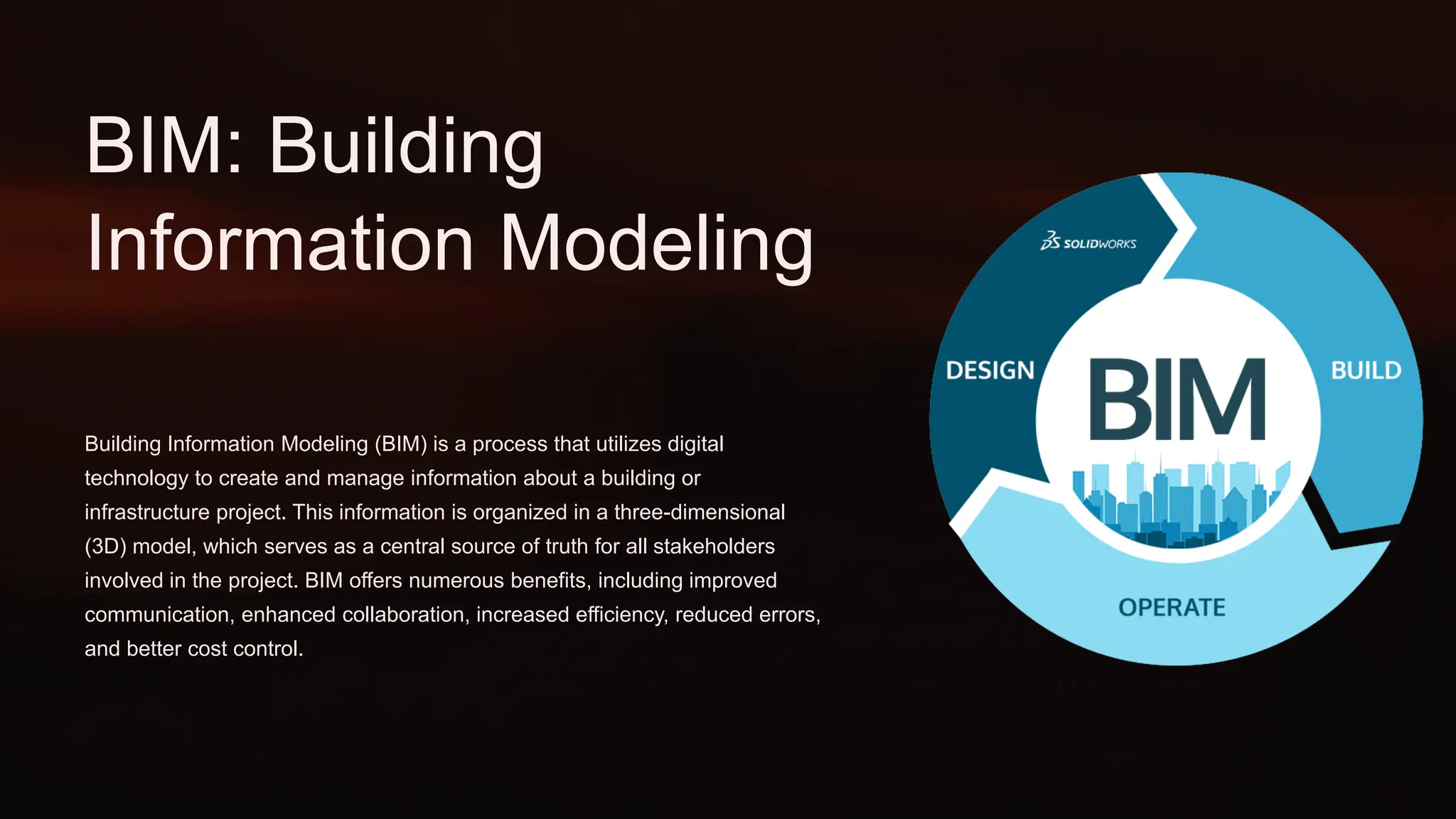
Building Information Modeling (BIM) is a process that utilizes digital
technology to create and manage information about a building or
infrastructure project. This information is organized in a three-dimensional
(3D) model, which serves as a central source of truth for all stakeholders
involved in the project. BIM offers numerous benefits, including improved
communication, enhanced collaboration, increased efficiency, reduced errors,
and better cost control.
BIM: Building Information Modeling
The term BIM encompasses a range of processes, technologies, and workflows used throughout the lifecycle of a construction project. It encompasses
everything from initial design and planning to construction, operations, and maintenance. BIM involves creating and utilizing a digital model that captures
all the relevant information about the building, including its geometry, materials, systems, and functions. This model becomes the primary source of
information for all project stakeholders, ensuring everyone is working with the latest and most accurate data.
Construction
BIM helps streamline construction
operations, reducing errors, optimizing
material usage, and coordinating between
different trades. The digital model can be
used for virtual mockups, clash detection,
and construction sequencing.
Operations
BIM facilitates building management by
providing a comprehensive understanding
of the building's systems and components.
The model can be used for facility
management, maintenance planning, and
energy optimization.
Building Information Exchange
BIM promotes collaboration and
information exchange between all parties
involved in the project. This includes
architects, engineers, contractors,
subcontractors, and owners. The digital
model serves as a common platform for
communication and data sharing.
BIM: Construction, Planning, Information, and
Exchange
BIM CPIX is a comprehensive approach to Building Information Modeling that emphasizes the importance of planning, information
management, and exchange throughout the construction lifecycle. It promotes a collaborative environment where all stakeholders work
together using a single, integrated digital model. This approach helps to improve project efficiency, reduce costs, and ensure the delivery of
high-quality buildings.
Construction
BIM CPIX enables efficient construction
planning and execution, using the digital
model for clash detection, sequence
optimization, and virtual mockups. It
helps to minimize delays and rework,
ensuring a smooth and productive
construction process.
Planning
BIM CPIX supports the development of
detailed and accurate construction plans,
utilizing the model to define project
requirements, scope, and deliverables.
This ensures that all stakeholders are on
the same page and have a clear
understanding of the project objectives.
Information & Exchange
BIM CPIX fosters open and transparent
information exchange between all project
participants. It enables seamless sharing
of data, documentation, and progress
updates, promoting effective
communication and collaboration.
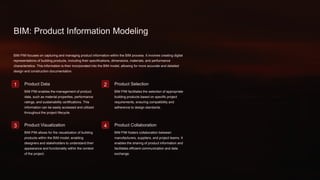
BIM: Product Information Modeling
BIM PIM focuses on capturing and managing product information within the BIM process. It involves creating digital
representations of building products, including their specifications, dimensions, materials, and performance
characteristics. This information is then incorporated into the BIM model, allowing for more accurate and detailed
design and construction documentation.
1 Product Data
BIM PIM enables the management of product
data, such as material properties, performance
ratings, and sustainability certifications. This
information can be easily accessed and utilized
throughout the project lifecycle.
2 Product Selection
BIM PIM facilitates the selection of appropriate
building products based on specific project
requirements, ensuring compatibility and
adherence to design standards.
3 Product Visualization
BIM PIM allows for the visualization of building
products within the BIM model, enabling
designers and stakeholders to understand their
appearance and functionality within the context
of the project.
4 Product Collaboration
BIM PIM fosters collaboration between
manufacturers, suppliers, and project teams. It
enables the sharing of product information and
facilitates efficient communication and data
exchange.
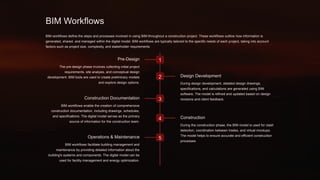
BIM Workflows
BIM workflows define the steps and processes involved in using BIM throughout a construction project. These workflows outline how information is
generated, shared, and managed within the digital model. BIM workflows are typically tailored to the specific needs of each project, taking into account
factors such as project size, complexity, and stakeholder requirements.
1
Pre-Design
The pre-design phase involves collecting initial project
requirements, site analysis, and conceptual design
development. BIM tools are used to create preliminary models
and explore design options.
2 Design Development
During design development, detailed design drawings,
specifications, and calculations are generated using BIM
software. The model is refined and updated based on design
revisions and client feedback.
3
Construction Documentation
BIM workflows enable the creation of comprehensive
construction documentation, including drawings, schedules,
and specifications. The digital model serves as the primary
source of information for the construction team.
4 Construction
During the construction phase, the BIM model is used for clash
detection, coordination between trades, and virtual mockups.
The model helps to ensure accurate and efficient construction
processes.
5
Operations & Maintenance
BIM workflows facilitate building management and
maintenance by providing detailed information about the
building's systems and components. The digital model can be
used for facility management and energy optimization.
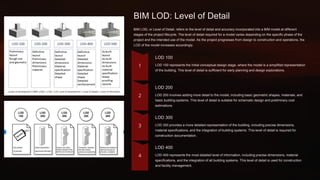
BIM LOD: Level of Detail
BIM LOD, or Level of Detail, refers to the level of detail and accuracy incorporated into a BIM model at different
stages of the project lifecycle. The level of detail required for a model varies depending on the specific phase of the
project and the intended use of the model. As the project progresses from design to construction and operations, the
LOD of the model increases accordingly.
LOD 100
LOD 100 represents the initial conceptual design stage, where the model is a simplified representation
of the building. This level of detail is sufficient for early planning and design explorations.
LOD 200
LOD 200 involves adding more detail to the model, including basic geometric shapes, materials, and
basic building systems. This level of detail is suitable for schematic design and preliminary cost
estimations.
LOD 300
LOD 300 provides a more detailed representation of the building, including precise dimensions,
material specifications, and the integration of building systems. This level of detail is required for
construction documentation.
LOD 400
LOD 400 represents the most detailed level of information, including precise dimensions, material
specifications, and the integration of all building systems. This level of detail is used for construction
and facility management.
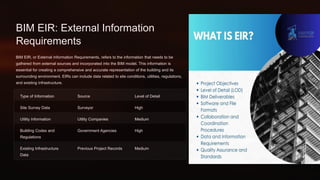
BIM EIR: External Information
Requirements
BIM EIR, or External Information Requirements, refers to the information that needs to be
gathered from external sources and incorporated into the BIM model. This information is
essential for creating a comprehensive and accurate representation of the building and its
surrounding environment. EIRs can include data related to site conditions, utilities, regulations,
and existing infrastructure.
Type of Information Source Level of Detail
Site Survey Data Surveyor High
Utility Information Utility Companies Medium
Building Codes and
Regulations
Government Agencies High
Existing Infrastructure
Data
Previous Project Records Medium
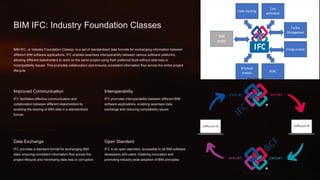
BIM IFC: Industry Foundation Classes
BIM IFC, or Industry Foundation Classes, is a set of standardized data formats for exchanging information between
different BIM software applications. IFC enables seamless interoperability between various software platforms,
allowing different stakeholders to work on the same project using their preferred tools without data loss or
incompatibility issues. This promotes collaboration and ensures consistent information flow across the entire project
lifecycle.
Improved Communication
IFC facilitates effective communication and
collaboration between different stakeholders by
enabling the sharing of BIM data in a standardized
format.
Interoperability
IFC promotes interoperability between different BIM
software applications, enabling seamless data
exchange and reducing compatibility issues.
Data Exchange
IFC provides a standard format for exchanging BIM
data, ensuring consistent information flow across the
project lifecycle and minimizing data loss or corruption.
Open Standard
IFC is an open standard, accessible to all BIM software
developers and users, fostering innovation and
promoting industry-wide adoption of BIM principles.

BIM-Building-Information-Modeling (3).pptx

  • 1.
    BIM: Building Information Modeling BuildingInformation Modeling (BIM) is a process that utilizes digital technology to create and manage information about a building or infrastructure project. This information is organized in a three-dimensional (3D) model, which serves as a central source of truth for all stakeholders involved in the project. BIM offers numerous benefits, including improved communication, enhanced collaboration, increased efficiency, reduced errors, and better cost control.
  • 2.
    BIM: Building InformationModeling The term BIM encompasses a range of processes, technologies, and workflows used throughout the lifecycle of a construction project. It encompasses everything from initial design and planning to construction, operations, and maintenance. BIM involves creating and utilizing a digital model that captures all the relevant information about the building, including its geometry, materials, systems, and functions. This model becomes the primary source of information for all project stakeholders, ensuring everyone is working with the latest and most accurate data. Construction BIM helps streamline construction operations, reducing errors, optimizing material usage, and coordinating between different trades. The digital model can be used for virtual mockups, clash detection, and construction sequencing. Operations BIM facilitates building management by providing a comprehensive understanding of the building's systems and components. The model can be used for facility management, maintenance planning, and energy optimization. Building Information Exchange BIM promotes collaboration and information exchange between all parties involved in the project. This includes architects, engineers, contractors, subcontractors, and owners. The digital model serves as a common platform for communication and data sharing.
  • 3.
    BIM: Construction, Planning,Information, and Exchange BIM CPIX is a comprehensive approach to Building Information Modeling that emphasizes the importance of planning, information management, and exchange throughout the construction lifecycle. It promotes a collaborative environment where all stakeholders work together using a single, integrated digital model. This approach helps to improve project efficiency, reduce costs, and ensure the delivery of high-quality buildings. Construction BIM CPIX enables efficient construction planning and execution, using the digital model for clash detection, sequence optimization, and virtual mockups. It helps to minimize delays and rework, ensuring a smooth and productive construction process. Planning BIM CPIX supports the development of detailed and accurate construction plans, utilizing the model to define project requirements, scope, and deliverables. This ensures that all stakeholders are on the same page and have a clear understanding of the project objectives. Information & Exchange BIM CPIX fosters open and transparent information exchange between all project participants. It enables seamless sharing of data, documentation, and progress updates, promoting effective communication and collaboration.
  • 4.
    BIM: Product InformationModeling BIM PIM focuses on capturing and managing product information within the BIM process. It involves creating digital representations of building products, including their specifications, dimensions, materials, and performance characteristics. This information is then incorporated into the BIM model, allowing for more accurate and detailed design and construction documentation. 1 Product Data BIM PIM enables the management of product data, such as material properties, performance ratings, and sustainability certifications. This information can be easily accessed and utilized throughout the project lifecycle. 2 Product Selection BIM PIM facilitates the selection of appropriate building products based on specific project requirements, ensuring compatibility and adherence to design standards. 3 Product Visualization BIM PIM allows for the visualization of building products within the BIM model, enabling designers and stakeholders to understand their appearance and functionality within the context of the project. 4 Product Collaboration BIM PIM fosters collaboration between manufacturers, suppliers, and project teams. It enables the sharing of product information and facilitates efficient communication and data exchange.
  • 5.
    BIM Workflows BIM workflowsdefine the steps and processes involved in using BIM throughout a construction project. These workflows outline how information is generated, shared, and managed within the digital model. BIM workflows are typically tailored to the specific needs of each project, taking into account factors such as project size, complexity, and stakeholder requirements. 1 Pre-Design The pre-design phase involves collecting initial project requirements, site analysis, and conceptual design development. BIM tools are used to create preliminary models and explore design options. 2 Design Development During design development, detailed design drawings, specifications, and calculations are generated using BIM software. The model is refined and updated based on design revisions and client feedback. 3 Construction Documentation BIM workflows enable the creation of comprehensive construction documentation, including drawings, schedules, and specifications. The digital model serves as the primary source of information for the construction team. 4 Construction During the construction phase, the BIM model is used for clash detection, coordination between trades, and virtual mockups. The model helps to ensure accurate and efficient construction processes. 5 Operations & Maintenance BIM workflows facilitate building management and maintenance by providing detailed information about the building's systems and components. The digital model can be used for facility management and energy optimization.
  • 6.
    BIM LOD: Levelof Detail BIM LOD, or Level of Detail, refers to the level of detail and accuracy incorporated into a BIM model at different stages of the project lifecycle. The level of detail required for a model varies depending on the specific phase of the project and the intended use of the model. As the project progresses from design to construction and operations, the LOD of the model increases accordingly. LOD 100 LOD 100 represents the initial conceptual design stage, where the model is a simplified representation of the building. This level of detail is sufficient for early planning and design explorations. LOD 200 LOD 200 involves adding more detail to the model, including basic geometric shapes, materials, and basic building systems. This level of detail is suitable for schematic design and preliminary cost estimations. LOD 300 LOD 300 provides a more detailed representation of the building, including precise dimensions, material specifications, and the integration of building systems. This level of detail is required for construction documentation. LOD 400 LOD 400 represents the most detailed level of information, including precise dimensions, material specifications, and the integration of all building systems. This level of detail is used for construction and facility management.
  • 7.
    BIM EIR: ExternalInformation Requirements BIM EIR, or External Information Requirements, refers to the information that needs to be gathered from external sources and incorporated into the BIM model. This information is essential for creating a comprehensive and accurate representation of the building and its surrounding environment. EIRs can include data related to site conditions, utilities, regulations, and existing infrastructure. Type of Information Source Level of Detail Site Survey Data Surveyor High Utility Information Utility Companies Medium Building Codes and Regulations Government Agencies High Existing Infrastructure Data Previous Project Records Medium
  • 8.
    BIM IFC: IndustryFoundation Classes BIM IFC, or Industry Foundation Classes, is a set of standardized data formats for exchanging information between different BIM software applications. IFC enables seamless interoperability between various software platforms, allowing different stakeholders to work on the same project using their preferred tools without data loss or incompatibility issues. This promotes collaboration and ensures consistent information flow across the entire project lifecycle. Improved Communication IFC facilitates effective communication and collaboration between different stakeholders by enabling the sharing of BIM data in a standardized format. Interoperability IFC promotes interoperability between different BIM software applications, enabling seamless data exchange and reducing compatibility issues. Data Exchange IFC provides a standard format for exchanging BIM data, ensuring consistent information flow across the project lifecycle and minimizing data loss or corruption. Open Standard IFC is an open standard, accessible to all BIM software developers and users, fostering innovation and promoting industry-wide adoption of BIM principles.