

A Curriculum Developed on
Communicative Goals
By :
Nanik Rahayu 201212500412
Ayu Fatimah 201212500420
Puji Astuti 201212500362
Lulu Syafwita 201212500400
Yuyun Wahyuningsih 201212500372
Suharyani 201212500421
Maria Hemas 201212500415
English Education Program
Faculty of Language and Art
University of Indraprasta PGRI (UNINDRA)
An
idealized
Communicative
Curriculum
Sociocultural
views on
the nature
of language
Cognitively-based
views on the
nature of
language learning
Humanistic views
of education
The Theoritical Views Which Influence The Goals Of
Communicative Curriculum
Sociolinguistic views any language as inseparable
from its sociocultural context.
Social Anthropologists
USA : SAPIR & WHORF
BRITAIN : Malinowski, Firth, Halliday
Main Concern : The connection between
language and society/culture and Phenomenon of
Variation at all Structural level.
Sociocultural Views of The Nature of Language
• Communicative Competence entails
knowing not only the language code or
the form of language, but also what to
say to whom and how to say it
appropriately in any given situation.
• The growing emphasis on cognitive psychology and
information processing models in education has given
special impetus to the area of research related to
language learning (Rivers and Melvin;1981).
• Curriculum planning and materials design need to include
tasks that allow learners to experience a variety of
cognitive activities.
• Teachers and students should become aware of individual
learning styles.
A Cognitively – based view of language learning
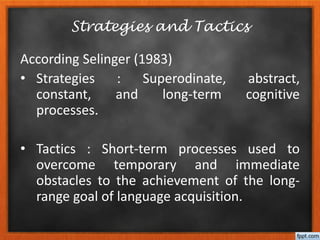
According Selinger (1983)
• Strategies : Superodinate, abstract,
constant, and long-term cognitive
processes.
• Tactics : Short-term processes used to
overcome temporary and immediate
obstacles to the achievement of the long-
range goal of language acquisition.
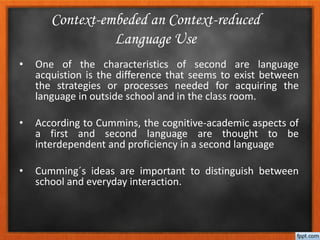
Strategies and Tactics
• One of the characteristics of second are language
acquistion is the difference that seems to exist between
the strategies or processes needed for acquiring the
language in outside school and in the class room.
• According to Cummins, the cognitive-academic aspects of
a first and second language are thought to be
interdependent and proficiency in a second language
• Cumming´s ideas are important to distinguish between
school and everyday interaction.
Context-embeded an Context-reduced
Language Use
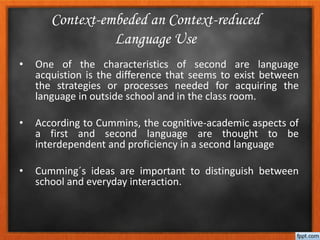
• One of the characteristics of second are language
acquistion is the difference that seems to exist between
the strategies or processes needed for acquiring the
language in outside school and in the class room.
• According to Cummins, the cognitive-academic aspects of
a first and second language are thought to be
interdependent and proficiency in a second language
• Cumming´s ideas are important to distinguish between
school and everyday interaction.
Context-embeded an Context-reduced
Language Use
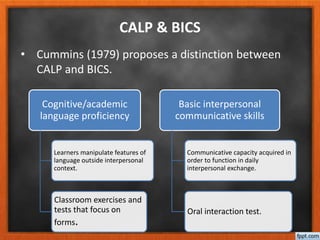
• Cummins (1979) proposes a distinction between
CALP and BICS.
CALP & BICS
Cognitive/academic
language proficiency
Learners manipulate features of
language outside interpersonal
context.
Classroom exercises and
tests that focus on
forms.
Basic interpersonal
communicative skills
Communicative capacity acquired in
order to function in daily
interpersonal exchange.
Oral interaction test.
• Cummins (1981) argues for a continuum with
context-embedded communication at one end
and context-reduced communication at the
other.
• The amount of information processing that
requires certain task. How much cognitive
involvement.
• Well-learned or automated task and not well-
learned or demanding task.
Cummins Idea :
In defining course objectives
In developing learning tasks
In designing activities for language use
In planning the overall course
• In the 1950's and 60's learning was
influenced by behavioristic psychology. In
behaviorism, the emphasis was on the
linguistic form (grammar, structure).
• Criticize against the behaviorism
This was criticized for limiting creativity and
self-expression.
The Holistic Approach to Language Learning
• Gestalt Theory
The cognitive theory its concerned about the
active learning, discovery learning that made
the students be more creative.
• Holistic Approach
The learning process happen in general and
socio cultural factors are included within. The
learning process carry through the overall
interaction, message transmission and doesn’t
focus with discrete units of language
(grammar).
in 1960s errors had to be avoided at all costs. But, now
they are part of the learning process.
Two questions arise from them:
1. Did the error made by the Transfer of L1 to L2?
2. Do they reveal universal characteristics of L1
acquisition?
Learners make hypothesis combining their previous L1
knowledge and their newly acquired L2 knowledge.
Course and material designers must be aware of this
mistakes.
What Learners’ Error Tell Us
• Greening Period (1960-1970)
• The Humanistic Theory scholars were Abraham
Maslow, Carl Rogers, Fritz Perls and Erich Berne.
• The Humanistic curriculum emphasized
responsibility of students in learning language,
making decision, choosing and initiating actions,
expressing themselves in feeling, opinion, needs,
ability, etc.
The Fundamentals of a
Humanistic Curriculum
1. Tried emphasizing on meaningful
communication from learners’ point of view.
2. Value the real characteristics of learner.
3. Learning is viewed as a "self-realization
experience“.
4. The other learners are the support group.
5. Teacher is a facilitator.
6. The first language of a learner is an useful
aid.
Objectives of a Language Program based on Humanistic
Curriculum goals:
• Planning for communicative goals calls for adopting
a distinct point of view. Its means distinct
underlying attitudes toward Nature of language,
Nature of language learning and Educational
framework
• Communicative Competence essentially suggest
that teaching learners to form grammatically
correct sentences is not enough, learners also need
to be able to use language appropriately in variety
of contexts (Hymes 1972)
Conclusion

A Curriculum Developed on Communicative Goals

  • 1.
    A Curriculum Developedon Communicative Goals By : Nanik Rahayu 201212500412 Ayu Fatimah 201212500420 Puji Astuti 201212500362 Lulu Syafwita 201212500400 Yuyun Wahyuningsih 201212500372 Suharyani 201212500421 Maria Hemas 201212500415 English Education Program Faculty of Language and Art University of Indraprasta PGRI (UNINDRA)
  • 2.
    An idealized Communicative Curriculum Sociocultural views on the nature oflanguage Cognitively-based views on the nature of language learning Humanistic views of education The Theoritical Views Which Influence The Goals Of Communicative Curriculum
  • 3.
    Sociolinguistic views anylanguage as inseparable from its sociocultural context. Social Anthropologists USA : SAPIR & WHORF BRITAIN : Malinowski, Firth, Halliday Main Concern : The connection between language and society/culture and Phenomenon of Variation at all Structural level. Sociocultural Views of The Nature of Language
  • 4.
    • Communicative Competenceentails knowing not only the language code or the form of language, but also what to say to whom and how to say it appropriately in any given situation.
  • 5.
    • The growingemphasis on cognitive psychology and information processing models in education has given special impetus to the area of research related to language learning (Rivers and Melvin;1981). • Curriculum planning and materials design need to include tasks that allow learners to experience a variety of cognitive activities. • Teachers and students should become aware of individual learning styles. A Cognitively – based view of language learning
  • 6.
    According Selinger (1983) •Strategies : Superodinate, abstract, constant, and long-term cognitive processes. • Tactics : Short-term processes used to overcome temporary and immediate obstacles to the achievement of the long- range goal of language acquisition. Strategies and Tactics
  • 7.
    • One ofthe characteristics of second are language acquistion is the difference that seems to exist between the strategies or processes needed for acquiring the language in outside school and in the class room. • According to Cummins, the cognitive-academic aspects of a first and second language are thought to be interdependent and proficiency in a second language • Cumming´s ideas are important to distinguish between school and everyday interaction. Context-embeded an Context-reduced Language Use
  • 8.
    • One ofthe characteristics of second are language acquistion is the difference that seems to exist between the strategies or processes needed for acquiring the language in outside school and in the class room. • According to Cummins, the cognitive-academic aspects of a first and second language are thought to be interdependent and proficiency in a second language • Cumming´s ideas are important to distinguish between school and everyday interaction. Context-embeded an Context-reduced Language Use
  • 9.
    • Cummins (1979)proposes a distinction between CALP and BICS. CALP & BICS Cognitive/academic language proficiency Learners manipulate features of language outside interpersonal context. Classroom exercises and tests that focus on forms. Basic interpersonal communicative skills Communicative capacity acquired in order to function in daily interpersonal exchange. Oral interaction test.
  • 10.
    • Cummins (1981)argues for a continuum with context-embedded communication at one end and context-reduced communication at the other. • The amount of information processing that requires certain task. How much cognitive involvement. • Well-learned or automated task and not well- learned or demanding task.
  • 11.
    Cummins Idea : Indefining course objectives In developing learning tasks In designing activities for language use In planning the overall course
  • 12.
    • In the1950's and 60's learning was influenced by behavioristic psychology. In behaviorism, the emphasis was on the linguistic form (grammar, structure). • Criticize against the behaviorism This was criticized for limiting creativity and self-expression. The Holistic Approach to Language Learning
  • 13.
    • Gestalt Theory Thecognitive theory its concerned about the active learning, discovery learning that made the students be more creative. • Holistic Approach The learning process happen in general and socio cultural factors are included within. The learning process carry through the overall interaction, message transmission and doesn’t focus with discrete units of language (grammar).
  • 14.
    in 1960s errorshad to be avoided at all costs. But, now they are part of the learning process. Two questions arise from them: 1. Did the error made by the Transfer of L1 to L2? 2. Do they reveal universal characteristics of L1 acquisition? Learners make hypothesis combining their previous L1 knowledge and their newly acquired L2 knowledge. Course and material designers must be aware of this mistakes. What Learners’ Error Tell Us
  • 15.
    • Greening Period(1960-1970) • The Humanistic Theory scholars were Abraham Maslow, Carl Rogers, Fritz Perls and Erich Berne. • The Humanistic curriculum emphasized responsibility of students in learning language, making decision, choosing and initiating actions, expressing themselves in feeling, opinion, needs, ability, etc. The Fundamentals of a Humanistic Curriculum
  • 16.
    1. Tried emphasizingon meaningful communication from learners’ point of view. 2. Value the real characteristics of learner. 3. Learning is viewed as a "self-realization experience“. 4. The other learners are the support group. 5. Teacher is a facilitator. 6. The first language of a learner is an useful aid. Objectives of a Language Program based on Humanistic Curriculum goals:
  • 17.
    • Planning forcommunicative goals calls for adopting a distinct point of view. Its means distinct underlying attitudes toward Nature of language, Nature of language learning and Educational framework • Communicative Competence essentially suggest that teaching learners to form grammatically correct sentences is not enough, learners also need to be able to use language appropriately in variety of contexts (Hymes 1972) Conclusion