i
TESTBEDS 2015 – Lincoln, Nebraska – November 10th
A Conceptual Framework for the
Comparison of Fully Automated GUI
Testing Techniques
Domenico Amalfitano
Nicola Amatucci
Anna Rita Fasolino
Porfirio Tramontana
i
TESTBEDS 2015 – Lincoln, Nebraska – November 10th
Context and Motivations
 Context
◦ Dynamic online testing techniques
◦ Android GUI Testing
 Motivation
◦ Objective and systematic comparison of
fully automatic testing techniques.
i
TESTBEDS 2015 – Lincoln, Nebraska – November 10th
Dynamic online testing
techniques
 According to Rothermel these
techniques are defined as:
◦ Dynamic event extraction-based GUI test
case generation techniques
 In these techniques:
◦ Test cases are actually sequences of one or
more GUI events that must be automatically
fired on the application under test (AUT).
◦ Test cases are executed as soon as they are
automatically defined at run-time.
 There is not a clear distinction between the steps of
Test Cases Generation and Test Cases Execution.
i
TESTBEDS 2015 – Lincoln, Nebraska – November 10th
A first classification proposal
 By a preliminary analysis of the
literature it is possible to classify these
techniques into two families:
◦ Random techniques
◦ Active Learning techniques
i
TESTBEDS 2015 – Lincoln, Nebraska – November 10th
Random testing techniques
 Automatically exercise the subject
applications by firing pseudo-random
sequences of events through their
GUI.
◦ Usually exploited to perform stress testing
of the AUT.
i
TESTBEDS 2015 – Lincoln, Nebraska – November 10th
Active Learning testing
techniques
 Combine together GUI testing and
model learning techniques.
 Try to learn a model of the GUI and
generate user event sequences on the
basis of this model.
◦ Usually exploit systematic exploration
strategies of the GUI, such as the ones
emulating well-known graph exploration
algorithms like Breadth-first search (BFS),
Depth-first search (DFS).
i
TESTBEDS 2015 – Lincoln, Nebraska – November 10th
Performances of dynamic testing
techniques
 Intuitively the performances of these
techniques may be influenced by
different choices, such as:
◦ When the process must be stopped?
◦ How the next sequence of events to be fired
is selected?
◦ In the case of active learning techniques,
when two GUIs can be considered as
equivalent?
◦ Etc.
 A way for comparing in a systematic
manner the performances of different
techniques is needed.
i
TESTBEDS 2015 – Lincoln, Nebraska – November 10th
Proposed approach
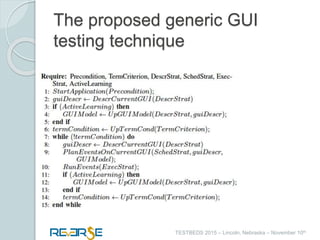
 The approach is based on a
generalized algorithm that abstracts
the key aspects of dynamic GUI
testing techniques.
 The algorithm provides a conceptual
framework that can be used to define
and compare different GUI testing
techniques.
i
TESTBEDS 2015 – Lincoln, Nebraska – November 10th
The proposed generic GUI
testing technique
i
TESTBEDS 2015 – Lincoln, Nebraska – November 10th
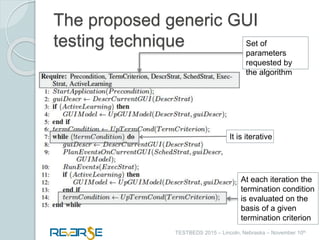
The proposed generic GUI
testing technique
It is iterative
At each iteration the
termination condition
is evaluated on the
basis of a given
termination criterion
Set of
parameters
requested by
the algorithm
i
TESTBEDS 2015 – Lincoln, Nebraska – November 10th
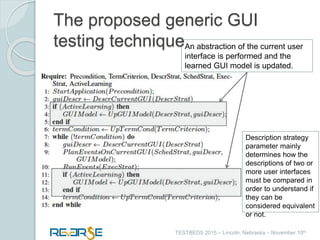
The proposed generic GUI
testing technique
Description strategy
parameter mainly
determines how the
descriptions of two or
more user interfaces
must be compared in
order to understand if
they can be
considered equivalent
or not.
An abstraction of the current user
interface is performed and the
learned GUI model is updated.
i
TESTBEDS 2015 – Lincoln, Nebraska – November 10th
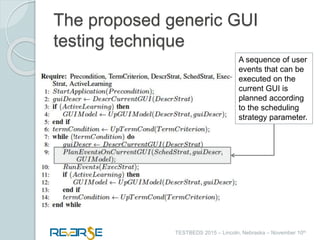
The proposed generic GUI
testing technique
A sequence of user
events that can be
executed on the
current GUI is
planned according
to the scheduling
strategy parameter.
i
TESTBEDS 2015 – Lincoln, Nebraska – November 10th
The proposed generic GUI
testing technique
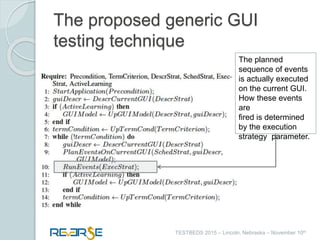
The planned
sequence of events
is actually executed
on the current GUI.
How these events
are
fired is determined
by the execution
strategy parameter.
i
TESTBEDS 2015 – Lincoln, Nebraska – November 10th
Testing techniques as instances
of the proposed algorithm
 The generalized algorithm can be
used to describe testing techniques
that vary as the values of the
algorithm parameters vary.
◦ Instances of the proposed algorithm are
dynamic GUI testing techniques.
◦ For a given instance, each parameter
assumes a specific value.
i
TESTBEDS 2015 – Lincoln, Nebraska – November 10th
Algorithm as a systematic
comparison framework
 The Algorithm can be exploited as a
framework for the systematic
comparison of different GUI testing
techniques.
◦ It can be exploited to understand how the
values assumed by one of the parameters
can influence the performances of the
technique.
 By varying one dimension and by fixing the
other ones.
i
TESTBEDS 2015 – Lincoln, Nebraska – November 10th
Evaluation
 We showed how the conceptual
framework can be exploited for defining
different fully automated testing
techniques and systematically comparing
their performances.
 We intended to understand:
1. How much the choice of the
parameters influences the
performances of fully automated testing
techniques.
2. How much the choice of the
parameters influences the models
inferred by Active Learning testing
techniques.
i
TESTBEDS 2015 – Lincoln, Nebraska – November 10th
Subject and metrics
 As subject application we considered
the Trolly Android application.
 Performances evaluated as:
◦ Test adequacy in terms of:
 LOCs coverage and LOCs Coverage %
◦ The cost for the execution in terms of:
 # of Fired Events
 The complexity of the inferred GUI
trees evaluated in terms of:
 # of Nodes, # of Edges, # of Leaves and
Depth.
i
TESTBEDS 2015 – Lincoln, Nebraska – November 10th
Framework Configurations
 We defined different values of each
parameter of the algorithm to
implement different fully automated
testing techniques.
◦ A single value for precondition and
execution strategy.
i
TESTBEDS 2015 – Lincoln, Nebraska – November 10th
Framework Configurations
cont’d
 Three values of Termination
Criterion:
◦ Nmg: all the visited GUIs have been
already encountered.
◦ MaxEv: a given maximum number of
events has been executed.
◦ Sat: a given number of parallel
executions of the algorithm covers the
same set of LOCs.
i
TESTBEDS 2015 – Lincoln, Nebraska – November 10th
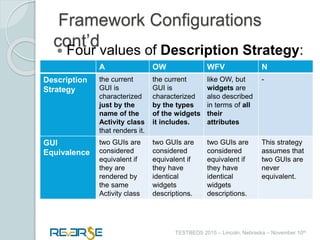
Framework Configurations
cont’d
A OW WFV N
Description
Strategy
the current
GUI is
characterized
just by the
name of the
Activity class
that renders it.
the current
GUI is
characterized
by the types
of the widgets
it includes.
like OW, but
widgets are
also described
in terms of all
their
attributes
-
GUI
Equivalence
two GUIs are
considered
equivalent if
they are
rendered by
the same
Activity class
two GUIs are
considered
equivalent if
they have
identical
widgets
descriptions.
two GUIs are
considered
equivalent if
they have
identical
widgets
descriptions.
This strategy
assumes that
two GUIs are
never
equivalent.
 Four values of Description Strategy:
i
TESTBEDS 2015 – Lincoln, Nebraska – November 10th
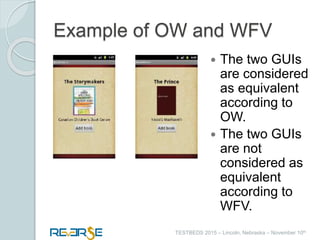
Example of OW and WFV
 The two GUIs
are considered
as equivalent
according to
OW.
 The two GUIs
are not
considered as
equivalent
according to
WFV.
i
TESTBEDS 2015 – Lincoln, Nebraska – November 10th
Framework Configurations
cont’d
 Three values of Scheduling Strategy:
◦ BF: breadth first GUI navigation
◦ DF: depth first GUI navigation
◦ R: uniform random GUI navigation
i
TESTBEDS 2015 – Lincoln, Nebraska – November 10th
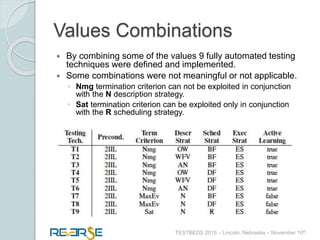
Values Combinations
 By combining some of the values 9 fully automated testing
techniques were defined and implemented.
 Some combinations were not meaningful or not applicable.
◦ Nmg termination criterion can not be exploited in conjunction
with the N description strategy.
◦ Sat termination criterion can be exploited only in conjunction
with the R scheduling strategy.
i
TESTBEDS 2015 – Lincoln, Nebraska – November 10th
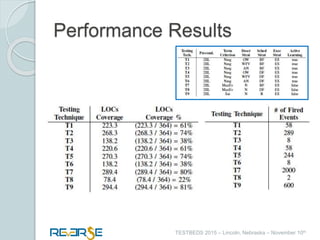
Performance Results
i
TESTBEDS 2015 – Lincoln, Nebraska – November 10th
Performance Results
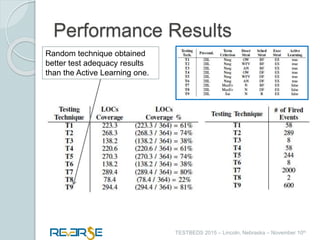
Random technique obtained
better test adequacy results
than the Active Learning one.
i
TESTBEDS 2015 – Lincoln, Nebraska – November 10th
Performance Results
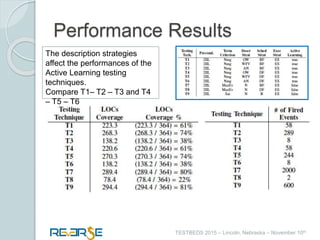
The description strategies
affect the performances of the
Active Learning testing
techniques.
Compare T1– T2 – T3 and T4
– T5 – T6
i
TESTBEDS 2015 – Lincoln, Nebraska – November 10th
Performance Results
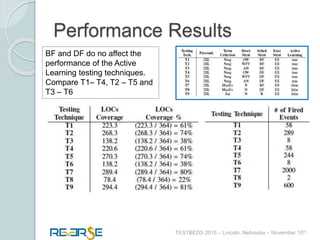
BF and DF do no affect the
performance of the Active
Learning testing techniques.
Compare T1– T4, T2 – T5 and
T3 – T6
i
TESTBEDS 2015 – Lincoln, Nebraska – November 10th
GUI tree Complexity Results
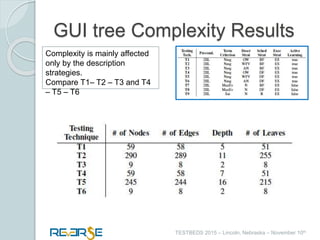
Complexity is mainly affected
only by the description
strategies.
Compare T1– T2 – T3 and T4
– T5 – T6
i
TESTBEDS 2015 – Lincoln, Nebraska – November 10th
About inferred GUI trees
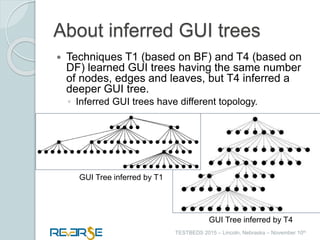
 Techniques T1 (based on BF) and T4 (based on
DF) learned GUI trees having the same number
of nodes, edges and leaves, but T4 inferred a
deeper GUI tree.
◦ Inferred GUI trees have different topology.
GUI Tree inferred by T1
GUI Tree inferred by T4
i
TESTBEDS 2015 – Lincoln, Nebraska – November 10th
Conclusions
 A conceptual framework that can be
exploited for describing and
implementing different fully automated
GUI testing techniques was proposed.
 The framework can be adopted for a
systematic comparison of different
testing techniques.
i
TESTBEDS 2015 – Lincoln, Nebraska – November 10th
Future Works
 To extend and validate the framework
on the basis of the different
techniques proposed in the literature,
in order to discover additional or
alternative parameters
 To exploit the framework for designing
an empirical study aiming at
systematically comparing the
performance of different techniques
i
TESTBEDS 2015 – Lincoln, Nebraska – November 10th
Thanks for your attention
Questions?
Further Information:
http://reverse.dieti.unina.it
@REvERSE_UNINA
domenico.amalfitano@unina.it

A Conceptual Framework for the Comparison of Fully Automated GUI Testing Techniques

  • 1.
    i TESTBEDS 2015 –Lincoln, Nebraska – November 10th A Conceptual Framework for the Comparison of Fully Automated GUI Testing Techniques Domenico Amalfitano Nicola Amatucci Anna Rita Fasolino Porfirio Tramontana
  • 2.
    i TESTBEDS 2015 –Lincoln, Nebraska – November 10th Context and Motivations  Context ◦ Dynamic online testing techniques ◦ Android GUI Testing  Motivation ◦ Objective and systematic comparison of fully automatic testing techniques.
  • 3.
    i TESTBEDS 2015 –Lincoln, Nebraska – November 10th Dynamic online testing techniques  According to Rothermel these techniques are defined as: ◦ Dynamic event extraction-based GUI test case generation techniques  In these techniques: ◦ Test cases are actually sequences of one or more GUI events that must be automatically fired on the application under test (AUT). ◦ Test cases are executed as soon as they are automatically defined at run-time.  There is not a clear distinction between the steps of Test Cases Generation and Test Cases Execution.
  • 4.
    i TESTBEDS 2015 –Lincoln, Nebraska – November 10th A first classification proposal  By a preliminary analysis of the literature it is possible to classify these techniques into two families: ◦ Random techniques ◦ Active Learning techniques
  • 5.
    i TESTBEDS 2015 –Lincoln, Nebraska – November 10th Random testing techniques  Automatically exercise the subject applications by firing pseudo-random sequences of events through their GUI. ◦ Usually exploited to perform stress testing of the AUT.
  • 6.
    i TESTBEDS 2015 –Lincoln, Nebraska – November 10th Active Learning testing techniques  Combine together GUI testing and model learning techniques.  Try to learn a model of the GUI and generate user event sequences on the basis of this model. ◦ Usually exploit systematic exploration strategies of the GUI, such as the ones emulating well-known graph exploration algorithms like Breadth-first search (BFS), Depth-first search (DFS).
  • 7.
    i TESTBEDS 2015 –Lincoln, Nebraska – November 10th Performances of dynamic testing techniques  Intuitively the performances of these techniques may be influenced by different choices, such as: ◦ When the process must be stopped? ◦ How the next sequence of events to be fired is selected? ◦ In the case of active learning techniques, when two GUIs can be considered as equivalent? ◦ Etc.  A way for comparing in a systematic manner the performances of different techniques is needed.
  • 8.
    i TESTBEDS 2015 –Lincoln, Nebraska – November 10th Proposed approach  The approach is based on a generalized algorithm that abstracts the key aspects of dynamic GUI testing techniques.  The algorithm provides a conceptual framework that can be used to define and compare different GUI testing techniques.
  • 9.
    i TESTBEDS 2015 –Lincoln, Nebraska – November 10th The proposed generic GUI testing technique
  • 10.
    i TESTBEDS 2015 –Lincoln, Nebraska – November 10th The proposed generic GUI testing technique It is iterative At each iteration the termination condition is evaluated on the basis of a given termination criterion Set of parameters requested by the algorithm
  • 11.
    i TESTBEDS 2015 –Lincoln, Nebraska – November 10th The proposed generic GUI testing technique Description strategy parameter mainly determines how the descriptions of two or more user interfaces must be compared in order to understand if they can be considered equivalent or not. An abstraction of the current user interface is performed and the learned GUI model is updated.
  • 12.
    i TESTBEDS 2015 –Lincoln, Nebraska – November 10th The proposed generic GUI testing technique A sequence of user events that can be executed on the current GUI is planned according to the scheduling strategy parameter.
  • 13.
    i TESTBEDS 2015 –Lincoln, Nebraska – November 10th The proposed generic GUI testing technique The planned sequence of events is actually executed on the current GUI. How these events are fired is determined by the execution strategy parameter.
  • 14.
    i TESTBEDS 2015 –Lincoln, Nebraska – November 10th Testing techniques as instances of the proposed algorithm  The generalized algorithm can be used to describe testing techniques that vary as the values of the algorithm parameters vary. ◦ Instances of the proposed algorithm are dynamic GUI testing techniques. ◦ For a given instance, each parameter assumes a specific value.
  • 15.
    i TESTBEDS 2015 –Lincoln, Nebraska – November 10th Algorithm as a systematic comparison framework  The Algorithm can be exploited as a framework for the systematic comparison of different GUI testing techniques. ◦ It can be exploited to understand how the values assumed by one of the parameters can influence the performances of the technique.  By varying one dimension and by fixing the other ones.
  • 16.
    i TESTBEDS 2015 –Lincoln, Nebraska – November 10th Evaluation  We showed how the conceptual framework can be exploited for defining different fully automated testing techniques and systematically comparing their performances.  We intended to understand: 1. How much the choice of the parameters influences the performances of fully automated testing techniques. 2. How much the choice of the parameters influences the models inferred by Active Learning testing techniques.
  • 17.
    i TESTBEDS 2015 –Lincoln, Nebraska – November 10th Subject and metrics  As subject application we considered the Trolly Android application.  Performances evaluated as: ◦ Test adequacy in terms of:  LOCs coverage and LOCs Coverage % ◦ The cost for the execution in terms of:  # of Fired Events  The complexity of the inferred GUI trees evaluated in terms of:  # of Nodes, # of Edges, # of Leaves and Depth.
  • 18.
    i TESTBEDS 2015 –Lincoln, Nebraska – November 10th Framework Configurations  We defined different values of each parameter of the algorithm to implement different fully automated testing techniques. ◦ A single value for precondition and execution strategy.
  • 19.
    i TESTBEDS 2015 –Lincoln, Nebraska – November 10th Framework Configurations cont’d  Three values of Termination Criterion: ◦ Nmg: all the visited GUIs have been already encountered. ◦ MaxEv: a given maximum number of events has been executed. ◦ Sat: a given number of parallel executions of the algorithm covers the same set of LOCs.
  • 20.
    i TESTBEDS 2015 –Lincoln, Nebraska – November 10th Framework Configurations cont’d A OW WFV N Description Strategy the current GUI is characterized just by the name of the Activity class that renders it. the current GUI is characterized by the types of the widgets it includes. like OW, but widgets are also described in terms of all their attributes - GUI Equivalence two GUIs are considered equivalent if they are rendered by the same Activity class two GUIs are considered equivalent if they have identical widgets descriptions. two GUIs are considered equivalent if they have identical widgets descriptions. This strategy assumes that two GUIs are never equivalent.  Four values of Description Strategy:
  • 21.
    i TESTBEDS 2015 –Lincoln, Nebraska – November 10th Example of OW and WFV  The two GUIs are considered as equivalent according to OW.  The two GUIs are not considered as equivalent according to WFV.
  • 22.
    i TESTBEDS 2015 –Lincoln, Nebraska – November 10th Framework Configurations cont’d  Three values of Scheduling Strategy: ◦ BF: breadth first GUI navigation ◦ DF: depth first GUI navigation ◦ R: uniform random GUI navigation
  • 23.
    i TESTBEDS 2015 –Lincoln, Nebraska – November 10th Values Combinations  By combining some of the values 9 fully automated testing techniques were defined and implemented.  Some combinations were not meaningful or not applicable. ◦ Nmg termination criterion can not be exploited in conjunction with the N description strategy. ◦ Sat termination criterion can be exploited only in conjunction with the R scheduling strategy.
  • 24.
    i TESTBEDS 2015 –Lincoln, Nebraska – November 10th Performance Results
  • 25.
    i TESTBEDS 2015 –Lincoln, Nebraska – November 10th Performance Results Random technique obtained better test adequacy results than the Active Learning one.
  • 26.
    i TESTBEDS 2015 –Lincoln, Nebraska – November 10th Performance Results The description strategies affect the performances of the Active Learning testing techniques. Compare T1– T2 – T3 and T4 – T5 – T6
  • 27.
    i TESTBEDS 2015 –Lincoln, Nebraska – November 10th Performance Results BF and DF do no affect the performance of the Active Learning testing techniques. Compare T1– T4, T2 – T5 and T3 – T6
  • 28.
    i TESTBEDS 2015 –Lincoln, Nebraska – November 10th GUI tree Complexity Results Complexity is mainly affected only by the description strategies. Compare T1– T2 – T3 and T4 – T5 – T6
  • 29.
    i TESTBEDS 2015 –Lincoln, Nebraska – November 10th About inferred GUI trees  Techniques T1 (based on BF) and T4 (based on DF) learned GUI trees having the same number of nodes, edges and leaves, but T4 inferred a deeper GUI tree. ◦ Inferred GUI trees have different topology. GUI Tree inferred by T1 GUI Tree inferred by T4
  • 30.
    i TESTBEDS 2015 –Lincoln, Nebraska – November 10th Conclusions  A conceptual framework that can be exploited for describing and implementing different fully automated GUI testing techniques was proposed.  The framework can be adopted for a systematic comparison of different testing techniques.
  • 31.
    i TESTBEDS 2015 –Lincoln, Nebraska – November 10th Future Works  To extend and validate the framework on the basis of the different techniques proposed in the literature, in order to discover additional or alternative parameters  To exploit the framework for designing an empirical study aiming at systematically comparing the performance of different techniques
  • 32.
    i TESTBEDS 2015 –Lincoln, Nebraska – November 10th Thanks for your attention Questions? Further Information: http://reverse.dieti.unina.it @REvERSE_UNINA domenico.amalfitano@unina.it