

Test Automation Framework
Designs
Designing standardized frameworks
instead of simple scripting
By Martin Lienhard
The Great Divide
• There has been a divide separating QA and Dev due in large
part by 3rd
party tool vendors and their proprietary test tools
• Open source tools have helped significantly to bridge that
divide, so that we can work together to create better
software
• Most QAs have the bigger picture of what they want to test,
and how to do it, but have trouble building robust automation
frameworks, because they lack the technical skills.
• Most Developers focus on testing code in isolation, but lack
the testing experience from a system-wide or end-to-end
perspective, so they have trouble building a test automation
framework that suits the needs of QA.
1st
Phase of Test Progression
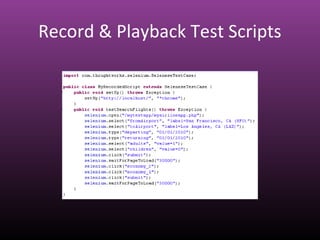
• Most QA start out creating test scripts by using record &
playback tools
• Lack conditional logic and looping
• Contain static data, UI locators, URLs, etc.
• Cannot be executed iteratively
• Cannot be reusable modules
• Should not be chained together as dependencies
• Lack configuration and global properties
• Cannot abstract away from the test tool or test runner
Record & Playback Test Scripts
2nd
Phase of Test Progression
• QA usually improves their tests by adding data-driven
techniques
• Create variables and arrays to store data
• Create parameterized functions or methods to store data
• Add looping to recorded scripts
3rd
Phase of Test Progression
• QA usually improves their tests by creating a business
function library
• Modular, reusable test libraries of functions
• Create file readers that pull in parameters from text files, CSV
files, etc.
• Abstract out the data from the tests by externalizing data
• Create parameterized or iterative tests that are data-driven
• Abstract out the UI locators from the tests by externalizing UI
maps
• Create global properties and configuration files
• A vast array of disparate data pools and UI maps are created,
which usually become unmanageable after a couple of years
4th
Phase of Test Progression
• QA usually improves their tests by creating a keyword-driven
library:
• Create ODBC functions that read data from spreadsheets and
databases
• Create spreadsheets of keywords that represent business
domain language
– Low-level keywords describe test operations
– High-level keywords describe business language
– Intermediate-level keywords map business functions to
test operations
– Tests become readable by business users and non-
technical QA
…continued
• Create spreadsheets of data that drive the tests
• Query data from the application database as input and
verification points for tests
• A hierarchy of abstracted keyword spreadsheets are created
• Now non-technical BAs and QAs are creating automated tests
• A vast array of disparate keyword spreadsheets are created,
which usually become unmanageable after a couple of years
• Nearly all 3rd
party vendor test tools live in this area today
– Most of these tools use legacy scripting languages, which
are not compatible with today’s technology
5th
Phase of Test Progression
• QAs become more technical and improve their tests by using
object oriented testing techniques:
• Objects are designed and created to further modularize and
reuse code with very low maintenance
• Test code is stored in objects
– The page object design is used
– Component object designs are used
• Test data are stored in objects
• Configuration and properties are stored in objects
• Calls are made to the application and developer written APIs
to make tests “smarter”
…continued
• Continuous integration environments are utilized to run tests
• QA moves into white box testing to drive quality deeper into
the application
– UI tests are ran “headless” to make them execute faster
• QA expands the test framework to include multiple test tools
and test runners
– Databases, web services, and APIs are created to reuse
code and data across multiple test tools
– Test tools and 3rd
party utilities can be upgraded to newer
versions with enhanced functionality with minor impact to
the test framework
…continued
• Developers can now run the tests, and contribute to the
overall test suites
• More 3rd
party vendors are rewriting their test tools to include
object oriented languages to accommodate these technical
QAs
– Due to the cost of the tools and their proprietary nature, it
is difficult to place these tools into a continuous
integration environment to share with developers
What is a test automation framework?
• A test automation framework is an application
that allows you to write a series of tests
without worrying about the constraints or
limitations of the underlying test tools
Benefits of building a Test Framework
• Tool agnostic
– Abstracts away low level commands
– Utilize many test tools
• Test tools such as Selenium, WebDriver, etc.
• Test runner such as unit test frameworks
• Other common utilities
– Perform multiple levels and types of testing
• Functional, regression, load, performance, unit,
integration, etc.
…continued
• Generic test API
– Common codebase and database
– Exception and error handling
– Modularized, reusable, and maintainable code and data
– Standardized test idioms
• Test configuration
– Configurable test suites
– Global test properties
…continued
• Automatic test versioning
– No need to get a specific version from the source control
repository
• Always get the latest version
– Eliminates deployment to multiple machines for testing
different versions of an application
• Deploy to a single server machine
…continued
• Multi-threading
– Run tests in parallel
– Runs on test machines in the grid or cloud
– Test across multiple environments and application
versions simultaneously
• Continuous integration
– Run in a continuous integration environment
– Share tests and collaborate with other teams
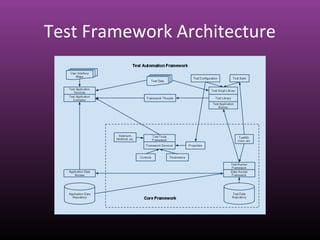
Test Framework Architecture
Test Suite
• A collection of tests to run
• Have test parameters
– i.e.: application, environment, version, etc.
• Have test groups
– i.e.: regression, build, etc.
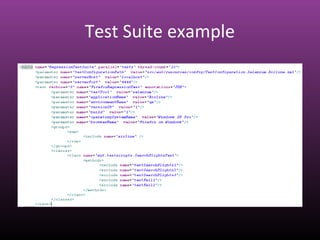
Test Suite example
Test Configuration
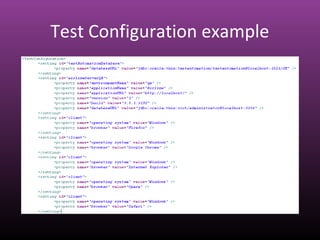
• Any configurable test item that is separate from the test suite
– i.e.: web site URLs, database URLs, usernames, passwords, lab
machine configurations, etc.
• Separated from the rest of the framework for information
security and regulatory compliance
Test Configuration example
Test Properties
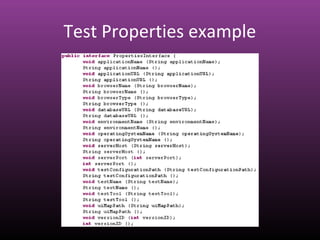
• Are thread specific
• Have global scope and can be accessed by any class method
Test Properties example
Test Data Repository
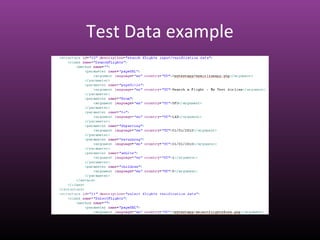
• Abstracts away changes made only to test data
• Data can be stored in databases and files such as XML, JSON,
XLS, TXT, CSV, etc.
• Data can be retrieved from data sources such as databases,
web services, APIs, EDI, etc.
• Metadata can be used to describe additional information
about the test data such as versions, application names,
required fields, invalid formats, etc.
• Share data across multiple screens, applications, and tools
Test Data example
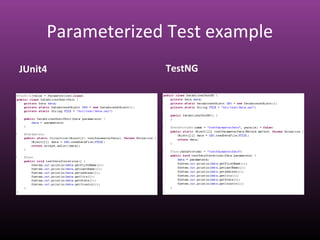
Parameterized Test example
JUnit4 TestNG
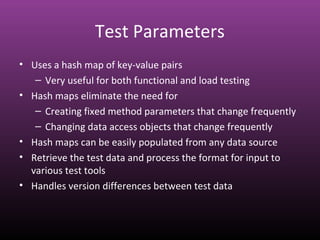
Test Parameters
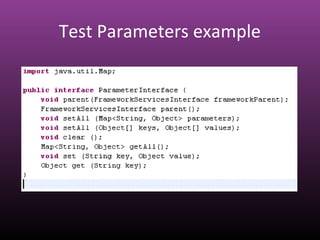
• Uses a hash map of key-value pairs
– Very useful for both functional and load testing
• Hash maps eliminate the need for
– Creating fixed method parameters that change frequently
– Changing data access objects that change frequently
• Hash maps can be easily populated from any data source
• Retrieve the test data and process the format for input to
various test tools
• Handles version differences between test data
Test Parameters example
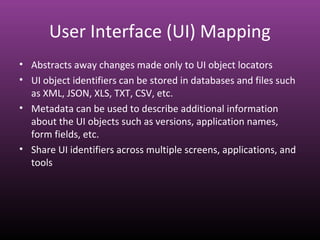
User Interface (UI) Mapping
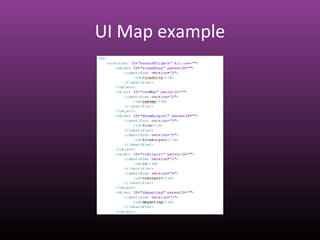
• Abstracts away changes made only to UI object locators
• UI object identifiers can be stored in databases and files such
as XML, JSON, XLS, TXT, CSV, etc.
• Metadata can be used to describe additional information
about the UI objects such as versions, application names,
form fields, etc.
• Share UI identifiers across multiple screens, applications, and
tools
UI Map example
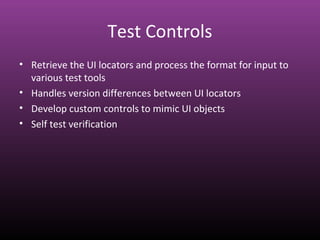
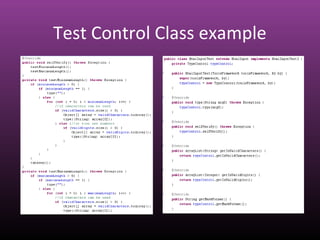
Test Controls
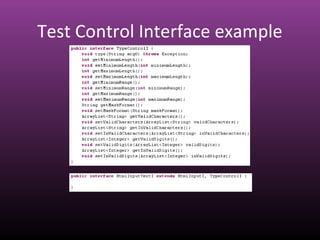
• Retrieve the UI locators and process the format for input to
various test tools
• Handles version differences between UI locators
• Develop custom controls to mimic UI objects
• Self test verification
Test Control Interface example
Test Control Class example
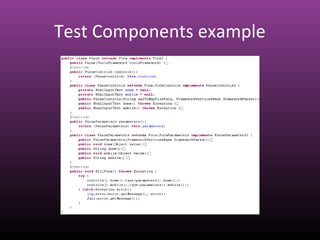
Test Components
• A class object that represents a piece of a form, page, or
screen
• Groups of common objects that can be found across more
than one page
• Standardized component verification tests
Test Components example
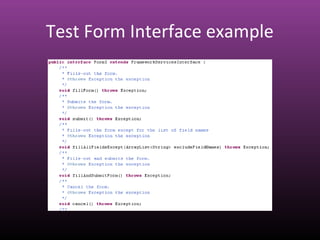
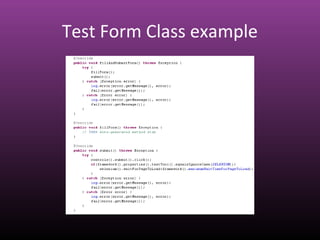
Test Forms
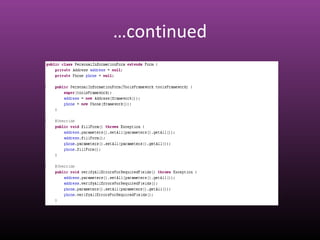
• A class object that represents a piece a form
• Groups of components and controls that mimic the UI form
• Standardized form verification tests
Test Form Interface example
Test Form Class example
…continued
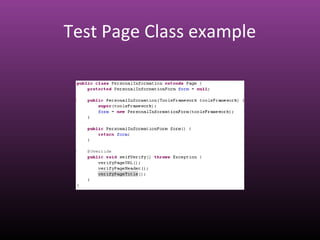
Test Page or Screen
• A class object that represents a web page or screen –
commonly referred to as “page objects”
• Groups of forms, components, and controls that mimic the UI
page or screen
• Self test verification
Test Page Class example
Instances when NOT to return a new
Page Object for each Page
• Submitting a page can return one of many different pages, or
versions of pages, which would be represented by many
different classes
– Page A could return B, C, or D
– Page A could return B v1.0, B v2.0, or Cv1.0, C v2.0, or D
v1.0, D v2.0, etc.
– This means that you would need to do the following:
• Create multiple methods with similar names that
return different page objects
– Page A.submitB() returns B
– Page A.submitC() returns C
…continued
• Return an page object of an inherited type, and then
cast the type of the page in the script
– Page A.submit() returns page X
– Pages B and C inherit from page X
– Script checks the type of X and casts to B or C
– This can get very ugly in a script…
• Submitting a page may initiate an AJAX call, which can rewrite
the same page
– Page A could display an AJAX (modal) dialog
– Page A could display some other AJAX widget
– Page A could be rewritten to look like page B
…continued
• If the page flow is not what is being tested, then an
unexpected page or AJAX call could fail and kill the test
– Test case:
• We are trying to test the functionality of page Z
• The primary page flow is as follows:
– A to B, B to C, C to D, and D to Z
• The alternative page flows could also correctly occur,
but are unpredictable base on many unknown
variables:
– A to H, H to L, L to M, and M to Z
– A to R, R to S, and S to Z
– A to X, X to Y, and Y to Z
…continued
– What if page A unexpectedly returned page H, R, or X
instead of page B?
– If page H, R, or X verified itself and asserted a failure, then
how would the test ever reach page Z?
JavaScript & HTML DOM
• There are many instances when we need the test framework
to mimic a human reading the content of a page and then
making a decision on what action to perform next
– Verifying the list of items on a search results page
– Selecting items to purchase from a list
– Selecting elements to edit, update, or delete
• Scenarios like these usually occur as a result of some previous
action, and display content generated dynamically to the user
• The test framework may have to query an application
database or web service to provide the input to trigger the
dynamic page content
…continued
• The test framework will then need to interrogate the page to
determine if the expected elements, attributes, or content
are present, and then make a decision on whether to perform
an action on some element
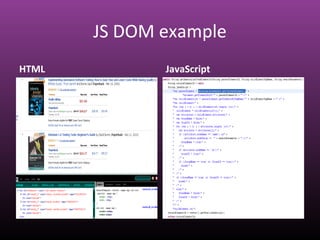
• JavaScript can be used to inspect the HTML DOM to find
these elements and their attributes and content
• JavaScript expressions can be evaluated by the test tool, and
then return some result that the test framework can use to
make a decision
• Checking if an element is present or getting a value will not
work on a dynamically generated element
JS DOM example
HTML JavaScript
Test Application Container
• A class object that represents the application, and contains
the major page and component objects by version
• It provides the test services available to the test scripts
• Is thread specific
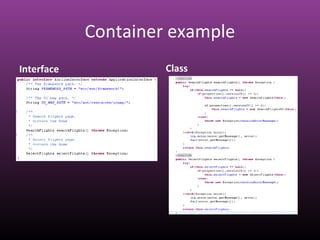
Container example
Interface Class
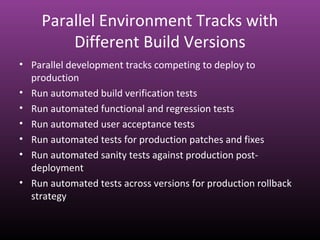
Parallel Environment Tracks with
Different Build Versions
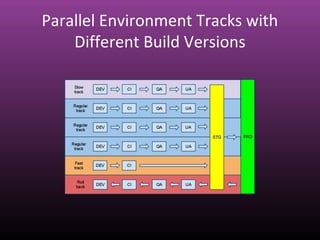
• Parallel development tracks competing to deploy to
production
• Run automated build verification tests
• Run automated functional and regression tests
• Run automated user acceptance tests
• Run automated tests for production patches and fixes
• Run automated sanity tests against production post-
deployment
• Run automated tests across versions for production rollback
strategy
Parallel Environment Tracks with
Different Build Versions
Test Scripts
• Test scripts can be written using standard unit test
frameworks
• Classes and methods are written using domain language
• Script details and complexity are abstracted to the framework
layers
• Scripts are shorter and easier to read
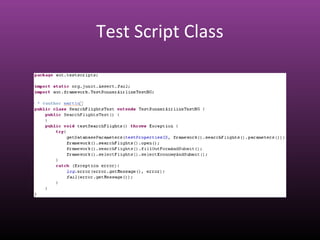
Test Script Class
Test Reports and Logs
• Reports can be generated from
– The unit test framework
– External reporting tools
– Custom report utilities can be written
• Test execution activity can be written to standard logging
utilities
• Test failures, errors, and exceptions can be written to the
reports and logs
Q&A
Thank you for your time!
Martin Lienhard
testautomaton1@gmail.com

Test Automation Framework Designs

  • 1.
    Test Automation Framework Designs Designingstandardized frameworks instead of simple scripting By Martin Lienhard
  • 2.
    The Great Divide •There has been a divide separating QA and Dev due in large part by 3rd party tool vendors and their proprietary test tools • Open source tools have helped significantly to bridge that divide, so that we can work together to create better software • Most QAs have the bigger picture of what they want to test, and how to do it, but have trouble building robust automation frameworks, because they lack the technical skills. • Most Developers focus on testing code in isolation, but lack the testing experience from a system-wide or end-to-end perspective, so they have trouble building a test automation framework that suits the needs of QA.
  • 3.
    1st Phase of TestProgression • Most QA start out creating test scripts by using record & playback tools • Lack conditional logic and looping • Contain static data, UI locators, URLs, etc. • Cannot be executed iteratively • Cannot be reusable modules • Should not be chained together as dependencies • Lack configuration and global properties • Cannot abstract away from the test tool or test runner
  • 4.
    Record & PlaybackTest Scripts
  • 5.
    2nd Phase of TestProgression • QA usually improves their tests by adding data-driven techniques • Create variables and arrays to store data • Create parameterized functions or methods to store data • Add looping to recorded scripts
  • 6.
    3rd Phase of TestProgression • QA usually improves their tests by creating a business function library • Modular, reusable test libraries of functions • Create file readers that pull in parameters from text files, CSV files, etc. • Abstract out the data from the tests by externalizing data • Create parameterized or iterative tests that are data-driven • Abstract out the UI locators from the tests by externalizing UI maps • Create global properties and configuration files • A vast array of disparate data pools and UI maps are created, which usually become unmanageable after a couple of years
  • 7.
    4th Phase of TestProgression • QA usually improves their tests by creating a keyword-driven library: • Create ODBC functions that read data from spreadsheets and databases • Create spreadsheets of keywords that represent business domain language – Low-level keywords describe test operations – High-level keywords describe business language – Intermediate-level keywords map business functions to test operations – Tests become readable by business users and non- technical QA
  • 8.
    …continued • Create spreadsheetsof data that drive the tests • Query data from the application database as input and verification points for tests • A hierarchy of abstracted keyword spreadsheets are created • Now non-technical BAs and QAs are creating automated tests • A vast array of disparate keyword spreadsheets are created, which usually become unmanageable after a couple of years • Nearly all 3rd party vendor test tools live in this area today – Most of these tools use legacy scripting languages, which are not compatible with today’s technology
  • 9.
    5th Phase of TestProgression • QAs become more technical and improve their tests by using object oriented testing techniques: • Objects are designed and created to further modularize and reuse code with very low maintenance • Test code is stored in objects – The page object design is used – Component object designs are used • Test data are stored in objects • Configuration and properties are stored in objects • Calls are made to the application and developer written APIs to make tests “smarter”
  • 10.
    …continued • Continuous integrationenvironments are utilized to run tests • QA moves into white box testing to drive quality deeper into the application – UI tests are ran “headless” to make them execute faster • QA expands the test framework to include multiple test tools and test runners – Databases, web services, and APIs are created to reuse code and data across multiple test tools – Test tools and 3rd party utilities can be upgraded to newer versions with enhanced functionality with minor impact to the test framework
  • 11.
    …continued • Developers cannow run the tests, and contribute to the overall test suites • More 3rd party vendors are rewriting their test tools to include object oriented languages to accommodate these technical QAs – Due to the cost of the tools and their proprietary nature, it is difficult to place these tools into a continuous integration environment to share with developers
  • 12.
    What is atest automation framework? • A test automation framework is an application that allows you to write a series of tests without worrying about the constraints or limitations of the underlying test tools
  • 13.
    Benefits of buildinga Test Framework • Tool agnostic – Abstracts away low level commands – Utilize many test tools • Test tools such as Selenium, WebDriver, etc. • Test runner such as unit test frameworks • Other common utilities – Perform multiple levels and types of testing • Functional, regression, load, performance, unit, integration, etc.
  • 14.
    …continued • Generic testAPI – Common codebase and database – Exception and error handling – Modularized, reusable, and maintainable code and data – Standardized test idioms • Test configuration – Configurable test suites – Global test properties
  • 15.
    …continued • Automatic testversioning – No need to get a specific version from the source control repository • Always get the latest version – Eliminates deployment to multiple machines for testing different versions of an application • Deploy to a single server machine
  • 16.
    …continued • Multi-threading – Runtests in parallel – Runs on test machines in the grid or cloud – Test across multiple environments and application versions simultaneously • Continuous integration – Run in a continuous integration environment – Share tests and collaborate with other teams
  • 17.
  • 18.
    Test Suite • Acollection of tests to run • Have test parameters – i.e.: application, environment, version, etc. • Have test groups – i.e.: regression, build, etc.
  • 19.
  • 20.
    Test Configuration • Anyconfigurable test item that is separate from the test suite – i.e.: web site URLs, database URLs, usernames, passwords, lab machine configurations, etc. • Separated from the rest of the framework for information security and regulatory compliance
  • 21.
  • 22.
    Test Properties • Arethread specific • Have global scope and can be accessed by any class method
  • 23.
  • 24.
    Test Data Repository •Abstracts away changes made only to test data • Data can be stored in databases and files such as XML, JSON, XLS, TXT, CSV, etc. • Data can be retrieved from data sources such as databases, web services, APIs, EDI, etc. • Metadata can be used to describe additional information about the test data such as versions, application names, required fields, invalid formats, etc. • Share data across multiple screens, applications, and tools
  • 25.
  • 26.
  • 27.
    Test Parameters • Usesa hash map of key-value pairs – Very useful for both functional and load testing • Hash maps eliminate the need for – Creating fixed method parameters that change frequently – Changing data access objects that change frequently • Hash maps can be easily populated from any data source • Retrieve the test data and process the format for input to various test tools • Handles version differences between test data
  • 28.
  • 29.
    User Interface (UI)Mapping • Abstracts away changes made only to UI object locators • UI object identifiers can be stored in databases and files such as XML, JSON, XLS, TXT, CSV, etc. • Metadata can be used to describe additional information about the UI objects such as versions, application names, form fields, etc. • Share UI identifiers across multiple screens, applications, and tools
  • 30.
  • 31.
    Test Controls • Retrievethe UI locators and process the format for input to various test tools • Handles version differences between UI locators • Develop custom controls to mimic UI objects • Self test verification
  • 32.
  • 33.
  • 34.
    Test Components • Aclass object that represents a piece of a form, page, or screen • Groups of common objects that can be found across more than one page • Standardized component verification tests
  • 35.
  • 36.
    Test Forms • Aclass object that represents a piece a form • Groups of components and controls that mimic the UI form • Standardized form verification tests
  • 37.
  • 38.
  • 39.
  • 40.
    Test Page orScreen • A class object that represents a web page or screen – commonly referred to as “page objects” • Groups of forms, components, and controls that mimic the UI page or screen • Self test verification
  • 41.
  • 42.
    Instances when NOTto return a new Page Object for each Page • Submitting a page can return one of many different pages, or versions of pages, which would be represented by many different classes – Page A could return B, C, or D – Page A could return B v1.0, B v2.0, or Cv1.0, C v2.0, or D v1.0, D v2.0, etc. – This means that you would need to do the following: • Create multiple methods with similar names that return different page objects – Page A.submitB() returns B – Page A.submitC() returns C
  • 43.
    …continued • Return anpage object of an inherited type, and then cast the type of the page in the script – Page A.submit() returns page X – Pages B and C inherit from page X – Script checks the type of X and casts to B or C – This can get very ugly in a script… • Submitting a page may initiate an AJAX call, which can rewrite the same page – Page A could display an AJAX (modal) dialog – Page A could display some other AJAX widget – Page A could be rewritten to look like page B
  • 44.
    …continued • If thepage flow is not what is being tested, then an unexpected page or AJAX call could fail and kill the test – Test case: • We are trying to test the functionality of page Z • The primary page flow is as follows: – A to B, B to C, C to D, and D to Z • The alternative page flows could also correctly occur, but are unpredictable base on many unknown variables: – A to H, H to L, L to M, and M to Z – A to R, R to S, and S to Z – A to X, X to Y, and Y to Z
  • 45.
    …continued – What ifpage A unexpectedly returned page H, R, or X instead of page B? – If page H, R, or X verified itself and asserted a failure, then how would the test ever reach page Z?
  • 46.
    JavaScript & HTMLDOM • There are many instances when we need the test framework to mimic a human reading the content of a page and then making a decision on what action to perform next – Verifying the list of items on a search results page – Selecting items to purchase from a list – Selecting elements to edit, update, or delete • Scenarios like these usually occur as a result of some previous action, and display content generated dynamically to the user • The test framework may have to query an application database or web service to provide the input to trigger the dynamic page content
  • 47.
    …continued • The testframework will then need to interrogate the page to determine if the expected elements, attributes, or content are present, and then make a decision on whether to perform an action on some element • JavaScript can be used to inspect the HTML DOM to find these elements and their attributes and content • JavaScript expressions can be evaluated by the test tool, and then return some result that the test framework can use to make a decision • Checking if an element is present or getting a value will not work on a dynamically generated element
  • 48.
  • 49.
    Test Application Container •A class object that represents the application, and contains the major page and component objects by version • It provides the test services available to the test scripts • Is thread specific
  • 50.
  • 51.
    Parallel Environment Trackswith Different Build Versions • Parallel development tracks competing to deploy to production • Run automated build verification tests • Run automated functional and regression tests • Run automated user acceptance tests • Run automated tests for production patches and fixes • Run automated sanity tests against production post- deployment • Run automated tests across versions for production rollback strategy
  • 52.
    Parallel Environment Trackswith Different Build Versions
  • 53.
    Test Scripts • Testscripts can be written using standard unit test frameworks • Classes and methods are written using domain language • Script details and complexity are abstracted to the framework layers • Scripts are shorter and easier to read
  • 54.
  • 55.
    Test Reports andLogs • Reports can be generated from – The unit test framework – External reporting tools – Custom report utilities can be written • Test execution activity can be written to standard logging utilities • Test failures, errors, and exceptions can be written to the reports and logs
  • 56.
    Q&A Thank you foryour time! Martin Lienhard testautomaton1@gmail.com