A GEOSTATIONARY SATELLITE
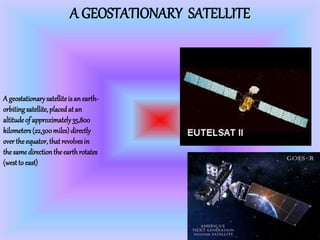
A geostationarysatelliteisanearth-
orbitingsatellite, placedat an
altitudeof approximately35,800
kilometers(22,300miles)directly
overtheequator, thatrevolvesin
thesamedirectiontheearthrotates
(westto east)
Geospatial technologY
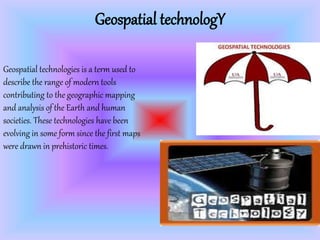
Geospatial technologies is a term used to
describe the range of modern tools
contributing to the geographic mapping
and analysis of the Earth and human
societies. These technologies have been
evolving in some form since the first maps
were drawn in prehistoric times.
USE OF GEOSTATIONARY SATELLITE
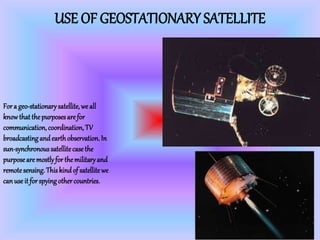
Fora geo-stationarysatellite,we all
knowthatthepurposesarefor
communication, coordination, TV
broadcastingandearthobservation.In
sun-synchronoussatellitecasethe
purposearemostlyforthemilitaryand
remotesensing.Thiskindof satellitewe
canuseit forspyingothercountries.
A GEOSTATIONARY ORBIT
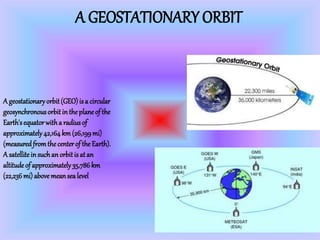
A geostationaryorbit(GEO)isa circular
geosynchronousorbitintheplaneof the
Earth'sequatorwitha radiusof
approximately42,164km(26,199mi)
(measuredfromthecenterof the Earth).
A satelliteinsuchanorbitis at an
altitudeof approximately35,786km
(22,236mi)abovemeansealevel
ORBIT ALLOCATION
Satellites in geostationary orbit must all occupy a single
ring above the Equator. The requirement to space these
satellites apart to avoid harmful radio-frequency
interference during operations means that there are a
limited number of orbital "slots" available, thus only a
limited number of satellites can be operated in
geostationary orbit. This has led to conflict between
different countries wishing access to the same orbital
slots (countries near the same longitude but
differing latitudes) and radio frequencies. These
disputes are addressed through the International
Telecommunication Union's allocation
mechanism.[10][11] In the 1976 Bogotá Declaration, eight
countries located on the Earth's equator claimed
sovereignty over the geostationary orbits above their
territory, but the claims gained no international
recognition
DESIGN OF GEOSTSTIONARY SATELLITE
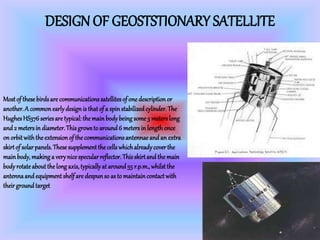
Mostof these birdsare communicationssatellitesof one descriptionor
another.A common earlydesign is that of a spin stabilizedcylinder.The
HughesHS376 seriesare typical: the main bodybeing some 3 meterslong
and 2 metersin diameter.This grows to around6 metersin length once
on orbitwiththe extension of the communicationsantennae and an extra
skirtof solar panels.These supplement the cellswhichalreadycover the
mainbody,making a verynice specular reflector.Thisskirtand the main
bodyrotateaboutthe long axis,typicallyat around55 r.p.m.,whilst the
antennaand equipment shelf are despun so as to maintain contact with
their groundtarget
VARIOUS TYPES OF GEOSPATIAL TECHNOLOGY
Remote Sensing:imagery and data collected from space- or airborne camera and sensor platforms. Some commercial satellite image providers
now offer images showing details of one-meter or smaller, making these images appropriate for monitoring humanitarian needs and human
rights abuses.
GeographicInformationSystems(GIS):a suite of software tools for mapping and analyzing data which is geo referenced (assigned a specific
location on the surface of the Earth, otherwise known as geospatial data). GIS can be used to detect geographic patterns in other data, such as
disease clusters resulting from toxins, sub-optimal water access, etc.
GlobalPositioningSystem(GPS):a network of U.S. Department of Defense satellites which can give precise coordinate locations to civilian and
military users with proper receiving equipment (note: a similar European system called Galileo will be operational within the next several years
while a Russian system is functioning but restricted).
InternetMappingTechnologies:software programs like Google Earth and web features like Microsoft Virtual Earth are changing the way
geospatial data is viewed and shared. The developments in user interface are also making such technologies available to a wider audience
whereas traditional GIS has been reserved for specialists and those who invest time in learning complex software programs
Satellite Launch Date Launch Vehicle Remarks ISRO Link
Aryabhata 19 April 1975 u-11 Interkosmos
Active technological
experience in building
and operating a satellite
system.
[1]
Bhaskara-I 7 June 1979 C-1 Interkosmos
First experimental remote
sensing satellite. Carried
TV and microwave
cameras.
[2]
Rohini Technology
Payload
10 August 1979 SLV-3
Intended for measuring
in-flight performance of
first experimental flight of
SLV-3, the first Indian
launch vehicle. Did not
achieve orbit.
[3]
Rohini RS-1 18 July 1980 SLV-3
Used for measuring in-
flight performance of
second experimental
launch of SLV-3.
[4]
SOME INDIAN GEOSTATIONARY SATELLITES
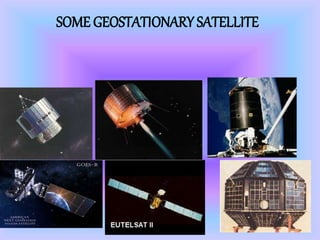
SOME GEOSTATIONARY SATELLITE
MADE BY : DANISH MADAAN
XI – CD
THANK YOU

What is geostationary satellite

  • 1.
    A GEOSTATIONARY SATELLITE Ageostationarysatelliteisanearth- orbitingsatellite, placedat an altitudeof approximately35,800 kilometers(22,300miles)directly overtheequator, thatrevolvesin thesamedirectiontheearthrotates (westto east)
  • 2.
    Geospatial technologY Geospatial technologiesis a term used to describe the range of modern tools contributing to the geographic mapping and analysis of the Earth and human societies. These technologies have been evolving in some form since the first maps were drawn in prehistoric times.
  • 3.
    USE OF GEOSTATIONARYSATELLITE Fora geo-stationarysatellite,we all knowthatthepurposesarefor communication, coordination, TV broadcastingandearthobservation.In sun-synchronoussatellitecasethe purposearemostlyforthemilitaryand remotesensing.Thiskindof satellitewe canuseit forspyingothercountries.
  • 4.
    A GEOSTATIONARY ORBIT Ageostationaryorbit(GEO)isa circular geosynchronousorbitintheplaneof the Earth'sequatorwitha radiusof approximately42,164km(26,199mi) (measuredfromthecenterof the Earth). A satelliteinsuchanorbitis at an altitudeof approximately35,786km (22,236mi)abovemeansealevel
  • 5.
    ORBIT ALLOCATION Satellites ingeostationary orbit must all occupy a single ring above the Equator. The requirement to space these satellites apart to avoid harmful radio-frequency interference during operations means that there are a limited number of orbital "slots" available, thus only a limited number of satellites can be operated in geostationary orbit. This has led to conflict between different countries wishing access to the same orbital slots (countries near the same longitude but differing latitudes) and radio frequencies. These disputes are addressed through the International Telecommunication Union's allocation mechanism.[10][11] In the 1976 Bogotá Declaration, eight countries located on the Earth's equator claimed sovereignty over the geostationary orbits above their territory, but the claims gained no international recognition
  • 6.
    DESIGN OF GEOSTSTIONARYSATELLITE Mostof these birdsare communicationssatellitesof one descriptionor another.A common earlydesign is that of a spin stabilizedcylinder.The HughesHS376 seriesare typical: the main bodybeing some 3 meterslong and 2 metersin diameter.This grows to around6 metersin length once on orbitwiththe extension of the communicationsantennae and an extra skirtof solar panels.These supplement the cellswhichalreadycover the mainbody,making a verynice specular reflector.Thisskirtand the main bodyrotateaboutthe long axis,typicallyat around55 r.p.m.,whilst the antennaand equipment shelf are despun so as to maintain contact with their groundtarget
  • 7.
    VARIOUS TYPES OFGEOSPATIAL TECHNOLOGY Remote Sensing:imagery and data collected from space- or airborne camera and sensor platforms. Some commercial satellite image providers now offer images showing details of one-meter or smaller, making these images appropriate for monitoring humanitarian needs and human rights abuses. GeographicInformationSystems(GIS):a suite of software tools for mapping and analyzing data which is geo referenced (assigned a specific location on the surface of the Earth, otherwise known as geospatial data). GIS can be used to detect geographic patterns in other data, such as disease clusters resulting from toxins, sub-optimal water access, etc. GlobalPositioningSystem(GPS):a network of U.S. Department of Defense satellites which can give precise coordinate locations to civilian and military users with proper receiving equipment (note: a similar European system called Galileo will be operational within the next several years while a Russian system is functioning but restricted). InternetMappingTechnologies:software programs like Google Earth and web features like Microsoft Virtual Earth are changing the way geospatial data is viewed and shared. The developments in user interface are also making such technologies available to a wider audience whereas traditional GIS has been reserved for specialists and those who invest time in learning complex software programs
  • 8.
    Satellite Launch DateLaunch Vehicle Remarks ISRO Link Aryabhata 19 April 1975 u-11 Interkosmos Active technological experience in building and operating a satellite system. [1] Bhaskara-I 7 June 1979 C-1 Interkosmos First experimental remote sensing satellite. Carried TV and microwave cameras. [2] Rohini Technology Payload 10 August 1979 SLV-3 Intended for measuring in-flight performance of first experimental flight of SLV-3, the first Indian launch vehicle. Did not achieve orbit. [3] Rohini RS-1 18 July 1980 SLV-3 Used for measuring in- flight performance of second experimental launch of SLV-3. [4] SOME INDIAN GEOSTATIONARY SATELLITES
  • 9.
  • 10.
    MADE BY :DANISH MADAAN XI – CD THANK YOU