teknorapex.com	
TEKNOR	APEX	PRESENTS:	
Get	a	Grip	on	Overmolding
teknorapex.com	
Contents	
Overmolding	Overview	
−  General	Information	
−  Insert	vs.	2K	Molding	
−  Choosing	the	Right	TPE:	Adhesion	and	Other	Factors	to	Consider	
−  Overmolding	Tips:		
−  Tooling	&	Part	Design	
−  Processing	
−  Material	Handling	
−  Maximizing	Adhesion
teknorapex.com	
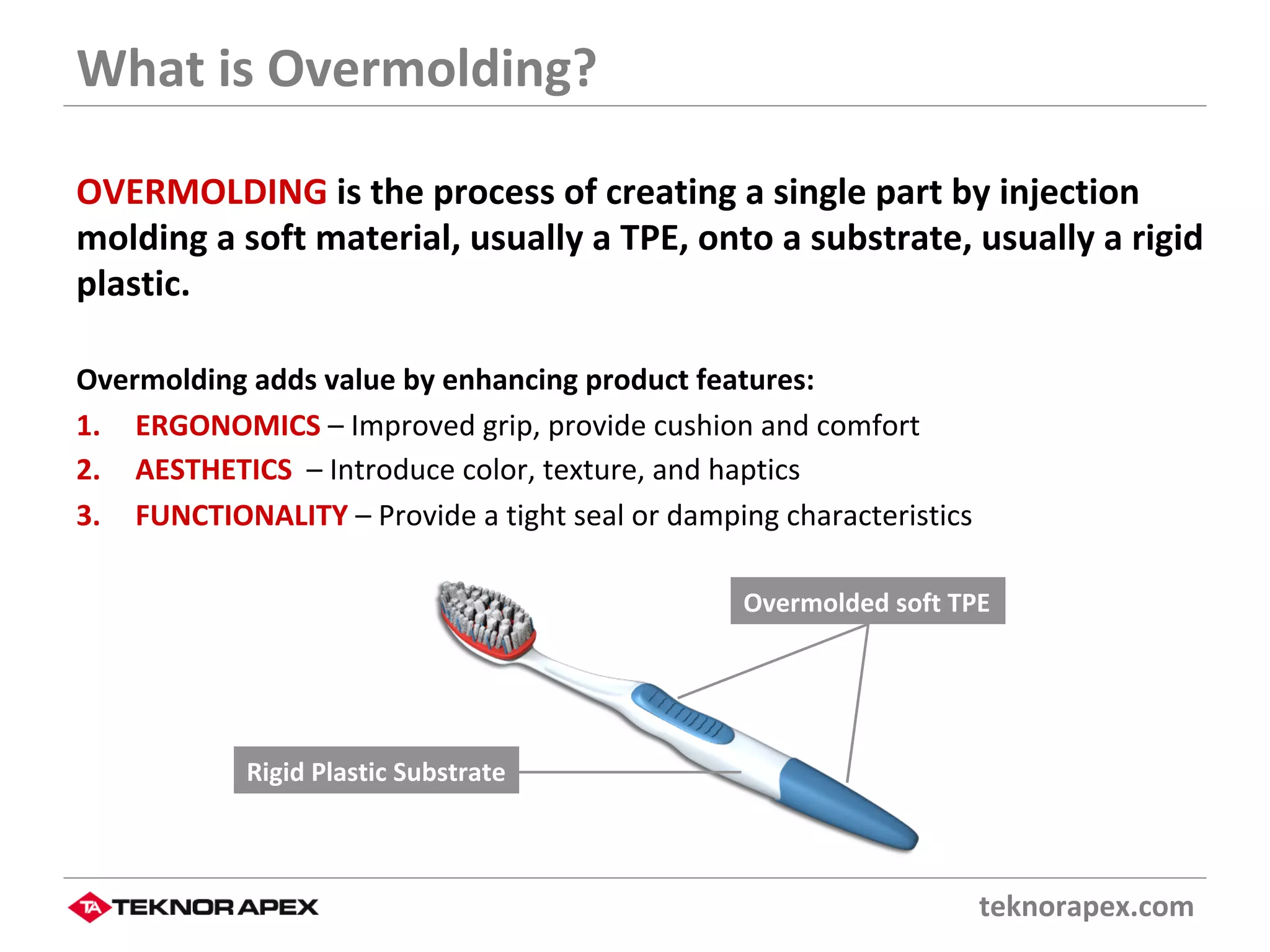
OVERMOLDING	is	the	process	of	creating	a	single	part	by	injection	
molding	a	soft	material,	usually	a	TPE,	onto	a	substrate,	usually	a	rigid	
plastic.	
	
Overmolding	adds	value	by	enhancing	product	features:	
1.  ERGONOMICS	–	Improved	grip,	provide	cushion	and	comfort	
2.  AESTHETICS		–	Introduce	color,	texture,	and	haptics	
3.  FUNCTIONALITY	–	Provide	a	tight	seal	or	damping	characteristics	
	
What	is	Overmolding?		
Overmolded	soft	TPE	
Rigid	Plastic	Substrate
teknorapex.com	
There	are	2	overmolding	processes:		
Insert	and	Multi-Shot	(or	2K)	Molding.	
Choosing	the	Right	Process:	Insert	vs.	2K	Molding	
Insert	Molding	
Pre-molded	insert	is	placed	into	a	mold	
&	TPE	is	shot	over	it.	
	
Advantages:		
−  Can	use	conventional	single	
shot	injection	molding	
machine	
−  Lower	tool	costs	vs.	multi-
shot	molding	
	
Multi-Shot	or	2-Shot	(2K)	Molding	
Requires	an	injection	molding	machine	
with	2	or	more	barrels,	allowing	more	
than	1	material	to	be	shot	during	the	
same	molding	cycle.	
	
Advantages:	
−  Shorter	cycle	times	
−  Superior	part	quality	
−  Lower	labor	costs	
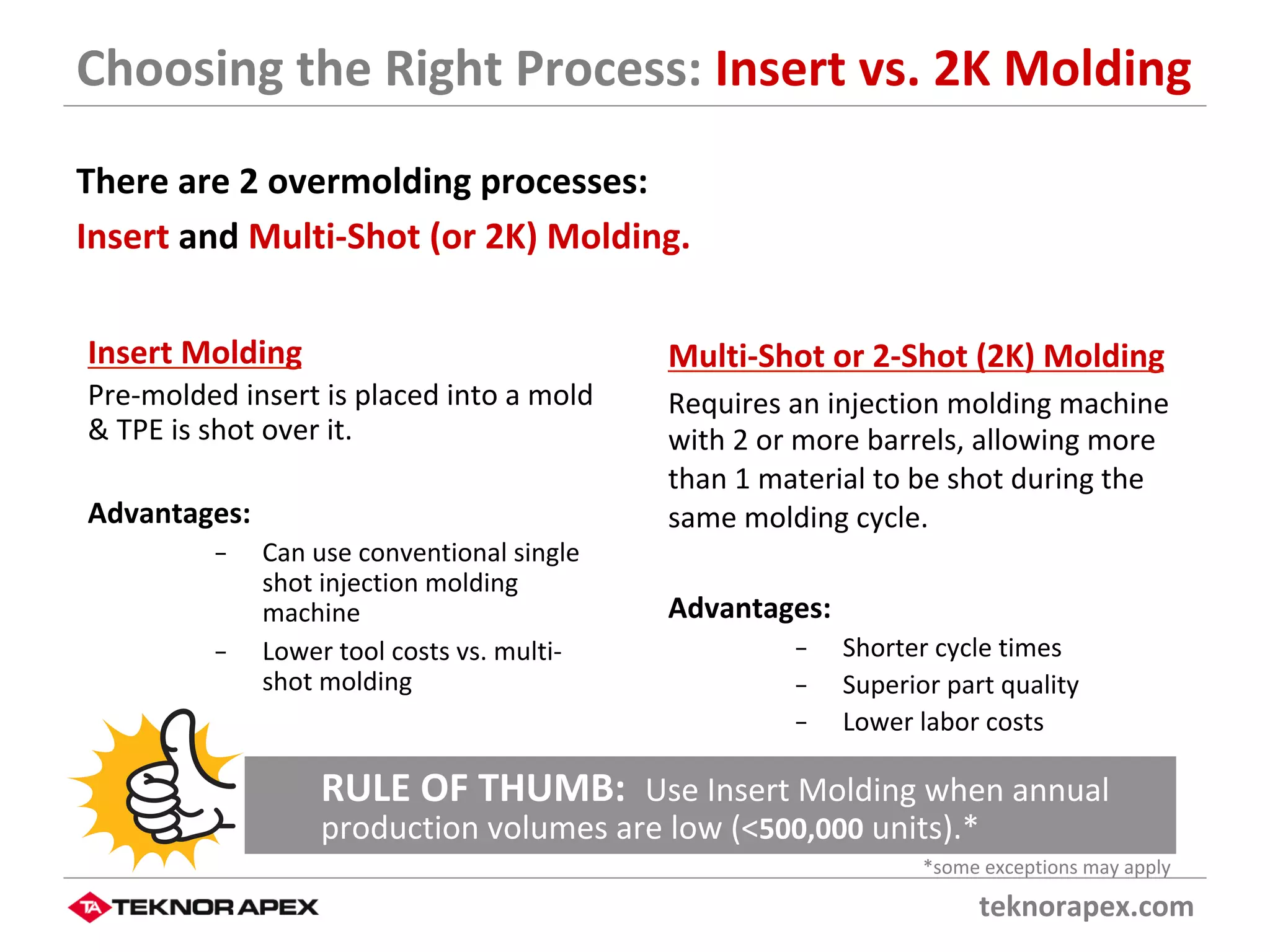
RULE	OF	THUMB:		Use	Insert	Molding	when	annual	
production	volumes	are	low	(<500,000	units).*	
*some	exceptions	may	apply
teknorapex.com	
In	some	cases,	better	adhesion	can	be	achieved	with	multi-shot	
molding	versus	insert	molding.			
−  Adhesion	between	the	TPE	and	the	hard	plastic	is	highly	dependent	on	the	
chemistry	and	compatibility	of	the	two	materials.		
−  For	certain	combinations	of	hard	and	soft	materials,	a	softened	(or	melted)	hard	
component	promotes	the	diffusion	and	entanglement	of	molecules	at	the	
interface,	improving	the	bond.		(This	is	known	as	a	cohesive	bond.)		Inserts	can	be	
pre-heated	to	improve	bond	strength.	
	
	
Insert	vs.	Multi-Shot	Molding:	Adhesion
teknorapex.com	
Choosing	the	Right	TPE:	Adhesion	to	Substrate	
The	substrate	material	plays	a	key	role	in	the	selection	of	the	TPE	
chemistry.	
	
•  Styrenic	TPEs	(TPS)	and	thermoplastic	vulcanizates	(TPV)	will	generally	adhere	to	
polyolefins	like	PP	and	PE	(fusion	bond).	
•  TPS	and	TPV	Materials	exhibit	poor	adhesion	to	polar	thermoplastics	like	PC,	ABS,	
PC/ABS	blends,	polyamides	(Nylon	6,	66,	12),	polystyrenes	(GPPS,	HIPS,	or	blends),	
polyacrylates	(PMMA),	copolyesters	(Tritan),	polyacetals	(POM),	ASA,	and	PBT.	
•  Thus,	standard	TPEs	need	to	be	chemically	modified	to	improve	adhesion,	and	this	
modification	is	solely	dependent	on	the	chemistry	of	the	substrate.		TPEs	are	
modified	to	adhere	to	a	specific	substrate	(i.e.	a	TPE	modified	to	bond	to	Nylon	
won’t	necessarily	bond	to	PC).	
•  Teknor	Apex	has	an	entire	portfolio	of	products,	the	Monprene®	OM	Series,	that	
are	adhesion-modified	for	excellent	bonding	to	engineering	thermoplastics	(ETPs).
teknorapex.com	
Choosing	the	Right	TPE:	3	Factors	to	Consider	
Many	times	in	overmolding	applications,	product	designers	are	
concerned	with	the	“look	and	feel”	of	the	TPE	in	order	to	provide	
that	certain	“soft	touch”.	
	
There	are	3	Key	Factors	to	Consider	
•  The	amount	of	“cushion”	you	feel	is	more	dependent	on	the	
thickness	of	the	TPE	overmolding	versus	the	material’s	
durometer.	
•  The	“feel”	of	the	TPE	is	characterized	by	its	coefficient	of	friction	
(COF)	and	this	can	be	customized.	
•  The	surface	finish	of	the	TPE	can	be	customized	for	gloss	level.	
How	does	that	translate	into	material	properties	or	
the	optimal	product	design?
teknorapex.com	
3	Factors	to	Consider:	“Cushion”	&	Thickness	
The	amount	of	“cushion”	you	feel	is	more	dependent	on	the	
thickness	of	the	TPE	overmolding	versus	the	material’s	durometer.	
−  The	thinner	the	TPE	overmold,	the	harder	it	will	feel.			
−  To	increase	cushion	without	increasing	the	thickness	of	the	overmold,	add	
multiple	ribs	placed	closely	together	to	create	the	perception	of	thickness.
teknorapex.com	
3	Factors	to	Consider:	“Feel”	&	Friction	
The	“feel”	of	the	TPE	is	characterized	by	its	coefficient	of	
friction	(COF)	and	this	can	be	customized.	
	
−  TPE	materials	are	often	described	as	rubbery	or	“grippy”	to	the	touch….this	is	not	
always	true!	
−  Teknor	Apex	has	the	capability	to	customize	the	feel	of	a	TPE,	with	formulations	
that	range	from	silky	smooth	and	lubricious	to	a	very	tactile	or	“grippy”	feel.		
Even	soft	TPEs	(40	Shore	A)	can	be	formulated	to	have	a	very	smooth	feel.	
Coefficient	of	friction	(COF)	measures	the	tacticity	of	TPEs	
	
COF	=	the	degree	of	force	required	to	move	one	surface	
across	another
teknorapex.com	
3	Factors	to	Consider:	Surface	Finish	&	Gloss	
The	surface	finish	of	the	TPE	is	characterized	by	its	gloss	level	
and	this	can	be	customized.	
	
−  TPE	materials	can	often	resemble	rubber,	with	a	matte	look,	however	gloss	level	
can	also	be	customized.	
−  Teknor	Apex	has	the	capability	to	adjust	the	gloss	level	of	a	TPE,	with	
formulations	ranging	from	a	very	glossy,	vinyl-like	finish	to	a	zero-gloss,	matte	
look.	
	
GLOSSY	 MATTE
teknorapex.com	
Overmolding	Tips:	Tooling	&	Part	Design		
Ideal	Gate	Position	/	Gate	Design	
−  Teknor	Apex	can	assist	with	Moldflow®	analysis	to	determine	ideal	gate	position.	
Influence	of	cavity	surface	finish	(substrate)	
−  A	smooth	mold	will	cause	a	smooth	(potentially	glossy)	finish	on	the	part.		
−  A	textured	mold	will	cause	a	matte	finish	on	the	part,	and	can	help	hide	a	lot	of	
surface	defects.	
−  A	textured	finish	on	the	substrate	serves	2	purposes:	
	1.	Provides	additional	surface	area	in	comparison	to	a	high	polish.	
	2.	Indentations	act	as	nooks	and	crannies	for	the	TPE	to	flow	into	and	provide	
a	mechanical	lock	on	a	micro	level.	
	
Part	Design	
−  The	use	of	mechanical	interlocks	in	the	component	design	will	reinforce	
overmolding.	
−  Ensure	thickness	of	TPE	overmolding	is	not	too	thin	as	this	can	cause	
delamination.
teknorapex.com	
Overmolding	Tips:	Processing		
Minimize	delay	time	between	first	and	second	shot:	
−  Maintain	high	temperature	of	substrate	
	
Ideal	injection	speed	of	TPE:		
−  As	fast	as	possible	without	warping	or	moving	the	substrate	
	
Ideal	holding	pressure	and	holding	pressure	time	of	TPE:		
−  Ideal	holding	time	is	however	long	it	takes	for	the	gate	to	freeze	off.			
−  Use	a	“Gate	Freeze	Analysis”	-	Weigh	parts	with	different	hold	times	&	
determine	when	the	part	weight	doesn’t	change.			
−  		Determine	the	correct	tool	temperature	of	hard	and	soft	component	to	
reduce	cooling	time.
teknorapex.com	
Overmolding	TPEs:	Material	Handling		
Drying	
−  The	presence	of	moisture	in	either	the	TPE	or	substrate	material	will	cause	
adhesion	issues.			
−  Hygroscopic	materials	must	be	dried	before	molding.		Consult	the	material’s	
technical	data	sheet	for	proper	desiccant	drying	instructions.	
	
Coloring	
−  Typically	PE-based	color	concentrates	are	used	with	standard	TPEs.	
−  PE	may	not	be	compatible	with	specialty	TPEs	that	are	formulated	for	
overmolding,	and	may	adversely	affect	adhesion.	
−  Consult	Teknor	Apex	on	the	best	carrier	resin	to	use.	
	
Regrind	
−  For	insert	molding,	clean	TPE	scrap	generated	from	sprues	and	runners	can	be	
used	as	regrind	at	around	20%.		
−  Generally	regrind	is	not	used	in	2-shot	molded	components.
teknorapex.com	
Insert	Molding	–	Substrate	Preparation	
−  Best	case	scenario:		Mold	the	inserts,	and	immediately	transfer	them	to	second	
mold	to	inject	TPE.	
−  If	inserts	are	molded	and	stored	prior	to	overmolding,	keep	them	protected	from	
dirt,	dust,	and	other	contaminants.		Wear	hand	protection	when	handling	inserts	
and	avoid	contaminating	with	skin	oils.		Do	not	use	mold	release;	as	lubricants	
can	also	affect	the	bond.	
−  Preheating	inserts	can	be	useful	and	in	some	cases	necessary.	
	
TPE	Melt	Temperature	
−  TPE	melt	temperature	is	a	critical	parameter	for	overmolding.	
−  Melt	temperature	set	point	is	determined	by	the	substrate	used	and	the	target	
bond	level.		Teknor	Apex	will	recommend	the	necessary	melt	temperature	for	a	
given	TPE.			
−  In	general,	increasing	the	TPE	melt	temperature	provides	a	stronger	bond.	
Overmolding	Tips:	Maximizing	Adhesion
teknorapex.com	
QUESTIONS?	
TPE@TEKNORAPEX.COM	
401.725.8000

A Clear Guide to Overmolding Essentials