IJRET: International Journal of Research in Engineering and Technology eISSN: 2319-1163 | pISSN: 2321-7308
_______________________________________________________________________________________
Volume: 04 Issue: 06 | June-2015, Available @ http://www.ijret.org 525
A CASE STUDY ON HEAT EXCHNAGE NETWORK
B.S Thirumalesh1
, Yashaswini.S.V2
, Nikhila R3
, Monika Khanchandani4
, Bibhuti Kumar S5
1
Assistant Professor, Department of Chemical Engineering, DSCE Bangalore-78, Karnataka, India
2
Department of Chemical Engineering, DSCE Bangalore-78, Karnataka, India
3
Department of Chemical Engineering, DSCE Bangalore-78, Karnataka, India
4
Department of Chemical Engineering, DSCE Bangalore-78, Karnataka, India
5
Department of Chemical Engineering, DSCE Bangalore-78, Karnataka, India
Abstract
The requirement of energy in any processing industry is not only a need but it is indeed a most wanted utility. In a typical
processing or manufacturing industry the most common utility are steam and cooling water. However the cost of these utility are
no longer cheap, in fact they are expensive. Therefore saving these utility or minimizing the usage of these utilities is one of the
most needed practice in a processing industry. Pinch technology is the most common method, which is aimed at minimizing the
requirement of utilities by maximizing the process to process heat transfer.
In the present study temperature interval diagram or TID is used to identify the targets for minimum utility requirement and
maximum process to process heat transfer in a processing facility. The targets for heat exchanger network are presented and
minimization of number of heat exchangers are provided using stream splitting technique.
Keywords: Pinch design, stream splitting, HEN synthesis, Utilities, TID
---------------------------------------------------------------------***---------------------------------------------------------------------
1. INTRODUCTION
In any processing industry there are many streams which
have to be heated prior to processing or any unit process,
and also there are streams which have to be cooled like
products before storage and sales. In both cases energy
transfer is involved. Normally heating is done using steam,
heating oil etc, and for cooling purpose either cooling water
or refrigerants are used depending on the need. However the
cost involved in the energy transfer process has to be taken
into account for any facility. Also the scarcity of natural
resources also contributes to the energy crisis problem.
Hence there is a need for minimizing the usage of utilities
like steam and cooling water and at the same time it is
required to maximize the process to process heat transfer.
Pinch technology is a promising technique from which we
can achieve the target of maximum process to process heat
transfer and minimum utility requirement. Pinch technology
involves graphical method called thermal pinch diagram and
an algebraic technique namely temperature interval diagram.
The latter has several advantages over the former as it can
be applied when several process streams are involved in a
facility.
The present study uses temperature interval diagram to
maximize process to process heat transfer for a given
industrial case study. Once the target for minimum utility
requirements is calculated , a network of heat exchangers
are designed using pinch design approach with minimum no.
of heat exchangers using stream splitting technique without
violating second law of thermodynamics.
2. METHODOLOGY
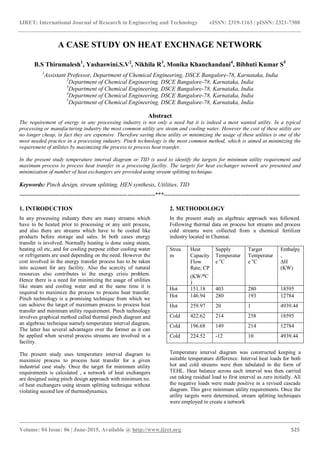
In the present study an algebraic approach was followed.
Following thermal data on process hot streams and process
cold streams were collected from a chemical fertilizer
industry located in Chennai.
Strea
m
Heat
Capacity
Flow
Rate, CP
(KW/⁰C
)
Supply
Temperatur
e o
C
Target
Temperatur
e o
C
Enthalpy
,
∆H
(KW)
Hot 151.18 403 280 18595
Hot 146.94 280 193 12784
Hot 259.97 20 1 4939.44
Cold 422.62 214 258 18595
Cold 196.68 149 214 12784
Cold 224.52 -12 10 4939.44
Temperature interval diagram was constructed keeping a
suitable temperature difference. Interval heat loads for both
hot and cold streams were then tabulated in the form of
TEHL. Heat balance across each interval was then carried
out taking residual load to first interval as zero initially. All
the negative loads were made positive in a revised cascade
diagram. This gave minimum utility requirements. Once the
utility targets were determined, stream splitting techniques
were employed to create a network
IJRET: International Journal of Research in Engineering and Technology eISSN: 2319-1163 | pISSN: 2321-7308
_______________________________________________________________________________________
Volume: 04 Issue: 06 | June-2015, Available @ http://www.ijret.org 526
3. RESULTS AND DISCUSSION
3.1 Temperature Interval Diagram
In the Temperature Interval Diagram (TID), 8 intervals were
constructed based on data shown in Figure 1.
Fig 1: Temperature Interval Diagram (for 10⁰C)
In Table of Exchangeable heat loads, total loads for each
interval was summarized in Table 1 and Table 2 for both hot
and cold streams respectively.
Table 1: Table of Exchangeable Heat Loads (TEHL) for
Hot Side:
Interva
l
H1(KW) H2(KW) H3(KW) HHz(KW
)
1 18595.5 0 0 18595.5
2 0 1763.371 0 1763.371
3 0 6465.694 0 6465.694
4 0 4555.375 0 4555.375
5 0 0 0 0
6 0 0 0 0
7 0 0 4939.443 4939.443
8 0 0 0 0
Table 2: Table of Exchangeable Heat Loads (TEHL) for
Cold Side:
Interval C1(KW) C2(KW) C3(KW) HCz(KW)
1 0 0 0 0
2 0 0 0 0
3 18595.5 0 0 18595.5
4 0 6097.19 0 6097.19
5 0 6687.2 0 6687.2
6 0 0 0 0
7 0 0 4265.8 4265.8
8 0 0 673.56 673.56
Fig 2: Cascade and Revised Cascade Diagram
From the revised cascade diagram, the minimum hot utility
was found to be 0.007 KW and minimum cold utility was
found to be 0 KW for ∆Tmin 10⁰C.
It was the case of threshold problem. An increase in ∆Tmin
overcomes the threshold problems [2]. However heat
exchanger network synthesis can be done for threshold
problems also. For threshold problem a capital energy trade
off suggested that the optimum temperature difference was
below threshold value. In order to get a pinch point in such
cases, the capital energy trade off suggested that, the
optimum temperature be increased such that it is at or above
the threshold value.
3.2 Heat Exchange Network Synthesis
From the pinch analysis, it was found that the minimum cold
utility was 0 KW. Hence the most constrained part lies in
the no utility zone. This was considered to be “above the
pinch” problem.
3.3 Minimum Number of Heat Exchangers
CP inequality criteria and the ∆Tmin of 10⁰C between the
matched streams were maintained. Also the stream number
criteria, SH ≤ SC (above pinch) was followed wherein 3 hot
and cold streams were considered. Streams H3 and C3, H2
and C2, H3 and C3, H1 and C2, H1 and C2 were considered
to be the different heat exchangers. A hot utility at C2 was
found. Hence minimum number of heat exchangers was
found to be 6.
IJRET: International Journal of Research in Engineering and Technology eISSN: 2319-1163 | pISSN: 2321-7308
_______________________________________________________________________________________
Volume: 04 Issue: 06 | June-2015, Available @ http://www.ijret.org 527
Fig 3: Pinch design (Threshold problem for ∆Tmin 10⁰C)
3.4 Temperature Interval Diagram AT ∆TMIN =
15⁰C
In the Temperature Interval Diagram(TID), 9 intervals was
constructed based on data shown in Figure 2.
Fig 4: Temperature Interval Diagram (∆TMIN = 15⁰C)
In Table of Exchangeable heat loads, total loads for each
interval was summarized in Table 3 and Table 4 for both hot
and cold streams respectively.
Table 3: Table of Exchangeable Heat Loads (TEHL) for
Hot Side:
Interval H1(KW) H2(KW) H3(KW) HHz(KW)
1 18595 0 0 18595
2 0 1028.6 0 1028.6
3 0 6465.6 0 6465.6
4 0 5290.1 0 5290.1
5 0 0 0 0
6 0 0 0 0
7 0 0 0 0
8 0 0 4419.5 4419.50
9 0 0 519.94 519.941
Table 4: Table of Exchangeable Heat Loads (TEHL) for
Cold Side:
INTERVAL C1(KW) C2(KW) C3(KW) HCz(KW)
1 0 0 0 0
2 0 0 0 0
3 18595.5 0 0 18595.5
4 0 7080.6 0 7080.6
5 0 5703.8 0 5703.8
6 0 0 0 0
7 0 0 1122.6 1122.6
8 0 0 3816.8 3816.8
9 0 0 0 0
Fig 5: Cascade diagram for case study
From the revised cascade diagram, both the minimum hot
utility and minimum cold utility were found to be 1122.6
KW for ∆Tmin 15⁰C. A pinch point was obtained at 20⁰C hot
side and 5⁰C cold side.
3.5 Heat Exchange Network
From the pinch analysis, it was found that the pinch point
was obtained 20⁰C at hot side and 5⁰C at cold side. A line
was drawn at the centre representing pinch temperature and
the design was divided as “above the pinch” and “below the
pinch” regions, the line being the most constrained part.
Above the pinch: By using CP inequality criteria, CPH ≤ CPc
(above pinch), matches were made. Below the Pinch:
CPH≥CPc criteria was followed.
3.6 Minimum Number of Heat Exchangers
CP inequality criteria and the ∆Tmin of 15⁰C between the
matched streams were maintained. Also the stream number
criteria, SH ≤ SC (above pinch) was followed wherein 3 hot
IJRET: International Journal of Research in Engineering and Technology eISSN: 2319-1163 | pISSN: 2321-7308
_______________________________________________________________________________________
Volume: 04 Issue: 06 | June-2015, Available @ http://www.ijret.org 528
and cold streams were considered. Streams H3 and C3, H2
and C2, H2 and C3, H2 and C2, H1 and C1 were considered
to be the different heat exchangers. A hot utility at C2 and
cold utility at H3 were found. Hence minimum number of
heat exchangers was found to be 7.
Fig 6: Pinch design (for ∆Tmin 15⁰C)
4. CONCLUSION
In order to overcome energy crisis in industry, heat
exchange network of different industries were studied.
In this case study which was taken from chemical fertilizer
industry, for ∆Tmin equal to 100
C, a threshold problem was
obtained with the cold utility equal to 0 KW.
At ∆Tmin equal to 15o
C, both utility requirements were found
to be 1122.6KW and for this a heat exchanger network
synthesis was done and it gave minimum of 7 heat
exchangers.
This study gave a network of heat exchangers with
maximum heat recovery among process streams there by
reducing the utility consumption. Here only one type of hot
utility and one type of cold utility was considered.
Even though initial ∆Tmin gave a threshold problem, a HEN
with heat recovery was synthesized. Thus an attempt was
made to understand the concept of threshold problems heat
exchange network synthesis and determination of minimum
number of heat exchangers, for an industrial problem.
REFERENCES
[1]. Process Integration: Mahmoud M.El-Halwagi
[2]. Chemical Process Design and Integration – Robin Smith
[3]. Beabu K. Piagbo1, American Journal of Engineering
Research (AJER) e-ISSN: 2320-0847 p -ISSN: 2320-0936
Volume-02, Issue-05, pp-11-18
[4]. Jackson Akpa, Journal of Emerging Trends in
Engineering and Applied Science, (JETEAS) 01/2012;
3(3):475-484.
[5]. John M. Joe, Journal of Power and Energy Engineering,
2013, 1, 47-52 http://dx.doi.org/10.4236/jpee.2013.15007
Published Online October 2013
[6]. Bodo Linnhoff†
and John R. Flower*
, Synthesis of Cost
Optimization Network, AIChE Journal Volume 24, Issue
4, pages 633– 642, July 1978
[7]. Linnhoff B, D.W. Townsend, D. Boland, G.F. Hewitt,
B.E.A. Thomas, A.R.Guy, and R.H. Marsland, “User Guide
on Process Integration for the Efficient Use of Energy”,
IChemE, Rugby, U.K. (1982).
[8]. Pinch Analysis Foundation Training Course, available
from Linnhoff March Ltd, UK.
[9]. “SuperTarget” pinch analysis software suite, available
from Linnhoff March Ltd, UK.
[10]. Townsend, D. W., and B. Linnhoff, “Heat and Power
Networks in Process Design, Part I: Criteria for Placement
of Heat Engines and Heat Pumps in Process Networks”,
AIChE J., 29(5), pp. 742-748 (May 1983). “Part II: Design
Procedure for Equipment Selection and Process Matching”,
AIChE J., 29(5), pp. 748-771 (May 1983).
BIOGRAPHIES
Mr. B.S Thirumalesh is currently
working as assistant Professor in the
Department of Chemical Engineering,
Dayananda Sagar College of
Engineering, Bangalore-78.His research
interest includes energy integration, Mass
Integration, Adsorption Studies etc.
Ms. Yashaswini S Vasisht is a chemical
engineer graduate from Dayananda Sagar
College of Engineering, Bangalore – 78.
Her research interest includes energy
integration, process design, heat transfer
etc.
Ms. Nikhila R is a chemical engineer
graduate from Dayananda Sagar College
of Engineering, Bangalore – 78. Her
research interest includes energy
integration, waste water treatment,
material science etc.
Ms. Monica Khanchandani is a chemical
Engineering graduate from Dayananda
Sagar College of Engineering, Bangalore
– 78. Her research interest includes
energy integration, computer applications,
java programming etc.
Mr. Bibhuti Kumar Singh is a chemical
engineer graduate from Dayananda Sagar
College of Engineering, Bangalore-78.
His research interest includes mass
integration, process integration etc.

A case study on heat exchnage network

  • 1.
    IJRET: International Journalof Research in Engineering and Technology eISSN: 2319-1163 | pISSN: 2321-7308 _______________________________________________________________________________________ Volume: 04 Issue: 06 | June-2015, Available @ http://www.ijret.org 525 A CASE STUDY ON HEAT EXCHNAGE NETWORK B.S Thirumalesh1 , Yashaswini.S.V2 , Nikhila R3 , Monika Khanchandani4 , Bibhuti Kumar S5 1 Assistant Professor, Department of Chemical Engineering, DSCE Bangalore-78, Karnataka, India 2 Department of Chemical Engineering, DSCE Bangalore-78, Karnataka, India 3 Department of Chemical Engineering, DSCE Bangalore-78, Karnataka, India 4 Department of Chemical Engineering, DSCE Bangalore-78, Karnataka, India 5 Department of Chemical Engineering, DSCE Bangalore-78, Karnataka, India Abstract The requirement of energy in any processing industry is not only a need but it is indeed a most wanted utility. In a typical processing or manufacturing industry the most common utility are steam and cooling water. However the cost of these utility are no longer cheap, in fact they are expensive. Therefore saving these utility or minimizing the usage of these utilities is one of the most needed practice in a processing industry. Pinch technology is the most common method, which is aimed at minimizing the requirement of utilities by maximizing the process to process heat transfer. In the present study temperature interval diagram or TID is used to identify the targets for minimum utility requirement and maximum process to process heat transfer in a processing facility. The targets for heat exchanger network are presented and minimization of number of heat exchangers are provided using stream splitting technique. Keywords: Pinch design, stream splitting, HEN synthesis, Utilities, TID ---------------------------------------------------------------------***--------------------------------------------------------------------- 1. INTRODUCTION In any processing industry there are many streams which have to be heated prior to processing or any unit process, and also there are streams which have to be cooled like products before storage and sales. In both cases energy transfer is involved. Normally heating is done using steam, heating oil etc, and for cooling purpose either cooling water or refrigerants are used depending on the need. However the cost involved in the energy transfer process has to be taken into account for any facility. Also the scarcity of natural resources also contributes to the energy crisis problem. Hence there is a need for minimizing the usage of utilities like steam and cooling water and at the same time it is required to maximize the process to process heat transfer. Pinch technology is a promising technique from which we can achieve the target of maximum process to process heat transfer and minimum utility requirement. Pinch technology involves graphical method called thermal pinch diagram and an algebraic technique namely temperature interval diagram. The latter has several advantages over the former as it can be applied when several process streams are involved in a facility. The present study uses temperature interval diagram to maximize process to process heat transfer for a given industrial case study. Once the target for minimum utility requirements is calculated , a network of heat exchangers are designed using pinch design approach with minimum no. of heat exchangers using stream splitting technique without violating second law of thermodynamics. 2. METHODOLOGY In the present study an algebraic approach was followed. Following thermal data on process hot streams and process cold streams were collected from a chemical fertilizer industry located in Chennai. Strea m Heat Capacity Flow Rate, CP (KW/⁰C ) Supply Temperatur e o C Target Temperatur e o C Enthalpy , ∆H (KW) Hot 151.18 403 280 18595 Hot 146.94 280 193 12784 Hot 259.97 20 1 4939.44 Cold 422.62 214 258 18595 Cold 196.68 149 214 12784 Cold 224.52 -12 10 4939.44 Temperature interval diagram was constructed keeping a suitable temperature difference. Interval heat loads for both hot and cold streams were then tabulated in the form of TEHL. Heat balance across each interval was then carried out taking residual load to first interval as zero initially. All the negative loads were made positive in a revised cascade diagram. This gave minimum utility requirements. Once the utility targets were determined, stream splitting techniques were employed to create a network
  • 2.
    IJRET: International Journalof Research in Engineering and Technology eISSN: 2319-1163 | pISSN: 2321-7308 _______________________________________________________________________________________ Volume: 04 Issue: 06 | June-2015, Available @ http://www.ijret.org 526 3. RESULTS AND DISCUSSION 3.1 Temperature Interval Diagram In the Temperature Interval Diagram (TID), 8 intervals were constructed based on data shown in Figure 1. Fig 1: Temperature Interval Diagram (for 10⁰C) In Table of Exchangeable heat loads, total loads for each interval was summarized in Table 1 and Table 2 for both hot and cold streams respectively. Table 1: Table of Exchangeable Heat Loads (TEHL) for Hot Side: Interva l H1(KW) H2(KW) H3(KW) HHz(KW ) 1 18595.5 0 0 18595.5 2 0 1763.371 0 1763.371 3 0 6465.694 0 6465.694 4 0 4555.375 0 4555.375 5 0 0 0 0 6 0 0 0 0 7 0 0 4939.443 4939.443 8 0 0 0 0 Table 2: Table of Exchangeable Heat Loads (TEHL) for Cold Side: Interval C1(KW) C2(KW) C3(KW) HCz(KW) 1 0 0 0 0 2 0 0 0 0 3 18595.5 0 0 18595.5 4 0 6097.19 0 6097.19 5 0 6687.2 0 6687.2 6 0 0 0 0 7 0 0 4265.8 4265.8 8 0 0 673.56 673.56 Fig 2: Cascade and Revised Cascade Diagram From the revised cascade diagram, the minimum hot utility was found to be 0.007 KW and minimum cold utility was found to be 0 KW for ∆Tmin 10⁰C. It was the case of threshold problem. An increase in ∆Tmin overcomes the threshold problems [2]. However heat exchanger network synthesis can be done for threshold problems also. For threshold problem a capital energy trade off suggested that the optimum temperature difference was below threshold value. In order to get a pinch point in such cases, the capital energy trade off suggested that, the optimum temperature be increased such that it is at or above the threshold value. 3.2 Heat Exchange Network Synthesis From the pinch analysis, it was found that the minimum cold utility was 0 KW. Hence the most constrained part lies in the no utility zone. This was considered to be “above the pinch” problem. 3.3 Minimum Number of Heat Exchangers CP inequality criteria and the ∆Tmin of 10⁰C between the matched streams were maintained. Also the stream number criteria, SH ≤ SC (above pinch) was followed wherein 3 hot and cold streams were considered. Streams H3 and C3, H2 and C2, H3 and C3, H1 and C2, H1 and C2 were considered to be the different heat exchangers. A hot utility at C2 was found. Hence minimum number of heat exchangers was found to be 6.
  • 3.
    IJRET: International Journalof Research in Engineering and Technology eISSN: 2319-1163 | pISSN: 2321-7308 _______________________________________________________________________________________ Volume: 04 Issue: 06 | June-2015, Available @ http://www.ijret.org 527 Fig 3: Pinch design (Threshold problem for ∆Tmin 10⁰C) 3.4 Temperature Interval Diagram AT ∆TMIN = 15⁰C In the Temperature Interval Diagram(TID), 9 intervals was constructed based on data shown in Figure 2. Fig 4: Temperature Interval Diagram (∆TMIN = 15⁰C) In Table of Exchangeable heat loads, total loads for each interval was summarized in Table 3 and Table 4 for both hot and cold streams respectively. Table 3: Table of Exchangeable Heat Loads (TEHL) for Hot Side: Interval H1(KW) H2(KW) H3(KW) HHz(KW) 1 18595 0 0 18595 2 0 1028.6 0 1028.6 3 0 6465.6 0 6465.6 4 0 5290.1 0 5290.1 5 0 0 0 0 6 0 0 0 0 7 0 0 0 0 8 0 0 4419.5 4419.50 9 0 0 519.94 519.941 Table 4: Table of Exchangeable Heat Loads (TEHL) for Cold Side: INTERVAL C1(KW) C2(KW) C3(KW) HCz(KW) 1 0 0 0 0 2 0 0 0 0 3 18595.5 0 0 18595.5 4 0 7080.6 0 7080.6 5 0 5703.8 0 5703.8 6 0 0 0 0 7 0 0 1122.6 1122.6 8 0 0 3816.8 3816.8 9 0 0 0 0 Fig 5: Cascade diagram for case study From the revised cascade diagram, both the minimum hot utility and minimum cold utility were found to be 1122.6 KW for ∆Tmin 15⁰C. A pinch point was obtained at 20⁰C hot side and 5⁰C cold side. 3.5 Heat Exchange Network From the pinch analysis, it was found that the pinch point was obtained 20⁰C at hot side and 5⁰C at cold side. A line was drawn at the centre representing pinch temperature and the design was divided as “above the pinch” and “below the pinch” regions, the line being the most constrained part. Above the pinch: By using CP inequality criteria, CPH ≤ CPc (above pinch), matches were made. Below the Pinch: CPH≥CPc criteria was followed. 3.6 Minimum Number of Heat Exchangers CP inequality criteria and the ∆Tmin of 15⁰C between the matched streams were maintained. Also the stream number criteria, SH ≤ SC (above pinch) was followed wherein 3 hot
  • 4.
    IJRET: International Journalof Research in Engineering and Technology eISSN: 2319-1163 | pISSN: 2321-7308 _______________________________________________________________________________________ Volume: 04 Issue: 06 | June-2015, Available @ http://www.ijret.org 528 and cold streams were considered. Streams H3 and C3, H2 and C2, H2 and C3, H2 and C2, H1 and C1 were considered to be the different heat exchangers. A hot utility at C2 and cold utility at H3 were found. Hence minimum number of heat exchangers was found to be 7. Fig 6: Pinch design (for ∆Tmin 15⁰C) 4. CONCLUSION In order to overcome energy crisis in industry, heat exchange network of different industries were studied. In this case study which was taken from chemical fertilizer industry, for ∆Tmin equal to 100 C, a threshold problem was obtained with the cold utility equal to 0 KW. At ∆Tmin equal to 15o C, both utility requirements were found to be 1122.6KW and for this a heat exchanger network synthesis was done and it gave minimum of 7 heat exchangers. This study gave a network of heat exchangers with maximum heat recovery among process streams there by reducing the utility consumption. Here only one type of hot utility and one type of cold utility was considered. Even though initial ∆Tmin gave a threshold problem, a HEN with heat recovery was synthesized. Thus an attempt was made to understand the concept of threshold problems heat exchange network synthesis and determination of minimum number of heat exchangers, for an industrial problem. REFERENCES [1]. Process Integration: Mahmoud M.El-Halwagi [2]. Chemical Process Design and Integration – Robin Smith [3]. Beabu K. Piagbo1, American Journal of Engineering Research (AJER) e-ISSN: 2320-0847 p -ISSN: 2320-0936 Volume-02, Issue-05, pp-11-18 [4]. Jackson Akpa, Journal of Emerging Trends in Engineering and Applied Science, (JETEAS) 01/2012; 3(3):475-484. [5]. John M. Joe, Journal of Power and Energy Engineering, 2013, 1, 47-52 http://dx.doi.org/10.4236/jpee.2013.15007 Published Online October 2013 [6]. Bodo Linnhoff† and John R. Flower* , Synthesis of Cost Optimization Network, AIChE Journal Volume 24, Issue 4, pages 633– 642, July 1978 [7]. Linnhoff B, D.W. Townsend, D. Boland, G.F. Hewitt, B.E.A. Thomas, A.R.Guy, and R.H. Marsland, “User Guide on Process Integration for the Efficient Use of Energy”, IChemE, Rugby, U.K. (1982). [8]. Pinch Analysis Foundation Training Course, available from Linnhoff March Ltd, UK. [9]. “SuperTarget” pinch analysis software suite, available from Linnhoff March Ltd, UK. [10]. Townsend, D. W., and B. Linnhoff, “Heat and Power Networks in Process Design, Part I: Criteria for Placement of Heat Engines and Heat Pumps in Process Networks”, AIChE J., 29(5), pp. 742-748 (May 1983). “Part II: Design Procedure for Equipment Selection and Process Matching”, AIChE J., 29(5), pp. 748-771 (May 1983). BIOGRAPHIES Mr. B.S Thirumalesh is currently working as assistant Professor in the Department of Chemical Engineering, Dayananda Sagar College of Engineering, Bangalore-78.His research interest includes energy integration, Mass Integration, Adsorption Studies etc. Ms. Yashaswini S Vasisht is a chemical engineer graduate from Dayananda Sagar College of Engineering, Bangalore – 78. Her research interest includes energy integration, process design, heat transfer etc. Ms. Nikhila R is a chemical engineer graduate from Dayananda Sagar College of Engineering, Bangalore – 78. Her research interest includes energy integration, waste water treatment, material science etc. Ms. Monica Khanchandani is a chemical Engineering graduate from Dayananda Sagar College of Engineering, Bangalore – 78. Her research interest includes energy integration, computer applications, java programming etc. Mr. Bibhuti Kumar Singh is a chemical engineer graduate from Dayananda Sagar College of Engineering, Bangalore-78. His research interest includes mass integration, process integration etc.