Deepa, Ravishankar / International Journal of Engineering Research and Applications
(IJERA) ISSN: 2248-9622 www.ijera.com
Vol. 3, Issue 4, Jul-Aug 2013, pp.1587-1592
1587 | P a g e
Reducing Hot and Cold Utility Requirements for Finishing
Column Section Using Pinch Analysis Techniques
Deepa1
, Ravishankar2
1, 2
Chemical Engineering Department, DSCE, Bangalore-78
ABSTRACT
Pinch Analysis is a methodology for
minimizing energy consumption of chemical plant
by maximizing the utilization of hot and cold
utilities available within the process, thereby
reducing the use of external utilities. It is also
known as process integration, heat integration,
energy integration or Pinch technology. Pinch
technology is applied on various process flow
diagrams from chemical industries using different
strategies or techniques. These techniques include
both graphical procedure (Thermal Pinch
diagram) as well as algebraic procedure
(Temperature interval diagrams) in order to
compare the minimum heating and cooling utility
requirement of a process with the actual
requirement. In the present work, the process flow
diagram of finishing column section is received
from a chemical industry and block diagram is
prepared for simplification. The hot and cold
streams are identified and Pinch analysis
techniques are applied in order to find out the
minimum heating and cooling utility requirement.
With this, the utilities available within the process
can be used better and thus energy can be
conserved to an extent of 25%.
Keywords: Graphical procedure, Heat integration,
Pinch Technology, Revised cascade diagram ,
Temperature interval diagram.
I. INTRODUCTION
Chemical processes should be designed as
part of a sustainable industrial activity that retains the
capacity of ecosystems to support both life and
industrial activity into the future. Sustainable
industrial activity must meet the needs of the present,
without compromising the needs of future
generations. For chemical process design, this means
that processes should use raw materials as efficiently
as is economic and practicable, both to prevent the
production of waste that can be environmentally
harmful and to preserve the reserves of raw materials
as much as possible. Processes should use as little
energy as economic and practicable, both to prevent
the build-up of carbon dioxide in the atmosphere
from burning fossil fuels and to preserve the reserves
of fossil fuels. [5]
In a chemical process, the heating and
cooling duties that cannot be satisfied by heat
recovery, dictate the need for external heating and
cooling utilities (furnace heating, use of steam, steam
generation, cooling water, air-cooling or
refrigeration). Thus, utility selection and design
follows the design of the heat recovery system.
Pinch Analysis is a methodology for
minimizing energy consumption of chemical
processes by calculating thermodynamically feasible
energy targets and achieving them by optimizing heat
recovery system, energy supply methods and process
operating conditions It is also known as process
energy integration, heat integration, energy
integration or Pinch technology.
1.1 Objective
In the present work the process flow
diagram of Finishing column section was obtained
from a chemical industry and Pinch analysis
techniques were applied in order to find the minimum
heating and cooling utility requirement. The main
objective is to find the energy available and saved
from the process.
1.2 Similar works
Studies similar to present work have been
done by several people among which a few are listed
below.
-Dr.Gavin P. Towler worked on “Integrated
process design for improved energy efficiency.” The
concept that the efficiency with which energy and
raw materials are used within the process industries
depends strongly on the way in which resources are
distributed within a manufacturing site were
described. Most sites or processes contain several
sources or sinks of the resource. For example, a
chemical plant will have heat sources (hot streams)
and heat sinks (cold streams). By matching these
sources and sinks in the appropriate manner we can
transfer heat between the streams. Thus developed a
more integrated process design which makes better
use of the resources available internally, and
therefore reduces the amount of external resource that
is required. The techniques for integrated design of
processes can be applied to a range of problems, for
example, recovery of process waste heat, reduction of
water usage (which reduces the consumption of heat
in treating fresh water and waste water), reduction of
chemicals use, etc. In all cases, the overall result is a
considerable saving in energy. [1]
Deepa, Ravishankar / International Journal of Engineering Research and Applications
(IJERA) ISSN: 2248-9622 www.ijera.com
Vol. 3, Issue 4, Jul-Aug 2013, pp.1587-1592
1588 | P a g e
-R.M. Mathur, B.P. Thapliyal used Pinch
analysis as a tool in pulp and paper industry for
setting energy targets and optimizing the heat
recovery systems. Using this methodology in a
bleached Kraft mill, various successful cost effective
process integration and design approaches have been
adopted to maximize the heat recovery. In a typical
case, all process heating and cooling duties were
reviewed , hot effluents being included as potential
sources of additional heat. Stream data is then
extracted as hot and cold streams according to
analysis procedure to derive composite and Grand
composite curves for a typical pulp mill. [2]
-Uday V.Shenoy worked on process
integration concepts and their application to energy
conservation. Heat integration Strategies such as
construction of composite curves and grand
composite curves for minimum energy targeting were
used. The targeting methodology proposed by
Shenoy etal.(1998) to determine the optimum loads
for multiple utilities is based on the cheapest utility
principle(CUP) ,which simply states that the
temperature driving forces at the utility pinches once
optimized do not change even when the minimum
approach temperature at the process pinch is varied.
In other words, it is optimal to increase the load of
the cheapest utility and maintain the loads of the
relatively expensive utilities constant while
increasing the total utility consumption.[3]
II. MATERIALS AND METHODS
2.1 Heat Integration Strategies
Two techniques are available for the
application of Pinch Technology on process flow
diagrams from chemical industries. These include:
1) Graphical procedure (Thermal Pinch diagram)
2) Algebraic procedure (Temperature interval
diagram)
The above techniques are used to find the minimum
heating and cooling utility requirement of a process.
Steps involved in Graphical Procedure:
• The given hot and streams must be plotted
on temperature-enthalpy axes
• A constant heat capacity over the operating
range is assumed
• Next, both the hot and cold streams are
plotted together in a single temperature
versus enthalpy plot which represents the
Thermal Pinch diagram
• The point where the two composite streams
touch or very close to each other is called
“Thermal Pinch point”.
• The region of overlap between the two
streams determines the amount of heat
recovery possible
•
The part of the cold stream that extends
beyond the start of the hot stream cannot be
heated by recovery and requires steam and it
is the minimum hot utility or energy target
• The part of the hot stream that extends
beyond the start of the cold stream cannot be
cooled by heat recovery and requires cooling
water and it is the minimum cold utility
Steps involved in Algebraic Procedure:
• The first step in algebraic approach is the
construction of the Temperature interval
diagram(TID)
• Next, the TEHLs (Table of exchangeable
heat loads) for the process hot and cold
streams are to be developed
• A cascade diagram is constructed
• A Revised Cascade diagram is constructed
whenever there exists a thermodynamic
infeasibility.
• The results obtained from the revised
cascade diagram will be identical to those
obtained using the graphical pinch approach
The flow pattern of Hot and cold streams for
Finishing column section is as follows. It was
observed that there were four hot streams and three
cold streams with the following data.
Initial cooling utility requirement=14300 kW
Initial heating utility requirement= 6500 kW
Fig.1 Block Diagram of Finishing Column
Overhead
from extract
column
C1,
1210
C
1440
C
H3
1240
C
1660
C
1660
C
H1
1650
C
C3, 1650
C C2, 1650
C
H2, 1430
C
550
C
Paraxylene to
Tankage system Desorbent to
Adsorbent
Chambers
Desorbent from
Surge Drum
H4
1910
C 660
C
To
vent
Water to
oily water
sewer
Crude
Toluene to
Totary
unit
Condenser
Finishing Column
Finishing
Column
Receiver
Deepa, Ravishankar / International Journal of Engineering Research and Applications
(IJERA) ISSN: 2248-9622 www.ijera.com
Vol. 3, Issue 4, Jul-Aug 2013, pp.1587-1592
1589 | P a g e
Table 1. Hot Stream Data
Sl.
No
Supply
Tempera
ture
(0
C)
Target
Temper
ature
(0
C)
Heat Capacity
Flow Rate,
m Cp
(kW/ 0
C)
Heat
Exchanged
(kW)
H1 165 143 30.132 662.91
H2 143 55 26.56 2337.63
H3 124 66 143.77 8338.71
H4 191 175 263.128 4210.06
Table 2. Cold Stream Data
Sl.
No
Supply
Temper
ature
(0
C)
Target
Tempe
rature
(0
C)
Heat
Capacity
Flow
Rate,
m Cp
(kW/ 0
C)
Heat
Exchanged
kW
C1 121 144 28.82 662.91
C2 165 166 4210.06 4210.06
C3 165 166 4733.41 4733.41
Fig 2.Representation of Hot Streams
Using supply and target temperature data of
hot and cold streams from Table 1 and Table 2, they
were plotted on Temperature versus Enthalpy graph
as shown in Fig 2 and Fig 3. Considering the
overlapping of hot and cold streams composite hot
stream and composite cold streams were constructed.
Fig3. Representation of Cold Streams
III. RESULTS AND DISCUSSION
Thermal Pinch diagram was constructed by
plotting composite hot and cold streams on a single
temperature versus enthalpy plot using graphical
procedure as shown in Fig 4. From Thermal Pinch
Diagram the minimum heating utility requirement
was found to be 5000 kW and minimum cooling
utility requirement was found to be 11000 kW.
Temperature interval diagram (TID) was
constructed using Algebraic procedure as shown in
Fig 5. Considering the highest and lowest
temperature of hot and cold streams the TID was
constructed with nine intervals. Hot stream1,H1 was
plotted between interval 3 and interval 5. H2 was
plotted between interval 5 and 9. H3 was plotted
between 7 and 8 and H4 between interval 1 and 2
with their respective supply temperature and target
temperatures as given in Table 1. Cold stream 1 was
plotted between interval 5 and 6. Similarly C2 and
C3 were plotted in interval 2 with the supply and
target temperatures as given in Table 2.
Deepa, Ravishankar / International Journal of Engineering Research and Applications
(IJERA) ISSN: 2248-9622 www.ijera.com
Vol. 3, Issue 4, Jul-Aug 2013, pp.1587-1592
1590 | P a g e
Fig 4.Thermal Pinch Diagram
Fig5. Temperature interval diagram
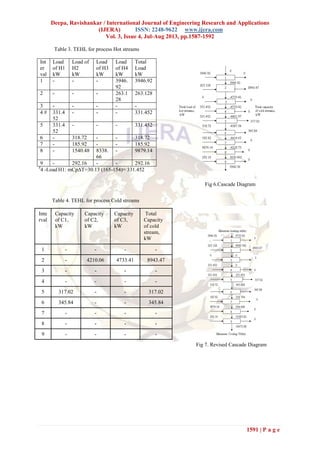
Using TID, the TEHL for process hot
streams and process cold streams were prepared as
shown in Table 3 and Table 4. A cascade diagram
was prepared by plotting total load of hot streams on
the left and total capacity of cold streams on the right
hand side and making a heat balance across each
interval. A revised cascade diagram was constructed
(since there were negative residual heat loads in the
cascade diagram) by adding the most negative
residual heat on the top of cascade diagram and
making the heat balance across each interval as
shown in Fig 7. We observed that there were no
negative residual heat loads in the revised cascade
diagram and hence there exists thermodynamic
feasibility.
Interval Hot Streams, T 0
C
191
Cold Streams, t 0
C
181 (T-∆Tmin )
1 176 H4 166
2 175 165 C2 C3
3 165 155
4 154 mcp=30.13 H1 144
5 143 133 C1
6 131 121
7 124 H2 114
8 66 H3 56
9 55 45
Deepa, Ravishankar / International Journal of Engineering Research and Applications
(IJERA) ISSN: 2248-9622 www.ijera.com
Vol. 3, Issue 4, Jul-Aug 2013, pp.1587-1592
1591 | P a g e
Table 3. TEHL for process Hot streams
Int
er
val
Load
of H1
kW
Load of
H2
kW
Load
of H3
kW
Load
of H4
kW
Total
Load
kW
1 - - - 3946.
92
3946.92
2 - - - 263.1
28
263.128
3 - - - - -
4 # 331.4
52
- - - 331.452
5 331.4
52
- - - 331.452
6 - 318.72 - - 318.72
7 - 185.92 - - 185.92
8 - 1540.48 8338.
66
- 9879.14
9 - 292.16 - - 292.16
#
4 -Load H1: mCp∆T=30.13 (165-154)= 331.452
Table 4. TEHL for process Cold streams
Inte
rval
Capacity
of C1,
kW
Capacity
of C2,
kW
Capacity
of C3,
kW
Total
Capacity
of cold
stream,
kW
1 - - - -
2 - 4210.06 4733.41 8943.47
3 - - - -
4 - - - -
5 317.02 - - 317.02
6 345.84 - - 345.84
7 - - - -
8 - - - -
9 - - - -
Fig 7. Revised Cascade Diagram
Fig 6.Cascade Diagram
Deepa, Ravishankar / International Journal of Engineering Research and Applications
(IJERA) ISSN: 2248-9622 www.ijera.com
Vol. 3, Issue 4, Jul-Aug 2013, pp.1587-1592
1592 | P a g e
Table 5. Comparison of Actual and minimum heating
utility requirement
Actual
heating
utility
requirement,
kW
Min. heating
utility requirement
(Graphical
procedure) kW
Min. heating
utility
requirement
(Algebraic
procedure) kW
6500 5000 4733.42
Table 6. Comparison of Actual and minimum cooling
utility requirement
Actual
Cooling
Utility
Requirement
kW
Min. cooling
utility
requirement
(Graphical
procedure) kW
Min. cooling
utility
requirement
(Algebraic
procedure) kW
14300 11000 10675.98
IV. CONCLUSION
By the application of Pinch analysis on
Finishing column section the minimum heating and
cooling utility requirements were found and
compared with the actual requirements which are
summarized as follows:
 The minimum cooling utility requirement for
Finishing column section from graphical and
algebraic procedure were found to be 11,000 kW
and 10,675.98 kW respectively which was
actually 14,300 kW and hence there is a
reduction in minimum cooling utility
requirement by 23%
 The minimum heating utility requirement for
Finishing column section from graphical and
algebraic procedure were found to be 5,000kW
and 4,733.42 kW respectively which was
actually 6,500 kW and hence there is a reduction
in minimum cooling utility requirement by 23%
 Pinch Analysis technique can be applied to any
section in an industry.
V. ACKNOWLEDGEMENT
We thank Mr.Ravindra, Reliance Company,
Jamnagar, Gujarath for his suggestions.
REFERENCES
[1] Towler .P. “Integrated process design for
improved energy efficiency.” Linnh off B,
DR and Wardle I (1979) Understanding
Heat Exchanger Networks, Comp Chem
Eng, 3:295
[2] Mathur.R.M. “Process Integration through
Pinch Analysis”, User Guide on Process
Integration for the Efficient Use of
Thermal Energy by Linnhoff & others,
Published by “The Institution of Chemical
Engineers, Geo. E. Davis Building, 165 –
171 Railway Terrace, Rugby, Warks,
CV21 3HQ, England”, 1982.
[3] Shenoy, U.V., Sinha, A. and Bandy
opadhyay, S. (1998) "Multiple utilities
targeting for heat exchanger networks",
Trans. IChemE. Chem. Eng. Res. Des., 76,
Part A, March, 259-272
[4] Lee, “Application of exergy and Pinch
analysis on oleochemical fractionation
process.” Linnhoff B, D.W. Townsend,
D. Boland, G.F. Hewitt, B.E.A. Thomas,
A.R.Guy, and R.H. Marsland, 1982, User
Guide on Process Integration for the
Efficient Use of Energy, IChemE, Rugby,
U.K.
[5] Smith, “Chemical Process Design and
Integration”, 8th Edition, 2006, pg 317-
437
[6] Mahmoud, “Process Integration”, Elsivier,
2006, pg 231-252

Ip3415871592

  • 1.
    Deepa, Ravishankar /International Journal of Engineering Research and Applications (IJERA) ISSN: 2248-9622 www.ijera.com Vol. 3, Issue 4, Jul-Aug 2013, pp.1587-1592 1587 | P a g e Reducing Hot and Cold Utility Requirements for Finishing Column Section Using Pinch Analysis Techniques Deepa1 , Ravishankar2 1, 2 Chemical Engineering Department, DSCE, Bangalore-78 ABSTRACT Pinch Analysis is a methodology for minimizing energy consumption of chemical plant by maximizing the utilization of hot and cold utilities available within the process, thereby reducing the use of external utilities. It is also known as process integration, heat integration, energy integration or Pinch technology. Pinch technology is applied on various process flow diagrams from chemical industries using different strategies or techniques. These techniques include both graphical procedure (Thermal Pinch diagram) as well as algebraic procedure (Temperature interval diagrams) in order to compare the minimum heating and cooling utility requirement of a process with the actual requirement. In the present work, the process flow diagram of finishing column section is received from a chemical industry and block diagram is prepared for simplification. The hot and cold streams are identified and Pinch analysis techniques are applied in order to find out the minimum heating and cooling utility requirement. With this, the utilities available within the process can be used better and thus energy can be conserved to an extent of 25%. Keywords: Graphical procedure, Heat integration, Pinch Technology, Revised cascade diagram , Temperature interval diagram. I. INTRODUCTION Chemical processes should be designed as part of a sustainable industrial activity that retains the capacity of ecosystems to support both life and industrial activity into the future. Sustainable industrial activity must meet the needs of the present, without compromising the needs of future generations. For chemical process design, this means that processes should use raw materials as efficiently as is economic and practicable, both to prevent the production of waste that can be environmentally harmful and to preserve the reserves of raw materials as much as possible. Processes should use as little energy as economic and practicable, both to prevent the build-up of carbon dioxide in the atmosphere from burning fossil fuels and to preserve the reserves of fossil fuels. [5] In a chemical process, the heating and cooling duties that cannot be satisfied by heat recovery, dictate the need for external heating and cooling utilities (furnace heating, use of steam, steam generation, cooling water, air-cooling or refrigeration). Thus, utility selection and design follows the design of the heat recovery system. Pinch Analysis is a methodology for minimizing energy consumption of chemical processes by calculating thermodynamically feasible energy targets and achieving them by optimizing heat recovery system, energy supply methods and process operating conditions It is also known as process energy integration, heat integration, energy integration or Pinch technology. 1.1 Objective In the present work the process flow diagram of Finishing column section was obtained from a chemical industry and Pinch analysis techniques were applied in order to find the minimum heating and cooling utility requirement. The main objective is to find the energy available and saved from the process. 1.2 Similar works Studies similar to present work have been done by several people among which a few are listed below. -Dr.Gavin P. Towler worked on “Integrated process design for improved energy efficiency.” The concept that the efficiency with which energy and raw materials are used within the process industries depends strongly on the way in which resources are distributed within a manufacturing site were described. Most sites or processes contain several sources or sinks of the resource. For example, a chemical plant will have heat sources (hot streams) and heat sinks (cold streams). By matching these sources and sinks in the appropriate manner we can transfer heat between the streams. Thus developed a more integrated process design which makes better use of the resources available internally, and therefore reduces the amount of external resource that is required. The techniques for integrated design of processes can be applied to a range of problems, for example, recovery of process waste heat, reduction of water usage (which reduces the consumption of heat in treating fresh water and waste water), reduction of chemicals use, etc. In all cases, the overall result is a considerable saving in energy. [1]
  • 2.
    Deepa, Ravishankar /International Journal of Engineering Research and Applications (IJERA) ISSN: 2248-9622 www.ijera.com Vol. 3, Issue 4, Jul-Aug 2013, pp.1587-1592 1588 | P a g e -R.M. Mathur, B.P. Thapliyal used Pinch analysis as a tool in pulp and paper industry for setting energy targets and optimizing the heat recovery systems. Using this methodology in a bleached Kraft mill, various successful cost effective process integration and design approaches have been adopted to maximize the heat recovery. In a typical case, all process heating and cooling duties were reviewed , hot effluents being included as potential sources of additional heat. Stream data is then extracted as hot and cold streams according to analysis procedure to derive composite and Grand composite curves for a typical pulp mill. [2] -Uday V.Shenoy worked on process integration concepts and their application to energy conservation. Heat integration Strategies such as construction of composite curves and grand composite curves for minimum energy targeting were used. The targeting methodology proposed by Shenoy etal.(1998) to determine the optimum loads for multiple utilities is based on the cheapest utility principle(CUP) ,which simply states that the temperature driving forces at the utility pinches once optimized do not change even when the minimum approach temperature at the process pinch is varied. In other words, it is optimal to increase the load of the cheapest utility and maintain the loads of the relatively expensive utilities constant while increasing the total utility consumption.[3] II. MATERIALS AND METHODS 2.1 Heat Integration Strategies Two techniques are available for the application of Pinch Technology on process flow diagrams from chemical industries. These include: 1) Graphical procedure (Thermal Pinch diagram) 2) Algebraic procedure (Temperature interval diagram) The above techniques are used to find the minimum heating and cooling utility requirement of a process. Steps involved in Graphical Procedure: • The given hot and streams must be plotted on temperature-enthalpy axes • A constant heat capacity over the operating range is assumed • Next, both the hot and cold streams are plotted together in a single temperature versus enthalpy plot which represents the Thermal Pinch diagram • The point where the two composite streams touch or very close to each other is called “Thermal Pinch point”. • The region of overlap between the two streams determines the amount of heat recovery possible • The part of the cold stream that extends beyond the start of the hot stream cannot be heated by recovery and requires steam and it is the minimum hot utility or energy target • The part of the hot stream that extends beyond the start of the cold stream cannot be cooled by heat recovery and requires cooling water and it is the minimum cold utility Steps involved in Algebraic Procedure: • The first step in algebraic approach is the construction of the Temperature interval diagram(TID) • Next, the TEHLs (Table of exchangeable heat loads) for the process hot and cold streams are to be developed • A cascade diagram is constructed • A Revised Cascade diagram is constructed whenever there exists a thermodynamic infeasibility. • The results obtained from the revised cascade diagram will be identical to those obtained using the graphical pinch approach The flow pattern of Hot and cold streams for Finishing column section is as follows. It was observed that there were four hot streams and three cold streams with the following data. Initial cooling utility requirement=14300 kW Initial heating utility requirement= 6500 kW Fig.1 Block Diagram of Finishing Column Overhead from extract column C1, 1210 C 1440 C H3 1240 C 1660 C 1660 C H1 1650 C C3, 1650 C C2, 1650 C H2, 1430 C 550 C Paraxylene to Tankage system Desorbent to Adsorbent Chambers Desorbent from Surge Drum H4 1910 C 660 C To vent Water to oily water sewer Crude Toluene to Totary unit Condenser Finishing Column Finishing Column Receiver
  • 3.
    Deepa, Ravishankar /International Journal of Engineering Research and Applications (IJERA) ISSN: 2248-9622 www.ijera.com Vol. 3, Issue 4, Jul-Aug 2013, pp.1587-1592 1589 | P a g e Table 1. Hot Stream Data Sl. No Supply Tempera ture (0 C) Target Temper ature (0 C) Heat Capacity Flow Rate, m Cp (kW/ 0 C) Heat Exchanged (kW) H1 165 143 30.132 662.91 H2 143 55 26.56 2337.63 H3 124 66 143.77 8338.71 H4 191 175 263.128 4210.06 Table 2. Cold Stream Data Sl. No Supply Temper ature (0 C) Target Tempe rature (0 C) Heat Capacity Flow Rate, m Cp (kW/ 0 C) Heat Exchanged kW C1 121 144 28.82 662.91 C2 165 166 4210.06 4210.06 C3 165 166 4733.41 4733.41 Fig 2.Representation of Hot Streams Using supply and target temperature data of hot and cold streams from Table 1 and Table 2, they were plotted on Temperature versus Enthalpy graph as shown in Fig 2 and Fig 3. Considering the overlapping of hot and cold streams composite hot stream and composite cold streams were constructed. Fig3. Representation of Cold Streams III. RESULTS AND DISCUSSION Thermal Pinch diagram was constructed by plotting composite hot and cold streams on a single temperature versus enthalpy plot using graphical procedure as shown in Fig 4. From Thermal Pinch Diagram the minimum heating utility requirement was found to be 5000 kW and minimum cooling utility requirement was found to be 11000 kW. Temperature interval diagram (TID) was constructed using Algebraic procedure as shown in Fig 5. Considering the highest and lowest temperature of hot and cold streams the TID was constructed with nine intervals. Hot stream1,H1 was plotted between interval 3 and interval 5. H2 was plotted between interval 5 and 9. H3 was plotted between 7 and 8 and H4 between interval 1 and 2 with their respective supply temperature and target temperatures as given in Table 1. Cold stream 1 was plotted between interval 5 and 6. Similarly C2 and C3 were plotted in interval 2 with the supply and target temperatures as given in Table 2.
  • 4.
    Deepa, Ravishankar /International Journal of Engineering Research and Applications (IJERA) ISSN: 2248-9622 www.ijera.com Vol. 3, Issue 4, Jul-Aug 2013, pp.1587-1592 1590 | P a g e Fig 4.Thermal Pinch Diagram Fig5. Temperature interval diagram Using TID, the TEHL for process hot streams and process cold streams were prepared as shown in Table 3 and Table 4. A cascade diagram was prepared by plotting total load of hot streams on the left and total capacity of cold streams on the right hand side and making a heat balance across each interval. A revised cascade diagram was constructed (since there were negative residual heat loads in the cascade diagram) by adding the most negative residual heat on the top of cascade diagram and making the heat balance across each interval as shown in Fig 7. We observed that there were no negative residual heat loads in the revised cascade diagram and hence there exists thermodynamic feasibility. Interval Hot Streams, T 0 C 191 Cold Streams, t 0 C 181 (T-∆Tmin ) 1 176 H4 166 2 175 165 C2 C3 3 165 155 4 154 mcp=30.13 H1 144 5 143 133 C1 6 131 121 7 124 H2 114 8 66 H3 56 9 55 45
  • 5.
    Deepa, Ravishankar /International Journal of Engineering Research and Applications (IJERA) ISSN: 2248-9622 www.ijera.com Vol. 3, Issue 4, Jul-Aug 2013, pp.1587-1592 1591 | P a g e Table 3. TEHL for process Hot streams Int er val Load of H1 kW Load of H2 kW Load of H3 kW Load of H4 kW Total Load kW 1 - - - 3946. 92 3946.92 2 - - - 263.1 28 263.128 3 - - - - - 4 # 331.4 52 - - - 331.452 5 331.4 52 - - - 331.452 6 - 318.72 - - 318.72 7 - 185.92 - - 185.92 8 - 1540.48 8338. 66 - 9879.14 9 - 292.16 - - 292.16 # 4 -Load H1: mCp∆T=30.13 (165-154)= 331.452 Table 4. TEHL for process Cold streams Inte rval Capacity of C1, kW Capacity of C2, kW Capacity of C3, kW Total Capacity of cold stream, kW 1 - - - - 2 - 4210.06 4733.41 8943.47 3 - - - - 4 - - - - 5 317.02 - - 317.02 6 345.84 - - 345.84 7 - - - - 8 - - - - 9 - - - - Fig 7. Revised Cascade Diagram Fig 6.Cascade Diagram
  • 6.
    Deepa, Ravishankar /International Journal of Engineering Research and Applications (IJERA) ISSN: 2248-9622 www.ijera.com Vol. 3, Issue 4, Jul-Aug 2013, pp.1587-1592 1592 | P a g e Table 5. Comparison of Actual and minimum heating utility requirement Actual heating utility requirement, kW Min. heating utility requirement (Graphical procedure) kW Min. heating utility requirement (Algebraic procedure) kW 6500 5000 4733.42 Table 6. Comparison of Actual and minimum cooling utility requirement Actual Cooling Utility Requirement kW Min. cooling utility requirement (Graphical procedure) kW Min. cooling utility requirement (Algebraic procedure) kW 14300 11000 10675.98 IV. CONCLUSION By the application of Pinch analysis on Finishing column section the minimum heating and cooling utility requirements were found and compared with the actual requirements which are summarized as follows:  The minimum cooling utility requirement for Finishing column section from graphical and algebraic procedure were found to be 11,000 kW and 10,675.98 kW respectively which was actually 14,300 kW and hence there is a reduction in minimum cooling utility requirement by 23%  The minimum heating utility requirement for Finishing column section from graphical and algebraic procedure were found to be 5,000kW and 4,733.42 kW respectively which was actually 6,500 kW and hence there is a reduction in minimum cooling utility requirement by 23%  Pinch Analysis technique can be applied to any section in an industry. V. ACKNOWLEDGEMENT We thank Mr.Ravindra, Reliance Company, Jamnagar, Gujarath for his suggestions. REFERENCES [1] Towler .P. “Integrated process design for improved energy efficiency.” Linnh off B, DR and Wardle I (1979) Understanding Heat Exchanger Networks, Comp Chem Eng, 3:295 [2] Mathur.R.M. “Process Integration through Pinch Analysis”, User Guide on Process Integration for the Efficient Use of Thermal Energy by Linnhoff & others, Published by “The Institution of Chemical Engineers, Geo. E. Davis Building, 165 – 171 Railway Terrace, Rugby, Warks, CV21 3HQ, England”, 1982. [3] Shenoy, U.V., Sinha, A. and Bandy opadhyay, S. (1998) "Multiple utilities targeting for heat exchanger networks", Trans. IChemE. Chem. Eng. Res. Des., 76, Part A, March, 259-272 [4] Lee, “Application of exergy and Pinch analysis on oleochemical fractionation process.” Linnhoff B, D.W. Townsend, D. Boland, G.F. Hewitt, B.E.A. Thomas, A.R.Guy, and R.H. Marsland, 1982, User Guide on Process Integration for the Efficient Use of Energy, IChemE, Rugby, U.K. [5] Smith, “Chemical Process Design and Integration”, 8th Edition, 2006, pg 317- 437 [6] Mahmoud, “Process Integration”, Elsivier, 2006, pg 231-252