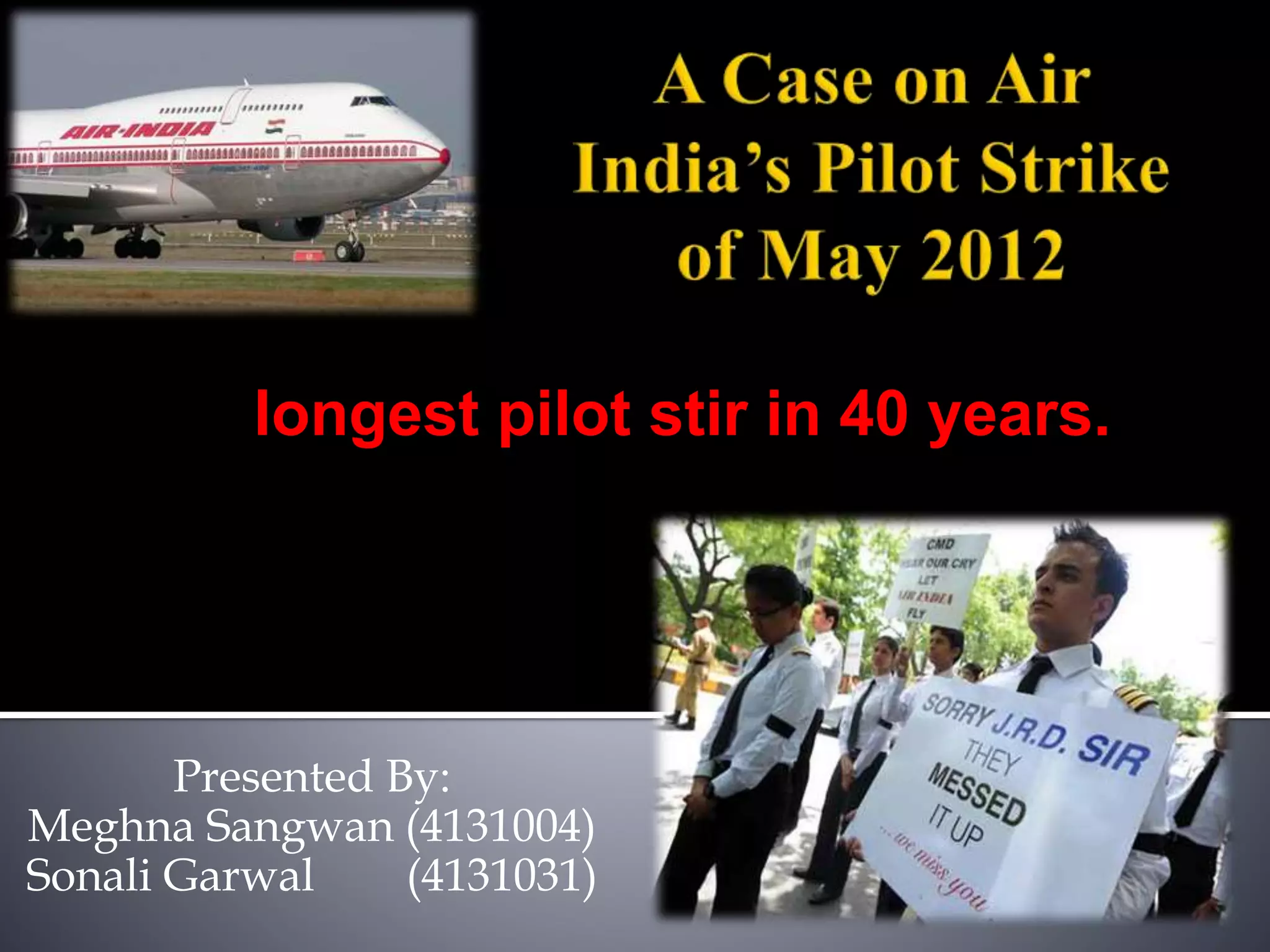
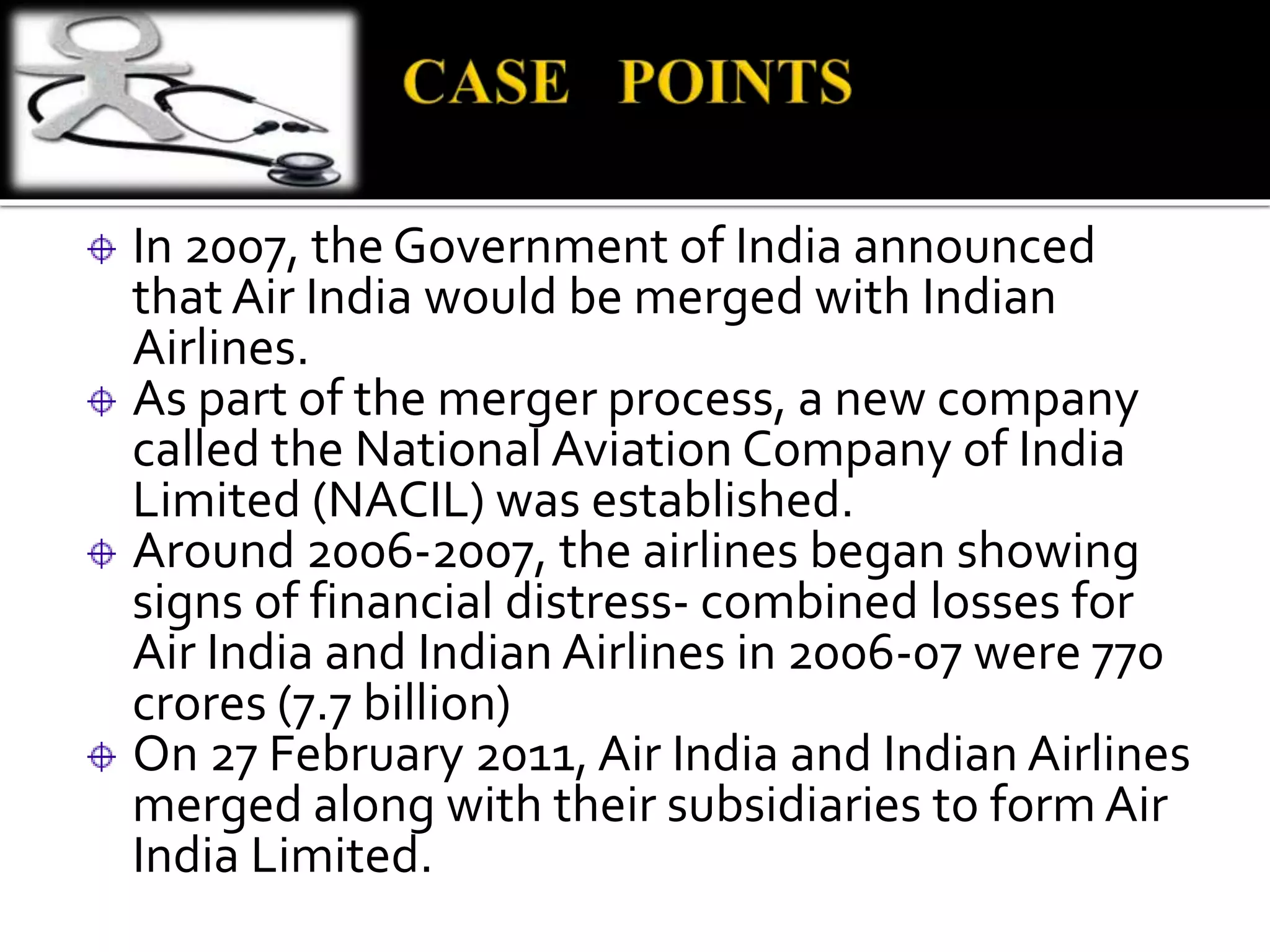

longest pilot stir in 40 years.
Presented By:
Meghna Sangwan (4131004)
Sonali Garwal (4131031)
In 2007, the Government of India announced
that Air India would be merged with Indian
Airlines.
As part of the merger process, a new company
called the National Aviation Company of India
Limited (NACIL) was established.
Around 2006-2007, the airlines began showing
signs of financial distress- combined losses for
Air India and Indian Airlines in 2006-07 were 770
crores (7.7 billion)
On 27 February 2011, Air India and Indian Airlines
merged along with their subsidiaries to form Air
India Limited.
 Better salary, promotion
and increment.
 Equality between Air
India and India Airline
Staff.
 Reappoint the pilots,
who force to resign.
 Career progression
 Integration across
various cadres
 Rationalization of pay
scale
 May 8, 2012: About 100 pilots went on medical
leave as a mark of protest while their talks with the
management were still on.
 Reason for mass sick leave: pilots were protesting
the move to provide Boeing-787 Dreamliner training
to pilots from the erstwhile Indian Airlines.
 Later, the same day Air India sacked ten agitating
pilots and de-recognized their union after 160 pilots
failed to join duty by the given deadline.
An original list of 14 demands was put and
reinstatement of their 101 sacked colleagues
was demanded by aviators.
May 15, 2012: the Union Civil Aviation Minister
Ajit Singh stated that the Government was
giving Air India one last chance and that it must
perform in order to qualify for a bailout.
May 26, 2012: Aviation Minister Ajit Singh
announced that he would go ahead and hire new
pilots if the strike didn’t end soon.
 AI management gave an assurance to
Delhi High Court that it would look into
the hardships of the pilots
sympathetically.
 July 4, 2012: 58 day old strike ended
immediately.
 Air India suffered a loss of 500 crores due
to strike in 45 days.
 Employee opinion: “The merger created problems that
cannot be solved. Our grades, work, promotions and
allowances are different. When you see your colleague from
the other cadre doing the same work, but getting easy
promotions, allowances, there is bound to be resentment,”.
 No attempts were made to standardise hiring policies for the
rank and file. Air India has a five-day week; Indian Airlines
has a six-day week.
 Indian Airlines pilots were promoted unconditionally once in
six years while Air India pilots complained they got their turn
after 10 years - if there was a vacancy.
 The ground handling teams of the two airlines continue to
operate separately.
Efforts were being made to
resolve the situation.
Appeal to the pilots that they
should think about the
passengers.
As per Rule 42 (2) of the Aircraft
Rules, 1937: Pilots who have
claimed sickness for two months
were asked to submit medical
reports. But verification of the
two-month long sickness and
related tests and reports may
catch pilots on the wrong foot
 The Delhi high court asked them to join duty within
48 hours and the management to sympathetically
consider their grievances
 "The AI management shall sympathetically consider
the grievances of the pilots including the aspect of
reinstatement of those pilots whose services were
terminated as a consequence to their strike," Justice
Khetrapal
 Why was the airline management
in such a tearing hurry to send
pilots from the erstwhile Indian
Airlines (IC) to train on the B787
aircraft?
 So what was the point in rushing
the IC pilots for B787 training
 The management should have
reached an agreement with the AI
pilots on their career progression
issues before sending the IC pilots
for training
 Successive managements have been
insensitive to issues raised by unions.
 Main reason: weak HR setup, lack of
structured policies and their
inconsistent application.
A case on air india’s pilot strike

A case on air india’s pilot strike

  • 1.
    longest pilot stirin 40 years. Presented By: Meghna Sangwan (4131004) Sonali Garwal (4131031)
  • 2.
    In 2007, theGovernment of India announced that Air India would be merged with Indian Airlines. As part of the merger process, a new company called the National Aviation Company of India Limited (NACIL) was established. Around 2006-2007, the airlines began showing signs of financial distress- combined losses for Air India and Indian Airlines in 2006-07 were 770 crores (7.7 billion) On 27 February 2011, Air India and Indian Airlines merged along with their subsidiaries to form Air India Limited.
  • 3.
     Better salary,promotion and increment.  Equality between Air India and India Airline Staff.  Reappoint the pilots, who force to resign.  Career progression  Integration across various cadres  Rationalization of pay scale
  • 4.
     May 8,2012: About 100 pilots went on medical leave as a mark of protest while their talks with the management were still on.  Reason for mass sick leave: pilots were protesting the move to provide Boeing-787 Dreamliner training to pilots from the erstwhile Indian Airlines.  Later, the same day Air India sacked ten agitating pilots and de-recognized their union after 160 pilots failed to join duty by the given deadline.
  • 5.
    An original listof 14 demands was put and reinstatement of their 101 sacked colleagues was demanded by aviators. May 15, 2012: the Union Civil Aviation Minister Ajit Singh stated that the Government was giving Air India one last chance and that it must perform in order to qualify for a bailout. May 26, 2012: Aviation Minister Ajit Singh announced that he would go ahead and hire new pilots if the strike didn’t end soon.
  • 6.
     AI managementgave an assurance to Delhi High Court that it would look into the hardships of the pilots sympathetically.  July 4, 2012: 58 day old strike ended immediately.  Air India suffered a loss of 500 crores due to strike in 45 days.
  • 7.
     Employee opinion:“The merger created problems that cannot be solved. Our grades, work, promotions and allowances are different. When you see your colleague from the other cadre doing the same work, but getting easy promotions, allowances, there is bound to be resentment,”.  No attempts were made to standardise hiring policies for the rank and file. Air India has a five-day week; Indian Airlines has a six-day week.  Indian Airlines pilots were promoted unconditionally once in six years while Air India pilots complained they got their turn after 10 years - if there was a vacancy.  The ground handling teams of the two airlines continue to operate separately.
  • 8.
    Efforts were beingmade to resolve the situation. Appeal to the pilots that they should think about the passengers. As per Rule 42 (2) of the Aircraft Rules, 1937: Pilots who have claimed sickness for two months were asked to submit medical reports. But verification of the two-month long sickness and related tests and reports may catch pilots on the wrong foot
  • 9.
     The Delhihigh court asked them to join duty within 48 hours and the management to sympathetically consider their grievances  "The AI management shall sympathetically consider the grievances of the pilots including the aspect of reinstatement of those pilots whose services were terminated as a consequence to their strike," Justice Khetrapal
  • 10.
     Why wasthe airline management in such a tearing hurry to send pilots from the erstwhile Indian Airlines (IC) to train on the B787 aircraft?  So what was the point in rushing the IC pilots for B787 training
  • 11.
     The managementshould have reached an agreement with the AI pilots on their career progression issues before sending the IC pilots for training  Successive managements have been insensitive to issues raised by unions.  Main reason: weak HR setup, lack of structured policies and their inconsistent application.