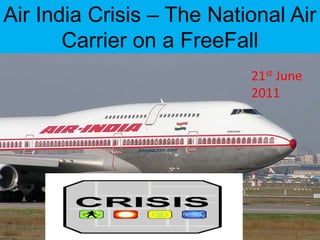
Air India Crisis – The National Air Carrier on a FreeFall21st June 2011
How it startedAir India (Hindi: एअरइंडिया) is a state-owned flag carrier, the oldest and the largest airline of India. It is a part of the Indian government-owned Air India Limited (AIL) which is renamed as Air India Ltd. The airline operates a fleet of Airbus and Boeing aircraft serving Asia, Australia, Europe and North America. Its corporate office is located at the Air India Building at Nariman Point in South Mumbai. It is the 16th largest airline in Asia. Air India has two major domestic hubs at Indira Gandhi International Airport and ChhatrapatiShivaji International Airport. An international hub at Dubai International Airport is currently being planned.
Some six decades ago in August 1953, the Indian airtransport industry was nationalised to provide safe, smooth and economic air travel to the people. It involved eight warring airlines with different work cultures, horrendous safety record, disastrous financial conditions because of cut-throat competition and inefficient management in some.Thus come into existence Indian Airlines Corp and Air India Ltd to operate domestic and international long haul services. The nationalisation was also expected to spur growth, promote economic activity, rush assistance in times of natural calamities like flood, famine and earthquake, foster national integration and, above all, serve as the second line of defence in the event of war with another country.It must be conceded that the nationalised airlines fulfilled most of the expectations of the nation, particularly at times of natural calamities and during the wars with China and Pakistan. This apart, bringing remote places of the country into the mainstream by connecting them with air service need not be told.
TimelineFounded by JRD TATA in 19321953 Indian Govt. acquired major stake1960 purchased first boeing 707 and entered jet ageRenamed to  Air India Ltd. In 1996Was set for disinvestment in 2001 but it failed due to global slowdown.In 2006  the airlines began showing signs of financial distress. Estimated loss  Rs. 770 crores ( 7.7 billion).In 2007 Air India and Indian Airlines merged along with their subsidiaries to form Air India Limited.Senseless merger of the two wings of the airline took loss figures to  Rs7,200 crores ( 72 billion) by March 2009This was followed by various restructuring plans which were not at all effective.May 2011 : Already reeling under financial crunch because of the ten day pilot strike  Air India finds itself in a tight spot  as State-run oil companies – the Indian Oil Corporation, the Bharat Petroleum Corporation Ltd. and the Hindustan Petroleum Corporation refuse to supply the fuel to the bleeding carrier.For the financial year 2010-2011  a loss of Rs 7000 crore is expected.
From a business case standpoint it should have ceased to operate a few years back had it been a private company.
Problems (part 1)Was not prepared for competition it started getting after the liberalization of India economy in 1990.
Bloated workforce. Air India has 28,000 permanent staff, double Jet's headcount. It operates 127 aircraft, compared with Jet's 115.
Highest Employees per Aircraft in the world 200:1 where as      desirable is 130-170:1.Bad management and faulty policies has brought Air India to this crisis level.
 A culture of complete sloth in administration.
 Complete lack of Ownership.
 Lake of responsibility for results and failures.
 Deeply ingrained corruption in all levels.

Case Study : Air India crashes into troubles

  • 1.
    Air India Crisis– The National Air Carrier on a FreeFall21st June 2011
  • 2.
    How it startedAirIndia (Hindi: एअरइंडिया) is a state-owned flag carrier, the oldest and the largest airline of India. It is a part of the Indian government-owned Air India Limited (AIL) which is renamed as Air India Ltd. The airline operates a fleet of Airbus and Boeing aircraft serving Asia, Australia, Europe and North America. Its corporate office is located at the Air India Building at Nariman Point in South Mumbai. It is the 16th largest airline in Asia. Air India has two major domestic hubs at Indira Gandhi International Airport and ChhatrapatiShivaji International Airport. An international hub at Dubai International Airport is currently being planned.
  • 3.
    Some six decadesago in August 1953, the Indian airtransport industry was nationalised to provide safe, smooth and economic air travel to the people. It involved eight warring airlines with different work cultures, horrendous safety record, disastrous financial conditions because of cut-throat competition and inefficient management in some.Thus come into existence Indian Airlines Corp and Air India Ltd to operate domestic and international long haul services. The nationalisation was also expected to spur growth, promote economic activity, rush assistance in times of natural calamities like flood, famine and earthquake, foster national integration and, above all, serve as the second line of defence in the event of war with another country.It must be conceded that the nationalised airlines fulfilled most of the expectations of the nation, particularly at times of natural calamities and during the wars with China and Pakistan. This apart, bringing remote places of the country into the mainstream by connecting them with air service need not be told.
  • 4.
    TimelineFounded by JRDTATA in 19321953 Indian Govt. acquired major stake1960 purchased first boeing 707 and entered jet ageRenamed to  Air India Ltd. In 1996Was set for disinvestment in 2001 but it failed due to global slowdown.In 2006  the airlines began showing signs of financial distress. Estimated loss  Rs. 770 crores ( 7.7 billion).In 2007 Air India and Indian Airlines merged along with their subsidiaries to form Air India Limited.Senseless merger of the two wings of the airline took loss figures to  Rs7,200 crores ( 72 billion) by March 2009This was followed by various restructuring plans which were not at all effective.May 2011 : Already reeling under financial crunch because of the ten day pilot strike  Air India finds itself in a tight spot  as State-run oil companies – the Indian Oil Corporation, the Bharat Petroleum Corporation Ltd. and the Hindustan Petroleum Corporation refuse to supply the fuel to the bleeding carrier.For the financial year 2010-2011 a loss of Rs 7000 crore is expected.
  • 5.
    From a businesscase standpoint it should have ceased to operate a few years back had it been a private company.
  • 6.
    Problems (part 1)Wasnot prepared for competition it started getting after the liberalization of India economy in 1990.
  • 7.
    Bloated workforce. AirIndia has 28,000 permanent staff, double Jet's headcount. It operates 127 aircraft, compared with Jet's 115.
  • 8.
    Highest Employees perAircraft in the world 200:1 where as desirable is 130-170:1.Bad management and faulty policies has brought Air India to this crisis level.
  • 9.
    A cultureof complete sloth in administration.
  • 10.
    Complete lackof Ownership.
  • 11.
    Lake ofresponsibility for results and failures.
  • 12.
    Deeply ingrainedcorruption in all levels.