A Brief
History to
Philippine Arts
Contemporary Philippine
Arts from the Regions
Contents
Arts of Different
Eras;
•* Pre – Conquest
•* Islamic Colonial Period
•* Spanish Colonial Period
•* American Colonial Period
•* Japanese Colonial Period
and the Post War Republic
•* 1970s and the Contemporary
Artworks and Forms,
Artist and Artisans,
and;
Contributions to
Philippine Industry
and Development
History of Art
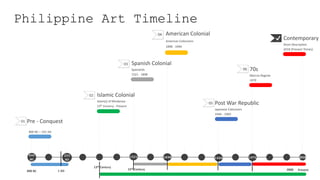
Philippine Art Timeline
890 BC
890
BC
225
AD
Pre - Conquest
890 BC – 225 AD
01
1 AD
1521
Islamic Colonial
Islam(s) of Mindanao
13th Century - Present
02
15th Century
Q1 Q4
Spanish Colonial
Spaniards
1521 - 1898
03
American Colonial
American Colonizers
1898 - 1940
04
2000
Q2
Post War Republic
Japanese Colonizers
1946 - 1969
70s
Marcos Regime
1970
06
Present
2018
13th Century
Contemporary
Short Description
2018 (Present Tiimes)
05
1898 1946 1970
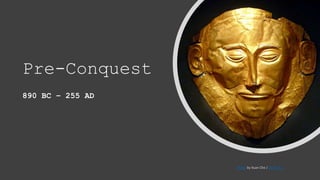
Pre-Conquest
890 BC – 255 AD
Photo CC BY 2.0
Historical
Overview
• In art historical terms, we
refer to art before the coming
of the first colonizers as
“pre-conquest.” Referred to it
as “indigenous” to emphasize
the idea that our ancestors.

• Art before is referred to as an
expression of an individual but
yet not categorized into
different kinds of forms until
the next slides conveys.
Historical
Overview
• Example of everyday
expressions are the
following:
- Rituals (planting,
harvesting, rites of passage,
funerary, ceremonies,
weddings);
- Hunting, and etc.
Historical
Overview
• A series of topics about
the following will be
tackled on:
• Rituals
• Music
• Dance
• Carving
• Pottery
• Weaving
• Body Ordamentation
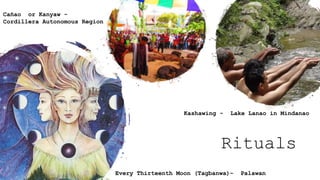
Rituals
Kashawing - Lake Lanao in Mindanao
Every Thirteenth Moon (Tagbanwa)- Palawan
Cañao or Kanyaw -
Cordillera Autonomous Region
Hunting
The pre-colonial Filipino
hunted food and game that
were shared among members
of a community in a
gathering where they told
stories about the hunt.
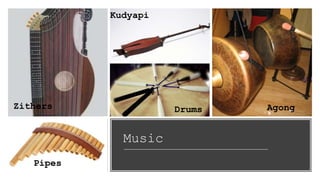
Music
Zithers
Pipes
Kudyapi
Drums Agong
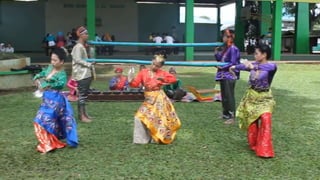
Native Dance
And Counterparts
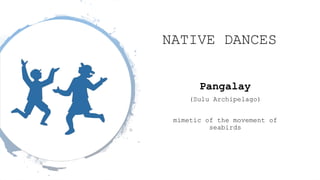
NATIVE DANCES
Pangalay
(Sulu Archipelago)
mimetic of the movement of
seabirds
NATIVE DANCES
Banog-banog
(Mandayas’kinabua of Mindanao)
movement of hawk
NATIVE DANCES
Man-manok
(Bagobos of Mindanao)
movements of predatory birds
NATIVE DANCES
Talip dance
(Ifugaos)
movements of wild fowls
NATIVE DANCES
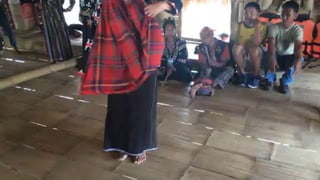
Kadaliwas dance
(T’bolis)
comedic movements of monkeys
NATIVE DANCES
Tinikling
(Tagalog folk dance)
evocative of the movements of
the crane
Carving
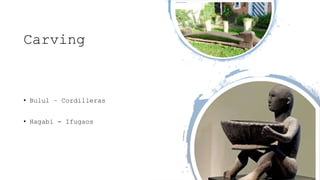
Carving
• Bulul – Cordilleras
• Hagabi - Ifugaos
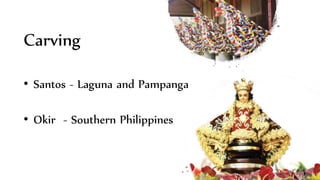
Carving
• Santos - Laguna and Pampanga
• Okir - Southern Philippines
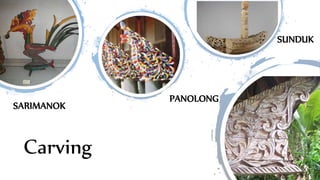
SARIMANOK
Carving
SUNDUK
PANOLONG
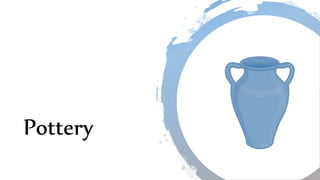
Pottery
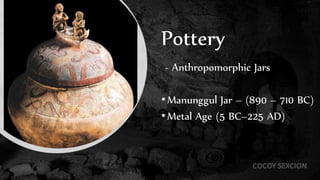
Pottery
- Anthropomorphic Jars
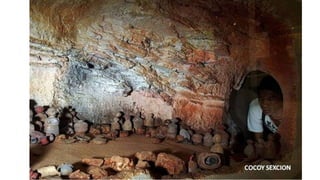
•Manunggul Jar – (890 – 710 BC)
•Metal Age (5 BC–225 AD)
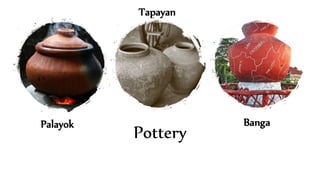
Pottery
Banga
Tapayan
Palayok
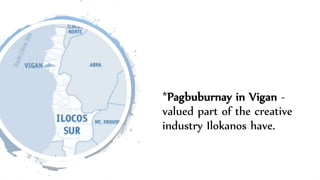
*Pagbuburnay in Vigan -
valued part of the creative
industry Ilokanos have.
Weaving
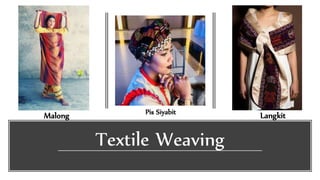
Textile Weaving
Weaving
Purpose:
- reverence for spirits and
nature
- criteria for the beautiful
- societies’sociopolitical
structures
Weaving
Made from:
fibers - cotton, abaca, and
pineapple leaves
pigments - clay, roots, and
leaves.
Textile Weaving
Pis Siyabit
Malong Langkit
Weaving
aside from body ormnaments,
weaving is also essential for
productivity of natives like baskets
and mat weaving.
Product
Weaving
Product Weaving
Head Sling Baskets Bubo Tepo Mats
Body
Ordamentation
Body
Ordamentations
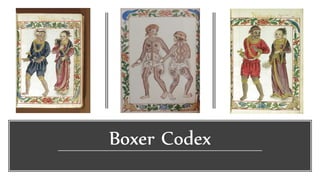
• A manuscript - Boxer Codex -
sometimes known as the Manila
Manuscript, is a manuscript written c.
1590, which contains illustrations of
ethnic groups in the Philippines at
the time of their initial contact with
the Spaniards - representations of
various ethnolinguistic groups, where
the following are classified:
Upper class Tagalog - gold jewelry
Visayans - tattoo
Boxer Codex
Body
Ordamentations
•Tattoos
•a means protection of an
individual from evil spirit
•a badge of maturity and
bravery
•Provinces like Kalinga, Kankanay,
Ibaloy, and Ifugao - practiced
tattooing
Body
Ordamentations
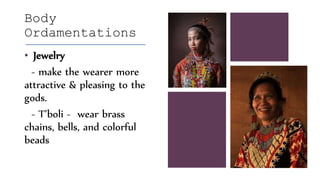
• Jewelry
- make the wearer more
attractive & pleasing to the
gods.
- T’boli - wear brass
chains, bells, and colorful
beads
Body
Ordamentations
•Metalworks like lotoans
or betel nut boxes are
made of brass or bronze
(Maranao of Lanao del Sur)
Body Ordamentations
lost wax or cire perdue
- metal casting, moulds filled with
liquefied metal, hardens
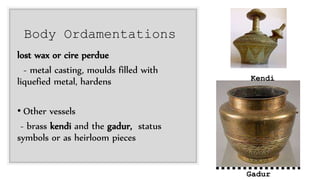
• Other vessels
- brass kendi and the gadur, status
symbols or as heirloom pieces
Gadur
Kendi
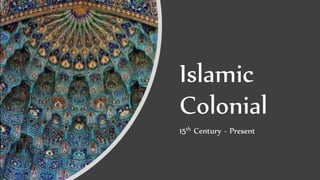
Islamic
Colonial
15th Century - Present
Historical Overview
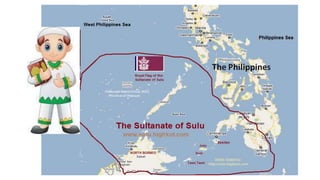
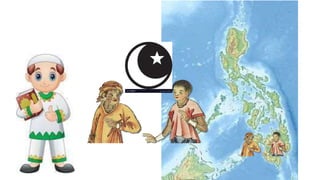
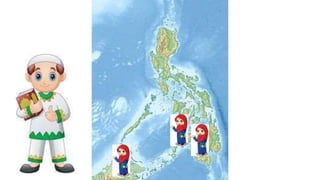
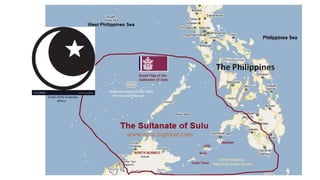
Islam, which is entrenched in
Southern Philippines is
already culturally dominant
and strong and said to have
gained significant grounding
in Sulu as early as the 13th
century
Historical Overview
•A series of topics about the
following will be tackled on:
History of Islam and Development
Islamic Influence in Arts
Art Influence of Islams in
Architechture
Story Telling
(History of Islam and Development)
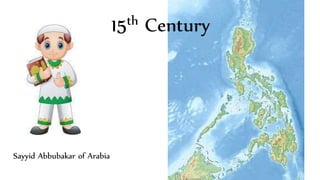
Sayyid Abbubakar of Arabia
15th Century
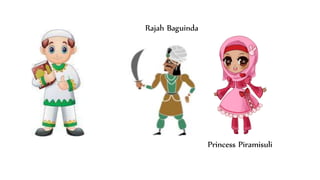
Princess Piramisuli
Rajah Baguinda
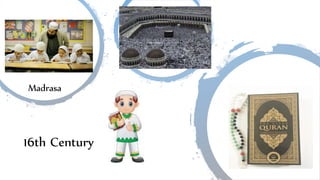
16th Century
Madrasa
Islamic
Influence in
Arts
Influence on
Arts
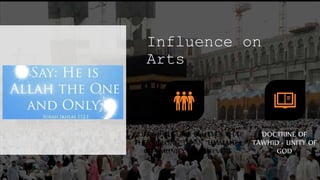
FILIPINO MUSLIMS BELIEVES THAT
THEY BELONG TO AN “UMMAH” -
COMMUNITY OF BELIEVERS
DOCTRINE OF
TAWHID - UNITY OF
GOD
Influence on Arts
• impermanence of
nature &
incomprehensible
greatness of the divine
Being.
Influence
on Arts
• Prof. Abraham Sakili, introduced
two aspects of reality:
- object perceived by the ordinary
sense
- sense of nothingness - a space or
a void empty
- Which evoke that God is above
and beyond all thing
Art Influence of
Islams in
Architechture
Architechture
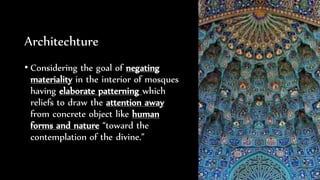
• Considering the goal of negating
materiality in the interior of mosques
having elaborate patterning which
reliefs to draw the attention away
from concrete object like human
forms and nature “toward the
contemplation of the divine.”
Architecture
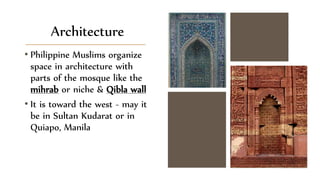
• Philippine Muslims organize
space in architecture with
parts of the mosque like the
mihrab or niche & Qibla wall
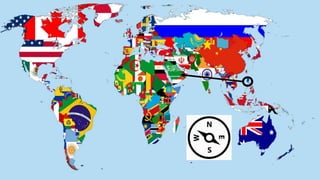
• It is toward the west - may it
be in Sultan Kudarat or in
Quiapo, Manila
Architecture
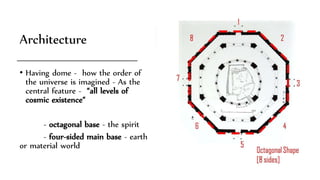
• Having dome - how the order of
the universe is imagined - As the
central feature - “all levels of
cosmic existence“
- octagonal base - the spirit
- four-sided main base - earth
or material world
Architecture
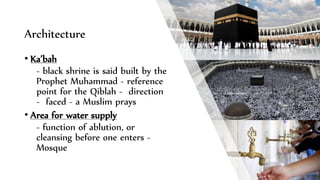
• Ka’bah
- black shrine is said built by the
Prophet Muhammad - reference
point for the Qiblah - direction
- faced - a Muslim prays
• Area for water supply
- function of ablution, or
cleansing before one enters -
Mosque
Architecture
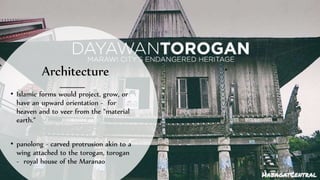
• Islamic forms would project, grow, or
have an upward orientation - for
heaven and to veer from the “material
earth.”
• panolong - carved protrusion akin to a
wing attached to the torogan, torogan
- royal house of the Maranao
Architecture
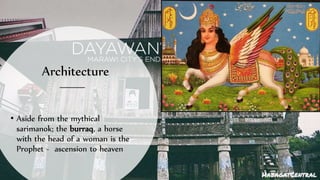
• Aside from the mythical
sarimanok; the burraq, a horse
with the head of a woman is the
Prophet - ascension to heaven

A Brief History CPAR 1.pdf