Benchmarking Methodology for  CO 2  Capture Processes using  Minimum Capture Work Targets Rahul Anantharaman , Kristin Jordal and David Berstad SINTEF Energy Research [email_address] Novi Sad, Serbia 06.07.2011
Overview Background and motivation Systematic approach to benchmarking Methodology Analysis Conclusions and further work
Benchmarking of processes Practice of comparing the performance metrics of a process to others that are considered as industry standard. Snapshot of performance of the process to understand where it is in relation to a particular standard process Commonly used performance metrics in CO 2  capture processes: Efficiency Cost
CO 2  capture processes All CO 2  capture processes require work Directly by ancillary units such as compressors, pumps etc. Indirectly by thermal energy requirements This work leads to energy penalty of CO 2  capture associated with the process Emphasis on: improving overall efficiency (or reducing energy penalty) What overall process efficiency can be achieved?
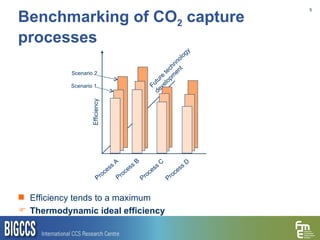
Benchmarking of CO 2  capture processes Process A Process B Process C Process D Efficiency Future technnology  development Scenario 1 Scenario 2 Efficiency tends to a maximum Thermodynamic ideal efficiency
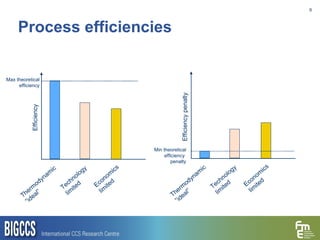
Process efficiencies Thermodynamic  ” ideal” Technology  limited Economics limited Efficiency Thermodynamic  ” ideal” Technology  limited Economics limited Efficiency penalty Max theoretical efficiency Min theoretical efficiency  penalty
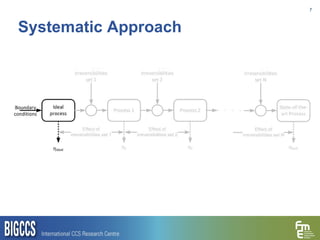
Systematic Approach
Minimum work targets Target before design – key aspect of process synthesis methodologies like Pinch Technology The methodology developed will  Provide ideal work targets (and thus efficiency penalties) for capture processes Provide benchmark for comparison Identify losses and provide recommendations where largest improvement potentials lie It is worth noting that though the thermodynamic minimum will never be achieved, it provides a  common  and  definite  basis for comparison of different processes.
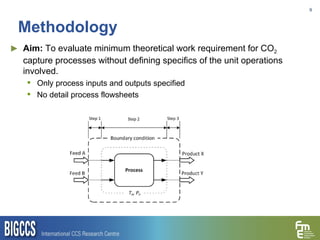
Methodology Aim:  To evaluate minimum theoretical work requirement for CO 2  capture processes without defining specifics of the unit operations involved. Only process inputs and outputs specified No detail process flowsheets
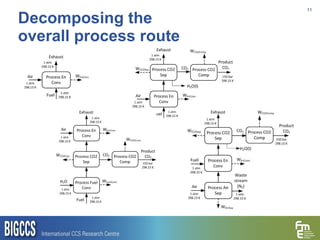
Methodology Decompose overall process route into identifiable process steps/unit operations. Calculate mass and energy balance for each step of the overall process. Calculate the entropy or exergy balance for each unit operation. Evaluate minimum energy requirement for the overall process.
Decomposing the  overall process route
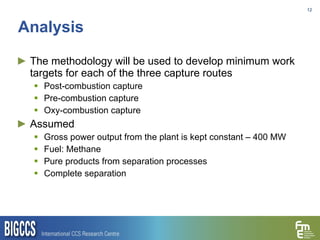
Analysis The methodology will be used to develop minimum work targets for each of the three capture routes Post-combustion capture Pre-combustion capture Oxy-combustion capture Assumed  Gross power output from the plant is kept constant – 400 MW Fuel: Methane Pure products from separation processes Complete separation
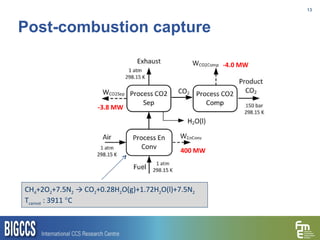
Post-combustion capture CH 4 +2O 2 +7.5N 2  -> CO 2 +0.28H 2 O(g)+1.72H 2 O(l)+7.5N 2   T carnot  : 3911  ° C 400 MW -3.8 MW -4.0 MW
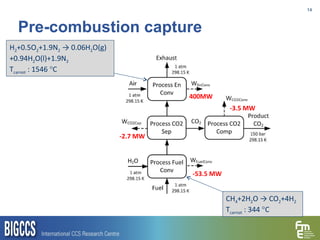
Pre-combustion capture CH 4 +2H 2 O -> CO 2 +4H 2 T carnot  : 344  ° C -53.5 MW H 2 +0.5O 2 +1.9N 2  -> 0.06H 2 O(g)+0.94H 2 O(l)+1.9N 2   T carnot  : 1546  ° C -2.7 MW -3.5 MW 400MW
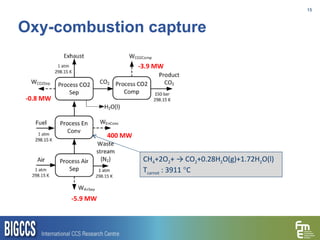
Oxy-combustion capture -5.9 MW CH 4 +2O 2 + -> CO 2 +0.28H 2 O(g)+1.72H 2 O(l)  T carnot  : 3911  ° C 400 MW -0.8 MW -3.9 MW
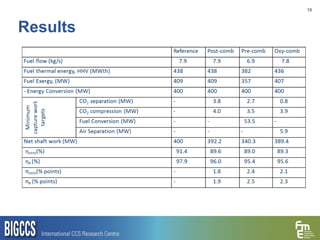
Results
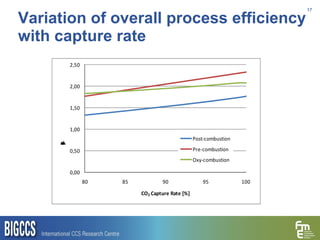
Variation of overall process efficiency with capture rate
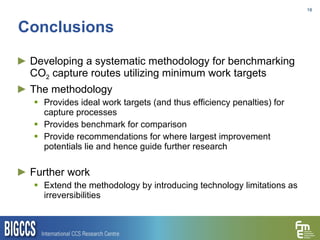
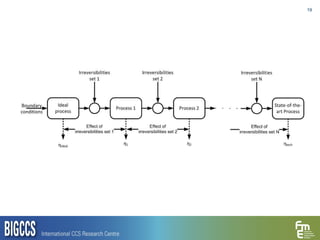
Conclusions Developing a systematic methodology for benchmarking CO 2  capture routes utilizing minimum work targets The methodology Provides ideal work targets (and thus efficiency penalties) for capture processes Provides benchmark for comparison  Provide recommendations for where largest improvement potentials lie and hence guide further research Further work Extend the methodology by introducing technology limitations as irreversibilities
Acknowledgements This publication has been produced with support from the BIGCCS Centre, performed under the Norwegian research program  Centres for Environment-friendly Energy Research (FME) . The authors acknowledge the following industrial partners for their contributions: Aker Solutions, ConocoPhilips, Det Norske Veritas, Gassco, Hydro, Shell, Statkraft, Statoil, TOTAL, GDF SUEZ and the Research Council of Norway (193816/S60).

A benchmarking methodology for CO2 capture processes

  • 1.
    Benchmarking Methodology for CO 2 Capture Processes using Minimum Capture Work Targets Rahul Anantharaman , Kristin Jordal and David Berstad SINTEF Energy Research [email_address] Novi Sad, Serbia 06.07.2011
  • 2.
    Overview Background andmotivation Systematic approach to benchmarking Methodology Analysis Conclusions and further work
  • 3.
    Benchmarking of processesPractice of comparing the performance metrics of a process to others that are considered as industry standard. Snapshot of performance of the process to understand where it is in relation to a particular standard process Commonly used performance metrics in CO 2 capture processes: Efficiency Cost
  • 4.
    CO 2 capture processes All CO 2 capture processes require work Directly by ancillary units such as compressors, pumps etc. Indirectly by thermal energy requirements This work leads to energy penalty of CO 2 capture associated with the process Emphasis on: improving overall efficiency (or reducing energy penalty) What overall process efficiency can be achieved?
  • 5.
    Benchmarking of CO2 capture processes Process A Process B Process C Process D Efficiency Future technnology development Scenario 1 Scenario 2 Efficiency tends to a maximum Thermodynamic ideal efficiency
  • 6.
    Process efficiencies Thermodynamic ” ideal” Technology limited Economics limited Efficiency Thermodynamic ” ideal” Technology limited Economics limited Efficiency penalty Max theoretical efficiency Min theoretical efficiency penalty
  • 7.
  • 8.
    Minimum work targetsTarget before design – key aspect of process synthesis methodologies like Pinch Technology The methodology developed will Provide ideal work targets (and thus efficiency penalties) for capture processes Provide benchmark for comparison Identify losses and provide recommendations where largest improvement potentials lie It is worth noting that though the thermodynamic minimum will never be achieved, it provides a common and definite basis for comparison of different processes.
  • 9.
    Methodology Aim: To evaluate minimum theoretical work requirement for CO 2 capture processes without defining specifics of the unit operations involved. Only process inputs and outputs specified No detail process flowsheets
  • 10.
    Methodology Decompose overallprocess route into identifiable process steps/unit operations. Calculate mass and energy balance for each step of the overall process. Calculate the entropy or exergy balance for each unit operation. Evaluate minimum energy requirement for the overall process.
  • 11.
    Decomposing the overall process route
  • 12.
    Analysis The methodologywill be used to develop minimum work targets for each of the three capture routes Post-combustion capture Pre-combustion capture Oxy-combustion capture Assumed Gross power output from the plant is kept constant – 400 MW Fuel: Methane Pure products from separation processes Complete separation
  • 13.
    Post-combustion capture CH4 +2O 2 +7.5N 2 -> CO 2 +0.28H 2 O(g)+1.72H 2 O(l)+7.5N 2 T carnot : 3911 ° C 400 MW -3.8 MW -4.0 MW
  • 14.
    Pre-combustion capture CH4 +2H 2 O -> CO 2 +4H 2 T carnot : 344 ° C -53.5 MW H 2 +0.5O 2 +1.9N 2 -> 0.06H 2 O(g)+0.94H 2 O(l)+1.9N 2 T carnot : 1546 ° C -2.7 MW -3.5 MW 400MW
  • 15.
    Oxy-combustion capture -5.9MW CH 4 +2O 2 + -> CO 2 +0.28H 2 O(g)+1.72H 2 O(l) T carnot : 3911 ° C 400 MW -0.8 MW -3.9 MW
  • 16.
  • 17.
    Variation of overallprocess efficiency with capture rate
  • 18.
    Conclusions Developing asystematic methodology for benchmarking CO 2 capture routes utilizing minimum work targets The methodology Provides ideal work targets (and thus efficiency penalties) for capture processes Provides benchmark for comparison Provide recommendations for where largest improvement potentials lie and hence guide further research Further work Extend the methodology by introducing technology limitations as irreversibilities
  • 20.
    Acknowledgements This publicationhas been produced with support from the BIGCCS Centre, performed under the Norwegian research program Centres for Environment-friendly Energy Research (FME) . The authors acknowledge the following industrial partners for their contributions: Aker Solutions, ConocoPhilips, Det Norske Veritas, Gassco, Hydro, Shell, Statkraft, Statoil, TOTAL, GDF SUEZ and the Research Council of Norway (193816/S60).