ICT for Govern m e nt and eGovernment Bosnia and Herzegovina Zlatan  Šabić October 9, 2008 Sarajevo
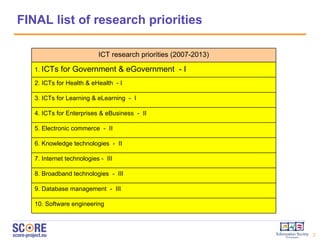
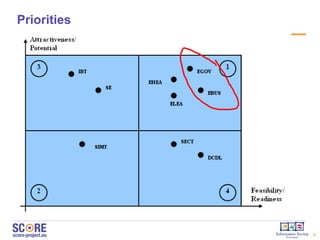
FINAL list of research priorities 6.  Knowledge technologies   -  II 4. ICTs for Enterprises & eBusiness  -  II 5. Electronic commerce  -  II 3. ICTs for Learning & eLearning  -  I 10. Software engineering 9. Database management  -  III 8.  Broadband technologies   -  III 1.  ICTs for Government & eGovernment  - I 2. ICTs for Health & eHealth  - I 7. Internet technologies -  III ICT research priorities (2007-2013)
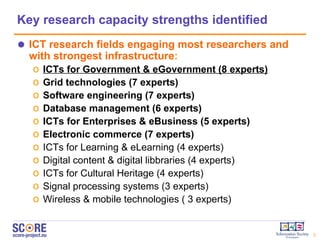
Key research capacity strengths identified ICT research fields engaging most researchers and with strongest infrastructure : ICTs for Government & eGovernment (8 experts) Grid technologies (7 experts) Software engineering (7 experts) Database management (6 experts) ICTs for Enterprises & eBusiness (5 experts) Electronic commerce (7 experts) ICTs for Learning & eLearning (4 experts) Digital content & digital libbraries (4 experts) ICTs for Cultural Heritage (4 experts) Signal processing systems (3 experts) Wireless & mobile technologies ( 3 experts)
Priorities
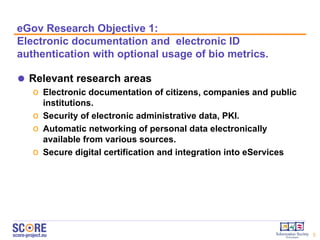
eGov  Research  O bjective  1:  E lectronic  d ocumentation and  e lectronic ID authentication with optional usage of bio metrics.  Relevant research areas  Electronic documentation of citizens, companies and public institutions. Security of electronic administrative data, PKI. Automatic networking of personal data electronically available from various sources. Secure digital certification and integration into eServices
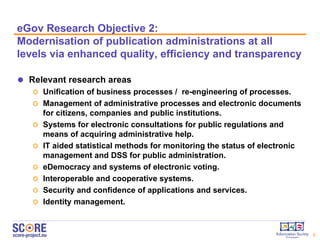
eGov  Research  O bjective  2:  Modernisation of publication administrations at all levels via enhanced quality, efficiency and transparency   Relevant research areas  Unification of business processes /  re-engineering of processes. Management of administrative processes and electronic documents for citizens, companies and public institutions. Systems for electronic consultations for public regulations and means of acquiring administrative help. IT aided statistical methods for monitoring the status of electronic management and DSS for public administration. eDemocracy and systems of electronic voting. Interoperable and cooperative systems. Security and confidence of applications and services. Identity management.
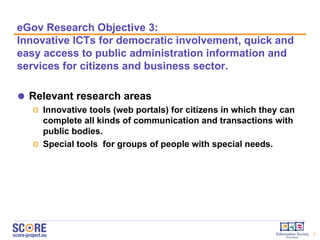
eGov  Research  O bjective  3:  Innovative ICTs for democratic involvement , quick and easy access to public administration information and services for citizens and business sector.  Relevant research areas  Innovative tools (web portals) for citizens in which they can complete all kinds of communication and transactions with public bodies. Special tools  for groups of people with special needs.
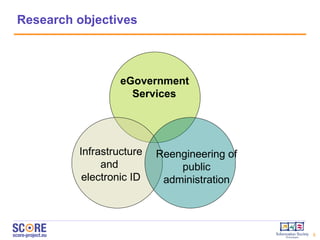
Research objectives eGovernment Services Infrastructure and  electronic ID Reengineering of public administration
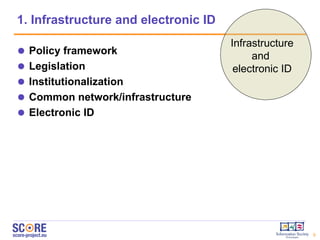
1.  Infrastructure and electronic ID Policy framework Legislation Institutionalization Common network/infrastructure Electronic ID Infrastructure and  electronic ID
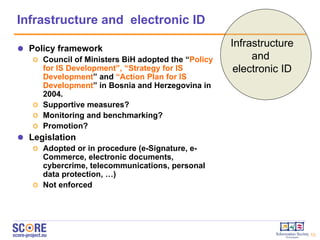
Infrastructure and  electronic ID Policy framework Council of Ministers BiH adopted the “ Policy for IS Development”, “Strategy for IS Development ” and  “Action Plan for IS Development ” in Bosnia and Herzegovina  in 2004.  Supportive measures? Monitoring and benchmarking? Promotion? Legislation Adopted or in procedure ( e-Signature, e-Commerce, electronic documents, cybercrime, telecommunications, personal data protection, …) Not enforced Infrastructure and  electronic ID
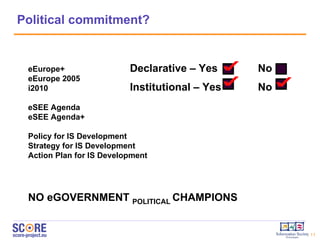
Political commitment? eEurope+  eEurope 2005 i2010 eSEE Agenda eSEE Agenda+ Policy for IS Development Strategy for IS Development Action Plan for IS Development NO eGOVERNMENT  POLITICAL  CHAMPIONS Declarative – Yes No Institutional – Yes No
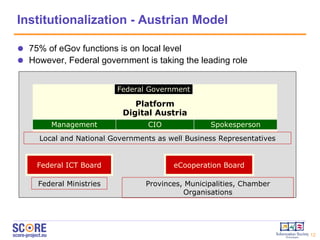
Institutionalization  - Austrian Model Platform Digital Austria Spokesperson Management CIO Local and National Governments as well Business Representatives Federal ICT Board eCooperation Board Federal  Ministries Provinces, Municipalities, Chamber Organisations Federal Government 75% of eGov functions is on local level However, Federal government is taking the leading role
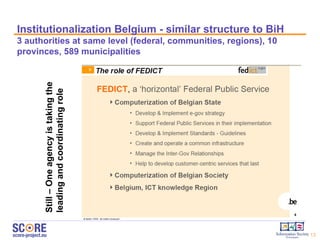
Institutionalization   Belgium - similar structure to BiH 3 authorities at same level (federal, communities, regions), 10 provinces, 589 municipalities Still – One agency is taking the leading and coordinating role
Institutionalization of eGov in BiH How to separate policy building and policy implementation? Leading Agency? Institutional options Functions … ICT Industry / Outsourcing IT Unit Agency? Agency? Agency? Governments / Ministries State IT Units Implementation and Support - - - Regulation IT Unit Directorates Coordination Community Policy Local Cantonal Entity
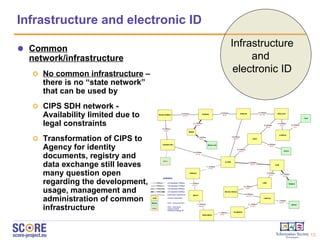
Infrastructure and electronic ID Common network/infrastructure No common infrastructure  – there is no “state network” that can be used by  CIPS SDH network - Availability limited due to legal constraints Transformation of CIPS to Agency for identity documents, registry and data exchange still leaves many question open regarding the development, usage, management and administration of common infrastructure Infrastructure and  electronic ID
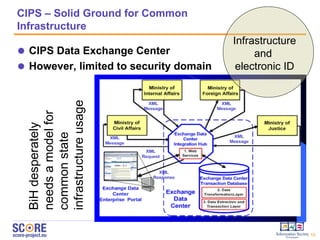
CIPS –  Solid Ground for Common  Infrastructure CIPS Data Exchange Center However, limited to security domain Infrastructure and  electronic ID BiH desperately needs a model for common state infrastructure usage
Infrastructure is not needed only on service side  HELP people to get Internet ADDRESS typical reasons to get Internet To get fast access to information To be able to e-mail or chat To do electronic banking Because it has become cheaper & easier to get internet in   house ADDRESS typical reasons to NOT get Internet I don’t need internet I cannot work with internet Internet is too expensive Computers are too expensive
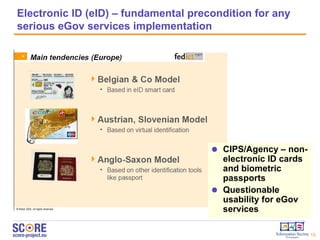
Electronic ID (eID) – fundamental precondition for any serious eGov services implementation CIPS/Agency – non-electronic ID cards and biometric passports Questionable usability for eGov services
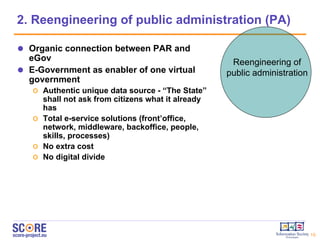
2.  Reengineering of public administration  (PA) Organic connection between PAR and eGov E-Government as enabler of one virtual government Authentic unique data source -  “The State”  shall not ask from citizens what it already has Total e-service solutions ( front’office, network, middleware, backoffice, people, skills, processes) No extra cost No digital divide Reengineering of public administration
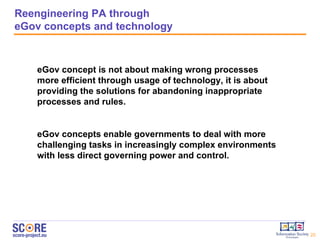
Reengineering PA through eGov concepts and technology eGov concept is not about making wrong processes more efficient through usage of technology, it is about providing the solutions for abandoning inappropriate processes and rules.  eGov concepts enable governments to deal with more challenging tasks in increasingly complex environments with less direct governing power and control.
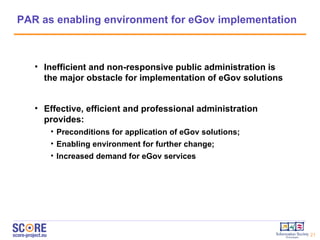
PAR as enabling environment for eGov implementation Inefficient and non-responsive public administration is the major obstacle for implementation of eGov solutions Effective, efficient and professional administration provides: Preconditions for application of eGov solutions; Enabling environment for further change;  Increased demand for eGov services
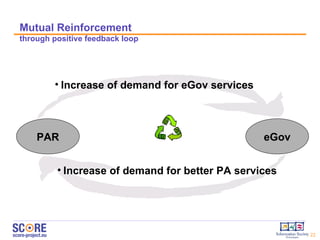
Mutual Reinforcement through positive feedback loop PAR eGov Increase of demand for eGov services Increase of demand for better PA services
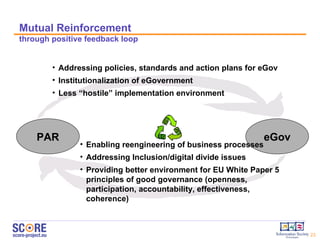
Mutual Reinforcement through positive feedback loop PAR eGov Addressing policies, standards and action plans for eGov Institutionalization of eGovernment Less “hostile” implementation environment Enabling reengineering of business processes Addressing Inclusion/digital divide issues Providing better environment for EU White Paper 5 principles of good governance (openness, participation, accountability, effectiveness, coherence)
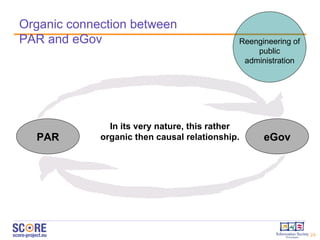
In its very nature, this rather organic then causal relationship. PAR eGov Organic connection between PAR and eGov Reengineering of public administration
E-Government as enabler of one virtual government PRINCIPLES Authentic unique data source -  “The State”  shall not ask from citizens what it already has Total e-service solutions ( front’office, network, middleware, backoffice, people, skills, processes) No extra cost No digital divide Reengineering of public administration
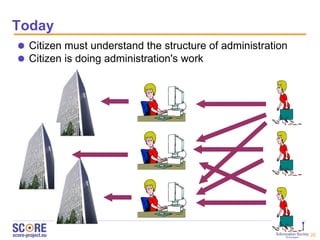
Today Citizen must understand the structure of administration Citizen is doing administration's work
Example A child was born  The municipality has the electronic information on that event (provided by hospital) – GREAT!  BUT!  The parent comes to municipality Municipality gives to him/her a birth certificate without ID The parent goes to CIPS ( must understand how and where administration works ) The CIPS provides him/her the ID for newborn child The parent brings the ID to municipality ( the citizen is doing the administration’s work – data exchange ) Finally – newborn child gets birth certificate with ID Even though both systems (in municipality and CIPS) are computerized, the procedure is manual, and forms and documents are on paper
Many other examples To get a service from PA, the citizen must provide certain number of documents The documents are provided by PA Citizen plays the role of “communication channel” Why is PA not asking for documents from PA?  Because it is not the “same” PA  Workload …
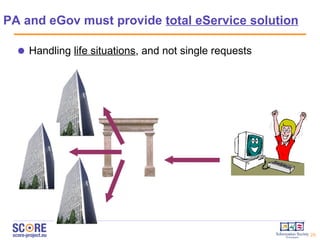
PA and eGov must provide  total eService solution Handling  life situations , and not single requests
3. eGovernment Services – Key principles eGovernment Services One-stop shop Life situations instead of requests for services One portal for citizens, all information and forms available  24/7 service delivery Proactive services Service provider starts the procedure Fill in forms in advance Grants allocated proactively Within privacy limits Interoperability
Interoperability Interoperability in ICT:  Capability of information systems and business processes, supported by IT systems, to share  data, information and knowledge Interoperabil ity framework  comprises a set of standards and guidelines which are needed to ensure interconnection between IT systems Within interoperability framework one can differentiate  between three levels of interoperability : Te c hni cal Semanti cal Organiz ational
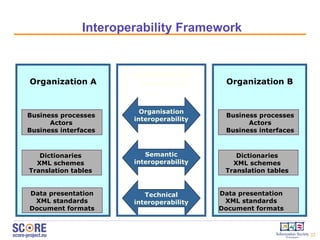
Interoperability Framework Organization A Organization B Business processes Actors Business interfaces Dictionaries XML schemes Translation tables Data presentation XML standards Document formats Business processes Actors Business interfaces Dictionaries XML schemes Translation tables Data presentation XML standards Document formats Organisation interoperability Semantic interoperability Technical interoperability Interoperability  framework
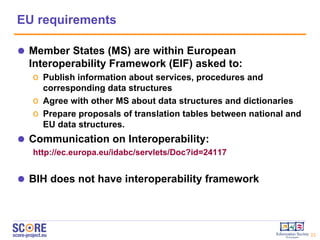
EU requirements Member States (MS) are within European Interoperability Framework (EIF) asked to: Publish information about services, procedures and corresponding data structures Agree with other MS about data structures and dictionaries Prepare proposals of translation tables between national and EU data structures. Communication on Interoperability: http://ec.europa.eu/idabc/servlets/Doc?id=24117 BIH does not have interoperability framework
BH best practices Even though there is no: Political leadership Leading agency Common infrastructure Reformed public administration One-stop services Interoperability framework … There are still cases of good practices, just to mention:  CIPS “ Single window” – Indirect Taxation Authority of BiH eGovernment program of Council of Ministers of BiH Human resources MIS – Agency for Civil Services BiH …
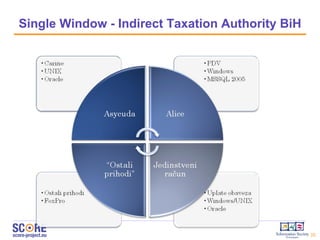
Single Window - Indirect Taxation Authority BiH
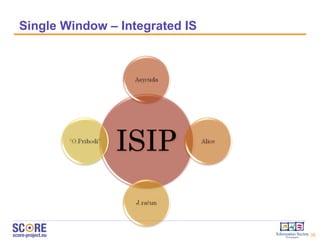
Single Window – Integrated IS
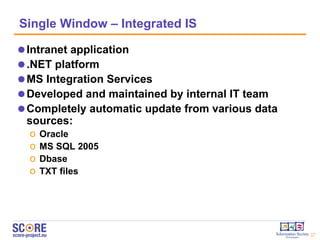
Single Window – Integrated IS Intranet  application .NET platform MS Integration Services Developed and maintained by internal IT team Completely automatic update from various data sources: Oracle MS SQL 2005 Dbase TXT f iles
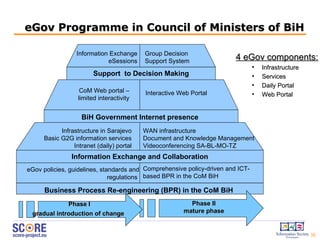
eGov  Programme in  C ouncil of Ministers of BiH Business Process Re-engineering (BPR) in the CoM BiH   eGov policies, guidelines, standards and regulations  Comprehensive policy-driven and ICT-based BPR in the CoM BiH  Information Exchange and Collaboration Infrastructure in Sarajevo Basic G2G information   services Intranet (daily) portal WAN infrastructure Document and  Knowledge Management Videoconferencing SA-BL -MO-TZ Support  to Decision Making Information Exchange eSessions Group Decision Support System Phase I gradual introduction of change   4 eGov  components : Infrastructure Services Daily Portal We b  Portal BiH Government Internet presence   CoM Web portal – limited interactivity Interactive Web Portal Phase II mature phase
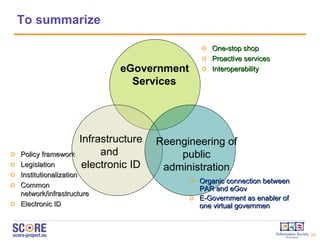
To summarize eGovernment Services Infrastructure and  electronic ID Reengineering of public administration Policy framework Legislation Institutionalization Common network/infrastructure Electronic ID Organic connection between PAR and eGov E-Government as enabler of one virtual governmen One-stop shop Proactive services Interoperability
ICT for Governance Bosnia and Herzegovina Zlatan  Šabić October 9, 2008 Sarajevo

Zlatan Sabic ICT for Governance

  • 1.
    ICT for Governm e nt and eGovernment Bosnia and Herzegovina Zlatan Šabić October 9, 2008 Sarajevo
  • 2.
    FINAL list ofresearch priorities 6. Knowledge technologies - II 4. ICTs for Enterprises & eBusiness - II 5. Electronic commerce - II 3. ICTs for Learning & eLearning - I 10. Software engineering 9. Database management - III 8. Broadband technologies - III 1. ICTs for Government & eGovernment - I 2. ICTs for Health & eHealth - I 7. Internet technologies - III ICT research priorities (2007-2013)
  • 3.
    Key research capacitystrengths identified ICT research fields engaging most researchers and with strongest infrastructure : ICTs for Government & eGovernment (8 experts) Grid technologies (7 experts) Software engineering (7 experts) Database management (6 experts) ICTs for Enterprises & eBusiness (5 experts) Electronic commerce (7 experts) ICTs for Learning & eLearning (4 experts) Digital content & digital libbraries (4 experts) ICTs for Cultural Heritage (4 experts) Signal processing systems (3 experts) Wireless & mobile technologies ( 3 experts)
  • 4.
  • 5.
    eGov Research O bjective 1: E lectronic d ocumentation and e lectronic ID authentication with optional usage of bio metrics. Relevant research areas Electronic documentation of citizens, companies and public institutions. Security of electronic administrative data, PKI. Automatic networking of personal data electronically available from various sources. Secure digital certification and integration into eServices
  • 6.
    eGov Research O bjective 2: Modernisation of publication administrations at all levels via enhanced quality, efficiency and transparency Relevant research areas Unification of business processes / re-engineering of processes. Management of administrative processes and electronic documents for citizens, companies and public institutions. Systems for electronic consultations for public regulations and means of acquiring administrative help. IT aided statistical methods for monitoring the status of electronic management and DSS for public administration. eDemocracy and systems of electronic voting. Interoperable and cooperative systems. Security and confidence of applications and services. Identity management.
  • 7.
    eGov Research O bjective 3: Innovative ICTs for democratic involvement , quick and easy access to public administration information and services for citizens and business sector. Relevant research areas Innovative tools (web portals) for citizens in which they can complete all kinds of communication and transactions with public bodies. Special tools for groups of people with special needs.
  • 8.
    Research objectives eGovernmentServices Infrastructure and electronic ID Reengineering of public administration
  • 9.
    1. Infrastructureand electronic ID Policy framework Legislation Institutionalization Common network/infrastructure Electronic ID Infrastructure and electronic ID
  • 10.
    Infrastructure and electronic ID Policy framework Council of Ministers BiH adopted the “ Policy for IS Development”, “Strategy for IS Development ” and “Action Plan for IS Development ” in Bosnia and Herzegovina in 2004. Supportive measures? Monitoring and benchmarking? Promotion? Legislation Adopted or in procedure ( e-Signature, e-Commerce, electronic documents, cybercrime, telecommunications, personal data protection, …) Not enforced Infrastructure and electronic ID
  • 11.
    Political commitment? eEurope+ eEurope 2005 i2010 eSEE Agenda eSEE Agenda+ Policy for IS Development Strategy for IS Development Action Plan for IS Development NO eGOVERNMENT POLITICAL CHAMPIONS Declarative – Yes No Institutional – Yes No
  • 12.
    Institutionalization -Austrian Model Platform Digital Austria Spokesperson Management CIO Local and National Governments as well Business Representatives Federal ICT Board eCooperation Board Federal Ministries Provinces, Municipalities, Chamber Organisations Federal Government 75% of eGov functions is on local level However, Federal government is taking the leading role
  • 13.
    Institutionalization Belgium - similar structure to BiH 3 authorities at same level (federal, communities, regions), 10 provinces, 589 municipalities Still – One agency is taking the leading and coordinating role
  • 14.
    Institutionalization of eGovin BiH How to separate policy building and policy implementation? Leading Agency? Institutional options Functions … ICT Industry / Outsourcing IT Unit Agency? Agency? Agency? Governments / Ministries State IT Units Implementation and Support - - - Regulation IT Unit Directorates Coordination Community Policy Local Cantonal Entity
  • 15.
    Infrastructure and electronicID Common network/infrastructure No common infrastructure – there is no “state network” that can be used by CIPS SDH network - Availability limited due to legal constraints Transformation of CIPS to Agency for identity documents, registry and data exchange still leaves many question open regarding the development, usage, management and administration of common infrastructure Infrastructure and electronic ID
  • 16.
    CIPS – Solid Ground for Common Infrastructure CIPS Data Exchange Center However, limited to security domain Infrastructure and electronic ID BiH desperately needs a model for common state infrastructure usage
  • 17.
    Infrastructure is notneeded only on service side HELP people to get Internet ADDRESS typical reasons to get Internet To get fast access to information To be able to e-mail or chat To do electronic banking Because it has become cheaper & easier to get internet in house ADDRESS typical reasons to NOT get Internet I don’t need internet I cannot work with internet Internet is too expensive Computers are too expensive
  • 18.
    Electronic ID (eID)– fundamental precondition for any serious eGov services implementation CIPS/Agency – non-electronic ID cards and biometric passports Questionable usability for eGov services
  • 19.
    2. Reengineeringof public administration (PA) Organic connection between PAR and eGov E-Government as enabler of one virtual government Authentic unique data source - “The State” shall not ask from citizens what it already has Total e-service solutions ( front’office, network, middleware, backoffice, people, skills, processes) No extra cost No digital divide Reengineering of public administration
  • 20.
    Reengineering PA througheGov concepts and technology eGov concept is not about making wrong processes more efficient through usage of technology, it is about providing the solutions for abandoning inappropriate processes and rules. eGov concepts enable governments to deal with more challenging tasks in increasingly complex environments with less direct governing power and control.
  • 21.
    PAR as enablingenvironment for eGov implementation Inefficient and non-responsive public administration is the major obstacle for implementation of eGov solutions Effective, efficient and professional administration provides: Preconditions for application of eGov solutions; Enabling environment for further change; Increased demand for eGov services
  • 22.
    Mutual Reinforcement throughpositive feedback loop PAR eGov Increase of demand for eGov services Increase of demand for better PA services
  • 23.
    Mutual Reinforcement throughpositive feedback loop PAR eGov Addressing policies, standards and action plans for eGov Institutionalization of eGovernment Less “hostile” implementation environment Enabling reengineering of business processes Addressing Inclusion/digital divide issues Providing better environment for EU White Paper 5 principles of good governance (openness, participation, accountability, effectiveness, coherence)
  • 24.
    In its verynature, this rather organic then causal relationship. PAR eGov Organic connection between PAR and eGov Reengineering of public administration
  • 25.
    E-Government as enablerof one virtual government PRINCIPLES Authentic unique data source - “The State” shall not ask from citizens what it already has Total e-service solutions ( front’office, network, middleware, backoffice, people, skills, processes) No extra cost No digital divide Reengineering of public administration
  • 26.
    Today Citizen mustunderstand the structure of administration Citizen is doing administration's work
  • 27.
    Example A childwas born The municipality has the electronic information on that event (provided by hospital) – GREAT! BUT! The parent comes to municipality Municipality gives to him/her a birth certificate without ID The parent goes to CIPS ( must understand how and where administration works ) The CIPS provides him/her the ID for newborn child The parent brings the ID to municipality ( the citizen is doing the administration’s work – data exchange ) Finally – newborn child gets birth certificate with ID Even though both systems (in municipality and CIPS) are computerized, the procedure is manual, and forms and documents are on paper
  • 28.
    Many other examplesTo get a service from PA, the citizen must provide certain number of documents The documents are provided by PA Citizen plays the role of “communication channel” Why is PA not asking for documents from PA? Because it is not the “same” PA Workload …
  • 29.
    PA and eGovmust provide total eService solution Handling life situations , and not single requests
  • 30.
    3. eGovernment Services– Key principles eGovernment Services One-stop shop Life situations instead of requests for services One portal for citizens, all information and forms available 24/7 service delivery Proactive services Service provider starts the procedure Fill in forms in advance Grants allocated proactively Within privacy limits Interoperability
  • 31.
    Interoperability Interoperability inICT: Capability of information systems and business processes, supported by IT systems, to share data, information and knowledge Interoperabil ity framework comprises a set of standards and guidelines which are needed to ensure interconnection between IT systems Within interoperability framework one can differentiate between three levels of interoperability : Te c hni cal Semanti cal Organiz ational
  • 32.
    Interoperability Framework OrganizationA Organization B Business processes Actors Business interfaces Dictionaries XML schemes Translation tables Data presentation XML standards Document formats Business processes Actors Business interfaces Dictionaries XML schemes Translation tables Data presentation XML standards Document formats Organisation interoperability Semantic interoperability Technical interoperability Interoperability framework
  • 33.
    EU requirements MemberStates (MS) are within European Interoperability Framework (EIF) asked to: Publish information about services, procedures and corresponding data structures Agree with other MS about data structures and dictionaries Prepare proposals of translation tables between national and EU data structures. Communication on Interoperability: http://ec.europa.eu/idabc/servlets/Doc?id=24117 BIH does not have interoperability framework
  • 34.
    BH best practicesEven though there is no: Political leadership Leading agency Common infrastructure Reformed public administration One-stop services Interoperability framework … There are still cases of good practices, just to mention: CIPS “ Single window” – Indirect Taxation Authority of BiH eGovernment program of Council of Ministers of BiH Human resources MIS – Agency for Civil Services BiH …
  • 35.
    Single Window -Indirect Taxation Authority BiH
  • 36.
    Single Window –Integrated IS
  • 37.
    Single Window –Integrated IS Intranet application .NET platform MS Integration Services Developed and maintained by internal IT team Completely automatic update from various data sources: Oracle MS SQL 2005 Dbase TXT f iles
  • 38.
    eGov Programmein C ouncil of Ministers of BiH Business Process Re-engineering (BPR) in the CoM BiH eGov policies, guidelines, standards and regulations Comprehensive policy-driven and ICT-based BPR in the CoM BiH Information Exchange and Collaboration Infrastructure in Sarajevo Basic G2G information services Intranet (daily) portal WAN infrastructure Document and Knowledge Management Videoconferencing SA-BL -MO-TZ Support to Decision Making Information Exchange eSessions Group Decision Support System Phase I gradual introduction of change 4 eGov components : Infrastructure Services Daily Portal We b Portal BiH Government Internet presence CoM Web portal – limited interactivity Interactive Web Portal Phase II mature phase
  • 39.
    To summarize eGovernmentServices Infrastructure and electronic ID Reengineering of public administration Policy framework Legislation Institutionalization Common network/infrastructure Electronic ID Organic connection between PAR and eGov E-Government as enabler of one virtual governmen One-stop shop Proactive services Interoperability
  • 40.
    ICT for GovernanceBosnia and Herzegovina Zlatan Šabić October 9, 2008 Sarajevo